
Abstract
The correlation between shapes, perimeter, and area is crucial in the study of shapes, polygons, and optimization. Historically, its importance can be observed in the classical Isoperimetric Problem, which inquired the maximum area of a shape with a fixed perimeter and was later proven and demonstrated using the isoperimetric inequality, and the tale of Queen Dido, which involves her clever method of maximizing the amount of land with a minimal boundary. In addition, it can provide a deeper conceptual understanding and mathematical knowledge. Although the isoperimetric inequality provides a deep conceptual understanding of shapes and optimization, to further the enrichment of mathematical knowledge and conceptual understanding, this study focuses on the optimization of polygons. This study aims to determine whether there can or cannot exist a polygon, amongst every polygon with the same perimeter, which has the largest area. Through this, it was concluded that there cannot exist such a polygon with a fixed perimeter that had the largest possible area. Instead, it was also concluded that as the area of polygons with the same perimeter approached its upper bound, it approached the shape of a circle with the same perimeter.
Keywords: Convex, Polygon, Convex Hull, Fixed Perimeter, Scaling, Equilateral, Equiangular, Largest Area, Polygons with a Set Perimeter, Base Polygons,  -sided, Derivative
Introduction
The relationship between the area and the perimeter of a polygon is one of the most important concepts in the study of polygons. Its analysis is not only important in mathematics, but it is also historically important, as observed in the classical Isoperimetric Problem1, which considers how to maximize the area of a shape with a fixed perimeter. The tale of Queen Dido is an early example of this applied practically, as she found a clever way to maximize the amount of land with a minimal boundary2. Mathematical knowledge is also of great importance in this topic as students can learn valuable insights. For instance, Heron’s formula, the formula for the area of triangles based on the length of its sides, is an alternative of the formula which utilizes the altitude and the length of its base to find the area, offering the students a deeper, conceptual understanding of mathematics3. By asking students to research the effect of perimeter manipulation (or diameter manipulation) on the properties of different polygons (i.e., triangles, quadrilaterals, and pentagons), one not only adds richness to mathematical reasoning, but also will help students think more about problem-solving and build a stronger base in geometry3. The isoperimetric inequality states that  , where
  and
and  denote the area and perimeter of a shape, respectively, in which equality holds if and only if the shape is a circle4. This implies that, of all the shapes with the same perimeter, the one which has the shape of a circle has the largest area. Despite the isoperimetric inequality truly providing a great understanding of shapes and optimization, to aid in the enrichment of mathematical knowledge, the aim of this study is to focus on polygons and to determine whether or not there existed the polygon with a fixed perimeter that has the maximum area.
The Conjecture
This study aims to prove whether or not there exists a polygon with the largest area amongst every polygon which has the same perimeter. In order for this to be done, the conjecture below must be either proven true or false:
Conjecture 0.0 Suppose there exists a set of every polygon with the same perimeter. Within this set, there exists a polygon with the largest area.
The remainder of this study demonstrates that Conjecture~0.0 is incorrect by first assuming the existence of a polygon which has the largest area within this set and then proving that it cannot actually exist.
The Definitions
Throughout this study, there are many terms that must be defined.
-sided
This is defined as having sides, where represents a positive integer.
Equivalence Classes under Similarity
The set of all shapes which have the same shape, regardless of their size, position, or orientation. Hence, the set of shapes that are all similar to one another5.
Convex Polygon
This is defined as a polygon whose interior angles are all smaller than  6.
6.
Convex Hull
The smallest convex set that entirely contains a given set of points or a shape7.
Polygons with a Set Perimeter
This is defined as a set of all polygons with the same perimeter.
The Largest Polygon with a Set Perimeter
This is defined as the polygon with a set perimeter that has the largest area.
Base Polygon
This is defined as a polygon with a perimeter of 1.
The Largest Base Polygon
This is defined as the base polygon with the largest area.
The Proof
Scaling Polygons and Base Polygons
When finding the largest polygon with a set perimeter, the perimeter is a major factor that must be considered. However, it is possible to find the largest polygon with a set perimeter through the scaling of base polygons. Every base polygon can be scaled to match every corresponding similar polygon with a set perimeter.
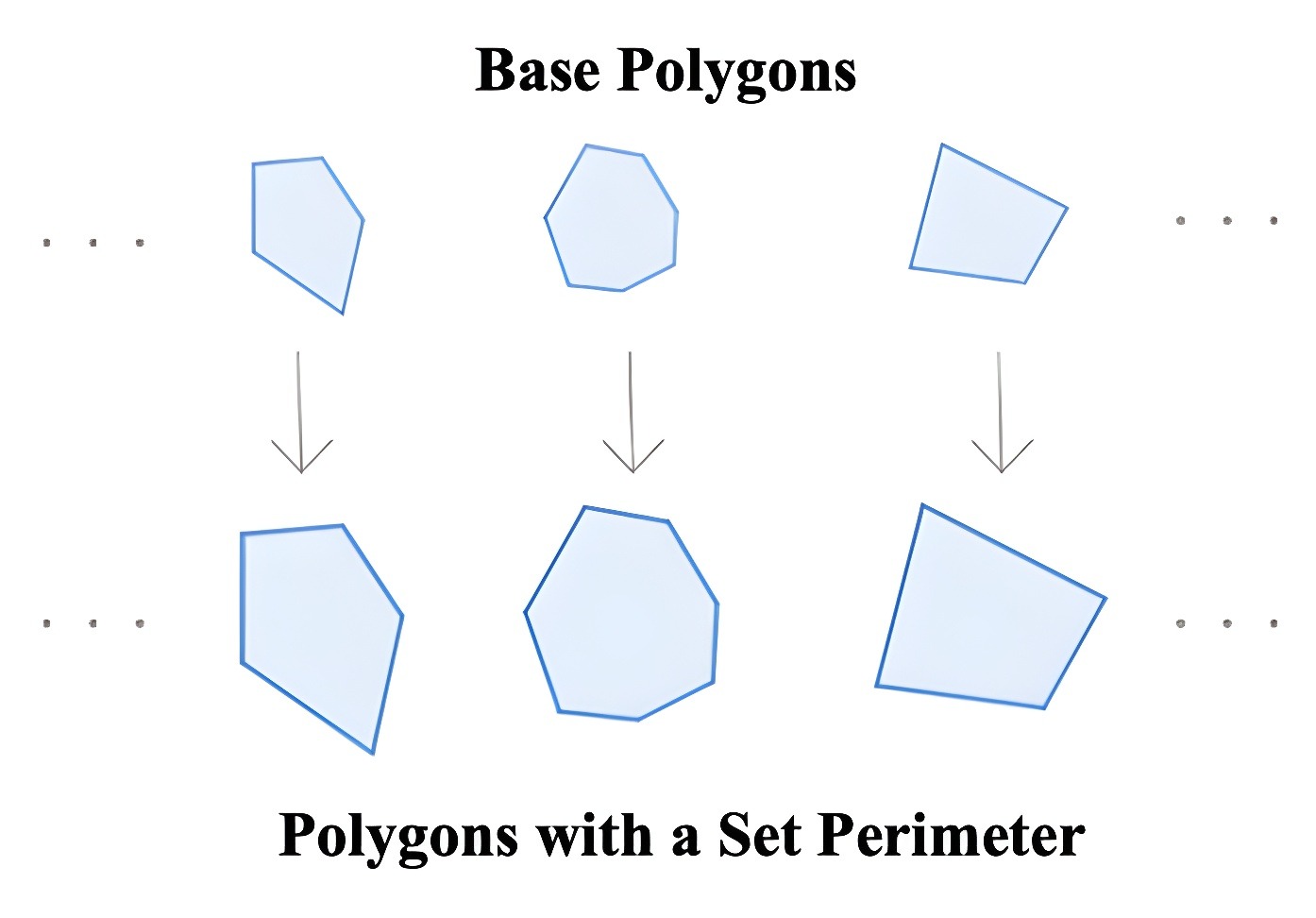
Suppose there exists a -sided convex polygon, denoted polygon  , and an
  -sided convex polygon, denoted polygon
  , where
  and
and  .
.
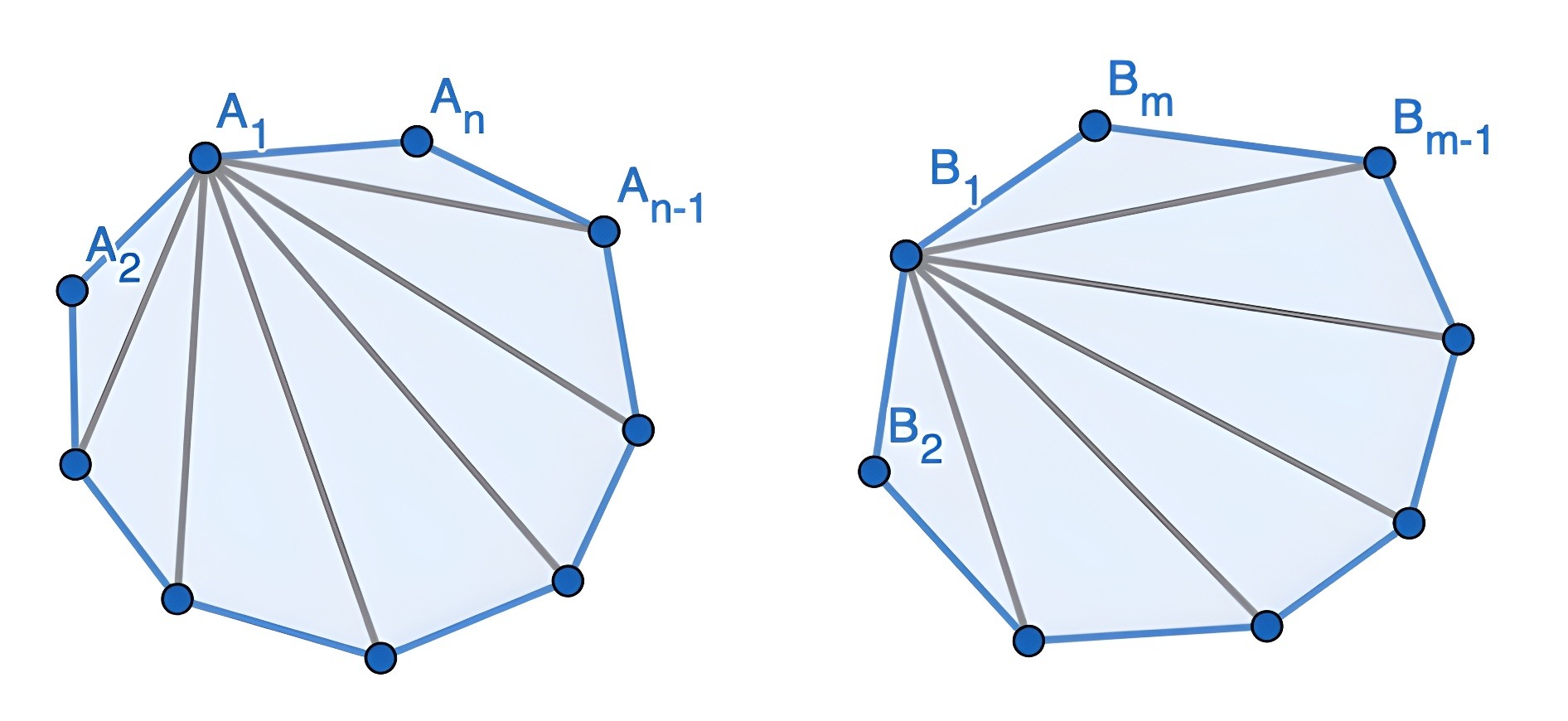 and polygon , where points
  , and
, and  are labeled and the diagonals from points
  and
and  to other points within polygon and polygon are illustrated, respectively.
Let and  denote the area of polygon and polygon , respectively. Additionally, let the perimeter of both polygons be 1. In addition, suppose is larger than . Using the sine rule for area8, the equations of and are shown below:
![\[A = \sum_{k=2}^{n-1} \frac{1}{2}(A_1A_k)(A_1A_{k+1})\sin\angle A_k A_1 A_{k+1}\]](https://nhsjs.com/wp-content/ql-cache/quicklatex.com-6cd378e2dfe9c2d1faff94850c6bf593_l3.png "Rendered by QuickLaTeX.com")
![\[B = \sum_{k=2}^{m-1} \frac{1}{2}(B_1B_k)(B_1B_{k+1})\sin\angle B_k B_1 B_{k+1}\]](https://nhsjs.com/wp-content/ql-cache/quicklatex.com-ce3be882cdb15e04ae34fcdd1c9d7301_l3.png "Rendered by QuickLaTeX.com")
Suppose there exists an -sided convex polygon, denoted polygon  , which is an element of the equivalence class under similarity which includes polygon and has a perimeter of
  , where
  . In addition, let the length of
  be times the length of
  , for unequal arbitrary integers
  and
and  which are greater than 0 and less than
  . As polygon is similar to polygon ,
  must be equal to
  , for unequal arbitrary integers , , and
  which are greater than 0 and less than .
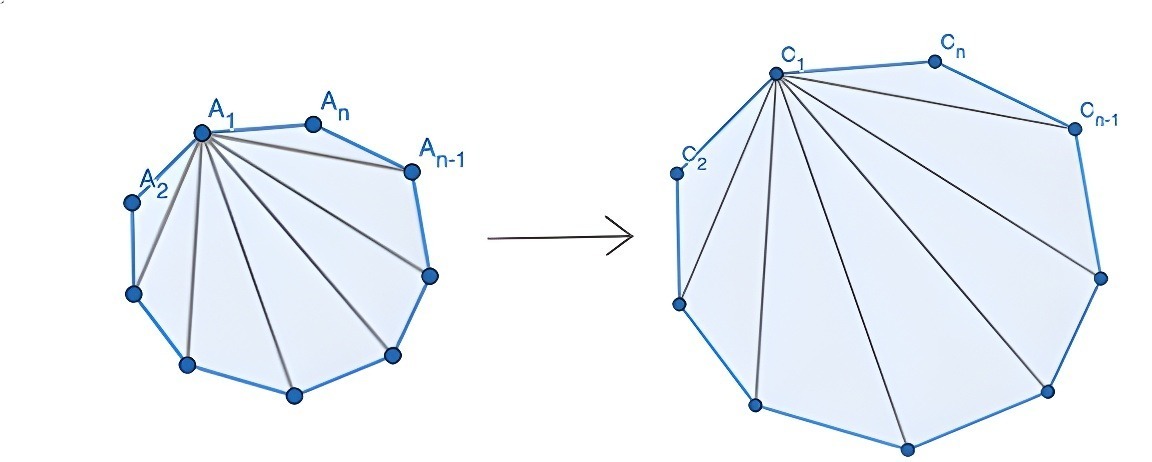 scaling to match polygon , where points
  , and
, and  are labeled and the diagonals from points and
  to other points within polygon and polygon are illustrated, respectively.
Suppose there also exists an -sided convex polygon, denoted polygon  , which is an element of the equivalence class under similarity which includes polygon and also has a perimeter of . In addition, let the length of
  be times the length of
  , for unequal arbitrary integers and which are greater than 0 and less than
  . Similarly, as polygon is similar to polygon ,
  must be equal to
  , for unequal arbitrary integers , , and which are greater than 0 and less than .
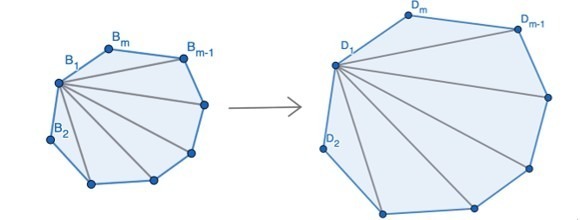 scaling to match polygon , where points
  , and
, and  are labeled and the diagonals from points and
  to other points within polygon and polygon are illustrated, respectively
Let  and
and  denote the area of polygon and polygon , respectively. Using the sine rule for area8, the equations of and are shown below:
![\[C = \sum_{k=2}^{n-1} \frac{1}{2}(C_1C_k)(C_1C_{k+1})\sin\angle C_k C_1 C_{k+1}\]](https://nhsjs.com/wp-content/ql-cache/quicklatex.com-a984d72b63411aa6d03f9a779c1e12d1_l3.png "Rendered by QuickLaTeX.com")
![\[D = \sum_{k=2}^{m-1} \frac{1}{2}(D_1D_k)(D_1D_{k+1})\sin\angle D_k D_1 D_{k+1}\]](https://nhsjs.com/wp-content/ql-cache/quicklatex.com-4cd7647371575c81315c50e2e43b86ef_l3.png "Rendered by QuickLaTeX.com")
These equations can be simplified as shown below:


As is larger than and is greater than 0,  is greater than
  . Hence, is greater than .
For polygons that are not convex, a similar method can be used. Suppose  is a base polygon which is not convex. can be divided into
  amount of triangles, denoted
  9. Therefore, the area of is the sum of the areas of .
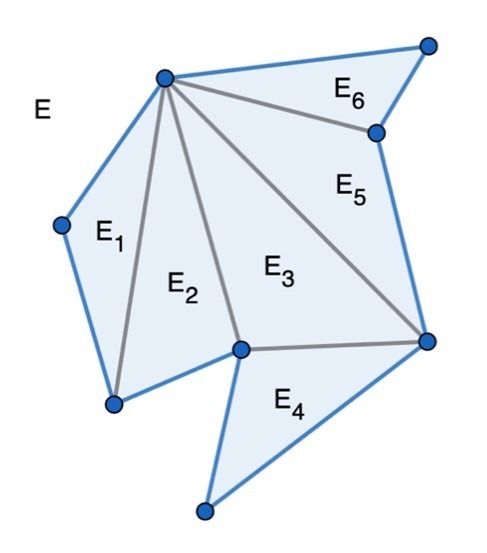 and an illustration, where is equal to 6, of the division of into 6 triangles, labeled
  , and
, and 
Suppose  is a polygon with a perimeter of and is an element of the equivalence class under similarity which includes . In addition, let
  be triangles which are an element of the equivalence class under similarity containing , respectively. In addition, for every integer value of between 1 and , let the perimeter of
  be times the perimeter of
  . Similarly to how was divided into , can also be divided into . Therefore, the area of is the sum of the areas of .
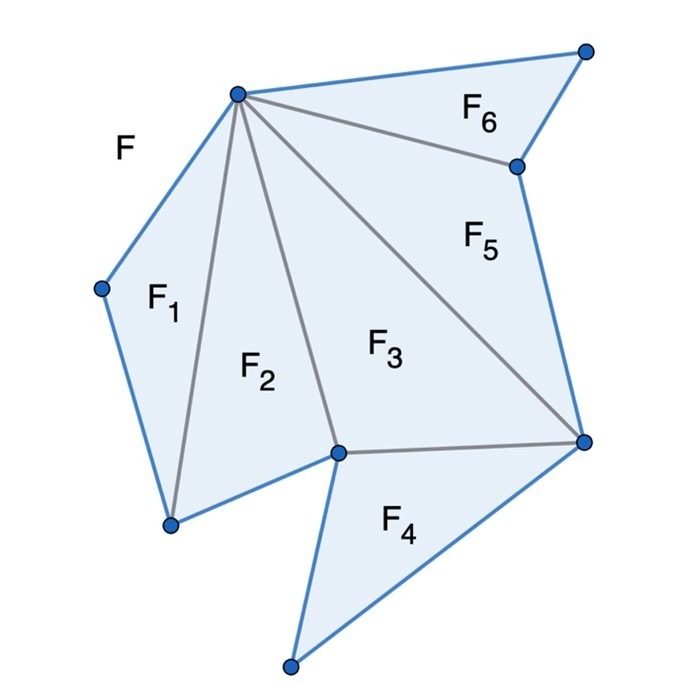 and an illustration, where is equal to 6, of the division of into 6 triangles, labeled
  , and
, and 
Similarly to as shown above, for every integer value of between 1 and , the area of is  times the area of . Therefore, the area of is times the area of . Suppose
  is a base polygon which has a smaller area than and
  is a polygon with a perimeter of and is an element of the equivalence class under similarity which includes . The area of would be times the area of similarly to how the area of is times the area of . As the area of is greater than the area of , the area of must be greater than the area of .
Therefore, if a base polygon has a greater area than another base polygon, a polygon that is similar to the former base polygon must have a greater area than a polygon with the same perimeter that is similar to the latter base polygon.
Furthermore, it can be proven that the largest polygon with a set perimeter is similar to the largest base polygon. The largest base polygon has a greater area than every other base polygon. Let  denote the equivalence class under similarity which contains the largest base polygon. As every base polygon can be scaled to match every polygon with a set perimeter that is an element of the same equivalence class under similarity, the polygon with a set perimeter that is an element of must have a larger area compared to the polygons with the same perimeter which are not elements of . In short, the largest polygon with a set perimeter must be an element of the equivalence class under similarity which contains the largest base polygon.
Thus, if it can be proven that the largest base polygon does not exist, there cannot exist an equivalence class under similarity which contains the largest base polygon. Furthermore, this would also prove that the largest polygon with a set perimeter cannot exist as well, disproving Conjecture~0.0. Hence, the remainder of this paper intends to demonstrate that the largest base polygon cannot exist in order to disprove Conjecture~0.0.
The Method of Elimination
There are an infinite number of base polygons that can have different side lengths, interior angles, and number of sides. Comparing the area of every base polygon to one another to determine the largest base polygon is not a feasible method because of this. For this reason, there must be a more efficient method to distinguish the polygons that cannot be the largest base polygon.
Theorem 0.1 Suppose there is a set, denoted as  , which consists of all the -sided base polygons that satisfy a certain property. If it is possible to prove the existence of a -sided base polygon with a larger area for each element of using this property, it can be proven that the largest -sided base polygon does not have this property.
Suppose is the set of all the -sided base polygons that satisfy a certain property. Additionally, for every element of , suppose this property can be utilized to prove the existence of a -sided base polygon that has a larger area. Consequently, every element of cannot be the largest -sided base polygon because there exists a -sided base polygon with a larger area. Correspondingly, the largest base polygon cannot be an element of . As the largest base polygon is not an element of , it must not satisfy this certain property, proving Theorem 0.1.
In the remainder of this paper, it is proven that the largest base polygon cannot possess certain properties by proving that, for each base polygon with those properties, there exists a base polygon with a larger area. Hence, Theorem~0.1 can be used to efficiently narrow down the possibilities through the elimination of every base polygon that satisfies certain properties that prevents them from being the largest base polygon.
Non-Convex Polygons
Theorem 1.0 The largest -sided base polygon is convex.
Let polygon  be a -sided base polygon which is not convex. must be more than 3 because all triangles are convex as the three interior angles of a triangle are all less than 10. (
 )
)
In addition, suppose the convex hull of polygon is denoted as  . Let
. Let  and
and  be two different vertices of which are connected to each other by an edge of . However, suppose and are not connected by an edge within polygon . Hence, must be greater than
  . (
. ( )
)
As and are vertices of and and are connected by an edge of , points  must be within the interior of .
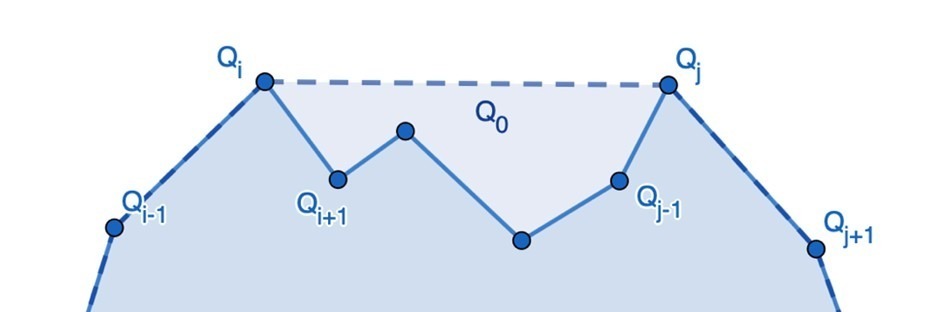 that focuses on vertices
  , and
, and  and includes the convex hull of polygon , which is denoted as
 Let points  be the reflection of points across line
  , respectively. In addition, let
  denote polygon
  .
.
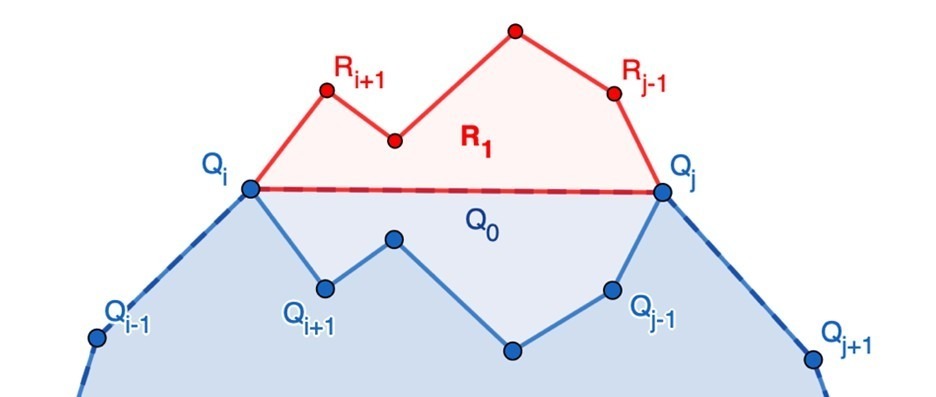 that focuses on vertices , and , includes the convex hull of polygon , which is denoted as , and illustrates polygon , where points
  and
and  are labeled
Points  excluding points and are on the opposite side of points across line as , which contains points , are all on the same side of line , excluding points and . Therefore, polygon and polygon meet at common vertices and .
Let  ,
,  ,
,  , and
, and  denote the perimeter and area of polygon
  and the perimeter and area of , respectively. As points are the reflection of points across line , respectively, the perimeter and area of polygon
  must be the same as the perimeter and area of , which is and , respectively. Points are within the interior of . Therefore, the area of polygon is the area of polygon subtracted by the area of , which is
  . Let
. Let  denote polygon
  . and polygon share the same edge, which is . Therefore, the area of is the area of polygon plus the area of , which is
  . Thus, has a larger area than polygon . In addition, the perimeter of polygon can be represented as
  . Similarly, the perimeter of can be represented as . As polygon is a base polygon and has the same perimeter as , must have a perimeter of 1.
In conclusion, for every -sided base polygon which is not convex, there exists a -sided base polygon which has a larger area. Utilizing Theorem~0.1, it can be proven that the largest -sided base polygon is convex, proving Theorem~1.0.
Triangles and Equilateral Polygons
Theorem 1.1 Suppose there is a non-equilateral triangle  in which
  and
and  are unequal. In addition to this triangle, there exists an isosceles triangle in which the base of the isosceles triangle has the length of
  and the two equal sides have the length of the mean of the lengths of and . It can be proven that this isosceles triangle has a larger area than
  .
.
Suppose there is a triangle with a perimeter of . Within , has a length of  , the length of is denoted as
  , and
, and  has an angle of
  radians. In addition, and are constants (
 ).
).
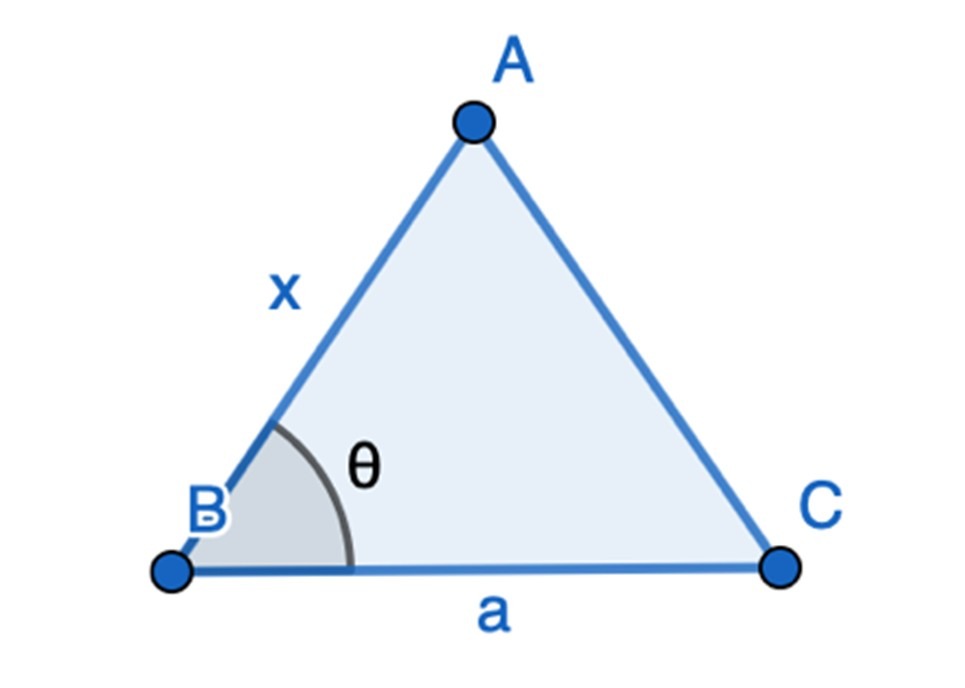 that includes , which has an angle of radians, the length of , which is , and the length of , which is
 The triangle inequality states that the sum of the length of any two arbitrary sides of a triangle must be greater than the length of the remaining side11. Because of this, the following inequalities can be formed as shown below:
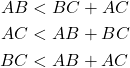
As the perimeter of , the length of , and the length of are , , and , respectively, the length of must be  , which must also be positive. Using this, the three inequalities can be altered and simplified as shown below:

Therefore, is greater than 0 and less than  and is greater than
  and less than . In addition, as is a triangle, must be less than . Thus, must be less than
  .
.
Let  be the function for the area of . can be written as shown below:
![\[S(x) = \frac{1}{2} ax \sin\theta\]](https://nhsjs.com/wp-content/ql-cache/quicklatex.com-5852686e19b8229bf67f21e636ce2f12_l3.png "Rendered by QuickLaTeX.com")
The absolute value of ,  , is defined as follows12:
![\[|x| = \begin{cases} x & \text{if } x \geq 0 \\ -x & \text{if } x < 0 \end{cases}\]](https://nhsjs.com/wp-content/ql-cache/quicklatex.com-ed5fcaaf8f8ea94f1d0e5ecea65d7793_l3.png "Rendered by QuickLaTeX.com")
As the square root function always gives non-negative values for real numbers, the value of  is when is more than or equal to 0 and
  when is less than 0. Therefore, is equal to . As
  can be simplified to
  , it is equal to
  . As the sine of is positive because is greater than 0 and less than , is equal to the sine of . Therefore, is equal to the sine of . Thus, can be altered as shown below:
![\[S(x) = \frac{1}{2} ax \sin\theta = \frac{1}{2} ax\sqrt{1 - \cos^2\theta}\]](https://nhsjs.com/wp-content/ql-cache/quicklatex.com-ab12350f4f53ed88c605fd2307bdd84f_l3.png "Rendered by QuickLaTeX.com")
To represent the area of as a function of , the cosine of must also be represented as a function of . Using the law of cosines8, the cosine of can be written as shown below:
![\[\cos\theta = \frac{a^2 + x^2 - (p - a - x)^2}{2ax}\]](https://nhsjs.com/wp-content/ql-cache/quicklatex.com-f38a7ffa450e6676a0b471407892c9a9_l3.png "Rendered by QuickLaTeX.com")
As the cosine of can be represented as a function of , the formula for the area of can also be written as a function of as shown below:
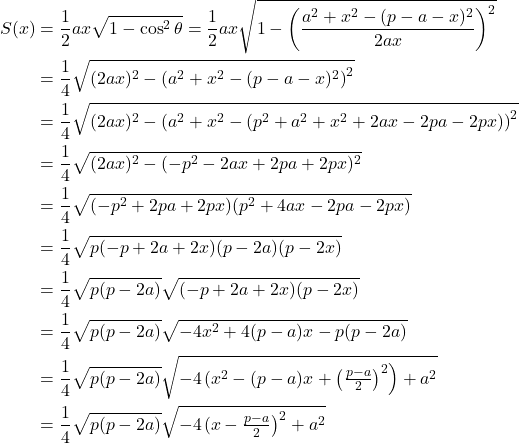
For the value of in which has the maximum value,  must also have its maximum value because
  is constant. Using the bounds of , the following inequalities can be proven:

Thus, has a maximum of , which is when is equal to  because
 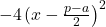 would be equal to 0, allowing to equal
  which is equal to . Therefore, the following inequality in which has the maximum value when is equal to can be shown below:
![\[S(x) = \frac{1}{4}\sqrt{p(p-2a)}\sqrt{-4\!\left(x-\tfrac{p-a}{2}\right)^2+a^2} \;\leq\; \frac{1}{4}a\sqrt{p(p-2a)} \qquad \left(\text{Equal when } x = \tfrac{p-a}{2}\right)\]](https://nhsjs.com/wp-content/ql-cache/quicklatex.com-5c6fc07afd5092c16aac6fdab6e8c7b2_l3.png "Rendered by QuickLaTeX.com")
Hence, when is , has a maximum area of 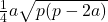 . Furthermore, when is , and both have equal lengths of , causing it to be an isosceles triangle. Thus, if there is a non-equilateral triangle in which and are not equal, there exists an isosceles triangle with the same perimeter as and a base with the length of which has a larger area than , proving Theorem~1.1.
Theorem 1.1: The largest -sided base polygon is a convex equilateral -sided base polygon.
Theorem 1.1 demonstrates that there exists a 3-sided base polygon with a larger area for every non-equilateral 3-sided base polygon. To prove the existence of a -sided base polygon with a larger area for every non-equilateral -sided base polygon with at least 4 sides, let’s suppose that there is a convex non-equilateral -sided base polygon, referred to as polygon , in which  and
and  are two arbitrary adjacent sides that do not have the same length (
 ,
,  ).
).
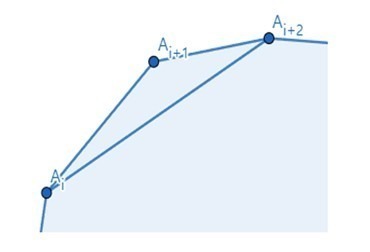 that focuses on vertices
  , and
, and  and includes
To prove that there exists a -sided base polygon that has a larger area compared to polygon , polygon must first be divided into two separate polygons, triangle  and polygon
  . As and do not have the same lengths, using Theorem~1.1, it can be proven that there exists an isosceles triangle with a larger area which has a base with the length of and the same perimeter as
  . Let’s denote this isosceles triangle as triangle in which is the base of the isosceles triangle. A new -sided polygon can be composed by shifting the position and rotating so that coincides with and vertex is not on the interior or the boundary of polygon . The new polygon can be referred to as polygon
  . As has a larger area compared to , polygon has a larger area compared to polygon . In addition, the sum of the lengths of and is equal to the sum of the lengths of and because the perimeter of both polygons is equal and and both have the same lengths. This reveals that polygon is also a base polygon because it has the same perimeter as polygon .
In short, for every convex non-equilateral -sided base polygon, there exists a -sided base polygon with a larger area. Theorem~1.0 states that the largest -sided base polygon must be convex. Thus, using Theorem~0.1, it can be proven that the largest -sided base polygon is equilateral. Hence, the largest -sided base polygon is a convex equilateral -sided base polygon, proving Theorem~1.2.
Quadrilaterals and Equiangular Polygons
Theorem 2.1 Suppose there is a convex quadrilateral  in which ,
  , and
, and  all have the same length and
  and
and  do not have the same angles. In addition to , there exists a convex quadrilateral, denoted
  , in which the lengths of
  ,
,  , and
, and  all equal the length of , the length of
  equals the length of , and
  has the same angle as
  . It can be proven that has a larger area than .
Suppose there is a convex quadrilateral with a perimeter of . Additionally, has a length of and the lengths of , , and all equal  (
( ,
,  ).
).
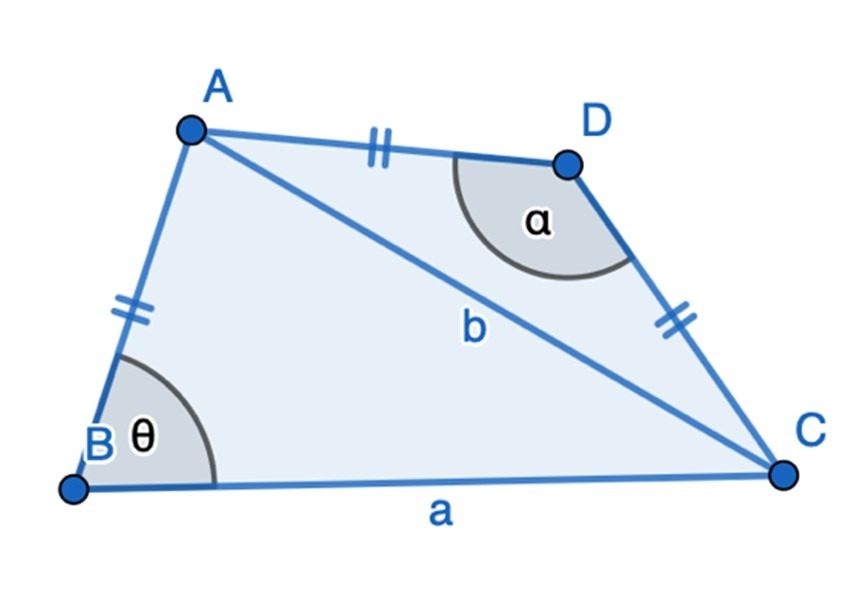 that includes , which has an angle of ,
  , which has an angle of
  , , the length of , which is
  , and the length of , which is
 To find the angle of when has the largest area, suppose the length of is denoted as , has an angle of , and has an angle of (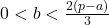 ,
,  ,
,  ).
).
Using the law of cosines8, the square of can be written as shown below:
![\[b^2 = a^2 + \left(\frac{p-a}{3}\right)^2 - 2a\left(\frac{p-a}{3}\right)\cos\theta\]](https://nhsjs.com/wp-content/ql-cache/quicklatex.com-49c4124dfc9bd3d601dba11f784b543f_l3.png "Rendered by QuickLaTeX.com")
Using the equation for the square of , the equation for the cosine of can be derived as shown below:

As the cosine of can be represented as a function of , the formula for the area of can also be written as a function of . Let  be the function for the area of . can be written as shown below:





The derivative of can be written as shown below:

Suppose the value of is  radians when
  is equal to zero. For the values of that are more than 0 radians and less than radians, if the value of is smaller than radians, is positive. However, if the value of is greater than radians, is negative. As anticipated, when the value of is radians, is equal to zero. This property of holds true for all permissible values of the constants and .
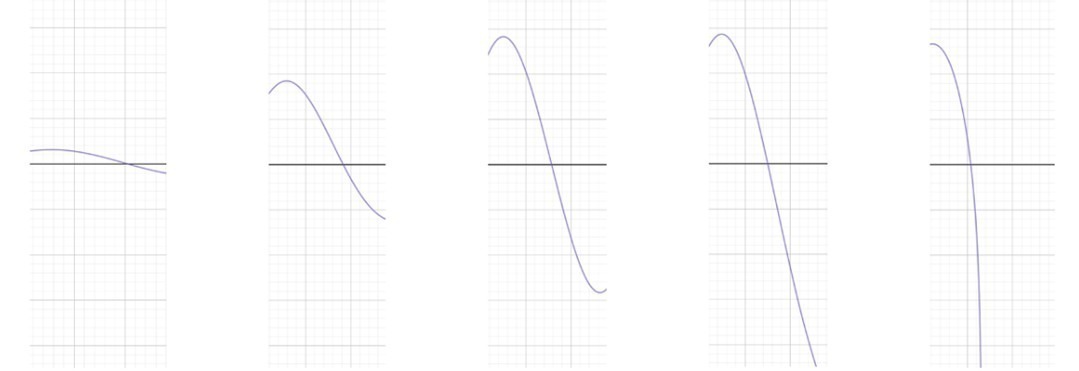 , in which is more than 0 radians and less than radians, for different permissible values of the constants and
 Therefore, for the values of that are more than 0 radians and less than radians, is strictly increasing. Similarly, for the values of that are more than radians and less than radians, is strictly decreasing. For this reason, has a maximum value if and only if the value of is radians. As represents the function for the area of for the values of that are more than 0 radians and less than radians, must be determined to find the value of at which has the maximum area. As is the value of when is equal to zero,  is equal to zero.





To eliminate the square root from the right side of the equation above, both sides of the equation can be squared and then simplified as shown below:
![\begin{align<em>} &\left(2a\left(\frac{p-a}{3}\right)\cos\beta - \left(a^2-\left(\frac{p-a}{3}\right)^2\right)\right)^2\sin^2\beta \ &= \cos^2\beta\left(-4a^2\left(\frac{p-a}{3}\right)^2\cos^2\beta + 4a\left(\frac{p-a}{3}\right)\left(a^2-\left(\frac{p-a}{3}\right)^2\right)\cos\beta - a^4 + 2a^2\left(\frac{p-a}{3}\right)^2 + 3\left(\frac{p-a}{3}\right)^4\right) \[6pt] &\left(2a\left(\frac{p-a}{3}\right)\cos\beta - \left(a^2 - \left(\frac{p-a}{3}\right)^2\right)\right)^2\sin^2\beta \ &= \left(4a^2\left(\frac{p-a}{3}\right)^2\cos^2\beta - 4a\left(\frac{p-a}{3}\right)\left(a^2 - \left(\frac{p-a}{3}\right)^2\right)\cos\beta + \left(a^2 - \left(\frac{p-a}{3}\right)^2\right)^2\right)(1 - \cos^2\beta) \ &= 4a^2\left(\frac{p-a}{3}\right)^2\cos^2\beta - 4a\left(\frac{p-a}{3}\right)\left(a^2 - \left(\frac{p-a}{3}\right)^2\right)\cos\beta + \left(a^2 - \left(\frac{p-a}{3}\right)^2\right)^2 \ &\quad - 4a^2\left(\frac{p-a}{3}\right)^2\cos^4\beta + 4a\left(\frac{p-a}{3}\right)\left(a^2 - \left(\frac{p-a}{3}\right)^2\right)\cos^3\beta - \left(a^2 - \left(\frac{p-a}{3}\right)^2\right)^2\cos^2\beta \[6pt] &= \cos^2\beta\left(-4a^2\left(\frac{p-a}{3}\right)^2\cos^2\beta + 4a\left(\frac{p-a}{3}\right)\left(a^2 - \left(\frac{p-a}{3}\right)^2\right)\cos\beta - a^4 + 2a^2\left(\frac{p-a}{3}\right)^2 + 3\left(\frac{p-a}{3}\right)^4\right) \ &= -4a^2\left(\frac{p-a}{3}\right)^2\cos^4\beta + 4a\left(\frac{p-a}{3}\right)\left(a^2 - \left(\frac{p-a}{3}\right)^2\right)\cos^3\beta + \left(-a^4 + 2a^2\left(\frac{p-a}{3}\right)^2 + 3\left(\frac{p-a}{3}\right)^4\right)\cos^2\beta \[6pt] &4a^2\left(\frac{p-a}{3}\right)^2\cos^2\beta - 4a\left(\frac{p-a}{3}\right)\left(a^2 - \left(\frac{p-a}{3}\right)^2\right)\cos\beta + \left(a^2 - \left(\frac{p-a}{3}\right)^2\right)^2 - \left(a^2 - \left(\frac{p-a}{3}\right)^2\right)^2\cos^2\beta \ &= \left(-a^4 + 2a^2\left(\frac{p-a}{3}\right)^2 + 3\left(\frac{p-a}{3}\right)^4\right)\cos^2\beta \[6pt] &4a^2\left(\frac{p-a}{3}\right)^2\cos^2\beta - 4a\left(\frac{p-a}{3}\right)\left(a^2 - \left(\frac{p-a}{3}\right)^2\right)\cos\beta + \left(a^2 - \left(\frac{p-a}{3}\right)^2\right)^2 \ &\quad - \left(a^2 - \left(\frac{p-a}{3}\right)^2\right)^2\cos^2\beta + \left(a^4 - 2a^2\left(\frac{p-a}{3}\right)^2 - 3\left(\frac{p-a}{3}\right)^4\right)\cos^2\beta = 0 \[6pt] &4a^2\left(\frac{p-a}{3}\right)^2\cos^2\beta - 4a\left(\frac{p-a}{3}\right)\left(a^2 - \left(\frac{p-a}{3}\right)^2\right)\cos\beta + \left(a^2 - \left(\frac{p-a}{3}\right)^2\right)^2 \ &\quad - \left(a^2 - \left(\frac{p-a}{3}\right)^2\right)^2\cos^2\beta + \left(a^4 - 2a^2\left(\frac{p-a}{3}\right)^2 - 3\left(\frac{p-a}{3}\right)^4\right)\cos^2\beta \ &= \left(4a^2\left(\frac{p-a}{3}\right)^2 - 4\left(\frac{p-a}{3}\right)^4\right)\cos^2\beta - 4a\left(\frac{p-a}{3}\right)\left(a^2 - \left(\frac{p-a}{3}\right)^2\right)\cos\beta + \left(a^2 - \left(\frac{p-a}{3}\right)^2\right)^2 \ &= 4\left(\frac{p-a}{3}\right)^2\left(a^2 - \left(\frac{p-a}{3}\right)^2\right)\cos^2\beta - 4a\left(\frac{p-a}{3}\right)\left(a^2 - \left(\frac{p-a}{3}\right)^2\right)\cos\beta + \left(a^2 - \left(\frac{p-a}{3}\right)^2\right)^2 \ &= \left(a^2 - \left(\frac{p-a}{3}\right)^2\right)\left(4\left(\frac{p-a}{3}\right)^2\cos^2\beta - 4a\left(\frac{p-a}{3}\right)\cos\beta + \left(a^2 - \left(\frac{p-a}{3}\right)^2\right)\right) \ &= \frac{1}{9}\left(-p^2 + 2ap + 8a^2\right)\left(4\left(\frac{p-a}{3}\right)^2\cos^2\beta - 4a\left(\frac{p-a}{3}\right)\cos\beta + \left(a^2 - \left(\frac{p-a}{3}\right)^2\right)\right) \ &= \frac{1}{9}(4a-p)(2a+p)\left(2\left(\frac{p-a}{3}\right)\cos\beta - \left(a - \left(\frac{p-a}{3}\right)\right)\right)\left(2\left(\frac{p-a}{3}\right)\cos\beta - \left(a + \left(\frac{p-a}{3}\right)\right)\right) \ &= \frac{1}{9}(4a-p)(2a+p)\left(2\left(\frac{p-a}{3}\right)\cos\beta - \frac{4a-p}{3}\right)\left(2\left(\frac{p-a}{3}\right)\cos\beta - \frac{p+2a}{3}\right) = 0 \[6pt] &(4a-p)\left(2\left(\frac{p-a}{3}\right)\cos\beta - \frac{4a-p}{3}\right)\left(2\left(\frac{p-a}{3}\right)\cos\beta - \frac{p+2a}{3}\right) = 0 \end{align</em>}](https://nhsjs.com/wp-content/ql-cache/quicklatex.com-4e54cd93e1e076bf29ee07f3f8d7ab8f_l3.png "Rendered by QuickLaTeX.com")
Based on the final equation, seems to be equal to zero when is equal to  or the cosine of is equal to
  or
or  . However, during one of the stages of the simplification process, both sides of the equation were squared. So, all the potential solutions must be verified.
In the case in which the cosine of is equal to , the sine of can be written as shown below:
![\[\sin\theta = \sqrt{1-\cos^2\theta} = \sqrt{1-\left(\frac{4a-p}{2(p-a)}\right)^2} = \frac{\sqrt{4(p-a)^2-(4a-p)^2}}{2(p-a)} = \frac{\sqrt{3p^2-12a^2}}{2(p-a)}\]](https://nhsjs.com/wp-content/ql-cache/quicklatex.com-2f4f52880f30d8ca06975581caa38c65_l3.png "Rendered by QuickLaTeX.com")
As is more than 0 radians and less than radians, the sine of is positive13. Using the sine of , the value of is shown below:
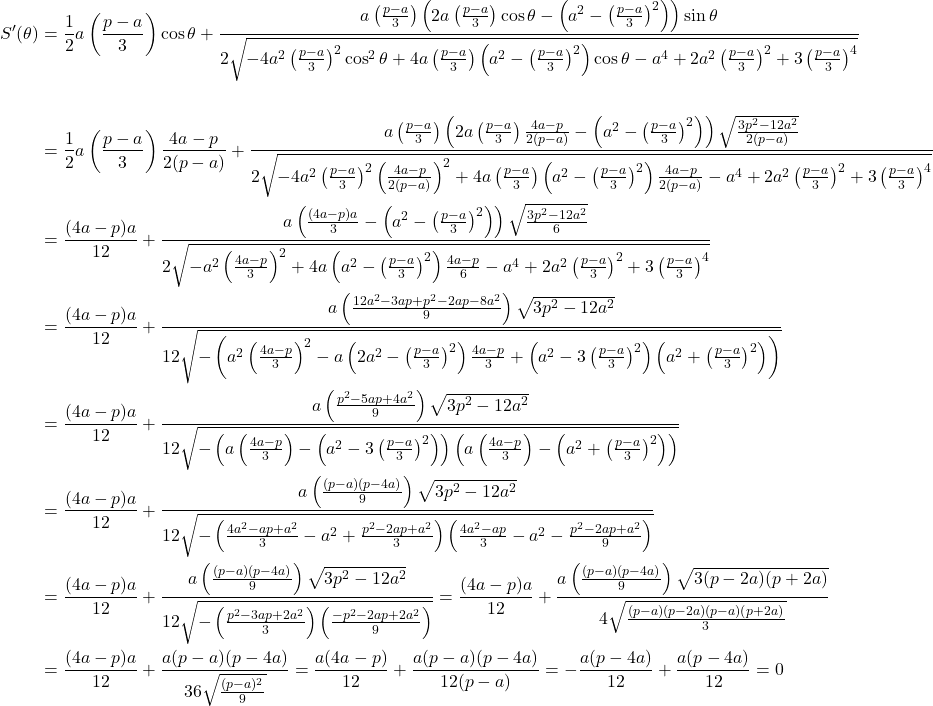
Thus, is equal to zero when the cosine of is equal to .
In the case in which the cosine of is equal to , the sine of can be written as shown below:

As is more than 0 radians and less than radians, the sine of is positive13. Using the sine of , the value of is shown below:

Thus, is not equal to zero when the cosine of is equal to .
In the case in which is equal to , the equation for the value of is shown below:

For to equal zero in the case in which is equal to , the cosine of must be zero. Coincidentally, in the case in which is equal to , is equal to zero. So, when is equal to , is equal to zero if and only if the cosine of is equal to .
After evaluating all the potential solutions, is equal to zero if and only if the cosine of is equal to . So, has a maximum area if and only if the value of is the inverse cosine of .
Using the equation for the cosine of , when the value of is the inverse cosine of , the value of the cosine of is as shown below:

Thus, when the value of is the inverse cosine of , the value of the cosine of is the additive inverse of the cosine of . As both and have a value that is more than 0 radians and less than radians, the value of is radians subtracted by the value of . So, the sum of the values of and is radians. Hence, the sum of and is .
As the sum of and is , is a cyclic quadrilateral. Let the circumcenter of be referred to as point .
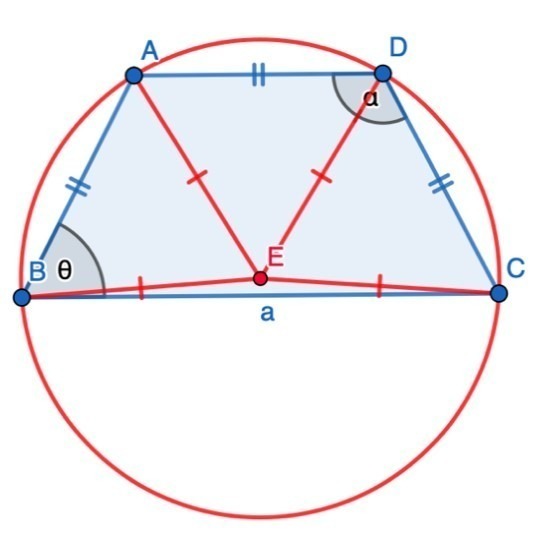 , which includes (angle ), (angle ), and the length of (), and a visual representation of the circumcircle of , which includes the circumcenter and
 ,
,  , and
, and  are all congruent isosceles triangles because , , and all have the same length and
  ,
,  ,
,  , and
, and  all have the same length. Thus,
  ,
,  ,
,  ,
,  ,
,  , and
, and  all have the same angles. As the sum of and is and the sum of and is , has the same angle as .
In short, when the cosine of is in which the area of is at its maximum, and also have the same angles.
Thus, if there is a convex quadrilateral in which , , and all have the same lengths and and do not have the same angle, there exists a convex quadrilateral with a larger area, denoted , in which the lengths of , , and all equal the length of , the length of is equal to the length of , and has the same angle as , proving Theorem~2.1.
Theorem 2.2 The largest -sided base polygon is the regular -sided base polygon.
Theorem 1.2 affirms that the largest -sided base polygon is an equilateral -sided base polygon. As the equilateral 3-sided base polygon is the regular 3-sided base polygon, the largest 3-sided base polygon is the regular 3-sided base polygon.
For every convex non-equiangular equilateral 4-sided base polygon, Theorem~2.1 demonstrates that there exists a 4-sided base polygon with a larger area. To prove the existence of a -sided base polygon with a larger area for every convex non-equiangular equilateral -sided base polygon with at least 5 sides, let’s suppose that there is a convex non-equiangular equilateral -sided polygon, referred to as polygon , in which  and
and  are two arbitrary adjacent angles that do not have the same angle (
 ,
,  ).
).
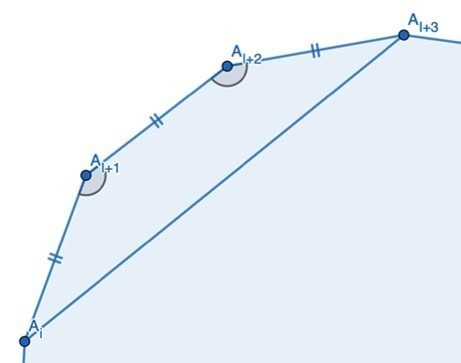 that focuses on vertices
  and
and  and includes
  , , and
 To prove that there exists a -sided base polygon that has a larger area compared to polygon , polygon must first be divided into two separate polygons, quadrilateral  and polygon
  . Quadrilateral must be convex because and are both less than and
  and
and  are also less than because they are smaller than
  and
and  , which are both smaller than , respectively. As quadrilateral is convex and and do not have the same angle, using Theorem~2.1, it can be proven that there exists a convex quadrilateral with a larger area, denoted quadrilateral , in which the lengths of , , and all equal the length of , the length of is equal to the length of , and has the same angle as . A new -sided polygon can be composed by shifting the position and rotating so that coincides with and vertex and vertex are not on the interior or the boundary of polygon . The new -sided polygon can be referred to as polygon
  . As has a larger area compared to , polygon has a larger area compared to polygon . In addition, as the lengths of , , and are all equal to the length of , polygon is also a base polygon because it has the same perimeter as polygon .
In short, for every convex non-equiangular equilateral -sided base polygon with at least 4 sides, there exists a -sided base polygon with a larger area. Theorem~1.2 states that the largest -sided base polygon must be a convex equilateral base polygon. Thus, using Theorem~0.1, it can be proven that the largest -sided base polygon with at least 4 sides is regular. Hence, the largest -sided base polygon is the regular -sided base polygon, proving Theorem~2.2.
Regular Polygons and the Circle
Theorem~2.2 affirms that the largest base polygon is a regular polygon. However, to find the largest base polygon, the area of every regular base polygon must be compared. Suppose there is a regular -sided base polygon . In addition, point  is the center of polygon ,
  has an angle of , and point is the midpoint of
  . As
. As  is an isosceles triangle,
  has an angle of
  (
( ).
).
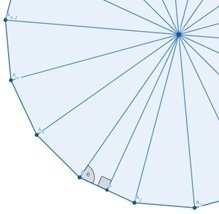 that focuses on center and vertices
  , and
, and  and includes (angle ), point , and ()
The equation for the value of in radians can be written as shown below:

Using the equation for the value of , the function for the area of polygon , denoted  , can be written as shown below:

Let  be defined as shown below:
![\[A(x) = \frac{1}{4x\tan\frac{\pi}{x}}\]](https://nhsjs.com/wp-content/ql-cache/quicklatex.com-f92c82df07afae3db3d587344b1ff707_l3.png "Rendered by QuickLaTeX.com")
The derivative of can be written as shown below:
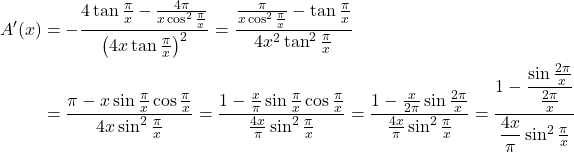
The inequality shown below is true for all greater than 0 and less than  14:
14:
![\[\frac{\sin i}{i} < \frac{1}{\cos i}\]](https://nhsjs.com/wp-content/ql-cache/quicklatex.com-dae889bf1671a78f837c5a3da55afc0d_l3.png "Rendered by QuickLaTeX.com")
This inequality can be rearranged and altered as shown below:

For every value of in which is more than or equal to 3,  is greater than 0 and less than . Therefore, using the above inequality, it can be proven that
  is less than 1 because the sine of
  is smaller than for every value of in which is more than or equal to 3. As a result,
  has a positive value. In addition,
  and the sine of are also positive. Thus,
  is positive for every value of in which is more than or equal to 3. So, is a strictly increasing function for every value of greater than or equal to 3. So, for every more than or equal to 3,
  is more than
  . As is equal to ,
  is more than for every value of in which is an integer more than or equal to 3. Therefore, as the number of sides in a regular base polygon increases, the area also increases. This insinuates that the largest base polygon does not exist because the number of sides can increase indefinitely.
In addition, to determine whether converges or diverges, the limit of as approaches infinity must be evaluated, as shown below:

As  would approach 1 as approaches 015,
 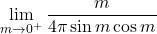 would equal
  . Hence, converges to as approaches infinity.
![\[\lim_{x\to\infty} A(x) = \frac{1}{4\pi}\]](https://nhsjs.com/wp-content/ql-cache/quicklatex.com-ed7d9b0ecd3b39a76392019ef4039716_l3.png "Rendered by QuickLaTeX.com")
Utilizing the Hausdorff metric and perimeter-area convergence16, it is possible to show that polygon converges to the shape of a circle as approaches infinity.
Suppose is a circle with a perimeter of 1 which has point as its center. Let  and
and  denote the set of all points on polygon and , respectively. Then, as approaches infinity,
  converges to
  in the Hausdorff metric as shown below:
![\[\lim_{n\to\infty} d_H(P_n, C_0) = 0\]](https://nhsjs.com/wp-content/ql-cache/quicklatex.com-92b244dfdc58845ef2c4a53045bb2adc_l3.png "Rendered by QuickLaTeX.com")
For all , the perimeters satisfy:
![\[\mathcal{H}^1(\partial P_n) = 1 = \mathcal{H}^1(\partial C_0)\]](https://nhsjs.com/wp-content/ql-cache/quicklatex.com-7edbd3aa5b58783e46c5cc7bcd3ec8c7_l3.png "Rendered by QuickLaTeX.com")
Hence, the perimeter of polygon and are both 1. Similarly to how converges to as approached infinity, would also converge to as approached infinity as is equal to . Thus, as approaches infinity, the area of polygon approaches . As the perimeter of is 1, it would have a radius of  . This means that the area of is . Therefore, as approaches infinity, the area of polygon approaches the area of .
![\[\lim_{n\to\infty} \mathcal{H}^2(P_n) = \frac{1}{4\pi} = \mathcal{H}^2(C_0)\]](https://nhsjs.com/wp-content/ql-cache/quicklatex.com-23925fd98e134948bed9f0e24a54bb1e_l3.png "Rendered by QuickLaTeX.com")
Thus, polygon converges to a circle with a perimeter of 1 as approaches infinity.
In conclusion, the largest base polygon does not exist. Therefore, the largest polygon with a set perimeter cannot exist because the equivalence class under similarity which contains the largest base polygon cannot exist. Hence, Conjecture~0.0 has been proven false because it stated that there did exist a polygon with the largest area, which is incorrect.
Thus, within a set of every polygon with the same perimeter, there cannot exist a polygon within this set which has the largest area. However, it has also been demonstrated that as the area of these polygons approaches its upper bound, it approaches the shape of a circle with the same perimeter.
Conclusion
In conclusion, many steps were taken to disprove the existence of a convex polygon with a fixed perimeter that has the maximum area. First, a conjecture, which stated there did exist a polygon with a fixed perimeter which also had the maximum area, was formed in order to be disproven. Next, using the scaling of polygons, it was demonstrated that such a polygon had to be similar to the shape of the polygon with a perimeter of 1 that has the largest area. Then, it had to be proven that the polygon with a perimeter of 1 that had the largest area had to also be convex. To determine whether the polygon with a perimeter of 1 that has the largest area is a convex equilateral polygon, it was proven that every convex non-equilateral convex polygon with a perimeter of 1 could not have the maximum area. Similarly, after proving that every convex non-equiangular equilateral polygon with a perimeter of 1 could not have the maximum area, it revealed that this polygon is a regular polygon. Finally, the areas of all of the regular polygons with a perimeter of 1 were compared to find the convex polygon with a perimeter of 1 that has the largest area. However, as the number of sides in the regular polygons increased, its area also continued to increase and approached a value of , which is the area of the circle with a perimeter of 1. Thus, the polygon with a fixed perimeter that has the largest possible area does not exist because the area of a polygon can continue to increase as its shape approaches the shape of a circle with the same perimeter, disproving the conjecture.
References
- A, Bogomolny. Isoperimetric theorem and inequality. Accessed June 20, 2025. http://www.cut-the-knot.org/do_you_know/isoperimetric.shtml [↩]
- Dido’s problem. Accessed June 20, 2025. from http://mathematica.ludibunda.ch/areas.html [↩]
- B. Engelker. Area and perimeter of polygons. MAT Exam Expository Papers. 11, 1-15, 2006. [↩] [↩]
- R. Osserman. The isoperimetric inequality. Bulletin of the American Mathematical Society, 84(6), 1182-1238. 1978. [↩]
- D. Collins. Math 4310 handout-equivalence relations, 1-4. Accessed February 10, 2026. https://pi.math.cornell.edu/~dcollins/math4310/EquivalenceRelations.pdf [↩]
- J.-L. De Carufel, A. Dumitrescu, W. Meulemans, T. Ophelders, C. Pennarun, C. D. Tóth, & S. Verdonschot. Convex polygons in Cartesian products. Journal of Computational Geometry 11(2), 205-233, 2021, doi: 10.20382/jocg.v11i2a9. [↩]
- M. de Berg, O. Cheong, M. van Kreveld, & M. Overmars. Computational geometry: Algorithms and applications (3rd ed.), Springer, 2008. [↩]
- R. Larson, & R. P. Hostetler. Trigonometry (7th ed.), Brooks/Cole ISE, 2006. [↩] [↩] [↩] [↩]
- M. R. Garey, D. S. Johnson, F. P. Preparata, & R. E. Tarjan. Triangulating simple polygon. Information Processing Letters 7(4), 175-179, 1977. [↩]
- A. Barvinok. A course in convexity, American Mathematical Society 54, 2002. [↩]
- M. A. Khamsi, & W. A. Kirk. An introduction to metric spaces and fixed point theory, John Wiley & Sons, 2001. [↩]
- J. Stewart. Single variable calculus: Early transcendentals (6th ed.), Thomson, 2008. [↩]
- M. Corral. Trigonometry. Schoolcraft College, 2009. [↩] [↩]
- T. M. Apostol. Calculus: One-variable calculus, with an introduction to linear algebra (2nd ed.). John Wiley & Sons, 1967. [↩]
- T. Sandesh, & H. S. Bishnu. An extension of the sandwich theorem for two-sided limits. Kathmandu University Journal of Science, Engineering and Technology 19(3), 1-3, 2025. [↩]
- L. C. Evans, & R. F. Gariepy. Measure theory and fine properties of functions. CRC Press, 1992. [↩]