

Abstract
Digital technologies have expanded access to information, connectivity, and innovation. Yet today’s digital markets are increasingly shaped by a small number of firms that control key platforms, data flows, and digital infrastructures. Existing work often treats platform power either as an antitrust issue or as a democracy issue; this review synthesizes both strands in a single framework. This concentration raises questions not only about economic competition but also about social rights and democratic life. This article examines how digital monopolization emerges and how it affects markets, governance, and society.
Methods: The study is based on a structured search in the Web of Science Core Collection (2015-2026; Article). The search identified 3,631 records; limiting the set to SSCI reduced it to 1,090, and keyword refinement produced 495 records. After screening, 31 studies were included for thematic synthesis. To reduce the risk of missing relevant work, the WoS results were cross-checked with targeted Google Scholar searches and citation tracking.
Results: The literature points to recurring drivers of platform dominance, such as network effects, ecosystem lock-in, and data-based advantages. The reviewed studies also suggest that monopolization is not only about prices or market shares; it can shape access, inequality, and the conditions of public debate.
Conclusions: Digital monopolization should be treated as a multidimensional issue that connects competition, regulation, and democratic governance. By organizing the evidence around the research questions, this article summarizes the main mechanisms behind platform dominance and explains why policy responses matter.
Keywords: Big Tech, Platform dominance, Digital markets, Antitrust, Data power, Disinformation, Democracy.
Introduction
Digital technologies promised open access to information, global connectivity, and rapid innovation. Yet today’s tech markets are increasingly shaped by concentration. In many areas, a small number of firms control the main platforms and infrastructures that others depend on. This matters because platform power is not limited to prices or market shares; it also affects access, visibility, and the basic rules of digital life.
The information technology sector first expanded through countries with long-established industrial and technological traditions such as the United States, Germany, and Japan. Over time, countries like India, Israel, and Ireland strengthened their positions through sustained policy frameworks and integration into the global digital economy. In recent years, China, whose presence in the sector was relatively limited during the 1990s, has risen rapidly through state-led strategies and large-scale investments. As digitalization accelerates, more countries that were previously outside the core of the IT landscape have begun to enter the field. This broader shift makes it increasingly important to understand how structural change in technology markets shapes economic outcomes, public administration, and social life.
Much of the existing discussion treats Big Tech either as a competition issue or as a debate about democracy and public discourse. What is often missing is a single, evidence-based synthesis that keeps these dimensions together and shows how they interact. This article addresses that gap by reviewing peer-reviewed research and organizing the findings around four questions: how dominance is built, how it relates to inequality and access, how it shapes public discourse and democratic processes, and how states and regulation respond.
The analysis then synthesizes the literature on mechanisms of dominance, impacts on public discourse and democracy, inequality and access, and state and regulatory responses, before concluding with the main implications and limitations.
Methodology
This study is based on a structured literature review guided by a clear analytical focus on the digital economy, technological monopolization, platform governance, and democratic processes. The review follows a qualitative, interpretive approach and synthesizes findings through thematic (narrative) analysis. For each included study, we recorded the main topic, method (conceptual/empirical), key mechanism (e.g., network effects, lock-in, data power), and policy focus (e.g., antitrust, DMA-style rules).
Screening summary: records identified (WoS) = 3,631; after SSCI filter = 1,090; after keyword refinement = 495; records screened (title/abstract) = 495; studies included in thematic synthesis = 31. Full texts were consulted selectively for the most relevant studies when accessible.
Included studies were required to directly address platform market power/dominance, competition and antitrust, gatekeeping practices (e.g., self-preferencing), or regulatory responses in digital/platform markets. Evidence was then organized around the research questions below, and recurring mechanisms (e.g., network effects, ecosystem lock-in, data advantages) as well as common policy tools (e.g., interoperability rules, limits on self-preferencing, remedies) were mapped to each question.
The review is organized around four questions: how platform dominance has evolved and which structural factors enable concentration; how monopolies reshape inequality and access; how platforms affect democratic processes and public discourse; and how states and regulation respond.
To ensure transparency in study selection, the review followed a stepwise screening process. Records were first identified in the Web of Science Core Collection (2015–2026; document type: Article), then restricted to SSCI. A keyword-refinement step narrowed the pool to studies most directly related to platform dominance and monopolization. The refined set was screened at the title/abstract level, and the final group of studies was retained for thematic synthesis. The overall flow of identification and screening is summarized in Figure 1.
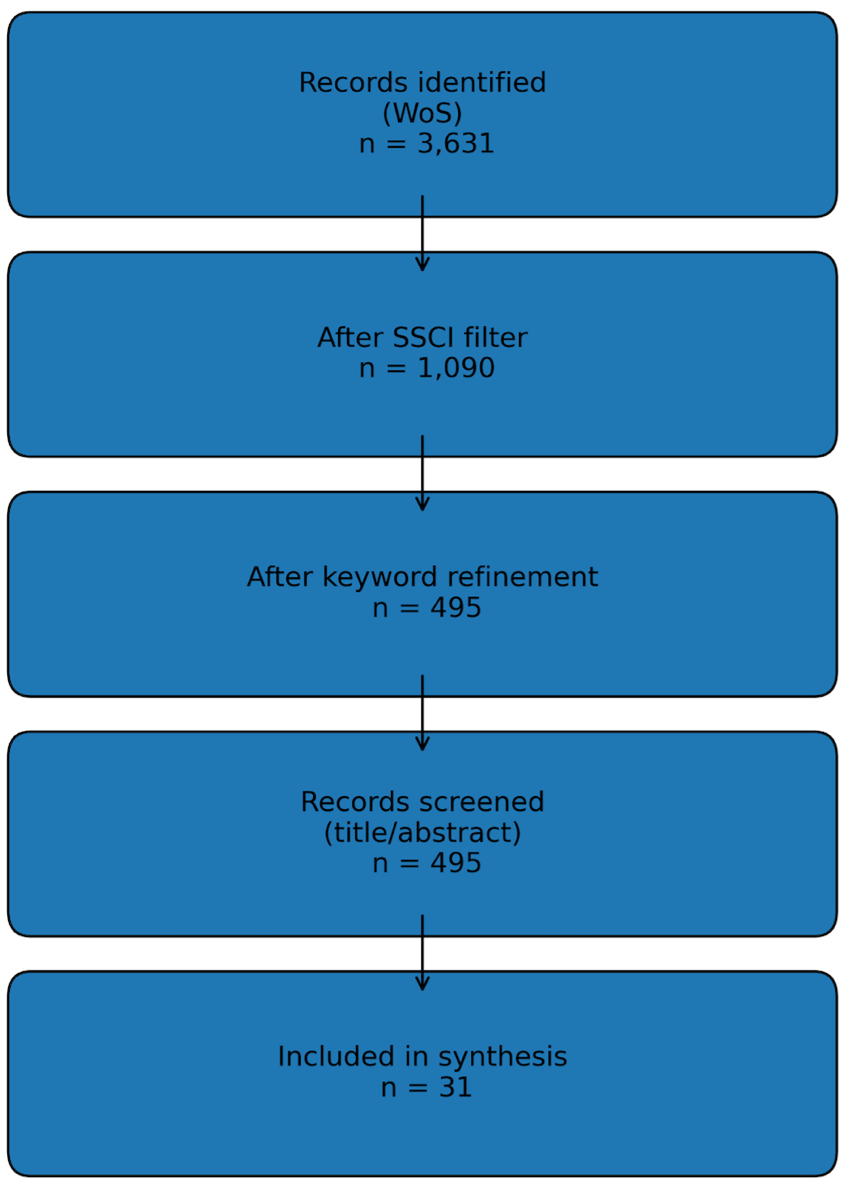
Records were identified through WoS, filtered to SSCI, refined by keywords, and screened at title/abstract level before inclusion in thematic synthesis.
Techno-Giants of the Digital Age: Surveillance Capitalism
While technology has promised progress throughout history, it has also played a central role in human development. In his study, ‘The Network Society’, Manuel Castells argues that the most essential feature of the digital age is that those who possess information shape not only the economy but also the social order: “the network society as a new social structure emerging from advances in information and communication technologies- information flows across global networks”1.
The world is changing rapidly, and the role of technology is steadily increasing. As traditional balances of power are being shaken, a new power struggle is emerging. It’s challenging to compile a definitive list of the actors in the technological revolution, but everyone is familiar with the main ones: the Big Five. The historical role of Big Tech is decisive in determining whether the power that will govern society and shape the future will change hands.
Assessments on information technologies and globalization are mostly focused on the use of technology. During this period, 26 of the top 50 IT companies were from the USA, 12 from Japan, and the remaining 12 were from Europe. Looking at the distribution of the largest companies in the IT services and software sector, nine of the top ten service companies are American, and one is a US-French partnership. Eight of the top ten software companies are American, and the others are German and Japanese. In 2000, the countries with an export ratio higher than imports were Finland, Japan, Ireland, South Korea, and Sweden. The countries with the highest software exports were the USA and Ireland. Between 1990 and 2000, the annual export market growth rates averaged 6% for Japan, 5% for the European Union (EU), and 3% for the USA, while the import rate was 8% for the USA, 5% for the European Union, and 3% for Japan. While the years between 1990 and 2000 were golden years of growth for many countries, growth in the European Union was quite low. The European Union, seeing that it was lagging behind the USA and Japan in the field of information technologies and the internet, aimed to transition to a knowledge-based economy model with the Lisbon Targets and created the European Action Plan. Among Turkey and the countries that recently joined the EU, Hungary ranked first in terms of information technology production volume, producing 38% of the total, followed by Poland, Turkey and the Czech Republic. Poland and Turkey were the two largest markets during the relevant period2.
Techno-giants, including Google, Apple, Microsoft, Amazon, and Meta, are recognized for their widely used technological products and services. Apple stands out with its user-friendly devices, while Google is a leader, particularly in internet search engines and cloud computing. While Microsoft continues its activities in operating systems and cloud computing, Amazon operates in a wide range of areas, from e-commerce to cloud computing. Meta (formerly Facebook) is the leading creative force behind popular social media platforms.
Today, the rise of Big Tech is the most concrete manifestation of the network power envisioned by Castells. Castells says, “this Network Society is structured around networks instead of individual actors and works through a constant flow of information through technology”1. In Shoshana Zuboff’s book, The Age of Surveillance Capitalism she reveals that Big Tech creates new dependencies not only at the economic but also at the psychological and political levels3. She explains the thesis that the systematic collection and manipulation of user data shackles the freedom of ordinary people: “Surveillance capitalism unilaterally claims human experience as free raw material for translation into behavioral data fabricated into predictive products that anticipate what you will do now, soon, and later”3.
Over the past decade, we have witnessed the exponential growth of the economic power of tech giants and the gradual expansion of their spheres of influence. Tech giants have acquired extraordinary power, becoming critically indispensable to everyone. Apple surpassed this milestone last year, on its way to reaching $3 trillion for the first time. Apple’s current value is nearly 10 times what it was in 2015. Microsoft, whose close ties to OpenAI have made it a pioneer, added $1 trillion to the stock market in 2022. Until recently, no one would have imagined that a technology company could reach a $1 trillion valuation. The Big Five have established such a strong market dominance, for example, with Instagram and WhatsApp under the Meta umbrella, Meta has reached a combined 3.5 billion users. It should come as no surprise that more than half of online advertising spending goes through Meta or Alphabet.
Joseph Stiglitz also argues that monopolies not only increase economic efficiency for themselves but also undermine democracy4. Thus far, the great paradox of the information age has been that while information has become available to all humanity simultaneously for the first time in history, control gates regulating the flow continue to become increasingly centralized in fewer hands. Their growing economic power, geopolitical importance, and influence on democratic authority and fundamental rights have put technology giants in parallel to the power of nation-states. Technological and digital growth and power have consequences in the realm of competition. These tech giants, driven by their propensity to acquire rivals or promising smaller companies, possess not only their size but also their tendency to monopolize. They have created a highly autonomous digital ecosystem. They have become powerful and autonomous actors that increasingly shape geopolitics. The excessive power of tech giants affects not only the economic dimension but also the foundations of democracy and the rule of law. The larger picture suggests that they pose concerns for democratic governance and legal oversight, exerting influence over governments. While these companies were dubbed liberation technologies in the first decade of the 21st century, they soon became labeled dominant platform firms.
The Structure of Big Tech and Examples from Key Markets
Tech giants are legal entities that, with their own internal governance structures, ownership, and profit-oriented approaches, can also serve as technology developers and platform owners. Tech giants are service providers for all social institutions; everyone is increasingly reliant on their services. These can include intermediary services, such as internet access providers and domain name registrars; hosts, including cloud and web hosting services; and online platforms, such as app stores and social media platforms4. These giant companies, comprising innovative operating systems like Android and iOS, and smart applications like Meta, X, Google, and Amazon, act as platforms, providing the underlying technologies that others use to build or facilitate their own businesses. Google and YouTube are platforms of the parent company, Alphabet. Simplified, these are technical structures that mediate relationships and value exchanges between different user categories. Generally, platforms serve as gatekeepers for the global flow of data and information5.
Platforms possess a range of regulatory power apparatuses, including deplatforming, networklessness, social exclusion, network standards, community rules, the observer effect, and in-network services. Standards govern the terms by which communities interact with one another. The network service we choose to use is like the language, calendar, holidays, and social values that are established through gradual consensus3. Culpepper and Thelen refer to this platform as power. Simply put, it’s: Platform Power = Network Power + Access Control.
A careful assessment of the technology market reveals the involvement of numerous stakeholders, including future generations, industry employees, universities, energy providers, countries where electronic devices are recycled or disposed of companies that provide hardware and networking tools, and businesses that offer software and cloud technology services. Each technology has a unique transformation story. Along with the development of hardware devices used in the IT sector, the programming languages that power this software also evolve. Sometimes, programming languages that were once very popular can lose their relevance and become obsolete over time. In their studies on management information systems and the labor market, Maier stated that the information systems labor market has become more diverse and rapidly growing since the late 1970s6. Consequently, they noted that proficiency in programming languages widely accepted in the business environment, such as C, Oracle, and Unix, has come to the fore. They also noted that some skills, such as COBOL and CICS, enjoyed and maintained relatively strong and stable demand. In contrast, programming languages such as Fortran and Data General experienced declining demand for aptitude6.
In recent years, the importance of web software, game programmers, and mobile software has increased in the market. While the need for talent in developing packaged software or desktop applications continues, it is evident that it is decreasing. The IT sector’s business environment has led to the development of a new organizational architecture characterized by business practices that, taken together, enable organizations to thrive in fast-paced, information-rich environments. Decision-makers are compelled to enhance their capacity to process, store, and transmit information, as the ever-increasing volume of data has complicated their decision-making processes7. Consequently, rapidly accumulating data has led to increased server capacities, enabling the transformation of server technologies, data management, and data structures to process this amount of data efficiently8.
Currently, the Video Games industry is larger than the music and cinema industry combined9. However, it is dominated by big companies such as Microsoft, Valve, Riot, and Sony. These companies seek to consume smaller game companies and indie projects to increase profits, which in turn results in less creativity and development in the industry. Social media and search engines are remarkably alike and extremely essential in today’s life. However, these areas are dominated by companies and individuals such as Google, Meta, and Elon Musk10. This monopolization leads to the manipulation of communities and renewed debates about free speech and content moderation. Hardware is what enables these technologies to run, and specific areas of it are dominated by either a single company or multiple companies. These companies include AMD, Intel, and Nvidia. When crafting a computer, there is practically nothing else that is viable except for these giants6.
All markets have similarities. These similarities lie in the fact that all these markets are either turning into monopolies or are already monopolies. When a market becomes a monopoly, the ruling company can dictate the price it wants, as well as the quality and quantity of supply it produces. This causes a halt in growth and is detrimental to consumers. When we examine all these markets together, we can see that monopolies are starting to control what the world is built on, and at this rate, we might be increasingly concentrated market structure.
Understanding Big Tech Monopolization
The concentration observed in artificial intelligence markets is not accidental. It is the result of a structure where a limited number of global players consolidate their positions through long-term strategies, and where economic scale advantages and technical capacity reinforce each other. In practice, platform dominance grows through infrastructure control, data access, and self-reinforcing market mechanisms11. This section first explains how dominance is built, then briefly summarizes how Big Tech consolidated over time, and finally discusses its effects on democracy, inequality, and regulation. AI intensifies these dynamics because model training and deployment depend on cloud infrastructure, data access, and platform distribution channels.
How dominance is built (market and infrastructure mechanisms)
One of the key determinants of this process is economies of scale and scope. Large technology companies reduce unit costs by spreading high infrastructure and R&D costs across broad user bases. They can also reuse the same technical infrastructure across different AI applications. Developing products such as machine learning, automated translation, image processing, and virtual assistants using shared data pools and expertise gives these firms advantages in speed, cost, and innovation capacity12. This makes it extremely difficult for new entrants to compete at a similar level.
One striking example is the cost required for training large language models. According to OECD data from 2024, training a GPT-4 level model requires tens of thousands of advanced graphics processors and hundreds of millions of dollars in investment13. Access to infrastructure and financing at this scale is effectively limited to a small number of global companies. Amazon Web Services, Microsoft Azure, and Google Cloud control a large portion of the global cloud computing market, which further solidifies infrastructure dominance.
This economic dominance is reinforced by vertical integration. Many leading firms do not only provide services; they also control operating systems, app stores, advertising networks, cloud services, and data pipelines. This creates ecosystems where users and businesses become dependent on a single company’s rules, interfaces, and pricing.
Another element strengthening this structure is network effects. As more people use a platform, its value increases, which attracts even more users and developers. Over time, this produces winner-takes-most dynamics and raises switching costs. In addition, digital markets increasingly reflect geopolitical and regulatory fragmentation, with different blocs centered on the United States, China, and Europe shaping technology standards, supply chains, and platform governance.
How Big Tech consolidated (brief background)
Before the internet era, the technology sector was largely shaped by hardware and enterprise computing firms. The spread of the internet in the 1990s shifted the center of power toward software, search, and online services10. In the early 2000s, platforms expanded quickly by combining user growth with data collection and advertising. Over time, acquisitions became a major strategy: dominant firms bought potential rivals, integrated complementary services, and expanded into new markets. Smartphones and app ecosystems further strengthened platform control by embedding platforms into everyday routines and business processes. In the 2020s, concerns about privacy, competition, and information integrity led to stronger political pressure for regulation, especially in the EU and the US.
Public discourse, disinformation, and democracy
Platform power is not only an economic issue, but it also affects democratic debate and public life. In an online environment where visibility is a scarce resource, platforms shape what is amplified and what is ignored. Disinformation, coordinated manipulation, and echo chambers can spread more easily when engagement-based systems reward speed and outrage over verification.
A high-profile example is Elon Musk’s acquisition of X (formerly Twitter), which raised public concerns about content moderation rules, algorithmic visibility, and the stability of information spaces during political conflicts14. The broader point is not a single individual, but the fact that concentrated ownership and platform governance can quickly reshape moderation practices and the visibility of speech15.
Habermas argues that the public sphere depends on conditions that allow citizens to access information, debate, and form opinions without being distorted by concentrated power15. When a small number of platforms control attention, distribution, and moderation, public debate can become narrower, more polarized, and more vulnerable to manipulation10. In this sense, platform dominance can influence not only how people consume information, but also how democratic discussion is organized16.
Inequality and access
Technological monopolization also intersects with inequality and uneven access. Structural inequalities and asymmetric power relations mean that many countries and communities cannot benefit equally from digital transformation. In developing contexts, limited infrastructure, weak R&D capacity, and restricted access to high-quality data increase dependence on external platforms and technologies17.
As one indicator, UNESCO data highlights that a very small share of global AI research and capacity is concentrated in a handful of countries, while much of the world remains underrepresented18. This creates a gap not only in technology production but also in the ability to adapt technologies to local needs, languages, and public priorities.
Artificial intelligence can deepen existing divides. Rural regions, small businesses, and disadvantaged groups may face barriers in skills, connectivity, and access to digital services18. When platform ecosystems become the main gateways to markets, communication, and visibility, inequality can grow through both economic dependence and information access.
States and regulation
Competition law alone is not enough. Technological monopolization cannot be addressed only through classic antitrust restrictions, because platform power is also shaped by data access, infrastructure, and ecosystem design19. In practice, policy responses increasingly point to a mix of competition enforcement and platform-specific rules. This includes proposals such as interoperability requirements, limits on self-preferencing, stronger transparency obligations, and fairer access to data and digital infrastructure20. At the same time, countries need capacity-building policies, training, public investment, and international cooperation, so that regulation is not only punitive, but also supports broader access and resilience.
Conclusion
This article shows that monopolization in the digital age is not only a matter of market share or pricing. The literature consistently points to a small set of mechanisms that push platform markets toward concentration: economies of scale, control over cloud and data infrastructure, vertical integration, and network effects. Over time, these mechanisms do not merely shape competition; they also influence the conditions of access, public debate, and governance.
The findings also suggest that the social and political costs of concentration deserve as much attention as the economic ones. When a limited number of platforms control visibility, distribution, and moderation rules, public discourse becomes easier to distort through disinformation, polarization, and coordinated manipulation. At the same time, unequal access to infrastructure and skills means that the benefits of digitalization are distributed unevenly across countries and communities. In this sense, platform dominance interacts with existing inequalities rather than replacing them.
Finally, the review indicates that standard competition enforcement may be insufficient on its own. Policy responses increasingly combine antitrust tools with platform-specific rules, including interoperability requirements, limits on self-preferencing, and transparency obligations. However, regulation is not only about restricting firms; it also depends on state capacity. Public investment, education, and international cooperation matter for reducing dependency and widening access. This study has limitations: it focuses primarily on peer-reviewed WoS (SSCI) journal articles in the 2015-2026 window, and Google Scholar checks were used only to support coverage rather than to build a second full dataset. Future research could extend the evidence base with additional databases and more detailed case-based comparisons across sectors and regions.
References
- M. Castells. The rise of the network society. Oxford: Blackwell; 1996. [↩] [↩]
- F. Alican. The software industry in the world and in Turkey with its economic and social dimensions. Istanbul: İletişim Yayınları; 2006. [↩]
- S. Zuboff. The age of surveillance capitalism: The fight for a human future at the new frontier of power. New York (NY): PublicAffairs; 2019. [↩] [↩] [↩]
- J. E. Stiglitz. The price of inequality: How today’s divided society endangers our future. New York (NY): W. W. Norton & Company; 2012. [↩] [↩]
- Ş. Işıklı. Technology giants vs. local states: are platforms becoming politicized? History Consciousness. 2024 Jun–Aug. [↩]
- J. L. Maier, W. J. Clark, W. S. Remington Jr. A longitudinal study of the management information systems (MIS) job market. Journal of Computer Information Systems. Vol. 39, pg. 37–42, 1998. [↩] [↩] [↩]
- H. Mendelson. Organizational architecture and success in the information technology industry. Management Science. Vol. 46, pg. 513–529, 2000. [↩]
- D. Florescu, G. Fourny. JSONiq: the history of a query language. IEEE Internet Computing. Vol. 17, pg. 86–90, 2013. [↩]
- N. Semenchenko, V. Melnychuk, A. Zaporozhchenko, M. Molchanov. Video game industry as a part of creative and digital economics. Norwegian Journal of Development of the International Science. Vol. 155, pg. 51-54, 2025. [↩]
- A. Almuqren. The contemporary public sphere—Habermas’ perspective. Advances in Social Sciences Research Journal. Vol. 10, pg. 183–192, 2023. [↩] [↩] [↩]
- M. E. Akpınar. A comparative analysis of Zuckerberg’s new public space Threads and Twitter (X). Niğde Ömer Halisdemir Üniversitesi İletişim Fakültesi Akademik Dergisi. Vol. 3, pg. 1–10, 2024. [↩]
- N. Semenchenko, V. Melnychuk, A. Zaporozhchenko, M. Molchanov. Video game industry as a part of creative and digital economics. Norwegian Journal of Development of the International Science. Vol. 155, pg. 51, 2025. [↩]
- R. May. Artificial intelligence, data and competition. OECD Artificial Intelligence Papers, No. 18. Paris: OECD; 2024. Available from: https://www.oecd.org/content/dam/oecd/en/publications/reports/2024/05/artificial-intelligence-data-and-competition_9d0ac766/e7e88884-en.pdf (Accessed 2026 Mar 7). [↩]
- M. Isaac, K. Conger. Elon Musk completes $44 billion deal to own Twitter. The New York Times. 2022 Oct 27. Available from: https://www.nytimes.com/2022/10/27/technology/elon-musk-twitter.html (Accessed 2026 Mar 7). [↩]
- J. Habermas. The structural transformation of the public sphere: An inquiry into a category of bourgeois society. Cambridge (MA): MIT Press; 1989. [↩] [↩]
- C. Kang. Musk’s Twitter changes reignite debate over free speech. The Washington Post. 2023 Mar 23. Available from: https://www.washingtonpost.com/technology/2022/11/22/elon-musk-twitter-content-moderations/ (Accessed 2026 Mar 7). [↩]
- K. S. Rahman. The new monopolists: Big Tech and free speech in the digital age. Yale Law Journal. Vol. 132, pg. 1243–1278, 2023. [↩]
- UNESCO. Harnessing the AI era in higher education: a handbook for higher education stakeholders. Paris: UNESCO; 2023. Available from: https://unesdoc.unesco.org/ark:/48223/pf0000386670 (Accessed 2026 Mar 7). [↩] [↩]
- H. Hovenkamp. Antitrust and platform monopoly. Yale Law Journal. Vol. 130, pg. 1952-2050, 2020. [↩]
- I. Lianos. Competition law for the digital era: a complex systems’ perspective. SSRN. 2019. Available from: https://ssrn.com/abstract=3492730 (Accessed 2026 Mar 7). [↩]