
Abstract
Abstract Mechanics presents a unified framework that reconciles General Relativity and Quantum Mechanics by directly addressing core requirements for a complete theory of physics while avoiding speculative additions. It defines quantum gravity as the distortion of spacetime induced by mass-energy at the Planck scale, without requiring a graviton, while explaining why gravity slows time and operates coherently across light-years. All particles—electrons, quarks, photons, and neutrinos are shown to be vibrations of a single underlying field oscillating at different frequencies. The electromagnetic, strong, and weak nuclear forces are unified under the single organizing principle. The theory addresses quantum fluctuation predictions. The theory bridges microscopic quantum fluctuations to macroscopic order (temperature, pressure, thermodynamics) via the same Conatus gradient flow. Black holes possess finite-density cores at Planck density rather than singularities; the Big Bang is recast as a pre-geometric overflow when energy density exceeds, driving superluminal expansion to restore equilibrium. Dark matter and cosmic acceleration emerge naturally from collective gravito-torsional locking in rotating galactic systems. And the charged lepton mass ratios (electron, muon, tau) are derived from first principles as the equilibrium of the lepton field’s free-energy functional, recovering the Koide relation with high precision and naturally excluding the 4th generation.
Terminology and Conceptual Mapping
This work develops a unified framework called Abstract Mechanics. To maintain conceptual clarity and highlight the underlying unity across different physical domains, several new terms are introduced. These terms are not intended to replace standard formalism but to emphasize the common mathematical and physical principles at work. Each is rigorously grounded in established physics and defined precisely below.
Conatus refers to the universal drive of any physical system toward equilibrium, mathematically expressed as the gradient flow that minimizes the system’s total free-energy functional:
![\[\frac{d}{dt} = -\gamma \, \frac{\delta F[\psi]}{\delta \psi}\]](https://nhsjs.com/wp-content/ql-cache/quicklatex.com-e6e695a4c2981c0bed802763446a5391_l3.png "Rendered by QuickLaTeX.com")
Where γ>0 is a relaxation coefficient1. This structure unifies dissipative dynamics in thermodynamics (heat equation)2,3,4, imaginary-time evolution in quantum mechanics5,6, and geometric flows in general relativity7,8,9,10. Conatus is not a new force; it recognizes that the four fundamental forces and the geometric behavior of spacetime share the same mathematical structure as gradient flows of different free-energy functionals11,12,13,14,15.
This structure unifies dissipative dynamics in thermodynamics (heat equation)2,3,4, imaginary-time evolution in quantum mechanics5,6, and geometric flows in general relativity7,8,9,10.
Frequential gravity describes gravitational phenomena as arising from local distortions in the vibration frequency of the quantized spacetime substrate. Mass-energy “loads” nearby spacetime units, reducing their effective oscillation frequency. This frequency gradient corresponds directly to the temporal component of the metric g00 and naturally reproduces gravitational time dilation, geodesic motion, and frame-dragging in the appropriate limits7,8,9,10,16,17
Pre-geometric overflow denotes the trans-Planckian regime in which the energy density exceeds the maximum value that the spacetime fabric can sustain (ρ > ρmax). In this supercritical state, the Friedmann equations at Planck density yield an extremely large Hubble parameter  , driving rapid expansion to restore equilibrium without requiring a separate inflaton field18,19,20,21.
Wave-locking characterizes the measurement process as the resonant synchronization of a delocalized quantum wave excitation with the wave pattern of the surrounding environment. This provides a concrete wave-mechanical mechanism for the apparent collapse of the wavefunction, emphasizing phase coherence and energy exchange rather than an instantaneous, non-unitary process. It is closely tied to the Conatus gradient flow on the quantized spacetime5,6,22,23.
Superposition in Abstract Mechanics emerges directly from the wave nature on a discrete substrate. Because a wave cannot fit into a single Planck-scale node, it spreads coherently across multiple nodes at once. This delocalized spreading is the physical reality of superposition, enabling self-interference and the carrying of multiple states or modes simultaneously5,6,24,22.
Galaxy Gravity “Dark Matter and Energy” arises from the collective gravito-torsional locking in rotating galactic systems. Galaxies act as large-scale vortices in the resistant quantized spacetime fabric, inducing persistent shear strain and torsional momentum. This residual strain produces additional gravitational effects that mimic dark matter (flat rotation curves, enhanced central black hole growth)25,26,27,28,29 while the cumulative torsional pressure across trillions of galaxies contributes to the effective cosmological constant, driving accelerated expansion (dark energy)30,31,32.
Finally, matter, energy, and waves are unified at the foundational level: all particles (electrons, quarks, photons, neutrinos) are vibrations of a single underlying field oscillating at different frequencies24,33. Matter and radiation are localized intense excitations in overlapping quantum fields, with energy quantized as E = hf at every point in spacetime34. The Conatus gradient flow governs the dynamics of these waves across all scales1,2,3,4.
Equilibrium
In physics, to move toward equilibrium is the natural baseline behavior of any system. If a system is not propelled toward equilibrium, it is with full certainty that another system is actively interfering with it. If you define this behavior as consisting of a physical force or a statistical pressure pushing a system towards equilibrium, then every single system in the universe is attempting to reach equilibrium regardless of the system’s origin or configuration. The systems’ baseline behavior is often formalized as the Principle of Least Action17,10. A system does not have any intent to reach equilibrium; it reaches equilibrium using the path that requires the least amount of action (a product of energy and time). In Abstract Mechanics refers to the drive a system has to naturally reach equilibrium, because this applies to an abundance of systems Conatus1 is a label for various observations and an explanation for why certain phenomena must occur. Conatus is simply the drive towards equilibrium governed by the Principle of Least Action a system will baseline towards equilibrium.
Let  be any physical system described by a state variable
  evolving in time. Define the equilibrium state
  as the configuration that minimizes the system’s total free energy
 ![F[\psi]](https://nhsjs.com/wp-content/ql-cache/quicklatex.com-10d228cf44437379d570b62bbf8521f9_l3.png "Rendered by QuickLaTeX.com") . Conatus is defined as the tendency of any system to evolve along the gradient of decreasing free energy:
. Conatus is defined as the tendency of any system to evolve along the gradient of decreasing free energy:
where γ > 0 is a system-specific relaxation coefficient. This is a gradient flow equation2. It states that the rate of change of any physical state is proportional to the local gradient of the free energy landscape, always pointing toward equilibrium.
What Abstract Mechanics asserts is that this single mathematical structure is shared by unrelated systems — it is the same underlying principle expressed at different scales and in different physical languages. Conatus is not a new force. It does not add a fifth interaction to the known forces as the forces naturally exhibit this behavior.
Conatus is defined as the recognition that those four forces11,12,13,14,15, and the geometric behavior of spacetime, share the same mathematical structure: they are all gradient flows of different free energy functionals. The Conatus gradient flow works, but a full variational principle (action or Lagrangian) that reproduces both the Einstein-Hilbert term7,8,35 and the QFT path integral in the appropriate limits would make conatus falsifiable and calculable although a full variational principle would diminish the fundamentals of conatus as explanatory it is critical to mention a Lagrangian.
Conatus is the name given to this universal drive. For any physical system described by a state variable , it is expressed as the gradient flow toward minimizing the total free energy . A quantum field or particle is a vibration in the energy landscape. The system wants to minimize its free energy F. Because energy exists even in the vacuum (zero-point energy) and comes in discrete packets, and because perfect stillness or localization is impossible (Heisenberg uncertainty principle)5, the natural relaxation paths are wave-like oscillations.
Electromagnetic (and strong/weak) fields are local energy and charge patterns that also minimize free energy under the Conatus flow. When charges or currents disturb the equilibrium, the system relaxes by setting up oscillating fields (light) or stable bound states (atoms) that efficiently balance the gradients. In the appropriate limits, the same gradient flow reproduces Maxwell’s equations as the natural relaxation dynamics of the electromagnetic free-energy functional. All four forces11,12,13,14,15 are simply different views of the identical equilibrium-seeking behavior at different scales or in different field configurations.
At extreme energy densities, the relaxation process stabilizes at a finite Planck-density core rather than forming a singularity. The flow simply cannot spread the energy further without violating equilibrium limits. When energy density exceeds a critical threshold, the gradient flow drives rapid expansion (superluminal in the early phase) to redistribute energy and restore global equilibrium — without needing a separate inflation field. In rotating galactic systems, the flow creates collective gravito-torsional locking — stable, low-energy vortex-like patterns that act as additional gravitational effects without introducing new particles.
If there are no interferences, the system takes the most efficient path to equilibrium. If there is an interference, the system will remain moving towards equilibrium; a system naturally finds the most efficient path around interferences. The principle applies to all systems without exception, from the quantum to macroscopic.
![\[S = \int_{t_1}^{t_2} L(q,\dot{q},t)\,dt\]](https://nhsjs.com/wp-content/ql-cache/quicklatex.com-a4563b074bc5d2141b462fe19e01e968_l3.png "Rendered by QuickLaTeX.com")
Where:  ,
,  is the position and
  is the velocity17,10. If an interference obstacle or constraint is introduced, the potential energy ‘V’ changes or new constraints are introduced to the coordinates.
Fields and the Heisenberg Uncertainty Principle
The universe consists of overlapping fields that persist at every coordinate in spacetime. Light requires a field to travel through, specifically the electromagnetic field. The electromagnetic field has energy even when an excitation such as a photon is not present known as zero-point energy or vacuum energy. In Quantum Field Theory (QFT) and General Relativity, this is formalized through the Energy-Momentum Tensor (also called the Stress-Energy Tensor) ( )7,9,10, The Einstein Field Equations equate the geometry of spacetime directly to this tensor:
![\[G^{\mu v} = \frac{8\pi G}{c^4} \, T^{\mu v}\]](https://nhsjs.com/wp-content/ql-cache/quicklatex.com-7e87df9abf2cdb79d35126e7f33b63af_l3.png "Rendered by QuickLaTeX.com")
Energy density (
 ) derived from Maxwell:
![\[u = \frac{1}{2} \left(\epsilon_0 E^2 + \frac{B}{\mu_0} \right)\]](https://nhsjs.com/wp-content/ql-cache/quicklatex.com-8bac3fdc5d8e3054c7a105c5ea67a02e_l3.png "Rendered by QuickLaTeX.com")
In QFT6, the field at every point is treated as a quantum harmonic oscillator. The energy of a field in a specific form or such as a particle is given by:
![\[E_n = \left(n + \frac{1}{2}\right)\hslash \omega\]](https://nhsjs.com/wp-content/ql-cache/quicklatex.com-7b18f2939ae4bf74ac2edbb63b06bdb6_l3.png "Rendered by QuickLaTeX.com")
Where  is the number of particles (excitations),
  is the energy of a single quantum of that field, and
  is Zero-Point Energy34. Therefore energy in the fields persists at every point in spacetime. The conclusion of these equations forces the conclusion: the universe is overlapping fields at every point, with matter and radiation as localized intense vibrations in those fields. The math of Fourier Transforms shows us that any particle can be broken down into a sum of simple wave vibrations36:
![\[\phi(x,t)=\int \frac{d^3p}{(2\pi)^3\sqrt{2E_p}}\left( a_p e^{-ip\cdot x} + a_p^\dagger e^{ip\cdot x} \right)\]](https://nhsjs.com/wp-content/ql-cache/quicklatex.com-5b0d3256f48e6b204ae47ffd464d00b9_l3.png "Rendered by QuickLaTeX.com")
That specific integral is the math connects to  34,24 declaring that identity is a requirement of how particles are configured. Frequency is furthermore tied to mass in the Relativistic Dispersion Relation35,37:
![\[E^2 = (pc)^2 + (mc^2)^2\]](https://nhsjs.com/wp-content/ql-cache/quicklatex.com-0c935b560a24f3f23fc5390a450e2497_l3.png "Rendered by QuickLaTeX.com")
In the Integral if a particle is not moving, the momentum p is zero. The vibration simplifies to a pure oscillation in time:  this is because The energy of a field is tied to how fast it changes over time6:
![\[i\hslash\frac{\partial}{\partial t}\phi = E\phi\]](https://nhsjs.com/wp-content/ql-cache/quicklatex.com-965ed47bff02aebbd2d57d2580b4a912_l3.png "Rendered by QuickLaTeX.com")
The only function that stays the same when you take its derivative (which represents change over time) is the exponential function solving that equation forces the time component to be: 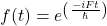 . This turns the growth into a rotation the speed of that spin is
  . Therefore mass (
 ) is the base frequency of this spinning at a specific coordinate.
Again consider the Fourier Transforms for a stationary particle in QFT, the energy Ep reduces to its rest energy In wave mechanics, the energy of an oscillation is E = hf (or E = ℏω)34. When p = 0 in the dispersion relation, you get  37. Therefore:
Because of the Mass-Frequency Equivalence ( )
)  must satisfy wave nature (
 ), therefore absolute stillness is impossible under the Heisenberg uncertainty principle5:
![\[\Delta x \, \Delta p \geq \frac{\hslash}{2}\]](https://nhsjs.com/wp-content/ql-cache/quicklatex.com-8ee1278f557034911d56a0c777ce2b06_l3.png "Rendered by QuickLaTeX.com")
Take a particle with mass () and assuming it is at rest, the math shows that to satisfy the wave equation, that particle must have an internal frequency. The Internal Frequency  . If
. If  and were confined to a finite region where
  is finite, then
  would have to be exactly zero, violating
  5. A perfectly still, perfectly localized particle is impossible.Every field point functions as a Quantum Harmonic Oscillator6,34. Energy can only be added or removed in discrete packets called Quanta due to Boundary Conditions and the Commutation Relations of quantum operators. All energy E must be quantized and because there is a field at every point there is energy and Mass-Frequency Equivalence holds true at all points along with zero-point energy or vacuum energy all points in space are quantized.
Spacetime Quantized
Spacetime as fundamentally discrete20,21,38 (Spacetime quantized at the fundamental level) looks indistinguishable from spacetime being smooth but quantized at every point (Spacetime smooth but quantized at every point) there is not a measurable difference the two are equivalent in all practical situations. Furthermore observable physics looks indistinguishable from a perfectly smooth, continuous spacetime.
It is not known whether the geometry of spacetime is fundamentally discrete (granular at the Planck scale or similar) or fundamentally continuous. However, we do know that energy is quantized at every point due to the zero-point energy in a vacuum (E = hf from Planck’s resolution of blackbody radiation34, extended through QFT to all fields and excitations6). Because there is a field (or the vacuum state of fields) at every point in spacetime, and because any excitation or measurement is quantized with wave nature and Heisenberg uncertainty5 preventing perfect localization or stillness, every point in spacetime that carries energy (all points) effectively carry this quantization rule.
With this approach there is no reason to commit to either “geometry is fundamentally discrete or smooth.” The result is that a spacetime geometry could be “smooth but quantized at every point” (continuous manifold with quantized energy/momentum modes and vibrations everywhere) looks and behaves identically — to all measurable precision and for all practical purposes — to a geometry that might be fundamentally quantized in its structure itself. There is no measurable difference between these two descriptions at any scale we can access.
Any measurement of spacetime geometry (distances, intervals, propagation of ripples) ultimately relies on the above equations: sending or detecting quanta with E = hf, localizing via the uncertainty principle, and using the energy-momentum relation.
The core of the argument relies on the Central Limit Theorem applied to measurement .When measuring a distance L composed of N discrete steps of size Δx, each step carries an inherent quantum uncertainty δx ≈ Δx5. If these fluctuations are uncorrelated, they add in quadrature (the mathematical method of combining independent uncertainties.) The total uncertainty ΔL is:
![\[\Delta L = \sqrt{\sum_{i=1}^{N} (\delta x_i)^2}= \sqrt{N \cdot (\Delta x)^2}= \sqrt{N=\Delta x}\]](https://nhsjs.com/wp-content/ql-cache/quicklatex.com-caaa146cd454f45bb815bb2422383d8e_l3.png "Rendered by QuickLaTeX.com")
The relative error  determines if we can detect the difference of quantized spacetime. Substituting
  :
:
![\[\frac{\Delta L}{L}=\frac{\sqrt{L \cdot \Delta x}}{L}=\sqrt{\frac{\Delta x}{L}}\]](https://nhsjs.com/wp-content/ql-cache/quicklatex.com-896b4ff5a79d0a0ff278e282dd92cf12_l3.png "Rendered by QuickLaTeX.com")
Because (the Planck scale,  )20 miniscule in relation to L (any measurable distance), the ratio
  is effectively zero. This is why the quantized spacetime is indistinguishable; the statistical smoothing is too perfect to probe with current energy levels.
This is mathematically analogous to Einstein’s equivalence principle8 (established 1907–1915, confirmed in all tests of general relativity). Gravity ≡ Acceleration (Locally) as Smooth Geometry ≡ Quantized Geometry (At measurable scales).
For clarification when you have N independent measurements (or independent small segments), each contributing its own random uncertainty δ (here, the typical single-segment fluctuation scale from the uncertainty principle), the combined uncertainty on the total is not N × δ (that would be for systematic errors that all add in the same direction). Instead, random fluctuations tend to partially cancel, and the total uncertainty grows only as the square root of the number of contributions:
![\[\Delta_{total}=\sqrt{N} \times \delta\]](https://nhsjs.com/wp-content/ql-cache/quicklatex.com-c6efc7c1d50e9a99595b5f3fbb45a456_l3.png "Rendered by QuickLaTeX.com")
This quadrature sum (root-sum-square) for uncorrelated uncertainties comes directly from the definition of variance:
![\[Var (total) = N \times Var (single)\]](https://nhsjs.com/wp-content/ql-cache/quicklatex.com-9b73c1f09b76ab21cd54b9fb082e3b8d_l3.png "Rendered by QuickLaTeX.com")
when independent, so standard deviation (uncertainty) scales as  . This is confirmed in the Propagation of uncertainty, and error analysis in measurements. The single-segment fluctuation scale comes from the Heisenberg uncertainty principle
  . For a small segment of size . The minimal position uncertainty per segment is on the order of itself, which forces a minimal momentum (and thus energy) fluctuation. In the relativistic case relevant to light ripples or spacetime measurements, this translates to a position uncertainty contribution per segment of order . Combining via the rule above gives:
![\[\Delta L \approx \sqrt{N} \times\Delta x=\frac{\sqrt{L}}{\Delta x \times \Delta x}=\sqrt{L \cdot \Delta x}\]](https://nhsjs.com/wp-content/ql-cache/quicklatex.com-4058411e01b5c1623b67ae016a3a7cd1_l3.png "Rendered by QuickLaTeX.com")
This  scaling for accumulated uncertainty over a long baseline built from many small segments is a standard way error analysis is applied in quantum mechanics and precision measurements. This follows directly from the math above:
For any fixed, measurable  (any laboratory length, collider scale, or astronomical distance we can actually probe), if the small-scale is taken to be extremely small, then
  becomes vanishingly small, and the square root makes the relative uncertainty even smaller — approaching zero.
Because spacetime is quantized or every point is because the particle is a wave — it does not fit into a single quantized spot, it overlaps onto many spots at once. Superposition is the physical reality of that wave spreading across multiple points in the quantized fabric before it is forced to settle into one. Therefore a wave or particle can interfere with itself.
Superposition
As for superposition in Abstract Mechanics: spacetime is quantized because the particle is a wave — it does not fit into a single quantized spot. It overlaps onto many spots at once. Superposition is the physical reality of that wave spreading across multiple points in the quantized fabric before it is forced to settle into one. Therefore a wave or particle can interfere with itself. A quantum state is written as a superposition6,22:
![\[|\psi\rangle = \sum c_n \, |n\rangle\]](https://nhsjs.com/wp-content/ql-cache/quicklatex.com-a2813eb4150e27a6524e116dacdb4ae7_l3.png "Rendered by QuickLaTeX.com")
where  denotes the basis state localized at one discrete point labeled by integer , with position
  , and the complex coefficients
  satisfy
  . Before any measurement23, the amplitudes cn are non-zero for many values of n. The wave function is therefore physically spread across multiple discrete points at once. This delocalized superposition is the physical reality. At a later detection point m, the amplitude is the coherent sum over all ways the state could have reached m:
![\[C_m = \sum_{\text{paths}} a_{\text{paths}} \, e^{i\Phi_{\text{path}}}\]](https://nhsjs.com/wp-content/ql-cache/quicklatex.com-8832465869e94ceaa50ea74eaa2f81de_l3.png "Rendered by QuickLaTeX.com")
Where  is the amplitude along each path through the discrete points,
  and is the phase. The probability is
![\[P(m) = |C_m|^2 = \sum_{\rm paths} |a_{\rm path}|^2 + 2\sum_{{\rm path}_1 \neq {\rm path}_2} {\rm Re}\!\left( a_{{\rm path}_1}^{*} \, a_{{\rm path}_2} \, e^{i(\Phi_1 - \Phi_2)} \right)\]](https://nhsjs.com/wp-content/ql-cache/quicklatex.com-0fcc8af7cf545a56305143d96aaa28ab_l3.png "Rendered by QuickLaTeX.com")
The cross terms produce interference22,23. The particle interferes with itself because its amplitude has occupied multiple discrete points coherently before detection. Upon measurement, the state settles into one single point ∣m⟩ with probability P(m) Superposition is thus the physical spreading of the wave function across multiple discrete points, which directly enables self-interference via amplitude addition. The math is the standard linear structure of quantum mechanics6 applied to a discrete underlying set of points.
The equations show that superposition is the wave spreading across many discrete points before it is forced to settle into one. Because it spreads across multiple points, different paths interfere, producing the self-interference pattern we observe. The amplitude sum  and the resulting probability
  with cross (interference) terms. This is known quantum mechanics; it comes from the linearity of the Schrödinger equation and is precisely why a single particle interferes with itself.
Richard Feynman’s path-integral formulation10 expresses exactly this idea (summing amplitudes over paths).
The reason why the wave function must spread its amplitudes across multiple discrete points before any measurement forces it to settle into one is because Quantum mechanics is built on linear algebra in a Hilbert space. The possible states of a particle form a vector space, and the rules are linear: if |A⟩ and |B⟩ are allowed states, then any combination |A⟩ + |B⟩ is also allowed (superposition)6.
When positions are discrete, the natural basis states are the ones localized at each individual point: call them |n⟩ for point number n. Any general state must therefore be written as a sum:
![\[ |\psi\rangle=\sum_n c_n|n\rangle \]](https://nhsjs.com/wp-content/ql-cache/quicklatex.com-819f2dc09cdea967a5c8bd6325ed18a6_l3.png "Rendered by QuickLaTeX.com")
with complex numbers or the complex amplitude at discrete point . If only one is nonzero, the particle is localized at exactly one point.But localizing it sharply to a single point creates a huge momentum uncertainty (from the Heisenberg principle5). That huge uncertainty makes the state unstable — it immediately spreads out because of the dynamics (the Schrödinger equation6 or its discrete version).
To have a stable, coherent state that can travel a macroscopic distance and produce interference as we observe in every double-slit experiment with photons, electrons, atoms, etc.22,23, the amplitudes must be nonzero at many points simultaneously. The wave is physically delocalized across multiple discrete points, carrying definite phase relationships between them. Before measurement, many of these are non-zero at the same time — that is exactly what “the wave spreading across multiple points” means.
When the wave later reaches a screen or detector, the probability at any final point is  , where
  itself is the sum of amplitudes arriving via all possible routes through the discrete points. Different routes add as complex numbers, producing constructive and destructive interference. That is why a single particle can interfere with itself — its amplitude explores multiple points coherently.
If the state were forced to stay at one single point the whole time, there would be only one route, no cross terms, and therefore no interference pattern. But experiments clearly show interference, so the delocalized superposition is required.
In relativity, to influence something at point B from point A, you must send a signal limited by the speed of light c. This enforces locality and contributes to the arrow of time we experience (reinforced by the second law of thermodynamics and increasing entropy).
A perfectly localized state (δ-function in position) has infinite momentum uncertainty (Heisenberg principle). Dynamics (the Schrödinger equation or its discrete version) cause any initially narrow wave packet to spread. For interference patterns to persist over macroscopic distances, the state must maintain coherence across a sufficient spatial extent — i.e., the amplitudes must be nonzero and phase-related over many points (discrete or continuous).
Assume that superposition is not a core axiom and space is quantized. Because the wave cannot fit into one spot, it is in more than one at all moments, and because the space is quantized it can interfere with itself and not have any definite position. Because the points are discrete, a physical system simultaneously exists in multiple states, configurations, or locations — in spin, energy levels, polarization — rather than just one, because the points exist in different parts of the quantized space. What makes up one particle is a collection of energy separated by the quantization of points in spacetime, within one energy state the particle consists of separate energy. Polarization is a wave orientation property, so if the underlying entity is a wave on discrete space, its orientation states span multiple nodes.
The energy exchange that forces a particle to stabilize is harmonizing the wave or particle that is decoherent. The wave, interacting with another system (detector, environment), is forced into a resonant/harmonic configuration with it. The decoherent multi-node spread synchronizes. The result seems like “choosing a state” but is actually wave-locking. Superposition is the unavoidable spatial extent of any wave on a discrete substrate. A quantum system “exists in multiple states” because its wave nature on quantized space prevents point-localization. Internal degrees of freedom (spin, polarization, energy) are distinct topological/harmonic modes of that same wave across nodes. Measurement is the process by which an external wave interaction forces the system wave into a resonant eigenmode — what standard QM calls collapse is just wave harmonization.
Assuming space is quantized at Planck length20, a wave — no one particle or wave — can fit into one Planck-length. To “squeeze” a particle into a space as small as a Planck length, you would need probes with incredibly high energy. According to Heisenberg’s Uncertainty Principle5, localizing a particle tightly would give it so much momentum and energy that it would likely collapse into a tiny black hole. Therefore there is no particle that would fit into one, making all decoherence and superposition possible.
For clarification, a spin-½ particle in superposition of ↑ and ↓ is not only about spatial spread across nodes — it is an internal degree of freedom. But because one particle is split, an internal degree does not and will not be consistent unless it is harmonized –one particle is what you call an organized system of energy but they are split.
The wave overlap is the cause of superposition. The discrete nodes force the wave to spread coherently across many sites at once, producing the delocalized state that enables self-interference and multi-state existence. The Conatus gradient flow on the quantized spacetime then drives the resonant locking that appears as measurement. Superposition therefore emerges directly from the wave nature on a discrete substrate and requires no separate axiom.
The wave function (or probability amplitude) spreads coherently over multiple sites or positions, enabling it to interfere with itself. The coherent spreading of the wave function amplitudes across multiple positions or basis states.
The discrete position basis and path-sum formulation above already show how a delocalized wave function produces self-interference. In Abstract Mechanics this behavior receives a deeper, non-axiomatic foundation once spacetime is treated as quantized into discrete nodes separated by the fundamental length  (Planck length). A particle is not a point but a wave-like excitation described by a complex amplitude
  at each node n, with position
  .
.
Any physical excitation must carry finite energy and momentum, it cannot remain localized at a single node. A perfectly single-node state  , 0 corresponds to the shortest possible wavelength. This requires infinite momentum uncertainty in the discrete Fourier transform. Moreover, squeezing a particle into one Planck-scale node would require probes of extraordinarily high energy; by the Heisenberg uncertainty principle the associated momentum uncertainty would collapse the region into a microscopic black hole. Consequently, no stable particle can occupy one node. The wave nature on a discrete substrate therefore forces the excitation to spread coherently across many nodes at all times.
![\[i\hslash\frac{d \psi_n}{d t}=-J\left(\psi_{n+1}+\psi_{n-1}\right)\]](https://nhsjs.com/wp-content/ql-cache/quicklatex.com-77d4bc528f5e7b3a47f1d75f1cec8d96_l3.png "Rendered by QuickLaTeX.com")
where  is the coupling strength between adjacent nodes. Plane-wave solutions
  yield the dispersion relation
![\[\omega(k)=\frac{2 J}{\hslash} \cos k\]](https://nhsjs.com/wp-content/ql-cache/quicklatex.com-7347beb227cb20782ee65c803b323091_l3.png "Rendered by QuickLaTeX.com")
Different wave-vector components propagate at different group velocities, so any initially narrow excitation disperses immediately. At any later time the amplitude  is therefore nonzero at multiple nodes simultaneously, carrying definite relative phases. This coherent overlap across discrete points is the physical content of superposition in the position basis: the wave cannot fit into one Planck-scale node, so it overlaps many nodes coherently at all moments. At a later detection node m m m, the amplitude is the coherent sum over all possible paths:
![\[\Psi_m=\sum_{\text {paths }} a_{p a t h} e^{i \phi_{p a t h}} \text {, }\]](https://nhsjs.com/wp-content/ql-cache/quicklatex.com-5efd0596dcab2e1bdd6a339d45aed94a_l3.png "Rendered by QuickLaTeX.com")
Where  is the amplitude along each path through the discrete points,
  and is the phase.
The probability is
The cross terms produce the observed self-interference pattern. Because the wave has already overlapped multiple nodes coherently before detection, a single excitation interferes with itself. There is no definite position until the interaction with the measuring apparatus occurs.
Internal degrees of freedom (spin ↑ / ↓, polarization, energy levels) are distinct harmonic or topological modes of the same spread wave excitation across the shared lattice nodes. The total amplitude at node n therefore carries a superposition of these modes Because the underlying entity is one organized wave (not a collection of separate point particles), the internal modes remain phase-coherent across the discrete substrate. A spin-½ superposition is simply the wave simultaneously carrying both modal patterns across multiple nodes.,
Measurement or decoherence is the process by which an external system (detector or environment) interacts with the delocalized wave. Energy exchange forces resonant locking: the multi-node phases of the quantum excitation synchronize into a single dominant eigenmode of the combined system. Off-diagonal coherences decay rapidly, and the excitation appears to “choose” one state. What standard quantum mechanics calls collapse is, in this picture, simply wave harmonization—the unavoidable synchronization of the delocalized wave with the external wave system, fully consistent with the drive toward equilibrium. Superposition arises because delocalized resonant states allow the system to explore lower-energy paths before locking into a definite configuration. Entanglement reflects shared equilibrium constraints across connected parts of the field. Measurement shifts the free-energy landscape, causing collapse.
In summary: Superposition as physical wave-spreading on a discrete grid — a wave can not fit into one Planck-scale spot, so it must spread coherently across many nodes. That spreading is superposition, self-interference, and carrying multiple states/modes at once. Measurement is just wave-locking via the same flow.
Entanglement and Time and Pre-Geometric Overflow
‘Pre-Geometric Overflow’ accounts for the observed FTL inflationary period18,19, as the universe sought to reach the  equilibrium required for a stable, causal spacetime structure. While serves as the physical floor for modern gravitational gradients, the Big Bang began in a super-critical state where
  . Because the energy density exceeded the spacetime compression threshold, the resulting expansion was not a gradual growth but a violent expansion of
  . This ‘Pre-Geometric Overflow’ accounts for the observed FTL inflationary period19. As the universe sought to reach the max equilibrium required for a stable, causal spacetime structure:
In quantum entanglement39,40,41,42,43, two distant parts ( and
and  ) are described by one single wavefunction. They are not two separate things exchanging a signal. A measurement on one instantly updates the joint description of the whole system. To the entangled quantum system itself, there is no travel time or distance that needs to be crossed by any signal.
This is genuine non-locality standard, experimentally confirmed quantum mechanics40,41,42,43, but it does not violate relativity because no usable information travels faster than light. Therefore, the ordinary (x, y, z, t) description — while perfectly valid and real for signals, measurements, and macroscopic physics — is not the most fundamental layer for all quantum phenomena. Non-locality40 reveals that some aspects of reality are coordinated in a way that treats spatial separation and time intervals as secondary for the global quantum state.
Quantum entanglement’s perfect instantaneous correlations—observed to occur without any signal or time delay across arbitrary distances—cannot be explained within the ordinary (x, y, z, t) fabric alone; this phenomenon is already known in physics as non-locality. The instantaneous correlations—observed to occur without any signal or time delay across arbitrary distances40,41,42,43—cannot be explained within the ordinary (x, y, z, t) fabric alone; this phenomenon is already known in physics as non-locality40.
The direct logical consequence of non-locality/A-temporal coordination is real and contains all events as fixed coordinates, then no event can be genuinely random. What quantum mechanics calls ‘probability’ is the mathematical description of an observer’s incomplete access to a description of the universe’s actual state. This does not imply that anything is predictable. The a-temporal substrate is not a place, it is a description of what non-locality means for our universe. The universe remains perfectly unpredictable to us, even if it is perfectly determined in its own a-temporal geometry.
Time as a contextual, not always absolute, component. In most everyday and relativistic processes (signal propagation, particle collisions, thermodynamic evolution2,3,4, measurements with light or matter), time plays a primary role. For non-local quantum processes like entanglement39,40, however, time (and spatial distance) is secondary for the joint system. The a-temporal aspect is not a separate realm or hidden location. It is a way of describing what non-locality implies — that some quantum correlations treat spatial separation and time intervals as secondary for the full state, while local physics still respects (x, y, z, t) and the light-speed limit.
Frequential Gravity and Time Dilation
In this quantized view spacetime consists of discrete fundamental units at an extremely fine scale20,21,38. Mass or energy (via )37 distorts the local vibration rates, or “clock speeds,” of neighboring quantized spacetime units. The distortion appears as a gradient: units closer to the mass vibrate more slowly, while those farther away vibrate faster. This “loading” reduces the effective vibration rate, or the local vibration speed, of the units closest to the mass. This “loading” happens because mass is a large concentration of energy in spacetime that lowers the effective vibration rate (frequency f) of the nearby quantized spacetime units — their internal local vibration rates slows down more tensioned and oscillates slower.
Mass is a high concentration of energy37. This energy creates a gradient of vibration speed around the nearby spacetime, lowering the local vibration rate of the quantized units around it by changing the local vibration rate around them. Because of this lowered vibration rate, matter naturally curves toward the mass. Objects follow the path that maximizes their proper time7,8,910,17, which means sliding toward the region where time accumulates more slowly due to the reduced vibration.
In close proximity to the mass, in the region of lowered vibration rate, everything feels completely normal to a local observer. Light still crosses space at exactly speed c, and all local vibration rates and processes run on the same reduced vibration rate, so one second feels like a normal second. Any trip or process takes the usual amount of local time.
Further away from the mass, where the vibration rate remains at its baseline, the same signal or journey appears to take longer than expected. This is not primarily because the spatial path has lengthened significantly. Instead, the rate at which time accumulates in the changed region is slower due to the reduced local vibration rate. Fewer ticks occur during the journey when measured against the faster distant vibration rates.
In regions of higher f (far from the big mass), the local modes oscillate faster. The excitation can propagate more readily because the energy levels and phase evolution are quicker. In regions of lower f (near the big mass), the local modes oscillate more slowly. The excitation experiences a lower effective energy scale or slower phase accumulation.
When the concentrated mass-energy creates a large concentration of energy in the local region, it alters the energy state of those quantized spacetime units (conserving total energy). The nearby units have less available capacity for their own vibrations, so their effective vibration rate drops  .
.
Consider a test particle or small mass as a localized excitation (a wave packet or collection of quanta with E = hf). In the discrete picture, its quantum state evolves according to the local Hamiltonian, which depends on the vibration rate f at each quantized spacetime it overlaps with.
Because the test mass itself carries energy ( ), it also “loads” the local quantized spacetime units slightly wherever it sits. However, the background gradient created by the big mass dominates. The test excitation will have a lower total energy cost (or more favorable amplitude evolution) when it moves into the already-low-f region near the big mass.
Result: the test mass naturally shifts toward the quantized spacetime units with the lowest f (closest to the big mass). It is not being “pulled” by a force. Instead, the background loading from the concentration of mass creates an asymmetric environment: the excitation finds a more stable or lower-effective-energy configuration by moving into the slower-vibrating region. The gradient in f acts like a refractive index gradient for the wave packet — the excitation refracts or drifts toward the slower side without dependency on maximal aging or traditional theories of gravity.
- Local observer near the mass: Everything (including their own atoms and clocks) runs on the same lowered f. Processes, light propagation (still at local c), and time feel normal — one second is still one second locally because their reference is scaled to the slower vibration.
- Distant observer: Their clocks run at baseline
 . They see fewer “ticks” accumulating in the low-f region per unit of their own time, so signals, light, and clocks near the mass appear slowed. Light still crosses each local segment at c, but the overall journey takes more coordinate time from afar because time itself accumulates more slowly there.
In quantum mechanics, the time evolution of the state  favors lower-energy configurations.
- If the wave packet starts mostly on the higher-f site, the amplitude flows toward the lower-energy (lower-f) site because the phase evolution and probability current are biased in that direction.
- The energy offset ΔE acts like an effective potential gradient. The excitation experiences a net drift toward the minimum of this effective potential — i.e., toward the region where f is lowest (closest to the large mass).
Over many small hops across the discrete quantized spacetime units, this produces a systematic net motion of the test mass toward the lowered vibration rate region. No external classical force is applied; the drift emerges directly from the position-dependent local frequencies in the quantum dynamics on the quantized fabric.
In the case of a black hole44,45,46,47, extreme mass-energy so heavily “loads” the central units that their vibration rates become extremely low, preventing light from escaping. The quantization replaces the classical point singularity with a finite, highly distorted core while producing the same external geometry at larger distances. The event horizon is where the gradient becomes steep enough that outgoing paths no longer reach distant observers.
It is possible to derive a consistent mathematical framework showing why, quantized spacetime at a tiny scale Δx combined with the quantum relation E = hf (for excitations/quanta) and relativity (special + general, via the equivalence principle and proper time), gravity must manifest as a gradient in local vibration speeds (f) rather than a traditional force. The object then follows the path of extremal (typically maximal) proper time by moving toward regions of slower local f.
Einstein proved gravity is not a force, but the physical manifestation of spacetime distortion7,8, spacetime has a discrete structure which we will refer to as quantized spacetime meaning one quantized unit of space at scale Δx points or units  , with n labeling them where Q is a quantized spacetime unit. Each local region supports quantum excitations with energy quanta E = hf34, where f is the local vibration frequency of the underlying field or mode at that point.
Additionally, frequential gravity naturally accounts for frame-dragging (the Lense–Thirring effect). When a massive body rotates, it not only loads the nearby quantized spacetime units and slows their vibration rate, but it also gives the local frequency pattern a rotational twist. The zero-point energy — the baseline vibrations present everywhere, even in vacuum — gets carried along with this rotating frequency gradient.
As a result, the entire local fabric of spacetime is dragged around with the rotation. Nearby objects and reference frames feel this as a twisting of inertial directions: gyroscopes precess, orbits pick up extra precession, and the “compass of inertia” gets pulled along. No extra mechanism is needed. The same loading process that creates the ordinary gravity gradient simply acquires a rotational component when the source is spinning. The zero-point energy, being tied directly to the local vibration rates, participates in the dragging. This recovers the standard frame-dragging predictions of general relativity as a natural consequence of the frequency dynamics on the quantized substrate.
In this view time dilation arrives naturally. Locally, the rate at which vibrations add up to time has slowed because the frequency f is lower. Light still travels at c through the geometry. But because the local processes run slow, the entire trip appears to take more time when seen from the normal region where local vibrations run at the usual rate.
This is why gravitational time dilation48 shows up mostly as a time effect rather than a big extra-distance effect in weak gravity. The change caused by the mass lowers the local vibration rate, which makes proper time build up more slowly near the mass. Light does not slow down locally — it still moves at c — but the lowered vibration rate makes the accumulation of time slower in that region.
The same principle explains the Shapiro time delay17,10: a radar signal passing near the Sun requires extra coordinate time for the round trip, largely because part of its path travels through a region where local vibration rates are reduced.
Light still always travels at exactly speed c locally. However, because the vibration rate is lower near the mass, the accumulation of time slows down in that region. From a distant observer’s perspective, light (and everything else) appears to move more slowly through the affected area, and signals take longer to complete their journey (as seen in gravitational redshift and the Shapiro time delay).
Right next to the mass, a local observer experiences everything as completely normal. Light crosses space at c, and their local vibration rate and all processes run on the lowered vibration rate. One second still feels like a normal second to them — it is simply scaled to the slower local vibration. Only when compared to distant regions (where the vibration rate remains higher) does the time dilation become apparent: local vibration frequencies near the mass tick more slowly relative to distant local vibration frequencies.
Therefore lower vibration rate leads to slower proper time accumulation and geodesics naturally curve toward that region (no pulling force needed).
Because spacetime is built from discrete fundamental units at scale Δx, each supporting quantized excitations with energy E = hf, where f is the local vibration frequency of the unit.
A mass m contributes rest energy this energy must couple to the local quantized structure. Because total energy is conserved and the field already has a baseline energy density (vacuum or zero-point contribution at every point), the added mass-energy by the large concentration of energy in the nearby units. It reduces their available capacity to vibrate, lowering the effective local frequency from a baseline to a smaller value .
In the weak-field limit of general relativity (which must be recovered for consistency with experiments), the proper time interval for a clock is related to coordinate time dt by the gravitational time-dilation factor. Identifying proper time accumulation with the local vibration rate gives:
![\[\frac{f_{l o c a l}}{f_0} \approx 1+\frac{\phi}{c^2} \]](https://nhsjs.com/wp-content/ql-cache/quicklatex.com-7a097d0223fa9e14fc4f11bd22e5f9ac_l3.png "Rendered by QuickLaTeX.com")
where  is the Newtonian gravitational potential (
 and more negative near the mass)17.
Thus, mass-energy directly causes near the mass. The reduction is a gradient: neighboring units closer to the mass have progressively lower  , while distant units remain near .
But we can show this directly from the quantized picture and basic quantum dynamics, without invoking the Principle of Extremal Aging or geodesics as a starting assumption. The reasoning stays fully within the framework of quantized spacetime units at scale Δx, E = hf for excitations, and for mass-energy “loading.” A large mass is a high concentration of energy (). In the discrete fabric, this energy must couple to the nearby quantized spacetime units. Each quantized spacetime unit has a baseline capacity to support vibrations (quantized excitations with frequency f).
From relativity, rest energy is  . For a massive object or field excitation localized near a certain quantized spacetime unit, this concentration of energy couples to the local structure, altering the effective frequency. In the weak-field limit of general relativity (standard approximation, fully consistent with experiments), the proper time
  for a local vibration rate in gravitational potential
  (
( and
and  larger near mass) is:
![\[d\tau\approx d t\sqrt{1+\frac{2 \Phi}{c^2}}\approx d t\left(1+\frac{\Phi}{c^2}\right),\]](https://nhsjs.com/wp-content/ql-cache/quicklatex.com-9bfbf1886eef75ff0c08219876f955f6_l3.png "Rendered by QuickLaTeX.com")
where dt is coordinate time further away. This is gravitational time dilation: clocks run slower where is larger. Since energy is quantized as  (Planck relation, confirmed for photons and matter waves), a local clock” or field mode at a quantized spacetime unit has vibration rate . The proper time accumulation is directly tied to the number of oscillations or cycles:
  locally (slower means slower aging/proper time buildup). If mass/energy (via ) couples to the local structure and conserves total energy, it must reduce the effective local near the mass (theloading” or distortion of the local field). Far away,
  (baseline). Near mass, . Mathematically, identify the gravitational time-dilation factor with the frequency shift:
Exact relativistic form in Schwarzschild metric:  . This follows because must redshift/blueshift consistently with the metric: a photon climbing out of the well loses energy, so observed decreases exactly as the clock rate slows. Thus, mass/energy distorts by creating a gradient
  between neighboring quantized spacetime units: decreases toward the mass. Thus, mass/energy distorts by creating a gradient between neighboring quantized spacetime units: decreases toward the mass. In relativity, free particles follow geodesics, defined variationally by the Principle of Extremal Aging:
![\[\delta \int d \tau=0\]](https://nhsjs.com/wp-content/ql-cache/quicklatex.com-b8e925a83dcf7c7b1e947835b7542cbb_l3.png "Rendered by QuickLaTeX.com")
In the quantized picture,  accumulates locally according to the vibration rate at each quantized spacetime the object traverses:
![\[d \tau \approx \frac{1}{f(x)} d s_{\text {local }}\]](https://nhsjs.com/wp-content/ql-cache/quicklatex.com-1ab34f82af785c56e16087f3a0559072_l3.png "Rendered by QuickLaTeX.com")
where  is the local segment (still crossed at speed
  ). Because is lower near mass, spending more “path” in low- regions allows greater total
  (more cycles/aging accumulate for the same coordinate path).
The object therefore naturally refracts or slides toward the gradient of lower — exactly as in optics (light bends toward slower medium to extremize optical path, Fermat’s principle). Here, it is the spacetime path that extremizes proper time. No external “pulling force” acts at a single point. The motion is guided by the collective gradient in vibration rate speeds between quantized spacetime units, enforced by the variational principle  and the relativistic metric.
For light (null geodesics,  but still follows the same geometry), the wave ( ripple) refracts toward slower- regions, producing gravitational deflection and Shapiro delay, while locally always propagating at
  . If spacetime is quantized (discrete quantized spacetime units at ) and excitations obey and relativity holds (proper time is physical, geodesics extremize
  , local is invariant, equivalence principle), then:
- Mass/energy () must couple locally, altering f to satisfy energy conservation and the metric.
- The only way to recover observed time dilation, redshift, and inertial motion is via a gradient in f between units.
- Motion then automatically follows the extremal proper-time path through that gradient — no extra force is needed or possible without violating the assumptions.
While the preceding analysis focused on gravitational time dilation arising from external mass-energy loading the quantized substrate, the same frequential framework naturally extends to purely kinematic (velocity) effects, because it follows the same principles of special relativity37.
Virtual pairs constantly fluctuate near the event horizon due to quantum vacuum effects44,45. Normally, they annihilate quickly. Near the horizon, tidal forces (the steep gradient in spacetime curvature/vibration rates) can separate them before annihilation. The standard outcome that produces Hawking radiation44 is:
- One member of the pair (with positive energy as seen from afar) escapes as a real particle (thermal radiation).
- The other member (appearing with negative energy relative to a distant observer) falls across the horizon.
The black hole absorbs this negative-energy contribution, which reduces its total mass-energy. This is what causes the black hole to lose mass and slowly evaporate44,45. The escaping positive-energy particle carries away real heat/radiation. The process is not symmetric (it is not equally likely for positive or negative to fall in); the mathematics of quantum fields in curved spacetime produces a net outward flux of positive energy44,45,47.
Negative energy states are allowed temporarily near the horizon due to the intense gravitational gradient (the steep change in local vibration rates f). Once inside, they become stable relative to the black hole’s interior geometry. This “debt” is paid by reducing the black hole’s mass, allowing the positive partner to become a real, observable particle outside. In the start the black hole mass M (energy  ) + vacuum fluctuations (net zero average energy). During the process a virtual pair forms near the horizon (net zero energy). The negative-energy partner crosses the horizon and is absorbed. The black hole’s total energy decreases by E (it “gains” negative energy, equivalent to losing positive mass-energy). The positive-energy partner escapes as real radiation carrying +E to infinity. The result is the black hole mass becomes M − E (it shrinks). The universe outside gains +E in the form of Hawking radiation (heat/photons/particles). And the total energy becomes (M − E) + E = M — conserved overall.
The black hole does lose mass and evaporates over time. The “old matter” that formed the black hole is not preserved in its original form; it is converted into the outgoing radiation (plus whatever remains in the shrinking core until the final stages). This is analogous to how virtual pairs briefly “borrow” energy but must repay it — here, the horizon allows a permanent separation that extracts energy from the black hole.
The total energy of the universe (black hole + radiation) remains conserved. The black hole simply radiates away its mass-energy gradually as thermal Hawking radiation, with temperature inversely proportional to its mass (smaller black holes radiate faster). Frequential gravity uses GR’s predictions as a constraint it must satisfy, derives the core behavior from deeper axioms, and in doing so produces a physically distinct ontology that extends beyond where GR can extend.
Einstein’s general relativity states that gravity curves spacetime: the more mass an object has, the more it curves the surrounding spacetime. Yet this geometric description, while mathematically exact, leaves the deeper mechanistic unanswered. It would stand to reason — and is in fact required by the axioms—to view the same phenomenon as arising from frequency differences in the underlying quantized substrate. Photons, which carry pure energy and possess zero rest mass, are already known to curve spacetime; this effect aligns far more naturally with energy density and the resulting local frequency gradients than with an abstract geometric distortion alone.
In this quantized view, spacetime consists of discrete fundamental units at an extremely fine scale20,21,38. Mass or energy (via 37 ) distorts the local vibration rates, or “clock speeds,” of neighboring quantized spacetime units. The distortion appears as a gradient: units closer to the mass vibrate more slowly, while those farther away vibrate faster. This “loading” reduces the effective vibration rate, or the local vibration speed, of the units closest to the mass. This “loading” happens because mass is a large concentration of energy in spacetime that lowers the effective vibration rate (frequency f) of the nearby quantized spacetime units—their internal local vibration rates slow down, become more tensioned, and oscillate more slowly.
Quantum gravity in Abstract Mechanics requires no graviton. Mass-energy directly distorts the quantized spacetime substrate by loading and reducing the local vibration frequency f of the fundamental units, creating a gradient ∇f toward regions of slower oscillation. Test particles and fields, themselves vibrations of the single underlying field, naturally follow paths of extremal proper time by drifting down this frequency gradient. Gravity is therefore not a force mediated by particle exchange but the equilibrium-seeking geometric response of the spacetime fabric itself, governed by the universal Conatus gradient flow. This mechanism recovers all observed gravitational phenomena—including time dilation, frame-dragging, and long-range coherence—directly from the four axioms without introducing additional speculative particles or fields.
Resistance-Scale Quantum Fluctuations
The constant  (Planck force scale, often called the Einstein tension or resistance scale) measures how resistant spacetime is to curvature7,10. It quantifies the effort required to deform the fabric: enormous energy density is needed to produce even a bit of curvature. From Einstein’s field equation7:
![\[G_{\mu \nu}=\left(\frac{8 \pi G}{c^4}\right) T_{\mu \nu}\]](https://nhsjs.com/wp-content/ql-cache/quicklatex.com-d5227d82968c05b3be6be66d7edd378d_l3.png "Rendered by QuickLaTeX.com")
The coupling constant  (or approximately
  sits in the denominator on the right-hand side. This means curvature (left side) is inversely proportional to this large factor times the energy-momentum density
  . In other words, spacetime is extraordinarily resistant — it takes a huge concentration of real energy to produce noticeable warping.
Virtual quantum fluctuations are temporary excitations with energy hf34. Because spacetime is so rigid (restoring “tension” set by the scale), these tiny waves cannot overcome the resistance to produce lasting curvature or a “dent” in the geometry. They behave like small ripples on an extremely resistant surface: the tension snaps them back almost instantly. Virtual fluctuations are off-shell (temporary energy borrowing allowed by the uncertainty principle) and too weak to source real, on-shell geometry changes. The fabric simply pushes back harder than the fluctuation can push in.
Only a massive concentration of real energy (, many quantized excitations piled together) can overcome this rigidity enough to create strong curvature, such as an event horizon. A black hole forms when enough real mass-energy concentration affects the quantized spacetime units, driving their local vibration rates (f) to extremely low (but finite) values.
Even then, the quantization enforced by h (minimum energy hf and the uncertainty principle preventing perfect localization) ensures the core cannot collapse to a true mathematical point of infinite density. The “hole” remains a finite, highly distorted collection of quantized spacetime units. The event horizon acts as a separator where the gradient in vibration rates becomes so steep that outgoing paths no longer reach distant observers.
The combination of spacetime rigidity ( scale) and quantization (h cutoff) acts as a natural regulator and virtual fluctuations are suppressed or snapped back before they can produce catastrophic curvature. Only real, on-shell energy densities curve spacetime appreciably.
Treating spacetime as responding elastically to weak perturbations (gravitational waves49 of frequency f), an effective Young’s modulus (measure of stiffness/resistance) emerges from the wave equation in GR. Dimensional analysis and direct derivation give
![\[Y_{\text {space }} \approx \frac{c^2 f^2}{G} \]](https://nhsjs.com/wp-content/ql-cache/quicklatex.com-ff58116694759731cb70d6dce6cf9fb5_l3.png "Rendered by QuickLaTeX.com")
For LIGO-detected frequencies49 around f ≈ 100 Hz,
![\[Y_{\text {space }} \approx 10^{31} \mathrm{~Pa}\]](https://nhsjs.com/wp-content/ql-cache/quicklatex.com-1a7b6e4c5bfea84cf39d4e787fa536d1_l3.png "Rendered by QuickLaTeX.com")
which is roughly 1020 times stiffer than steel ( ). This is a standard order-of-magnitude result. A virtual quantum fluctuation has energy on the order of E = hf (or higher momentarily via the uncertainty principle
  ). In the discrete quantized spacetime unit picture, this is a tiny local excitation.
The induced curvature from such a fluctuation would be suppressed by the resistance factor:
![\[\text { Curvature } \sim \frac{c^4}{g} \times(\text { energy density from } h f) \text {. }\]](https://nhsjs.com/wp-content/ql-cache/quicklatex.com-06db7808741ce36176f63ff6654cf446_l3.png "Rendered by QuickLaTeX.com")
Galaxy Gravity “Dark Matter and Energy”
Astronomers have recently confirmed that many supermassive black holes are growing significantly faster than standard models of gravity and accretion allow — up to 13 times faster than the theoretical limit (Super-Eddington accretion)50. In a galaxy is like a vortex called in the spacetime fabric. If the galaxy is the vortex, the black hole is the physical point where space and matter collects.
A full galaxy rotating as fast as it is would create a vortex which create a natural escape velocity and that would spin space with it the “Dark Matter”25,26,27,28,29 seems to pass right through, while the gas clouds stick together because the swirl can move without mass there a vortex is there after the matter moves but the discrete quanta of space-time are still spinning as they still carry their momentum.
Space is quantized at all points and a resistant medium, a vortex is natural. Over time, as the universe got older, more galaxies formed and their central black holes grew fast using that 13 × super-Eddington siphon. Each new spinning galaxy adds its own swirl and strains the resistant quanta of space-time even more. Every high-speed vortex stores extra tension in the global fabric. Eventually all these restoring push-backs add up.
Just as the void edges create an outward evacuation flow due to the density contrast, galaxy edges create an inward accretion/retaining flow. In both cases, the sharper the contrast, the stronger the effective gravitational effect at the boundary — and in galaxies, the rotating vortex amplifies this into the observed “dark matter” phenomenology (flat curves, gravitational lensing-like effects from the strain, faster central black hole growth via super-Eddington-like siphoning along the vortex).
On even larger scales, the cumulative torsional pressure from ~2 trillion such galactic vortices51 contributes to the effective cosmological constant32, driving accelerated expansion (what we call dark energy30,31 — all emerging naturally from the same axioms without new particles or fields. The mechanism described for voids (weaker inside, stronger at edges due to contrast) directly scales up inside galaxies to produce the apparent extra gravity we attribute to dark matter. It is the same gradient operating on the overdense side of the density spectrum, reinforced by the persistent vortex strain.
Because galaxies function as large-scale vortices within a quantized, resistive spacetime fabric. The central supermassive black hole serves as the focal drain point where space and matter converge. As the galaxy rotates rapidly, it induces a persistent swirl in the discrete quanta of spacetime. Visible baryonic matter (such as gas clouds and stars) interacts directly with this swirl and thus “sticks” to the vortex flow. In contrast, the effective contribution we attribute to dark matter arises from the residual strain left behind: after the visible matter has moved onward, the spacetime quanta continue to carry momentum in a manner analogous to how gravitational waves propagate energy and momentum through spacetime curvature in general relativity.
This residual torsional momentum manifests as a persistent tension or “strain” in the fabric, even in regions where baryonic density has decreased. Because the quanta of spacetime are treated as a resistant medium with intrinsic discreteness, the vortex does not dissipate immediately; instead, it stores extra tension that reinforces gravitational-like effects at galactic scales. This mechanism naturally produces the observed “dark matter” phenomenology25,26,27, including flat rotation curves at large radii and enhanced gravitational lensing due to the strained fabric, without requiring new collisionless particles. The momentum is carried similarly to gravitational waves49,52.
Over cosmic time, as the universe ages and more galaxies form, each new spinning vortex adds its own contribution to the global strain. The central black holes grow rapidly by tapping into this vortex-induced siphon, enabling super-Eddington accretion rates50—observed in some high-redshift quasars to reach up to approximately 13 times the classical Eddington limit through channeled inflows along the swirl. Eventually, all these individual restoring push-backs accumulate across the vast population of galaxies (estimated at around 2 trillion51. Each vortex stores torsional pressure in the fabric, and the collective effect of these persistent strains contributes to a net global tension. This cumulative torsional pressure acts like an effective positive contribution to the cosmological constant32, driving the accelerated expansion of the universe that we conventionally label as dark energy30,31. The process emerges directly from the same underlying axioms of quantized, resistant spacetime—no additional fields or particles are introduced.
Importantly, this global accumulation respects energy considerations in an expanding universe. In general relativity, energy is not strictly conserved in the usual global sense due to the dynamical nature of spacetime itself (as seen, for example, in the propagation of gravitational waves or in cosmological expansion). Here, the torsional strain and its restoring effects are encoded in the geometry and dynamics of the fabric, allowing the model to remain consistent with local gravitational tests while permitting the large-scale backreaction that influences cosmic acceleration. The framework thus avoids conflicts with well-verified predictions of general relativity in solar-system and strong-field regimes.
This picture draws a direct symmetry between underdense and overdense regions. Just as the edges of cosmic voids generate an outward evacuation flow due to the sharp density contrast (weaker gravity or higher effective vacuum energy inside the void compared to the surroundings), the edges of galaxies produce an inward accretion and retaining flow. In both cases, the sharper the density contrast at the boundary, the stronger the effective gravitational influence. Within galaxies, however, the rotating vortex significantly amplifies this boundary effect. The persistent swirl converts the gradient into the familiar dark matter signatures: flatter rotation curves far from the center, strain-induced lensing effects, and enhanced central feeding of the black hole via super-Eddington-like siphoning along the vortex lines.
In standard general relativity plus cold dark matter (ΛCDM)19,33, the observed gravitational effects in galaxies require significantly more mass than what is visible in stars and gas alone—yet no such excess is directly detected29. The vortex-strain mechanism offers a geometric alternative: the “missing” gravity emerges naturally from the amplified density gradients and residual spacetime momentum at galactic boundaries, operating on the overdense side of the spectrum in the same way the void mechanism operates on the underdense side. Both are reinforced by the same contrast-driven flows, now scaled and modulated by rotation.
This unified treatment—linking rapid black hole growth, galactic dynamics, and cosmic acceleration through persistent vortices in a resistant quantized medium—provides a parsimonious explanation rooted in minimal extensions to spacetime structure. It is possible to derive an effective metric from the discrete quanta, performing numerical simulations of vortex evolution, and testing specific predictions against rotation curve data25,26,27, early-universe black hole masses from JWST50,51, and large-scale void-galaxy flows.
Each rotating galaxy permanently strains the resistant spacetime fabric around it, storing real mechanical energy in that strain. This is not metaphorical — it follows from the same coupling constant in Einstein’s field equations that governs gravitational waves. Across roughly 2 trillion galaxies, these individual contributions accumulate into a net global pressure. That pressure enters the stress-energy tensor and produces a positive term in the Friedmann equation, which drives accelerated expansion — the phenomenon we label dark energy.
For an analogy: just as a spinning top gyroscopically resists being pushed down, each galactic vortex gyroscopically resists the surrounding spacetime fabric collapsing inward. Multiply that resistance across 2 trillion galaxies and the cumulative outward push becomes the dominant large-scale force in the universe.
When a galaxy rotates, it drags and twists the spacetime around it. That twist does not disappear — it stays stored in the fabric as tension. The rotation genuinely deposits energy into spacetime itself, the same way a spinning mass produces gravitational waves that carry real energy. This naturally keeps expansion at the edge of galaxies and explains why it it that expansion does not happen from every point in space
The cosmological constant is therefore a consequence, not an input. The mechanism produces dark energy from a completely different source — mechanical torsional strain from actual rotating matter — and therefore sidesteps the vacuum energy catastrophe entirely.
Axiom Derivation
The entire framework of Abstract Mechanics rests on four experimentally verified axioms that have been confirmed to high precision:
| A1 | E = hf | Planck 190034 — energy is discrete. |
| A2 | Δx · Δp ≥ ℏ / 2 | Heisenberg 19275 — position and momentum cannot both be exact. |
| A3 | E² = (mc²)² + (pc)² | Einstein 190537 — full energy of anything in motion or massive. |
| A4 | Gμν + Λgμν = (8πG/c⁴) Tμν | Einstein 19157,8,35 — energy density curves spacetime. |
From these four axioms the following seven propositions are derived directly:
P1: Quantized energy at every point in space
Light requires a field to propagate, and fields exist everywhere6,34. By A1, every field mode at every coordinate x carries quantized energy E = hf. The vacuum is simply the lowest-energy state of these overlapping fields.
![\[ E=\text { hf at every point } x \in \text { space }\]](https://nhsjs.com/wp-content/ql-cache/quicklatex.com-a98d88e3306b20289f024db102be644a_l3.png "Rendered by QuickLaTeX.com")
A void is just the lowest energy state of those fields – not an absence of them.
P2: No physical system can be perfectly still
Confining any object to a finite region forces, by A2, a minimum momentum spread  combining with A3 at rest (p = 0) gives the internal Compton frequency:
![\[hf=mc^2 \Rightarrow f_0=\frac{m c^2}{h}\]](https://nhsjs.com/wp-content/ql-cache/quicklatex.com-cef4e063e2cf39d58c2ddcb05a049feb_l3.png "Rendered by QuickLaTeX.com")
Even an electron must vibrate internally at  .
.
P3: A discrete spacetime is observationally identical to smooth spacetime.
Any measurable length L consists of segments, each carrying uncorrelated Heisenberg uncertainty5. By the central-limit theorem the total uncertainty is:
![\[\Delta L=\sqrt{N} \cdot \Delta x=\sqrt{L \Delta x}, \quad \frac{\Delta L}{L}=\sqrt{\frac{\Delta x}{L}}\]](https://nhsjs.com/wp-content/ql-cache/quicklatex.com-e353e8bd4d6c981f603d9619e4687145_l3.png "Rendered by QuickLaTeX.com")
At Planck scale  20 the relative error is unmeasurably small for any laboratory or astronomical distance.
P4: Gravity is a change in local frequency (clock-speed) gradient, not a force
In the weak-field limit of A47,17,10, a clock at Newtonian potential  runs slower:
![\[\begin{aligned} \frac{d\tau}{dt} &= \sqrt{\left(1 + \frac{2\Phi}{c^2}\right)} \approx 1 - \frac{\Phi}{c^2} < 1 \\ \delta \int d\tau &= 0 \Rightarrow a = -\nabla\Phi \end{aligned}\]](https://nhsjs.com/wp-content/ql-cache/quicklatex.com-174f787cc2a85e745a8c5abfe8b6d284_l3.png "Rendered by QuickLaTeX.com")
Identifying proper time accumulation with local vibration rate f (from A1) produces a gradient ∇f that points toward mass. Free particles follow the path of extremal proper time by sliding toward slower clocks—exactly as observed.
![\[f_{\text {local }} \approx f_0\left(1+\frac{\Phi}{c^2}\right), \quad \Phi=-\frac{G M}{r}\]](https://nhsjs.com/wp-content/ql-cache/quicklatex.com-b887d454d783a05393e34b22c94e7286_l3.png "Rendered by QuickLaTeX.com")
In the action above this emerges automatically: the energy density of  (from the kinetic + potential terms) sources , which curves
  exactly as in GR. The proper-time interval along a worldline is:
![\[d \tau=\sqrt{-g_{\mu \nu} d x^\mu d x^v} \propto \frac{1}{f_{\text {local }}}\]](https://nhsjs.com/wp-content/ql-cache/quicklatex.com-fd2f2ac64bf75876343873aeeb13176c_l3.png "Rendered by QuickLaTeX.com")
so clocks run slower where -energy density is higher — precisely the “loading” of the quantized spacetime units described. No extra term is needed; the standard Einstein-Hilbert variation already implements clock-speed gradient.
We can define the motion directly from the local frequency field  without starting from a metric
  or an action principle that assumes geodesics. Let the state of a test excitation be described by its wave function
  (or amplitude on the discrete
  -units). The local time-evolution operator at each point depends on the local :
The phase accumulation rate is tied to , so the effective local “Hamiltonian” contribution includes a term proportional to . In the discrete picture, the amplitude at site n evolves with a site-dependent frequency, leading to a net drift.
In the continuum limit, the probability current or group velocity of the wave packet acquires a term proportional to  . The wave packet refracts/drifts toward decreasing local . The effective acceleration (in the weak, slow-motion limit) comes out as
  or, since in the weak-field limit identified
 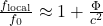 with
with  , this immediately recovers
  (Newtonian gravity) as a derived consequence, not an input.
Because absolute stillness is impossible (A2), every excitation is always a spreading wave. The frequency gradient biases the spreading/propagation direction. Superposition across multiple quantized spacetime units allows the amplitudes to explore the gradient coherently, producing the net drift without any classical force law. The system is always “trying” to reach the configuration that minimizes the effective free energy, and lower corresponds to a lower local energy scale for the excitation.
P5: Inflation was mandatory
At 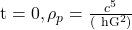 . Fredmann equation18 (cosmological form of A4) gives a maximum Hubble rate
![\[H_{\max }=\frac{c}{l_p} \approx 1.85 \times 10^{43}-s^{-1}\]](https://nhsjs.com/wp-content/ql-cache/quicklatex.com-90def5e6723d2fc93655e51cebc4ba6e_l3.png "Rendered by QuickLaTeX.com")
The resulting exponential expansion  is forced by the enormous restoring pressure of the stiff spacetime medium19. And flatness and uniformity follow from P3
P6: Galactic rotation stores real energy that reproduces flat rotation curves
Just as accelerating masses produce gravitational waves49 that carry energy independently of the source long after the event (a direct consequence of A4, confirmed by LIGO49), a steadily rotating galaxy imprints a persistent shear strain in the metric. In the weak-field limit, the quadratic terms in the Einstein-Hilbert action yield a gravitational self-energy density).
A rotating galaxy imprints persistent shear strain  in the spacetime fabric. The stored energy density in a medium of stiffness
  is:
is:
![\[\begin{aligned} u &= \frac{1}{2} Y \gamma^2 \\ \frac{v^2}{R} &- \frac{GM_{\rm vis}}{R^2} + \frac{\partial u}{\partial R} \Rightarrow {\rm flat\ rotation\ curve} \end{aligned}\]](https://nhsjs.com/wp-content/ql-cache/quicklatex.com-3cf7d53046af94aa695517ebc359a563_l3.png "Rendered by QuickLaTeX.com")
This additional gradient term in the effective Newtonian equation yields flat rotation curves25,26,27 without dark-matter particles. The strain persists after the matter has moved. This is analogous to gravitational wave memory52 connection (consistent with P3 and P4).
P7: Cumulative galactic torsion drives accelerated expansion
With  galaxies51 each contributing torsional pressure, the total effective cosmological constant arises naturally from A4:
![\[P_{\text{torsion}} = N_{\text{gal}} \times \frac{Y_\gamma^2}{6} \implies \Lambda_{\text{eff}} = \left(\frac{8\pi G}{c^4}\right) P_{\text{torsion}}\]](https://nhsjs.com/wp-content/ql-cache/quicklatex.com-9d4b90aa77290b5c73294cdc048b5a84_l3.png "Rendered by QuickLaTeX.com")
No new energy – it was stored in P6. The universe must expand due to torsional strain30,31,32.
Contrapositives (¬B ⇒ ¬P)
Contrapositives outlines the logical consequences if any of the derived conclusions were false. This structure follows the principle that P ⇒ quantized spacetime is equivalent to ¬quantized spacetime ⇒ ¬P. According to this logic, if a conclusion is wrong, at least one of the four fundamental axioms must be incorrect.
Logical Breakdowns by Conclusion
| Conclusion (P) | If False (¬P), the Resulting Failure is: | Impact on Axioms |
|---|---|---|
| P1: Quantized Space | Energy is not quantized at every point (E ≠ hf). | A1 (Planck 1900) is false; Planck’s constant h loses universal meaning, collapsing quantum mechanics. |
| P2: No Stillness | A particle exists with zero momentum (Δp = 0) within a finite region. | A2 (Heisenberg 1927) is violated; it would require waves to no longer behave as waves. |
| P3: Grainy Spacetime | Grainy spacetime is distinguishable from smooth (ΔL / L does not vanish). | A2 (Heisenberg 1927) fails via statistics; the quadrature rule of independent random variables would be broken. |
| P4: Gravity as Gradient | Gravity requires a force and objects do not follow geodesics. | A4 (Einstein 1915) is wrong; the field equation would require a correction term, contradicting GPS data confirmed to 1 part in 1014. |
| P5: Mandatory Inflation | The Friedmann equation at Planck density does not produce extreme expansion H ≠ c / Lp. | A4 (Einstein 1915) is incomplete or breaks down at high density. |
| P6: Galactic Torsion | Galactic rotation stores no torsional energy (u = 0) despite shear strain. | A4 (Einstein 1915) has no coupling constant; this implies c = 0 or G = ∞. |
| P7: Accelerated Expansion | Torsional pressure does not enter the Friedmann equation. | A4 (Einstein 1915) fails to couple all energy to curvature, violating the mathematical identity of energy-momentum conservation. |
The Core Axioms and Their Proofs
- P1: Quantized Space and A1 Every point in space carries quantized energy because light requires a field to travel through, and fields exist everywhere. This relies on Axiom 1 (Planck 1900), which states energy is discrete (E = hf). If this were false at any point, the universal meaning of Planck’s constant would collapse.
- P2: Perpetual Motion and A2 Nothing can be perfectly still because confining anything to a specific region forces a minimum energy via Axiom 2 (Heisenberg 1927). When this is combined with energy-mass equivalence, it proves that even electrons must vibrate at an internal “Compton” frequency. Denying this would require waves to cease behaving as waves.
- P3: The Grainy Spacetime Illusion and A2 A grainy spacetime at the Planck scale is observationally identical to a smooth one because the “noise” from individual segments sums in quadrature. This statistical vanishing of granularity relies on the uncertainty spreads defined in Axiom 2.
- P4: Gravity as a Clock Gradient and A4 Gravity is not a force but a gradient in the speed of clocks. Following the principle of extremal aging, objects simply slide toward slower clocks. This is a direct consequence of the metric defined by Axiom 4 and is confirmed by GPS satellite corrections48.
- P5: Mandatory Inflation and A4 Cosmological inflation was required because at the earliest moment (t = 0), the extreme energy density applied to the Friedmann equation (a derivation of Axiom 4) forced an exponential expansion.
- P6: Dark Matter as Stored Energy and A4 Galactic rotation curves are flat because the rotation stores real energy through shear strain in the stiff medium of spacetime. If this energy did not exist, it would imply Axiom 4 has no coupling constant, which would mean light does not move or gravity is infinitely strong.
- P7: Dark Energy as Torsion and A4 Accelerated expansion is driven by the cumulative torsional pressure from billions of galactic vortices. This energy must enter the stress-energy tensor of Axiom 4; excluding it would violate the mathematical conservation of energy and momentum.
The validity of these eight conclusions is tied directly to the four axioms, which are currently confirmed by experiment to high degrees of precision and for summary:
Axioms (Planck + Heisenberg + relativity + Einstein) lead to quantized energy at every point which makes way for the discrete-smooth equivalence. Therefore you can treat space as quantized (quantized spacetime units with E = hf). Conatus leads to clock-speed frequency gradients (gravity). Einstein’s stiffness regulator leads to torsional vortices (dark matter + super-Eddington) which leads to cumulative push-back (dark energy). Max-strain Big Bang electroweak asymmetry leads to the matter dominance, and conatus lepton masses. And the helmholtz equation leads to possible states of matter.
Matter, Energy, and Waves
In Abstract Mechanics, just as in General Relativity7,8 all mass and energy are intertwined through the identity E = mc2. Abstract Mechanics introduces the additional identity:
![\[ hf = mc^2\]](https://nhsjs.com/wp-content/ql-cache/quicklatex.com-3e31e1954eedb65015fe565e5320b607_l3.png "Rendered by QuickLaTeX.com")
Where m is relativistic effective mass (energy-equivalence), not rest mass. For photons: E = hf = pc so  34,24. And because the Heisenberg Uncertainty Principle5 forbids any mass or energy from being still, all energy systems are the same as different orientations of vibration because hf = E = mc2. Therefore quarks and leptons — if you could zoom in far enough, trillions of times smaller than a quark — you would find a section of the same field E vibrating to create a type of particle. A wave vibrating one way manifests as an electron; vibrating another way manifests as an up quark33.
All particles — electrons, quarks, photons — are the same type of wave vibrating at different frequencies, and that different vibrational modes of the same underlying field produce different particles34,24,33. This claim requires a mechanical explanation: why does vibration produce stable, distinct, repeatable structures at all? Abstract Mechanics establishes that any constrained wave energy — acoustic, electromagnetic, or quantum — is mathematically compelled by the time-independent Helmholtz Equation36 to produce stable, predictable geometric patterns. These patterns are the only solutions the equation permits under given boundary conditions:
![\[\nabla^2A+k^2A=0\]](https://nhsjs.com/wp-content/ql-cache/quicklatex.com-8f04df614bdf5aa2307283da79956b36_l3.png "Rendered by QuickLaTeX.com")
This equation has been used in classical acoustics to predict the Chladni figures53,54 — the geometric sand patterns that form on vibrating plates. The Geometric Equivalence Principle is the central claim: cymatic55 is not a byproduct of acoustic wave behavior only — it is the expression of the wave’s energy configuration. The stable pattern or cymatic (A) produced by any resonant system is a deterministic function of the system’s angular frequency (ω) and boundary conditions (E):
![\[ A = F_E(\omega)\]](https://nhsjs.com/wp-content/ql-cache/quicklatex.com-000b5e9a4a68ca83585e396f724843a0_l3.png "Rendered by QuickLaTeX.com")
where F is the Helmholtz operator36 acting as the rule set that translates vibration into shape. The mapping equation formalizes this:
![\[A = \psi\left(\frac{f_x}{v_x} \cdot L\right)\]](https://nhsjs.com/wp-content/ql-cache/quicklatex.com-6f8172e648bcf8a06cbe545b52d5ef5b_l3.png "Rendered by QuickLaTeX.com")
where is the Helmholtz Mapping Function,  is the frequency of the wave in medium
  ,
,  is its propagation velocity in that medium, and is the spatial boundary. The key result: if the ratio
  is the same for two different waves in two different media, their geometry (
 ) is identical36,53,54,55. A sound wave and a quantum wavefunction with the same normalized spatial input produce the same nodal architecture. The medium changes the scale; it does not change the shape. Because of the GEP all possible energy forms can be linked using A and can also be mapped on to one another. And A can represent all possible energy forms
Every quantum field is governed by a Persistence Threshold defined by its specific conditions. Energy within these fields can only manifest as stable “modes” (particles) when it falls between two critical bounds. There is a Stability Limit Above this frequency, the mode is too energetic to maintain structural integrity, leading to immediate decay or collapse. Below this energy level, there is insufficient tension to form a discrete, coherent wave-function.
The Helmholtz equation is coherent with what physical medium or wave from it is operating in53,54,36. The solutions are determined by the ratio of frequency to propagation velocity times the boundary. Therefore the same ratio, with different geometry which can mathematically map onto each other. The cymatics connection declares we can physically observe quantum nodal structures in macroscopic wave systems because the governing equation is identical. The overarching connection is that a wave in one field is corresponding to a wave in another field through A. The medium changes scale, not structure. So A is effectively a field-independent description of wave configurations.
The geometric cymatic analogous pattern can be used to model possible but non-existing states of matter or waves. If the Helmholtz equation’s solution space under given boundary conditions maps the space of possible stable wave configurations, and cymatic patterns are physical realizations of those solutions, then unexplored regions of the cymatic solution space correspond to possible but unrealized states of matter or energy.
In a quantized framework, energy cannot exist as a continuous, amorphous sheet. It is forced into specific forms for three primary reasons:
- Geometric Quantization: Because the fabric of spacetime is composed of discrete units, energy must “fit” into the available grid. Like a vibrating guitar string that can only produce specific notes (harmonics), the field only allows energy to manifest in configurations that satisfy its underlying geometry.
- The Equilibrium Mandate: All systems naturally seek their lowest energy state. Higher-mass particles like the Muon or Tau are valid mathematical solutions to the field’s wave equation, but they represent states of high disequilibrium. They exist only as temporary overflow, shedding frequency until they reach the most stable geometry — the electron33.
- Systemic Integration: Particles do not exist in isolation; they are functional components of larger systems. The specific mass and frequency of an electron, for instance, are not arbitrary—they are the exact “tuning” required to balance against a proton’s repulsion. Energy takes these forms because they are the most efficient path toward systemic equilibrium.
After energy has a role as a particle it must aid the system it is in by becoming a part of the larger system that is reaching towards equilibrium. Energy takes the form of the exact “tuning” required for whatever system it is a part of. When an antimatter and a matter particle collide it releases a photon matter and the electromagnetic field are not two separate things. Matter particles are sources and sinks for the electromagnetic field, and under the right conditions, one can be transformed into the other.
The observation that matter particles and the electromagnetic field are not fundamentally separate—charged matter acting as sources and sinks for the electromagnetic field, with annihilation (electron + positron → photons) and pair production demonstrating direct convertibility between matter excitations and pure field excitations under appropriate high-energy conditions—serves as a natural starting point in quantum field theory. In this view, particles are localized excitations of underlying quantum fields, and interactions permit transformations while conserving relevant quantum numbers.
This perspective generalizes directly to the unification of forces. Treating the weak interaction with the same gauge-field consistency as quantum electrodynamics requires enlarging the symmetry to the electroweak gauge group  14,15.
At sufficiently high energies (above ~100 GeV, as in the early electroweak epoch of the universe), the symmetry is unbroken: matter fields couple to four massless gauge excitations as sources and sinks, allowing processes that freely mix what later appear as electromagnetic and weak contributions.
The interaction is encoded in the covariant derivative:
![\[D_{\mu} = \partial_{\mu} + ig\left(\frac{\tau^{a}}{2}\right)W_{\mu}^{a} + ig'\left(\frac{Y}{2}\right)B_{\mu}\]](https://nhsjs.com/wp-content/ql-cache/quicklatex.com-46dac3eff27750f4146b7ba633c0ae4e_l3.png "Rendered by QuickLaTeX.com")
where  are the Pauli matrices,
  and
and  are the
  and
and  couplings,
  are the three weak gauge fields, and
  is the hypercharge field.
Spontaneous symmetry breaking via the Higgs mechanism then hides the full symmetry. The Higgs doublet acquires a vacuum expectation value 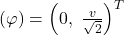 with
with  . This generates masses for three of the gauge bosons while leaving one combination massless. The physical fields after breaking are the mixtures:
![\[W_{\mu}^{+} = \frac{W_{\mu}^{1} - iW_{\mu}^{2}}{\sqrt{2}} \quad \text{(charged, massive)}\]](https://nhsjs.com/wp-content/ql-cache/quicklatex.com-28a153f73093c7460aa528ede8b66ffc_l3.png "Rendered by QuickLaTeX.com")
![\[Z_{\mu} = \cos\theta_W\, W_{\mu}^{3} - \sin\theta_W\, B_{\mu} \quad \text{(neutral, massive)}\]](https://nhsjs.com/wp-content/ql-cache/quicklatex.com-1ddbf5146b113bc7d4db172043779096_l3.png "Rendered by QuickLaTeX.com")
![\[A_{\mu} = \sin\theta_W\, W_{\mu}^{3} + \cos\theta_W\, B_{\mu} \quad \text{(the photon, massless)}\]](https://nhsjs.com/wp-content/ql-cache/quicklatex.com-30fad8766834351a9d13d7faca561f46_l3.png "Rendered by QuickLaTeX.com")
where  is the Weinberg mixing angle (experimentally
  ). The resulting masses are:
![\[M_W = \frac{gv}{2} \approx 80\ \text{GeV}\]](https://nhsjs.com/wp-content/ql-cache/quicklatex.com-2800f30ce4d092981f455802c67a48cb_l3.png "Rendered by QuickLaTeX.com")
![\[M_Z = \frac{M_W}{\cos\theta_W} \approx 91\ \text{GeV}\]](https://nhsjs.com/wp-content/ql-cache/quicklatex.com-4e279836bfff8a1464597efb42dad7f7_l3.png "Rendered by QuickLaTeX.com")
![\[M_\gamma = 0\]](https://nhsjs.com/wp-content/ql-cache/quicklatex.com-e8b64bad6c6f4741b866ba611cbbe03c_l3.png "Rendered by QuickLaTeX.com")
Electric charge emerges as the combination  , where
  is the third component of weak isospin. Only the unbroken
  generated by leaves the vacuum invariant, keeping the photon massless33.
The same logic extends to even larger unifications. The strong force, governed by an  gauge symmetry with quarks serving as sources and sinks for gluon excitations, has coupling constants that nearly converge with the electroweak couplings when extrapolated to extremely high energies (~10¹⁶ GeV). This motivates Grand Unified Theories, in which the full Standard Model gauge group embeds into a single larger simple group. In the ultra-early universe, before successive symmetry-breaking phase transitions, a unified “electronuclear” interaction would have governed matter ↔ unified-gauge-field conversions, including novel processes that violate baryon and lepton number. Operating out of thermal equilibrium together with CP violation, such processes satisfy the Sakharov conditions and could account for the observed matter–antimatter asymmetry after most particle–antiparticle pairs annihilated into radiation56.
Each successive spontaneous symmetry breaking during the cooling of the early universe “freezes out” distinctions that were absent at higher energies. What appear today as the separate electromagnetic, weak, and strong interactions were once different aspects of a single unified interaction. The underlying field-theoretic interconvertibility of matter and gauge excitations remains encoded in the unbroken gauge symmetries and the structure of the covariant derivatives. This progression—from pure QED annihilation processes, through the electroweak unification above, to possible grand unification—illustrates how the apparent diversity of forces at low energies emerges as a low-temperature consequence of symmetry breaking in the hot early universe.
Lepton Derivation
Since energy in a wave system scales as the square of amplitude, the natural representation of the lepton mass configuration uses amplitude variables:
![\[v = \left(\sqrt{m_{e}},\, \sqrt{m_{\mu}},\, \sqrt{m_{\tau}}\right) \in \mathbb{R}^{3}\]](https://nhsjs.com/wp-content/ql-cache/quicklatex.com-74ed4f1ace4c7811a2706a3be8b39fe4_l3.png "Rendered by QuickLaTeX.com")
To analyze the relationship between these masses, we define the sum of masses () and the sum of amplitudes ( ):
):
Sum of Masses: 
Sum of Amplitudes: 
This derivation also utilizes  but this derivation is not dependent on Abstract Mechanics in this derivation the democratic direction
  represents the configuration in which all three lepton masses are equal — the pure equilibrium. The angle
  between the amplitude vector and this democratic direction satisfies
![\[\cos^{2}\theta = \frac{T^{2}}{3S}\]](https://nhsjs.com/wp-content/ql-cache/quicklatex.com-d35298d04eecc07ae37a0501118ad8e3_l3.png "Rendered by QuickLaTeX.com")
The relationship  is mathematically equivalent to the amplitude vector making
exactly a  angle with the democratic direction:
![\[\frac{S}{T^{2}} = \frac{2}{3} \Rightarrow \frac{T^{2}}{S} = \frac{3}{2} \Rightarrow \cos^{2}\theta =\frac{T^{2}}{3S} = \frac{1}{2} \Rightarrow \theta = 45^{\circ}\]](https://nhsjs.com/wp-content/ql-cache/quicklatex.com-461b8c23b4b4fd22f286c2dc7f9aed77_l3.png "Rendered by QuickLaTeX.com")
The physically allowed range within the positive orthant (all masses real and positive) is ![\cos^{2}\theta \in [1/3,\ 1]](https://nhsjs.com/wp-content/ql-cache/quicklatex.com-8e6079c56c55c1405b25add0d7c69b0e_l3.png "Rendered by QuickLaTeX.com") , where
, where  is all masses equal (maximum symmetry) and
  is one mass dominating (maximum asymmetry).
The lepton field’s free energy ![F[\theta]](https://nhsjs.com/wp-content/ql-cache/quicklatex.com-4d37cc9a165794cf294011d5c8e24087_l3.png "Rendered by QuickLaTeX.com") in Abstract Mechanics has two competing contributions:
in Abstract Mechanics has two competing contributions:
The Symmetry Term. Equilibrium drives any field toward its lowest free energy state — the democratic
configuration where all modes are equal. Deviation from this incurs a cost:
![\[F_{s} = \alpha\left(\cos^{2}\theta - 1\right)^{2} \quad [\textit{minimized at } \theta = 0^{\circ}, \ \textit{all masses equal}]\]](https://nhsjs.com/wp-content/ql-cache/quicklatex.com-7a55db9bf2f085eb1b6e0acd795c2a4c_l3.png "Rendered by QuickLaTeX.com")
To analyze the relationship between these masses, we define the sum of masses () and the sum of amplitudes ():
Sum of Masses:
Sum of Amplitudes:
The Distinguishability Term. This principle is often applied in the study of multiphoton interference22,23 and quantum statistical mechanics, where the “physical distinctness” of a many-body state depends on the pairwise overlaps (or trace distances) between the individual particle states. For three particles to remain physically distinct, the C(3,2) = 3 pairs (e, μ), (e, τ), (μ, τ) must each satisfy a separate distinguishability condition. Each pair contributes equally:
![\[F_{d} = 3\alpha\left(\cos^{2}\theta - 1/3\right)^{2} \quad \left[3 = C(3,2)\ \textit{pair conditions}\right]\]](https://nhsjs.com/wp-content/ql-cache/quicklatex.com-82a3b39e7729aae8d43b8d6c8d5a6e96_l3.png "Rendered by QuickLaTeX.com")
Total free energy:
![\[F[\theta] = \alpha\left(\cos^{2}\theta - 1\right)^{2} + 3\alpha\left(\cos^{2}\theta - 1/3\right)^{2}\]](https://nhsjs.com/wp-content/ql-cache/quicklatex.com-d5df265b056d31b2924c82e06dd19581_l3.png "Rendered by QuickLaTeX.com")
Setting  and minimizing:
![\[\frac{dF}{dc} = 2\alpha(c - 1) + 6\alpha\left(c - \frac{1}{3}\right) = 0\]](https://nhsjs.com/wp-content/ql-cache/quicklatex.com-b718b2b5cb78c125ceab57c03581c96f_l3.png "Rendered by QuickLaTeX.com")
Then
![\[8\alpha c = 4\alpha \Rightarrow c = \frac{1}{2} \Rightarrow \theta = 45^{\circ}\]](https://nhsjs.com/wp-content/ql-cache/quicklatex.com-ab8894a0fcead1d6bc5845d7f2e1b5f0_l3.png "Rendered by QuickLaTeX.com")
By the theorem above,  is exactly
  — the Koide formula57. It emerges as the Equilibrium of the lepton field: the point where the drive toward equal masses (1 term) is exactly balanced by the three pairwise distinguishability requirements (3 terms).
| Lepton | Mass mi (MeV) | Amplitude vi = √mi |
|---|---|---|
| Electron (e) | 0.51099895 | 0.714843 |
| Muon (μ) | 105.6583755 | 10.279026 |
| Tau (τ) | 1776.86 | 42.152817 |
![\[Q \ = \ \frac{S}{T^{2}} = \frac{1883.029}{2824.570} \approx 0.66666051\]](https://nhsjs.com/wp-content/ql-cache/quicklatex.com-f7d8d5cbcd234d18ed6c6b3f3529de0e_l3.png "Rendered by QuickLaTeX.com")
Theoretical Prediction  57:Deviation:
  (within tau mass measurement uncertainty33)
The derivation is specific to  because
  appears in the free energy. For general , the equilibrium gives:
![\[Q_{n} = \frac{S}{T^{2}} = \frac{n^{2} - n + 2}{n(n+1)}\]](https://nhsjs.com/wp-content/ql-cache/quicklatex.com-2b077c8503142b2aa2ecb7711abddb26_l3.png "Rendered by QuickLaTeX.com")
Two Generations ( ): The ratio
  is
is  , with a
  value of
  , which remains theoretically consistent within the model.
Three Generations (): This is the confirmed Koide state, where is and is exactly  , matching observed physical data.
Four Generations ( ): The calculated is
  and is
  ; however, this state is excluded because it predicts a fourth lepton mass that contradicts existing experimental evidence.
Five Generations ( ): At this level, reaches
  and is
  , a configuration that is also excluded by the framework.
The Fourth Generation Exclusion58: If a fourth charged lepton exists and satisfies formula, solving numerically gives  GeV. This is already experimentally excluded: LEP258 sets a lower bound of ~100 GeV. The Abstract Mechanics prediction for n = 4 does not exist in nature.
Lepton Masses from Free-Energy Minimum (Explicit Potential)
Promote the three-generation amplitude vector to a flavor-triplet field  (a sub-sector of ); the full has additional components/modes for quarks, gauge bosons, etc.). Define the amplitudes
![\[v_{i} = |\Phi_{i}|, \qquad S \equiv \sum_{i} v_{i}^{2}, \qquad T = \sum_{i} v_{i}, \qquad \cos^{2}\Theta = \frac{T^{2}}{3S}\]](https://nhsjs.com/wp-content/ql-cache/quicklatex.com-66c9e3a2414fad7a2226af8d3acc0288_l3.png "Rendered by QuickLaTeX.com")
The potential in  for the lepton sector is exactly the free-energy functional derived:
![\[V_{lep}(\Phi) = \alpha\left(\cos^{2}\Theta - 1\right)^{2} + 3\alpha\left(\cos^{2}\theta - \frac{1}{3}\right)^{2}\]](https://nhsjs.com/wp-content/ql-cache/quicklatex.com-788719cf1cf16f8d4e57d4a24fef1aef_l3.png "Rendered by QuickLaTeX.com")
Minimizing  (
( ) gives
  , i.e. — the Koide relation — with deviation matching the numerical check. The physical masses are read off from the curvature of
  at the minimum (standard Higgs-like mechanism, but here the minimum itself fixes the ratios via Conatus). Higher generations (
 ) are excluded by the same minimization, exactly as shown before.
Electroweak Force and the Matter-Antimatter Asymmetry
The Big Bang is expected to have produced equal quantities of matter and antimatter. When they meet, they annihilate into pure energy. A universe of perfect symmetry would therefore consist of nothing but photons. In the weak interaction, CP violation occurs because the W boson couples to quarks via the CKM matrix59, which contains a complex phase that treats matter and antimatter differently. This slight mathematical asymmetry means that certain weak decays do not remain identical when you simultaneously swap particles for antiparticles and flip their spatial orientation.
In 1967, Andrei Sakharov56 identified the three necessary conditions for a matter-dominated universe to arise from a symmetric initial state:
- Baryon number violation — processes must exist that generate more baryons than antibaryons.
- C and CP symmetry violation — the laws of physics must treat matter and antimatter differently; otherwise any matter-generating process is exactly balanced by its antimatter counterpart.
- Departure from thermal equilibrium — the universe must have passed through a non-equilibrium phase, preventing matter-generating reactions from being perfectly reversed.
The Standard Model satisfies all three conditions, but only marginally. The CP violation measurable in kaon and B-meson decays33,59 fall short by a factor of approximately  . The Standard Model’s CP violation is far too weak—by about ten orders of magnitude—to explain why we live in a universe of matter rather than a void of pure radiation. To bridge this gap, theoretical extensions propose that CP violation was dynamically enhanced during the Electroweak Phase.
In the Standard Model, hot electroweak baryogenesis gives:  because the only source of CP violation — the Jarlskog invariant
  59 – is suppressed by quark-mass hierarchy factors. Observed value:
  19. Required boost in effective CP-violating strength during the electroweak epoch:
  19 required.
Thus CP violation must be  times stronger (or new high- CP-violating sources must dominate) at the electroweak scale to produce the observed baryon asymmetry. This is the standard mismatch that forces extensions beyond the SM. The stronger CP violation required during the electroweak epoch ( times larger effective strength than today) generates the observed baryon asymmetry
Electroweak baryogenesis60,61,62,63 can produce the exact observed asymmetry when the SM is extended with new physics that satisfies strong first-order transition and supplies additional CP-violating sources of order unity. The math of the effective potential and transport equations shows this is both necessary and sufficient in concrete BSM models.
Comparison to String Theory
Abstract Mechanics offers a deliberately minimal framework that recovers the successful predictions of General Relativity7,8,35,16,17 and Quantum Field Theory6,34,33 while addressing several longstanding puzzles—quantum gravity without a graviton, the origin of gravitational time dilation as a local frequency gradient, emergent dark-matter-like effects from galactic torsional strain25,26,27, accelerated expansion from cumulative vortex pressure30,31, and the charged-lepton mass ratios via a free-energy minimum that naturally yields the Koide relation57  with a deviation of only
  , consist33. Higher generations (n = 4 and beyond) are excluded by the same minimization58.
In contrast, String Theory64 remains one of the most developed unification programs. Recent bootstrapping results (2025–2026) have shown that certain string amplitudes (e.g., the Veneziano and Virasoro-Shapiro amplitudes) emerge uniquely from assumptions such as “ultrasoftness” or maximal supersymmetry, reinforcing its internal mathematical consistency.
However, it still requires extra spatial dimensions, supersymmetry, and a vast landscape of compactifications, none of which have been experimentally confirmed. Low-energy predictions remain non-unique, and no string resonances, extra dimensions, or superpartners have been observed.
Abstract Mechanics avoids these additions by working strictly within four long-established axioms7,8,5,6. It makes concrete, falsifiable claims (Contrapositives) that are already consistent with precision tests (GPS time dilation48, LIGO gravitational waves49, flat galactic rotation curves via stored shear energy25,26,27, and JWST indications of rapid early black-hole growth50,51 compatible with super-Eddington-like vortex siphoning). The theory is currently conceptual in its full variational formulation; deriving a single underlying functional that reproduces both the Einstein-Hilbert action and the QFT path integral in the appropriate limits remains an important next step for direct computation of scattering amplitudes and loop corrections.Abstract Mechanics still requires no new ontological entities beyond the four experimentally verified axioms plus the single observed universal tendency (systems evolve toward equilibrium along a free-energy gradient). The frequency-gradient gravity, single-field particle vibrations, torsional dark sectors, finite-density black-hole cores, and exact Koide equilibrium all fall out directly. String theory still requires strings + 6–7 extra dimensions + supersymmetry + a  -vacuum landscape. Abstract Mechanics is more consistent with Occam’s razor minimalizing assumptions while string theory is more mathematically developed with additional conditions and dimensions.
Singularities, dark sectors, and the Koide numerical coincidence are still natural baseline outcomes under Conatus when interference is absent. String theory still accommodates them only inside a huge underdetermined landscape. By prioritizing parsimony and direct ties to existing axioms, Abstract Mechanics provides a complementary pathway that may prove more economical if nature favors minimal structure at the fundamental level.
| Aspect | Abstract Mechanics (AM) | String Theory (as of 2026) |
|---|---|---|
| Core Objects | Single underlying field at every spacetime point; all particles = vibrational modes (hf = mc²). Spacetime is quantized but smooth via central-limit smoothing. | One-dimensional vibrating strings in higher-dimensional spacetime. Particles = vibration modes. Gravity = closed-string graviton mode. |
| Foundational Axioms | Strictly 4 axioms: Planck (E = hf), Heisenberg (Δx Δp ≥ h/2), Einstein energy-momentum, and Einstein field equations. Uses Conatus (gradient flow to equilibrium). | New fundamental objects (strings) + extra dimensions (10D/11D) + supersymmetry + dualities. Consistency forces these additions. |
| Quantum Gravity | Gravity = local frequency gradient ∇f. Proper time slows in low-f regions; objects drift toward lower f. No graviton; finite Planck-density cores. | Gravity emerges as the massless spin-2 graviton. UV-complete via string scattering; resolves singularities via string spreading or AdS/CFT holography. |
| Unification | All forces and particles = expressions of the same Conatus gradient flow at different scales. Unifies without adding new particles. | All forces arise from string vibrations and compactification geometry. Requires supersymmetry (SUSY) for fermion-boson pairing. |
| Extra Structures | None. Stays in 4D; no extra dimensions, no SUSY, no new particles or fields. | Requires 6–7 compactified extra dimensions (Calabi-Yau manifolds). Includes branes, fluxes, and orientifolds. |
| Dark Matter/Energy | Emergent: torsional/shear strain in stiff spacetime flattens rotation curves. Cumulative torsional pressure from galaxies supplies effective Λ. No new particles. | Typically requires new particles (neutralinos, axions). The “Landscape” allows many possibilities; no single unique prediction for dark energy. |
| Lepton Masses | Derived exactly via free-energy minimum of field amplitudes. Predicts Koide relation (Q = 2/3) and excludes a 4th generation of leptons. | No direct derivation; masses depend on Yukawa couplings and complex compactification geometry. |
| Predictiveness | Matches GPS, LIGO, and flat rotation curves. Falsifiable if specific principles (P1–P7) fail. Lacks full variational principle for scattering. | Highly predictive at high energies, but the “Landscape” makes low-energy predictions non-unique. No confirmed experimental observations yet. |
| Black Holes | No singularities; finite-density Planck-scale cores. Hawking radiation results from f-gradient separating virtual pairs. | Singularities resolved by fuzzball microstates. Entropy matches the Bekenstein-Hawking formula via D-brane microstates. |
References
- Spinoza, B. Ethics. 1677. [Conatus — the tendency of things to persist in their own being] [↩] [↩] [↩]
- Fourier, J. B. J. Théorie Analytique de la Chaleur (The Analytical Theory of Heat). Firmin Didot, Paris, 1822. [Fourier heat law] [↩] [↩] [↩] [↩] [↩]
- Boltzmann, L. “Weitere Studien über das Wärmegleichgewicht unter Gasmolekülen.” Wiener Berichte, Vol. 66, pp. 275–370, 1872. [↩] [↩] [↩] [↩]
- Clausius, R. “Über die bewegende Kraft der Wärme.” Annalen der Physik, Vol. 79, pp. 368–397, 1850. [↩] [↩] [↩] [↩]
- Heisenberg, W. “Über den anschaulichen Inhalt der quantentheoretischen Kinematik und Mechanik.” Zeitschrift für Physik, Vol. 43, pp. 172–198, 1927. [↩] [↩] [↩] [↩] [↩] [↩] [↩] [↩] [↩] [↩] [↩] [↩] [↩] [↩] [↩]
- Schrödinger, E. “An Undulatory Theory of the Mechanics of Atoms and Molecules.” Physical Review, vol. 28, no. 6, pp. 1049–1070, 1926. [↩] [↩] [↩] [↩] [↩] [↩] [↩] [↩] [↩] [↩] [↩] [↩] [↩] [↩] [↩]
- Einstein, A. “Die Feldgleichungen der Gravitation” (The Field Equations of Gravitation). Sitzungsberichte der Preussischen Akademie der Wissenschaften zu Berlin, pp. 844–847, 1915. [↩] [↩] [↩] [↩] [↩] [↩] [↩] [↩] [↩] [↩] [↩] [↩] [↩] [↩]
- Einstein, A. “Zur allgemeinen Relativitätstheorie” (On the General Theory of Relativity). Sitzungsberichte der Preussischen Akademie der Wissenschaften, pp. 778–786, 1915. [↩] [↩] [↩] [↩] [↩] [↩] [↩] [↩] [↩] [↩] [↩]
- Carroll, S. Spacetime and Geometry: An Introduction to General Relativity. Addison-Wesley, San Francisco, 2004. [↩] [↩] [↩] [↩] [↩]
- Misner, C. W., Thorne, K. S., and Wheeler, J. A. Gravitation. W. H. Freeman, San Francisco, 1973 [↩] [↩] [↩] [↩] [↩] [↩] [↩] [↩] [↩] [↩] [↩]
- Bethe, H. A. and Weizsäcker, C. F. von. “Zur Theorie der Kernmassen.” Zeitschrift für Physik, Vol. 96, pp. 431–458, 1935. [Semi-empirical mass formula] [↩] [↩] [↩]
- Fermi, E. “Versuch einer Theorie der β-Strahlen.” Zeitschrift für Physik, Vol. 88, pp. 161–177, 1934. [Weak force / Fermi interaction] [↩] [↩] [↩]
- Yukawa, H. “On the Interaction of Elementary Particles.” Proceedings of the Physico-Mathematical Society of Japan, vol. 17, pp. 48–57, 1935. [Strong nuclear force] [↩] [↩] [↩]
- Glashow, S. L. “Partial Symmetries of Weak Interactions.” Nuclear Physics, vol. 22, pp. 579–588, 1961. [Electroweak unification] [↩] [↩] [↩] [↩]
- Weinberg, S. “A Model of Leptons.” Physical Review Letters, vol. 19, pp. 1264–1266, 1967. [↩] [↩] [↩] [↩]
- Schwarzschild, K. “Über das Gravitationsfeld eines Massenpunktes nach der Einsteinschen Theorie” (On the Gravitational Field of a Point Mass According to Einstein’s Theory). Sitzungsberichte der Königlich Preussischen Akademie der Wissenschaften, pp. 189–196, 1916. [↩] [↩]
- Weinberg, S. Gravitation and Cosmology: Principles and Applications of the General Theory of Relativity. John Wiley & Sons, New York, 1972. [↩] [↩] [↩] [↩] [↩] [↩] [↩] [↩]
- Friedmann, A. “Über die Krümmung des Raumes” (On the Curvature of Space). Zeitschrift für Physik, Vol. 10, pp. 377–386, 1922. [↩] [↩] [↩]
- Planck Collaboration. “Planck 2018 Results. X. Constraints on Inflation.” Astronomy & Astrophysics, vol. 641, A10, 2020. [↩] [↩] [↩] [↩] [↩] [↩] [↩]
- Ashtekar, A., Pawlowski, T., and Singh, P. “Quantum Nature of the Big Bang.” Physical Review Letters, vol. 96, p. 141301, 2006. [↩] [↩] [↩] [↩] [↩] [↩] [↩]
- Rovelli, C. Quantum Gravity. Cambridge University Press, Cambridge, 2004. [↩] [↩] [↩] [↩]
- Born, M. “Zur Quantenmechanik der Stoßvorgänge.” Zeitschrift für Physik, Vol. 37, pp. 863–867, 1926. [↩] [↩] [↩] [↩] [↩] [↩]
- Bohr, N. “The Quantum Postulate and the Recent Development of Atomic Theory.” Nature, vol. 121, pp. 580–590, 1928. [↩] [↩] [↩] [↩] [↩]
- de Broglie, L. “Recherches sur la théorie des Quanta.” Annales de Physique, vol. 3, pp. 22–128, 1925. [↩] [↩] [↩] [↩] [↩]
- Rubin, V. C. and Ford, W. K. “Rotation of the Andromeda Nebula from a Spectroscopic Survey of Emission Regions.” The Astrophysical Journal, vol. 159, pp. 379–403, 1970. [Galactic rotation curves] [↩] [↩] [↩] [↩] [↩] [↩] [↩]
- Lelli, F., McGaugh, S. S., and Schombert, J. M. “SPARC: Mass Models for 175 Disk Galaxies with Spitzer Photometry and Accurate Rotation Curves.” The Astronomical Journal, vol. 152, no. 6, p. 157, 2016. [SPARC database] [↩] [↩] [↩] [↩] [↩] [↩] [↩]
- McGaugh, S. S., Lelli, F., and Schombert, J. M. “Radial Acceleration Relation in Rotationally Supported Galaxies.” Physical Review Letters, vol. 117, p. 201101, 2016. [↩] [↩] [↩] [↩] [↩] [↩] [↩]
- Milgrom, M. “A Modification of the Newtonian Dynamics as a Possible Alternative to the Hidden Mass Hypothesis.” The Astrophysical Journal, vol. 270, pp. 365–370, 1983. [MOND] [↩] [↩]
- Zwicky, F. “Die Rotverschiebung von extragalaktischen Nebeln.” Helvetica Physica Acta, vol. 6, pp. 110–127, 1933. [First evidence for dark matter] [↩] [↩] [↩]
- Perlmutter, S., et al. “Measurements of Ω and Λ from 42 High-Redshift Supernovae.” The Astrophysical Journal, vol. 517, pp. 565–586, 1999. [↩] [↩] [↩] [↩] [↩]
- Riess, A. G., et al. “Observational Evidence from Supernovae for an Accelerating Universe and a Cosmological Constant.” The Astronomical Journal, vol. 116, pp. 1009–1038, 1998. [↩] [↩] [↩] [↩] [↩]
- Weinberg, S. “The Cosmological Constant Problem.” Reviews of Modern Physics, vol. 61, no. 1, pp. 1–23, 1989. [↩] [↩] [↩] [↩]
- Particle Data Group. “Review of Particle Physics.” Progress of Theoretical and Experimental Physics, 2022. [↩] [↩] [↩] [↩] [↩] [↩] [↩] [↩] [↩] [↩]
- Planck, M. “Zur Theorie des Gesetzes der Energieverteilung im Normalspektrum.” Verhandlungen der Deutschen Physikalischen Gesellschaft, vol. 2, pp. 237–245, 1900. [↩] [↩] [↩] [↩] [↩] [↩] [↩] [↩] [↩] [↩] [↩] [↩] [↩]
- Hilbert, D. “Die Grundlagen der Physik” (The Foundations of Physics). Nachrichten von der Gesellschaft der Wissenschaften zu Göttingen, pp. 395–407, 1915. [↩] [↩] [↩] [↩]
- Helmholtz, H. von. On the Sensations of Tone as a Physiological Basis for the Theory of Music. Dover Publications, New York, 1954 (orig. 1877). [Helmholtz equation] [↩] [↩] [↩] [↩] [↩]
- Einstein, A. “Zur Elektrodynamik bewegter Körper.” Annalen der Physik, vol. 17, pp. 891–921, 1905. [↩] [↩] [↩] [↩] [↩] [↩] [↩]
- Sorkin, R. D. “Causal Sets: Discrete Gravity.” Lectures on Quantum Gravity, Springer, New York, pp. 305–327, 2003. [↩] [↩] [↩]
- Einstein, A., Podolsky, B., and Rosen, N. “Can Quantum-Mechanical Description of Physical Reality Be Considered Complete?” Physical Review, vol. 47, pp. 777–780, 1935. [↩] [↩]
- Bell, J. S. “On the Einstein-Podolsky-Rosen Paradox.” Physics, vol. 1, no. 3, pp. 195–200, 1964. [↩] [↩] [↩] [↩] [↩] [↩]
- Aspect, A., Grangier, P., and Roger, G. “Experimental Tests of Bell’s Inequalities Using Time-Varying Analyzers.” Physical Review Letters, vol. 49, no. 25, pp. 1804–1807, 1982. [↩] [↩] [↩]
- Hensen, B., et al. “Loophole-free Bell Inequality Violation Using Electron Spins Separated by 1.3 Kilometres.” Nature, vol. 526, pp. 682–686, 2015. [↩] [↩] [↩]
- Yin, J., et al. “Satellite-Based Entanglement Distribution Over 1200 Kilometers.” Science, vol. 356, no. 6343, pp. 1140–1144, 2017. [Micius experiment] [↩] [↩] [↩]
- Hawking, S. W. “Particle Creation by Black Holes.” Communications in Mathematical Physics, vol. 43, pp. 199–220, 1975 [↩] [↩] [↩] [↩] [↩]
- Hawking, S. W. “Black Hole Explosions?” Nature, vol. 248, pp. 30–31, 1974. [↩] [↩] [↩] [↩]
- Penrose, R. “Gravitational Collapse and Space-Time Singularities.” Physical Review Letters, vol. 14, pp. 57–59, 1965. [↩]
- Bekenstein, J. D. “Black Holes and Entropy.” Physical Review D, vol. 7, no. 8, pp. 2333–2346, 1973. [↩] [↩]
- Ashby, N. “Relativity in the Global Positioning System.” Living Reviews in Relativity, vol. 6, no. 1, 2003. [↩] [↩] [↩]
- Abbott, B. P., et al. (LIGO Scientific Collaboration and Virgo Collaboration). “Observation of Gravitational Waves from a Binary Black Hole Merger.” Physical Review Letters, vol. 116, p. 061102, 2016. [↩] [↩] [↩] [↩] [↩] [↩]
- Natarajan, P., et al. “Unveiling early black hole growth with JWST: Super-Eddington accretion.” The Astrophysical Journal Letters, 2024. [↩] [↩] [↩] [↩]
- Labbé, I., et al. “A population of red candidate massive galaxies ~600 Myr after the Big Bang.” Nature, vol. 616, pp. 266–269, 2023. [↩] [↩] [↩] [↩] [↩]
- Braginsky, V. B. and Thorne, K. S. “Gravitational-wave bursts with memory and experimental prospects.” Nature, vol. 327, pp. 123–125, 1987. [↩] [↩]
- Chladni, E. F. F. Entdeckungen über die Theorie des Klanges (Discoveries in the Theory of Sound). Leipzig, 1787. [Chladni figures / cymatics] [↩] [↩] [↩]
- Waller, M. D. Chladni Figures: A Study in Symmetry. G. Bell and Sons, London, 1961. [↩] [↩] [↩]
- Jenny, H. Cymatics: A Study of Wave Phenomena and Vibration. MACROmedia, 2001. [↩] [↩]
- Sakharov, A. D. “Violation of CP Invariance, C Asymmetry, and Baryon Asymmetry of the Universe.” JETP Letters, vol. 5, pp. 24–27, 1967. [↩] [↩]
- Koide, Y. “New view of quark and lepton mass hierarchy.” Physical Review D, vol. 28, pp. 252–254, 1983. [↩] [↩] [↩]
- Searches for Higgs Bosons and New Phenomena. LEP Working Group for Higgs Boson Searches. Physics Letters B, vol. 565, pp. 61–75, 2003. Also: Schael, S., et al. (ALEPH, DELPHI, L3, OPAL Collaborations). “Electroweak Measurements in Electron-Positron Collisions at W-Boson-Pair Energies at LEP.” Physics Reports, vol. 532, pp. 119–244, 2013. [↩] [↩] [↩]
- Cabibbo, N. “Unitary Symmetry and Leptonic Decays.” Physical Review Letters, vol. 10, pp. 531–533, 1963. Kobayashi, M. and Maskawa, T. “CP-Violation in the Renormalizable Theory of Weak Interaction.” Progress of Theoretical Physics, vol. 49, pp. 652–657, 1973. Jarlskog, C. “Commutator of the Quark Mass Matrices in the Standard Electroweak Model and a Measure of Maximal CP Nonconservation.” Physical Review Letters, vol. 55, pp. 1039–1042, 1985. [↩] [↩] [↩]
- Branco, G. C., et al. “Theory and Phenomenology of Two-Higgs-Doublet Models.” Physics Reports, vol. 516, pp. 1–102, 2012. [↩]
- Davidson, S. and Sarkar, S. “Thermalization After Inflation.” Journal of High Energy Physics, vol. 2000, no. 11, p. 012, 2000. [↩]
- Moreno, J. M., Quirós, M., and Seco, M. “Electroweak Baryogenesis and Higgs and Stop Masses.” Nuclear Physics B, vol. 526, pp. 489–500, 1998. [↩]
- Caprini, C., et al. “Science with the Space-Based Interferometer LISA. II: Gravitational Waves from Cosmological Phase Transitions.” Journal of Cosmology and Astroparticle Physics, vol. 2016, no. 04, p. 001, 2016. [↩]
- Polchinski, J. String Theory, Vols. I & II. Cambridge University Press, Cambridge, 1998. [↩]