
Abstract
Social media use is continuously growing in popularity among adolescents, with up to 95% of teens ages 13–17 reporting near-constant engagement across platforms This study examined how media exposure and cultural beauty expectations influence adolescents’ perceptions of beauty and appearance-based self-perceptions, including self-rated attractiveness. Using a correlational survey design, we measured the relationships between participants’ exposure to different beauty representations on social media, their perceptions of attractiveness, exposure to cultural beauty expectations, and social-media-related self-image through Spearman’s correlations and percentage analyses. Attractiveness was based on the participants’ perceptions of the individual. If the individual was rated “attractive,” it is assumed that the participant found them to be appealing or pleasant to look at. Meanwhile, an “unattractive” rating suggests that the participant found that the individual was aesthetically unpleasant. Factors that can influence whether or not a participant finds an individual attractive are conventional beauty standards in America. Results suggest that exposure to a higher number of “attractive” individuals ultimately correlated to lower self-rated attractiveness. Also, participants who felt more pressure to look perfect due to social media typically had stronger reactions to low social media engagement. However, not enough correlation evidence was collected to determine whether or not cultural beauty expectations impact perceptions of beauty. This was likely due to the limited diversity of participants and small size of the study. Findings provide a foundation for hypotheses and research questions in future studies on the topics of self-esteem and cultural perceptions in adolescents.
Keywords: Social media influence; Cultural beauty expectations; Beauty standards; Perception of attractiveness; Appearance based self-perception; Appearance based self-esteem; Self-image; Adolescents
Introduction
Social media is incredibly prominent in adolescents, as previously stated in the abstract1. The negative impacts of social media are commonly discussed amongst adults, particularly for their effects on adolescents. Numerous studies were founded on research questions regarding the impacts of social media exposure. Namely, one study discovered that greater social media exposure for women correlated to greater body image issues2. Relatedly, another study found that young women who engaged in more appearance comparisons to peers on social media could potentially have increased body image concerns3. These studies collectively suggest that increased social media exposure correlates to increased appearance issues.
Our research elaborated on this impact and asked: how do social media and cultural beauty expectations affect self-esteem and self-perception, or perception of others’ beauty? In this instance, self-perception is defined as one’s image of oneself in the lens of attractiveness (defined in the abstract). Possible reasons for this impact on self-perception could include constant comparison, unrealistic content on social media sites, and dissatisfaction, among others. Notedly, these possible explanations for social media’s impact on self image are related to the social comparison theory established by Leon Festinger, which states that humans compare themselves to others in order to fulfill the natural human desire for self-evaluation4. Through these examples, it is evident that more exposure to social media decreases positive self-image in girls5,6,7. It is plausible that social media algorithms consistently push conventionally attractive individuals onto adolescent girls’ feeds, which encourages girls to compare themselves intuitively to such individuals, leading to decreased appearance based self-esteem8.
Furthermore, the impact of cultural beauty standards and expectations has a large, yet overlooked, impact9. Conventional beauty standards often push a narrow lens of attractiveness that does not apply to all10. Girls that do not fit such standards or expectations will begin to feel out of place, different, or unattractive; especially compared to the cultural beauty expectations they are consistently exposed to–thus negatively impacting self-esteem and self-perception. For instance, an experimental study found that a group of people exposed to images of individuals who fit the conventional beauty standard experienced a decrease in body satisfaction11. Meanwhile, those exposed to images of diverse body types experienced an increase in body satisfaction. This study not only proves that social media and the conventional beauty standards it pushes through algorithms have a significant negative impact on individuals, but also that there are solutions to undo the harmful narratives.
Cultural beauty expectations (conventional beauty expectations) are pushed, and at times shaped, through social media algorithms, thus reaching the adolescent girls and impacting their self-perception. When referring to cultural beauty expectations, it is reasonable to assume that social media can be used synonymously in that context because social media uses cultural beauty expectations in its algorithms12. Existing research often covers the impact social media has on self-image and self-esteem, but rarely studies the impact of cultural beauty expectations on self-image and perception of beauty. The perception of beauty could potentially impact how much social media will affect self-esteem. This study aims to answer this question by investigating both social media and cultural beauty expectations to uncover the extent each factor correlates to lower self-esteem and negative self-perceptions. The methods of data collection include an anonymous survey in which participants answered a series of questions regarding beauty standards, perceptions of beauty, social media, and the impact it has had on them. The hypothesis, based on Festinger’s social comparison theory, is that cultural surroundings and exposure to media or beauty standards as a child (particularly via social media algorithms) contribute to one’s perception of beauty itself, or what one considers beautiful. Additionally, more social media exposure to “attractive” individuals (those who fit the conventional beauty standards) based on the mentioned perceptions will be correlated with lower self-esteem and lower self-perception of one’s own beauty.
Methods
Participants completed an anonymous survey created in Google Forms containing thirty-eight questions split into eight sections. Participants were able to take the survey within a window of six days (August 27-September 1, 2025). The sample consisted of adolescents ages thirteen through eighteen who identified as female who were recruited through social media and word of mouth. The survey was designed to ask questions that collect both quantitative and qualitative data to answer the research question: how do social media and cultural beauty expectations shape one’s perception of beauty and self-esteem?
However, there are limitations to this study, particularly in areas of sample bias and diversity. Due to the small size and lack of resources, gathering a geographically, racially and economically diverse population of participants was not feasible. The majority of the participants were located in the same general region, a disproportionate amount identified their race as white, and had similar assumed economic status based on the region of the participants. These factors could impact the results of the study by not properly representing races other than white, individuals of lower or higher economic status, and those from regions or countries with a different set of conventional beauty standards, who do not have the same answers as the participants of this study. If all these categories of people were equally represented, the results could differ. For instance, there might not be enough participants who identified as Black to correctly correlate how colorism in conventional beauty standards impacts self-esteem. Moreover, there is likely not a large enough percentage of people of color in this study to accurately predict the impact of underrepresentation in the media on perceptions of beauty and self-image. Since many of the participants are assumed to somewhat fit the conventional beauty standard in America due to their identified race being white, it may be harder to find a correlation between race and perception of beauty.
Additionally, another limitation of this study is self-selection bias. The participants voluntarily took the survey, which raises concern that their answers differ from those who did not choose to take the survey due to motivations for taking it. For example, all participants were gathered through social media and word of mouth, meaning that individuals who either did not hear about the survey or chose not to take it could have different answers than those who did. This could change the outcome of the study, as those who chose not to participate likely hold a different perspective or mindset than those who did, thus impacting their potential answers to the questions. Plus, those who found the survey through social media could have a larger attachment to it or spend more time on it than those who did not see the survey on social media, whether they participated or not. This could impact those participants’ answers, since more exposure to social media impacts how much influence social media has on one’s life. A smaller attachment to social media by non-participants could have given a different perspective on its effects and possibly minimized the impact of social media on appearance based self-esteem.
Ethics
All participants filled out a consent form prior to beginning the non-demographic portion of the survey that was signed either by parents/guardians if the participant was under 18, or by the participant themself should they be 18. The consent form contained all necessary information about the study, possible risks, benefits, confidentiality maintenance and an informed consent statement. Participants were allowed to continue the survey if they answered “Yes, I am under 18 and my parents/guardians have been informed and consent to my participation,” or “Yes, I am over the age of 18 and consent to my participation.” Participants were not allowed to continue the survey and forced to exit if they answered “No, I do not consent.” Participants were expected to inform their parents/guardians of all contents of the consent form before clicking the option for parental approval. We consulted an Institutional Review Board (IRB) before the survey was sent out. All members signed that the research was ethical and could continue. All participation was voluntary and completely anonymous.
Measures
This study was a between-subjects, correlational design– an ideal choice for evaluating the impact of one variable on another. The survey took around 15-20 minutes to complete, and the goal sample size was  . Participants consisted of those who identify as women ages 13-18 in the United States. However, it did not include those who cannot read or write in English, those who identify as men, and anyone over the age of 18 or under the age of 13. Participants were recruited through word of mouth, Reddit posts, and emailing youth groups in the area.
The questions on the survey were formed by their relation to this larger research question. For example, “How much were you surrounded by people of your race or ethnicity as a child?” relates to the cultural beauty expectations part of the research question. Most of the questions were answered with scales, ratings, and multiple choice. Some questions asked participants to pick their “favorite” or “most seen” out of five different people representing five different ethnic groups: Caucasian, African-American, Asian-American, Latina, and South Asian. One question asked, “Rate these random people on a scale of attractiveness from 1-10 in your opinion.” A person from each ethnic group was provided along with a scale from 1-10, “1” being the lowest possible score and “10” being the highest possible score (e.g. unattractive to very attractive). Another question asked “Which one of these characters was your favorite to watch on TV as a child?” The options were “Emma from Jessie” (Caucasian), “Charlotte from Henry Danger” (African-American), “London from Suite Life on Deck” (Asian-American), “Haley from Stuck in the Middle” (Latina), “Mo from Lemonade Mouth” (South Asian), and “I don’t know any of these characters.” We used previous demographic information to find a correlation between the participant’s own race and which person was their favorite option. Additionally, we used the question of “How much were you exposed to people of your race or ethnicity as a child?” in correlation with the previously stated questions to analyze whether or not exposure to people of one’s same race as a child impacts one’s perception of beauty. An example of two questions on the survey asking how social media might affect self-esteem are “How many attractive people do you see on social media each day?” and “Do you ever feel like everyone else is more attractive than you?”
The dependent variables for this survey were aspects of self-image/self-perception, such as self-rated attractiveness, pressure to look perfect, and emotional reactions to social media. The independent variables were cultural beauty expectations and social media exposure. In order to determine the independent variable, we asked specific questions to determine how much a participant was exposed to social media or cultural beauty expectations as a child. To find the dependent variable, we asked questions about the participant’s perception of beauty and self-esteem and used correlation and linear regression to assess the associations.
Data Analysis
To test the hypothesis that cultural surroundings and media exposure contribute to one’s perception of beauty itself, we tested Spearman’s correlations and significant percentages. The correlational data analysis focused on determining the impact of social media exposures to self-esteem, and how much self-esteem impacts the participant’s actions on their appearance. The data analysis involving percentages from the survey looked more at which people were rated highest, and how many people’s self-image was impacted by social media. It should be noted that the percentage data cannot be correlated to any specific factors. Any incomplete surveys were excluded from the analysis. A survey qualifies as incomplete if the participant did not fit the target demographic or did not officially submit the form. Data were analyzed in Jamovi using Spearman’s correlations with a p-value of 0.10 due to the study’s size, as well as autogenerated percentages from Google Forms.
Results
We received 58 answers to the survey, 57 of which were acceptable to the demographic (1 person identified as male). The mean age of participants was 15.45 with a standard deviation of 1.21. In addition, all race demographics are shown in Table 1 below.
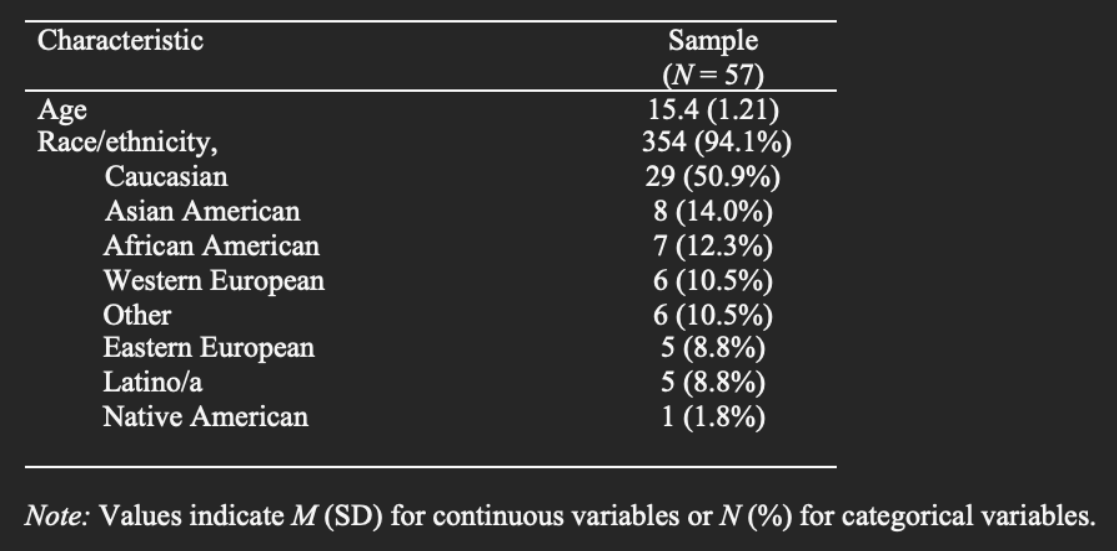
Note: This is a continuous distribution of the races/ethnicities of participants. Caucasian was the most common race/ethnicity based on the table.
After the demographics section was completed, the main questions of the survey began. One of our most frequent results was that when asked to choose which person was their “favorite,” the participants’ most common answer was the Caucasian option. Around 39% of participants voted Emma from Jessie as their favorite TV character as a child, 31.6% said their favorite actress out of the options was Madelyn Cline, and 32.1% reported that the most popular influencer on their “for you page” was Embreigh Courtlyn.
When asked to rank social media interactions based on how they made them feel on a scale from 1-10 (1 being a negative feeling and 10 being a positive feeling), over 90% of participants ranked the following as a 5 or higher: someone liking their post, getting a positive comment on a post, someone reposting them, being tagged in a post where they like the way they look, and someone replying to their story positively. Meanwhile, over 76% of participants ranked the following as a 5 or lower: getting a negative comment under a post, being tagged in a post where they don’t like the way they look. In the figure below (Figure 1), we can see how people reacted to getting less interaction on their post as usual.
Note: This bar graph shows the frequency of how each participant feels after not receiving as much interaction with their post as usual, 0 being the most neutral and 5 being the most emotional. The independent variable (x-axis) is the participants and the dependent (y-axis) is their reactions to social media engagement.
Next, participants were asked how many attractive and unattractive people they see on social media each day. Results state that 47.4% of participants see attractive people all the time on social media, while 49.1% said they only see a few unattractive people on social media. Further analysis using Spearman’s correlations found that seeing attractive people on social media positively correlates to how much pressure one feels to look perfect (ρ ≈ +0.36). Relatedly, the more pressure one feels to look perfect, the more effort one will put into their appearance (ρ ≈ +0.39). Then, we found that putting more effort into daily appearance has a slight negative correlation to self-rated attractiveness (ρ ≈ –0.18). See Figures 2-5 below for the distribution checks.
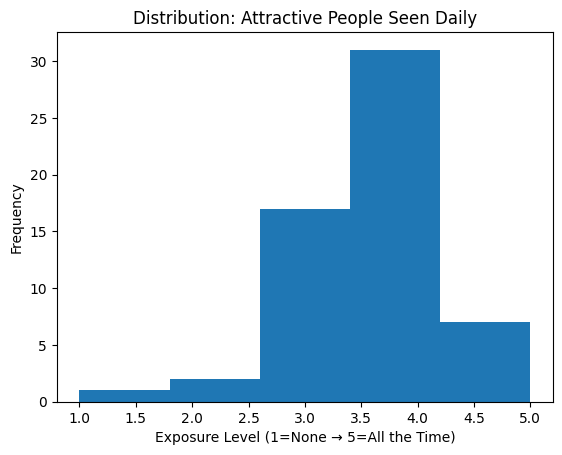
Note: This histogram shows the distribution check of the variable “Attractive People Seen Daily.” Note that the data is clustered at levels 3-4, has a moderate ceiling tendency and is non-normal. The independent variable (x-axis) is the level of exposure to attractive individuals and the dependent (y-axis) is the frequency at which participants were exposed to an attractive individual.
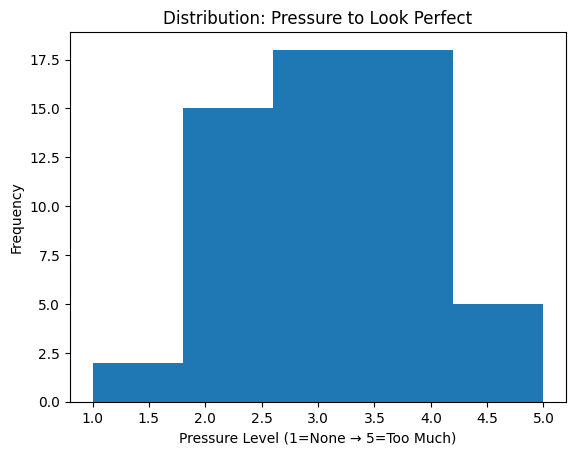
Note: This histogram shows the distribution check of the “Pressure to Look Perfect” variable. Note that the data is concentrated at levels 3-4, is skewed slightly right, and is non-normal. The independent variable (x-axis) is the pressure the participant feels to look perfect and the dependent (y-axis) is the frequency at which participants felt this pressure.
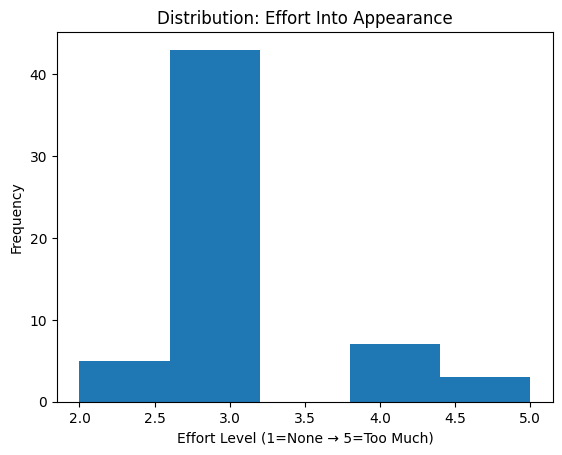
Note: This histogram shows the distribution check for the “Effort Into Appearance” variable. Note that the data is heavily clustered at level 3, has a strong central peak and is non-normal. The independent variable (x-axis) is the level of effort a participant put into their appearance and the dependent (y-axis) is the frequency at which participants put a certain amount of effort into their appearance.
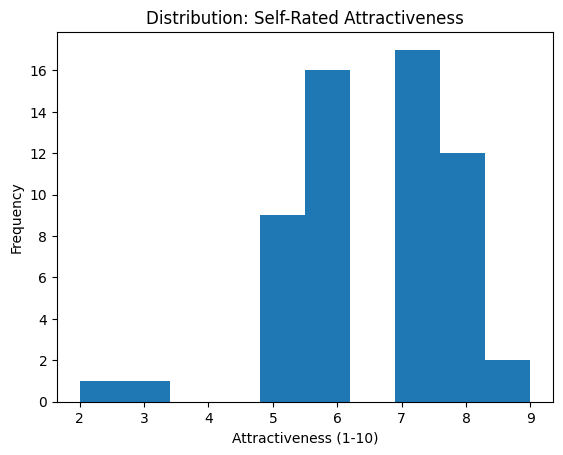
Note: This histogram shows the distribution check for the “Self-Rated Attractiveness” variable. Note that the data is clustered between 5 and 8, has a slight left skew, a mild ceiling effect and is non-normal. The independent variable (x-axis) is the attractiveness rating on a scale from 1-10 and the dependent (y-axis) is the frequency at which participants rated themselves a certain number.
Additionally, participants were asked in a multiple-choice format what makes them post a picture on social media. 76.8% said their appearance in general, and 62.5% said the way their face looked. Then, they were asked if they ever wished they looked like someone they saw on social media; 50% said yes. When asked if they ever felt like everyone else was more attractive than them, 32% said they feel like that all the time, 30.4% said sometimes, and 26.8% said a lot of the time. Only 10.7% said no or rarely.
Using Spearman’s correlations, we found that participants who felt a stronger pressure to look perfect had stronger emotional reactions to low engagement on social media posts (ρ ≈ +0.44). See Figure 6 below for the distribution check.
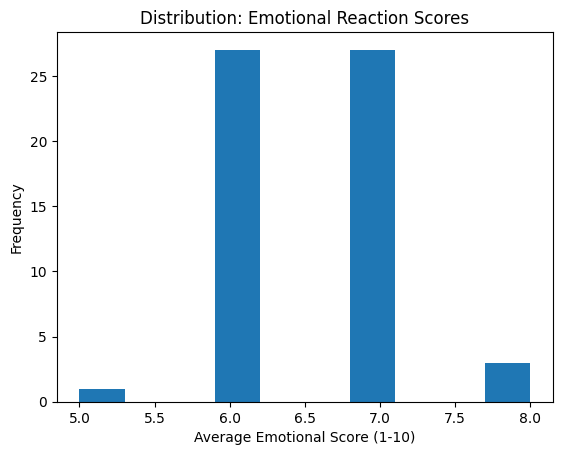
Note: This histogram shows the distribution check for the variable of “Emotional Reaction Scores.” Note that the data is clustered to levels 6 and 7, has a narrow distribution, slight central peak and is non-normal.
Moreover, through the Spearman’s correlations, a suggested monotonic chain within the gathered data was captured. The pattern displays that more exposure to attractive people is typically associated with higher perceived pressure to look perfect, which could correlate to a lower self-rated attractiveness; which would then be followed by a statistically stronger emotional reaction to engagement with social media posts. It is important to note that the chain is solely suggestive, not strongly demonstrated in the results.
In addition, a Spearman-based regression was conducted to examine whether self-rated attractiveness, pressure to look perfect, effort into appearance, and exposure to attractive people predicted emotional reactions to social media interactions. Results show that the model was not significant  . None of the predictors significantly predicted emotional reaction scores (all p > .10), suggesting that appearance-related perceptions were associated with, but did not significantly predict, emotional responses in this sample.
Lastly, there were some areas where we were unable to prove any specific correlations, many in the hypothesis that cultural beauty expectations impact perception of beauty. These variables we will call “null findings.” For example, we found that there was no correlation between race and how much one compares oneself to one’s relatives from the same or different race. Additionally, there were no notable correlations between race and rating random people of different races, which would have been the most significant indicator of cultural beauty expectations and surroundings impacting perception of beauty and, by extension, self-esteem. This does not mean that these correlations do not exist, there was simply not enough information or participants to find them.
Discussion
To summarize the percentage results, we found that “favorites” were most commonly the Caucasian option and many participants admitted to comparing themselves to others on social media. For correlational results, we found that seeing attractive people on social media may be associated with lower self-rated attractiveness, an element of self-perception, through pressure to look perfect. Lastly, we also found that participants who felt more pressure to look perfect had stronger emotional reactions to low engagement on social media posts. These results align with the association between social media and constructing one’s perception of beauty.
First, it was found that the most common “favorite” from the participants was the Caucasian option. Possible reasons associated with this could include that American conventional beauty standards tend to fit Caucasian features. Moreover, one possible reason the Caucasian option was chosen so often is because they were often the most well-known out of the options. This could correlate to “pretty privilege” and fitting the beauty standard, making it easier to become “famous.” Even if the participants only chose the Caucasian option because they were the only person they knew of, it would still mean that the person who fit the cultural beauty expectations had more fame than those who did not. There is not enough data to support this hypothesis; however, research suggests that there could be a correlation between fitting the beauty standard and gaining “fame” on social media faster13. This theory supports the idea that conventionally attractive individuals are shown more often on social media; thus leading to the discovered percentages of people seeing attractive people constantly on social media14.
Furthermore, we found that the majority of participants feel that they see attractive people “all the time” on social media, and the majority report that they only see a few unattractive people. Interestingly, we found that participants who felt more pressure to look perfect every day, possibly due to the abundance of attractive individuals on social media, tended to put more effort into their appearance each day. Then, a mild negative association was found between increased effort in appearance and self-rated attractiveness. If low self-rated attractiveness is reflected in low appearance-based self-esteem, it implies that seeing more attractive people on social media ultimately results in lower self-esteem. However, this variable was not measured in the study. Therefore, it is not factual that the measured variables result in lower self-esteem–only self-rated attractiveness, although self-esteem is often associated with self-rated attractiveness. Self-perception is more synonymous with self-rated attractiveness. The viewing of more attractive people on a daily basis could be a cause of many adolescents’ desire for validation, conveniently through social media15. This association would also tie into the social comparison theory on which this study is based upon. The abundance of attractive people one can be exposed to likely allows for more comparison, thus leading to lower self-rated attractiveness.16.
Next, when ranking how each social media interaction made them feel, there was a consistent pattern. The majority of participants always ranked at least a five (which is average) for interactions that are positive, but lower than five for interactions that are negative. This could show an emotional connection to social media interactions, or when one feels stronger emotions in regards to social media interaction, engagement, etc. The extent social media affects self-esteem may depend on whether participants are emotionally connected to their social media platform17. If there is no connection between the participant and social media, then what the participant sees on social media is less likely to affect them. However, although these associations were observed, there is no concrete data from our study to truly support this hypothesis, as we did not study emotional connection to social media. This would be an interesting area for future research. This association is further supported by our finding that those who felt more pressure to look perfect felt stronger emotional reactions to lower engagement than usual on social media posts. The larger emotional emphasis put on appearance-based validation via social media could be associated with a stronger negative reaction to the outcomes of social media post engagement. Moreover, the emotional connection between an adolescent and a social media platform suggests an association with social media based self-perception, or when one’s self-perception depends on comparisons through social media. Also, this would possibly be associated with perception of beauty being shaped by social media influence18.
Lastly, our null findings included no correlation between race and how much one compares oneself to one’s relatives from the same or different race. Plus, no notable correlations between race and rating random people of different races were found, which would have been the most significant indicator of cultural beauty expectations and surroundings impacting perception of beauty and self-esteem. It’s most likely that we did not have enough participants to formulate a proper correlation, but the results could change given a larger sample size. If it is the case that cultural beauty expectations do not relate to perception of beauty, then previous related findings, such as Ankole girls placing too much emphasis on beauty, should be deemed null, which is highly unlikely19. The most plausible explanation for why there was no correlation between race/cultural surroundings and perception of beauty is that there were not enough participants, or not enough diversity in the participants to gather a reasonable correlation.
Conclusion
Social media is a prevalent component in the twenty-first century; however, the drawbacks can include constant comparison, potentially leading to low self-esteem and poor self-perception. Even without the social media factor, cultural beauty standards oppressed society in the same way, especially among young women. The results of this study only supported some of the hypotheses. Findings did suggest that more social media exposure, especially to attractive individuals, can be associated with lower self-rated attractiveness. However, because of the limitations of the study, we were unable to support that cultural beauty expectations can affect one’s perception of beauty. It remains a reasonable hypothesis, but with the small scale of this study, we have insufficient evidence to support it.
While this study collected relevant data, it was conducted on a smaller scale with a limited geographic location and age demographic. In the future, doing a study of this same principle on a larger scale could create more precise results, as beauty standards and cultural beauty expectations have different implications in other geographic regions within the US and other countries. Limiting the study to just one geographic region limits the accuracy of the study since the results of one group cannot automatically be applied to others. The small size could decrease the reputability of the results. Another way to enlarge the study would be to include a broader age or race demographic. For instance, having a proportionate number of participants from each race and increasing the age range to twenty-five or more would make the results relevant to more people and include a more diverse group of perspectives. This would then increase the plausibility of the results as it accounts for and can be applied to a larger group of people. The age range for this study was chosen to find results specifically for teenage girls, whose self-perception will be affected by social media the most20,21. However, including older participants may help to discover more information about how age and development relate to social media exposure and self-esteem.
Diversity is an important factor in many studies22,23.
Our demographic was more than 50% Caucasian, meaning we didn’t get the ideal amount of diverse results. The abundance of Caucasian participants could be related to the majority of “favorites” also being Caucasian. If there was a more diverse group of participants, results may have produced a different pattern. This possibility decreases the credibility of the results, as there is a large margin for error or inaccuracy. Diversity is a very necessary factor in studies involving correlation to a cultural expectation, making our lack of diversity a major issue with this study. Diversity could have been especially helpful to support the claim that cultural beauty expectations affect our key hypothesis that one’s perception of beauty, since race plays a large factor in cultural beauty expectations–especially considering the wide variety of cultural beauty expectations that exist in the world24,25,26. In future studies, it is encouraged to include a much larger variety of races, ethnicities, religions, ages or locations to ensure the most inclusive and all-encompassing results.
Now, although there were some disappointing aspects of our results mostly due to sample size, there were also associations that leave room for much more discussion. If associations were found between social media, pressure to look perfect and self-rated attractiveness even in the small size of this study, it is possible that these results will be further supported by a larger study. The correlations discussed in this study between social media and self-esteem create new research questions that should be answered in the future. For instance, how can we prevent these issues from occurring? Is social media itself a problem for the youth? What other areas of life does social media influence? In what areas is emotional connection to social media impactful? These new research questions create many opportunities for future studies on a similar topic, and more impactful results could be found.
Overall, the implications of our findings, although minimized by the study’s limitations, do not lack impact. The association between high social media exposure, pressure to look perfect and lower self-rated attractiveness implies that social media negatively impacts self-perception. These findings suggest that a possible solution to the issue is lowering social media exposure in teens27,7.
Additionally, through our finding that those who felt more pressure to look perfect often had stronger emotional reactions to low social media engagement, we can logically assume that a possible solution includes limiting the pressure to look perfect. Since this relates to the earlier result of high social media exposure, a factor for this solution would also be lowering social media exposure. These implications beg the final research question, will limiting social media exposure counteract social media’s negative impact on teen girls? We hope these new questions can be answered in future studies.
Acknowledgements
To the participants of the survey, I am so appreciative of every single one of you for making this research possible. For taking the time from your day to fill out my survey, thank you. Next, to anyone who played even the smallest role in furthering my research, I couldn’t be more grateful. No matter how tiny the help may have seemed, it made a difference. Lastly, I can hardly express how grateful I am for my mentor, Sarah Alonsi, for supporting my project through all of its highs and lows. I’ve truly learned so much throughout this whole process and enjoyed every minute of it. From the bottom of my heart, thank you to all of you.
References
- M. Anderson, J. Jiang. Teens, social media and technology 2024. https://www.pewresearch.org/internet/2024/12/12/teens-social-media-and-technology-2024/. [↩]
- C. E. Sagrera, J. Magner, J. Temple, R. Lawrence, T. J. Magner, V. J. Avila-Quintero, P. McPherson, L. L. Alderman, M. A. N. Bhuiyan, J. C. Patterson, K. S. Murnane. Social media use and body image issues among adolescents in a vulnerable Louisiana community. Frontiers in Psychiatry. Vol. 13, pg. 1001336, 2022, https://doi.org/10.3389/fpsyt.2022.1001336. [↩]
- J. V. Hogue, J. S. Mills. The effects of active social media engagement with peers on body image in young women. Body Image. Vol. 28, pg. 1–5, 2019, https://doi.org/10.1016/j.bodyim.2018.11.002. [↩]
- E. L. Trist, K. W. Bamforth. Some social and psychological consequences of the longwall method of coal-getting. Human Relations. Vol. 7, pg. 3–38, 1954, https://doi.org/10.1177/001872675400700202. [↩]
- K. A. Fardouly, P. C. Diedrichs, L. Vartanian, E. Halliwell. Social comparisons on social media: the impact of Facebook on young women’s body image concerns and mood. Body Image. Vol. 13, pg. 38–45, 2015, https://doi.org/10.1016/j.bodyim.2014.12.003. [↩]
- L. R. Vandenbosch, S. Eggermont. Sexualization of adolescent boys: media exposure and boys’ internalization of appearance ideals. Cyberpsychology, behavior, and social networking. Vol. 16, pg. 537–542, 2013, https://doi.org/10.1089/cyber.2013.0305. [↩]
- A. K. Hawes, L. Zimmer-Gembeck, K. Campbell. Social media, body dissatisfaction, and eating pathology: a systematic review. Nutrients. Vol. 15, pg. 5071, 2023, https://doi.org/10.3390/ijerph16214177 [↩] [↩]
- Fashion Sustainability Directory. How does algorithmic bias affect body image. https://fashion.sustainability-directory.com/question/how-does-algorithmic-bias-affect-body-image/, 2024. [↩]
- H. Dittmar. Does Barbie make girls want to be thin? The effect of experimental exposure to images of dolls on the body image of 5–8-year-old girls. Developmental Psychology. Vol. 42, pg. 283–292, 2006, https://doi.org/10.1037/0012-1649.42.2.283. [↩]
- S. A. Bhandari, R. Poudel. Social media use and body image perception among adolescents. Cogent Social Sciences. Vol. 10, Art. 2427350, 2024, https://doi.org/10.1080/23311886.2024.2427350. [↩]
- R. C. Silva, G. Steins. Social networking site use and body image dissatisfaction: a meta-analysis. Frontiers in Psychology. Vol. 14, pg. 1037932, 2023, https://doi.org/10.3389/fpsyg.2023.1037932. [↩]
- S. Tiggemann, Z. Slater. NetGirls: The internet, Facebook, and body image concern in adolescent girls. Journal of Children and Media. Vol. 8, pg. 206–224, 2014, https://doi.org/10.1002/eat.22141. [↩]
- J. Foster, Birkin bags and beautiful people: how fashion, capital, and fame collide. TSpace. (2024). [↩]
- S. Sharma. Exploring Instagram’s algorithmic bias towards attractive women and its impact on users. https://medium.com/@heysuryansh/exploring-instagrams-algorithmic-bias-towards-attractive-women-and-its-impact-on-users-case-79a4c7e6583f, 2023. [↩]
- L. Kumar, R. K. Singh. Social media influencers’ impact on young women’s acceptance of beauty standards. https://www.researchgate.net/profile/Lalit-Kumar-62/publication/376650225_Social_Media_Influencers’_Impact_On_Young_Women’s_Acceptance_Of_Beauty_Standards/links/6582a10f6f6e450f198b0b87/Social-Media-Influencers-Impact-On-Young-Womens-Acceptance-Of-Beauty-Standards.pdf, 2023. [↩]
- M. Solomon, Social media and self-evaluation: the examination of social media use on identity, social comparison, and self-esteem in young female adults. ProQuest Dissertations Publishing. (2016). [↩]
- A. D’Arienzo, G. Boursier, M. D. Griffiths. Social networking site use and body image concerns: a systematic review. International Journal of Mental Health and Addiction. Vol. 18, pg. 59–71, 2020, https://doi.org/10.1007/s11469-019-00082-5. [↩]
- J. Perloff. Social media effects on young women’s body image concerns: theoretical perspectives and an agenda for research. In: Body image, social media and eating disorders. IntechOpen. pg. 1–20, 2020. [↩]
- R. Kaziga, C. Muchunguzi, D. Achen, S. Kools, Beauty is skin deep: The self-perception of adolescents and young women in the construction of body image within the Ankole society. Int J Environ Res Public Health. 18, 7751 (2021). [↩]
- C. Freeman, A. Potente. Social media and body image in adolescents: a review of research. EClinicalMedicine. Vol. 6, pg. 59–68, 2018, https://doi.org/10.1016/S2589-5370(18)30060-9. [↩]
- Drexel University College of Medicine. Pros and cons of social media for adolescent girls. https://drexel.edu/medicine/academics/md-program/scholars-programs/womens-health-education-program/whep-blog/pros-and-cons-of-social-media-for-adolescent-girls/, 2023. [↩]
- National Academies of Sciences, Engineering, and Medicine. Social media and adolescent health. National Academies Press, Washington, DC. https://www.ncbi.nlm.nih.gov/books/NBK584396/, 2023. [↩]
- V. H. Murthy. Protecting youth mental health in the age of social media. New England Journal of Medicine. Vol. 388, pg. 185–187, 2023, https://doi.org/10.1056/NEJMp2215609. [↩]
- J. Tolentino. The age of Instagram face. https://www.mediastudies.press/pub/tolentino-age/release/2, 2019. [↩]
- S. Bumochir. Renegotiating female beauty and body ideals in Mongolia: the embodiment of nation, tradition, and modernity. https://www.academia.edu/9315859/Renegotiating_Female_Beauty_and_Body_Ideals_in_Mongolia_The_Embodiment_of_Nation_Tradition_and_Modernity, 2014. [↩]
- R. Popenoe. Feeding desire: fatness, beauty, and sexuality among a Saharan people. https://www.researchgate.net publication/287466179_Feeding_desire_Fatness_beauty_and_sexuality_among_a_saharan_people, 2004. [↩]
- S. E. Jackson, K. Robinson, M. Daly. Social media use and mental health among adolescents. Professional Psychology: Research and Practice. Vol. 54, pg. 1–12, 2023, https://doi.org/10.1037/ppm0000460. [↩]