
Abstract
Construction sites often meet minimum welfare requirements, yet workers may still perceive facilities as inconvenient or unhygienic. This study asks (i) how sanitation satisfaction compares with other welfare facilities on South Korean construction sites and (ii) whether overall work-environment satisfaction is associated with turnover intention among construction workers. Using published national survey tables from Korea’s Construction Works Mutual Aid Association (CWMA) and Ministry of Employment and Labor (MOEL) (survey respondents n = 1,327), we find that toilets are reported to be available at most sites (91%) but receive the lowest average satisfaction among surveyed welfare facilities (mean 3.06/5), indicating a persistent coverage-quality gap. Using the Korea Labor & Income Panel Study (KLIPS) Wave 26 (2023) construction workers (analytic n = 696), we estimate an OLS model of turnover intention (1-5) on overall work-environment satisfaction (1-5) with controls for worker and job characteristics and construction-subindustry fixed effects; standard errors are clustered at the household level. Higher work-environment satisfaction is associated with lower turnover intention (beta = -0.302, SE = 0.039, p < 0.001). Because the sanitation tables and KLIPS microdata cannot be linked at the worker or site level, the regression should not be interpreted as a sanitation-specific effect, and results are associational rather than causal. We situate the findings using brief comparisons of sanitation-planning guidance in the United Kingdom, Singapore, and Australia and outline an illustrative concept for reducing access distance on multi-storey sites. Future research should directly measure sanitation quality and link upgrades to subsequent turnover behavior.
Keywords: Construction welfare; sanitation; turnover intention; work-environment satisfaction; KLIPS; policy comparison
Introduction
Background and Context
South Korea’s construction industry accounts for approximately 5.2% of national GDP and about 1.74 million workers1. The sector also faces labor shortages and an aging workforce, with only 8.7% of workers under 30.
Construction worker retention has been studied from many perspectives, yet the role of basic workplace infrastructure remains underexamined. Sanitation and welfare facilities receive limited academic attention even though they shape workplace dignity and health. Cross-country turnover rates are not directly comparable because definitions and measurement windows differ (e.g., the U.S. Bureau of Labor Statistics Job Openings and Labor Turnover Survey (JOLTS) versus Statistics Korea (KOSTAT) and the Korean Ministry of Employment and Labor (MOEL))1,2.
Problem Statement and Rationale
Building on this gap, we ask how sanitation satisfaction compares with other welfare facilities on construction sites and whether overall work-environment satisfaction is associated with turnover intention among construction workers. Importantly, our sanitation evidence (published national survey tables) and our regression evidence (KLIPS microdata) are separate strands that cannot be linked at the worker or site level; therefore, we avoid sanitation-specific causal claims and present the KLIPS results as associational. This design lets us position sanitation within broader site welfare without claiming a worker-level sanitation effect that the data cannot identify.
Construction Worker Turnover: Global Context and Consequences
Construction employment is shaped by project-based arrangements, physical demands, safety risks, and historically poor site conditions. We reference official labor-market sources (e.g., JOLTS in the U.S.) when making country-specific statements and otherwise describe patterns qualitatively2. Industry and government reports also note recruitment difficulties and persistent skills shortages relative to other sectors. These macro pressures reinforce the importance of workplace conditions for employee retention.
A systematic review identifies poor working conditions as a recurring factor in construction workforce turnover3. However, that review does not directly test specific workplace infrastructure elements, particularly in Asian construction markets.
Workplace Welfare and Employee Retention
The relationship between workplace conditions and employee retention has a strong theoretical foundation in the organizational behavior literature. Herzberg’s two-factor theory distinguishes between hygiene factors and motivators, such as recognition and promotion4. According to this framework, inadequate hygiene factors, including sanitation facilities, create dissatisfaction associated with higher turnover, while bringing them to acceptable standards mainly reduces dissatisfaction rather than creating motivation. Consistent with this logic, job demands-resources theory similarly predicts that insufficient resources increase strain and burnout, thereby raising turnover probability5. Related organizational research outside construction also examines how management and training practices shape employee outcomes6.
In a construction-specific context, Sunindijo and Kamardeen highlight that work stress and broader work-environment problems are salient issues for Australian construction professionals7. Their study, however, focuses on psychosocial stressors and gender diversity rather than field sanitation on construction sites.
International Comparative Practices
The United Kingdom’s construction industry is a useful comparator for this study because it combines a documented skills outlook with established welfare guidance. CITB’s Construction Skills Network tracks workforce demand and recruitment pressures in the sector8. These wider labor-market pressures help frame why welfare conditions may matter for attraction and retention.
CDM 2015 (Construction Design and Management Regulations 2015) mandates specific welfare provisions, including adequate toilets, sanitation, and resting facilities9. The UK also publishes regular national fatal-injury statistics through the Health and Safety Executive (HSE)10,11. Over the long run, all-industry work-related fatalities have declined markedly, although construction still represents a notable share of the total.
Theoretical Framework
This study integrates three theoretical perspectives: Human capital theory, social exchange theory, and the job characteristics model. Originally developed by Becker (1964), human capital theory suggests that welfare investments can raise productivity by improving working conditions12. Economically, such investments are justified up to the point where their marginal costs equal their expected benefits through lower turnover and higher productivity.
Second, social exchange theory suggests that workers who feel supported and treated fairly are more likely to reciprocate. Visible investments in welfare beyond the minimum can signal respect and strengthen attachment to the employer, thereby lowering quit intentions13.
Lastly, Hackman and Oldham’s job characteristics model provides insight into how the physical work-environment affects work motivation and satisfaction14. While the model primarily focuses on task characteristics, later work extends related ideas to physical working conditions. Basic comfort and dignity significantly influence how work is experienced.
Research Questions
This study asks whether sanitation satisfaction scores are systematically lower than those for other welfare facilities on South Korean construction sites.
It also examines whether higher overall work-environment satisfaction is associated with lower turnover intention among construction workers using KLIPS Wave 26 (2023).
Methods
Research Design
We use a convergent mixed-methods design that combines (i) quantitative secondary analysis of published national survey tables on welfare-facility provision and satisfaction, (ii) an associational regression analysis of KLIPS Wave 26 construction workers, (iii) a comparative review of sanitation-planning guidance (UK and selected benchmarks), and (iv) an illustrative concept discussion focused on reducing access distance on multi-storey sites. The strands are analyzed in parallel and integrated at interpretation. Variable mapping for the KLIPS analysis is provided in Appendix S1.
Participants and Data Sources
CWMA/MOEL Worker Survey (Korea). To describe sanitation-related conditions on Korean construction sites, we use a nationwide survey from the Construction Works Mutual Aid Association (CWMA) and the Korean Ministry of Employment and Labor (MOEL). The published tables include various aspects of construction workers’ job conditions and welfare. We extracted relevant descriptive metrics: availability and satisfaction ratings of on-site facilities (toilets, washing facilities, rest areas, etc.) and qualitative survey items on working-environment concerns. We also reviewed prior years’ CWMA reports and related literature for context on reported reasons for leaving construction work, especially among younger workers.
KLIPS Panel (Korea). We used the Korea Labor & Income Panel Study (KLIPS) Wave 26 (2023) microdata to examine turnover intention among construction-industry respondents15. We restrict to construction-industry respondents (p_ind2017 410-429) and construct turnover intention and work-environment satisfaction measures, along with standard controls15. After complete-case restrictions, our analytic sample is n = 696. Full variable mapping is documented in Appendix S1.
Regulatory and Technical Documents. For international comparison, we reviewed regulatory and guidance materials in the UK, HSE/CIS welfare guidance, planning ratios, and CDM-linked documents. For other benchmarks, Singapore NEA’s code and WorkSafe Victoria’s Facilities in Construction guidance were assessed16,17. A detailed source list and evidence table are available upon request.
Variables and Measurements
Facility Satisfaction (CWMA/MOEL). Measured on a 5-point Likert scale (1 = very dissatisfied, 5 = very satisfied) across eight facility types: toilets, washing facilities, rest areas, changing rooms, storage, drinking water, heating/cooling, and dining.
Turnover intention (KLIPS). Derived by reverse-coding the stay-intention item (p4305) so that higher values indicate greater intention to leave (Table 1).
Work-environment satisfaction (KLIPS). Derived by reverse-coding p4314 so that higher values indicate greater satisfaction (Table 1).
Controls. Controls include log monthly wage, age, education, weekly hours, job status, and firm size. We also include construction-subindustry fixed effects based on the 2017 industry classification (p_ind2017). Detailed item wording and construction are documented in Appendix S1.
| Variable | KLIPS item / source | Coding / construction | Notes |
| Turnover intention (1-5) | p4305 | TurnoverIntention = 6 − p4305 | Reverse-coded so higher = more likely to leave |
| Work-environment satisfaction (1-5) | p4314 | WorkEnvSatisfaction = 6 − p4314 | Reverse-coded so higher = more satisfied |
| Log monthly wage | p_wage | log(p_wage) | p_wage is monthly wage/income (unit: 10,000 KRW); self-employed report income |
| Age (years) | p_age | As reported | |
| Education level (1-6) | p_edu | As reported | 1=no schooling; 2=<HS; 3=HS; 4=some college; 5=associate; 6=BA+ |
| Weekly hours | p_hours | As reported | Average weekly hours at main job |
| Job status | p_job_status | As reported (categorical code) | 1=regular; 2=temporary; 3=daily; 4=employer/self-employed; 5=unpaid family worker |
| Firm size | p_firm_size | As reported (categorical code) | 1=<10; 2=10-29; 3=30-99; 4=100-299; 5=300-499; 6=500+ employees |
| Construction subindustry FE | p_ind2017 | Indicator variables (410-429; drop-first) | Included in OLS; coefficients not reported |
Table 1 | Variable definitions and coding for KLIPS regression analysis
| Variable | N | Mean | SD | Min | Max |
| Turnover intention (1-5) | 696 | 2.257 | 0.651 | 1 | 5 |
| Work-environment satisfaction (1-5) | 696 | 3.332 | 0.644 | 1 | 5 |
| Age (years) | 696 | 51.208 | 11.574 | 20 | 81 |
| Education level (1-6) | 696 | 4.079 | 1.498 | 2 | 6 |
| Job status (code) | 696 | 1.865 | 1.063 | 1 | 4 |
| Firm size (code) | 696 | 2.145 | 1.416 | 1 | 6 |
| Log monthly wage | 696 | 5.762 | 0.490 | 3.85 | 7.601 |
| Weekly hours | 696 | 39.325 | 8.503 | 8 | 72 |
Notes. Work-environment satisfaction is reverse-coded from p4314, so higher values indicate greater satisfaction; turnover intention is derived by reverse-coding the stay-intention item p4305.
Procedure
CWMA/MOEL
We compute descriptive availability and satisfaction by facility type and summarize worker comments thematically.
KLIPS
We restrict to construction-industry respondents in KLIPS Wave 26 (2023) (p_ind2017 410-429). For the regression analysis, we use a complete-case analytic sample (n = 696) for the outcome, predictor, and controls; no imputation is used in the main analysis.
Data Analysis: KLIPS
We analyze construction-industry respondents from KLIPS Wave 26 (2023) (analytic n = 696)15. Turnover intention (1-5; higher = more likely to leave) and work-environment satisfaction (1-5; higher = more satisfied) are derived by reverse-coding the original items (Table 1). We regress turnover intention on work-environment satisfaction using OLS with controls for age, education, log wage, weekly hours, job status, and firm size and include construction-subindustry fixed effects. Standard errors are clustered at the household level. Results are associational, not causal. Following Clark and Böckerman and Ilmakunnas, our core specification is OLS18,19:
(1) 
where i indexes respondents. X includes age, education, job status, log monthly wage, weekly hours, and firm size. δ_subindustry denotes construction-subindustry fixed effects based on p_ind2017 codes 410-429. Standard errors are clustered at the household level. Because the analysis uses a single cross-sectional wave, the model does not include year fixed effects; results are associational rather than causal.
Economic Impact Assessment
Cost-of-Turnover. We translate separations into cost using Boushey and Glynn’s benchmark that replacement costs average around 21% of annual pay for typical roles, treating it as a calibration device rather than a point estimate20. The cost included direct costs (hiring, processing, and training) and indirect costs (reduced productivity and vacancy period for the new hire). Although the model is a general benchmark derived largely from the U.S. labor market, we use it only as an illustrative calibration because Korea-specific estimates are limited and transferability is uncertain. To address transferability to Korea, where hiring/training institutions, subcontracting prevalence, and wage composition differ, we present a conservative sensitivity around the 0.21 factor (-30%, baseline, +30%). Accordingly, the annual cost formula is
(2) 
where m is the replacement-cost multiplier (0.21 in the baseline calibration). Table 3 reports the turnover-cost-multiplier sensitivity used for this illustrative calibration.
| Scenario | Multiplier (m) | Interpretation |
| Low (-30%) | 0.147 | Lower-bound transferability (lean hiring/training spend) |
| Baseline | 0.210 | Boushey & Glynn (2012) benchmark |
| High (+30%) | 0.273 | Upper-bound transferability (richer hiring/training spend) |
OPEX (operating expenditure) offset. We consider a hypothetical OPEX offset scenario in which improved on-site sanitation corresponds to a Δ percentage-point reduction in separations. This is a back-of-the-envelope calibration (not an estimate) intended to show how even small changes in separations could compare with ongoing operating costs under different assumptions.
Productivity Impacts. We do not estimate productivity gains; references are used to contextualize mechanisms, not to derive monetary totals. Research in construction management showed that poor working conditions can reduce productivity and work quality21. Time lost traveling multiple floors to ground-level toilets and associated fatigue are hidden costs. Although we do not directly measure productivity loss here, we drew on logical inferences from other industries where work welfare correlates with performance. The correlation between the workspace convenience, such as the presence of sanitary facilities nearby, and productivity is investigated and discussed qualitatively rather than measured directly.
Comparative Policy Review
To contextualize the comparative policy discussion, we reviewed UK welfare guidance (HSE Construction Information Sheet 59 (CIS59)), planning ratios, and CDM-linked materials for minimum provision, servicing cadence, and enforcement logic9,22,23.
Ethics
This study uses de-identified secondary data (KLIPS public microdata; CWMA/MOEL published tables). No human subjects were recruited; IRB approval was not required under journal policy.
Results
Sanitation Satisfaction in Korea: Descriptive Evidence
Analysis of the CWMA 2022 survey data suggests that sanitation facilities are a salient concern in Korean construction workplaces24. As shown in Table 4, about 91% of the surveyed construction workers reported that their site had a toilet available, making toilets the most commonly provided amenity. Despite the provision, satisfaction with the condition and convenience of toilets was the lowest among all categories of welfare facilities surveyed (mean 3.06/5), below changing rooms (3.36), showers (3.37), rest areas (3.13), and canteens (3.23). Workers frequently complained of (1) unsanitary conditions (stagnant odors, uncleanness), (2) insufficient supply (wait time, inadequate units), and (3) inaccessibility (distance). The report groups these complaints within the broader category of “poor working environment,” but the published tables do not permit a direct worker-level link between sanitation dissatisfaction and turnover24. Table 4 summarizes availability and satisfaction contrasts. Toilet access is widespread, but perceived condition and convenience lag behind other amenities.
| Welfare Facility | South Korea |
| Toilet Quality Satisfaction | Low satisfaction (3.06/5): Unsanitary conditions, insufficient supply, and inaccessibility. |
| Wider welfare | Basic canteen or rest area on larger sites; smaller sites often have none. Shower availability ~34.7% of sites. Limited heating in winter. |
| Focus | Compliance-focused: Provide a minimum required by law. |
| Workforce concern | The report notes concern about the industry’s appeal to younger workers and about longer-term attraction and retention. |
KLIPS Associational Results
Table 2 reports descriptive statistics for the KLIPS Wave 26 construction-worker analytic sample (n = 696). Turnover intention is coded on a 1-5 scale (higher = more likely to leave), and work-environment satisfaction is coded so that higher values indicate greater satisfaction.
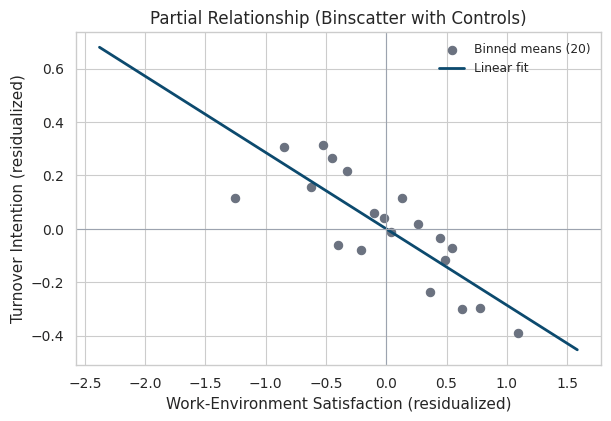
OLS with controls, construction-subindustry fixed effects, and household-clustered standard errors shows a negative association between work-environment satisfaction and turnover intention (β = −0.302, SE = 0.039, p < 0.001). Model R² is 0.21. Among controls, log wage is negatively associated with turnover intention; other covariates are not consistently significant.
| Turnover intention (1-5) | (1) OLS |
| Work-environment satisfaction (1-5) | -0.302*** |
| (0.039) | |
| Controls: log wage, age, education, weekly hours, job status, firm size Fixed effects: construction subindustry (p_ind2017) | |
| Clustering unit | Household (hhid) |
| Observations | 696 |
| R² | 0.21 |
Notes. *** p < 0.001; ** p < 0.01; * p < 0.05.
Figure 1 visualizes the partial relationship using binscatter after residualizing both variables on controls and construction-subindustry fixed effects. The linear fit in residual space aligns with the regression result.
International Benchmarks (UK, Singapore, Australia)
A structured review of welfare guidance shows that the UK, Singapore, and Australia make minimum provision and servicing cadence explicit and enforceable. Table 6 summarizes contrasts most relevant to Korean high-rise sites. UK rows reflect regulatory requirements/practice notes, whereas the Korea row combines regulation and worker-rated satisfaction from CWMA; items are not strictly comparable but help situate cross-national differences in sanitation planning and worker experience.
| Country | Primary Sources | Minimum toilet provision | Servicing cadence | Placement | Gender segregation |
| Korea | MOEL/KOSHA regs; CWMA 2022 | More than 1 per 30 males, more than 1 per 20 females (chemical or fixed) | Not specified | Within 300 m of work area | Required |
| UK | CDM 2015; HSE CIS59; BS 6465-1 | 1 portable chemical toilet per 7 workers per 40-hour week or 1 main WC per 25 persons | At least weekly for chemical units (increase with usage/shifts) | Not specified in code; on-site and accessible | Yes |
| Singapore | NEA Code of Practice on Environmental Health (2017) | Per 25 workers: 1 WC, 1 urinal, 1 WHB (Male), 2 WCs, 1 WHB (Female) | Service/cleaning required; frequency set by usage & hygiene | On-site, with privacy and signage | Yes |
| Australia | WorkSafe Victoria, Facilities in construction (Compliance Code) | 1 closet for 1-5 workers, 1 closet 1 urinal for 6-10 workers, up to 100 | Clean, well-lit, maintained, cadence per use | On-site and reasonably close | Yes |
Note. Cross-national welfare benchmarks relevant to construction sites. UK/SG/AUS entries are regulatory requirements or practice notes; Korea combines regulation with worker-rated satisfaction (CWMA 2022). Items are descriptive and not causal. Abbreviations: MOEL = Ministry of Employment and Labor; KOSHA = Korea Occupational Safety and Health Agency; HSE = Health and Safety Executive; CIS59 = Construction Information Sheet 59; NEA = National Environment Agency; WHB = wash hand basin; WC = water closet.
Illustrative Concept: Vertical Ascending Lavatory (VAL) System
To address vertical access constraints that can make existing toilets difficult to reach on high-rise projects, we outline an illustrative concept—the Vertical Ascending Lavatory (VAL)—intended to reduce travel distance to sanitation facilities by enabling closer placement to active floors. This concept is presented to motivate future prototyping rather than as a validated engineering solution; detailed specifications, calculations, and sensor designs are omitted here and are beyond the scope of this study.
Discussion
Theoretical Implications
Across the two strands of evidence, we find (i) a consistent sanitation satisfaction gap in published national welfare tables and (ii) a negative association between overall work-environment satisfaction and turnover intention in KLIPS, after adjusting for standard controls and construction-subindustry fixed effects. Because the sanitation tables and KLIPS microdata cannot be linked at the worker or site level, and because the KLIPS analysis is cross-sectional, the regression should be interpreted as associational rather than causal. The pattern is consistent with hygiene-factor and social-exchange perspectives, while a human-capital lens frames basic welfare as a retention-related investment and the job-characteristics tradition underscores how everyday physical conditions shape how work is experienced.
Implications for Welfare Priorities
Among welfare facilities on Korean construction sites, toilets consistently receive the lowest satisfaction scores compared with other surveyed amenities. In the published CWMA tables, toilets are present at over 90% of sites but are rated less positively than changing rooms, canteens, showers, and rest areas. This pattern identifies sanitation as a plausible priority area for future site-level improvement and evaluation, especially because worker comments repeatedly mention access distance, insufficient units, waiting time, and hygiene. At the same time, our data do not show that sanitation upgrades would reduce turnover on their own; that question requires directly linked worker- or site-level data.
Policy context and implementation considerations
The United Kingdom. General regulations are from the Workplace (Health, Safety and Welfare) Regulations 1992, and planning ratios are commonly taken from BS 6465-1:200622,25. HSE construction guidance uses rules-of-thumb such as one mains WC per 25 persons and 1 portable chemical toilet per 7 workers (per 40-hour week) with at least weekly servicing; requirements scale with headcount and shift patterns26,27. Under CDM 2015, employers must ensure adequate welfare, and these ratios typically evidence compliance.
Singapore. The NEA Code of Practice on Environmental Health specifies sex-disaggregated ratios for construction settings16. For example, the code specifies one water closet, one urinal, one wash hand basin, and one mirror for every 25 male workers, and two water closets and one wash hand basin for every 25 female workers. These ratios make servicing and privacy requirements explicit at the planning stage.
Australia. WorkSafe Victoria’s compliance guidance requires access to clean and hygienic toilets at all times while on site17. It also provides a numeric matrix that scales closet and urinal provision by workforce size (summarized in Appendix S4/Table S4.2).
South Korea’s Current Regulations
Under the Construction Workers’ Employment Improvement Act, designated construction sites must provide and maintain welfare facilities, including toilets, for workers28. The implementing rule (annex) specifies: (i) toilets must be usable within 300 m of the work area, (ii) separate facilities for men and women, (iii) a designated toilet manager, and (iv) minimum fixture counts of at least one WC per 30 male workers and one WC per 20 female workers29.
Planning considerations for South Korea
Comparative sources from the United Kingdom, Singapore, and Australia provide planning benchmarks that may be informative for South Korea, especially on multi-storey projects. Across jurisdictions, common themes include closer placement of units (e.g., within ~100 m walking distance or roughly one unit per active floor where feasible), explicit capacity and servicing assumptions (e.g., one portable chemical toilet per seven workers per 40-hour week, scaled by shifts and usage), and simple monitoring and reporting mechanisms (e.g., fill-level/odor indicators and anonymous feedback) to support timely servicing. Any enforcement or incentive approach would need to be proportionate and sensitive to site heterogeneity, space constraints, and implementation capacity.
Challenges and Limitations
Construction sites are heterogeneous and fast-changing, which makes it challenging to apply a universal standard across different site sizes, durations, and locations. Urban density and small-contractor settings also limit space for welfare units. In one survey, 43% of respondents cited space constraints as a barrier, 31% reported insufficient employer commitment or prioritization, and 24% cited budget limits24. These physical and financial constraints depress compliance even when rules exist.
Awareness and enforcement are uneven. Supervisors tend to report higher knowledge and satisfaction with current standards than frontline workers, who are less aware of their rights or perceive facilities as inadequate; installed units may therefore be underused or poorly maintained.
This study has several measurement limits. First, KLIPS provides self-reported outcomes and a single cross-sectional wave for our estimation sample (Wave 26, 2023; analytic n = 696); results are associational, not causal, and should be interpreted cautiously rather than used as the sole basis for national-level policy inference. Second, our outcome is turnover intention rather than actual separations. Third, the KLIPS satisfaction measure captures the overall work-environment, not sanitation specifically. Fourth, CWMA and MOEL statistics come from published tables rather than microdata, so we cannot link CWMA and KLIPS at the worker or site level. In addition, the published sanitation satisfaction tables are not disaggregated by gender, limiting our ability to assess gender-specific access and privacy concerns; future work should explicitly examine these dimensions. Unobserved site quality and management practices may co-vary with both sanitation and retention despite fixed effects and controls.
Future Directions
Future research should first investigate the welfare-performance relationship beyond turnover intention to actual turnover behavior, productivity, safety, and quality outcomes to create a more comprehensive understanding of welfare investment returns. Second, the optimal welfare investment should be identified across different project types, geography, and workforce demographics. This could support more targeted implementation for specific worker groups. Lastly, the comparative benchmarks should be broadened to additional welfare-oriented countries (e.g., Germany or Japan) to refine implementable standards for the high-rise context.
Conclusion
This study examines workplace welfare on South Korean construction sites and its potential relevance for retention. We find that sanitation facilities are widely provided but receive the lowest satisfaction scores among surveyed amenities, and that higher overall work-environment satisfaction is associated with lower turnover intention in KLIPS Wave 26 (2023) cross-sectional models with controls and construction-subindustry fixed effects. Because the sanitation tables and KLIPS microdata cannot be linked at the worker or site level, and because the KLIPS analysis is observational, results should be interpreted as associational rather than causal.
Our contribution is fourfold: (i) document a persistent availability-satisfaction gap for sanitation in published national welfare tables; (ii) estimate an associational link between overall work-environment satisfaction and turnover intention in KLIPS; (iii) compile minimum-ratio and servicing guidance from the UK and other jurisdictions to clarify the policy gap; and (iv) outline an illustrative concept for reducing vertical access distance on multi-storey sites. Future work should directly measure sanitation quality at the site level and evaluate whether targeted upgrades change subsequent turnover behavior.
Strategic attention to basic sanitation, such as placement, capacity, and service cadence, may improve perceived site welfare and is a plausible area for retention-focused evaluation on multi-storey projects. Future work using multi-wave microdata or pilot evaluations could identify causal effects and quantify the incremental value of engineering and policy interventions. In the current study, sanitation is best understood as an important descriptive welfare concern rather than a directly estimated driver of turnover.
Acknowledgement
I am grateful to my advisor at Chadwick International for guidance, feedback, and patient line-edits throughout this project.
Supplementary Information
References
- Statistics Korea (KOSTAT). Economically active population survey & industry indicators (construction workforce shares). https://kostat.go.kr 2024. [↩] [↩]
- U.S. Bureau of Labor Statistics. Job openings and labor turnover survey (jolts). https://www.bls.gov/jlt/ 2025. [↩] [↩]
- O. A. Ayodele, A. Chang-Richards, V. González. Factors affecting workforce turnover in the construction sector: a systematic review. Journal of Construction Engineering and Management. Vol. 146, 2020, https://doi.org/10.1061/(ASCE)CO.1943-7862.0001725. [↩]
- Z. Alfayad, L. S. M. Arif. Employee voice and job satisfaction: an application of herzberg’s two-factor theory. International Review of Management and Marketing. Vol. 7, pg. 150–156, 2017. [↩]
- A. B. Bakker, E. Demerouti. Job demands–resources theory: taking stock and looking forward. Journal of Occupational Health Psychology. Vol. 22, pg. 273–285, 2017, http://dx.doi.org/10.1037/ocp0000056. [↩]
- P. Ghosh, R. Satyawadi, J. P. Joshi, R. Ranjan, P. Singh. Towards more effective training programmes: a study of trainer attributes. Industrial and Commercial Training. Vol. 44, pg. 194–202, 2012, https://doi.org/10.1108/00197851211231469. [↩]
- R. Y. Sunindijo, I. Kamardeen. Work stress is a threat to gender diversity in the construction industry. Journal of Construction Engineering and Management. Vol. 143, pg. 04017073, 2017, https://doi.org/10.1061/(ASCE)CO.1943-7862.0001387. [↩]
- Construction Industry Training Board. Construction Skills Network: Industry outlook 2023–2027. https://www.citb.co.uk/industry-insights/forecasts/ 2023. [↩]
- UK Government. The Construction (Design and Management) Regulations 2015, Schedule 2 (Welfare). 2015. [↩] [↩]
- Health and Safety Executive. Work-related fatal injuries in great britain. https://www.hse.gov.uk/statistics/fatals-overview.htm 2025. [↩]
- Health and Safety Executive. Latest annual work-related fatalities published (press release). https://press.hse.gov.uk/2025/latest-annual-work-related-fatalities-published/ 2025. [↩]
- G. S. Becker. Human Capital: A Theoretical and Empirical Analysis, with Special Reference to Education. University of Chicago Press, 1964. [↩]
- R. Cropanzano, M. S. Mitchell. Social exchange theory: an interdisciplinary review. Journal of Management. Vol. 31, pg. 874–900, 2005, https://doi.org/10.1177/0149206305279602. [↩]
- J. R. Hackman, G. R. Oldham. Motivation through the design of work: test of a theory. Organizational Behavior and Human Performance. Vol. 16, pg. 250–279, 1976, https://doi.org/10.1016/0030-5073(76)90016-7. [↩]
- Korea Labor Institute. Korea Labor & Income Panel Study (KLIPS), Wave 26: User guide and codebook. https://www.kli.re.kr/klips 2024. [↩] [↩] [↩]
- National Environment Agency (Singapore). Code of Practice on Environmental Health. https://www.nea.gov.sg/docs/default-source/our-services/code-of-practice-on-environmental-health-(1-mb).pdf 2017. [↩] [↩]
- WorkSafe Victoria. Compliance Code: Workplace facilities and the working environment. https://content-v2.api.worksafe.vic.gov.au/sites/default/files/2023-12/Compliance-code-Workplace-facilities-working-environment-2023-12.pdf 2023. [↩] [↩]
- A. E. Clark. What really matters in a job? hedonic measurement using quit data. Labour Economics. Vol. 8, pg. 223–242, 2001, https://doi.org/10.1016/S0927-5371(01)00031-8. [↩]
- P. Böckerman, P. Ilmakunnas. Job disamenities, job satisfaction, quit intentions, and actual separations: putting the pieces together. Industrial Relations. Vol. 48, pg. 73–96, 2009, https://doi.org/10.1111/j.1468-232X.2008.00546.x. [↩]
- H. Boushey, S. J. Glynn. There are significant business costs to replacing employees. https://www.americanprogress.org/article/there-are-significant-business-costs-to-replacing-employees/ 2012. [↩]
- M. Abrey, J. J. Smallwood. The effects of unsatisfactory working conditions on productivity in the construction industry. Procedia Engineering. Vol. 85, pg. 3–9, 2014, https://doi.org/10.1016/j.proeng.2014.10.522. [↩]
- UK Government. The Workplace (Health, Safety and Welfare) Regulations 1992 (SI 1992/3004). 1992. [↩] [↩]
- Health and Safety Executive. Provision of welfare facilities during construction work (CIS59). https://www.hse.gov.uk/pubns/cis59.htm 2010. [↩]
- Construction Workers Mutual Aid Association, Ministry of Employment and Labor. Comprehensive Living Conditions Survey of Construction Workers. https://www.moel.go.kr/news/enews/report/enewsView.do?news_seq=14259 2022. [↩] [↩] [↩] [↩]
- British Standards Institution. BS 6465-1: sanitary installations—code of practice for the design of sanitary facilities and scales of provision. 2006,. [↩]
- Health and Safety Executive. Provision of welfare facilities during construction work (CIS59). https://www.hse.gov.uk/pubns/cis59.htm 2010. [↩]
- Health and Safety Executive. Have the right workplace facilities: toilets and washing facilities. https://www.hse.gov.uk/simple-health-safety/workplace-facilities/health-safety.htm 2024. [↩]
- 건설근로자의 고용개선 등에 관한 법률 제7조의2(고용 관련 편의시설의 설치 등) [Act on the Improvement of Employment of Construction Workers, Article 7−2 (Installation of Employment-Related Convenience Facilities)]. https://www.law.go.kr/LSW/LsiJoLinkP.do?docType=JO&joNo=000700002&languageType=KO&lsNm=%EA%B1%B4%EC%84%A4%EA%B7%BC%EB%A1%9C%EC%9E%90%EC%9D%98+%EA%B3%A0%EC%9A%A9%EA%B0%9C%EC%84%A0+%EB%93%B1%EC%97%90+%EA%B4%80%ED%95%9C+%EB%B2%95%EB%A5%A0¶s=1. [↩]
- 건설근로자의 고용개선 등에 관한 법률 시행규칙 [별표] 고용 관련 편의시설의 설치 또는 이용 조치에 관한 기준 (제4조 관련) [Enforcement Rule of the Act on the Improvement of Employment of Construction Workers, Appendix—Standards for Installing or Using Employment-Related Convenience Facilities (Article 4)]. https://www.law.go.kr/flDownload.do?flSeq=53963347 2023. [↩]