
Abstract
Background/Objective: This systematic review examines how fatigue affects serving accuracy, groundstroke biomechanics, and decision-making in elite tennis players. It proposes the Precision Degradation Cascade as a hypothesis-generating framework to describe the observed pattern of performance decline.
Methods: Following PRISMA guidelines, a systematic search of PubMed, Google Scholar, and SPORTDiscus was conducted for records published between January 2002 and December 2023. Inclusion criteria targeted elite and sub-elite populations, quantitative performance metrics, and validated fatigue protocols. A single reviewer screened and selected the final ten studies for qualitative synthesis. Study quality was appraised using criteria adapted from established risk-of-bias frameworks.
Results: Qualitative synthesis revealed a dissociation between power and precision. Serve velocity showed minimal decline across four primary experimental studies reporting paired velocity-accuracy comparisons (range: 0.4–2.8%, generally non-significant), while accuracy degraded substantially (serve: 25–41%; groundstrokes: up to 69%). Biomechanical data indicated fatigue-related reductions in knee flexion angle during the service motion, with compensatory changes in trunk and shoulder kinematics. Three studies measuring reaction time reported delays of 47–68 ms and declines in decision-making quality.
Conclusions: The reviewed studies suggest that performance decline in elite tennis is characterized by maintained force output alongside degraded precision and cognitive function. The proposed Precision Degradation Cascade provides a preliminary framework for understanding this pattern, though prospective studies with larger samples are needed to validate its sequential nature.
Keywords: Tennis, Fatigue, Biomechanics, Kinetic Chain, Decision-Making, Systematic Review.
Introduction
Background and Context
Professional tennis offers a unique context for studying human performance under prolonged stress. A single match requires hundreds of explosive sprints and strokes, interspersed with brief recovery periods, lasting anywhere from 90 minutes to over five hours1,2. While sports science has traditionally focused on fatigue as a decline in force production3, victory in tennis often depends on precision: success requires millimeter-level accuracy and split-second decisions executed under increasing physiological load.
The phenomenon of fatigue-induced performance decline is not unique to tennis. In baseball pitching, Escamilla et al.4 demonstrated that as pitchers approach muscular fatigue during simulated games, kinematic changes emerge that may compromise both performance and injury risk. Similarly, research in water polo5 and table tennis6 has documented the sensitivity of precision-dependent motor tasks to fatigue. Forestier and Nougier7 demonstrated that muscular fatigue disrupts multi-joint coordination even when individual muscle force is only partially diminished. These findings across multiple sports suggest a common pattern by which fatigue preferentially impairs fine motor control while sparing gross force production.
Problem Statement and Rationale
This review argues that the critical performance threshold in elite tennis is not a loss of power, but a collapse of precision. We synthesized biomechanical and cognitive data from ten peer-reviewed studies to propose the Precision Degradation Cascade, a hypothesis-generating framework describing how fatigue may manifest as a sequence of motor control impairments rather than simple force decline.
Theoretical Framework
Fatigue is traditionally defined as a reduction in the capacity to generate force3. However, this definition is insufficient for tennis, which integrates anaerobic power with fine motor control8 and perceptual-cognitive skills9. Enoka and Duchateau10 have argued that fatigue should be understood as a multifactorial phenomenon involving both peripheral muscular and central nervous system processes. Research in water polo demonstrates that physiological stress compromises the neural resources required for fine motor control even when gross force production remains stable5. Therefore, this paper operationally defines performance-limiting fatigue as the degradation of motor control precision and cognitive function despite maintained force output capacity.
Significance and Purpose
Understanding the trade-off between precision and power has applications beyond tennis, including other precision sports, injury prevention, and cognitive performance in high-stress professional environments.
Objectives
This review aims to synthesize the existing evidence on fatigue-related performance decline in elite tennis, identify consistent patterns across bio-mechanical and cognitive domains, and propose a preliminary framework for understanding the sequential nature of this decline.
Scope and Limitations
This review is limited to studies of elite and sub-elite tennis players and does not address recreational populations, junior athletes, or fatigue from causes other than match-play or validated simulation protocols.
Methods
Search Strategy
This systematic review followed PRISMA guidelines11. A comprehensive literature search was conducted across PubMed (MEDLINE), Google Scholar, and SPORTDiscus for records published between January 1, 2002, and December 31, 2023. The search strategy utilized the following Boolean logic: (“Tennis” OR “Racquet Sport*”) AND (“Fatigue” OR “Exhaustion” OR “Physical Stress”) AND (“Biomechanics” OR “Kinetic Chain” OR “Accuracy” OR “Precision” OR “Cognitive” OR “Decision Making”). Reference lists of included studies and relevant review articles were also screened to identify additional eligible records.
Inclusion Criteria
Studies were selected based on strict inclusion criteria. Eligible studies were required to be peer-reviewed publications in English. Study populations had to be defined as elite or sub-elite, meaning national level or higher. Studies were required to use validated fatigue protocols, such as the Loughborough Intermittent Tennis Test or prolonged match simulation. Finally, studies had to report quantitative outcome measures for velocity, accuracy, or kinematic variables. Studies focusing on recreational players, qualitative surveys, or acute injuries unrelated to fatigue were excluded.
Screening
A single reviewer conducted all stages of screening, full-text assessment, and data extraction. This is a methodological limitation, as dual-reviewer processes with inter-rater reliability assessment are the gold standard. The potential for selection bias cannot be ruled out and may have affected the final study selection.
Quality Assessment
Study quality was appraised on three domains. The first domain, selection, evaluated the appropriateness of the sample and representativeness of elite or sub-elite populations. The second domain, comparability, assessed the use of validated fatigue protocols with pre-post measurement design. The third domain, outcome assessment, evaluated the use of objective, quantitative performance metrics. Results are summarized in Table 1.
| Study | Type | Selection | Comparability | Outcome | Overall |
| Davey et al. (2002) | Primary | Low | Low | Low | Low |
| Ferrauti et al. (2003) | Primary | Low | Low | Low | Low |
| Girard et al. (2006) | Primary | Low | Low | Low | Low |
| Hornery et al. (2007) | Review | N/A | N/A | N/A | N/A |
| Lyons et al. (2013) | Primary | Moderate | Low | Low | Low-Mod |
| Rota et al. (2014) | Primary | Moderate | Low | Low | Moderate |
| Reid & Duffield (2014) | Review | N/A | N/A | N/A | N/A |
| Martin et al. (2016) | Primary | Low | Low | Low | Low |
| Fenter et al. (2017) | Primary | Low | Low | Low | Low |
| Bilic et al. (2023) | Primary | Low | Low | Low | Low |
Review articles (Hornery et al., Reid & Duffield) were not scored on bias domains. Among the eight primary tennis studies, overall risk of bias was assessed as moderate, primarily due to small sample sizes (all n < 20) and absence of blinded outcome assessment, but with low risk on outcome measurement validity as all used validated protocols and objective metrics.
While the final inclusion of ten studies may appear small for a twenty-year search window, this reflects the stringent inclusion criteria requiring elite/sub-elite populations, validated fatigue protocols, and quantitative performance metrics. Recent systematic reviews in exercise science have similarly included comparable numbers of studies when applying strict eligibility criteria to specialized populations12.
Data Extraction
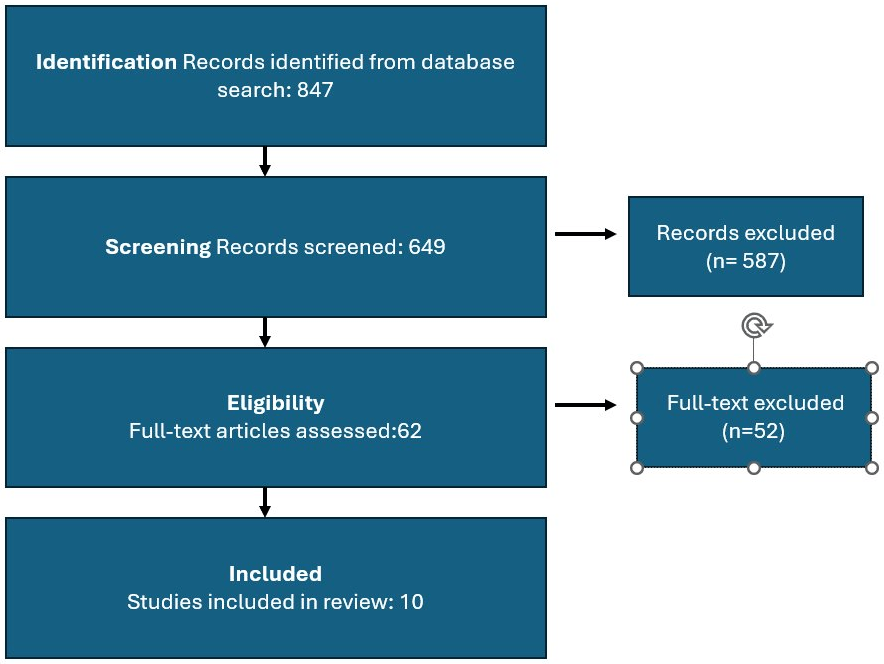
The initial search yielded 847 records. After removing 198 duplicates, 649 titles and abstracts were screened. Of these, 587 were excluded: 312 did not involve tennis-specific populations, 147 focused on recreational or junior players, 89 were qualitative or review-only articles, and 39 did not include fatigue-related outcome measures. The remaining 62 full-text articles were assessed. Of these, 52 were excluded because they did not report quantitative performance metrics under validated fatigue conditions or examined variables outside this review’s scope. Ten studies met the final inclusion criteria (Figure 1).
Synthesis Method
Due to heterogeneity in outcome measurement methods, a formal meta-analysis was not performed. Computation of standardized effect sizes (Cohen’s d or Hedges’ g) was also not feasible. Several studies did not report the individual-level means and standard deviations necessary for such calculations. Additionally, the incompatible outcome definitions across studies would have made pooled estimates unreliable. A vote-counting approach was considered but deemed inappropriate given the small number of studies and the consistent directionality of effects; all studies reported accuracy decline, which would have produced a trivially unanimous result. Instead, a systematic qualitative synthesis was conducted to identify consistent directional patterns and effect ranges.
Summary of Included Studies
| Study | n | Level | Protocol | Velocity | Accuracy | Other Outcomes |
| Davey et al. (2002) | 8 | Elite | LITT (High) | -1.8% (NS) | -41% S; -69% G | RPE increased |
| Ferrauti et al. (2003) | 12 | Elite | HIIT | -1.2% (NS) | -25% target | Recovery effects |
| Girard et al. (2006) | 12 | Sub-elite | Prolonged | -0.4% (NS) | -31% zone | MVC decline |
| Hornery et al. (2007)† | Review | Mixed | Multiple | <-3% (synth.) | -29% (synth.) | Kinetic chain review |
| Lyons et al. (2013) | 16 | Expert | Mod. int. | -2.8% | -48% FH | Expert vs non-expert |
| Rota et al. (2014) | 11 | Sub-elite | Fatigue prot. | Maintained | EMG altered | Coordination changes |
| Reid & Duffield (2014)† | Review | Mixed | Match-play | Discussed | Discussed | Fatigue model |
| Martin et al. (2016) | 8 | Elite | 3-hr match | Decreased | Impact ht. down | Angular vel. decreased |
| Fenter et al. (2017) | 11 | Collegiate | 3-set match | N/A | N/A | Knee flex. decreased ~6° |
| Bilic et al. (2023) | 14 | Young elite | Exercise | Declined | Precision down | COD impaired; RT delayed |
†Narrative review article. S=Serve; G=Groundstroke; FH=Forehand; NS=Not Statistically Significant; COD=Change of Direction; RT=Reaction Time; MVC=Maximal Voluntary Contraction; RPE=Rating of Perceived Exertion; synth.=synthesized from multiple sources.
Results
The Velocity-Accuracy Dissociation
A consistent finding across the reviewed literature is the dissociation between ball velocity and placement accuracy. Four primary experimental studies reported paired velocity-accuracy comparisons (Table 1). Contrary to the expectation that fatigue reduces power, velocity showed minimal decline, ranging from 0.4% to 2.8%, with most changes failing to reach statistical significance. Two additional studies reported velocity-related outcomes without paired accuracy data: Rota et al.13 found that serve velocity was maintained despite altered muscle coordination, and Bilic et al.14 reported declines in both serve speed and precision.
However, the maintenance of power came at a substantial cost to accuracy. Serve accuracy declined by 25–41%, while groundstroke accuracy suffered even greater degradation, dropping by up to 69% in high-intensity protocols15.
| Study | Fatigue Protocol | Velocity Change | Accuracy Change | Accuracy Metric |
| Davey et al. (2002) | LITT (High Int.) | -1.8% (NS) | -41% (S); -69% (G) | Target hit % |
| Girard et al. (2006) | Prolonged Play | -0.4% (NS) | -31% | Zone hit % |
| Ferrauti et al. (2003) | HIIT Protocol | -1.2% (NS) | -25% | Target hit % |
| Lyons et al. (2013) | Mod. Intensity | -2.8% | -48% (Forehand) | Radial error |
NS = Not Statistically Significant; S = Serve; G = Groundstroke.
Biomechanical Observations: The Kinetic Chain
Several studies reported that velocity is maintained not through fatigue resistance, but through biomechanical compensation. Efficient tennis strokes rely on a kinetic chain—the sequential transfer of energy from the legs through the trunk to the racket16. Fatigue appears to disrupt this sequence at its base.
Fenter et al.17 directly measured knee kinematics during a three-set match using motion capture and wireless electromyography, observing a statistically significant reduction in maximum knee flexion angle averaging approximately 6 degrees from the first to the third set, with decreased EMG amplitudes in the hamstrings and quadriceps. This is consistent with Girard et al.18, who reported decreased knee extensor maximal voluntary contraction and reduced leg stiffness after prolonged play, and with Girard et al.19, who demonstrated that restricted knee motion directly reduces ground reaction force and ball speed.
Martin et al.20, using a 20-camera motion capture system during a three-hour match, reported significant decreases in maximal angular velocities of the trunk and upper limb, decreased ball impact height, and reduced ball speed by the end of the match. Rota et al.13 found that fatigue altered upper limb muscle activity, suggesting adaptation in muscle activation level rather than changes in overall coordination structure.
These compensatory patterns have been observed in other sports: Escamilla et al.4 documented similar kinematic shifts in baseball pitchers, and Aune et al.6 found that skilled table tennis players adaptively modified movement coordination to preserve accuracy under fatigue, while recreational players did not.
| Variable | Direction of Change | Primary Source | Implication |
| Knee Flexion | Decreased (~6°/3 sets) | Fenter et al. (2017) | Reduced leg drive |
| Knee Extensor MVC | Decreased post-match | Girard et al. (2006) | Lower-body fatigue |
| Trunk Ang. Velocity | Decreased over 3-hr match | Martin et al. (2016) | Reduced trunk power |
| Ball Impact Height | Decreased | Martin et al. (2016) | Reduced serve margin |
| Upper Limb EMG | Altered patterns | Rota et al. (2014) | Modified recruitment |
Cognitive Impairment
Physical fatigue was found to have a deleterious effect on cognitive performance. Two primary studies measured reaction time under fatigue conditions, reporting delays ranging from 47 to 68 milliseconds14,13. Bilic et al.14 assessed reaction time using a standardized change-of-direction test requiring rapid visual stimulus recognition and whole-body motor response, finding significant impairment in fatigued players. Rota et al.13 evaluated upper limb performance using surface electromyography analysis combined with sport-specific accuracy tasks following a validated fatigue protocol. In a sport where ball flight times are often under 1000 ms, a 50 ms delay represents approximately 5% of available decision time.
Decision-making quality also appeared to decline under fatigue. Bilic et al.14 reported impaired change-of-direction performance alongside reduced serve precision in young elite players, suggesting that cognitive-motor coupling may be particularly vulnerable to fatigue. The broader literature on mental fatigue and sport-specific psychomotor performance has documented systematic declines in decision accuracy across multiple sports12, with fatigued athletes exhibiting patterns of either excessive passivity or excessive aggression.
Discussion
The Precision Degradation Cascade: A Proposed Framework
Synthesizing the patterns observed across the reviewed studies, this review proposes the Precision Degradation Cascade as a preliminary, hypothesis-generating framework. The included studies are cross-sectional or short-protocol designs, not longitudinal experiments tracking the same athletes through sequential stages. The following describes the proposed ordering based on the available evidence; it is not a confirmed causal sequence and requires validation through prospective research.
The earliest observable changes reported in the literature involve lower-body fatigue. Fenter et al.17 measured an approximately 6-degree decrease in knee flexion over a three-set match, and Girard et al.21,18 reported decreased knee extensor strength and leg stiffness after prolonged play. These changes are consistent with the interpretation that the initial stage of the proposed cascade involves metabolic fatigue in the quadriceps and gastrocnemius, reducing ground reaction force.
As lower-body capacity diminishes, the data are consistent with compensatory recruitment of the trunk and shoulder to maintain ball velocity. Martin et al.20 documented decreased maximal angular velocities across multiple body segments during a three-hour match, while Rota et al.13 observed altered muscle coordination patterns. Similar compensatory patterns have been documented in baseball pitching under fatigue4.
This modified coordination pattern appears to coincide with accuracy degradation. Davey et al.15 reported up to 69% decline in groundstroke accuracy, Lyons et al.22 reported 48% forehand accuracy loss, and Ferrauti et al.23 documented 25% target hit reductions. Forestier and Nougier7 demonstrated that muscular fatigue disrupts multi-joint coordination, providing a mechanistic basis for this accuracy decline.
Martin et al.20 additionally reported decreased ball impact height as the match progressed, suggesting continued fatigue may restrict rotational mobility and reduce topspin generation. Finally, systemic fatigue appears to impair cognitive function, with reaction time delays and impaired serve precision reported by Bilic et al.14 in the later stages of prolonged play. Knicker et al.24 have proposed that physical fatigue and cognitive decline are linked by interactive processes, suggesting they are not independent phenomena.

Alternative Explanations and Critical Perspectives
Biomechanical compensation is not the only mechanism that could explain accuracy decline under fatigue. Psychological factors such as performance anxiety and motivational changes during extended match play may independently affect precision24. Dehydration and thermoregulatory stress impair both physical and cognitive performance in tennis25,2. Environmental conditions such as court surface and temperature may also interact with fatigue in ways not captured here.
Additionally, expertise level may moderate the fatigue-precision relationship. Aune et al.6 demonstrated that skilled table tennis players maintained spatial accuracy under fatigue through adaptive coordination, while recreational players could not. Lyons et al.22 similarly found differences between expert and non-expert tennis players. This suggests the proposed framework may manifest differently depending on skill level.
Practical Applications
The patterns observed suggest several practical implications. First, coaches should monitor accuracy metrics, not just velocity, as indicators of emerging fatigue. Second, reduced knee flexion during the serve appears to be an observable early marker of lower-body fatigue, detectable through visual assessment or wearable sensors. Third, integrating decision-making drills under physiological load may help athletes maintain tactical discipline under fatigue. The 2012 Australian Open final between Djokovic and Nadal, lasting nearly six hours, exemplifies the competitive relevance of maintaining cognitive clarity under extreme fatigue2. Finally, practicing technical precision drills in a fatigued state could help athletes develop motor patterns that resist compensatory breakdowns.
Limitations
This review has several important limitations. First, the small number of included studies (n=10, of which eight are primary experimental and two are narrative reviews) limits generalizability, though this reflects the stringent inclusion criteria applied to a specialized population. A broader search encompassing non-English journals may have identified additional studies.
Second, a single reviewer conducted all screening and data extraction, introducing potential selection bias that cannot be quantified. Third, although study quality was appraised using adapted risk-of-bias criteria (Table 1), no standardized scoring system was applied, and the assessment should be considered approximate. The experimental studies showed moderate overall risk of bias.
Fourth, the heterogeneity of accuracy measurements prevented both meta-analysis and standardized effect size computation. The reported ranges are directional approximations. Fifth, findings are limited to elite and sub-elite populations. Sixth, varied fatigue protocols make cross-study comparison difficult. Seventh, the proposed cascade is based on cross-sectional data and requires prospective validation. The included studies did not incorporate neuroimaging data, limiting conclusions about neural mechanisms.
Conclusion
The reviewed studies suggest that the critical performance threshold in elite tennis is characterized not by a loss of gross force output, but by a degradation of precision and cognitive function. The evidence indicates that elite players maintain force output through biomechanical compensations that come at the cost of accuracy. The proposed Precision Degradation Cascade provides a preliminary, hypothesis-generating framework for understanding this pattern. Prospective studies with larger samples, longitudinal designs, integrated biomechanical-cognitive measurement approaches, and neuroimaging methodologies are needed to validate the proposed framework.
References
- M. S. Kovacs. Tennis physiology: Training the competitive athlete. Sports Medicine. Vol. 37, pg. 189-198, 2007. [↩]
- J. Fernandez-Fernandez, D. Sanz-Rivas, A. Mendez-Villanueva. A review of the activity profile and physiological demands of tennis match play. Strength and Conditioning Journal. Vol. 31, pg. 15-26, 2009. [↩] [↩] [↩]
- R. H. Edwards. Biochemical bases of fatigue in exercise performance. In: Human Muscle Fatigue: Physiological Mechanisms. Pitman Medical, 1981, pg. 3-28. [↩] [↩]
- R. F. Escamilla, S. W. Barrentine, G. S. Fleisig, et al. Pitching biomechanics as a pitcher approaches muscular fatigue during a simulated baseball game. American Journal of Sports Medicine. Vol. 35, pg. 23-33, 2007. [↩] [↩] [↩]
- K. A. Royal, D. Farrow, I. Mujika, S. L. Halson, D. Pyne, B. Abernethy. The effects of fatigue on decision making and shooting skill performance in water polo players. Journal of Sports Sciences. Vol. 24, pg. 807-815, 2006. [↩] [↩]
- T. K. Aune, R. P. Ingvaldsen, G. J. C. Ettema. Effect of physical fatigue on motor control at different skill levels. Perceptual and Motor Skills. Vol. 106, pg. 371-386, 2008. [↩] [↩] [↩]
- N. Forestier, V. Nougier. The effects of muscular fatigue on the coordination of a multijoint movement in human. Neuroscience Letters. Vol. 252, pg. 187-190, 1998. [↩] [↩]
- L. Vergauwen, A. J. Spaepen, J. Lefevre, P. Hespel. Evaluation of stroke performance in tennis. Medicine and Science in Sports and Exercise. Vol. 30, pg. 1281-1288, 1998. [↩]
- C. Triolet, N. Benguigui, C. Le Runigo, A. M. Williams. Quantifying the nature of anticipation in professional tennis. Journal of Sports Sciences. Vol. 31, pg. 820-830, 2013. [↩]
- R. M. Enoka, J. Duchateau. Muscle fatigue: What, why and how it influences muscle function. Journal of Physiology. Vol. 586, pg. 11-23, 2008. [↩]
- M. J. Page, J. E. McKenzie, P. M. Bossuyt, et al. The PRISMA 2020 statement. BMJ. Vol. 372, pg. n71, 2021. [↩]
- J. Habay, J. Van Cutsem, J. Verschueren, et al. Mental fatigue and sport-specific psychomotor performance: A systematic review. Sports Medicine. Vol. 51, pg. 1527-1548, 2021. [↩] [↩]
- S. Rota, B. Morel, D. Saboul, I. Rogowski, C. Hautier. Influence of fatigue on upper limb muscle activity and performance in tennis. Journal of Electromyography and Kinesiology. Vol. 24, pg. 90-97, 2014. [↩] [↩] [↩] [↩] [↩]
- Z. Bilic, F. Sinkovic, P. Barbaros, D. Novak, E. Zemkova. Exercise-induced fatigue impairs change of direction performance and serve precision among young male tennis players. Sports. Vol. 11, pg. 111, 2023. [↩] [↩] [↩] [↩] [↩]
- P. R. Davey, R. D. Thorpe, C. Williams. Fatigue decreases skilled tennis performance. Journal of Sports Sciences. Vol. 20, pg. 311-318, 2002. [↩] [↩]
- D. J. Hornery, D. Farrow, I. Mujika, W. Young. Fatigue in tennis: Mechanisms of fatigue and effect on performance. Sports Medicine. Vol. 37, pg. 199-212, 2007. [↩]
- B. Fenter, T. S. Marzilli, Y. T. Wang, X. N. Dong. Effects of a three-set tennis match on knee kinematics and leg muscle activation during the tennis serve. Perceptual and Motor Skills. Vol. 124, pg. 214-232, 2017. [↩] [↩]
- O. Girard, S. Racinais, J. P. Micallef, G. P. Millet. Spinal modulations accompany peripheral fatigue during prolonged tennis playing. Scandinavian Journal of Medicine and Science in Sports. Vol. 21, pg. 455-464, 2011. [↩] [↩]
- O. Girard, J. P. Micallef, G. P. Millet. Lower-limb activity during the power serve in tennis: Effects of performance level. Medicine and Science in Sports and Exercise. Vol. 37, pg. 1021-1029, 2005. [↩]
- C. Martin, B. Bideau, P. Delamarche, R. Kulpa. Influence of a prolonged tennis match play on serve biomechanics. PLoS One. Vol. 11, pg. e0159979, 2016. [↩] [↩] [↩]
- O. Girard, G. Lattier, J. P. Micallef, G. P. Millet. Changes in exercise characteristics, maximal voluntary contraction, and explosive strength during prolonged tennis playing. British Journal of Sports Medicine. Vol. 40, pg. 521-526, 2006. [↩]
- M. Lyons, Y. Al-Nakeeb, J. Hankey, A. Nevill. The effect of moderate and high-intensity fatigue on groundstroke accuracy in expert and non-expert tennis players. Journal of Sports Science and Medicine. Vol. 12, pg. 298-308, 2013. [↩] [↩]
- A. Ferrauti, B. M. Pluim, K. Weber. The effect of recovery duration on running speed and stroke quality during intermittent training drills in elite tennis players. Journal of Sports Sciences. Vol. 21, pg. 235-242, 2003. [↩]
- A. J. Knicker, I. Renshaw, A. R. H. Oldham, S. P. Cairns. Interactive processes link the multiple symptoms of fatigue in sport competition. Sports Medicine. Vol. 41, pg. 307-328, 2011. [↩] [↩]
- A. Mendez-Villanueva, J. Fernandez-Fernandez, D. Bishop. Exercise-induced homeostatic perturbations provoked by singles tennis match play. British Journal of Sports Medicine. Vol. 41, pg. 717-722, 2007. [↩]