Abstract
Thermal management is a challenge for robots operating in the extreme environments of the Moon and Mars, but coatings can provide passive cooling power through radiative heat transfer mechanisms. The goal of this paper is to identify coatings that combine nanolayers of metals with dielectrics to yield an optimal net cooling power. Based on simulations, the results indicate that silicon dioxide (SiO₂) is a simple and effective coating material for cooling robotic systems; however, the effectiveness plateaus at higher thicknesses. Additionally, the study found that a combination of materials—specifically multilayer coatings made of dielectric materials such as SiO₂ and titanium dioxide (TiO₂)—could provide a greater net cooling power. The outcome suggests that multilayer coatings can be designed and engineered to enhance thermal management for robots.
Keywords: Thermal Management, Space Robotics, Multilayer coatings
Introduction
Human-operated robotic systems are important for exploring the Moon and Mars. These controlled robots can perform tasks such as digging and collecting samples, providing insights into geology and surface environments. During such expeditions, one factor that can affect the durability of a robot on the Moon and Mars is the lack of a protective atmosphere to shield it from extreme temperatures. The Moon lacks an atmosphere, which causes temperatures to swing from a high of 400K (260°F, 127°C) during the day to a low of 100K (-280°F, −173.15°C) at night1. Similarly, the thin atmosphere on Mars, composed primarily of carbon dioxide, nitrogen, and argon, causes heat to be lost, leading to temperature fluctuations from 70°F (20°C) to as low as −225°F (−153°C), which can cause robots to freeze if not properly protected2.
To protect against such extreme temperatures, various types of coatings are used on space robots. White coatings, including those made with zinc oxide, titanium dioxide, or silicate, help to reject heat3,4. These materials have low absorptance and high emittance, allowing them to reflect sunlight and release heat through radiative cooling processes5,6,7,8. A few white coatings also offer resistance to atomic oxygen. These coatings have an absorptivity ranging from 0.15 to 0.25 and an emissivity greater than 0.853. A high emissivity (close to 1) means a material absorbs and emits thermal radiation very well, like that of blackbody. A low emissive value (near zero) means that the material reflects or scatters more radiation and absorbs less.
In contrast to white coatings, black coatings are designed to absorb and retain heat, which helps robots stay warm and regulate their temperature. Materials such as carbon-based coatings, black anodized aluminum, and MLS-85SB silicates perform well because they have high absorptance and emissivity. These materials have absorptivity and emissivity values higher than 0.93.
It should, however, be noted that not all materials are reliable for use as coatings. Polyurethane-based blacks do not hold up well against atomic oxygen and are not suitable for all missions. As a result, the selection of thermal control coatings depends strongly on the mission environment, including factors such as atomic oxygen exposure, ultraviolet radiation, and thermal conditions9.
Advanced materials for extreme environments are often described in terms of a “life ring” of three key capabilities: multi-functionality, adaptivity, and self-restoration. In the present work, the proposed multilayer coatings primarily demonstrate multi-functionality, simultaneously providing low solar absorptivity and high mid-infrared emissivity to regulate thermal loads on robotic systems. This enables passive thermal management without additional active cooling systems.
Lessons from spacecraft thermal control technologies provide useful guidance for the design of coatings intended for robotic systems operating on the Moon and Mars, as demonstrated in spacecraft thermal system studies10,11. Modern spacecraft commonly employ optical solar reflectors and multilayer dielectric coatings that combine low solar absorptivity with high infrared emissivity to regulate thermal loads4. Materials such as SiO₂, Al₂O₃, and TiO₂ are widely used in these coatings due to their optical stability and durability in space environments3. These technologies demonstrate the importance of maximizing solar reflection while enabling efficient thermal radiation, principles that also guide the coating designs investigated in this work.
For this research paper, WPTherml will be used12. This Python package simulates the optical and thermal properties of multilayer surface coatings to determine how they can aid in thermal management in space. This package applies the transfer matrix method (TMM) to calculate wavelength-dependent absorptivity and emissivity of multilayer thin films13,14. It enables the design of materials to control how much heat they emit, which is important for allowing robots to withstand extreme temperatures in space. This research investigates how various factors can be adjusted to design surface coatings that regulate heat and radiation exposure on the Moon and Mars.
Methodology
To address the extreme temperature conditions faced by robots in space, simulations of emissivity and absorptivity were carried out to identify candidate materials for thermal management coatings for space robots. WPTherml (v1.1.1)12 was used to simulate how different combinations of materials behave under temperatures across the infrared spectrum and visible light range (Figure 1). This research includes running simulations on both individual and multilayer combinations of the materials (SiO₂, HfO₂, Au, Al₂O₃, TiO₂, Ag) and evaluating their performance across different thicknesses ranging from 10 nm to 1000 nm. This approach allowed the exploration of how specific configurations could enhance thermal emission control and facilitate the identification of suitable materials for protecting robots on the Moon or Mars. The key performance metric analyzed was P_cool (T), which indicates whether a coating causes cooling (positive P_cool) or heating (negative P_cool) at temperature T. This metric was used to assess each material’s effectiveness in managing heat under space conditions12 and was calculated using
(1) 
which is derived from standard radiative heat transfer principles15
where
 is the thermally emitted radiative power from the coating measured in W/m2 at temperature T
 is absorbed solar radiation measured in W/m2
 is absorbed atmospheric radiation measured in W/m2.
Because the Moon lacks an atmosphere and Mars has only a thin CO₂ atmosphere, atmospheric infrared exchange is much smaller than on Earth and is therefore neglected in this simplified model1,2.
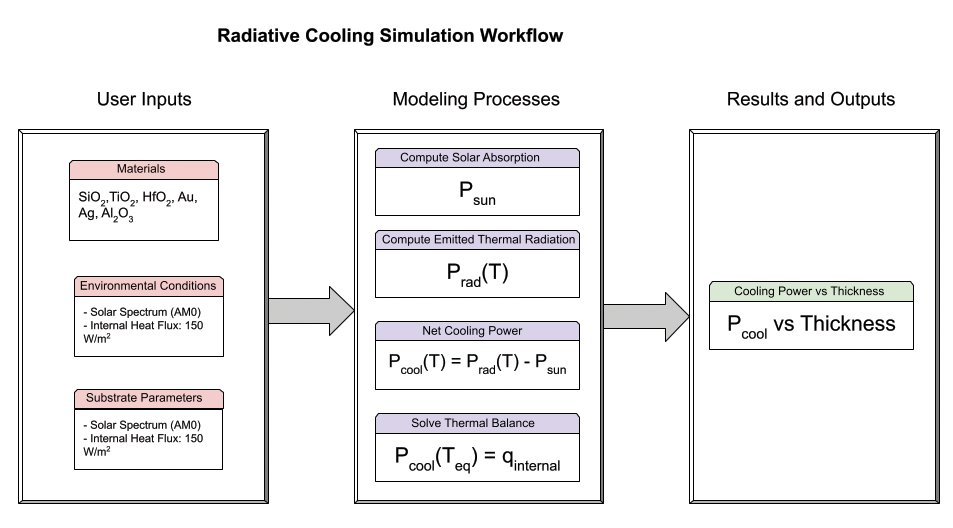
To couple coating performance to a realistic robot configuration, a simplified steady-state thermal model was introduced. A reference temperature of 300 K was used to compare cooling performance across different coating configurations. The coating was assumed to be deposited on an Aluminum substrate with a 5mm thickness and a thermal conductivity of 205 W/m-K, so conduction is assumed to be sufficiently high such that the coating and chassis surface reach uniform temperature. Convective heat transfer was neglected due to vacuum conditions on the Moon and low atmospheric density on Mars. An internal heat generation flux of qinternal = 150 W/m2 was assumed to represent electronic power dissipation based on standard spacecraft thermal engineering references16, hence Pcool values approaching 150 W/m2 are treated as practically significant, because they would be sufficient to offset a representative internal heat flux for compact robotic electronics under steady-state conditions.
An equilibrium surface temperature Teq can be determined by solving the steady-state radiative energy balance, where the emitted thermal radiation equals the absorbed solar irradiance plus internal heat generation i.e.
(2) 
Rewriting in net cooling power, equilibrium occurs when 
All the materials chosen for this research, (SiO₂, HfO₂, Au, Al₂O₃, TiO₂, Ag), exhibit high melting temperatures, chemical stability, and resistance to ultraviolet radiation and atomic oxygen exposure. These characteristics are essential for coatings exposed to direct solar irradiation, ultraviolet exposure, and vacuum conditions on the Moon and Mars. Oxide-based dielectrics such as SiO₂, TiO₂, HfO₂, and Al₂O₃ are particularly attractive due to their environmental durability and proven performance in space-qualified optical coatings17,18. Noble metals such as gold (Au) and silver (Ag) were included because they exhibit very high reflectivity across the visible and near-infrared solar spectrum, making them effective layers for reducing solar absorptance in multilayer optical and thermal-control coatings19,20. A comprehensive list of optical characteristics and functional roles are summarized in Table 1.
| Material | Material Type | Key Optical Properties | Functional Role in Coating |
| SiO₂ (Silicon Dioxide) | Dielectric oxide | Low refractive index (~1.45), high transparency across visible spectrum, high thermal stability | Used as a low-index dielectric layer to enhance solar reflection and improve infrared emission performance |
| TiO₂ (Titanium Dioxide) | Dielectric oxide | High refractive index (~2.4), strong optical contrast with SiO₂, stable under UV exposure | Provides high-index contrast in multilayer structures to enhance spectral selectivity and thermal emission |
| HfO₂ (Hafnium Dioxide) | Dielectric oxide | High refractive index (~2.0), high melting point (~2800 °C), strong chemical stability | Improves durability and optical performance of multilayer coatings under extreme space conditions |
| Al₂O₃ (Aluminum Oxide) | Dielectric oxide | Moderate refractive index (~1.6–1.8), high hardness, good resistance to atomic oxygen | Provides structural stability and environmental durability in multilayer coatings |
| Ag (Silver) | Noble metal | Extremely high reflectivity in visible and near-IR wavelengths | Enhances solar reflection and reduces solar absorptance in the coating stack |
| Au (Gold) | Noble metal | High reflectivity in infrared wavelengths and excellent resistance to oxidation | Used in optical coatings and thermal control surfaces to enhance reflectivity and durability in space environments |
WPTherml employs the transfer matrix method to compute spectral optical properties of planar multilayer structures. The model evaluates radiative heat transfer only and does not inherently include conductive, convective, or multi-surface radiative exchange effects. The simulation also assumes ideal defect-free thin films and no degradation due to radiation or dust deposition. It also assumes no temperature-dependent changes in optical constants and a uniform surface temperature. There can also be numerical uncertainty that may arise from the spectral resolution used in the simulation. To minimize this effect, a dense wavelength grid was used across the modeled spectral range, ensuring convergence of the calculated cooling power values. Additionally, optical constants are treated as temperature-independent, and long-term environmental degradation effects are not modeled. Therefore, results represent idealized steady-state radiative performance rather than full spacecraft thermal network predictions All the key simulation parameters and modeling assumptions used in the WPTherml calculations are summarized in Table 2 to ensure transparency and reproducibility of the computational analysis.
| Parameter | Value / Range Used | Description |
| Simulation software | WPTherml v1.1.1 | Python-based simulation framework used to compute optical properties and radiative cooling performance of multilayer coatings |
| Optical model | Transfer Matrix Method (TMM) | Used to calculate reflectance, absorptance, and emissivity of thin-film multilayer structures |
| Materials evaluated | SiO₂, HfO₂, Au, Al₂O₃, TiO₂, Ag | Candidate materials selected for their optical stability, high melting temperatures, and durability in space environments |
| Material stack format | Air / coating layers / Air | Defines surrounding media in the optical multilayer simulation |
| Baseline layer thickness | 100 nm per layer | Initial thickness used for multilayer comparison simulations |
| Thickness variation study | ~10–1000 nm | Thickness range evaluated to analyze sensitivity of cooling performance to coating thickness |
| Wavelength range | 300–30000 nm | Covers solar spectrum (visible + near-IR) and thermal infrared emission region |
| Number of wavelength points | 2000 | Spectral resolution used for numerical integration of radiative heat transfer |
| Solar spectrum used | AM0 spectrum | Default solar spectrum implemented in WPTherml for solar heating calculations |
| Reference temperature | 300 K | Surface temperature used when reporting cooling power vs. thickness |
| Ambient temperature | 300 K | Background temperature assumed for radiative heat exchange |
| Internal heat generation | 150 W/m² | Representative heat flux from onboard electronics in robotic systems |
| Substrate material | Aluminum | Simplified representation of spacecraft structural material |
| Substrate thickness | 5 mm | Assumed structural thickness for system-level thermal analysis |
| Aluminum thermal conductivity | 205 W/m·K | Standard room-temperature value used in thermal modeling |
| Cooling power definition | Pcool(T) = Prad(T) − Psun | Net radiative cooling power calculated by subtracting absorbed solar power from emitted thermal radiation |
| Convection | Neglected | Assumed negligible for lunar vacuum conditions and low atmospheric density on Mars |
| Atmospheric heating | Neglected | Simplified model focusing on radiative heat transfer mechanisms |
| Output quantities | Emissivity spectra, absorptivity spectra, Prad, Psun, Pcool | Key outputs used to evaluate coating performance |
Results and Discussion
The objective of this study is to identify a novel surface coating that can help space robots manage heat in extreme environments, such as the Moon or Mars. Various single-material coatings and multilayer combinations were simulated, and their radiative cooling performance was evaluated using the net cooling power Pcool. Graphs generated from the simulations were then used to assess whether each coating met the thermal management criteria. Greater absorptance was indicated by a larger area under the absorptance curve, while a larger area under the emissivity curve corresponds to greater emissivity12.
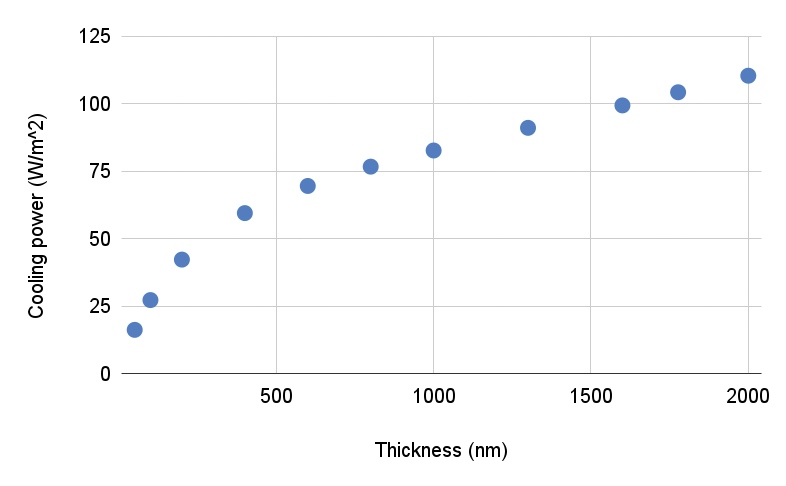
Most single materials did not perform well for cooling. For example, gold (Au) at 100 nm had a P_cool of -132.74 W/m2, meaning it heated significantly. Silver (Ag) and aluminum oxide (Al₂O₃) produced Pcool values near zero, indicating minimal net cooling. In contrast, SiO₂ at 200 nm showed a somewhat moderately effective result with P_cool = 42.27 W/m2, meaning it cooled by radiating heat away. The use of a single material alone is generally avoided because effective thermal management must be carefully balanced between absorption and emissivity, which cannot be fully achieved with only one material. Multiple materials are used to precisely tune these thermal properties to suit extreme environments. Additionally, if only SiO₂ were used, achieving sufficient thermal control would require the application of relatively thick layers. Such thickness would increase the overall mass of the coating, which is not ideal for space missions, where minimizing weight is essential to reduce launch costs.
As the thickness of the SiO₂ layer increases, the cooling power becomes more positive, indicating that the coating effectively cools (Figure 2). However, the data points show that the rate of this change diminishes as the thickness increases. This suggests that the P_cool will likely approach a limiting value and increases in thickness beyond a certain point will not lead to a significant change in the P_cool.
The simulated cooling power values for SiO₂ are consistent with experimentally reported passive radiative cooling materials. Previous experimental studies have demonstrated net cooling powers on the order of 50–120 W/m² under ideal radiative conditions21,22. The peak simulated cooling power of approximately 100–110 W/m² therefore falls within the experimentally observed range, supporting the physical plausibility of the model. Additionally, the observed plateau in cooling power with increasing thickness is consistent with thin-film interference theory, as optical response converges once the layer thickness exceeds several effective optical wavelengths.
By combining materials, thinner, lighter coatings can be produced while maintaining effective thermal regulation. Some results improved when two materials were combined. For example, SiO₂ 100 nm + Au 100 nm had a P_cool=-150.52 W/m2, which indicated heating, but reversing the order (Au + SiO₂) resulted in a slightly lower heating value of P_cool=-132.25 W/m2. These high values mean the materials absorb more heat than they radiate away. This demonstrates that the order of layering matters. For a cooler P_cool, the metal layer must be placed beneath the dielectric layer.
On the other hand, some dielectric-only combinations, such as HfO₂ + TiO₂ at 100 nm (each) showed positive values (51.94 W/m2), indicating that they performed well at cooling. These stacks reflect sunlight well and emit heat efficiently in the infrared part of the spectrum, making them ideal for use in space. However, these output values are not yet sufficient for thermal management; a much larger positive value must be achieved, along with low absorption. This can only be achieved with more layers with varying thicknesses.
During the exploration of three-layer stacks, many combinations resulted in poor cooling performance. For instance, SiO₂ + HfO₂ + Au, each with a thickness of 100 nm, resulted in a low P_cool of -161.5 W/m2. To increase the emissivity and reduce the absorptance, additional materials and varying thicknesses were explored. An effective way to improve these coatings was found by adding dielectrics or non-metals that enhance cooling. As an example, Al₂O₃ + TiO₂ + HfO₂, each with a thickness of 100 nm, achieved a cooling value of 51.85 W/m2, which demonstrates that using the right dielectrics in the correct order can lead to better net cooling, with low absorptance (Figure 3) and high emissivity (Figure 4). Simulations with different layer orderings of Al₂O₃, TiO₂, and HfO₂ while maintaining identical thicknesses changed the resulting cooling power values only slightly, suggesting that the radiative cooling performance is largely determined by the overall dielectric stack rather than the specific sequence of individual layers.
Figure 3 shows that the Al₂O₃ + TiO₂ + HfO₂ stack has near-zero absorptivity across the 300–2500 nm solar spectrum. This is significant because absorbed solar irradiance is typically the largest external heating term for sunlit robotic surfaces. Minimizing solar-band absorptivity reduces the solar warming power Psun, which improves net cooling power and lowers the expected equilibrium temperature under direct illumination. In other words, low absorptivity in the solar band supports thermal stability by limiting heat gain while the coating emits thermal radiation in the mid-infrared.
The solar-band absorptivity of multilayer stacks can depend on thickness because interference effects shift the wavelength-dependent reflectance and absorption features. To assess sensitivity, the Al₂O₃ + TiO₂ + HfO₂ design was evaluated for multiple thickness sets ranging from 50 to 200 nm per layer. Across this range, the stack maintained low solar-band absorptivity, indicating that the design is not highly sensitive to modest thickness variation in the solar spectrum. This robustness is important practically because it reduces performance sensitivity to fabrication tolerances in coating deposition.
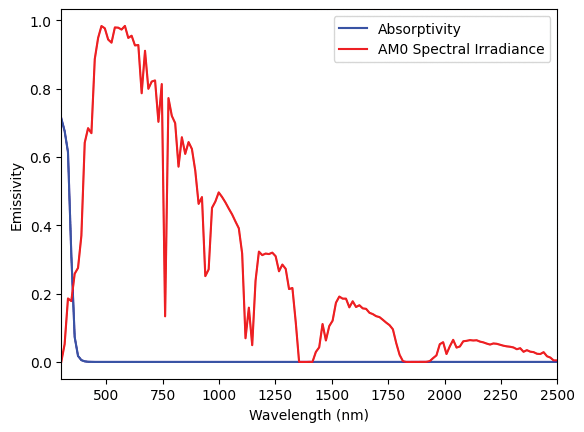
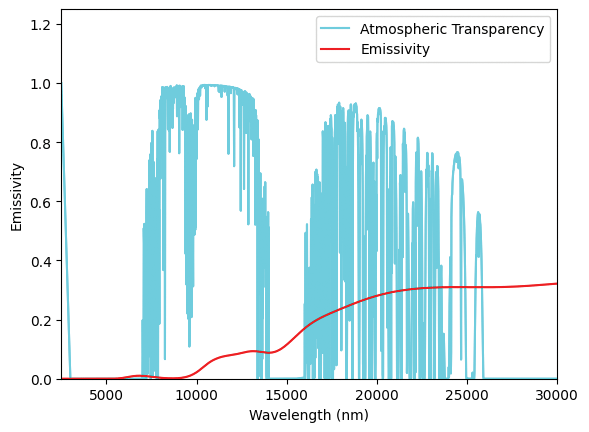
Figure 4 shows that the Al₂O₃ + TiO₂ + HfO₂ multilayer stack exhibits elevated emissivity across the mid-infrared region (2500-30000 nm). This wavelength range corresponds to the thermal emission band of surfaces near 250–400 K. According to Wien’s displacement law15, a surface at approximately 300 K emits peak thermal radiation near 9000-10000 nm. Therefore, enhanced emissivity in the mid-infrared region directly increases the radiative emission Prad, thus improving the net cooling power of the coating, consistent with prior work on photonic radiative cooling structures23. Because radiative heat transfer dominates under lunar vacuum conditions, broadband mid-infrared emissivity is particularly advantageous for thermal regulation of robotic systems15,24. For Martian environments, where a thin CO₂ atmosphere selectively absorbs portions of the infrared spectrum, emission within atmospheric transmission regions further enhances radiative cooling efficiency.
Figure 4 also shows the emissivity of the Al₂O₃ + TiO₂ + HfO₂ multilayer stack overlaid with terrestrial atmospheric transmissivity. The coating exhibits increased emissivity beginning near 8000 nm, overlapping significantly with the atmospheric transparency window between approximately 8000–13000 nm. In this spectral range, thermal radiation can escape through the atmosphere with minimal absorption. For terrestrial radiative cooling applications, selective emission within the 8000–13000 nm atmospheric window is critical, as emission outside this band is partially absorbed by atmospheric gases such as water vapor and CO₂. However, under lunar conditions, where no atmosphere is present, thermal radiation at all infrared wavelengths can radiate directly into space. Therefore, broadband infrared emissivity contributes to radiative heat rejection, and the atmospheric window constraint does not apply. In contrast, Mars possesses a thin CO₂ atmosphere with selective infrared absorption bands. Although less restrictive than Earth’s atmosphere, spectral emission within transmission regions remains advantageous for maximizing radiative heat rejection.
Based on these results, adding more layers increases the complexity of the system but improves cooling performance. The best layer stack identified in this study achieved P_cool = 51.94 W/m2 for HfO₂ + TiO₂ at 100 nm (each). Further exploration and optimization of these multilayer stacks could achieve cooling powers as high as P_cool= 109.586 W/m212. This suggests that additional research and simulations are needed to refine these findings and potentially increase the highest cooling power reported to date.
Conclusion
The thermal management challenges for space robots on the Moon and Mars were investigated through the simulation of different coatings. Using the WPTherml software12, the performance of several coatings was evaluated, with P_cool as the primary metric.
The simulations revealed that metals, such as Au and Ag, were not effective for cooling, producing high negative P_cool values. While SiO₂ provided cooling, the effect began to plateau as the thickness increased. The most promising results were achieved with multilayer coatings, especially those composed of dielectric materials such as SiO₂, and TiO₂. These coatings exhibited large positive P_cool values, showing their effectiveness for cooling.
In the future, further research and simulations are suggested to refine these findings by testing a broader range of material combinations, aiming to improve coatings by increasing emissivity while reducing absorptivity, thereby enhancing thermal regulation for space robots. A more specific next step would be to test zirconium dioxide (ZrO₂) and silicon nitride (Si₃N₄) as additional passive dielectric layers in place of TiO₂ or HfO₂, and to evaluate vanadium dioxide (VO₂) / barium fluoride (BaF₂)-based variable-emissivity stacks with TiO₂ protective layers as an adaptive thermal-control extension. These materials are promising because current radiative-cooling research highlights the importance of dielectric intrinsic properties and multilayer design, while recent spacecraft smart-radiator studies have shown that VO₂-based multilayers with TiO₂ protection can provide strong emissivity tunability under space-relevant conditions25,26,27.
Acknowledgements
The author wishes to acknowledge guidance and support from Dr. Jordi Ferrer Orri, PhD, University of Cambridge, and Dr. Praveen Setu, PhD, University of Rochester.
References
- A. R. Vasavada, D. A. Paige, S. E. Wood. Near-surface temperatures on mercury and the moon and the stability of polar ice deposits. Icarus. Vol. 141(2), pg. 179–193, 1999, https://doi.org/10.1006/icar.1999.6175. [↩] [↩]
- G. M. Martínez, N. O. Renno, E. Fischer. The modern near-surface martian climate: a review of in-situ meteorological data from viking to curiosity. Space Science Review. Vol. 212, pg. 295–338, 2017, https://doi.org/10.1007/s11214-017-0360-x. [↩] [↩]
- D. G. Gilmore. Spacecraft thermal control handbook, volume I: fundamental technologies. Aerospace Press. 2002. https://doi.org/10.2514/4.989117. [↩] [↩] [↩] [↩]
- V. Baturkin. Micro-satellites thermal control — concepts and components. Acta Astronautica. 2005. https://doi.org/10.1016/j.actaastro.2004.09.003. [↩] [↩]
- X. Sun, Y. Sun, Z. Zhou, M. A. Alam, P. Bermel. Radiative sky cooling: fundamental physics, materials, structures, and applications. Nanophotonics, Vol. 6, no. 5, 2017, pp. 997-1015, https://doi.org/10.1515/nanoph-2017-0020. [↩]
- D. Zhao, A. Aili, Y. Zhai, S. Xu, G. Tan, X. Yin, R. Yang. Radiative sky cooling: fundamental principles, materials, and applications. Applied Physics Reviews. 6, 021306, 2019, https://doi.org/10.1063/1.5087281. [↩]
- J. Kang, C. Lee, H. Chung, P. Bermel. Design strategies, manufacturing, and applications of radiative cooling technologies. Nanophotonics, 14(14), 2355-2395, 2025, https://doi.org/10.1515/nanoph-2025-0159. [↩]
- M. M. Hossain, M. Gu. Radiative Cooling: principles, progress, and potentials. Advanced Science. Vol 3, 1500360, 2016, https://doi.org/10.1002/advs.201500360. [↩]
- A. C. Tribble. The Space Environment: Implications for Spacecraft Design – Revised and Expanded Edition (REV-Revised). Princeton University Press. 2003, https://doi.org/10.2307/j.ctvzxx9nh. [↩]
- T. D. Swanson, G. C. Birur. NASA thermal control technologies for robotic spacecraft. Applied Thermal Engineering. Vol. 23, no. 9, Elsevier, pp. 1055–1065, 2003, https://doi.org/10.1016/S1359-4311(03)00036-X. [↩]
- G. C. Birur, T. P. O’Donnell. Advanced thermal control technologies for space science missions at Jet Propulsion Laboratory. AIP Conference Proceedings. 2 February 2001; 552 (1): 263–270, https://doi.org/10.1063/1.1357933. [↩]
- J. F. Varner, N. Eldabagh, D. Volta, R. Eldabagh, J. Foley . WPTherml: a python package for the design of materials for harnessing heat. Journal of Open Research Software. Vol. 7, pg 28, 2019, https://doi.org/10.5334/jors.271. [↩] [↩] [↩] [↩] [↩] [↩]
- P. Yeh. Optical Waves in Layered Media (Wiley, New York) 1988. [↩]
- C. C. Katsidis, D. I. Siapkas. General transfer-matrix method for optical multilayer systems with coherent, partially coherent, and incoherent interference. Applied Optics, 41(19), 3978–3987, 2002, https://doi.org/10.1364/AO.41.003978. [↩]
- J. R. Howell, M. P. Mengüç, K. Daun, R. Siegel. Thermal radiation heat transfer. CRC press, 2020. [↩] [↩] [↩]
- J. Meseguer, I. Pérez-Grande, A. Sanz-Andrés. Spacecraft thermal control. Woodhead Publishing. 2012. [↩]
- B. A. Banks, K. K. de Groh, S. K. Miller. Low earth orbital atomic oxygen interactions with spacecraft materials. MRS Online Proceedings Library, 851,426-437, 2004, https://doi.org/10.1557/PROC-851-NN8.1. [↩]
- E. Rephaeli, A. Raman, S. Fan. Ultrabroadband photonic structures to achieve high-performance daytime radiative cooling. Nano Letters, Vol 13(4), pg 1457–1461, 2013. https://doi.org/10.1021/nl4004283. [↩]
- P. B. Johnson, R. W. Christy. Optical constants of the noble metals. Physical Review B, Vol 6(12), pg. 4370–4379, 1972. https://doi.org/10.1103/PhysRevB.6.4370. [↩]
- H. A. MacLeod. Thin-film optical filters, 4th Edition. CRC Press. 2010. [↩]
- A. Raman, M. Anoma, L. Zhu, E. Rephaeli, S. Fan. Passive radiative cooling below ambient air temperature under direct sunlight. Nature. Vol 515, pg. 540–544, 2014. https://doi.org/10.1038/nature13883. [↩]
- Y. Zhai, Y. Ma, S. N. David, D. Zhao, R. Lou, G. Tan, R Yang, X. Yin. Scalable-manufactured randomized glass-polymer hybrid metamaterial for daytime radiative cooling. Science. Vol 355, pg. 1062-1066, 2017. https://doi.org/10.1126/science.aai7899. [↩]
- S. Fan, W. Li. Photonics and thermodynamics concepts in radiative cooling. Nature Photonics. Vol 16, 182–190, 2022, https://doi.org/10.1038/s41566-021-00921-9. [↩]
- G. Smith, A. Gentle. Radiative cooling: energy savings from the sky. Nature Energy Vol 2, 17142, 2017, https://doi.org/10.1038/nenergy.2017.142. [↩]
- R. Liu, S. Wang, Z. Zhou, K. Zhang, G. Wang, C. Chen, Y. Long. Materials in Radiative Cooling Technologies. Advanced materials. Vol 37(2). https://doi.org/10.1002/adma.202401577. [↩]
- R. Beaini, B. Baloukas, S. Loquai, J.E. Klemberg-Sapieha, L. Martinu. Thermochromic VO2-based smart radiator devices with ultralow refractive index cavities for increased performance. Solar Energy Materials and Solar Cells. Vol 205, 2020. [↩]
- Q. Xu, H. Ji, Y. Ren. VO2-Based Spacecraft Smart Radiator with High Emissivity Tunability and Protective Layer. Nanomaterials (Basel). Vol 14(16), pg. 1348, 2024. https://doi.org/10.3390/nano14161348. [↩]