

Sanhe Zheng1, Mengqi Tan2
1 The Village School, Houston 77077, USA
2 The University of Chinese Academy of Sciences, Beijing 100101, China
Abstract
The phenomenon of biological invasions has become one of the most severe ecological and economic problems in China. Although there exists an effective legal foundation and recently a Biosafety Law in particular, some of the management approaches used by authorities still fail to correspond to scientific evaluations of danger. Hence, in this paper, the author will summarize the current literature on the problem and discuss three case studies related to different invasive species: the alligator gar, the Hercules beetle, and cases when local flora and fauna were incorrectly classified. As a result, based on the analysis of these examples, the author will introduce the concept of a “cognitive disconnect.” This term implies the discrepancy between scientific facts, popular awareness, and governmental actions in dealing with invasive species. Thus, in conclusion, the paper will discuss how this cognitive disconnect might cause difficulties in estimating dangers, recognizing the importance of the invaded ecosystem, and implementing unified policies. This problem is usually associated with weak coordination between authorities, unclear motivation, and a shortage of professional skills among frontline practitioners. Therefore, it is necessary to introduce a more adaptive approach to governance that would include a closer integration of science, better flexibility of policies, and enhanced capacities of practitioners.
Keywords: biological invasions; China; risk assessment; governance; alien species; cognitive disconnect
Introduction
Biological invasions represent one of the major sources of global environmental changes with negative consequences for biodiversity, agriculture, infrastructure, and even human health1,2. The problem of biological invasions has received growing attention in China recently. As the economic development of the country accelerates, its interaction with the rest of the world deepens through international cooperation and internet commerce. Hence, species migration becomes more common, which raises the number of introduced alien species in China3,4. In response to the emerging threat, the government introduces policies and legislation that provide a framework for risk assessment and quarantine of foreign species5. For example, an earlier national survey aimed at the identification of invasive alien species in China was used in developing relevant legislation6. Therefore, it can be stated that the biosecurity system in China is rather elaborate from the legal standpoint.
However, there seems to be a gap between legislation and practice. As an illustration, Ruzhou city pumped out an urban lake in order to catch a single alligator gar in August 20227. Previous research shows that the species cannot survive winter in such climatic conditions8. Moreover, Xiamen Customs prevented the delivery of five Hercules beetles as exotic pets. Media extensively informed about the potential hazards of importing these animals9. However, the climate of mainland China would not allow the creatures to survive10. Therefore, it could be argued that there is a disparity between the risk assessments conducted within a scholarly setting and managerial actions taken in response to those assessments. Policy literature refers to such cases as “reactions to ecological alarms” because they lack evidence backing. In terms of China, it is probably more appropriate to refer to this phenomenon as cognitive dissonance due to the alien status of the species concerned.
This type of dissonance may have several consequences. The resources are likely to be allocated to the assessment of low-potential threats while more significant issues will remain unnoticed. Moreover, a general view of alien species as extremely hazardous may arise, thus creating uncertainty in this field. In addition, a poor understanding of taxonomy may confuse invasive organisms with protected ones. All these issues can be considered typical implications of cognitive dissonance, which is characteristic of risk assessment and management in the public sector and general population11,12.
The following are the main goals of the proposed study. First, to identify previous research focused on causes and processes of biological invasions in China both ecological and human aspects. Second, to review existing management practices using a case study method and understand what types of cognitive dissonance take place. Third, to find possible approaches to solving the issue in the future.
Methodological Approach
In order to analyze the relationship between scientific knowledge and the governance of the phenomena, this paper employs a critical interpretative methodology, recognizing the fact that meta-analytical synthesis will be limited by its inherent inability to address the complexity. However, an attempt was made to apply systematic review techniques to increase transparency and minimize source bias13.
To that end, the following databases were searched for relevant publications within the time frame from January 2000 to March 2026: Web of Science, CNKI, Scopus, and Google Scholar (as a supplementary database). The search keywords included: “biological invasion,” “alien species,” “China,” “risk assessment,” “governance,” “invasive species management,” and “biosecurity policy.” Furthermore, the case study terms included “alligator gar” (Atractosteus spatula) and “Hercules beetle” (Dynastes hercules). In case of Chinese sources, Chinese versions of keywords were used (生物入侵, 外来物种, 风险评估).
At the very first stage, articles were selected based on certain basic requirements. As a result, the focus of the study narrowed down to peer-reviewed journal articles and government reports, as well as international guidelines (such as those developed by IPPC and IUCN) and news reports. The documents should have been available in English or Chinese, and methodologically incomplete publications were excluded from consideration.
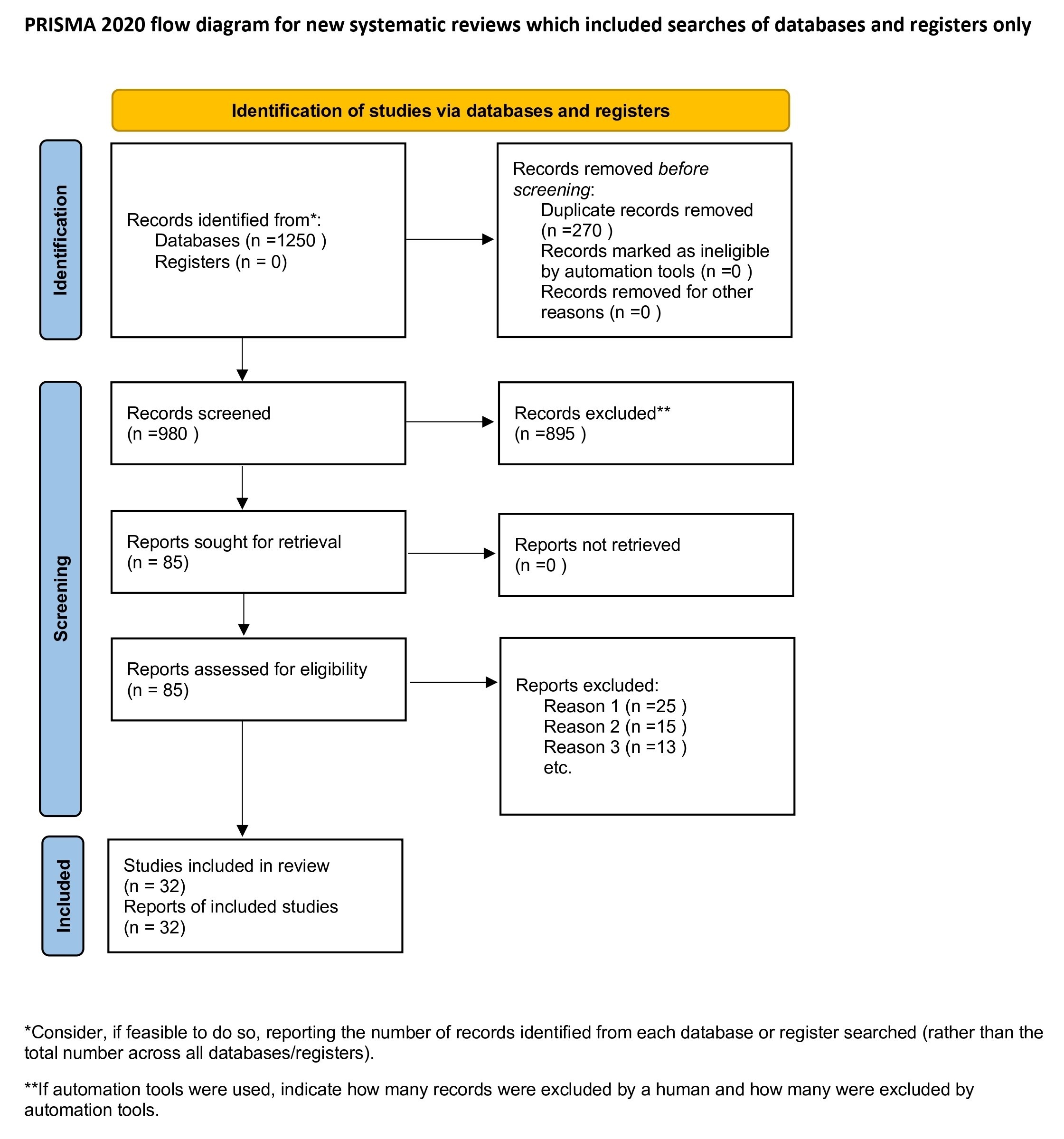
Based on the large number of sources obtained at the previous stage, thirty-two articles entered the next stage of the analysis. The whole process is illustrated by the PRISMA diagram (Appendix A). Information related to the species involved, their possible modes of biological invasion, governance issues, and policy recommendations was gathered from all publications. Appendix B summarizes these data.
When it comes to case studies mentioned in results, they were selected as exemplifying different aspects of the research question rather than being representative examples. Each case study addresses a specific problem – risk underestimation, low evaluation of the ecological potential of a species, and implementation limitations, correspondingly.
Results
Mechanisms of Biological Invasions
What are the key determinants of a successful or failed establishment of an invading species? Ecosystem vulnerability, species’ traits, and anthropogenic dispersal emerge as the consistent variables associated with invasions across the literature base14,15,16. From the perspective of the Chinese ecosystem, vulnerability seems to be the defining factor of invasion success in freshwater environments. An example in point could be the depletion of apex predators in the Yangtze River system. Extinction of Lipotes vexillifer (Yangtze river dolphin) has already been confirmed, although the mammal can be considered as functionally extinct17. The substantial reduction of population of Psephurus gladius (Chinese paddlefish)18 leads to the loss of ecological balance. Therefore, invasive species may establish themselves in the absence of the natural top predators. Species like Trachemys scripta elegans (red-eared slider) and tilapia (Oreochromis niloticus and O. zillii) are abundant despite that fact. On the contrary, those species remain at low levels of abundance in the ecosystems with intact apex predator population.
As far as the biological characteristics of successful invaders are concerned, rapid reproduction, high mobility, phenotypic plasticity, and tolerance to varying environmental conditions are typical for them19,20. Nevertheless, even possessing those traits, a species will be incapable of spreading if the habitat does not provide necessary conditions for expansion. Hence, the invasion potential is a highly context-dependent variable, implying a relationship between species traits and ecosystem properties14.
Finally, there should be discussed the matter of human-mediated dispersal. Anthropogenic transport of species has evolved dramatically in recent decades. With increasing globalization, characterized by expanded trade networks, e-commerce, international tourism, and enhanced migration flows, species jump dispersal becomes more frequent15,21. As for China, the pet trade and fishery represent the most prominent ways for introducing species into new territories3,22. Introduced species may be transported both deliberately and unintentionally. It can be stated with reasonable certainty that the probability of invasion is easier to predict taking into account the propagule pressure rather than individual biological attributes14.
Cognitive Disconnect in Practice: Three Cases
In some policy discussions, certain management actions have been described as responses to “unverified ecological alarms.” Our analysis suggests that these situations reflect a form of cognitive disconnect, in which key scientific factors are not fully considered and decisions are influenced more by visible traits, media attention, or administrative pressure. The following three cases illustrate risk misjudgment, value neglect, and implementation failure.
Risk Misjudgment: The Alligator Gar
For example, there is the alligator gar (Atractosteus spatula), being the representative of the Lepisosteidae family and one of the largest species of fish found in freshwater environments of North and Central America23. The species had been imported into China several times in order to be used as ornamental fish23. In the recent example, there was just one individual caught in Yunchan Lake of Ruzhou City in the Henan Province in August 202224—this source provides a reaction to the mentioned case.
However, the current situation is much less threatening than the activity carried out in response to the threat posed by the aforementioned alien fish species. In the first place, judging by currently available information, risks of the alien fish invading into temperate regions of China are rather minimal. For instance, the optimal range of temperature necessary for raising the alligator gar is within 24-28° C; at the same time, temperatures lower than 9 °C appear to be lethal for the species8. It goes without saying that winter temperatures in the country’s northern parts will not match those, besides they lead to the ice covering the surface of the water bodies. Second, it is noted that the species achieves sexual maturity at the age of 5-6 years; however, there has been no information on the presence of the species in China until now25. Third, there have been no reports on aggression of this ambush predator toward humans because the fish is unable to attack any prey larger than itself. Hence, in scientific terms, there is no need to be worried about the current situation.
Nonetheless, regardless of the situation described above, introduction of invasive species certainly should not be neglected; on the contrary, a preliminary risk assessment needs to be conducted. Unfortunately, however, there seems to be no way to prevent alien species from spreading in China in the described case.
Value Neglect: The Hercules Beetle
There is the case in which, in 2021, five individuals of the Hercules beetle (Dynastes hercules) have been seized during importation to Xiamen for usage as exotic pets. According to local and national sources, the incident attracted the attention due to the power possessed by the insects, enabling them to resist a weight eight times heavier than their own body mass, as well as potential threats associated with their spread in ecosystems. However, in spite of it, the insects were seized anyway. The case is regarded as the illustration showing how biological invasion could be prevented successfully26—cited only for illustration purposes.
Nevertheless, taking into account scientific literature on the subject, there may be a different viewpoint on the situation. The condition necessary for insect invasion into the new territory is, among others, specific thermal conditions10. Native habitat of the Hercules beetles refers to tropical rainforests of Central America27; therefore, necessary temperature regimes will include temperatures from 24 to 28 °C as well as high humidity. Thus, seasonal temperature changes observed throughout almost all regions of China will not fit. Besides, the fact should be kept in mind that the mentioned insects have not ever survived in the natural environment; hence, they pose no real threat to the ecosystem.
Apart from that, it should also be noted that there is yet another aspect connected with the problem. Being exotic pets, the Hercules beetles become part of multibillion-dollar industry21. China also experiences rapid development of this sector, with approximately 17 million people earning up to 10 billion yuan annually28. Although a number of exotic pets require certain climatic conditions and are unable to multiply in captivity, legislative measures have already been undertaken.
Implementation Failure: Misidentification of Native Species
The third facet involves the possibility for frontline enforcement officers to discern aliens and natives. Past cases indicate that such ability is inconsistent. For instance, in 2021, the local authorities in Zhangjiagang City of Jiangsu Province issued a notice to the public naming Ophiophagus hannah, the king cobra—a native and national protected species—as an invasive alien species29,30. In the second case, in 2022, the police of Shijiazhuang City, Hebei Province, confused Physignathus cocincinus, the native Chinese water dragon, with Iguana iguana, the alien green iguana, while erroneously labeling the latter as an endangered species31. Lastly, in 2022, the fisheries department of Siyang County, Jiangsu Province, mistook Apalone ferox, the Florida softshell turtle, for Pelodiscus sinensis, the native Chinese softshell turtle, and released it into the environment despite current regulations on alien species management32.
Such errors could negatively impact the biosecurity policies’ effectiveness by undermining public trust in its implementation or diverting attention from other potentially hazardous species. At times, they might cause additional ecological challenges, particularly when alien species are released into their habitats. In this regard, they do not constitute one-off mistakes, but reflect a more complex problem linked to the professional capability of the relevant officials. In some cases, such individuals may lack adequate tools, training, or timely expertise to make proper distinctions.
At the same time, it would be misleading to claim that all cases of enforcing policies on biosecurity entail such challenges. Indeed, there are examples of efficient differentiation and handling of high-risk species. Specifically, Bursaphelenchus xylophilus, the pine wood nematode, was monitored systematically via surveillance in the country’s forests33. Furthermore, Brontispa longissima, the coconut leaf beetle, was under special control in the southern regions of China34,35. Hence, the presented issue cannot be associated with a broad failure of the biosecurity governance system in China, but rather reflects a specific flaw that could emerge during the management of visually apparent low-risk species.
China’s Governance Framework in Comparative Perspective
None of the listed examples provide us with grounds to state that China is completely inefficient in its biosecurity policy regulations. To begin with, over the past few years, China managed to achieve rather decent results in terms of biosecurity policy regulations. First of all, the adoption of The Biosafety Law in 2021 serves as the basis for quarantine and risk assessment5. Furthermore, it is worth mentioning that there is a list of invasive alien species which could be revised periodically6. Also, the surveillance and monitoring of such high-risk species as coconut leaf beetle and pine wood nematode is currently underway34,33. From the standpoint of international recommendations, including IPPC36, all of the mentioned means could be considered efficient.
That said, there is certainly room for improvement regarding the regulation of low-risk species with regard to the use of the abovementioned methods. In general, according to international guidelines, the risk assessment procedure should be always scientific and aligned with the actual level of risks37. In real life, however, the influence of social fears on policy-making tends to exceed the impact of the actual level of risks involved, which might be intensified during the pandemic times38,39. Therefore, it seems that visual and striking events tend to attract more attention than the issues of capacity building and risk assessment itself.
Discussion
Why Does Cognitive Disconnect Persist?
The aforementioned examples demonstrate that this type of discrepancy is rather common. What is the reason for this to occur time after time?
One of the explanations involves institutional arrangements. In the case of China, risk assessment and public communications often belong to different institutions with rather poor coordination among them11. Thus, species may be intercepted by the customs authority, reported in mass media, acted upon by local governments—without a single risk assessment being conducted beforehand. There appears to be no point at which scientific evaluation is required before taking action.
Motivational aspects serve as another reason. Local governments and enforcement agencies face a strong pressure to react swiftly to potential dangers and show the effectiveness of their actions. Draining a lake just to catch a “strange fish” – this is certainly a very obvious reaction. Inaction, on the contrary, is almost invisible and difficult to justify even when science suggests that risk is minimal. In short, action prevails over inaction.
Knowledge and technical support comprise yet another factor. Personnel may act in good faith, yet have no reliable tools to perform proper species identification or receive advice from experts. Misidentification of king cobras and Chinese water dragons are not isolated instances. These problems stem from insufficient training, lack of access to the information sources, and other related factors12,11.
Towards Intelligent Governance: A Science-Informed Framework
What does an adaptive response look like in this case? According to Lockwood et al.14 and Yemshanov et al.40, an “intelligent governance” strategy based on scientific risk assessment and professional expertise proves to be efficient (Figure 1). The problem lies in operationalizing this approach, however. Based on international guidelines36,37 and Chinese practice, there appear to be three key aspects.
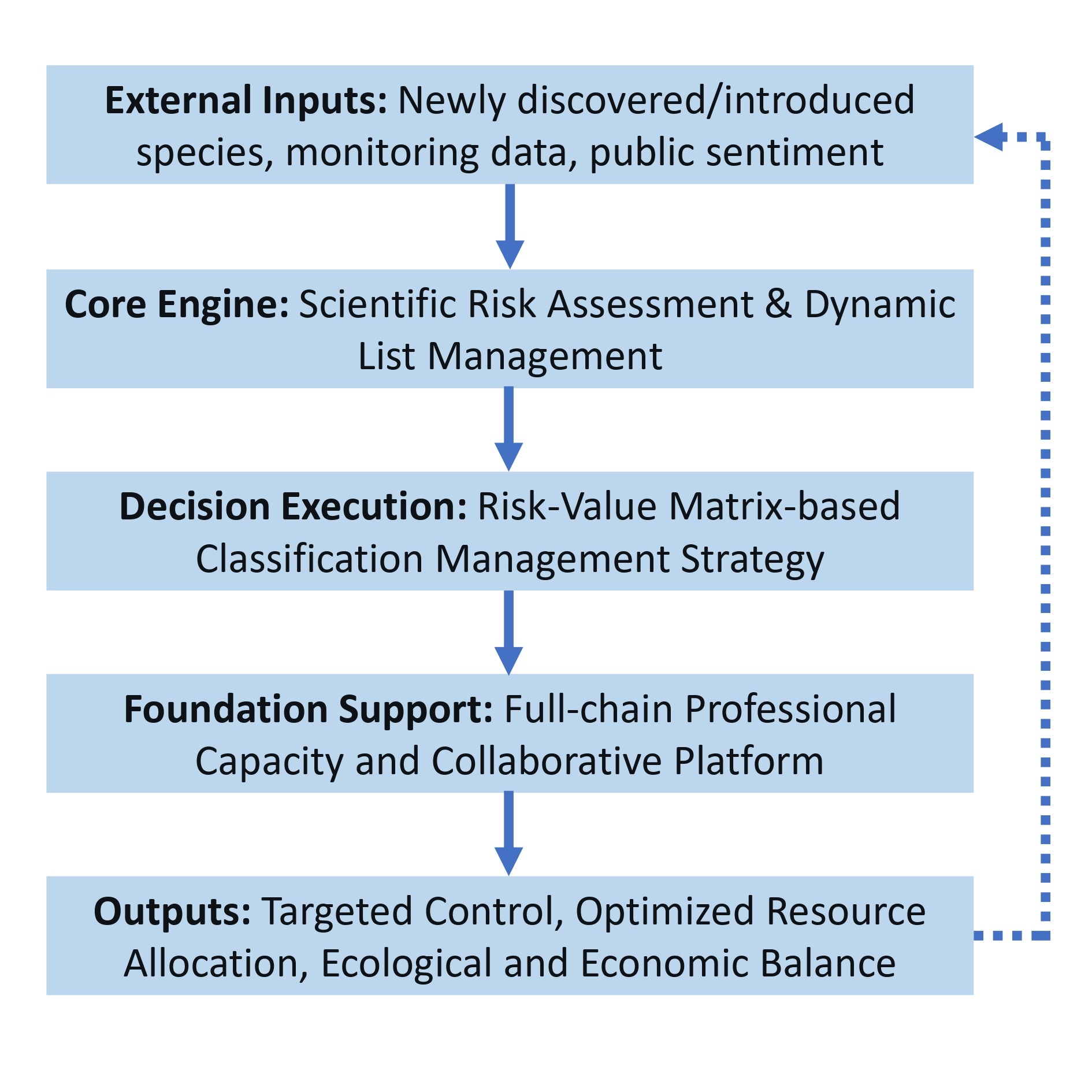
Aspect 1: Risk Assessment Incorporation into Decision-Making Process. As seen from the present paper, the problem in question has nothing to do with the absence of scientific data. Rather, it consists in the integration of the latter into decision-making process. One solution could be procedural mandate: before applying any actions towards alien species control, a risk assessment based on criteria such as climate suitability, reproductive conditions, propagule pressure, and previous establishments should be made. Had the managers from Ruzhou acted on this principle, the outcome would have been different.
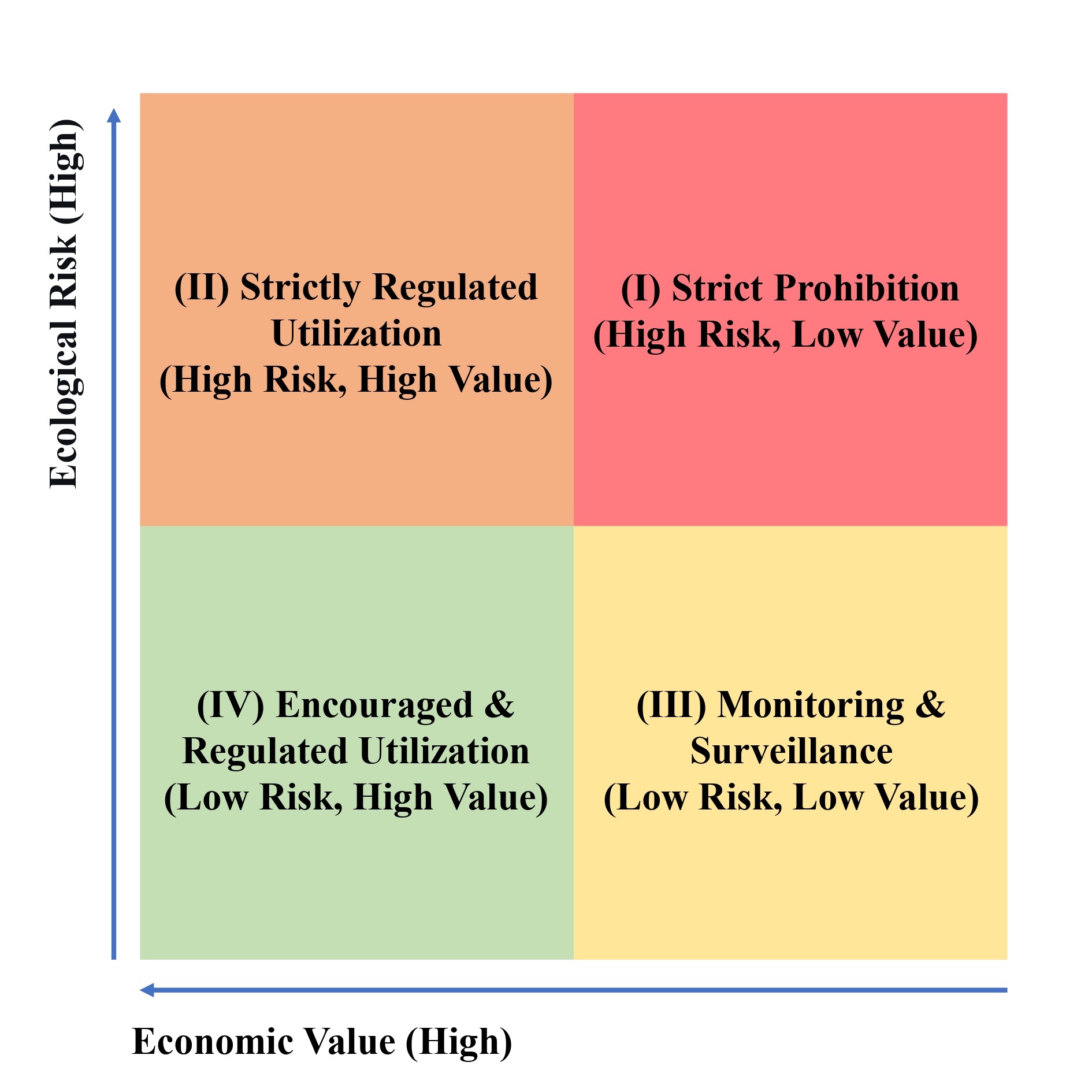
Aspect 2: Differentiation by Risk and Value. Instead of assuming that all alien species have the same detrimental effect, a simple matrix of decisions based on ecological risk and economic value can be created to regulate appropriate actions (Figure 2). Four types of species may be differentiated:
Species having high ecological risks and low economic value (e.g. red imported fire ant, pine wood nematode, water hyacinth). These species, being extremely dangerous for the environment but worthless economically, should be controlled with strict measures, including restriction of introductions/movements/releases and field management.
High-risk/high-value alien species, e.g., crayfish, bullfrog, and tilapia, are species having economic value along with ecological risks. In this situation, regulated uses of the species should be encouraged by creating closed farms, traceability systems, and escapes tracking.
Species of low ecological risk and high economic value, e.g., Hercules beetles, captive reptiles, and ornamental fish, usually do not pose risks and contribute to economic/cultural activity. In this case, the regulation should be easier and be limited to creating whitelist systems along with quarantine and registration.
Low-risk and low-value alien species, e.g., accidentally introduced species or small invertebrates, are usually harmless, as they have almost no effect on the environment and human society. In such a case, regular monitoring is sufficient to track the species’ spread.
To be more practical, this study recommends the creation of a National Biosafety Committee (NBC) comprising approximately 10-12 people – invasion ecologists, taxonomists, trade economists, and representatives of MEE, MARA, and GAC. This committee will evaluate annually the National List of Invasive Alien Species in terms of risk–value classification, while enabling to change the status of any species to another one within 30 days following the presentation of peer-reviewed articles providing evidence of a species’ establishment in comparable regions of a similar climate.
Additional criteria can be applied for changing a species’ status. For instance, it should be moved from the category of Observation to Control in the following cases: survival through winters for two consecutive years, generation of more than 1,000 individuals per year, and occurrence of hybridization with local species. Conversely, when it is demonstrated that species’ presence significantly and irreversibly harms native species by reducing their population by 30% while requiring costs higher than CNY 100 million for controlling the species, it should be moved from Control to Prohibition. On the other hand, it should be moved from Control back to Observation if it is proven that no introductions or establishments took place during five consecutive years, and it was estimated that risks are low.
Although lacking empirical validation, this system may be considered a reasonable initial step toward development of the improved system.
Aspect 3: Investment into Frontline Capacity. The third aspect that requires attention is the investment into frontline capacity. It could be implemented by developing unified guidelines to identify species throughout the country by means of image recognition software and expert judgment, increasing the expertise of customs, fisheries, and forestry workers regarding taxonomy, and improving cross-departmental cooperation through platforms combining risk assessments, interceptions data, and management experience. Without a sufficient frontline capacity, no risk assessment scheme can be utilized.
Of course, it would be misleading to draw a conclusion based on the examples mentioned above. Indeed, it is incorrect to state that all biosecurity measures taken in China were based on cognitive dissonance. High-profile species, e.g., pine wood nematode and coconut leaf beetle, were addressed by the government in terms of surveillance and control that align with scientific recommendation34,33. Cognitive dissonance is not ubiquitous in China; it emerges under certain conditions, e.g., when a species is aesthetically pleasing but carries low risks, risk assessment methods are inapplicable, or frontline capacity is insufficiently developed.
Limitations
These include several points. The case studies were chosen in line with the aim of raising awareness of the certain examples of cognitive disconnects. Although there can be found other examples where science and governance were less disconnected, they are not considered here. Information obtained solely from publicly accessible sources was used, as any evaluations and discussions held internally within the Chinese government remained inaccessible.
The comparison of China and international experience presented here cannot be regarded as a thorough one; the point that deserves noting is that a full-fledged comparative study will certainly exceed the bounds of the current paper. Besides, even though a new framework was suggested theoretically, its applicability needs to be confirmed by means of pilot testing and further research. Furthermore, there exists some possibility of linguistic bias since, owing to the focus on the Chinese experience, the literature review involved, among other sources, those written in Chinese.
Finally, another problem is associated with the use of sources: events discussed here (identification errors, Shijiazhuang, etc.) were supported mostly by government documents and media coverage instead of academic sources. However, it should be mentioned that only a confirmation of the occurrence of such instances was necessary; therefore, no conclusions about their frequency or reasons can be drawn based on these sources.
Conclusion
The situations discussed in the cases above demonstrate that there was a connection between the response of policymakers to biological invasions in China and emergency procedures despite the existence of scientific knowledge proving otherwise about the relatively low level of risks. It appears that this discrepancy is not only the result of poor communication. On the contrary, its roots may lie in the institutional arrangements, incentives, and professionalism involved in dealing with biological invasions.
It should be noted that much progress has been made in building institutional infrastructure and legal mechanisms related to biosecurity in China. The Biosafety Law and the national List of Invasive Alien Species provide favorable circumstances for biosecurity. Yet, implementation of these notions and their consistency with scientific evidence pose difficulties. The development of novel risk assessment methodologies as well as flexibility in alien species classification and management is required to solve this problem.
There are several areas worth investigating further. For instance, a comparative analysis of various governance frameworks in terms of the science-policy-making gap in biological invasions management can be carried out. Another research direction may involve empirical analysis of pilot programs employing risk-based management techniques. Moreover, it would be useful to explore the adverse consequences resulting from inadequate reactions to high-risk species and excessive reactions to low-risk species.
Consequently, managing biological invasions does not imply the extermination of all alien species due to potential inefficiency and irrationality of such measures. Rather, it requires effective application of limited economic, technological, and human resources based on scientific evidence and flexible governance mechanisms.
Appendix A: PRISMA Flow Diagram
Appendix B: Summary Table of 32 Included Articles
| ID | Author(s) (Year) | Species / Topic | Main Findings (Relevance to Risk/Governance) |
| 1 | Bartnicki et al. (2021) | Atractosteus spatula (alligator gar) | Determined critical thermal minimum (ca. 11–12 °C) during early life stages, demonstrating inability to overwinter in temperate regions; supports low‑risk classification. |
| 2 | Cao (2021) | China’s Biosafety Law | Systematically reviewed the 11 institutional mechanisms established by the law (risk assessment, information sharing, listing, etc.); provides academic basis for the legal framework. |
| 3 | Cheng et al. (2026) | China’s IAS governance policies | Identified systemic problems including insufficient coordination of implementation mechanisms and weak basic support; supports analysis of institutional design and knowledge infrastructure. |
| 4 | Cuthbert et al. (2025) | Economic impact prediction of IAS | Proposed a trait‑based framework to predict economic impacts, emphasizing context‑dependent risk; supports species traits discussion. |
| 5 | Diagne et al. (2021) | Global economic costs of IAS | Quantified the economic costs of biological invasions worldwide; provides background data for introduction. |
| 6 | Ding et al. (2021) | Bursaphelenchus xylophilus (pine wood nematode) | Studied population differentiation and epidemic tracking using whole‑genome sequencing; supports positive case of systematic surveillance in China. |
| 7 | Gao & Guo (2022) | Atractosteus spatula (alligator gar) | Documented the Ruzhou lake‑draining incident; serves as an academic source for event occurrence. |
| 8 | Han (2022) | Atractosteus spatula (alligator gar) | Indicated that alligator gar entered China through the ornamental fish trade (illegal smuggling); supports introduction pathway discussion. |
| 9 | Hulme (2021) | Biosecurity and biological invasions | Discussed how COVID‑19 reinforced global precautionary biosecurity policies; supports argument that the pandemic amplified precautionary tendencies. |
| 10 | IPPC (2019) | International phytosanitary standards | Provides international norms for plant quarantine; serves as an international standard with which China’s framework aligns. |
| 11 | IUCN (2000) | Guidelines on IAS prevention | Stipulates that risk assessment should be science‑based, transparent, and proportionate to actual risk; supports citation of international guidelines. |
| 12 | Jarošik et al. (2015) | Thermal requirements of invasive insects | Found that invasive insects have higher developmental threshold temperatures; supports the general principle that climatic mismatch limits invasion. |
| 13 | Li et al. (2022) | Risk perception and policy tools | Analyzed post‑pandemic increase in public risk perception and its interaction with policy choices in China; supports COVID‑19 impact discussion. |
| 14 | Liu et al. (2021) | Belt & Road invasion risks | Analyzed introduction pathways including pet trade and aquaculture in China; supports human‑mediated dispersal discussion. |
| 15 | Lockwood et al. (2013) | Invasion ecology (textbook) | Synthesized the three‑factor framework (ecosystem vulnerability, species traits, propagule pressure); primary source for theoretical framework. |
| 16 | Lockwood et al. (2019) | Exotic pet trade and invasions | Discussed mechanisms of the pet trade as an invasion pathway and its multi‑billion‑dollar scale; supports value neglect case. |
| 17 | Lu et al. (2019) | Brontispa longissima (coconut leaf beetle) | Quantitatively assessed invasion drivers and produced pest risk maps; supports positive case of systematic management in China. |
| 18 | Moher et al. (2009) | PRISMA methodology | Provides the standard framework for systematic literature review methodology. |
| 19 | Myers et al. (2024) | Dynastes hercules (Hercules beetle) | Records that the species is distributed in Central American tropical rainforests; supports geographic and thermal background. |
| 20 | Newsome & Noble (1986) | Traits of invading species | Classic work summarizing successful invader traits (rapid reproduction, high dispersal, etc.); supports species traits discussion. |
| 21 | Peng et al. (2019) | Brontispa longissima (coconut leaf beetle) | Summarized the ecological basis and control technology system for invasion outbreaks; supports positive case of management in China. |
| 22 | Pyšek & Richardson (2007) | Invasive plant traits | Systematically reviewed traits associated with invasiveness (phenotypic plasticity, broad tolerance, etc.); supports species traits discussion. |
| 23 | Pyšek et al. (2020) | Scientists’ warning on IAS | Comprehensively reviewed drivers, impacts, and governance needs of biological invasions; serves as background citation. |
| 24 | Turvey et al. (2007) | Lipotes vexillifer (Yangtze river dolphin) | Declared the species functionally extinct; supports discussion of apex predator decline in the Yangtze basin. |
| 25 | Verloove (2010) | Misidentifications in IAS management | Emphasized the serious consequences of misidentifications and the need for taxonomic training; supports knowledge infrastructure discussion. |
| 26 | Wang et al. (2023) | Online ant trade in China | Monitored online pet trade revealing high biological invasion risk; supports the argument that pet trade is a major introduction pathway. |
| 27 | Weber & Li (2008) | Plant invasions in China | Discussed drivers of plant invasions under economic development (agriculture, aquaculture, ornamental trade, etc.); supports human‑mediated dispersal discussion. |
| 28 | Wilson et al. (2009) | Dispersal pathways and invasion success | Discussed how human‑mediated dispersal affects invasion success through propagule pressure; supports human factors framework. |
| 29 | Xie et al. (2023) | Atractosteus spatula (alligator gar) | Assessed establishment risk in Chinese freshwaters, concluding no wild populations established; supports low‑risk conclusion. |
| 30 | Xu et al. (2012) | Inventory of IAS in China | Provided an early scientific inventory, laying the groundwork for subsequent regulatory lists; supports listing as a regulatory baseline. |
| 31 | Yemshanov et al. (2019) | Surveillance strategy optimization | Developed mathematical models to optimize early‑detection surveillance strategies; supports the monitoring capacity dimension of the intelligent governance framework. |
| 32 | Zhang et al. (2020) | Psephurus gladius (Chinese paddlefish) | Declared the species extinct; supports discussion of apex predator decline in the Yangtze basin. |
References
- Pyšek, P., Hulme, P. E., Simberloff, D., Bacher, S., Blackburn, T. M., Carlton, J. T., Dawson, W., Essl, F., Foxcroft, L. C., Genovesi, P., Jeschke, J. M., Kühn, I., Liebhold, A. M., Mandrak, N. E., Meyerson, L. A., Pauchard, A., Pergl, J., Roy, H. E., Seebens, H., … Richardson, D. M. (2020). Scientists’ warning on invasive alien species. Biological Reviews, 95(6), 1511–1534. [↩]
- Diagne, C., Leroy, B., Vaissière, A. C., Gozlan, R. E., Roiz, D., Jarić, I., Salles, J. M., Bradshaw, C. J. A., & Courchamp, F. (2021). High and rising economic costs of biological invasions worldwide. Nature, 592, 571–576. [↩]
- Liu, X., Blackburn, T. M., Song, T., Li, X., Huang, C., & Li, Y. (2021). Risks of biological invasion on the Belt and Road. Current Biology, 31(14), 3203–3210. [↩] [↩]
- Wang, Z., Zeng, J., Ran, H., Meng, W., Zhou, S., Davies, A. B., & Liu, C. (2023). Monitoring the online ant trade reveals high biological invasion risk. Biological Conservation, 282, 110038. https://doi.org/10.1016/j.biocon.2023.110038 [↩]
- Cao, C. (2021). China’s evolving biosafety/biosecurity legislations. Journal of Law and the Biosciences, 8(1), lsab020. https://doi.org/10.1093/jlb/lsab020 [↩] [↩]
- Xu, H., Qiang, S., Genovesi, P., Ding, H., Wu, J., Meng, L., Han, Z., Miao, J., Hu, B., Guo, J., Sun, H., Huang, C., Lei, J., Le, Z., Zhang, X., He, S., Wu, Y., Zheng, Z., Chen, L., … Pysek, P. (2012). An inventory of invasive alien species in China. NeoBiota, 15, 1–26. https://doi.org/10.3897/neobiota.15.3575 [↩] [↩]
- Gao, H., & Guo, T. X. (2022). The action of “draining the lake water” to capture the alien species alligator gar (Atractosteus spatula) was staged in He’nan, China. International Journal of Aquaculture, 12(1), 1–2. [↩]
- Bartnicki, J., Snow, R. A., Taylor, A. T., & Butler, C. J. (2021). Critical thermal minima of alligator gar (Atractosteus spatula) during early life stages. Journal of Applied Ichthyology, 37(4), 572–577. [↩] [↩]
- CCTV News. (2021, April 22). Commonly known as ‘Hercules’, one of the world’s largest beetles: Five live Hercules beetles seized [News report]. Retrieved from http://sannong.cctv.com/2021/04/22/ARTIFxM7YW8ItraQn2peVnCP210422.shtml [↩]
- Jarošik, V., Kenis, M., Honěk, A., Skuhrovec, J., & Pyšek, P. (2015). Invasive insects differ from non‑invasive in their thermal requirements. PLoS ONE, 10(6), e0131072. [↩] [↩]
- Cheng, X., Li, Q., Li, Y., & Zhang, M. (2026). The dilemmas and solutions for invasive alien species governance policy systems. Biodiversity Science, 34(2), 25332. [↩] [↩] [↩]
- Verloove, F. (2010). Invaders in disguise: The importance of misidentifications for invasive species management. Management of Biological Invasions, 1, 1–5. [↩] [↩]
- Moher, D., Liberati, A., Tetzlaff, J., & Altman, D. G. (2009). Preferred reporting items for systematic reviews and meta‑analyses: The PRISMA statement. PLoS Medicine, 6(7), e1000097. [↩]
- Lockwood, J. L., Hoopes, M. F., & Marchetti, M. P. (2013). Invasion ecology (2nd ed.). Wiley‑Blackwell. [↩] [↩] [↩] [↩]
- Wilson, J. R. U., Dormontt, E. E., Prentis, P. J., Lowe, A. J., & Richardson, D. M. (2009). Something in the way you move: Dispersal pathways affect invasion success. Trends in Ecology & Evolution, 24(3), 136–144. [↩] [↩]
- Pyšek, P., & Richardson, D. M. (2007). Traits associated with invasiveness in alien plants: Where do we stand? In W. Nentwig (Ed.), Biological invasions (pp. 97–125). Springer. [↩]
- Turvey, S. T., Pitman, R. L., Taylor, B. L., Barlow, J., Akamatsu, T., Barrett, L. A., Zhao, X., Reeves, R. R., Stewart, B. S., Wang, K., Wei, Z., Zhang, X., Pusser, L. T., Richlen, M., Brandon, J. R., & Wang, D. (2007). First human-caused extinction of a cetacean species? Biology Letters, 3(5), 537–540. [↩]
- Zhang, H., Jarić, I., Roberts, D. L., He, Y., Du, H., Wu, J., Wang, C., & Wei, Q. (2020). Extinction of one of the world‘s largest freshwater fishes: Lessons for conserving the endangered Yangtze fauna. Science of the Total Environment, 710, 136242. [↩]
- Newsome, A. E., & Noble, I. R. (1986). Ecological and physiological characters of invading species. In R. H. Groves & J. J. Burdon (Eds.), Ecology of biological invasions (pp. 1–20). Cambridge University Press. [↩]
- Cuthbert, R. N., Bodey, T. W., Briski, E., Capellini, I., Dick, J. T. A., Kourantidou, M., Ricciardi, A., & Pincheira‑Donoso, D. (2025). Harnessing traits to predict economic impacts from biological invasions. Trends in Ecology & Evolution, 40(7), 639–650. [↩]
- Lockwood, J. L., Welbourne, D. J., Romagosa, C. M., Cassey, P., Mandrak, N. E., Strecker, A., Leung, B., Stringham, O. C., Udell, B., Episcopio‑Sturgeon, D. J., Tlusty, M. F., Sinclair, J., Springborn, M. R., Pienaar, E. F., Rhyne, A. L., & Keller, R. (2019). When pets become pests: The role of the exotic pet trade in producing invasive vertebrate animals. Frontiers in Ecology and the Environment, 17(6), 323–330. [↩] [↩]
- Weber, E., & Li, B. (2008). Plant invasions in China: What is to be expected in the wake of economic development? BioScience, 58(5), 437–444. [↩]
- Han, Y. (2022). The invasion of the alien species alligator gar (Atractosteus spatula) all over China. International Journal of Aquaculture, 12(2), 1–6. [↩] [↩]
- Chen. (2022). [Full citation unavailable in the provided reference list.] [↩]
- Xie, W. D., Wen, Z. X., Song, K., Guo, B. C., Fang, Y., & Sun, Y. H. (2023). Global freshwater assessment of establishment risk of invasive Alligator gar (Atractosteus spatula) and risks to freshwater ecosystems in China. Zoological Research, 44(1), 90–93. [↩]
- People’s Daily App Fujian Channel. (2021, April 21). Extraordinarily long! Xiamen Customs seizes five live long‑horned rhinoceros beetles for the first time. People’s Daily. (Cited only for event documentation.). [↩]
- Myers, P., Espinosa, R., Parr, C. S., Jones, T., Hammond, G. S., & Dewey, T. A. (2024). Dynastes hercules. Animal Diversity Web. University of Michigan. [↩]
- Global Times. (2025, August 4). Chinese Ministry of State Security warns of hidden risks of exotic pets. (Cited only for market size; not peer‑reviewed.). [↩]
- Nanjing Customs. (2021, November 19). Zhangjiagang Customs seizes 4‑meter‑long live king cobra. http://gdfs.customs.gov.cn/… (Cited only for event documentation.). [↩]
- The Paper. (2021). [Full citation unavailable in the provided reference list.] [↩]
- Shijiazhuang Daily. (2022, June 10). Keeping endangered wild animals as pets leads to legal action [News report]. (Cited only for event documentation). [↩]
- Liu. (2022, June 21). Fishermen in Jiangsu Province discovered a giant soft‑shelled turtle weighing 16 kilograms. Wo Su Website. (Cited only for event documentation.). [↩]
- Ding, X., Guo, Y., Ye, J., Wu, X., Lin, S., Chen, F., Zhu, L., Huang, L., Song, X., Zhang, Y., Dai, L., Xi, X., Huang, J., Wang, K., Fan, B., & Li, D. (2021). Population differentiation and epidemic tracking of Bursaphelenchus xylophilus in China based on chromosome‑level assembly and whole‑genome sequencing data. Pest Management Science, 78(3), 1213–1226. [↩] [↩] [↩]
- Peng, Z., Lyu, B., Qin, W., & Li, Z. (2019). Ecological basis and control technology system of invasion and outbreak of alien pest Brontispa longissima. Journal of South China Agricultural University, 40(5), 118–124. (Original work published in Chinese). [↩] [↩] [↩]
- Lu, B., Peng, Z., Lu, H., Yang, F., & Lin, F. (2019). Inter‑country trade, genetic diversity and bio‑ecological parameters upgrade pest risk maps for the coconut hispid Brontispa longissima. Pest Management Science, 76(5), 1768–1782. [↩]
- International Plant Protection Convention (IPPC). (2019). International standards for phytosanitary measures (ISPMs). FAO. [↩] [↩]
- IUCN. (2000). IUCN guidelines for the prevention of biodiversity loss caused by alien invasive species. IUCN Species Survival Commission. [↩] [↩]
- Hulme, P. E. (2021). Advancing One Biosecurity to address the pandemic risks of biological invasions. BioScience, 71(7), 708–721. [↩]
- Li, L., Wang, Z., & Li, Y. (2022). The dynamic evolution mechanism of public health risk perception and the choice of policy tools in the post‑epidemic era: Evidence from China. International Journal of Disaster Risk Reduction, 76, 103056. [↩]
- Yemshanov, D., Haight, R. G., Koch, F. H., Venette, R. C., Swystun, T., Fournier, R. E., Marcotte, M., Chen, Y., & Turgeon, J. J. (2019). Optimizing surveillance strategies for early detection of invasive alien species. Ecological Economics, 162, 87–99. [↩]