Pranil Raichura1, Nouchine Hadjikhani2 & Natalie Elkin1,3
1 Granite Bay High School
2 Harvard University/MGH
3 Roseville Joint Union High School District
Abstract
Large language models (LLMs) and AI-assisted writing tools such as ChatGPT, Gemini, and Grammarly are rapidly becoming part of everyday schoolwork. Public debate often assumes that these tools either boost students’ creativity or undermine their sense of ownership, yet there is little quantitative evidence about how high school students themselves experience AI-assisted writing. This cross-sectional, correlational study used an anonymous online survey of N = 246 students at a large public high school in California to examine how frequency of AI use for school writing relates to two psychological outcomes: perceived general creativity in school writing and sense of authorship over AI-assisted work. Generative AI (GenAI) tools in this study refer to large language models and AI-assisted writing platforms used for text generation, brainstorming, and grammar or style suggestions. Students reported how often they used AI tools for brainstorming, drafting, editing, and overcoming writer’s block, and rated their creativity and authorship on 1–5 Likert-type scales. Correlational and regression analyses showed that more frequent AI use was moderately associated with lower self-reported general creativity but higher perceived authorship, even after adjusting for demographic and contextual covariates. An exploratory k-means cluster analysis suggested three broad profiles of students. In this sample, heavier AI users reported feeling less creative in their school writing yet were more likely to view AI-assisted work as their own. Because the design is correlational and based on self-report from a single school, these findings should be interpreted as associations rather than causal effects and may not generalize to other school contexts.
Keywords: generative artificial intelligence (GenAI), large language models (LLMs), perceived creativity, authorship, academic writing, high school students, k-means clustering, correlational survey, creative self-efficacy, writer identity.
Introduction
Over the past two years, large language models (LLMs) and AI-assisted writing tools—such as ChatGPT and Gemini for text generation and brainstorming, and Grammarly for grammar and style suggestions—have moved from experimental curiosities to widely adopted supports in schools. Surveys conducted in 2023–2024 report that a majority of secondary and postsecondary students in the United States have used generative AI (GenAI) at least once for school-related tasks, most commonly for brainstorming, drafting, and revising written assignments1,2. At the same time, teachers and administrators are struggling to decide whether these systems should be framed as legitimate learning tools, potential threats to academic integrity, or both3,4.
Empirical work with university students suggests clear benefits of AI-supported writing. Experimental and quasi-experimental studies indicate that access to automated feedback and generative tools can improve organization, surface quality, and overall readability of essays, particularly for less experienced and second-language writers3,4,5. Other studies report gains in externally rated creativity when creativity is operationalized as the novelty or variety of digital products generated with AI support6,7,8. Students themselves often describe AI tools as useful for idea generation, feedback, and overcoming writer’s block9.
Alongside these potential benefits, a parallel strand of research highlights possible costs. Writing instructors and academic integrity officers worry that heavy reliance on AI may erode students’ independent writing skills, blur the boundary between students’ ideas and model-generated text, and incentivize superficial workflows rather than deep engagement with content3,10. Global surveys of university students report confusion and concern about when and how AI assistance should be disclosed, as well as fear of plagiarism accusations and institutional penalties11,12,13.
Theoretical models of technology-mediated learning suggest that learners’ motivational beliefs and perceived agency over tool use shape whether generative AI ultimately supports or undermines learning outcomes8. This study draws on two complementary theoretical traditions. First, Kaufman and Beghetto’s Four C Model of Creativity distinguishes among levels of creative magnitude, with “mini-c” creativity—the personally meaningful interpretive process through which learners construct new understanding—being most relevant to everyday school writing. Generative AI may complicate mini-c creativity by providing ready-made text that reduces opportunities for the personal interpretive work that underlies creative self-beliefs14,15. Second, Ivanić’s framework of writer identity and the discoursal construction of authorship emphasizes that authorship is not merely about producing text but involves a felt sense of being the primary agent and owner of one’s writing16. Bandura’s self-efficacy theory provides an additional lens: mastery experience is the strongest source of self-efficacy, and if AI use reduces opportunities for independent writing practice, students may experience lower creative self-efficacy over time17. Conversely, students who actively direct AI as a tool may experience enhanced agency, consistent with Vygotsky’s concept of tool-mediated activity18.
High school students sit at the center of these debates, yet most empirical work has focused on adults in higher education. Developmentally, adolescence is a critical period for the formation of academic self-concept, including creative self-efficacy and writer identity19,20. High school students are actively constructing their sense of who they are as writers and thinkers, and the introduction of powerful AI tools during this formative period may shape self-perceptions in ways that differ from effects on adults whose academic identities are more established21,22. Research on writing motivation in secondary school students indicates that self-beliefs about creative ability influence willingness to engage with challenging writing tasks and to take expressive risks23. Large-scale reports from ACT and the College Board have documented how U.S. high school students use AI tools1,2. However, these reports are primarily descriptive and rarely link AI use patterns to psychological constructs such as students’ perceived creativity or sense of authorship.
It is important to distinguish between creative performance—the quality, novelty, or originality of a product as judged by external raters—and perceived creativity, which refers to students’ self-assessed creative confidence, originality, and enjoyment in writing. This study focuses on perceived creativity because self-beliefs about creativity are known to influence writing motivation and long-term engagement with writing tasks15,24. The authorship construct is grounded in Ivanić’s notion of the authorial self and captures whether students experience themselves as the primary agent behind AI-assisted text16.
This study addresses that gap using a correlational survey of N = 246 students from a large public high school in California. We examined how AI use frequency, self-reported creativity, and perceived authorship relate to one another after accounting for grade level, gender, writing workload, perceived writing ability, school AI policy, and AI-related instruction. The study provides quantitative evidence on associations between AI use and perceived creativity and authorship in a high school sample, examines these while controlling for covariates, and uses exploratory clustering to identify within-sample heterogeneity. These contributions are descriptive and associational rather than causal, and are limited to the specific context studied.
Given the theoretical expectation that reduced opportunities for independent idea generation may lower creative self-efficacy17 and evidence that frequent AI reliance may reduce independent writing practice10, we formulated the following associational hypothesis:
H1: Higher frequency of AI use for school writing will be associated with lower self-reported general creativity in school writing.
Drawing on Ivanić’s framework of writer identity16 and the tool-mediation perspective from activity theory18, we reasoned that students who actively direct AI as a tool may integrate its output into their sense of authorial agency. Preliminary survey evidence suggests mixed student attitudes toward ownership of AI-assisted work9,2. We therefore also hypothesized:
H2: Higher frequency of AI use for school writing will be associated with a stronger sense that AI-assisted assignments still belong to the student.
Two additional questions were treated as exploratory:
RQ1: Is perceived writing ability associated with a difference in the strength of the cross-sectional relationship between AI use and authorship?
RQ2: Do distinct profiles of students emerge based on their patterns of AI use, creativity, authorship, and related contextual factors?
Method
Design
The study used a cross-sectional, correlational survey design. Because all variables were measured at a single time point, the design cannot establish causal direction, temporal precedence, or rule out third-variable explanations; all reported effects are associations25. All data were collected via an anonymous online questionnaire and analyzed quantitatively.
Participants
Participants were N = 246 students enrolled at a large public high school in California. Two respondents were excluded from the original 248 survey completions: one who reported an implausible age (47 years) and one with missing data on multiple covariate items. Students were in grades 9 through 12 (9th grade: n = 23, 9.3%; 10th grade: n = 29, 11.8%; 11th grade: n = 147, 59.8%; 12th grade: n = 47, 19.1%). The sample included 121 females (49.2%), 120 males (48.8%), 4 nonbinary students (1.6%), and 1 student who preferred not to say (0.4%). Students ranged in age from 14 to 18 years.
To reduce bias, teachers were sampled using a quasi-random procedure: faculty names were listed, random numbers were generated, and selected teachers were invited by email to distribute a Google Forms survey link. Fifteen teachers were invited and 11 distributed the survey. Because the survey was anonymous, class-level response rates could not be computed. The survey took approximately 8–10 minutes. Google Forms was configured to limit responses to one per session. Participation was voluntary, anonymous, and uncompensated, which may have introduced self-selection bias.
The survey did not collect data on race/ethnicity or socioeconomic status to protect participant anonymity in a single-school context. The project was conducted as part of a high school psychology course. The school administration reviewed and approved the survey protocol, and the school’s research guidelines classified it as minimal-risk, not requiring formal IRB review. Parental opt-out notification was provided through the standard course information process, and student assent was obtained through the survey introduction.
Measures
All closed-ended items used five-point Likert-type scales. Composite scores were computed as the mean of their component items.
AI Use Frequency
AI use was operationalized as self-reported frequency of using AI tools across five writing-related activities, each rated from 1 (“Never”) to 5 (“Always”): brainstorming ideas, drafting sentences and paragraphs, editing or proofreading, using AI when stuck, and overall reliance on AI tools. The five items showed excellent internal consistency (α = .89), supporting aggregation into a single composite.
General Creativity in School Writing
Three statements rated from 1 (“Strongly disagree”) to 5 (“Strongly agree”) captured distinct facets of perceived creativity: self-assessed originality, ideational confidence, and willingness to experiment. Items were informed by existing measures of creative self-efficacy15,24 but were adapted for the high school writing context and were not formally validated prior to this study.
Sense of Authorship for AI-Assisted Work
Four statements (two positively worded, two reverse-coded) captured felt ownership, grounded in Ivanić’s concept of the authorial self16. Reverse coding was verified by confirming positive correlations between reverse-coded and positively worded items before computing the composite.
Demographic and Context Variables
Covariates included Grade (9–12), Gender (Female = 1, else = 0), Writing Ability (1–5), Assignments per Week (ordinal categories converted to approximate midpoints: 0.5, 2.5, 4.5, 6), AI Policy (perceived, 1–5), and AI Instruction (1–5).
Data Preparation and Analysis
Data were analyzed in Python 3.11 using pandas 2.1, numpy 1.26, scipy 1.12, statsmodels 0.14, and scikit-learn 1.4. The use of Pearson correlations and OLS regression on Likert-type composites is justified by methodological work demonstrating that parametric methods perform well with such scores when distributions are approximately symmetric26,27. OLS regression models were fit with AI Use as the primary predictor and all covariates entered simultaneously. We also tested an AI Use × Writing Ability interaction for authorship (RQ1). All tests were two-tailed with α = .05. For RQ2, we conducted an exploratory k-means cluster analysis; silhouette scores for k = 2 through k = 5 were examined, and the three-cluster solution was retained for its interpretive value despite k = 2 having a marginally higher silhouette score.
Results
Descriptive Statistics and Scale Reliability
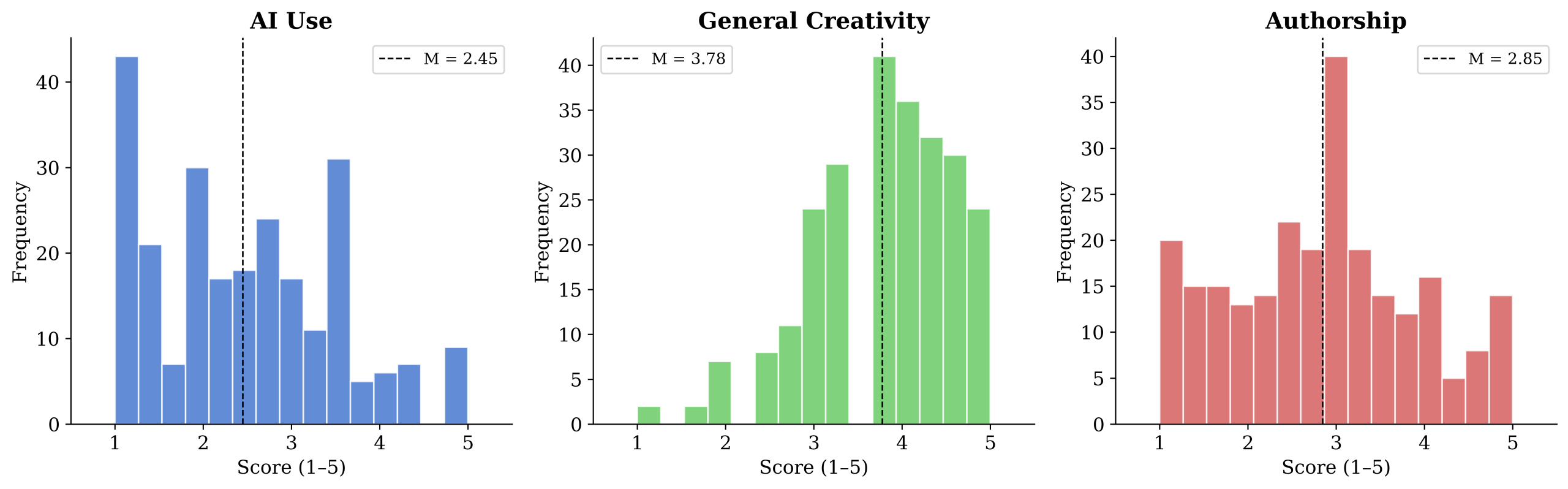
Descriptive statistics are presented in Table 1. AI Use (M = 2.45, SD = 1.05) fell between “Rarely” and “Sometimes,” suggesting most students are occasional AI users. General Creativity was moderately high (M = 3.78, SD = 0.83). Authorship was slightly below the midpoint (M = 2.85, SD = 1.01), suggesting some ambivalence about ownership of AI-assisted work.
| Scale | M | SD | Cronbach’s α |
|---|---|---|---|
| AI Use (5 items) | 2.45 | 1.05 | .89 |
| General Creativity (3 items) | 3.78 | 0.83 | .69 |
| Authorship (4 items) | 2.85 | 1.01 | .75 |
Note. Each composite is the mean of its component items (1 = low, 5 = high). N = 246.
The General Creativity scale achieved below-threshold reliability (α = .69), partly attributable to brevity (three items); the mean inter-item correlation of .43 falls within the recommended .15–.50 range28. The Authorship scale showed acceptable reliability (α = .75).
Bivariate Correlations
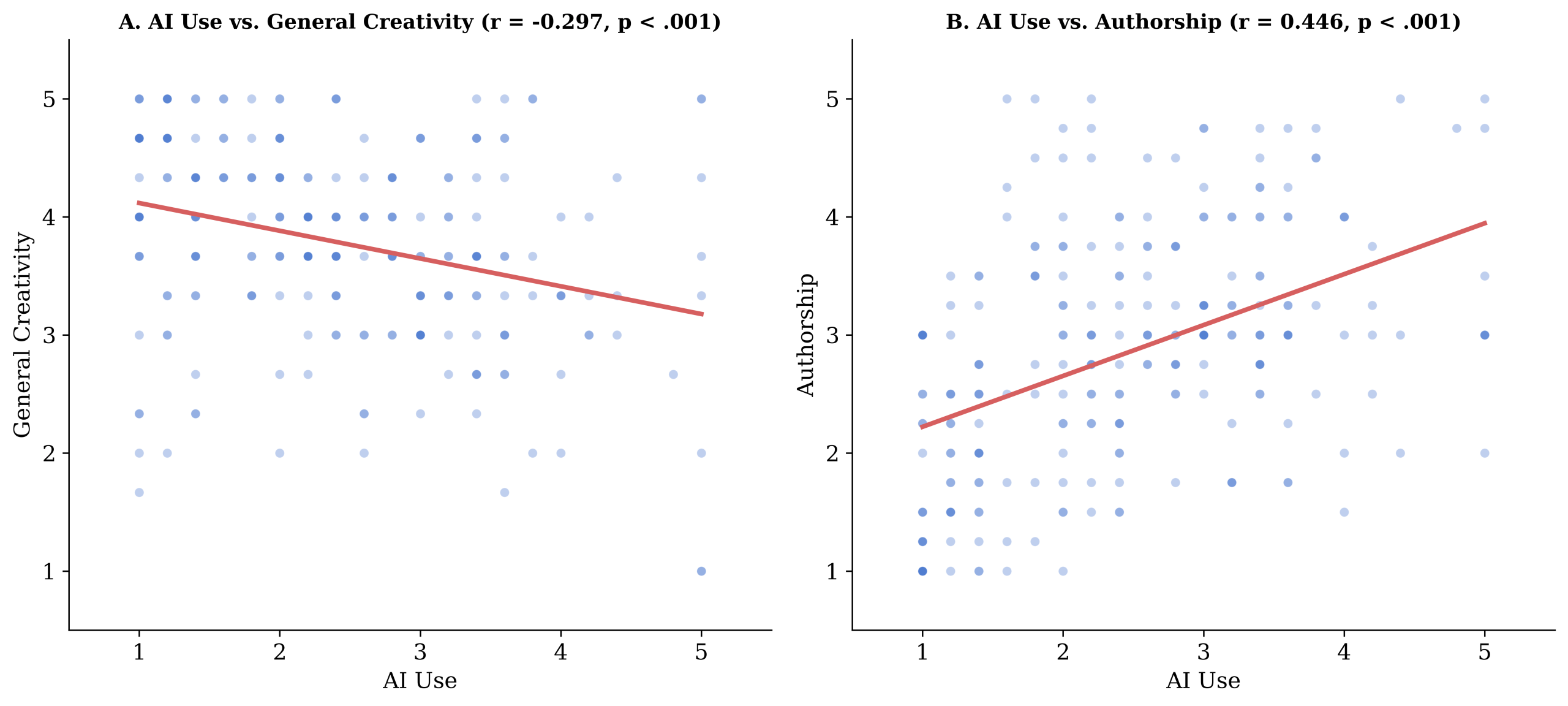
AI Use was moderately negatively correlated with General Creativity (r = –.297, p < .001), accounting for approximately 9% of shared variance. AI Use was moderately positively correlated with Authorship (r = .446, p < .001), accounting for approximately 20% of shared variance. General Creativity and Authorship were weakly negatively correlated (r = –.202, p = .001), accounting for about 4% of shared variance.
Multiple Regression Analyses
All VIFs were below 1.11, indicating no multicollinearity. In Model A (General Creativity), R² = .250; AI Use was significantly associated with lower creativity (B = –0.205, SE = 0.047, p < .001, 95% CI [–0.297, –0.114], β = –.260). In Model B (Authorship), R² = .229; AI Use was significantly associated with higher authorship (B = 0.424, SE = 0.058, p < .001, 95% CI [0.311, 0.538], β = .439). Full results are in Table 2.
| Predictor | B (A) | SE | β | p | B (B) | SE | β | p |
|---|---|---|---|---|---|---|---|---|
| AI Use | −.205 | .047 | −.260 | <.001 | .424 | .058 | .439 | <.001 |
| Grade | .048 | .058 | .047 | .414 | −.093 | .072 | −.075 | .198 |
| Female | .013 | .094 | .008 | .889 | −.137 | .116 | −.068 | .240 |
| Writing Ability | .321 | .049 | .376 | <.001 | .007 | .061 | .007 | .908 |
| Assignments/Wk | .020 | .030 | .038 | .509 | −.085 | .038 | −.131 | .024 |
| AI Policy | −.023 | .055 | −.025 | .671 | .015 | .068 | .013 | .827 |
| AI Instruction | .063 | .044 | .081 | .157 | −.018 | .055 | −.019 | .739 |
Note. N = 246. Model A: R2 = .250. Model B: R2 = .229. HC1 robust standard errors produced substantively identical results.
Moderation by Perceived Writing Ability
The AI Use × Writing Ability interaction was not significant (B = –0.028, SE = 0.057, p = .624). R² changed negligibly (.229 to .230).
Cluster Analysis (Exploratory Profiles)
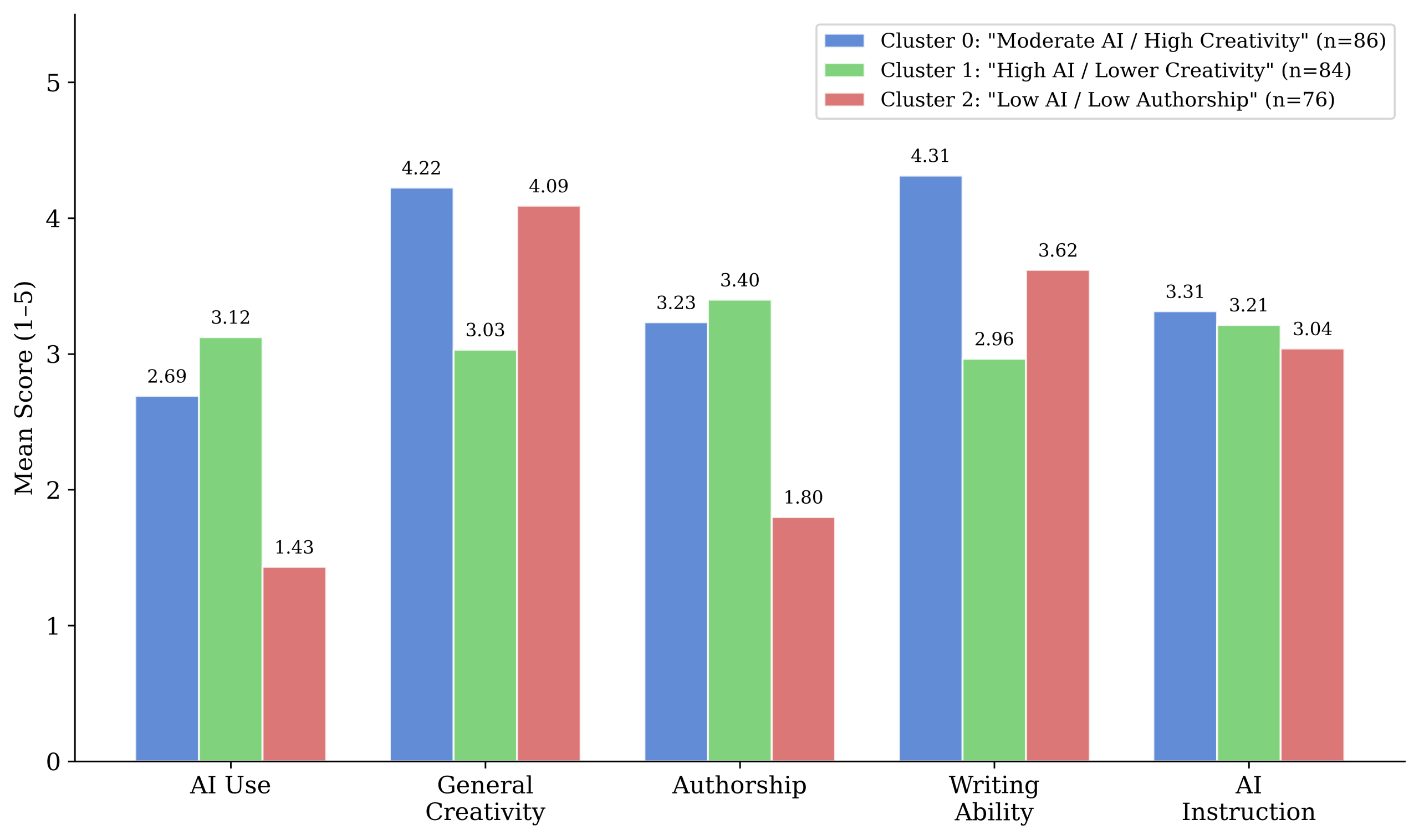
All cluster results are exploratory and descriptive. Cluster centroids are shown in Table 3.
| Cluster | n | AI Use | Creativity | Authorship |
|---|---|---|---|---|
| 0 (“Moderate AI / High Creativity”) | 86 | 2.69 | 4.22 | 3.23 |
| 1 (“High AI / Lower Creativity”) | 84 | 3.12 | 3.03 | 3.40 |
| 2 (“Low AI / Low Authorship”) | 76 | 1.43 | 4.09 | 1.80 |
Note. Descriptive labels are tentative shorthand. N = 246.
Discussion
This study examined how high school students’ use of AI writing tools is associated with their perceived creativity and sense of authorship. In this sample, more frequent AI use was moderately associated with lower General Creativity and higher Authorship. The weak negative correlation between creativity and authorship (r = –.202) suggests these are partially independent experiences. Because the design is cross-sectional, no causal direction can be established.
The negative AI–creativity association aligns with concerns in the literature3,4,10. Prior work shows AI can improve text quality and external creativity ratings5,6, yet students who use AI more often do not necessarily feel more creative. This discrepancy may be particularly salient for adolescents whose academic identities are still forming20,21.
The positive AI–authorship association contrasts with fears that AI undermines ownership10,9,12,11. One tentative explanation is that students frame AI as an instrument they direct rather than an autonomous author, consistent with self-efficacy and tool-mediation frameworks8,17.
Three speculative interpretations are offered: a selection explanation (less creative students adopt AI), a tool-integration explanation (AI as directed instrument), and a cognitive dissonance explanation (rationalization of AI use). The data cannot discriminate among these mechanisms.
The pattern of associations suggests tentative implications: schools should scaffold both AI-supported and AI-free writing to sustain creative confidence, and should clarify expectations for transparent AI use given that many students already feel comfortable claiming AI-assisted work as their own.
Limitations
The study is cross-sectional, relies on self-report (introducing common-method variance and social desirability bias), draws from a single school, did not collect race/ethnicity or socioeconomic data, used brief and not formally validated scales (creativity α = .69), and employed exploratory clustering without stability checks.
Future Directions
Longitudinal, experimental, and multi-site designs are needed. Future work should distinguish between modes of AI use, incorporate behavioral creativity measures and AI literacy scales, and include diverse school contexts.
Conclusion
In this sample of 246 students at a single California public high school, more frequent AI use was associated with lower self-reported creativity and higher perceived authorship. Both associations remained significant after controlling for covariates. These results indicate a pattern of association within this specific sample. Whether these associations hold in other school contexts remains an open question.
Acknowledgments
The authors would like to thank Natalie Elkin of Granite Bay High School for her guidance and feedback throughout the design and revision of this study. The authors would also like to thank teachers Shannon McCann, Gerald Law, Robert Beltrami, Bruce Honberger, and more for sharing the survey link with their classes and to the students who volunteered their time to participate. Finally, thanks are due to the Granite Bay High School administration for supporting the implementation of this research project.
References
- J. Schiel, B. L. Bobek, J. Z. Schnieders. High school students’ use and impressions of AI tools. ACT Research Report, Iowa City, IA, 2023. [↩] [↩]
- A. Adair. U.S. high school students’ use of generative artificial intelligence: New evidence from high school students, parents, and educators. College Board, AI Research Brief 1, New York, NY, 2024. [↩] [↩] [↩]
- Y. K. Dwivedi, et al. So what if ChatGPT wrote it? Multidisciplinary perspectives on opportunities, challenges, and implications of generative conversational AI for research, practice and policy. International Journal of Information Management. Vol. 71, 2023. [↩] [↩] [↩] [↩]
- E. Kasneci, et al. ChatGPT for good? On opportunities and challenges of large language models for education. Learning and Individual Differences. Vol. 103, 2023. [↩] [↩] [↩]
- J. Li, S. Link, V. Hegelheimer. Rethinking the role of automated writing evaluation (AWE) feedback in ESL writing instruction. Journal of Second Language Writing. Vol. 27, pg. 1–18, 2015. [↩] [↩]
- D. Grimes, M. Warschauer. Utility in a fallible tool: A multi-site case study of automated writing evaluation in the classroom. Journal of Technology, Learning, and Assessment. Vol. 8, no. 6, 2010. [↩] [↩]
- A. T. Corbett, J. R. Anderson. Locus of feedback control in computer-based tutoring: Impact on learning rate, achievement and attitudes. Proceedings of the SIGCHI Conference on Human Factors in Computing Systems, pg. 245–252, 2001. [↩]
- O. Zawacki-Richter, M. Marín, M. Bond, F. Gouverneur. Systematic review of research on artificial intelligence applications in higher education—Where are the educators? International Journal of Educational Technology in Higher Education. Vol. 16, no. 39, 2019. [↩] [↩] [↩]
- C. K. K. Chan. Students’ voices on generative AI: Perceptions, benefits, and concerns. Frontiers in Education. Vol. 8, 2023. [↩] [↩] [↩]
- K. M. Sommers. Responding to student writing in the age of artificial intelligence. College Composition and Communication. Vol. 75, no. 2, pg. 254–274, 2024. [↩] [↩] [↩] [↩]
- C. K. K. Chan, A. Hu, A. Reynolds. Generative AI in higher education: A cross-regional survey of students in Europe and North America. Computers & Education: Open. Vol. 5, 2024. [↩] [↩]
- S. Chen, X. Shi. University students’ acceptance of ChatGPT in mainland China: Academic use, plagiarism concerns, and institutional policies. International Journal of Educational Technology in Higher Education. Vol. 21, 2024. [↩] [↩]
- Higher Education Policy Institute. Student academic experience survey: Generative AI supplement. HEPI Report, Oxford, U.K., 2024. [↩]
- J. C. Kaufman, R. A. Beghetto. In praise of Clark Kent: Creative metaphors, student identity, and the “everyday” classroom. In: Nurturing creativity in the classroom. R. A. Beghetto, J. C. Kaufman, Eds. Cambridge University Press, pg. 1–19, 2010. [↩]
- R. A. Beghetto. Creative self-efficacy: Correlates in middle and secondary students. Creativity Research Journal. Vol. 18, no. 4, pg. 447–457, 2006. [↩] [↩] [↩]
- R. Ivanić. Writing and identity: The discoursal construction of identity in academic writing. John Benjamins, 1998. [↩] [↩] [↩] [↩]
- A. Bandura. Self-efficacy: The exercise of control. W. H. Freeman, 1997. [↩] [↩] [↩]
- L. S. Vygotsky. Mind in society: The development of higher psychological processes. Harvard University Press, 1978. [↩] [↩]
- E. H. Erikson. Identity: Youth and crisis. W. W. Norton, 1968. [↩]
- S. Harter. The construction of the self: Developmental and sociocultural foundations. 2nd ed. Guilford Press, 2012. [↩] [↩]
- F. Pajares, G. Valiante. Self-efficacy beliefs and motivation in writing development. In: Handbook of writing research. C. A. MacArthur, S. Graham, J. Fitzgerald, Eds. Guilford Press, pg. 158–170, 2006. [↩] [↩]
- M. Appel, N. Kronberger, J. Aronson. Stereotype threat impairs ability building: Effects on test preparation among women in science and technology. European Journal of Social Psychology. Vol. 41, no. 7, pg. 904–913, 2012. [↩]
- S. Graham, V. Berninger, W. Fan. The structural relationship between writing attitude and writing achievement in first and third grade students. Contemporary Educational Psychology. Vol. 32, no. 3, pg. 516–536, 2007. [↩]
- M. Karwowski, J. C. Kaufman. The creative self: Effect of beliefs, self-efficacy, mindset, and identity. Academic Press, 2017. [↩] [↩]
- W. R. Shadish, T. D. Cook, D. T. Campbell. Experimental and quasi-experimental designs for generalized causal inference. Houghton Mifflin, 2002. [↩]
- G. Norman. Likert scales, levels of measurement and the “laws” of statistics. Advances in Health Sciences Education. Vol. 15, no. 5, pg. 625–632, 2010. [↩]
- J. Carifio, R. Perla. Resolving the 50-year debate around using and misusing Likert scales. Medical Education. Vol. 42, no. 12, pg. 1150–1152, 2008. [↩]
- L. A. Clark, D. Watson. Constructing validity: Basic issues in objective scale development. Psychological Assessment. Vol. 7, no. 3, pg. 309–319, 1995. [↩]