Abstract
The current study investigates the relationship between sports participation and grit, as well as how grit levels differ across various sport types, and across team vs. individual sports and contact vs. non-contact sports. Grit, defined as perseverance and passion for long-term goals, has been related to success in education, career development, and physical performance. Prior researches report that sports may foster psychological traits related to grit such as self-regulation, resilience, growth mindset, and self-efficacy. This study hypothesizes that athletes would exhibit higher levels of grit than non-athletes, and that grit would vary depending on sports type. In this research, different sports are studied on two different dimensions: team and individual, as well as contact and non-contact. A total of 133 participants from China completed the survey. Results show that individuals currently participating in sports report slightly higher grit scores than non-participants (including past participants and people who never participated), although this difference is not statistically significant (β = 0.15, t = 1.44, p = 0.15). Athletes who engage in both team and individual sports report significantly higher grit levels than those who participate in only one type (F (2, 117) = 6.10, p = 0.003). In contrast, there is no significant difference in grit level between participants in team or individual sports (p = 0.472), and between participants in contact and non-contact sports (β = 0.13, t = 1.00, p = 0.319). Overall, these results provide limited evidence that sport participation or sport type strongly predicts grit.
Keywords: grit, sports participation, team sports, individual sports, contact sports
Introduction
Grit is defined as perseverance and passion for long-term goals1. Previous researches have demonstrated that grit is positively associated with success across many important life domains2. In education, higher grit level predicts better academic performance2, and is also associated with a greater likelihood of high school graduation3. In the workplace, individuals with higher levels of grit tend to show better job performance4, and are more likely to persist in their careers and manage challenges efficiently5. Additionally, grit plays a significant role in sports in helping athletes maintain motivation, overcome setbacks, and achieve peak performance6. Overall, grit plays a crucial psychological role in helping individuals sustain effort and motivation toward long-term goals, making it an indicator of success and personal growth.
Although grit shares similarities with other psychological traits like self-control, mental toughness, and resilience, researchers suggest that grit is a distinct trait. Duckworth and Gross7. emphasized that grit and self-control are related but different determinants of success. Grit measures sustained effort toward long-term goals, while self-control involves resisting short-term temptations8. In sports psychology, mental toughness refers to the ability to maintain focus, confidence, and performance under pressure9, whereas resilience describes the capacity to recover and adapt positively after setbacks10. These definitions are distinctively different from that of grit (see above).
Given that many positive outcomes associate with grit, an important question is how people can develop higher levels of grit. Grit is not a skill that can be taught directly. Instead, researchers have found that grit can be trained by developing related psychological traits, including self-regulation and resilience11, growth mindset12, and self-efficacy13.
Self-regulation, the ability to manage one’s emotions, thoughts, and behaviors in pursuit of long-term goals, is directly related to the level of grit. Researchers suggest that individuals with strong self-regulation are more capable of sustaining effort and resisting short-term temptations, supporting the two core dimensions of grit14: consistency of interest and perseverance.
Resilience, defined as the capacity to recover from setbacks and adapt positively to adversity, also contributes to grit development. Resilient students tend to remain engaged despite experiencing difficulties and interpret failure as a learning opportunity, which aligns with the persistent nature of grit10.
Growth mindset, the belief that abilities and intelligence can be developed through effort and learning, plays a similarly important role in improving grit level. Individuals with a growth mindset are more likely to embrace challenges and persist through obstacles, viewing effort as a path to mastery15.
Self-efficacy, defined as the belief in one’s ability to succeed in specific tasks, is also related to grit. Students with strong self-efficacy are more likely to persist through difficult tasks and maintain their motivation over time, even in the face of setbacks13.
Engagement in sports and physical activities creates supports towards the development of psychological qualities such as self-efficacy16 and resilience17. Participation in physical activities has also been found to enhance grit and resilience level among college students6. Through regular training and overcoming challenges in sports, young people could strengthen self-regulation, resilience, and grit, which are key factors that determine long-term achievement.
Previous researches have established a positive association between participation in sports and the development of Grit6,16,17. Engagement in athletic activities often exposes individuals to goal-setting, repeated challenges, and the necessity of perseverance, which all closely align with grit. Dunston et al. found that college students who participate in high intensity levels of physical activity exhibit higher levels of grit and resilience4. Similarly, Jiang et al. reported that physical activity is positively related to greater emotional resilience17, and Peng et al. found that physical activity participation is associated with higher levels of persistence in children and adolescents16. The findings suggest that sports participation may foster grit-related qualities by encouraging sustained effort, overcoming setbacks, and long-term perseverance.
Although evidence suggests that sports participation may cultivate grit, few studies have examined whether different types of sports are associated with varying grit levels. Therefore, more research is needed to clarify how different sport types contribute to grit development. This study addresses two primary research questions: whether athletic participation is positively related to grit, and how this relationship differs across sport types. It is already reported that physical activity is linked to psychological traits such as perseverance and resilience, which are key components of grit6,16,17. Based on these reports, it is hypothesized that athletes should exhibit higher levels of grit compared to non-participants (including past participants and people who never participated). This hypothesis is supported by previous findings suggesting that regular participation in sports requires consistent effort, goal-setting skills, and the ability to persist through failure and discomfort, which are all core components of grit16,17.
Furthermore, it is hypothesized that participants involved in both individual and team sports would demonstrate a higher level of grit, since these individuals tend to have broader and longer-term sport engagement, which may lead to more diverse challenges and learning experiences. Exposure to both settings may also foster greater adaptability and sustained motivation. In addition, it is expected that people who engage in individual sports should show higher grit than those in team sports, as individual athletes must rely solely on themselves during competition. Without teammates sharing responsibility or providing motivation, these athletes need to develop stronger self-discipline and internal drive. Finally, it is hypothesized that athletes in contact sports would demonstrate higher grit than those in non-contact sports, because contact sports often involve greater physical risk, confrontation, and psychological stress. These demanding conditions may help develop perseverance and mental resilience over time.
The sample in this study includes individuals who currently participate in sports, those who previously participated but no longer do (past athletes), and those who have never engaged in sports (non-athletes). For statistical analysis, the non-athletes and past athletes are combined into one group called non-participants to compare against current athletes. For statistical analysis, grit was examined using a two-dimensional framework based on participation status (current athletes vs. non-participants) and sport type (team/individual and contact/non-contact sports).
Method
Participants volunteered to complete an online survey assessing their grit, sports participation, demographic variables, and an attention check question. All methods and materials were approved by school level IRB at Beijing National Day School, and the methods were preregistered on Open Science Framework18. Participants were recruited by sending out questionnaires in WeChat groups. They were required to read the instructions and consent to participants by checking an agreement box. Only the people who have this box checked could answer rest of the questions. 187 participants completed the full questionnaire, and 28.9% of them (54 participants) failed the attention check and had to be removed. As such, the final sample consists of 133 participants.
R19 is used for data analysis, and the criterion used for statistical significance is p < 0.05. Assumptions of linear regression, including normality, homoscedasticity, and multicollinearity, were met.
Grit
The 31 items measuring grit came from Angela Duckworth’s book Grit: The Power of Passion and Perseverance20. Among them, 10 items, specifically questions 25-28 and 30-35, were directly adapted from this book. The book itself synthesized the theoretical framework and empirical evidence first established by Duckworth et al. in 200721, who introduced and validated the concept of grit, which was further refined by Duckworth and Quinn in 200922, who developed and validated the Short Grit Scale. Because these 10 items were based on the validated theoretical definition and measurement of grit proposed in these studies, they contained strong theoretical and content validity. The rest 21 items were created based on Duckworth’s book Grit: The Power of Passion and Perseverance20. To assess the reliability of these 31 questions, a Cronbach’s alpha analysis was conducted using R19, yielding an alpha coefficient of 0.928, which explained excellent internal consistency. For each question, a 5-point Likert scale was used, where 1 represented “not at all like me”, and 5 represented “extremely like me”. Some examples of questions included: “New ideas and projects sometimes distract me from my original ones”, “Setbacks won’t make me lose heart. I won’t give up easily”, and “I often set a goal, but later I would choose a different one”.
An index score for grit was created by averaging responses across 31 questions (specifically, items 10 through 28 and 30 through 41). Prior to creating the index, histograms were generated for each item to examine the distribution of responses and identify any invalid or outlier values. Reverse scoring was applied to negatively worded items (items 2, 16, 18, 20, 22, 24, and 31), so that higher scores consistently reflected higher grit.
Current Sports Participation
To measure current sports participants, participants were asked: “Do you participate in sports currently or in the past? (Notice: you must do sports at least two times a week to count)”. Response options were: Currently, In the past and Never. Current participants received a value of 1, while those who participated in the past or never received a value of 0. Among the sample, 81 of the participants currently participate in sports activities, while 52 of the participants participated in the past or never.
Team Sports vs. Individual Sports
To assess if participants were in team or individual sports, participants were asked: “Which type of sport do you participate in? (Notice: you must attend the sport you choose at least twice a week)” (Team sports, Individual sports, Both). Team sports involve multiple individuals working together towards a shared goal, whereas individual sports are characterized by athletes competing on their own with outcomes dependent primarily on their personal performance23. Those who reported participating in a team sport received a value of 1, those who did individual sports got a value of 2, and those who did both got a value of 3. Among the sample, 20 of the participants reported participating in a team sport, 51 of the participants reported participating in individual sports, and 49 of the participants reported participating in both kinds.
Contact Sports
To assess if the sport was contact or non-contact, participants were asked: “Which sport do you participate in? (Notice: you must attend the sport you choose at least 2 times a week)” (response options included Basketball, Soccer, Football, Badminton, etc.). Contact sports are those in which athletes are likely to be in physical contact with other people or objects as a recognized part of the competition, whereas non-contact sports are those in which contact with another person or object is rare and unexpected24,25. For instance, football, ice hockey, soccer, basketball, lacrosse have been categorized as contact sports, and tennis, baseball have been categorized as non-contact sport26. Based on these resources, the following sports were categorized as contact sports: basketball, soccer, football, ice hockey, and lacrosse. The following were categorized as non-contact sports: rhythmic gymnastics, badminton, tennis, table tennis, frisbee, volleyball, gymnastics, rock climbing, short distance running, long distance running, swimming, baseball, and fitness. For this variable reporting the contact or non-contact property of sports, non-contact sports participants received a value of 0, and contact sports participants received a value of 1. Among the sample, 82 of the participants reported doing non-contact sports, while 28 of the participants reported doing contact sports.
Demographic Variables
Participants reported their gender, age, and economic status. The specific details for these are provided at the beginning of the method section. All participants were from China, and the age range of the participants was above 11 years old. The average age was 26.68 years (SD = 8.32), with 50 participants (37.6%) between the ages of 16 and 20. The sample included 82 women (61.7%) and 51 men (38.3%). On average, participants reported low levels of sport-related financial barriers, with a mean score of 1.83 (SD = 1.13) on a 5-point Likert scale measuring how frequently they had to forgo participation in sports due to financial reasons (1 = never, 5 = frequently).
Results
Descriptive Statistics
The average grit score across participants is 3.42 (SD = 0.55). Regarding sports participation status, 81 participants (60.9%) are currently engaged in sports, 39 (29.3%) participated in the past but no longer do, and 13 (9.8%) have never participated in sports.
Analyses
To test the hypotheses of this study, linear regression was used to predict grit scores from the sports variables. Results from linear regressions controlling for demographic variables (age, gender, and economic status) did not differ from those without demographic controls. Therefore, results are reported without demographic control variables in this study.
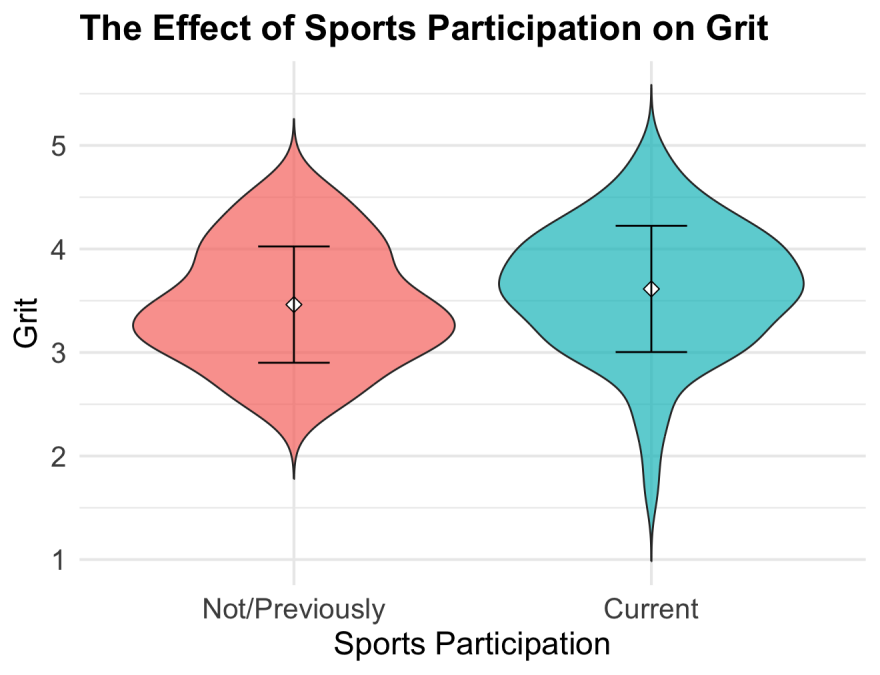
First, linear regression was used to predict grit scores of participants who reported being currently involved in sports and non-participants (including past participants and people who never participated). As illustrated in Figure 1, individuals currently participating in sports report slightly higher mean grit scores compared to non-participants. However, this difference does not reach statistical significance (β= 0.15, t = 1.44, p = 0.15), accounting for only 1.6% of the variance in grit. This suggests that, within the sample collected, current engagement in sports does not reliably predict higher levels of grit, but it shows the presence a positive relationship between sports participation and the level of grit.
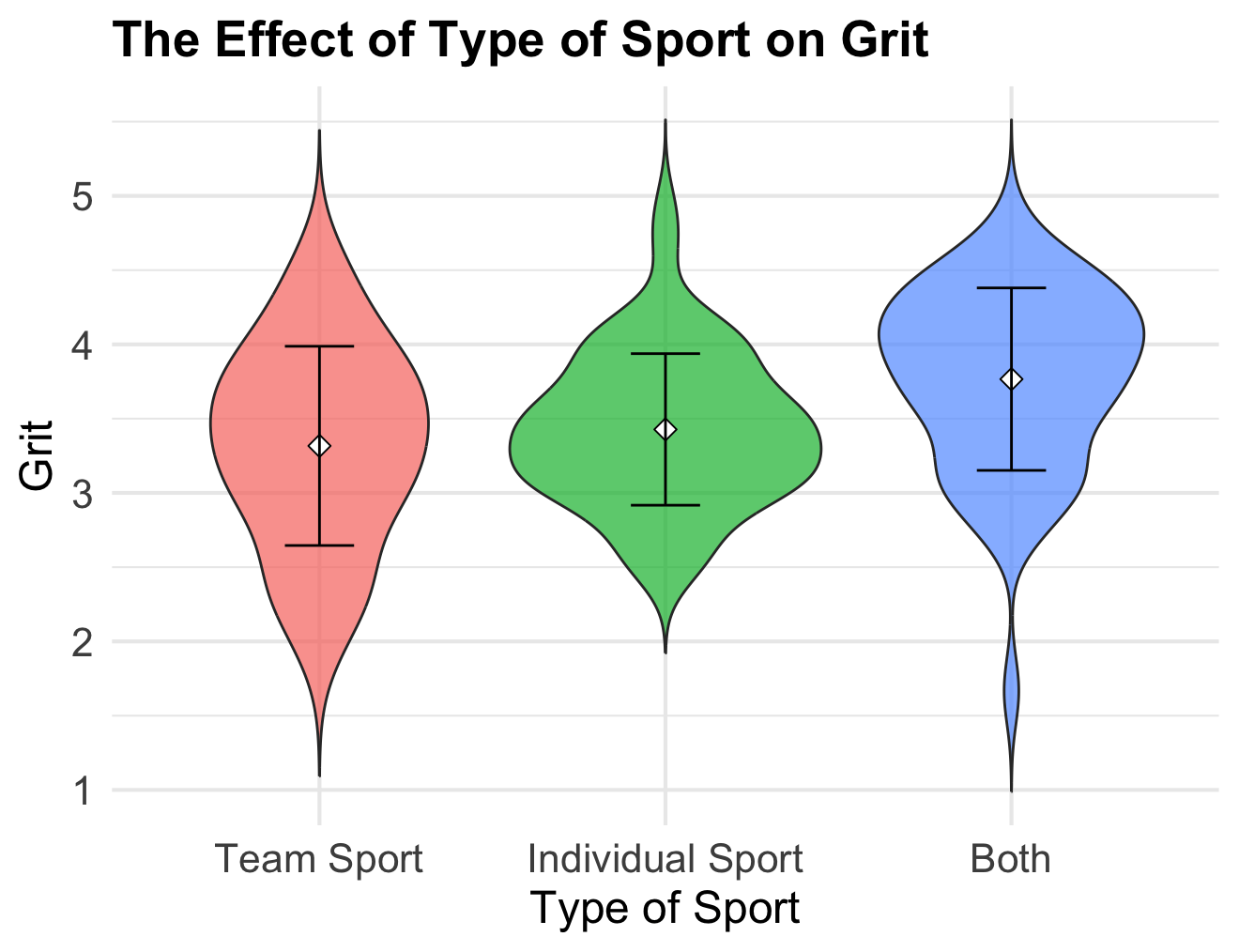
Next, grit scores from the individual vs. team sports variable were analyzed. The initial hypothesis was that individuals who participate in individual sports would report higher grit scores than those who participate exclusively in team sports. Furthermore, it was predicted that those involved in both types of sports would demonstrate the highest grit scores, as participation in both types of sports likely reflects greater duration and intensity of physical activity.
Figure 2 depicts violin plots of grit scores across three groups: team sports, individual sports, and those participating in both. Linear regression analysis revealed a significant effect of sport type on grit scores (F (2, 117) = 6.10, p = 0.003), and sport type accounts for approximately 9.4% of the variance in grit. When using the “both” group as the reference category, comparisons indicate that individuals participating in both types of sports exhibits significantly higher grit scores than those participating exclusively in team sports (β = -0.45, p = 0.004) and those participating exclusively in individual sports (β = -0.34, p = 0.004).
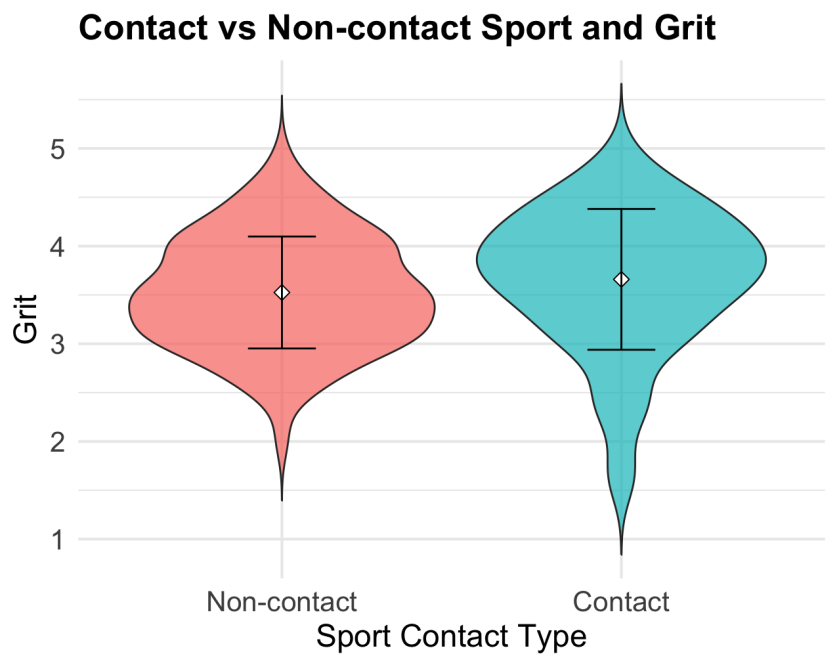
Finally, whether the contact nature of the sport was associated with grit was analyzed. Individuals participating in contact sports were expected to report higher grit scores than those involved in non-contact sports. However, as shown in Figure 3, the distribution of grit scores is similar between these groups. Regression analyses revealed no statistically significant difference (β = 0.13, t = 1.00, p = 0.319), accounting for merely 0.9% of the variance.
Discussion
Duckworth et al.21 defined grit as perseverance and passion for long-term goals, highlighting how it can affect the achievement in both academic and professional contexts. Later work by Duckworth and Gross11 emphasized that grit helps to develop self-control to predict sustained success, while Dweck15 noted that a growth mindset helps individuals persist in the face of obstacles. These findings together suggest that grit contributes to both educational and psychological development.
Sports participation may provide a unique environment for cultivation of grit. According to self-determination theory27,28, activities that fulfill individuals’ needs for autonomy, competence, and relatedness foster intrinsic motivation and persistence. When doing sports, athletes frequently encountered challenges that require persistence, discipline, and resilience, making sports a practical context for observing how grit manifests in action29. Other studies have shown that participation in physical activity is associated with higher resilience16 and self-efficacy17, and that active individuals often exhibit greater perseverance and motivation than their less active peers6. Moreover, evidences also suggest that athletic engagement enhances psychological well-being and mental toughness—traits conceptually linked to grit30,31.
Building upon these foundations, this study examined the relationship between sports participation and grit. Previous studies have found that physical activity is associated with grit21, and people with a background in exercising show significant higher grit score (p = 0.002)32. Participants who are currently involved in sports report higher grit scores than those who have never participated or only did so in the past, although this difference is not statistically significant. This may be caused by overall small sample size, with only 133 people answering the questionnaire, as it may overestimate or underestimate the effects of non-predominant factors. These findings are in line with past researches connecting physical activity to persistence6, self-discipline16, and resilience33.
The relationship between sports and grit is also examined, in particular, team vs. individual sports and contact vs. non-contact sports. Among the various sport types, individuals who participate in both team and individual sports give the highest grit levels, followed by those in individual sports, while those in team sports report the lowest grit scores. The difference between participants involved in both types and the other two groups is statistically significant, whereas the difference between team and individual sports alone is not significant. This might be caused by the unequal sample size, as there are only 20 samples for team sports and 51 samples for individual sports. This finding may reflect the benefits of engaging in varied training methods, challenges, and forms of discipline across different types of sports. Furthermore, the higher grit levels among individual sport participants compared to team sports athletes may suggest that personal accountability and self-directed motivation may play an important role in fostering long-term perseverance. This difference can also be explained by achievement goal theory34. Individual sports often have a mastery-oriented atmosphere, where success is defined by personal improvement rather than social cooperation, encouraging sustained efforts and resilience. In contrast, team sports may emphasize performance goals or external validation, which could limit intrinsic persistence when outcomes depend on collective performance.
In contrast, no significant difference in grit is observed between participants in contact and non-contact sports. One of the reasons may be the large difference between sample sizes, since this study contains 82 non-contact sports sample, but only 28 contact sports sample. Another reason may be that both types of sports require similar levels of commitment, discipline, and perseverance in training and competition. While contact sports involve more physical confrontation, non-contact sports may also demand skill development and mental toughness. Another possibility is that participation in competitive events rather than the type of the sport is the predominant factor governing the development of grit level. Without the pressures and goals associated with competition, even physically intense contact sports may not significantly contribute to the development of grit.
There are several methodological strengths that support the credibility of these results. The study uses a 31-question grit scale with clear Likert-scale responses that allows for reliable measurement. Attention check questions help clear out careless responses, improving data quality. In addition, the analyses include multiple sport categories and are controlled for demographic variables, increasing the internal validity of the findings. These features increase the confidence that the observed patterns are not artifacts of measurement error or inattentive responding.
Nonetheless, some limitations should be acknowledged. First, the sample size is modest (N = 133), which may have reduced statistical power, especially for detecting subtle effects. Second, although the survey specified that qualifying sports training should involve at least two sessions per week, some participants may have misunderstood this and reported other forms of physical activity that do not meet the criteria, such as throwing basketball toward the hoop without running after dinner. This could lead to biased estimates. In addition, the binary classification of contact vs. non-contact sports may not fully capture the nuances in training contexts, competitive environments, or mental demands across different sports. Additionally, because all participants were from China, the homogeneity of the sample limits the cultural generalizability of the findings. Cross-cultural evidence shows that the grit scale demonstrates only partial measurement invariance between Chinese and U.S. samples, showing that the definition and expression of grit may vary between different culture backgrounds35. Finally, while sports participation is associated with higher grit, the underlying nature remains unclear, as both the experiences provided by sports and individual differences in grit may contribute to continued engagement. Future research should utilize experiments to understand whether sports participation causes increased grit.
In summary, this study contributes to growing evidence that sports might help in the development of grit, particularly when athletes engage in diverse types of sports. These results suggest that combining the cooperativity of team sports with the personal discipline of individual sports may provide the most useful method for building perseverance and long-term motivation. Future studies could focus on sports participation more precisely by considering factors such as training intensity, competitiveness, and duration. These aspects may help capture meaningful information about how grit level varies across different kinds of sports.
References
- A. L. Duckworth, C. Peterson, M. D. Matthews, D. R. Kelly, Journal of Personality and Social Psychology, 92(6), 1087–1101 (2007). [↩]
- A. L. Duckworth, C. Peterson, M. D. Matthews, D. R. Kelly, Journal of Personality and Social Psychology, 92(6), 1087–1101 (2007). [↩] [↩]
- L. Eskreis-Winkler, E. P. Shulman, S. A. Beal, A. L. Duckworth, Journal of Research in Personality, 59, 36–42 (2014). [↩]
- M. Credé, M. C. Tynan, P. D. Harms, Journal of Personality and Social Psychology, 113(3), 492–511 (2017). [↩]
- L. Eskreis-Winkler, E. P. Shulman, S. A. Beal, A. L. Duckworth, Journal of Research in Personality, 59, 36–42 (2014). [↩]
- E. R. Dunston, E. S. Messina, A. J. Coelho, S. N. Chriest, M. P. Waldrip, A. Vahk, K. Taylor. Physical activity is associated with grit and resilience in college students: is intensity the key to success? Journal of American College Health, 70(1), 216–222 (2022). [↩] [↩] [↩] [↩] [↩] [↩]
- A. L. Duckworth, J. J. Gross. Self-control and grit: related but separable determinants of success. Current Directions in Psychological Science, 23(5), 319–325 (2014). [↩]
- A. L. Duckworth, J. J. Gross. Self-control and grit: related but separable determinants of success. Current Directions in Psychological Science, 23(5), 319–325 (2014). [↩]
- A. R. Nicholls, R. C. J. Polman, A. R. Levy, S. H. Backhouse. Mental toughness, optimism, pessimism, and coping among athletes. Personality and Individual Differences, 44(5), 1182–1192 (2008). [↩]
- A. J. Martin, H. W. Marsh. Academic resilience and its psychological and educational correlates: a construct validity approach. Psychology in the Schools, 43(3), 267–281 (2006). [↩] [↩]
- A. L. Duckworth, J. J. Gross. Self-control and grit: related but separable determinants of success. Current Directions in Psychological Science, 23(5), 319–325 (2014). [↩] [↩]
- C. S. Dweck. Mindset: The new psychology of success. Random House (2006). [↩]
- E. L. Usher, F. Pajares. Sources of self-efficacy in school: critical review of the literature and future directions. Review of Educational Research, 78(4), 751–796 (2008). [↩] [↩]
- A. L. Duckworth, J. L. Taxer, L. Eskreis-Winkler, B. M. Galla, J. J. Gross. Self-control and academic achievement. Annual Review of Psychology, 70, 373–399 (2019). [↩]
- C. S. Dweck. Mindset: The new psychology of success. Random House (2006). [↩] [↩]
- B. Peng, X. Liu, Y. Zhang, R. Chen. How does physical exercise influence self-efficacy in adolescents? Mediating role of psychological resilience. BMC Psychology, 13, Article 252 (2025). [↩] [↩] [↩] [↩] [↩] [↩] [↩]
- C. Jiang, K. Wang, H. Qin. Physical exercise and children’s resilience: mediating roles of self-efficacy and emotional intelligence. Frontiers in Psychology, 16, 1491262 (2025). [↩] [↩] [↩] [↩] [↩] [↩]
- S. Liu. Grit related to sports. OSF Preprints (2025). [↩]
- R. Core Team. R: A language and environment for statistical computing (Version 4.5.1) [Software]. R Foundation for Statistical Computing (2000). [↩] [↩]
- A. L. Duckworth. Grit: The power of passion and perseverance. Scribner (2016). [↩] [↩]
- A. L. Duckworth, C. Peterson, M. D. Matthews, D. R. Kelly. Grit: perseverance and passion for long-term goals. Journal of Personality and Social Psychology 92, 1087–1101 (2007). [↩] [↩] [↩]
- A. L. Duckworth, P. D. Quinn. Development and validation of the Short Grit Scale (Grit-S). Journal of Personality Assessment, 91(2), 166–174 (2009). [↩]
- J. R. Pharr, N. L. Lough, M. A. Terencio. Health and sociodemographic differences between individual and team sport participants. Sports, 7(6), 150 (2019). [↩]
- Gillette Children’s Specialty Healthcare. Contact Classifications of Sports and Activities. (n.d.). Retrieved from [↩]
- D. R. Howell, M. W. Kirkwood, S. Laker, J. C. Wilson. Collision and contact sport participation and quality of life among adolescent athletes. Journal of Athletic Training, 55(11), 1174–1180 (2020). [↩]
- R. C. Fair, C. Champa. Estimated Costs of Contact in Men’s Collegiate Sports(2017). SSRN Electronic Journal. [↩]
- E. L. Deci, R. M. Ryan. The “what” and “why” of goal pursuits: Human needs and the self-determination of behavior. Psychological Inquiry, 11, 227–268 (2000). [↩]
- R. M. Ryan, E. L. Deci. Self-determination theory: Basic psychological needs in motivation, development, and wellness. Guilford Press (2017). Available at [↩]
- Á. MacNamara, A. Button, D. Collins. The role of psychological characteristics in facilitating the pathway to elite performance. Part 1: Identifying mental skills and behaviors. The Sport Psychologist, 24(1), 52–73 (2010). [↩]
- D. F. Gucciardi, S. Hanton, S. Gordon, C. J. Mallett, P. Temby. The concept of mental toughness: Tests of dimensionality, nomological network, and traits. Journal of Personality, 83(1), 26–44 (2015). [↩]
- M. Crane, V. Temple. A systematic review of dropout from organized sport among children and youth. European Physical Education Review, 21(1), 114–131 (2015). [↩]
- D. C. Foote, S. M. Baker, K. C. Davis, T. R. Cullinan, A. K. Nelson, L. E. Ketelboeter, K. M. O’Heron. From athlete to surgeon: examining sports and grit among general surgery residents. Journal of Surgical Education, 81(10), 1374–1382 (2024). [↩]
- C. Jiang, K. Wang, and H. Qin, Frontiers in Psychology, 16, 1491262 (2025). [↩]
- J. G. Nicholls. Achievement motivation: Conceptions of ability, subjective experience, task choice, and performance. Psychological Review, 91, 328–346 (1984). [↩]
- M. Li, W. Fan, F. T. L. Leong. Psychometric assessment of the Grit Scale: Evidence from US and Chinese samples. Journal of Pacific Rim Psychology, 17, 18344909221147108 (2023). [↩]