
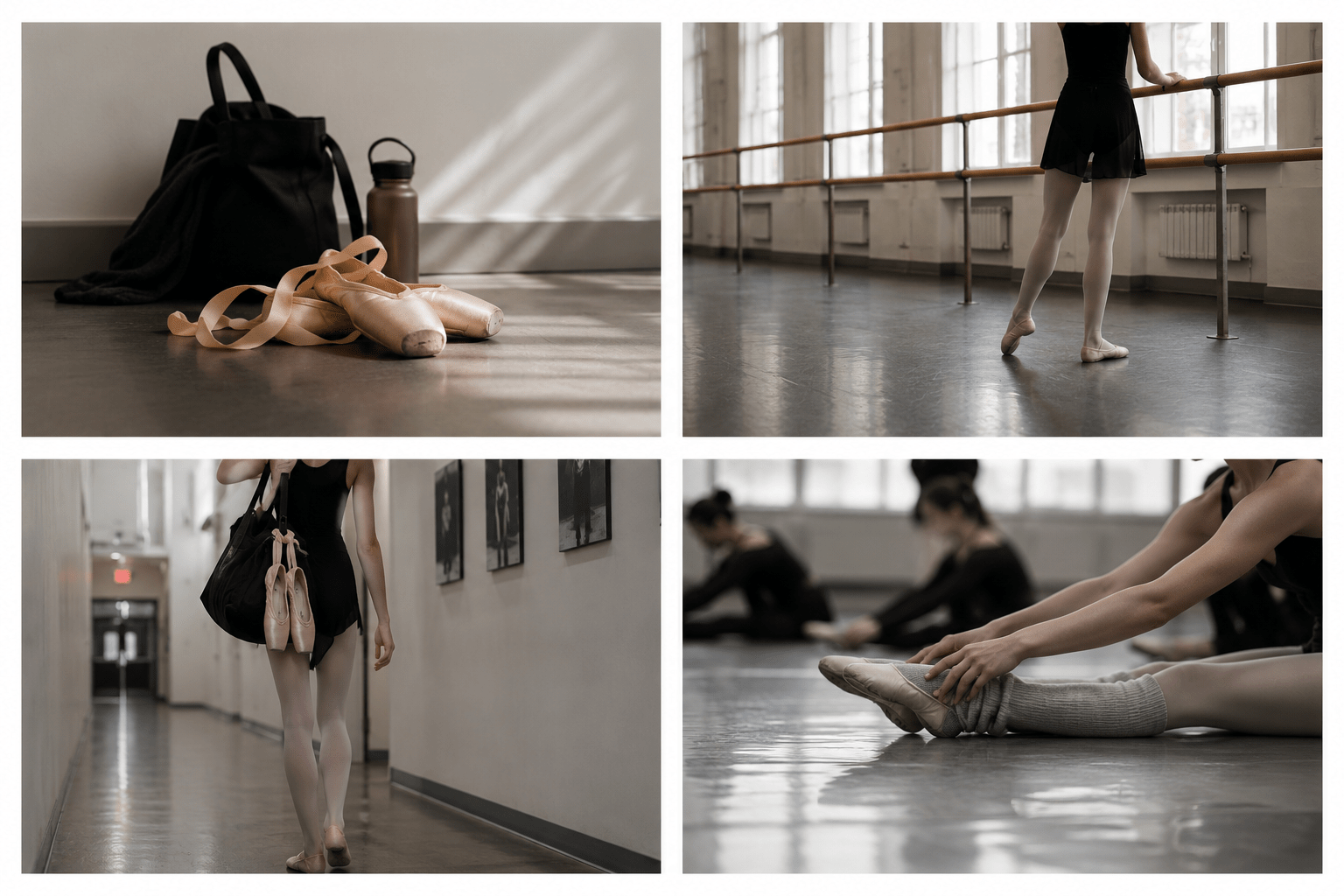
Abstract
This paper examines how pre-professional ballet students in the United States understand ballet as both work and play, and how these intertwined dynamics shape their decisions to pursue or forgo a professional career. This study employs ethnographic methods including 4 semi-structured interviews (three with pre-professional ballet dancers aged 12-17 and one with the executive director of the pre-professional training program) and focused ethnographic observation conducted during a two-week pas de deux summer intensive and the first four weeks of a fall semester at a pre-professional ballet academy. Thematic analysis of interview transcripts and fieldnotes reveal three principal findings. First, dancers reframe the disciplined, repetitive labor of daily conditioning, technique classes, and rehearsals as a source of personal fulfillment and self-improvement rather than obligation. Second, camaraderie, performance, and the embodied sensation of movement function as forms of play that sustain motivation through the significant physical and mental demands of training. Third, the decision to pursue or forgo a professional career is shaped by a reconfiguration of the work-play balance: dancers who pursue professional paths do so when structural conditions (financial support, self-assessed competence) allow rigorous work to remain infused with play, while dancers who choose higher education do so when structural constraints (financial precarity, injury history, academic interests) threaten to transform play into unsustainable labor. These findings suggest that for pre-professional ballet students in the sample, work and play are not opposing forces but mutually constitutive experiences that inform self-understanding and consequential career decisions.
Keywords: Social and Behavioral Sciences; Cultural Anthropology; Anthropology of Dance; Anthropology of Work and Play; Pre-professional Ballet
Introduction
Formalized during the seventeenth century in the French court and subsequently codified through distinct pedagogical systems–including the Vaganova, Cecchetti, Royal Academy of Dance, and Balanchine methods–ballet training today requires young dancers to commit to intensive, multi-year programs that structure their daily lives around repetitive physical practice, aesthetic refinement, and competitive evaluation1,2. Central to this training is the danse d’école, the standardized lexicon of classroom steps and positions that dancers practice from a young age3. In the contemporary United States, aspiring professional dancers typically begin training in early childhood, progressing toward the formal demands of the danse d’école through increasingly demanding curricula. By late adolescence, these dancers face a pivotal decision: whether to pursue a professional ballet career or transition to higher education4,5. This decision is shaped by a complex interplay of factors including financial resources, physical capacity, self-assessed competence, and the dancer’s subjective experience of ballet as a form of labor, leisure, or both.
It is important to note at the outset that this study centers the experiences of female pre-professional ballet dancers. Women constitute approximately 70% of the professional ballet workforce6 and face greater competition for company contracts than their male counterparts. However, the decision to center female dancers reflects more than demographic prevalence. Gender operates as a social structure that shapes the experience of ballet training in fundamental ways: femininity intensifies perfectionist body ideals, as Aalten observed, “the lines of the female dancer have to be longer and her weightlessness has to be more convincing”7; and the structural overrepresentation of women creates heightened competition for limited positions that reconfigures the experience of daily training as precarious labor6. While the experiences of male dancers warrant further investigation, this study focuses on female dancers because the majority of students at the ethnographic site were female, and for the reasons outlined above, female dancers may face experiences and mindsets in ballet–particularly around body ideals and competition–that their male counterparts do not.
Previous scholars in anthropology have explored topics relevant to this enquiry spanning the issues of labor, dance, ballet, and play. As early as the 1930s, Katherine Dunham pioneered the “research-to-performance” method, in which she transformed Caribbean fieldwork into staged ballets that merged anthropology and dance, preserving and reinterpreting African diasporic cultural memory8. Her choreography was both a performed ethnography and a form of intercultural communication, honoring Afro-Caribbean expressive arts and sharing a deeper understanding of the Black Atlantic with a broader audience8. The anthropology of dance later solidified its emergence as a distinct field in the 1970s United States, shaped by scholars trained in both dance and anthropology who developed movement-specific anthropological methods. Foundational works, such as Roderyk Lange’s The Nature of Dance (1975) and Franziska Boas’s The Function of Dance in Society (1972), marked the field’s growing recognition and academic legitimacy9. More recently, ethnographic studies of ballet have examined the art form through the lens of identity and bodily capital. Wulff’s multi-sited ethnography of both major and minor professional ballet companies revealed how dancers’ careers are shaped by institutional cultures behind the curtain2. Pickard and Bailey depicted the “crystallizing experiences” through which young elite dancers form career aspirations, showing that formative moments in training shape whether dancers envision futures oriented toward professional dance4. Pickard traced how young dancers construct “ballet body narratives” that reflect the internalization of aesthetic ideals related to what dancers constitute as “good” and “bad” pain10.
The anthropology of labor has much deeper roots with nineteenth-century ethnologists including Lewis Henry Morgan and Herbert Spencer classifying societies along evolutionary scales that were often used to justify European superiority11. Contemporary anthropologists have moved beyond these frameworks to understand labor as the culturally and historically situated ways in which people produce, exchange, and sustain life11. Within the performing arts, scholarship on creative labor has demonstrated that artistic work occupies an ambiguous position between vocation and exploitation. Hesmondhalgh and Baker showed that creative workers frequently experience their labor as simultaneously fulfilling and precarious, a tension McRobbie further elaborated by arguing that the discourse of “passion” in creative industries obscures structural inequalities and self-exploitation12,13. Standing’s concept of the “precariat”, a class defined by insecure and flexible labor, resonates with the circumstances of pre-professional ballet dancers who invest years of intensive training with no guarantee of employment14. Horowitz substantiated this connection in her sociological study of 87 corps de ballet dancers, coining the term “ballet discipline” to describe the strict adherence to standards of physical appearance, deference to tradition, and total devotion to the art form—at substantial financial, social, and emotional cost15.
The anthropology of play offers a counterpoint to labor. In Homo Ludens, Huizinga argued that play is not a byproduct of culture but its generative origin, contending that foundational cultural forms developed as play, through voluntary activities set apart from ordinary life and characterized by their own internal order, tension, and joy16. Caillois built on Huizinga’s framework by classifying play along a spectrum from free, spontaneous, and unstructured play (paidia) to play that is disciplined, rule-governed, and demanding of skill (ludus)17. Sutton-Smith argued that play is inherently ambiguous, identifying seven rhetorics through which societies make sense of play—among them progress, power, and identity18. French anthropologist Roberte Hamayon has shifted the emphasis from play’s social functions to its experiential logic, advancing the theory of the “fictional frame” to describe how play creates a bounded space in which individuals can live a form of fantasy or fiction while remaining rooted in empirical reality19.
A critical gap emerges at the intersection of these subfields. Dance ethnography has documented the embodied discipline of ballet training; labor scholarship has theorized the precarious and passionate nature of creative work; play scholarship has articulated play as a cultural force that ranges from spontaneous expression to disciplined skill. Yet no existing study has ethnographically examined how these dimensions coexist in the daily experiences of pre-professional ballet students who are not yet professional laborers but whose training is structured as productive work where the boundary between disciplined labor and embodied play is not merely theoretical but shapes consequential life decisions. Stinson examined adolescent engagement in dance education, finding that the most deeply engaged students experienced dance not as either work or play but as a fused experience in which challenge, concentration, and self-expression become indistinguishable from one another20. However, her analysis was situated in recreational middle school dance classes rather than pre-professional training environments, where the stakes of this work-play fusion carry material consequences for career decisions. Research on perseverance in professional ballet careers21 and on the precarious labor of working dancers15 has examined how professional dancers sustain their careers through adversity, but without examining the pre-professional period when the decision to pursue such a career is still being formed. Pickard and Bailey examined the most directly relevant dimension of this gap, identifying ‘crystallizing experiences’ for young elite dancers but without examining how the interplay of labor and play within those experiences informs the decision itself4. This study addresses these gaps by ethnographically examining the lived experiences of pre-professional ballet students at a critical juncture in their training, documenting how labor and play operate not as opposing categories but as intertwined dimensions of daily practice that shape consequential career decisions.
This study is guided by two research questions: (1) How do pre-professional ballet students in the United States understand and navigate ballet as simultaneously a form of labor and a form of play? (2) How do these intertwined understandings of work and play shape their decision-making regarding whether to pursue a professional ballet career or transition to higher education? To address these questions, the analysis focuses on three domains: the embodied discipline of daily training practices (conditioning, technique class, rehearsal); the social and affective dimensions of camaraderie and performance; and the structural factors (financial resources, physical capacity, academic interests) that reconfigure the work-play balance as dancers approach the point of career decision-making.
Methods
This study draws on ethnographic methods to examine the experiences of pre-professional ballet students. Data collection comprised three components: semi-structured interviews, focused ethnographic observation, and reflexive fieldnotes supplemented by the researcher’s positionality as a pre-professional dancer. This research was conducted under the advisement of Postdoctoral Researcher Natalie Egan. Written informed consent was obtained from parents of all minor participants, and approval was granted by the ballet academy. To protect participant privacy, all names and identifying details have been anonymized throughout this manuscript.
The study focused on dancers in the most advanced level at the pre-professional ballet academy, comprising students aged 12-17. All dancers at this level were observed during regular training activities, three dancers (all female) were invited to participate in semi-structured interviews, along with one executive director of the training program. The age range of 12-17 corresponds to the developmental period during which pre-professional ballet students navigate formative “crystallizing experiences” that shape career aspirations and the pivotal decision of whether to pursue a professional career or transition to higher education4. This is a small, qualitative sample that offers in-depth insight into the experiences of a specific group of pre-professional ballet students; however, while training curricula are broadly standardized across pre-professional ballet institutions, the social and institutional dynamics documented here may vary across contexts.
Four semi-structured interviews were conducted: three interviews with pre-professional ballet dancers and one interview with the executive director. All interviews were conducted in person and in English at the academy and lasted approximately 15-30 minutes. The interview guide included open-ended questions addressing participants’ daily training routines, their subjective understanding of ballet as work and/or play, and (for the student participants) their thoughts on future career plans. Follow-up probes were used to elicit elaboration on emergent themes. Additional participant perspectives were gathered through informal conversations during training and recorded in the researcher’s fieldnotes. Focused ethnographic observations were conducted at two sites: (1) a two-week pas de deux summer intensive, during which the researcher participated as a dancer alongside the students; and (2) the first four weeks of the fall semester at the pre-professional ballet academy, during which the researcher observed and participated in daily technique classes, conditioning sessions, and rehearsals. Pas de deux, translated from French as “step of two”, involves a partnership between a male and female dancer that incorporates movements only possible through partnering, distinguishing it from a solo variation or corps de ballet work. During observations, the researcher attended to daily routines, social interactions, verbal and non-verbal communication among students, teacher-student dynamics, and the physical environment of the studio. Detailed fieldnotes were written within 24 hours of each observation session.
The researcher’s background as a pre-professional ballet dancer is a significant dimension of this study’s design. This positionality facilitated access to the research site, rapport with the participants, and an embodied understanding of ballet’s movement vocabulary and social norms. However, insider status carries methodological risks well documented in qualitative research: the tendency to assume shared understanding rather than probing for participant meaning, to project one’s own experiences onto others’ accounts, and to normalize practices that warrant analytical scrutiny22. To mitigate these risks, the researcher maintained a reflexive journal throughout the data collection period, documenting moments where personal experience may have shaped interpretation. In the analysis, personal reflections were treated as a secondary source used to contextualize, rather than substitute for, participant-generated data.
Analysis
Interview recordings were transcribed verbatim by the researcher. Transcripts and fieldnotes were analyzed using thematic analysis following the six-phase framework outlined by Braun and Clarke23. An inductive approach was adopted: initial open coding was conducted to identify emergent patterns across the data, which were then organized into preliminary themes. These themes were iteratively refined through repeated comparison across transcripts and fieldnotes, resulting in the thematic categories presented in the Results and Discussion section: “Work” (encompassing conditioning, technique class, and mental demands), “Play” (encompassing camaraderie, performance, and intrinsic joy), and “The Point of Decision Making” (encompassing the structural and subjective factors shaping career choices). Fieldnotes from participant observation were coded alongside interview data to triangulate findings. Where relevant, the researcher’s reflexive journal was consulted to examine how positionality may have influenced coding decisions, but personal experiences were not coded as primary data.
Results and Discussion
Work
Conditioning and Preparation Outside of Class
Although the daily technique and pointe classes are the most identifiable sites of labor in pre-professional training, much of the work begins prior to entering the studio. Dancers consistently arrived 30 to 60 minutes before class to engage in individual stretching and conditioning routines. The studio environment was characterized by the overlapping melodies of classical scores, the chatter of students, and an atmosphere that felt at once homely and intensely serious. Dancers sat among the white lockers lining the enclave in the center of the academy, pulling on canvas ballet flats and tying the satin ribbons of their pointe shoes. On the floor, students stretched alongside bags of stretching and conditioning tools, some listening to music, others chatting with their friends. The conditioning routines I observed followed a broadly consistent pattern: stretches to open the hips, progressing into left, right, and middle splits (often with resistance bands), followed by quadriceps and foot stretches, theraband exercises for the toes and feet, abdominal training, and body-weight bearing turnout exercises. What was notable during observation was the level of self-awareness and anticipation these young dancers possessed prior to stepping into the classroom. Within dance therapy literature, bodily awareness is understood as a primary pathway through which individuals develop self-knowledge and regulation24. The intrinsic self-awareness derived from the nature of ballet itself is exacerbated by the immediate candid feedback dancers receive from a young age. This embodied awareness resonates with Bourdieu’s concept of habitus, which suggests that repeated physical practice becomes internalized as a set of dispositions that feel natural rather than imposed, a dynamic clearly observable in these dancers’ conditioning routines25.
Students’ own accounts reflected this internalized discipline. One student stated, “I warm up so I don’t get injured,” a perspective echoed by a peer who explained, “I warm up before class because it helps prevent injury and fosters healthy muscles and fascia”. This preparation extends beyond injury prevention; dancers tailored their warm-ups to address individual areas of weakness. I observed, for instance, a dancer preparing for a variation with many extensions working on oversplits, while another focused on core exercises to improve balance. As one dancer summarized, “It doesn’t really bother me, it’s only 10 minutes out of my day… I like to warm up,” and another noted, “I feel better when I’m dancing [if I warm up] because when I don’t warm up I’m all over the place.” These responses suggest that conditioning, while clearly a form of labor, has become what Foucault might describe as a disciplinary practice so thoroughly internalized that it is no longer experienced as coercion—illustrating how disciplinary power operates most effectively when individuals perceive it as self-directed26.
Technique Class
Following stretching and conditioning, dancers entered the studio for technique class. Floor-to-ceiling mirrors across the front and sides of the room reflected the wooden barres lining the white walls. As more students filtered in, many brought out portable barres to be placed perpendicular to the mirrors. When the teacher entered the studio, dancers gradually stopped stretching, ready to give their full attention to the upcoming technique class. The barre section of class followed a relatively predictable progression of steps usually consisting of plies, tendus, jetes, rond de jambe, fondu, frappe, adagio, and grand battement. The way in which these exercises are incorporated into the barre follows the teacher’s discretion, thus resulting in combinations that may include an amalgamation of two types of steps, the inclusion of two sequences of the same step, or a supplementary combination targeting an infrequent step. This section of class generally lasted around an hour before proceeding into center work which includes combinations of adagio, tendus, pirouettes, petite allegro, and grand allegro. Throughout, fundamental elements of traditional ballet training, namely proper body alignment, port de bras, turnout development, and balance are nurtured in accordance with classical conventions.
In an interview, the Executive contextualized this daily routine within the broader training trajectory:
Most of our dancers start taking ballet classes between ages four and seven or eight. It’s a bit of a progression, so when students start, they take a discrete number of hours and as they get older and they advance, the rigors of the program become more and more. Our advanced students train on average 20 hours a week, many of them doing extra time for private coaching.
The repetitive structure of technique class is pedagogically essential: ballet consists of a set repertoire of steps, each impossible to perfect, that are essential for developing and sustaining strength and technical proficiency. As Murray argues, the repetition carries significance beyond physical training, transmitting a collective cultural memory from generation to generation, with each repetition simultaneously preserving a tradition and allowing for reinvention27. This dynamic helps explain why dancers in this study experienced the discipline of daily class not as mere labor but as a practice imbued with meaning. As one interviewee observed, “There are aspects of the ballet class that are the same from when you’re seven to 17.” Ballet historian Jennifer Homans epitomized this disciplined structure, reflecting that for dancers, standing “at the barre every morning, in these positions which have been prescribed for over four hundred years” constitutes “a ritual of repetition… a ritual of physical discipline”27.
This repetitive nature fosters self-criticism, a process exacerbated by ballet’s conventions. Dancers wear leotards and tights while surrounded by mirrors and teachers who provide corrections publicly. Instructors externally guide correction, with detailed verbal cues and physical demonstration to shape movement execution in accordance with established technical and aesthetic norms3. Between combinations, I consistently observed the majority of dancers on the sidelines or at the barre working on areas they felt needed improvement, often observing their movements in the mirror. In this way, the self-awareness cultivated through early preparatory practices is formally reinforced within the structure of technique class itself. Repetition, surveillance, and the pursuit of unattainable perfection compel dancers to continually monitor and evaluate their own strengths and limitations. One student articulated this dynamic:
The movements are super difficult and it puts a lot on your body and it also takes a lot of discipline to maintain any progress you’ve made, so a large part of the work aspect is just putting in the effort to consistently show up and consistently work hard even when in the moment you really don’t want to.
These understandings of technique class as labor raise a central question: how do the personalities and environment of pre-professional training shape dancers’ perception of ballet as work? The high levels of motivation among the students were evident throughout fieldwork. Unlike a recreational studio, students in the pre-professional program have chosen to train at a high level, already making them highly motivated. This drive is consistent with patterns documented in existing research, as Nordin-Bates, Cumming, Aways, and Sharp found that 84.94% of the elite ballet students in their sample experienced moderate or extreme perfectionistic tendencies28. While the present study does not measure perfectionism quantitatively, the Executive Director acknowledged a similar temperament among the students, observing, “generally people who are attracted to ballet are perfectionists and are people who are very disciplined.” As a result, the dancers have the advantage of being surrounded by individuals just as accomplished and focused, creating a cycle in which students continually reinforce one another’s motivation. What outsiders might perceive as demanding workload–hours or repetition, correction, and physical strain–is reframed by the students. For them, discipline becomes a form of play, and play becomes inseparable from disciplined work. One student with professional aspirations stated, “I see ballet as work because it allows me to have discipline in my daily life and work solely on myself and rely on myself for my progress.” Another reflected, “When you finally master a really difficult step, the hard work feels worth it.” This finding resonates with Hesmondhalgh and Baker’s observation that creative workers frequently experience labor as simultaneously demanding and fulfilling, and with Stinson’s finding that disciplined engagement and enjoyment are not mutually exclusive in dance education12,29.
Mental Work
Beyond physical labor, pre-professional ballet training demands significant mental discipline. In technique and pointe classes, students must rapidly memorize new combinations and immediately execute quality dancing, a skill requiring the ability to internalize lengthy movement sequences while simultaneously coordinating musicality. Each time the teacher demonstrated a combination, students would “mark” the movements—mentally and physically rehearsing sequences at a simplified level to memorize the combination. This mental exercise extends to rehearsals, where students must navigate artistry and collaboration on a larger scale. In an interview, the Executive Director emphasized that “it’s not like dancers have the luxury of going very slow and going over things five and six times. You guys are expected to pick up things really quickly and not just things, but so much in terms of the detail, not just the step and the musicality, but the arms, the head, corrections, etc.” This mental demand intensifies during performances, where dancers navigate an unfamiliar environment and the adrenaline of the stage while simultaneously retaining hours of precise choreography.
The intensity of ballet culture also creates conditions that can challenge dancers’ mental well-being. Research has documented that the prevalence of eating disorders in ballet is 16.4%, compared to approximately 9% in the general US population that will have an eating disorder in their lifetime30. Clinical research has characterized anorexia nervosa and bulimia nervosa as associated with perfectionism and related personality traits31. Within this sample, the perfectionistic tendencies documented by Nordin-Bates et al. appeared to function as a double-edged sword: the same discipline that drove progress also created rigid standards resistant to change or adaptation28. Dancers described how this constant pressure from multiple sources could diminish their enjoyment of dance, as the pursuit of perfection began to overshadow fulfillment. It is important to note that the present study does not diagnose participants; rather, it draws on published prevalence data to contextualize the environment in which pre-professional dancers train. Within this sample, students described experiences consistent with the pressures documented in the clinical literature. Although the academy maintains a no-tolerance policy towards body shaming, dancers reported that the pressure to maintain a particular physique was reinforced through social media and experiences at other training programs. One dancer described her experience of balancing fulfillment with mental health pressure:
I consider ballet to be work sustained by fulfillment. The joy of performing is upheld by at times mundane and tiresome exertion; memorizing combinations, getting home after dark, balancing schoolwork, etc. It definitely takes a toll on my mental health. But I find that my love for being in the studio and the sensation of dancing makes it worthwhile, especially amongst friends.
This account illustrates how, within this sample, the demands of pre-professional training extend beyond the physical to encompass significant psychological pressures. The mental discipline required to navigate these demands (maintaining focus, managing self-criticism, and sustaining motivation) constitutes an important dimension of the labor that pre-professional ballet dancers perform daily. Horowitz documented this inseparability among professional corps de ballet dancers, finding that the physical and psychological demands of “ballet discipline” exact substantial social and emotional costs, a pattern already visible at the pre-professional level15.
Play
Camaraderie
For all its discipline, ballet is not exclusively experienced as labor. Because collaboration is a fundamental part of ballet and the shared hours in the studio, bonds form quickly. This camaraderie—visible in the laughter echoing through the locker room during water breaks and in the quiet exchanges on the sidelines of center work—constitutes a significant dimension of how students understand ballet as a form of leisure: engaging in friendship becomes a kind of play that sustains dancers through work. On the first day of the summer intensive program, many of the academy students were reuniting after attending training programs across the United States and abroad. The affection among dancers was palpable, as each arrival was greeted with embraces and animated conversation. Alumni who had graduated years before and former students who had moved abroad returned to take class, generating an energizing atmosphere. This fondness did not diminish as dancers entered the fall semester and returned to the routine of seeing each other daily. Before each class, dancers enrolled in in-person school shared updates on their social lives, while others discussed their most recent rehearsals for the studio’s production of The Nutcracker. Even during focused center work, students would break into applause when their friends performed steps particularly well.
In Huizinga’s terms, these peer relationships constitute a “play-community”—a social formation that arises through shared ludic activity and sustains participants through its demands16. Camaraderie is not only a motivator through work but also a value that dancers recognize as deeply intertwined with it. The shared experience of growing up together in a pre-professional ballet academy and spending hours rehearsing ensemble pieces enhances the quality of the final performance. The Director shared a similar observation gathered through her years of overseeing performances, stating, “you have to work together with other people, obviously, if not, then it’s not a good group piece.” When observing couples in the pas de deux intensive working together on repertoire from Don Quixote and Tchaikovsky Pas de Deux, the most effective performances resulted from partnerships characterized by mutual respect and trust. Dance is not only an intense physical discipline but also an art form in which dancers must convey complex emotions using only their bodies. In group pieces, this artistic quality is heightened when performers are connected and collaborate effectively. Chemistry becomes evident on stage when dancers navigate the emotional nuances of a piece together and attune themselves to one another’s expressive intentions.
Performances
If the studio is where technique is built, the theater is where that labor is transfigured. Even before stepping onto the stage, the atmosphere visibly shifted as students in rehearsals began to receive their roles and prepare repertoire. This shift was especially visible leading up to the final day of the pas de deux intensive. To showcase their progress, each couple performed the rehearsed pas de deux for academy families sitting in chairs at the front of the room. This moment provided a satisfying conclusion which, although not a formal performance, gave dancers the opportunity to present the result of their training. The Executive Director described her own satisfaction, reflecting, “seeing the progress in the students from the first day to what you are all able to accomplish in just four days is dramatic and really a super fun part.” Much like moments in class in which dancers find fulfillment in mastering individual steps, performances provide a similar feeling of gratification in which accumulated repetition culminates in a visible result. A student tied performance directly to motivation: “I love performing on stage, sharing my dance and my love for it with others… getting to perform with other people.” For her, the stage validated hours of unseen practice and reframed repetition as investment.
In more formal performances such as the academy’s production of The Nutcracker and The Spring Gala, the transformation from studio to theater becomes even more substantial. The Executive Director notes, “The energy really changes dramatically from what it is in the studio… I find that it’s super fun in the dressing rooms. You know, I see that it changes very much the dynamic amongst the students.” Performance thus functions both as a pedagogical endpoint and a social catalyst, connecting camaraderie with the culmination of training. Costumes add another dimension to the play involved with ballet. The opportunity to wear tutus and performance attire heightened the sense of transformation. One interviewee reminisced on her first tutu, articulating, “I felt like this was it. I was a real ballerina.” This transformation reflects what Hamayon describes as the “fictional frame,” a space in which individuals can inhabit a form of fantasy while remaining rooted in empirical reality19. Within this frame, the theater becomes a liminal space, neither entirely real nor imaginary, where dancers can inhabit alternate selves while still grounded in the disciplined labor of ballet. The boundaries between work and play blur: repetition and precision allowing for imagination and collective joy. The Director relayed her own response to costumes, sharing, “I get excited when I start doing all the fittings and when people are wearing new costumes for the first time.” These elements of performance deviate from the repetitive structure of daily training, and change itself becomes something to anticipate.
Joy in Ballet Itself
Beyond camaraderie and performance, the dancers interviewed, when asked why they dance, consistently returned to a simpler anchor: how it feels to move. Joy surfaced in pushing the body to its limits and in finding the music while performing a particular step. One student described ballet as a form of mindfulness in which she can “let loose.” Another expressed her love for ballet as “a way that I can really feel myself through my movement and I can express myself that way” and “a separate space where I don’t have to think about anything… and just focus on each intricate movement.” For both, ballet is not experienced as a binary of labor or leisure. Instead, play is not an escape from rigor but the affective quality that makes rigor sustainable. This finding aligns with Sutton-Smith’s argument that play is inherently ambiguous, serving simultaneously as a form of freedom and a structured practice, and with Caillois’s spectrum from paidia to ludus, a continuum that maps directly onto the tension dancers describe between joy in movement and adherence to technical convention18,17.
The Point of Decision Making: College vs. Professional Aspirations
Comparative Case Studies
To examine how the work-play dynamic shapes career decision-making, two dancers were interviewed: one pursuing a professional career and another choosing to attend college. These two cases offer a direct contrast in how structural constraints reconfigure the meaning of ballet as labor and play.
The dancer pursuing a professional career cited her love for dance as the primary motivation, while expressing the logical reasoning behind her choice. She stated, “I put so much time into it that I know I can make it as a career and something that I’m able to rely on in my life.” From a young age, female dancers are placed into a competitive environment as they are rewarded with preferable spots in pieces or superior roles based on their abilities. This system of work incentivized by recognition shapes dancers’ awareness of their own capacities. Moreover, the interviewee acknowledged that she “[has] a great support system” with the capacity to support her financially through training and emotionally through the demands of a career. In terms of the work-play framework, this dancer’s structural conditions—financial security, familial support, and self-assessed competence—allowed her to sustain a balance in which rigorous work remained infused with play. This professional path, for her, represented not a surrender of play to labor but an intensification of both within a supportive structure.
By contrast, the dancer choosing college identified three major reasons that shifted the work-play balance towards unsustainable labor. First, she expressed genuine interest in academics: “I’ve always liked school and I’m excited about the possibility of studying engineering in the future.” This interest offered an alternative source of fulfillment where intellectual exploration could provide the engagement and satisfaction that ballet currently supplies. In the context of work and play, this choice reflects a recalibration: while ballet has long combined both rigorous discipline and joy, the professional track shifts the balance toward work. Second, she cited the financial demands of a professional ballet career: “It doesn’t pay very well,” she explained, noting that many dancers must work a second job in order to afford a comfortable standard of living. One of the academy’s coaches, who previously pursued a professional ballet career and has been teaching at the academy for nearly a decade, emphasized the importance of financial self-sufficiency—while acknowledging that following a professional ballet path often makes this ideal difficult to achieve. Third, the dancer noted the physical toll: “I’m very prone to injury and I’ve already had many.” She recognized that the increasing intensity of professional training, where dancers rehearse most of the day and perform two-to three-hour shows at night, sometimes seven days a week, posed a significant risk to her well-being. For this dancer, college offered a way to maintain engagement with ballet as a source of play and personal fulfillment rather than a career obligation in which play might be eclipsed by work.
These two cases illustrate that the decision to pursue or forgo a professional ballet career is shaped not only by passion and talent but by access to resources that determine whether the work-play balance remains sustainable, a finding consistent with scholarship on the precarious labor of professional dancers. The tipping point is not a single event but a cumulative reconfiguration: as structural constraints accumulate—financial precarity, recurring injury, competing intellectual interests—each incrementally reframes what was experienced as play into what is anticipated as unsustainable labor, until the balance no longer holds. Kim, Tasker, and Shen have similarly documented that persevering in a professional ballet career requires dancers to proactively manage their mental health and navigate career uncertainties, processes that the pre-professional dancers in this study are actively confronting as they approach the point of career decision-making21.
Transferable Skills
Whether a pre-professional ballet student chooses to pursue a professional ballet career or not, the skills that are developed through training extend beyond dance itself. The Executive Director affirmed that, “the experience of having to dance at a high level and juggle academics invariably creates the opportunity for skills beyond the obvious inherent efficiency must be developed”. Dancers identified emotional resilience, memory retention, and persistence as capacities born from years of tedious repetition and failure. The Director, who worked as a lawyer prior to leading the Academy, reflected on how ballet shaped her professional success:
I wasn’t more efficient because I’m necessarily smarter, I’m probably not. But I had the discipline of being able to focus and absorb information very quickly and to stay zeroed in. I think that is very much a result of the ballet training. Yes, there are some things that are personality traits, but it’s like a muscle. When that’s what you do with your extracurricular and those are the skills that it requires, then it becomes, you know, part of you.
This account suggests that the interplay of work and play in pre-professional ballet training produces capacities that extend beyond dance. The discipline of daily attendance, the focus required to memorize and execute complex sequences, and the emotional resilience cultivated through years of correction and performance become internalized dispositions that shape how former dancers approach challenges in other professional and academic contexts. These capacities are not products of labor or play alone but of their sustained integration: the discipline of repetition produces focus and resilience, while the play that sustains engagement through that repetition cultivates adaptability and intrinsic motivation.
Conclusion
This ethnographic study demonstrates that pre-professional ballet students in the United States experience ballet as a site where labor and play intersect rather than oppose one another. Three findings emerge with implications for anthropological scholarship. First, scholarship on creative labor has documented how passion and precarity coexist in artistic work12,13. This study adds an embodied dimension to that account: the pre-professional dancers did not merely tolerate demanding labor because of occasional moments of play but experienced discipline itself as a form of play, suggesting that in training contexts, embodied fulfillment is not incidental to but constitutive of the labor process. Second, the comparative case studies demonstrate that professionalization in the arts is not a linear intensification of work at the expense of play but a structural reconfiguration of their relationship. Whether the work-play balance remains sustainable depends on access to financial resources, physical resilience, and alternative sources of fulfillment. Third, by integrating the anthropology of dance, labor, and play, this study models an approach applicable to other domains where embodied discipline and creative fulfillment coexist, including music, sport, and other performing arts. Future research might examine how the work-play dynamic operates for male pre-professional ballet dancers or track dancers longitudinally through the transition from training to professional careers or higher education.
Acknowledgments
I would like to express my sincere gratitude to the students, instructors, and administration at the ballet academy for granting me the opportunity to conduct this study within their institution. I would also like to thank Natalie Egan, Ph.D. (University of Cambridge), postdoctoral researcher, for her insightful feedback throughout the course of this ethnography.
References
- D. Craine, J. Mackrell. The Oxford dictionary of dance. 2nd ed. Oxford University Press (2010). https://doi.org/10.1093/acref/9780199563449.001.0001. [↩]
- H. Wulff. Ballet across borders: career and culture in the world of dancers. Routledge (1998). https://doi.org/10.4324/9781003084754. [↩] [↩]
- G. Morris. Historical schooling: ballet style and technique. Research in Dance Education 25, 73–92 (2022). https://doi.org/10.1080/14647893.2022.2064843. [↩] [↩]
- A. Pickard, R. Bailey. Crystallising experiences among young elite dancers. Sport, Education and Society 14, 165–181 (2009). https://doi.org/10.1080/13573320902809047. [↩] [↩] [↩] [↩]
- T. J. Sandham, J. J. Nicol. Aspiring ballerinas and implications for counselling practice. Canadian Journal of Counselling and Psychotherapy 52, 345–368 (2018). [↩]
- Y. Herrera-Guzmán, E. Lee, H. Kim. Structural gender imbalances in ballet collaboration networks. EPJ Data Science 12 (2023). https://doi.org/10.1140/epjds/s13688-023-00428-z. [↩] [↩]
- A. Aalten. “The moment when it all comes together”: embodied experiences in ballet. European Journal of Women’s Studies 11, 263–276 (2004). https://doi.org/10.1177/1350506804044462. [↩]
- H. Osumare. Dancing the black Atlantic: Katherine Dunham’s research-to-performance method. AmeriQuests 7 (2010). https://doi.org/10.15695/amqst.v7i2.165. [↩] [↩]
- G. Gore, A. Grau. The anthropology of dance. Ethnology, Ethnography and Cultural Anthropology, Encyclopedia of Life Support Systems (EOLSS) (2023). [↩]
- A. Pickard. Ballet body narratives: pain, pleasure and perfection in embodied identity. Peter Lang (2015). [↩]
- J. Folz, R. Smith. Work/labour. Open Encyclopedia of Anthropology (2024). https://doi.org/10.29164/24worklabour. [↩] [↩]
- D. Hesmondhalgh, S. Baker. Creative labour: media work in three cultural industries. Routledge (2011). https://doi.org/10.4324/9780203855881. [↩] [↩] [↩]
- A. McRobbie. Be creative: making a living in the new culture industries. Polity Press (2016). [↩] [↩]
- G. Standing. The precariat: the new dangerous class. Bloomsbury Academic (2011). [↩]
- R. Horowitz. Passionate work: choreographing a dance career. Stanford University Press (2024). https://doi.org/10.1515/9781503639614. [↩] [↩] [↩]
- J. Huizinga. Homo ludens: a study of the play-element in culture. Routledge & Kegan Paul (1949). [↩] [↩]
- R. Caillois. Man, play and games. Free Press of Glencoe (1961). [↩] [↩]
- B. Sutton-Smith. The ambiguity of play. Harvard University Press (1997). https://doi.org/10.2307/j.ctv1q16s5b. [↩] [↩]
- R. Hamayon. Why we play: an anthropological study. HAU Books (2016). [↩] [↩]
- S. W. Stinson. A question of fun: adolescent engagement in dance education. Dance Research Journal 29, 49–69 (1997). https://doi.org/10.2307/1478734. [↩]
- S. Kim, S. L. Tasker, P. Shen. How to persevere in a ballet performance career: exploring personal wisdom of retired professional ballet dancers. Research in Dance Education (2020). https://doi.org/10.1080/14647893.2020.1837765. [↩] [↩]
- S. C. Dwyer, J. L. Buckle. The space between: on being an insider-outsider in qualitative research. International Journal of Qualitative Methods 8, 54–63 (2009). https://doi.org/10.1177/160940690900800105. [↩]
- V. Braun, V. Clarke. Using thematic analysis in psychology. Qualitative Research in Psychology 3, 77–101 (2006). https://doi.org/10.1191/1478088706qp063oa. [↩]
- N. Gomes, S. Cochet, A. Guyon, M. Adrian-Scotto, G. Gandolfo, S. Perez. Dance and embodiment: therapeutic benefits on body-mind health. Journal of Interdisciplinary Methodologies and Issues in Science (2021). https://doi.org/10.18713/jimis-02072021-9-4. [↩]
- P. Bourdieu. Outline of a theory of practice. Cambridge University Press (1977). https://doi.org/10.1017/CBO9780511812507. [↩]
- M. Foucault. Discipline and punish: the birth of the prison. Pantheon Books (1977). [↩]
- M. B. Murray. Repetitions and variations: the embodied cultural memory of ballet. Athens Journal of Humanities & Arts 9, 15–26 (2022). https://doi.org/10.30958/ajha.9-1-1. [↩] [↩]
- S. M. Nordin-Bates, J. Cumming, D. Aways, L. Sharp. Imagining yourself dancing to perfection? Correlates of perfectionism among ballet and contemporary dancers. Journal of Clinical Sport Psychology 5, 58–76 (2011). https://doi.org/10.1123/jcsp.5.1.58. [↩] [↩]
- S. W. Stinson. A question of fun: adolescent engagement in dance education. Dance Research Journal 29, 49–69 (1997). https://doi.org/10.2307/1478734. [↩]
- J. Arcelus, G. L. Witcomb, A. Mitchell. Prevalence of eating disorders amongst dancers: a systemic review and meta-analysis. European Eating Disorders Review 22, 92–101 (2014). https://doi.org/10.1002/erv.2271. [↩]
- S. E. Cassin, K. M. von Ranson. Personality and eating disorders: a decade in review. Clinical Psychology Review 25, 895–916 (2005). https://doi.org/10.1016/j.cpr.2005.04.012. [↩]