
Abstract
Global reserve currencies, which are currencies widely used by countries to trade and store monetary value, shape international trade, finance, and geopolitical power. Any transition of a global reserve currency transition would create financial impacts to economies across the world. This integrative literature review examines research published between 2000 and 2025 to assess whether one of three emerging alternatives – the Chinese yuan, cryptocurrencies, or central bank digital currencies (CBDCs) – could realistically challenge the U.S. dollar’s dominance as the global reserve currency. The review synthesizes findings across four dimensions: Economic Strength and Stability, Trade Networks, Institutional Trust, and Geopolitical Influence. The analysis suggests that none of the three alternatives evaluated currently exhibit the strength, depth, or global credibility required to displace the dollar. The yuan is the strongest contender but faces significant barriers such as capital controls and limited convertibility as China’s one-party authoritarian government has historically focused more on domestic strength and stability than global integration. Cryptocurrencies and CBDCs are innovative but remain too volatile and immature to serve as reserve assets. Rather than substitutes, digital currencies are more likely to serve as a complement to existing financial systems. The shift from the Pound Sterling to the U.S. dollar between World War I and World War II underscores that reserve currency transitions are rare and usually follow major geopolitical upheavals rather than incremental technological changes.
Keywords: Global reserve currency, Reserve currency transitions, U.S. dollar dominance, Currency competition, Chinese yuan internationalization, Cryptocurrencies, Central Bank Digital Currencies (CBDCs)
Introduction
Reserve currencies, or foreign currencies held by central banks and monetary authorities, play a key role in shaping global trade, financial stability, and geopolitical dynamics. Reserve currencies don’t just help countries manage international payments; they influence everything from commodity prices to borrowing costs. Instability or changes to the global reserve currency would have far-reaching global consequences if disrupted1. For example, the price of commodities like oil, gold or wheat, the cost of imports and exports, and interest rates or borrowing costs are all affected by the stability or volatility of reserve currencies. The U.S. dollar has maintained its position as the dominant reserve currency for nearly eight decades. This position has been supported by the scale of the U.S. economy, its deep and liquid financial markets (meaning its assets can be easily converted to cash), and the fact that the dollar is widely used around the world. In fact, the dollar is the primary currency in 11 countries and territories and is the backup currency to another 10-15 countries out of 220 countries2.
Historically, global reserve currency transitions have been rare and typically happen over many years. When they do occur, they are usually driven by structural shifts in economic power, financial depth, and geopolitical influence1. The most notable example is the reserve currency transition from the British pound to the U.S. dollar between World War I and World War II. This was a change that was prompted by Britain’s economic recovery challenges and mounting war debts, particularly debts owed to the U.S., as well as America’s wartime industrial expansion3. This historical example demonstrates that reserve currency transitions are complex, rare, and often connected to unique global crises, which makes future predictions uncertain and difficult.
Despite the dollar’s global dominance, new developments have raised questions about whether other options could challenge it. China’s rapid economic growth and efforts to make the yuan more global have positioned the renminbi as a potential competitor. In fact, a previous study from 2011 predicted that the yuan would surpass the dollar within a decade because China holds the largest population and fastest growing economy in the world4. While this shift did not occur in the timeframe predicted, it is the case that the Chinese economy has become a close rival in production, depth, and growth to the U.S. market4. Similarly, technological innovations have introduced cryptocurrencies and CBDCs as new monetary instruments, raising questions about their long-term role in global finance. With cryptocurrencies gaining greater acceptance in Washington D.C. through President Trump’s Strategic Bitcoin Reserve established on March 6, 2025, and the Senate’s passing of GENIUS Act on July 18, 2025, they are predicted to experience more widespread adoption in the coming years5. While these alternatives currently face significant barriers, including volatility, institutional immaturity, and geopolitical trust issues, those challenges may weaken as their prevalence grows. As a case in point, El Salvador made Bitcoin legal tender in 2021 because it is less subject to sanction and inflation risks (where their currency becomes worth less), and because it signaled to the rest of the world its leadership in technological innovation. While El Salvador scaled back its use of Bitcoin as legal tender in 2025, it remains highly active in crypto initiatives6.
Given these emerging developments in the global financial landscape, this study provides a framework and assessment of threats to the U.S. dollar’s status as the global reserve currency over the next decade, given the rise of the Chinese yuan, cryptocurrencies, and CBDCs. To address this question, the study employs an integrative literature review of research published between 2000 and 2025, synthesizing insights into a model across four dimensions: economic strength and stability, trade networks, institutional trust, and geopolitical influence. This method is appropriate because it allows integration of multiple sources and perspectives across history and economics to evaluate a complex question7. Sources were drawn from select, English-based peer-reviewed journals, policy institutes, central bank and government reports, and leading financial institutions, with inclusion criteria focused on direct examination of the yuan, cryptocurrencies, or CBDCs.
This analysis highlights the main reasons the U.S. dollar has maintained its dominant role in global finance. One major reason for the dollar’s dominance is its global use for pricing goods and services and for trade contracts, which makes transactions simpler and less risky for businesses and governments3. In addition, historical agreements reinforced the dollar’s central role. For example, under the Bretton Woods system, the dollar was linked to gold, which made it the standard for global trade. Later, OPEC’s decision to price oil in dollars further strengthened its position, ensuring that energy markets and therefore, much of global commerce relied on the dollar1. This analysis also examines barriers facing challengers: China’s capital controls (the ease of capital moving in and out of the country), limited convertibility (the ease of conversion to other foreign currencies), and trust deficits following events like the 2015-yuan devaluation8, alongside the volatility and institutional immaturity of cryptocurrencies and CBDCs.
Assessing whether the U.S. dollar’s reserve currency status is at risk is important because of its influence on global trade, economic stability, and political power. If another currency were to take over, governments could face higher borrowing costs, prices for key goods like oil and gold could change, and international financial systems would look very different. For the United States, losing this position could make paying off debt more expensive and significantly reduce its global influence. Other countries would also experience the impact through changes in exchange rates, trade, and how they make investments in their own country. In short, studying whether the yuan, cryptocurrencies, or CBDCs could replace the dollar is key to preparing for possible changes in the global financial system.
Methodology
This study uses an integrative review to examine whether the yuan, cryptocurrencies, or CBDCs could realistically challenge the dollar’s reserve currency status in the next decade. In this paper, I combine empirical evidence, historical examples, and policy analyses to uncover recurring themes across sources. Using Elsbach & van Knippenberg’s framework for integrative reviews7, the methodology applies inclusion and exclusion criteria for selecting sources and organizes findings into key themes.
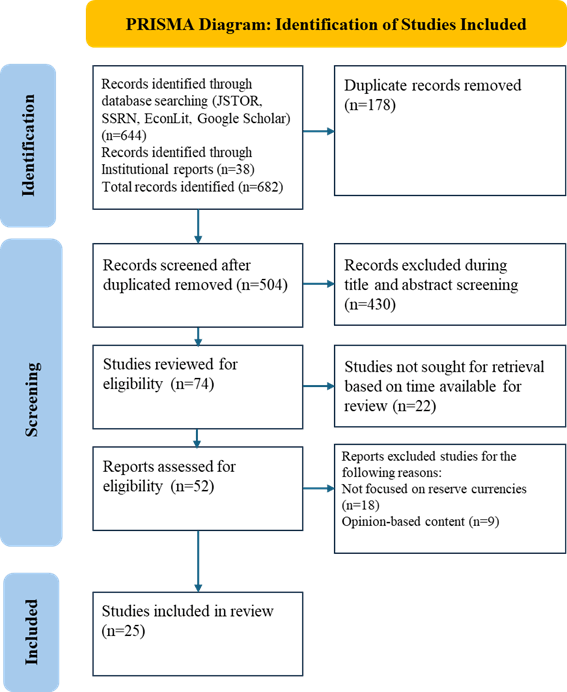
A comprehensive search was conducted across JSTOR, SSRN, EconLit, and Google Scholar. These databases were the primary focus due to their focus on social science research as well as accessibility. These sources were supplemented by targeted retrieval from leading policy and monetary institutions (e.g., IMF, BIS) due to their data on currency-related research as well as select publications from major financial institutions (e.g., J.P. Morgan), given their market influence and reliance on accurate forecasting. Searches were restricted to English‑language sources published 2000–2025 to capture both historical context and recent developments relevant to reserve currency transitions. Query construction used combinations of terms such as reserve currency, currency transitions, dominant currency, cryptocurrency reserve currency, and CBDC usage. In total, 682 records were identified through the database and institutional searches.
The inclusion criteria applied to the references studies was the following: (i) published in or after 2000; (ii) sourced from a peer‑reviewed journal, recognized policy institute, central bank/government report, or a major financial institution’s research publication; and (iii) directly examined at least one of the focal alternatives to the dollar (Chinese yuan/RMB, cryptocurrencies, or CBDCs). Studies were excluded if they were not focused on reserve currencies, were opinion pieces or news articles lacking empirical support, focused solely on domestic monetary policy without linking to international currency systems, had a peripheral focus on cryptocurrencies, or had aged out in relevance for contemporary synthesis. All records were imported into a review spreadsheet and de-duplicated. Titles and abstracts were screened against the eligibility criteria; records passing this stage underwent full‑text review for relevance, methodological clarity, and data adequacy. The study’s primary contributions to understanding reserve currency dynamics (e.g., trade networks, financial market depth, institutional trust) were assessed to determine inclusion. Following this process, 25 studies and articles were retained for synthesis. For each included study, the following were extracted: author(s), publication year, source type, research methodology, and principal findings, with a focus on information related to reserve currency dominance and transition. The following PRISMA flow diagram provides a summary of included and excluded studies9:
Analysis
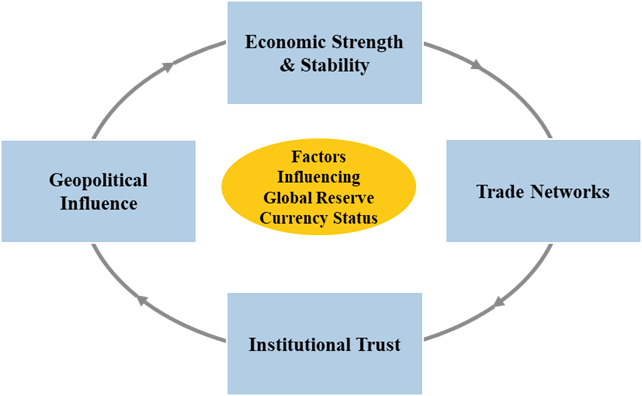
This analysis applies the integrative review framework to evaluate whether emerging alternatives of the Chinese yuan, cryptocurrencies, or CBDCs pose a credible challenge to the U.S. dollar’s reserve currency status. The synthesis is organized around four dimensions critical to reserve currency status identified through this research and as demonstrated in the model below: Economic Strength and Stability, Trade Networks, Institutional Trust, and Geopolitical Influence.
Economic Strength and Stability
According to the study by Aizeman, Cheung, and Qian on reserve currency compositions, reserve currency authority typically relies on three key factors10: economic scale, which is measured by Gross Domestic Product or GDP, macroeconomic stability – the ability to maintain a steady and balanced economy with low inflation, full employment, and consistent economic growth – and financial market depth, which is the degree to which a country’s financial markets are large, liquid, and diversified. While the dollar’s international dominance has slightly declined, the dollar has built worldwide trust because of its role as the global reserve currency for the past 80 years and because the dollar is backed by the U.S. economy, which has proven to be resilient and reliable. A contrary example of the stability represented by the U.S. dollar is the Argentinian peso. Because Argentina has struggled with high inflation and economic instability, the Argentinian government extensively uses the U.S. dollar to price, invoice and settle trades. Argentina has done this to mitigate volatility and avoid risks of deflation, or the peso losing its value rapidly, which would make trade more expensive for its country11.
Furthermore, U.S. financial markets are deep and liquid – or easy to trade in – and the dollar is widely used for pricing and payments. This makes the currency system stable and reduces risk for governments and businesses. A report from National Economic Bureau of Research on “Dominant Currency Paradigm” shows that the dollar’s role extends beyond U.S. borders through pricing, bank lending, and contracts, amplifying its resilience even during economic shocks12. Historic arrangements such as Bretton Woods’ link to gold, which then connected the dollar to oil, further solidified the dollar’s leading role and made it widely available for global trade and finance13.
In contrast, despite China’s large economy, the yuan’s prospects as the global reserve currency are constrained by capital controls, limited convertibility, and high degrees of interventions by the Chinese government4. For example, investor ownership of Chinese companies must be approved by the government, and all land purchases are also monitored and approved by the government. While such interventions create more stability in the yuan, it also creates more perceived risks because China does not have a free market. The 2015 RMB devaluation by the People’s Bank of China was implemented to boost exports in a struggling economy. However, this intervention surprised markets because China’s markets had been experiencing high growth, therefore the “devaluation action weakened international confidence in the predictability of China’s economic policies8. On the other hand, while cryptocurrencies are technologically innovative, they remain too volatile and lack the safeguards of bank‑backed systems, making them currently impractical as a reserve asset14. CBDCs are still in the early stages of development and vary widely from country to country. Rules for how they will be managed and their impact on the broader economy are still being worked out. Because of this, most experts believe CBDCs will complement the U.S. dollar rather than replace it anytime soon.
Trade Networks
A related point to economic strength and stability is the trade linkages and liquidity commitments, or network effects, between countries15. Global trade networks reinforce dominant currencies, making them harder to displace. The U.S. dollar dominates global trade because it is widely used for pricing and payments, which makes transactions simpler and less risky for other countries. For example, most oil contracts around the world are priced in dollars, which was established in the early 1970s when the U.S. struck a deal with OPEC and Saudi Arabia to trade oil in dollars in exchange for military protection16. The deal is still in effect today and most oil trades are dollar denominated. This means countries like China need to keep large dollar reserves to pay for oil imports from nations such as Saudi Arabia, which reinforces the dollar’s importance.
China has tried to expand the use of the yuan through projects like the Belt and Road Initiative and offshore trading hubs in Hong Kong and London, but its reach is still limited compared to the dollar17. The Belt and Road Initiative was created to promote infrastructure and trade projects across Asia, Africa, and Europe. The objective was to encourage partner countries to settle transactions in yuan. China has made concerted efforts to replace the dollar as the major currency for payments and settlements as seen in the mBridge project, launched in 2021 by China, Hong Kong, the UAE and Thailand, and joined by the Saudis as a full participant in 2024, to facilitate cross-border payments using a new ledger platform as a means to replace the US-dominated international finance system called SWIFT18. However, as previously discussed, these efforts have not yet achieved widespread success because strict capital controls, limited yuan convertibility, and concerns about transparency make many countries hesitant to rely on the RMB for large-scale trade.
While cryptocurrencies and CBDCs were designed to help people, businesses and countries move currencies more seamlessly as digital payment solutions, they still face significant challenges. Some of these challenges include extreme price volatility, lack of global systems to support large-scale trade, and lack of institutional trust, which will be discussed next. While CBDCs may improve payment efficiency in certain regions, they are viewed as far from replacing the dollar’s dominant role in global trade19.
Institutional Trust
A currency’s strength depends not only on its economic size but also on confidence in its legal and financial institutions. The U.S. dollar benefits from strong institutions such as clear laws, reliable courts, and predictable regulations. These establishments make international transactions safer and more transparent. For example, foreign investors know that U.S. contracts will be enforced and that financial rules won’t change suddenly, reducing risk for businesses and governments20.
By contrast, the Chinese yuan faces challenges because of strict government controls and limited transparency. For instance, China’s capital controls restrict how much money can move in and out of the country. Additionally, the Chinese government is a one-party, authoritarian state and its political system, known as the Communist Party of China, holds power at all levels of the country. The authoritarian government does not support a high degree of transparency and provides limited financial data to international partners, further impeding trust. These factors create uncertainty and limit the yuan’s appeal as a global reserve currency.
Cryptocurrencies struggle even more with trust because they lack any central authority or legal protection21. Their prices can swing wildly. For example, in November 2021, Bitcoin reached an all-time high around $69,000, then plummeted to approximately $35,000 by late January 2022. This swing in pricing represented an over 50% decline in just over three months22. There is also no global system to guarantee security or provide recourse in cases of fraud or hacking, which makes businesses hesitant to use them for large transactions. CBDCs are backed by governments but have questions about privacy and surveillance. In addition, CBDCs are still in early stages, with rules and cross-border systems under development, so most experts see them as tools to improve payment efficiency rather than full replacements for the dollar.
Geopolitical Influence
The last factor affecting global reserve currency status is Geopolitical Influence. Geopolitical influence plays a major role in deciding which currency becomes the global reserve. The U.S. dollar’s dominance has been reinforced by America’s military reach, strategic alliances, and leadership in international institutions (e.g., the International Monetary Fund and United Nations) which create confidence in its stability. A historical example illustrates this dynamic: the transition from the British Pound Sterling to the U.S. dollar between World War I and World War II was driven not only by economic strength but also by Britain’s war debts and America’s rising global influence during and after the wars. This shift shows that reserve currency changes occur gradually and typically follow major geopolitical realignments3.
By comparison, China’s influence is growing through initiatives like the Belt and Road, but its geopolitical power remains limited, especially due to its isolationist nature. Cryptocurrencies and CBDCs lack any sort of government backing, making them unlikely to gain reserve status in the foreseeable future.
Discussion
The preceding analysis demonstrates that the U.S. dollar currently retains strong advantages across economic, institutional, and geopolitical dimensions. However, future developments in global finance and technology raise questions about whether these advantages will continue. The scenarios outlined below are informed by research and historical examples but should be viewed as speculative rather than academic predictions as changes in reserve currencies are uncertain and hard to predict.
Scenario 1: Dollar Dominance Persists
In this scenario, the dollar remains the primary reserve currency because China’s economic growth slows and digital alternatives fail to scale meaningfully. OECD predictions indicate that China’s GDP growth could slow from 5% in 2024 to 4.3% in 202623 as its shifts more of its economy away from manufacturing and towards services such as healthcare, education, tourism, and financial services24. This slowing economy will limit China’s its ability to challenge U.S. economic leadership. Cryptocurrencies and stablecoins, despite technological progress, still represent less than 1% of global money supply25, making a crypto replacement unlikely in the near term. This result follows past trends: reserve currencies almost never lose their leading role unless there is a major global event or crisis.
Scenario 2: Gradual Rise of the Yuan
A second possibility is that China sustains robust growth and expands RMB usage through trade initiatives like Belt and Road and cross-border payment platforms. Even under this scenario, structural barriers previously discussed in the form of capital controls, limited convertibility, and trust deficits are likely to slow the yuan’s dominance. As of Q2‑2025, IMF COEFR as shown in the chart below demonstrates that the RMB is at 2.1% and the USD is at 56.3% of allocated reserves26. This shows that global adoption of the RMB remains highly limited despite China’s trade expansion efforts. Furthermore, research on currency transitions suggests that overcoming these barriers requires decades of reform and global alignment, making a rapid transition unlikely.
| Shares, Percent | 2024Q1 | 2024Q2 | 2024Q3 | 2024Q4 | 2025Q1 | 2025Q2 |
|---|---|---|---|---|---|---|
| Shares of Allocated Reserves | 92.79 | 92.81 | 92.88 | 92.78 | 92.81 | 92.90 |
| Shares of US dollars | 58.93 | 58.15 | 57.28 | 57.79 | 57.79 | 56.32 |
| Shares of euros | 19.60 | 19.76 | 20.04 | 19.84 | 20.00 | 21.13 |
| Shares of Chinese renminbi | 2.15 | 2.14 | 2.18 | 2.18 | 2.12 | 2.12 |
| Shares of Japanese yen | 5.70 | 5.60 | 5.83 | 5.81 | 5.60 | 5.57 |
| Shares of pounds sterling | 4.89 | 4.95 | 4.98 | 4.73 | 4.74 | 4.83 |
| Shares of Australian dollars | 2.16 | 2.24 | 2.27 | 2.05 | 2.02 | 2.09 |
| Shares of Canadian dollars | 2.57 | 2.68 | 2.74 | 2.77 | 2.63 | 2.61 |
| Shares of Swiss francs | 0.19 | 0.20 | 0.17 | 0.18 | 0.18 | 0.16 |
| Shares of other currencies | 3.81 | 4.29 | 4.52 | 4.65 | 4.92 | 5.17 |
| Shares of Unallocated Reserves | 7.21 | 7.19 | 7.12 | 7.22 | 7.19 | 7.10 |
Scenario 3: Digital Disruption Accelerates Change
This scenario imagines a future where digital currencies and technology reshape global finance. For this to happen, CBDCs would need to work smoothly across borders, and cryptocurrencies like stablecoins would have to become far less volatile and more trusted by institutions. Currently, cryptocurrencies only make up approximately 0.64% of the global money supply27. At the same time, China would need strong economic growth and major policy changes to make its currency easier to use globally. While such a shift is theoretically possible, history shows that reserve currency changes such as the move from the British pound to the U.S. dollar after World War II usually follow major geopolitical upheavals, not just technological innovation. These changes would require years of cooperation and reform, so a quick transition is unlikely.
Limitation
This study is subject to several important limitations. First, the reliance on English-language sources may underrepresent perspectives from non-English-speaking or emerging economies, particularly where domestic research and official publications are not widely translated. Second, the analysis is based primarily on secondary literature, including peer-reviewed studies and institutional reports, which may lag behind rapidly evolving developments in currency markets, financial technology, and geopolitical strategy. As a result, real-time shifts in reserve practices or policy experimentation may not be fully captured. Most significantly, historical evidence suggests that reserve currency transitions are often driven by major geopolitical disruptions, such as wars or systemic financial crises, which are inherently unpredictable. This structural uncertainty constrains the ability of any forward-looking assessment to make precise forecasts regarding the timing or nature of future changes in global reserve currency dynamics.
Conclusion
The U.S. dollar remains the cornerstone of global finance due to its leadership across all four dimensions analyzed: economic strength, trade networks, institutional trust, and geopolitical influence. The Chinese yuan is the closest competitor, but it faces big hurdles like strict capital controls, limited convertibility, and concerns about government trust and transparency. Cryptocurrencies and CBDCs are innovative, but they are better seen as complementary tools for payments rather than full replacements for the dollar given their newness and issues of volatility and payment tracking. While these challengers to the dollar are growing, none of them have the depth or credibility to replace it soon. History shows reserve currency shifts are rare and usually follow major crises rather than gradual trends. Nonetheless, technological innovation, evolving trade networks, and geopolitical realignments could create incremental changes over the next two to three decades. To preserve its dominant role, the United States must maintain economic stability, strong financial markets, and sustain global trust. Any major shift could transform global trade, investment strategies, and political alliances, highlighting the role reserve currencies play in shaping the world economy.
References
- A. S. Berman. The dollar: the world’s reserve currency. Council on Foreign Relations, https://www.cfr.org/backgrounder/dollar-worlds-reserve-currency, 2020. [↩] [↩] [↩]
- Countries that use the U.S. dollar. https://www.investopedia.com/articles/forex/040915/countries-use-us-dollar.asp, 2025 [↩]
- B. Eichengreen, M. Flandreau. The Federal Reserve, The Bank of England and the rise of the dollar as an international currency, 1914–1939. Working Paper No. 16/2010, Graduate Institute of International and Development Studies, 2010, https://www.econstor.eu/bitstream/10419/77442/1/642338310.pdf. [↩] [↩] [↩]
- A. Subramanian. Renminbi rules: the conditional imminence of the reserve currency transition. Peterson Institute for International Economics Working Paper 11-14, 2011, https://ideas.repec.org/p/iie/wpaper/wp11-14.html. [↩] [↩]
- A. M. Edt. What to expect from bitcoin and crypto markets in the 2nd half of 2025. Investopedia, https://www.investopedia.com/what-to-expect-bitcoin-crypto-markets-second-half-2025-11762236, 2025. [↩]
- F. E. Alvarez, D. Argente, D. Van Patten. Are cryptocurrencies currencies? Bitcoin as legal tender in El Salvador. NBER Working Paper 29968, 2023, https://doi.org/10.3386/w29968. [↩]
- K. D. Elsbach, D. van Knippenberg. Creating high-impact literature reviews: an argument for integrative reviews. Journal of Management Studies. Vol. 57, pg. 1–25, 2020, https://law-journals-books.vlex.com/vid/creating-highimpact-literature-reviews-855625516. [↩] [↩]
- The impact of China devaluing the yuan in 2015. Investopedia, https://www.investopedia.com/trading/chinese-devaluation-yuan/, 2025. [↩] [↩]
- American Journal Experts. How to create an effective PRISMA flow diagram. https://www.aje.com/arc/how-to-create-prisma-flow-diagram./, 2023. [↩]
- J. Aizenman, Y.-W. Cheung, X. Qian. The currency composition of international reserves, demand for international reserves, and global safe assets. NBER Working Paper No. 25934, 2019, https://doi.org/10.3386/w25934. [↩]
- International Monetary Fund. Argentina: eighth review under the extended arrangement under the extended fund facility. IMF Country Report no. 24/167, 2024, https://www.imf.org/en/Publications/CR/Issues/2024/06/17/Argentina-Eighth-Review-Under-the-Extended-Arrangement-Under-the-Extended-Fund-Facility-550548. [↩]
- G. Gopinath, E. Boz, C. Casas, F. J. Díez, P.-O. Gourinchas, M. Plagborg-Møller. Dominant currency paradigm. NBER Working Paper no. 22943. 2019, https://www.nber.org/papers/w22943. [↩]
- Understanding the correlation between oil and currency. Investopedia, https://www.investopedia.com/articles/forex/092415/oil-currencies-understanding-their-correlation.asp, 2025 [↩]
- L. Dionysopoulos, M. Marra, A. Urquhart. Central bank digital currencies: a critical review. International Review of Financial Analysis. Vol. 91, pg. 103031, 2024, https://doi.org/10.1016/j.irfa.2023.103031. [↩]
- T. Kikuchi, L. Pham. Trade networks and the rise of a dominant currency. arXiv, 2025, https://arxiv.org/abs/2505.22080. [↩]
- Office of the Historian, U.S. Department of State. Milestones in the history of U.S. foreign relations. https://history.state.gov/milestones/1969-1976/oil-embargo. [↩]
- X. Huang. RMB internationalization under the BRI—A challenge of currency internationalization model. World Scientific Proceedings in Economics and International Finance. Vol. 8, pg. 81–94, 2024, https://doi.org/10.47297/wspeiWSP2516-253513.20240806. [↩]
- Bank for International Settlements. Project mBridge reached minimum viable product stage. https://www.bis.org/about/bisih/topics/cbdc/mcbdc_bridge.htm, 2024. [↩]
- D. Leipziger. Too much of a good thing: the role of the global U.S. dollar. CEPR VoxEU, https://cepr.org/voxeu/columns/too-much-good-thing-role-global-us-dollar, 2025. [↩]
- M. Chinn, J. Frankel. Why the euro will rival the dollar. International Finance. Vol. 11, pg. 49–73, 2008, https://users.ssc.wisc.edu/~mchinn/Chinn_Frankel_IntFin2008.pdf. [↩]
- International Monetary Fund. Central bank digital currency: further navigating challenges and risks; IMF Policy Paper No. 25/041. 2025, https://www.imf.org/-/media/files/publications/pp/2025/english/ppea2025041.pdf. [↩]
- J. Tarassov, N. Houlié. Bitcoin: a life in crises. PLOS ONE. Vol. 17, pg. e0274165, 2022, https://doi.org/10.1371/journal.pone.0274165. [↩]
- Organisation for Economic Co-operation and Development. OECD economic outlook. OECD Economic Outlook. Vol. 2025, Issue 1, 2025, https://doi.org/10.1787/83363382-en. [↩]
- DevelopmentAid. Top 5 sectors driving the Chinese economy today. https://www.developmentaid.org/news-stream/post/179737/5-sectors-driving-the-chinese-economy, 2025. [↩]
- Grand View Research. Cryptocurrency market size & share: industry report, 2030. https://www.grandviewresearch.com/industry-analysis/cryptocurrency-market-report, 2025. [↩]
- International Monetary Fund. IMF data brief: Currency composition of official foreign exchange reserves. 2025, https://data.imf.org/en/news/october%201%202025%20cofer. [↩]
- N. Reiff. Bitcoin’s share of global wealth: an analysis. Investopedia, https://www.investopedia.com/tech/how-much-worlds-money-bitcoin/, 2025. [↩]