Abstract
Algol (β Persei) is the prototype eclipsing binary. This star is famous for its brightness changes every 2.867 (approx.) days. Modern observations have revealed that Algol’s period is not perfectly constant. “Observed minus Calculated” (O–C) diagrams show slight variations that are usually attributed to mass transfer between the stars in the Algol system, including possible third-body effects. Algol has been popular long before modern astronomy. Ancient observers may have noticed Algol’s variability. A debated example is an Egyptian “calendar of lucky and unlucky days,” which some researchers interpret as encoding Algol’s changing brightness. If correct, this would represent an early form of astronomy from more than three millennia ago. This paper investigates whether Algol’s modern O–C behavior is consistent with such ancient observations. By using a recent ephemeris and O–C curve, then extrapolating backward in time and comparing with dates proposed from Egyptian records, we test how well the modern model predicts historical cycles and explore what this implies about long-term monitoring as it relates to calculating ephemerides.
Introduction
Ephemerides are highly popular tools in astronomy. They provide predictions of recurring solar events such as eclipses, transits, and orbital phases. They are highly accurate, which allows us to calculate everything from spacecraft navigation to monitoring of variable stars and eclipsing binaries1,2. However, despite their importance, ephemerides are often applied as time-invariant formulas. This creates an important consideration; an ephemeris may have limitations that are not considered as part of its algorithms.
It is well-established that ephemerides are limited in their long-term accuracy. Planetary ephemerides such as DE405/LE4053, DE440/DE4414, INPOP10a5, EPM6, and VSOP877 are all constructed using observational datasets over finite time intervals. It has been shown that over long-time scales, these small uncertainties can accumulate and reduce the precision of these models when extended far into the past or future8,9. Furthermore, due to cumulative dynamic effects, long-term Solar System studies have similarly demonstrated that orbital solutions become increasingly uncertain when extrapolated across thousands of years10. O–C analyses are therefore commonly used to track long-term deviations between predicted and observed eclipse timings11.
This study builds on those established ideas by applying them to the historical problem of extrapolating Algol’s ephemeris backward more than 3,000 years for comparison with the Cairo Calendar. Rather than proposing that temporal validity limits are a new concept, this paper argues that the same caution already used in planetary ephemerides should also be considered in long-baseline historical studies of variable stars.
To illustrate this, a widely used modern ephemeris for Algol is compared, under a set of modeling assumptions, with reconstructed dates from the Late Bronze Age. The differences that arise are not seen as failures of the ephemeris. Instead, they suggest that long-term predictions could benefit from clearly defined ranges of time validity, similar to what is done in other time-dependent scientific models12,13.
Introduction to Algol
Algol (β Persei) is one illustration of this issue. Algol’s orbital period of approx 2.867 days shows measurable variations1,14. These variations are commonly attributed to mass transfer and light-time effects from a tertiary companion14,15. Modern ephemerides for Algol describe its eclipse timings over the decades or centuries. However, when these same formulas are extrapolated across larger periods, the predictions may diverge from observations
Introduction to Cairo Calendar
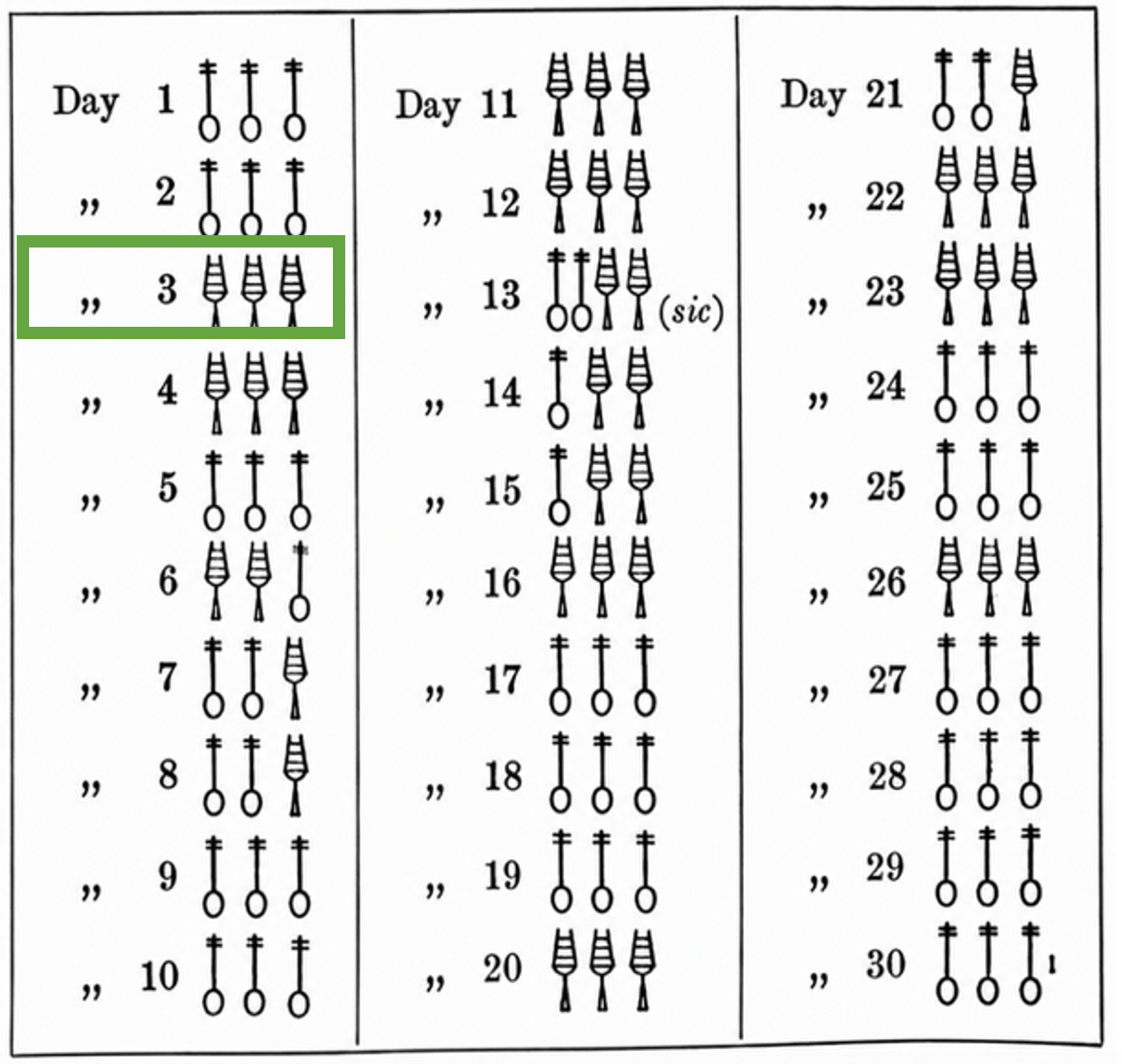
In order to compare the model ephemeris with historical records, this study uses the Cairo Calendar as a historical dataset. The Cairo Calendar (Fig 1, 2, 3) is a late Bronze Age Egyptian document that labels each day of the year as “good,” “bad,” or mixed. The calendar has been analyzed in both Egyptian studies and astronomy16,17.
The Cairo Calendar had a fixed 365-day year without leap years, which caused it to drift18 compared to the solar year. Later reconstructions estimate that the year began on a month named ‘Thoth 1’, which is often approximated to late summer (late August18 in the proleptic Julian calendar). However, this alignment is uncertain and depends on the model used.
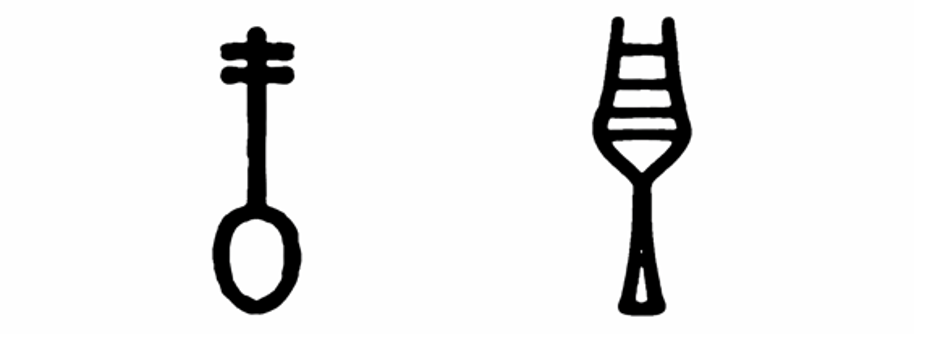
In this study, the third day of Thoth (Thoth 3 highlighted in Fig 1), classified as an unfavorable (“bad”) day, as it is marked by what is believed to be the symbol for a ‘Bad’ period (Fig. 3). Thoth 3 will serve as a reference point for comparison. This choice gives a consistent historical day marker across all reconstructed years without implying a unique link to a specific solar date.
Note that the idea that the Cairo Calendar matches the variability of Algol is debated and serves here as a motivating hypothesis16,19 rather than an established premise.
Methods
This study includes multiple steps.
- Step 1: A reference epoch for Algol is established using modern observations.
- Step 2: Cairo Calendar dates are mapped to the proleptic Julian calendar using a multi-anchor-year approach that accounts for calendar drift.
- Step 3: The resulting dates are then converted to Julian Date (JD), which serves as the input to the ephemeris (next step).
- Step 4: An ephemeris is applied to predict the eclipse timings and phases for Algol.
- Step 5: Using an O-C framework, these predictions are compared with Cairo Calendar dates to evaluate the validity of the ephemeris over a long timeframe.
Establish Algol’s Reference Epoch
We need to define an anchor point for this study. In order to do this, we will adopt Algol eclipse timing (when Algol was dimmest) from published O–C analyses1,2. This will be our modern-day reference eclipse and occurred on July 26, 1982 at 21:44 UT (Universal Time).
To standardize calculations across large timeframes, the reference epoch is expressed in Julian Date (JD), a continuous astronomical timescale used throughout this analysis20. The primary minimum of Algol on July 26, 1982, at 21:44 UT corresponds to JD 2,445,177.40 and serves as the baseline for all later calculations.
Chronology and Calendar Conversion
To compare the Algol predicted phase with dates from the Cairo Calendar, Egyptian civil dates must first be converted into a continuous astronomical time system. The Cairo Calendar consisted of a fixed 365-day year without leap years, causing it to drift18 relative to the solar year by approximately one day every four years.
Previous studies of the Egyptian calendar, along with analyses of the Cairo Calendar, suggest that Thoth 1 can be approximated to late August in the proleptic Julian calendar during the Late Bronze Age. This correspondence, however, is not exact and depends on the reconstruction method used. As a result, any conversion between Egyptian calendar dates and Julian dates carries an uncertainty in the magnitude of days.
Anchor-Year Modeling and Calendar Drift
To account for uncertainty in calendar alignment, we use a multi-anchor-year approach vs. relying on a single fixed date. We will select these anchor-years within the estimated date range of the Cairo Calendar (1244–1163 BCE)16, and for each of the anchor years, Thoth 3 is taken to correspond to August 31 in the proleptic Julian calendar.
For years occurring after our anchor year in the sample, the August 31 date is adjusted to reflect the known drift. Because the Egyptian calendar shifts by roughly one day every four years relative to the solar year, the corresponding Julian date is offset from the anchor value based on the number of years separating them. For example, an eight-year difference produces a shift of about two days, while a twelve-year difference results in a shift of roughly three days.
This approach keeps the calendar date itself fixed (Thoth 3) while allowing its position within the solar year to change in a way that reflects the calendar’s underlying behavior. Repeating the analysis across multiple anchor-year models then makes it possible to evaluate how sensitive the results are to the initial alignment assumption.
Conversion to Julian Date (JD)
For each Julian calendar date, the corresponding Julian Date (JD) is calculated using standard astronomical conversion methods. All dates are presented using the proleptic Julian calendar, which extends the Julian calendar backward in time before its historical introduction, ensuring a continuous timescale. These conversions apply to dates that occurred before the introduction of the Gregorian calendar in 1582.
For BCE dates, astronomical year numbering is used, so 1 BCE is year 0 and 2 BCE is year -1. Since the Cairo Calendar does not specify times of day, each reconstructed date is assigned a time of 00:00 UT. This introduces a possible uncertainty of up to ±0.5 days in the reconstructed timing. The total uncertainty in reconstructed dates falls within ±1–2 days.
The calculated JDs are used in calculating the ephemeris.
Calculating the Ephemeris
An ephemeris is a mathematical equation that is widely used to predict the timing of planetary events. It is important to note that every ephemeris is unique, depending on the astronomical body. For variable stars, the ephemeris gives us the time between minimum or maximum brightness. The standard quadratic form1,20 used in modern studies of eclipsing binaries is below
![\[T(E) = T0 + PoE + aE^2\]](https://nhsjs.com/wp-content/ql-cache/quicklatex.com-786aec332c5d6df9ea88bfb00db23d02_l3.png "Rendered by QuickLaTeX.com")
where:
- T(E): The predicted time of eclipse for a given cycle E
- T0: Is the reference eclipse time we calculated earlier (JD 2,445,177.40)
- P0: Is the mean orbital period
- aE2: This represents long-term period evolution, a combination of mass transfer and / or light-time effects from Algol C
The values and coefficients2 adopted in this analysis are:
![\[P_o = 2.867315\ days\]](https://nhsjs.com/wp-content/ql-cache/quicklatex.com-2988ac71f3cb898ef1979c32bd64a34d_l3.png "Rendered by QuickLaTeX.com")
![\[a = 1.40 \times 10^{-9}\ days / cycle^2\]](https://nhsjs.com/wp-content/ql-cache/quicklatex.com-b53fbd7dfa3318ae9e1eb47e71fc94ac_l3.png "Rendered by QuickLaTeX.com")
This ephemeris fits observations extremely well over the timespan of the modern dataset. The goal of this paper is to test how well such a model performs when extrapolated over several millennia.
Phase Calculation Procedure
For each Julian Date, we compute the corresponding cycle number E in relation to the reference epoch. We then calculate the predicted eclipse timing (T(E)) using the ephemeris model. We determine the phase of Algol by comparing the reconstructed Julian Date with the predicted cycle timing.
Phases are understood in relation to the primary minimum (phase 0 or 1), with 0 being Algol’s dimmest state. As the phase increases, it indicates brighter states. Since the light curve is continuous, we consider phase classifications to be approximate rather than strictly binary.
Phases within ±0.1 of 0.0 (or equivalently 1.0) are classified as near primary minimum (dimmest state). Larger deviations correspond to progressively brighter phases.
Sampling Strategy (Thoth 3 Selection)
The analysis looks at dates related to Thoth 3, which is marked as an unfavorable (“bad”) day in the Cairo Calendar for morning, afternoon, and evening. A set of ten historical years is chosen from the estimated calendar timeframe, with roughly equal spacing throughout the timeframe of the Cairo Calendar.
Choosing Thoth 3 as our anchor date gives a steady reference point for all modeled years. This does not suggest a unique link with Algol’s changes. The sample of ten dates, spread across the estimated timeframe of the Cairo Calendar, is meant to show behavior across the interval instead of providing a complete statistical test. Therefore, the results should be seen as a demonstration based on sensitivity, not as a formal statistical analysis.
Sensitivity Analysis Framework
Because both calendar alignment and ephemeris extrapolation introduce uncertainty, the results are interpreted within a sensitivity framework. Differences between predicted phases and Cairo Calendar classifications may arise from multiple factors, including calendar reconstruction uncertainty, limitations of the quadratic ephemeris model15,12, or the possibility that the calendar does not encode Algol’s variability.
Given Algol’s orbital period of approximately 2.867 days, even small uncertainties in reconstructed dates (±1–2 days) correspond to phase shifts of approximately 0.35–0.7. By comparing results across multiple anchor-year models, this study evaluates how strongly conclusions depend on underlying assumptions rather than attempting to establish precise historical agreement.
Results
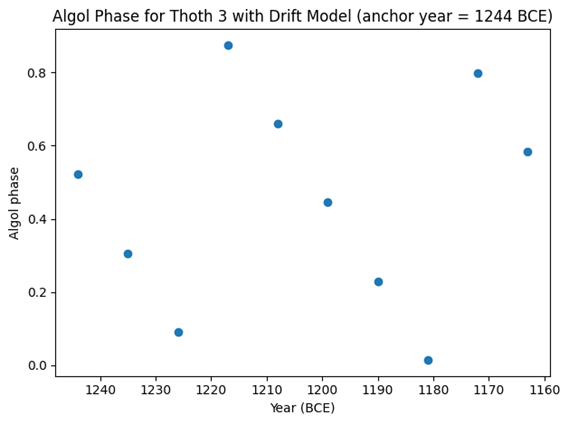
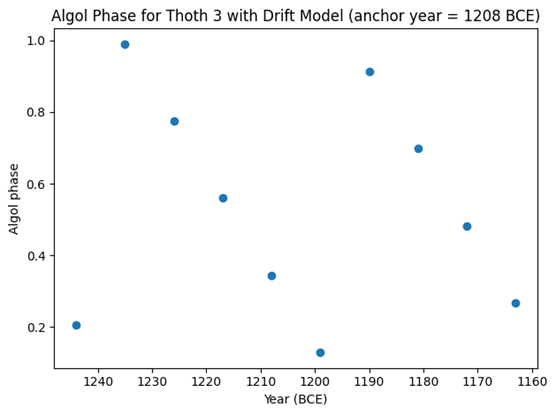
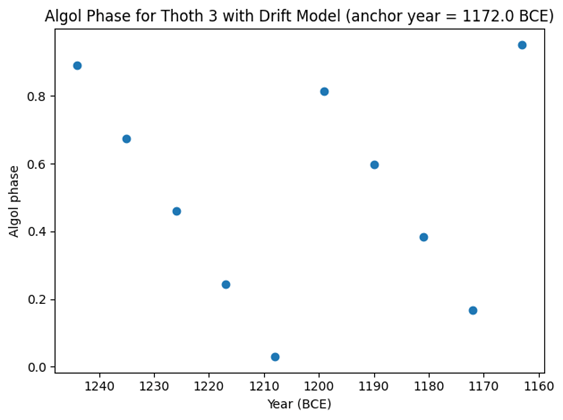
Algol phase predictions were computed for ten selected years within the estimated span of the Cairo Calendar under three anchor-years: 1244 BCE (early), 1208 BCE (midpoint), and 1172 BCE (late). For each model, Julian Dates were calculated using known calendar drift, and the corresponding Algol phases were determined using the widely accepted ephemeris. The complete set of results is provided in Appendix A, and the computational notebook is available upon request.
Across all three anchor-year models, the predicted phases show limited agreement with the Cairo Calendar classification for Thoth 3. The proportion of cases in which predicted phases align with the “bad” designation ranges from approximately 20% to 30%, depending on the selected anchor-year model.
While the specific phase values vary across anchor assumptions, the overall pattern of limited agreement remains consistent. This consistency indicates that the observed mismatch is not solely an artifact of a particular anchor-year assumption. Instead, it persists across a range of plausible calendar alignments.
However, this result does not uniquely identify the source of the discrepancy. The mismatch may arise from uncertainties in calendar reconstruction, limitations in long-term ephemeris extrapolation, or the possibility that the Cairo Calendar classifications are not directly related to Algol’s variability.
Discussion
The O-C mismatch between predicted Algol phases and Cairo Calendar classifications may be caused by a few different reasons. First, the lack of certainty in the Cairo Calendar to Julian calendar mapping leads to potential date offsets of about ±1 to 2 days. This can cause significant phase shifts. Second, the ephemeris itself might gather errors when stretched over long timescales due to unmodeled or changing astrophysical processes. Third, the Cairo Calendar reflecting Algol’s variability might be incorrect.
The multi-anchor-year approach used in this study partly tests how sensitive the results are to assumptions about calendar alignment. The sustained mismatch across all anchor-year models suggests that the differences are not just due to one calendar alignment choice. However, this analysis does not pinpoint the relative impact of each factor and does not clearly identify the source of the discrepancy.
The O-C comparison of predicted Algol phases to the Cairo Calendar does not assume that the calendar clearly records Algol’s variability. Instead, the calendar serves as a comparative dataset based on a proposed but debated interpretation. Because of this, any mismatch observed cannot be solely linked to errors in the ephemeris. It may also reflect limits in how the calendar has been historically interpreted or a mix of both issues. This analysis, therefore, looks at consistency under a set of assumptions rather than testing one clear hypothesis.
Over many years, factors like mass transfer variability14,21 and third body effects can change the system’s orbital movement. These changes can lead to variations from the ephemeris and lower accuracy for long-range predictability12,22
We note that our conclusions are very sensitive to calendar alignment, and model assumptions are not dependable over long time periods. These findings match what is known in ephemeris modeling, where it is understood that predictive accuracy declines outside the period used for calibration12,13.
One outcome of this study is that ephemerides should be treated as time-limited models rather than universally valid predictors. This limitation is already implicit in studies of orbital dynamics22,13 and ephemeris construction, where long-term extrapolation is known to accumulate uncertainty due to both measurement error and unmodeled physical processes.
Several approaches could be applied to ephemerides for eclipsing binary. First, ephemerides can be accompanied by formal validity intervals. This is similar to those already used in planetary ephemerides, where models are calibrated over a defined observational baseline and are not assumed to remain accurate beyond it12,13.
Second, instead of a single model15,21,23 ephemerides could be used to reflect changes in system behavior over time, particularly in systems affected by variable mass transfer or third-body interactions.
A third approach is to incorporate uncertainty propagation12,22 directly into the ephemeris, allowing the predicted phase error to grow as a function of time from the reference epoch. Under this framework, a practical predictive horizon can be defined as the interval over which the phase uncertainty remains below a chosen threshold (e.g., ±0.1 in phase).
Together, these approaches shift ephemerides from static formulas to time-dependent predictive models with explicit limits, improving both transparency and long-term interpretability.
Conclusion
This study examines the behavior of a modern Algol ephemeris when extrapolated across millennial timescales and compared with reconstructed dates from the Cairo Calendar. The results show very little agreement between O-C predicted phases and historical classifications, with this mismatch remaining consistent across multiple calendar alignment methods.
These findings suggest that long-term discrepancies are not solely the result of a single modeling choice, but instead reflect the combined effects of calendar uncertainty and the inherent limits of ephemeris extrapolation.
More broadly, this analysis supports the view that ephemerides are powerful but temporally limited. When applied far beyond their calibration, even small uncertainties can accumulate into large phase errors.
Accordingly, published ephemerides would benefit from more explicit treatment of their validity. This includes defining validity ranges, documenting underlying assumptions, and incorporating uncertainty growth over time. Such practices would improve the reliability and interpretability of ephemerides, particularly in applications involving long-term extrapolation.
Appendix A
| Year | Drift from anchor (days) | JD | Algol Phase | Day Type (Observed) | Day Type (Calculated) |
| 1244 BCE | 0.0 | 1267294.5 | 0.521 | Bad (near eclipse) | Good (bright) |
| 1235 BCE | 2.25 | 1267296.75 | 0.306 | Bad (near eclipse) | Bad (near eclipse) |
| 1226 BCE | 4.5 | 1267299.0 | 0.09 | Bad (near eclipse) | Good (bright) |
| 1217 BCE | 6.75 | 1267301.25 | 0.875 | Bad (near eclipse) | Bad (near eclipse) |
| 1208 BCE | 9.0 | 1267303.5 | 0.66 | Bad (near eclipse) | Good (bright) |
| 1199 BCE | 11.25 | 1267305.75 | 0.445 | Bad (near eclipse) | Good (bright) |
| 1190 BCE | 13.5 | 1267308.0 | 0.229 | Bad (near eclipse) | Bad (near eclipse) |
| 1181 BCE | 15.75 | 1267310.25 | 0.014 | Bad (near eclipse) | Good (bright) |
| 1172 BCE | 18.0 | 1267312.5 | 0.799 | Bad (near eclipse) | Good (slightly faded) |
| 1163 BCE | 20.25 | 1267314.75 | 0.583 | Bad (near eclipse) | Good (bright) |
| Year | Drift from anchor (days) | JD | Algol Phase | Day Type (Observed) | Day Type (Calculated) |
| 1244 BCE | -9.0 | 1280434.5 | 0.205 | Bad (near eclipse) | Intermediate |
| 1235 BCE | -6.75 | 1280436.75 | 0.99 | Bad (near eclipse) | Bad (near eclipse) |
| 1226 BCE | -4.5 | 1280439.0 | 0.775 | Bad (near eclipse) | Intermediate |
| 1217 BCE | -2.25 | 1280441.25 | 0.56 | Bad (near eclipse) | Good (bright) |
| 1208 BCE | 0.0 | 1280443.5 | 0.344 | Bad (near eclipse) | Good (bright) |
| 1199 BCE | 2.25 | 1280445.75 | 0.129 | Bad (near eclipse) | Intermediate |
| 1190 BCE | 4.5 | 1280448.0 | 0.914 | Bad (near eclipse) | Bad (near eclipse) |
| 1181 BCE | 6.75 | 1280450.25 | 0.698 | Bad (near eclipse) | Good (bright) |
| 1172 BCE | 9.0 | 1280452.5 | 0.483 | Bad (near eclipse) | Good (bright) |
| 1163 BCE | 11.25 | 1280454.75 | 0.268 | Bad (near eclipse) | Good (bright) |
| Year | Drift from anchor (days) | JD | Algol Phase | Day Type (Observed) | Day Type (Calculated) |
| 1244 BCE | -18.0 | 1293574.5 | 0.89 | Bad (near eclipse) | Intermediate |
| 1235 BCE | -15.75 | 1293576.75 | 0.675 | Bad (near eclipse) | Good (bright) |
| 1226 BCE | -13.5 | 1293579.0 | 0.459 | Bad (near eclipse) | Good (bright) |
| 1217 BCE | -11.25 | 1293581.25 | 0.244 | Bad (near eclipse) | Intermediate |
| 1208 BCE | -9.0 | 1293583.5 | 0.029 | Bad (near eclipse) | Bad (near eclipse) |
| 1199 BCE | -6.75 | 1293585.75 | 0.814 | Bad (near eclipse) | Intermediate |
| 1190 BCE | -4.5 | 1293588.0 | 0.598 | Bad (near eclipse) | Good (bright) |
| 1181 BCE | -2.25 | 1293590.25 | 0.383 | Bad (near eclipse) | Good (bright) |
| 1172 BCE | 0.0 | 1293592.5 | 0.168 | Bad (near eclipse) | Intermediate |
| 1163 BCE | 2.25 | 1293594.75 | 0.952 | Bad (near eclipse) | Bad (near eclipse) |
References
- J. M. Kreiner, C.-H. Kim, I.-S. Nha. An atlas of O–C diagrams of eclipsing binary stars. Wydawnictwo Naukowe Akademii Pedagogicznej, Kraków, 2001. [↩] [↩] [↩] [↩]
- J. M. Kreiner. Up-to-date linear elements of close binaries. Acta Astronomica. Vol. 54, pg. 207–210, 2004. [↩] [↩] [↩]
- E. M. Standish. “JPL Planetary and Lunar Ephemerides, DE405/LE405.” Interoffice Memorandum, Jet Propulsion Laboratory, 1998 [↩]
- R. S. Park, W. M. Folkner, J. G. Williams, D. H. Boggs. “The JPL Planetary and Lunar Ephemerides DE440 and DE441.” Astronomical Journal. Vol. 161, no. 3, 2021, Article 105. [↩]
- A. Fienga, J. Laskar, P. Kuchynka, et al. “INPOP10a and Its Applications in Fundamental Physics.” Celestial Mechanics and Dynamical Astronomy. Vol. 111, no. 3, 2011, pp. 363–385. [↩]
- E. V. Pitjeva. “High-Precision Ephemerides of Planets—EPM and Determination of Some Astronomical Constants.” Solar System Research. Vol. 39, no. 3, 2005, pp. 176–186. [↩]
- P. Bretagnon, G. Francou. “Planetary Theories in Rectangular and Spherical Variables: VSOP87 Solutions.” Astronomy and Astrophysics. Vol. 202, 1988, pp. 309–315. [↩]
- J. Chapront, M. Chapront-Touzé, G. Francou. “A New Determination of Lunar Orbital Parameters, Precession Constant and Tidal Acceleration from LLR Measurements.” Astronomy and Astrophysics. Vol. 387, 2002, pp. 700–709. [↩]
- G. A. Krasinsky, V. A. Brumberg. “Secular Increase of Astronomical Unit from Analysis of the Major Planet Motions.” Celestial Mechanics and Dynamical Astronomy. Vol. 90, 2004, pp. 267–288. [↩]
- S. Mikkola, K. Innanen. “Symplectic Tangent Map Methods for the Study of Long-Term Planetary Orbits.” Astronomical Journal. Vol. 121, no. 6, 2001, pp. 3288–3294 [↩]
- T. Borkovits, B. Csizmadia, E. Forgács-Dajka, T. Hegedüs. “A Comprehensive Study of Dynamical and Light-Travel Time Effects in Eccentric Eclipsing Binaries.” Astronomy and Astrophysics. Vol. 398, no. 3, 2003, pp. 1091–1102. [↩]
- E. V. Pitjeva, N. P. Pitjev. Development of planetary ephemerides. Celestial Mechanics and Dynamical Astronomy. Vol. 119, pg. 237–256, 2014, https://doi.org/10.1007/s10569-014-9569-4. [↩] [↩] [↩] [↩] [↩] [↩]
- W. M. Folkner, et al. The planetary and lunar ephemerides DE430 and DE431. Interplanetary Network Progress Report.Vol. 196, pg. 1–81, 2014. [↩] [↩] [↩] [↩]
- T. Borkovits, et al. Eclipse timing variation analyses of eccentric binaries with close tertiaries in the Kepler field. Monthly Notices of the Royal Astronomical Society. Vol. 448, pg. 946–993, 2015, https://doi.org/10.1093/mnras/stv015. [↩] [↩] [↩]
- S. Zasche, et al. Period changes and third bodies in eclipsing binaries. Astronomy & Astrophysics. Vol. 572, A71, 2014. [↩] [↩] [↩]
- L. Jetsu, J. Porceddu, S. Jetsu. Did the ancient Egyptians record the period of the eclipsing binary Algol—The raging one? Astrophysical Journal. Vol. 773, pg. 1–13, 2013, https://doi.org/10.1088/0004-637X/773/1/1. [↩] [↩] [↩]
- A. Clagett. Ancient Egyptian science: Calendars, clocks, and astronomy. American Philosophical Society, 1995. [↩]
- R. A. Parker. The calendars of ancient Egypt. University of Chicago Press, 1950. [↩] [↩] [↩]
- B. E. Schaefer. The earliest record of Algol. Astrophysical Journal. Vol. 661, pg. 703–707, 2007. [↩]
- C. Sterken. The O–C diagram: Basic procedures. Astronomical Society of the Pacific Conference Series. Vol. 335, pg. 3–23, 2005. [↩] [↩]
- A. Prša, et al. Physics of eclipsing binaries. Astrophysical Journal Supplement. Vol. 227, pg. 29, 2016. [↩] [↩]
- J. Laskar. Large-scale chaos in the solar system. Astronomy & Astrophysics. Vol. 287, pg. L9–L12, 1994. [↩] [↩] [↩]
- A. Qian. Period changes in close binary systems. Astronomy & Astrophysics. Vol. 384, pg. 908–912, 2002. [↩]