
Abstract
Recurrent depth models show remarkable promise in improving model performance without scaling up model parameters. Multiple architectures and models have been proposed and trained. However, benchmarking the efficacy of the architecture when model hyperparameters differ makes it difficult to accurately attribute the source of performance differences. Three different recurrent depth architectures are trained on the TinyStories dataset along with a control, and compared to determine the optimal architecture. Results showed that the difference between recurrent architecture performance can be attributed to initialization. However performance compared to the control model was substantial.
Literature Review
Over the past decade, transformer-based models have revolutionized deep learning, achieving state-of-the-art performance across numerous tasks1’2. However, their increasing size has led to a substantial increases in the demands for memory and computational resources required, posing considerable creating significant challenges during training and inference3’4. As transformer models continue to advance the state-of-the-art, their growing size has become a significant bottleneck3. Larger models require more memory, bandwidth, and compute, making them expensive to deploy, especially in resource-constrained environments such as mobile devices or consumer hardware. Several strategies have been introduced to mitigate these challenges, including programmatic improvements5’6’7, mixed precision training8’9, and architectural improvements10’11’12’13. These efforts primarily aim to reduce VRAM usage with the memory-bandwidth-intensive demands of large transformer models3’14. One promising direction is recurrent depth transformer architectures. By reusing model parameters through recursion, allowing for lower bandwidth requirements and more efficient training on GPUs due to their FLoP-heavy nature15. Various architectures have been proposed: Tabak16 recursed through layers, Geiping et al.17 used two layers for encoding and four recursive layers before decoding, and Bae et al.18 incorporated LoRAs alongside recurrence for better performance. Empirical studies demonstrated the efficacy of the recurrent structure. It achieves performance closing in on models twice their parameter count through repeated computation while enabling adaptive compute and early exiting17’16. Additionally, recurrent models can scale compute depth dynamically, allowing them to allocate computational resources on harder problems, akin to human reasoning5’15’19. While results are promising, these models lack standardization—being trained on varying hyperparameters and datasets—leading to incomparable benchmarks. For instance, the parameter counts of these models were drastically different, Bae et al.18 trained models from one to two billion parameters, Geiping et al.17 3.5 billion, and16 on the scale of millions. We trained all three architectures on the same dataset and control for as many hyperparameters as possible.
Methods
We evaluated 3 different recurrent architectures and one control model on a 3070 laptop gpu, while keeping most hyperparameters the same.
| Hyperperameters | Value |
| Layers | 4 |
| Hidden Dimension | 256 |
| Sequence Length | 128 |
| Intermediate Dimension | 512 |
| Vocab | 4096 |
| Attention Heads | 8 |
| Key Value Heads | 8 |
| Batch Size | 32 |
| Recurrent depth | 4 |
The implementation extended on top of the llama2.c github project with architectural changes for each variant.
Training Data and Evaluation
We will be training on Tiny Stories20. Tiny Stories is a dataset that contains elementary stories generated by GPT-4 and is designed to test the efficacy of reasoning in small language models20. Common LLM evaluations require a model with general knowledge of the world. With a model so small trained on stories, results would be unusable21’22’23. Instead gemini-2.5-flash-preview is used to grade on 4 criteria with a similar prompt to16:
In the following exercise, the student is given a task of writing a short story. The student needs to come up with a coherent story that is graded on criteria mentioned below. The exercise tests the student’s language abilities, creativity, and ability to follow directions.
{story}
Please provide your general assessment about the story written by the
student. Consider the following aspects:
1. Grammar: Is the completion grammatically correct?
2. Creativity: Does the completion show creativity and original thought?
3. Consistency: Is the completion consistent with the beginning of the story?
4. Plot: Does the plot of the completion make sense and is it coherent throughout?
Now, grade the student’s completion in terms of the following categories,
each on a scale from 1 to 10.
FraiLT Approach
Used in16, this architecture uses a transformer layer, with an iteration encoder similar to how learnable positional encodings work. It will have 4 transformer layers and recur 4 times.
Three Part Approach
In17, a three-part approach was used. A prelude, recurrent, and coda blocks. In this experiment, the prelude will consist of the embedding matrix as well as one transformer layer. The coda will contain the unembedding and one transformer layer as well. The recurrent block will have 2 layers and recur 7 times. Given a number of recurrent iterations , and a sequence of input tokens  , these groups are used in the following way to produce output probabilities
  :
:
![\[e = P(x)\]](https://nhsjs.com/wp-content/ql-cache/quicklatex.com-2a7cd105999f0bd616017838618fc19d_l3.png "Rendered by QuickLaTeX.com")
![\[s_0 \sim \mathcal{N}(0, \sigma^2 I_{n \cdot h})\]](https://nhsjs.com/wp-content/ql-cache/quicklatex.com-94d3b842200542fc05d32bc5fce8aac8_l3.png "Rendered by QuickLaTeX.com")
![\[s_i = R(e, s_{i-1}) \quad \text{for } i \in {1, \ldots, r}\]](https://nhsjs.com/wp-content/ql-cache/quicklatex.com-56c818658a5e050835264f2aec1368f4_l3.png "Rendered by QuickLaTeX.com")
![\[p = C(s_r)\]](https://nhsjs.com/wp-content/ql-cache/quicklatex.com-2d4a79ee8da1219f2b3462cd67e4359c_l3.png "Rendered by QuickLaTeX.com")
where  is some standard deviation for initializing the random state. This process is shown in Figure~2. Given an initial random state
  , the model repeatedly applies the core block
  , which accepts the latent state
  and the embedded input
  and outputs a new latent state
  . After finishing all iterations, the coda block processes the last state and produces the probabilities of the next token.
Adding LoRAs
Employs18 LoRAs to mimic bigger large language models24. This model also recurs through 4 layers. A LoRA of rank 16 will be unique for each layer for each depth. The output of the transformer layer will be combined with the LoRAs for each layer.
Differences in Hyperparameters for each model
| Hyperparameter | FraiLT | Three Part | Relaxed | Control |
| Recurrent Depth | 4 | 7 | 4 | 0 |
| Recurrent Blocks | 4 | 2 | 4 | 0 |
| Lora Rank | 0 | 0 | 16 | 0 |
| Component | FraiLT | Three Part | Relaxed | Control |
| adapt | 0 | 131,072 | 0 | 0 |
| depth_encoding | 1,024 | 0 | 0 | 0 |
| lora | 0 | 0 | 1,246,976 | 0 |
| Total Parameters | 4,214,016 | 4,344,320 | 5,462,272 | 4,212,992 |
To try and minimize the recurrence difference between the models, a few modifications had to be made. With the Three Part architecture needing Prelude and Coda layers, of the four, only two could be utilized when recurring, as detailed in Table 1. To compensate for having two layers, recurrent depth was changed to seven, resulting in 16 layers of computation. Lora Rank and adapt are integral to their respective architectures, but added additional parameters, as shown by the parameter counts in Table 2. Compensating for the additional parameters through changes in other hyperparameters would change other hyperparameters. We let it be.
Results
Time to train
Memory Usage
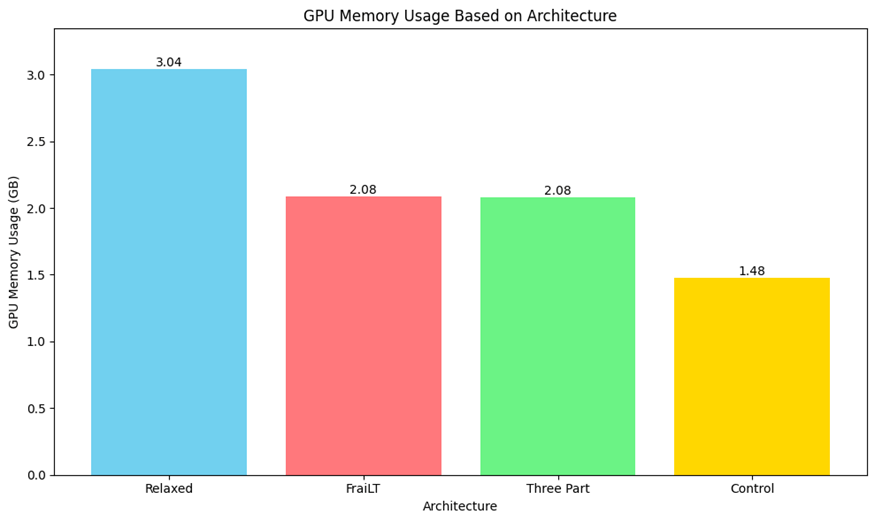
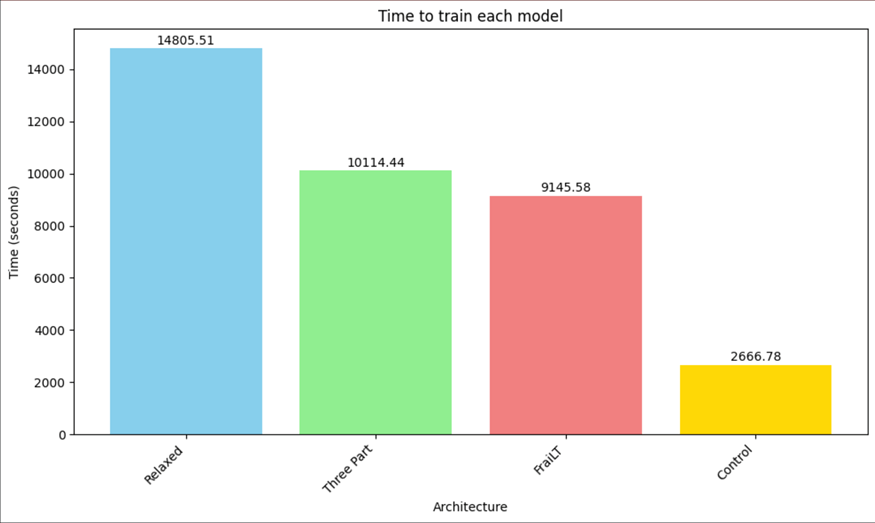
Training duration was increased for all recurrent models, as evident in Figure 1. FraiLT and Three Part’s duration were almost quadruple the control’, while memory usage increased by one third, as shown in Figure 2. This demonstrates that recurrent models require four times the compute, but not four times the memory. The Relaxed architecture exhibited a large increase in memory usage and training duration from the other recurrent depth models (see Figure 1 and Figure 2). This could potentially be attributed to the increase in parameters, or poor implementation of LoRAs. A basic estimate of the increase in VRAM, calculated using (5,462,272/4,344,320) * 2.08, would result in ~2.6GB of usage. This is a significant difference from the actual VRAM usage of 3.04 hinting at a poor LoRA implementation.
Validation Loss and Evaluation
The models were trained for 204 million tokens with a batch size of 32 at 8192 tokens per batch, in total 25,000 batches. The final validation loss for each model is presented in Table 3.
| Validation Loss | |
| Control | 1.429 |
| Relaxed | 1.393 |
| FraiLT | 1.390 |
| Three Part | 1.384 |
| Grammer | Creativity | Consistency | Plot | Average | |
| Control | 3.30 | 3.41 | 2.65 | 2.21 | 2.89 |
| Relaxed | 3.53 | 3.48 | 2.75 | 2.32 | 3.02 |
| FraiLT | 3.47 | 3.51 | 2.84 | 2.40 | 3.05 |
| Three Part | 3.52 | 3.54 | 2.85 | 2.40 | 3.07 |
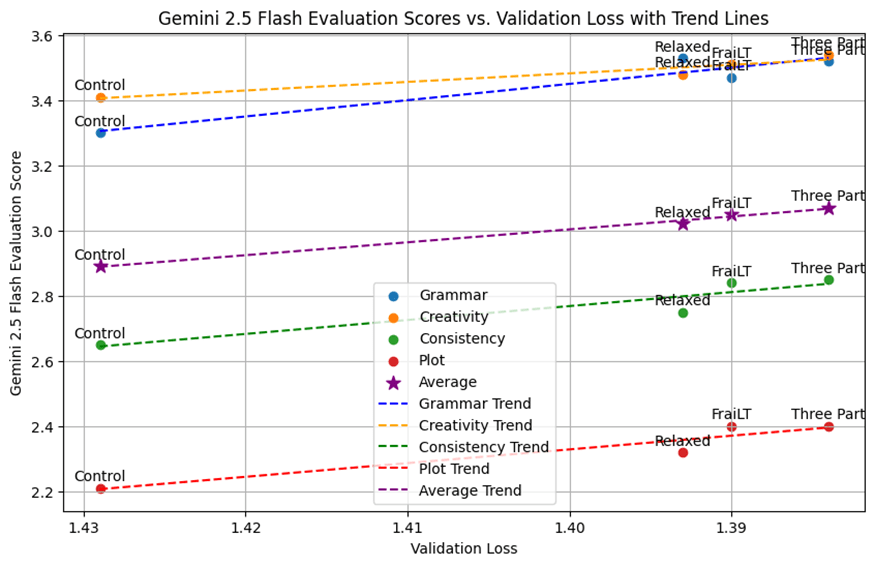
We used Gemini 2.5 Flash Preview to evaluate the model by inputting the generated story and the prompt. As shown in Table 4, the model gives feedback on four criteria: grammar, creativity, consistency, and plot coherence on a scale of one to ten. This method utilizes the Large Language Models writing capabilities to provide a more nuanced opinion compared to other approaches.
| Model | Initial model loss | Validation Loss |
| Control | 8.390 | 1.492 |
| Relaxed | 8.375 | 1.393 |
| FraiLT | 8.373 | 1.390 |
| Three Part | 8.369 | 1.384 |
From the data observed, the recurrent depth models outperform the control model, consistent with the findings in16. As shown in Table 5, given the minimal performance difference between all three of the recurrent depth models, the model initiation seems to have been the determining factor for which model would perform the best. However, there is an increase in the gap between the control model and the recurrent models after training. Interestingly, even though the Three Part model only recurs through two layers, it matches the performance of the models that recur through four layers, as further illustrated in Figure 3. It could suggest that the limit of recurrence is lower than expected or the Three Part architecture would be more efficient scaled up. It might also indicate that the models are undertrained (have not been trained for long enough) as there is seemingly no performance difference between the models. Another factor could be the scale of these models, we trained on the scale of millions, while the architectures were proposed on the scale of billions. We expected the Relaxed model to outperform the others due to it’s higher parameter count, but it wasn’t observed here. Another factor could be the small scale, as results in16 found that recurrent depth performance scales with embedding size.
Limitations and Conclusions
Due to time and compute restraints, these models were trained at a relatively small scale, a significant limitation given their potential complexity, and a control model double the size was not trained. This was despite the embedding size being scaled up to 1024, where in16, FraiLT models reached similar performance to models double their size. With this information in mind, the recurrent depth models do seem to outperform models with no recurrence with roughly the same parameter count. The difference in performance between the three recurrent depth architectures seems to be due to the difference in model initialization and the inherent limitations imposed by the small scale of the training. This restricted scale likely masked the true potential for divergent performance. This could potentially be attributed to undertraining, as all three architectures had similar validation losses and scores, suggesting they may not have fully converged to their optimal performance. While recurrent depth models are effective at these small scales, this may not be indicative of model performance at larger, more representative scales. The three recurrent architectures would likely show significant differences in performance then, as the larger scale would allow their architectural nuances to manifest more clearly. While no recurrent depth architecture achieved better performance than the others under these constrained conditions, it proved the effectiveness of recurrent depth architectures in general at a relatively small scale.
Future Work
While the effectiveness of recurrent depth models seem promising, the efficacy of the different architectures were not shown and we suggest further work to further understand the difference between the architectures
- Training at Larger Scales: Due to computational and time restraints, our models were relatively small, potential emergent properties of the architectures were not shown such as how architectural nuances might manifest in performance gains or limitations at higher parameter counts. Training these architectures at larger scales will provide insights into the scalability of the models, as well as impacts each change had on the performance of the models.
- Further Understanding Recurrence: The gains from recurring additional times may taper off due to the limitations of parameters. However no research has been done testing the limits and plotting the trade off between recurrence and model performance
- Combining Proposed Architectures: While no discernible difference was observed, we believe that at larger scales differences will be more substantial. At that scale some more architectures could be introduced, through a combination of the proposed architectures or novel approaches.
References
- Vaswani, A., Shazeer, N., Parmar, N., Uszkoreit, J., Jones, L., Gomez, A. N., Kaiser, L., & Polosukhin, I. (2023). Attention Is All You Need (No. arXiv:1706.03762). arXiv. https://doi.org/10.48550/arXiv.1706.03762 [↩]
- Devlin, J., Chang, M.-W., Lee, K., & Toutanova, K. (2019). BERT: Pre-training of Deep Bidirectional Transformers for Language Understanding (No. arXiv:1810.04805). arXiv. https://doi.org/10.48550/arXiv.1810.04805 [↩]
- T. Nouamane, F. Ferdinand, Z. Haojun, N. Phuc, M. Mohamed, W. Leandro, T. Thomas. The Ultra-Scale Playbook. Hugging Face. (2025). https://huggingface.co/spaces/nanotron/ultrascale-playbook [↩] [↩] [↩]
- Kaplan, J., McCandlish, S., Henighan, T., Brown, T. B., Chess, B., Child, R., Gray, S., Radford, A., Wu, J., & Amodei, D. (2020). Scaling Laws for Neural Language Models (No. arXiv:2001.08361). arXiv. https://doi.org/10.48550/arXiv.2001.08361 [↩]
- Hijma, P., Heldens, S., Sclocco, A., van Werkhoven, B., & Bal, H. E. (2023). Optimization Techniques for GPU Programming. ACM Comput. Surv., 55(11), 239:1-239:81. https://doi.org/10.1145/3570638 [↩] [↩]
- Dao, T., Fu, D. Y., Ermon, S., Rudra, A., & Ré, C. (2022). FlashAttention: Fast and Memory-Efficient Exact Attention with IO-Awareness (No. arXiv:2205.14135). arXiv. https://doi.org/10.48550/arXiv.2205.14135 [↩]
- Dao, T. (2023). FlashAttention-2: Faster Attention with Better Parallelism and Work Partitioning (No. arXiv:2307.08691). arXiv. https://doi.org/10.48550/arXiv.2307.08691 [↩]
- Micikevicius, P., Narang, S., Alben, J., Diamos, G., Elsen, E., Garcia, D., Ginsburg, B., Houston, M., Kuchaiev, O., Venkatesh, G., & Wu, H. (2018). Mixed Precision Training (No. arXiv:1710.03740). arXiv. https://doi.org/10.48550/arXiv.1710.03740 [↩]
- J. Yuan, H. Gao, D. Dai, J. Luo, L. Zhao, Z. Zhang, Z. Xie, Y. X. Wei, L. Wang, Z. Xiao, Y. Wang, C. Ruan, M. Zhang, W. Liang, W. Zeng. Native Sparse Attention: Hardware-Aligned and Natively Trainable Sparse Attention. arXiv. (2025). https://doi.org/10.48550/arXiv.2502.11089 [↩]
- DeepSeek-AI et al. DeepSeek-MoE: The All-Around MoE. arXiv. (2025). https://doi.org/10.48550/arXiv.2501.07725 [↩]
- Child, R., Gray, S., Radford, A., & Sutskever, I. (2019). Generating Long Sequences with Sparse Transformers (No. arXiv:1904.10509). arXiv. https://doi.org/10.48550/arXiv.1904.10509 [↩]
- Kitaev, N., Kaiser, Ł., & Levskaya, A. (2020). Reformer: The Efficient Transformer (No. arXiv:2001.04451). arXiv. https://doi.org/10.48550/arXiv.2001.04451 [↩]
- Cai, W., Jiang, J., Wang, F., Tang, J., Kim, S., & Huang, J. (2025). A Survey on Mixture of Experts in Large Language Models. IEEE Transactions on Knowledge and Data Engineering, 1–20. https://doi.org/10.1109/TKDE.2025.3554028 [↩]
- Pope, R., Douglas, S., Chowdhery, A., Devlin, J., Bradbury, J., Levskaya, A., Heek, J., Xiao, K., Agrawal, S., & Dean, J. (2022). Efficiently Scaling Transformer Inference (No. arXiv:2211.05102). arXiv. https://doi.org/10.48550/arXiv.2211.05102 [↩]
- Kaplan, J., McCandlish, S., Henighan, T., Brown, T. B., Chess, B., Child, R., Gray, S., Radford, A., Wu, J., & Amodei, D. (2020). Scaling Laws for Neural Language Models (No. arXiv:2001.08361). arXiv. https://doi.org/10.48550/arXiv.2001.08361 [↩] [↩]
- A. Tabak. Freely Long-Thinking Transformer (FraiLT). arXiv. (2024). https://doi.org/10.48550/arXiv.2401.11626 [↩] [↩] [↩] [↩] [↩] [↩] [↩] [↩]
- J. Geiping, S. McLeish, N. Jain, J. Kirchenbauer, S. Singh, B. R. Bartoldson, B. Kailkhura, A. Bhatele, T. Goldstein. Scaling up Test-Time Compute with Latent Reasoning: A Recurrent Depth Approach. arXiv. (2025). https://doi.org/10.48550/arXiv.2502.05171 [↩] [↩] [↩] [↩]
- S. Bae, A. Fisch, H. Harutyunyan, Z. Ji, S. Kim, T. Schuster. Relaxed Recursive Transformers: Effective Parameter Sharing with Layer-wise LoRA. arXiv. (2025). https://doi.org/10.48550/arXiv.2410.20672 [↩] [↩] [↩]
- J. Wei, X. Wang, D. Schuurmans, M. Bosma, B. Ichter, F. Xia, E. Chi, Q. Le, D. Zhou. Chain-of-Thought Prompting Elicits Reasoning in Large Language Models. arXiv. (2023). https://doi.org/10.48550/arXiv.2201.11903 [↩]
- R. Eldan, Y. Li. TinyStories: How Small Can Language Models Be and Still Speak Coherent English?. arXiv. (2023). https://doi.org/10.48550/arXiv.2305.07759 [↩] [↩]
- K. Cobbe, V. Kosaraju, M. Bavarian, M. Chen, H. Jun, L. Kaiser, M. Plappert, J. Tworek, J. Hilton, R. Nakano, C. Hesse, J. Schulman. Training Verifiers to Solve Math Word Problems. arXiv. (2021). https://doi.org/10.48550/arXiv.2110.14168 [↩]
- D. Hendrycks, C. Burns, S. Basart, A. Zou, M. Mazeika, D. Song, J. Steinhardt. Measuring Massive Multitask Language Understanding. arXiv. (2021). https://doi.org/10.48550/arXiv.2009.03300 [↩]
- S. Lin, J. Hilton, O. Evans. TruthfulQA: Measuring How Models Mimic Human Falsehoods. arXiv. (2022). https://doi.org/10.48550/arXiv.2109.07958 [↩]
- E. J. Hu, Y. Shen, P. Wallis, Z. Allen-Zhu, Y. Li, S. Wang, L. Wang, W. Chen. LoRA: Low-Rank Adaptation of Large Language Models. arXiv. (2021). https://doi.org/10.48550/arXiv.2106.09685 [↩]