

Abstract
In human rights (HR) discussion, approaches designed to address critical issues often overlook the distinct conditions of political structures. This paper reviews common economic strategies implemented by policymakers to determine the most effective economic strategy in diverse political contexts. Specifically, it evaluates the strengths and weaknesses of sanctions, foreign direct investment (FDI), and preferential trade agreements (PTAs) with an analysis of their impacts on political and economic rights. The findings reveal several key insights. First, sanctions lean effective in democratic nations rather than autocratic because democratic leaders derive their authority from utilitarian frameworks. Second, FDI is most beneficial in nations that possess resources appealing to global investors and often lead to exploitation within labor-precarious regimes. Last, PTAs may represent the most effective approach due to their coercive nature, with some exceptions. The literature also concludes that no universal approach exists to such policies. Rather, leaders that strive to improve HR must consider political and economic structures in the targeted regime to make decisions that reduce repression. Otherwise, the deployment of misguided HR judgement in international policy may produce unintended consequences. As such, the paper hopes to direct international actors to craft suitable economic policies and serve as a foundational guide for political action.
Introduction
The issue of human rights (HR) has been a crucial concern for the international community. The adoption of the UN Declaration provides a bright-line for human rights strategies and is the normative model of justice in many Western countries. The V Dem (Voices of Democracy) Model indicates that democracy levels have fallen approximately 10% since 2012. State level action alone is insufficient, as some governments refuse to reform their human rights policies; thus, the future of democracy relies on collaborative international action and effective policy selection. Drawing on the existing literature, this paper evaluates sanctions, foreign direct investment (FDI), and preferential trade agreements (PTAs) as instruments to promote economic and political rights within authoritarian regimes. Ultimately, this paper adopts a normative approach through empirical methods, aiming to provide a foundation for how policymakers can appropriately select strategies and determine the best timing and approach for implementation.
In the following pages, the paper first explores the universal experience of human rights to provide context on how leaders can resolve HR violations. The second portion of the paper addresses the need for economic policies in human rights action, and provides an inside look into the minds of policymakers incentives of oppression in relation to economics. Then, the paper surveys the empirical findings on the qualities of each policy (sanctions, foreign direct investment, and preferential trade agreements) and their impact on human rights across existing studies. Lastly, the paper proposes how policymakers should adjust policies to differing regimes.
What are Human Rights?
According to the Universal Declaration of Human Rights (UDHR),human rights can be defined as “recognition of the inherent dignity and of the equal and inalienable rights of all members of the human family is the foundation of freedom, justice and peace in the world, whereas disregard and contempt for human rights have resulted in barbarous acts which have outraged the conscience of mankind, and the advent of a world in which human beings shall enjoy freedom of speech and belief and freedom from fear and want has been proclaimed as the highest aspiration of the common people”1.
There are various forms of human rights, including political, economic, social, natural, and emancipatory. Political rights are rights that allow the populace to protest against laws or policies that do not benefit the greater good and refer to the extent to which governments derive their authority from the common population. For example, if a government passes a law that is believed to be unfair, citizens have the right to organize peaceful protests, marches, or rallies to pressure the government to change that law2. Economic rights allow people to access the resources needed to participate in the economy, including the right to work, produce goods and services, earn income, and build wealth. Social rights grant people access to services provided or supported by the government to fulfill their basic needs. They include the right to food, healthcare, and housing, all necessities needed to sustain life3. Natural rights are granted to every person by virtue of them being human, existing universally regardless of whether governing authority recognizes them. The most common natural rights include life, liberty, property, security, and resistance to oppression. Finally, emancipatory rights enable people to free themselves from oppression and social inequality. They are rights that support human dignity, autonomy, equality, and participation in transforming unjust social conditions. For example, these include a women’s right to vote, workers rights against exploitation, and disability rights. Overall, what human rights encompass is broad. A fulfillment of one right may threaten the presence of another; therefore, it is important to carefully balance competing rights while protecting the dignity and freedom of all individuals.
The UDHR has been a pivotal force in shaping global definitions of human rights, establishing a universal benchmark for identifying violations. However, interpretations of human rights remain tied to the context in which individuals understand them. Dembour’s analysis reveals a variety of perspectives among scholars, ranging from those who view human rights as a consensus-driven construct, to those who see them as achievements borne out of struggle, and others who consider them primarily as subjects of ongoing discourse. The diverse frameworks through which philosophers and policymakers approach human rights influence their interpretation and application4. Within most societies, human rights represent a modern standard of civilization that all countries are expected to uphold. Yet, these standards are often oversimplified or overlooked, leading scholars to establish a singular “standard” for defining what human rights are and when they have been violated5. The international community leans towards Western liberalism, often treating Western conceptions of human rights as the universal standard6. This occurs largely because many non-governmental organizations (NGOs) in international human rights work are Western-based and bring their own cultural frameworks into other countries7. This approach presents significant challenges. Western states typically experience fewer human rights violations than countries in the Middle East or Indo-Pacific regions, and pressure to conform to these Western standards can inadvertently overshadow the needs of those in unstable regions. This neglect of other cultural contexts proves detrimental for several reasons. Terman and Buzas argue that it perpetuates fundamental misunderstandings about what human rights actually are, as the standard reflects Western privilege rather than universal principles6. It distorts understanding of individual states by treating human rights as straightforward issues, however, they are deeply complex and inherently context-dependent.
Despite ongoing debates over the definition and scope of human rights, there is broad international consensus on many fundamental rights. For example, the prohibition of torture, the right to life, and protections against violence are widely recognised as core human rights. Countries that strive to address these problems have a goal in preserving such rights, and it is their approach to choosing effective policies which serve as the foundation of this paper.
Beyond simply defining human rights, scholars also face the issue of measuring them. Human rights are measured differently across datasets, making comparisons between studies difficult. Most quantitative measures of human rights focus on political and economic rights when comparing countries because they are more observable and easier to measure consistently.
To measure political rights, scholars use electoral characteristics such as whether elections are regular, fair, inclusive, and free from manipulation. Political liberties are measured through freedoms related to political activity, such as the ability to form political parties and protest policies without repression. These concepts are broad; many indicators exist, and misrepresented data is common. In measurement, scholars rely on indexes of democracy—a widely accepted measurement strategy—to measure political rights and liberties. Observable indicators of political characteristics are converted into numerical scores so that countries can be compared across time and cases; however, severity measurements can change over time. For instance, if using binary variables where “violation = 1,”an extreme violation reported in 1980 and a less extreme violation in 2010 would be coded the same8. This measurement is inaccurate and causes the data to suggest stagnation in human rights even though they might be improving, and potentially mislead researchers and scholars. One scholar, Bollen, discourages existing measures of democracy (political stability, voter turnout, or party competition). Instead, he defines political rights as the ability of citizens to participate in government through free and fair elections and uphold the social contract. These include political liberties such as free speech, free press, peaceful assembly, and the right to form political organizations. Bollen then reviews major human rights datasets from 1950 to 1984 and finds that while some are useful, many rely on subjective judgements, incomplete information, and Western news sources, making them vulnerable to bias. For instance, Western media often devotes more attention to countries that are strategically important, while reporting less on smaller or less influential countries. He also explains that abusive governments may hide violations, media coverage can differ across countries, and researchers’ perspectives can influence ratings, leading to inaccurate comparison9.
Economic rights should be measured directly from outcomes rather than being inferred from data such as economic growth. Specifically, scholars should avoid using GDP, poverty rates or inequality alone as proxies from economic rights. Instead measurements should focus on laws and regulations, state policies, enforcement mechanisms, and institutional protections10. This paper uses the Gini index and labor rights measurements as mechanisms to measure improvements in economic rights. The Gini index measures how evenly wealth is distributed, determining access to basic necessities, including food, housing, healthcare, and education. Labor rights contribute to stronger economic rights because they enforce fair wages, include safe working conditions, and grant rights to unions to collectively bargain.
The paper draws on both institutional and liberal frameworks. Institutional analysis examines how structures shape political behavior and reaction, reflected in the paper’s focus on how sanctions, FDI, and PTAs influence governmental policy and political organization. Liberal analysis, in contrast, centers on individual rights, freedoms, and international cooperation. It draws on the results of the studies used, such as the Gini Index and the Political Terror Scale to assess the prevalence and severity of human rights violations.
Economic Effect on Human Rights
Economic development is necessary to reduce corruption. While methods such as investment may improve certain societies, they can adversely affect others. Scholars have examined how economic methods can be used to address human rights. First, weak and failing states often govern poorly because they lack the resources to maintain the state. Thus, military and police forces are susceptible to bribes proposed by rivals, as the state is too poor to pay them to be morally just. However, FDI can stimulate the local job market. As foreign firms have better economies than those of repressive countries, they may pressurize wages enough to bring up a middle class. The presence of a strong middle class pressurizes governments to respect human rights, as such economic power from the public stabilizes regime influence. Economic scholars have long found that coercion is an effective way to force corrupt leaders to consider changing their policies11. Considering these factors, scholars have established the most successful economic theories that are empirically proven to promote human rights: sanctions, foreign direct investment (FDI), and preferential trade agreements (PTAs).
Sanctions
Economic sanctions have been increasingly used in the modern world, and the 1990s have been referred to as the “sanctions” decade12. The rise of sanctions began after the Cold War because the UN wanted to pressurize states into compliance with foreign policy objectives. In the 1990s, more than fifty new episodes of sanctions took place, with 12 instances of UN Security Council Sanctions, and the rest from the EU and the US. During this period, the UN imposed a record high number of sanctions because it was an effective way to get states to comply without verbal intervention. However, this popularity died as sanctions were found to inflict socio-economic hardships and political conflict in certain states, which created a destabilizing effect instead of achieving political incentives13.
The Effect of Sanctions
Sanctions are applied to exert diplomatic or economic pressure on a target country to prompt change in corrupt policy. Typically, the “target” is the country that receives the sanction, and the “sender” is the country that imposes the sanction. Allen delineates two common scenarios: Either the target concedes because of severe and irrecoverable economic downturns, or the sender withdraws the sanction. Empirically, democracies concede quicker to sanctions. Resistance to sanctions can damage government support because it forces downturns on the lower and middle class voters which compose the majority. In response to public opinion, leaders surrender to the sanction to bring previous conditions back. However, in some states—when nationalism is powerful—the public may support their government if they want to challenge the sender (Allen 2005). This dynamic suggests that policymakers should prioritize sanctions for democracies because they empirically succumb quickly, which can improve human rights in a shorter period of time.
Sanction Success and Democracy
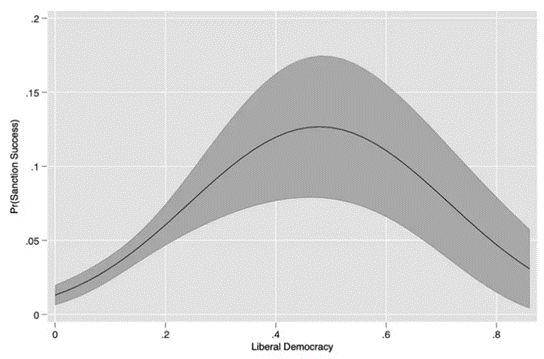
Figure 1 shows the predicted probability of sanction success by democracy scores. The dependent variable is sanction success, measured by the Global Sanctions Data Base, analyzing over 1,064 sanction episodes from 1950 to 2020. Each sanctioned episode is coded from 0 to 3, with 0 representing a failed sanction and 3 representing a success. In this way, 0 implies that the target does not change their behavior and 3 implies that the target fully concedes to the sanction and accepts the request. The independent variable is democracy, taken from the V Dem Model, composed of the quality of sanctions, limits on executive, constitutional civil liberties, rule of law, and independent judiciary. The data uses the statistical method of binary logistic regression, with robust standard errors clustered by target states. The graph shows the predicted probabilities from this regression model with 90% confidence intervals. The control variables include target GDP per capita, domestic instability, international organization sender, sanction type, political objectives, and duration terms. The x-axis represents the V-Dem liberal democracy index where 0.0 represents complete autocracy, 0.5 represents hybrid or autocratic regimes, and 1.0 represents full liberal democracy. The maximum value observed is 0.9, which leans towards full democracy. The y-axis shows sanction success, where the scale only goes to 0.2 (20%) because the success rates never exceed this.
The data concludes with a few findings: at the democracy score of 0.0, the predicted probability of success is 1%. These represent fully autocratic regimes. At the democracy score of 0.5 (partial democracies), the predicted probability for sanctions is 11-12%, the highest in the findings. And at 0.9 —near full democracy—the predicted probability of success is 2%. The 90% confidence intervals are shown in gray, and are wider at the extremes. These suggest fewer observations at extremes, more variability in outcomes at extremes, and less certainty about true effect in these ranges. Autocracies manage to persist longer because their leaders are not held accountable through elections and can easily suppress any domestic opposition through various means of oppression, often manipulating resources as a political tool to secure loyalty and strengthen their own parties. Partial democracies find themselves in a precarious position as their leaders, despite facing some level of electoral pressure, are undermined by weak institutions, possessing enough accountability to be susceptible to pressure but lacking the institutional robustness to effectively resist. In contrast, full democracies exhibit resilience against external pressures through the strength of multiple sources of regime legitimacy, enabling the public to mobilize through democratic discourse and actively support resistance efforts. Overall, the data concludes that partial democracies are the most susceptible to sanctions and are the most effective structure for political change14.
tion, 67(7-8), 1482-1509.
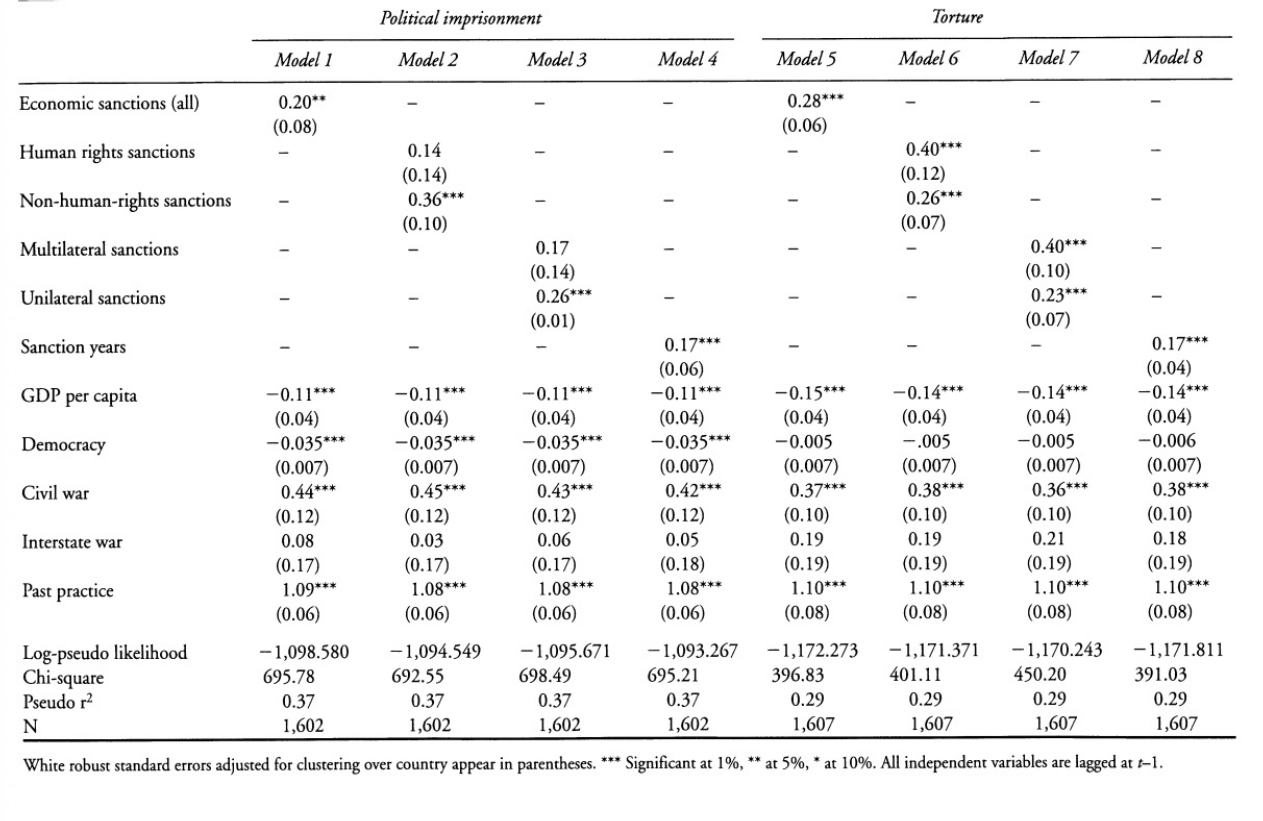
Table 1 presents statistical models examining the relationship between economic sanctions and two specific types of human rights violations: the physical integrity index and political terror scale, both of which correlate to political rights. The dependent variables are the physical integrity index and the political terror scale. Physical integrity is measured by researchers from the US State Department Country Reports of Human Rights Practices and Amnesty International Annual Reports. The physical integrity index combines four specific violations into an additive scale including: disappearances, extra-judicial killings, political imprisonment, and torture, all of which use a 0-2 scale of severity. The final scale with all of the additive scales combined measures from 0 to 8, where 0 represents no government respect for these rights and where 8 represents full government respect. The political terror scale utilizes a scale from 1 to 5 where 1 represents countries under secure rule of law or where political imprisonment is rare, whereas 5 represents terror expanded to the whole population. The independent variables are economic sanctions, human rights sanctions, non-human rights sanctions, multilateral and unilateral sanctions, and sanction years. Economic sanctions are coded as such: where 0 represents none, 1 represents limited sanctions and 2 represents extensive economic sanctions. Human rights sanctions and nonhuman rights sanctions are coded using binary (0 to 1) based on stated objectives. Multilateral and unilateral sanctions are coded based on the number of sender countries or organizations. The sanction years are measured through count variables and show the number of consecutive years sanctions have been in effect.
Model 1 shows that general economic sanctions have a small effect on physical integrity, while Model 5 shows sanctions worsen the terror scale. Models 2 and 6 separate sanctions by objective, and find that both human rights and non human rights sanctions show mixed effects and human rights sanctions slightly improve the integrity index but substantially worsen the terror scale. Models 3 and 7 distinguish between multilateral and unilateral sanctions, with multilateral sanctions showing stronger effects in both directions, a large improvement on the integrity index, but also worsening on the terror scale. Model 4 and 8 examine duration, showing that each additional year of sanctions improves the integrity index but also increases political terror, suggesting that sanctions have contradictory effects that accumulate over time. The data concludes that the physical integrity rights index suggests that sanctions help, whereas the political terror index shows that sanctions have negative effects on political terror. Physical integrity rights increase because, under sanctions, leaders do not often have the resources to oppress or abuse their populace further, and political terror strengthens because resources are less widespread and thus leaders are able to withhold resources and use their power abusively. Overall, Table 1 shows that sanctions are not the best measure to advance political rights, and although they may show changes in physical integrity, it may strengthen the political terror of the regime further12.
Dursun Peksen. 2009. “Better or Worse? The Effect of Economic Sanctions on Human Rights.” Journal of Peace Research 46 (1): 59-77.
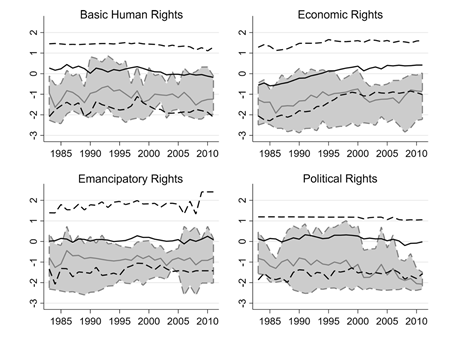
In addition to the effects of regime type, the effectiveness of sanctions also depends on the kind of right that the sender country is trying to improve. Specifically, sanctions appear to be more effective at improving economic rights compared to various types of political rights. This pattern is shown with data from Gutmann et al. (2019)15 in Figure 2, which plots the average human rights condition in the four categories of basic human rights, economic rights, emancipatory rights, and political rights. It shows the non-sanctioned countries with solid black lines, and sanctioned countries with solid grey lines. The dashed black lines show the 5% and 95% quantiles for non-sanctioned countries. It does comparative analysis on how human rights improve or change over time for countries with or without sanctions. The figure demonstrates that economic rights followed a steeper increase than other rights in sanctioned countries. This may occur because sanctions damage the economy, they create incentives for political leaders to treat workers and employed people better, so that they will still perform well and be satisfied in a less successful economy.
To measure human rights, Gutmann and others use Principal Component Analysis. Principal Component Analysis (PCA) is a statistical method used to combine related variables into a smaller number of summary measures, whilst keeping as much useful information as possible. Figure 2 focuses on US sanctions because the US has well documented and reliable sanction data and it uses a well established dataset that tracks every US sanction episode from 1976 to 2012. The data shows the effects of US sanctions across multiple indicators of human rights, including basic human rights, economic rights, emancipatory rights, and political rights. In order to measure sanctions, sanctions are encoded as such: a country-year gets a value of “1” if the country indicated is under US sanctions that year, and is encoded a “0” otherwise. It defines the country “i” in the year “t,” where “i” represents a specific country, and “t” represents a specific year. Each row is a country in a specific year and sanctions are marked 1(yes) or 0 (no). The authors divide sanctions primarily based on two categories: economic severity and duration. First, economic severity shows how much economic sanctions may hurt an economy, with effects such as limiting exports and importance, and blocking access to international finance. Low cost sanctions reduce Gross National Product (GNP) by less than 1%, whereas high cost sanctions reduce GNP by 1% or more. Sanctions that reduce GNP by less than 1% are considered economically mild, while those reducing GNP by 1% or more are classified as severe. Severe economic harm can change government behavior differently than minor economic pressure, by either encouraging reform or increasing repression. Separating sanctions by economic severity allows for testing how the magnitude of economic damage influences human rights outcomes. Second, duration refers to how many years a country has been under US economic sanctions. The authors group sanctions into short-term (fewer than 6 years), medium term (6-10 years), and long term (11 years or more). Each group represents a different stage of adjustment to sanctions. The authors test two competing effects, reform over time and entrenchment and oppression. Longer sanctions may either gradually weaken the regime and increase internal pressure for reform, or increase nationalism and blame outsiders. Duration is important because the effects of economic sanctions change over time and regimes may become more reform-oriented or more repressive, depending on the structure of the regime. Figure 2 shows the average human rights score over time for sanctioned and non sanctioned countries, including confidence bands from 5% to 95% quantiles to show variation. They mainly observe that economic rights improve over time in both groups, although political rights worsen in sanctioned countries. Overall, human rights are consistently one standard deviation worse in sanctioned countries.
Although principal component analysis is indeed reliable, there is no certainty that the data is not skewed. Firstly, principle component analysis does not account for certain fallacies. For example, PCA assumes that all variables are measured accurately, and does not account for biased survey data or systematic underreporting. Indicators that are incomplete or politically biased may be reflected in the data because PCA only accounts for existing indicators that have been provided. This means that the analysis that rights had increased across 36 years could be incorrect depending on the pool and the data that was measured.
Jerg Gutmann, Matthias Neuenkirch, and Florian Neumeier. 2019. “Precision guided or Blunt? The Effect of US Economic Sanctions on Human Rights.” Public Choice 185
A few case studies were examined in this paper. The selection of case studies prioritized: authoritarian regimes, comprehensive sanctions implementation, and evidence of both compliance and non-compliance. Iraq was selected as a case study because it satisfies all criteria including: Hussein’s authoritarian regime, UN sanctions, and partial compliance from the Oil for Food Program. Other studies analyzed, but not chosen include: North Korea, while similar in authoritarian structure and resistance to sanctions, lacks a documented moment of incentive based compliance and limits the analytical value of PTAs16. Cuba—although fitting the criteria of authoritarian regime and sanctions—received Soviet support that cushioned the economic impact, failing to show the detriment of sanctions17. Myanmar, although a more recent example, remains an ongoing conflict zone with limited historical data due to its ability to trade with neighboring states despite sanctions showing that the sanctions were never fully enforced. Iraq shows a well documented historical case where both the failure of sanctions and the success of incentive based compliance are obvious.
Following Iraq’s invasion of Kuwait in 1990, the UN imposed extensive economic sanctions designed to force Saddam Hussein to permit weapon inspections. These sanctions included limitations on food, medicine, and oil exports. At the time of the sanctions, Hussein led a personalist authoritarian regime characterized by a single-party system which rewarded loyalty. The authoritarian government controlled resources and protected loyalists and elites, making it particularly resistant to outside economic pressures. As a result, Iraq experienced a humanitarian crisis marked by shortages of food and medicine18. In response, the UN introduced the Oil for Food program, permitting the Iraqi government to sell oil in exchange for food and aid. However, since the regime dictated the distribution of food and aid, it favored loyal regions and groups while neglecting opponents and marginalized communities. Consequently, aid transformed into a means of political manipulation, reinforcing loyalty to the regime19.
Sanctions generally succeed only if the regime is organized to be able to distribute resources equitably. Otherwise, authoritarian regimes typically withhold resources from citizens in need, thereby fortifying the regime while diminishing citizens’ political freedoms and opportunities for coups or rebellion. It is now understood that authoritarian governments are less susceptible to the effects of sanctions, so policymakers should avoid using such measures against autocratic regimes. In Iraq’s case, the UN imposed sanctions because it was the era of the “sanctions decade,” exemplifying a reliance on an insufficient theory and a lack of meaningful implementation. In contrast, strategies like preferential trade agreements (PTAs) and foreign direct investment (FDI) tend to be more effective as they target the populace directly and are less reliant on the government structure. PTAs often pressure the government to improve human rights, while foreign investments can create job opportunities for individuals with minimal governmental interference.
PTAs would likely have been more effective than sanctions in influencing Iraq’s behavior in the 1990s. As Hussein’s regime prioritized regime survival, his interest in tangible economic benefits would incentivize compliance with the UN. In contrast, FDI alone would not achieve the UN’s objective because FDI does not interfere with political coercion, and is less consistent with its results.
Foreign Direct Investment (FDI)
Up until the 1970s, developing countries were rather reluctant towards foreign investment and pursued policies of import substitution. Although, as a result of structural adjustment programs and global organizations such as the UN and IMF, developing countries have increasingly opened up their economies to such investment9. As a result, FDI has become a potential tool for governments to promote human rights in other countries. However, there are debates about how effective FDI is at improving human rights outcomes.
What is FDI?
Foreign Direct Investment is the process of obtaining lasting interest by a resident investor into another economy. This interest implies a long term relationship between the direct investor and the enterprise with major influence over the enterprise from the investor. The IMF’s Balance of Payment Manual defines that the owner of 10% or more of a company’s capital is the direct investor20.
Generally, when Western or foreign companies enter states, local populations are attracted to firms because they may get higher wages. FDI tends to elevate wage levels, as these external firms typically offer better compensation, particularly due to their commitment to training initiatives. Further, leaders often reduce their repressive violations to attract investors because investment increases the welfare of the economic state. From an investor standpoint, state credibility decreases the risk of autocratic power interrupting corporation processes and normal state functions, such as the adaptation of policies that will negatively affect their operations. In order to prevent the formation of this perception, states often decrease their repressive violations to gain investment and deter bad perception.
However, abusive structures may also attract investment; some scholars argue that firms may use authoritarian power to allow forced labor and lower wages21. Investors consider locations for natural resources, such as oil and minerals, which explains why investment is common on the African Continent, with the goal of exporting goods to richer, industrialized countries. Local communities often work in poor conditions; many multinational companies (MNCs) use exploitative strategies and there are few attempts to enhance conditions for their workers22.
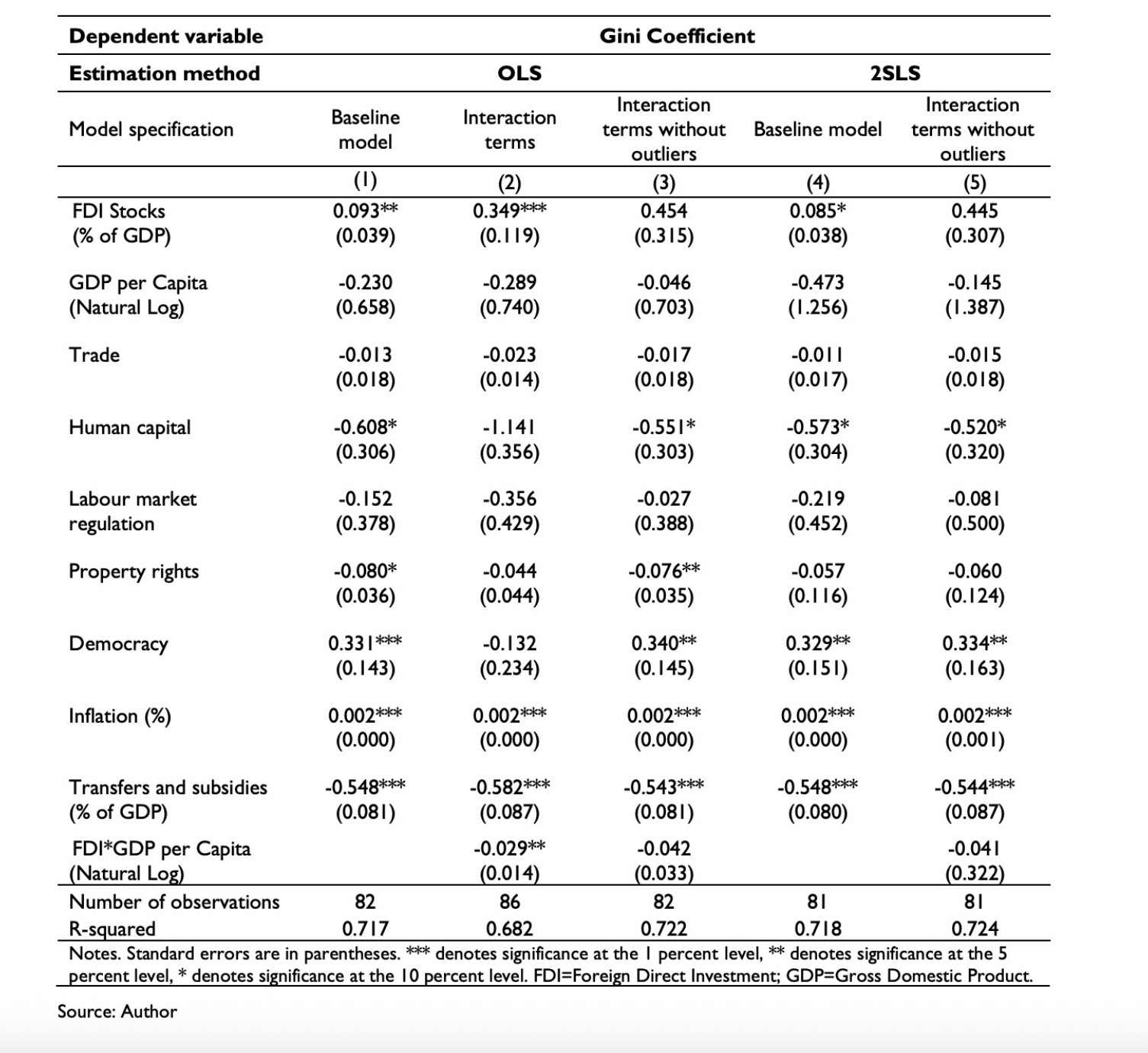
Table 2 examines the impact of foreign direct investment (FDI) on income inequality, where the Gini coefficient is used as the dependent variable. The main independent variable is FDI stocks as a percentage of GDP, included to capture the effect of foreign capital and technology inflows on the income distribution. The model also includes control variables such as GDP per capita, human capital, trade openness, labor market regulation, property rights, democracy, inflation, and transfers and subsidies, which account for alternative economic, institutional, and policy-related determinants of inequality. Interaction terms between FDI and GDP per capita are added to test whether the effect of FDI depends on a country’s level of economic development, consistent with the absorptive capacity hypothesis. However, the analysis is limited by its cross-sectional design, relatively small sample size, potential weaknesses in the instrumental variable strategy, and the absence of lagged effects, which motivates the use of panel data estimations in later tables.
The study concludes that the effect of FDI on income and inequality depends on a country’s level of economic and technological development. There is no single, universal effect of FDI on inequality. In developing or non-OECD countries, FDI is generally associated with higher income inequality. In developed or OECD countries, FDI tends to reduce income or wage inequality. It suggests that developed economies already have high skill levels, mature technologies, and institutions that allow FDI benefits to be shared more broadly (Paolo and Gorg 2011).
Figini, Paolo, and Holger Görg23. “Does Foreign Direct Investment Affect Wage Inequality? An Empirical Investigation.” The World Economy, vol. 34, no. 9, 2011, pp. 1455–1475.
Although foreign investment is advantageous to certain regions, investors take advantage of authoritarian regimes to exploit certain societies for their labor policies. Profit-oriented corporations are often able to cover up manipulative and forced labor that often suppress children and underpaid workers because foreign law allows them to do so. Moreover, those in autocratic or corrupt countries may not sense exploitative labor because they are exposed to such conditions in their daily lives. Rather than viewing such tactical corporations negatively, they may view them as more promising and strive to work in these environments compared to those of their local circumstances21. Given that the perceptual standard of human rights differ in every country, these people remain unaware that such conditions are harmful, which provides no change in the realm of human rights and instead worsens or maintains the bad conditions that these people are forced to live in.
Investor Preferences
Investors are less likely to invest in politically unstable environments because political risks and unilateral actions enacted by host governments can disrupt corporation productivity. Particularly when long term projects are initiated with investment, investors are dependent on the host government to establish secure infrastructural work spaces. In some cases, governments may nationalize foreign businesses for political or social reasons, which can decrease profit. Legal systems in these countries may be frail, which makes it harder for foreign companies to protect their rights or receive compensation. For instance, countries with high GDPs attract greater investment due to their empirically stable economies and recognized production capabilities, which positively appeals to corporate investors (see Figure 3). Investors tend to endorse lucrative regions where they are able to build long term profit. FDI is not a consistent way to track or determine the course of human rights because it is dependent on investors and their priorities and policies9.
Figure 3 illustrates the net flows expressed as a percentage of GDP. Nations marked in a darker shade of green exhibit higher investment rates per their GDP. The map prominently features countries like those in Africa because of their abundant resources. In areas such as Mali, which possess extensive reserves of gold, iron ore, manganese, and uranium, their resources are exported globally because there is high demand from corporations. The significant level of investment in these areas can be explained by the high global demand for their resources, and subsequent corporate interest. States in Europe with higher GDPs often attract less investment because they have less natural resources and do not necessarily fit the setting that is needed. Furthermore, often, these countries have high numbers of investors that invest in foreign states, which results in a diminished level of investment within their own states.
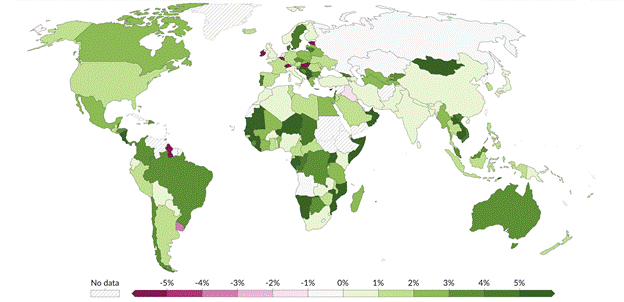
International Financial Statistics and Balance of Payments databases, International Monetary Fund (IMF); International Debt Statistics, World Bank (WB); World Bank GDP estimates, World Bank (WB); OECD GDP estimates, Organisation for Economic Co-operation and Development (OECD)24
Preferential Trade Agreements
In 1995, the EU decided to include non-trade clauses in trade agreements, and many other countries followed suit, including the US25. Preferential Trade Agreements have popularized within the modern world. In the 1990s, human rights were regulated through preferential trade agreements. Over time, these trade agreements have comprised standards that do not directly relate to trade and instead in the objective of preserving human rights.
Preferential trade agreements are formal agreements between countries that give attractive trade terms for government restructuring, often to improve human rights. PTAs are coercive, which makes them stronger than other agreements such as Human Rights Agreements (HRAs). Countries stopped using HRAs because they required persuasion rather than material incentives. HRAs have low success rates because persuasion requires changing corrupt actors’ internal opinions, which generally fails on those who have strong values for repression. There are several disadvantages to persuasion regarding time frame: persuasion occurs slowly, and institutions must gather supporters who can convince powerful or resistant groups to change their methods. However, when hard standards take place and give material incentives, leaders are more likely to listen. If an institution offers trade benefits or trade deals, but only under the condition that the government stops its repressive acts immediately, governments make their changes quickly26.
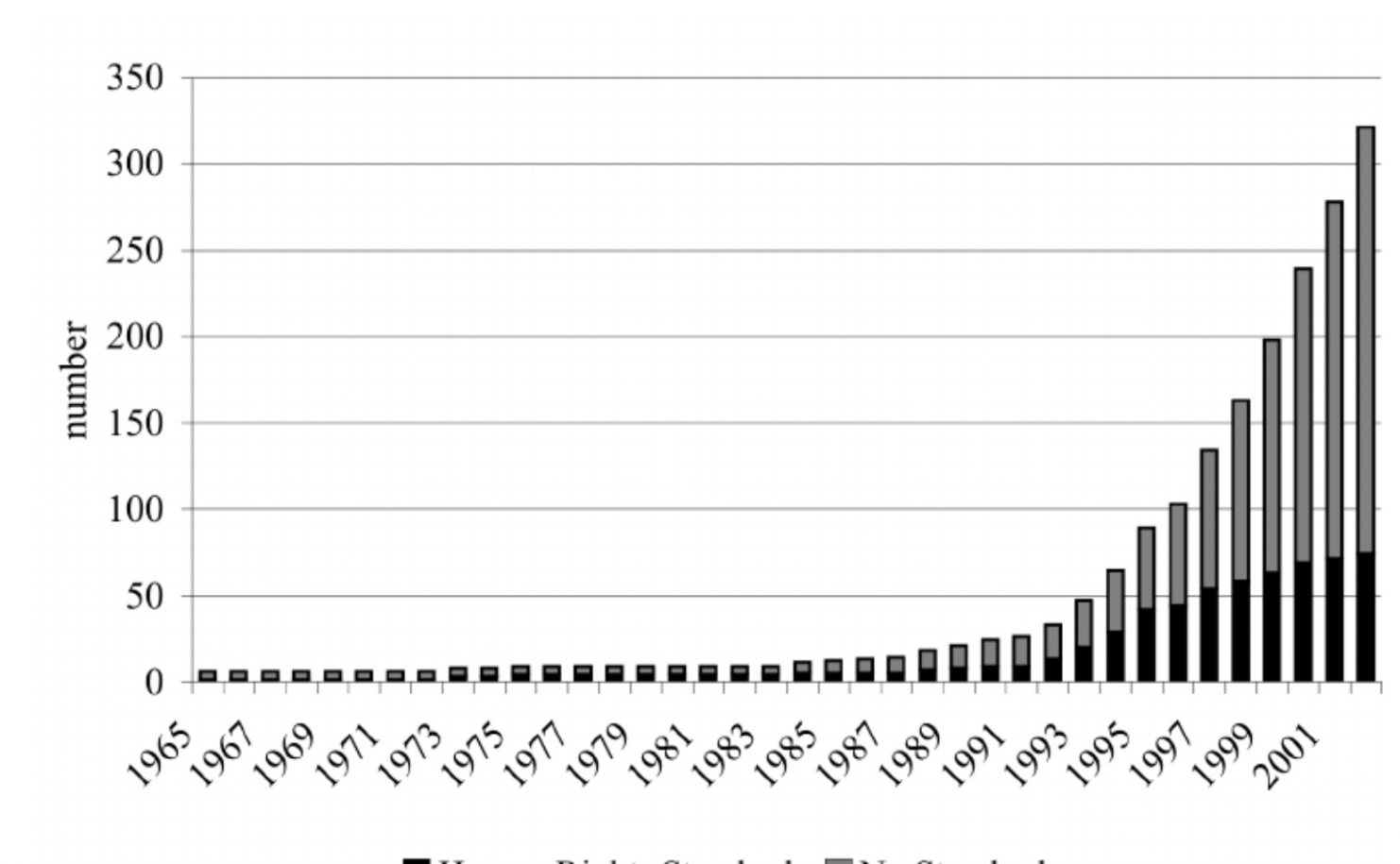
Scholars evaluate that oppression is valued by corrupt leaders because it is a strategy to accumulate wealth or redistribute resources to the most powerful. PTAs are able to coerce leaders to be considerate of human rights because they are able to earn material incentives26. Empirically, when authoritarian regimes are given what they want to stop being repressive, they are likely to accept the offer. These policies are effective (see Figure 4), as the numbers of abuses often skyrocket when standards and agreements are not implemented.
In Figure 4, the x-axis shows the years from 1968 to 2002, and the y-axis shows the number of Preferential Trade Agreements (PTAs). Hafner-Burton synthesizes the data through documents and datasets from Poe and Tate and Gibney, derived from Amnesty International Reports. She merges these into a single repression index, spanning 176 states over two decades. The variable is ordinal, ranging from 1 to 5, where higher values indicate more severe repression. As for the independent variables, she does her own content analysis of every PTA’s formal documents, ranging from treaties, protocols and amendments. She then codes each one for whether it contained explicit human rights language, using the keyword “right” or “rights,” and whether the trade benefits were conditional on human rights compliance or merely declaratory. As such, each bar shows how many PTAs existed that year which included human rights language within the agreement. Each bar is stacked with two components. The black bar represents hard PTAs, which represent hard human rights standards with coercion and risks involved. The gray bar represents PTAs with soft human rights standards (often HRAs), which are often only persuasive or symbolic. The total height of the bar represents a combination of the number of hard and soft PTAs in the specific year reflected by the x-axis. The figure concludes that the number of violations when there are human rights standards is drastically less than no standards, implying that trade agreements with human rights standards can decrease violations.There is clear correlation with time, because from 1968 to the late 1980s, there were very few PTAs that included human rights and almost all of them were HRAs. From the early mid 1990s onward, there was a sharp increase in total PTAs and hard standards became increasingly common. Overall, the figure shows that human rights language with trade incentives is a recent phenomenon, and there is a shift from HRAs to PTAs.
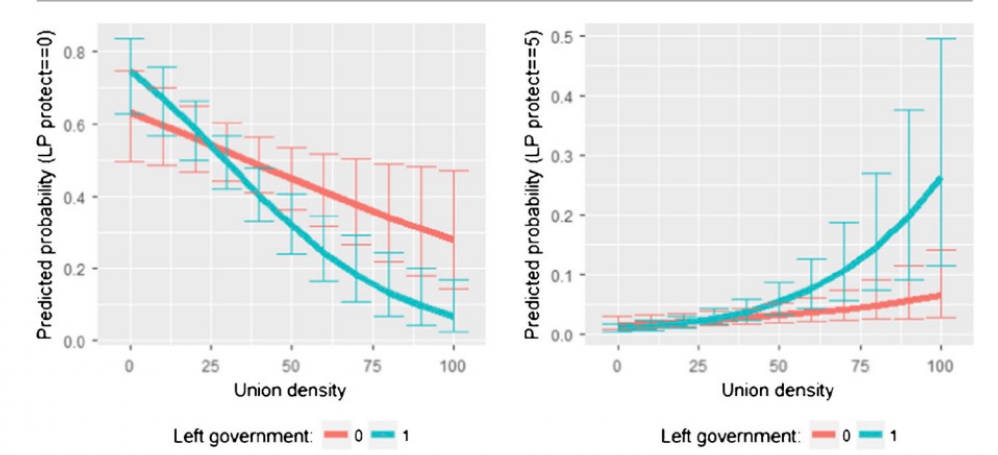
Many PTAs signed over the last twenty years include labor provisions (LPs), which are important in correlation to human rights. LPs within PTAs emerged in the 90s, beginning with NAFTA and expanding past that. Although, it is important to understand that not all PTAs have the same rules or strength when it comes to protecting labor provision; it is dependent on the independent trade deal. Left-wing governments are more likely to include LPs in their PTAs because left-wing parties usually represent workers who rely on salaries, so the left tends to support strict labor regulations and welfare policies27. Union density in left-wing governments is more common because democratic governments are more likely to listen to workers and their needs. When unions are strong, left governments are more likely than non-left governments to include labor protections and the chance of no labor drops faster for left governments as left power rises (see Figure 5). In other words, labor protections are dependent on union density in left governments.
PTA’s have demonstrated empirical success, shown by multiple examples that highlight its coercive features. For instance, in Pakistan, under the EU’s Generalized System of Preferences, Pakistan is granted trade benefits only if it adheres to workers’ rights. In 1995, the Trade Unions Confederation raised concerns about Pakistan’s use of child labor, and the European Parliament confirmed after an investigation that this was true. The European Commission used the threat of a ban on trade and other incentives to push Pakistan into joining the ILO (International Labor Organization) to eliminate child labor. Indeed, Pakistan passed laws to ban child labor and updated the Commission regularly in this process, fostering a system that respects labor rights within their state11.
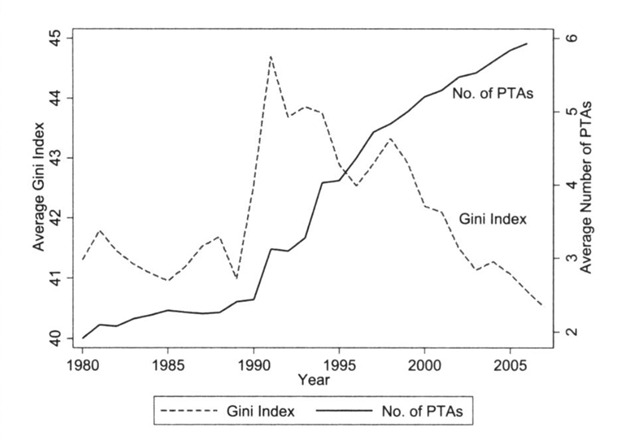
PTAs seem the most sufficient because they empirically have greater success rates than other policies. In addition to that, the methodology that it takes is more compelling than others. In an evaluation of democracies and autocracies, autocracies are more likely to sign PTAs, as they incentivize autocrats to sign favorable agreements on economic policies. Dictators sign PTAs strategically to stabilize regimes and by redistributing gains from trade to labor and reducing inequality. Figure 6 analyzes the correlation between PTAs and average inequality and the average amount of PTAs signed within dictatorships to see if the PTAs signed directly correlate to more equality. The left y-axis displays the Gini index. The Gini index measures the income inequality in a country by scoring a 0 for perfect equality and 100 for perfect inequality. The Gini is computed through collecting household income surveys. Thus, income and consumption is adjusted for household size, inflation, and purchasing power parity (PPP). In this graph, they compute the simple average of the Gini score per year reflected by the x-axis. The right y-axis shows the average number of PTAs implemented. The x-axis of the graph lists the years from 1985 to 2005. It mainly concludes that, as the number of PTAs go up, the Gini index lowers, meaning that PTAs may correlate to lower inequality. This comes to show that PTAs can result in more income equality in autocratic states, which severely improves the quality of economic rights within the state.
The data may be flawed. It shows correlation, not causation, unable to account for alternative causes. A skeptical sign in the graph is when the PTAs slowly increased between the periods of 1990 and 1992, the Gini index had reached its peak, which meant that inequality was still present when PTAs had been implemented. This shows that the downfall of the Gini index could be because of alternative causes, as it is not directly correlated to PTA increase in the data. Alternative causes such as technology, aid, and institutions could also affect inequality (Chang 2016).
Findings
After the analysis of empirical examples, it is concluded that there is no “one size fits all” approach in which a specific economic policy works in every state. In the analysis of sanctions, sanctions are more preferable in partial democracies per Figure 1. FDI may increase the welfare of an economy, but corrupt companies may use authoritarian countries for loose regulations and cheap labor.
Leaders often use popularized strategies and former success rates of economic methods rather than unique social and political aspects of each regime, resulting in incorrect decision making and worsened human rights outcomes. Specifically, Andrews from Oxford explains that leaders make decisions based on their understanding of their country’s role, and how much public benefit they want to create. International organizations that strive for democracy and rights rely on legitimacy for resources and funding.
Thus, international organizations use isomorphic mimicry. Isomorphic mimicry copies the appearance and action of successful policies without underlying analysis. These strategies are forced onto countries unnecessarily, aggravating the issue. Further, Andrews uses the idea of “novelty” to reveal that, although not all new ideas are good, organizations that are able to test and filter new ideas effectively are more likely to have better performing organizations. Analysis and accuracy benefits both the target and the organization or country because their successful solutions are perceived well enough to attract donors28. In order to obtain such success, leaders should use experimentation before full commitment to a policy.
Second, although methods may have scattered successes, the imposition of some policies have better outcomes than others. Among the ones elaborated on, PTAs generally have better outcomes with their coercive nature and consistent time frame; this allows corruption to decrease quickly. International analysis has found that leaders generally repress their citizens because of financial or personal benefit. PTAs force corrupt leaders to push human rights as a priority because of their appealing benefit.
The primary reason corrupt states evade accountability is the absence of consistent oversight. Although countries may check in with regimes, lack of oversight creates doubts on whether rules are being enforced. However, PTA’s allow for leaders to be aware of such benefits and consequences, and increase leadership consistency, because financial offers are rescinded when the regime breaks their side of the deal. This way, international organizations and countries feel more confident that the policies are being carried out. Compared to policies such as FDI and sanctions, which have a much slower time frame and specific rules to success, PTAs can enforce quick, harsh coercion that demand change.
Methods
This paper conducts a literature review that examines the effects of economic policy instruments on human rights outcomes. Rather than presenting original datasets, the paper synthesizes findings from peer-reviewed quantitative studies published between the mid-1990s and the early 2020s. The studies reviewed were identified through searches of JSTOR and major political science and economic journals, with keywords including “human rights,” economic sanctions,” “foreign direct investment,” “preferential trade agreements,” repression,” “political rights,” and “physical integrity rights.” Studies were included if they used established human rights datasets, examined policy instruments, and reported statistically evaluated relationships (n=56). They were excluded if they were theoretical or lacked relevant systematic analysis in human rights and economic policies (n=20).
Figure 7 presents a PRSIMA-compliant flowchart that depicts the systematic record identification, screening, and inclusion process used in the literature review. Initial database searches were conducted across four primary sources: JSTOR, Google Scholar, SSRN, and ResearchGate. The process contained a combined total of 80 records. Records were removed if they lacked relevant analysis, used inadequate data collection methods, or contained duplicates. After the initial removal, 56 records moved on to the screening stage. 20 records were removed because the analysis was generally acceptable, but the data presentation was lacking. The arguments were too similar to those already represented in the review, making their inclusion redundant. The remaining 36 reports were sought for full-text retrieval. Of these, 5 could not be obtained due to paywalls or other access limitations and 3 excess ones were removed due to irrelevant studies or repetitive arguments. A final of 28 studies was included in the review.
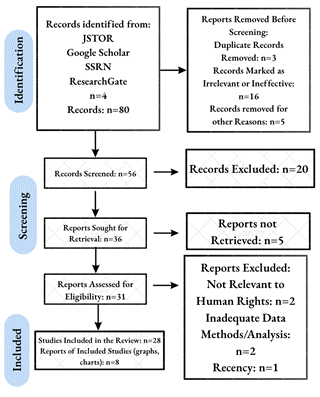
Across the reviewed literature, human rights outcomes are most commonly measured using datasets such as V-Dem, the CIRI HR Dataset, the Gini Index, and the Political Terror Scale. Economic policies are operationalized in different ways which include sanction incidence, severity indicators, foreign direct investment inflows, and coding of preferential trade agreements.
The paper is organized by policy instruments. First, the paper analyzes the most effective regimes for sanctions, and uses ordered probit models to analyze independent variables of political imprisonment and torture—both preferable indicators of human rights. Second, the paper uses Gini indexes, and the IMF’s BoP to outline the effects of FDI. Last, the paper uses an analysis of over two decades to show the correlation between soft and hard human rights through the search of the keyword “right” or “rights” in PTA documents. The second PTA study analyzed finds the correlation between PTAs and labor provisions, concluding that left wing or democratic governments are more likely to enforce labor policies within their PTAs.
Limitations
The literature review has several limitations. To begin, certain sources were omitted due to access restrictions such as subscription requirements and university paywalls, meaning that potentially relevant material may have been excluded from the review. The studies used have limitations as well, which can also deteriorate the full knowledge of the paper. For instance, an issue with Peksen’s (2009)12 study is that while it demonstrates that economic sanctions worsen human rights outcomes, it cannot explain why. Although it proposes 4 distinct mechanisms—elite resource diversion, civilian grievance triggering state repression, it never empirically tests which one is operating. The methodology of the paper is incapable of resolving the question because it detects average effects across many cases instead of tracing the internal political dynamics. Ultimately, the paper tells policymakers what not to do without being able to tell them what to do instead.
Second, there may be biases present in many of the studies in the literature review. Selection bias may be present in several of the studies, as countries that are geographically or linguistically remote, lack NGO infrastructure, or restrict press access will be systematically underreported (Haschke 2022). The Political Terror Scale may also exhibit selection bias, since it only covers what appears in three source reports, and is dependent on their data and definitions. Measurement bias may be present in the CIRI codes the US State Department reports for several of its indicators. Its physical integrity index has four binary indicators, which are torture, extrajudicial killing, political imprisonment, and disappearance, all of which are treated equally and independent. The aggregation creates a ceiling effect because countries that commit all four violations at low frequencies look identical to those that commit them at a massive scale. Additionally, CIRI’s index relies on coder judgement about what crosses the threshold for “frequent” and “occasional” violations, which limit inter-rater reliability benchmarks29. Conceptual bias may be present in V-Dem’s Electoral Democracy index, as it reflects a broad definition of democracy, which tends to detect more democratic decline than narrower measures, even without coder error. The V-Dem index also exhibits selection bias when experts are not randomly sampled but drawn from available specialists. Countries with strong academic and information environments have better coverage and reliable aggregations, whereas less studied regions have fewer qualified coders. Although the Bayesian IRT model can adjust for differences in expert reliability, it cannot fully correct the underlying gaps in expert availability and coverage.
Moreover, while the paper identifies the most favorable conditions for policy implementation, there is no certainty that it is the most effective policy in some scenarios. No universal framework should be applied equally, which is why country-specific analysis is key before any policy is implemented. This involves the examination of a nation’s implementation history, meta-studies of Gini indexes across targeted regions, and accounting for variables that influence policy outcomes. Ultimately, the paper generally argues that a “one size fits all” model does not exist and that unique scenarios require thorough research before policy adoption.
Future Research
The paper opens up avenues for future research. First, policymakers should develop plans that prevent or predict negative outcomes during the adoption process. Engineers and scholars have named this system “fault tolerance,” commonly used in computer science to “tolerate” errors or faults remaining in a system post-development. The two main approaches to fault tolerance are “reactive” and “proactive.” A reactive approach focuses on quick responses after failure occurs and is set to reduce the effect of failure on the overall system. The proactive approach anticipates failure before they happen; it predicts error and replaces the suspected fault components with operative and working components30.
While both methodologies suffice and counter the issue, this paper recommends policymakers to use a proactive approach to predict issues. The paper examined multiple datasets to show how minor policy failures can rapidly produce significant consequences. Predicting and preventing failures before they occur minimizes disruption to systems and the people who depend on them, and is essential to effective implementation. This can be done through human simulation with a base configuration of historical data on the human rights situation in the region of interest, as well as actor analyses on their characteristics and past reaction to economic policies and humanitarian aid. The simulation can examine power asymmetries, cultural factors, institutional behavior, individual psychology, historical grievance, and collective action. Therefore, it increases the likelihood that the model correctly reproduces known patterns to give the most accurate prediction31.
Secondly, a notable gap exists in the current literature on economic policymaking where scholars have extensively examined the conditions necessary for successful policy implementation, but little attention has been devoted to contingency strategies when initial policies fail. A preliminary search on Google Scholar using the keywords “alternative strategies” and “economic policies” (n=48) found no studies which address the specific measures policymakers should adopt in response to economic policy failure.
Consider the case of economic sanctions that may produce unintended consequences. A sound response would involve the withdrawal of the sanction with the provision of humanitarian aid and funding. However, in authoritarian states, host governments seizes the aid and guards it against its people. From the perspective of the sender, the question becomes: what is the most viable solution? These are the questions that future scholarships should engage with.
Conclusion
This paper analyzed different economic methods, including sanctions, Foreign Direct Investment (FDI), and Preferential Trade Agreements (PTAs), to understand what the most effective policy is for improving human rights. A case study of Iraq was used to analyze sanctions on authoritarian regimes and their outcomes. Through a comprehensive literature review, the paper found that economic rights generally increase with sanctions and political rights remain stagnant or decrease. Partial democracies are the most susceptible to sanctions, and should therefore be adequate targets for sanction implementation. However, sanctions on authoritarian regimes may harm political rights and strengthen political terror further. While FDI is known to strengthen income, its correlation to income is reliant on a state’s technological and economic advancement: investors are less likely to invest in politically unstable environments. PTAs are strong politically because of their coercive nature, and human rights standards in trade agreements have significantly less violations than those without standards. The paper concludes that the most favorable economic policy is PTAs because of their regressions; however, there is no certainty that it is the most effective policy in every scenario. No universal framework should be applied equally, which is why country-specific analysis is key before any policy is implemented. Ultimately, this research may be relevant to policymakers in generally arguing that a “one size fits all” model does not exist and that unique scenarios require thorough research before policy adoption. Future research should use “fault tolerance” to provide contingency plans and evaluate strategies to improve the conditions of failed implemented policies.
References
- United Nations. Universal Declaration of Human Rights. United Nations, 1948.https://www.un.org/en/about-us/universal-declaration-of-human-rights, Accessed 13 Apr. 2026 [↩]
- Amar, Vikram David, and Alan Brownstein. “The Hybrid Nature of Political Rights.” Stanford Law Review, vol. 50, no. 3, 1998, pp. 915–1014. JSTOR, https://doi.org/10.2307/1229327. Accessed 28 June 2026 [↩]
- Landau, David, The Reality of Social Rights Enforcement (March 2, 2011). 53 Harvard International Law Journal 189 (2012)., FSU College of Law, Public Law Research Paper No. 488, Available at SSRN: https://ssrn.com/abstract=1774914 [↩]
- Dembour, Marie-Bénédicte. 2010. “What Are Human Rights? Four Schools of Thought.” Human Rights Quarterly, 32(1): 1–20. JSTOR, http://www.jstor.org/stable/40390000, Accessed 13 Apr. 2026 [↩]
- Donnelly, Jack. 1998. “Human Rights: A New Standard of Civilization?” International Affairs, 74(1): 1–23, https://www.jstor.org/stable/2624663, Accessed 13 Apr. 2026 [↩]
- Terman, Rochelle, and Zoltan I. Buzas. 2021. “A House Divided: Norm Fragmentation in the International Human Rights Regime.” International Studies Quarterly, 65: 488–499. https://doi.org/10.1093/isq/sqab019, Accessed 13 Apr. 2026 [↩] [↩]
- Mutua, Makau. 1996. “The ideology of human rights.” Virginia Journal of International Law, 36: 589–657. https://www.researchgate.net/publication/228163745_The_Ideology_of_Human_Rights, Accessed 13 Apr. 2026 [↩]
- Fariss, C. (2014). “Respect for Human Rights Has Improved Over Time.” American Political Science Review, https://doi.org/10.1017/S0003055414000070, Accessed 13 Apr. 2026 [↩]
- Bollen, Kenneth A. “Political Rights and Political Liberties in Nations: An Evaluation of Human Rights Measures, 1950 to 1984.” Human Rights Quarterly, vol. 8, no. 4, 1986, pp. 567–91. JSTOR, Colen, Liesbeth, Miet Maertens, and Jo Swinnen. 2008. “Foreign Direct Investment as an Engine for Economic Growth and Human Development: A Review of the Arguments and Empirical Evidence.” Leuven Centre for Global Governance Studies. https://doi.org/10.1007/BF00183328, Accessed 13 Apr. 2026 [↩] [↩] [↩]
- Minkler, Lanse. “Economic Rights and Political Decision Making.” Human Rights Quarterly, vol. 31, no. 2, 2009, pp. 368–93. JSTOR, http://www.jstor.org/stable/20486756. Accessed 13 Apr. 2026 [↩]
- Hafner-Burton, Emilie M. 2014. “A social science of human rights.” Journal of Peace Research, 51(2): 273–286. https://doi.org/10.1177/0022343313516822. Accessed 15 Mar. 2026 [↩] [↩]
- Peksen, Dursun. 2009. “Better or Worse? The Effect of Economic Sanctions on Human Rights.” Journal of Peace Research, 46(1): 59–77. http://www.jstor.org/stable/27640799. Accessed 13 Apr. 2026 [↩] [↩] [↩]
- Weber, P. M., & Schneider, G. (2022). Post-Cold War sanctioning by the EU, the UN, and the US: Introducing the EUSANCT Dataset. Conflict Management and Peace Science, 39(1), 3–27. https://doi.org/10.1177/0738894220948729 [↩]
- Zarpli, O. (2022). “When Do Imposed Sanctions Work? The Role of Target Regime Type.” Journal of Conflict Resolution, 67(7-8), 1482-1509. https://doi.org/10.1177/00220027221139809, Accessed 13 Apr. 2026 [↩] [↩]
- Gutmann, Jerg, Matthias Neuenkirch, and Florian Neumeier. 2019. Precision-guided or blunt? The effects of US economic sanctions on human rights. Public Choice, 185: 161–182. https://doi.org/10.1007/s11127-019-00746-9, Accessed 13 Apr. 2026 [↩]
- Haggard, S. & Noland, M. — Sanctioning North Korea: The Political Economy of Denuclearization and Proliferation (2010), http://dx.doi.org/10.2139/ssrn.1437681 [↩]
- Fisk, Daniel, (2000). “Economic Sanctions: The Cuba Embargo Revisited.” In: S. Chan and A.C. Drury (eds), Sanctions as Economic Statecraft. Palgrave Macmillan, London. https://doi.org/10.1057/9780230596979_4 [↩]
- Drezner, Daniel W. 2019. “Counter-hegemonic strategies in the global economy.” Security Studies, 28(3): 505–531. https://doi.org/10.1080/09636412.2019.1604985, Accessed 13 Apr. 2026 [↩]
- Weiss, Thomas G. “Sanctions Enforcer: Economic Sanctions and the Oil-for-Food Program.” The United Nations and Changing World Politics, edited by Thomas G. Weiss and Sam Daws, Westview Press, 2007, pp. 149–168. https://doi.org/10.1093/0199278571.003.0005, Accessed 13 Apr. 2026 [↩]
- Duce, M., & de España, B. 2003. Definitions of Foreign Direct Investment (FDI): A methodological note. Banco de España, 6: 43–49. https://www.researchgate.net/publication/228588548_Definitions_of_Foreign_Direct_Investment_FDI_a_methodological_note, Accessed 13 Apr. 2026 [↩]
- Barry, Colin M., et al. 2013. “Avoiding the Spotlight: Human Rights Shaming and Foreign Direct Investment.” International Studies Quarterly, 57(3): 532–544. JSTOR, https://doi.org/10.1111/isqu.12039, Accessed 13 Apr. 2026 [↩] [↩]
- Janz, N. 2018. “Foreign direct investment and repression: An analysis across industry sectors.” Journal of Human Rights, 17: 163–183. https://doi.org/10.1080/14754835.2017.1306691. Accessed 20 Mar. 2026 [↩]
- Figini, Paolo, and Holger Görg. “Does Foreign Direct Investment Affect Wage Inequality? An Empirical Investigation.” The World Economy, vol. 34, no. 9, 2011, pp. 1455–1475. https://doi.org/10.1111/j.1467-9701.2011.01397.x, Accessed 13 Apr. 2026 [↩]
- World Bank. (2024). Foreign direct investment, net inflows (% of GDP) [Data set]. World Development Indicators. https://data.worldbank.org/indicator/BX.KLT.DINV.WD.GD.ZS, Accessed 13 Apr. 2026 [↩]
- Lechner, Lisa. 2016. “The Domestic Battle Over the Design of Non-Trade Issues in Preferential Trade Agreements.” Review of International Political Economy, 23(5): 840–871. https://doi.org/10.1080/09692290.2016.1231130, Accessed 13 Apr. 2026 [↩]
- Hafner-Burton, Emilie M. 2005. “Trading Human Rights: How Preferential Trade Agreements Influence Government Repression.” International Organization, 59(3): 593–629. http://www.jstor.org/stable/3877810. Accessed 13 Apr. 2026 [↩] [↩] [↩]
- Raess, Damian, Andreas Dür, and Dora Sari. 2018. “Protecting labor rights in preferential trade agreements: The role of trade unions, left governments, and skilled labor.” The Review of International Organizations, 13(2): 143–162. https://doi.org/10.1007/s11558-018-9301-z, Accessed Apr. 13 2026 [↩]
- Andrews, Matt, Lant Pritchett, and Michael Woolcock. 2017. Looking like a state: The seduction of isomorphic mimicry. In Building state capability: Evidence, analysis, action, pp. 29-52. https://doi.org/10.1093/acprof:oso/9780198747482.003.0003, Accessed 13 Apr. 2026 [↩]
- Nieman, M., Ring, J. The Construction of Human Rights: Accounting For Systematic Bias in Common Human Rights Measures. Eur Polit Sci 14, 473–495 (2015). https://doi.org/10.1057/eps.2015.60 [↩]
- Bala, Anju, and Inderveer Chana. Fault Tolerance-Challenges, Techniques and Implementation in Cloud Computing. Jan. 2012. https://doi.org/10.46243/JST.2022.V7.I010.PP30-34 Accessed 13 Apr. 2026 [↩]
- Diallo, Saikou, et al. Human Simulation: Perspectives, Insights, and Applications. 2019. https://doi.org/10.1007/978-3-030-17090-5, Accessed 13 Apr. 2026 [↩]