

Abstract
This paper examines how persistent seasonal labor shortages arise in tourism dependent economies such as Ocean City, Maryland, and focuses on the interaction of federal labor supply shocks with local housing inelasticity, rather than shocks alone. I frame housing as a complementary input to labor supply, explaining how such constraints in the housing supply amplify and prolong the labor shortage. This paper uses a mixed method approach to analyze seasonal labor shortages in Ocean City. The analysis sources from J-1 visa participation data, Ocean City housing statistics, and local reporting. Government statistics provide quantitative evidence, while news sources provide qualitative evidence into firm-level responses. Altogether, these sources prove that while national J-1 participation recovered to pre-pandemic levels by 2023, Ocean City’s seasonal workforce remains well below equilibrium. This divergence indicates that local constraints, and not only national constraints prevent the labor market from stabilizing. The paper adds to the literature on labor market disequilibrium by identifying the causes of seasonal labor shortages and why economies fail to re-equilibrate after exogenous shocks. Finally, the paper offers a specialized housing solution for Ocean City and other resort towns to solve the housing shortage. This model is based on estimates and approaches taken by other cities facing the same housing and seasonal labor shortages.
Keywords: housing inelasticity, market constraints, seasonal labor, demand, supply, equilibrium
Introduction
Ocean City is a beach resort town on the eastern shore of Maryland. Despite having a permanent population of approximately 6,800 residents, the town attracts 8 million annual visitors; the vast majority concentrated during the summer months. This seasonal influx drives economic activity as tourists patronize the 200+ dining establishments in Ocean City or one of the 100,000 hotel rooms in the town.
The seasonal nature of work creates demand for many part-time and seasonal workers, and this gap in the employment supply and quantity demanded is typically filled by seasonal workers, including J-1 visa holders. According to the Ocean City Chamber of Commerce Executive Director Melanie Pursel, J-1 visa holders account for about a third of the total seasonal workforce; or about 4,000 workers during the summer months of June, July, and August1. This constant summer flow of employees on J-1 visas helped staff the Ocean City hospitality industry during the peak summer months.
This seasonal labor-based model has worked as long as there was market equilibrium, which is defined by pre-pandemic 2019 seasonal worker numbers, with around 12,000 seasonal workers. This equilibrium was heavily reliant on a steady J-1 supply that supplied around 4,000 of the 12,000 seasonal workers. Peak months in 2019 suggested a stable labor market, with many businesses running on full staffing at full capacity. By contrast, observations in 2023 revealed massive town-wide staffing shortages. As of 2025, the workforce has not recovered to 2019 levels. This development over the past 5 years outlines a shift from the earlier seasonal labor equilibrium toward a persistently tighter labor market. Ocean City’s dependence on external seasonal labor makes its economy vulnerable to macroeconomic shocks that affect seasonal labor supply.
Additionally, evidence suggests that Ocean City’s housing market has shifted towards high-end residential housing, leading to higher living costs. Evidence on seasonal labor reliance and housing costs is drawn from U.S. State Department J-1 visa data, Ocean City Comprehensive Plans, and local reporting on rental and housing market conditions. Businesses control neither J-1 visa regulations on a federal level nor housing on a local level yet are exposed to the constraints both have created on the seasonal labor market. J-1 visa policy changes are determined at the federal level and are unrelated to local labor demand or housing conditions within Ocean City.
Ocean City is not alone in its struggle. Tourism in the United States has grown after the pandemic, and the hospitality industry likewise experienced growth after the pandemic contraction. Despite a growth in tourism demand and growth in business supply, many resort towns continue to face persistent labor shortages. The number of hospitality-oriented businesses has grown, but a complementary input (necessary inputs for a result) for these businesses, labor, has failed to grow with seasonal labor demand. Standard economic intuition would predict that businesses in attractive locations should be able to recruit more easily; however, many tourism-based, seasonal destinations experience persistent staffing shortages.
This paper asks: why do seasonal labor shortages persist in tourism economies even after the macroeconomic labor supply shocks subside? I suggest that labor shortages occur as an effect of labor shocks and inelastic housing. Additionally, the paper identifies the economic dynamic that correlated with the labor disequilibrium: after federal J-1 restrictions reduced the workers entering the country, this strained number was further reduced by the unaffordable local housing market. Conversely, the mechanism also works from bottom-up: unaffordable local housing constrains the intake of seasonal labor and is positively related with sustained seasonal labor shortages; even after macroeconomic recovery.
Beginning with market context, the paper transitions to how Ocean City staffing shortages occur after federal reductions in J-1 labor supply, how the local housing market prices out seasonal workers, and the strategies Ocean City businesses use to deal with the labor market disequilibrium, so as to balance labor supply with demand. Finally, the paper proposes a large-scale housing solution to the structural labor shortage.
Literature Review
Following the introduction of “America First” labor policies during the pandemic, J1 visa acceptances dropped substantially nationwide. Proclamation 10052, issued in June 20202, suspended most J1 visa processing, including summer work-travel programs (SWT); programs that Ocean City relies on for around 1/3 of the seasonal workforce. In labor market, this policy imposed a shift in the effective labor supply curve for seasonal hospitality workers. Proclamation 10052 was an exogenous—or external— labor supply shock that acted as a binding quantity constraint, resulting in staffing shortages across the hospitality industry. While Ocean City typically welcomed around 4,000 J-1 visa workers, the pandemic-era visa restrictions led to nearly zero J-1 visa workers in 2020.
| Program Begin Date Year | |||||||||||||
| CATEGORY | 2015 | 2016 | 2017 | 2018 | 2019 | 2020 | 2021 | 2022 | 2023 | 2024 | 2025 | Grand Total | |
| ALIEN PHYSICIAN | 2,567 | 2,625 | 2,832 | 2,738 | 2,912 | 2,858 | 3,192 | 3,302 | 3,714 | 4,285 | 4,635 | 35,660 | |
| AU PAIR | 17,589 | 19,237 | 20,353 | 20,680 | 21,554 | 7,179 | 16,543 | 21,482 | 21,422 | 19,408 | 16,840 | 202,287 | |
| CAMP COUNSELOR | 21,206 | 22,994 | 24,868 | 24,917 | 25,682 | 219 | 5,856 | 21,869 | 28,640 | 32,079 | 32,470 | 240,800 | |
| GOVERNMENT VISITOR | 3,990 | 5,495 | 4,768 | 4,998 | 3,501 | 267 | 28 | 2,788 | 2,689 | 2,470 | 1,252 | 32,246 | |
| INTERN | 24,506 | 25,696 | 26,367 | 26,147 | 26,780 | 6,470 | 5,521 | 17,101 | 19,067 | 18,719 | 16,877 | 213,251 | |
| INTERNATIONAL VISITOR | 5,568 | 5,304 | 6,272 | 6,312 | 6,483 | 1,060 | 81 | 4,599 | 5,871 | 5,369 | 3,928 | 50,847 | |
| PROFESSOR | 1,331 | 1,223 | 1,118 | 1,079 | 930 | 251 | 486 | 774 | 718 | 704 | 585 | 9,199 | |
| RESEARCH SCHOLAR | 36,083 | 36,317 | 34,848 | 34,021 | 32,822 | 10,533 | 16,629 | 23,921 | 24,548 | 24,067 | 17,622 | 291,411 | |
| SHORT-TERM SCHOLAR | 20,896 | 20,049 | 19,764 | 18,890 | 19,069 | 3,933 | 3,849 | 12,446 | 13,963 | 14,488 | 11,188 | 158,535 | |
| SPECIALIST | 1,103 | 1,332 | 1,359 | 1,350 | 1,454 | 363 | 756 | 1,806 | 1,482 | 1,289 | 1,148 | 13,442 | |
| STUDENT COLLEGE UNIVERSITY | 51,270 | 46,801 | 46,720 | 46,679 | 47,557 | 11,938 | 20,304 | 36,549 | 35,293 | 35,910 | 32,102 | 411,123 | |
| STUDENT SECONDARY | 24,948 | 24,011 | 22,965 | 23,525 | 23,558 | 4,795 | 18,525 | 21,144 | 20,114 | 19,077 | 17,863 | 220,525 | |
| SUMMER TRAVEL/WORK | 95,039 | 101,404 | 104,992 | 104,624 | 108,501 | 4,991 | 40,818 | 93,286 | 103,856 | 107,228 | 104,609 | 969,348 | |
| TEACHER | 2,526 | 2.726 | 2,880 | 3,258 | 3,458 | 402 | 4,280 | 5,775 | 6,774 | 6,780 | 5,276 | 44,135 | |
| TRAINEE | 10,523 | 10.862 | 10,948 | 10,894 | 10,650 | 2,541 | 4,052 | 10,807 | 10,672 | 9,821 | 8,605 | 100,375 | |
| Grand Total | 319,145 | 326,076 | 331,054 | 330,112 | 334,911 | 57,800 | 140,920 | 277,649 | 298,823 | 301,694 | 275,000 | 2,993,184 | |
Nationally, participation in the J-1 Summer Work Travel (SWT) program declined sharply following the moratorium of 2020. SWT participation was 108,501 nationally in 2019, but after the cuts in June of 2020, the number fell to 4,991, representing a 95.4% drop in J-1 seasonal workers nationally. To fully gauge the effects, a Bartik Shock Model was run to predict the effect that the J-1 visa cuts had on Ocean City’s labor force compared to other cities.
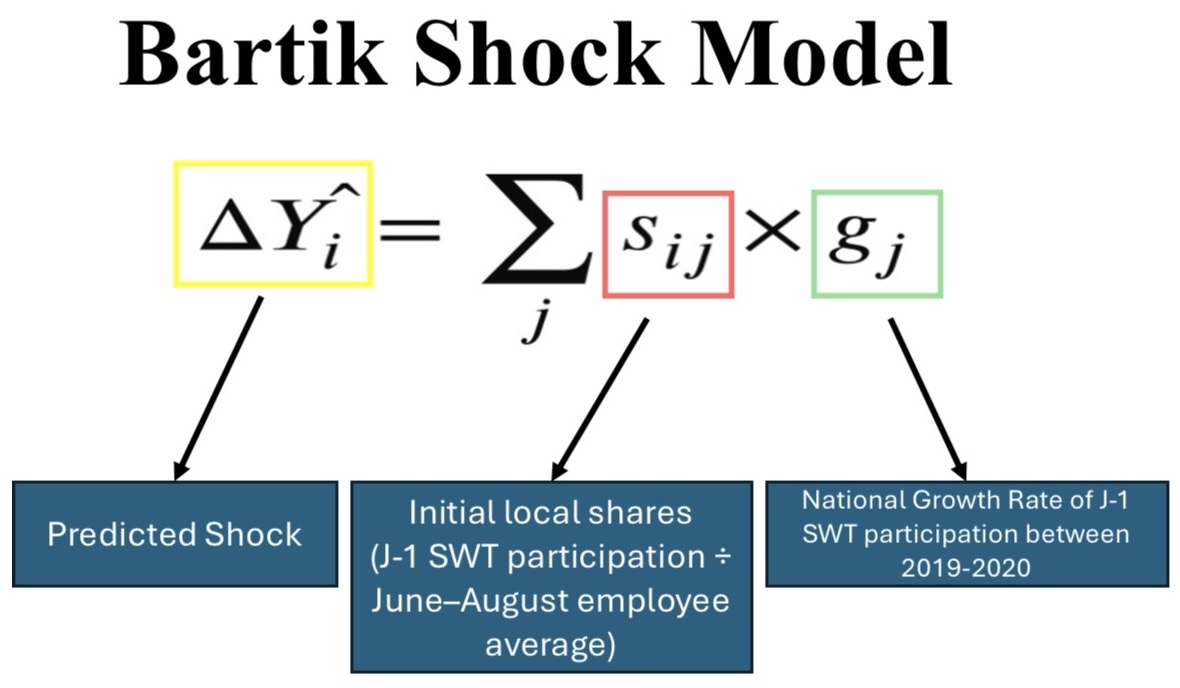
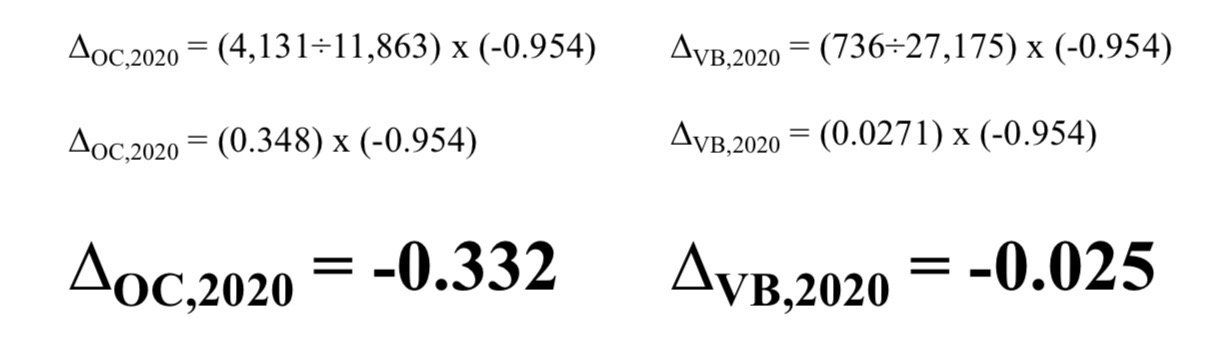
Ocean City’s disproportionally high baseline reliance on J-1 workers makes it particularly vulnerable to macroeconomic shocks, whereas Virginia Beach, that had a diversified labor pool was significantly less vulnerable. Further, although J-1 workers returned to the city in 2021, the labor market has yet to return to the 2019 equilibrium.
| Ocean CIty SWT | Ocean City Index | National SWT | National Index | |
| 2019 | 4,116 | 100 | 108,501 | 100 |
| 2020 | 98 | 0 | 4,991 | 5 |
| 2021 | 1,740 | 42 | 40,818 | 38 |
| 2022 | 2,000 | 49 | 93,286 | 86 |
| 2023 | 2,900 | 70 | 103,856 | 96 |
| 2024 | 3,355 | 82 | 107,228 | 99 |
| 2025 | 3,678 | 89 | 104,609 | 96 |
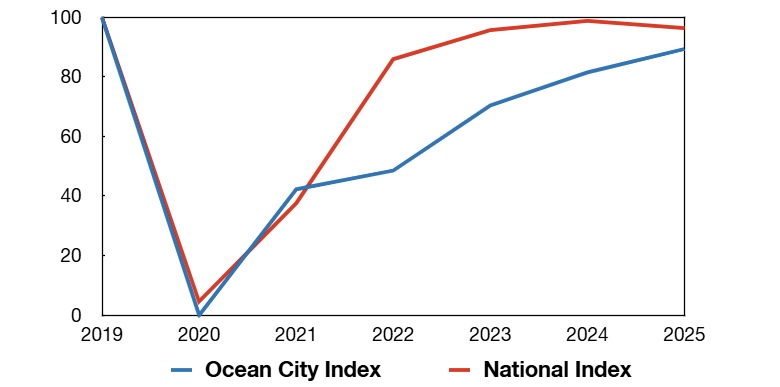
Figure 3 illustrates the divergence between national and local recovery by indexing J-1 participation to pre-pandemic levels. While minor visa slowdowns occurred in 20253 and 20264, quantitative trends from Figure 1 prove that these were inconsequential. While J-1 participation nationally had recovered to pre-COVID levels by 2023, Ocean City’s remained in a 30% deficit and had yet to recover to 2019 levels. The shift-share model proved that a macroeconomic shift’s impact on a location is determined by the preexisting microeconomic conditions. Therefore, while J-1 restrictions caused the initial labor shock in 2020, quantitative trends point to a different reason for why Ocean City’s recovery has been slower than the rest of the country’s.
Housing Constraints on Labor Supply
While the exogenous labor shocks detailed in Section 3 ignited the labor shortage, there is a different constraint that is slowing or preventing economic recovery. While there are many other factors contributing to the labor market disequilibrium—such as competition or demographic shift, this paper specifically points to housing as the main constraint for the sustained labor shortage.
There is an abundance of literature on the effects of housing constraint on labor supply. In an Austrian Institute of Economic Research paper M. Klien and M. Weingärtler’s observed that Salzburg has one of the highest rates of job vacancies in Austria, and a pronounced labor shortage in the service industry; in contrast with the rest of the country. This shortage aligned with the expectation that low-income workers would struggle to afford Salzburg’s high housing costs, which are amongst the highest in the country. Further, the study found the assumed connection between housing cost burden and job vacancies is particularly evident in the accommodations and food service industry. Affordable housing shortages are correlated with labor shortages in low-income sectors, through increased emigration and reduced immigration. They found that this trend had been active before the COVID pandemic, which exacerbated the labor shortage through worker turnover. This could be the case for Ocean City, as prohibitive housing costs prevent new workers from joining the small permanent workforce. While a multitude of factors create labor shortages, Klien and Weingärtler’s study on housing economics suggests housing is a relevant factor in the creation labor shortages5. We can predict that the effect housing costs have on seasonal labor shortages is likely stronger in Ocean City due to high housing prices and the small permanent workforce. Other hypotheses for the sustained labor shortage have notable flaws. For example, external competition for SWT J-1 workers is not a plausible factor, since beach resort towns in direct competition with Ocean City on average experienced 14% decline in SWT participation, meaning external competition was not likely a factor6,7. Further, a change in age demographics is also not a plausible explanation for the sustained labor shortage, as it has not changed considerably between 2019 and 20256,7. Therefore, data suggests that housing is the main constraint.
Ocean City receives around 12,000 seasonal workers, with around 3,000-4,000 J-1 visa holders, which requires affordable seasonal housing so they can work. However, summer workforce rentals are sparse, and even when they exist can far exceed a student’s, or seasonal worker’s budget, making seasonal employment in Ocean City increasingly infeasible for these temporary workers8.
| Ocean City town, Maryland | Census Tract 9500; Worcester County; Maryland | Census Tract 9500; Worcester County; Maryland | Census Tract 9500; Worcester County; Maryland | |||||
| Label | Count | Percent | Count | Percent | Count | Percent | Count | Percent |
| HOUSING OCCUPANCY | ||||||||
| Total housing units | 30,028 | 100.00% | 5,705 | 100.00% | 12,947 | 100.00% | 11,608 | 100.00% |
| Occupied housing units | 3,820 | 12.70% | 1,029 | 18.00% | 1,046 | 8.10% | 1,777 | 15.30% |
| Vacant housing units | 26.208 | 87.30% | 4.676 | 82.00% | 11,901 | 91.90% | 9,831 | 84.70% |
| For rent | 1,392 | 4.60% | 208 | 3.60% | 884 | 6.80% | 302 | 2.60% |
| Rented, not occupied | 428 | 1.40% | 58 | 1.00% | 356 | 2.70% | 15 | 0.10% |
| For sale only | 125 | 0.40% | 21 | 0.40% | 40 | 0.30% | 66 | 0.60% |
| Sold, not occupied | 177 | 0.60% | 28 | 0.50% | 137 | 1.10% | 12 | 0.10% |
| For seasonal, recreational, or occasional use | 23,803 | 79.30% | 4,227 | 74.10% | 10,398 | 80.30% | 9,372 | 80.70% |
| AII other vacants | 283 | 0.90% | 134 | 2.30% | 86 | 0.70% | 64 | 0.60% |
| HOUSING TENURE | ||||||||
| Occupied housing units | 3,820 | 100.00% | 1,029 | 100.00% | 1,046 | 100.00% | 1,777 | 100.00% |
| Owner-occupied housing units | 2,576 | 67.40% | 525 | 51.00% | 748 | 71.50% | 1,335 | 75.10% |
| Renter-occupied housing units | 1,244 | 32.60% | 504 | 49.00% | 298 | 28.50% | 442 | 24.90% |
Source: U.S. Census 2020 DP1 Housing Tenure
Table 2 | Table 6-4. Housing Tenure (2020). Notice 87% of all housing units in Ocean City are considered vacant, with nearly 23,000 units occupied seasonally, likely second homes. Out of all occupied housing units, around a third are inhabited by renters. Source: US Census 2020 DP1 via Town of Ocean City Comprehensive Plan (2025)
Data from the 2020 Housing Tenure indicates that the issue lies not in a lack of housing, but in the allocation. Only 12.7% is considered occupied, leaving 87.3% vacant for most of the year. 79.3% of all houses are classified as “seasonal or occasional use,” and lie vacant for most of the year. Many of these houses are occupied solely in the Summer, coinciding with peak seasonal worker housing demand, preventing additional units from being available on the rental market. In fact, only 1,392 units are even up for rent. The cheap seasonal rentals that seasonal workers took advantage of before the 2000s no longer exist in this economy.
These vacancies suggest that the Ocean City housing market is following a broader economic trend where wealth, being driven by mobility and hyper consumption, is increasingly being invested into second homes. Housing is being increasingly being treated as a financial asset for growth rather than for its actual purpose9. Ocean City’s appeal as a beach town likely attracts investors who view the property in Ocean City as a high yield investment and wealthy individuals looking for second homes for leisure.
This leads to direct competition for housing between theses individuals and seasonal workers. This situation plays into a fundamental question of economics: How are scarce resources allocated amidst unlimited want? According to M. Klien and M. Weingärtler, high real estate costs place a disproportionate amount of purchasing power with wealthy individuals as low income and seasonal workers that aren’t able to afford the properties are forced out of the market5. Ocean City’s naturally constrained land supply and status as a popular beach town lead to strong interest and competition for houses on the island. In line with Klien’s assertion, it has been accepted on the municipal level that this rise in second homes has raised housing prices. This has led to a constrained rental housing supply, also raising rental costs10.
While the previous paragraphs suggest reasons for the lack of worker housing, the next few paragraphs aim to answer how rental costs have also become a block for sessional workers. The Ocean City Chamber of Commerce defines affordable housing as ‘housing with costs not exceeding 30% of a household’s gross total income11.’ With so few units available for seasonal rent, and competing demand from nearly 3,000 seasonal J-1 visa workers, prices have become financially burdensome or unaffordable for most J-1 workers. This artificial supply constriction makes most housing unaffordable and burdensome for the seasonal workers.
Evidence from the Housing Report in the Ocean City Comprehensive Plan of 2025 shows that around 61% of renters experience housing burden. The Ocean City average of 61% of renters housing burdened is higher than Maryland’s average of 53% and national average of 49.5%. The situation has gotten so bad as to the point that 41% of renters reported they have had to reduce spending on essential needs such as food in order to cover housing costs10. The Baltimore Banner reports that some J-1 students have had to share their housing with 9 roommates12: conditions that are disappointing for a town that operated on a $165.5 million municipal budget in 2025. In fact, many local sources such as the OC Today-Dispatch and Delmarva Now also attribute the slow recovery of J-1 visa worker populations to a lack of affordable housing.
While the Ocean City government has stepped in to alleviate the housing crisis, regulatory barriers still remain. Additionally, the local government has inadvertently placed many obstacles to businesses on top of federal barriers. The strict government imposed local zoning laws in particular, have been problematic. In M. Klien and M. Weingärtler’s study on the effects of high housing costs, they found that increased housing costs are causally linked with increasingly restrictive government zoning regulations. These increased costs place a disproportionate amount of purchasing power with wealthy individuals as low income and seasonal workers that aren’t able to afford the properties are forced out of the market5.
Further, zoning restrictions artificially constrain housing supply and prevent the creation of new housing units. John Fager is the owner of Fager’s Island, a famous restaurant and bar that employs more than a hundred J-1 workers each summer. He sums up many business owners’ frustrations in his interview with WDMT, channel 47. “But because of regulations and because of zoning and because of the fire marshal requirements, so when it becomes so expensive to do with special treatments,” Fager said. “It just increases the costs, our little building for example for 12 students the fire Marshall added about 75,000 in costs13.” Ocean City businesses attempting to vertically integrate housing face difficult zoning and fire requirements that make construction expensive. These regulatory barriers prevent local business owners who are building a solution themselves by introducing enormous regulatory costs that effectively prevent them from doing so. This effectively creates an inelastic housing supply, meaning that despite high demand, the number of new homes does not rise accordingly. In effect, housing availability functions as a binding constraint on labor supply, limiting the capacity of seasonal workers whom the town relies on for summer labor.
Eventually, these factors add up to an unaffordable reality. This suggests that the leisure home market in Ocean City has led to economic disintermediation, where much of the housing is luxury priced and there is no median housing availability. Affordable housing is a necessary condition for seasonal labor supply—you can’t work if you don’t have a place to stay for the other 16 hours. As the housing market becomes increasingly unaffordable for seasonal workers, they will begin seeking outside options at higher rates. Without targeted policy adjustments to address workforce housing constraints, Ocean City risks undermining the labor supply its economy depends on.
Government and Business responses to Labor Market Disequilibrium
The Ocean City government has attempted to address the labor shortage, but it has proven to be a significant challenge for the government. Unfortunately, regarding federal J-1 restrictions, Ocean City has little input as national macroeconomic policy is determined by the government which acts for the aggregate of millions of firms. If the government wants less J-1 workers, then there will be less J-1 workers; there is little Ocean City, or any other city for that matter, can do about it and must shoulder the cost. Instead, Ocean City focuses on microeconomic intervention, such as the local housing crisis or incentivizing domestic workers, as a means to improve the local hospitality industry.
However, while the Ocean City government acknowledges the severity of the situation, it remains relatively dormant in any sort of tangible response to the microeconomic housing shortage. The idea is often unpopular and lacks economic justification, making it hard to carry out. Fager admits: “The economics of it don’t work. You spend a lot of money building let’s say a dormitory-style facility and it’s only occupied for 4 months out of the year.13.” However, owners remain disappointed that the planning committee fails to address the seasonal housing crisis considering how much of importance it is for local industry.
As of April 2026, there are no municipal housing projects underway specifically for J-1 visa workers. Instead, Ocean City maintains its approach of offering “incentives” for affordable housing, such as a new housing zone. The new housing zone allows businesses to build housing without the typical parking or height restrictions. The Ocean City Development Corporation (OCDC) is a state funded non-profit organization that provides grants and tax credits to developers who create workforce housing.
However, these solutions have done little to move the proverbial needle. The new housing zone does remove some legal barriers to building more apartments; however, it does not reduce compliance costs, which were a huge barrier for businesses such as Fager’s Island aiming to build private J-1 housing. OCDC grants are often pennies compared to the opportunity cost of building seasonal worker housing instead of luxury condos. While these new developments in theory encourage developers to build J-1 worker housing, nothing of substance has been achieved. The only housing project for J-1 workers as of 2026 is a renovation of the second floor of a post office, creating 10 new beds.
As a result, neither federal nor local housing policy has meaningfully expanded the effective supply of seasonal labor. The sector hardest hit by this sustained shortage is the Accommodation and Food category, which includes hotels and restaurants11. This sector drives employment in Ocean City, accounting for 20% of all employment in city10 and is the primary driver of J-1 worker demand. Thus, any constraint on seasonal labor such as visa restrictions or a lack of affordable housing is of particular concern to these businesses. In order to adapt to these worker shortages, Ocean City businesses have resorted to multiple measures to guard against the volatile labor supply This study observed 3 main methods used by businesses to adapt to the seasonal worker shortage.
Limiting service
One strategy that was prevalent among Ocean City restaurants in particular, was limiting service. Dumser’s Dairyland is a famous Ocean City restaurant that serves ice cream at 7 locations in Ocean City— including 3 on the Boardwalk. Founded in 1939, the company has survived through many turbulent periods throughout its history and has emerged as an iconic business of the town.
However, it doesn’t make the 87-year-old business immune to supply side constraints. Brittany Flurer, the general manager of the Dumser’s Dairyland on 123rd Street of Ocean City noted in 2022 that they often had to block off tables due to a lack of servers. They also limited service hours on certain days where they would close a couple of hours earlier— such as 8 p.m instead of 10 p.m —to ensure that the demand was met with adequate service14.
Even in 2021, businesses such as Shenanigan’s Irish Pub15 and the Dough Roller16 faced issues in recruiting seasonal workers per CBS Baltimore and DelmarvaNow. The Dough Roller in particular, was hit hard, cutting 12 hours weekly due to staffing16. The losses suffered by the company eventually forced it to close its hallmark West Ocean City location17, yet another casualty of the ongoing labor crisis.
However, this strategy isn’t feasible in the long run. Businesses in Ocean City lost a combined $24 million due to shortages in staffing,18 which led to reduced service and, consequently, reduced revenue. In order to truly solve the labor issue there needs to be a fundamental restructuring of the labor market which leads into the second solution.
Recruiting full-time workers
The second strategy that was observed in Ocean City businesses was an increase in the recruitment of year-round workers. The town government, in conjunction with local businesses and non-profit organizations, seeks to increase off-season visitation with the development of festivals, entertainment, and sporting events11. A year-round destination would require a large workforce that is available year-round. In order to accomplish this, the idea has been to continue to bring in more workers, both seasonal and year-round19. The recent expansion into also recruiting year-round workers suggests that as Ocean City aims to become a year long destination, businesses are increasingly looking toward year-round workers to fill roles.
However, a workforce comprised of year-round participants remains out of reach currently. While Ocean City hosts many popular offseason events such as Springfest or Sunfest, it is by no means a year-round destination yet.
| Table 1-9 Population Density— 2020 | ||
| Population type | Population | Density (Persons per square mile) |
| Year-Round Population | 6,844 | 1,521 |
| Winter (Average Weekend) | 74,690 | 16,746 |
| Spring (Average Weekend) | 125,781 | 28,202 |
| Summer (Average Weekend) | 277,932 | 62,316 |
| Fall (Average Weekend) | 140,174 | 31,429 |
Still, some businesses like the famed nightclub Seacrets have upgraded many of their seasonal positions to full time. This trend is reflected in the following Figure:
| Seasonal Workers | Yearly Workers | |
| 2020 | 5640 | 5593 |
| 2021 | 8390 | 4858 |
| 2022 | 6068 | 5293 |
| 2023 | 7220 | 5650 |
| 2024 | 8021 | 6277 |
| 2025 | 7441 | 6158 |
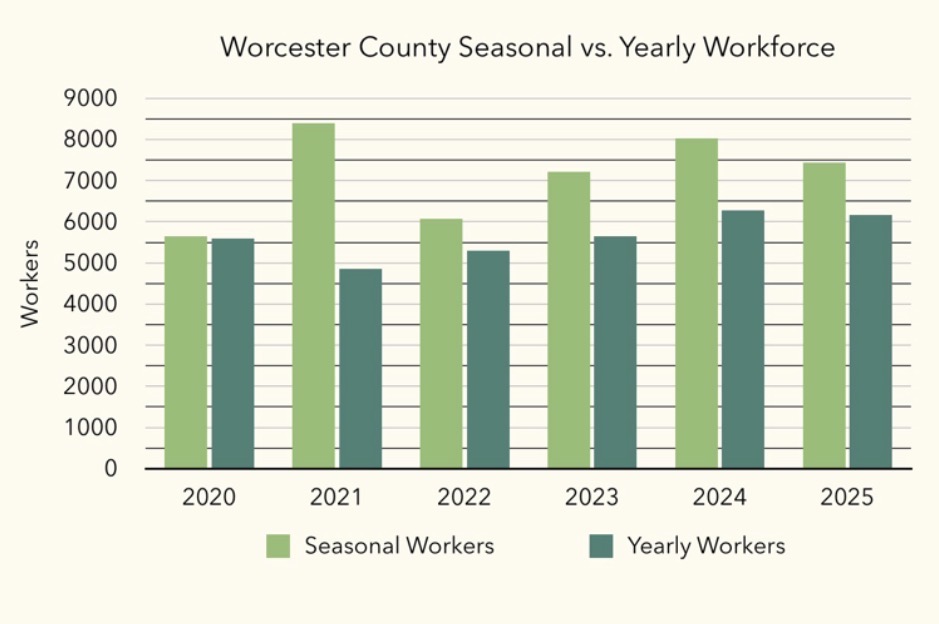
Again, however, this plan isn’t without its faults. The average income of an Accommodation and Food Services worker in Ocean City is $32,924, while the income requirement for the rental of a one-bedroom dwelling was $76,705 in order not to be housing burdened10. Additionally, for some businesses and especially restaurants, the math of paying workers full-time wages do not make economic sense. During the offseason, the smaller marginal revenue does not offset the marginal cost of paying the salary of full-time worker for a restaurant. Most small and medium businesses cannot afford this cost, and so many remain reliant on seasonal workers during the summer months and retain a small workforce to staff during the offseason when business is slower. This leaves them vulnerable to macroeconomic policies causing labor fluctuations and the sustained labor shortage.
Offering Better Benefits
The third main strategy I observed among businesses, especially restaurants, was offering better wages and benefits to their employees. The state minimum wage was set to $12.50 in 2022, but the Salisbury Daily Times reported that offers as high as $20 were made to entice workers14. Sourcing Indeed job posting data, the average salary for a seasonal associate (Seasonal Worker) was $18.14 an hour, 17% above the national average and 21% above minimum wage in Maryland, which sits at $15.00 as of 202620.
Despite these incentives, many restaurants are still preparing for staffing shortages ahead of the 2026 summer year4. With a decrease in J-1 worker participation, the remaining J-1 and domestic seasonal workers are becoming more valuable. This leads to businesses competing to offer the best benefits. For example, in order to capture seasonal worker labor, some businesses have vertically integrated by providing their own housing in order to entice seasonal workers due to housing scarcity. Vertically integrated housing benefits employees by reducing commuting and housing costs, but Wei and Li’s study also found that businesses that do provide housing to their employees reported lower levels of burnout and higher work quality21. In fact, some owners such as Cole Taustin of the Taustin group, believed their success in bringing in more J-1 workers in 2024 was due to the construction of company-built housing in West Ocean City. While the Ocean City government attributes this widespread success to increased J-1 acceptances, it continues to encourage the creation of vertically integrated housing22. Nevertheless, the benefits of vertically integrated housing are specifically why the restaurants that can afford to provide housing, such as Fager’s or Seacrets, do it, and use housing as a competitive edge to attract more seasonal workers.
All considered, these represent the collective responses to the labor market instability. The industry has done well to adapt to the staff shortages, but these reactions do not solve the underlying supply issue of labor, which is being constrained by housing. These solutions are short-term reliefs and will not undo years of systemic negligence. Therefore, to solve the issue, the root must be addressed: the lack of affordable housing. It is therefore imperative that a long-term solution is reached between the local government and businesses.
Proposed Solution and Policy Implications
As previously discussed, housing has acted as the main constraint in J-1 worker supply. It has been proven that there is a correlation between labor shortages and high housing prices5, that vertically integrated housing benefits employees and employers alike22, and how housing has been correlated with worker stability21,22. Therefore, a solution to the sustained labor shortage likely lies in providing affordable housing for seasonal workers. This could be provided in multiple ways, but I believe the solution is in a central housing complex. This would permanently solve the worker housing shortage, provide stability, and would make organization simpler. However, in order to guarantee the well-being of these restaurants, and the hospitality sector as a whole, there needs to be broader cooperation between private businesses and the local government. When there is a lack of government initiative, individual businesses may attempt to do it themselves, which Fager’s example suggests is economically inefficient. Labor deficiencies are positively associated with reduced business operational capacity and lower revenues. When amplified across hundreds of businesses, these losses also reduce tax income for the local government. This suggests that the opposite is also true: when aggregated, individual firm losses can eventually add up to generate broader economic pressure. In any case, a coordinated effort by private actors and the public government is required in order to finally solve the issue of labor plaguing Ocean City businesses.
When developing solutions, it is important to first consider the approaches of others. One such example is Sandusky, Ohio. Similar to Ocean City, Sandusky is a waterfront resort town, lying on the southern shore of Lake Erie. Its signature attraction is the Cedar Point Amusement Park, similar to Ocean City’s Boardwalk. The Shores and Islands Ohio area encompasses Erie County and nearby Ottawa county. Sandusky and Cedar Point are in Erie County. Using the proportional estimates, the city of Sandusky likely received around 9 to 9.5 million annual visitors in 202523. This would be comparable to Ocean City’s 8 million per year visitation in 2025. Similar to Ocean City, Sandusky faced a seasonal worker housing challenge. The city identified this as a threat to their 2.1-billion-dollar tourism industry in 2018 and set in motion a plan to address the housing issue24.
Thus, the Falcon Point Lofts initiative was created. It is a Public-Private Academic Partnership (PPP) between Cedar Point (the private employer), the City of Sandusky, and Bowling Green State University25. The three parties created a program where students and seasonal workers share the building throughout the year. Falcon Point Lofts cost approximately $14 million and is a luxury housing complex located in downtown Sandusky. It was completed in 2020 and has 80 units for seasonal workers during summer months, and university students during the offseason. Falcon Point Lofts also hosts an academic center that houses classes for the BGSU Resort and Attraction Management program24.
While small, the Falcon Point Lofts serve as a proof of concept. This counters the offseason vacancy issue because university students inhabit it during the 8 offseason months. Additionally, in PPP projects, costs are spread between the university, the city, and the business, which keeps costs manageable between parties.
The second example Ocean City can draw from is that of Myrtle Beach, South Carolina. It is also a large beach town drawing millions during the Summer. Similar to Ocean City, Myrtle Beach also faced a lack of seasonal worker housing. The City of Myrtle Beach chose to address its seasonal labor shortage by approving the construction of the International Residence Hall, a $50 million housing complex for roughly 1,200 workers26. Ocean City can learn from Falcon Point Lofts the partnerships between local governments and universities, while Myrtle Beach’s approach provides scale.
Preconditions
Ocean City can draw off the examples Falcon Point Lofts and the International Residence Hall provide to achieve the seasonal worker equilibrium of 12,000. A similar model, if implemented similarly, could promise cheap housing for seasonal workers and stable labor flow for businesses. However, for a similar model to succeed in Ocean City, several preconditions must be met. In order to carry out such a project, the Sandusky government did something interesting. In 2019, the city approved a 1-million-dollar grant to Cedar Point, specifically, Marous Development, a private developer with an ownership stake in the project27. This grant covered some of the building costs, allowing the developer to rent units at lower rates. Without a substantial grant from the Ocean City government, the capital costs would be recovered through rents, which—given seasonal workers’ low-wage elasticity— could result in a forced market exit for these workers.
Another relevant precondition that would have to be met is zoning. To help facilitate the construction of the International Residence Hall, the Myrtle Beach city government went out and redid zoning laws. Myrtle Beach created a PUD—a Planned Unit Development to bypass zoning laws. This zone is an exempt from the strict zoning laws that otherwise would’ve prohibited the construction of high-density transient housing.
For a design similar to the International Residence Hall to work in Ocean City, a PUD would likely be the best option to bypass the zoning laws. The Planned Unit Development designation would allow a similar building project in Ocean City to bypass the strict regulatory barriers that currently block construction of high-density seasonal worker housing. Without a designation that allows seasonal labor housing to bypass the zoning laws, the housing situation would remain difficult to act upon.
Another precondition for a project similar to the Falcon Point Lofts and the International Residence Hall to work in Ocean City would be extensive business cooperation. While in Sandusky’s case there was one large employer Cedar Point, Ocean City businesses would need to band together and overcome collective action issues arising from a lack of individual incentive to internalize costs. Apportionment of employee housing slots would be determined internally, perhaps through a lottery or auction between businesses. Failure to do so would cause disorganization and hurt the businesses that rely on seasonal worker housing.
To financially support this project, Ocean City could follow the model of the City of Sandusky, which used Tax Increment Financing (TIF) as a mean to fund the project28. The creation of a large housing complex on the land increases its value significantly. This increment is then taxed as property tax from the developer by the local government. Instead of going to the general fund however, the property tax goes toward paying off the construction debt. Under a TIF arrangement, the property taxes fully service construction debt. This structuring of debt leverages future tax gains instead of current capital to finance the project without taking from the general fund. This method, however, is contingent upon popular and political support and backing, as TIF arrangements favor developers.
Effective implementation of a building similar to Falcon Point Lofts would require collaboration with a third-party developer capable of coordinating construction, financing, and regulatory compliance. Developers with experience in large-scale municipal redevelopment can internalize development costs and manage compliance more efficiently than local governments or firms acting independently. Feasibility of the building also depends on maintaining sufficiently high occupancy across seasons to spread construction costs equally.
Implementation of Solution in Ocean City
A public-private partnership similar to the Falcon Point Lofts with the dimensions of the International Residence Hall can be implemented in Ocean City through a hospitality program with nearby Salisbury University or UMES (University of Maryland Eastern Shore). For the sake of continuity, let us call it the tripartite housing facility, representing the tripartite cooperation between the university, businesses, and town of Ocean City. The strength of the tripartite model is that it brings in the university and businesses as project partners, which spreads risks to multiple parties. R. Khallaf et. Al observed that a core concern of Public-Private Partnerships especially amongst universities was a lack of risk sharing between the public institution and private backers. Often the public institution would end up paying more. They noted that a way to overcome this would be including a role for partner involvement in operations and sharing of financial risk. They also concluded that government supervision is important in PPP projects to curb the private party’s opportunism29. Including a university as another partner in the Public-Private partnership between the town of Ocean City and local business allows for costs and risks to be spread out between another party.
Design
The tripartite building’s layout would be similar to that of the International Residence Hall’s, encompassing around 7.5 acres, preferably in West Ocean City on the mainland to reduce property costs. It would house around 1,500 workers and students in 3 story buildings similar to the International Residence Hall. Similar to the International Residence Hall, it would house 4 people per room with 2 bunk beds. The complex would similarly offer a recreational facility and communal kitchens24. The complex would also include an academic facility with classes provided by the university.
Functionality
Similar to Falcon Point Lofts, during the 4 summer months, it would be inhabited by J-1 visa workers, while in the offseason it would be used by university students. Alternatively, it could also house a mixture of domestic and foreign seasonal workers. The building eliminates the seasonal housing vacancy issue by providing seasonal worker housing during the Summer, while remaining full in the offseason with university students. It also provides additional benefits, because during the offseason the university students will likely spend at local businesses, improving the offseason demand and driving offseason economic activity.
Financing
The total cost of the complex would be split between the participating university, town of Ocean City, and the individual businesses. After the total cost is divided amongst them, Individual businesses would pay far less than market rates for housing. To financially support this project, Ocean City could use Tax Increment Financing (TIF) as a means to fund the project. Under a TIF arrangement, the property taxes fully service construction debt in a span of 20-30 years. This structuring of debt leverages future tax gains instead of current capital to finance the project without taking from the general public fund.
Location
The tripartite building could be built anywhere in Ocean City, but it would likely be in West Ocean City, where land prices are lower than on the island. Other building options include Berlin or Ocean Pines. West Ocean City has public transport infrastructure in place that can be leveraged by workers. Berlin and Ocean Pines are only 15–20-minute drives from the Boardwalk as well.
Occupancy
As mentioned before, the tripartite facility would house J-1 workers in the Summer (May, June, July, August) and college students the rest of the year. Khallaf et al. noted that multiple PPP projects guaranteed a minimum rate of occupancy for housing projects to entice private partners, citing UC Irvine’s three-year occupancy guarantee with the concessionaire for its housing project Vista Del Norte29. This similar approach would be taken in the tripartite to simultaneously attract private partners as well as guaranteeing occupancy. Businesses and J-1 sponsors could guarantee rooms for workers. During the offseason, an occupancy guarantee could be reached with Salisbury University for the building to house students.
Alternatively, this private project could function by providing housing for yearly workers rather than seasonal workers. The expensive housing market remains a barrier for year-round workers as well. These yearly workers could also include college students at nearby universities such as Salisbury. Instead of seasonal workers, the housing could house students all year as part of a hospitality program. This arrangement would work in another way—if one year there are less J-1 workers, then businesses could replace their labor with that of college students from local universities. This would reduce the volatility of labor supply by recruiting college students as yearly workers and providing them housing at the tripartite building.
Feasibility and Effects
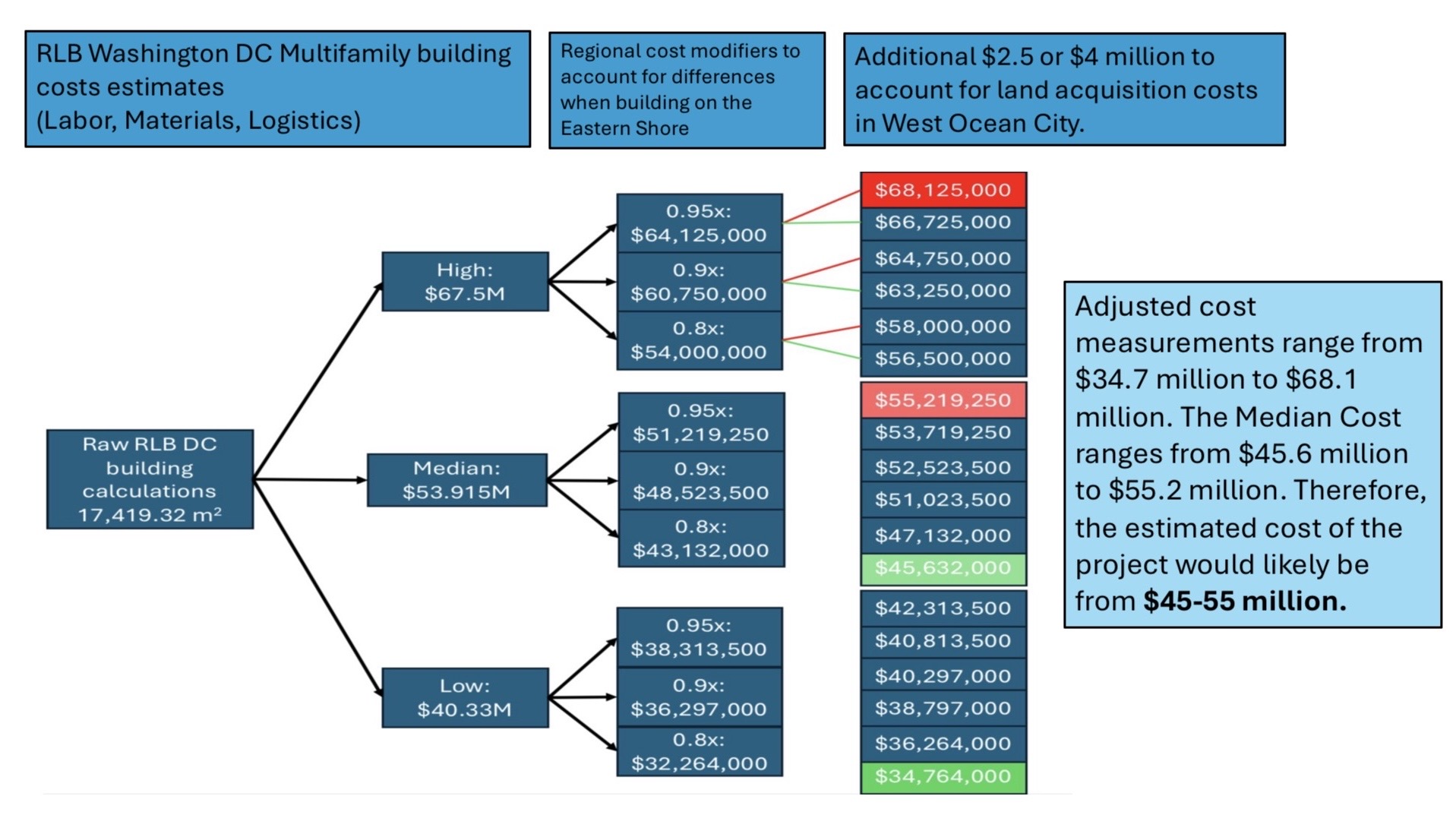
The construction of the tripartite would be difficult due to costs but not completely impossible. Despite the enormous cost of the project, the involvement of the university makes the project eligible for many grants. The TIF would help finance the rest of the construction. building tripartite building would help Ocean City to reach the 2019 equilibrium of 4,116 workers by providing affordable housing to J-1 workers, removing the constraint that previously capped participation. It would likely draw in even more J-1 workers, meeting the municipal government’s goal of 4,000-5,000 J-1 workers during the summer. The justification of creating such an expensive project is that it would act as a permanent solution to the J-1 housing issue and provide a stable labor supply through housing.
Methodology
This paper uses a mixed-method approach to analyze seasonal labor shortages in Ocean City. Quantitative data are sourced from the U.S. Department of State BridgeUSA J-1 visa records, U.S. Census housing data, Ocean City Comprehensive Plans, and the Bureau of Labor Statistics. Qualitative data on firm-level responses are sourced through interviews conducted by local news and analysis by housing reports. Altogether, the paper analyzed a variety of sources to paint a more complete picture of the situation to the reader, while maintaining academic rigor. The year 2020 is considered as an outlier due to the pandemic, therefore, the paper uses 2019 as a pre-pandemic control, 2023 as the recovery divergence point, and 2025, the last full year. Apparent conflicts between datasets are resolved using a methodological triangulation hierarchy. For example, while the US Census data showed high vacancy rates, news outlets reported overcrowding in worker housing. This contradiction was resolved through peer reviewed literature that contextualized both findings: the Census data were measuring seasonally occupied second homes, while news outlets reported crowding due to a lack of affordable housing.
Section 2 &3
Quantitative data was primarily used to back major claims such as measuring the constraint J-1 restrictions had on seasonal workforce in Section 2 or proving correlation and effects between housing and labor shortages in Section 3. The author uses a Bartik shift-shock model to predict the impact national policy (shift) had on Ocean City and Virginia Beach based on workforce compositions (share). Section 2 also incorporates a national benchmarking trend graph to compare recovery nationally and in Ocean City. To understand why Ocean City has not recovered despite national recovery by 2023, Section 3 utilizes an urban economics framework. Peer-reviewed literature was used to support claims on quantitative housing trends, housing impact on economics, and development of PPP projects. Sources were selected based on relevance and category; government data and academic literature were used to support main claims about correlation
Section 4 & 5
Qualitative sources were primarily used to reflect owner and worker sentiment and business adaptation in Section 4. News sources were primarily used to contextualize and display owner sentiment; displaying the issue on a microeconomic, firm level. Government reports, peer-reviewed literature, and construction firm estimates were used in the development of the solution in Section 5. The paper evaluates whether observed patterns are consistent with the economic model as causal identification may not be precise due to the involvement of multiple macroeconomic and local factors. Therefore, mixed methods are used because no single dataset can capture both policy shocks and firm behavior.
Limitations
This study acknowledges multiple limitations. The descriptive empirical design evaluates statistical correlations rather than causality. Quantitative claims and claims derived from the Matrix Housing Report or the Ocean City Comprehensive Plan are subject to 95% confidence intervals and margins of error reported by the U.S. Census Bureau. Furthermore, this study relies heavily on BridgeUSA J-1 visa, which is an exact count, removing the possibility of sampling error, but is subject to administrative reporting bias. These federal records track visa issuances and sponsor approvals, meaning they measure legal labor supply rather than the exact count of physically present workers. While the geographic coding for Ocean City zip codes is precise, the model is subject to minor commuter boundary leakage, as it does not account for seasonal workers who may commute from nearby municipalities. Secondary quality constraints also exist, as local data aggregation may obscure firm-level variations. Qualitative metrics are subject to selection bias, as media reports capture a limited sample of business responses. The tripartite solution mentioned in the section prior serves as a proof of concept rather than an actual usable model. Ocean City’s highly tourism dependent economy and unique geographical constraints may prevent the findings of this study from being generalized to other markets. Finally, there is a lack of peer-reviewed literature written on J-1 labor dynamics in tourism regions that limits historical benchmarking.
Conclusion
This analysis establishes the macroeconomic and microeconomic factors that constrain labor supply in Ocean City. Similarly, this study suggests a complementary relationship between labor and housing—housing is a complementary input to labor supply. High housing costs have been fueled by amenity driven demand in the second home market and housing inelasticity due to zoning. Without affordable housing, labor supply will remain constrained.
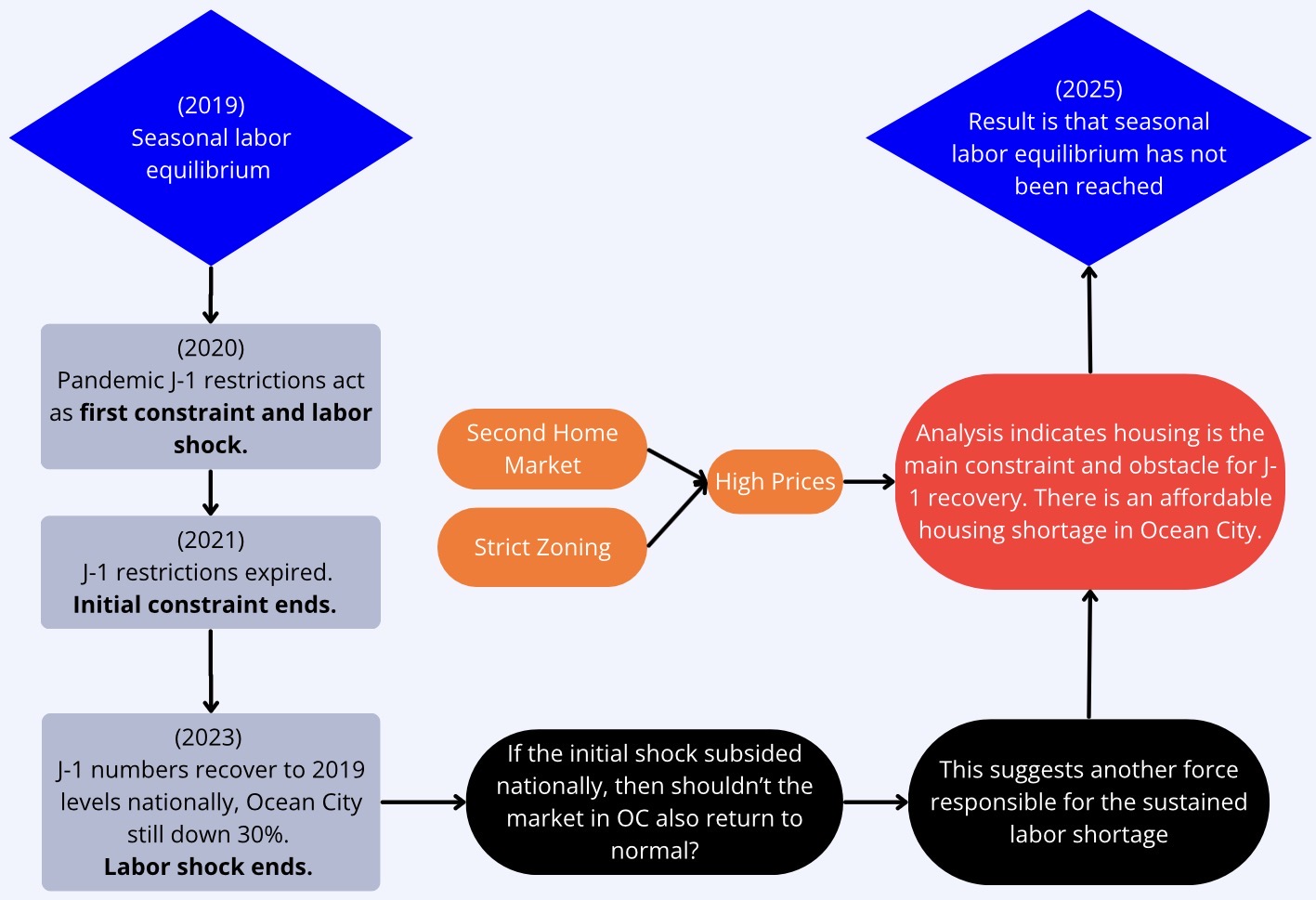
Acknowledging that housing is a complementary input to labor is critical for Ocean City and other resort towns. W. Wei and L. Li’s empirical analysis established that employees of businesses that supplied housing reduced turnover by reducing the rate of burnout and increasing motivation and productivity21. In fact, Ocean City was the biggest recipient of SWT visa J-1 workers in America according to the State Department30. Ocean City must provide affordable housing to seasonal workers one way or another, or else it will lose this title and with it a third of its workforce and tens of millions of dollars.
In conclusion, this paper contributes to the literature by suggesting that persistent seasonal labor shortages are driven by the interaction between a volatile labor supply and inelastic local housing markets, rather than by labor shocks alone, aiming to explain why labor markets do not consistently re-equilibrate even after macroeconomic shocks subside. The study highlights the importance of housing in seasonal worker recruitment and also finds that unaffordable housing is correlated with slowed economic recovery after labor shocks in economies highly reliant on seasonal labor. Further, the paper suggests that Ocean City and other tourism towns increase the supply of housing affordable to seasonal workers as a measure to mitigate exposure to macroeconomic shocks and sustained seasonal labor shortages.
References
- C. Miller. Ocean City businesses fear losing seasonal workforce if J-1 visa program is reduced. Capital News Service. https://cnsmaryland.org/2017/09/05/ocean-city-businesses-fear-losing-seasonal-workforce-if-j-1-visa-program-is-reduced/, 2017 [↩]
- D. J Trump. Proclamation No. 10052, Suspension of entry of immigrants and nonimmigrants who present a risk to the United States labor market during the economic recovery following the COVID‑19 outbreak, 85 Fed. Reg. 38,263, June 22, 2020. https://www.federalregister.gov/d/2020-13888 [↩]
- D. J Trump. Proclamation 10998: Restricting and Limiting the Entry of Foreign Nationals To Protect the Security of the United States, 90 Fed. Reg. 59,717, December 16, 2025. [↩]
- A. Evangelista. Ocean City businesses warn J-1 visa delays could strain summer staffing. WBOC. https://www.wboc.com/news/ocean-city-businesses-warn-j-1-visa-delays-could-strain-summer-staffing/article_43a59189-dcde-4e2a-870e-166c9b3637b0.html, April 13, 2026. [↩] [↩]
- M. Klien, M. Weingärtler. Hohe Wohnkosten als Belastung für den Wirtschaftsstandort Salzburg. Österreichisches Institut für Wirtschaftsforschung. https://www.wifo.ac.at/wp-content/uploads/upload-8641/s_2024_wohnkosten_salzburg_71319_.pdf, 2024. [↩] [↩] [↩] [↩]
- U.S Department of State. Explore Data by Zip Code (2019). U.S. Department of State, BridgeUSA. https://j1visa.state.gov/basics/facts-and-figures/participant-totals-by-state-and-zip-code-2019/. [↩] [↩]
- U.S Department of State. Explore Data by Zip Code (2025). U.S. Department of State, BridgeUSA. https://j1visa.state.gov/basics/facts-and-figures/participant-totals-by-state-and-zip-code-/. [↩] [↩]
- G. Wehner. Ocean City seasonal workers going elsewhere for housing, jobs. OC Today-Dispatch. https://www.octodaydispatch.com/news/article_978f9c42-b69b-11ec-a052-5f51a1e28bff.html, April 7, 2022. [↩]
- C. Paris. Re‐positioning second homes within housing studies: household investment, gentrification, multiple residence, mobility, and hyper‐consumption. Housing, Theory and Society 26.4. 292-310. https://doi.org/10.1080/14036090802300392, 2009. [↩]
- Matrix Design Group. 2025 Worcester County Housing Study. https://worcestermd.gov/sites/default/files/Worcester%20County%20Housing%20Study%20Final%202025%2009%2022.pdf, September 2025. [↩] [↩] [↩] [↩]
- Town of Ocean City. OC Comprehensive Plan (2025). https://planning.maryland.gov/Documents/OurWork/PBP/compplans/25-DRF-Ocean-City.pdf, 2025. [↩] [↩] [↩]
- N. Leybengrub. 3 jobs, 9 roommates: What it’s like for foreign students to work a summer in Ocean City. Baltimore Banner. https://www.thebanner.com/community/local-news/ocean-city-foreign-student-workers-444SAIGXRRFTVG3AHDCBEGL67I/, September 20, 2025. [↩]
- J. Fiechtner. Housing shortage in Ocean City for seasonal workers. WMDT Channel 47. https://www.wmdt.com/2023/05/housing-shortage-in-ocean-city-for-seasonal-workers/, May 22, 2023. [↩] [↩]
- A. Minzola. Ocean City businesses say ‘it’s harder than ever’ to find workers: Summer 2022 forecast. Salisbury Daily Times. https://www.delmarvanow.com/story/news/local/maryland/2022/04/07/7268168001/, April 7, 2022. [↩] [↩]
- CBS Baltimore. Ocean City Officials Ask Visitors To Be Patient As They Continue To Struggle With Staffing Hotels, Restaurants And Attractions. CBS Baltimore. https://www.cbsnews.com/baltimore/news/ocean-city-worker-shortage-seasonal-summer-hires-needed/, June 7, 2021. [↩]
- M. Prensky. Ocean City labor shortages worry businesses; vacations to pick up. Salisbury Daily Times. https://www.delmarvanow.com/story/news/local/maryland/2021/04/22/7290620002/, April 22, 2021. [↩] [↩]
- K. Powers. Dough Roller to close West Ocean City location in COVID-19 hardship. Salisbury Daily Times. https://www.delmarvanow.com/story/news/local/maryland/2021/02/23/4557872001/, February 23, 2021. [↩]
- M. Prensky. Fatigued Ocean City businesses hopeful J-1 workers can return in summer 2021. Salisbury Times. https://www.delmarvanow.com/story/money/2020/12/28/ocean-city-businesses-hopeful-j-1-visa-workers-can-return-2021-labor-shortage-foreign-students/3943152001/, December 28, 2020 [↩]
- K. Orens. Ocean City ramps up efforts to attract more employees. WBOC. https://www.wboc.com/news/article_77265bae-3c8b-11ee-a4c5-53116c9a3c49.html, August 16, 2023. [↩]
- Indeed, Inc. Seasonal associate salary in Ocean City, MD, accessed April 2026. https://www.indeed.com/career/seasonal-associate/salaries/Ocean-City–MD, 2026. [↩]
- W. Wei, L. Li. Job-housing balance and job burnout among migrant workers: mechanisms and implications for housing support policies. Humanit Soc Sci Commun 13, 33. https://doi.org/10.1057/s41599-025-06334-, 2026 [↩] [↩] [↩]
- R. Flaks. Ocean City sees increasing allotment for J1 workers ahead of summer season. WMDT 47. https://www.wmdt.com/2024/05/ocean-city-sees-increasing-allotment-for-j1-workers-ahead-of-summer-season/, 2024. [↩] [↩] [↩]
- Tourism Economics. Economic Impact of Tourism 2023 fact sheet. Shores & Islands Ohio. https://assets.simpleviewinc.com/simpleview/image/upload/v1/clients/lakeerieoh/2023_Economic_Impact_of_Tourism_Fact_Sheet_e48e17a3-7fc0-4de3-be13-0372a7ae469c.pdf, 2023. [↩]
- A. Ouriel. Falcon Points Loft to open Oct. 1. Sandusky Register. https://sanduskyregister.com/news/273641/falcon-point-lofts-to-open-oct-1/, April 22, 2020 [↩] [↩] [↩]
- The Associated Press. Cedar Point’s parent company partners with BGSU for college degree. Cleveland 19 News. https://www.cleveland19.com/story/37753494/cedar-points-parent-company-partners-with-bgsu-for-college-degree/, March 19, 2018. [↩]
- City of Myrtle Beach. Ordinance no. 2023-21Nance Street International Residence Hall Planned Unit Development. https://cms6.revize.com/revize/myrtlebeachsc/05.%202023-021%20International%20Residence%20Hall%20PUD%20(1st).pdf, April 25, 2023 [↩]
- City of Sandusky. City of Sandusky 2019 Annual Report. https://cms6.revize.com/revize/sandusky/Documents/Annual%20Reports/City%20Annual%20Reports/City%20of%20Sandusky%20Annual%20Report%202019.pdf, 2019. [↩]
- City of Sandusky. Downtown Sandusky Master Plan, p. 96. https://cms6.revize.com/revize/sandusky/Documents/Planning%20&%20Zoning/210225%20Downtown%20Sandusky%20Master%20Plan%20-%20Adopted%20lr.pdf, February 2021. [↩]
- R. Khallaf, K. Kang, M. Hastak, K. Othman. Public-Private Partnerships for Higher Education Institutions in the United States. Buildings 12(11), 1888. https://www.mdpi.com/2075-5309/12/11/1888#B78-buildings-12-01888, November 4, 2022 [↩] [↩]
- M. Basch. Will Maryland’s favorite beach town have enough international student workers this summer? WTOP News. https://wtop.com/maryland/2026/04/will-marylands-favorite-beach-town-have-enough-international-student-workers-this-summer/, April 15, 2026. [↩]