

Abstract
The growing prevalence of plastic waste and carbon-intensive construction methods has created an urgent need for innovative, sustainable, and scalable solutions. This study argues that 3D-printing construction using recycled plastic materials offers a promising approach for reducing the environmental and economic impacts of traditional building methods. Through an in-depth analysis of five real-world case studies, including Azure Printed Homes, MIT HAUS Initiative, BioHome3D, 3D-printed Pavilion from Recycled Plastic, and Recycled Construction Waste for Ecomould Initiative, the study explores the diverse applications of recycled plastics in housing, infrastructure, and construction tools. Findings indicate that recycled-plastic 3D-printing can reduce construction waste and avoid high-emission materials in specific contexts, and may shorten delivery timelines and costs; quantitative outcomes are context-dependent and, where company-reported, are identified as such. Despite these advantages, challenges such as material inconsistency, weather resistance issues, and the absence of standardized regulations hinder widespread adoption. To address these obstacles, the study concludes with recommendations for improvement, including the development of advanced materials, the promotion of decentralized production methods, and the establishment of updated building codes to facilitate the scalable use of recycled plastics in sustainable construction practices globally.
Keywords: Recycled plastic materials, 3D-printing construction, Sustainable construction, Environment
Introduction
Integrating recycled plastics into 3D-printed construction offers a compelling solution to two of today’s most urgent environmental challenges: plastic pollution and carbon-intensive building practices. Plastic waste remains a persistent global crisis. The world population uses 481.6 billion plastic bottles on average every year. Among them, 80% of the used plastic bottles end up in landfills, and about 244,000 metric tons (~244 million kg) of plastic are floating in the ocean1. Plastic bottles take 450 years to decompose2, and only about 23% of disposable plastic bottles are recycled3. As climate change impacts have become more visible, related statistics on environmental degradation have also become clearer. Therefore, many researchers have been challenged to find the solution to this problem, like finding an alternative material that can decompose easily, plastic that is unharmful to the environment, and innovative recycling strategies.
Simultaneously, most building construction relies heavily on materials like concrete and steel, which are highly carbon intensive. In fact, the building and construction sector is one of the highest greenhouse gas emitters, with about 37% of global emissions4. These factors have created a need for more sustainable construction methods. Cement production alone is responsible for 8% of global CO emissions5. These challenges highlight an urgent need for innovation and more sustainable construction methods.
3D-printing in construction, also known as additive manufacturing, has emerged as a novel solution with the potential to transform building practices. Unlike traditional methods, 3D-printing allows for the creation of complex structures through precise, layer-by-layer deposition of material, minimizing waste and labor requirements. Historically, this technique has relied heavily on 3D-printed concrete (3DPC), which, while efficient, still has a significant environmental cost. In recent years, researchers and innovators have begun exploring the use of recycled plastics as a construction material in 3D-printing. In this paper, “recycled plastic” refers primarily to post-consumer thermoplastics such as polyethylene terephthalate (PET) and high-density polyethylene (HDPE), which are collected, sorted, cleaned, and reprocessed into 3D-printing feedstock. Unless otherwise noted in specific case studies, the term does not include biodegradable plastics or mixed polymer composites without preprocessing. This approach reuses common plastics found in bottles, such as PET and HDPE. The method not only addresses plastic waste by diverting it from landfills, but it also reduces dependency on virgin construction materials, potentially lowering the sector’s carbon footprint.
Using plastic in 3D-printing construction can lead to two key benefits: less plastic pollution and a lower carbon footprint for buildings. Researchers and start-ups are now exploring recycled plastic 3D-printing technology in order to create affordable housing while reducing waste. In the following sections, we will examine the environmental benefits of using recycled plastic in 3D-printed construction, look at some real-world examples, and discuss how to further improve the sustainability of this approach.
Recent studies highlight the significant environmental advantages of using recycled plastics as 3D-printing feedstock. Kassab et al. emphasize that this approach “transforms plastic waste into new products, reducing the amount of waste generated and the reliance on raw materials, energy, and water”. In practice, even small substitutions of natural aggregate with recycled plastic can cut waste6. For example, Oosthuizen et al. find that a portion of sand with Resin 8 (a plastic aggregate material) in 3D-printed concrete “can effectively reduce plastic waste in our environment”, highlighting that even small amounts of replacement can make a significant impact7. By diverting plastics into construction, resource demands also drop, and waste plastics substitute for depleting resources like sand and gravel. Life cycle analyses reinforce these gains.
Cáceres-Mendoza et al. report that locally recycling PLA into filament for 3D-printing yields greater than 97% reduction in carbon, eutrophication, and resource depletion impacts versus virgin (new) filament production8. Similarly, Maraveas et al. review that 3D-printed items from recycled agricultural polymers have properties “comparable to those of virgin plastic,” underlining the viability for this route for waste management9. Overall, the literature consistently shows that using recycled plastic in additive construction can cut landfill waste, conserve raw materials, and lower energy and emissions compared to conventional practices.
In addition to sustainability metrics, economic and logistical considerations further validate this approach. Hossain et al. note that automated 3D-printing systems reduce labor requirements, material waste, and time, making the process attractive in both industrialized and labor-scarce regions10. The combination of speed, material efficiency, and low-cost inputs like recycled plastic can significantly lower construction costs and can reduce overall project timelines.
Despite these benefits, several studies raise concerns about material performance. Kyriakidis et al. observe that recycled polymers “often exhibit significantly low mechanical properties” compared to virgin materials11. Loss of strength in the material has been reported in several other studies, for example, Oosthuizen et al. reported that while Resin8 can be a useful additive, increasing its proportion beyond a certain threshold diminishes overall strength7. Furthermore, outdoor applications expose plastic-based material to UV radiation, moisture, and thermal cycling, all of which accelerate degradation. Maraveas et al. caution that UV instability in recycled plastics can lead to cracking and microplastic shedding over time. This challenge is particularly significant for structural elements that are directly exposed to weather conditions9.
Material inconsistency is another challenge that limits further adoption. Kassab et al. note that proper collection and sorting of plastics is “critical” because mixed polymers have different melting points and behaviors6. Without standards, plastic waste materials can be unpredictable. In practice, recycled filament often requires additives or blending to achieve a virgin-level performance.
In summary, the literature supports the significant environmental and economic advantages of using recycled plastic in additive manufacturing for construction. However, challenges related to structural integrity, weather resistance, and quality control must be addressed through further research and innovation. The path forward involves not just improving materials but creating regulatory frameworks and technical standards.
This study examines the viability of using recycled plastic in additive construction by reviewing existing literature, analyzing real-world case studies, and identifying both the environmental benefits and practical challenges involved. It evaluates five notable projects, including Azure Printed Homes, MIT’s HAUS initiative, the University of Maine’s BioHome3D, a public pavilion in Spain, and the Ecomould system from Germany and Austria, to determine how recycled plastic performs as a structural material or how 3D-printing was utilized in the construction. Based on these findings, the paper proposes pathways for advancing this technology through improved material science, decentralized production models, and supportive regulatory frameworks.
Results
Throughout this paper, we distinguish three application categories for recycled-plastic 3D-printing: (i) structural elements (e.g., load-bearing shells, foundations), (ii) non-structural components (e.g., cladding, pavilions, temporary enclosures), and (iii) manufacturing tools (e.g., reusable molds/formwork). These categories entail different performance targets, code pathways, service lives, and environmental implications. In the case studies and tables, we identify the application type for each project to avoid cross-category conflation.
Environmental Benefits
Baseline conventions: Unless noted otherwise, statements such as “lower  ” or “reduced energy” are compared to conventional concrete/steel construction, and polymer comparisons are recycled vs. virgin of the same resin. Emissions values are per-kg cradle-to-gate and not normalized to functional equivalence (see Methods: LCA scope).
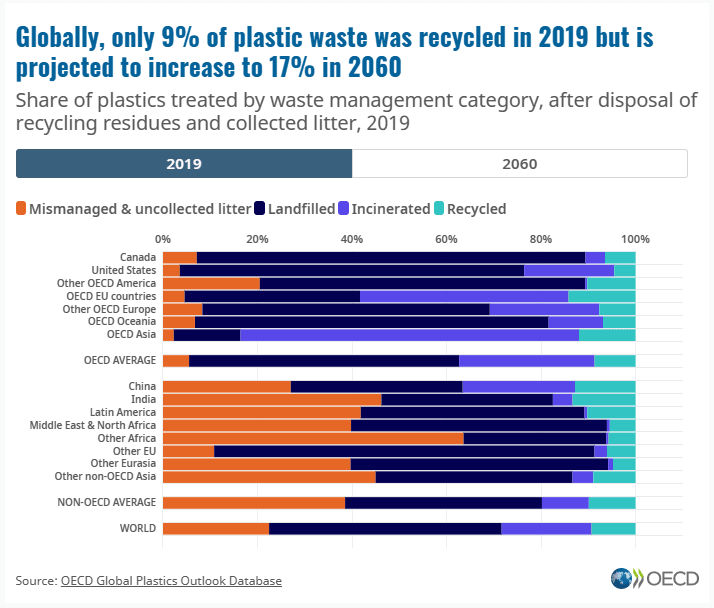
Reduction in Plastic Waste and Pollution: Using recycled plastic in 3D-printing mitigates one of the most extensive forms of environmental degradation. According to Figure 1, only 9% of plastic waste is recycled as of 201912. Repurposing plastic that would otherwise end up in landfills or oceans into building components can have a substantial environmental benefit. Construction, which consumes vast quantities of material, presents a viable absorption channel for this waste. Additive manufacturing also minimizes waste generation during fabrication, unlike traditional methods that create surplus through cutting and molding. In Europe, nearly 50% of post-consumer plastic is already used in the construction sector, illustrating its high absorption capacity. By scaling up this trend through 3D-printing, more waste can be diverted from incinerators and oceans, thereby reducing associated ecological harm13.
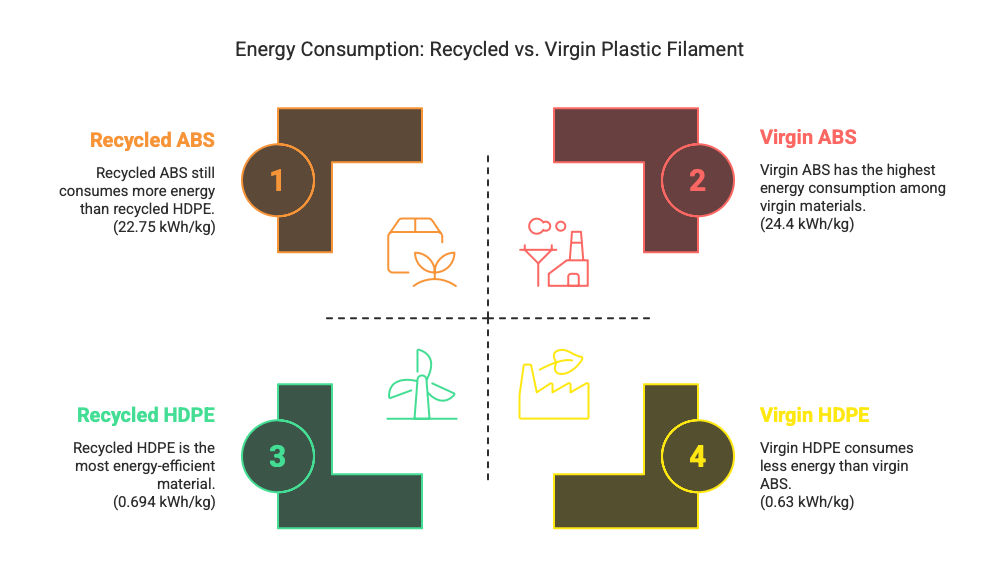
Lower Carbon Footprint: The carbon intensity of traditional construction materials, especially cement, is well documented compared to polymer routes. Recycled plastic production generally requires less energy and emits fewer greenhouse gases than producing virgin resin. For example, reprocessing ABS consumes 54% less energy than virgin ABS production14. Additionally, on-site or near-site 3D-printing can minimize transport-related emissions compared to off-site fabrication with long-haul logistics. Figure 2 presents general trends from life cycle assessments comparing energy use between recycled and virgin plastics. While exact values vary by material type, processing method, and location, recycled plastics such as PETG and ABS can reduce energy use by up to 82%15‘16‘17‘18. These reductions are also significant relative to conventional materials like cement and steel. Consistent with Figure 2 and Table 1, recycled polymers show lower CO2e per kilogram than virgin polymers16‘17. These values are expressed per kilogram and do not account for differences in structural properties between materials or the varying quantities needed to achieve equivalent performance in construction applications.
Lifecycle persistence: Realized environmental gains depend on service life and maintenance; premature failure or frequent replacement can erode net benefits. Projects should verify benefits with cradle-to-grave LCA boundaries, including use-phase upkeep and end-of-life scenarios, per ISO 14040/4419‘20.
Scope note: Values referenced in this section are route- and boundary-specific (generally per-kg, cradle-to-gate). Persisting advantages over a full cradle-to-grave lifecycle depend on use-phase durability, maintenance, and end-of-life handling (see Methods; ISO 14040/44).
Balance and limits: Reported advantages must be weighed against potential microplastic release during service or at end-of-life, energy use for drying/melting/reprocessing, and uncertain end-of-life pathways when disassembly or take-back is absent. These risks and mitigations (UV stability/coatings, moisture control, design-for-disassembly, material passports) are detailed in 2.2 and 3.3, with data quality noted as Not reported (NR) where sources lack measurements6‘9‘10‘11.
Cost Savings and Economic Benefits: Using recycled plastic as a construction material can reduce the cost of raw inputs, lower labor needs due to automation, and reducing overall project timelines. According to Azure Printed Homes, the use of recycled plastic enables 30% cost savings and 70% faster completion times compared to conventional building methods21.
These reported figures vary by project scale, location, and methodology. For example, Azure Printed Homes reports that their process can achieve up to 70% faster completion times and 30% cost savings compared to conventional methods21. Similarly, some lifecycle assessments of recycled PET indicate potential CO reductions exceeding 50% compared to cement production22‘23. However, these figures are specific to the cited projects and may not be representative of all recycled plastic construction applications.
Emission Reduction from On-Site Production: On-site 3D-printing eliminates emissions related to transportation of materials and prefabricated units. When combined with portable, container-sized 3D-printing units, construction can occur directly where housing is needed, reducing carbon footprints.
Enhanced Material Circularity: Some approaches allow recycled materials to be reused multiple times. For example, Voxeljet’s Ecomould technology allows molds to be shredded and reused, reducing resource inputs by up to 90% and cutting CO emissions by over 100 kg per square meter24. Similarly, MIT’s use of PET demonstrates that structural-grade recycled materials can be looped into durable applications25.
Recycled plastic in 3D-printed construction can offer advantages in waste reduction, carbon mitigation, material circularity, and construction efficiency. Data and real-world case studies reinforce its potential as a valuable tool for sustainable infrastructure. Further standardization and research on long-term durability and environmental performance will enhance adoption and policy integration. Table 1 compares cement vs. rPET on a per-kg, cradle-to-gate basis. Figure 2 and refs 18-19 summarize recycled vs. virgin polymer trends.
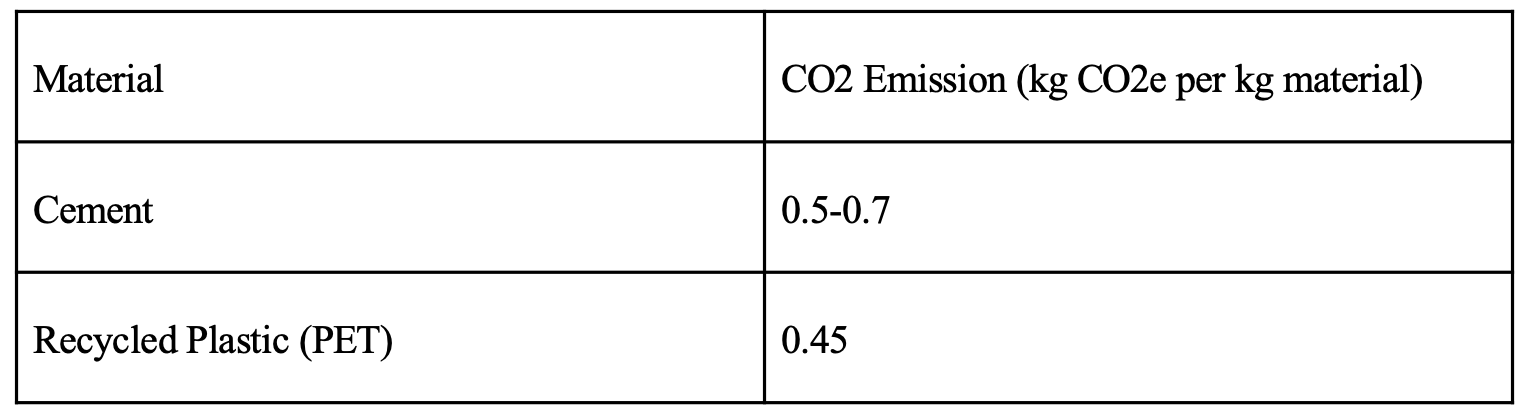 emissions per kilogram for cement and recycled PET.
Note: Values are per kilogram (kg) and cradle-to-gate. Results are not normalized to functional equivalence and should not be used to infer whole-building totals. Figures are route- and boundary-specific.
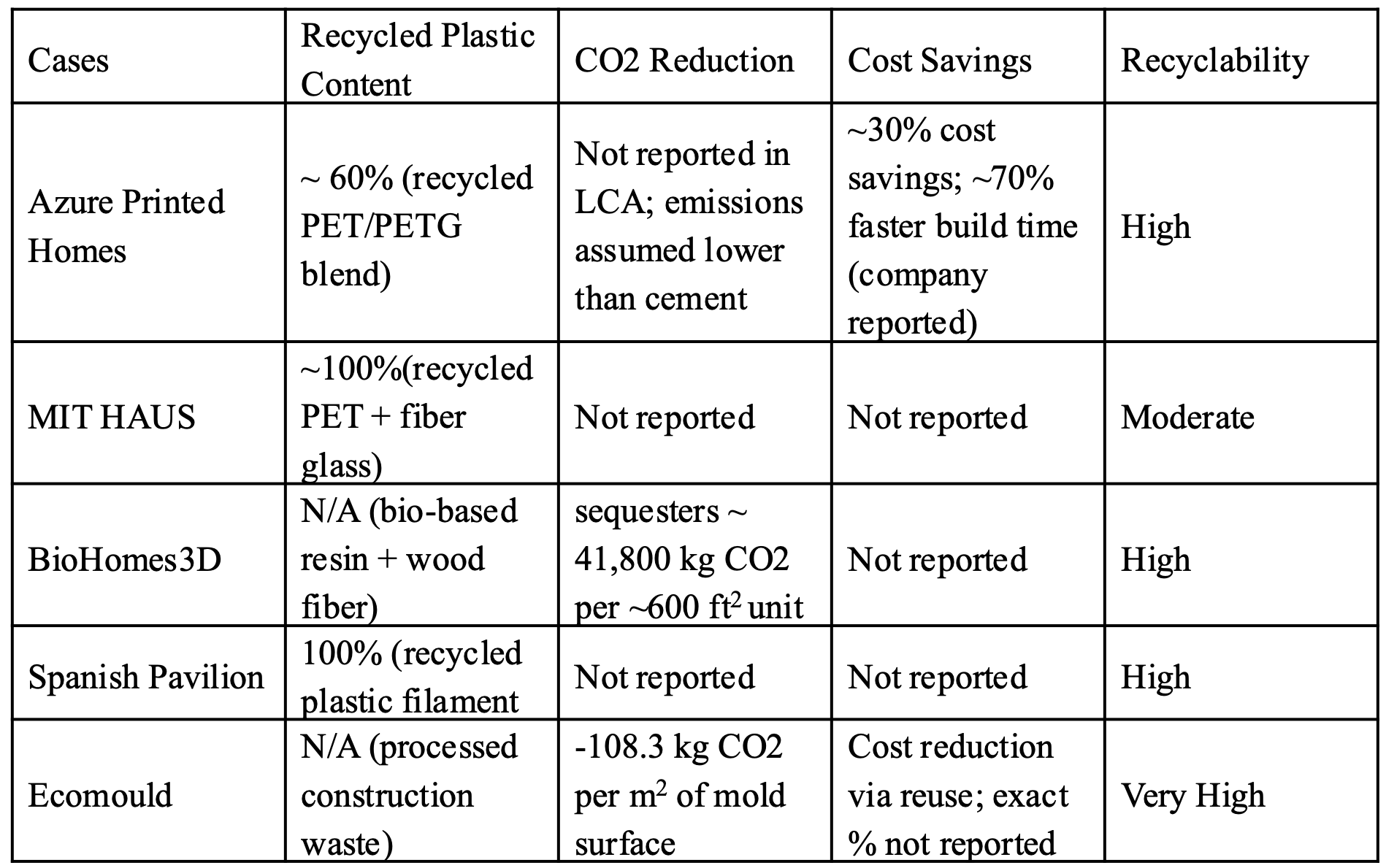
Note: Data reflects the most reliable information available from company reports and peer-reviewed literature. “Not reported” indicates that no specific public or peer-reviewed data were found for that metric. CO reduction figures vary in scope—e.g., lifecycle analysis, carbon sequestration, or material reuse emissions. Recyclability terms are qualitatively defined based on available material reuse data: “Very High” indicates closed-loop or repeatedly recyclable systems; “High” reflects high recycled content with strong reuse potential; “Moderate” reflects partial or uncertain recyclability due to limited data. Application type for each case is noted in parentheses; metrics should not be compared across categories. Values are not normalized to functional equivalence and are not compared across application categories (see Methods: Data completeness and comparability).
Challenges of Recycled Plastic in 3D-printed Construction
Despite the environmental and economic benefits that it can provide, it faces several technical and systemic challenges that limit further adoption of recycled plastic in 3D-printed construction. These can be grouped into four primary categories: material properties, environmental durability, processing variability, and regulatory barriers.
Inferior Mechanical Properties
Recycled plastics often undergo thermal degradation during the recycling process, which can cause polymer chain scission. This leads to embrittlement and a reduction in critical mechanical metrics such as tensile strength, compressive strength, and flexural resistance. Kyriakidis et al. confirmed that recycled polymers typically perform below virgin materials in structural applications, posing safety concerns for large-scale adoption11.
Environmental Degradation
Recycled plastics are often vulnerable to deterioration under long term exposure to environmental elements. UV radiation from sunlight can cause discoloration, cracking, and a breakdown in polymer structure, particularly in plastics without stabilizing additives. Maraveas et al. warn that outdoor structures made from recycled plastic may degrade over time or even release microplastics into the environment unless properly treated with UV-resistant coatings or blended with stabilizing compounds9.
Processing Inconsistency
One of the key technical issues with using post-consumer plastic waste is material inconsistency. Recycled plastic feedstocks can contain various polymer types with differing melting points, viscosities, and thermal behaviors. Without rigorous sorting and preprocessing, this variability leads to inconsistent extrusion quality, layer adhesion, and print integrity. Kassab et al. emphasize the importance of standardized feedstock preparation and the development of industrial-grade recycled filaments6. As a mitigation, the Methods now outline a basic feedstock QC and batch-traceability protocol to reduce variability from mixed or contaminated streams6‘11.
Lack of Regulation and Codes
Existing building codes and safety standards often do not account for plastic-based structural materials, especially the ones that are made from recycled sources like recycled plastics. Without a separate codified performance criterion, regulatory acceptance would remain limited. The regulatory gap causes discouragement in investment in innovation and slow-down certification of new materials, even when preliminary tests suggest they are safe and viable.
Mechanical properties and safety for load-bearing use
Recycled-plastic prints exhibit anisotropic behavior due to layer interfaces; interlayer adhesion governs shear and flexural strength and can limit performance under combined bending and torsion6‘11. Creep and relaxation at service temperatures are critical for sustained loads and long spans (see ASTM D2990)27. Fire performance and smoke must be demonstrated for occupied spaces and egress components (e.g., ASTM E84)28. Durability factors—moisture uptake (ASTM D570)29 UV exposure (ASTM G154)30 and thermal cycling—affect stiffness, toughness, and long-term stability6‘9. Connections and fastening into PET/HDPE require attention to low surface energy and potential stress-cracking; mechanical interlocks, inserts, or bonded interfaces may be necessary6.
Mitigations include controlling bead temperature and moisture; selecting raster orientation for principal stresses; pellet-extrusion with larger bead size to enhance fusion; post-process annealing/welding; and formulation with fibers/stabilizers to restore stiffness and reduce creep6‘9‘11. For code compliance, structural use should proceed through performance-based qualification aligned with UL 3401 30 and ISO/ASTM 52939:202331 supported by a minimum test suite (tension D63832 compression D69533 flexure D79034 creep D299027 water absorption D57035 and E8436 plus project-specific interlayer adhesion coupons. Until such evidence is produced, applications should be limited to non-life-safety or engineered with conservative safety factors.
Service life and premature failure: environmental implications
The environmental advantages of recycled-plastic printing depend on components achieving their intended service life. If parts degrade early, replacement and repair can erode carbon and waste benefits by adding new material, transport, and processing cycles19‘20. Durability drivers include UV exposure (surface embrittlement, color change)30‘ moisture uptake (dimensional change, plasticization)29 thermal cycling, and in-service abrasion; several of these mechanisms can also contribute to microplastic release9. To reduce premature failure risk, projects should (i) specify a target service life by application (e.g., enclosure panel vs. load-bearing element), (ii) demonstrate retention of properties after accelerated aging, e.g., percent retention of tensile/flexural properties (ASTM D638/D790) following UV/moisture exposure (ASTM G154/D570) with project-specific acceptance criteria32‘34‘30‘29, and (iii) document inspection and maintenance (recoat schedules for UV-stabilized finishes, moisture barriers, fastener checks). End-of-life should be planned to avoid uncontrolled fragmentation: design for disassembly, controlled shredding and re-processing where compatible, or downgrading into non-structural uses if mechanical properties fall below thresholds6‘9‘19‘20. Where exterior, high-UV, or humid exposure is unavoidable, stabilizers/coatings, raster orientation that minimizes exposed interfaces, and conservative safety factors are recommended6‘911. Quantitatively, lifecycle LCAs should demonstrate that use-phase durability and maintenance do not negate the cradle-to-gate advantages reported for recycled polymers (see 2.1; ISO 14040/44)19‘20.
Climate and regional performance considerations
Performance and scalability of recycled-plastic AM are climate-dependent. Key exposure drivers include: UV intensity (affects surface embrittlement and color stability), humidity and precipitation (moisture uptake and dimensional change), thermal extremes/thermal cycling (creep and relaxation under sustained load; embrittlement at low temperatures), and coastal/industrial environments (salt/chemical exposure). Mitigations include UV-stabilized resins or coatings, drainage and shading details, moisture barriers, conservative safety factors at high service temperatures, and raster orientation that reduces exposed interfaces6‘9‘11. Projects should verify property retention after accelerated aging—e.g., tensile/flexural retention (ASTM D638/D790) following UV exposure (ASTM G154) and moisture uptake (ASTM D570), with project-specific acceptance criteria aligned to the intended climate32‘34‘30‘29. Regional energy mix and transport distances also influence environmental performance and scalability; on-/near-site production can reduce logistics where feasible, while grid carbon intensity affects process impacts4‘10‘15‘19‘20. Finally, availability of suitable feedstocks, local recycling infrastructure, and permitting regimes will vary by region, which should be reflected in case-by-case feasibility and policy pathways6‘10‘31‘37.
Discussion
The successful integration of recycled plastic into 3D-printing construction requires advancements across material science, system design, policy frameworks, and industrial infrastructure. Strategic interventions in these areas can address existing challenges and unlock the full potential of this innovative approach to sustainable construction. Scope note. Our focus is recycled-plastic 3D-printing; we acknowledge other low-carbon approaches (e.g., CLT, rammed earth, recycled concrete aggregates) but do not compare them in detail here. The following sections outline key opportunities for improvement in the field.
Advanced Material Development
Enhancing the properties of recycled plastics through additive formulations is critical for improving long-term performance. Stabilizers, flame retardants, and UV inhibitors can be incorporated to increase durability and resistance against environmental factors such as heat, light, and fire. For example, fiberglass reinforcement, as demonstrated by MIT’s HAUS project, highlights the potential of recycled plastics for load-bearing applications, paving the way for structural advancements in 3D-printed construction.
The development of composite materials presents another promising avenue for improving the mechanical properties and environmental resistance of recycled plastic. By blending recycled plastics with other waste materials, such as fly ash, wood fibers, or ground glass, stronger and more stable construction materials can be achieved. This approach, as seen in the BioHome3D project, demonstrates how material innovation can enhance both functionality and sustainability in 3D-printed construction.
Biodegradable plastics, such as PLA, are increasingly used in desktop 3D-printing but remain limited in structural construction due to their lower durability, sensitivity to moisture, and thermal instability. In contrast, recycled plastics like PET and HDPE offer greater mechanical strength and weather resistance, making them more suitable for architectural applications. While combining biodegradable and recycled materials could offer future environmental benefits, current implementations of biodegradable plastics in construction-scale 3D-printing are rare and largely experimental.
Scaling and Efficiency Improvements
Decentralized production hubs near urban and rural communities can play a pivotal role in scaling sustainable 3D-printing construction. These localized facilities would enable the conversion of regional plastic waste into construction-grade materials, reducing logistical emissions and fostering local employment. Initiatives like MIT HAUS aim to leverage this model in the future, demonstrating its potential to streamline production while addressing regional waste management issues.
Deployable 3D-printing platforms housed within shipping containers offer a practical solution for emergency response, disaster recovery, and housing shortages. By enabling on-site printing of components, these units can reduce construction timelines and transportation costs while providing critical infrastructure in remote or underserved areas. Many 3D-printing construction platforms already utilize similar systems, showcasing their reliability and versatility in diverse contexts.
Improving hardware and software systems can significantly enhance the efficiency and precision of 3D-printing construction. Advanced printer calibration, automated quality control mechanisms, and predictive modeling tools can reduce error rates, optimize material usage, and shorten project timelines. Furthermore, energy-efficient printers powered by renewable energy sources could minimize the carbon footprint of the production process, advancing sustainability goals.
Potential unintended consequences
While recycled plastic 3D-printing can reduce waste and enable modular, on-demand construction, large-scale deployment could introduce unintended effects. First, microplastic release may occur during service (abrasion, sanding) or at end-of-life if parts fragment, particularly for UV-exposed polymers without stabilizers9. Second, energy and process trade-offs matter: repeated melting, drying, and reprocessing can increase energy use relative to single-use polymer products, depending on the energy mix and process efficiency6. Third, strong demand for recyclable feedstocks might shift waste streams—e.g., drawing PET away from closed-loop bottle-to-bottle systems toward down-cycling pathways—unless procurement is coordinated with existing recycling hierarchies6. Fourth, additives and composite fillers (e.g., fibers, flame retardants) may improve performance but can complicate future recyclability and sorting6‘11. Finally, end-of-life risks remain if structures are not designed for disassembly and take-back, potentially diverting material to landfills or incineration. Mitigation strategies include design-for-disassembly, material passports, limits on incompatible additives, microplastic-shedding tests for outdoor parts, and project-level LCAs to confirm net benefits6‘9‘10‘11.
Policy Support and Regulatory Reform
Specific regulatory actions for recycled-plastic AM in construction. To move from pilots to permitted projects, we suggest the following performance-based steps:
1. Adopt performance pathways referencing emerging standards. Permit recycled-plastic AM elements through performance equivalence, with documentation aligned to ISO/ASTM 52939:202331 and UL 340137.
2. Define a minimum test suite for approval. Require pre-qualification of the printed material/system using established tests: tensile (ASTM D638)32 compressive (ASTM D695)33 flexural (ASTM D790)34 interlayer adhesion (project-specific coupon geometry), moisture absorption (ASTM D570)29 accelerated UV weathering (ASTM G154)30 creep (ASTM D2990)27 and surface burning characteristics/smoke (ASTM E84)28. Acceptance criteria should be calibrated to the project’s climate zone (e.g., UV/moisture exposure and service temperatures) using retention thresholds from accelerated aging32‘34‘30‘29.
3. Mandate QA/QC and traceability. Include batch-level moisture content, MFR/MFI, feedstock polymer identification and recycled content (%), printer calibration logs, and on-site inspection hold points (first-article print, change of batch, nozzle change). Minimum QC should document polymer ID, moisture targets, trial-extrusion window, and coupon test results (as applicable) with batch traceability to printed parts6‘11.
4. Require environmental documentation. For projects claiming sustainability benefits, submit an LCA/EPD-style summary following ISO 14040/4419‘20 covering collection, sorting/cleaning, reprocessing, transport, printing, service life, and end-of-life scenarios, explicitly including use-phase maintenance/inspection schedules and end-of-life scenarios that affect net benefits19‘20.
5. Plan for end-of-life. Approve designs that demonstrate disassembly, material labeling/passports, and take-back or compatible re-recycling pathways; limit incompatible additives that obstruct recycling.
6. Enable pilots through public procurement. Allow recycled-plastic AM under performance-based equivalence for non-life-safety use cases (e.g., site furniture, non-structural enclosures) to build validated datasets that inform future code updates.
Establishing formal standards for recycled plastic components in collaboration with engineering and construction authorities is essential for accelerating adoption in the 3D-printing construction industry. Structural integrity, fire safety, and environmental performance guidelines must be clearly defined to facilitate permitting and ensure compliance with legal frameworks. Recent standards such as ISO/ASTM 52939:2023, which outline performance-based construction guidelines for additive manufacturing in building38, and UL 3401, which is used to evaluate whether 3D-printed building components consistently meet structural integrity and safety requirements39, represent important steps toward regulatory acceptance. These frameworks could be expanded to incorporate recycled plastic–based materials, enabling more consistent evaluation of safety, performance, and environmental compliance. Government initiatives such as subsidies, tax credits, and inclusion in green building certifications like LEED can stimulate demand for recycled plastic construction methods. These incentives would encourage investment in research and development while promoting widespread adoption of sustainable practices in the construction sector.
3D-printing construction using recycled plastic materials offers measurable environmental and economic advantages. These include reduced landfill and ocean-bound waste, a lower carbon footprint due to the avoidance of traditional high-emission materials like cement and steel, and substantial energy savings through additive manufacturing processes. Projects such as Azure Printed Homes and MIT’s HAUS initiative provide strong evidence of the feasibility and performance of this technology, even under real-world constraints. However, these benefits have notable limitations, including mechanical performance variability, weather degradation, and a lack of standardized regulations.
The convergence of technological innovation, environmental responsibility, and economic viability shows that recycled plastic 3D-printing is not a fringe experiment—it is a serious contender in sustainable construction. However, realizing its full potential will depend on resolving current challenges through targeted research, regulatory reform, and public-private partnerships.
This paper highlights the fragmented and inconsistent nature of data reporting in recycled plastic construction, pointing to a critical need for standardized environmental metrics across projects. By compiling and comparing case studies, this work helps identify both the potential and the limitations of recycled plastics in 3D-printed construction. Future studies should aim to produce full lifecycle assessments, quantify long-term durability under field conditions, and establish baseline performance thresholds to guide material selection and policy development. In small towns and underserved regions, 3D-printing using recycled plastics can not only deliver needed infrastructure but also catalyze circular economic practices, reducing pollution, lowering costs, and advancing local resilience. While challenges exist and will continue to, the momentum is clear: sustainable, 3D-printed, recycled plastic construction can create a whole new market.
While recycled plastics offer notable advantages in waste diversion and design flexibility, it’s important to consider other sustainable construction methods. Cross-laminated timber (CLT), for instance, sequesters carbon in the building structure and often emits less than half the embodied CO of functionally equivalent concrete or steel buildings40. Rammed earth, a locally sourced earthen construction method, also features significantly reduced energy use and greenhouse gas emissions31. Recycled concrete aggregates further minimize environmental impact by lowering demand for virgin materials and reducing waste37. Compared to these alternatives, recycled plastic 3D-printing excels in modularity and on-demand fabrication, though it typically requires higher energy per kilogram. The best choice depends on resource availability, performance needs, and lifecycle considerations. Structural deployments should document the mechanical/durability evidence summarized in Section 2.2.5 and submit it under the UL 3401 / ISO-ASTM 52939 performance pathway. Authorities should require a documented service-life target and O&M plan with evidence of property retention after accelerated aging (ASTM G154/D570 against D638/D790 baselines)30‘29‘32‘34.
Realistic Scalability Constraints
Scaling recycled-plastic 3D-printing depends on several practical constraints. Feedstock supply and quality: consistent, sorted PET/HDPE streams are required; contamination and mixed polymers increase preprocessing cost and degrade properties6‘13. Processing capacity: collection, washing, drying, and reprocessing into filament or pellets require capital and energy; distributed/near-site recycling can reduce transport impacts and improve traceability6‘15. Printer throughput: large-format pellet extrusion boosts deposition rates but demands robust temperature/moisture control and QA to maintain interlayer adhesion at higher speeds6‘11. Skills and QA/QC: operators need training in materials handling, process control, and inspection within a circular-economy workflow10. Regulatory/insurance path: approvals, documentation, and liability coverage add time and cost (see Policy section). Energy mix and location: net LCA benefits depend on local electricity sources and logistics4‘10. End-of-life infrastructure: realizing circular benefits requires design-for-disassembly and available take-back/re-recycling options6. Near-term scaling is most promising for non-structural components and manufacturing tools; structural adoption will track progress on standardized testing and performance-based approvals (see Policy).
Recycling process pathways and environmental trade-offs
Environmental outcomes depend strongly on the recycling route and printing modality, rather than “recycled” status alone. In this paper, the relevant pathways are mechanical recycling into filament or pellets for 3D-printing, carried out either centrally or in distributed/near-site systems. Evidence indicates that distributed mechanical recycling coupled with additive manufacturing can lower transport and reprocessing burdens relative to centralized systems by shortening logistics and enabling local circularity15. For filament-based routes, the extrusion step (granulate to filament) carries nontrivial energy and drying requirements; LCAs of distributed filament production show large reductions vs. virgin polymer but still register process energy that projects should count explicitly8. In contrast, pellet-fed large-format printing (LFAM) avoids the filament-making stage, which can reduce embodied process energy and moisture sensitivity exposure; however, maintaining moisture control and interlayer adhesion at higher deposition rates is essential6‘11. Across all routes, net benefits are location-dependent: the electricity mix and transport distances materially influence results4‘10. Accordingly, projects should (i) specify the recycling pathway used (centralized vs. distributed; filament vs. pellet), (ii) document drying/extrusion parameters and energy use, and (iii) verify results with a project-level LCA boundary that includes collection, sorting/cleaning, reprocessing, transport, printing, service life, and end-of-life (see Methods; ISO 14040/44)19‘20.
Business model and unit economics (scope)
Because audited financials for current projects are not publicly available, profitability cannot be evaluated directly. Instead, we outline cost drivers and reporting fields needed to compare viability across contexts: (i) feedstock and preprocessing (sorting, cleaning, drying, QC), (ii) process energy (kWh/kg or kWh/ ) and printer utilization, (iii) labor/automation and post-processing, (iv) yield/scrap and rework rates, (v) logistics (on-/near-site vs off-site), and (vi) capital costs and maintenance allocation (depreciation per ). Projects should report: bill of materials per , print time per , energy per kg or , labor hours per , scrap (%), and capital allocation method. Where available, literature benchmarks for 3D-printed polymer formwork productivity can guide time/cost ranges (context-dependent)41, and circular-economy reviews inform systemic cost drivers10. For transparency, all unit-cost comparisons in this paper are interpreted to include hidden costs (QC, compliance/insurance, labor/post-processing, scrap/rework, logistics, capital allocation) rather than implying firm-level profitability.
Methods
To understand how recycled plastic 3D-printing functions in practical construction scenarios, five cases are selected. These cases are selected as representative because they highlight the diverse applications, environmental benefits, and technical challenges of using recycled plastics (primarily post-consumer PET and HDPE, as defined in the Introduction) in 3D-printing construction. These five cases were selected based on their availability of published data, variety in application (structural vs. non-structural), material sources (PET, bio-resin, construction waste), and regional diversity across North America and Europe. They represent a cross-section of commercial, academic, and design-focused efforts. One case (Ecomould) was also included as an example of a non-structural application where limitations in material performance are acknowledged. For rigor, peer-reviewed sources are cited for general claims and technical context; company or institutional pages are used only to document project existence or basic facts and are labeled as such.
Azure Printed Homes demonstrates large-scale housing potential, while MIT HAUS explores academic and technological innovation. BioHome3D showcases sustainable material integration, and the Pavilion emphasizes design and structural versatility. Lastly, the use of recycled construction waste for mold making illustrates how 3D-printing can innovate building processes. Together, these cases provide a comprehensive view of the opportunities and limitations of this approach. These cases show various approaches in material use, design scale, environmental performance, and feasibility. Through this relative framework, this looks at the applicability of recycled plastics in additive manufacturing across different scales and environmental settings. All units are metric (e.g., kg, ( ) ) unless directly quoted; imperial values were converted where possible. Performance metrics in the case studies that originate from company or project sources are labeled as such and were not independently verified by the author.
LCA scope and boundaries: Unless noted otherwise, environmental figures cited here are per-kg, cradle-to-gate (collection/sorting/cleaning to reprocessing to gate). Use-phase maintenance, service life, logistics beyond the factory gate, and end-of-life outcomes are addressed narratively where reported; when absent they are marked Not reported (NR). Whole-building or functional-equivalence comparisons require project-specific cradle-to-grave LCAs consistent with ISO 14040/44.
Hidden-cost accounting: Economic comparisons in this paper consider quality control (sorting, cleaning, drying, QC tests), regulatory compliance (permitting, required testing/inspections), liability/insurance, labor & post-processing/finishing, training/skill, yield/scrap & rework, logistics (on-/near-site vs off-site), and capital allocation/maintenance; figures labeled as company-reported are retained only as project facts and were not independently verified.
Evaluation criteria and comparability: Reporting across publicly available sources is uneven. To enable consistent comparison without implying false precision, we apply a qualitative rubric rather than numeric scores. For each case we note the presence/absence of: (i) cost/time delta %, (ii) carbon/energy ( ) or (
 ), (iii) recycled content (%), (iv) recyclability/end-of-life pathway, and (v) regulatory status. Missing values are marked Not reported (NR) and not-applicable items N/A. We discuss implications in the text and do not average across application categories (structural, non-structural, tooling).
Process overview (recycled-plastic AM): This paper focuses on mechanical reprocessing routes used in construction AM: (i) distributed filament for FFF printers and (ii) pellet-fed large-format extrusion (FGF). Typical steps are identification/sorting, washing/drying, size reduction, optional melt filtration, then either filament extrusion (diameter-controlled) or direct pellet feed to a heated screw or auger. Printing proceeds by layer-by-layer deposition with designed bead overlap and interlayer fusion; parts may be post-processed by trimming, milling, or coating. Process settings are polymer-specific and governed by moisture content, MFR/MFI, melt/build temperatures, raster strategy, and cooling rate; acceptance is verified with the test suite cited in this paper (tension D638, compression D695, flexure D790, moisture D570, UV G154, creep D2990)32‘33‘34‘29‘30‘27.
Feedstock preparation and quality control (QC): Because post-consumer plastics vary in polymer type, moisture, and prior thermal history, we apply a simple QC protocol to support consistent processing: (i) Identification & sorting by polymer family (e.g., PET, HDPE) using visual labeling and spot spectroscopy (e.g., FTIR where available); (ii) Cleaning & drying to remove contaminants and achieve target moisture prior to melt processing (especially for PET/PETG); (iii) Basic property checks on reprocessed feed (e.g., qualitative melt-flow window during trial extrusion and bead fusion/adhesion checks); and (iv) Batch traceability (lot numbers, mass balance, print parameters). Where quantitative data are required, mechanical and durability properties are verified using established test methods (tension D638, compression D695, flexure D790; moisture D570; UV G154; creep D2990) on project-specific coupons, and results are referenced in the text or marked Not reported (NR) when unavailable. Compared with virgin pellets, recycled feedstocks can show variable composition and thermal history (shifting MFR/MFI), moisture-induced degradation (especially PET/PETG), solid contaminants and additive/pigment incompatibilities, and lower interlayer strength; mitigations include tighter sorting, thorough drying, melt filtration, compatible chain-extension/compatibilizers where permitted, coarser nozzles and tuned print parameters, with performance verified by the above test methods6‘9‘11‘32‘33‘34‘29‘30‘27. Where applicable, site climate informs the choice of accelerated aging tests and acceptance thresholds (see 2.2.7).
Azure Printed Homes (California, USA)
Azure Printed Homes (Application type: structural elements (modular shell/panels). Reported metrics: time ( ) and cost (
 ) deltas; recycled content
  ; COe/energy NR; end-of-life NR; regulatory status NR42 represents one of the most commercially active companies in 3D-printed construction using recycled plastics. Established in California, the company focuses on small modular structures such as accessory dwelling units (ADU), studios, and backyard offices. In 2022, Azure opened a 15,000-square-foot factory in Los Angeles for printing structures using a proprietary blend of post-consumer plastics. Roughly 60% of materials used in Azure homes consist of recycled waste, including PET bottles and packaging films.
One of the primary features of Azure’s approach is its focus on speed and affordability. The 3D-printer creates the roof, wall panels, and floors within 24 hours, and these components are later assembled on-site with minimal labor. Azure reports that their process is faster and less expensive than conventional construction (company-reported; independent verification not available). In addition, Azure Printed Homes has reported that they have low print waste. This approach makes the houses customizable and suitable for rapid deployment in areas experiencing housing shortages.
In Fall of 2022, the company was selected by Oasis Development to create a community of 14 homes in California. Each home was designed to be completed within a month. Although a detailed assessment or emission data have not been publicly disclosed, Azure’s business model exemplifies how construction firms can integrate circular economy principles into market-ready products21.
Independent benchmarks in the peer-reviewed literature report substantial time and cost advantages for polymer 3D-printed formwork (e.g., up to  faster than timber and
  faster than CNC-milled formwork; a case
  faster at
  of timber-formwork cost) and describe reusability/recycling pathways for printed tooling41, with further work demonstrating recycling/reuse of large-format printed polymer formworks43 and closed-loop printed thermoplastics for construction applications44.
MIT HAUS Initiative (Massachusetts, USA)
The Massachusetts Institute of Technology’s HAUS initiative (Application type: structural element (foundation prototype). Reported metrics: recycled content  (PET); cost/time NR; COe/energy NR; end-of-life NR; regulatory status NR25.) (Housing and Urban Sustainability) is an academic project aimed at developing structurally viable, scalable, and sustainable housing components using recycled plastics. In 2023, Dr. AJ Perez and his research team successfully printed a full-scale house foundation using PET plastic reinforced with fiberglass. The building was 8-feet-long, 2-feet-high, and 1-foot-wide (
 ), and was able to support a small building.
Structural testing showed that the foundation can withstand over 60,000 pounds which is ten times the structural load of an average 8-by-10-foot building. This indicates that recycled plastics, when properly reinforced, can meet conventional structural performance benchmarks. The HAUS team is exploring enhancements such as the addition of crushed glass bottles to improve bonding, the creation of in-situ printing systems for disaster zones, and the development of universal print parameters for plastic-based composites. The team also describes off-grid micro-factories to process local waste and print components on-site25. For engineering detail on lightweight, non-concrete foundations using recycled polymers, see Perez’s MIT thesis45.
BioHome3D (University of Maine, USA)
BioHome3D (Application type: structural (bio-based comparator; not recycled plastic). Reported metrics: recycled content  (bio-based comparator); cost/time NR; COe/energy NR; end-of-life NR; regulatory status NR46, developed by the University of Maine, represents a notable development in sustainable construction through additive manufacturing. While it does not utilize recycled plastics as defined in this paper, the project showcases the potential for scalability and material substitution in 3D-printing by employing bio-based, recycled materials such as wood fiber and bio-resin. In 2022, BioHome3D successfully created the first house entirely composed of these renewable materials, with the structure printed in four modular sections that were assembled onsite in less than a day and fully operational within hours. This rapid construction process highlights the efficiency and practicality of 3D-printing in real-world applications.
The project is particularly notable for its environmental benefits, as the house is capable of sequestering up to approximately  of carbon dioxide over its lifetime, significantly contributing to carbon reduction efforts. Additionally, the structure is designed to withstand harsh climate conditions, ranging from extreme cold to severe coastal storms, demonstrating that sustainable materials can achieve high durability and resilience. By pushing the boundaries of material innovation, BioHome3D sets an inspiring example for the construction industry, encouraging the exploration of alternative frameworks, including recycled plastics, for achieving sustainability in 3D-printing construction. This project underscores the versatility of additive manufacturing in addressing environmental challenges while maintaining structural integrity and performance47. Peer-reviewed studies on recycled-polymer AM (rPET/rPLA) report viable mechanical performance and process routes (including direct pellet printing) that reduce energy steps relative to filament workflows48‘49.
3D-printed Pavilion from Recycled Plastic (Spain)
The 3D-printed Pavilion (Application type: non-structural (temporary pavilion). Reported metrics: recycled content  ; cost/time NR; COe/energy NR; end-of-life NR; regulatory status NR50 from Recycled Plastic in Spain is an example of how 3D-printing technology and sustainable materials can be combined to produce functional architectural structures. This project was a collaboration between the architecture firm Hassell, the 3D-printing company Nagami, and the non-profit organization, To.org, resulting in a weather-resistant pavilion constructed entirely from recycled plastic. It serves as a powerful demonstration of how recycled plastic, often regarded as waste, can serve as a durable and reusable resource for construction, paving the way for more eco-friendly and sustainable building practices.
What sets this project apart is its ability to expand the scope of 3D-printing applications beyond traditional housing and commercial infrastructure into public, civic, and recreational spaces. The pavilion challenges the perception that recycled materials are only suited for utilitarian purposes, proving instead that they can deliver high aesthetic and functional value. Its design not only emphasizes artistic appeal but also demonstrates practical benefits such as being lightweight and portable, which makes it ideal for temporary structures or installations. Additionally, the pavilion has a low carbon footprint and adheres to the principles of the circular economy, where materials are reused and repurposed rather than discarded.
This project serves as a case study for the potential of recycled plastic in broader urban design and temporary structures, such as those used for events, exhibitions, or community engagement. It shows how sustainable materials can be integrated into creative and functional designs, inspiring architects, designers, and urban planners to adopt eco-innovative approaches in their projects. By combining sustainability with versatility and design excellence, the 3D-printed Pavilion demonstrates how recycled plastic can reshape the future of architecture and urban spaces51. A closely related, peer-reviewed pavilion used robotically 3D-printed recycled thermoplastic formwork at full architectural scale, demonstrating recyclable printed formwork in practice52.
Ecomould Initiative (Germany/Austria)
A joint initiative between Voxeljet AG in Germany and Parastruct GmbH in Austria tested the use of 3D-printing with construction industry waste. Using binder jetting technology, the team used a custom material called Ecomould (Application type: manufacturing tool (reusable molds/formwork). Reported metrics: CO reduction reported ( CO
CO mold surface) and resource reduction (
 ); cost/time NR; recycled content NR; end-of-life: reusable/shreddable; regulatory status N/A (tooling)53, developed from biogenic and mineral-based residuals. The molds are fully recyclable and capable of being shredded and reused multiple times without quality loss.
The companies report that it reduces resource consumption by up to  and CO emission by
  per square meter of mold surface, showing substantial environmental gain. The approach does not use recycled plastics as defined in this paper, but rather employs construction waste-derived composite material for supporting tools like mold for casting, which are needed in various construction workflows. It effectively demonstrates the circular economy principle and potential closed-loop system within additive manufacturing for construction24.
Collectively, these case studies demonstrate the flexibility, scalability, and environmental potential of recycled plastic in additive construction. Azure provides a commercially scalable model; MIT HAUS proves structural feasibility and local circularity; BioHome3D illustrates material innovation in the 3D-printing paradigm; the Spanish Pavilion showcases design versatility; and the Ecomould initiative proves feasibility in construction tooling and resource circularity. Standardized testing, regulatory pathways, and long-term durability data remain essential for broader adoption. The broader concept—3D-printed polymer/binder-jet formwork that is recyclable or reusable—is supported by peer-reviewed studies mapping printed-formwork technologies and their reuse/recycling pathways44‘41 and by recent research on recycling large-format printed polymer formworks43.
Disclosure
The author declares no competing interests and no financial or professional relationship with any organizations or companies referenced in this manuscript. No external funding was received for this work.
References
- Schriever, N. (2013, July 29). Plastic water bottles causing flood of harm to our environment. Huffpost. [↩]
- WWF. (2021, July 1). The lifecycle of plastics. WWF Australia. [↩]
- P., J. (2021). How Many Plastic Bottles Are Recycled? (Plus Other Facts). Eco Friendly Habits. [↩]
- UNEP. (2023, September 12). Building Materials And The Climate: Constructing A New Future. UN Environment Programme. [↩] [↩] [↩] [↩]
- Shivaprasad, K. N., Yang, H.-M., & Singh, J. K. (2024). A path to carbon neutrality in construction: An overview of recent progress in recycled cement usage. Journal of CO Utilization, 83, 102816. [↩]
- Kassab, A., Al Nabhani, D., Mohanty, P., Pannier, C., & Ayoub, G. Y. (2023). Advancing Plastic Recycling: Challenges and Opportunities in the Integration of 3D-printing and Distributed Recycling for a Circular Economy. Polymers, 15(19), 3881. [↩] [↩] [↩] [↩] [↩] [↩] [↩] [↩] [↩] [↩] [↩] [↩] [↩] [↩] [↩] [↩] [↩] [↩] [↩] [↩] [↩] [↩] [↩] [↩]
- Oosthuizen, J., Babafemi, A., & Walls, R. (2023). 3D-printed recycled plastic eco-aggregate (Resin8) concrete. Construction and Building Materials, 408, 133712. [↩] [↩]
- Caceres-Mendoza, C., Santander-Tapia, P., Cruz Sanchez, F. A., Troussier, N., Camargo, M., & Boudaoud, H. (2023). Life cycle assessment of filament production in distributed plastic recycling via additive manufacturing. Cleaner Waste Systems, 5, 100100. [↩] [↩]
- Maraveas, C., Kyrtopoulos, I. V., & Arvanitis, K. G. (2024). Evaluation of the viability of 3D-printing in recycling polymers. Polymers, 16(8), 1104. [↩] [↩] [↩] [↩] [↩] [↩] [↩] [↩] [↩] [↩] [↩] [↩] [↩]
- Hossain, M. U., Ng, S. T., Antwi-Afari, P., & Amor, B. (2020). Circular economy and the construction industry: Existing trends, challenges and prospective framework for sustainable construction. Renewable and Sustainable Energy Reviews, 130, 109948. [↩] [↩] [↩] [↩] [↩] [↩] [↩] [↩] [↩]
- Kyriakidis, I. F., Kladovasilakis, N., Pechlivani, E. M., & Tsongas, K. (2024). Mechanical Performance of Recycled 3D-printed Sustainable Polymer-Based Composites: A Literature Review. Journal of Composites Science, 8(6), 215. [↩] [↩] [↩] [↩] [↩] [↩] [↩] [↩] [↩] [↩] [↩] [↩] [↩] [↩]
- OECD. (2022). Global Plastics Outlook: Economic Drivers, Environmental Impacts and Policy Options. OECD Publishing. [↩] [↩]
- FSC. (2022). The circular economy for plastics. Plastics Europe. [↩] [↩]
- Oladapo, B. I., Bowoto, O. K., Adebiyi, V. A., & Ikumapayi, O. M. (2023). Netzero on 3D-printing filament recycling: A sustainable analysis. Science of the Total Environment, 894, 165046. [↩]
- Zhong, S., & Pearce, J. M. (2018). Tightening the loop on the circular economy: Coupled distributed recycling and manufacturing with recyclebot and reprap 3-D printing. Resources, Conservation and Recycling, 128, 48–58. [↩] [↩] [↩] [↩] [↩]
- Franklin Associates, A Division of ERG. (2022, November). Cradle to gate life cycle analysis of acrylonitrile butadiene styrene (ABS) resin. American Chemistry Council (ACC) Plastics Division. [↩] [↩] [↩]
- Franklin Associates, A Division of ERG. (2020, October). Cradle to gate life cycle analysis of high density polyethylene (HDPE) resin. American Chemistry Council (ACC) Plastics Division. [↩] [↩] [↩]
- Kreiger, M., Anzalone, G., Mulder, M., Glover, A., & Pearce, J. (2013). Distributed Recycling of Post-Consumer Plastic Waste in Rural Areas. MRS Proceedings, 1492. [↩]
- International Organization for Standardization (ISO). (2006). ISO 14040:2006 Environmental management — Life cycle assessment — Principles and framework. ISO. [↩] [↩] [↩] [↩] [↩] [↩] [↩] [↩]
- International Organization for Standardization (ISO). (2006). ISO 14044:2006 Environmental management — Life cycle assessment — Requirements and guidelines. ISO. [↩] [↩] [↩] [↩] [↩] [↩] [↩] [↩]
- Azure Printed Homes. (2022, February 22). Azure Printed Homes has been selected by Oasis Development to create the first community to be 3D-printed from recycled plastic. Cision. [↩] [↩] [↩]
- Nie, S., Zhou, J., Yang, F., Lan, M., Li, J., Zhang, Z., Chen, Z., Xu, M., Li, H., & Sanjayan, J. G. (2022). Analysis of theoretical carbon dioxide emissions from cement production: Methodology and application. Journal of Cleaner Production, 334, 130270. [↩]
- ALPHA. (2017, August 9). Study confirms the excellent carbon footprint of recycled PET. Packaging Europe. [↩]
- Tyler, A. (2024, February 5). Voxeljet and Parastruct leverage recycled construction waste for binder jet 3D-printing. 3D-printing Industry. [↩] [↩]
- Brehm, D. (2023, May 5). MAD Fellow, AJ Perez 3D-prints the First Building Foundation Made From Recycled Plastic Bottles. MIT News. [↩] [↩] [↩]
- Kreiger, M., Anzalone, G., Mulder, M., Glover, A., & Pearce, J. (2013). Distributed Recycling of Post-Consumer Plastic Waste in Rural Areas. MRS Proceedings, 1492.). [↩]
- ASTM International. (2017). ASTM D2990-17 Standard Test Methods for Tensile, Compressive, and Flexural Creep and Creep-Rupture of Plastics. ASTM International. [↩] [↩] [↩] [↩] [↩]
- ASTM International. (2021). ASTM E84-21a Standard Test Method for Surface Burning Characteristics of Building Materials. ASTM International. [↩] [↩]
- ASTM International. (2022). ASTM D570-22 Standard Test Method for Water Absorption of Plastics. ASTM International. [↩] [↩] [↩] [↩] [↩] [↩] [↩] [↩] [↩]
- ASTM International. (2023). ASTM G154-23 Standard Practice for Operating Fluorescent Ultraviolet (UV) Lamp Apparatus for Exposure of Nonmetallic Materials. ASTM International. [↩] [↩] [↩] [↩] [↩] [↩] [↩] [↩] [↩]
- International Organization for Standardization (ISO) & ASTM International. (2023). ISO/ASTM 52939:2023 Additive manufacturing for construction — Qualification principles — Structural and infrastructure elements. ISO. [↩] [↩] [↩] [↩]
- ASTM International. (2022). ASTM D638-22 Standard Test Method for Tensile Properties of Plastics. ASTM International. [↩] [↩] [↩] [↩] [↩] [↩] [↩] [↩]
- ASTM International. (2023). ASTM D695-23 Standard Test Method for Compressive Properties of Rigid Plastics. ASTM International. [↩] [↩] [↩] [↩]
- ASTM International. (2017). ASTM D790-17 Standard Test Methods for Flexural Properties of Unreinforced and Reinforced Plastics and Electrical Insulating Materials. ASTM International. [↩] [↩] [↩] [↩] [↩] [↩] [↩] [↩]
- ASTM International. (2022). ASTM D570-22 Standard Test Method for Water Absorption of Plastics. ASTM International.), UV G154 ((ASTM International. (2023). ASTM G154-23 Standard Practice for Operating Fluorescent Ultraviolet (UV) Lamp Apparatus for Exposure of Nonmetallic Materials. ASTM International. [↩]
- ASTM International. (2021). ASTM E84-21a Standard Test Method for Surface Burning Characteristics of Building Materials. ASTM International.). [↩]
- UL LLC. (2022, November 28). UL 3401 Outline of Investigation for 3D-printed Building Construction (Ed. 2). UL Standards & Engagement. [↩] [↩] [↩]
- 3D-printing Industry. (2023). ISO/ASTM 52939:2023 published: A new standard for construction 3D-printing. 3D-printing Industry. [↩]
- UL Solutions. (2021). UL helps build safety with 3D-printed technology. UL.com. [↩]
- Andersen, J. H., Rasmussen, N. L., & Ryberg, M. W. (2022). Comparative life cycle assessment of cross laminated timber building and concrete building with special focus on biogenic carbon. Energy and Buildings, 254, 111604. [↩]
- Jipa, A., et al. (2022). 3D-printed Formwork for Concrete: State-of-the-Art, Opportunities, Challenges, and Applications. 3D-printing and Additive Manufacturing, 9(2), 84–107. [↩] [↩] [↩]
- Azure Printed Homes. (2022, February 22). Azure Printed Homes has been selected by Oasis Development to create the first community to be 3D-printed from recycled plastic. Cision.). [↩]
- Schweizer, K., et al. (2024). Recycling Large-Format 3D-printed Polymer Composite Formworks. Journal of Composites for Construction. [↩] [↩]
- Burger, J., Lloret-Fritschi, E., Scotto, F., et al. (2023). Circular Formwork: Recycling of 3D-Printed Thermoplastic Formwork for Concrete. Technology|Architecture + Design. [↩] [↩]
- Perez, A. A. (2023). Design of lightweight prefabricated home foundation (Master’s thesis). Massachusetts Institute of Technology. [↩]
- BioHome3D. (n.d.). Advanced Structures & Composites Center. The University of Maine.). [↩]
- BioHome3D. (n.d.). Advanced Structures & Composites Center. The University of Maine. [↩]
- Oussai, A., Bártfai, Z., & Kátai, L. (2021). Development of 3D-printing Raw Materials from Plastic Waste: A Case Study on Recycled PET. Applied Sciences, 11(16), 7338. [↩]
- Mi, D., et al. (2023). Direct 3D-printing of Recycled PET/PP Granules by Shear Screw Extrusion. Polymers. [↩]
- Hassell. (2023, March 22). Is this 3D-printed pavilion the future of climate-responsive design? Hassell Studio.). [↩]
- Hassell. (2023, March 22). Is this 3D-printed pavilion the future of climate-responsive design? Hassell Studio. [↩]
- Burger, J., et al. (2023). Eggshell Pavilion: A Reinforced Concrete Structure Fabricated Using Robotically 3D-Printed Formwork. Construction Robotics, 7, 1–21. [↩]
- Tyler, A. (2024, February 5). Voxeljet and Parastruct leverage recycled construction waste for binder jet 3D-printing. 3D-printing Industry.). [↩]