
Abstract
This paper investigates the role of artificial intelligence, particularly ChatGPT, in creative writing and its implications for future literature, authorship, and ethical standards. A systematic literature review was conducted to synthesize trends in scholarly conversation. The review focused on peer-reviewed studies and academic sources published between 2022 and 2025, aligning with the emergence and evolution of generative AI technologies. Databases searched included Gale Academic, JSTOR, and Google Scholar, using a defined strategy with keywords such as “ChatGPT”, “AI’s Future”, “ChatGPT’s creativity”, “AI Publishing”, and “AI Ethicality”. Inclusion criteria targeted studies addressing ChatGPT’s creative applications, impacts on literature, and ethical considerations, while studies unrelated to creative writing or lacking scholarly material were excluded. Data extraction focused on study findings and discussions, providing a basis for synthesizing new information on AI’s capabilities and limitations in narrative generation, style adaptation, and co-creation with human authors. The review highlights that while ChatGPT and similar models can refine ideas and writing; they do not originate fundamentally new concepts and lack emotional variation. It further identifies unresolved challenges and debates related to authorship attribution, copyright, bias, and overreliance on AI, highlighting the need for future research and guidelines to maintain a balance between AI usage and human creativity.
Keywords: Robotics and Intelligent Machines; Machine Learning; Artificial Intelligence: Chat GPT; Creative Writing
1. Introduction
Artificial intelligence is currently being used in all fields of work and people’s everyday lives,1, whether for easier accessibility of devices or performing programmed outputs to help solve issues or make tasks easier to perform. With the development of new generative AI models, people have been introduced to Chat GPT, a tool that can be both harmful or beneficial depending on the use and how it was developed. Due to the increased use of this tool, there is a greater lack of authenticity in the publication field2.
During the past years, there has been a breakthrough in generative AI. With this breakthrough, uncertainties have been growing regarding the degree of decision-making autonomy that should be allowed for artificial intelligence.3. While ChatGPT has the potential to bring many benefits, it is also causing an overreliance on its technology. This ‘overreliance’ could lead to a situation where writers, students, or other users become dependent on AI for creative ideas or narrative structures, potentially diminishing the role of human creativity in literature.
Chat GPT is a highly accessible AI model that has a wide range of features, such as enhancing the efficiency of writing, teaching, and work.4.
However, due to the easy access of this tool, there are concerns over confidentiality and proprietary rights3, as AI generated writing has the potential to be published. Chat GPT, additionally is a digital tool for writing support, personalized learning experiences, and improvement of language skills through real-time feedback.4. Therefore, it remains to be seen how Chat GPT influences creative writing applications. While preliminary research suggests that large language models can assist with the narrative development, ideation, and style refinement5, the extent to which it reshapes the human creative process has yet to be systematically analyzed. For example, with the capabilities of Chat GPT to generate creative suggestions for stories and the lack of publishing issues faced with AI-generated content, there is a possibility for a macro change in the published literature available online in the future. This ‘macro change’ could refer to a shift in the balance of human and AI-generated content, or a change in the nature of the content itself, such as a proliferation of AI-generated stories with unique narrative structures.6,7.
While an increase in AI-generated stories online may seem beneficial in the short term as it provides a quicker production of stories, it can have a detrimental impact on the future of authorship.8. The possibility of the publication of AI generated books raises significant concerns about the spread of misinformation, the diminishing of literary quality, and unresolved issues of authorship, threatening to undermine human creativity and integrity of future literature.
This literature review provides insight into the depths of Chat GPT’s creative applications and the future consequences that align. This review had its articles chosen from a comprehensive search through Gale Academic, JSTOR, and Google Scholar through the keywords, “ChatGPT”, “AI’s Future”, “ChatGPT’s creativity, “AI Publishing”, and “AI Ethicality”. This paper specifically aims to identify and understand the implications and limitations that the future impacts of the increased use of generative AI have in the authoring field. Addressing the implications could allow for the possible preservation of human creativity, prevention of unethical oversights as well as the development of balanced co-creation with artificial intelligence and humans.
2 Methods
Articles referenced in this review were chosen from a comprehensive search through Gale Academic, JSTOR, and Google Scholar, using the topic considered key words “ChatGPT”, “AI’s Future”, “ChatGPT’s creativity, “AI Publishing” and “AI Ethicality”. The key word “AI’s Future” was considered with the addition of positive and negative impacts as to remain unbiased in data collection from the peer reviewed scholarly sources. The review aimed to identify current trends with the newly developed generative AI, with a deeper focus on ChatGPT. Publications used in the review were from 2022 to 2025, aligning with the development and release of OpenAI’s first ChatGPT version. Additional sources were found by researching “ChatGPT’s writing” and “AI’s Impacts” on the Google Web.
The inclusion criteria for the literature review consisted of peer reviewed studies performed over the general topic of AI’s capabilities as well as specifying studies over ChatGPT. Specifically, articles consisting of AI’s connection with literature were considered as they provided fundamental information needed to understand possible AI impacts in the publishing world. Additionally, sources from the web that contained valuable information over the benefits and liabilities of AI in the literary world were included. Exclusion criteria included studies that didn’t pertain to the specifying criteria of “ChatGPT” + “Creative Writing”. Articles that were focused on other specifying topics, such as “debate partners” were excluded. Additionally, articles from the web that consisted of biased data or that lacked sufficient information to contribute to the review were excluded.
Data for the review was extracted through the results of the studies as they provided more insight to the extent of ChatGPT than is known through general knowledge. Additionally, discussions from both experimental studies as well as University articles were used in the review. Finally, the data was combined and reflected on, creating the needed results over AI’s writing applications for the review.
3 Results
3.1 Creative Writing Applications
3.1.1 Creativity in LLMs
ChatGPT is used as an enhancement application to creativity,9 as it doesn’t create novel concepts but rather synthesizes various information from its training data to compile creative ideas.
ChatGPT is a language model that is trained on large amounts of text data that then generates a human response to text-based prompts. It uses a technique called unsupervised learning, meaning that it learns from text data without any human intervention.9. Through the learning of large data sets of code, AI is able to identify and combine patterns and concepts from different domains and apply them to new contexts, developing new idea outputs. This makes it a powerful tool for generating creative new ideas, as it can provide unique responses that are not limited by human biases or preconceptions.
ChatGPT can increase the creativity of responses to tasks by generating ideas or repurposing unused items into redefined ways that challenge conventional human thinking. According to a Rice Study, Chat GPT is highly effective at generating ideas that are incrementally new rather than radically new.10. To do so, Chat GPT combines various concepts from its database, rather than inventing entirely new concepts from scratch. This AI ability can allow for the generations of ideas that may not be immediately apparent to a human, fostering a broader exploration of possibilities and challenging conventional thinking.
3.1.2 Extent of Capabilities
The advancement of artificial intelligence (AI) has significantly impacted creative writing and content generation, particularly through neural network models that showcase a capacity for producing original thought. A prime example is the neural network program developed by OpenAI, which can autonomously generate text without continuous programming input. This development challenges the traditional views of creativity and raises questions about the originality in machine-generated content.
Research using the WordCraft interface by Yuan and Coenen demonstrates that AI-driven language models can engage in open-ended discussions about stories, respond to complex natural language prompts, and provide suggestions to help writers overcome creative blocks.11. This ability indicates that AI interprets and processes language variation, fostering a collaborative writing experience that enhances human author’s writing.
Chat GPT can generate ideas based on the inputs given by users when asking a question.12. For example, AI models such as LaMDA can take an input and
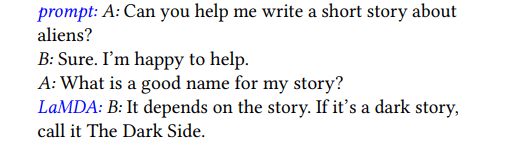
Image by Yuan and Coenen of a prompted ChatGPT large language model. The user prompts the AI to create a short story title for their story about aliens.
formulate an entire conversation.13. Google Researcher Ann Yuan shows an example of a LaMDA conversation in the Figure above. The conversation proves that AI can produce creative ideas, helping create a book title, plot, or write sentences for a book. However, GPT’s creative writing has some faults. For example, it lacks a human touch.14. The generated text would not include the emotional depth or creativity that comes with human writing. The text has the possibility to result in an increase in homogenization as ChatGPT’s texts need human input to ensure originality and a personal voice to match that of the uniqueness of each person’s individual writing style15.
Chat GPT’s writing style, however, does change based on different literary forms. The AI has the ability to adapt to writing styles for different genres, such as fiction, poetry, and scripts, primarily through mimicking patterns from its trained datasets.16.
In fiction, Chat GPT capabilities extend to brainstorming plot ideas, generating character descriptions, and writing chapters. However, it is limited in originality as the content generated is based on preexisting data. Similarly, scripts’ dialogues and stage directions can be generated through ChatGPT as an aid tool for artists. Despite this, the dialogue generated for play scripts are not original and may be copying that of preexisting text. AI generated poetry consists of structural rhymes that can help poets generate ideas, however, the text lacks an emotional nuance that poems are centered around16.
3.1.3 Human vs. AI
Open AI has been currently working towards making AI more human like. Current AI models are learning about human nature by comparing their own outputs to human-generated content.17.
In a study conducted by Stony Brook University, researchers have found that AI’s moral judgment and decision-making are almost perfectly aligned with humans. However, unlike humans, they tend to be neutral by default and lack emotional expression. Bots show little variation in emotionality, personality, and demographics.17. Additionally, bots tend to consistently contain more positive emotional language, more adjectives, and more analytic writing, compared to human writing. The Stonybrook researcher’s study shows that ChatGPT contains significantly less negative emotion, hate speech, and punctuation as compared to human-authored texts. It is even known to lack purpose and readability.17. For example, in the study over a generated hotel review, ChatGPT said, “The room was spacious, clean, and had all the amenities I needed for a comfortable stay. The bed was comfortable, and I slept like a baby every night.” Clearly, the AI and its language are misleading the reader, because it’s ungrounded in the material world. As a result, it engages in inherent deception — AI cannot have an experience like a human being, but it can write as if it did.”17.) This shows that ChatGPT tends to be more limited in its expression of human traits with personality, as compared to the uniqueness of each human’s writing style.
Due to the differences between both human and AI generated content, Chat GPT’s generated writing and creative ideas should be used as a starting point that requires further human refining and evaluation to reach the level of written literature being published online.
3.2 Generative AI
3.2.1 Recent Models
Recent advancements in large language models have led to a notable improvement in artificial intelligence’s ability to generate creative ideas and coherent writing. Models such as OpenAI’s GPT-4 and GPT-4o, Anthropic’s Claude 3 and 3.5, Google’s Gemini 1.5 Pro, and Mistral’s Mixtral represent the current state-of-the-art in natural language generation. Each of these models is trained on large-scale datasets, with transformer-based architectures and reinforcement learning mechanisms to improve contextual accuracy, coherence, and alignment with human preferences18.
Early versions of generative models, such as GPT-2 and BERT, were primarily effective at text completion, summarization, and classification18. Creativity in those models was limited to basic language reassembly and lacked structure or originality. As models scaled in size and training complexity (evident in the jump from GPT-3 to GPT-4 and Claude 1 to Claude 3.5), the ability to generate original, stylistically distinct text improved considerably. Claude 3.5, for example, demonstrates refined performance in multi-turn dialogue, narrative consistency, and stylistic mimicry, allowing it to produce stories, arguments, or concept pitches that match that of human writing18. Similarly, the developments in GPT-4 model has led to faster response time and multimodal integration, allowing the AI to generate text with image input and auditory cues18.
Gemini 1.5 Pro shows strong capabilities in text generation and analysis, particularly for long-context tasks, which improves its utility in generating structured arguments and extended fictional content.18.
These models now exhibit controlled creativity, where output remains grounded in user intent while still offering variation and uniqueness. However, creativity is limited as models synthesize prior knowledge, but do not originate fundamentally new ideas in the human sense. Despite this limitation, their ability to produce high quality outputs and assist in story generation represents a shift towards AI-human co-creation.
3.2.2 Comparative Analysis
Generated content from ChatGPT is known to be of generally high quality in that it can generate original, creative text; however, while the advancement and extent of capabilities of the Chat Bot is of advanced quality, the generated text (in regard to accuracy and original thought) is superficial5.
Chat GPT is able to generate creative text through prompt engineering techniques that can allow for the assistance and enhancement of creative writing processes. Through the precise human prompting in which the input establishes a scenario, defines a desired tone and audience, the bot can generate a high-quality output for the readers. To do so, AI uses chain of thought prompting (step by step guide reasoning process), few-shot prompting (example input-output prompting), role prompting (assigning specific persona or viewpoint), or priming and continuation (provide partial sentences or paragraphs)4. With the prompting, the Chat Bot is able to generate high quality assistance to humans in the way of generating ideas and refining writing. Recently developed generative AI is considered high quality due to its delivery and accuracy from its vast amount of trained data19. Chat GPT has the capability to produce grammatically correct and stylistically refined text. Due to its wide knowledge coverage from being trained with various datasets spanning many domains, it can respond with usually factually accurate data19.
Despite this, AI lacks conceptual grounding and understanding of information. Chat GPT is able to predict text sequences based on statistical patterns15, but it lacks an actual understanding of material, leading to shallow processing and superficial reasoning. AI tends to have superficial reasoning in that it avoids logical reasoning, resorting to generating outputs that feel correct since they mirror published texts or answers found online.15. As such, the outputs generated could be no different than answers found through blogs online, resulting in a lack of guarantee in factual answers when requiring any type of reasoning.
3.3 Future Impacts
3.3.1 Benefits
Chat GPT can generate text regarding various topics, including general knowledge, health, education, and entertainment. It can be fine-tuned to perform specific tasks or applications, such as customer service or language translation, by adjusting its training data and algorithms. “This flexibility ensures that ChatGPT’s responses are tailored to the specific needs of the users’, making it highly flexible and versatile to use”20. AI is programmed to address the users’ commands or questions, providing relevant and appropriate context to aid the users. In addition, generative AI provides original and creative ideas that may help users. In a theoretical example, a publisher can ask an AI program to “write and illustrate a book about a specified subject by entering a “prompt,” and the AI program will deliver a finished manuscript.”20. This shows the high capabilities of AI in that it can answer any command with generated text.21.
The increase in AI usage has led to positive and negative future impacts. For example, GPT technology can significantly change how we learn and teach.22. These changes include improving school skills, such as writing and language, while expanding knowledge on various topics18. GPT provides very easy and efficient access to a wide range of topics. It can improve learning in the future by connecting previous knowledge found online to make new meanings and connections on different topics23. With this, teachers and students alike can benefit from ChatGPT’s personalized learning experiences and enhance their teaching and learning skills. This can lead to advancements in literature as new ideas are proposed, and people feel more driven to read and write due to the personalized learning they could receive from GPT. Chat GPT will also improve cyber security, customer support, and healthcare.20.
Due to its advanced technology, LLMs can detect cyber-attacks, provide virtual aid to customers, and provide personalized assistance to doctors20.
3.3.2 Liabilities
Chat GPT efficiently generates accurate text, answering user’s comment or question. It is a tool developed to act more like a human, performing similar human tasks. However, “AI is known for not being completely accurate when trying to match the behavior of a human. This is shown in the complexity of the text generated or the grammar. For example, one participant mentioned that some language models treat all symbols (e.g., nouns, prepositions, numbers, etc.) equally, but humans care much more about, for example, incorrectly stating someone’s age than about misplacing a preposition”24.
Generated text from AI is gathered from available data online that it has access to. The LLM is trained in diverse data sets. However, it may not have access to all information, leading to some faults in the accuracy. This can lead to bias and errors in the data presented by GPT as it could inadvertently take biased data5 and present it. Models that generate responses to customer support queries will produce inaccurate or out-of-date results if the content it is grounded in is old, incomplete, and inaccurate. This can lead to hallucinations, in which a tool confidently asserts that a falsehood is real. Training data that contains bias will result in tools that propagate bias25. This is a huge concern as generated text from AI is usually trusted and can then be published online, leading to an increase in faulty information being available. AI has become a tool that is heavily relied on in many ways. There are concerns about overreliance, cultural limitations, and the inability of AI to measure creativity and emotional tone24. If the quality and accuracy of AI are not subpar, there needs to be changes in the structure, as it could cause future issues as AI usage grows.
Additionally, challenges with ChatGPT, such as ethical considerations, data privacy, and bias, should be carefully addressed26. The ethical concerns over GPT include privacy concerns over sensitive information, the lack of transparency of the ChatGPT model, and increased societal bias25. “One of the most interesting findings is that the widespread accessibility of generative AI can undermine trust in verifiable facts” as the amount of false data available increases.1. GPT’s usage is not monitored, and therefore, there is no limitation on its usage, resulting in AI being used to generate fake news or speeches. AI can create a video or image of a politician or actor performing tasks that have never occurred in real life. This is a cause for concern in the future as the amount of fake information will skyrocket. Another negative impact GPT could have on the future is that it would impact jobs, specifically in the customer support field.20. GPT’s capacity to autonomously manage customer queries could reduce employment opportunities in entry-level customer support roles as companies turn to automation to lower costs. Additionally, “When focusing on the literature and creative writing aspect, we have found that anyone can use AI-generated content because it is outside copyright protection.6. According to the Copyright Office, copyright law requires human authorship for copyright protection, meaning AI-generated work is generally not copyrightable and falls into the public domain. This has been further discussed in debates as the court case Thaler vs Perlmutter claimed that AI generated work was denied registration due to lack of human writing. However, AI assistance is publishable and has copyright protection27. While this helps GPT’s ethicality concerns, it also means that AI-generated work, such as poems or novels, can still be published without copyright protection.28. This leads to concerns for the future of authorship as stories and books generated by AI are being published and sold, even if they are not under copyright protection.
3.3.3 Future Directions
The development of generative AI, such as ChatGPT, represents the next phase in a historical sequence of tools that have altered human information production and processing. This trajectory can be traced from the mechanical typewriter, which accelerated written communication in the late 19th and 20th centuries29, to the emergence of hypertext in the mid-to-late 20th century, which introduced nonlinear access and organization of digital information30. Each of these technologies redefine the relationship between the human mind and external tools.
Typewriters shifted the act of writing from manual to mechanical, improving speed and legibility, but maintained complete human control29. Hypertext expanded the structure of digital texts, allowing for interlinked, non-sequential access to information and introducing early forms of dynamic navigation and associative thinking30.
Generative AI continues this progression by not only storing or transmitting human knowledge but also generating unique content, synthesizing diverse sources, and simulating aspects of human reasoning.19. The future direction of ChatGPT lies in structured human AI co-collaboration. Current models do not operate independently but require human prompting and oversight. Their strength is in synthesizing human work within a feedback loop where human users refine the outputs19. This collaborative structure is not fixed, however, and has the potential to evolve toward a more seamless integration, where AI can participate in the work field across various disciplines with minimal input. As AI becomes more developed, its role may shift from passive responder to an active participant in collaborative systems. This includes applications in research, education, design, and decision-making, where the human and the model each contribute complementary capabilities.19. However, this also results in further concerns over responsibility and authorship for AI.
4 Discussion
The rise of artificial intelligence technologies, particularly in language processing, has resulted in a transformation for creative writing. AI tools, such as ChatGPT, are now able to generate stories that have the potential to be published online. This capability raises ethicality questions over authorship, originality, and the implications for future literature. AI story generation relies on vast datasets to learn language patterns, structures, and stylistic elements, allowing it to mimic human published stories. However, the resulting narratives often reflect a collaboration of existing texts gathered from online databases, rather than authentic creativity. This leads to concerns about authorship rights: is it the user, the writer, or the collaborated online data that should hold ownership? Additionally, the increase of AI-generated stories could result in the homogeneity of all literary content, as these systems face constraints of information by their training data. This constraint limits the diversity of voices and perspectives in literature, which could undermine the artistic significance of storytelling. Educationally, the reliance on AI for creative writing may diminish critical thinking and imaginative skills among students and authors. The ease of generating content through AI might discourage deeper thinking during the writing process, impacting the development of future literature. While AI’s ability to create publishable stories offers exciting possibilities, it is also necessary to take careful consideration of the ethical, cultural, and educational consequences.
4.1 Future Research Decisions
As Artificial Intelligence continues to evolve, further investigation into its literary capabilities is critical. Despite existing research addressing the benefits and challenges of tools such as ChatGPT, several key areas require additional exploration. Future studies are required to examine how perceptions of quality in AI created literature change over time, focusing on reader engagement and emotional depth of the generated writing. The ethical implications of AI authorship, including copyright and ownership concerns, must also be addressed to create a balance between AI development and the responsibility of over usage in the professional world. Moreover, research should explore how AI influences traditional authorship and creativity and analyze the diversity and representation within AI-generated texts. Understanding how technological advancements may reshape produced literature will provide essential insights. While significant strides have been made in understanding generative AI’s impact on literature, a deeper exploration of its ethical and creative implications are necessary.
5 Conclusion
This study examined ChatGPT’s role in creative writing, highlighting the extent of its technological capabilities and limitations in developing originality, detecting falsehoods, and understanding the context of human inputs. The findings underscore unresolved challenges in authorship attribution, copyright, and the reliability of AI-generated content. Addressing these implications enables the preservation of human creativity, mitigates ethical risks, and establishes clearer boundaries for human-AI collaboration. Rather than replacing authors, AI can be integrated as a supportive tool within defined limits. Ongoing research and regulation will be essential to ensure responsible and transparent use in creative domains.
6 Acknowledgements
We thank our mentors, Dr. Siddarth Krishnan and Billy Gao, for their valuable advice, feedback, and assistance in creating this work. Additionally, we would like to thank the organization Indigo Research and its director, Laila Smith. I want to express my gratitude to the mentors and peers who have helped create a stimulating academic environment that has helped us finish this paper. In conclusion, this research is a collaborative effort, and we are grateful to those mentioned above.
References
- T. Ryan-Mosley. How Generative Ai is Boosting the Spread of Disinformation and Propaganda. MIT Technology Review. https://www.technologyreview.com/2023/10/04/1080801/generative-ai-boosting-disinformation-and-propaganda-freedom-house/. (2023). [↩] [↩]
- T. Ryan-Mosley. How Generative AI is Boosting the Spread of Disinformation and Propaganda. MIT Technology Review. https://www.technologyreview.com/2023/10/04/1080801/generative-ai-boosting-disinformation-and-propaganda freedom-house/. (2023). [↩]
- M. Jaakkola. Academic AI literacy: Artificial intelligence in scholarly writing, editing, and publishing. Gothenburg University Library. https://gupea.ub.gu.se/handle/2077/80946. (2024). [↩] [↩]
- S. Adipat. Challenging Conventions: ChatGPT’s Controversial Impacts on Educational and English Language Teaching Practices. Educational Process: International Journal, 14(1).https://link.gale.com/apps/doc/A837164861/GPS?u=j084910&sid=bookmark-GPS&xid=9cdb91fd. (2025). [↩] [↩] [↩]
- T.C. Helmus. Artificial Intelligence, Deepfakes, and Disinformation: A Primer. RAND Corporation. http://www.jstor.org/stable/resrep42027. (2022). [↩] [↩] [↩]
- A. Schlosser. Artificial intelligence and Publishing Law. IBPA PubSpot.https://pubspot.ibpa-online.org/article/artificial-intelligence-and-publishing-law. (2024). [↩] [↩]
- A. Yuan, A. Coenen. Wordcraft: story writing with large language models. 27th International Conference on Intelligent User Interfaces (IUI’ 22), 12. https://dl.acm.org/doi/pdf/10.1145/3490099.3511105. (2022). [↩]
- A. Tamkin, D. Ganguli. How large language models will transform science, society, and AI. Stanford HAI. https://hai.stanford.edu/news/how-large-language-models-will-transform-science-society-and-ai. (2021). [↩]
- Bogaert, N. Using Chat-GPT for Innovators: Enhancing Creativity and Innovation. Board Of Innovation. BOI.https://www.boardofinnovation.com/blog/using-chat-gpt-for-innovators-enhancing-creativity-and-innovation/#:~:text=It%20uses%20a%20technique%20called,by%20human%20biases%20or%20preconceptions. (2025). [↩] [↩]
- A. Franklin. Chat GPT Could Help People with Creativity in Everyday Tasks. Rice University News and Media Relations. Rice University. https://news.rice.edu/news/2024/chatgpt-could-help-people-creativity-everyday-tasks-study-says. (2024). [↩]
- M. Sharples, R. Perez. Can a computer write a story? | 1 | Story Machines: How Computers Have. Routledge. https://www.taylorfrancis.com/books/mono/10.4324/9781003161431/story-machines-computers-become-creative-writers-mike-sharples-rafael-p%C3%A9rez-p%C3%A9rez. (2022). [↩]
- Gómez-Rodríguez, P. Williams, P. A Confederacy of Models: A Comprehensive Evaluation of LLMs on Creative Writing. Cornell University. https://arxiv.org/abs/2310.08433. (2023). [↩]
- The MIT Press Reader, & K. Holyoak. Can AI write authentic poetry? The MIT Press Reader. https://thereader.mitpress.mit.edu/can-ai-write-authentic-poetry/. (2023). [↩]
- Božić, V. & General hospital Koprivnica. Chat GPT and education. ResearchGate. https://www.researchgate.net/doi/removed?__cf_chl_rt_tk=4v_A2Z0iQQAP4NxVMqhm.9rovDHwuerNyRlk.NmhIJo-1751336442-1.0.1.1-DcT53_rZV3qmnbtaI475I.i7.XYcJL9nvzMiioKkcvY. (2023). [↩]
- H. Jo. From concerns to benefits: a comprehensive study of ChatGPT usage in education. International Journal of Educational Technology in Higher Education, 21(1). https://link.gale.com/apps/doc/A796122755/GPS?u=j084910&sid=bookmark-GPS&xid=b5ddd03d. (2024). [↩] [↩] [↩]
- E. Schalevska. The Digital Laureate: Examining AI-Generated Poetry. Romanian Association of Teachers of English. https://www.researchgate.net/publication/378461120_The_Digital_Laureate_Examining_AI-Generated_Poetry. (2024). [↩] [↩]
- A. Nagpal. Did a Person Write That, or Was it AI? Stony Brook University: AI Innovation Institute. https://ai.stonybrook.edu/about-us/News/did-person-write-or-was-it-ai. (2025). [↩] [↩] [↩] [↩]
- K. Zdravkova, B. Ilijoski. The impact of large language models on computer science student writing. International Journal of Educational Technology in Higher Education, 22(1). vol. 22, no. 1, Dec. 2025. Gale In Context: Global Issues, link.gale.com/apps/doc/A839708685/GPS?u=j084910&sid=bookmark-GPS&xid=b5f6c72. (2025). [↩] [↩] [↩] [↩] [↩] [↩]
- T. Tulubas, M. Demirkol, T. Y. Ozdemir, H. Polat, T. Karakose, R. Yirci. An Interview with ChatGPT on Emergency Remote Teaching: A Comparative Analysis Based on Human-AI Collaboration. Educational Process: International Journal, 12(2), 91+. https://link.gale.com/apps/doc/A752177186/GPS?u=j084910&sid=bookmark-GPS&xid=1a962750. (2023). [↩] [↩] [↩] [↩] [↩]
- D. Kalla, N. Smith. Study and Analysis of Chat GPT and its Impact on Different Fields of Study. Academia. https://www.academia.edu/99060898/Study_and_Analysis_of_ChatGPT_and_its_Impact_on_Different_Fields_of_Study. (2023). [↩] [↩] [↩] [↩] [↩]
- R. Melisa, A. Ashadi, A. Triastuti, S. Hidayati, A. Salido, P. E. L Ero, C. Marlini, Z. Zefrin, & Z. A. Fuad. Critical Thinking in the Age of AI: A Systematic Review of AI’s Effects on Higher Education. Educational Process: International Journal, 14(1). https://link.gale.com/apps/doc/A837164826/GPS?u=j084910&sid=bookmark-GPS&xid=10b47963. (2025). [↩]
- V. Božić, General hospital Koprivnica. Chat GPT and education. ResearchGate. https://www.researchgate.net/doi/removed?__cf_chl_rt_tk=4v_A2Z0iQQAP4NxVMqhm.9rovDHwuerNyRlk.NmhIJo-1751336442-1.0.1.1-DcT53_rZV3qmnbtaI475I.i7.XYcJL9nvzMiioKkcvY. (2023). [↩]
- R. Imamguluyev. The rise of GPT-3: Implications for natural language processing and beyond. International Journal of Research Publication and Reviews, 4(3), 4893–4903. https://doi.org/10.55248/gengpi.2023.4.33987. (2023). [↩]
- A. Tamkin, M. Brundage. Understanding the capabilities, limitations, and societal impact of large language models. Cornell University. https://arxiv.org/abs/2102.02503. (2021). [↩] [↩]
- Baxter, K., & Schlesinger, Y. Managing the Risks of Generative AI. Harvard Business Review. https://hbr.org/2023/06/managing-the-risks-of-generative-ai. (2023). [↩] [↩]
- T. Rasul, S. Nair. The role of ChatGPT in higher education: Benefits, challenges, and future research directions. Journal of Applied Learning & Teaching, 6(1). https://doi.org/10.37074/jalt.2023.6.1.29. (2023). [↩]
- U.S. Copyright Office. Identifying the Economic Implications of Artificial Intelligence for Copyright Policy. Copyright.gov. https://www.copyright.gov/economic-research/economic-implications-of-ai/. (2025). [↩]
- Schlosser, A. (2024). Artificial intelligence and Publishing Law. IBPA PubSpot.https://pubspot.ibpa-online.org/article/artificial-intelligence-and-publishing-law [↩]
- V. Pulkkinen. A Curious Thing: Typescripts and Genetic Criticism. In V. Pulkkinen, S. Katajamäki, & T. Dunderlin (Eds.), Genetic Criticism in Motion: New Perspectives on Manuscript Studies (Vol. 13, pp. 33–58). Finnish Literature Society. http://www.jstor.org/stable/jj.10067050.5. (2023). [↩] [↩]
- J. Nielson. The History of Hypertext. Nielson Norman Group. https://www.nngroup.com/articles/hypertext-history/. (1995). [↩] [↩]