
Abstract
The Klein bottle is a classical non-orientable surface in topology that cannot be embedded in three-dimensional Euclidean space without self-intersection. This paper presents an expository analysis explaining why the Klein bottle cannot enclose a volume in R3. We examine orientability, embeddings and immersions. Using topological arguments and properties of smooth surfaces, we show that any surface enclosing a volume R3 must be orientable. We further discuss why the Klein bottle may be immersed in R3 with self-intersection but also an embedding in R4. Results show the relationship between topology and geometric constraints. The non-orientability of the Klein bottle and its inability to embed in R3 are known; however, these topics are often presented separately and briefly in textbooks. This paper combined these concepts into a single logical framework, demonstrating how orientability, embeddings, immersions, and classical theorems collectively explain why the Klein bottle cannot enclose volume in R3.
Keywords: orientability, embedding, Euclidean space, boundaries, immersed.
Introduction
The Klein bottle was found in 1882 by German mathematician Felix Klein, and it is considered to be a classic example in topology because of its non-orientability and unusual geometric properties. Unlike familiar surfaces such as spheres and tori, the Klein bottle cannot be present in three-dimensional Euclidean space without self-intersection. Modern topology literature frequently uses the Klein bottle as an example of quotient constructions and non-orientable surfaces1,2. Differential topology textbooks further use the Klein bottle as an example to illustrate quotient manifolds, smooth structure, and immersion versus embedding3.
Orientability is a fundamental property of surfaces and determines where consistent orientation may be defined across an entire manifold. A surface is considered to be orientable if it can be assigned continuous normal vectors globally3. Classical examples of non-orientable surfaces are the Möbius strip and the Klein bottle. Non-orientable surfaces possess the property that the normal vector and orientation reverse, which creates important geometric restrictions and influences the application of some mathematical theorems.
For example, a sphere  , defined by
![\[x^{2}+y^{2}+z^{2}=r^{2}\]](https://nhsjs.com/wp-content/ql-cache/quicklatex.com-1a1aa2d1db4a3514c63277c295a81383_l3.png "Rendered by QuickLaTeX.com")
Which encloses a volume,
![\[\operatorname{Vol}(V)=\frac{4}{3}\,\pi r^{3}\]](https://nhsjs.com/wp-content/ql-cache/quicklatex.com-9aa710a2f2df68682254d789f218081c_l3.png "Rendered by QuickLaTeX.com")
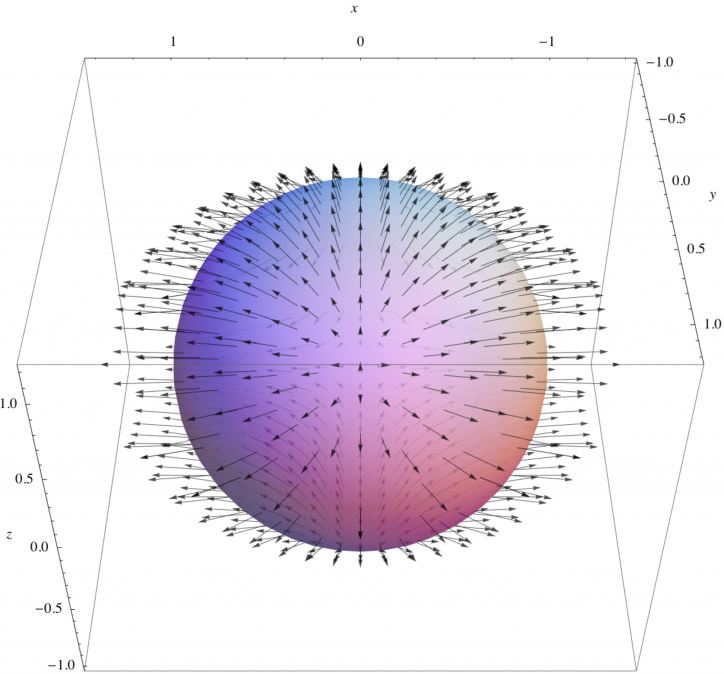
Such a surface is orientable, meaning it has a continuous unit normal vector field  over all points
  . As Figure 1 shows, all the unit normal vectors are pointing outward over all points.
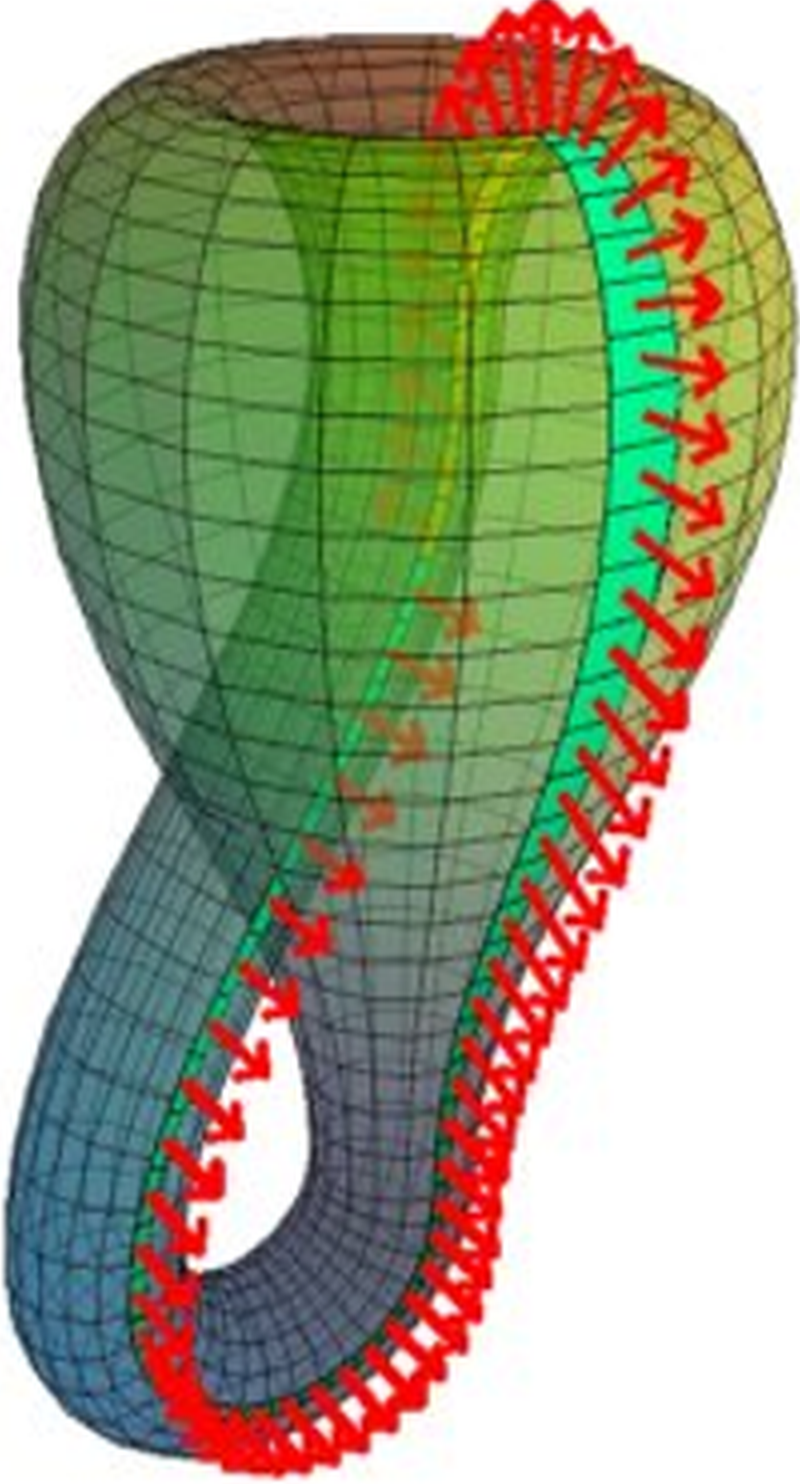
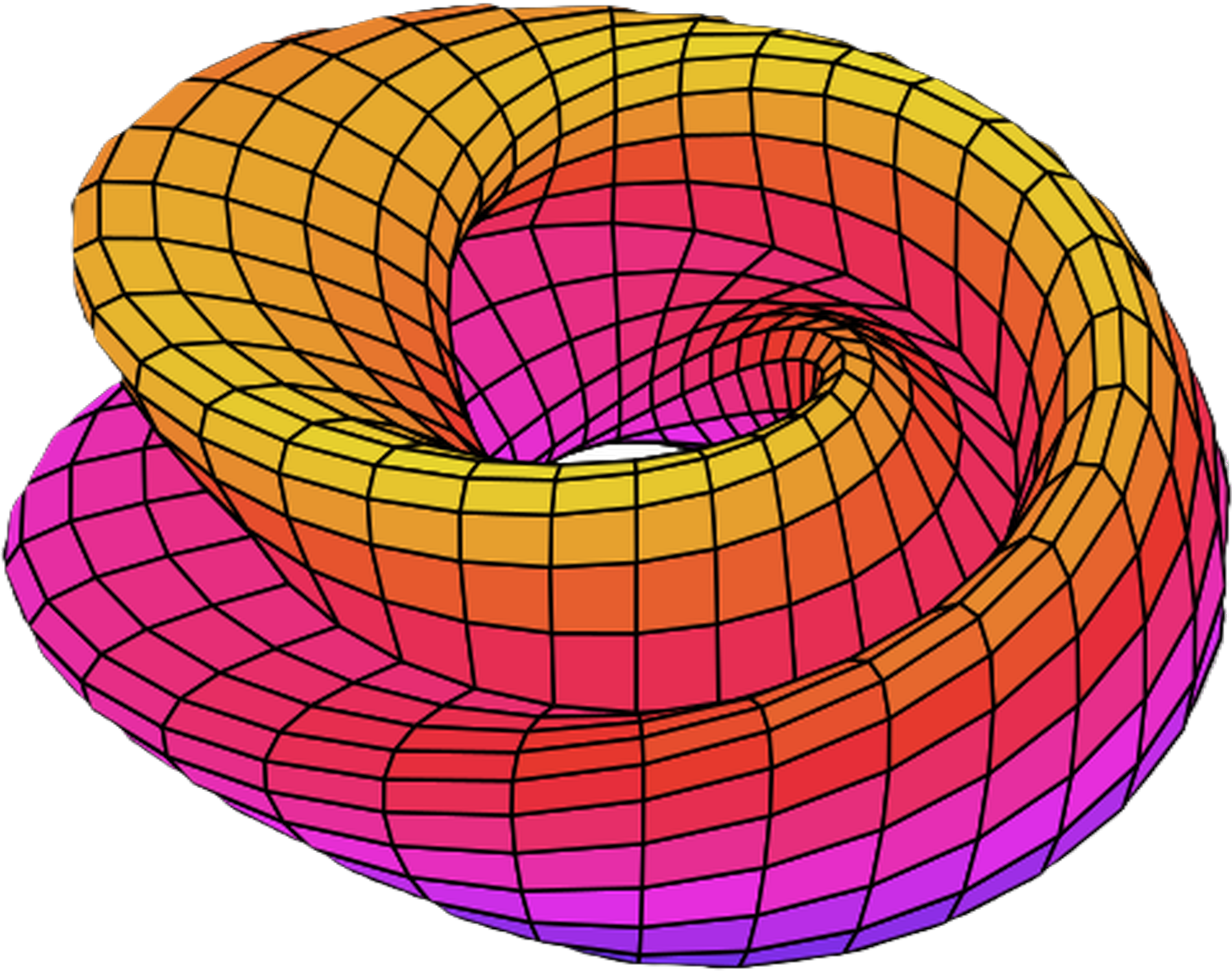
As Figure 2 shows, the Klein Bottle has unit vectors pointing outward when on the surface but pointing inward when approaching the “opening” of the Klein Bottle. At first glance, the Klein Bottle appears to be a closed surface that has a bounded volume. However, Klein Bottle fails to separate the space inside and outside.
The distinction between embeddings and immersions is important in understanding the Klein bottle4. Both immersion and embeddings require the derivative matrix to have maximal rank equal to the dimension of the starting space M. The difference is that an immersion only requires the derivative of a map to have constant maximal rank locally, meaning that it can be an “embedding” around a certain point, while an embedding holds a stricter topological structure in that the map needs to be homomorphic onto its image too, meaning that it is an “immersion” without self-intersections3,5. Existing literature proved that the Klein bottle can be immersed into R3 but does not embed in R3. Self-intersection in three-dimensional space occurred due to the dimensional limitations and the non-orientable property of the Klein bottle.
The Möbius strip and the Klein bottle are often talked about together as fundamental examples of non-orientable 2-manifolds. The Klein bottle is constructed by pasting two Mobius strips together along their boundary, physically by splitting a square with mixed orientations (reserving one pair) along a diagonal and flipping one of the triangular pieces over. After pasting the sides with reserved orientations, a Klein bottle was formed. Topologically, a Klein bottle is equivalent to the connect sum of two real projective planes RP2#RP22
In the last century, the related work on Klein bottle mainly focused on its classification of non-orientable surfaces and manifolds. Subsequent research has studied its algebraic-topological properties, including its fundamental group and topological complexity, which study found out the fundamental group of the Klein bottle is defined as  and the topological complexity
  of the Klein bottle
  is 46,7. Furthermore, in algebraic topology, researchers use different approaches to the generalization of the Klein bottle, extending it to
  dimensions, as well as computing its integral cohomology algebra. The topological properties of the Klein bottle
  varied on , specifically its parity properties. immerses into Euclidean space
  and embeds into
  without self-intersection8.
Later, mathematicians further studied the immersions of the Klein bottle, indicating that a simplified version requires exactly nine vertices to immerse the Klein bottle in R3. From Euler’s formula that any standard triangulations of a Klein bottle must have at least eight vertices, counterintuitively the theoretical eight vertices aren’t enough due to the geometric constraints in R39. Adding another vertex provides an extra dimension to move; just like crossing a small stream, jumping into the “third dimension” helps to avoid “crashing” into the stream.
Likewise, the Klein bottle is used not only as a main study subject but also as a fixed topological base for problems in geometry. In spectral geometry, mathematicians maximized the first eigenvalue on a Klein bottle, which explicitly shows the effect of non-orientability on geometric shapes. Meanwhile, the first eigenfunctions of the Klein bottle metric admit a minimal isometric embedding into a four-dimensional sphere S410. Other studies in differential geometry analyze a specific non-orientable minimal surface in Lawson’s bipolar surface  . Whose surface is a Klein bottle11.
Recent studies have explored the stability of systolic inequalities that provide an alternative proof for Bavard’s optimal lower bound on the systolic area of a Klein bottle and further extend to the Möbius strip. By the estimation on the systolic defect  using the
  -distance of the conformal factor from the systolic area minimizing metric. Similar estimates for metric also appear on the Möbius strip12. Another recent published paper proposed the idea that Klein bottle cosmology is a theoretical physics framework, physicists and mathematicians together explore a higher-dimensional universe constructed with the product of Minkowski space and Klein bottle. A huge step towards our universe’s evolution, the topology of the universe itself potentially causes the creation of matter-antimatter asymmetry13.
Methodology
This paper used keywords such as “Klein bottle,” “topology,” and “Euclidean space” to search for relevant literature. In terms of enhancing the precision, literature and sources are selected from verified online journals and textbooks on reliable publication sites like arXiv and Cambridge University Press within the time range of 1926 to present. Since this study is based on existing literature and topology textbooks, sources are qualified if and only if they are cited multiple times by other researchers or are being used as teaching resources in universities or colleges, while authors must publish multiple research papers in their careers for credibility and reliability purposes, and their key findings and reinforcing reports must contribute to future studies and help develop mathematics over time.
First, introduce some key theorems and definitions to set up the base of this study, then build upon it by proving special properties of the Klein bottle, for example, non-orientability, embedding, and immersion. Ultimately, linked to the divergence theorem, the paper presented an expository topological analysis of the Klein bottle.
Theoretical Framework
1. Theorem (Jordan-Brouwer separation theorem)14.
Let  be a compact connected hypersurface, that
  result into two connected regions, the outside
  and inside
  while itself is a compact manifold with boundary
  .
.
The theorem implies that a surface enclosing volume in R3 must separate inside and outside.
2. Theorem (Divergence theorem)15.
Let  be a compact region with boundary
  . For a vector field
  .
.
![\[\iiint_{\nabla}\cdot F\,dV\]](https://nhsjs.com/wp-content/ql-cache/quicklatex.com-4bd925e5849ba1e345ab9c1f4cdc63e2_l3.png "Rendered by QuickLaTeX.com")
The application of this theorem requires a consistent normal orientation on boundary surface.
3. Definition (Orientability)16.
Let the manifold  be oriented in
  . It is orientable if there exists a smooth map
  , where at each point we can define a corresponding continuous unit normal vector field on and its size is
  .
.
A globally consistent normal vector field allows a surface to separate inside and outside.
4. Definition (Embedding)17.
Let  and
and  be two topological spaces, and
  is an injective continuous map. Let
  be the image of in , a subspace of donated to the function
  is bijective by restricting the range of
  . We call that the map is topological embedding if
  is homeomorphism.
An embedding place a topological space in another larger space while preserves the its shape, connectivity and structure.
5. Definition (Immersions)3,18,19,20.
Let  be a smooth map. Then is an immersion if its differential
  has rank equal to
  for every point
  .
.
Immersions may contain self-intersections.
The Klein bottle is non-orientable.
Proposition. The Klein Bottle is non-orientable.
Proof. The Klein bottle can be represented as a quotient space obtained from the square ![Q=[0,1]\times[0,1]](https://nhsjs.com/wp-content/ql-cache/quicklatex.com-02df8392898d7d38521ac86a97faf969_l3.png "Rendered by QuickLaTeX.com") 21,22,23.
21,22,23.
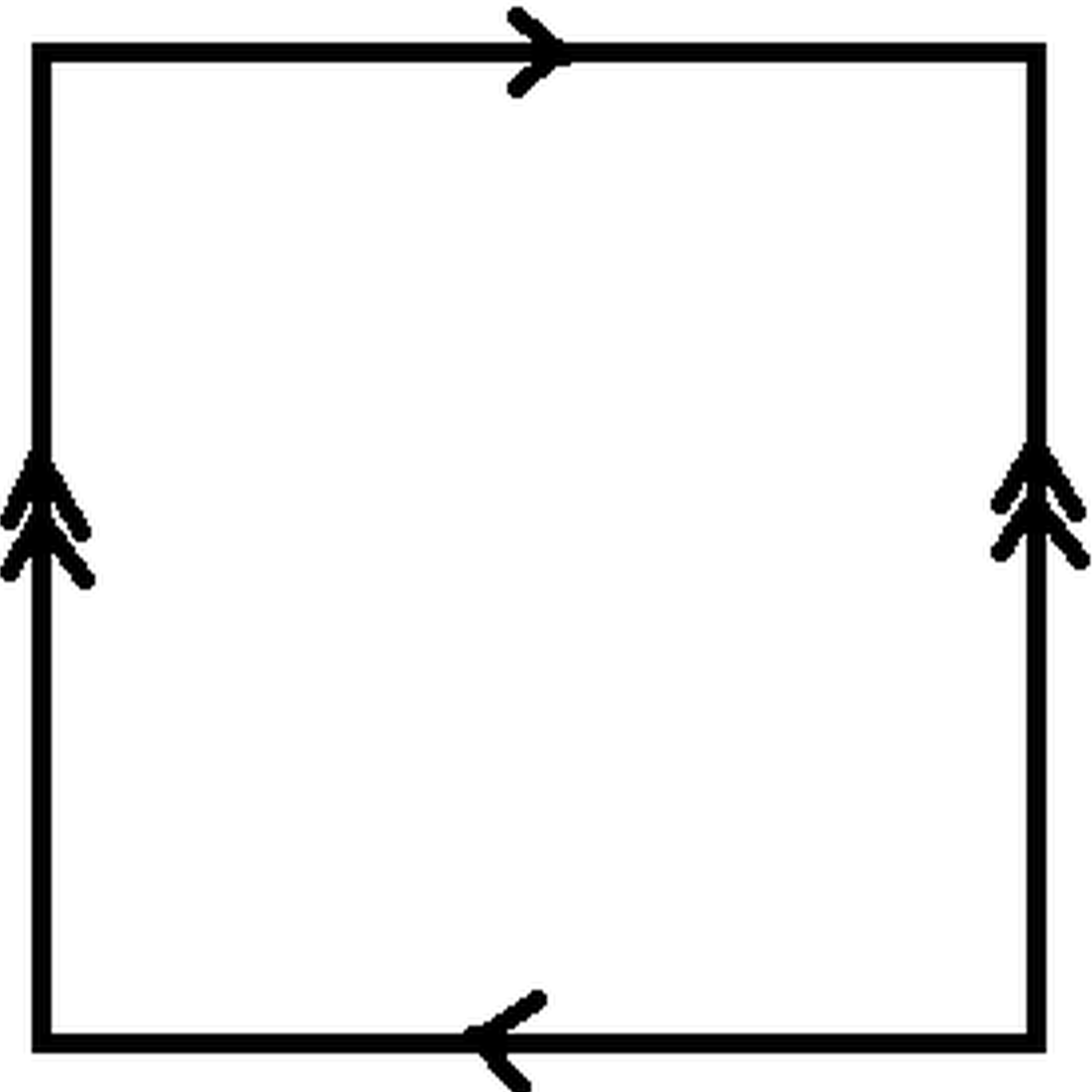
with edge identifications:
 and
and  for all
 ![x,y\in[0,1]](https://nhsjs.com/wp-content/ql-cache/quicklatex.com-4436f08f8f018b6a0502eee55e66a1ed_l3.png "Rendered by QuickLaTeX.com") .
.
The Klein bottle is defined as the quotient space  17.
17.
Suppose is orientable. Thus, there must exists a continuous orientation on the tangent spaces  and a consistent oriented tangent basis on every point:
![\[\left(V_{1(P)},V_{2(p)}\right)\]](https://nhsjs.com/wp-content/ql-cache/quicklatex.com-961a155f635768e1a93dff5f5d874a02_l3.png "Rendered by QuickLaTeX.com")
For every tangent space such that all transition maps keep the orientation.
Consider the identification map corresponding to the twisted edge:
![\[\phi:[0,1]\rightarrow[0,1]\]](https://nhsjs.com/wp-content/ql-cache/quicklatex.com-41fef39f4e789b318c1f137931dcbf62_l3.png "Rendered by QuickLaTeX.com")
Defined by:
![\[\phi(x)=1-x\]](https://nhsjs.com/wp-content/ql-cache/quicklatex.com-a627b0a83332341ebf9ed9031af81d81_l3.png "Rendered by QuickLaTeX.com")
The derivative of  is
is
![\[\frac{d\phi}{dx}=-1\]](https://nhsjs.com/wp-content/ql-cache/quicklatex.com-b3a6586d35eabdd5b11f1959c3e42fcb_l3.png "Rendered by QuickLaTeX.com")
Since  , the map reverses its orientation.
The oriented basis at a point  on the lower edge of
  :
:
![\[(e_{1},e_{2})\]](https://nhsjs.com/wp-content/ql-cache/quicklatex.com-64fc2dd0ca4c4add2ad8e6eb6dff906c_l3.png "Rendered by QuickLaTeX.com")
becomes:
![\[(-e_{1},e_{2})\]](https://nhsjs.com/wp-content/ql-cache/quicklatex.com-2fd20148c673c947754b8aecc8d04e22_l3.png "Rendered by QuickLaTeX.com")
After completing the loop, the orientation of the ordered basis reversed:
![\[(e_{1},e_{2})\rightarrow(-e_{1},e_{2})\]](https://nhsjs.com/wp-content/ql-cache/quicklatex.com-c710d9c96a4483d691ace281d7e072ff_l3.png "Rendered by QuickLaTeX.com")
Thu, no globally consistent orientation can descend to the quotient space . This contradicts to the assumption that is orientable. Hence is non-orientable.
Embedding and Immersion
Proposition. The Klein bottle cannot be embedded in R3.
Proof. Assume the Klein bottle can be embedded in  . Since is a compact closed embedded surface, the Jordan-Brouwer Separation Theorem states that
  has exactly two connected components: an inside and an outside. Thus, would be the boundary separating those regions. The boundary of the compact three-dimensional region must have a consistent outward pointing normal unit vector, which means is orientable. However, proposition 4.1 says that the Klein bottle is non-orientable, forming a contradiction. Therefore, the Klein bottle cannot be embedded in .
Proposition. Klein Bottle is immersible in R3
Proof. We must first prove that the Klein Bottle descends to a smooth map on the quotient space and then compute the partial derivatives to calculate the rank of the Jacobian Matrix to shows the Klein Bottle is immersible in R3.
Step 1. Let the Klein Bottle be represented as a quotient of a square ![[0,2\pi]\times[0,2\pi]](https://nhsjs.com/wp-content/ql-cache/quicklatex.com-cc05c394d943c844d37160242a9e7068_l3.png "Rendered by QuickLaTeX.com") with identifications:
with identifications:
![\[(u,0)\sim(u,\,2\pi),\ (0,v)\sim(2\pi,\,2\pi-v)\]](https://nhsjs.com/wp-content/ql-cache/quicklatex.com-7312cf5c83166c9c468da665a89a23b7_l3.png "Rendered by QuickLaTeX.com")
(Note: We represent the Klein Bottle as a unit square instead of a ![[0,1]\times[0,1]](https://nhsjs.com/wp-content/ql-cache/quicklatex.com-a80c631f90a267e309a47e77ab3b96ef_l3.png "Rendered by QuickLaTeX.com") unit square because the Klein Bottle immersion is built from rotations, where parametric equations will be involved and rotations are
unit square because the Klein Bottle immersion is built from rotations, where parametric equations will be involved and rotations are  periodic.)
Consider the standard figure-eight parametrization:
![\[f(u,v)=\begin{pmatrix}\bigl(r+\cos(u/2)\,\sin(v)-\sin(u/2)\,\sin(2v)\bigr)\cos(u)\\\bigl(r+\cos(u/2)\,\sin(v)-\sin(u/2)\,\sin(2v)\bigr)\sin(u)\\\sin(u/2)\,\sin(v)+\cos(u/2)\,\sin(2v)\end{pmatrix}\]](https://nhsjs.com/wp-content/ql-cache/quicklatex.com-8816d4d72dcd87f6c8b3e91e5c0fb15e_l3.png "Rendered by QuickLaTeX.com")
And let:
![\[x(u,v)=\left(r+\cos\left(\frac{u}{2}\right)\sin(v)-\sin\left(\frac{u}{2}\right)\sin(2v)\right)\cos(u)\]](https://nhsjs.com/wp-content/ql-cache/quicklatex.com-59a0f898ea4889041b6974e97ed2f557_l3.png "Rendered by QuickLaTeX.com")
![\[y(u,v)=\left(r+\cos\left(\frac{u}{2}\right)\sin(v)-\sin\left(\frac{u}{2}\right)\sin(2v)\right)\sin(u)\]](https://nhsjs.com/wp-content/ql-cache/quicklatex.com-d6317c6847889f20554eab063a331bc5_l3.png "Rendered by QuickLaTeX.com")
![\[z(u,v)=\sin\left(\frac{u}{2}\right)\sin(v)+2\cos\left(\frac{u}{2}\right)\sin(2v)\]](https://nhsjs.com/wp-content/ql-cache/quicklatex.com-377abf6de3b67ce3a9a2c8fa19138e2d_l3.png "Rendered by QuickLaTeX.com")
for  ,
,  and
and 
For the horizontal edge identification  since,
![\[\sin(0)=\sin(2\pi),\ \sin(2\times 0)=\sin(4\pi)=0\]](https://nhsjs.com/wp-content/ql-cache/quicklatex.com-664a84bedf8b38607b72e21fe5cf0212_l3.png "Rendered by QuickLaTeX.com")
By substituting  or
or  into the parametric equation:
![\[x(u,0)=r\cos(u)=x(u,2\pi)\]](https://nhsjs.com/wp-content/ql-cache/quicklatex.com-05aafab6a0257a808a856f88eadfffd9_l3.png "Rendered by QuickLaTeX.com")
![\[y(u,0)=r\sin(u)=y(u,2\pi)\]](https://nhsjs.com/wp-content/ql-cache/quicklatex.com-8ada0d01609fd8c8249fc94acaeb36dc_l3.png "Rendered by QuickLaTeX.com")
![\[z(u,0)=0=z(u,2\pi)\]](https://nhsjs.com/wp-content/ql-cache/quicklatex.com-6cfedfe5e5b6f5c7e608a266c1ea4b6b_l3.png "Rendered by QuickLaTeX.com")
Where  .
.
For vertical edge identification  first
first  is evaluated, by using
![\[\cos\left(\frac{0}{2}\right)=1,\ \cos(0)=1,\ \sin\left(\frac{0}{2}\right),\ \sin(0)=0\]](https://nhsjs.com/wp-content/ql-cache/quicklatex.com-973d94603ccd71e3195950b5960a0a3a_l3.png "Rendered by QuickLaTeX.com")
Yielding:
![\[x(0,y)=r+\sin v\]](https://nhsjs.com/wp-content/ql-cache/quicklatex.com-28cac14c16519d74520346375c70acf9_l3.png "Rendered by QuickLaTeX.com")
![\[y(0,v)=0\]](https://nhsjs.com/wp-content/ql-cache/quicklatex.com-421aa00b167317966316d03523487dbf_l3.png "Rendered by QuickLaTeX.com")
![\[z(0,v)=\sin 2v\]](https://nhsjs.com/wp-content/ql-cache/quicklatex.com-aa5faf8762f954988c0f292e360da4be_l3.png "Rendered by QuickLaTeX.com")
Second,  is evaluated using:
![\[\cos 2\pi=1,\ \cos\pi=-1,\ \sin 2\pi=0,\ \sin\pi=0\]](https://nhsjs.com/wp-content/ql-cache/quicklatex.com-5d181ba0e27037ccede7967a98eec487_l3.png "Rendered by QuickLaTeX.com")
And trigonometry identities:
![\[\sin(2\pi-v)=-\sin v,\ \sin\left(2(2\pi-v)\right)=-\sin 2v\]](https://nhsjs.com/wp-content/ql-cache/quicklatex.com-6720b2f45fce9e6822baef0525c981ff_l3.png "Rendered by QuickLaTeX.com")
By substituting into parametric equations yield:
![\[x(2\pi,\,2\pi-v)=r+(-1)(-\sin v)-0=r+\sin v\]](https://nhsjs.com/wp-content/ql-cache/quicklatex.com-b8f315b8ab4b3f4d95f8434819fa7ef8_l3.png "Rendered by QuickLaTeX.com")
![\[y(2\pi,\,2\pi-v)=0\]](https://nhsjs.com/wp-content/ql-cache/quicklatex.com-6a6d71f859456b192e1fba9c417e5702_l3.png "Rendered by QuickLaTeX.com")
![\[z(2\pi,\,2\pi-v)=(-1)(-\sin 2v)=\sin 2v\]](https://nhsjs.com/wp-content/ql-cache/quicklatex.com-f55b98bad6e3e7ac5ded5c7fbbb87c9c_l3.png "Rendered by QuickLaTeX.com")
Which is equivalent to the result for evaluating , therefore it can be concluded that  .
.
Since both identifications satisfy:
![\[f(u,0)=f(u,\,2\pi),\ f(0,v)=f(2\pi,2\pi-v)\]](https://nhsjs.com/wp-content/ql-cache/quicklatex.com-eeee71e9375ab711dcf10fe68d12d84e_l3.png "Rendered by QuickLaTeX.com")
Hence, descends to a defined smooth map on the quotient space.
Step 2. Now compute the rank of the Klein Bottle. The following differential-geometric calculations use the standard parametrization and tangent vector frame-work for smooth surfaces. The partial derivatives of  are
are  well computed.
Recall the map from the previous step:
![\[f(u,v)=(x(u,v),\ y(u,v),\ z(u,v))\]](https://nhsjs.com/wp-content/ql-cache/quicklatex.com-837b3dd6d73bae1e0d0cb9bc4b4a35fd_l3.png "Rendered by QuickLaTeX.com")
Let
![\[A(u,v)=r+\cos\left(\frac{u}{2}\right)\sin(v)-\sin\left(\frac{u}{2}\right)\sin(2v)\]](https://nhsjs.com/wp-content/ql-cache/quicklatex.com-1dc57d197662274b4e50423a1e547bc5_l3.png "Rendered by QuickLaTeX.com")
![\[B(u,v) = \sin\left(\frac{u}{2}\right)\sin(v) + 2\cos\left(\frac{u}{2}\right)\sin(2v)\]](https://nhsjs.com/wp-content/ql-cache/quicklatex.com-13e3ef4ddda64ab7a725866f205dc95e_l3.png "Rendered by QuickLaTeX.com")
Were
![\[x(u,v)=A(u,v)\cos u\]](https://nhsjs.com/wp-content/ql-cache/quicklatex.com-cf809e30177b9e9f3a82eb82883bcfa8_l3.png "Rendered by QuickLaTeX.com")
![\[y(u,v)=A(u,v)\sin u\]](https://nhsjs.com/wp-content/ql-cache/quicklatex.com-06d9dcf4ce6570336f33186d85861c37_l3.png "Rendered by QuickLaTeX.com")
![\[z(u,v)=B(u,v)\]](https://nhsjs.com/wp-content/ql-cache/quicklatex.com-1bfca5e12d73fae1c85614010a2c705a_l3.png "Rendered by QuickLaTeX.com")
With respect to  :
:
![\[A_{u}=-\frac{1}{2}\sin\frac{u}{2}\sin v-\frac{1}{2}\cos\frac{u}{2}\sin 2v\]](https://nhsjs.com/wp-content/ql-cache/quicklatex.com-4199a327ce2d9d857b6c26ae09108680_l3.png "Rendered by QuickLaTeX.com")
![\[B_{u}=\frac{1}{2}\cos\frac{u}{2}\sin v-\frac{1}{2}\sin\frac{u}{2}\sin 2v\]](https://nhsjs.com/wp-content/ql-cache/quicklatex.com-fcb8ef150e94f5c008f0a72e4edc4ecb_l3.png "Rendered by QuickLaTeX.com")
With respect to  :
:
![\[A_{v}=\cos\frac{u}{2}\cos v-2\sin\frac{u}{2}\cos 2v\]](https://nhsjs.com/wp-content/ql-cache/quicklatex.com-2007321ab402d1e9ed8b928926628286_l3.png "Rendered by QuickLaTeX.com")
![\[B_{v}=\sin\frac{u}{2}\cos v+2\cos\frac{u}{2}\cos 2v\]](https://nhsjs.com/wp-content/ql-cache/quicklatex.com-d0e9f5cf3bc4085789d29cf97f7d8754_l3.png "Rendered by QuickLaTeX.com")
Step 3. compute 
Using the product rule results in it:
![\[\frac{\partial x}{\partial u}=A_{u}\cos u-A\sin u\]](https://nhsjs.com/wp-content/ql-cache/quicklatex.com-a2342d67b70589328f1487625f9a2b43_l3.png "Rendered by QuickLaTeX.com")
![\[\frac{\partial y}{\partial u}=A_{u}\sin u+A\cos u\]](https://nhsjs.com/wp-content/ql-cache/quicklatex.com-25bb4613c76731db139ff1b7ca9ac79d_l3.png "Rendered by QuickLaTeX.com")
![\[\frac{\partial z}{\partial u}=B_{u}\]](https://nhsjs.com/wp-content/ql-cache/quicklatex.com-b7a19ab26c498833423e27f245bf3a38_l3.png "Rendered by QuickLaTeX.com")
Thus,
![\[\frac{\partial f}{\partial u}=\begin{pmatrix}A_{u}\cos u-A\sin u\A_{u}\sin u+A\cos u\B_{u}\end{pmatrix}\]](https://nhsjs.com/wp-content/ql-cache/quicklatex.com-023c0d2f98c1125254d9ae759f3f70bd_l3.png "Rendered by QuickLaTeX.com")
Step 4. Now computing  , again using the product rule:
![\[\frac{\partial x}{\partial v}=A_{v}\cos u\]](https://nhsjs.com/wp-content/ql-cache/quicklatex.com-2d27c985614c7e0e6ec00c36b710066f_l3.png "Rendered by QuickLaTeX.com")
![\[\frac{\partial y}{\partial v}=A_{v}\sin u\]](https://nhsjs.com/wp-content/ql-cache/quicklatex.com-c908eb0e8109c810ff3c557d088bb47b_l3.png "Rendered by QuickLaTeX.com")
![\[\frac{\partial z}{\partial v}=B_{v}\]](https://nhsjs.com/wp-content/ql-cache/quicklatex.com-8ebe7023e716a06dc3665c28674d8efd_l3.png "Rendered by QuickLaTeX.com")
Thus,
![\[\frac{\partial f}{\partial v}=\begin{pmatrix}A_{v}\cos u\\A_{v}\sin u\\B_{v}\end{pmatrix}\]](https://nhsjs.com/wp-content/ql-cache/quicklatex.com-e467a0344cc5fc0b4811d54c5fa445a0_l3.png "Rendered by QuickLaTeX.com")
Step 4. To compute  the cross-product matrix elements all determined:
![\begin{equation*}\begin{aligned}\frac{\partial f}{\partial v}\times\frac{\partial f}{\partial u}&=\begin{vmatrix}\boldsymbol{i} & \boldsymbol{j} & \boldsymbol{k} \\A_u\cos u-A\sin u & A_u\sin u+A\cos u & B_u \\A_v\cos u & A_v\sin u & B_v\end{vmatrix}\\[6pt]&= \boldsymbol{i}\left[(A_u\sin u+A\cos u)B_v-B_u(A_v\sin u)\right]\\&\quad-\boldsymbol{j}\left[(A_u\cos u-A\sin u)B_v-B_u(A_v\cos u)\right]\\&\quad+\boldsymbol{k}\left[(A_u\cos u-A\sin u)(A_v\sin u)-(A_u\sin u+A\cos u)(A_v\cos u)\right].\end{aligned}\end{equation*}](https://nhsjs.com/wp-content/ql-cache/quicklatex.com-e613510db13d2ab5720e4e5c8a098442_l3.png "Rendered by QuickLaTeX.com")
then simplified:
![\[&= A_uB_v\sin u + AB_v\cos u - A_vB_u\sin u\]](https://nhsjs.com/wp-content/ql-cache/quicklatex.com-876168352f3a953a923e4a2905a7eed9_l3.png "Rendered by QuickLaTeX.com")
![\[&\quad -A_uB_v\cos u + AB_v\sin u + A_vB_u\cos u\]](https://nhsjs.com/wp-content/ql-cache/quicklatex.com-44f23f78d05c153e7d7121715b50f562_l3.png "Rendered by QuickLaTeX.com")
![\[&\quad - AA_v\]](https://nhsjs.com/wp-content/ql-cache/quicklatex.com-964d96cebe6ee4f788efd705148b91bd_l3.png "Rendered by QuickLaTeX.com")
and finally:
![\begin{equation*}\frac{\partial f}{\partial v}\times\frac{\partial f}{\partial u} =\left(\begin{gathered} A_uB_v\sin u + AB_v\cos u - A_vB_u\sin u \\[2pt]-A_uB_v\cos u + AB_v\sin u - A_vB_u\cos u \\[2pt] -AA_v \end{gathered} \right)\end{equation*}](https://nhsjs.com/wp-content/ql-cache/quicklatex.com-c9f8ff26311f6f3c45dddfd4ae66f4f8_l3.png "Rendered by QuickLaTeX.com")
Step 5. To prove that defines an immersion, need to verify that
![\[\operatorname{rank}\left(df_{u,v}\right)=2\]](https://nhsjs.com/wp-content/ql-cache/quicklatex.com-b939169b8cc41df4841874314d97dcc2_l3.png "Rendered by QuickLaTeX.com")
For every point  .
.
Since the Jacobian matrix consists of the tangent vectors:
![\[f_{u}=\frac{\partial f}{\partial u},\ f_{v}=\frac{\partial f}{\partial v},\]](https://nhsjs.com/wp-content/ql-cache/quicklatex.com-ef4f4aa0daf35dfcce5cc0d8f2b5bf58_l3.png "Rendered by QuickLaTeX.com")
Rank two is equivalent to showing that these vectors are linearly independent.
A necessary and sufficient condition for linear independence is
![\[f_{u}\times f_{v}\neq 0\]](https://nhsjs.com/wp-content/ql-cache/quicklatex.com-c112f723485fb7550125c0161557b318_l3.png "Rendered by QuickLaTeX.com")
Now compute the squared norm:
![\[\left|f_{u}\times f_{v}\right|^{2}\]](https://nhsjs.com/wp-content/ql-cache/quicklatex.com-52967117f7d2a32355a27587143aa018_l3.png "Rendered by QuickLaTeX.com")
Let
![\[R_{1}(u,v)=A_{u}B_{v}\sin(u)+AB_{v}\cos(u)-A_{v}B_{u}\sin(u)\]](https://nhsjs.com/wp-content/ql-cache/quicklatex.com-4365eeecd036091523fa60d5d15d00be_l3.png "Rendered by QuickLaTeX.com")
![\[R_{2}(u,v)=-A_{u}B_{v}\cos(u)+AB_{v}\sin(u)-A_{v}B_{u}\cos(u)\]](https://nhsjs.com/wp-content/ql-cache/quicklatex.com-09738ee1ddaad79c02cffdd7173d9c66_l3.png "Rendered by QuickLaTeX.com")
![\[R_{3}(u,v)=-AA_{v}\]](https://nhsjs.com/wp-content/ql-cache/quicklatex.com-d50e2d9d4438666d436b88703182618c_l3.png "Rendered by QuickLaTeX.com")
Which the squared norm of the cross-product equals:
![\[\left|f_{u}\times f_{v}\right|^{2}=R_{1}^{2}+R_{2}^{2}+R_{3}^{2}\]](https://nhsjs.com/wp-content/ql-cache/quicklatex.com-a8206e6bedd9865f3839b100ea66b7d3_l3.png "Rendered by QuickLaTeX.com")
Since each term is squared,
 occurs only if
While  , vanishing requires either
  or
or  .
.
Substituting these cases into  and
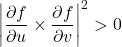
and  shows that all three equations cannot hold simultaneously throughout the equation domain.
Thus:
 For all
Therefore, , , are linearly independent everywhere.
Hence
For every point of the quotient domain. is an immersion of the Klein bottle into .
Corollary. Every immersion of the Klein bottle into R3 contains self-intersections.
Proof. Suppose an immersion of K→R3 has no self-intersections. Then the map would be injective. Since K is compact, an injective immersion would be an embedding. However, proposition 5.1 shows that K admits no embedding into R3. Hence every immersion must contain self-intersections.
Divergence Theorem
The Divergence theorem is another approach for volume enclosure. To apply the theorem, the manifold must have a boundary in . For an  -compact, oriented manifold embedded in , the theorem states that:
![\[\int_{\partial M} (\operatorname{div}\mathbf{G})\,dV = \int_M \langle \mathbf{G}, \mathbf{N} \rangle\,dV\]](https://nhsjs.com/wp-content/ql-cache/quicklatex.com-b0f25ef4b5fc6cfb105efb7b3b1d00d0_l3.png "Rendered by QuickLaTeX.com")
Where  is a differentiable vector field,
  is the consistently defined outward-pointing unit normal vector field24 For the case of the Klein bottle, in without the boundary
  , the integral cannot be computed with an unidentified inside and outside; with in
  a continuous global unit normal field is undefined fails to compute the volume using the Divergence theorem.
Discussion
This study shows that the Klein bottle cannot enclose a volume in R3 because of its non-orientable and boundaryless properties. A surface that encloses a volume must have distinguishable inside and outside orientation, equivalent to being orientable. By the Jordan-Brouwer Separation theorem, an embedded compact space separating R3 into an interior and exterior must be orientable, which the Klein bottle cannot be embedded into R3. However, it can be immersed in R3 with self-intersections and eventually embedded in R4 , by having an extra dimension to extend its shape. Non-orientability is a topological restriction for higher-dimensional topological figures, whereby a self-intersection is a unique shape of them in lower dimensions.
The analysis presents the relationship between topology and geometry, where the intrinsic topological properties can impose restrictions and affect how an object exists in Euclidean space. Furthermore, the paper clarifies the concepts of embeddings and immersions, which often confuse students. The use of the Jordan-Brouwer separation theorem provides a topological explanation, while the use of the divergence theorem provides an additional geometric or vector-calculus perspective, helping students to connect and bring together topology and calculus. In academics, this paper combines several established concepts into one logical chain rather than discussing them separately in different chapters, as in textbooks. Its educational significance can be present in the second or third year of university, where students begin to learn topology and differential geometry that need them to cooperate with spatial structure and theorems; the comprehension of the known result is essential for them to do further studies.
The primary objective of the study was achieved: to provide an expository explanation to explain why the Klein bottle cannot enclose a volume in R3 by establishing the non-orientability of the Klein bottle, explaining why the Klein bottle is non-orientable, which prevents volume generation. No new mathematical theorems or results were presented in the paper; therefore, success was achieved by clarity and synthesis of existing results. The study’s conclusions were consistent with the original objectives.
Limitations
The paper is expository rather than original mathematical research and only includes established results rather than introducing a new theorem or proof. Thus, the findings are limited to existing mathematical knowledge. Advanced visualization tools or computational topology are not used in this paper. Conclusions strictly focus only on the Klein bottle and cannot be extended to all non-orientable manifolds, despite being in the same classification in topology.
Conclusion
Overall, the Klein bottle might appear to enclose a volume geometrically, but it is topologically impossible. Dimension and topology are the fundamental constraints of geometric objects, while volume enclosure associated with in-depth ideas regarding orientability, embedding, and the structure of the space. Topology helps to understand not only the shape but also the topological rules that control the way they exist in space.
Acknowledgement
I would like to thank Dr. Patricia Mitchler and Professor Derek Krepski for providing guidance and suggestions for the paper.
References
- K. Polthier. Imaging maths − Inside the Klein bottle. 1997. [↩]
- Munkres James R. Topology (2nd edition). 1999. [↩] [↩]
- Lee John.M. Introduction to Smooth Manifolds. 2012. [↩] [↩] [↩] [↩]
- Weeks Jeffrey Renwick. The Shape of Space. 1985. [↩]
- Smith, A. “Piecewise linear immersions.” Mathematical Proceedings of the Cambridge Philosophical Society, 68(1), 45–55, 1970. doi:10.1017/S0305004100001031 [↩]
- D. Cohen, L. Vandembroucq. Topological complexity of the klein bottle. Journal of Applied and Computational Topology. 2017. [↩]
- H. H. Torriani. Profinite completions of the fundamental group of the klein bottle. Czechoslovak Mathematical Journal 35.4. pg. 511–514, 1985. [↩]
- D. M. Davis. An n -dimensional klein bottle. Proceedings of the Royal Society of Edinburgh: Section A Mathematics. Vol. 149, pg. 1207–1221, 2019 https://doi.org/10.1017/prm.2018.73. [↩]
- Cervone Davide P. Vertex-minimal simplicial immersions of the klein bottle in three-space. Geometriae Dedicata, 50. pg. 117–141, 1994. [↩]
- Jakobson, D., Nadirashvili, N., & Polterovich, I. “Extremal Metric for the First Eigenvalue on a Klein Bottle.” Canadian Journal of Mathematics, 58(2), 381–400, 2006. DOI: 10.4153/CJM-2006-016-0 [↩]
- J. Hirsch, E. Mäder-Baumdicker. A note on willmore minimizing klein bottles in euclidean space. Advances in Mathematics. Vol. 319, pg. 67–75, 2017 https://doi.org/10.1016/J.AIM.2017.08.021. [↩]
- J. Eyll. Stability of systolic inequalities for the möbius strip and klein bottle. The Journal of Geometric Analysis 2025 35:11. Vol. 35, pg. 365-, 2025 https://doi.org/10.1007/S12220-025-02197-9. [↩]
- B. Greene, D. Kabat, J. Levin, M. Porrati. Klein bottle cosmology. 2026. [↩]
- W. Schmaltz. THE JORDAN-BROUWER SEPARATION THEOREM. 2009. [↩]
- Marsden Jerrold E., Tromba Anthony J. Vector Calculus. 1976. [↩]
- Munkres James R. Analysis On Manifolds. CRC Press, 2018. [↩]
- Lee John M. Introduction to Topological Manifolds. 2000. [↩] [↩]
- Milnor John Willard. Topology from the Differentiable Viewpoint. 1965. [↩]
- Guillemin Victor William, Pollack Alan. Differential Topology. 1974. [↩]
- Hirsch Morris William. Differential Topology. 1976. [↩]
- Massey William S. A Basic Course in Algebraic Topology. 1991. [↩]
- Hatcher Allen. Algebraic Topology. 2001. [↩]
- Armstrong Mark Anthony. Basic Topology. 1979. [↩]
- Munkres James R. Analysis On Manifolds. CRC Press, 2018. [↩]