
Abstract
The extensive integration of social media into daily life has gained significant academic interest in its implications for mental health. The inconsistent findings suggest that individual differences may moderate these effects. The neuroticism trait is found to be linked with negative mental health outcomes among various personalities. To understand these dynamics, it is essential to determine how this trait moderates the relationship between social media and mental health. However, a critical gap exists in integrating psychological research into this moderating role with the neurobiological evidence. A systematic search of two complementary bodies of literature, i.e., psychological and neurological, is conducted in this review. It synthesizes findings from peer-reviewed empirical studies on neurobiology, neuroticism, and social media. It proposes a theoretical framework on the pathway by which neural substrates of neuroticism amplify the adverse effects of social media on mental health. Specifically, it examines four mechanisms of neuroticism, i.e., emotional reactivity, social comparison, rumination, and compulsive social media use, and investigates their underlying plausible neurobiological pathways. By integrating two streams of research studies, this review proposes a neurocognitive pathway in which neuroticism may contribute to vulnerability. The results provide a foundation for future empirical validation and the development of personality-sensitive interventions to promote healthier social media engagement.
Introduction
Social media use has become a pervasive aspect of modern life. Globally, nearly 5 billion individuals worldwide, about 59% of the world population, are active social media users with an average usage time of over 2.5 hours per day1. As its use continues to expand, there are ongoing concerns about its impact on mental health outcomes. However, there is a general inconsistency in the research findings of past studies, which have attempted to establish a link between social media usage and the mental health outcomes2. For example, in some studies, there is a strong relationship between usage of social media platforms and adverse psychological consequences, including depression and anxiety3. On the contrary, some studies found no significant relationships1,4. This underscores the multifaceted and intricate nature of this problem. The inconsistency suggests that understanding of social media’s impact requires the identification of critical moderators. In other words, for whom and under what circumstances do social media platforms pose the highest psychological risk.
Personality traits are defined as stable patterns of thinking, feeling, and behaving5. It shapes an individual’s perception and responses to their environment, including the digital world. This perspective aligns with the Differential Susceptibility to Media Effects Model (DSMM), which posits that media effects are contingent on an individual’s dispositional characteristics6. Neuroticism, which is characterized by a tendency to experience negative emotions such as anxiety, irritability, and emotional instability7, is one of the most significant traits in this context. Individuals high in this trait have greater cognitive-affective vulnerabilities, such as increased threat-sensitivity and negative interpretation biases. These traits may make them susceptible to social media environments. Neuroimaging studies demonstrate that individuals high in neuroticism exhibit increased amygdala reactivity to emotional stimuli8, which may be associated with amplified emotional distress when exposed to negative or ambiguous social media content9.
While the separate literatures on the psychological effects of social media and the neuroscience of neuroticism are each robust, a critical gap exists. No review has systematically integrated these two bodies of work to construct a coherent framework to explain how the neural substrates of neuroticism might interact with the specific stimuli of social media to amplify negative outcomes of social media. Many neuroimaging studies on neuroticism use general emotional tasks10,11, (e.g., responses to faces), while studies on the neurobiological impact of digital media often do not assess personality12,13.
Scope and definitions
To ensure conceptual clarity, it is essential to distinguish between closely related terms in digital media research. For the purposes of this review, social media refers to websites and technological applications (e.g., Instagram, Facebook, TikTok, X/Twitter) that allow their users to share content and/or to participate in social networking14. In this review, the time spent on social media is examined. Social media is distinguished from general screen media use, which is defined as the time spent viewing or interacting with television, DVDs or videos, computer or electronic games, and smartphones or tablets15. Problematic smartphone use refers to the excessive use of smartphones with associated dysfunction, withdrawal difficulties, and other phenomena similar to substance addiction16. Internet addiction, also referred to as problematic internet use or compulsive internet use, is defined as excessive or poorly controlled preoccupations, urges, or behaviors regarding computer use and internet access that lead to impairment or distress17. Social media is considered the focus of the review because of its unique affordances, such as social comparison, feedback loops, self-presentation, and asynchronous communication. The mental health outcomes focus on internalizing symptoms such as depression and anxiety.
The aims of this review:
- To synthesize evidence from two complementary literatures to construct an integrative theoretical framework, (a) psychological literature on neuroticism and social media, (b) Neurobiological correlates of neuroticism.
- To propose four interconnected pathways through which neuroticism may magnify social media’s impacts on mental health. They are emotional reactivity, social comparison, rumination, and compulsive social media use.
Method
This review synthesizes current literature on how neuroticism influences the relationship between social media use and mental health, with a focus on neurobiological mechanisms. A systematic search of two complementary bodies of literature: (1) psychological studies on neuroticism and social media, and (2) neurobiological studies on either neuroticism or social media effects.
Search Strategy
Searches were conducted in PubMed, PsycINFO, and Web of Science using the following terms:
Search 1: Psychological Literature
- (neuroticism) AND (“social media” OR Facebook OR Instagram) AND (“mental health” OR depression OR anxiety)
Search 2: Neurobiological Literature
- (neuroticism) AND (neuroimaging OR fMRI)
- (social media) AND (neuroimaging OR fMRI)
Filters were set to include English-language, peer-reviewed empirical articles published from 2000 to 2024. Google Scholar was used for supplemental citation tracking only. Search results were pooled, and duplicates were removed using Zotero.
Inclusion and exclusion criteria
Studies were included if they were peer-reviewed empirical investigations that either: (a) measured neuroticism and social media use alongside a mental health outcome, or (b) used neuroimaging to study the neural correlates of neuroticism or the neural effects of social media engagement. Studies focusing solely on general screen time, internet addiction, or smartphone use without isolating social media were excluded, as were non-peer-reviewed papers and case studies.
Study selection process
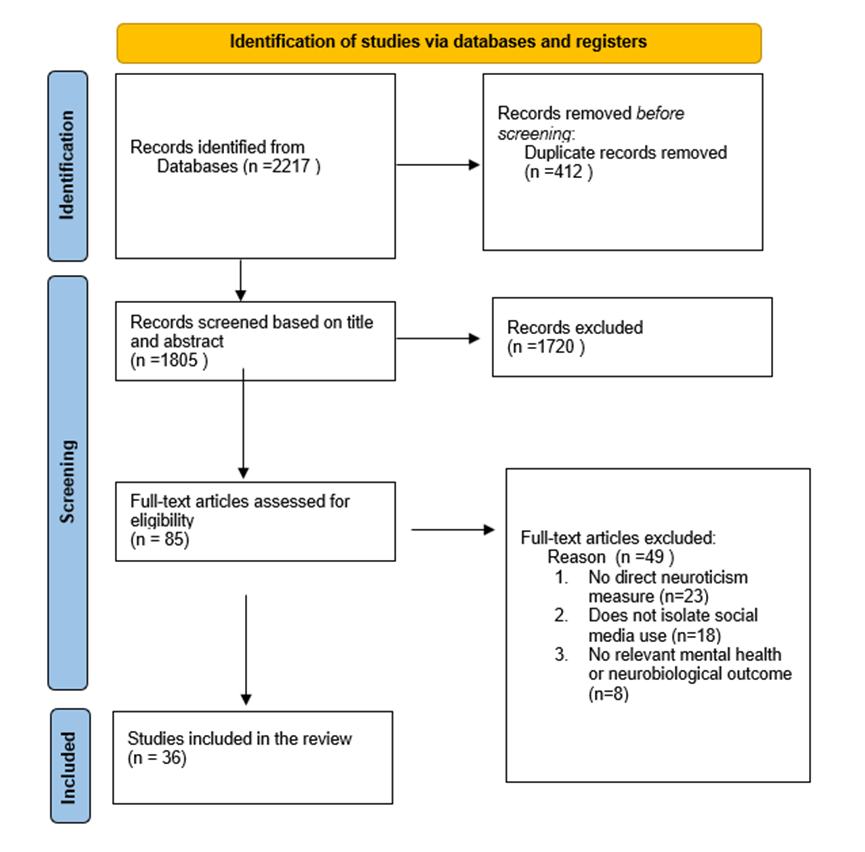
The selection process followed PRISMA 2020 guidelines18. After duplicate removal, title and abstract screening were conducted using Rayyan systematic review software19. The full-text screening was conducted by one reviewer. The selection process is summarized in a PRISMA flow diagram (Figure 1).
A narrative synthesis approach was employed. Synthesis was structured deductively around the four pre-specified, theoretically derived mechanisms. For each mechanism, psychological findings linking neuroticism to social media behavior (from Stream A) were first summarized, then integrated with relevant neuroimaging evidence on the associated brain systems (from Stream B). This cross-literature integration for each mechanism forms the core of the proposed theoretical framework, with key relationships summarized in Table 1.
Results
Study selection
Database searches yielded 2,217 initial records. After removing 412 duplicates, 1,805 unique records underwent title and abstract screening, excluding 1,720 as irrelevant. Eighty-five full-text articles were assessed, with 49 excluded (primarily for lacking a neuroticism measure [n=23] or not isolating social media use [n=18] and no relevant mental health or neurobiological outcome [n=8]). A final set of 36 studies met all inclusion criteria (see PRISMA flow diagram, Figure 1).
Study characteristics
The 36 included studies comprised two distinct streams. Stream A (Psychology) contained 24 studies. They were cross-sectional (n=18) or longitudinal (n=6) survey designs with community, adolescent, or young adult samples. Stream B (Neurobiology) contained 12 neuroimaging studies. No studies were found to simultaneously measure neuroticism, specific social media behaviors, and neurobiological outcomes.
Synthesis of findings
Social media’s impact on mental health
The association between social media use and mental health outcomes has been widely investigated and yields mixed results4. On the positive aspects, individuals can connect with people, despite physical distance, with similar hobbies and interests. It can help to cultivate a sense of belonging and foster relationships20. However, research has shown that social media use is associated with increased anxiety, depression, and feelings of loneliness21. A recent literature review has shown that adolescents who spend more than three hours on social media per day are at a higher risk for negative mental health problems in comparison to peers who visit social media less frequently22. Neurological findings show that the brain’s neurobiological reward circuitry is changed after prolonged exposure. Moreover, research reveals that chronic activation of the amygdala due to frequent negative social interactions is associated with heightened anxiety responses23.
Despite growing evidence of negative ramifications of social media, some studies have reported negligible results. In one study, the relationship between time spent on social media and the mental outcome was examined. This research found that social media use is very weakly associated with anxiety and not associated with depression or stress24. Such inconsistency suggests that social media is not a uniform experience for each individual.
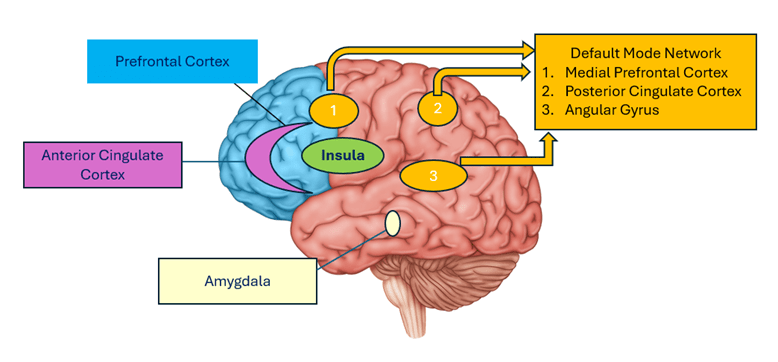
The narrative synthesis is structured around the four pre-specified mechanisms. To provide a neuroanatomical foundation, Figure 2 illustrates the key brain regions consistently implicated in neuroticism across neuroimaging studies. These neural substrates—including the amygdala, prefrontal cortex, anterior cingulate cortex, anterior insula, and default mode network—form the biological basis for the proposed pathways. Table 1 provides an integrated summary of the behavioral manifestations on social media (from Stream A), neurobiological correlates (from Stream B), and the proposed theoretical framework for each mechanism. The following sections outline the evidence for each pathway.
| Mechanism | Behavioral manifestation of social media | Neurobiological correlates | Proposed integrative framework (Theoretical Pathway) |
| Emotional Reactivity | • Overreacting to neutral posts or messages, interpreting them as personal affronts. • Difficulty resisting the urge to check social media due to reduced impulse control. • Heightened sensitivity to comments and feedback. | • Amygdala hyperactivity: Heightened reactivity to negative or ambiguous emotional stimuli. • Reduced prefrontal cortex (PFC) volume: Impairs emotional regulation and impulse control. | • The social media environment—filled with potential social-evaluative threats may activate the hyper-reactive amygdala in neurotic individuals. Concurrently, compromised prefrontal regulation may fail to mitigate this distress, prolonging negative affect and driving compulsive checking. |
| Social Comparison | •Frequent and distressing upward comparisons to idealized lives, beauty standards, and the success of others. • Focusing on others’ successes, leading to intensified feelings of inadequacy and envy. | • Dorsal anterior cingulate cortex (dACC): Activated when comparing oneself to superior others, correlating with feelings of envy. • Anterior Insula (AI): Involved in integrating social and emotional information, activated during upward comparison. | • The curated, highlight-reel nature of social media provides a constant stream of upward comparison targets. For neurotic individuals, engagement with this content is proposed to trigger pronounced dACC and AI activation, translating into intense and frequent experiences of envy and social pain. |
| Rumination | • Persistently dwelling on and replaying one’s own posts and the responses they receive. • Obsessively analyzing ambiguous comments through a negative filter. • Getting stuck in a loop of catastrophic interpretations about minor social interactions (e.g., a lack of likes). | • Default Mode Network (DMN) dysregulation: An overactive and difficult-to-disengage network involved in self-referential thought.A hyperactive DMN locks into a cycle of negative, repetitive thinking. | • Social media may offer potent, personalized triggers for self-focused thought (e.g., ambiguous feedback). In neurotic individuals, a perceived slight online may trigger a hyperactive DMN rumination cycle, initiating negative self-referential loops that prolong the psychological impact of digital interactions |
| Compulsive Social Media Use | • Compulsive and problematic checking and updating of social media platforms. • Using online platforms to seek validation and compensate for less satisfying real-life social circles. • Inability to self-regulate usage, leading to negative impacts on real-life functioning and relationships. | • Dopaminergic reward circuitry: Social media interactions trigger dopamine release, reinforcing compulsive use. • Anterior cingulate cortex (ACC) and Prefrontal cortex (PFC): Reduced grey matter volume, further impairing impulse control and emotional regulation. | • For neurotic individuals, social media may provide variable social reinforcement (likes, comments) that offers transient relief from negative affect. This could create a powerful negative-reinforcement cycle. Impairments in the ACC and PFC compromise inhibitory control and sustain compulsive engagement. |
Emotional reactivity
Emotional reactivity is a hallmark of individuals with neuroticism. Individuals with high levels of this trait tend to be significantly more sensitive to threats and punishment and possess problems with emotion regulation25. Individuals may interpret neutral events as a threat and intensify their emotional responses.
In one study, 540 undergraduate students were recruited to participate in a measurement burst design and complete a 30-day daily diary annually for four years to examine the daily emotional reactivity to stressors. The results indicate that higher neuroticism predicts both greater average daily negative affect and greater emotional reactivity to stressors during the 30-day diary collected each year for four years26. Thus, while engaging in social media platforms, individuals may overreact to others’ posts or messages due to their tendency to misinterpret benign interactions as personal affronts.
Several fMRI studies have found a positive association between neuroticism and amygdala activation27,28,29. The amygdala is a small, almond-shaped cluster of neurons inside the temporal lobe in the human brain. The key role of the amygdala is to detect threat and to process emotional responses, in particular fear and anxiety. The differences at the structural and functional level of the brain, for example, reduced prefrontal volume, reward circuitry alteration, and limbic reactivity, are compatible with a vulnerability towards stronger psychological reactions to social media, particularly for neurotic individuals.
Moreover, empirical findings indicate that increased social media use is associated with a reduction in grey matter volume in the prefrontal cortex, correlating with adverse influences on decision-making and emotion management30. The prefrontal cortex forms the executive center of the brain, which is responsible for planning, prioritization, decision-making, impulse control, and emotional regulation. This impaired impulse control can make it more difficult for social media consumers to withstand the urge to check their phones, thereby increasing their exposure to social media feedback.
Social comparison
Another tendency for a neurotic individual involved in a social media context is social comparison. Social comparison theory centres on the belief that individuals evaluate their personal and social worth by upward or downward comparison31. On the social media platform, the idealized life, high beauty standards, popularity, and wealth are often emphasized, which amplifies social comparison. Research indicates that individuals who have higher levels of neuroticism are more likely to engage in upward social comparisons32,33. They tend to dwell on their shortcomings, which intensifies the feeling of inadequacy. In addition, by upward comparison, they may focus on the successes and happiness of others instead of their own.
Activation of a specific part of the brain is found to be associated with upward comparison through fMRI studies. For instance, in one study34, subjects were presented with target persons who possessed superior or average ability and quality. The result indicates neural responses of the dorsal anterior cingulate cortex (dACC) to superior others were correlated with envy feelings, such that people who exhibited stronger dACC responses reported higher envy scores. Another brain region, the anterior insula (AI), is also consistently found to be associated with upward comparison. The Anterior insula is a brain region that is responsible for integrating social and emotional information and transforming subjective feelings35. This activation of this region is found to be significantly associated with the feelings resulting from upward comparison36.
Ruminating thinking style
Rumination is a repetitive thinking pattern in which individuals dwell on the negative feelings and distress, contributing to the negative emotional outcomes37. Research consistently shows that neuroticism is strongly associated with rumination38,39,40. The neurotic individuals are more likely to ruminate upon causes and consequences, creating a cyclical, self-perpetuating thought pattern When engaging with the social media platform, they may persistently dwell on how their content was received, replaying and obsessing over the intent of others’ responses. They are also likely to interpret the ambiguous replies, analyzing them with their own negative thinking pattern.
One study investigated the genetic and environmental relationships between neuroticism and rumination. A total of 877 participants were recruited from 439 same-sex twins. They were assessed with rumination, psychopathology, and neuroticism at different time points. Results indicate that neuroticism and rumination are highly genetically correlated, which means that they are different manifestations of a shared underlying genetic predisposition41. Other studies investigated the brain region involved in the rumination process. Much of this perseverative thinking likely involves the Default Mode Network, a set of brain regions (including medial prefrontal cortex, posterior cingulate, and angular gyrus) that become active during self-referential thought and mind-wandering42. For most people, the DMN activates during downtime and quiets when attention shifts outward. However, in individuals high in neuroticism, this network appears dysregulated—remaining hyperactive and difficult to disengage even when such self-focus proves unhelpful.
Consider what happens after posting content that receives limited engagement. A person with a low level of neuroticism might only quickly observe it and move on. For the neurotic person, their DMN may go into a rumination mode and endlessly replay the event and generate catastrophic interpretations43. A specific event, such as a lack of likes or an ambiguous comment, may initiate a cycle of negative and loop thinking about their digital social world.
Compulsive social media use
Social media addiction is characterized by compulsive and problematic use of social media. Individuals are obsessed with checking and updating social media platforms, affecting their functioning and disturbing their real-life relationships44. According to a recent meta-analysis encompassing 51 studies, social network addiction was found to be 18.4% among young adults45.
The factors associated with social media addiction have been widely examined. Result shows that people at risk of social media addiction include those experiencing impulsivity, individuals with anxiety and social anxiety, females, people prone to fixating on negative information, individuals with low self-esteem, and the personality trait neuroticism46,47,48. A meta-analysis confirms that high neuroticism is a significant risk factor for social media addiction49. Due to their personality characteristics, neurotic individuals often have limited or less satisfying social circles in real life. To compensate for this, they frequently turn to online platforms to pursue social recognition and validation50 Neurotic individuals are often attracted to social networks because they may utilize online spaces for self-presentation, expressing their true selves.
Neurobiology research indicates that social media has a reinforcing nature. It can activate the brain’s reward center by releasing dopamine, a “feel-good chemical” linked to pleasurable activities such as sex, food, and social interaction51. This chemical response is similar to those of addictive substances such as drugs and alcohol. This may help explain why individuals continue to check their platforms, as the comments and feedback obtained provide immediate reward, making it increasingly compulsive and addictive. Furthermore, research has shown that addiction is associated with brain structure and function alteration, further diminishing self-control and increasing dependency. For instance, research indicates that prolonged use of social media and smartphones is linked to reductions in gray matter volume, including the anterior cingulate cortex (ACC) and prefrontal cortex (PFC)52. The ACC is involved in emotional regulation and impulse control. Changes in this area have been associated with increased addiction susceptibility and difficulty managing emotions. Similarly, alterations in the PFC—the brain’s key region for executive control, as noted earlier—are linked to impaired judgment and self-regulation, which may further contribute to compulsive social media use53.
The synthesis presents psychological and neurobiological evidence for four mechanisms through which neuroticism may influence social media-related mental health outcomes. The following section integrates these findings into a proposed theoretical framework.
Discussion
This systematic review synthesized evidence from two complementary literatures to propose a theoretical framework. It explains how neuroticism amplifies social media’s negative mental health impact through four neurobiological mechanisms. The key finding is that individuals high in neuroticism possess neural vulnerabilities, which are hypothesized to interact with the social media platforms, potentially creating a self-reinforcing cycle of distress. The proposed vulnerability cycle is demonstrated in Figure 3.
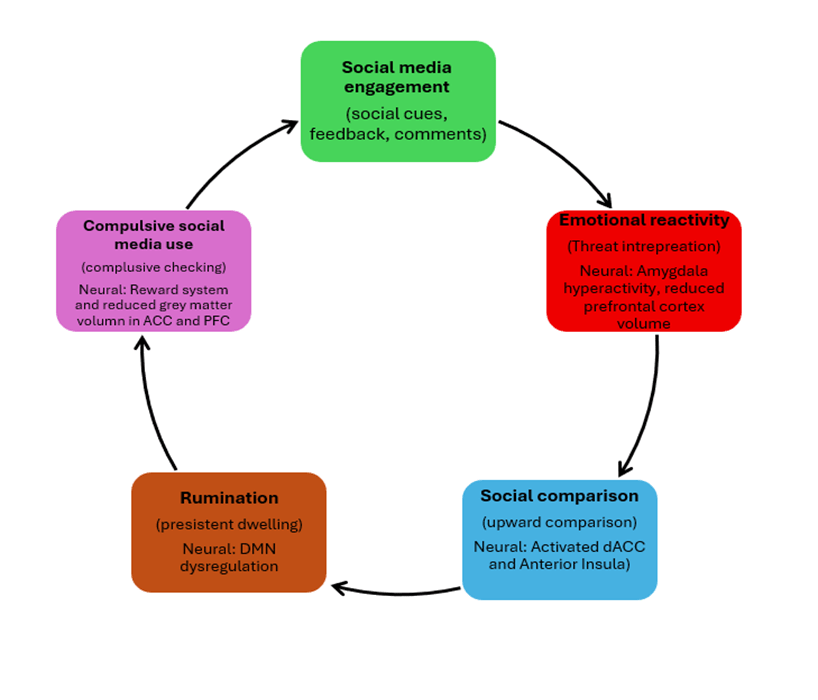
The four mechanisms do not operate in isolation but form a dynamic, interconnected cycle (see Figure 3). The cycle typically begins when a neurotic individual encounters an ambiguous or potentially threatening social media cue (e.g., a lack of likes). This is proposed to trigger heightened emotional reactivity, driven by amygdala hyperactivity27,28,29, resulting in immediate negative affect. This emotional response may then prompt upward social comparison, activating the dACC and anterior insula34,36, which are linked to feelings of envy and inadequacy. Such comparisons could fuel rumination, facilitated by a dysregulated Default Mode Network that becomes stuck in self-referential, negative thought loops54,55. To escape this aversive state, the individual may engage in compulsive checking and use, seeking transient dopamine-mediated relief through social feedback48,51. Subsequently, these behaviors could increase exposure to other triggers and restart the cycle.
The proposed neurocognitive framework is not an isolated construct but rather extends and grounds several well-established psychological theories within a neuroscientific context. First, the framework aligns with the cognitive-behavioral model56. It frames psychopathological conditions as the result of maladaptive cognitions (including negative interpretation biases), driving negative emotional states, which, in turn, further reinforce compensatory compulsive behaviors.
Second, the framework operationalizes the dual-process theory, which breaks down thinking into fast, automatic systems (System 1) and a slower, controlled, and rational system (System 2)57. Within the proposed framework, the automatic, emotion-driven processing characteristic of System 1 is disproportionately driven by heightened activity in limbic and reward-related regions. Concurrently, the regulatory capacity of System 2 is undermined by structural and functional deficits in prefrontal control regions, particularly the PFC and ACC. Reinforcement theory additionally helps to explain the addictive aspect58: the social rewards (likes, comments) serve as the powerful reinforcers to replace the aversive states produced by the cycle, amplifying the compulsive checking habit. This acts as a powerful negative reinforcement loop.
Finally, the framework grounds the Differential Susceptibility to Media Effects Model (DSMM) in neurobiological evidence. The model suggests that media effects depend on individual dispositional ties59. The proposed framework explains how neuroticism—via its underlying brain vulnerabilities—may heighten susceptibility to negative mental health outcomes from social media use.
By integrating psychology with neuroscience, this framework addresses the inconsistent findings in social media effects research. It provides insight into how individuals with different neurocognitive characteristics shape their engagement patterns and psychological outcomes.
Limitations of the review
The main limitation of the current literature is the absence of relevant studies integrating neuroticism, social media, and neurobiology. In this regard, the proposed framework needs to be empirically validated. In addition, several neuroimaging studies include a small sample size, limiting generalizability. Furthermore, the majority of behavioral studies are of cross-sectional design, thereby preventing clear inferences about the causality of neuroticism, social media use, and mental health.
Future research directions
Future research is suggested to directly validate the proposed integrative framework based on the measurement of the three core variables of the proposed pathway: neuroticism, social media use, and neural correlates. Such comprehensive designs can help to verify whether the neural substrates of neuroticism moderate or mediate the influence of social media on mental health outcomes. Longitudinal design is proposed to examine the long-term consequences of social media usage on neurobiological activities and mental health within individuals exhibiting neuroticism. Researchers should move beyond self-report measurements by measuring real social media use through objective digital phenotyping and ecological momentary assessment (EMA)60. Such methods will capture real use patterns, including specific behaviors (passive scrolling vs. active posting), emotions while using, and these correlations with neurobiological parameters and mental health outcomes. The use of neuroscience-based methods, such as neuroimaging, during social media interactions is necessary for providing the full picture of these relationships.
Implications
Understanding the role of personality differences in social media use facilitates the development of personality-sensitive interventions that support individuals in positively regulating their online use. The cyclic nature of the framework suggests interventions should target breaking the loop at multiple points. On the preventive level, psychoeducation would illuminate how personality differences could influence online experiences, encouraging individuals to adopt a high degree of self-awareness. On the clinical level, Cognitive Behavioral Therapy (CBT) appears to be a well-suited intervention to address the underlying mechanisms: helping individuals challenge and reconstruct maladaptive thought patterns into more adaptive appraisals56. Behavioral activation, a specific CBT technique, can reduce compulsive checking by purposefully scheduling in enjoyable and meaningful activities61. Mindfulness techniques can assist individuals to become more aware of present sensory experiences (sounds, feelings), interrupting the focus on the distressing loop62.
Conclusion
This review has systematically synthesized evidence from complementary psychological and neurobiological literatures to address persistent inconsistencies in the literature regarding the relationship between social media use and mental health. Its central contribution is the proposal of a neurocognitive vulnerability framework, which posits that pre-existing neural patterns associated with neuroticism may interact with the affective and evaluative features of social media platforms. This interaction is hypothesized to amplify adverse mental health outcomes through four interrelated processes: emotional reactivity, social comparison, rumination, and compulsive social media use.
By integrating psychology with neuroscience, the review clarifies for whom and through what mechanisms social media pose the greatest psychological risk. It provides a testable framework for future research and a foundation for more effective, personality-sensitive approaches to digital well-being.
Acknowledgements
I want to express my heartfelt gratitude to my mentors, Dr. Kimberly Clark from Dartmouth College and Monika Rybak, for their invaluable support in the preparation of this paper. Their guidance throughout my research journey has greatly enriched my understanding of the topic.
References
- O. Ahmed, E. Walsh, A. Dawel, K. Alateeq, D. Andrea, N. Cherbuin. Social media use, mental health and sleep: a systematic review with meta-analyses. Journal of Affective Disorders. Vol. 367, pg. 701-712, 2024, https://doi.org/10.1016/j.jad.2024.08.193. [↩] [↩]
- D.J. Yu, Y.K. Wing, T. Li, N.Y. Chan. The impact of social media use on sleep and mental health in youth: a scoping review. Current Psychiatry Reports. Vol. 26, pg. 104–11926, 2024, https://pmc.ncbi.nlm.nih.gov/articles/PMC10948475/. [↩]
- X.He, J. Hu, M. Yin, W. Zhang, B. Qiu. Screen media use affects subcortical structures, resting-state functional connectivity, and mental health problems in early adolescence. Brain Sciences. Vol. 13, pg. 1452, 2023, https://doi.org/10.3390/brainsci13101452. [↩]
- M. Vuorre, A. K. Przybylski. Global well-being and mental health in the internet age. Clinical Psychological Science. Vol. 12, 2023, https://doi.org/10.1177/21677026231207791. [↩] [↩]
- P. T. Costa, R. R. McCrae, C. E. Löckenhoff. Personality across the life span. Annual Review of Psychology. Vol. 70, pg. 423–448, 2019, https://doi.org/10.1146/annurev-psych-010418-103244. [↩]
- P.M. Valkenburg, J. Peter. The differential susceptibility to media effects model. Journal of Communication. Vol. 63, pg. 221–243, 2013, https://doi.org/10.1111/jcom.12024. [↩]
- M. R. Leary, R. H. Hoyle, editors. Handbook of individual differences in social behavior. New York: Guilford Press, 2009. [↩]
- H. R. Cremers, L. R. Demenescu, A. Aleman, R. Renken, M. J. van Tol, N. J. A. van der Wee, D. J. Veltman, K. Roelofs. Neuroticism modulates amygdala—prefrontal connectivity in response to negative emotional facial expressions. NeuroImage. Vol. 49, pg. 963–970, 2010, https://doi.org/10.1016/j.neuroimage.2009.08.023. [↩]
- M.P. Gingras, M. Brendgen, M. H. Beauchamp. Adolescents and social media: longitudinal links between types of use, problematic use and internalizing symptoms. Research on Child and Adolescent Psychopathology. Vol. 51, pg. 1641–1655, 2023, https://doi.org/10.1007/s10802-023-01084-7. [↩]
- S. Klamer, L. Schwarz, O. Krüger, K. Koch, M. Erb, K. Scheffler, T. Ethofer. Association between neuroticism and emotional face processing. Scientific Reports. Vol. 7, pg. 17669, 2017, https://doi.org/10.1038/s41598-017-17706-2. [↩]
- M. H. Silverman, S. Wilson, I. S. Ramsay, R. H. Hunt, K. M. Thomas, R. F. Krueger, W. G. Iacono. Trait neuroticism and emotion neurocircuitry: functional magnetic resonance imaging evidence for a failure in emotion regulation. Development and Psychopathology. Vol. 31, pg. 1085–1099, 2019, https://doi.org/10.1017/S0954579419000610. [↩]
- E. C. de Barros. Understanding the influence of digital technology on human cognitive functions: a narrative review. IBRO Neuroscience Reports. Vol. 17, pg. 415–422, 2024, https://doi.org/10.1016/j.ibneur.2024.11.006. [↩]
- M. Korte. The impact of the digital revolution on human brain and behavior: where do we stand? Dialogues in Clinical Neuroscience. Vol. 22, pg. 101–111, 2020, https://doi.org/10.31887/DCNS.2020.22.2/mkorte. [↩]
- J. M. Leyrer-Jackson, A. K. Wilson. The associations between social-media use and academic performance among undergraduate students in biology. Journal of Biological Education. Vol. 52, pg. 221–230,, 2018, https://doi.org/10.1080/00219266.2017.1307246. [↩]
- A. Morawska, A. E. Mitchell, L. R. Tooth. Managing screen use in the under-fives: recommendations for parenting intervention development. Clinical Child and Family Psychology Review. Vol. 26, pg. 943–956, 2023, https://doi.org/10.1007/s10567-023-00435-6. [↩]
- J. Billieux, P. Maurage, O. Lopez-Fernandez, D. J. Kuss, M. D. Griffiths. Can disordered mobile phone use be considered a behavioral addiction? An update on current evidence and a comprehensive model for future research. Current Addiction Reports. Vol. 2, pg. 156–162, 2015, https://doi.org/10.1007/s40429-015-0054-y. [↩]
- A. Weinstein, L. Curtiss Feder, K. P. Rosenberg, P. Dannon. Internet addiction disorder: overview and controversies. In: Behavioral addictions. pg. 99–117, 2014. [↩]
- M. J. Page, J. E. McKenzie, P. M. Bossuyt, I. Boutron, T. C. Hoffmann, C. D. Mulrow, L. Shamseer, J. M. Tetzlaff, E. A. Akl, S. E. Brennan, R. Chou, J. Glanville, J. M. Grimshaw, A. Hróbjartsson, M. M. Lalu, T. Li, E. W. Loder, E. Mayo-Wilson, S. McDonald, L. A. McGuinness. The PRISMA 2020 statement: an updated guideline for reporting systematic reviews. PLoS Medicine. Vol. 18, pg. 1003583, 2021, https://doi.org/10.1371/journal.pmed.1003583. [↩]
- M. Ouzzani, H. Hammady, Z. Fedorowicz, A. Elmagarmid. Rayyan—a web and mobile app for systematic reviews. Systematic Reviews. Vol. 5, pg. 210, 2016, https://doi.org/10.1186/s13643-016-0384-4. [↩]
- R. C. Tripathi. A study of social media’s positive and negative effects on society. Asian Journal of Multidimensional Research. Vol. 10, pg. 41–47, 2021, https://doi.org/10.5958/2278-4853.2021.01072.7. [↩]
- A. Vannucci, K. M. Flannery, C. M. Ohannessian. Social media use and anxiety in emerging adults. Journal of Affective Disorders. Vol. 207, pg. 163–166, 2017, https://doi.org/10.1016/j.jad.2016.08.040. [↩]
- A. J. Tørmoen. A nationwide study on time spent on social media and self-harm among adolescents. Scientific Reports. Vol. 13, pg. 19111,2023, https://doi.org/10.1038/s41598-023-46370-y. [↩]
- T. Pejic, A. Hermann, D. Vaitl, & R. Stark. Social anxiety modulates amygdala activation during social conditioning. Social Cognitive and Affective Neuroscience, Vol. 8, pg. 267–276, 2011, https://doi.org/10.1093/scan/nsr095. [↩]
- C. N. Jones, J. F. Patrick, D. Clarke, D. Rudaizky, T. Mahalingham. Investigating the links between objective social media use, attentional control, and psychological distress. Social Science & Medicine. Vol. 361, pg. 117400, 2024, https://doi.org/10.1016/j.socscimed.2024.117400. [↩]
- G. C. Hisler, Z. Krizan, T. DeHart, A. G. C. Wright. Neuroticism as the intensity, reactivity, and variability in day-to-day affect. Journal of Research in Personality. Vol. 87, pg. 103964, 2020, https://doi.org/10.1016/j.jrp.2020.103964. [↩]
- M. Howland, S. Armeli, R. Feinn, H. Tennen. Daily emotional stress reactivity in emerging adulthood: temporal stability and its predictors. Anxiety, Stress, & Coping. Vol. 30, pg. 121–132, 2016, https://doi.org/10.1080/10615806.2016.1228904. [↩]
- W. A. Cunningham, N. L. Arbuckle, A. Jahn, S. M. Mowrer, A. M. Abduljalil. Reprint of: aspects of neuroticism and the amygdala: chronic tuning from motivational styles. Neuropsychologia. Vol. 49, pg. 657–662, 2011, https://doi.org/10.1016/j.neuropsychologia.2011.02.027. [↩] [↩]
- C. Brück, B. Kreifelts, E. Kaza, M. Lotze, D. Wildgruber. Impact of personality on the cerebral processing of emotional prosody. NeuroImage. Vol. 58, pg. 259–268, 2011, https://doi.org/10.1016/j.neuroimage.2011.06.005. [↩] [↩]
- C. L. Harenski, S. H. Kim, S. Hamann. Neuroticism and psychopathy predict brain activation during moral and nonmoral emotion regulation. Cognitive, Affective, & Behavioral Neuroscience. Vol. 9, pg. 1–15, 2009, https://doi.org/10.3758/CABN.9.1.1. [↩] [↩]
- C. Montag, A. Markowetz, K. Blaszkiewicz, I. Andone, B. Lachmann, R. Sariyska, B. Trendafilov, M. Eibes, J. Kolb, M. Reuter, B. Weber, S. Markett. Facebook usage on smartphones and gray matter volume of the nucleus accumbens. Behavioural Brain Research. Vol. 329, pg. 221–228, 2017, https://doi.org/10.1016/j.bbr.2017.04.035. [↩]
- L estinger. A theory of social comparison processes. Human Relations. Vol. 7, pg. 117–140, 1954, https://doi.org/10.1177/001872675400700202. [↩]
- T. S. Chow, H. Y. Wan. Is there any “Facebook Depression”? Exploring the moderating roles of neuroticism, Facebook social comparison and envy. Personality and Individual Differences. Vol. 119, pg. 277–282, 2017, https://doi.org/10.1016/j.paid.2017.07.032. [↩]
- D. Rozgonjuk, T. Ryan, J. K. Kuljus, K. Täht, G. G. Scott. Social comparison orientation mediates the relationship between neuroticism and passive facebook use. Cyberpsychology: Journal of Psychosocial Research on Cyberspace. Vol. 13, Article 2, 2019, https://doi.org/10.5817/CP2019-1-2. [↩]
- H. Takahashi, M. Kato, M. Matsuura, D. Mobbs, T. Suhara, Y. Okubo. When your gain is my pain and your pain is my gain: neural correlates of envy and schadenfreude. Science. Vol. 323, pg. 937–939, 2009, https://doi.org/10.1126/science.1165604. [↩] [↩]
- H. Namkung, S. H. Kim, A. Sawa. The insula: an underestimated brain area in clinical neuroscience, psychiatry, and neurology. Trends in Neurosciences. Vol. 40, pg. 200–207, 2017, https://doi.org/10.1016/j.tins.2017.02.002. [↩]
- N. Steinbeis, T. Singer. Projecting my envy onto you: neurocognitive mechanisms of an offline emotional egocentricity bias. NeuroImage. Vol. 102, pg. 370–380, 2014, https://doi.org/10.1016/j.neuroimage.2014.08.007. [↩] [↩]
- S. Nolen-Hoeksema. Responses to depression and their effects on the duration of depressive episodes. Journal of Abnormal Psychology. Vol. 100, pg. 569–582, 1991, https://doi.org/10.1037/0021-843X.100.4.569. [↩]
- S. A. Nolan, J. E. Roberts, I. H. Gotlib. Neuroticism and ruminative response style as predictors of change in depressive symptomatology. Cognitive Therapy and Research. Vol. 22, pg. 445–455, 1998, https://doi.org/10.1023/A:1018769531641. [↩]
- P. Singh, N. Mishra. Rumination moderates the association between neuroticism, anxiety and depressive symptoms in Indian women. Indian Journal of Psychological Medicine. Vol. 45, 2023, https://doi.org/10.1177/02537176231171949. [↩]
- N. Sachs-Ericsson, E. A. Selby, J. L. Hames, T. E. Joiner, K. L. Fingerman, S. H. Zarit, K. S. Birditt, L. M. Hilt. Transmission of parental neuroticism to offspring’s depression: the mediating role of rumination. Personality and Mental Health. Vol. 8, pg. 306–319, 2014, https://doi.org/10.1002/pmh.1268. [↩]
- A. du Pont, S. H. Rhee, R. P. Corley, J. K. Hewitt, N. P. Friedman. Are rumination and neuroticism genetically or environmentally distinct risk factors for psychopathology? Journal of Abnormal Psychology. Vol. 128, pg. 385–396, 2019, https://doi.org/10.1037/abn0000430. [↩]
- F.Callard, D. S. Margulies. What we talk about when we talk about the default mode network. Frontiers in Human Neuroscience. Vol. 8, 2014, https://doi.org/10.3389/fnhum.2014.00619. [↩]
- T. Chou, T. Deckersbach, D. D. Dougherty, J. M. Hooley. The default mode network and rumination in individuals at risk for depression. Social Cognitive and Affective Neuroscience. Vol. 18, 2023, https://doi.org/10.1093/scan/nsad032. [↩]
- J. Amirthalingam, A. Khera. Understanding social media addiction: a deep dive. Cureus. Vol. 16, 2024, https://doi.org/10.7759/cureus.72499. [↩]
- N. Salari, H. Zarei, A. Hosseinian-Far, S. Rasoulpoor, S. Shohaimi, M. Mohammadi. The global prevalence of social media addiction among university students: a systematic review and meta-analysis. Journal of Public Health. Vol. 33, pg. 223-236, 2023, https://doi.org/10.1007/s10389-023-02012-1. [↩]
- G. Fioravanti, S. Bocci Benucci, S. Ghinassi. Psychological risk factors for problematic social network use: an overview of systematic reviews and meta-analyses. Addictive Behaviors Reports. Vol. 21, pg. 100600, 2025, https://doi.org/10.1016/j.abrep.2025.100600. [↩]
- C. Marino, A. Vieno, A. C. Moss, G. Caselli, A. V. Nikčević, M. M. Spada. Personality, motives and metacognitions as predictors of problematic Facebook Use in university students. Personality and Individual Differences. Vol. 101, pg. 70–77, 2016, https://doi.org/10.1016/j.paid.2016.05.053. [↩]
- J. Zhao, T. Jia, X. Wang, Y. Xiao, X. Wu. Risk factors associated with social media addiction: an exploratory study. Frontiers in Psychology. Vol. 13, 2022, https://doi.org/10.3389/fpsyg.2022.837766. [↩] [↩]
- L. Marciano, A. L. Camerini, P. J. Schulz. Neuroticism in the digital age: a meta-analysis. Computers in Human Behavior Reports. Vol. 2, pg. 100026, 2020, https://doi.org/10.1016/j.chbr.2020.100026. [↩]
- D. Blackwell, C. Leaman, R. Tramposch, C. Osborne, M. Liss. Extraversion, neuroticism, attachment style and fear of missing out as predictors of social media use and addiction. Personality and Individual Differences. Vol. 116, pg. 69–72, 2017, https://doi.org/10.1016/j.paid.2017.04.039. [↩]
- R. L. Peterson. The neuroscience of investing: FMRI of the reward system. Brain Research Bulletin. Vol. 67, pg. 391–397, 2005, https://doi.org/10.1016/j.brainresbull.2005.06.015. [↩] [↩]
- D. Lee, K. Namkoong, J. Lee, B. O. Lee, Y. C. Jung. Lateral orbitofrontal gray matter abnormalities in subjects with problematic smartphone use. Journal of Behavioral Addictions. Vol. 8, pg. 404–411, 2019, https://doi.org/10.1556/2006.8.2019.50. [↩]
- R Z. Goldstein, N. D. Volkow. Dysfunction of the prefrontal cortex in addiction: neuroimaging findings and clinical implications. Nature Reviews Neuroscience. Vol. 12, pg. 652–669, 2011, https://doi.org/10.1038/nrn3119. [↩]
- S A. Nolan, J. E. Roberts, I. H. Gotlib. Neuroticism and ruminative response style as predictors of change in depressive symptomatology. Cognitive Therapy and Research. Vol. 22, pg. 445–455, 1998, https://doi.org/10.1023/A:1018769531641. [↩]
- T. Chou, T. Deckersbach, D. D. Dougherty, J. M. Hooley. The default mode network and rumination in individuals at risk for depression. Social Cognitive and Affective Neuroscience. Vol. 18, 2023, https://doi.org/10.1093/scan/nsad032. [↩]
- K. Fenn, M. Byrne, M. The key principles of cognitive behavioural therapy. InnovAiT: Education and Inspiration for General Practice. Vol. 6, 2013, https://doi.org/10.1177/1755738012471029. [↩] [↩]
- P. Barrouillet. Dual-process theories and cognitive development: advances and challenges. Developmental Review. Vol. 31, pg. 79–85, 2011, https://doi.org/10.1016/j.dr.2011.07.002. [↩]
- M. A. Adams. Reinforcement theory and behavior analysis. Behavioral Development Bulletin. Vol. 9, pg. 3–6, 2000, https://doi.org/10.1037/h0100529. [↩]
- P. M. Valkenburg, J. Peter. The differential susceptibility to media effects model. Journal of Communication. Vol. 63, pg. 221–243, 2013, https://doi.org/10.1111/jcom.12024. [↩]
- S. Shiffman, A. A. Stone, M. R. Hufford. Ecological momentary assessment. Annual Review of Clinical Psychology. Vol. 4, pg. 1–32, 2008, https://doi.org/10.1146/annurev.clinpsy.3.022806.091415. [↩]
- J. W. Kanter, R. C. Manos, W. M. Bowe, D. E. Baruch, A. M. Busch, L. C. Rusch. What is behavioral activation? A review of the empirical literature. Clinical Psychology Review. Vol. 30, pg. 608–620, 2010, https://doi.org/10.1016/j.cpr.2010.04.001. [↩]
- M. Deyo, K. A. Wilson, J. Ong, C. Koopman. Mindfulness and rumination: does mindfulness training lead to reductions in the ruminative thinking associated with depression? EXPLORE. Vol. 5, pg. 265–271, 2009, https://doi.org/10.1016/j.explore.2009.06.005. [↩]