Abstract
This paper focuses on Hawking radiation and its role in the black hole information paradox. The black hole information paradox is one of the most profound challenges facing modern physicists. It emerges from the contradiction between general relativity, which holds that information crossing the event horizon of a black hole is forever lost, and quantum mechanics, which requires information to be conserved. This paper covers basic physics concepts such as Kepler’s Laws, Newtonian physics, Newtonian gravity, escape velocity, Schwarzschild radius, etc. As well as covering key thermodynamic principles and how those principles relate to black holes more specifically entropy and energy conservation. This paper also covers the Klein-Gordon equation in order to describe quantum field behavior around black holes. Through all these theories, Hawking radiation is explored as a possible resolution for this paradox and possible connection between general relativity and quantum mechanics. Finally, the paper presents a gravitational lensing simulation that visualizes light curvature when in the presence of a black hole according to general relativity. While also proving the code used to create this simulation and relate its findings to better understand black hole behavior.
Keywords: Hawking radiation, black holes, information paradox, quantum mechanics, general relativity, Schwarzschild radius, Klein-Gordon equation, gravitational lensing, Python coding, thermodynamics
Introduction
The motivation for this paper stems from the desire to understand two of the most successful theories in physics, quantum mechanics and general relativity, which contradict on black holes. This seemingly small disagreement challenges the core guiding principles on how humanity understands the universe. This is more commonly referred to as the information paradox.
The information paradox is one of the most contradictory concepts in modern physics that has puzzled scientists for decades. It arises from the conflict between classical general relativity, which argues that any information about the physical state of matter that falls into a black hole is lost1,2. On the other hand, the three laws of thermodynamics (which will be discussed later on in theory) set the rules for how entropy behaves, but it is unitarity in quantum mechanics that demands that information must be conserved. This paper explores information as the properties and states of physical systems, for example, position and momentum3. The concept of conservation holds true when examining any object composed of matter in the universe including black holes, this phenomenon causes the possibility of information loss in black holes, which in turn creates a paradox that requires a resolution.
Black holes are described as events in spacetime that exhibit a gravitational field of significant strength that no form of matter or light can escape. Black holes begin to form when the force of gravity overwhelms all other forces during the collapse of a star, thus forming a black hole. A black hole has two defining features, an event horizon, which is also known as the “point of no return” and a spacetime singularity1,2. The event horizon is marked as the boundary at which the escape velocity is equal to the speed of light. This is formally defined as the Schwarzschild radius given by the equation:
(1) 
where  is the Schwarzschild radius,
  is the gravitational constant
  ,
,  is the mass of the black hole (kg), and
  is the speed of light in a vacuum
  .
.
Once any matter crosses this outlined boundary, it can never escape the black hole’s gravitational pull as nothing is faster than the speed of light2. Although the nature of singularity is heavily debated for simplicity and this paper’s understanding, a spacetime singularity is defined as a breakdown of the geometry of spacetime a “tear in the fabric” of spacetime due to immense gravitational force4. It is not an actual tear in the physical sense, but rather a point where physical theories can no longer make accurate predictions due to both large-scale (gravitational) effects and small-scale (quantum mechanical) effects. Since matter that falls into a black hole has mass, and since mass is dependent on the body’s motion relative to the motion of the observer, mass can be directly related to energy. This relationship is captured by Einstein’s equation:
(2) 
where  is energy (J),
  is mass (kg), and is the speed of light in a vacuum.
This equation highlights the connection of mass as a form of energy. Meaning that when an object crosses the event horizon their energy related to its mass is now inaccessible by outside observers and the information it carries is not preserved. This connection between mass and energy is crucial to build our understanding of the information paradox as it links the loss of matter to the potential loss of information due to an object’s fall into a black hole.
Furthermore, according to classical physics, all information that enters a black hole is lost forever to the outside universe1. Since nothing (not even light) can escape the gravitational pull of a black hole, any information about matter that falls in can never be retrieved or observed again, it is considered lost to the external universe. This view is supported by general relativity, meaning that since not even light can escape the event horizon of a black hole that information cannot be relayed or examined by outside observers rendering it lost5.
However, quantum mechanics is grounded by the principle of conserved energy described by the three laws of thermodynamics, which states that information in isolated systems is preserved. Noether’s theorem connects continuous symmetries in physical systems to conserved quantities such as energy. By contrast, information conservation follows quantum unitarity and is not a direct consequence of Noether’s theorem6. This contradiction between these two core concepts creates a compelling paradox that battles classical physics with quantum mechanics. Due to this compelling question, numerous resolutions have been proposed over the years to explain this phenomenon.
These include the concept that information is preserved via quantum entanglement, stored in the surface of black holes with the holographic principle, and finally escapes through Hawking radiation. The following sections will explore each principle in order to provide clarity, but ultimately explore the fundamentals of Hawking radiation as the resolution for the information paradox.
Hawking radiation is a critical concept explored in this report, as it provides a unique resolution for the information paradox and broadens the understanding regarding the nature of black holes. Developed by Stephen Hawking in 1974, his idea fundamentally altered the idea that black holes are permanent and unchanging1. Hawking combined principles of general relativity with quantum mechanics in order to explore the behavior of particles near the event horizon. According to this theory, black holes emit radiation near the event horizon causing black holes to gradually lose mass and over time evaporate. Hawking radiation offers two primary theoretical solutions to the information paradox:
- Information may be encoded on the surface and thus carried away by the emitted Hawking radiation. Meaning that although the radiation appears thermal it can allow for the gradual release of information
- Information is preserved in a stable remnant after the black hole evaporates, smaller than the Planck length
 .
.
Both scenarios prioritize the conservation of information supported by quantum mechanics and by Emmy Noether’s theorem6.
Hawking radiation provides a substantial view into the interconnectedness of quantum mechanics, general relativity and thermodynamics offering a critical understanding into the behavior of black holes in addition to their role in the universe. Hawking’s proposal builds upon the framework set by Einstein’s general theory of relativity, which describes gravity as the curvature of spacetime caused by both mass and energy4. The Schwarzschild solution to Einstein’s field equation describes a non-rotating black hole whose event horizon can be defined by the Schwarzschild radius. Vacuum fluctuations generate particle-antiparticles pair close to the event horizon, one of the particles with negative energy falls into the black hole while the other escapes. Due to this process Hawking radiation can be observed outside the event horizon7.
Moreover, the presence of Hawking radiation suggests that black holes possess entropy and temperature, challenging the classical view that black holes are cold and static. Leonard Susskind’s lectures expand on this theory by connecting general relativity and quantum mechanics through entanglement and the ER=EPR conjecture.
According to this proposal, two entangled pairs of particles collapsing into black holes creates two entangled black holes8. This would connect black holes via non-traversable Einstein-Rosen bridges (or wormholes) that act as geometric manifestations of quantum entanglement. This idea stems from earlier work by Einstein and Rosen, who introduced the concept of these bridges in order to avoid singularities allowing particles to be molded as tunnels in spacetime3.
This consequently means the geometry mirrors the quantum correlation between the two entangled black holes, in principle meaning that the information from one black hole could be retrieved from its entangled partner. However, this idea is challenged by the AMPS (Almheiri-Marolf-Polchinski-Sully) paradox8, which arises from the monogamy of entanglement, if a black hole is entangled and is emitting Hawking radiation this would be in violation of quantum monogamy, meaning that since the black holes are maximally entanglement neither system can correlate with a third system8.
Further developing on these concepts, Susskind emphasizes the convergence of quantum mechanics and general relativity through spacetime geometry and entanglement. Entangled regions of space are stitched together forming a fabric of spacetime constructed from quantum information8. Quantum complexity also suggests that the interior volume of a black hole grows with complexity in the corresponding quantum system even after entropy stabilizes. This long-term growth is modeled using quantum circuits where gates act on qubits to evolve states across immense space of possibilities8. This is further expanded on by the multipartite entanglement such as GHZ (Greenberger–Horne–Zeilinger) states, where a third object measuring an entangled system creates a tri-partite Einstein-Rosen Bridge which links all three systems in a shared network.
These modern ideas regarding black hole behavior through entanglement, Einstein-Rosen bridges, and quantum complexity redefine the internal structure of black holes and deepens the paradox surrounding information conservation. Hawking radiation stands as a compromise of quantum mechanics and general relativity, incorporating classical concepts with respect to their limitations. To understand the advanced theories present in the paragraph above, essential principles of Newtonian physics, gravitation and thermodynamics are crucial.
Theory
In this section we briefly review fundamental expressions such as Newtonian physics, Newtonian gravity and thermodynamics that help define the event horizon of a black hole. Newtonian physics also known as classical mechanics provides a crucial understanding for all objects of matter in the physical world. Consisting of the three laws of motion, the universal law of gravitation, and equations derived from these laws. Newton’s law interplay with previous theories such as Kepler’s Laws which describe how planets orbit the sun5,9.
Kepler’s First Law of Ellipses
This law helps explain how gravity shapes orbits and connects how stars collapse under gravity which forms black holes. Each planet orbits around the Sun in an ellipse, with the Sun’s center always at one focus of the orbital ellipse. Meaning that the distance between the planet and Sun is constantly changing as the planet orbits.
(3) 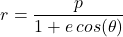
where  is the radial distance from the focus to the orbiting object (measured in meters,
  );
);  is the semi-latus rectum of the orbit (meters), ); and
  is the eccentricity of the orbit, a dimensionless constant, determines shape of orbit; if
  , the orbit is elliptical; if
  , the orbit is parabolic; and if
  , the orbit is hyperbolic.
  is the angle (in radians). Lastly,
  denotes the cosine of the true anomaly.
Kepler’s Second Law of Equal Areas
This law showcases how energy and speed change during motion which is useful for understanding object motion near strong gravitational fields such as those around black holes. Imaginary line as the object orbits joining a planet and the Sun is equal areas of space during equal time intervals. Meaning that velocity during orbits change so that the line joining the centers spans equal parts of an area in equal times. This law states that a planet has the highest speed when it is at perihelion (closest to the sun) and slowest at aphelion (furthest from the sun while remaining in orbit), which is in accordance with the conservation of energy.
(4) 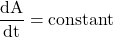
where  is the area swept out by the line joining the planet and the Sun
  ,
,  is time
  ,
,  is the areal velocity, the rate at which area is swept out
  ). This equation is a direct consequence of the conservation of angular momentum.
Kepler’s Third Law of Harmonies
This law supports the concept that mass and distance affect the rate of motion, which explains how gravity helps black holes pull objects in. The squares of the orbital periods of the planets are directly proportional to the semi-major axes of their orbits cubed. Meaning that the period, time for one full revolution for a planet to orbit the Sun increases with the radius of its orbit.
(5) 
where  is the orbital period of the planet (measured in
  ) and
) and  is the semi-major axis of the orbit (the average distance from the Sun). However if measured in convenient units the proportionality constant for the Solar System is
  . Meaning that
  .
.
Newtonian Physics
In this paper, we will be deriving the Schwarzschild radius using Newtonian gravity but not necessarily the three laws of motion. That being said, in order to provide a concise understanding. Thus, reviewing gives a refresher and a foundation on which to build new knowledge when examining Hawking radiation. Newton’s three laws of motion provide invaluable insight in the fundamental principles that define the relationship between an objects; motion and the forces acting on it. Newtonian mechanics works in cases where at least some of the forces acting on the object are known and if there is a reasonable coordinate system. This being said, Newtonian laws are expressed in terms of forces meaning they are not easily applied to small-scale problems.
1. Newton’s First Law Of Motion
An object will stay in motion or stay in rest unless acted upon by an external force.
2.Newton’s Second Law Of Motion
The force of an object is the acceleration times the mass.
(6) 
where  stands for the sum of all forces experienced by the object, m is the mass of the object and a is the acceleration.
Newton’s Third Law Of Motion
For every action there is an equal reaction, if a force is applied on one object by another it will also be applied to the original object with the same magnitude but with an opposite direction.
Newtonian Gravity
This section is crucial as gravity is the main force that causes the collapse of stars and black hole formation. Understanding gravity helps calculate the conditions for no escape.
Gravitational Force
Fundamental force that creates an attraction between all objects of matter in the universe. This force influences the formation and behavior of celestial bodies which makes it crucial for understanding space phenomena such as the Big Bang.
Newton’s Law of Gravitation
The force of attraction that occurs between two masses is proportional to the product of their masses and inversely proportional to the square of the distance between their centers.
(7) 
where G is the universal gravitational constant  , and are the two masses and is the distance between them.
Gravity (g)
Is the force produced by the gravitational force of a massive object to another object in its gravitational field.
Thermodynamics
Thermodynamics is a branch of physics that deals with the relationship between heat and other forms of energy, or in other words the relationship between all forms of energy. This allows for the study of all systems and their transformations. For completeness, we state each law of thermodynamics which will be useful when examining black holes and hawking radiation.
Laws of thermodynamics
These laws are key to understanding the information paradox, as they explain energy behavior of all physical systems and are crucial in supporting energy conservation from quantum mechanics. The laws of thermodynamics provide a fundamental understanding of all forms of energy and their interactions in the real world. These laws govern the behavior of isolated systems which become more disordered over time due to increase in entropy, where entropy is defined as the degree of uncertainty in a system.
1. Zeroth Law
Which states, if two bodies A and B are each independently in thermal equilibrium with body C, then A and B are in thermal equilibrium with one another.
2. First Law of Thermodynamics
Which states that energy cannot be created or destroyed only altered. This is also known as the conservation of energy law and it means that the total amount of energy in a system and its surroundings is always constant.
(8) 
where  is the change in internal energy of the system
  ,
,  is the heat added to the system , and
  is the work done on the system .
(9) 
where  is the external pressure
  and
and  is the change in volume
  .
.
(10) 
where is the mass of the substance  ,
,  is the specific heat capacity
  , and
, and  is the change in temperature
  .
.
3. Second Law of Thermodynamics
Which states that entropy, which is the randomness of particles in a system, can only increase and never decrease.
(11) 
where  is the change in entropy
  ,
,  is the reversible heat transfer ,
  is the change in enthalpy , and is the absolute temperature .
4. Third Law of Thermodynamics
Which states that the entropy of a system approaches a constant as the temperature approaches absolute zero (0K Kelvin or -273.15 degrees Celsius).
Black Hole Thermodynamics
Black hole thermodynamics is defined as the relationship between the laws of thermodynamics and black hole behavior. It provides frameworks to treat black holes as systems with thermodynamical properties such as entropy and temperature. This section builds on previously explored concepts and relates them to gravitational systems more specifically how energy and information evolve alongside black hole evolution.
The entropy of a black hole is proportional to the surface area of the event horizon; this theory was first proposed by Bekenstein and expanded by Hawking. Which can be seen in the Bekenstein-Hawking formula2,10.
(12) 
where  is entropy, is the area of the event horizon,
  is Boltzmann’s constant, is the gravitational constant,
  is the reduced Planck constant, and is the speed of light.
This equation implies that black holes over time evaporate and its surface area decreases, meaning that since they are proportional entropy also decreases. This seemingly contradicts the second law of thermodynamics mentioned above2,1. This could consequently mean as the even horizon shrinks the black hole loses not only mass and energy but also information that fell into it.
This raises the question of whether Hawking radiation is able to encode information to preserve thermodynamic laws or if eventual evaporation means permanent loss of information. If a black hole evaporation leaves no remnant (remainder after the larger part has been destroyed), and Hawking radiation is random then this paradox alters humanities understanding of the universe11,12.
Some physicists propose that Hawking radiation allows information to leak out gradually over time, which has led to numerous new theories such as the firewall hypothesis. Suggesting that while the radiation might appear thermal, it could have deeper quantum-level mechanisms that would preserve the information, thus respecting the conservation laws 8.
However, since the shrinking of a black hole due to evaporation causes extreme curvature and quantum effects (near the Planck length). Classical relativity fails and quantum mechanics is needed. Understanding thermodynamics, entropy and calculus is key to resolving this paradox and unifying general relativity with quantum mechanics 8.
Newtonian Mechanics
Centripetal force
In order to derive the Schwarzschild radius, we must first examine which conditions must be maintained for an object to stay in a stable circular orbit while under the influence of gravity. This can be modeled by the equation of centripetal force
(13) 
Where the centripetal force is the mass of the orbiting object, its velocity squared divided by the radius which in this case refers to as the distance between the center of the orbiting object and the center of the object it is orbiting around. Moreover, the equation for the gravitational force that provides the centripetal pull is described by Newton’s law of gravitation stated in the previous subsection,
(14)
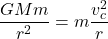
Where is the gravitational constant, is the mass of the central object, and is the mass of the orbiting object. Since the gravitational force is the cause of centripetal force on an orbiting object we can set them equal to each other which gives us
(15) 
Now we expand these formulas which gives us
(16) 
We cancel from both sides assuming is non-zero
(17) 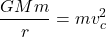
We can cancel from both sides (assuming it’s non-zero)
(18) 
Taking the square root now gives us the orbiting velocity
(19) 
This now gives the minimum speed to maintain orbit at radius . This also consequently means that if an object were to reach speed of light , escape from the pull of gravity would be impossible.
(20) 
Derivation of Schwarzschild Radius
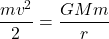
In order to derive the Schwarzschild radius, an object’s kinetic energy must equal the gravitational potential energy at the verge for escape. This is because in order to overcome the gravitational pull the object escapes with zero residual velocity. At the escape limit, total mechanical energy is equal to zero
(21) 
At escape velocity, the particle reaches infinity leaving no residue so the equation is equal to zero. Thus, when expanding both equations and rearranging them equal to one another results in
(22) 
Solving for radius yields
(23) 
However, since by construction
(24) 
Since black holes are defined as a region from which not even light can escape leading to the Schwarzschild radius
(25) 
This radius defines the event horizon of a black hole: if an object is compressed within this radius the escape velocity is greater than the speed of light meaning that the object is a black hole.
The Klein-Gordon Equation in Flat Spacetime
The Klein-Gordon equation is a fundamental equation that unifies special relativity and quantum mechanics13. It is derived from the relativistic energy-momentum relation
(26) 
by substituting the quantum operators  and
and  which leads to
(27) 
where  is the wave function,
  is the reduced Planck constant
  , and
, and  is the Hamiltonian operator.
This governs the behavior of scalar fields in relativistic quantum theory. The Schrödinger equation on the other hand applies in the non-relativistic limit, the Klein Gordon equation is fully Lorentz-invariant is essential when modeling quantum fields around curved spacetime which makes it crucial when discussing Hawking radiation since quantum fields interact with gravitational objects14. More specifically, since Hawking radiation occurs when quantum fields are near the event horizon, Klein-Gordon can model this in flat spacetime14. Unlike other equations such as the Schrödinger equation, this one stays relativistic consistent meaning that it respects Lorentz invariance, meaning that the observation will be the same for all observers moving at a constant velocity relative to each other14.
Derivation in Flat Spacetime
Start using the energy-momentum relation from special relativity
(28) 
Make substitutions
(29) 
(30) 
Substituting into the energy-momentum relation
(31) ![\begin{equation*}\left(i\hbar \frac{\partial}{\partial t} \right)^2 \psi = \left[ (-i\hbar \nabla)^2 c^2 + m^2c^4 \right] \psi\end{equation*}](https://nhsjs.com/wp-content/ql-cache/quicklatex.com-5e9a6151d936c22431be71e66c719dc3_l3.png "Rendered by QuickLaTeX.com")
Simplify
(32) ![\begin{equation*}-\hbar^2 \frac{\partial^2 \psi}{\partial t^2} = \left[ -\hbar^2 c^2 \nabla^2 + m^2 c^4 \right] \psi\end{equation*}](https://nhsjs.com/wp-content/ql-cache/quicklatex.com-d05f6b99c65996e1553c41bf775fead7_l3.png "Rendered by QuickLaTeX.com")
Rewrite
(33) 
Often written in compact four-vector notation
(34) 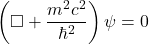
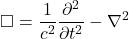
Where the d’Alembertian operator  is
is
(35) 
Since in Hawking’s 1974 calculation, the scalar field obeys this relativistic wave near the defined Schwarzschild black hole, the observed thermal spectrum of radiation is due to the field boundary across the black hole’s event horizon1. This further complements ER=EPR as they both rely on understanding quantum fields in respect to gravitational areas. This makes the Klein-Gordon equation invaluable to grounding quantum principles to understand information conservation near black holes.
Visualization Note
As a visual aid for spacetime curvature, we include in Appendix B a simple gravitational-lensing simulation based on the GR point-mass deflection. Lensing is not a probe of information retention or entanglement structure; we use it only to illustrate how strong gravity distorts null geodesics near compact objects. The information-theoretic aspects of black hole evaporation are treated via the page curve and modern “islands” ideas.
Conclusion
This paper explores the black hole information paradox through the lenses of classical mechanics, quantum theory, thermodynamics and Python modeling. It reviews key frameworks such as Kepler’s Laws, Newtonian gravity, and the thermodynamic laws, which provide the solid foundation for understanding the structure and behavior of black holes.
The derivation of the Schwarzschild radius and the introduction of the Klein-Gordon equation which provides the mathematical framework for analyzing particle behavior near black holes. Hawking radiation offers a compelling resolution to the information paradox by bridging general relativity and quantum mechanics. This challenges earlier theories that suggest black holes are cold and static, instead demonstrating that they emit radiation and evolve over time potentially encoding information in the process.
Furthermore, recent developments support this framework through the island model, which furthers our understanding of the Page curve and observable information. Studies have shown that as Hawking radiation gathers, entanglement entropy rises and then saturates at the Page time which indicates that information can re-emerge through correlations in radiation15. Which suggests that information loss during black hole evaporation could be delayed as islands may preserve unitarity.
In closing, this paper reinforces that resolving the black hole information paradox requires a unified understanding of both gravity and quantum theory. Hawking radiation and other advancements in modern physics continue to support one of the universe’s most fundamental principles: the conservation of information.
Appendix A: List of Symbols and Units
| Symbol | Quantity | Units |
|---|---|---|
| G | Gravitational constant | m³ kg⁻¹ s⁻² |
| c | Speed of light in vacuum | m s⁻¹ |
| M | Mass of black hole or central object | kg |
| m | Mass of test particle | kg |
| rs or Rs | Schwarzschild radius | m |
| r | Radial distance from center | m |
| vc | Orbital (circular) velocity | m s⁻¹ |
| E | Energy | J |
| S | Entropy | J K⁻¹ |
| A | Surface area of event horizon | m² |
| T | Temperature (or orbital period, context-dependent) | K or s |
| k | Boltzmann constant | J K⁻¹ |
| ħ | Reduced Planck constant | J s |
| θE | Einstein radius (angular) | arcseconds or radians |
| DL, DS, DLS | Lens, source, and lens–source distances | m or Gpc |
| ψ | Wavefunction (scalar field) | — |
| □ | d’Alembertian operator | — |
Appendix B: Gravitational Lensing Simulation, Results and Analysis Gravitational Lensing Simulation: Results and Analysis
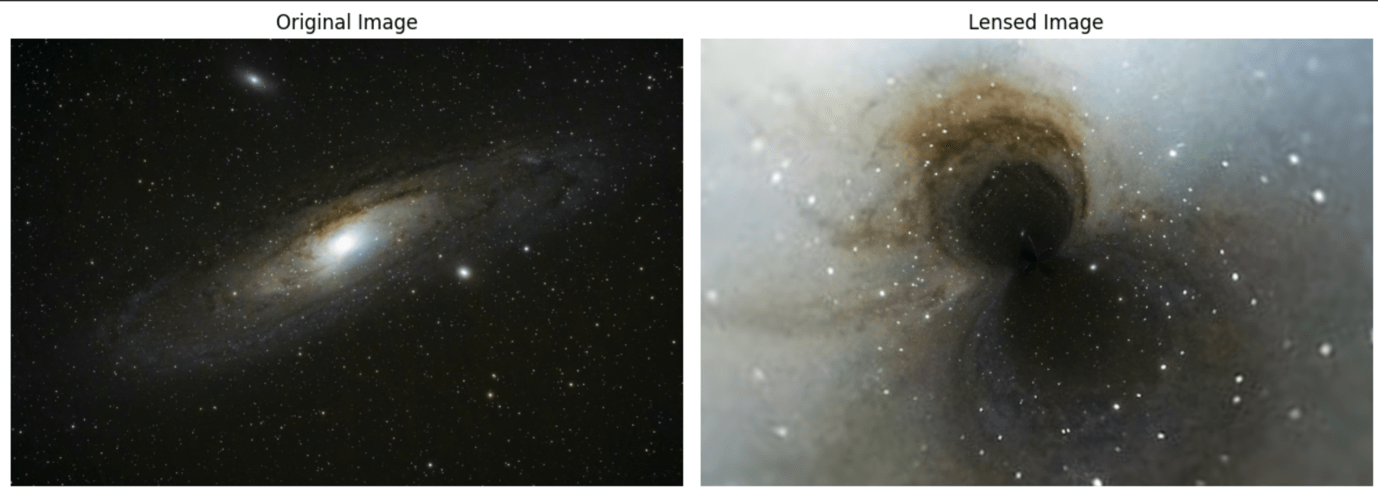
For coherence, this paper showcases gravitational lensing as predicted by general relativity in a numerical simulation done in Python. This aims to demonstrate how massive objects (in this case black holes) bend spacetime and thus distort light which can be illustrated with this gravitational lensing simulation. Meaning the examination of how black holes alter information and observable physics. More notably, how even though light which is massless adopts a curved path when near a black hole.
B. 1. Methodology
This simulation was done through the usage of an image of a galaxy16. The image was then converted into a numerical array using PIL (Python Imaging Library) and a locally sourced image. A simulated black hole was positioned at the center of the image its effect was calculated using Einstein’s deflection formula:
![\[\vec{\alpha} = \frac{\theta_E^2}{r^2} \vec{r}\]](https://nhsjs.com/wp-content/ql-cache/quicklatex.com-1c80d3f07e945ee8726ea2685bb8190e_l3.png "Rendered by QuickLaTeX.com")
where  is the displacement from the lens, and
  is the Einstein radius, determining the strength of lensing. Through this calculation, each pixel in the original image was remapped based on the deflection using map_coordinates() function from |scipy.ndimage|.
B.2. Code Analysis
These were the following steps performed in Python to achieve this simulation:
Step 1: Load Image
import numpy as np
import matplotlib.pyplot as plt
from scipy.ndimage import map_coordinates
from PIL import Image
\end{lstlisting}

\begin{lstlisting}[caption={Step 1: Load Image}]
def load_background_image(path):
    img = Image.open(path).convert('RGB')
    return np.asarray(img, dtype=np.float64) / 255.0
img = load_background_image("/galaxy.png")
height, width = img.shape[:2]
\end{lstlisting}
Step 2: Define Lensing
def lens_image(img, theta_E, lens_pos):
    height, width = img.shape[:2]
    x = np.arange(width)
    y = np.arange(height)
    X, Y = np.meshgrid(x, y)
    dx = X - lens_pos[0]
    dy = Y - lens_pos[1]
    dr2 = dx**2 + dy**2 + 1e-9
    alpha_x = theta_E**2 / dr2 * dx
    alpha_y = theta_E**2 / dr2 * dy
    beta_x = X - alpha_x
    beta_y = Y - alpha_y
    lensed_img = np.zeros_like(img)
    for c in range(3):
        lensed_img[:, :, c] = map_coordinates(img[:, :, c], [beta_y, beta_x], order=3, mode='nearest')
    return lensed_img
\end{lstlisting}
Here the angles (θ, β, α) are in pixel units, proportional to arc seconds and X and Y are the angular coordinates of the image plane.
Step 3: Lensing and Clean-up
lens_pos = (width//2, height//2)
    theta_E = 250
    lensed_img = lens_image(img, theta_E, lens_pos)
    plt.figure(figsize=(12, 6))
    plt.subplot(1, 2, 1)
    plot_image(img, title='Original Image')
    plt.subplot(1, 2, 2)
    plot_image(lensed_img, title='Lensed Image')
    plt.tight_layout()
    plt.show()
\end{lstlisting}
In this section we introduced a physical scale using the Einstein-radius formula:
We introduced a physical scale using the Einstein-radius formula:
![\[\theta_E = \sqrt{\frac{4GM}{c^2}\frac{D_{LS}}{D_L D_S}},\]](https://nhsjs.com/wp-content/ql-cache/quicklatex.com-30adee6f99959e0f572f3f530dd311eb_l3.png "Rendered by QuickLaTeX.com")
where we use  ,
,  , and
, and  , yielding
  which gives us approximately 250 arcsec/pixel in the simulation.
B.3 Simulation Images
B.4 Interpretation
The result of this simulation is a lensed image that showcases distortion of light that occurs when black holes pass in front of a galaxy background. The ring-like and warped light path distortions align with general relativity through the usage of Einstein’s deflection formula and the Einstein radius.
This model reinforces the core idea that mass curves spacetime and that light follows these curved paths, leading to observable distortions near black holes and other massive objects. Several assumptions were made in order to create this simulation such as; the black hole was treated as static and spherically symmetric; the spacetime is assumed to be flat under the Klein-Gordon Equation. The deflection follows the general-relativistic point-mass formula, the scaling corresponds to the full general relativity prediction.
While gravitational lensing does not directly model the information conservation paradox itself, it serves as a visual analogy for how objects with large masses can distort information, which echoes the challenge of accessing information from black holes. Despite its simplifications, the simulation captures the essence of gravitational lensing and serves as this paper’s bridge between theory and observation.
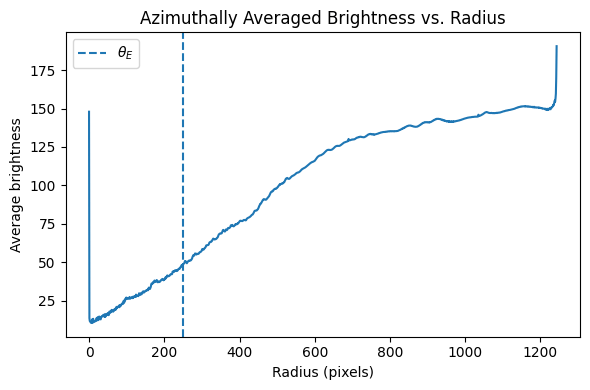
B.5. Sanity Check: Azimuthally Averaged Brightness
In order to verify the accuracy of the simulation, an azimuthally averaged brightness profile was computed by averaging the pixel intensity as a function of radius.
Step 4: Azimuthally Averaged Brightness
import numpy as np
    import matplotlib.pyplot as plt
    intensity = (0.2126*lensed_img[...,0] + 0.7152*lensed_img[...,1] + 0.0722*lensed_img[...,2]).astype(np.float64)
    center = (width // 2, height // 2)
    yy, xx = np.indices((height, width))
    r = np.sqrt((xx - center[0])**2 + (yy - center[1])**2).astype(np.int32)  # 0,1,2,... pixels
    tbin = np.bincount(r.ravel(), weights=intensity.ravel())
    nr   = np.bincount(r.ravel())
    radial_profile = tbin / np.maximum(nr, 1)
    plt.figure(figsize=(6,4))
    plt.plot(radial_profile)
    plt.xlabel("Radius (pixels)")
    plt.ylabel("Average brightness")
    plt.title("Azimuthally Averaged Brightness vs. Radius")
    plt.axvline(x=theta_E, linestyle="--", label=r"")
    plt.legend()
    plt.tight_layout()
    plt.show()
\end{lstlisting}
Appendix C: Reproducibility and Code Availability
All functions used in this paper are defined within the notebook with random seeds in order to ensure the output is identical across runs. The code below displays images locally which eliminates external sources.
Helper Function for Reproducibility
import numpy as np
import matplotlib.pyplot as plt
from PIL import Image
def plot_image(img, title=None):
    plt.imshow(np.clip(img, 0, 1))
    if title:
        plt.title(title)
    plt.axis("off")
\end{lstlisting}
The image is stored locally and all random seeds are fixed.
References
- S. W. Hawking. Particle creation by black holes. Communications in Mathematical Physics. Vol. 43, pg. 199–220, 1975. [↩] [↩] [↩] [↩] [↩] [↩]
- J. D. Bekenstein. Black holes and entropy. Physical Review D. Vol. 7, pg. 2333–2346, 1973. [↩] [↩] [↩] [↩] [↩]
- A. Einstein, B. Podolsky, N. Rosen. Can quantum-mechanical description of physical reality be considered complete? Physical Review. Vol. 47, pg. 777–780, 1935. [↩] [↩]
- A. Einstein, N. Rosen. The particle problem in the general theory of relativity. Physical Review. Vol. 48, pg. 73–77, 1935. [↩] [↩]
- A. K. Mandal. Origin of laws of motion (Newton’s law): an introspective study. American Journal of Engineering Research. Vol. 9, pp-87-92, 2020 [↩] [↩]
- W. Sarlet, F. Cantrijn. Generalizations of Noether’s theorem in classical mechanics. SIAM Review. Vol. 23, pg. 467–494, 1981. [↩] [↩]
- Y. Wang. Quantum simulation of particle pair creation near the event horizon. National Science Review. Vol. 7, pg. 1476–1484, 2020. [↩]
- J. Maldacena, L. Susskind. Cool horizons for entangled black holes. Fortschritte der Physik. Vol. 61, pg. 781–811, 2013. [↩] [↩] [↩] [↩] [↩] [↩] [↩]
- V. Spatz, M. Hopf, T. Wilhelm, C. Waltner, H. Wiesner. Introduction to Newtonian mechanics via two-dimensional dynamics: the effects of a newly developed content structure on German middle school students. European Journal of Science and Mathematics Education. Vol. 8, pg. 76–91, 2020. [↩]
- S. W. Hawking. Particle creation by black holes. Communications in Mathematical Physics. Vol. 43, pg. 199–220, 1975.). [↩]
- P. Bokulich. Black hole remnants and classical vs. quantum gravity. Philosophy of Science. Vol. 68, pg. S407–S423, 2001. [↩]
- P. Bokulich. Does black hole complementarity answer Hawking’s information loss paradox? Philosophy of Science. Vol. 72, pg. 1336–1349, 2005. [↩]
- E. S. Escobar-Aguilar, T. Matos, J. I. Jiménez-Aquino. Fundamental Klein–Gordon equation from stochastic mechanics in curved spacetime. Foundations of Physics. Vol. 55, pg. 60, 2025. [↩]
- E. M. De Jager. The Lorentz-invariant solutions of the Klein–Gordon equation. SIAM Journal on Applied Mathematics. Vol. 15, pg. 944–963, 1967. [↩] [↩] [↩]
- P. Jain, S. Pant, H. Parihar. Effect of backreaction on island, Page curve and mutual information. Nuclear Physics B. Vol. 1003, pg. 116991, 2025. [↩]
- B. Goff. Galaxy with starry night. Unsplash, 2018. [↩]