Abstract
Background: It is essential for athletes in fast-paced sports to execute rapid motor responses while processing physical, emotional, mental, and situational demands. Previously, dual-task paradigms have tested how concurrent cognitive demands affect motor performance, but very few studies have examined these effects in adolescent competitive athletes.
Objective: We tested whether concurrent serial 7s subtraction would slow reaction time and visuomotor target acquisition speed in adolescent tennis athletes. We hypothesized that counting backward by 7s aloud would significantly slow both outcomes compared to baseline.
Methods: Thirty players (ages 14–18) completed a computerized reaction time task (5 trials) and a visuomotor aiming task (30 targets) under two counterbalanced conditions: baseline and dual-task (counting backward by 7s aloud from 1000). We evaluated effects using paired t-tests, Wilcoxon signed-rank tests, and 2×2 mixed ANOVAs.
Results: Reaction time increased from 272.4 ms (SD = 41.3) at baseline to 433.5 ms (SD = 77.5) under the dual-task condition, t(29) = 13.83, p < .001, dz = 2.53, a 59% increase. Average time per target increased from 632.2 ms (SD = 115.5) to 843.1 ms (SD = 237.6), t(29) = 6.55, p < .001, dz = 1.20, a 33% increase. Effects replicated in a trackpad-only subgroup (n = 25). Wilcoxon tests confirmed significance for both outcomes.
Conclusions: Concurrent serial subtraction significantly slows reaction time and visuomotor target acquisition speed in adolescent athletes. Because the secondary task required counting aloud, observed effects likely reflect both cognitive interference and speech-motor coordination demands. Our findings extend the established cognitive-motor interference literature to an understudied adolescent population.
Keywords: Dual-task interference, reaction time, visuomotor performance, adolescent athletes, serial subtraction, cognitive-motor interference
Introduction
Tennis requires constant decision-making under time pressure, with players managing tactical choices, score-tracking, and emotional regulation within fractions of a second1. Understanding how dual-task demands affect basic motor functions like reaction time and visuomotor target acquisition speed has implications for training optimization and performance prediction. In competitive sports, small delays in reaction or aiming during high-pressure moments can meaningfully change outcomes, making the study of cognitive-motor interference directly relevant to athletic performance.
Reaction time and visuomotor speed are not only important in sports; they are widely used in cognitive science and clinical research because they are sensitive to attention and executive control. For example, in a well-established finding in ADHD research, greater variability (more “lapses” in reaction time) reflects unstable attention over time, a signal which is consistently associated with ADHD2. Although the present study focuses on mean reaction time, the broader literature highlights that reaction time measures can capture meaningful changes in cognitive state.
Several theoretical accounts address why performing two tasks at once tends to hurt both. For example, Kahneman’s capacity model3 treats attention as a single shared pool: when two tasks draw from it simultaneously, both suffer proportionally. Pashler’s response selection bottleneck4 proposes that the brain can only commit to one response decision at a time, which forces the second task to wait until the first response is selected. Wickens’ multiple resources theory5 takes a more nuanced view, arguing that attention is not one pool but several partially independent ones, organized by processing stage (perceptual, cognitive, response), input modality (visual, auditory), and response type (vocal, manual). Under each theoretical account, two tasks interfere primarily when they draw from the same resource pool. We framed the present study within Wickens’ model because our secondary task was verbal and arithmetic (counting aloud by 7s from 1000) while our primary tasks were visuospatial and manual (clicking screen targets). This pairing crosses resource domains: the counting task draws on verbal-vocal resources and central arithmetic processing, while the reaction time and aim tasks draw on visual-spatial perception and manual responses. Any interference observed under this arrangement would therefore suggest that dual-task costs extend beyond within-pool competition to reflect broader capacity constraints or cross-domain bottlenecks.
Additionally, working memory constraints remain relevant to this framework. Sweller’s cognitive load theory6 established that working memory has a limited capacity for processing information, and visuospatial working memory capacity has been shown to predict visuomotor learning and adaptation in healthy adults7,8. This means that when individuals perform tasks that demand working memory resources, their ability to execute concurrent motor tasks can become impaired. Neuroimaging work points to the prefrontal cortex as a key site where task-relevant representations weaken when two tasks compete for processing resources9. In the present study, serial subtraction by 7s places continuous demands on central executive and phonological loop resources, while the motor tasks require visuospatial processing and manual response execution. Due to the multiple tasks within this experiment, the multiple resources framework predicts partial rather than complete interference for this cross-domain arrangement.
Studies have demonstrated that dual-task demands can impair motor performance across various populations and task types10,11, and a systematic review of acute dual-task studies in athletes found performance costs in 12 of 13 cases12. When researchers use mental tasks such as backward counting, mental math, or word recall, participants tend to demonstrate slower reaction times and reduced coordination13. However, most research has focused on general populations or older adults, with relatively limited investigation of dual-task interference in adolescent athletes. While some research has examined dual-task effects on reaction time in athletes14, investigation of adolescent competitive athletes performing sport-relevant motor tasks remains limited. Recent work in tennis has shown that experts maintain motor accuracy under dual-task conditions while experiencing cognitive costs15, and table-tennis studies have demonstrated expertise-dependent dual-task costs during counting-backward paradigms16. However, these studies focused on adult athletes rather than adolescents.
This manipulation was a practical dual-task manipulation intended to mimic thinking demands; however, the tasks are simplified proxies. Because participants counted backward aloud while performing the motor tasks, the dual-task condition introduced both an arithmetic demand and a concurrent vocal-motor output requirement. Prior research has shown that vocal and manual response modalities can produce cross-modal interference that is at least partially independent of central cognitive demands17,18. The present design does not include an articulatory-control condition and therefore is unable to isolate the cognitive component from the speech-motor component of any observed interference (see Limitations). Competitive tennis players represent an ideal population for this investigation because competitive tennis requires both rapid reactions and precise motor control under conditions of high cognitive demand (e.g., high-stress points). We focused on adolescent athletes because this developmental period is crucial for skill acquisition and competitive advancement, yet cognitive-motor interactions in this age group remain understudied. We tested whether concurrent serial subtraction by 7s would be associated with slower reaction time and visuomotor target acquisition speed in adolescent tennis athletes. We hypothesized that concurrent serial subtraction would significantly slow reaction time and increase average time per target compared to baseline conditions.
Materials and Methods
Participants
Participants consisted of 30 high school students (ages 14–18) recruited from local tennis teams. Students provided assent before participating, and a parent/guardian provided permission for the use of their child’s de-identified data. This study was supervised by Professor Zhen Zhao (Tulane University) and conducted as an independent high school research project under Diamond Bar High School’s guidelines for student research. All participants reported normal or corrected-to-normal vision and no history of neurological disorders. Participation was voluntary, and all performance data were recorded using a participant ID and do not include names. Consent/permission forms include names and contact information and are stored separately from the performance dataset. Only the research supervisor(s) have access to the consent forms. All procedures were conducted in accordance with ethical standards for research with human participants. Participants were informed of their right to withdraw at any time without penalty.
Participants were instructed to sit in a quiet environment and to avoid caffeine intake two hours before testing. Data from participants who report caffeine intake, significant distractions, and/or fewer than 5 hours of sleep were excluded from analysis. Age (years), primary sport, sleep duration (hours), and training history (years in sport; hours/week) were recorded to explore potential individual differences in dual-task cost magnitude.
A separate pilot phase (n = 5) was conducted solely to refine instructions and timing; pilot data were not included in the analyses reported here. During the main data collection, 32 athletes began the protocol. Two participants were excluded because they could not sustain the dual-task procedure (counting backward) and stopped completing the task rather than showing performance changes. Additional exclusions were applied based on pre-specified criteria (below). The final analyzed sample comprised N = 30 (15 baseline-first; 15 dual-task-first).
No a priori power analysis was conducted; the sample size (N = 30) was determined by participant availability within the accessible competitive tennis population. A post-hoc sensitivity analysis (G*Power 3.1, paired t-test, two-tailed, α = .05, power = .80, n = 30) indicated that the minimum detectable effect size was dz = 0.53 (medium). The observed effect sizes (dz = 2.53 and 1.20) exceeded this threshold, and achieved power for both primary outcomes exceeded .99.
Experimental Design
A within-subject experimental design was used in which all participants completed motor performance tasks under two conditions: baseline and dual-task. In the baseline condition, participants performed tasks without additional cognitive demands. In the dual-task condition, participants performed the same tasks while continuously counting backward by 7s aloud from 1000.
Each condition consisted of two sequential tasks: a reaction time test (five trials) and a visuomotor aiming test (30 target clicks). Each participant completed both conditions, baseline and dual-task, in counterbalanced order (baseline→dual-task or dual-task→baseline). Within each condition, participants completed (i) the reaction-time task followed by (ii) the aim-trainer task. A brief rest interval of approximately 15 seconds separated conditions. This interval is shorter than the 2–5 minute rest periods used in many laboratory dual-task studies19. However, the counterbalanced design provides a direct test of carryover effects: the non-significant condition × order interaction for both outcomes (see Results) indicates that order did not moderate the observed effects.
Counterbalancing
Participants were assigned to one of two order conditions: baseline-first (n = 15) or dual-task-first (n = 15). This balanced design allows examination of potential order effects.
Tasks and Measures
Reaction Time
Reaction time was assessed using a computerized visual reaction time test (Human Benchmark; humanbenchmark.com), which measures the latency (in milliseconds) between the appearance of a visual stimulus and a motor response. Each of the 30 participants completed five reaction time trials per condition, yielding 150 trial-level observations per condition (300 total across both conditions). The reaction time score for each participant was calculated as the mean latency (ms) across five trials per condition. Browser-based reaction time tools introduce input and display latency that varies by device20; however, because all comparisons are within-subject, device-related latency offsets are held constant across conditions for each participant.
Target Acquisition Time
Visuomotor performance was assessed using the Human Benchmark Aim Trainer, in which participants click 30 sequential targets. The Aim Trainer score is the platform’s summary of the average time per target (ms/target) across 30 targets; lower values indicate faster target acquisition. Because the recorded score is a time metric, we interpret this measure as visuomotor target acquisition speed (average time per successful target) rather than a pure accuracy measure. No data on misses, overshoots, or cursor trajectories were captured.
Procedure
Participants completed a reaction time test (five trials) followed by a visuomotor aiming task (thirty targets) under both baseline and dual-task conditions, separated by a brief rest period (~15 seconds).
During the dual-task condition, participants continuously count backward by 7s aloud from 1000 while completing both tasks, continuing with the number they last counted. Participants were instructed to count to the best of their ability and to maintain counting throughout task completion.
Cognitive Load Monitoring
During the dual-task condition, the experimenter supervised participants in real-time (audio or in-person) to ensure continuous engagement with the counting task. Participants who stopped counting for extended periods (>5 seconds) or appeared disengaged were verbally prompted to continue. Sessions requiring more than 2 prompts were flagged for potential exclusion due to inadequate dual-task engagement.
For 15 of 30 participants, starting and ending count values were recorded as a rough compliance indicator. End-count recording was added partway through data collection after recognizing its value for compliance documentation; the remaining 15 participants were monitored through real-time verbal supervision only. Because end-count data were collected for only half of participants and do not capture errors or skips, they serve as a rough indicator of continued counting rather than a validated measure of dual-task engagement (Table 3). We acknowledge this inconsistency as a limitation. Future studies should record counting accuracy, error rate, and response rate systematically for all participants, consistent with established dual-task methodology21,22.
Vocal-Motor Confound Notice
Because participants counted backward aloud while performing the motor tasks, the dual-task condition introduced both an arithmetic demand and a concurrent vocal-motor output. Prior research has shown that vocal and manual response modalities can produce cross-modal interference that is at least partially independent of central cognitive demands17,18. The present design does not include an articulatory-control condition (e.g., repeating a single syllable at a matched rate without arithmetic content), and therefore cannot isolate the cognitive component of the observed interference from the speech-motor component. This limitation is addressed in the Discussion.
Data Quality and Exclusion Criteria
Trial-level exclusions
Reaction time trials exceeding 1000 ms were classified as inattentive responses and excluded from analysis.
Participant-level exclusions
Participants were excluded from final analysis if: (a) more than 20% of their trials were excluded due to the 1000 ms criterion, (b) they reported caffeine consumption within 2 hours of testing, (c) they report fewer than 5 hours of sleep prior to testing, or (d) significant environmental distractions occur during testing as noted by the experimenter. All exclusion criteria were determined prior to data analysis to maintain objectivity.
Data Screening
Thirty-two athletes began the protocol. Two participants were excluded because they could not sustain the dual-task procedure. Of the remaining 30 participants, all participant-level mean reaction times fell below 1000 ms in both conditions. Trial-level exclusion counts were not retained in the final dataset, which is a limitation of the data management protocol. No participants met criteria for exclusion based on caffeine, sleep, or environmental distraction.
Data Analysis
Primary hypothesis testing
Paired-samples t-tests compared baseline versus dual-task conditions for both reaction time and visuomotor target acquisition speed (average time per target). Effect sizes were calculated using Cohen’s dz, with d = 0.2 (small), d = 0.5 (medium), and d = 0.8 (large) as interpretation benchmarks.
Assumption checks
Normality of difference scores was assessed using Shapiro-Wilk tests prior to parametric analysis23. Wilcoxon signed-rank tests were conducted as nonparametric robustness checks for both outcomes.
Order effects
A 2 (condition: baseline vs. dual-task) × 2 (order: baseline-first vs. dual-task-first) mixed ANOVA examined whether order of presentation moderated the dual-task effect.
Individual differences
Pearson correlations explored relationships between participant characteristics (age, sport experience, sleep duration, training intensity) and the magnitude of dual-task costs (calculated as difference scores: dual-task performance − baseline performance). With n = 30, these analyses were powered to detect only large correlations (r ≥ .49 at α = .05, power = .80) and are reported as exploratory.
All analyses were conducted using JASP statistical software (version 0.95.4) and verified using SciPy (Python 3); no custom code was used. Statistical significance was evaluated at α = 0.05 (two-tailed).
Results
Assumption Checks
Shapiro-Wilk tests indicated that difference scores for reaction time were approximately normally distributed, W(30) = 0.959, p = .289. Difference scores for average time per target violated the normality assumption, W(30) = 0.905, p = .011. Therefore, Wilcoxon signed-rank tests were conducted as robustness checks. For reaction time, the Wilcoxon test confirmed significance, T = 0, p < .001. For average time per target, the Wilcoxon test also confirmed significance, T = 6, p < .001. Because both parametric and nonparametric tests yielded convergent results, paired t-tests are reported as the primary analyses for consistency with prior literature.
Participant Characteristics
The final sample consisted of 30 high school tennis players (M = 16.1 years, SD = 1.2, range = 14–18). Participants had an average of 6.3 years of tennis experience (SD = 3.1) and trained an average of 9.8 hours per week (SD = 5.4). Mean sleep duration was 7.3 hours (SD = 1.4) (Table 1). The majority of participants used laptop computers with trackpad input (n = 25), while a minority used desktop computers with mouse input (n = 5).
| Variable | M (SD) or n (%) | Range / Notes |
|---|---|---|
| Age (years) | 16.1 (1.2) | 14–18 |
| Years in sport | 6.3 (3.1) | 2–12 |
| Training hours per week | 9.8 (5.4) | 2–25 |
| Sleep prior night (hours) | 7.3 (1.4) | 5–9 |
| Order: Baseline → Dual-task | 15 (50.0%) | Counterbalanced |
| Order: Dual-task → Baseline | 15 (50.0%) | Counterbalanced |
| Device: Desktop/Mouse | 5 (16.7%) | Device heterogeneity noted |
| Device: Laptop/Trackpad | 25 (83.3%) | Trackpads documented as more difficult for aim trainer |
| Setting: In-person | 24 (80.0%) | Majority in-person |
| Setting: Remote | 6 (20.0%) | Minority remote |
Effect of Dual-Task Condition on Reaction Time
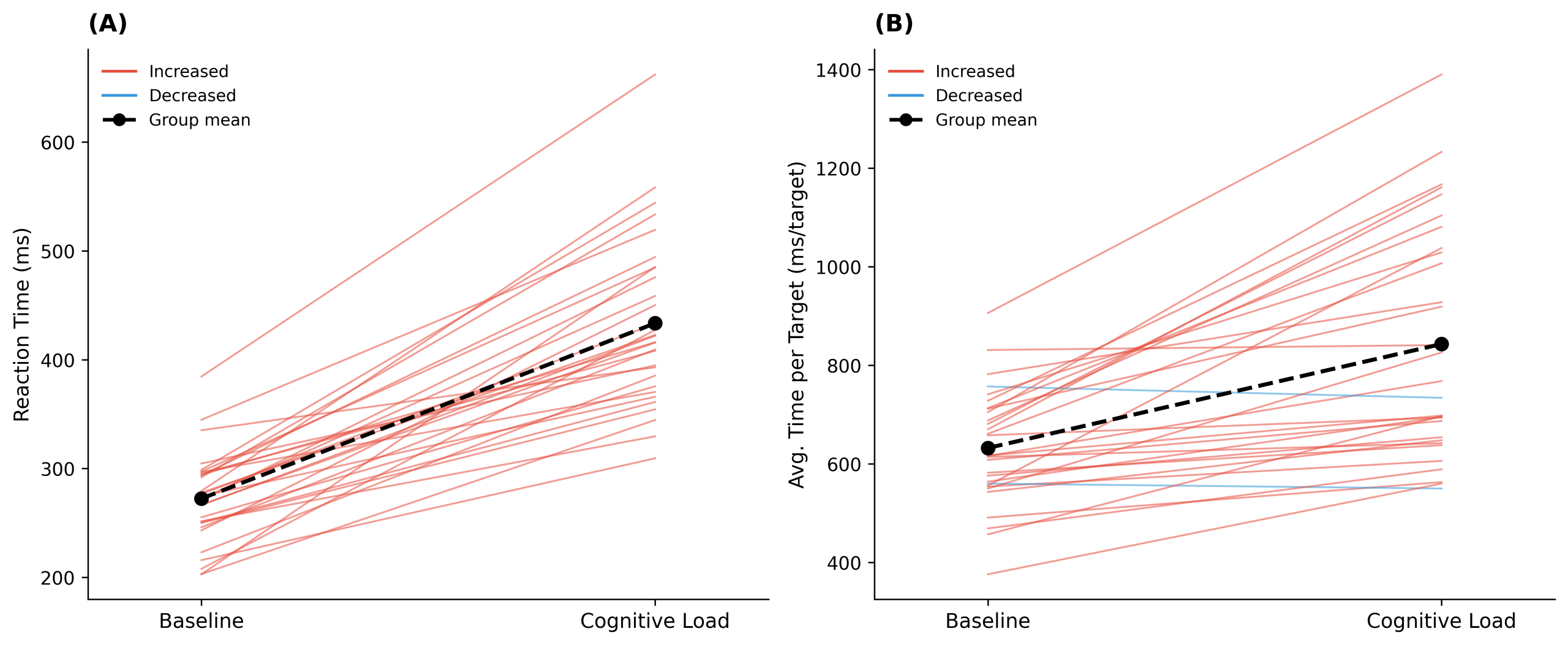
A paired-samples t-test revealed that the dual-task condition significantly increased reaction time compared to baseline, t(29) = 13.83, p < .001, Cohen’s dz = 2.53. Mean reaction time increased from 272.4 ms (SD = 41.3) at baseline to 433.5 ms (SD = 77.5) under the dual-task condition, representing a mean increase of 161.1 ms (95% CI [137.3, 184.9]) or approximately 59% slowing (Table 2). (Figure 1).
Effect of Dual-Task Condition on Target Acquisition Time
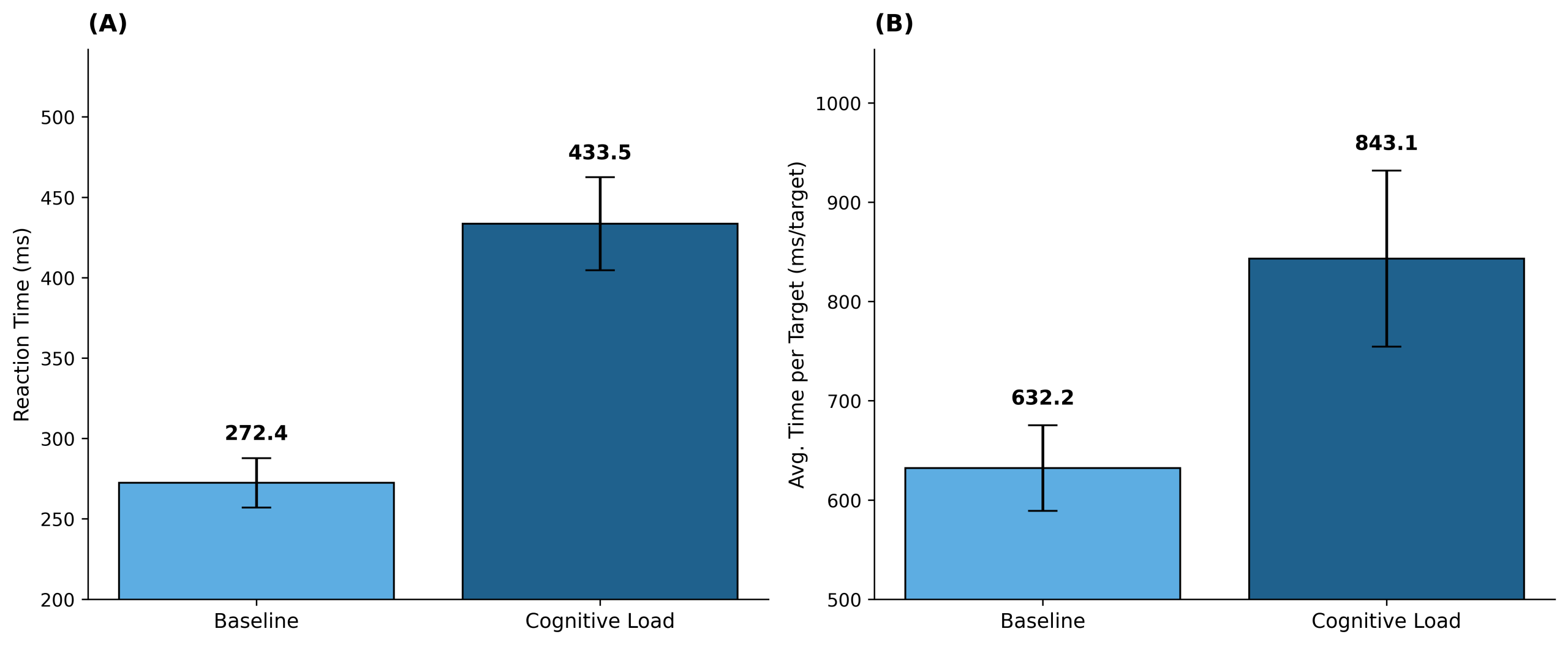
A paired-samples t-test revealed that average time per target was significantly slower under the dual-task condition compared to baseline, t(29) = 6.55, p < .001, Cohen’s dz = 1.20, Δ = dual-task − baseline. Average time per target increased from 632.2 ms (SD = 115.5) at baseline to 843.1 ms (SD = 237.6) under the dual-task condition, representing a mean increase of 210.9 ms (95% CI [145.1, 276.7]) or approximately 33% slowing (Table 2). (Figure 2).
| Outcome | Baseline M (SD) | Dual-Task M (SD) | Δ (Dual–Baseline) | 95% CI | % Change | t(df) | p | dz |
|---|---|---|---|---|---|---|---|---|
| Reaction Time (ms) | 272.4 (41.3) | 433.5 (77.5) | +161.1 | [137.3, 184.9] | +59% | 13.83 (29) | <.001 | 2.53 |
| Aim time per target (ms/target) | 632.2 (115.5) | 843.1 (237.6) | +210.9 | [145.1, 276.7] | +33% | 6.55 (29) | <.001 | 1.20 |
Note. Aim time per target is the Aim Trainer summary measure (average milliseconds per target across 30 targets) as recorded by the platform. CI = confidence interval. dz = Cohen’s dz for paired samples.
Input Device Subgroup Analysis
To address device heterogeneity, a trackpad-only subgroup analysis was conducted (n = 25, excluding 5 mouse users). Reaction time increased from 281.4 ms (SD = 44.9) at baseline to 442.1 ms (SD = 79.2) under the dual-task condition, t(24) = 12.00, p < .001, dz = 2.40. Average time per target increased from 650.0 ms (SD = 106.3) at baseline to 878.6 ms (SD = 248.8) under the dual-task condition, t(24) = 6.29, p < .001, dz = 1.26. Effect sizes in the trackpad-only subgroup were comparable to the full sample, indicating that the primary findings are not driven by device heterogeneity. The mouse subgroup (n = 5) was too small for independent analysis.
Order Effects
Two 2×2 mixed ANOVAs examined whether order of presentation (baseline-first vs. dual-task-first) moderated the dual-task effect. For reaction time, the condition × order interaction was not significant, F(1, 28) = 0.86, p = .363. For average time per target, the condition × order interaction was similarly not significant, F(1, 28) = 0.07, p = .790.
Individual Differences
Exploratory Pearson correlations examined whether participant characteristics predicted the magnitude of dual-task costs. With n = 30, these analyses were powered to detect only large correlations (r ≥ .49 at α = .05, power = .80); associations smaller than this threshold would not be reliably detected. No correlations reached statistical significance (all |r| < .25, all p > .18; see Supplementary Table S1 for Pearson and Spearman results). These null results should be interpreted cautiously as inconclusive rather than as evidence that individual differences do not moderate dual-task costs.
| Variable | n | Mean (SD) | Median | Range (min–max) | Notes |
|---|---|---|---|---|---|
| End count value | 15 | 881.93 (47.85) | 890 | 168 | End values reflect both counting behavior and task duration; errors/skips were not scored. |
| Count change (1000 − end) | 15 | 118.07 (47.85) | 110 | 168 | Use only as a rough indicator of continued counting. |
Discussion
This study tested whether concurrent serial subtraction (counting backward by 7s aloud) would slow reaction time and visuomotor target acquisition speed in adolescent tennis athletes. Using a counterbalanced within-subject design, we found that reaction time was 59% slower and average time per target was 33% slower under the dual-task condition compared to baseline. Order effects were not significant, indicating that the counterbalancing procedure controlled for practice and fatigue effects.
The performance costs observed here likely reflect a combination of at least two mechanisms. First, serial subtraction by 7s places continuous demands on central executive resources (arithmetic computation) and the phonological loop (maintaining the running count), which according to multiple resources theory may compete with visuospatial processing for shared central capacity5,6. Second, because participants produced the count aloud, the vocal-motor output itself may have introduced cross-modal response interference with the manual clicking task. Hazeltine, Ruthruff, and Remington17 demonstrated that vocal-manual response pairings produce measurable dual-task costs that are at least partly independent of central cognitive processing demands. Without an articulatory-control condition—such as repeating a single syllable at a matched speech rate without arithmetic content—we cannot determine the relative contributions of cognitive load and speech-motor coordination to the observed performance costs. The observed effects are therefore best interpreted as reflecting dual-task interference during concurrent serial subtraction, rather than purely cognitive load effects.
Acute dual-tasking generally impairs motor and cognitive outcomes in athletes12,24. Our results are consistent with this pattern, with substantial slowing in both reaction time and visuomotor target acquisition speed. While a majority of prior studies have tested adults, fewer have examined dual-task interference in adolescent competitive athletes using both reaction time and a visuomotor aiming task. Beilock and colleagues25 demonstrated that divided attention can impair motor performance differently depending on skill level, and recent work in basketball has examined cognitive-motor dual-task effects in adolescent athletes26, but the present study appears to be among the first to assess dual-task costs in adolescent tennis athletes using computerized reaction time and visuomotor tasks.
In a dual-task study of tennis athletes, return accuracy was maintained while cognitive task performance declined, a pattern consistent with task prioritization15. In a similar study with table-tennis athletes that used counting backwards by 7 and quantified correct responses, experts had near-zero costs while novices had ~35% costs16. Our study differs: our tasks are browser proxies, not on-court tennis returns, our “motor” outcome is time-based, and we did not quantify counting accuracy.
The observed effect sizes (dz = 2.53 for reaction time, dz = 1.20 for target acquisition time) are large by conventional standards in cognitive psychology. Several factors likely contribute to their magnitude. First, serial subtraction by 7s is among the most demanding secondary tasks used in dual-task research, and meta-analyses of dual-task gait studies using serial subtraction have reported pooled standardized mean differences exceeding d = 1.027,28. Second, the dual-task condition combined arithmetic processing with concurrent vocal output, meaning the observed effects reflect both cognitive and speech-motor interference. Third, the baseline condition involved no secondary task at all, maximizing the contrast between conditions. Fourth, computer-based reaction time tasks may produce larger within-subject effects than complex sport-specific tasks because they offer less room for compensatory strategies. Despite their magnitude, the effect sizes are consistent with prior dual-task research using demanding secondary tasks and should not be interpreted as evidence of measurement error, particularly given the convergent Wilcoxon signed-rank results and the successful replication in the trackpad-only subgroup (dz = 2.40 and 1.26).
Limitations
Several methodological limitations should be considered when interpreting these findings. The most consequential is the vocal-motor confound discussed above: because participants counted aloud, the observed costs cannot be cleanly attributed to cognitive load alone, and an articulatory-control condition would be needed to isolate these components17,18. A related issue is the incomplete compliance data, since end-count values were recorded for only 15 of 30 participants and counting errors and skips were not scored; established dual-task methodology recommends systematic recording of counting accuracy and error rate for all participants21,22. We also did not collect a subjective measure of perceived cognitive load, which is standard practice in this literature (e.g., the NASA Task Load Index29or the Paas cognitive load scale30); without one, we cannot independently confirm that participants experienced the manipulation as effortful. Another concern is the limited trial count for reaction time. Five trials per participant per condition is fewer than the 20–30 trials recommended for stable individual-level estimation31, although the group-level analysis draws on 150 observations per condition and within-participant baseline variability was relatively modest (mean SD = 27.3 ms); future studies should nonetheless use at least 20 trials per condition. Beyond trial counts, online reaction time measurement introduces input and display latency that varies by device20, and the Human Benchmark platform has not been formally psychometrically validated in peer-reviewed research. We also cannot rule out a dual-task tradeoff in which participants prioritized counting over the motor tasks; without counting accuracy data, this remains unknown. Finally, the browser-based tasks are simplified proxies for sport-specific motor demands such as ball tracking, anticipation, and full-body coordination, and findings should not be extrapolated directly to on-court tennis performance.
| Variable | Pearson r | Pearson p | Spearman ρ | Spearman p |
|---|---|---|---|---|
| ΔAIM — Sleep (hrs) | -0.139 | .463 | -0.082 | .667 |
| ΔAIM — Device | 0.150 | .428 | 0.147 | .437 |
| ΔAIM — Input | 0.225 | .233 | 0.212 | .261 |
| ΔAIM — Years in sport | -0.210 | .265 | -0.173 | .361 |
| ΔAIM — Hrs/week training | -0.033 | .863 | 0.028 | .883 |
| ΔAIM — Age | 0.042 | .827 | -0.001 | .994 |
| ΔRT — Sleep (hrs) | 0.124 | .514 | 0.117 | .538 |
| ΔRT — Device | -0.027 | .888 | -0.057 | .766 |
| ΔRT — Input | -0.177 | .351 | -0.183 | .333 |
| ΔRT — Years in sport | -0.250 | .182 | -0.249 | .185 |
| ΔRT — Hrs/week training | 0.079 | .679 | 0.097 | .609 |
| ΔRT — Age | -0.221 | .240 | -0.080 | .676 |
Note. Δ = dual-task minus baseline. With n = 30, the analysis is powered to detect only large correlations (|r| ≥ .49 at α = .05, power = .80). Null results should be interpreted as inconclusive.
Conclusion
Restatement of Key Findings
Concurrent serial subtraction by 7s was associated with substantial slowing of both reaction time (59% increase) and visuomotor target acquisition time (33% increase) in adolescent tennis athletes. Effects were large (dz = 2.53 and 1.20), confirmed by nonparametric robustness checks, and replicated in a trackpad-only subgroup analysis. Counterbalancing controlled for practice and fatigue effects, and exploratory individual difference analyses did not detect significant moderators of dual-task cost magnitude.
Implications and Significance
These findings extend the cognitive-motor interference literature to the understudied population of adolescent competitive athletes performing computerized reaction time and visuomotor tasks. The magnitude of dual-task costs we observed is consistent with meta-analytic findings in dual-task gait research and reinforces that demanding verbal secondary tasks substantially degrade basic visuomotor performance. Thus, our results are potentially relevant for understanding how concurrent cognitive demands during athletic competition may affect motor execution, although direct extrapolation to on-court performance requires further research using sport-specific motor tasks.
Connection to Objectives
Our hypothesis that concurrent serial subtraction would slow both reaction time and visuomotor target acquisition speed was supported. However, our design did not include an articulatory-control condition, so the observed costs reflect dual-task interference during concurrent counting instead of pure cognitive load effects. We’ve adjusted the framing of the study to reflect what the data can and cannot support.
Recommendations for Future Research
We recommend that future studies should: (1) include an articulatory-control condition to isolate cognitive from speech-motor components of interference; (2) employ standardized input devices to reduce measurement noise; (3) collect subjective workload measures (e.g., NASA-TLX) to validate the manipulation; (4) increase trial counts to at least 20 per condition for stable individual-level reaction time estimation; (5) systematically record counting accuracy, error rate, and response rate for all participants; and (6) employ sport-specific motor tasks to test ecological generalization to athletic performance.
Closing Thought
The robust dual-task costs documented here suggest that even brief moments of concurrent verbal-cognitive demand can meaningfully slow basic visuomotor response in adolescent athletes. We believe that how these laboratory effects translate to the split-second decisions athletes make under competitive pressure is an open and important question for future research.
Acknowledgments
We thank the participants from local tennis teams for their voluntary participation in this study. We’d also like to thank Zhen Zhao, PhD (Tulane School of Medicine) for his ongoing guidance on study design, statistical analysis, and manuscript preparation.
Supplementary information
References
- A. Castillo-Rodríguez, et al. Tennis vs padel: Precompetitive anxiety as a function of gender and competitive level. Frontiers in Psychology. Vol. 13, pg. 1018139, 2022, https://doi.org/10.3389/fpsyg.2022.1018139. [↩]
- M. J. Kofler, et al. Reaction time variability in ADHD: A meta-analytic review of 319 studies. Clinical Psychology Review. Vol. 33, no. 6, pg. 795–811, 2013, https://doi.org/10.1016/j.cpr.2013.06.001. [↩]
- D. Kahneman. Attention and Effort. Prentice-Hall, Englewood Cliffs, NJ, 1973. [↩]
- H. Pashler. Dual-task interference in simple tasks: Data and theory. Psychological Bulletin. Vol. 116, no. 2, pg. 220–244, 1994, https://doi.org/10.1037/0033-2909.116.2.220. [↩]
- C. D. Wickens. Multiple resources and mental workload. Human Factors. Vol. 50, no. 3, pg. 449–455, 2008, https://doi.org/10.1518/001872008X288394. [↩] [↩]
- J. Sweller. Cognitive load theory. Psychology of Learning and Motivation. Vol. 55, pg. 37–76, 2011, https://doi.org/10.1016/B978-0-12-387691-1.00002-8. [↩] [↩]
- J. A. Anguera, et al. Contributions of spatial working memory to visuomotor learning. Journal of Cognitive Neuroscience. Vol. 22, no. 9, pg. 1917–1930, 2010, https://doi.org/10.1162/jocn.2009.21351. [↩]
- A. I. Christou, et al. Individual differences in explicit and implicit visuomotor learning and working memory capacity. Scientific Reports. Vol. 6, pg. 36633, 2016, https://doi.org/10.1038/srep36633. [↩]
- K. Watanabe, S. Funahashi. Neural mechanisms of dual-task interference and cognitive capacity limitation in the prefrontal cortex. Nature Neuroscience. Vol. 17, no. 4, pg. 601–611, 2014, https://doi.org/10.1038/nn.3667. [↩]
- E. Vaportzis, et al. Dual task performance in normal aging: A comparison of choice reaction time tasks. PLOS ONE. Vol. 8, no. 3, pg. e60265, 2013, https://doi.org/10.1371/journal.pone.0060265. [↩]
- H. Kim, et al. Dual task effects on speed and accuracy during cognitive and upper limb motor tasks in adults with stroke hemiparesis. Frontiers in Human Neuroscience. Vol. 15, pg. 671541, 2021, https://doi.org/10.3389/fnhum.2021.671541. [↩]
- P. E. D. Moreira, et al. The acute and chronic effects of dual-task on the motor and cognitive performances in athletes: A systematic review. International Journal of Environmental Research and Public Health. Vol. 18, no. 4, pg. 1732, 2021, https://doi.org/10.3390/ijerph18041732. [↩] [↩]
- T. Buszard, et al. The relationship between working memory capacity and cortical activity during performance of a novel motor task. Psychology of Sport and Exercise. Vol. 22, pg. 247–254, 2016, https://doi.org/10.1016/j.psychsport.2015.07.005. [↩]
- D. Van Biesen, et al. The relation between intelligence and reaction time in tasks with increasing cognitive load among athletes with intellectual impairment. Intelligence. Vol. 64, pg. 45–51, 2017, https://doi.org/10.1016/j.intell.2017.06.005. [↩]
- G. Amico, S. Schaefer. Tennis expertise reduces costs in cognition but not in motor skills in a cognitive-motor dual-task condition. Acta Psychologica. Vol. 223, pg. 103503, 2022, https://doi.org/10.1016/j.actpsy.2022.103503. [↩] [↩]
- S. Schaefer, G. Amico. Table tennis expertise influences dual-task costs in timed and self-initiated tasks. Acta Psychologica. Vol. 223, pg. 103501, 2022, https://doi.org/10.1016/j.actpsy.2022.103501. [↩] [↩]
- E. Hazeltine, E. Ruthruff, R. W. Remington. The role of input and output modality pairings in dual-task performance: Evidence for content-dependent central interference. Cognitive Psychology. Vol. 52, no. 4, pg. 291–345, 2006, https://doi.org/10.1016/j.cogpsych.2005.11.001. [↩] [↩] [↩] [↩]
- E. Hazeltine, E. Ruthruff. Modality pairing effects and the response selection bottleneck. Psychological Research. Vol. 70, no. 6, pg. 504–513, 2006, https://doi.org/10.1007/s00426-005-0017-3. [↩] [↩] [↩]
- T. Strobach. The dual-task practice advantage: Empirical evidence and cognitive mechanisms. Psychonomic Bulletin & Review. Vol. 27, no. 1, pg. 3–14, 2020, https://doi.org/10.3758/s13423-019-01619-4. [↩]
- R. R. Plant, G. Turner. Millisecond precision psychological research in a world of commodity computers: New hardware, new problems? Behavior Research Methods. Vol. 41, no. 3, pg. 598–614, 2009, https://doi.org/10.3758/BRM.41.3.598. [↩] [↩]
- T. Bristow, et al. Standardization and adult norms for the sequential subtracting tasks of serial 3’s and 7’s. Applied Neuropsychology: Adult. Vol. 23, no. 5, pg. 372–378, 2016, https://doi.org/10.1080/23279095.2016.1179504. [↩] [↩]
- O. Beauchet, et al. ‘Faster counting while walking’ as a predictor of falls in older adults. Age and Ageing. Vol. 36, no. 4, pg. 418–423, 2007, https://doi.org/10.1093/ageing/afm004. [↩] [↩]
- A. Ghasemi, S. Zahediasl. Normality tests for statistical analysis: A guide for non-statisticians. International Journal of Endocrinology and Metabolism. Vol. 10, no. 2, pg. 486–489, 2012, https://doi.org/10.5812/ijem.3505. [↩]
- J. Wu, et al. The effects of cognitive-motor dual-task training on athletes’ cognition and motor performance: A systematic review. Frontiers in Psychology. Vol. 15, pg. 1284787, 2024, https://doi.org/10.3389/fpsyg.2024.1284787. [↩]
- S. L. Beilock, et al. When paying attention becomes counterproductive: Impact of divided versus skill-focused attention on novice and experienced performance of sensorimotor skills. Journal of Experimental Psychology: Applied. Vol. 8, no. 1, pg. 6–16, 2002, https://doi.org/10.1037/1076-898X.8.1.6. [↩]
- S. Lucia, et al. Effects of a cognitive-motor training on anticipatory brain functions and sport performance in semi-elite basketball players. Brain Sciences. Vol. 12, no. 1, pg. 68, 2022, https://doi.org/10.3390/brainsci12010068. [↩]
- A. Bishnoi, M. E. Hernandez. Dual task walking costs in older adults with mild cognitive impairment: A systematic review and meta-analysis. Aging & Mental Health. Vol. 25, no. 9, pg. 1618–1629, 2021, https://doi.org/10.1080/13607863.2020.1802576. [↩]
- E. Al-Yahya, et al. Cognitive motor interference while walking: A systematic review and meta-analysis. Neuroscience & Biobehavioral Reviews. Vol. 35, no. 3, pg. 715–728, 2011, https://doi.org/10.1016/j.neubiorev.2010.08.008. [↩]
- S. G. Hart, L. E. Staveland. Development of NASA-TLX (Task Load Index): Results of empirical and theoretical research. In P. A. Hancock, N. Meshkati (Eds.), Human Mental Workload, North-Holland, Amsterdam, pg. 139–183, 1988, https://doi.org/10.1016/S0166-4115(08)62386-9. [↩]
- F. G. W. C. Paas. Training strategies for attaining transfer of problem-solving skill in statistics: A cognitive-load approach. Journal of Educational Psychology. Vol. 84, no. 4, pg. 429–434, 1992, https://doi.org/10.1037/0022-0663.84.4.429. [↩]
- J. Miller, R. Ulrich. Mental chronometry and individual differences: Modeling reliabilities and correlations of reaction time means and effect sizes. Psychonomic Bulletin & Review. Vol. 20, no. 5, pg. 819–858, 2013, https://doi.org/10.3758/s13423-013-0404-5. [↩]