

Ting Ho Hui1, Shuixin Pang1
1 John Rennie High School, Montreal, Canada
Abstract
Language serves as a bridge for communication. However, countless native Chinese speakers struggling with English pronunciation due to certain phonemes absent in Chinese, which impacts social integration in English-speaking environments. This research aims to help contribute to a more supportive ESL environment, helping learners overcome phonetic barriers and communicate more effectively through understanding accent interference. Data was collected from 33 native Chinese-speaking participants with 29 corresponding audio recordings; 15 participants reported living in an English-speaking country and 18 did not. Audio samples were annotated for segmental pronunciation errors by five independent blinded raters; quantitative analyses included, chi-square tests, and Pearson correlations relating error frequency to age of English acquisition and self-rated confidence. Place of origin and dialect spoken was strongly negatively correlated with pronunciation error frequency (r(27) ≈ -0.64, p < 0.001). Living abroad was significantly associated with lower self-reported phoneme differentiation difficulty (χ²=5.05, df=1, p=0.025). Pronunciation error frequency was strongly positively correlated with age of English acquisition (r ≈ 0.58, p < 0.01) and strongly negatively correlated with self-rated confidence (r ≈ -0.83, p < 0.001).These results suggest earlier exposure to English and greater immersion are associated with producing fewer pronunciation errors, while later acquisition and lower confidence predict more frequent and consistent errors. These findings highlight that pronunciation difficulties among Chinese speakers are not random but systematically influenced by a combination of linguistic, cognitive, and social factors.
Introduction
Accent is a natural part of second language learning and daily speaking habits, and often reflects the influence of a speaker’s native language. Understanding the root causes of accent interference is crucial not only for improving peer communication but also for mitigating bias in multilingual environments.
Many second language speakers report worrying about how their accents affect how they are perceived in professional, academic and social settings. Such concerns can influence productivity, equality, confidence, and access to different opportunities1.
Chinese students remain the top demographic of international students worldwide2, yet the EF English Proficiency Index ranked them as “low”3. In China, English is introduced relatively late into a students’ scholastic year, contributing to a linguistic mismatch, high outbound mobility paired with modest language skills, often results in friction in an international academic or professional setting.
This study aims to investigate qualitative interviews to clarify the pronunciation challenges faced by different demographics of native Chinese speakers of English and how the challenges presented relate to learners’ perception and strategies to minimise such effects.
Pronunciation is shaped by multiple factors, including linguistic, cognitive, social, and physiological.
Certain English phonemes, such as /r/, /l/, /θ/, and /v/, have been documented to be difficult for Chinese learners due to their absence or differing use in Chinese phonology4. This phenomenon, known as accent interference or L1 transfer, occurs when learners apply native phonological rules, such as those that exclude /θ/ or /v/, to English pronunciation5. Certain phonemes such as /r/, /l/, /θ/, and /v/ are absent or contrast differently in Chinese, leading learners to substitute [s] for /θ/ and [w] for /v/ in many contexts6. Beyond phonemic challenges, suprasegmental features such as intonation, stress, and rhythm, largely absent in Chinese, also hinder learners’ oral ability7. English is stress-timed, with vowel reduction in unstressed syllables to enhance different definitions. In addition, English typically exhibits minimal lexical patterns7 compared to Chinese dialects such as Mandarin or Cantonese.
Cognitive factors, such as the Critical Period Hypothesis8 can be linked to early plasticity, in which infants’ speech perception attunes faster due to their biological window8. As individuals age, their diminishing neuroplasticity often makes it difficult to achieve native-like accents6. Consistent with this view, fMRI studies show diminished activation and connectivity in classical phonological areas during second language learning post-puberty9.
Accent can also be shaped by language exposure and early phonological habits10. Infants exposed from birth to multiple languages or accents may form broader phonological categories, which may lead to less precise speech patterns in a particular language11. Furthermore, adults who had early childhood immersion in their second language retain more native-like phonological habits5.
Emotional and psychological factors such as anxiety, motivation, and self-perception of ability can also influence how students engage with pronunciation learning12. This could be attributed to a negative correlation with confidence and motivation, in which learners decrease their allocated efforts in pronunciation practice¹. Conversely, there is also research that suggests that speaking anxiety showed no significant correlation with pronunciation accuracy13.
Moreover, despite extensive work on segmental and suprasegmental errors, most studies rely on either controlled laboratory tasks or decontextualised reading materials, with limited attention to spontaneous speech. Few studies focused on triangulated studies combining corpus acoustics with self-perception of ability, and qualitative accounts from Chinese speakers with overseas experience, as well as distinguished mainstream Chinese accents, remain scarce. There have also been notable accounts where research debates on the correlation between anxiety and pronunciation accuracy13.
Limitations can be attributable to a small sample size and the use of convenience sampling, a controlled reading task, which may restrict generalizability.
Results
Our analysis and research are based on the survey we have created. Between late June and July 2025, we collected 33 questionnaires and received 29 corresponding audio recordings. Participants differed in age, experience and English acquisition, ensuring the diversity and comprehensiveness of our research. The result below summarises pronunciation error patterns and their correlations with linguistic, cognitive, social, and psychological factors.
Linguistic Factors
Research Question: Does living abroad experience correlate with perceived English phoneme differentiation difficulties? (n=33)
Of 18 without abroad experience, 16 reported difficulties vs. 2 without; of 15 with experience, 7 reported difficulties vs. 8 without.
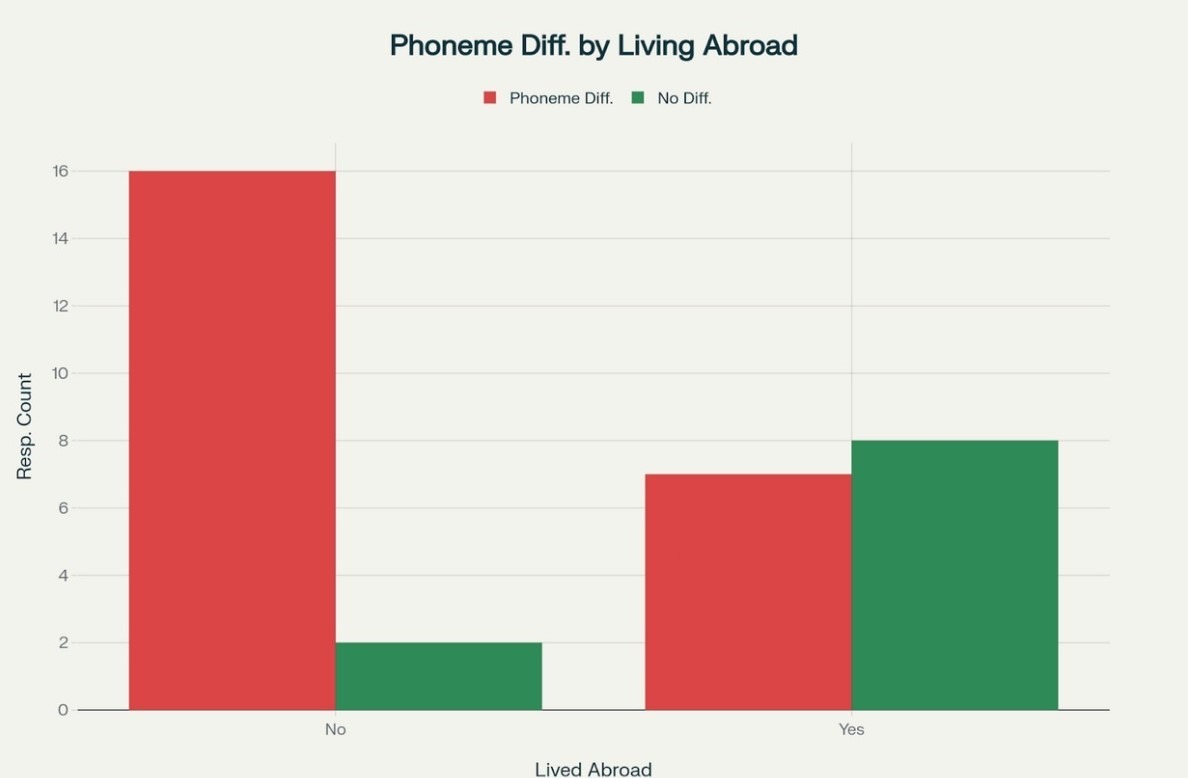
We divided all participants into two groups based on whether they had lived in an English-speaking country. Among the 33 participants who completed the questionnaire, 18 responded no and 15 responded yes.
Based on the above groupings, we analysed three aspects respectively from the subjective responses of the participants and the objective recordings.
The chi-square statistic was χ² = 5.05 with 1 degree of freedom, yielding a p-value of 0.025.
Living abroad is associated with reduced difficulties in English phoneme differentiation difficulties.
Research Question: What are the reported difficulties for different phonemes among native Chinese speakers? (n=33)
/th/ (both θ and ð) was reported 6 times, /r/ 5 times, /s/ 4 times, tongue or lip movements such as interdental sounds and other specific phonemes like /l/, d sound were both mentioned 3 times. In addition to the above, ch/, /sh/, difficult blends linkings like s and /th/ and diphthongs were also mentioned twice, twice, twice, once respectively.
| Phonemes | Self-Reported Difficulty (Respondents) |
| /th/ (both θ and ð) | 6 |
| /r/ | 5 |
| /s/ | 4 |
| Interdental sounds | 3 |
| /h/ | 3 |
| /ch/ | 2 |
| /sh/ | 2 |
| Difficult blends/linkings | 2 |
| Diphthongs | 1 |
/th/ and /r/ are the phonemes to be reported as the most challenging among native Chinese speakers, followed by /s/, interdental sounds, /h/, and other sounds.
Research Question: What are the phonemes most commonly mispronounced among native Chinese speakers? (n=29)
The /r/ phoneme was the most commonly mispronounced, with 12 instances observed across 29 recordings. Voiceless /θ/ accounted for approximately 10 mispronunciations, while voiced /ð/ occurred approximately 6 times. The /s/ sound followed with around 8 mispronunciations, /l/ with 7, and both /d/ and diphthongs with 6 and 5 instances, respectively. The /h/ sound was mispronounced approximately 3 times. These mispronunciations appeared in high-frequency lexical items including “rainbow,” “reach,” “raindrops” (/r/), “things,” “think,” “path,” and “something” (/θ/), and “these,” “those,” and “the” (/ð/). The /s/ and /l/ sounds were mispronounced in words such as “strikes,” “sunlight,” “light,” and “long.” Diphthongs were particularly evident in words like “boiling,” “above,” and “horizon.”
| Phonemes | Mispronounced Count (Respondents) |
| /r/ | 12 |
| /θ/ (voiceless th) | 10 |
| /s/ | 8 |
| /ð/ (voiced th) | 6 |
| /d/ | 6 |
| Diphthongs/vowels | 5 |
| /ʃ/ (sh) | 4 |
| /h/ | 3 |
/r/ and /θ/ (voiceless th) are the most commonly mispronounced phonemes reported among native Chinese speakers, followed by /s/, /ð/ (voiced th), /d/, and other sounds.
Research Question: What are the relations between Chinese speakers from Hong Kong and mainland Chinese speakers and mispronunciation? (n=29)
Pearson correlation analyses were conducted using individual participant data.
r(27) ≈ -0.64, p < 0.001, r² = 0.41
| Place of Origin | Number of respondents (Respondents) | Mispronounced words on average (Words) (SD) |
| Hong Kong | 6 | 1.0 (0.82) |
| Mainland China | 23 | 8.5 (5.0) |
Cantonese speaker status was strongly negatively correlated with pronunciation error frequency, (r(27) ≈ -0.64, p < 0.001), indicating that Cantonese speakers tended to mispronounce fewer words than non-Cantonese participants.
Respondents who were born in Hong Kong and spoke Cantonese as their main dialect has reported significant less mispronounced words compared to respondents who were born in Mainland China and spoke Mandarin.
Cognitive Factors
Research Question: What are the relations between the age of English acquisition and pronunciation accuracy among native Chinese speakers? (n=29)
Pearson correlation analyses were conducted using individual participant data.
r(27) ≈ 0.58, p < 0.01, r² = 0.34
| Age of English Acquisition (Years) | Number of respondents (Respondents) | Mispronounced words on average (Words) (SD) |
| 0-5 | 10 | 3.18 (1.2) |
| 6-8 | 13 | 7.4 (2.1) |
| 8-13 | 6 | 7.2 (1.8) |
Age of English acquisition was positively correlated with pronunciation error frequency (r ≈ 0.58, p < .01), indicating that later acquisition was associated with more errors.
The respondents who had a lower age of English acquisition at 0-5 have reported a significantly lower number of mispronounced words compared to respondents who started at 6-8 years old, and the respondents who had a lower age of English acquisition at 6-8 years old have reported lower numbers of mispronounced words compared to respondents who started at 8-13 years old.
Research Question: What are the relations between the age of respondents and pronunciation accuracy among native Chinese speakers? (n=29)
Pearson correlation analyses were conducted using individual participant data.
r(27) ≈ 0.27, p ≈ 0.15, r² = 0.07
| Age (Years) | Number of respondents (Respondents) | Mispronounced words on average (Words) (SD) |
| 6-12 | 6 | 5.0 (1.3) |
| 13-17 | 12 | 6.7 (1.5) |
| 18-25 | 8 | 7.0 (1.7) |
| 26-35 | 3 | 4.6 (0.9) |
Age was weakly positively correlated with pronunciation error frequency.
Older participants exhibited a non-significant increase in mispronunciation, though the effect was not statistically significant.
Social Factors
Research Question: What are the relations between prescence of living abroad experiences and pronunciation accuracy among native Chinese speakers? (n=29)
Pearson correlation analyses were conducted using individual participant data.
r(27) ≈ -0.48, p ≈ 0.004, r² = 0.23
| Experiences Living Abroad | Number of respondents (Respondents) | Mispronounced words on average (Words) (SD) |
| Yes | 15 | 4.73 (1.5) |
| No | 18 | 7.61 (2.0) |
Experiences living abroad were significantly negatively correlated with pronunciation error frequency, indicating that participants who had lived abroad tended to mispronounce fewer words.
Respondents who lived abroad fewer mispronounced words compared to respondents who have never lived abroad.
Psychological Factors
Research Question: What are the relations between confidence level and pronunciation accuracy among native Chinese speakers? (n=29)
Pearson correlation analyses were conducted using individual participant data.
r(27) ≈ -0.83, p < 0.001, r² = 0.69
| Confidence level | Number of respondents (Respondents) | Mispronounced words on average (Words) (SD) |
| 1 (Insecure) | 3 | 13.5 (0.6) |
| 2 | 4 | 10.2 (0.8) |
| 3 | 6 | 6.14 (0.5) |
| 4 | 9 | 5.6 (0.7) |
| 5 (Confident) | 7 | 1.43 (0.5) |
Confidence level was strongly negatively correlated with pronunciation error frequency, indicating that more confident participants tended to mispronounce fewer words.
Respondents who are confident in their English acquisition fewer mispronounced words compared to respondents who were not confident.
Regarding participants’ responses to corrective feedback, attitudes were categories in three categories. Ten individuals described the feedback as helpful, stating, for example, that the feedback “helps with pronunciation” Five participants expressed neutral attitudes, while three reported negative emotional responses, such as discomfort or insecurity, when pronunciation errors were pointed out. These response categories were treated as qualitative data and were used to contextualise the confidence–accuracy relationship reported above.
Additional Observations
A review of participant profiles revealed a distinct pattern among those with minimal or no mispronunciations. These individuals commonly reported high pronunciation confidence (levels 4 or 5), high frequency of English usage, and no self-reported phonemic difficulties. Moreover, they also generally expressed neutral or positive attitudes toward corrective feedback and were within the adolescent or young adult age range.
Finally, we also explored participants’ views on their own accents in the survey; out of the 33 respondents, 15 affirmed this view.
| Metric | Value | 95% CI | Interpretation |
| Fleiss’ κ | 0.72 | [0.68, 0.76] | Substantial |
| Cronbach’s α | 0.81 | – | Good |
Fleiss’ κ of 0.72 (95% CI [0.68, 0.76]) indicates substantial inter-rater agreement beyond chance among multiple annotators for phoneme mispronunciations, while Cronbach’s α of 0.81 indicates good internal consistency reliability across ratings.
Discussion
Overall, the findings of this study suggest that accent interference among native Chinese speakers is not random, but is systematically associated with multiple overlapping factors. Across the dataset, pronunciation errors clustered around specific segmental phonemes (e.g., /r/, /θ/, /ð/), and variation in error frequency was associated with age of English acquisition, experience living in an English-speaking environment, and self-rated pronunciation confidence. Rather than reflecting a single explanatory factor, the results indicate that linguistic constraints, cognitive timing, social exposure, and psychological variables jointly shape pronunciation outcomes. The discussion below examines these dimensions in turn, while highlighting how they interact.
A substantial number of participants, regardless of residency, reported difficulty with English phonemes. Among the 18 respondents who had never lived abroad, 16 respondents expressed difficulty with English phonemes. This indicates an overwhelming 88.9% expressed difficulty with native Chinese speakers, while only 7 out of the 15 respondents who have lived abroad expressed difficulty, reducing the number to only 46.7%. The chi-square test (χ²=5.05, df=1, p=0.025) confirms a significant association; living abroad is associated with improved phoneme identification and pronunciation.
Phoneme-by-phoneme analysis revealed similar patterns to existing literature research. /θ/ and /ð/ are cited as the most challenging phonemes in the English language for Chinese speakers by a considerable margin, followed by phonemes consisting of /r/, /s/, and /l/. This can be associated with the absence of such articulation in the Chinese language, making tongue posture and articulatory motion particularly unnatural to the normal Chinese speaker.
Notably, the mispronounced words and phonemes most frequently overlapped with the “difficult” sounds, such as /θ/ and /ð/ for words like “things” or “those, /r/, /s/, and /l/ for “rainbow”, “strikes”, “light”, supporting our above hypothesis on foreign articulation.
In addition, respondents have other difficulties, like with diphthongs, in words such as “above”, and most respondents mispronounced the word “arch” as “arc”, potentially due to insufficient exposure to the word.
Respondents have also struggled with intonation, stress and rhythm, making their speech seem “unnatural” at times. Their struggle with a lack thereof of lexical tones makes some words difficult to understand.
Hong Kong-born Chinese has reported to have fewer mispronounced words than Mainland-born Chinese. This could be associated with the influence of Cantonese as a first language, or with greater exposure to English in educational or social settings in Hong Kong14.
However, living abroad is associated with greater exposure to the English language, which may facilitate phonological adaptation through increased opportunities for practice and use. Accordingly, pronunciation difficulty was found to be strongly associated with experience living in an English-dominant environment.
These patterns suggest that phoneme-level difficulty alone cannot account for individual variation in pronunciation accuracy, directing attention to cognitive factors such as the timing of English acquisition.
A positive correlation (r≈0.58) was observed between the age of English acquisition and the average number of mispronounced words, indicating early plasticity. This reaffirms sensitive-period hypotheses in second language acquisition through Lenneberg’s Critical Period Hypothesis8, in which he suggests there is an early biological window for language adaptation.
Even so, the correlation between participant age and mispronounced words yielded a weak positive relationship (r≈0.27), suggesting that chronological age has little impact on accent interference. The timing, not just total years of practice or age, is more critical to amending pronunciation mistakes.
However, early acquisition does not occur in isolation; sustained opportunities for use and feedback are also shaped by learners’ social environments.
There is a significant negative correlation between mispronounced words comparing native Chinese and Chinese who live abroad. (r≈0.27) This further suggests that experience living abroad is associated with differences in English articulation, reinforcing the importance of second language immersion, as those who lived abroad performed significantly better with fewer mispronounced words than those who did not.
At the same time, exposure alone may be insufficient if learners’ psychological responses to speaking and feedback constrain engagement with the language.
The mean number of mispronounced words using a triangulated study in corpus acoustics, in an increasing order of self-perception of ability, from insecure (1) to confident (5), 13.5 words, 10.2 words, 6.14 words, 5.6 words and 1.43 words. Confidence level was strongly negatively correlated with pronunciation error frequency, indicating that more confident participants tended to mispronounce fewer words (r≈-0.83) As confidence increases, the average mispronounced words decreases.
The affective filter hypothesis15 is a prevalent study in second-language acquisition, in which confidence reduces emotional barriers. Confidence fuels motivation, which invites more opportunities and increases allocated effort for English speakers, creating effective study. The self-efficiancy theory16 suggests that confidence is about your belief in your capabilities, which influence performance.This suggests that self-perception of ability has a strong impact on English engagement, often in the effect of English improvement and a decrease in accent interference.
Other statistics
Most participants found other people correcting and pointing out their accent helpful in their pronunciation, while some stayed neutral, and 3 reported feeling insecure or negatively.
The commonality amongst the participants with “no error” is high confidence(4 or 5), frequent use of English (4 or 5), and minimal or no difficulty with English pronunciation. They also expressed neutral or positive attitudes towards accent correction.
This reflects that accent correction often comes in welcoming feedback from others, especially native English speakers.
45% of respondents believed that their accent was part of their cultural identity, while 55% did not. This indicated that accent perception is subject to experience.
Insufficient data to notice any trend in the method of practising and mispronounced words. This limitation is partly attributable to the relatively small sample size and the use of convenience sampling, which may restrict the generalizability of the findings. In addition, pronunciation accuracy was assessed using a controlled reading task rather than spontaneous speech, which may not fully capture natural pronunciation patterns. Furthermore, the relatively small sample of Hong Kong (Cantonese dialect) participants constrains the robustness and generalisability of dialect-discrepency findings and was unable to conclude whether place of origin or dialects was truly the factor in accent interference and language acquisition. Finally, as the analyses are correlational in nature, the observed relationships should not be interpreted as causal.
Strategies
Based on the above results, and within the limitations of the present study, native Chinese speakers seeking to improve their oral English and reduce accent interference may benefit from increased exposure to English, particularly through meaningful exchanges with native speakers. For those who could not gain overseas experience, they should immerse themselves in local English communities, have their inner monologue in English, or consume English entertainment. They should also start as early as possible, since plasticity diminishes over time. Other strategies include being confident and proud of the progress they have made rather than focusing on their weaknesses, as the data show that this would increase allocated effort, which would increase the effectiveness of practice, and being open to feedback.
Conclusion
Across linguistic, cognitive, social, psychological, and cultural axes, this research indicates that accent interference is not caused by one factor, but rather, a range of factors. Foreign exposure, early acquisition, confidence, dialect, and a positive mindset both in studying and in feedback all foster better pronunciation outcomes. Conversely, late exposure, accent-insecurities, showing limited receptiveness to feedback, and negative correction-perception are all risk factors for persistent language struggles.
These results further support established theoretical frameworks. The Critical Period Hypothesis explains why early exposure and plasticity enhance pronunciation, while the Interlanguage Theory can be associated with the persistence of certain phoneme errors, the cause of accents, as part of the learning curve of a new language. Sociophonetic perspective further illuminates how attitudes, confidence and perception affect pronunciation and accent interference.
This study provides a holistic understanding of the case of phoneme difficulties, as well as the complex perception in second language phonological development. Limitations can be attributable to a small sample size and the use of convenience sampling, a controlled reading task, which may restrict generalizability.
Methods
Data Collection Platform
To gather diverse responses from Chinese English learners both within and outside of mainland China, we utilised two data collection platforms: Google Forms and Wenjuanxing to collect survey data.
Wenjuanxing is a widely used Chinese online survey platform for distributing questionnaires. Wenjuanxing, which offers functions comparable to Google Forms (e.g., multiple question types, anonymous responses, file uploads, and secure data storage), was used to distribute the questionnaire.
Participants were recruited using convenience sampling, primarily through the authors’ personal networks, including family members (relatives), friends, student peers and teachers.This approach enabled access to participants with diverse ages, English learning backgrounds, and exposure to English-speaking environments. Eligibility criteria required all participants to identify Chinese as their native language and to be born in countries where Chinese is officially recognised as one of the official languages. All participants were informed of the study procedures and provided informed consent through the built-in consent forms of the data collection platforms.
The survey was built specifically for this study, with questions developed upon existing literature, and literature gaps that had insufficient data. The survey was offered in Chinese on Wenjuanxing for participants currently residing in mainland China, and English for participants currently residing outside of mainland China to ensure clarity.
Recordings were submitted as MP3 files via the file upload function for participants using Google Forms, and recordings were sent directly to one of the authors via WeChat for participants using Wenjuanxing.
Audio samples were analysed for segmental pronunciation errors using a structured phoneme-annotation procedure, in which mispronounced target phonemes in the Rainbow Passage were identified and coded based on predefined phonemic categories.
Mispronounced phonemes were annotated using a structured Excel-based rating sheet. Five independent raters were a part of the annotation process. All raters were native English speakers with proficient phonemic awareness. To prevent bias, all raters were fully blinded, identifiable information, such as names, was removed prior to evaluation. The raters are not aware of one another and did not communicate at any point during the annotation process, ensuring independent judgments.
Each rater listened to the speech samples and flagged perceived mispronounced phonemes according to predefined phonemic categories. A phoneme was classified as mispronounced only if at least two raters independently identified the same phoneme as mispronounced. Disagreements were resolved through this majority-threshold rule rather than discussion, thereby avoiding consensus bias.
Rater training consisted of an individual debrief on what to look out for, including annotation guidelines, phonemic inventory, and examples of common pronunciation errors relevant to the study and the text. No further calibration occurred during the rating phase.
Inter-rater reliability was assessed using a multi-rater agreement metric (Fleiss’ κ), and overall agreement was found to be acceptable. Reliability statistics are reported in the Results section.
Inter-rater reliability showed substantial agreement (Fleiss’ κ = 0.72, 95% CI [0.68, 0.76]) and good internal consistency (Cronbach’s α = 0.81)
Qualitative responses were reviewed using thematic analysis.
Quantitative data were computed in Excel and analysed using descriptive and inferential statistical analyses.
The chi-square (χ²) test was used to examine the association between categorical variables with the trends with difficulties expressed in phonemes and quantifiable mispronounced words, comparing native Chinese and Chinese who have or had lived abroad.
The Pearson correlation coefficient (r) was calculated to measure the strength and direction of linear relationships between continuous variables, in correlations such as early acquisition, age and confidence level with mispronounced words.
Descriptive statistics such as means, averages, and counts were conducted to give a numerical value to variables such as English phonemes respondents find the most difficult to pronounce, commonly mispronounced words, their psychology on feedback surrounding their accents, outliers, and if they believe that their accent is part of their cultural identity.
This research has a total of 33 participants, with 29 voice recordings provided for phoneme and pronunciation analysis.
All data were stored on encrypted drives, and identifiers were removed from all public results. This independent student research adhered to ethical standards (TCPS 2, 2022). Participants (n=33 Chinese L1 English learners) provided written informed consent; speech samples were anonymized, encrypted, and stored securely. No institutional affiliation or formal REB approval was required due to minimal risk and non-clinical nature.
Survey Design and Instruments
The questionnaire included 18 questions, divided into five thematic sections:
Section 1: Demographics and Language Background (Q1–Q6): These questions gathered essential background information such as age range, duration of English learning, and experience in English-speaking environments. This section helped us segment participants by their language exposure levels and linguistic history.
Section 2: Phonological Awareness and Production (Q8–Q10, Q15, Q16, Q18): These questions explored participants’ ability to perceive and pronounce English phonemes that are commonly difficult for Chinese speakers. Items included both perceptual distinctions (e.g., /r/ vs. /l/) and production-related challenges (e.g., tongue movement, imitation ability).
Section 3: Accent Perception and Attitudes (Q11-14): This section assessed how learners feel about their own accents, whether they perceive social bias or cultural significance in their pronunciation, and how they respond to peer or teacher correction.
Section 4: Speech Practice Habits(Q17): Participants were asked to share their methods of English practice (if any), which provided qualitative insight into individual learning strategies.
Section 5: Audio Sample Collection (Q7): Participants were instructed to read and record the Rainbow Passage, a widely used phonetically balanced text. These recordings serve as primary materials for phonetic analysis in the quantitative portion of the study.
Acknowledgement
The authors declare that there are no conflicts of interest regarding the publication of this paper. The authors acknowledge that convenience sampling bias is present in this paper, which may limit generalisability.
In addition, the authors would like to thank all participants who contributed to this paper in completing the survey.
Appendix
Formula Used:
Chi-Square ( ):
):
![\[\chi^2 = \sum \frac{(O_i - E_i)^2}{E_i}\]](https://nhsjs.com/wp-content/ql-cache/quicklatex.com-869336c9144b8f4e2bd684d49e534127_l3.png "Rendered by QuickLaTeX.com")
where  = observed,
  = expected.
Pearson r:
![\[r = \frac{n(\Sigma xy) - (\Sigma x)(\Sigma y)}{\sqrt{\left[n\Sigma x^2 - (\Sigma x)^2\right]\left[n\Sigma y^2 - (\Sigma y)^2\right]}}\]](https://nhsjs.com/wp-content/ql-cache/quicklatex.com-b96887bde106a3a6c79cadf2bf054af7_l3.png "Rendered by QuickLaTeX.com")
Fleiss’  :
:
![\[\kappa = \frac{P_{\text{obs}} - P_{\text{exp}}}{1 - P_{\text{exp}}}\]](https://nhsjs.com/wp-content/ql-cache/quicklatex.com-ec903eb82c3d1dfa7a0a825fb24d3044_l3.png "Rendered by QuickLaTeX.com")
where
 = observed agreement,
  = chance agreement.
Cronbach’s  :
:
![\[\alpha = \frac{N \cdot \bar{c}}{\bar{v} + (N-1) \cdot \bar{c}}\]](https://nhsjs.com/wp-content/ql-cache/quicklatex.com-02644d328a9983d9aa43c8ac1a2b2241_l3.png "Rendered by QuickLaTeX.com")
where
 = number of items,
  = average covariance,
  = average variance.
Survey content
A Quantitative and Qualitative Study of Speech: Accent Interference in English Pronunciation Among Native Chinese Speakers,” conducted by Hui Ting Ho and Shuixin Pang
语音的定量和定性研究:汉语母语者英语发音中的口音干扰”调查
Consent Question: This is a research study on how native Chinese speakers pronounce English, focusing on accent interference patterns.
This survey involves you reading a short passage aloud (The Rainbow Passage), recording it, and answering a few short questions.
知情同意问题:这是一项关于以中文母语者如何发音英语、聚焦于口音干扰模式的研究
本调查需要您朗读一篇短文(The Rainbow Passage),进行录音并回答几个简短的问题。
Your audio recording will be used for research analysis only and will not be shared publicly. Consent to your voice recording being used for academic research purposes
您的录音将仅会用于研究分析,不会被公开。您同意您的录音被用于学术研究。
- Do you consent to participate in this study? 您是否同意参加本次调查?
是 Yes
否 No
Personal Information: Please fill in all necessary information. All demographic information will not be shared publicly. 个人信息: 请填写所有重要信息。所有统计信息不会被公开。
2. Name姓名
3. Age Range您所属于的年龄段
6-12
13-17
18-25
26-35
4. Age Range of English Acquisition (when did you (approximately) start learning/speaking English?) 英语学习时长(你大约是什么时候开始学习/说英语的?)
5. Frequency of English UsageHow frequently do you use English? 英语使用频率您使用英语的频率如何?1:Never(从不) 5:Always(经常)
6. Have you lived abroad before? (in English-dominant countries)您是否在英语占主导的国家居住过?
Voice Recording:
-Please read the following passage aloud in English and send it to us after you finish this survey.
-How to Record Your Reading of the Rainbow Passage:
-You can use any one of the following methods that is easiest for you:
If you are using a phone:
Use your built-in Voice Recorder app (most phones have one by default).
Speak clearly and record yourself reading the passage in a quiet room.
Save the audio file (MP3, M4A, WAV, or any common format is fine).
• If you are using a computer/laptop:
Go to this free website: https://vocaroo.com
Click the record button, read the passage aloud, then download your recording when finished.
Save the file to your device.
Alternative: You can use built-in Voice Recorder apps on your computer, or Audacity
– After recording:
Please upload your audio file here (attach to this survey using the upload button below).
– Tips for Good Quality Audio:
Find a quiet room with minimal background noise.
Speak naturally and clearly, as you would in conversation.
Don’t worry about mistakes-just try your best and complete the full passage.
录音
-请用英语大声朗读下面的文章,并在做完问卷后将您的录音发送给我们。
-如何记录你Rainbow Passage的阅读:
您可以使用以下任何一种最简单的方法:
• 如果你正在使用手机:使用内置的录音应用程序(大多数手机默认都有)。
在一个安静的房间里,清晰地说出来,并录下自己读文章的过程。保存音频文件(MP3、M4A、WAV或任何常用格式都可以)。
• 如果您使用的是电脑/笔记本电脑:请访问这个免费网站:https://vocaroo.com
点击记录按钮,大声朗读文章,完成后下载录音。
将文件保存到您的设备。
其他选择:你可以使用电脑上内置的Voice
Recorder应用程序,或者Audacity
记录:
若您在使用google forms 请使用下面的上传按钮附加到本调查中。 若您在使用问卷星请将您的音频文件发给调查员
-关于高质量音频的建议:
找一个安静的房间,背景噪音最小。说话自然而清晰,就像你在交谈一样。不要担心犯错误,只要尽你最大的努力完成完整的文章即可。
The Rainbow Passage
When the sunlight strikes raindrops in the air, they act as a prism and form a rainbow. The rainbow is a division of white light into many beautiful colours. These take the shape of a long, round arch, with its path high above, and its two ends apparently beyond the horizon. There is, according to legend, a boiling pot of gold at one end. People look, but no one ever finds it. When a man looks for something beyond his reach, his friends say he is looking for the pot of gold at the end of the rainbow.
7. Your recording/ Add File (Google Forms) 您的录音/添加文件(Google Forms)
8. Have you finished the recording? 您是否完成录音?(Wenjuanxing)
Self Review:
Please fill in all necessary information truthfully.
自我评估
请真实地填写所有必要信息。
9. Which English phonemes do you find most difficult to pronounce? (If any) 你觉得英文中哪个(哪些)音最难发出?(如果有的话)
10、Can you hear the difference between phonemes like /r/ and /I/ or /θ/ and /s/. 您是否可以听出音素之间的区别,例如 /r/和/I/,或者/θ/和/s/?
是 Yes
否 No
11、Do you think your native language affects how you speak and learn English? 您是否认为你的母语影响了您说或学习英语?
是 Yes
否 No
12、How do you feel about your accent ?您对您的口音感觉如何?1: Insecure 没有安全感5: Confident 自信
Scale from 1-5
13、Have you ever felt judged or treated differently because of your accent? 您是否曾经因为您的口音而受到不同的对待或被评判?
是 Yes
否 No
14、Do your teachers or peers correct your pronunciation? How do you feel about it? 你的老师或伙伴会纠正你的发音吗?你对此感觉如何?
Helpful, it helps me with my pronunciation.有帮助,他帮助我发音。
Insecure, I don’t want them to point it out.没有安全感,我不想让他们指出来。
Neutral.中立。
My pronunciation does not often get flagged or corrected.我的发音不经常被关注或纠正。
15、Do you think your accent is part of your cultural identity? 您是否认为您的口音是您文化认同的一部分吗?
是 Yes
否 No
16、Do you find it physically hard to pronounce certain sounds, like moving your tongue or lips? 您是否觉得很难发出某些声音,比如移动舌头或嘴唇?
是 Yes
否 No
17、Are you good at copying the way native English speakers sound? 您是否擅长模仿英语母语者的发音?
是 Yes
否 No
18、How do you usually practice speaking English, if at all? (If no, type n/a) 您平时是怎么练习英语的?(如果不练习请输入n/a)
19、Can you easily hear the small differences between similar English sounds (phonemes)? 您是否能很容易地听出相似的英语音素发音之间的细微差别?
是 Yes
否 No
End: Thank you for your time and response!
结束:感谢您的时间和回复!
References
- Z. Alimorad, F. Adib. The effects of pronunciation anxiety and motivation on English learners’ willingness to communicate. GIST – Education and Learning Research Journal. Vol. 25, pg. 41–62, 2022. [↩]
- China Daily. China still leading source of foreign students. China Daily, 2024. [↩]
- EF Education First. China | EF English proficiency index: 2024 fact sheet. EF Education First, 2024. [↩]
- K. Saito. Factors affecting the accuracy of formant frequency measurement for vowel quality assessment in second language acquisition. Language Learning. Vol. 59, pg. 720–758, 2009. [↩]
- H. Hanini, et al. Early exposure and retention of native-like phonological habits in bilinguals. International Journal of Bilingualism. Vol. 28, 2024. [↩] [↩]
- S. Krashen, H. Ashtari. The critical period and second language acquisition. Applied Linguistics Review. Vol. 14, 2023. [↩] [↩]
- J. M. Rivera. English accent acquisition among Latin American learners. GIST – Education and Learning Research Journal. Vol. 23, 2021. [↩] [↩]
- J. F. Werker. Critical periods in speech perception: new directions. Trends in Cognitive Sciences. Vol. 19, pg. 7–13, 2015. [↩] [↩] [↩]
- T. Bitan, D. M. Booth, F. Hoeft. Developmental differences of neurocognitive networks for phonological and orthographic processing. NeuroImage. Vol. 38, pg. 568–580, 2007. [↩]
- Y. Suzukida. Early phonological habits and accent acquisition. Journal of Second Language Pronunciation. Vol. 7, pg. 278–297, 2021. [↩]
- Z. Sim, B. Post. Infant bilingual exposure and category formation in phonology. Journal of Child Language. Vol. 51, 2024 [↩]
- M. Szyszka. Foreign language anxiety and self-perceived English pronunciation competence. Studies in Second Language Learning and Teaching. Vol. 1, pg. 283–300, 2011. [↩]
- A. K. Mamang, et al. L2 English and language anxiety: accuracy, comprehensibility, and speech rate among Indonesian EFL students. Indonesian Journal of Applied Linguistics. Vol. 11, pg. 324–340, 2021. [↩] [↩]
- F. W. Yip. A comparative study of pronunciation errors in Cantonese and Mandarin speakers. ERIC – Education Resources Information Center, 2017. [↩]
- Krashen, S. D. Principles and practice in second language acquisition. Pergamon Press, 1982. [↩]
- Bandura, A. Self-efficacy: The exercise of control. W. H. Freeman, 1997. [↩]