
Abstract
This pilot study examines acoustic variation in labial harmony among three female Kazakh speakers from a single family. The primary object was to examine potential shifts in vowel rounding across a grandmother (70), mother (48), and daughter (27). Participants were asked to produce target words designed to elicit root-internal and suffixal vowel rounding. Acoustic analysis included extracting Bark-normalized F1 and F2 formant values from post-initial vowels. Due to the small sample size, formal statistical approaches were unreliable. Hence, the analysis focused on descriptive statistics, percentages per speaker, and visual interpretation of formant plots with ellipses. The primary results show a consistent descriptive pattern of declining labial harmony across generations. Statistical tests, such as the Chi-squared test, demonstrated no significant generational differences; the acoustic data and descriptive findings suggest a reduction in rounding in younger speakers. Particularly, the daughter exhibited a complete absence of rounding for the high front [ɪ] (as [ʏ]) and mid-central [ə] (as [ʊ]) vowels, which were observed in the grandmother’s and, to a lesser degree, the mother’s speech. Visual analysis of formant spaces supported this trend, showcasing clearer acoustic separation between rounded and unrounded vowels in the grandmother’s data. This study concludes that, within this specific family context, labial harmony appears to be subject to a phonetic weakening, particularly in the youngest generation. These preliminary findings support broader sociolinguistic trends in post-Soviet Kazakhstan, where Russian language influence is hypothesized to cause phonological shifts. While acknowledging limitations of this pilot study, such as a small sample and a single-family design, this research generates hypotheses for future and larger-scale investigations into Kazakh vowel harmony.
Introduction
Kazakh (ISO 639-3: kaz) is a Kipchak (Northwestern) Turkic language with an estimated 10 million speakers both inside and outside of Kazakhstan1‘2. The language, as well as other Turkic Languages, is notable for its intriguing vowel harmony, where the vowels in a word share common characteristics.
The phenomenon of harmony, particularly rounded vowel harmony, offers insight into how phonological processes are influenced by social and historical factors. It becomes more convincing when considering the sociolinguistic context of Kazakhstan, such as the policy of Russification or urbanization during the Soviet era. This pilot study, by examining intergenerational acoustic variation within a single family, aims to provide exploratory sociolinguistic insights into the potential weakening of labial harmony in contemporary Kazakh.
Kazakh is an agglutinative language, where words are formed primarily through suffixation in accordance with vowel harmony from right to left. In this system, each vowel depends on the features of the preceding vowels3‘4‘5. Like other Turkic languages, the Kazakh language has both palatal(backness) and labial(rounding) vowel harmony6. While palatal harmony is stable, rounded harmony is less robust. Menges7 and Korn8 found that front vowels tend to elicit rounding in subsequent vowels, whereas back vowels tend to do so if the target vowel is high9.
These generalizations remained stable in research during and after the Soviet era10. Despite significant changes in the socio-political landscape of Kazakhstan over the past century, linguistic contact with Russian and demographic change led to extensive bilingualism, especially in northern and central Kazakhstan11‘12‘13. By the end of the Soviet Union, a significant portion of the Kazakh population, especially young people in urban areas, had become more proficient in Russian than in Kazakh14‘15.
These phenomena lead to phonological consequences, such that Russian-dominant Kazakh speakers may produce disharmonic words and have difficulty with Kazakh morphemes16. These observations raise important questions about change in phonology and the influence of factors such as age, language, and education in the production of sounds. This pilot study will explore these topics through an acoustic investigation of vowel rounding variation across three generations within a single family.
Typological and Theoretical Background of Vowel Harmony
Vowel harmony is a distinctive feature of the Turkic languages. Kazakh, in accordance with this typological trend, has a stable harmony between the roots and suffixes of the word. In native Kazakh words, the suffixes match the features of the vowels in the root, maintaining harmonic consistency17. However, the increased influence of the Russian language is hypothesized to affect this process across generations.
In Kazakh, palatal harmony is more stable and even reflected orthographically. For example, the plural suffix alternates between /tar/ and /ter/ depending on the backness of the root vowels16. Rounding harmony, by contrast, is more complex. Although Kazakh demonstrates stronger rounding harmony than Turkish, Uyghur, or Tuvan, it is less pervasive than in Kirghiz and Altay. This mainly applies to high vowels (e.g., [süj-dü] ‘kiss-PST’) and occasionally to certain non-high vowels (e.g., [süj-mö] ‘kiss-NEG’), but it can be blocked, as in [quj-ma] ‘pour-NEG’ rather than *quj-mo. Rounding harmony also diminishes over distance, as seen in [ʒüzüm-dö] ‘grape-LOC’ versus [ʒüzüm-ümüz-de] ‘grape-1PL.LOC’. These facts highlight the complexity of Kazakh rounding harmony, which is sensitive to height, morphological structure, and distance18.
Kazakh Vowel Harmony: Phonological and Phonetic Perspectives
As mentioned earlier, the Kazakh language has both backness and labial harmony, which influences the vowels of the suffixes based on the characteristics of the root vowels. Menges7, Korn8, and Abuov10 note how front vowels actively induce rounding, while back vowels do so only for high vowels. These results indicate that high vowels tend to have rounded harmony and that the influence of the rounded vowel weakens with increasing distance from the root.
Vajda19 reports that internal vowels are more prone to rounding than suffixal vowels, indicating positional asymmetry9. From a phonetic point of view, rounding harmony seems to be limited by morphological structure. For example, suffixes expressing tense or mood often resist rounding, even when preceded by a front-rounded vowel. This phenomenon can be seen in [ʒʏzʏk-tɪ] ‘ring-ACC’ with the suffix [tɪ] remains unrounded, while the rounded vowel [ʏ] in the root. This shows that rounding is primarily dependent on the first syllable or root, with limited extension to subsequent syllables or suffixes6. These observations demonstrate that Kazakh vowel harmony is both formed and limited by phonological and morphological constraints.
Acoustic Studies and Generational Variation in Kazakh Phonology
Historical and sociocultural factors have influenced the phonological landscape of Kazakh over the past century. During the Soviet era, Russification policy and demographic shifts led to bilingualism, mostly in northern and central regions. At the beginning of the 20th century, the majority of ethnic Kazakhs were Kazakh-dominant speakers. However by the end of the Soviet Union, a significant portion had transitioned to Russian as their main language14‘20.
The sociolinguistic changes in Kazakhstan have led to clear shifts in phonological patterns. Speakers who are more dominant in Russian frequently produce forms that deviate from expected harmonic patterns and exhibit a diminished sensitivity to vowel contrasts that are specific to Kazakh16. These tendencies vary across generations. Older speakers, whose linguistic environment was more strongly shaped by Kazakh, preserve more traditional harmonic patterns. In contrast, younger speakers show a less robust application of rounding harmony.
McCollum’s9 comparison of vowel harmony patterns between Korn’s8 data and his own data reveals a decline in rounding harmony across generations, mostly due to changing sociolinguistic contexts. This decline is particularly evident in younger speakers of Russian with weakened harmonic agreement and changed vowel formants.
These results suggest that internal phonological changes in Kazakh are linked to external sociolinguistic factors. They contribute to a better understanding of how language contact, education, and generational identity change phonetic variation.
This literature review leads to the primary research question of the pilot study: How do acoustic features of vowel rounding vary across three generations within a single Kazakh-speaking family, and what exploratory insights do these variations provide regarding the potential weakening of labial harmony?
Methodology
Participants
This pilot study involved three female Kazakh speakers from the same family, residing in or around Pavlodar, Kazakhstan. The participants were selected to form a single-family case study, allowing for an exploratory investigation of potential generational phonetic variation within a closely related group. They represented three generations: a grandmother (70), a mother (48), and a daughter (27).
All speakers were fluent in both Kazakh and Russian, with some also conversant in English. While these sociolinguistic factors were noted, their specific impact on phonetic results was not empirically measured in this pilot study. Future research could explore these correlations in greater depth. All elicitation was conducted in Kazakh.
Protocol
Speakers were asked to produce target words based on pictures to minimize the influence of Kazakh orthography, which does not indicate post-initial rounding. McCollum9 notes that Kazakh is rarely used for writing, while Russian and English are often seen as more “appropriate” languages caused by the Soviet portrayal of indigenous languages as backward. During the Soviet era, speakers who did not primarily use Russian were often perceived as uncultured13.
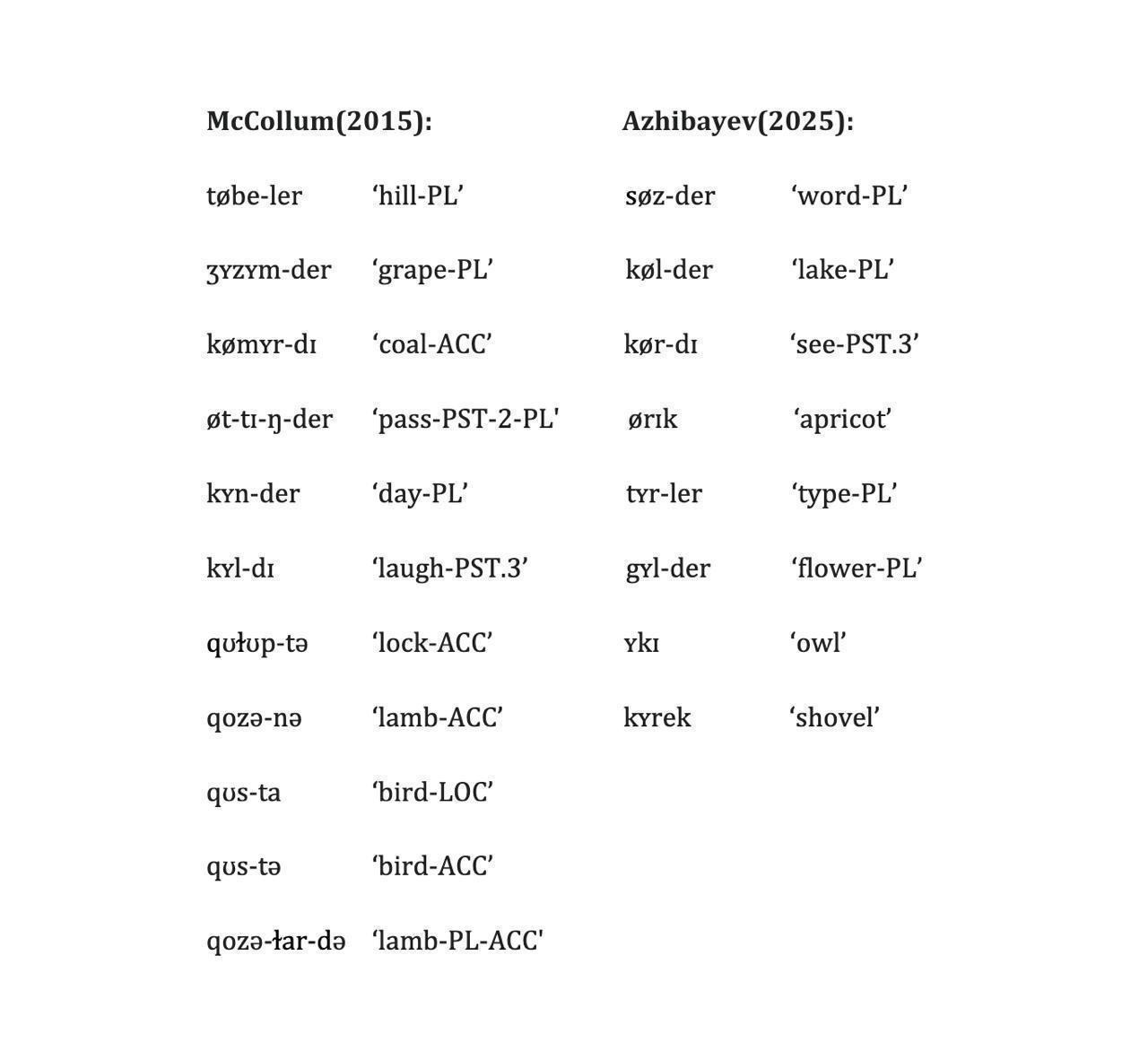
A set of 8 root words and their inflected forms was designed to elicit both suffixal and root-internal vowel rounding in varied phonetic environments. The wordlist also included 11 tokens selected from prior studies8‘9 to facilitate direct comparison with previously documented vowel rounding patterns and validate earlier findings. The full wordlist, including IPA transcriptions, glosses, and predicted harmonic outcomes, is provided in Appendix A. The selection of root/suffix combinations was guided by considerations of lexical frequency, syllable structure, and a balanced distribution of vowel height and backness to ensure a comprehensive phonetic context.
Participants were recorded in a quiet room using a high-quality Shure SM58 dynamic microphone positioned approximately 15 cm from the speaker’s mouth. Room acoustics were controlled to minimize reverberation and background noise. All sessions were recorded at a 44.1 kHz sampling rate. Speakers used the sentence frame “men djedim” (“I said”) followed by the target word in Figure 1. Tokens with significant background noise or speech errors were excluded from analysis.
Acoustic and Statistical Analyses
Audio files were analyzed using PRAAT software21. F1 and F2 formant values were extracted at three equidistant points (20%, 50%, and 80%) during the steady-state portion of the post-initial vowel. The midpoint (50%) measurements were then Bark-normalized using the Lobanov method22 to account for inter-speaker anatomical differences and allow for cross-speaker comparison. This method involves standardizing formant values relative to each speaker’s mean and standard deviation for all measured vowels.
The normalized vowel data (n=118 tokens) was used to evaluate the degree of lip rounding using R statistical software23. Vowel rounding was impressionistically coded by the primary researcher as either rounded or unrounded, based on auditory perception and visual inspection of spectrograms. While clear a priori acoustic criteria for rounding (e.g., F2 values below a certain Bark threshold) were considered, a formal inter-rater reliability assessment was beyond the scope of this pilot study. This is acknowledged as a limitation, and future research will incorporate multiple trained phoneticians for coding and inter-rater reliability measures.
First, descriptive statistics were computed to summarize the distribution of rounded and unrounded vowels across the three generational groups. Chi-squared tests were then conducted to explore potential associations between vowel rounding distribution and generational group. Second, due to the small sample size and potential for quasi-complete separation, a descriptive analysis of per-speaker proportions of rounded vowels was performed. While a logistic regression model was initially considered to predict the likelihood of rounded vs. unrounded vowel production based on generational group, the limitations of the dataset (small N, single family) suggest that inferential results would be unreliable. Therefore, the focus remains on descriptive trends. Third, linear regression models were applied for each acoustic measure (normalized F1 and F2), again using generation as the sole predictor variable, to explore potential acoustic correlates of generational differences in vowel production. However, given the exploratory nature of this pilot study, these linear models are interpreted as indicative of trends rather than definitive causal relationships.
Results
Descriptive Analysis of Vowel Rounding
A descriptive analysis was performed on both the rounding of vowels on the root and target vowels. One hundred eighteen (n=118 tokens) contained eight vowels in Kazakh / a, o, ə, ʊ, e, ø, ɪ, ʏ /, and were impressionistically coded based on their phonetic realization and later acoustically analyzed, including both root-internal and suffixal target vowels.
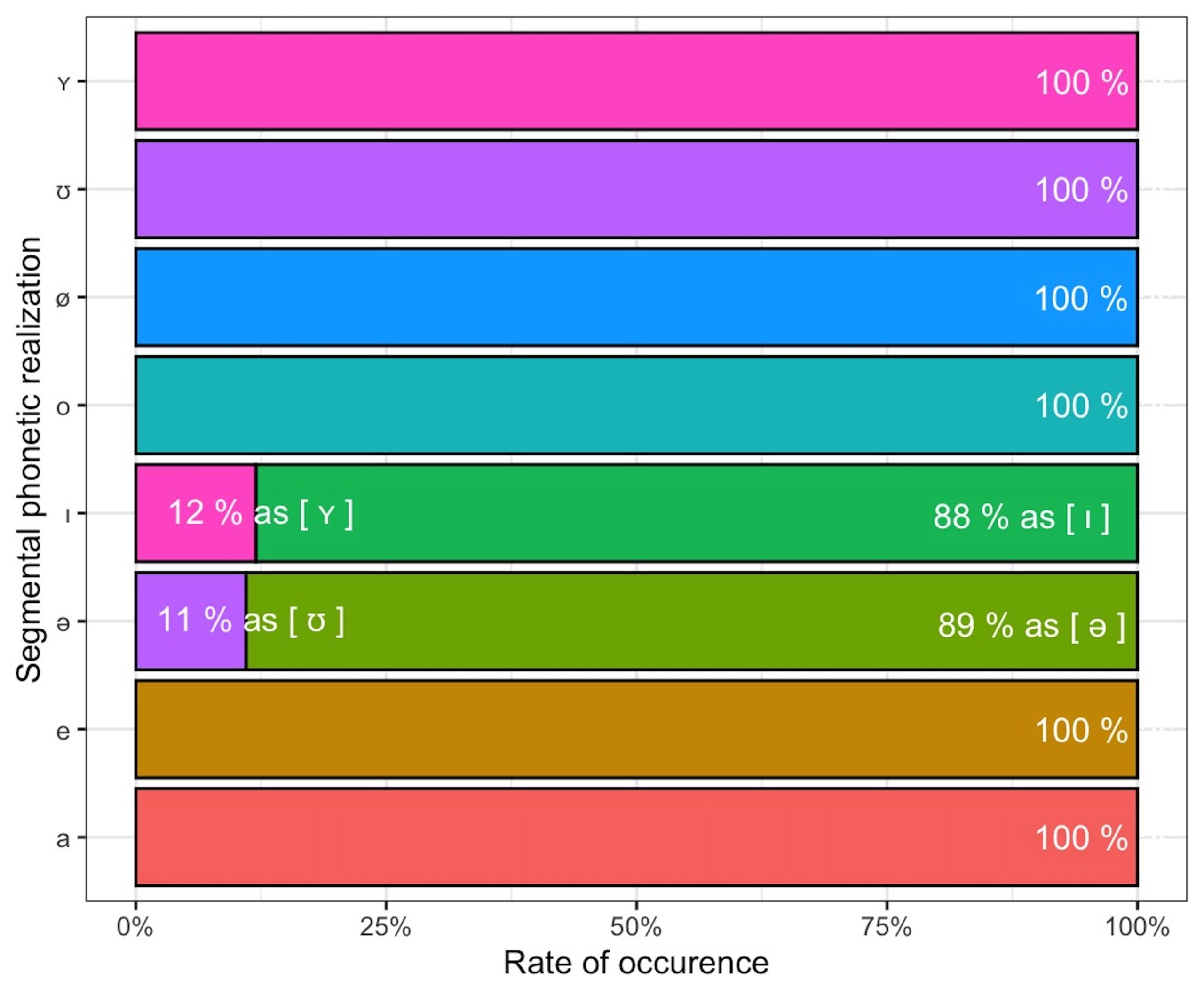
The overall analysis revealed that only the high front unrounded vowel [ɪ] (n=24 tokens) and the mid-central unrounded vowel [ə] (n=18 tokens) exhibited phonetic rounding in their realization. Specifically, [ɪ] was realized as its rounded counterpart [ʏ] in 12.5% of its occurrences (3 out of 24 tokens), while [ə] was realized as [ʊ] in 11% of its occurrences (2 out of 18 tokens) across all participants.
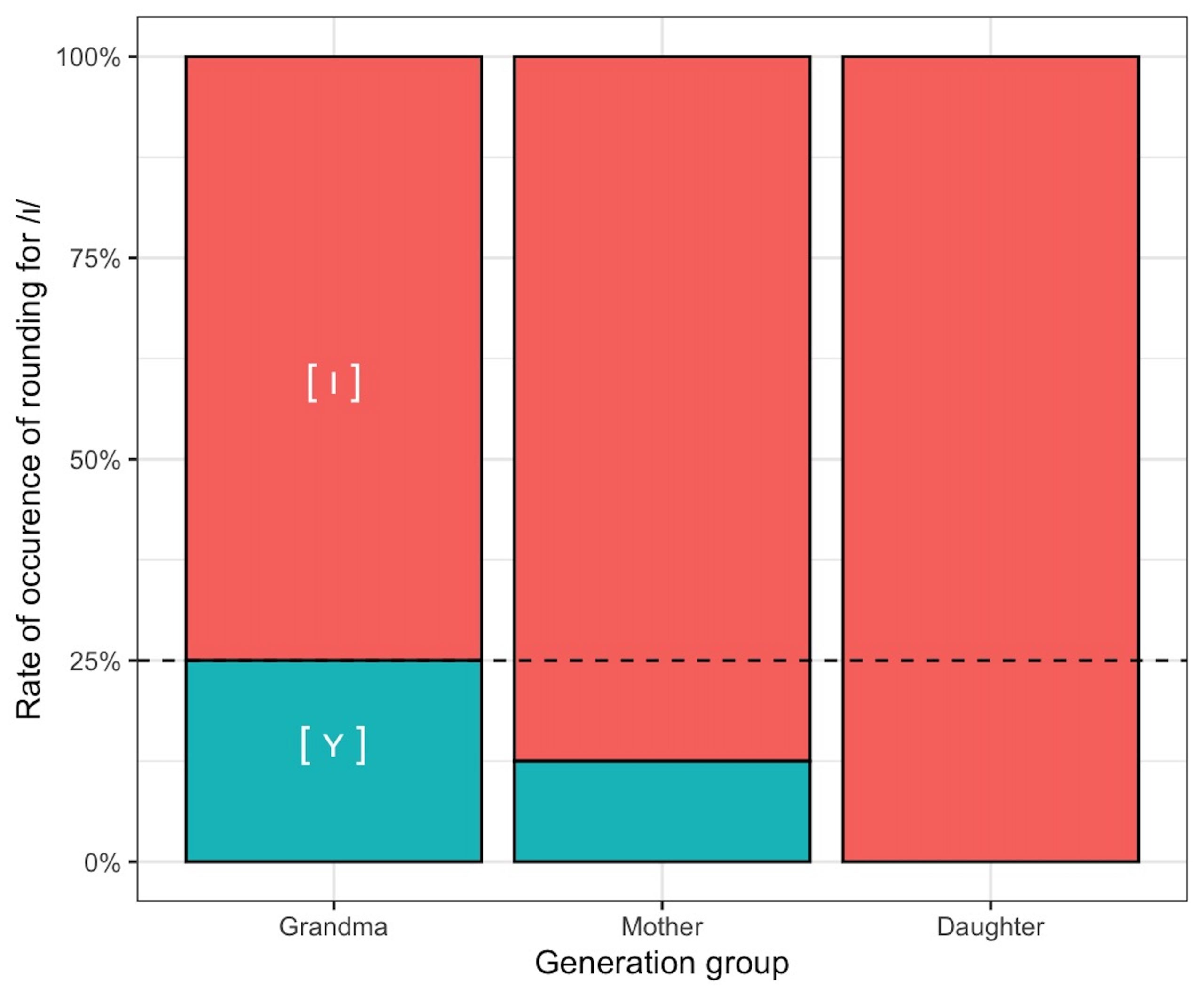
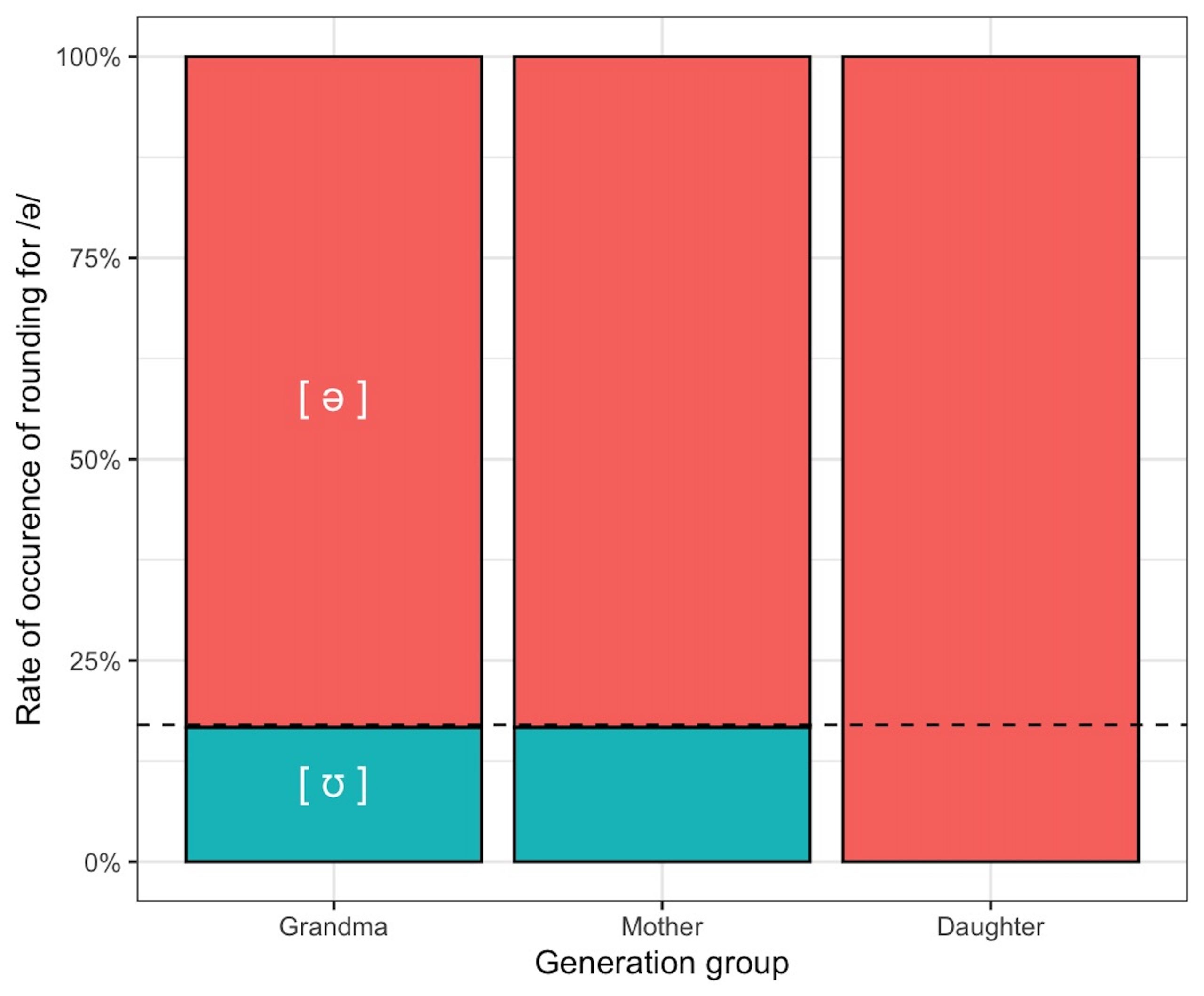
Figure 2 illustrates the observed rate of rounding for the high front vowel [ɪ] across the three generations. The grandmother (70) produced [ɪ] as [ʏ] in 25% of her tokens (2 out of 8 tokens). The mother (48) showed a reduced rate of rounding at 12.5% (1 out of 8 tokens). The daughter (27) exhibited no instances of [ɪ] being realized as [ʏ] (0 out of 8 tokens). A Pearson’s Chi-squared test indicated no statistically significant difference in the distribution of [ɪ] rounding across generations, X²(2)=2.29, p=0.32. This suggests a descriptive trend of decreasing [ɪ] rounding across generations within this family, though not statistically significant given the limited sample size.
Similarly, Figure 3 presents the observed rate of rounding for the mid-central vowel [ə] across generations. The grandmother produced [ə] as [ʊ] in 16.7% of her tokens (1 out of 6 tokens), and the mother showed the same rate of 16.7% (1 out of 6 tokens). The daughter again exhibited no rounding of [ə] (0 out of 6 tokens). A Pearson’s Chi-squared test found no statistically significant difference in the distribution of [ə] rounding across generations, X²(2)=1.13, p=0.57. Similar to [ɪ], this indicates a descriptive trend of decreasing [ə] rounding in the youngest generation, without reaching statistical significance.
In summary, the descriptive analysis revealed that only [ɪ] and [ə] exhibited phonetic rounding, with [ɪ] realized as [ʏ] in 12.5% of cases and [ə] as [ʊ] in 11% of cases overall. Rounding was most frequently observed in the grandmother’s speech, decreased in the mother’s, and was absent in the daughter’s production for both vowels. However, Chi-squared tests showed no statistically significant generational differences for either vowel ([ɪ]: X²(2)=2.29, p=0.32; [ə]: X²(2)=1.13, p=0.57). These findings should be interpreted as exploratory trends rather than definitive shifts in rounding behavior across generations, primarily due to the small number of tokens and participants.
Exploratory Analysis of Rounding Likelihood
Given the small number of observed rounding instances and the single-family case study design, formal inferential logistic regression models were deemed inappropriate for drawing robust conclusions. Instead, an exploratory analysis of the likelihood of rounding was conducted by examining per-speaker proportions.
For the high front vowel [ɪ], the observed proportions of rounding were 25% for the grandmother, 12.5% for the mother, and 0% for the daughter. For the mid-central vowel [ə], the observed proportions were 16.7% for the grandmother, 16.7% for the mother, and 0% for the daughter. The complete absence of rounding in the daughter’s speech for both vowel pairs suggests a descriptive pattern of reduced rounding in the youngest generation within this specific family context.
The initial attempt to run logistic regression models for both vowel pairs resulted in extreme standard errors and non-significant p-values (e.g., for [ɪ]: grandmother β=18.47, p=0.996; mother β=17.62, p=0.996; for [ə]: grandmother β=17.96, p=0.997; mother β=17.96, p=0.997). This outcome is primarily attributable to the limited number of rounding tokens, particularly the zero instances of rounding in the daughter’s data, which leads to quasi-complete separation in the model. Consequently, these inferential statistical results are not interpretable as evidence for or against generational differences in rounding likelihood.
Linear Regression Analysis
Acoustic analyses of Bark-normalized F1 and F2 values were conducted to explore generational differences in vowel height (F1) and backness (F2). The daughter generation served as the reference level in these exploratory linear regression models.
For the front vowels ([ɪ] and [ʏ]), the analysis showed no statistically significant difference across generations in terms of vowel height (F1: p>0.89) or backness (F2: p=0.23). However, the mother generation exhibited a descriptive trend towards a slightly more back articulation of [ɪ] (F2: β=-203.20), though this trend did not reach statistical significance.
For the central vowels ([ə] and [ʊ]), the analysis of F1 and F2 again showed no statistically significant generational difference in vowel height (F1: p>0.45). There was a descriptive trend in the grandmother’s articulation of [ʊ] towards a more back F2 (F2: β=250.97, p=0.18), which approached but did not reach conventional levels of statistical significance.
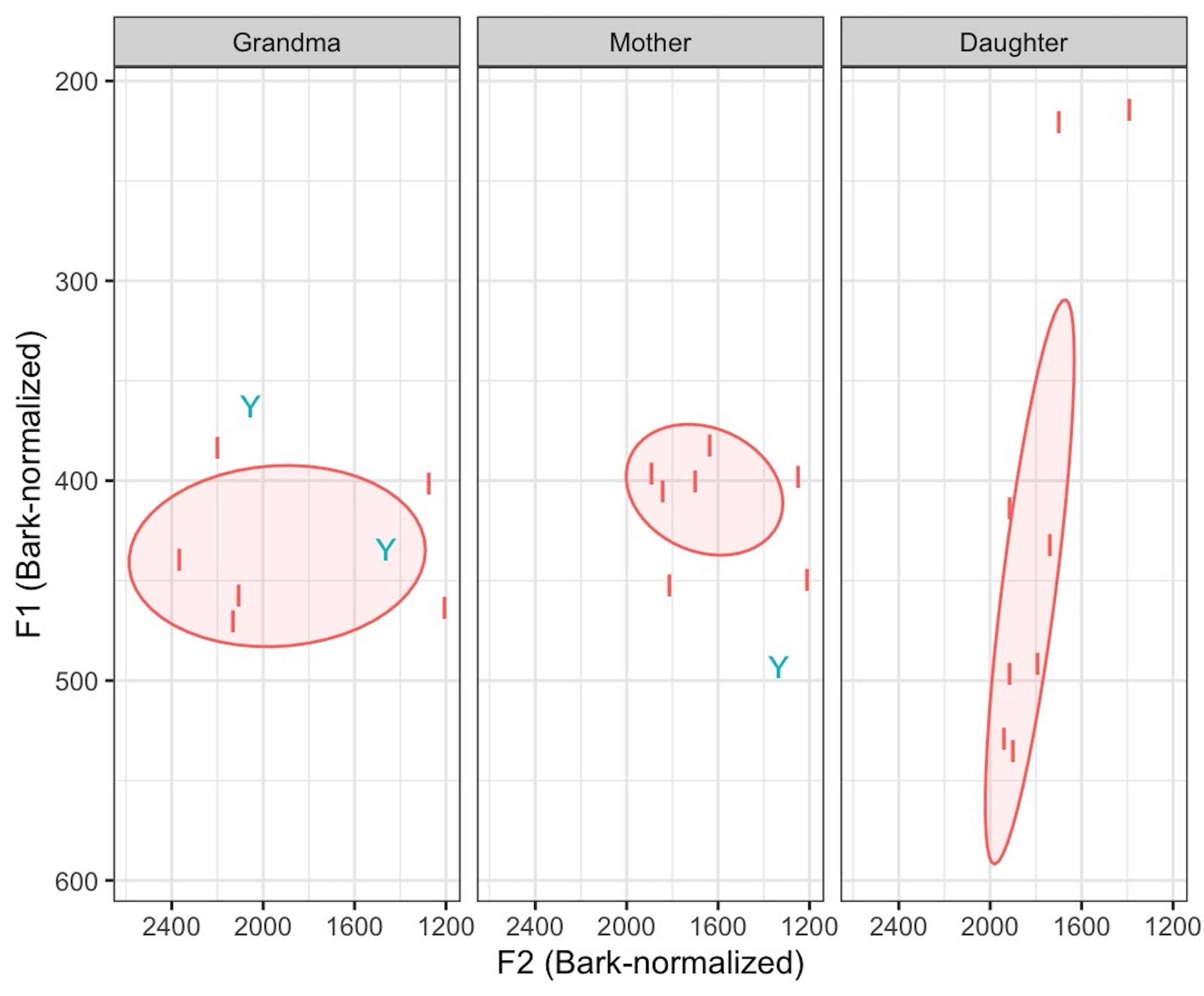
In Figure 4, the grandmother’s data visually demonstrates a clearer acoustic separation between [ɪ] and [ʏ], with each vowel occupying distinct regions in the F1/F2 space. The vowel [ʏ], as the rounded counterpart, is positioned with a relatively lower F2, indicating a more back articulation. The mother’s plot maintains a visual trend of separation, but with less pronounced acoustic distinction, suggesting reduced rounding. In contrast, the daughter’s plot consists exclusively of [ɪ] realizations, lacking any acoustic evidence of [ʏ]. The ellipse for the daughter’s data is vertically oriented and narrow, indicating variation primarily in vowel height but relative consistency in frontness, consistent with the absence of a rounding contrast.
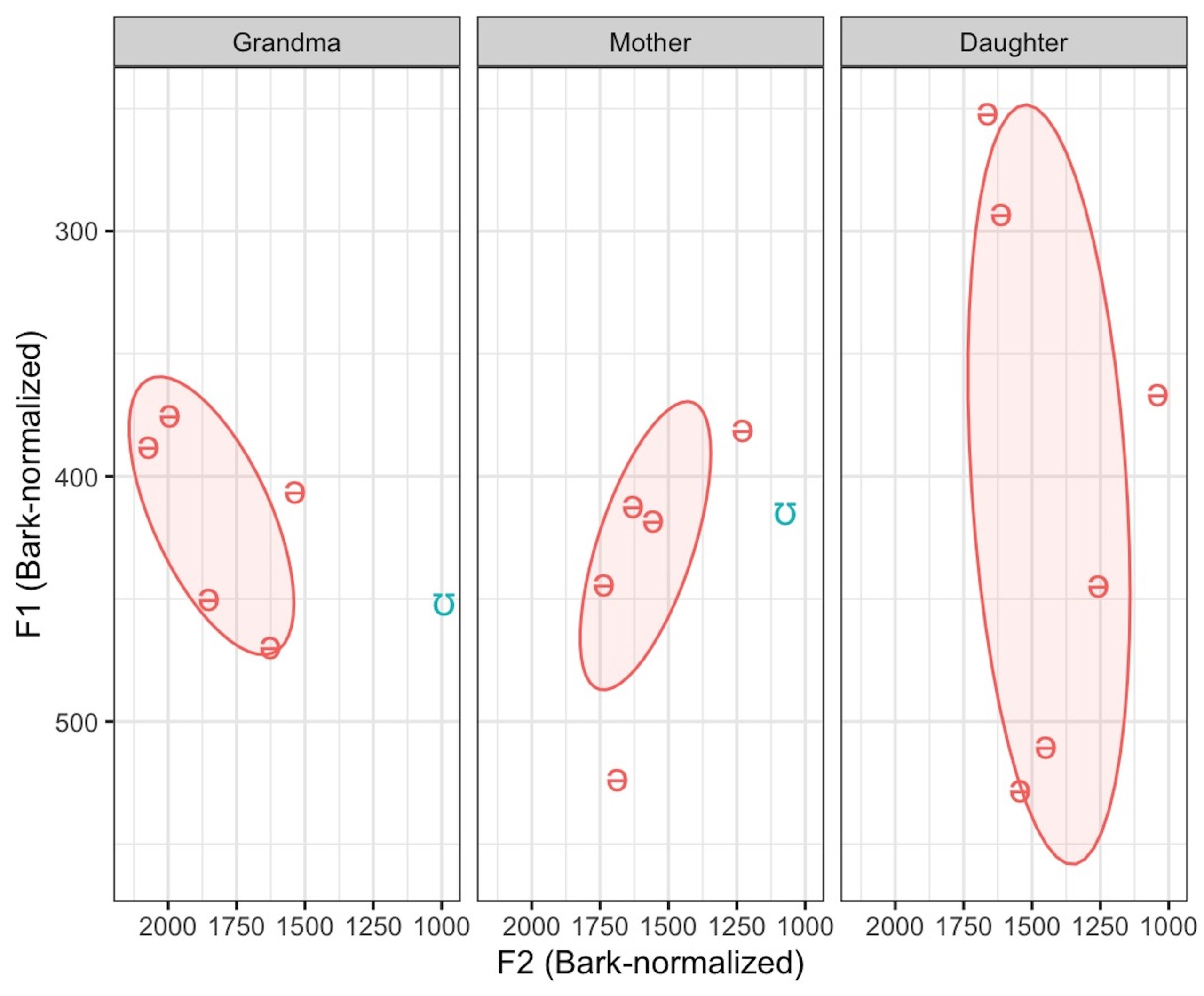
Figure 5 illustrates the acoustic space for central vowels. The grandmother’s data visually demonstrates a strong acoustic separation between [ə] and [ʊ]. The mother’s plot shows a reduced acoustic separation, with [ʊ] positioned closer to [ə] in both F1 and F2 space, suggesting a weakening of the rounding distinction. The daughter’s data again shows a vertically oriented ellipse, shifted towards the back, and critically, the vowel [ʊ] is entirely absent from her acoustic space, indicating a categorical lack of rounded contrast for central vowels.
Taken together, the acoustic analyses, particularly the visual representation of formant spaces, suggest a descriptive pattern of generational decline in vowel labial harmony within this family. The acoustic contrast between rounded and unrounded vowels appears more pronounced in the grandmother’s articulation and progressively weakens across generations, culminating in the apparent absence of rounding contrast in the daughter’s speech. This visual evidence, however, is based on a limited number of tokens and participants.
Summary of Findings
This pilot study’s exploratory analyses consistently suggest a descriptive pattern of decline in labial harmony across generations within the observed family. While formal statistical tests (Chi-squared, logistic regression, linear regression) yielded non-significant results, primarily due to the small number of tokens and participants, the acoustic analysis, particularly the visual representation of formant ellipses, alongside descriptive data, indicates a reduction in harmony and a lack of rounding in the younger generation, especially in the daughter’s data. Specifically, the complete absence of [ʏ] and [ʊ] realizations in the daughter’s speech, coupled with the reduced acoustic separation in the mother’s data compared to the grandmother’s, provides compelling visual evidence for this trend.
Therefore, while no method showed a statistically significant generational difference, the overall pattern observed in this pilot case study supports the idea that labial harmony is weakening across generations in this specific context of contemporary Kazakh. These findings should be interpreted as preliminary and hypothesis-generating, warranting further investigation with larger and more diverse participant samples.
Discussion
This pilot study investigated the acoustic and categorical features of labial harmony in Kazakh across three generations within a single family. Although formal statistical tests did not reveal statistically significant generational trends, primarily due to the limited number of tokens and participants, the cumulative descriptive and acoustic evidence suggests an exploratory pattern of subtle and possibly systematic decline in labial harmony, particularly evident in the youngest speaker’s data.
This exploratory finding aligns with prior research suggesting that rounding harmony is subject to phonetic, morphological, and social constraints9‘6. For instance, rounding tends to affect high vowels and can weaken with phonological distance. Our observations support earlier findings, where rounding was more prevalent in older generations. It is particularly noteworthy that the daughter demonstrated no instances of rounding in both front ([ɪ] as [ʏ]) and central ([ə] as [ʊ]) vowels, which descriptively suggests a potential loss of rounding contrast in her speech. This pattern is consistent with McCollum’s16 claim that Russian-dominant speakers may exhibit non-harmonic behavior due to sociolinguistic influence.
The visual evidence from the Bark-normalized F1/F2 plots with confidence ellipses further reinforces the observed reduction in rounding harmony across generations. The grandmother’s vowel spaces visually suggest a clearer acoustic contrast between rounded and unrounded vowels, while the mother’s data shows a partial overlap, and the daughter’s data indicates a complete neutralization of the rounding contrast for the investigated vowels. These descriptive trends illustrate patterns consistent with Vajda’s19 and Abuov’s10 observations about positional asymmetry and distance decay effects in Kazakh rounding harmony.
The descriptive patterns observed in this study further emphasize the potential role of positional asymmetry and distance decay in shaping Kazakh labial harmony. Root-internal vowels, especially in initial syllables, exhibited clearer rounding contrasts in the grandmother’s data, which supports earlier claims that harmony is strongest closest to the root19‘9. However, this influence appeared to decline in suffixal positions, where post-root vowels showed less rounding, particularly in the daughter’s productions. The asymmetry was visible in forms like [ʒʏzʏm-der] ‘grape-PL’, where the rounded vowel in the root did not consistently trigger suffixal harmony. This weakening effect across morphological boundaries showcases a pattern consistent with distance decay, where the influence of harmonic features weakens over phonological distance. The gradual merging of vowel spaces across generations also suggests that this decay may be becoming more categorical in younger speakers. To sum up, these descriptive patterns suggest that the observed decline in labial harmony is not only generational but also structurally conditioned within the phonological system of Kazakh.
Despite the non-significant results from formal statistical analyses, which are primarily attributable to the limited number of tokens and the single-family design, the acoustic and descriptive phonetic data consistently suggest a generational decline in labial harmony in post-root initial [ɪ] and [ə] vowels. This observed trend may reflect larger sociolinguistic trends in post-Soviet Kazakhstan, where Russian language dominance has been hypothesized to lead to phonological simplification and disharmonic articulation in younger generations24‘16. To sum up, the exploratory findings contribute to the growing body of evidence that Kazakh labial harmony is undergoing a gradual decline relative to generational differences under sociolinguistic factors, a decline more readily observed among the younger generations.
Generational Trends and Phonological Change in Labial Harmony
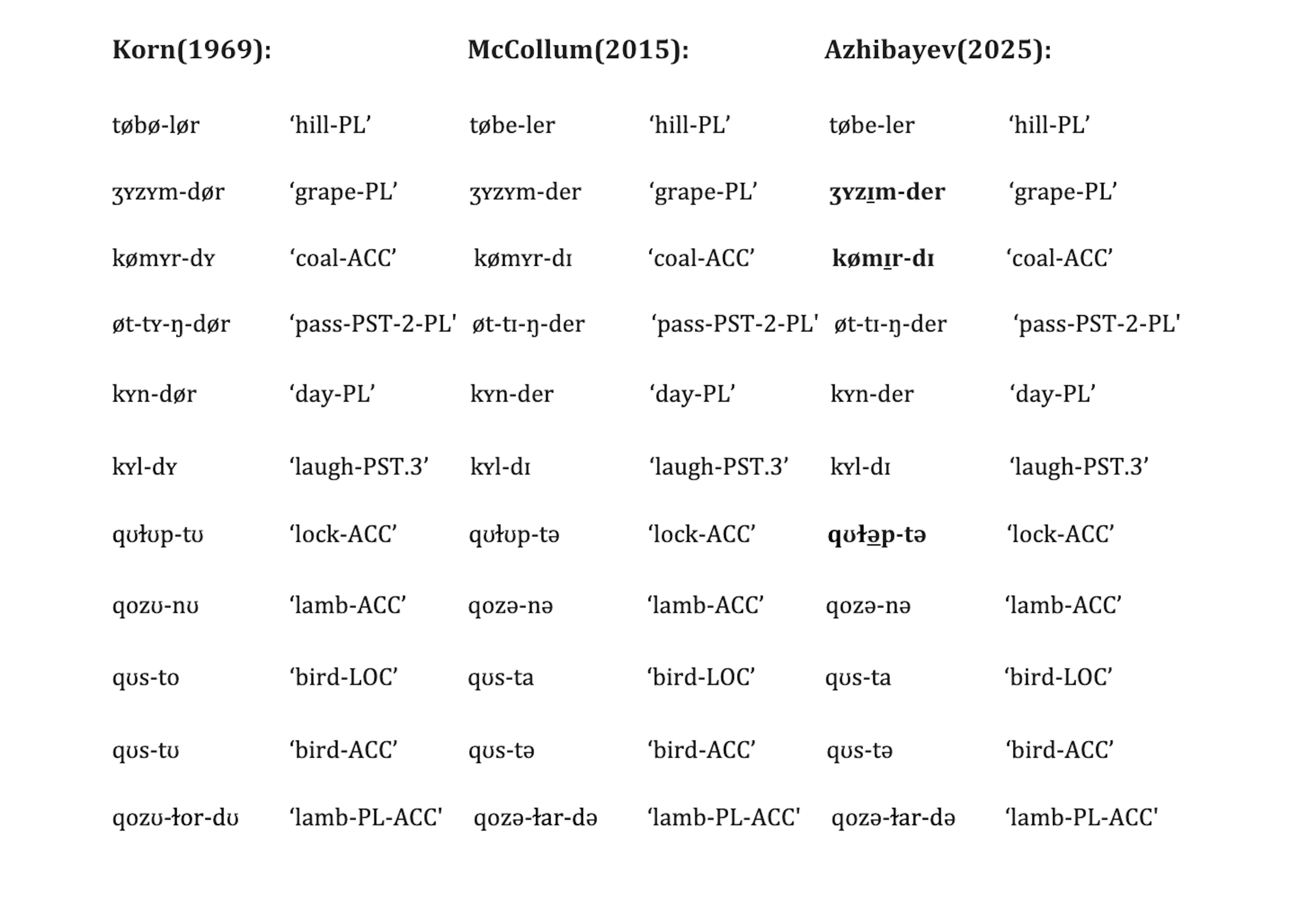
An intergenerational comparison of lexical terms such as ‘grape-PL’ ([ʒʏzʏm-dør]) and ‘lock-ACC’ ([qʊlʊp-tʊ]) descriptively reveals a weakening in rounding harmony in contemporary Kazakh within this family. In Korn’s8 forms, post-root suffixes demonstrated harmony with the root vowel, which resulted in rounded variants such as [ʒʏzʏm-dør] and [qʊlʊp-tʊ]. McCollum’s9 findings already documented a reduction in these patterns, and this pilot study’s data from urban Kazakh speakers, particularly the youngest participant, show a near-total absence of such rounding.
For instance, the form [ʒʏzʏm-der] reflects a front rounded root vowel [ʏ] followed by the unrounded suffix -der, instead of the historically attested -dør. Therefore, this descriptively suggests that rounding harmony no longer consistently extends into suffixal domains in the youngest generation’s speech. Similarly, in [qʊlʊp-tʊ], the rounding of the accusative suffix after a rounded vowel in the root is not realized. These examples illustrate a descriptive shift from morphological harmony toward phonetic simplification, especially among the younger generation in this study.
Furthermore, the synchronic variation among the three generations aligns with theoretical expectations of positional asymmetry and distance decay in vowel harmony19‘9. Root-internal rounding, while still occasionally preserved in the grandmother’s and mother’s data, descriptively fails to trigger harmony in suffixes for the daughter. For instance, compound suffixes, as seen in [qozə-lar-də] ‘lamb-PL-ACC’, show no trace of assimilation, which differs from the rounded form [qozʊ-lor-dʊ] in Korn’s dataset. This observed weakening of rounding harmony is not limited to isolated forms but also appears across multiple morphological constructions, suggesting a potential systemic phonological change. It is worth mentioning that the daughter participant was raised in a Russian-dominant urban context, and this pattern is consistent with McCollum’s16 claim that increased Russian influence, especially where vowel harmony is absent, can produce disharmonic patterns. Altogether, this descriptively suggests that rounding harmony in contemporary urban Kazakh has become phonologically optional, particularly in suffixal domains, supporting a broader trend of language-internal changes shaped by external sociolinguistic forces.
Sociolinguistic Context and Theoretical Implications
The observed patterns in this pilot study, particularly the apparent weakening of labial harmony, can be interpreted within a framework that considers both phonetic gradualness and sociolinguistic influence on phonological change. The descriptive evidence of reduced rounding in younger generations aligns with usage-based models of phonology, where less frequent or less salient phonetic features may gradually erode over time, especially under contact-induced pressure.
Despite the non-significance in formal statistical data, which is primarily attributable to the limited number of tokens and participants, the acoustic and descriptive phonetic data consistently suggest a generational decline in labial harmony in post-root initial [ɪ] and [ə] vowels. This observed trend may reflect larger sociolinguistic trends in post-Soviet Kazakhstan, where Russian language dominance has led to phonological simplification and disharmonic articulation in younger generations24‘16. The obtained descriptive results are consistent with the hypothesis that social and linguistic shifts contribute to the phonetic reduction of rounded harmony in the modern Kazakh language.
Conclusion
This pilot study examined the phonetic data of labial harmony in Kazakh across three generations within a single family, revealing a consistent descriptive pattern of apparent weakening of rounded harmony across generational differences. Although formal statistical models revealed no significant generational effects, the descriptive and acoustic data indicate trends suggestive of phonological change in modern Kazakh.
The data descriptively indicate that labial harmony in the Kazakh language is phonetically weakening, with the youngest native speaker not exhibiting any noticeably rounded variants for either front or back high vowels. Although no statistically significant generation effects were found, acoustic trends suggest that the grandmother produced relatively rounder sounds, especially [ɪ] and [ə], consistent with expectations of vowel harmony conservation in previous generations.
The mother, in contrast, produced a small number of rounded tokens, which may indicate a transitional pattern rather than a strong harmonic contrast. These tendencies should be interpreted as probabilistic and descriptive trends rather than categorical phonological contrasts. The daughter did not show any rounding in all the corresponding lexemes, which descriptively indicates a possible phonetic neutralization of the rounding in her speech.
Although the individual impact of the Russian language has not been formally quantified in this pilot study, the broader sociolinguistic backdrop of increased Russian dominance and declining Kazakh use in urban areas provides historical context for interpreting this decline24‘16. The obtained descriptive results are consistent with the hypothesis that social and linguistic shifts contribute to the phonetic reduction of rounded harmony in the modern Kazakh language.
Future research should expand the sample size to include a more diverse group of speakers, examine regional differences, and more systematically analyze labial harmony using both acoustic and perceptual methods. A more complete sociophonetic profile, including detailed language use questionnaires and proficiency assessments, will contribute to clarification of the observed trends and reasons underlying the gradual simplification of the harmonic system of the Kazakh language in the post-Soviet landscape. Furthermore, future research will prioritize data transparency by depositing de-identified audio, TextGrids, and analysis code to a public repository such as OSF/Zenodo.
Appendix A: Target Wordlist
References
- Muhamedowa, R. (2015). Kazakh: A comprehensive grammar. Routledge. [↩]
- McCollum, A. G., & Chen, S. (2021). Kazakh. Journal of the International Phonetic Association, 51(2), 276–298. [↩]
- Gafos, A. (1999). The articulatory basis of locality in phonology. Garland Publishing. [↩]
- Baković, E. (2000). Harmony, dominance and control [Doctoral dissertation, Rutgers University]. [↩]
- Ní Chiosáin, M., & Padgett, J. (2001). Markedness, segment realization, and locality in spreading. In L. Lombardi (Ed.), Segmental phonology in Optimality Theory: Constraints and representations (pp. 118–156). Cambridge University Press. [↩]
- McCollum, A. G. (2018). Vowel dispersion and Kazakh labial harmony. San Diego Linguistic Papers, UC San Diego. [↩] [↩] [↩]
- Menges, K. (1947). Qaraqalpaq grammar. King’s Crown Press. [↩] [↩]
- Korn, D. (1969). Types of labial vowel harmony in the Turkic languages. Anthropological Linguistics, 11(3), 98–106. [↩] [↩] [↩] [↩] [↩]
- McCollum, A. G. (2015). Labial harmonic shift in Kazakh: Mapping the pathways and motivations for change. In Proceedings of the 41st Annual Meeting of the Berkeley Linguistics Society (pp. 329–352). Berkeley Linguistics Society. [↩] [↩] [↩] [↩] [↩] [↩] [↩] [↩] [↩]
- Abuov, Z. (1994). The phonetics of Kazakh and the theory of synharmonism. UCLA Working Papers in Phonetics, 88, 39–54. [↩] [↩] [↩]
- Dave, B. (2004). Entitlement through numbers: Nationality and language categories in the first post-Soviet census of Kazakhstan. Nations and Nationalism, 10(4), 439–459. [↩]
- Fierman, W. (1998). Language and identity in Kazakhstan: Formulations in policy documents 1987–1997. Communist and Post-Communist Studies, 31(2), 171–186. [↩]
- Grenoble, L. A. (2003). Language policy in the Soviet Union. Kluwer Academic Publishers. [↩] [↩]
- Kirchner, M. (1998). Kazakh and Karakalpak. In L. Johanson & É. Á. Csató (Eds.), The Turkic languages (pp. 318–332). Routledge. [↩] [↩]
- Dave, B. (2002). Demographic and language politics in the 1999 Kazakhstan census. The National Council for Eurasian and Eastern European Research. [↩]
- McCollum, A. G. (2019). The empirical consequences of data collection methods: A case study from Kazakh vowel harmony. Linguistic Discovery, 16(2), 72–110. [↩] [↩] [↩] [↩] [↩] [↩] [↩] [↩]
- Bowman, S. R., & Lokshin, B. (2014). Idiosyncratically transparent vowels in Kazakh. In Proceedings of the 2013 Annual Meeting on Phonology. Linguistic Society of America. [↩]
- Özçelik, Ö. (in press). Kazakh phonology. In L. Johanson, É. Á. Csató, L. Karoly, & A. Menz (Eds.), Encyclopedia of Turkic Languages and Linguistics. Brill. [↩]
- Vajda, E. (1994). Kazakh phonology. In D. B. Honey & D. B. Wright (Eds.), Opuscula Altaica: Essays in honor of Henry Schwarz (pp. 603–650). Western Washington University. [↩] [↩] [↩] [↩]
- Dave, B. (2002). Demographic and language politics in the 1999 Kazakhstan census. The National Council for Eurasian and Eastern European Research [↩]
- Boersma, P., & Weenink, D. (2023). Praat: Doing phonetics by computer (Version 6.3.01) [Computer software]. Retrieved from http://www.praat.org/ [↩]
- Lobanov, B. M. (1971). Classification of Russian vowels spoken by different speakers. Journal of the Acoustical Society of America, 49(2B), 606–608. [↩]
- R Core Team. (2023). R: A language and environment for statistical computing (Version 4.3.2) [Computer software]. R Foundation for Statistical Computing. https://www.R-project.org/ [↩]
- Dave, B. (2007). Kazakhstan: Ethnicity, language and power. Routledge. [↩] [↩] [↩]