Abstract
Access to safe drinking water remains a critical global challenge, and Uzbekistan is no exception. There is an increasing demand for household purification technologies, and this research aims to explain that trend in Samarkand. This study serves as a preliminary investigation that assesses the microbial, chemical, and acceptability aspects of Samarkand’s supplied drinking water during summer, using government monitoring data. Furthermore, it examines the Point-of-Use (PoU) filters currently on the market. An official report from Uzsuvtaminot, covering 25 sampling points across Samarkand for June 2025, was analyzed and compared with the guidelines of the World Health Organization (WHO) and Uzbekistan’s national standards. The report shows that major chemical parameters—chloride, fluoride, sulfate, and nitrate—remain within national limits. However, total coliforms were detected in all samples, indicating the potential presence of fecal coliforms, and free chlorine was absent in 60% of the samples, which does not meet WHO standards. Acceptability characteristics, including taste, color, and odor, were mainly satisfactory, but levels for hardness and Total Dissolved Solids were occasionally elevated. These findings indicate risks of microbial contamination and uneven disinfection practices, justifying the growing demand for PoU systems. Among available technologies, Reverse Osmosis provides the most comprehensive treatment, effectively addressing the identified issues. Affordable alternatives include boiling water to ensure microbiological safety and filters that reduce hardness. This research concludes that further studies, policy changes, and infrastructure renovation are essential for safe drinking water access in Samarkand.
Keywords: Drinking water quality, Samarkand, microbial contamination, PoU filtration, Reverse Osmosis, Uzbekistan, water safety
Introduction
Access to safe drinking water is a fundamental human right. The World Health Organization (WHO) defines safe drinking water as water that does not significantly affect health over a lifetime of consumption, including individuals from different age groups and sensitivities. It must be suitable and pleasant for usual household activities, such as drinking, cooking, washing dishes, and personal hygiene, by being microbiologically, chemically, and radiologically safe1.
Currently, access to safe drinking water is one of the biggest challenges our world faces for two main reasons. Firstly, water pollution is rising, mostly across Asia, Africa, and Latin America, exposing hundreds of millions of people to waterborne diseases, with 3.4 million people dying annually because of pathogens in water, caused mainly by fecal pollution2. Secondly, the world population is at its highest in recorded history and continues to grow, primarily in the continents mentioned above3. Thus, the availability of clean water per capita is decreasing. Uzbekistan is facing similar challenges; the Aral Sea and major rivers are drying up, leading to desertification and the loss of reliable water sources. Central Asia’s population is expected to grow by approximately 30% by 2050. Thus, there will be a significant increase in demand for water services4.
In recent years, the use of household water purification systems has grown significantly globally, due to concerns over pollution and waterborne infections5. A similar trend is observed in Uzbekistan, where consumer demand for water purifiersis increasing6. However, limited efforts have been made to publicly release water quality data or educate citizens on selecting appropriate filtration technologies for their specific needs. Sometimes, this results in people being misled into purchasing expensive filtration technologies that may not directly address their needs. This also applies to Samarkand city, the subject of this research, where no public data is available on the specifics of the city’s water supply, as well as instructions for citizens. This research aims to analyze the quality of drinking water in Samarkand, to assess whether concerns about drinking water quality and the increasing prevalence of Point-of-Use (PoU) filters are justified. If the answer is positive, the performance of different PoU filtration technologies will be evaluated.
This report analyzes official water quality data obtained from Uzsuvtaminot—the national water supply company of Uzbekistan, responsible for providing centralized drinking water and wastewater services to urban and rural populations across the country—by comparing the microbial, chemical, and acceptability aspects with the WHO’s guidelines and Uzbekistan’s standards7. Then, it lists the PoU filters available on local markets and online stores, and based on identified deficiencies in drinking water, identifies the most viable filtration technologies for households in Samarkand, along with some affordable alternatives.
It is essential to note that the sampling had been conducted only during June, representing peak summer conditions, and therefore may not accurately reflect seasonal variations in water quality. Specific chemical parameters, such as heavy metals and radiological parameters, had not been analyzed due to laboratory constraints8. Furthermore, the evaluation of PoU filters was limited to available product information and literature rather than experimental testing under local conditions.
Methods
Data collection
Drinking water quality reports in Samarkand are not directly available for public use, so the headquarters of Uzsuvtaminot in Samarkand city were visited. The head of the central analysis laboratory presented an official report that had been submitted to the Ministry of Health of the Republic of Uzbekistan. This report includes 25 sampling points across the city, with all samples collected by Uzsuvtaminot and all values calculated and provided by them. 12 sampling points (№2, 3, 4, 5, 7, 8, 15, 16, 18, 20, 21, 23) were measured only once. In comparison, 13 points (№1, 6, 9, 10, 11, 12, 13, 14, 17, 19, 22, 24, 25) were measured multiple times in June, ranging from 2 (№10) to 104 (№1) measurements in this month. For these, averages were calculated for all values except Total Microbial Count (TMC), which is reported as a range representing the minimum and maximum values observed. The sampling points include values for total coliforms, TMC, chloride, fluoride, nitrates, sulfate, free chlorine, temperature, taste, color, odor, pH, alkalinity, total hardness, and Total Dissolved Solids (TDS). Uzsuvtaminot did not provide information about the analytical methods they had used for calculating values8.
To identify the Point-of-Use filtration systems commercially available in Samarkand, local stores were visited, and the filter brands were recorded, with photographic documentation for each product. Additionally, the prices of certain filtration technologies were obtained by reviewing the official websites of the respective manufacturers.
Data analysis
For drinking water, the main characteristics have been divided into three categories: microbial, chemical, and acceptability aspects. The values for each category have been organized in tables. To assess them, two main criteria have been used: Guidelines for drinking-water quality: fourth edition incorporating the first and second addenda by the World Health Organization, and OʻzMSt 133:2024—Uzbekistan’s national standards for drinking water. The significance of each aspect will be described below.
Microbial contamination is the most significant and widespread health risk associated with drinking water, primarily arising from fecal pollution. Pathogenic microorganisms, including bacteria, viruses, protozoa, and helminths, can cause a wide range of waterborne infections. They can result in acute health outcomes, such as diarrhea, cholera, typhoid, and viral hepatitis. For infants, the elderly, and immunocompromised individuals, the outcomes may be fatal. For this reason, microbial quality is the highest priority in ensuring the safety of drinking water. The presence of Escherichia coli (E. coli) in drinking water is considered a definitive indicator of fecal contamination. The WHO’s guidelines specify that E. coli should be completely absent in any 100 mL sample of drinking water1. However, the dataset provided by Uzsuvtaminot reports total coliforms, not E. coli, which Uzbekistan limits to 3 colony forming units per liter (CFU/L)8‘9.
Chemical contaminants in drinking water arise from both natural sources and human activity. Specifically, geological formations, agricultural activities, industrial sources, or treatment processes. These substances may include organic and inorganic compounds. Unlike microbial contaminants, the health effects associated with chemical exposure are generally long-term and chronic rather than acute. Prolonged ingestion of even low concentrations of certain chemicals can lead to carcinogenic, mutagenic, reproductive, or neurological effects. For chemical parameters, national standards are considered more representative, as they are adjusted to local conditions, such as sociocultural, economic, and environmental factors1.
Acceptability properties—such as taste, odor, color, and temperature—are critical determinants of drinking water aesthetics. The WHO emphasizes that while these properties rarely indicate a health risk, they strongly influence consumer perception and usage. Water with unpleasant taste or odor often leads to rejection of piped supplies and reliance on unsafe alternative sources, increasing the risk of waterborne diseases1. Additional parameters influencing acceptability include pH, alkalinity, total hardness, and TDS.
Literature Review
Researching and thoroughly understanding this subject matter would be impossible without consulting various sources. The digital Bavarian State Library was utilized to locate research papers, documents, and articles closely related to the research topic. Sources were filtered by date, starting from 2008, to exclude obsolete information about filtration technologies and water quality concerns. The search was guided by keywords like “drinking water quality,” “PoU filtration” and the more focused “PoU filters for drinking water.”
Results
The full table of values for each aspect is provided in the Appendix.
Microbial aspects
All samples are at the national limit of 3 CFU/L for total coliforms, except for sample 2, which has 7 CFU/L9. The WHO states that “Total coliforms should be absent immediately after disinfection, and the presence of these organisms indicates inadequate treatment1.” Total coliforms serve as an indicator that other, potentially harmful, fecal bacteria may be present. The presence of coliform bacteria in tap water suggests that there could be a problem with existing equipment or treatment systems, contamination of the source water, or a breach in the distribution system that could introduce E. coli contamination.If any routine or repeat sample is total coliform positive, the lab must further analyze that sample to determine if E. coli is present10. However, Uzsuvtaminot did not further analyze the samples for the presence of E. coli. Thus, fecal contamination may be present, and the water cannot be considered microbiologically safe. TMC, not specified by the WHO, remains within the national limit of 100 CFU/mL across all samples1‘9.
Chemical aspects
Chemical data show that most anion concentrations remain below the national limits. Chloride concentrations range from 12 to 38.5 mg/L, and sulfate values range from 50.4 to 192.0 mg/L, both of which are below the national limit. Fluoride levels vary between 0.14 and 0.34 mg/L, much lower than 0.7 mg/L. This reduces the risk of fluorosis; however, the levels are below the optimal value for oral health, which increases the risk of dental caries1. Nitrate concentrations range from 9.0 to 38.2 mg/L, all of which are within the limit. Still, higher values may cause methemoglobinemia in infants if concentrations increase1.
Free chlorine concentrations vary significantly, ranging from 0 to 0.66 mg/L. According to O’zMSt 133:2024, free chlorine should remain between 0.2–0.5 mg/L after 30 minutes of contact time to ensure continued microbiological safety and avoid aesthetic issues9. In this dataset, 15 out of 25 (60%) samples exhibit zero free chlorine, indicating a potential risk of microbial contamination. On the other hand, samples 13 and 17 exceed 0.6 mg/L, raising the possibility of taste and odor complaints1.
Acceptability aspects and additional parameters
Taste scores at 20°C are zero for all 25 samples, suggesting that the water has no unpleasant taste. Likewise, all color scores are zero, indicating clear water with no coloration. To classify odor, the six-point odor intensity scale, ranging from 0 (no odor) to 5 (extremely strong odor), has been used. Odor is reported as 0 (no odor) in 19 samples and as 1 (slightly perceptible) in 6 samples. The temperature across all samples ranges between 16.5°C and 17.7°C, remaining below the preferable upper limit of 20°C for cold water systems indicated by the WHO’s guidelines, which note that water temperatures above 20-25°C can promote microbial growth, particularly Legionella1.
pH values range from 7.05 to 7.73, well within Uzbekistan’s and WHO standards of 6.0-9.0 and 6.5-8.5, respectively, and alkalinity ranges from 2.4 to 6.6 mEq/L1‘9. These suggest neutral to slightly alkaline water. Total hardness ranges from 3.8 to 17.5 mEq/L. Six samples exceed the national limit of 7 mEq/L, indicating hardness issues that may cause scale deposition in pipework and tanks within buildings1‘9. Total Dissolved Solids are an essential indicator of overall mineralization, ranging from 263 to 668 mg/L. While all samples comply with Uzbekistan and WHO’s upper limit of 1000 mg/L, readings higher than 600 mg/L impart a slightly mineralized taste1‘9.
Point-of-Use Filters
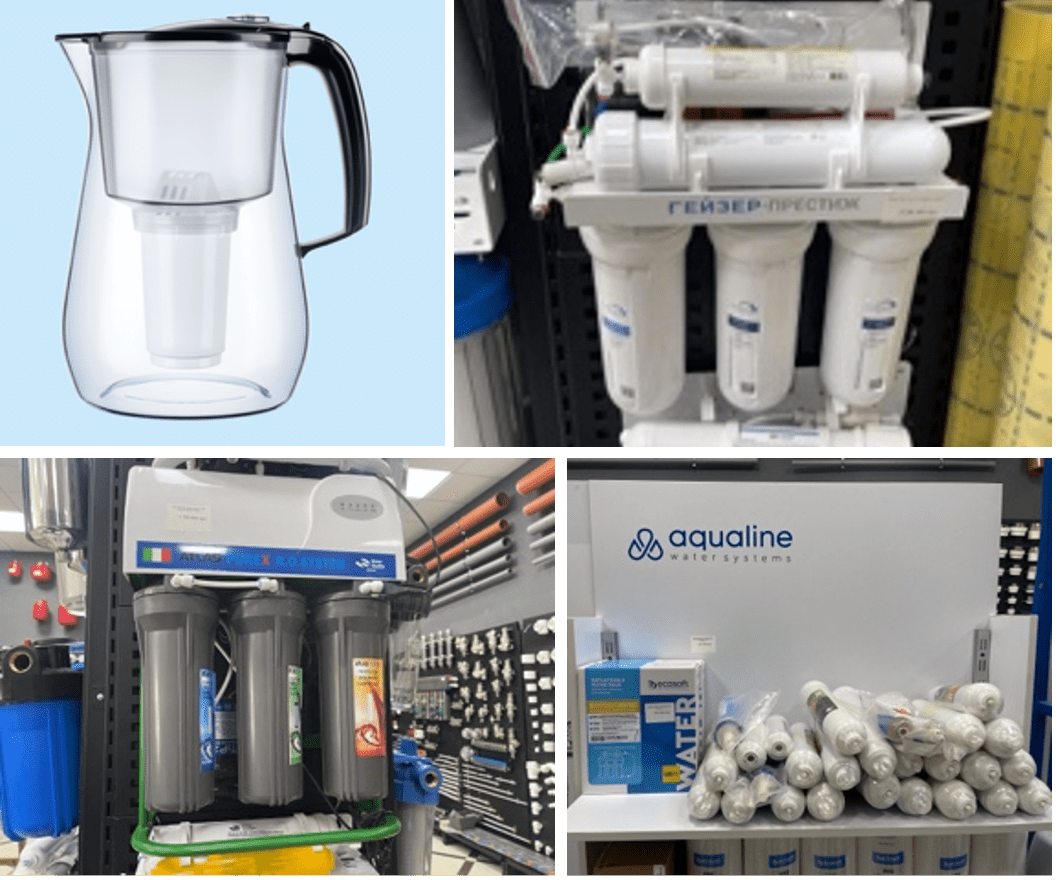
Local dealers in Samarkand offer a variety of different brands, including Aquaphor, Aqualine, Ecosoft, Geyser, Atlas Filtri, Vontron, Acqua Brevetti, Krausen, Hidrotek, Zegor, and others. Most of the PoU systems available in Samarkand and broader Uzbekistan rely on Reverse Osmosis (RO). Nevertheless, some provide limited microbial removal due to simpler filtration mechanisms. For example, Aquaphor’s filter jugs (e.g., Figure 1.a) use activated carbon filters, which filter chlorine and improve odor and taste, but do not clean the water microbiologically11. Another example is the Geyser Classic, which offers mechanical, ion exchange, and carbon filtration but lacks effective microbial control against viruses12. In contrast, the Geyser Prestige M (Figure 1.b), among many others (e.g., Figure 1.c), integrates RO, making it a more comprehensive solution13.
Discussion
Overall, the drinking water supplied in Samarkand is not entirely safe to drink. Microbiologically, total coliforms are found in water without further testing for E. coli, indicating possible fecal contamination, which renders the water non-compliant with international standards. Additionally, the free chlorine level of 60% of the samples is zero, further increasing the risk. Chemically, the concentrations of major ions, such as chloride, fluoride, sulfate, and nitrate, remain within national limits. Aesthetic parameters are generally acceptable; however, high free chlorine and hardness levels that exceed the limits in some samples suggest shortcomings. These findings justify the increasing demand for PoU technologies. Given the observed issues—particularly the presence of total coliforms and the variability in hardness and TDS—RO systems are the most appropriate household solution in Samarkand, as they effectively remove microbial contaminants like bacteria and viruses, and dissolved mineral content such as lead, arsenic, per- and polyfluoroalkyl substances, and volatile organic compounds14.
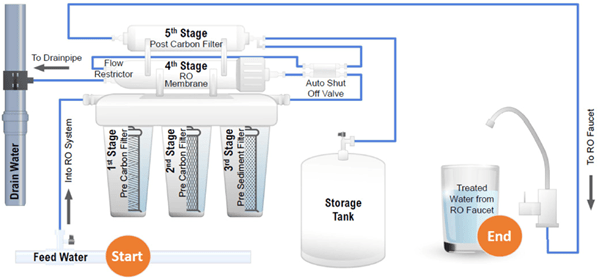
Figure 2 illustrates a typical Point-of-Use RO system, which would be installed under a kitchen sink. Water first enters the pre-filters, which remove large particles, sediment, and chlorine that could damage the RO membrane. It is then pushed under pressure through a semi-permeable membrane, which allows only water molecules to pass while rejecting dissolved salts, minerals, and most contaminants. The purified water that comes through the membrane is collected as product water (permeate), while the concentrated water containing the removed impurities is discharged as waste to the drainpipe. After the membrane, the permeate typically passes through a post-filter to remove any remaining taste or odor before being stored in a tank or delivered to the faucet for drinking.
However, RO systems have several drawbacks. They are relatively expensive compared to other filtration technologies, with prices in Uzbekistan generally ranging from 2 to 8 million Uzbekistani sums. Secondly, they produce substantial wastewater, as typically only 10–20% of the feed water is recovered as purified water; however, some modern systems with certain specifications, such as NSF 58 or EPA WaterSenseⓇ, reach recovery rates above 30%16. Additionally, maintenance is critical: prefilters (e.g., Figure 1.d) should be typically replaced every 6 months and RO membranes every 1–5 years, depending on local water quality and usage patterns15.
While national and international initiatives in Uzbekistan support improved public water supply infrastructure, no documented scheme was found specifically offering subsidized household PoU filtration systems for low-income families in Samarkand17‘18. For low-income families, boiling water provides adequate microbial safety. For households with hard water, filters that reduce hardness, such as the Geyser Classic or Aquaphor Crystal A, which cost 790 thousand and 900 thousand sums, respectively, can be used. These filters also remove chlorine, which improves odor12‘19.
Other countries facing similar water quality challenges have implemented various approaches to ensure the availability of safe drinking water. In Europe, many nations have adopted the WHO-developed Water Safety Plan framework, which emphasizes proactive risk management from source to tap20. Likewise, in Bhutan, a successful Water Safety Plan pilot led to improved microbiological compliance and reduced contamination incidents through systematic monitoring and local operator training21. In rural Kenya, household-level water treatment technologies such as ceramic and BioSand filters have been shown to significantly reduce microbial contamination where centralized water treatment is unavailable22. Similarly, in Malaysia, low-cost upflow sand filters have been implemented in rural communities, improving microbial quality when properly maintained23. These examples demonstrate that adapted, locally appropriate solutions can significantly enhance drinking-water safety.
Limitations and Recommendations
This study offers insights into the state of drinking water quality in Samarkand; however, it has several limitations. Firstly, sampling was performed during June, the peak of the summer season, when temperatures are higher, and water demand increases significantly. These seasonal factors can influence both the chemical and microbial composition of water1. As a result, the dataset may not wholly reflect the drinking water quality supplied across the entire year. A multi-seasonal approach is necessary to account for variations in temperature, humidity, rainfall, and demand across different seasons.
Secondly, laboratory equipment used for analysis is likely outdated, as some chemical parameters, such as heavy metals, pesticides, and organic pollutants, as well as radiological aspects, were not assessed, despite being included in WHO’s guidelines and national standards for drinking water quality1. E. coli is not assessed because of limited laboratory equipment and the legacy of the regulations: Uzbekistan’s regulations for microbial safety are taken from GOST 18963-73, a former Soviet standard for drinking water9. In recent decades, it has been found that total coliforms are not reliable indicators of fecal pathogens1. The exact health implications are therefore uncertain. Thirdly, all of the analytical data were obtained from Uzsuvtaminot, Uzbekistan’s government-operated water supply authority. Because the institution is responsible for both providing the water and reporting its quality, there is an inherent risk of reporting bias. This may manifest as selective sampling, reduced testing frequency during high-risk periods, or emphasis on compliance values rather than full disclosure of variability.
Updating national standards to align more closely with the WHO’s guidelines, particularly in terms of microbial safety, as well as the independent verification of laboratory results by third-party institutions such as local universities or research laboratories, and the disclosure of public data are crucial policy changes for enhancing consumer safety and transparency in drinking water assessment. Furthermore, future studies should include testing for copper and iron due to corrosion and pipe leaching of aged water infrastructure in Samarkand1‘17. Given agricultural activity surrounding Samarkand, and Uzbekistan in general, screening for commonly used pesticides is also recommended to assess potential long-term chemical exposure24‘25.
Finally, the evaluation of Point-of-Use filtration systems relied primarily on theoretical sources, such as manufacturer specifications and U.S. Environmental Protection Agency documents. No experimental verification of filter efficiency was performed under local conditions in Samarkand. Removal efficiencies reported for filtration technologies reflect laboratory conditions, which may differ from those in household settings due to variations in pressure, maintenance quality, filter age, or user behavior. The brands mentioned above were limited to those available at local dealers, so the market sample may not accurately represent the full range of products used by residents. Future work should include controlled laboratory testing of locally installed filters using actual Samarkand tap water to obtain specific performance data.
Despite these constraints, the study provides an initial analysis of Samarkand’s drinking water, examining microbial safety, chemical quality, and consumer-relevant properties. The findings serve as a baseline for future investigations, policy adjustments, and infrastructure improvements.
Acknowledgments
The author expresses their deepest gratitude to Professor Cosimo Buffone for his invaluable guidance and support throughout the writing process.
Appendix
| Sample | Total coliforms (CFU/L) | TMC (CFU/mL) |
| 1 | 3 | 0-6 |
| 2 | 7 | 10 |
| 3 | 3 | 1 |
| 4 | 3 | 7 |
| 5 | 3 | 2 |
| 6 | 3 | 0-6 |
| 7 | 3 | 5 |
| 8 | 3 | 0 |
| 9 | 3 | 0-4 |
| 10 | 3 | 0-30 |
| 11 | 3 | 0-3 |
| 12 | 3 | 0-1 |
| 13 | 3 | 0-3 |
| 14 | 3 | 0-35 |
| 15 | 3 | 0 |
| 16 | 3 | 3 |
| 17 | 3 | 0-2 |
| 18 | 3 | 1 |
| 19 | 3 | 0-4 |
| 20 | 3 | 3 |
| 21 | 3 | 1 |
| 22 | 3 | 0-15 |
| 23 | 3 | 3 |
| 24 | 3 | 0-10 |
| 25 | 3 | 0-4 |
| Sample | Chloride | Fluoride | Sulfate | Nitrates | Free chlorine |
| 1 | 17.5 | 0.16 | 110.4 | 14.1 | 0.30 |
| 2 | 20 | 0.22 | 110.6 | 10.1 | 0 |
| 3 | 15 | 0.18 | 134.4 | 19.9 | 0 |
| 4 | 12 | 0.21 | 393.6 | 13.2 | 0 |
| 5 | 16 | 0.23 | 52.4 | 11.9 | 0 |
| 6 | 18 | 0.16 | 100.8 | 14.1 | 0.30 |
| 7 | 15 | 0.24 | 98.2 | 9.1 | 0 |
| 8 | 14 | 0.18 | 88.8 | 9.0 | 0 |
| 9 | 38.5 | 0.34 | 172.0 | 28.2 | 0.30 |
| 10 | 38 | 0.33 | 172.2 | 28.3 | 0 |
| 11 | 20 | 0.18 | 156.4 | 26.6 | 0.43 |
| 12 | 20 | 0.20 | 156.0 | 15.7 | 0 |
| 13 | 15 | 0.17 | 103.0 | 22.1 | 0.66 |
| 14 | 17 | 0.17 | 57.6 | 20.2 | 0 |
| 15 | 21 | 0.24 | 96.0 | 24.4 | 0 |
| 16 | 19 | 0.24 | 110.6 | 26.6 | 0 |
| 17 | 15.5 | 0.18 | 50.4 | 15.9 | 0.61 |
| 18 | 15 | 0.14 | 94.2 | 24.5 | 0 |
| 19 | 17.5 | 0.18 | 158.4 | 16.8 | 0 |
| 20 | 16 | 0.17 | 175.2 | 12.4 | 0 |
| 21 | 13 | 0.18 | 134.4 | 34.7 | 0 |
| 22 | 21.5 | 0.21 | 100.8 | 31.0 | 0.17 |
| 23 | 30 | 0.23 | 192.0 | 35.5 | 0.20 |
| 24 | 18 | 0.18 | 108.2 | 38.2 | 0.17 |
| 25 | 15 | 0.20 | 117.6 | 33.2 | 0.30 |
| National | 250 | 0.7 | 400 | 45 | 0.2-0.5 |
| Sample | Taste score | Color score | Odor score | Temperature(℃) | рН | Alkalinity (mEq/L) | Total hardness (mEq/L) | TDS/L |
| 1 | 0 | 0 | 1 | 17.0 | 7.28 | 5.1 | 17.5 | 405 |
| 2 | 0 | 0 | 0 | 17.0 | 7.05 | 5.6 | 8.0 | 476 |
| 3 | 0 | 0 | 0 | 17.1 | 7.25 | 4.8 | 7.0 | 456 |
| 4 | 0 | 0 | 0 | 16.5 | 7.20 | 4.0 | 6.2 | 320 |
| 5 | 0 | 0 | 0 | 17.3 | 7.73 | 3.4 | 5.5 | 296 |
| 6 | 0 | 0 | 1 | 17.0 | 7.38 | 4.4 | 6.7 | 379 |
| 7 | 0 | 0 | 0 | 16.9 | 7.57 | 3.8 | 5.6 | 358 |
| 8 | 0 | 0 | 0 | 16.8 | 7.54 | 2.7 | 5.2 | 400 |
| 9 | 0 | 0 | 1 | 17.0 | 7.12 | 6.6 | 11.5 | 500 |
| 10 | 0 | 0 | 0 | 16.9 | 7.11 | 6.4 | 11.2 | 500 |
| 11 | 0 | 0 | 0 | 17.1 | 7.10 | 3.5 | 6.3 | 407 |
| 12 | 0 | 0 | 0 | 17.3 | 7.23 | 3.6 | 6.4 | 411 |
| 13 | 0 | 0 | 1 | 17.2 | 7.45 | 3.1 | 5.2 | 297 |
| 14 | 0 | 0 | 0 | 17.0 | 7.47 | 3.3 | 5.1 | 286 |
| 15 | 0 | 0 | 0 | 17.1 | 7.43 | 2.4 | 3.8 | 263 |
| 16 | 0 | 0 | 0 | 17.3 | 7.47 | 4.1 | 4.6 | 375 |
| 17 | 0 | 0 | 1 | 17.3 | 7.44 | 3.4 | 6.0 | 283 |
| 18 | 0 | 0 | 0 | 16.8 | 7.57 | 2.9 | 5.0 | 295 |
| 19 | 0 | 0 | 0 | 17.7 | 7.23 | 4.0 | 6.6 | 427 |
| 20 | 0 | 0 | 0 | 17.4 | 7.14 | 4.4 | 7.4 | 471 |
| 21 | 0 | 0 | 0 | 17.0 | 7.48 | 3.9 | 5.6 | 412 |
| 22 | 0 | 0 | 0 | 17.4 | 7.53 | 5.4 | 5.8 | 372 |
| 23 | 0 | 0 | 0 | 17.7 | 7.62 | 6.6 | 8.9 | 668 |
| 24 | 0 | 0 | 0 | 16.9 | 7.48 | 3.2 | 4.4 | 324 |
| 25 | 0 | 0 | 0 | 17.2 | 7.55 | 4.8 | 6.6 | 420 |
References
- World Health Organization. Guidelines for drinking-water quality: fourth edition incorporating the first and second addenda (2022). [↩] [↩] [↩] [↩] [↩] [↩] [↩] [↩] [↩] [↩] [↩] [↩] [↩] [↩] [↩] [↩] [↩]
- United Nations Environment Programme. Hundreds of Millions Face Health Risk as Water Pollution Rises Across Three Continents. unep.org/news-and-stories/story/hundreds-millions-face-health-risk-water-pollution-rises-across-three (2018). [↩]
- United Nations Department of Economic and Social Affairs. As the world’s population hits 8 billion people, UN calls for solidarity in advancing sustainable development for all. un.org/en/desa/world-population-hits-8-billion-people (2022). [↩]
- World Bank Group. No More Business as Usual: Improving Water Usage in Central Asia. worldbank.org/en/news/feature/2019/06/28/no-more-business-as-usual-improving-water-usage-in-central-asia (2019). [↩]
- Fortune Business Insights. Water Purifier Market Size, Share & Industry Analysis. fortunebusinessinsights.com/water-purifier-market-103118 (2025). [↩]
- Volza. Water Purifier Imports In Uzbekistan – Market Size & Demand Based On Import Trade Data. volza.com/p/water-purifier/import/import-in-uzbekistan (2025). [↩]
- Uzsuvtaminot. General Information. uzsuv.uz/en/general-info. [↩]
- Uzsuvtaminot. Official June report (2025). [↩] [↩] [↩] [↩] [↩] [↩]
- Uzsuvtaminot. O’zMSt 133:2024. uzsuv.uz/media/page/2024/11/OzMSt_133-2024.pdf (2024). [↩] [↩] [↩] [↩] [↩] [↩] [↩] [↩] [↩]
- Addressing Total Coliform Positive or E. coli Positive Sample Results in EPA Region 8 epa.gov/region8-waterops/addressing-total-coliform-positive-or-e-coli-positive-sample-results-epa-region-8 (2025). [↩]
- Aquaphor. Filter jugs. aquaphor.uz/filters/pitchers. [↩] [↩]
- Гейзер [Geyser]. Фильтр Гейзер Классик для жесткой воды [Geyser Classic, filter for hard water]. suv-filtri.uz/catalog/filtry_po_tipu_vody1/dlya_zhestkoy_vody/filtry_pod_moyku_/489. [↩] [↩]
- Гейзер [Geyser]. Гейзер Престиж М[Geyser Prestige M].suv-filtri.uz/catalog/bytovye_filtry/membrannye_filtry1/465 [↩]
- U.S. Environmental Protection Agency. Point-of-Use Reverse Osmosis Systems. epa.gov/watersense/point-use-reverse-osmosis-systems (2025). [↩]
- EPA Water Sense. Treating water with less waste: reverse osmosis systems. epa.gov/system/files/documents/2024-11/ws-products-ro-systems-mini-report.pdf (2024). [↩] [↩]
- Cloud. Cloud RO. cloudwaterfilters.com/buy/cloud-ro [↩]
- The World Bank. Uzbekistan Bukhara and Samarkand sewerage project. documents1.worldbank.org/curated/en/603471654270126364/pdf/Uzbekistan-Bukhara-Samarkand-Sewerage-Project.pdf (2022). [↩] [↩]
- Abu Dhabi Fund for Development. Infrastructure development in Samarkand. adfd.ae/en/what-we-do/projects/infrastructure-development-in-samarkand (2019). [↩]
- Aquaphor. Aquaphor Crystal A for hard water. aquaphor.uz/filters/crystal-ha [↩]
- World Health Organization. Implementing Water Safety Plans in the European Region. who.int/europe/activities/implementing-water-safety-plans-in-the-european-region. [↩]
- D. Sutherland, Payden. Observations and lessons learnt from more than a decade of water safety planning in South-East Asia. WHO South-East Asia Journal of Public Health. Vol. 6(2), pg.27-33, doi.org/10.4103/2224-3151.213788 (2017). [↩]
- S. K. Tiwari, M. W. Jenkins. Point-of-Use treatment options for improving household water quality among rural populations in the River Njoro watershed, Kenya. Global Livestock Collaborative Research Support Program, 2008. [↩]
- F. A. Lahin, R. Sarbatly, C. K. Chiam. Performance of an upflow sand filter as a Point-of-Use treatment system in rural areas. Akademi Sains Malaysia Science Journal. Vol. 17,pg.1-7, doi.org/10.32802/asmscj.2022.1223 (2022). [↩]
- B. K. Karimov, S. S. Shoergashоva, L. Fadong, V. N. Talskikh, L. N. Latisheva. Impact of agricultural development on water quality in Zarafshan River, Uzbekistan, Central Asia: Trends since 1960s. Science Direct. Vol. 5, pg. 411-436, doi.org/10.1016/B978-0-323-85378-1.00021-0 (2022). [↩]
- K. Asilbekova, Z. Yarullina, M. Plocen, K. Sherimbetov, T. Li, J.Talipov, U.Abdullayev, B. Makhmudov, N. Shokirov, J. Abdukhalikov, A.Tursunaliyev, S.Usmanova, O. Mirshina. National state of the environment report: Uzbekistan. unece.org/sites/default/files/2024-02/uzbekistan-state-of-the-environment-en.pdf (2023). [↩]