

Abstract
Decision-making under uncertainty can be influenced by emotional responses to losses and gains. Cognitive reframing, a strategy derived from cognitive behavioral approaches, involves changing the interpretation of an emotionally significant event. This protocol proposes a scenario-based experiment examining whether cognitive reframing influences decision-making in hypothetical poker situations involving uncertainty and emotionally salient outcomes. Approximately 50 participants aged 16–21 will be randomly assigned to either a cognitive-reframing condition or an active-control condition. Both groups will receive identical information about probability, expected value, and the decision rule used to evaluate scenarios. The reframing group will additionally practice reinterpreting emotionally salient losses without being given a specific poker action, while the active-control group will complete a matched neutral writing task. The primary outcome will be the probability of selecting a prespecified expected-value-maximizing action across repeated poker scenarios. State positive and negative affect will be measured using a validated state-affect instrument at prespecified points before and after the intervention and following loss-related scenarios. Treatment credibility, engagement, and study expectancy will also be assessed. Decision-level responses will be analyzed using a generalized linear mixed-effects model accounting for repeated observations within participants. Changes in state affect will be analyzed using repeated-measures methods, and a prespecified mediation analysis will examine whether changes in negative state affect are associated with decision quality. An a priori power analysis will determine the final sample size. Because participants will respond to hypothetical scenarios rather than play actual poker, conclusions will be restricted to decision-making and state-affect responses within hypothetical, emotionally framed poker vignettes. The study will not claim to measure real-world poker behavior or clinical “tilt.”
Introduction
Decision-making under uncertainty is ubiquitous – in both everyday life and high-stakes environments. Poker provides a unique setting for studying this process: it requires repeated decisions under probabilistic conditions, and naturally players frequently encounter losses that can trigger emotional responses like frustration or overconfidence – making it an ideal scenario for researchers to isolate how cognitive bias influences risk-taking behavior over time. Unlike other laboratory tasks, poker mirrors real-world decision environments where outcomes are neither fully predictable or within the player’s control.
One of the most well-documented obstacles to rational play is ‘tilt’ – an emotional response triggered by loss that leads to impulsive decision-making and risk-seeking behavior. This phenomenon has been studied in behavioral economics: individuals tend to weigh losses more heavily than gains, often making risk-seeking decisions to recover what they have lost.
Although the present study uses poker as a controlled model of decision-making under uncertainty, the proposed mechanism may have relevance beyond gambling contexts. In finance, individuals may make emotionally influenced decisions following financial losses or gains. In healthcare, professionals may need to make decisions under uncertainty while managing emotionally salient outcomes. In education, students may respond emotionally to academic setbacks and subsequently alter their decision-making or risk-taking. In business and other high-pressure professional settings, reframing unfavorable outcomes may similarly help individuals distinguish between the emotional significance of an outcome and the information relevant to a subsequent decision. These applications are not directly tested by the present study, but they illustrate how a controlled poker-based paradigm could provide a framework for future research on emotion regulation and decision-making across high-pressure environments.
For clarity, “tilt” refers to emotionally driven changes in decision-making following unfavorable or otherwise emotionally salient poker outcomes. “Expected value (EV)” refers to the probability-weighted average outcome of a decision. “Pot odds” refer to the ratio between the amount required to call and the resulting pot, which determines the break-even probability for a call. “Card equity” refers to the estimated probability that a hand will win against an assumed opponent range.
Cognitive reframing, a psychological strategy that involves reinterpreting situations to alter their emotional impact, has been shown to improve emotional regulation and adaptive thinking in stressful contexts. However, its strategic influence remains underexplored.
Adolescence and young adulthood are relevant periods for studying decision-making under uncertainty because cognitive control, reward sensitivity, and affective processes continue to develop across this period. These developmental characteristics may influence how individuals respond to emotionally salient outcomes and uncertainty. The present study therefore focuses on participants aged 16–21 to examine whether a brief cognitive-reframing intervention is associated with changes in decision-making and state affect in hypothetical poker scenarios.
We hypothesize that participants assigned to the cognitive-reframing condition will select the prespecified expected-value-maximizing option more frequently than participants assigned to the active-control condition. The primary outcome will be the proportion of expected-value-maximizing decisions across the hypothetical poker scenarios. As a secondary outcome, participants in the cognitive-reframing condition are hypothesized to show a greater reduction in negative state affect following the intervention and loss-related scenarios compared with participants in the active-control condition. We further hypothesize that greater reductions in negative state affect will be associated with improved decision quality, such that changes in state affect will partially account for the relationship between cognitive-reframing condition and expected-value-maximizing decisions.
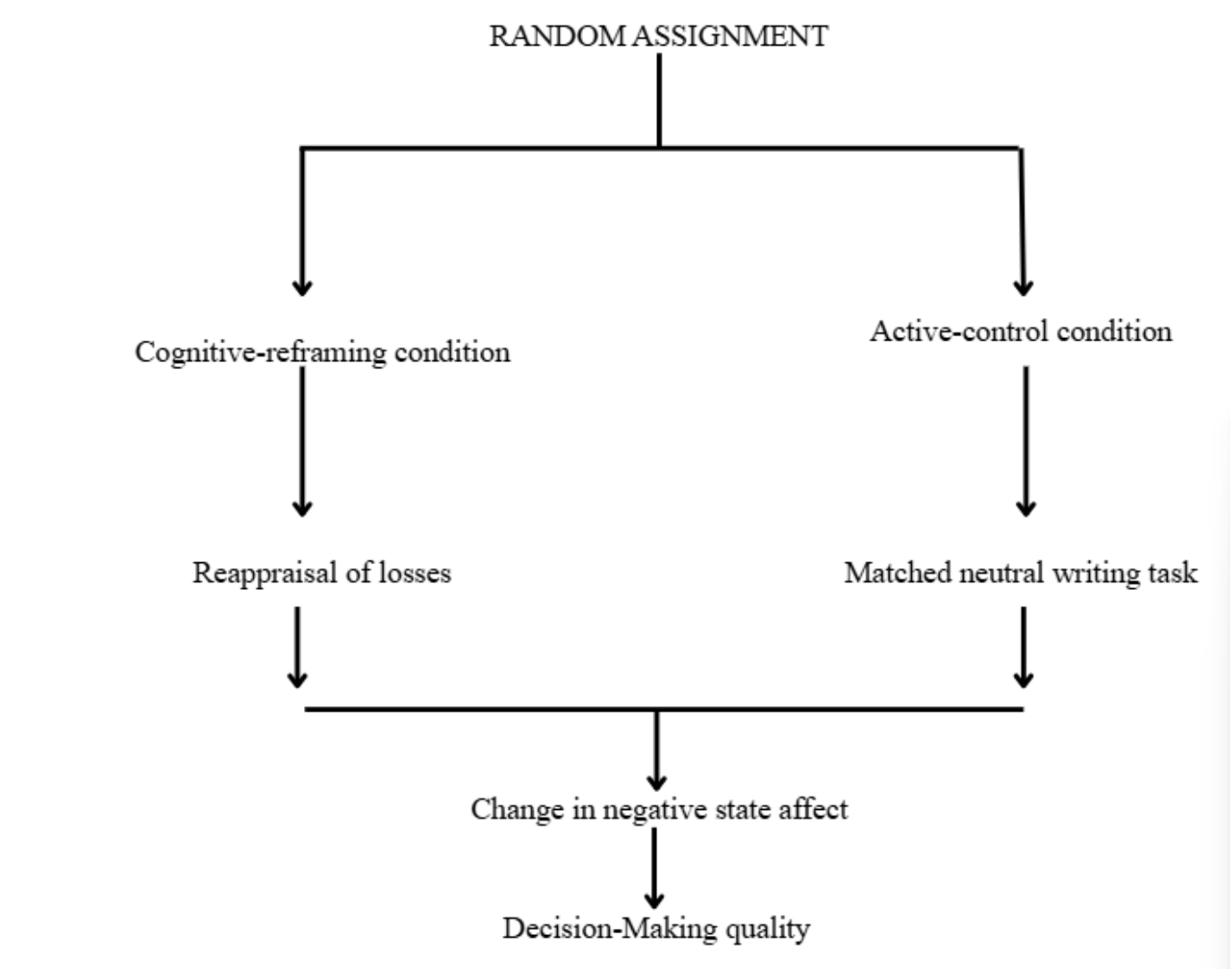
Random assignment to the cognitive-reframing or active-control condition is expected to influence state affect and subsequent decision-making under uncertainty. The proposed mechanism is that cognitive reframing changes the interpretation of emotionally salient losses, which may reduce negative state affect and improve selection of expected-value-maximizing decisions. The study will examine whether changes in state affect statistically account for part of the relationship between experimental condition and decision quality.
Literature Review
Cognitive restructuring, a core technique in Cognitive Behavioral Therapy, is based on the idea that individuals’ emotional responses are influenced by how they interpret events rather than by events themselves.1 Beck’s cognitive model proposes that maladaptive automatic thoughts and interpretations can contribute to negative emotional responses, while modifying these interpretations may alter subsequent emotional and behavioral reactions.1 Cognitive restructuring involves identifying automatic thoughts, evaluating their accuracy and usefulness, and developing more balanced interpretations of circumstances.2 Rather than encouraging individuals to simply replace negative thoughts with positive ones, the technique emphasizes evaluating whether a thought is supported by available evidence and whether alternative interpretations are possible.2 This process may be particularly relevant in situations involving uncertainty or emotionally significant outcomes, where an individual’s interpretation of an event can influence subsequent behavior. Because cognitive restructuring involves modifying interpretations of emotionally significant events, its theoretical basis overlaps with research on cognitive reappraisal, a broader emotional regulation strategy that also involves changing how an individual interprets a situation.
Cognitive restructuring and cognitive reappraisal are conceptually related approaches that both involve modifying interpretations of emotionally significant events, although cognitive restructuring originates within the CBT framework and typically emphasizes evaluating the accuracy and usefulness of thoughts. Gross’s process model of emotional regulation proposes that reconsideration occurs relatively early in the generation of an emotional response, allowing individuals to modify the meaning of a situation before the emotional response is fully developed.3 In contrast, strategies such as expressive suppression attempt to control the outward expression of an emotion after the emotional response has already occurred.4 Research by Gross and John found that greater habitual use of cognitive reappraisal was associated with more favorable emotional outcomes.4 More recent work has continued to emphasize cognitive reappraisal as an important component of flexible emotional regulation.5 Meta analytic evidence has further demonstrated relationships between emotional regulation strategies and psychological outcomes across a large body of research.6 These findings suggest that changing the interpretation of an emotionally significant event may influence not only how individuals experience emotion, but also how they respond behaviorally to that event. If emotional responses can be altered through reappraisal, an important question is whether these changes extend to decisions involving risk and uncertainty.
Research has also examined the cognitive and neural mechanisms involved in reappraisal, providing evidence that the strategy requires active cognitive control. A meta-analysis of neuroimaging studies found consistent involvement of brain regions associated with cognitive control during cognitive reappraisal, suggesting that reframing an emotional situation involves active regulation rather than simply suppressing an emotional response. Experimental research has also shown that cognitive reappraisal can alter physiological responses to emotionally stressful feedback, suggesting that reframing may influence the intensity of responses to negative outcomes.7 Research examining cognitive reappraisal in mood and anxiety disorders has similarly identified alterations in neural systems involved in cognitive control and emotional regulation.8 Although these findings do not directly establish an effect on risk-taking, they provide a potential mechanism through which cognitive restructuring could influence responses to emotionally salient outcomes.
Importantly, research has begun to examine whether emotional regulation can directly influence decision-making under risk. Heilman et al. found that emotional regulation through cognitive reappraisal affected risky decision-making in experimental tasks, suggesting that regulating emotional responses may alter how individuals respond to uncertain outcomes.9 Similarly, Martin et al. found that reappraisal influenced risk-taking in relation to expected value and the individual’s regulatory goal.10,11 Research suggests that emotion regulation can alter subsequent risky decision-making, although its effects may depend on the regulatory goal and characteristics of the decision11,12,13,10,14 Recent experimental research has further demonstrated that negative feedback creates situations in which emotion-regulation goals interact with performance goals, suggesting that individuals’ responses to unfavorable outcomes depend partly on how they regulate their emotional reactions.13 Other research has also examined whether cognitive reappraisal reduced susceptibility to framing effects in economic decision-making, providing evidence that changing an individual’s interpretation of a decision can influence how gains and losses are evaluated. Experimental research has further demonstrated that emotional regulation can influence subsequent risk-taking and activity in brain regions involved in decision-making, providing additional evidence that regulating emotional responses may affect how individuals evaluate risky choices.12,13,15,14,12,16 Together, these findings provide a basis for investigating whether cognitive restructuring can influence risk-taking in a more complex decision-making environment. This context-dependence is particularly important when decisions involve gains and losses, because individuals may not evaluate equivalent positive and negative outcomes in the same way.
More broadly, research on emotion and decision-making suggests that emotional states can systematically influence judgements and choices under uncertainty. Different emotional states have been associated with different patterns of risk perception and risk-taking, indicating that responses to uncertainty are influenced not only by objective probabilities but also by individuals’ affective states.17,18,15 The “Risk as Feelings” framework similarly proposes that emotional reactions to risky situations can influence behavior independently of more deliberate cognitive evaluations of risk.18 Experimental research has also demonstrated that stress can alter financial risk-taking, providing evidence that emotionally demanding conditions can influence decisions involving uncertain outcomes.19 These findings are particularly relevant to environments in which individuals must repeatedly make decisions while experiencing emotional feedback, because emotional responses may influence the evaluation of subsequent choices.
Behavioral economics provides an additional framework for understanding how individuals respond to risky decisions. Prospect Theory proposes that individuals evaluate outcomes relative to a reference point and generally exhibit greater sensitivity to losses than equivalent gains.20 The theory also predicts differences in risk preferences depending on whether individuals are considering gains or losses, helping explain why the same probability may be evaluated differently depending on the framing of an outcome.21 The effects of framing on risky choice may be partly explained by emotional responses to gains and losses, with research showing that negative affect toward sure losses can increase subsequent risk-taking.20,21,22 Loss framing can influence behavioral responses even when the underlying outcomes are objectively equivalent, suggesting that the interpretation of an outcome can shape subsequent decision-making. Recent research has continued to examine the empirical evidence for loss aversion, demonstrating substantial but variable effects across different decision-making contexts.23 In gambling environments, these loss-related biases may be particularly relevant because individuals experience repeated wins and losses and must continually decide whether to continue taking risks. If losses receive greater psychological weight than equivalent gains, repeated unfavorable outcomes may influence not only how a current choice is evaluated but also how individuals approach subsequent choices.
The effects of losses may extend beyond the evaluation of an individual decision and influence subsequent risk-taking behavior. Experimental research has also found that responses to prior losses can differ across gambling populations, with problem gamblers showing less reduction in risk-taking following prior losses than healthy controls and treated pathological gamblers, suggesting reduced sensitivity to negative feedback.24 Research on loss-chasing suggests that individuals may respond to unfavorable outcomes by increasing their willingness to take risks in an attempt to recover previous losses. Campbell-Meiklejohn et al. examined the mechanisms underlying loss-chasing and found that continuing to pursue losses and deciding to stop were associated with different processes involved in reward and conflict monitoring.25 More recent research has identified increased stakes, increased risk, and faster play as behavioral expressions of within-session loss chasing.26 Large-scale behavioral research has further demonstrated that loss-chasing can be observed through changes in subsequent gambling behavior, including decisions to continue gambling and changes in stake size.27 Research using account-level gambling data has similarly examined different behavioral indicators of chasing losses, demonstrating that chasing can be operationalized through observable changes in gambling behavior.28 These findings are relevant to poker because repeated losses can create an environment in which emotional responses and attempts to recover losses influence subsequent decisions. These findings suggest that losses can influence not only immediate evaluations of outcomes but also subsequent behavioral choices, making loss-chasing an important mechanism for understanding risk-taking in gambling contexts.
Research in gambling psychology further suggests that unfavorable outcomes can interact with cognitive and emotional processes to influence subsequent behavior.29 For example, research examining “losses disguised as wins” has demonstrated that the psychological interpretation of an outcome may influence subsequent behavioral responses, even when the objective monetary outcome does not correspond to a conventional loss.30 Such findings are consistent with the broader idea that individuals’ interpretations of outcomes can influence subsequent behavior, providing a potential connection between cognitive restructuring and gambling-related decision-making. However, much of the existing gambling literature has focused on describing maladaptive responses such as chasing rather than examining whether an intervention designed to change the interpretation of an outcome can reduce these responses.
Poker provides a particularly relevant environment for studying these processes because players must repeatedly make decisions under uncertainty while receiving immediate and emotionally salient feedback. Research on online poker has documented the phenomenon of “tilt”, in which unfavorable outcomes can produce emotional and cognitive dysregulation that subsequently affects decision-making. Palomäki et al. found that significant losses could produce strong emotional reactions and subsequent loss-chasing behavior among online poker players.31 Laakasuo et al. similarly found that emotional and social factors could influence poker decision-making accuracy, with anger negatively affecting mathematical accuracy under certain conditions.32 Moreau et al. found relationships between poker tilt, cognitive distortions, and loss of control, further suggesting that emotional responses to poker outcomes can contribute to maladaptive decision-making.33 Research examining tilt has also considered the identification of tilt episodes, suggesting that emotional and cognitive dysregulation following unfavorable outcomes can be examined as an observable phenomenon rather than simply as an informal description used by poker players. Unlike simplified laboratory tasks involving isolated risky choices, poker requires players to make repeated decisions while integrating probability, expected value, previous outcomes, and strategic considerations. This combination of probabilistic reasoning, repeated feedback, and emotional responses to uncertain outcomes makes poker a useful environment for examining whether cognitive restructuring can alter risk-taking behavior.
Taken together, existing research demonstrates that cognitive restructuring and cognitive reappraisal can influence emotional regulation, that emotional states can affect decision-making under risk, and that losses can contribute to increased risk-taking and loss-chasing. Research in poker further indicates that emotional dysregulation and cognitive distortions can impair decision-making and contribute to tilt. However, these areas of research have largely been examined separately. Research on emotional regulation has established that individuals can alter their emotional responses through reappraisal, while research on risk-taking has demonstrated that emotional states, losses, and stress can influence subsequent decisions. Gambling research has further documented loss-chasing and other maladaptive responses to unfavorable outcomes, while poker-specific research has connected emotional dysregulation and cognitive distortions with impaired decision-making and tilt. However, these literatures have not established whether a cognitive restructuring intervention can alter risk-taking following emotionally salient poker outcomes. In particular, it remains unclear whether reframing emotionally salient poker outcomes can reduce outcome-driven decision-making while allowing individuals to maintain appropriate responses to probability and expected value. The present study addresses this gap by examining whether cognitive restructuring affects decision-making in high-risk poker scenarios.
Methodology
The study will look at cognitive restructuring, a structured form of cognitive reframing derived from Cognitive Behavioral Therapy (CBT). Participants are guided to identify automatic negative thoughts triggered by poker losses and replace them with rational, probability-based interpretations focused on long-term expected value.
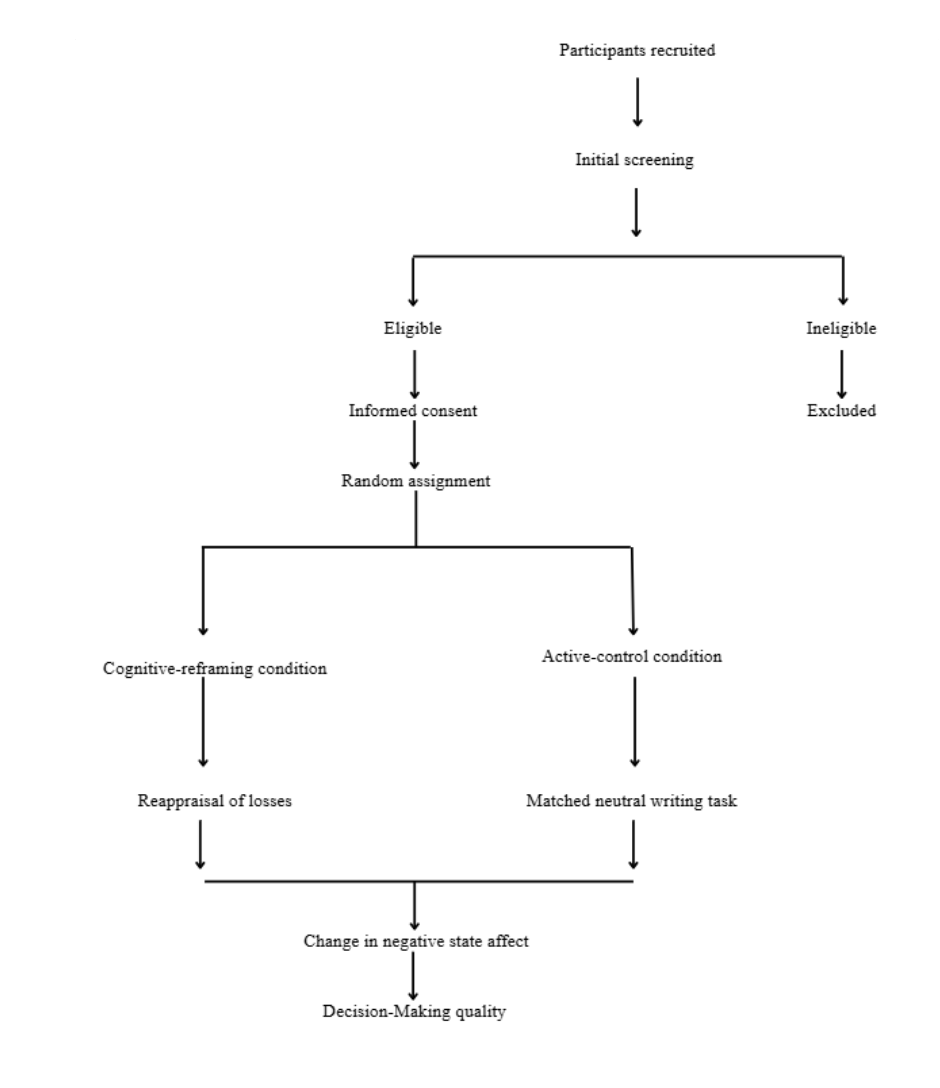
Approximately 50 participants between the ages of 16 and 21 will be recruited through a pre-screener Google Form. The pre-screener will include demographic and poker-experience questions, as well as questions assessing familiarity with poker rules and prior exposure to cognitive reframing or emotional-regulation techniques. The final sample size will be determined through an a priori power analysis based on the planned primary statistical model and a prespecified minimum effect size. Therefore, the target of 50 participants will not be treated as sufficient solely on the basis of convenience.
To maintain the ethical standards of the experiment, each participant must complete an informed consent process before participation. Participants under 18 will require parental or guardian consent in addition to the participant’s assent. The consent process will explain the general purpose of the study, the voluntary nature of participation, the right to withdraw without penalty, and the types of hypothetical poker-related material participants will encounter. No personally identifying information will be stored with study responses, and participant data will be coded for analysis.
Participant welfare will be prioritized throughout the study. The protocol does not involve real-money gambling, monetary rewards based on gambling performance, or instructions to gamble. Poker scenarios are presented solely as hypothetical decision-making stimuli. Because some scenarios involve losses, frustration, or other emotionally salient situations, participants will be informed that they may skip a question or discontinue participation without penalty. The study will avoid intentionally inducing severe emotional distress, and participants will be provided with an opportunity to discontinue the study if the material becomes uncomfortable. The study will be submitted for appropriate ethical review before data collection, with additional protections applied because the proposed sample includes minors.
This study will use a scenario-based experimental design to examine how cognitive reframing affects poker decision-making. Participants would be randomly divided into two groups: a reframing group and a control group.
The reframing group would first read a short explanation about variance in poker and how focusing on decision quality rather than outcomes can reduce emotional reactions such as tilt. They would then complete a brief exercise where they practice rewriting negative thoughts about losing a hand into more rational, probability-based interpretations. The active-control group would receive the same general information about probability, expected value, and decision quality as the reframing group, but would complete a neutral writing task rather than a cognitive-reframing exercise.
The control group will receive the same normative information about expected value, probability, and decision quality as the reframing group and will complete a writing exercise matched to the reframing exercise in duration, number of responses, amount of writing, and task difficulty. The critical difference between conditions will be that the reframing group will practice reappraising the meaning of hypothetical losses, whereas the active-control group will complete a neutral writing task that does not instruct participants to reinterpret losses. This design is intended to reduce the possibility that differences between groups are caused by unequal exposure to poker information, writing practice, task duration, or cognitive engagement rather than by the reframing intervention itself.
Both groups will receive the same information about expected value and the same practice with the decision rule used to identify the mathematically optimal response. The experimental manipulation will therefore be limited to the cognitive-reframing component rather than the teaching of a particular poker strategy.
To assess participants’ state affect, the State version of the Positive and Negative Affect Schedule (PANAS) will be administered at prespecified points during the protocol. PANAS is an established measure of positive and negative affect with evidence of reliability and validity.34 State affect will be assessed at four prespecified time points: (1) baseline, before the intervention; (2) immediately after the intervention or active-control task; (3) following designated loss-framed scenarios; and (4) following the final scenario block. The primary affect outcome will be the change in negative affect from baseline to the prespecified post-intervention and post-loss assessments.
Participants will also complete a brief treatment-credibility and engagement questionnaire after the intervention. These measures will assess whether participants understood the assigned task, how engaged they were with it, and how credible they considered the intervention. Participants will additionally answer a study-expectancy question asking what they believed the study was testing. These measures will be used to assess whether differences between groups could be explained by participants identifying the study hypothesis rather than by the reframing manipulation itself.
Constants would include the questions given, the amount of questions, the environment in which the participant would answer the questions, and the same amount of time for each participant to ensure each participant has the same environment.
To reduce differences in prior poker knowledge and gaming experience, participants will be eligible only if they have less than one year of poker experience, do not play regularly, and demonstrate a basic understanding of poker hand rankings. The screening questionnaire will also collect information about prior gaming experience more broadly, including frequency of participation in strategy-based or probability-based games. Participants will be asked about prior training or experience with cognitive reframing, CBT-based techniques, or formal emotional-regulation strategies. These characteristics will be recorded and considered as potential sources of between-participant variability. Personality, mathematical ability, and emotional intelligence will not be treated as eligibility criteria, but their potential influence on decision-making will be acknowledged as limitations of the study.
The “best decision” for each scenario will be prespecified by the research team using the expected-value calculation and relevant probability information established before data collection. The scoring criteria will be finalized before participants are recruited to prevent the outcome definition from being changed in response to participant responses.
After this, both groups would respond to a series of written poker scenarios that required them to choose how they would act in different situations. These scenarios would include examples of winning, losing, and high-risk decisions (see Appendix A for all scenarios). The primary outcome will be the proportion of scenarios in which each participant selects the prespecified expected-value maximizing option. Secondary outcomes will include state-affect change following the intervention and loss-related scenarios, as well as decision consistency across scenarios with similar probability structures.
Each scenario will be piloted by 5 non-participating volunteers in the same target population for comprehension. Because this is a protocol, pilot feedback will be used before formal data collection to revise unclear or ambiguous scenarios. Afterwards, scenarios would be revised based on feedback. Each scenario will be reviewed by one person with prior poker experience for legitimacy and comprehension.
The study will not claim to measure real-world “tilt” or real-world poker behavior. Instead, the protocol is designed to measure changes in self-reported state affect and decision-making responses to hypothetical, emotionally framed poker vignettes. The distinction between hypothetical decision-making and behavior during actual poker play will be explicitly acknowledged as a limitation.
Participants
Participants between the ages of 16 and 21 will be recruited through a Google Form, with an initial target sample of approximately 50 participants. Before data collection, an a priori power analysis will be conducted using simulation based on the planned generalized linear mixed-effects model. The simulation will incorporate the number of participants, number of scenarios per participant, expected baseline probability of an EV-maximizing response, within-participant correlation, and the minimum between-condition effect considered scientifically meaningful. Power will be targeted at 80% or greater. The recruitment target will be increased above the initial target of 50 participants if necessary to achieve the prespecified power.
To reduce differences in prior poker knowledge, participants will be eligible only if they have less than one year of poker experience, do not play regularly, and demonstrate a basic understanding of poker hand rankings. Participants will also be asked during screening whether they have prior training in cognitive reframing, CBT-based techniques, or formal emotional-regulation strategies. This information will be recorded as a potential participant characteristic rather than assuming that participants have no prior knowledge of these concepts.
Data Collection
Responses will be coded based on each participant’s response to each scenario. Each response will be coded as 1 if the participant selects the prespecified expected-value-maximizing option and 0 otherwise. These binary responses will be retained at the individual-scenario level for the primary analysis rather than being reduced only to a single participant average.
The primary outcome will be decision quality, operationalized as the probability that a participant selects the expected-value-maximizing option. Because each participant will respond to multiple scenarios and each response will be binary, the primary analysis will use a generalized linear mixed-effects model with a binomial distribution and logit link. Participants will be included as a random effect to account for repeated observations within participants, and experimental conditions will be included as the primary fixed effect. Scenario characteristics, including loss-related versus non-loss-related framing, may be included as prespecified fixed effects where appropriate.
The primary effect will be reported with an estimated effect size and 95% confidence interval rather than relying only on a p-value. The statistical analysis plan will specify the minimum effect of interest before data collection begins.
State affect will be analyzed as a repeated measure across the prespecified assessment points. Change in negative affect from baseline to post-intervention and following loss-related scenarios will be compared between the reframing and active-control groups using an appropriate repeated-measures model. A mixed-effects model will be preferred because it can account for repeated observations within participants and differences among scenarios. Effect estimates and 95% confidence intervals will be reported alongside significance tests.
The relationship between changes in state affect and decision quality will be examined using a prespecified mediation analysis. Specifically, the analysis will test whether assignment to the cognitive-reframing condition predicts changes in state affect and whether those changes in affect are associated with subsequent decision quality. The indirect effect will be estimated with confidence intervals. Because this is an experimental protocol rather than a completed study, the mediation analysis will be treated as a test of the proposed mechanism rather than evidence that mediation has already been demonstrated.
The loss-related, neutral, and gain/win scenario categories will be treated as a prespecified secondary analysis. Rather than comparing multiple group means independently without adjustment, the analysis will examine whether the effect of experimental condition differs by scenario category through an appropriate condition-by-scenario-category interaction in the mixed-effects model. Any additional exploratory comparisons will be identified as exploratory and will include an appropriate correction for multiple comparisons.
The study will report descriptive statistics for all primary and secondary outcomes, including means and standard deviations or appropriate distributional summaries, estimated between-group effects, 95% confidence intervals, and effect sizes. Statistical assumptions appropriate to each planned model will be assessed before interpretation.
The final statistical analysis plan will be established before examination of the outcome data. The study will distinguish between the prespecified primary outcome, prespecified secondary outcomes, and exploratory analyses to reduce the risk of selective reporting.
No conclusions about actual poker behavior, real-world gambling behavior, or the development or prevention of clinical “tilt” will be drawn from the study. Conclusions will be restricted to decision-making and state-affect responses within the hypothetical, emotionally framed poker scenarios used in the experiment.
Anticipated Results
We hypothesize that participants assigned to the cognitive-reframing condition will have a higher probability of selecting the prespecified expected-value-maximizing action than participants assigned to the active-control condition. We also hypothesize that the reframing condition will be associated with a greater reduction in negative state affect following the intervention and loss-framed scenarios.
Several alternative outcomes are possible. Cognitive reframing may reduce negative state affect without producing a measurable improvement in decision quality. Conversely, participants may demonstrate improved decision quality without a corresponding change in state affect, which would suggest that the intervention may influence decision-making through mechanisms other than the proposed affective pathway. The study may also produce null results, with no detectable difference between conditions in either decision quality or state affect.
The mediation analysis will test whether changes in state affect statistically account for part of the association between experimental condition and decision quality. Because this is a protocol and no participant data have yet been collected, these predictions are hypotheses rather than empirical findings. The results will be interpreted according to the prespecified primary and secondary outcomes regardless of whether they support the hypotheses.
Limitations
One major limitation is that participants are only responding to written poker scenarios rather than playing actual poker with real consequences. Because there is no money, competition, or social pressure involved, participants may not experience genuine emotions such as tilt. This reduces ecological validity because decision-making in hypothetical situations may differ from real poker environments.
The size of the experimental group could be a potential limitation to the experiment. A sample of 50 participants may also not be enough to detect small differences between groups. Individual differences in personality, risk tolerance, mathematical ability, emotional intelligence, and prior gaming experience could influence responses to the scenarios and the effectiveness of the intervention. Although poker experience and prior exposure to cognitive-reframing techniques will be assessed during screening, the study will not comprehensively measure all individual differences that may affect decision-making. These factors therefore represent potential sources of variability and should be considered in future studies with larger samples and more extensive participant characterization.
Limited age range could also pose an issue. Using only participants aged 16–21 limits how broadly the findings can be applied. Adolescents and young adults may process risk and emotions differently from older adults or experienced poker players. This means the results may not generalize to the wider poker-playing population.
Even though participants have limited poker experience, some may already use emotional coping strategies from sports, gaming, academics, or previous psychology knowledge. This could affect how strongly the reframing intervention appears to work.
The experiment only measures immediate responses after the reframing exercise. It does not show whether cognitive reframing has lasting effects on decision-making over time. Participants may temporarily apply the strategy during the study but not retain it afterward.
Although EV calculations provide a mathematical “best decision,” real poker decisions can depend on factors not included in the scenarios, such as player tendencies, bluffing patterns, or table dynamics. This means the study simplifies real poker strategy.
The hypothetical nature of the task is a central limitation rather than a minor caveat. Participants will not experience actual financial consequences, time pressure, competition, or social evaluation. Consequently, the study cannot establish that the intervention would reduce emotional dysregulation or alter behavior during actual poker play. The use of emotionally framed vignettes is intended to provide experimental control over the decision environment, but this control occurs at the expense of ecological validity.
Another issue is that participants may guess the purpose of the study and change their behavior accordingly. For example, the reframing group may realize the experiment is testing rational decision-making and intentionally choose safer or more logical answers.
Appendix
Appendix A: Standardized Decision-Making Scenarios
Participant Instructions:
Each scenario should be treated as an independent decision. Do not use information from previous scenarios when answering subsequent scenarios. For each scenario, choose the action you would take based only on the information provided.
Scenario 1: You have just lost three hands in a row and feel frustrated about the losing streak. Your stack is $300.
The pot contains $100, and your opponent bets $50. You must pay $50 to continue. Based on the information available to you, you have an estimated 20% probability of winning if you call.
What do you do?
A. Call
B. Fold
Scenario 2: You have just joined the table and have not yet played a hand. Your stack is $300.
The pot contains $100, and your opponent bets $50. You must pay $50 to continue. Based on the information available to you, you have an estimated 20% probability of winning if you call.
What do you do?
A. Call
B. Fold
Scenario 3: You have just lost a large pot after making a decision that you believed was reasonable. You are disappointed and want to recover your previous losses. Your stack is $400.
The pot contains $200, and your opponent bets $50. You must pay $50 to continue. Based on the information available to you, you have an estimated 25% probability of winning if you call.
What do you do?
A. Call
B. Fold
Scenario 4: You have just won a large pot after making a decision that you believed was reasonable. You feel confident about your recent play. Your stack is $400.
The pot contains $200, and your opponent bets $50. You must pay $50 to continue. Based on the information available to you, you have an estimated 25% probability of winning if you call.
What do you do?
A. Call
B. Fold
Scenario 5: You have lost several hands in a row and are concerned that the game is going against you. Your stack is $350.
The pot contains $150, and your opponent bets $100. You must pay $100 to continue. Based on the information available to you, you have an estimated 25% probability of winning if you call.
What do you do?
A. Call
B. Fold
Scenario 6: You have not experienced any significant wins or losses during the current game. You feel neutral about your recent play. Your stack is $350.
The pot contains $150, and your opponent bets $100. You must pay $100 to continue. Based on the information available to you, you have an estimated 25% probability of winning if you call.
What do you do?
A. Call
B. Fold
Scenario 7: You have just lost two consecutive hands and feel frustrated by the recent outcomes. Your stack is $500.
The pot contains $300, and your opponent bets $100. You must pay $100 to continue. Based on the information available to you, you have an estimated 30% probability of winning if you call.
What do you do?
A. Call
B. Fold
Scenario 8: You have just won two consecutive hands and feel confident about your recent outcomes. Your stack is $500.
The pot contains $300, and your opponent bets $100. You must pay $100 to continue. Based on the information available to you, you have an estimated 30% probability of winning if you call.
What do you do?
A. Call
B. Fold
Scenario 9: You have just lost a hand after being confident that your decision was correct. You feel disappointed and are thinking about recovering the chips you lost. Your stack is $450.
The pot contains $250, and your opponent bets $200. You must pay $200 to continue. Based on the information available to you, you have an estimated 28% probability of winning if you call.
What do you do?
A. Call
B. Fold
Scenario 10: You have just joined a new table and have not yet experienced any wins or losses. You feel neutral about your current position. Your stack is $450.
The pot contains $250, and your opponent bets $200. You must pay $200 to continue. Based on the information available to you, you have an estimated 28% probability of winning if you call.
What do you do?
A. Call
B. Fold
Scenario 11: You have just lost several hands in a row, but none involved a particularly large pot. You feel somewhat frustrated by the recent results. Your stack is $600.
The pot contains $400, and your opponent bets $100. You must pay $100 to continue. Based on the information available to you, you have an estimated 22% probability of winning if you call.
What do you do?
A. Call
B. Fold
Scenario 12: You have just won several hands in a row, but none involved a particularly large pot. You feel confident about the recent results. Your stack is $600.
The pot contains $400, and your opponent bets $100. You must pay $100 to continue. Based on the information available to you, you have an estimated 22% probability of winning if you call.
What do you do?
A. Call
B. Fold
Appendix B: Cognitive-Reframing Practice Scenarios
The following scenarios are used to practice cognitive reframing. For each scenario, participants identify an initial automatic thought and consider a more balanced interpretation of the situation. The purpose of the exercise is to practice changing the interpretation of an emotionally significant event rather than determining a specific poker action.
Scenario 1: You are dealt a weak hand. Your first thought is that you are unlucky, or the game is rigged since you never seem to get good cards.
Answer: A more balanced interpretation would be that receiving weak hands is a normal part of a game involving probability. A short sequence of unfavorable outcomes does not necessarily indicate that the game is unfair or that future outcomes will also be unfavorable. The situation can be viewed as a normal part of uncertainty rather than evidence that something is going wrong.
Scenario 2: You have a very strong hand and bet confidently, but another player ends up winning the pot with a lucky card in the final round. Your initial reaction may be to think that you made a terrible decision.
Answer: A more balanced interpretation would be that the quality of a decision and the eventual outcome are not always the same. A sound decision can still produce an unfavorable outcome because uncertain events do not guarantee a particular result. The outcome can therefore be evaluated separately from the information available when the decision was made.
Scenario 3: Another player successfully bluffs you, and you fold a decent hand. Afterward, you realize they did not actually have strong cards. Your first thought might be that you were tricked and embarrassed.
Answer: A more balanced interpretation would be that being uncertain about another player’s cards is an inherent part of poker. The fact that the other player successfully bluffed does not necessarily mean that the decision was foolish or that you should feel embarrassed. The event can instead be viewed as information about the uncertainty involved in the decision.
Scenario 4: During the game, one player repeatedly raises when you enter a hand. You might begin to think they are targeting you because they think you are weak.
Answer: A more balanced interpretation would be that there may be several possible explanations for the other player’s behavior. Their actions do not necessarily provide enough evidence to conclude that they are deliberately targeting you. Instead of assuming a negative interpretation, you can recognize the uncertainty surrounding their intentions and focus on evaluating the available information.
Scenario 5: You lose several hands in a row, and you start thinking you are unlucky and that the game is going against you.
Answer: A more balanced interpretation would be that losing several hands in succession can occur by chance and does not necessarily predict what will happen next. The recent outcomes provide information about what has already happened, but they do not guarantee that future outcomes will follow the same pattern. This allows the losses to be viewed as part of normal variability rather than evidence that continued losses are inevitable.
Scenario 6: After losing a large pot, you feel the urge to immediately play more aggressively to win your chips back.
Answer: A more balanced interpretation would be that the desire to recover a previous loss is an emotional response rather than evidence that greater risk is necessary. The previous outcome does not change the objective probabilities of a new decision. Separating the emotional significance of the loss from the information relevant to the next decision can help produce a more balanced interpretation.
Scenario 7: A very skilled or confident player sits at your table, and you begin to think that you have little chance of beating them.
Answer: A more balanced interpretation would be that another player’s apparent skill does not determine the outcome of every future decision. Their presence may make the situation feel more intimidating, but feeling intimidated is not the same as having evidence that a particular outcome is likely. The situation can therefore be evaluated based on the information available rather than assumptions about the other player.
Scenario 8: You fold a hand because the bets were too high, but later you discover that your cards would have won the pot. You might feel regret and think you made a terrible mistake.
Answer: A more balanced interpretation would be that a decision should be evaluated using the information available when it was made rather than information revealed afterward. Knowing the eventual outcome does not mean that the outcome was predictable beforehand. This distinction can reduce the tendency to judge an earlier decision solely because the result turned out differently than expected.
Scenario 9: You win a large pot and begin to feel that you are playing extremely well and can win every hand.
Answer: A more balanced interpretation would be that one successful outcome does not guarantee future success. The win can be recognized as a positive outcome without treating it as evidence that future outcomes are certain. Maintaining a realistic interpretation of uncertainty allows the result to be acknowledged without assuming that it determines what will happen next.
Scenario 10: You have been folding many hands in a row and start to feel bored or impatient, making you want to play weaker hands just for excitement.
Answer: A more balanced interpretation would be that boredom can influence how the situation feels without changing the underlying probabilities. Wanting an exciting outcome does not provide evidence that taking additional risk is justified. Recognizing the difference between an emotional desire for stimulation and the objective information available can help separate the feeling from the decision itself.
Appendix C
Before participant recruitment, each scenario will be converted into a standardized decision vignette containing the pot size, amount required to call, estimated probability of winning, and break-even probability for continuing. The emotional context and decision information will be standardized across participants, and the EV-maximizing action will be determined before data collection.
| Scenario | Pair | Pot Before bet | Opponent bet/call | Final pot | Win probability | Break-even probability | EV of call | Optimal Action |
| 1 | 1 | $100 | $50 | $200 | 20% | 25% | -$10.00 | Fold |
| 2 | 1 | $100 | $50 | $200 | 20% | 25% | -$10.00 | Fold |
| 3 | 2 | $200 | $50 | $300 | 25% | 16.7% | +$25.00 | Call |
| 4 | 2 | $200 | $50 | $300 | 25% | 16.7% | +$25.00 | Call |
| 5 | 3 | $150 | $100 | $350 | 25% | 28.6% | -$12.50 | Fold |
| 6 | 3 | $150 | $100 | $350 | 25% | 28.6% | -$12.50 | Fold |
| 7 | 4 | $300 | $100 | $500 | 30% | 20% | +$50.00 | Call |
| 8 | 4 | $300 | $100 | $500 | 30% | 20% | +$50.00 | Call |
| 9 | 5 | $250 | $200 | $650 | 28% | 30.8% | -$18.00 | Fold |
| 10 | 5 | $250 | $200 | $650 | 28% | 30.8% | -$18.00 | Fold |
| 11 | 6 | $400 | $100 | $600 | 22% | 16.7% | +$32.00 | Call |
| 12 | 6 | $400 | $100 | $600 | 22% | 16.7% | +$32.00 | Call |
The calculations use: EV(call) = P(win) × (pot + call) − call
For example, Scenario 1: EV = 0.20 × (100 + 54) − 54 = −23.2 chips
**Expected value will be used as a prespecified normative criterion for evaluating decision quality. Participants will not be shown the EV calculations during the decision-making scenarios. Instead, the exact cards, betting information, and opponent range assumptions for each scenario will be established before data collection, and the mathematically optimal action will be determined in advance.
EV-based scoring will therefore represent one operational definition of decision quality under the controlled assumptions of the experiment. It will not be interpreted as a complete measure of poker expertise or universally optimal real-world poker strategy.
Because real poker decisions may depend on opponent modeling, incomplete information, strategic deception, position, stack depth, implied odds, tournament structure, and other contextual factors, the scenarios will be designed to isolate probability-based decision-making rather than reproduce every aspect of live poker.
References
- A. T. Beck. Cognitive Therapy and the Emotional Disorders. New York: International Universities Press, 1976. [↩] [↩]
- J. S. Beck. Cognitive Therapy: Basics and Beyond. New York: Guilford Press, 1995. [↩] [↩]
- J. J. Gross. Emotion regulation: Affective, cognitive, and social consequences. Psychophysiology. Vol. 39, pg. 281-291, 2002, https://doi.org/10.1017/S0048577201393198. [↩]
- J. J. Gross, O. P. John. Individual differences in two emotion regulation processes: Implications for affect, relationships, and well-being. Journal of Personality and Social Psychology. Vol. 85, pg. 348-362, 2003, https://doi.org/10.1037/0022-3514.85.2.348. [↩] [↩]
- J. J. Gross. Emotion regulation: Current status and future prospects. Psychological Inquiry. Vol. 26, pg. 1-26, 2015, https://doi.org/10.1080/1047840X.2014.940781. [↩]
- T. Hu, D. Zhang, J. Wang, R. Mistry, G. Ran, X. Wang. Relation between emotion regulation and mental health: A meta-analysis review. Psychological Reports. Vol. 114, pg. 341-362, 2014, https://doi.org/10.2466/03.20.PR0.114k22w4. [↩]
- C. L. Burk, B. S. Wiese. How to alleviate the agony of providing negative feedback: Emotion regulation strategies affect hormonal stress responses to a managerial task. Hormones and Behavior. Vol. 127, pg. 104868, 2021, https://doi.org/10.1016/j.yhbeh.2020.104868. [↩]
- M. Picó-Pérez, J. Radua, T. Steward, J. M. Menchón, C. Soriano-Mas. Emotion regulation in mood and anxiety disorders: A meta-analysis of fMRI cognitive reappraisal studies. Progress in Neuro-Psychopharmacology & Biological Psychiatry. Vol. 79, pg. 96-104, 2017, https://doi.org/10.1016/j.pnpbp.2017.06.001. [↩]
- R. M. Heilman, L. G. Crişan, D. Houser, M. Miclea, A. C. Miu. Emotion regulation and decision making under risk and uncertainty. Emotion. Vol. 10, pg. 257–265, 2010, https://doi.org/10.1037/a0018489. [↩]
- L. M. Braunstein, S. J. Herrera, M. R. Delgado. Reappraisal and expected value modulate risk taking. Cognition and Emotion. Vol. 28, no. 1, pg. 172–181, 2014. https://doi.org/10.1080/02699931.2013.809330. [↩] [↩]
- A. Panno, M. Lauriola, B. Figner. Emotion regulation and risk taking: Predicting risky choice in deliberative decision making. Cognition and Emotion. Vol. 27, pg. 326-334, 2013, https://doi.org/10.1080/02699931.2012.707642. [↩] [↩]
- P. Sokol-Hessner, M. Hsu, M. R. Delgado, C. F. Camerer, E. A. Phelps. Thinking like a trader selectively reduces individuals’ loss aversion. Proceedings of the National Academy of Sciences. Vol. 106, pg. 5035-5040, 2009, https://doi.org/10.1073/pnas.0806761106. [↩] [↩] [↩]
- F. Grundmann, K. Epstude, S. Scheibe. Whether and how to regulate: Emotion regulation in negative-feedback situations. Journal of Experimental Psychology: General. Vol. 153, pg. 1281-1308, 2024, https://doi.org/10.1037/xge0001566. [↩] [↩] [↩]
- C. Morawetz, P. N. C. Mohr, H. R. Heekeren, S. Bode. The effect of emotion regulation on risk-taking and decision-related activity in prefrontal cortex. Social Cognitive and Affective Neuroscience. Vol. 14, pg. 1109-1118, 2019, https://doi.org/10.1093/scan/nsz078. [↩] [↩]
- J. S. Lerner, Y. Li, P. Valdesolo, K. S. Kassam. Emotion and decision making. Annual Review of Psychology. Vol. 66, pg. 799–823, 2015, https://doi.org/10.1146/annurev-psych-010213-115043. [↩] [↩]
- P. L. Szasz, S. G. Hofmann, R. M. Heilman, J. Curtiss. Effect of regulating anger and sadness on decision-making. Cognitive Behaviour Therapy. Vol. 45, no. 6, pg. 479–495, 2016, https://doi.org/10.1080/16506073.2016.1203354. [↩]
- L. Mayiwar, F. Björklund. Fear from afar, not so risky after all: Distancing moderates the relationship between fear and risk taking. Frontiers in Psychology. Vol. 12, pg. 674059, 2021, https://doi.org/10.3389/fpsyg.2021.674059. [↩]
- G. Loewenstein, E. U. Weber, C. K. Hsee, N. Welch. Risk as feelings. Psychological Bulletin. Vol. 127, pg. 267-286, 2001, https://doi.org/10.1037/0033-2909.127.2.267. [↩] [↩]
- A. J. Porcelli, M. R. Delgado. Acute stress modulates risk taking in financial decision making. Psychological Science. Vol. 20, pg. 278-283, 2009, https://doi.org/10.1111/j.1467-9280.2009.02288.x. [↩]
- D. Kahneman, A. Tversky. Prospect theory: An analysis of decision under risk. Econometrica. Vol. 47, pg. 263-291, 1979, https://doi.org/10.2307/1914185. [↩] [↩]
- A. Tversky, D. Kahneman. Advances in prospect theory: Cumulative representation of uncertainty. Journal of Risk and Uncertainty. Vol. 5, pg. 297-323, 1992, https://doi.org/10.1007/BF00122574. [↩] [↩]
- N. A. Young, M. M. Shuster, J. A. Mikels. The sure thing: The role of integral affect in risky choice framing. Emotion. Vol. 19, pg. 1035-1043, 2019, https://doi.org/10.1037/emo0000505. [↩]
- A. L. Brown, T. Imai, F. M. Vieider, C. F. Camerer. Meta-analysis of empirical estimates of loss aversion. Journal of Economic Literature. Vol. 62, pg. 485-516, 2024, https://doi.org/10.1257/jel.20221698. [↩]
- N. Bonini, A. Grecucci, M. Nicolè, L. Savadori. Reduced risk-taking after prior losses in pathological gamblers under treatment and healthy control group but not in problem gamblers. Journal of Gambling Studies. Vol. 34, pg. 429-447, 2018, https://doi.org/10.1007/s10899-017-9709-z. [↩]
- D. K. Campbell-Meiklejohn, M. W. Woolrich, R. E. Passingham, R. D. Rogers. Knowing when to stop: The brain mechanisms of chasing losses. Biological Psychiatry. Vol. 63, pg. 293-300, 2008, https://doi.org/10.1016/j.biopsych.2007.05.014. [↩]
- N. Banerjee, Z. Chen, L. Clark, X. Noël. Behavioural expressions of loss-chasing in gambling: A systematic scoping review. Neuroscience & Biobehavioral Reviews. Vol. 153, pg. 105377, 2023, https://doi.org/10.1016/j.neubiorev.2023.105377. [↩]
- Z. Chen, R. A. Doekemeijer, X. Noël, F. Verbruggen. Winning and losing in online gambling: Effects on within-session chasing. PLOS ONE. Vol. 17, e0273359, 2022, https://doi.org/10.1371/journal.pone.0273359. [↩]
- M. Auer, M. D. Griffiths. An empirical attempt to operationalize chasing losses in gambling utilizing account-based player tracking data. Journal of Gambling Studies. Vol. 39, pg. 1547-1561, 2023, https://doi.org/10.1007/s10899-022-10144-4. [↩]
- L. A. Marchica, M. T. Keough, T. C. Montreuil, J. L. Derevensky. Emotion regulation interacts with gambling motives to predict problem gambling among emerging adults. Addictive Behaviors. Vol. 106, pg. 106378, 2020, https://doi.org/10.1016/j.addbeh.2020.106378. [↩]
- F. Salaghe, F. Guerrero, D. Jones, M. W. Nichols, J. Sundali. Behavioral responses to losses disguised as wins: A field study of slot machine players. Journal of Gambling Studies. Vol. 39, pg. 1155-1174, 2023, https://doi.org/10.1007/s10899-022-10184-w. [↩]
- Palomäki, J., Laakasuo, M., & Salmela, M. (2013). “This is just so unfair!”: A qualitative analysis of loss-induced emotions and tilting in on-line poker. International Gambling Studies, 13(2), 255–270. https://doi.org/10.1080/14459795.2013.780631. [↩]
- M. Laakasuo, J. Palomäki, M. Salmela. Emotional and social factors influence poker decision making accuracy. Journal of Gambling Studies. Vol. 31, pg. 933-947, 2015, https://doi.org/10.1007/s10899-014-9454-5. [↩]
- A. Moreau, É. Chauchard, S. Sévigny, I. Giroux. Tilt in online poker: Loss of control and gambling disorder. International Journal of Environmental Research and Public Health. Vol. 17, pg. 5013, 2020, https://doi.org/10.3390/ijerph17145013. [↩]
- D. Watson, L. A. Clark, A. Tellegen. Development and validation of brief measures of positive and negative affect: The PANAS scales. Journal of Personality and Social Psychology. Vol. 54, no. 6, pg. 1063–1070, 1988, https://doi.org/10.1037/0022-3514.54.6.1063. [↩]