

Abstract
This literature analysis examines the association between eating disorders and selected physical risk factors. While previous research has focused primarily on psychological and environmental contributors to eating disorders, this review analyzes six somatic conditions: food allergies, gastrointestinal disorders, diabetes, thyroid disorders, obesity, and precocious puberty. Using a biopsychosocial framework, studies published between 2000 and 2026 were collected from the PubMed and ScienceDirect databases according to defined inclusion and exclusion criteria. Ultimately, fifteen studies were selected for analysis. Results demonstrated the strongest and most consistent associations between eating disorders and food allergies, gastrointestinal disorders, obesity, and precocious puberty. More limited but generally positive associations were identified for diabetes and thyroid disorders. Across studies, findings suggested that physical conditions may contribute to disordered eating through their effects on eating behaviors, metabolism, and body perception. However, most evidence was correlational, limiting conclusions regarding causality or directionality. Overall, this review supports the idea that eating disorders are associated with a complex interaction of biological and psychological factors and highlights the need for further research examining somatic factors in eating disorder development.
Introduction
An eating disorder is characterized by a repeated abnormality in behaviors surrounding eating and/or weight control that significantly affects one’s physical, psychological, and/or social health1. Approximately 15% of young women struggle with one, with a peak onset age between 15 and 252. As this is a significant percentage of the female population, it is necessary for eating disorders to be studied to improve treatment for this large group of women.
Primary classification systems in psychiatry acknowledge two predominant types of eating disorders: anorexia nervosa (AN), and bulimia nervosa (BN)1. AN is defined by an obsession with achieving a low body weight, often resulting in excessive exercise and extreme dieting3. BN is defined by taking in large amounts of food followed by behaviors such as self-induced vomiting and abuse of laxatives to counteract the calories consumed4. Two other types of eating disorders that will be acknowledged in this paper are binge eating disorder (BED) defined by frequent episodes of consuming significantly large amounts of food with a loss of control over one’s own eating behaviors5, and avoidant/restrictive food intake disorder (ARFID), characterized by non-weight-related anxiety and restrictive behavior surrounding food6.
Past research has associated several environmental factors with the development of eating disorders, particularly those related to social influence and early life experiences. These factors often include exposure to appearance-related pressures, such as parental modeling of disordered eating behaviors, weight-related criticism, and the use of food as a reward or punishment. Together, these findings suggest that social and environmental influences play a large role in individuals’ relationships with food and body image7.
However, these environmental factors are subjective, making them harder to recognize and develop treatment plans for than physical factors. As a result, I have chosen to focus solely on physical risk factors for this paper. This paper is guided by the biopsychosocial model, which proposes that health and illness are the result of the interaction of biological, psychological, and social factors8. Within this framework, physical conditions may increase eating disorder risk by impacting individual’s relationships with food, body perception, and emotional responses. This study aims to examine and synthesize existing research on the association between eating disorders and selected physical risk factors, in order to analyze the relative strength of these associations. In this paper, physical risk factors are defined as biological or somatic conditions that are associated with an increased likelihood of developing an eating disorder. Importantly, the physical risk factors described in this paper will not be limited to those confirmed to contribute directly to eating disorders but also the ways in which a physical characteristic can become a risk factor.
Literature Review
Most existing eating disorder research focuses on environmental and psychological risk factors. Mental health disorders such as obsessive-compulsive disorder, anxiety, and depression are commonly linked with the development of eating disorders. However, the existing research on eating disorders is mostly correlational, limiting conclusions that can be drawn about direct links between eating disorders and their examined risk factors. There is some existent research on physical risk factors for eating disorders — most notably, on conditions related to physical responses to food such as food allergies, and conditions related to physical appearance, such as precocious puberty. However, these studies are isolated, rather than combined or compared. In addition, these studies vary widely in terms of methods and sample sizes. As a result, it is difficult to compare the results of these studies. In addition, as these studies are correlational rather than causal, conclusions cannot be drawn about whether a potential risk factor contributes to eating disorders or vice versa.
In other words, current eating disorder research makes it difficult to rank or compare risk factors. As a result, there is a need for a synthesis across studies to analyze various risk factors. The purpose of this paper is to synthesize studies reporting various potential risk factors for eating disorders, in order to view physical risk factors holistically.
Methods
A risk factor is any attribute, characteristic or exposure of an individual that increases the likelihood of developing a disease or injury9. In this paper, physical risk factors refer to somatic conditions, rather than environmental, social, or psychological factors. This paper aims to synthesize and evaluate existing research on the associations between eating disorders and selected physical conditions, and to report the relative strength and consistency of these associations in order to identify the potential most significant physical risk factors for eating disorders.
I selected six conditions with which to analyze correlations with eating disorders, and they are as follows: food allergies, gastrointestinal (GI) disorders, diabetes, thyroid disorders, obesity, and precocious puberty. As previously stated, eating disorders are characterized by repeatedly abnormal eating behaviors and/or weight control. Therefore, I chose to analyze conditions with a connection to eating behaviors and metabolic function, and conditions with a connection to physical appearance. Food allergies, GI disorders, and diabetes both impose restrictions on a patient’s eating behaviors, thyroid disorders disrupt the body’s metabolism, and obesity and precocious puberty both impact a patient’s weight. It is important to acknowledge that these are not the only possible somatic conditions with correlations with eating disorders. These particular conditions were selected to provide a structured comparison across distinct but related categories.
My inclusion and exclusion criteria is as follows:
Inclusion Criteria:
- Peer reviewed (journals, not websites)
- Written in English
- Examines eating disorders (AN, BN, BED, ARFID, etc)
- Examines at least one of my selected conditions
- Reports data on association, comorbidity, or prevalence
- Includes human female participants
Exclusion Criteria:
- Websites, blogs, or non-academic sources
- Does not include data on associations (just general discussion)
- Focuses on unrelated conditions
- Are animal studies
- Are exclusively male studies
- Are not in English
- Are duplicates of the same study
I searched the PubMed and ScienceDirect databases. The PubMed database comprises over 40 million citations for medical literature from MEDLINE, life science journals, and online books, and the ScienceDirect database comprises a reported 3.3 million open access, peer reviewed articles, indicating a high likelihood of finding credible and sufficient content regarding the relations between eating disorders and the six conditions I listed.
On these databases, I conducted a systematic search, with the final search performed in April 2026. Studies published between 2000 and 2026 were included to ensure current information regarding eating disorder comorbidities and diagnostic criteria.
The following Boolean search strategy was used in PubMed:
(“Eating Disorders”[MeSH] OR “Anorexia Nervosa”[MeSH] OR “Bulimia Nervosa”[MeSH] OR “Binge-Eating Disorder”[MeSH] OR “eating disorder” OR “anorexia nervosa” OR “bulimia nervosa” OR “binge eating disorder” OR “ARFID” OR “avoidant restrictive food intake disorder”) AND (“Diabetes Mellitus”[MeSH] OR diabetes OR “type 1 diabetes” OR “type 2 diabetes”) AND (prevalence OR comorbidity OR association).
The following Boolean search strategy was used in ScienceDirect (simplified keyword combinations were used due to the platform’s limitation of 8 Boolean operators per search):
“eating disorders” AND “diabetes” AND human AND female NOT rat NOT mouse NOT mice.
In Pubmed, the following filters were used:
Free full text, English, Humans, Females.
In ScienceDirect, the following filters were used:
Open Access & Open Archive, English, Humans, Females, Research Articles, Review Articles.
The digital object identifiers (DOIs) of all identified papers were imported into Google Spreadsheets, where duplicates were removed. Studies were screened in two stages: (1) title screening, and (2) abstract screening. Only studies examining associations between eating disorders and at least one of the previously specified potential risk factors were included. Below, a PRISMA flow diagram outlines this process.
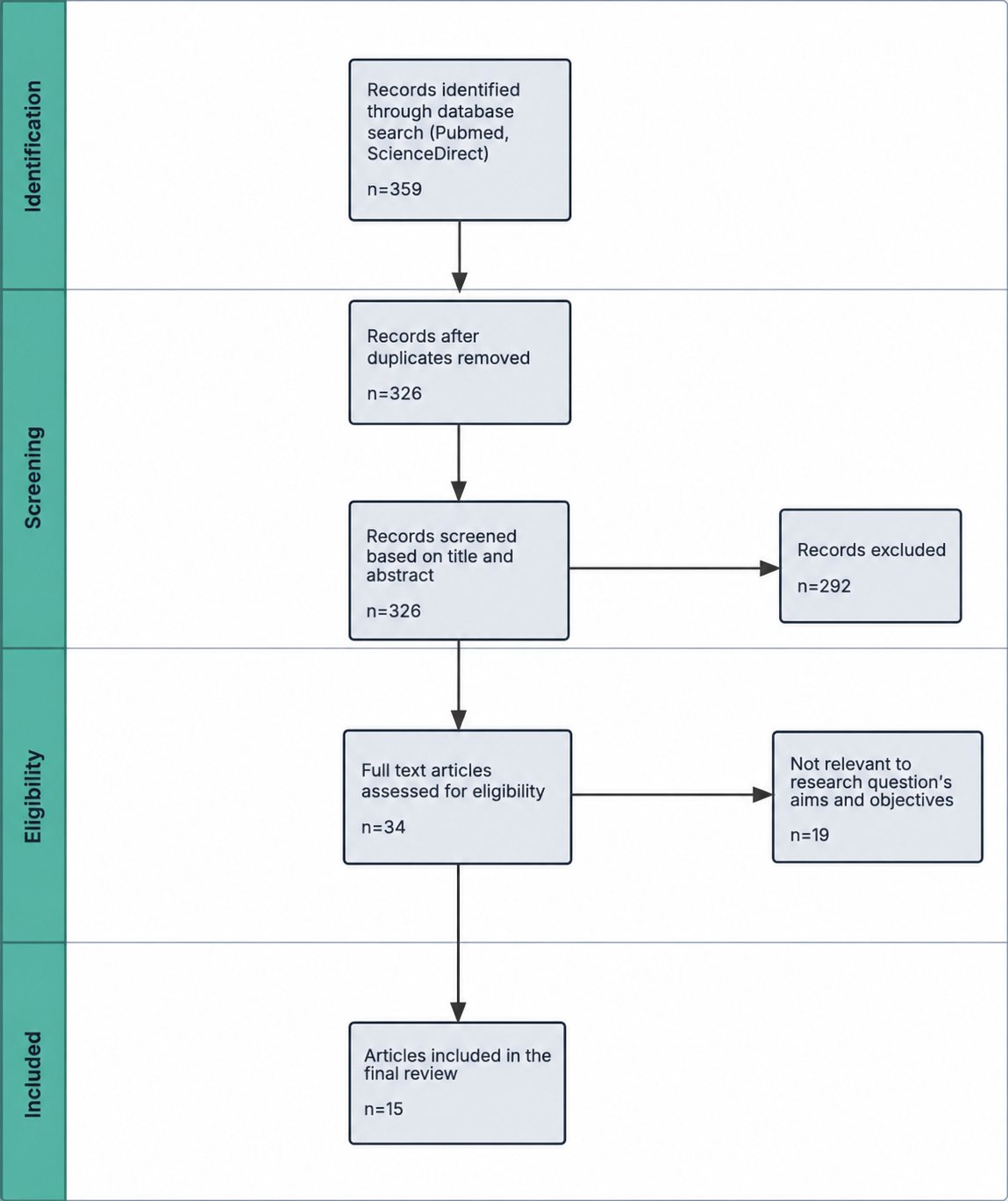
All fifteen studies used quantitative methodologies, including observational, experimental, and meta-analytic designs reporting statistical outcomes. Sample sizes ranged from 79 to 11,962,287, and in studies where exact ages were specified, participants’ ages ranged from 8 to 68. Combined, the studies included participants of virtually every race, in addition to both male and female participants; however, each study had at least some female participants in order to maintain the focus on risk factors in women.
In order to obtain this information, in addition to the measures of comorbidity, I manually extracted the data provided by each article to create a table, which can be seen below in the Results section. This table includes each article’s title, author, study type, sample size, demographics, conditions studied, and reported overlap/comorbidity.
Results
Eating behaviors and metabolic function
Included studies reported associations between eating disorders and ARFID and gastrointestinal or metabolic conditions, although the number and type of studies available varied by condition. Food allergies and gastrointestinal disorders were more frequently reported across included studies, while findings for diabetes and thyroid disorders were less frequently reported.
Several studies identified associations between eating disorders and food allergies. A study by Polloni et al. (2024) found that in a sample of 309 individuals over the age of 18, there was a positive correlation between ARFID and food allergies (p < 0.006)10. In addition, a case-control study by Fisher et al. (2014) found that in a sample of 98 ARFID patients ages 8-18, 4.1% had a food allergy6. Similarly, a study by Shanahan et al. (2015) found that in a sample of 1420 individuals ages 10-16, food allergy patients had a 2-2.4-fold higher AN risk than non-food allergy patients11.
Gastrointestinal disorders were reported across multiple studies, although outcome measures varied by study design and population. A meta-analysis by Goddard et al. (2025) found that in sample sizes ranging from 18 to 331,950, 13.6% of inflammatory bowel disease patients had eating disorder symptoms, 2.84% had a diagnosed eating disorder, and 17.1% screened positive for ARFID-related risks12. In addition, an observational study by Wang et al. (2014) found that in a sample of 260 female eating disorder patients ages 17-50, 83% of patients in the first cohort (n = 100) and 94% in the second cohort (n = 160) met criteria for at least one gastrointestinal disorder13. Similarly, a cross-sectional study by Burton-Murray et al. (2024) found that in a sample of 158 individuals ages 10-23, youth with ARFID had a higher chance of gastrointestinal disorders than youth without ARFID (37% versus 3%)14.
While literature relevant to my research question was limited in the cases of metabolic disorders, the existing published research generally supported associations with eating disorder risk. A systematic review and meta-analysis by Dean et al. (2024) found that in a sample of 9079 individuals, participants with type 1 diabetes mellitus had a 2.8-fold greater risk of BN, and a 1.5-fold greater risk of BED than participants without type 1 diabetes15. Similarly, a cross-sectional study by Presskreischer et al. (2022) found that in a sample of 11,962,287 Medicaid enrollees, participants with eating disorders had a higher risk of thyroid disorders (32.2% versus 19%)16.
Physical appearance
A clinical trial by Jebeile et al. (2024) found that in a sample of 141 obese (BMI ≥ 30) individuals ages 13-17, 12.1% met the criteria for either an eating disorder or depression17. Similarly, a cross-sectional analysis by AlTarrah et al. (2025) found that in a sample of 376 obese (BMI ≥ 30) individuals over the age of 18, 65.8% showed signs of eating disorder risk18. In addition, a randomized controlled trial by Berner et al. (2015) analyzing correlations between body image satisfaction and central fat deposition found that in a sample of 294 females ages 18.2 ± 0.4 and BMI 23.65 ± 2.88 kg/m², patients experienced lower body satisfaction with higher total body fat (r = -0.24, P < 0.01)19. Further, a clinical trial by Jackson et al. (2012) found that in a sample of 115 females who met the criteria for BED — 66.1% of which were obese (BMI ≥ 30) — individuals who experienced appearance teasing experienced higher weight concern and body dissatisfaction (r ≈ 0.19 and r ≈ 0.29, respectively)20.
A randomized controlled trial by Vannucci et al. (2014) found that in a sample of 468 individuals ages 8-17, participants experienced higher rates of disordered eating post-puberty (p ≤ 0.001)21. In addition, a cross-sectional study by Gonzalez-Juarez et al. (2007) found that in a sample of adolescents ages 12-18 attending secondary school in Leganés, Madrid, Spain, early menarche increased eating disorder risk (OR = 1.69)22. A later study found similar information, as a cross-sectional study by Melisse et al. (2025) found that in a sample of 585 females ages 16-68, early menarche increased eating disorder risk (R ≈ 0.12-0.26)23.
Discussion
This review examined associations between eating disorders and six select somatic comorbidities to evaluate evidence for non-environmental risk factors. The need to analyze somatic risk factors arises from the fact that environmental risk factors are difficult to measure or treat, while the six somatic comorbidities described in this review are widely medically recognized. Management of somatic conditions that co-occur with eating disorders may help reduce eating disorder symptom severity or consequent health burden.
Existing research consistently identified strong correlations between eating disorders and food allergies and gastrointestinal disorders. Across studies associating eating disorders with food allergies, multiple types of eating disorders are analyzed, strengthening the evidence that eating disorders overall are correlational to food allergies. However, correlations with gastrointestinal disorders were mostly found in ARFID, making correlations between gastrointestinal disorders and other eating disorders unclear.
Correlations between eating disorders, and diabetes and thyroid disorders, are far more tentative, as research regarding such correlations was limited. Still, the research identified in this paper indicates a correlation between eating disorders and both diabetes and thyroid disorders. However, the correlation between eating disorders and diabetes is especially tentative, as the research paper regarding this correlation focused on eating disorders and solely type 1 diabetes.
In addition, existing research consistently demonstrated correlations between eating disorders and obesity, although it is important to acknowledge that many of these correlations are implicit. For instance, in the case of the Jebeile et al. clinical trial, the percentage overlap was for both eating disorders and depression, meaning that the exact percent overlap of obesity and eating disorders is unknown. In addition, the Berner et al. trial addresses central fat deposition, rather than obesity directly, and body dissatisfaction, rather than eating disorders directly. However, through the study’s conclusion that higher body fat leads to higher body dissatisfaction, this relationship may reflect an association between the two. Further, while the Jackson et al. clinical trial analyzes the environmental factor of appearance teasing, individuals of higher weight are more likely to be targets of appearance teasing than individuals of lower weight, and weight concern and body dissatisfaction are personal rather than environmental, suggesting an association between higher weight and body dissatisfaction in the context of eating disorder symptoms.
Existing research consistently demonstrated correlations between eating disorders and pubertal changes. However, the Vannucci et al. trial analyzes eating disorders post-puberty, rather than post-precocious puberty, with the findings of this study suggesting puberty in general as an inevitable “risk factor” for eating disorders. Still, this study has been interpreted in the literature as potentially related to earlier pubertal timing and eating disorder risk, though direction cannot be confirmed from the included studies. Comorbidities between eating disorders and precocious puberty were found in the studies analyzing correlations between eating disorders and early menarche. However, these studies focus solely on the risk factor of early menarche rather than other precocious pubertal developments, making correlations between eating disorders and such other developments unclear.
It is important to acknowledge that the studies analyzed used different sample sizes, age ranges, and demographics, meaning that the strength of the evidence varies widely from study to study. It is also essential to recognize that the findings of these studies demonstrate correlationality, rather than causality. Based on the findings of these studies, it is equally possible for eating disorders to cause a given potential “risk factor,” rather than vice versa. Still, these studies show strong correlations between eating disorders and the given potential risk factors, indicating the possibility of an association that may vary in directionality.
Overall, these findings can be interpreted through a biopsychosocial framework of eating disorder development. Across the reviewed literature, the biological conditions of food allergies, gastrointestinal disorders, diabetes, and thyroid disorders, and the appearance-related factors of obesity and precocious puberty, all demonstrated associations with eating disorders through one’s psychological perceptions of food, their body, and their appearance. This framework may help explain why eating disorders are frequently comorbid with diverse medical and developmental conditions.
Limitations
The main limitation faced in this research project is a lack of papers to analyze. As further clinical research in eating disorders and their somatic risk factors is warranted, I was unable to find neat data to suggest a correlation or lack thereof between every type of previously specified eating disorder and every previously specified somatic condition.
Similarly, there were significant discrepancies between the number of papers per potential risk factor. For instance, there was ample research on eating disorder and obesity comorbidity, but limited research on eating disorder and thyroid disorder comorbidity. As a result, the data regarding comorbidity between eating disorders and conditions such as thyroid disorders is significantly more tentative than data regarding comorbidity between eating disorders and conditions such as obesity.
Conclusion
This review examined associations between eating disorders and selected potential physical risk factors. Across the reviewed literature, consistent associations were observed between eating disorders and several somatic conditions, especially food allergies and gastrointestinal disorders. However, much of the data was correlational, limiting conclusions about causality and directionality. These findings contribute to the increasing understanding that eating disorders are associated with a complex interaction of physical factors, rather than solely environmental influences. Still, further research is needed to clarify directionality regarding these relationships.
References
- C. G. Fairburn, B. T. Walsh. Atypical eating disorders (eating disorder not otherwise specified). Eating Disorders and Obesity: A Comprehensive Handbook. Vol. 2, pg. 171, 2002. [↩] [↩]
- J. Treasure, T. A. Duarte, U. Schmidt. Eating disorders: The big issue. The Lancet Psychiatry. Vol. 3, pg. 313–315, 2016. [↩]
- C. M. Bulik, L. Reba, A. Siega-Riz, T. Reichborn-Kjennerud. Anorexia nervosa: Definition, epidemiology, and cycle of risk. International Journal of Eating Disorders. Vol. 37, pg. S2–S9, 2005. https://doi.org/10.1002/eat.20107. [↩]
- American Psychiatric Association. Diagnostic and statistical manual of mental disorders (5th ed.). American Psychiatric Publishing, 2013. [↩]
- A. J. Stunkard. Eating patterns and obesity. Psychiatric Quarterly. Vol. 33, pg. 284–295, 1959. https://doi.org/10.1007/BF01529786. [↩]
- M. M. Fisher, D. S. Rosen, R. M. Ornstein, K. A. Mammel, D. K. Katzman, E. S. Rome, S. T. Callahan, J. Malizio, S. Kearney, B. T. Walsh. Characteristics of avoidant/restrictive food intake disorder in children and adolescents: A “new disorder” in DSM-5. Journal of Adolescent Health. Vol. 55, pg. 49–52, 2014. https://doi.org/10.1016/j.jadohealth.2013.11.013. [↩] [↩]
- S. E. Mazzeo, C. M. Bulik. Environmental and genetic risk factors for eating disorders: What the clinician needs to know. Child and Adolescent Psychiatric Clinics of North America. Vol. 18, pg. 67–82, 2009. https://doi.org/10.1016/j.chc.2008.07.003. [↩]
- G. L. Engel. The need for a new medical model: A challenge for biomedicine. Science. Vol. 196, pg. 129–136, 1977. https://doi.org/10.1126/science.847460. [↩]
- M. Dovjak, A. Kukec. Identification of health risk factors and their parameters. Creating healthy and sustainable buildings: An assessment of health risk factors. Springer, 2019. https://doi.org/10.1007/978-3-030-19412-3_3. [↩]
- L. Polloni, L. Ronconi, V. De Fazio, R. Bonaguro, F. Lazzarotto, A. Toniolo, R. Schiavo, A. Muraro. Avoidant/restrictive food intake disorder and food neophobia in adult patients with food allergy: A preliminary study. Nutrients. Vol. 18, pg. 913, 2026. https://doi.org/10.3390/nu18060913. [↩]
- L. Shanahan, N. Zucker, W. E. Copeland, E. J. Costello, A. Angold. Are children and adolescents with food allergies at increased risk for psychopathology? Journal of Psychosomatic Research. Vol. 77, pg. 468–473, 2014. https://doi.org/10.1016/j.jpsychores.2014.10.005. [↩]
- Q. Goddard, A. Markovinović, P. E. Ronksley, C. H. Seow, C. Ma, A. A. Shaheen, G. G. Kaplan. Meta-analysis: Prevalence of eating disorders in inflammatory bowel disease. Alimentary Pharmacology & Therapeutics. Vol. 63, pg. 603–615, 2026. https://doi.org/10.1111/apt.70492. [↩]
- X. Wang, G. M. Luscombe, C. Boyd, J. Kellow, S. Abraham. Functional gastrointestinal disorders in eating disorder patients: Altered distribution and predictors using ROME III compared to ROME II criteria. World Journal of Gastroenterology. Vol. 20, pg. 16293, 2014. https://doi.org/10.3748/wjg.v20.i43.16293. [↩]
- H. Burton-Murray, A. Sella, J. E. Gydus, M. Atkins, L. Palmer, M. Kuhnle, K. Becker, L. Breithaupt, K. Brigham, A. Aulinas, K. Staller, K. Eddy, M. Misra, N. Micali, J. Thomas, E. Lawson. Medical comorbidities, nutritional markers, and cardiovascular risk markers in youth with ARFID. International Journal of Eating Disorders. Vol. 57, pg. 11, 2024. https://doi.org/10.1002/eat.24243. [↩]
- Y. E. Dean, K. R. Motawea, M. Aslam, J. J. Loayza, M. Salam, P. Obed, A. Webster Donaldy, Z. Alqiqie, N. Sultana, A. M. Mohamed, T. Hashmi, M. S. Mohamed, M. W. Assal, N. M. Attia, H. Hagar, H. A. Abdelaziz, A. Subedi. Association between type 1 diabetes mellitus and eating disorders: A systematic review and meta-analysis. Endocrinology, Diabetes & Metabolism. Vol. 7, pg. 3, 2024. https://doi.org/10.1002/edm2.473. [↩]
- R. Presskreischer, J. E. Steinglass, K. E. Anderson. Eating disorders in the U.S. Medicare population. International Journal of Eating Disorders, 2022. https://doi.org/10.1002/eat.23676. [↩]
- H. Jebeile, L. A. Baur, C. Kwok, S. Alexander, J. Brown, C. E. Collins, C. T. Cowell, K. Day, S. P. Garnett, M. L. Gow, A. M. Grunseit, M. Henderson, E. T. House, M. K. Inkster, S. Lang, S. J. Paxton, H. Truby, K. A. Varady, N. B. Lister. Symptoms of depression, eating disorders, and binge eating in adolescents with obesity. JAMA Pediatrics, 2024. https://doi.org/10.1001/jamapediatrics.2024.2851. [↩]
- D. AlTarrah, L. Al-Abdullah, M. Alhusayan, D. Canha, S. Almazeedi, A. Al-Serri, M. Abulhasan, T. Alsomly, N. Almutawa, M. Al-Onaizi, G. Fagherazzi, F. Alzaid. Cross-sectional analysis of eating disorder risk and risk correlates in candidates for bariatric surgery from the BariPredict cohort. Scientific Reports. Vol. 15, pg. 1, 2025. https://doi.org/10.1038/s41598-025-95614-6. [↩]
- L. A. Berner, D. Arigo, L. E. Mayer, D. B. Sarwer, M. R. Lowe. Examination of central body fat deposition as a risk factor for loss-of-control eating. American Journal of Clinical Nutrition. Vol. 102, pg. 736–744, 2015. https://doi.org/10.3945/ajcn.115.107128. [↩]
- T. D. Jackson, C. M. Grilo, R. M. Masheb. Teasing history, onset of obesity, current eating disorder psychopathology, body dissatisfaction, and psychological functioning in binge eating disorder. Obesity Research. Vol. 8, pg. 451–458, 2000. https://doi.org/10.1038/oby.2000.56. [↩]
- A. Vannucci, M. Tanofsky-Kraff, L. M. Ranzenhofer, N. R. Kelly, L. M. Hannallah, C. K. Pickworth, M. V. Grygorenko, S. M. Brady, T. A. Condarco, M. Kozlosky, A. P. Demidowich, S. Z. Yanovski, L. B. Shomaker, J. A. Yanovski. Puberty and the manifestations of loss of control eating in children and adolescents. International Journal of Eating Disorders. Vol. 47, pg. 738–747, 2014. https://doi.org/10.1002/eat.22305. [↩]
- C. González-Juárez, E. Pérez-Pérez, B. Martín Cabrera, I. Mitja Pau, R. R. de Pablo, P. V. de la Torre Escalera. Detección de adolescentes en riesgo de presentar trastornos de la alimentación. Atención Primaria. Vol. 39, pg. 189–194, 2007. https://doi.org/10.1157/13100842. [↩]
- B. Melisse, E. Trujillo-ChiVacuan, D. L. Grange. Early menarche and body dissatisfaction in individuals with eating disorders: A modest but significant association. Eating Behaviors. Vol. 102021, 2025. https://doi.org/10.1016/j.eatbeh.2025.102021. [↩]