Abstract
Historically, the responsibility for archive creation has been held by individuals within centralized power structures. Their role has been to create, or curate, a collection of evidence that informs a consistent, linear national narrative with the aim of describing “truth”. However, in the 20th century, theorists began to challenge the assumption that a linear, consistent truth could be recorded and went further by arguing that the content of archives and official records merely reflects the views of those with power at that moment in time. In the digital age, the ability to record any form of information has led to more explicit conflict about the “truth” in linear, consistent narratives. This paper explores the need for a new approach to national record keeping and archives that reflects the growing challenge of determining what is true and what is worth recording in the age of rapidly advancing artificial intelligence and the consequences this has for digital memory ethics. Qualitative synthesis of frameworks suggested by Verne Harris and Jacques Derrida is used broadly to advocate for a polyphonic method of archiving. Specific, practical applications of the approach are beyond the scope of this paper, but the analysis concludes with a recommendation to apply the polyphonic method to better reflect the nature of digital information, the challenges and opportunities associated with artificial intelligence and the impossibility of creating a linear, neutral archive.
Keywords: archives, digital, Jacques Derrida, Verne Harris, polyphonic, misinformation
Introduction
Background and context
The oldest surviving archives, or “proto archives”, emerged in temple libraries in ancient cultures in the Near East and are dated to the third millennium BC. As populations increased due to the development of agriculture, a “need arose to organize and canonize the religious literature…the incantations, omens, prayers, scriptures, creation stories, genealogies of the gods, sacred laws, rituals, and songs” were archived to create consensus around what was orthodox and orthopraxy, or correct beliefs and correct conduct1. Although the practice of creating archives appears to have emerged in the Near East, the development of similar methods can be seen around the world in every type of literate community and society. Twentieth century philosophers, such as Verne Harris and Jacques Derrida challenged the mostly subliminal role of archiving in creating conformity and reinforcing existing power structures. Derrida claimed that “there is no political power without control of the archive”2. Professor Verne Harris, who leads the Memory Programme at the Nelson Mandela Foundation, wrote that archives are “those apparatuses of power and authority that determine who is in, and who is out, who gets heard and who does not, whose lives matter and whose don’t”3. As challenges to the traditional role of archiving have emerged, arguments have arisen about exactly what to include in archives and how varied and sometimes conflicting viewpoints should be reconciled with the aim of creating a trustworthy and factual archive.
The digitization of information and the proliferation of published opinion through technology such as social media and more recent developments such as artificial intelligence also challenge the idea that one centralized and coherent linear narrative can be created through an archive. When artificial intelligence has been used to inform decisions related to the content of archives, controversy has arisen with regard to factors such as reliability, bias, social justice, privacy, and consent4. Historically, the power associated with the control of archives, as identified by Harris and Derrida, was limited by the reach of written and verbal communication. However, today, the potential for centralized control of digital spaces and the design of artificial intelligence creates a threat to contradictory perspectives and voices. A gap has emerged between the desire for truth and repression of “fake news” and the profound insight of Verne and Derrida that truth has multiple perspectives. To avoid the propagation of simplistic and damaging truth v fake news narratives in the digital age, could Harris and Derrida’s insight into the benefits of polyphony in the archives should become the lens through which the general public understands their archives and a new foundation for digital ethics and archival practice is established?
Challenges to official narratives created through archiving and record keeping have intensified as information has been digitized and artificial intelligence has developed. Both have created greater awareness of the influence that centralized narratives have on power structures in societies. The rationale of this research is that a new philosophy of archive creation and maintenance needs to be developed. Although various philosophers and theorists have influenced academia and the creation of archives in contexts such as national libraries, the general public does not seem to have a deep awareness of the changes being made and the opportunities they create for more diverse and local community-perspectives to be included in the creation of polyphonic archives. Polyphony in this context means multiple perspectives describing reality, and society accepting differences between these perspectives even when they might seem to contradict each other. Polyphony creates layers of meaning and truth. This research aims to show polyphonic archiving can empower participants with diverse views to contribute to national record keeping. Developing a consensus on archiving and national record keeping is significant because of the polarization currently seen in societies around the world, especially democracies. A polyphonic approach to archiving could create agreement about various controversial subjects such as national identity and how it changes with high levels of immigration and reconciliation for periods of time or events that have not yet been addressed as matters of social justice.
The research uses the theoretical approach of Jacques Derrida to reforming archiving methodology. However, the broad approach to the philosophical debate means that practical application of the ideas in specific cultural and social contexts is not within the scope of the paper. Neither does the research attempt to understand current perspectives on archiving and national record keeping among the general public or openness to the changes that are suggested. These are limitations of the research, but could be areas for future research. However, various examples are used to show how a polyphonic approach has contributed to the creation of social cohesion in challenging contexts. The examples are illustrative of the potential for polyphonic archiving and rewriting to address concerns around degrading social cohesion in modern societies at a broader scale. Proving that the approach will work outside the specific contexts of these examples would be the focus of future research.
Theoretical Framework: Jacques Derrida
According to Derrida, the etymology of “archive’ can be connected back to the Greek word “arkheion”, which was “the residence of the superior magistrates, the archons, those who commanded”2. The etymology of the word archive reveals the connection to authority and power. For Derrida, archives or national records are not just attempts to create a true narrative that participants can rely on to learn about their past and their values. Instead, the archivists have the power to shape the narrative, and by shaping the narrative they become powerful. They choose what should be included and excluded based on their opinions and experiences or other influences, such as pressure from powerful or wealthy members of society who aim to perpetuate their power by shaping the narrative. Conversely, in a system which creates these kinds of cohesive, linear archives, participants with less power or ability to influence the narrative will not have their voices heard. As the ability to influence the archives is an effective tool of power, very few people have the opportunity to determine what is included and excluded and how the narrative is created. Most participants of a society that relies on this type of archive do not have their voices heard, and their opinions and experiences are lost. Historically, the control of the archive was much easier because it was physical. As shown by the etymology of the word, the archive contained texts and materials in a physical location that was guarded by those with power. Today, however, the digitization of information has changed the nature of archives as there is no longer a need to guard highly valued texts and materials with limited access. Anyone can access digital archives, at almost any time and in any place.
Derrida describes how archives shape transgenerational memory and that transgenerational has as “force and authority” that is like our ancestors speaking to us2. However, Derrida argues that the archive is not “dealing with the past” as if we want to understand the meaning of an archive, we have to understand that it is the “question of the future itself, the question of a response, of a promise and a responsibility for tomorrow”2. For many people an archive appears to be a connection to the past, but it’s more important role is to shape the future. Participants make decisions and judge values based on how they understand the archives and how create meaning. Using Derrida’s approach to archives reveals how they shape the world today. For example, Russia’s national record focuses on the defeat of Nazi Germany in World War II but ignores their pact with Nazi Germany early in the war and Russian atrocities committed against Eastern European civilian populations. The archive was shaped in this way to reinforce Stalin’s power, for Russians in 2025 the archive does not connect them to the past but informs their decisions about defeating Ukrainians, who they have labeled as a new form of Nazism5. When Derrida’s framework for reinterpreting archives as influences on the future, not as authentic descriptions of the past, the true importance of archives becomes apparent.
Professor Verne Harris used Derrida’s insights to shape how the archive of Nelson Mandela’s life would be created, and his approach can inform how a new polyphonic form of digital record keeping can become a tool of social cohesion and social justice without excluding perspectives that contradict each other. Professor Harris’s work shows that a linear, consistent narrative for archives and national record is not required for social cohesion, even if it were possible in the digital age. Harris uses Derrida’s framework to further explore how “in the archive, the whispers will always be heard of contexts undocumented, unknown or yet to be generated. Ghostly voices3. The ghostly voices are both the voices of ancestors and the unheard voices of people who could not shape or influence the archive. Derrida describes the same ghosts in the archive, but if the archive is a question of the future, the unheard voices have the potential to be found, included, and explored. If the archive is a fossilized, linear narrative, there is no potential for the ghost voices to be included. Harris further describes how archives can change to become more future focused and effectively “alive” with change and evolution. Harris stated that “Archives in the new archive are ever-opening, never fixed or closed, respecting story, inviting multiple stories, people in society will in turn be free from the meta-narratives of power”3.
Harris agrees with Derrida who stated that “The archive is never closed. It opens out of the future”3. In the digital age, the framework of Derrida, and Harris’s later developments, can be used to create an approach to archives and national records that allows multiple perspectives. This framework requires a change in perspective as participants will need to think about their archives as unreliable representations of the past but effective tools of informing the creation of meaning in the future. Derrida says that “The archive: if we want to know what this will have meant, we will only know in times to come2. To create a new philosophy of archives, participants should understand how their own experiences shape the meaning of the records of the past. Therefore, the meaning is only created in the present and future. If participants attempt to create a meaning that is based completely in the past, they will be creating a delusion, because the archive cannot provide access to the experience of the past in totality. There will always be gaps. Furthermore, the power structures that shapes the archives of the past will continue to influence the present and future if they are perceived as having value as unchangeable and providing direct access to some kind of truth from the past.
For a new philosophy of archives in the digital age, the framework created by Derrida and developed by Harris can be used to assess the challenges of archive creation such as attempting to find shared truth that contribute to social cohesion when various groups within a society have contradictory perspectives on their experiences and sometimes conflicting values.
To some extent, the approach has already been proved to work in specific circumstances. The island of Ireland comprised of Northern Ireland and the Republic of Ireland has experienced centuries of violent conflict rooted in religious division. A peace agreement signed in 1997 was founded on a polyphonic approach to the creation of an archive that would allow future generations to live in peace. In this context, polyphonic archiving became a process through which the population could move away from conflict, with a strong emphasis on the process that the communities that created the archive experienced as they gathered, recollected, and reinterpreted rather than valuing the concept of recording some form of static, objective “truth” that everyone could agree on6. In the context of Northern Ireland, although the term polyphonic is not used directly, research showed that the regular maintenance and updating of online oral archives, combined with instant access, facilitated the creation of a dynamic archive that engaged local communities and avoided the privileging or subsuming of marginalized voices7. Importantly, the process of polyphonic creation in Northern Ireland focused on process and participation, allowing people to have their voices heard in a form of “bottom-up community engagement”, which contrasts with the traditional concept of an archive that is a store of truth maintained by a centralized power8.
In the context of the United States, division and anger emerged around key events connected to racial injustice. In 2014, Michael Brown was shot and killed by a police officer in Ferguson, Missouri, leading to civil unrest. Narratives from the police around the killing created significant anger and contributed to violent protests. In response, Documenting Ferguson, a community-led archive was created, with contributors encouraged to submit video, images, audio, and their own narratives related to the events that followed the shooting. The demand for this type of polyphonic archive was assessed by researchers to be motivated by “humanitarian and altruistic values”, revealing that the archive was demanded and needed by the community who had rejected the narratives of the powerful institutions in their lives9. In 2015, Freddie Gray was killed by police officers in Baltimore, leading to massive violent protests. Similarly to the protests following the death of Michael Brown, the institutional response was to create a narrative from a centralized position of power, which marginalized community voices and led to demand for what has been described as a “participatory archive” of the events that occurred around the killing. The potential of polyphonic archiving to give the powerless a voice has been highlighted by research on how the experiences of black children during the riots have been effectively recorded as part of the creation of a participatory archive. Researchers have described the archive as “reflecting tensions between adult-centric narrative and youth-authored perspectives, structural power dynamics shaping black childhood, and the potential of participatory methods to challenge archival practices in the histories of black childhood”10.
Finally, probably the most ambitious large-scale at polyphonic archiving has emerged in India, with the People’s Archive or Rural India (PARI) describing itself as “a contemporary living journal covering the everyday stories of everyday people” that is a “living archive” of “833 million people…speaking close to 800 languages”11. PARI shows how polyphonic archives can create value beyond facilitating social cohesion by allowing marginalized communities to express themselves. Research has shown that the archive has become an invaluable resource on Traditional Ecological Knowledge (TEK), with the rural communities’ combined knowledge challenging the “dominant climate discourses, particularly in mainstream media” which “often adopt technocratic and universalizing approaches that prioritize urban, elite, and state-sanctioned perspectives”12. Some have argued that PARI has become a form of alternative media that competes with the commercialized media system that dominates narrative creation in India and can be understood as another form of centralized narrative and archive creation that emerges from monopolized power and wealth and marginalizes various communities in India12.
Assessing the success of the polyphonic approach to archiving can be challenging due to the complex variables in contexts such as peach in Northern Ireland, institutional racial injustice in the United States, and representation of rural voices across India. However, the examples provided show that there is strong demand for the approach from communities around the world, and the effort and time that communities commit to the process shows that the communities value the effects they experience when creating and maintaining this form of archive.
Methods
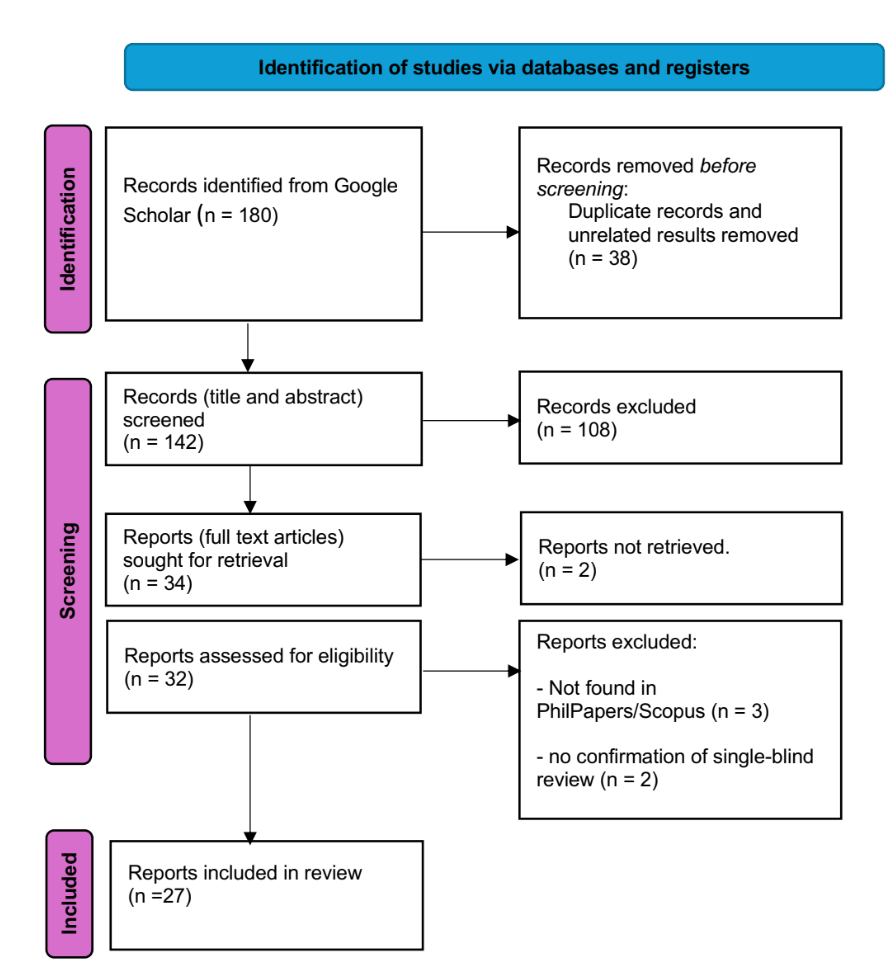
The PRISMA 2020 Checklist was used to create a transparent review process. The description of the philosophical positions was sourced from seminal works by the philosophers. Initial searches will be conducted on Google scholar. The key words used for the Google Scholar search will be: “archives”, “digital”, “polyphonic”, “misinformation”, “oral”. “community”. “cohesion”. Only peer-reviewed journals and commentary from respected academics within the field of philosophy of archiving, national record keeping, and the impact of digitization on these processes were included. Any papers on the influence of digitization from before 2020 will be excluded, as the emergence of artificial intelligence has made a lot of commentary on the pre-AI influence of digitization redundant. Research which is not published in at least single-blind peer reviewed academic journals will be excluded. After selection through Google Scholar, searches of the indexes Scopus and PhilPapers will be conducted. Research that was not indexed on at least one was excluded. Books that are not published by academic or university presses with transparent editorial and peer review standards accessible online will also be excluded. Subjects such as social understanding and opinion on archiving and national records are outside the scope of this paper, so the results of survey and interview research on the subject will be excluded. The information collected on the digitization of archives, conflict over national narratives and how they should be recorded or presented, and factors such as reliability, bias, social justice, privacy, and consent are synthesized through the insights of Derrida and Harris.
Results
In the early 21st century, when mass digitization of archives became viable, some scholars argued that archives would become redundant as a means of creating national narratives: “some key aspects of the digital present…do not follow national boundaries and, indeed, erode them. If national archives were part of the projects of state-building and nationalism, then why should states support post-national digital archives?”13. However, as digitization increased, the debate has shifted towards awareness of the role of digitization in the creation of the “imagined nation” which: “is still of paramount importance as a focal point around which the construction of memory and identity, as well as struggles for the past, coalesce and play out”14. Fundamentally, the imagined nation emerges bottom-up from the minds of the community which, in the context of polyphonic archives, is an ongoing process of maintenance and adaptation to suit future needs.
Digitization appears to facilitate “small, local efforts” that reflect “a long tradition of bottom-up preservation”14. However, before digitization the efforts of small groups created local physical archives that had limited exposure to wider audiences. With digitization, the role of archiving in creating a narrative historical events and intersecting concepts such as national identity has become open to anyone with an internet connection and the ability to attract attention. The creation of narratives has a powerful effect on the perception of reality, with psychological research showing that false memories can be created from fake news that “reflects positively” on the narrative a person has created or absorbed about themselves15. Although archivists can attempt to create a definitive narrative, even if it contains multiple perspectives, the nature of digital culture also means that masses of content and commentary compete for attention in varied forms such as Instagram’s 24-hour stories. Research has shown there is a “tension between ephemeral content and archive cultures” which “raise epistemological and ethical concerns about the collection, analysis and archival of ephemeral content”16. Concerns about the ephemeral nature of archives created in digital spaces seem to be based on an anxiety about the loss of clarity that an idealized, static archive offers.
In contrast to physical records, which offer more permanence, Koulouris, argues digital existence is a form of “UnBeing” which is defined as a metaphor for the “reality of a world in which people, politics, culture, and technology are utterly enmeshed”17. Koulouris argues that the digital record does not have the physical existence of traditional archives and creates these forms of UnBeing, which can be interpreted as anxiety about the apparently chaotic and often undefinable content produced when billions of people can create their own digital spaces. Traditional archives are physical collections with gaps full of “ghosts,” or unheard voices as described by Derrida, whereas digital archives have no physical presence and offer only a confusing mix of multiple perspectives with no solid truth. In practical terms, when someone interprets a physical archive, they feel in touch with the reality of the physical object. The narrative around the object is shaped by power structures. With digital archives, there is no reality to touch. There is no final “object” that is created and defined for the archive. As a thought experiment, Koulouris asked whether people would have a better understanding of an individual’s reality, views, and experiences if all of an individual’s digital content were archived. The thought experiment shows how the digital archive can overwhelm with information.
However, such arguments fail to consider the prioritizing of the process of archiving over the creation of a finalized archive, and examples such as the community oral archives in Northern Ireland show that the ephemeral and sometimes overwhelming nature of a multitude of voices is not an obstacle to creating the feeling of belonging and being heard that polyphonic archives can offer18. In particular, the process of creating oral digital archives combines the benefits of mass participation and offering the participants a sense that they are contributing to the creation of their community. The search for an objective truth in archives becomes irrelevant when the aim of the archive is the continuous process of speaking, listening, and collecting knowledge, with the participation itself becoming the aim.
Foucault described how attempts at archiving to offer accurate views of the past will always fail because even with physical archives, the meaning of reality is based in discourse that is comprised of “linguistic sequences that…in sheer size, exceed the capacities of recording, memory, or reading”19. In other words, the attempt to create archives as transparent windows to the past that can inform understanding of experiences such as national and personal identity will fail and cause confusion. The confusion is caused because archives cannot create an objective narrative that everyone will agree on. By nature, archives are fragmented and full of unheard voices, as argued by Derrida. Polyphonic archives, in contrast, become a tool for participation and when people talk in the way that is necessary for polyphonic archive production, they naturally tend to think about the future and even past crises can become foundation for constructive future-oriented discussion and behavior20.
The process of digitization has been described as “democratizing the doing of history”21. Technological developments allow individuals and small groups to create their own archives, independently of a centralised power. This is the major difference between pre-digital archives and digital archiving. One of the challenges of this change has been the integration of multiple voices and perspectives into a unified narrative that performs the role of pre-digital archives in creating social cohesion and shared values. The value of the digital democratization of archives is that “the lives of marginalized people…reside in spaces outside traditional academic and government institutions”22. However, even if marginalized voices and perspectives are digitized, it does not necessarily mean that these narratives are automatically included in the central national narrative or identity narrative of a place or time. Participants will give meaning to the archives and narratives that fit their pre-existing views, as described earlier. Therefore, democratization of archives requires more than only the facilitation of new archives through digital processes. Without integration into a new philosophical approach to the core national and identity narratives of participants, new archives will not have a significant impact. The opportunity to create them through digitization and provide easier access is only a first step.
The development of digitization has been connected to the “alignment of diverse ideologies onto a single spectrum”23. The alignment onto one spectrum creates a feeling of there only being two sides to a debate and a sense that one side must defeat the other. The over-simplification of narratives into two competing opponents contradicts the claims of archivists who argue that digitization has become a force for democratization. Faced with many views and perspectives, debates around history, national identity, and other related subjects descend into confused and basic tribalism24. Instead of democratization, the multitude of voices is leading to what has been called an “infocracy”, in which “processing by algorithms and artificial intelligence have a decisive influence on social, economic, and political processes”25. From this perspective, the fragmentation of narratives around archives leads to the need for information curation, otherwise the total amount of information will become overwhelming. The processes of curation would then become the forms of control, mirroring the way in which the original, physical archives had gatekeepers who would allow or prevent access and shape narratives in this way. However, this criticism loses force when the aim of archives is changed from creating something everyone can agree on to facilitating engagement in a process that is ongoing and values debate and contradiction. It is through this process that communities will realize their shared values are not based on superficial agreements about what did or did not happen in the past. Instead, cohesion will be created by sharing a respect for the process of debate and discussion about truth at the same time as accepting that there will never be a final, objective truth that everyone agrees with.
The traditional aim of archivists has been to choose what is included and excluded from archives, but digitization means that everything can be included. In this sense, the archive as an artifact becomes meaningless, but the process of contributing to a dynamic archive becomes polyphonic because everyone, from small local community groups and individuals on social media up to large international organizations, can cheaply and quickly archive anything with algorithms and artificial intelligence. Archivists today still focus on the “critical concerns” of “documenting” as: “History, memory, knowledge, and data; transparency accountability, and trust; inclusion, repair, disruption; affect, and imaginaries26. These critical concerns can be best addressed with a polyphonic process that engages as broadly as possible.
Discussion
The systematic review has revealed that, in contrast to the expectation that digitalization of archives would democratize the process, the response of participants has been to coalesce around simplified narratives, which leads to polarization and mistrust. With a core official linear narrative, there was an imbalance of power caused by control over the archive, but participants in general had a consistent and reliable, generally agreed-upon narrative that was easier to deal with than the multitudinous cacophony. This finding requires a paradigm shift in the understanding of the aims of creating archives. In the digital age, if the aim of archiving continues to be the creation of a linear, widely accepted narrative for social cohesion, the result will be further confusion and disharmony because a single narrative cannot please everyone.
Instead, as shown by the example of Northern Ireland, the aim of archiving should become the process by which as many people as possible have their views heard. The value is created in the individual’s feeling that they are contributing to the debate on their imagined nation. When the voice of the individual is valued in this way, it seems likely that the same value will be placed on others’ voices. Accepting the uncertain and often chaotic nature of events and the way in which they produce infinite possible interpretations and perspectives means giving up the desire for the delusional comfort of a linear, single-voiced, and widely accepted narrative.
The objective of the research was to explore how polyphonic archiving facilitated by digitalization could lead to fairer power dynamics in narratives related to concepts like history and identity. The research shows that despite the expected benefits of polyphonic voices in the creation of archives and narratives around them, the focus on the past and how it connects to identity could be a cause of the polarization that is weakening democracies around the world. The digitization of archives therefore seems to facilitate polyphony but also conflict when the aim of archives forces people to fight over what will become the one “true” narrative. The conflict is exacerbated by the use of attention as a metric for the success of algorithms and artificial intelligence online, which means narratives become oversimplified and tribalized.
However, participants do not need to agree on the meaning and narratives of the past to create a cohesive democratic society. Historically, the centralized, physical archive acted as an anchor that allowed participants to share a common narrative of their national story and shared identity. In the digital age, archives should not be valued for their ability to create this type of narrow story and identity in society. With multicultural societies in the digital age, this simple approach to national storytelling cannot succeed. Instead, archives should become a tool for creating a sense of participation in the national story and sense of identity. Digital oral archives seem particularly suited to this process as people can experience their voices being heard and listen to the voices of others. The process of creating oral histories has been shown to have powerful therapeutic effects27.
The question, then, is how can policy be developed to ensure that archives contribute to solving the confusion and polarization caused by the fragmentation of the digital age? They cannot go back to being the authoritative source of national or personal identity because digitization has destroyed the gatekeeper role. Any attempt to recreate it will fail as the diversity of narratives that have emerged are often contradictory and cannot be forced into one coherent, centralized form.
Archives can be the solution to polarization; however, it is only possible if policy makers realize the value of archives is in the never-ending process of creation and becoming future-oriented instead of trying to create a linear, cohesive narrative of the past. Centralized archives, such as national records, should become forward-looking and include artifacts and discourse from the fragmented and diverse voices that inform the debate on the future of national and personal identity.
Future research could focus on how centralized archives, such as national records, can become open to community engagement focused on the future. Instead of thinking the archives can somehow be corrupted by untruths, all voices should be heard. The narratives that describe the past can be created bottom-up by communities and smaller, local groups, as it is their responsibility to create and understand the narratives of identity in their community and how they fit into the future-oriented larger scale of identities and narratives of nations and humanity as a whole.
Digitization has democratized the creation and curation of archives, especially centralized archives like national records. However, the process has contributed to the intense polarization of modern democracies, as traditional certainties about identity and history have been challenged. The fragmentation of the process is irreversible, so centralized archives like national records need to have their role and purpose redefined. The prioritization of recording oral histories, to capture as many voices as possible, and an emphasis on the process and engagement with the creation of archives as a tool for making individuals feel part of their communities, should become the basis for archival policy.
References
- D.S. Porcaro. Sacred libraries and temples of the Near East. Studia Antiqua. 2. 63-70 (2002). [↩]
- J. Derrida. Archive Fever: A Freudian Impression. Diacritics. 25. 9-63 (1995). [↩] [↩] [↩] [↩] [↩]
- V. Harris. Ghosts of Archive: Deconstructive Intersectionality and Praxis. Routledge. (2020). [↩] [↩] [↩] [↩]
- S. Mannheimer, N. Bond, S.W.H. Young, H.S. Kettler, A. Marcus, S.K. Slipher, J.A. Clark, Y. Shorish, D. Rossman, B. Sheehey. Responsible AI practice in libraries and archives. Information Technology and Libraries. 43. (2024). [↩]
- M. Kramer. Russia is repeating its brutal history in Ukraine. https://daviscenter.fas.harvard.edu/insights/russia-repeating-its-brutal-history-ukraine (2022). [↩]
- A, Jeffers. Recollecting and re-collecting: the ethical challenges of social archiving in post-conflict Northern Ireland. Theatre history and historiography: ethics, evidence, and truth. 147-162 (2016). [↩]
- S.D. McQuaid. Passive archives or storages for action? Storytelling projects in Northern Ireland. Irish Political Studies 31, 63-85. (2016). [↩]
- E. Kinder. Non-recurrence, reconciliation, and transitional justice: situating accountability in Northern Ireland’s oral archive history. Beyond evidence: the use of archives in transitional justice. 5-27 (2022). [↩]
- C. Freeland. K. Atiso. Determining users’ motivations to participate in online community archives: a preliminary study of documenting ferguson. Proceedings of the Association for Information Science and Technology. 52. 1-4. (2015). [↩]
- A.B. Ruffin. Black childhood in focus: counter-histories of black urban childhood in preserve the Baltimore uprising, a 21st century participatory archive. University of Louisville. (2025). https://ir.library.louisville.edu/etd/4535/ [↩]
- P. Sainath. Many Worlds, One Website. People’s archive of rural India. (2025). https://ruralindiaonline.org/en/article/many-worlds-one-website-en [↩]
- P. Chamroy. People’s archive of rural India as alternative media. Media Asia. 50 (3). 333-354. (2021). [↩] [↩]
- R. Rosenzweig. Scarcity or abundance? Preserving the past in the digital era. The American Historical Review. 108. 735-762. (2003). [↩]
- G. Zaagsma. Digital history and the politics of digitization. Digital Scholarship in the Humanities. 38. 830-851. (2022). [↩] [↩]
- T. Delaney, L. Castillo, M.A. Friehs, B. Buttlar, C.M. Greene. Us versus them: the role of national identity in the formation of false memories for fake news. Journal of Experimental Psychology: Applied. 30. 33-47 (2024). [↩]
- L. Bainotti, A. Caliandro, A. Gandini. From archive cultures to ephemeral content, and back: studying Instagram stories with digital methods. New Media and Society. 23. 3656-3676. (2021). [↩]
- T. Koulouris. Prolegomena to the study of the digital being: Jacques Derrida and the UnBeing. Derrida Today. 18. 162-180. (2025). [↩]
- S.D. McQuaid. Passive archives or storages for action? Storytelling projects in Northern Ireland. Irish Political Studies 31, 63-85. 2016,
[↩]
- M. Foucault. The Archaeology of Knowledge and the Discourse on Language. Pantheon Books. (1972). [↩]
- S.M. Hall. Oral histories and futures: researching crises across the life-course and the life-course of crises. Area. 56(1). 1-9. (2022). [↩]
- C.M. Bolick. Digital Archives: Democratizing the doing of history. International Journal of Social Education. 21. 122-134. (2006). [↩]
- M. Caswell, C. Harter, B. Jules. Diversifying the digital historical record: integrating community archives in national strategies for access to digital cultural heritage. The Magazine of Digital Library Research. 23. (2017). [↩]
- K.J. Leyva. Polarization in the digital age: democracy at a crossroads. https://politicsrights.com/polarization-in-the-digital-age/ (2023). [↩]
- B. Cova, L. Dessart. Socializing and finding your tribe in the digital age. The Routledge Handbook of Digital Consumption. (2022). [↩]
- B. Han. Infocracy: Digitalization and the Crisis of Democracy. Wiley. (2022).
[↩]
- A.J. Gilliland. Archives and Emotions: International Dialogues Across Past, Present, and Future. Bloomsbury. (2024). [↩]
- W. Baum. Therapeutic Value of Oral History. The International Journal of Aging and Human Development. 12. (1981). [↩]