Abstract
This study investigates altering a section of primordial code, PRyMordial, to observe the effect on the abundances of light elements, specifically of helium-4 and deuterium. PRyMordial simulates the first few seconds after the Big Bang, with many parameters to separately analyze how each factor affects various aspects of the theory. By altering the code, we identified a range of values of neutrino chemical potential (NCP) that relieve the tension between the observed and theoretical abundances. We hypothesized that the values of the NCP would be relatively close to zero, suggesting that there lies minimal asymmetry between neutrinos and antineutrinos. By running PRyMordial several times, the theoretical values were collected and input into our code to produce a graph with the x-axis as NCP and the y-axis as the element abundance. Both graphs have horizontal lines representing the true values for the light elements. The data points are the theoretical values connected by a continuous line, and the intersection of this line and the bar of observed abundances was used to reveal the range of values for NCP. Following the Big Bang, NCP played a prominent role in the formation of the first elements by helping protons convert to neutrons and vice versa. By allowing the conversions to occur, this sets up the correct ratio of the particles, ultimately paving the way for Big Bang Nucleosynthesis (BBN). Because the majority of neutrons end up in helium-4, both the n:p ratio and the NCP directly affect the light element abundances.
Keywords: Big Bang Nucleosynthesis, neutrino, antineutrino, n:p ratio
Introduction
Although the events that took place in the early universe occurred 13.8 billion years ago, their effects remain relevant today. ΛCDM, the standard theory of cosmology, explains the origin of the universe and the formation of its primordial elements. However, questions persist regarding the formation of these elements created during Big Bang Nucleosynthesis (BBN). One second after the Big Bang occurred, BBN began. BBN is the process in which nuclei of the lightest elements were formed: deuterium, helium, and lithium1. BBN is important because cosmology directly supports ΛCDM with the abundances of the formed elements2. One way we can study BBN is by altering certain parameters such as the neutron lifetime and masses of particles like protons and neutrons while using existing understanding of cosmology to evaluate the impact on the primordial light-element abundances3.
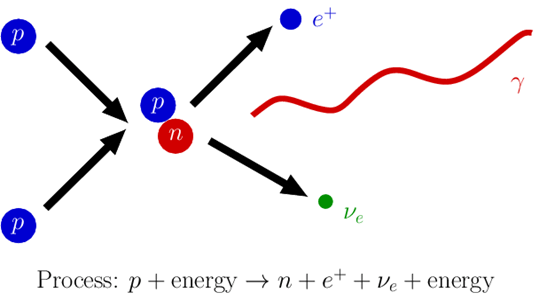
Note: The p in the figure stands for proton, n is a neutron, e+ stands for positron, and ve refers to an electron neutrino
Neutrinos are subatomic particles that subtly influence our current universe. Despite their weak interactions, they played a large role in forming the first elements by driving neutron-proton conversions. These conversions directly affect which elements were formed and in what amounts. A parameter in the theory that influences the abundances of these elements is the neutrino chemical potential (NCP). NCP refers to a thermodynamic quantity that tells us how much energy is needed to add a neutrino to a system. In simple models, including our current Big Bang model, NCP is fixed to zero. However, NCP becomes significant when neutrinos decouple during universe expansion, revealing the imbalance between neutrinos and antineutrinos and the energy they carry4. All matter particles have an antimatter counterpart, which has equal mass to the matter particle but possesses an opposite charge; for example, positrons are the antimatter particles of electrons, which explains why electrons have a negative charge while positrons have a positive charge; however, they each have a mass equal to 9.11 × 10–³¹ kilograms5. Neutrinos and antineutrinos differ from other subatomic particles. While both do not have an electric charge, neutrinos and antineutrinos participate in weak processes differently, leading to asymmetries in proton-neutron conversion rates assuming a nonzero NCP.
According to these equations, representing proton/neutron conversions,
(1) 
 = neutron,
  = neutrino,
  = proton,
  = electron
(2) 
= proton,  = antineutrino, = neutron,
  = positron increasing the value of NCP would mean there are more neutrinos than antineutrinos, subsequently favoring the production of protons over neutrons. This is because neutrinos help convert neutrons to protons6.
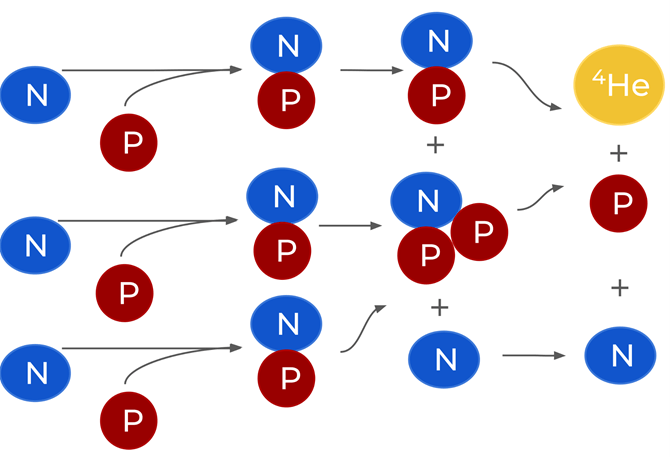
deuterium atoms (one proton and one neutron)
According to Equations 1 and 27, in addition to Figure 2, a higher neutrino chemical potential leads to a lower number of neutrons available for the formation of deuterium and helium-4, ultimately lowering the light element nuclei production.
As conveyed by the ideas associated with BBN, the visible matter in the universe consists of roughly 75% hydrogen and its isotopes, 25% helium, and trace amounts of other elements. Based on the ideas related to ΛCDM, the theory predicts that the origin of these elements was fostered by the early universe’s hot and dense environment. The conditions of the environment enhanced neutrino production, ultimately increasing the neutron to proton ratio during the big bang nucleosynthesis8.
There are several publicly available codes that implement the standard BBN model, including PArthENoPE and PRIMAT. These codes are used to calculate the abundances of light elements during BBN given some set cosmological parameters and nuclear reaction rates.
This study utilizes the Python code PRyMordial to investigate the effect of varying the NCP on the abundances of these elements. Similar research regarding light elements was conducted at University of Minnesota, where they found minimal uncertainty in the neutron mean life and studied how it impacted the formation of light elements during the BBN, specifically on helium-41. Despite successfully studying various primary parameters of BBN, that study neglected the role of NCP, as they assumed it to equal zero in all cases, the consequences of which this study explicitly aims to test.
Methods
In this simulation-based study, the Python package PRyMordial, provided and developed by our mentor, Anne-Katherine, simulates primordial element production and calculates the values of the primordial light-element abundances created during the universe’s beginning 9,10. For the initial inputs into the PRyMordial package simulation, weak interaction rates were a key nuclear reaction which occurred during the freeze-out, a brief moment in time when the ratio of numbers of protons to number of neutrons was set11. Prior to the freeze-out, protons were converting to neutrons and vice-versa. The weak reaction rates encompass three reactions between protons, neutrons, and antineutrinos. Neutron lifetime is a parameter for the weak rate, controlling the decay of neutrons seconds before the BBN12. Another fundamental reaction was the thermonuclear reaction rate which represented the likelihood of a successful reaction. It includes roughly twelve to eighteen reactions within the input.
PRyMordial was chosen due to its several benefits that are not addressed in alternative packages. The most notable is its accuracy regarding neutrino decoupling. Other models simulate the process as instantaneous whereas PRyMordial harnesses physics to accurately reproduce the BBN. Additionally, PRyMordial accounts for the uncertainties of the event, leading to more forgiving marginalization within its calculations. Other publicly available codes like PArthENoPE and PRIMAT are written in programming languages which are less comprehensible now. PArthENoPE is written in FORTRAN and PRIMAT is written in Mathematica. Antiquity prevents these codes from computing vast amounts of information efficiently. There are no additional reactions in PRyMordial as compared to other modeling packages but, a key distinction is rather that PRyMordial elevates existing nuclear reactions by focusing on the preciseness of its features, one being weak rates. In order to assess the validation of the PRyMordial package, the authors ran the code to check for inconsistencies and compared their outputs with reliable publications. They ensured their calculations for neutrino decoupling, for example, matched the Standard model value which is approximately 3.04413. Finally, they evaluated their code with other models such as PArthENoPE and PRIMAT to make sure there was no variability in outputs, particularly the element abundances.
The package was developed from scientific theories, which leads to approximations and assumptions. The observable universe being homogenous is a widely accepted principle, allowing the uncharted areas of space to be delineated. Furthermore, the baryon-to-photon ratio is constant during the BBN because it overarched the process. NCP was also assumed to be approximately zero as a result of the minimal lepton asymmetry. When scientists calculate the abundances, they use a spectrometer to detect atomic particles and translate the information from the machine to then evaluate the data in the form of a stick diagram. To be practical, we used the code to calculate the amounts of deuterium and helium-4 primordial abundances using input values of a BBN parameter.
The code has many parameters such as particle masses like electrons and interaction strengths of different particles with each other that can be used to study the effect of varying these parameters on the primordial element abundances during the formation of the universe.
| Parameter | Symbol | Specific Effect on Abundance |
| Baryon Density |  | Directly proportional to the rate of nuclear collisions which increases helium-4 due to less time for neutron decaying and decreases the deuterium abundance because these collisions consume deuterium at faster rates14. |
| Expansion Rate |  (Neutrino species) (Neutrino species) | Increasing the neutrino species speeds up the rate at which the universe expands which leaves less time for neutrons to decay before being taken in helium, leading to a higher helium-4 abundance. |
| Weak Interaction | rates | Aids the proton-to-neutron conversion. Once these conversion processes stop, the ratio of the number of protons to the number of neutrons is set. If the rates were even weaker, there would be more neutrons which increase the helium abundance. |
| Particle Masses | Electron Mass  | The mass of the electron determines when e± pairs contribute their energy into photon baths, which releases entropy and changes the cooling rate of the universe, consequently affecting when the elements could begin forming. |
| Nuclear Rates |  | Deuterium traps protons to convert into helium-3. This reaction rapidly destroys deuterium by facilitating these conversions. PRyMordial tests the ways uncertainties in this specific rate affect our predictions compared to actual observations. |
In our study, we focused on NCP as the parameter of interest and harnessed PRyMordial to vary NCP in order to calculate the region of parameter space that results in the correct element abundance for both helium-4 and deuterium. These elements have many observations as compared to helium-3 and lithium-7, but the uncertainties are significantly higher, so data for both elements are considered to be less reliable.
To analyze the effect of changing the NCP, the independent variable, we separately plot the abundances of deuterium and helium-4 for different inputs of NCP on a graph. We also display a horizontal band representing the observed range of element abundances on the graph, revealing the theoretical range of values of NCP that caused the observed and theoretical values to match. By analyzing the linear plots, we were able to deduce the result of modifying the NCP during BBN. Our first step was to acquire the standard theory values of the primordial abundances, by running the code without modifications, with the default value of NCP being zero.
| Parameter / Abundance | Symbol | Standard Theory Value |
| Baryon Density |  | 0.02237 |
| Neutrino Species | | 3.044 |
| Neutron Lifetime |  | 879.4s |
| Helium-4 Mass Fraction | Yp | 0.247 |
| Deuterium Abundance | D/H | 2.52×10⁻⁵ |
This is because, in the early universe, there was not much opportunity for neutrinos to participate in significant interactions that would cause an asymmetry. In relation to particle physics, symmetry supports the shift on which particle interactions occur between neutrons and protons which directly affects the neutron to proton ratio as introduced above. Then, we altered the NCP and recorded the helium-4 and deuterium values, the dependent variables.
Next, we created a code to plot the data consisting of values that we had stored from earlier and the observed values, using Python and Matplotlib. There is one band for the observed value of deuterium and two for helium-4, which comes from two different sources, the ElectroMagnetic Processes with Reliable Error Simulation and Synthesis (EMPRESS) collaboration15 and the Particle Data Group (PDG)16. The PDG is the historically accepted collection of particle data. The EMPRESS collaboration was done in 2022 and is based on different observational samples and methodologies, prompting its inclusion in addition to PDG values. The abundance values of the PDG do not create any tension between observed and theory values because its observed elemental abundance matches the theory NCP value of zero, while the values from EMPRESS do cause tension. The scientific rationale for including EMPRESS was because its initial Helium-4 abundance is reportedly lower than PDGs, introducing an extensive range of potential parameters for the line of best fit. It must therefore be suitable for both baseline values despite deviations. For this purpose, it was necessary to include both. After running both of them, we noticed where the line and band(s) intersected which indicates the values of NCP that relieve the tension.
Results
In this investigation, we aimed to probe the effect of varying NCP values on the primordial light element abundances, helium-4 and deuterium1. In the case of helium-4, the values of NCP relieving the tension point to a greater number of neutrinos than antineutrinos. It is clear from the plots that a higher neutrino chemical potential leads to lower abundance values. As observed in the graphs, the same value of NCP cannot resolve both tensions of helium-4 and deuterium simultaneously.
between theoretical and observed element abundances
between theoretical and observed element abundances
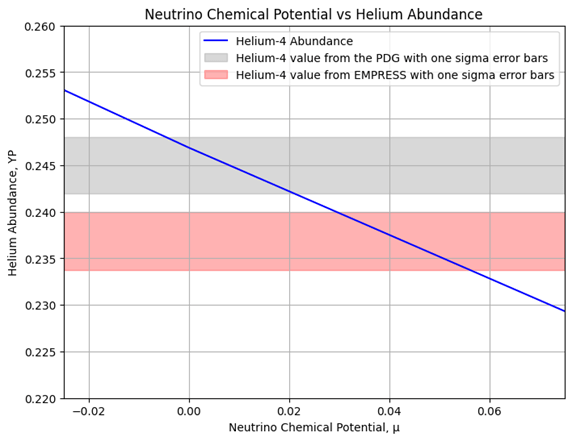
The resulting plots show that an increase in neutrino chemical potential leads to a decrease in both helium-4 and deuterium abundances.
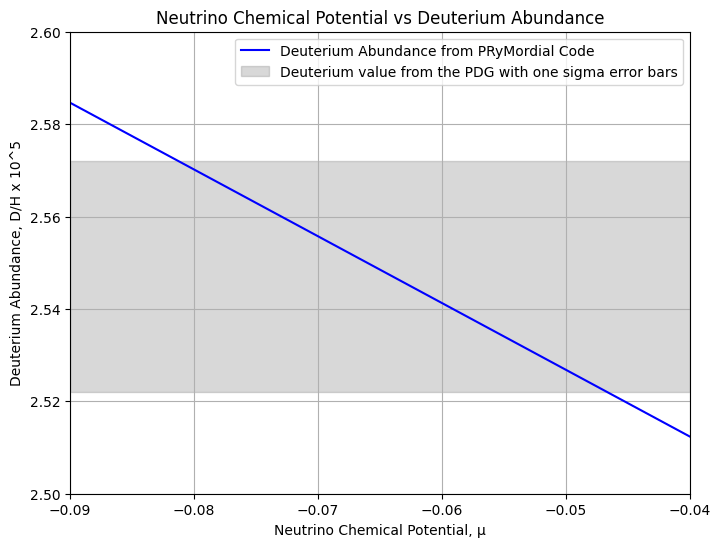
In our deuterium abundance graph (Figure 3), the observed value of deuterium is provided by the PDG. The resulting deuterium abundance value from the PDG with one sigma error bars remains exactly the same for all values of NCP in the deuterium abundance graph. This is in part because the deuterium value was measured using a telescope, an observational calculation. Only the theoretical values, the data points produced by the simulation, depend on NCP, but the ones observed were pre-recorded, so we are displaying both a fixed empirical value and fluctuating theoretical value on the graph. The differences between the PRyMordial predictions and observed PDG values come from the role neutrinos play in the universe’s energy, which affects how quickly the universe expands and when the n:p conversions stop. Other reasons for the discrepancy involve the empirical value being faulty because of the systematic uncertainties which arise from the method.
D/H is the value used to discuss the abundance of deuterium and gives information for the number of deuterium atoms for every one of hydrogen. Our finding was that the NCP should have a value from -0.08 to -0.043 to relieve the tension between observed and theoretical values of deuterium abundance. Similar to how the sigma error bar for the deuterium graph was constant, the bar for helium-4 remains constant as well because it is a fixed value. In addition, our primary objective is to analyze where the line of theoretical points and horizontal bars intersect. If they both were adjusted, we wouldn’t be provided a definite interval of values for NCP. The reason behind the sources of the marked differences for the deuterium graph hold true for the helium-4 one as well.
Yp, the mass fraction for helium-4, represents helium-4 element abundance. In other words, it tells us the fraction of our early universe that was composed of helium-4. Using our helium-4 plot (Figure 4) and the values from the PDG, we discovered that the NCP values relieving the tension were bound from -0.005 to 0.02. According to the data from the EMPRESS collaboration, the values of NCP could range from 0.03 to 0.05517.
Escudero et al. (2023) determined the NCP ranges by performing a BBN+CMB analysis using both EMPRESS helium measurements and PDG abundances, finding that NCP values derived from EMPRESS observations must fit within the range 0.043±0.015and NCP values derived from PDG values must fit within the range 0.008±0.013818. Our inferred values are consistent with these findings and fall within their allowed values.
We included two bars on account of the values from the EMPRESS collaboration that differed from the PDG. The reasoning for the difference can be deduced by the pool of data both EMPRESS and PDG sampled from. EMPRESS focused on extremely-metal poor galaxies whereas PDG targeted metal-poor galaxies which contain higher elemental content. Because stars and metals produce helium simultaneously, EMPRESS based their helium-4 value off a sample with low metallicity, resulting in a lower helium-4 value19. The additional helium in the galaxies PDG studied led to a higher helium-4 value. Figures 3 and 4 compared to other BBN models such as PArthENoPE and PRIMAT would share a similar negative trend, since the neutrinos’ influence on the process depends on the duration of the hubble expansion rate, dictating when the freeze-out terminates. However, key differences exist. Misaligned calculation on the primordial abundances parameters, relying on the probability of particle collisions, baryon-to-photon ratio, and neutrino lifetime can cause a shift either up or down of the line, as they are crucial in determining the elemental abundances. As for the horizontal bars, they will remain the same because as mentioned previously, observational values are fixed. Positive values of NCP indicate that there are more neutrinos than antineutrinos at this time, and negative values mean more antineutrinos. A higher positive or lower negative NCP value points to a larger asymmetry; there is a larger gap between the amount of matter versus antimatter when NCP is farther from zero.
Discussion
This research project has given us insight into the universe’s environment at the beginning of BBN. Revisiting our objective, we established a range of NCP values that satisfied the light-element abundances, particularly of deuterium and helium-41. By inputting values of NCP in the Python code PRyMordial to observe its effect on the element abundances, we could see its trajectory and confine where this line meets the observed values of the element abundances. We identified three intersections between abundance potential graphs and observational abundance ranges: deuterium with its PDG range, helium-4 with its PDG range, and helium-4 with its EMPRESS range. These intersections allowed us to determine the range of NCP values consistent with both observed abundances and abundance potential predictions, providing insight into early universe thermodynamics. Although not discussed initially, there are inevitably uncertainties in the modeling package. One of the major sources of error is the probability of particles colliding, which is experimentally tested in a lab. The environment of these labs don’t offer the exact energy levels as the theoretical collision, in fact they are normally higher which overlooks the ability to acquire precise data which the simulation relies on. An inconsistency in the input of data leads to a miscalculated elemental abundance. The neutron lifetime is directly related to the elemental abundance as well because it determines the neutron-to-proton ratio. A lack of neutrons leads to less product, so shortening or lengthening the span of its life can significantly shift the elemental output. Moreover, PRyMordial’s use of reserved reactions can limit its ability to calculate elements with more metallicity but fortunately, helium-4 and Deuterium are not heavier elements. In figures 3 and 4, the regions where the blue theoretical calculations intersect the data extrapolated from cosmological observations are where our model agrees with them. However, it is important to note that this is only true for the ranges of NCP highlighted above for both the helium-4 and Deuterium graph. Including both the PDG and EMPRESS bars for our helium abundance graph adds another layer which introduces tension because both observed values reveal a marked difference.
Our calculated range of NCP values is relatively close to zero, implying limited asymmetry existed in the number of neutrinos to antineutrinos which is relevant as it explains why matter was so much more abundant than antimatter during the Big Bang. This is close to what we expected because the theory value of NCP is zero. Our results indicate that small, nonzero values of NCP are consistent with observational abundances, suggesting that mild lepton asymmetry still maintains true with current observations. Our value relieves tensions between theoretical and observed abundances, providing a range of NCP values which are more consistent. This explains and induces further investigation about other matter-antimatter asymmetries, such as lepton and baryon asymmetries. Since the previous evidence stated there is negligible lepton asymmetry, our research suggests that there does exist asymmetry, particularly by the NCP being slightly further from zero. Only focusing on one parameter limited the accuracy of our results because other factors played a role. The PRyMordial modeling results offered more precise values by matching it to observational measurements. This is partly owed to the simulation being more accurate in its neutrino decoupling, as it is not instantaneous. Still, there remains uncertainty for the observed values because it relies on certain parameters such as neutron lifetime and reaction rates, so it is essentially yielding error due to human’s inability to simulate everything perfectly. The margin of error for the sigma bars is larger than the theoretical values which suggest less precision.
In the Introduction section, we mentioned similar research conducted by the University of Minnesota. To equate, our study was focused on the NCP to determine the abundance of helium-4 and deuterium while their input of choice was the neutron lifetime and specifically the effect of its minimal uncertainty on helium-4. Besides, we aimed to find a range of NCP values that relieved the statistical tension between two sources, EMPRESS and PDG. Their study resulted in the theoretical and observational value being in accord. On the other side, their work was used to confirm our resulting downward trend of helium-4 and deuterium abundances.
Since we have studied the theory value of NCP, existing at thermal equilibrium, potential future research could explore the alternate side, the non-zero NCP caused by uneven lepton asymmetry. The imbalance could impact an aspect of particle physics, flavor oscillations which contribute to neutrino decoupling and ultimately, affect the abundance of light elements.
An additional BBN parameter that could be explored is the neutron-to-proton ratio20. NCP directly affects the n:p ratio because of the proton/neutron conversion equations (Equations 1 & 2 listed in the Introduction). This interaction makes NCP and the n:p ratio two of the most crucial parameters in BBN. As stated before, a higher NCP favors more proton production, while a lower NCP favors neutron production. Thus, our current research on NCP would support a further investigation of the n:p ratio, obtaining results that can be compared to our current findings.
Acknowledgements
We would like to acknowledge our mentor, Anne-Katherine, who has been mentoring us for the past several months. She has been there to guide and support us through this journey. With her advice and knowledge, we became educated about Big Bang Nucleosynthesis and the first moments of the universe. Additionally, she has provided the primary code for our research which has helped us reach our conclusions for this paper. Her commitment and mindset have enabled us to be curious and to embrace and overcome obstacles along the way. We admire the hard work she has put into the project and hope to work with her in the future.
References
- R. H. Cyburt, B. D. Fields, K. A. Olive, and T.-H. Yeh. Big bang nucleosynthesis: Present status. Reviews of Modern Physics. 88, 015004 (2016). [↩] [↩] [↩] [↩]
- D. Romano, M. Tosi, F. Matteucci, C. Chiappini. Light element evolution resulting from WMAP data. Mon Not R Astron Soc. 346, 295–303 (2003). https://doi.org/10.1046/j.1365-2966.2003.07083.x. [↩]
- M. Gerbino, E. Grohs, M. Lattanzi, K. N. Abazajian, N. Blinov, T. Brinckmann, M.-C. Chen, Z. Djurcic, P. Du, M. Escudero, S. Hagstotz, K. J. Kelly, C. S. Lorenz, M. Loverde, P. Martínez-Miravé, O. Mena, J. Meyers, W. C. Pettus, N. Saviano, and A. M. Suliga. Synergy between cosmological and laboratory searches in neutrino physics. Physics of the Dark Universe. 42, 101333 (2023). [↩]
- Elementary particles and the laws of physics: The 1986 Dirac memorial lectures. Internet Archive (2019). https://archive.org/details/elementarypartic0000feyn. [↩]
- S. Weinberg. The quantum theory of fields. Cambridge University Press (1995). Retrieved from https://archive.org/details/quantumtheoryoff00stev (2025). [↩]
- INSPIRE. Inspirehep.net. https://inspirehep.net/literature/2090806 (2025). [↩]
- D. Kirilova, M. Panayotova, and E. Chizhov. Big bang nucleosynthesis constraints and indications for beyond standard model neutrino physics. Symmetry. 16, 53 (2023). [↩]
- S. Reddy, G. Shen. Collaborative research: Neutrinos & nucleosynthesis in hot dense matter (Report No. DOE/SC0008028). Institute for Nuclear Theory, University of Washington. Submitted to the Nuclear Physics Division, Office of Science, U.S. Department of Energy (2013). https://www.osti.gov/servlets/purl/1092060. [↩]
- A.-K. Burns, T. M. P. Tait, and M. Valli. PRyMordial: The first three minutes, within and beyond the standard model. European Physical Journal C. 84, 86 (2024). [↩]
- A.-K. Burns. Unveiling the cosmos: Insights from big bang nucleosynthesis, dark matter modeling, and studies in quantum gravity. https://escholarship.org/uc/item/5ks3q31m (2024). [↩]
- E. W. Kolb, M. S. Turner. The early universe (2nd ed.). Westview Press (2025). [↩]
- T. H. Yeh, K. A. Olive, B. D. Fields. The neutron means life and big bang nucleosynthesis. Universe. 9, 183 (2023). https://doi.org/10.3390/universe9040183. [↩]
- I. Esteban, M. C. Gonzalez-Garcia, M. Maltoni, T. Schwetz, and A. Zhou. The fate of hints: Updated global analysis of three-flavor neutrino oscillations. Journal of High Energy Physics. 2020, 178 (2020). [↩]
- A. Ade, N. Aghanim, M. Arnaud, M. Ashdown, J. Aumont, C. Baccigalupi, A. J. Banday, R. B. Barreiro, J. G. Bartlett, N. Bartolo, E. Battaner, R. Battye, K. Benabed, A. Benoît, A. Benoit-Lévy, J.-P. Bernard, M. Bersanelli, P. Bielewicz, J. J. Bock, and A. Bonaldi. Planck 2015 results. Astronomy & Astrophysics. 594, A13 (2016). [↩]
- A. Matsumoto, M. Ouchi, K. Nakajima, M. Kawasaki, K. Murai, K. Motohara, Y. Harikane, Y. Ono, K. Kushibiki, S. Koyama, S. Aoyama, M. Konishi, H. Takahashi, Y. Isobe, H. Umeda, Y. Sugahara, M. Onodera, K. Nagamine, H. Kusakabe, and Y. Hirai. EMPRESS. VIII. A new determination of primordial He abundance with extremely metal-poor galaxies: A suggestion of the lepton asymmetry and implications for the Hubble tension. The Astrophysical Journal. 941, 167 (2022). [↩]
- B. D. Fields, P. Molaro, and S. Sarkar. Big bang nucleosynthesis. In: R. L. Workman et al. (Particle Data Group). Review of Particle Physics. Progress of Theoretical and Experimental Physics. 2024, 083C01 (2024). [↩]
- A. Matsumoto, M. Ouchi, K. Nakajima, M. Kawasaki, K. Murai, K. Motohara, Y. Harikane, Y. Ono, K. Kushibiki, S. Koyama, S. Aoyama, M. Konishi, H. Takahashi, Y. Isobe, H. Umeda, Y. Sugahara, M. Onodera, K. Nagamine, H. Kusakabe, and Y. Hirai. EMPRESS. VIII. A new determination of primordial He abundance with extremely metal-poor galaxies: A suggestion of the lepton asymmetry and implications for the Hubble tension. The Astrophysical Journal. 941, 167 (2022). [↩]
- M. Escudero, A. Ibarra, and V. Maura. Primordial lepton asymmetries in the precision cosmology era: Current status and future sensitivities from BBN and the CMB. arXiv:2208.03201 [hep-ph]. https://doi.org/10.48550/arXiv.2208.03201 (2022). [↩]
- G. Meynet. Astronomy & astrophysics: A journal of astronomers for astronomers. Astrophysics and Space Science Library. 273, 283 (2007). [↩]
- S. Chang, S. Ganguly, T. H. Jung, T.-S. Park, and C. S. Shin. Constraining MeV to 10 GeV majorons by big bang nucleosynthesis. Physical Review D. 110, 015019 (2024). [↩]