Abstract
Due to the ongoing depletion of fossil fuels and the mounting interest in minimizing greenhouse gas emissions, studies on alternative fuels for internal combustion engines have received significant attention. Ammonia has emerged as a candidate because it is carbon-free, has a high energy density per volume, and has an established infrastructure for production and storage worldwide. This paper is a secondary analysis of published experimental data on the thermal efficiency of ammonia-diesel dual-fuel engines at varying Ammonia Energy Share (AES). Thermal efficiency was determined from experimental mass flow rate measurements of diesel and ammonia across nine operating conditions, varying the ammonia energy share from 0 percent to 84.16 percent. The findings indicate a gradual increase in thermal efficiency from 32.16% to 37.68% as the ammonia contribution increases. These values are comparable with the efficiency ranges reported for conventional internal combustion engines under certain operating conditions. Nevertheless, the fact that ammonia is difficult to ignite, has a slow flame speed, and has higher nitrogen oxide emissions (according to other studies, but these have not been thoroughly analysed in this research paper) remains an important challenge. The objective of this paper is to present a concise theoretical background, elaborate on the methodology, and explicitly calculate efficiency using secondary analysis of published experimental data. The paper is currently nearing journal submission.
Literature Review
Several researchers have investigated ammonia as a fuel and its possible use as an alternative to conventional fuels. Ammonia contains no carbon in its molecule, and therefore, it does not release carbon dioxide directly. But it has various disadvantages as well. It has a slow flame speed, releases nitrogen oxides, and consumes higher ignition energy. This shows that ammonia is not a self-sufficient fuel. This led to an alternative field of research in ammonia-diesel dual fuel engines.1
One of the earliest studies on ammonia was done by Zamfirescu and Dincer (2009); they identified ammonia as a carbon-free fuel and a hydrogen carrier. They demonstrated ammonia’s high energy density, ease of storage as compared to hydrogen, and its potential use in future transportation systems and as an alternative to conventional fuels. But they also mentioned a few challenges regarding combustion characteristics and emissions, such as the NOx gases they emit.2
Kobayashi et al. (2019) also provided a detailed overview of ammonia as a fuel. Here, they reported that ammonia has a lower flame speed than that of other conventional fuels. The research paper concluded that either ammonia requires very high temperatures or the use of a pilot fuel to speed up the process of combustion. The review also highlighted a significant issue about the excessive harmful gases, nitrogen oxides (NOx), being produced by ammonia.3
Recent research papers have shown the rapid advancement of ammonia-diesel dual-fuel engines. For effective combustion, different ammonia injection strategies were also investigated, which included intake-port injection, low-pressure direct injection (LPDI), and high-pressure direct injection (HPDI). These injection systems influence air-fuel mixing, ignition delay, duration of combustion, and thermal efficiency. Intake-port injection is simple to implement as compared to others and is mainly used in most experimental setups, whereas direct injection systems improve combustion performance at higher ammonia energy share but require more complex fuel delivery systems.4
Nadimi et al. (2023) also experimentally investigated the effects of substitution of ammonia in an ammonia-diesel dual fuel engine. The study examined ammonia energy share from 0% to 84.2% and reported that with an increase in ammonia energy share, it reduces carbon dioxide and other particulate matter emissions. In contrast, with increasing ammonia energy share, the NOx emissions also increase.5
Although there are many research papers that have investigated combustion behaviour, ignition characteristics, and engine performance. Very few have calculated the actual thermal efficiency of ammonia-diesel engines with varying ammonia energy share from experimentally calculated datasets. The present study is completely different, as it is a secondary analysis of experimental data to calculate the brake thermal efficiency using different ammonia energy shares with a consistent methodology. It also mentions the general thermal efficiency of other engines like hydrogen, diesel, petrol, natural gas, and electrical vehicles to get an overview of where ammonia engines stand and their potential as a future source of energy in vehicles. Thus, the research gives an educational yet systematic analysis of the performance of an ammonia diesel dual-fuel engine, considering that emissions and combustion need to be measured experimentally.
Introduction
Energy Demand and the Alternative Fuel Requirement
The society in the present day heavily relies on internal combustion engines in transportation, power, and industrial use. Most of these engines use fossil fuels like diesel and gasoline, which have not been found to be renewable and contain high carbon content. These fuels burn and emit a lot of carbon dioxide (CO 2), which is a cause of global warming and climate change. Moreover, the availability of fossil fuels is limited, and this has also raised the issue of energy security in the long term.6
An alternative has been suggested in the form of electric cars to cut down on the emission levels, but their expensive nature at the time of purchase, absence of widespread charging systems, and reliance on rare materials render them less reachable, particularly in third-world economies. This necessitates a high desire to consider alternative fuels that can be incorporated in the existing engine technologies with a minimum of restructuring.7
Ammonia as an Alternative Fuel
Ammonia (NH3) has been considered as a possible alternative fuel owing to a number of favourable characteristics.8 It does not have any carbon atoms, implying that its burning does not directly release carbon dioxide.9 It is possible to produce ammonia with the help of renewable energy sources, store it as a liquid under moderate pressure, and then deliver it through the existing infrastructure that has been developed in the fertilizer industry.10
Also, ammonia has a high-octane rating, meaning that it can endure high compression ratios without pre-ignition. This makes it appropriate in compression ignition engines in combination with pilot fuel like diesel11.
Although these are the benefits, ammonia also has a number of challenges. It ignites slowly, burns slowly, and has small flammability limits.12 In normal engines, these characteristics make it tricky to burn pure ammonia. Moreover, burning of the ammonia may produce more nitrogen oxides (NO[x]) gases that are injurious pollutants.13 Consequently, most realistic designs of ammonia engines currently make use of the dual fuel policy, in which a minor quantity of diesel is combusted to induce combustion.14
Ammonia-Diesel Dual Fuel Engines.
Ammonia-diesel dual fuel engines rely on diesel as a source of ignition, as it has a low ignition temperature, and on the ammonia, which provides a large fraction of the total energy input. The proportion of ammonia is sometimes given as the Ammonia Energy Share (AES), which is a percentage of the total energy of a chemical supplied by ammonia.
Different types of engines have been researched in the literature, such as intake port injection, low-pressure direct injection (LPDI), and high-pressure direct injection (HPDI).4 These settings vary in reference to the injection timing, mixing of fuel and air, and the combustion properties. The work done in the past indicated that enhancing AES can mostly decrease the level of carbon-based emissions but may also have a different impact on efficiency and the formation of nitrogen oxides.15
Objective of the Study
This research aims to analyze the thermal efficiency of an ammonia-diesel dual fuel engine over a series of ammonia energy shares through experimental data on fuel flow rates and power output rates. This paper will evaluate the ability of ammonia-based engines to reach the same efficiency levels as traditional internal combustion engines by directly determining the thermal efficiency of each of the operating conditions.
Theoretical Background
Thermal Performance of Internal Combustion Engines.
Thermal efficiency is used in the measurement of how well an engine uses the chemical energy of fuel to produce useful mechanical work. It is the ratio of the power produced by the engine to the chemical energy rate of fuel consumption:
The thermal efficiency calculated in the study is the brake thermal efficiency, as the power output values reported in the dataset represent the brake power measured using a dynamometer. Indicated thermal efficiency (ITE) could not be calculated as indicated power and in-cylinder work values were not reported in the study. The Lower Heating Value (LHV) of diesel and ammonia was assumed to remain constant for calculation purposes. There would be slight variations in the LHV value under different operating conditions, but constant literature values are assumed so that efficiency under different values of AES can be compared.
An increase in thermal efficiency implies the increased use of the energy in the fuel.16
Lower Heating Value (LHV)
The heating value defines the chemical energy content of a fuel. The Lower Heating Value (LHV) is the amount of energy released through combustion without the latent heat of vaporization of water. LHV is usually applied in the calculation of engine efficiency since, during combustion, the water that is generated usually escapes the engine in the form of vapor.
For this study:
Such values are derived from known literature17.
The power input in the dual-fuel engines
The total power input is the sum of the energy contributions of each of the fuels in a dual-fuel engine:
where:
 is the rate of mass flow of the fuel.
Methodology
Experimental Setup
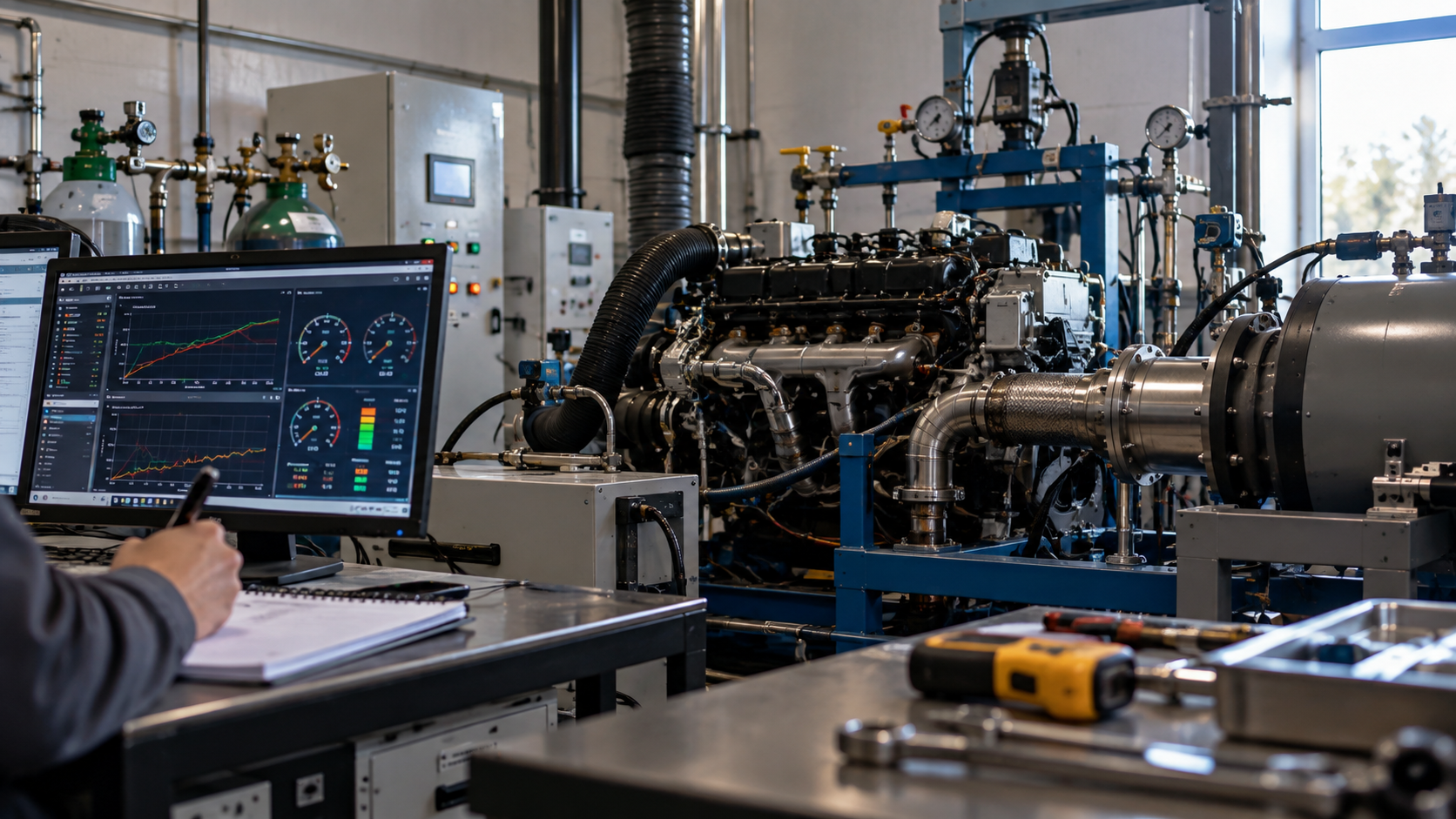
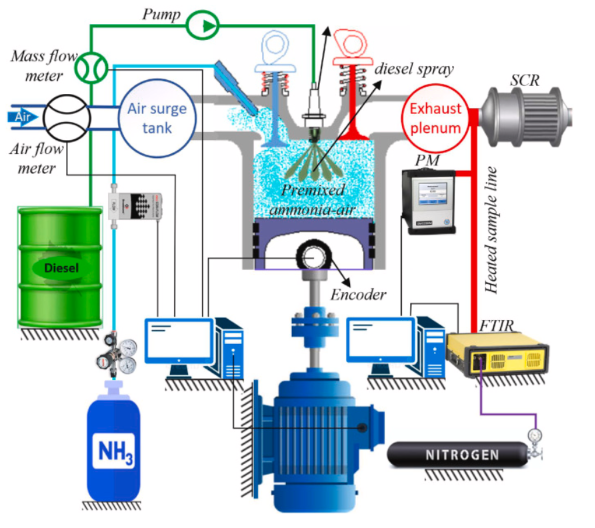
All the experiments were conducted in a single-cylinder, four-stroke, Lifan diesel engine. These were retrofitted for ammonia port injection. The engine had a bore of 86mm, a stroke of 70mm, and a geometric compression ratio of 16.5:1. Ammonia had been stored within the cylinder at a pressure of 10 bars but was injected at a pressure of 2 bars. The mass flow rate of ammonia was measured by a Coriolis flow meter. Cylinder pressure was recorded using a piezoelectric transducer with a resolution of 1024 data points per crankshaft revolution, and measurements were averaged over 100 consecutive engine cycles. An electric meter dynamometer was used to control the engine load and rotational speed. Exhaust gas composition was measured using a Gasmet DX4000 Fourier Transform Infrared (FTIR) analyser. The rotational speed of the engine was 1200 rpm under full load conditions with the power output regulated to a small range between 2.95 kW and 3.06 kW. The temperature of the port varied with AES. As the ammonia percent increased, a smaller temperature was required to combust the mixture.
| Engine Info. | Valves | Units |
| Engine model | 4 strokes, Lifan | – |
| Bore and stroke | 86×70 | mm |
| Geometric CR | 16.5:1 | |
| Maximum Power (3500rpm) | 6.4 | kW |
| Conn. Rod length | 117.5 | mm |
| IVO | 14° | BTDC |
| IVC | 45° | ABDC |
| EVO | 50° | BBDC |
| EVC | 16° | ATDC |
| SOI | -15.5 | BTDC |
| Injection Pressure | 200 | bar |
| Instrument | Purpose | Accuracy/Precision |
| Coriolis flow meter | Ammonia mass flow measurement | Not reported |
| Turbine flow meter | Air mass flow measurement | Not reported |
| Piezoelectric pressure transducer | Cylinder pressure measurement | 1024 points/revolution |
| Gasmet DX4000 FTIR | Exhaust gas analysis | ±2% |
| SMG200M | Particulate matter measurement | ±3% |
| Electric dynamometer | Engine load and speed control | Not reported |
Measurement quality
The experimental measurements used were obtained using calibrated instrumentation as in the source publication. Cylinder pressure measurements were averaged at around 100 consecutive engine cycles to reduce cycle-to-cycle variation. Instrument accuracies are summarised in Table 2. The original study does not report the replicate counts for the remaining measurements or the ambient laboratory conditions. Therefore, no additional assumptions have been made in the present secondary analysis.
Experimental Data
This study is based on a secondary analysis of experimental data reported in previously published literature. In the source study, ammonia was added through the intake port injection, whereas diesel was used as a pilot fuel for enhanced combustion. The information utilized in this research is the mass flow rates of diesel and ammonia, measured power output, and the power input calculated in nine working conditions characterized by various ammonia energy shares. The engine power output was kept at levels of approximately 3 kW so that an efficient comparison with various fuel compositions could be done. The source dataset contained 9 operating points, each with a different AES and diesel composition.
A schematic diagram of detailed instrument specifications is provided in the original study. Since this is a secondary analysis, the measurement ranges and accuracy are not reproduced here. The experimental data used in the study were obtained under engine operating conditions where the speed was maintained at 1200 rpm using an electric dynamometer. Across the nine operating conditions, the brake power remained between 2.95kW and 3.06kW while the ammonia energy share varied. The small variation in brake power indicates that all nine operating conditions were calculated under similar loading conditions, allowing the influence of ammonia energy share on brake thermal efficiency to be examined. The original study does not describe the control strategy used to maintain the brake power, and hence no assumptions are made in this study as well.
In the source experiment, the testing was done at a fixed engine speed of 1200 rpm at full engine load since ammonia has a low flame speed and needs fairly high ignition energy to burn successfully. At this engine operational point, the observed brake power ranged between 2.95 kW and 3.06 kW across all nine engine operational points. Therefore, the current secondary analysis was done based on this engine operational point instead of choosing another engine load.
Procedure for the Calculation of Efficiency
At all operating conditions:
- The mass flow rate of diesel and ammonia was measured.
- The LHVs of ammonia and diesel were used to compute power input.
- The calculation of thermal efficiency was determined in terms of power output to power input.
- The Power Output of ammonia engines has a very small range from 2.95kW to 3.06kW. This ensures that the effect of Ammonia Energy Share (AES) on thermal efficiency could be examined while minimizing the effect of load variation.
Sample Calculation
All the operating conditions were calculated in a similar way.18
Since the lower heating values are expressed in MJ/kg, all measured mass flow rates (g/s) were converted to kg/s prior to the calculation of power input.
Uncertainty Analysis
Brake Power output and mass flow rates were calculated by another researcher. There is not much information about the uncertainty in their values, but even a small change in their value will cause a change in the efficiency of ammonia engines. Moreover, uncertainty in the values of efficiency might also arise from keeping LHV constant, which may vary slightly due to operating conditions, and cause certain uncertainties in the value of efficiency. Though the uncertainties involved in all these components were not mentioned in the original source, the use of professional instruments in the research suggests that the calculated thermal efficiency values are sufficiently reliable for identifying overall trends.19
Results
The efficiency of ammonia engines generally ranges from 32.16% to 37.68%, depending on different ammonia energy shares (AES). On the other hand, the efficiency of diesel engines usually ranges from 30% to 45%20, while the efficiency of petroleum engines typically ranges from 25% to 35%.21. The calculated efficiencies fall within ranges reported for conventional internal combustion engines under certain operating conditions. Considering other cleaner fuels, hydrogen engines have an efficiency range of 35% to 40%22, and natural gas engines have an efficiency between 30% and 40%, which indicates that they have an efficiency on par with other cleaner fuels under certain operating conditions. Although electric cars have an efficiency of 85% to 95%, they tend to be expensive to purchase.23 Therefore, ammonia engines could offer a great alternative if ammonia could be produced at lower costs.
The computed thermal efficiencies are presented in Table 1.
| S. No. | AES(%) | M˙diesel(g/s) | M˙NH3(g/s) | Power Output(kW) | Power Input(kW) | Efficiency(%) |
| 1 | 0 | 0.22 | 0 | 3 | 9.328 | 32.16 |
| 2 | 14.9 | 0.186 | 0.074 | 3.05 | 9.2628 | 32.93 |
| 3 | 27.94 | 0.152 | 0.135 | 3 | 8.9558 | 33.49 |
| 4 | 35.85 | 0.127 | 0.162 | 2.95 | 8.398 | 35.12 |
| 5 | 47.44 | 0.103 | 0.212 | 3 | 8.3104 | 36.1 |
| 6 | 54.81 | 0.09 | 0.249 | 3.06 | 8.4474 | 36.22 |
| 7 | 61.62 | 0.076 | 0.279 | 3.06 | 8.4118 | 36.38 |
| 8 | 78.73 | 0.04 | 0.338 | 2.98 | 7.9828 | 37.33 |
| 9 | 84.16 | 0.03 | 0.364 | 3.03 | 8.0424 | 37.68 |
Efficiency percentage rises gradually with the ammonia energy share, which is 32.16 at 0% AES and 37.68 at 84.16 AES. This trend indicates that there is enhanced energy use with increased ammonia additions, even though the heating value of ammonia is lower.
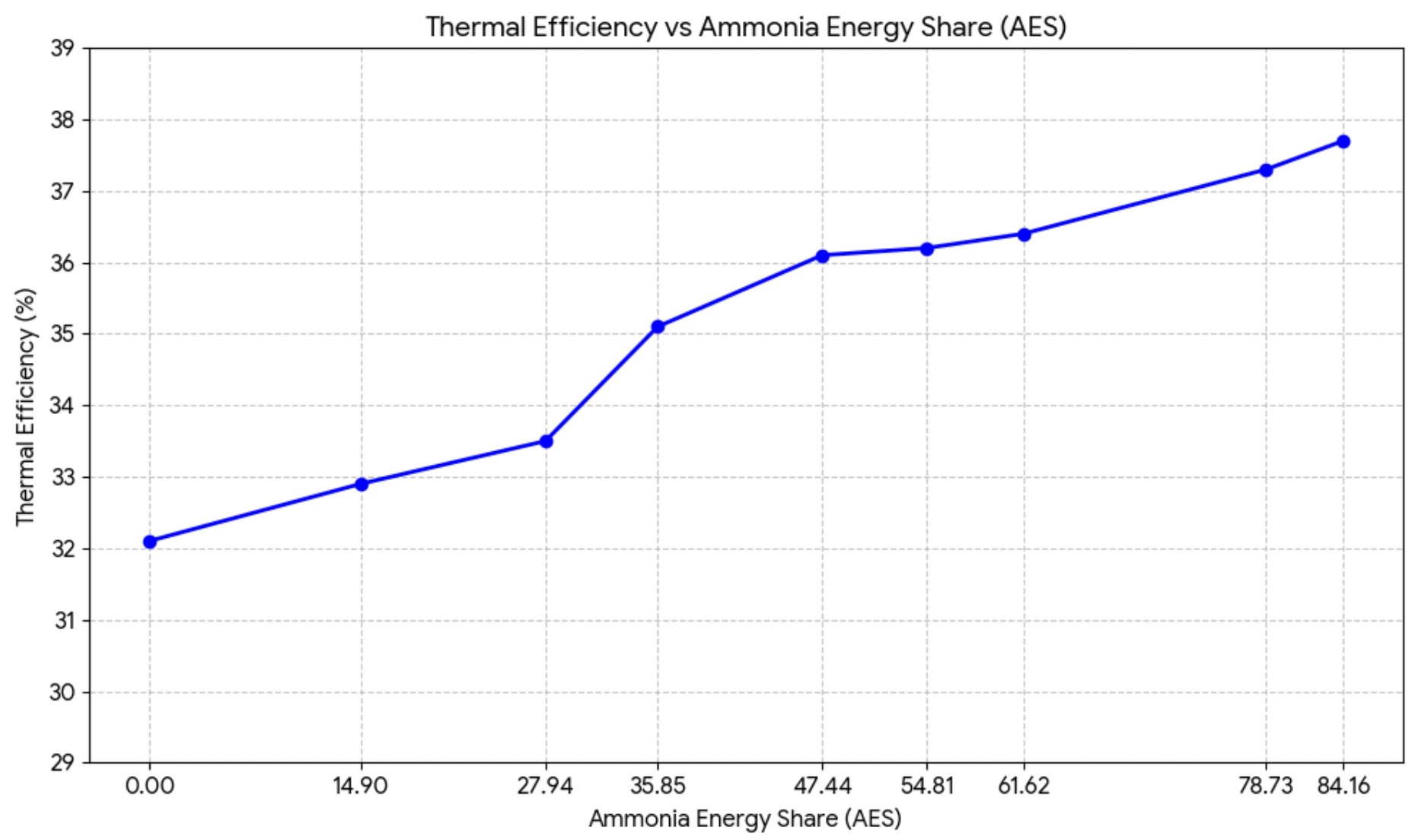
There is a steady increase in the thermal efficiency with ammonia energy share, which may be attributed to changes in combustion behaviour. The proportion of ammonia increases, and the pilot fuel decreases. Due to the slower combustion characteristics of ammonia, there may be a change in combustion phasing, and the heat losses may reduce overall. This may result in greater work done overall, leading to a greater thermal efficiency. Though the temperature of the gases released and the pressure changes inside the cylinder have not been measured, it is a possible characteristic and not a confirmed phenomenon.
Since this is a secondary analysis of already published research papers. Therefore, the graph does not have any mention of error bars as they were not mentioned in the source paper.
Discussion
Comparison with Conventional Engines
Typical thermal efficiencies:
- Petrol engines: 25–35%
- Diesel engines: 30–45%
- Natural gas engines: 30–40%
- Hydrogen engines: 35–40%
The ammonia–diesel engine efficiencies are compared with those of other engines under different operating conditions and temperatures. These efficiency ranges are taken from different sources conducted under different engine types and conditions. This is to provide context for where ammonia engines stand and does not directly compare them with other conventional engines.
The calculated Brake Thermal Efficiency increased from 32.16% to 37.68% as the ammonia energy share increased from 0% to 84.16%. This was obtained through secondary analysis of the data, where brake power and fuel mass rates were obtained through secondary analysis of published papers rather than direct experimentation. Therefore, the efficiency calculation is a separate interpretation of the already published dataset and should not be considered as a validation to the data.
The experimental dataset was obtained from Nadimi et al. (2023), who investigated the effects of increasing ammonia substitution in the ammonia-diesel dual fuel engine on combustion characteristics, emissions, and overall engine performance of the engine. The original study mainly researched combustion and emissions, while the present study extends beyond it by calculating the brake thermal efficiency for each operating condition using the already published dataset. This provides an additional perspective on how increasing ammonia energy share affects the thermal efficiency.
The efficiency trend presented in the study is consistent with the broader understanding of ammonia-diesel combustion in previous literature. Valera-Medina et al. described ammonia as a promising low-carbon fuel for compression ignition engines but also emphasised that it requires a pilot fuel to combust efficiently due to relatively slow flame speed, high ignition energy, and narrow flammability limits. Similarly, Kobayashi et al. also explained that the combustion characteristics of ammonia make it difficult to combust ammonia on its own and instead require a pilot fuel to combust efficiently. The intake-port ammonia injection and ammonia-diesel dual fuel strategy in the source experiment is consistent with findings of other research papers.
Although the calculated efficiency increased with ammonia energy share for this paper, conclusions should be drawn carefully because engine configurations and operating conditions differ considerably. The source experiment used a single-cylinder, four-stroke Lifan compression ignition engine at 1200 rpm with intake-port ammonia injection and diesel pilot injection. Other published studies have investigated different engine sizes, multicylinder configurations, alternative injection strategies such as LPDI and HPDI with different operating speeds and loads. These differences influence combustion behaviour, heat release, and combustion characteristics to a great extent.
Emissions Perspective
No emissions data have been analyzed in this research. Although previous research has reported that there is a low amount of carbon dioxide when ammonia is burned. The reduction of CO2 emissions after a part of the diesel is replaced by ammonia is proportional to the decrease in the usage of diesel.24 Previous studies have reported that NOx emissions may increase during ammonia combustion because nitrogen is in the fuel molecule, and this is a major problem.25
Conclusions and Future Work
Within the analysed operating range, thermal efficiency increased from 32.16% to 37.68% as ammonia energy share increased. This shows that ammonia warrants further research to evaluate emissions and overall environmental performance.26 Because the published dataset represents a single operating condition, the calculated thermal efficiency should not be assumed to represent other engine behaviours at other loads or operating speeds. Additional experimental studies over a wide operating range are required before any broader conclusions can be drawn.
Nonetheless, there are issues like nitrogen oxide emission, stability of combustion, and fuel toxicity that must be resolved before it becomes widespread.27 To manage the emission of NOx, future studies need to be conducted on the optimization of combustion, innovative methods of injection, and efficient post-treatment systems.28
References
- Valera-Medina A, Xiao H, Owen-Jones M, David W, Bowen P. NH3 as a transport fuel in internal combustion engines. Journal of Energy Resources Technology. 2019. https://asmedigitalcollection.asme.org/solarenergyengineering/article/141/2/020304/368769/Solar-Thermochemical-Cyles-for-Fuel-Production-in [↩]
- Zamfirescu C., Dincer I. Ammonia as a green fuel and hydrogen source for vehicular applications. Fuel Processing Technology. 2009. https://www.sciencedirect.com/science/article/abs/pii/S0378382009000241?via%3Dihub [↩]
- Kobayashi H., Hayakawa A., Somarathne K.D.K.A., Okafor E.C. Science and technology of ammonia combustion. Proceedings of the Combustion Institute. 2019.https://www.sciencedirect.com/science/article/pii/S1540748918306345?via%3Dihub [↩]
- Journal of Cleaner Production. Sustainable Ammonia Combustion Strategies in Dual Fuel Engines. https://www.sciencedirect.com/science/article/abs/pii/S0959652623044323 [↩] [↩]
- Nadimi E., Przybyła G., Lewandowski M.T., Adamczyk W. Effects of ammonia on combustion, emissions, and performance of the ammonia/diesel dual-fuel compression ignition engine. Journal of the Energy Institute. https://www.sciencedirect.com/science/article/pii/S1743967122002069 [↩] [↩] [↩] [↩]
- International Energy Agency Advanced Motor Fuels. Ammonia fuel properties. IEA-AMF, Year unknown. https://www.iea-amf.org/content/fuel_information/ammonia/fuel_properties [↩]
- Energy. Energy Transition and Alternative Fuel Adoption in Developing Economies.
https://ideas.repec.org/a/eee/energy/v284y2023ics0360544223026853.html [↩] - Naber JD et al. Ammonia as a fuel for internal combustion engines. Combustion Engines. Available at: https://www.combustion-engines.eu/ [↩]
- A. Valera-Medina, H. Xiao, M. Owen-Jones, W. David, P. Bowen. NH3 as a transport fuel in internal combustion engines. Journal of Energy Resources Technology. Vol. 141, pg. 070703, 2019. https://doi.org/10.1115/1.4042753 [↩]
- M. Valera-Medina et al. Ammonia storage and transportation for energy applications. Energies. Vol. 13, pg. 4086, 2020. https://www.mdpi.com/1996-1073/13/16/4086 [↩]
- D. Zamfirescu, I. Dincer. Ammonia as a green fuel and hydrogen source for vehicular applications. Fuel Processing Technology. Vol. 90, pg. 729–737, 2009. https://doi.org/10.1016/j.fuproc.2009.02.004 [↩]
- Kobayashi H, Hayakawa A, Somarathne KDKA, Okafor EC. Science and technology of ammonia combustion. Proceedings of the Combustion Institute. 2019. https://doi.org/10.1016/j.proci.2018.09.029 [↩]
- He Z, et al. Environmental impacts of ammonia combustion systems: A review. Journal of Hazardous Materials. 2024. https://www.sciencedirect.com/journal/journal-of-hazardous-materials [↩]
- International Energy Agency Advanced Motor Fuels. Ammonia safety and handling. IEA-AMF. https://www.ieaamf.org/content/fuel_information/ammonia/safety [↩]
- International Journal of Hydrogen Energy. Recent Advances in Ammonia–Diesel Dual Fuel Combustion. https://www.sciencedirect.com/science/article/pii/S0360319925040558 [↩]
- U.S. Department of Energy. Internal Combustion Engine Basics.https://www.energy.gov/cmei/vehicles/articles/internal-combustion-engine basics [↩]
- University of Waterloo. Gasoline and diesel heating values. Waterloo. https://uwaterloo.ca/centre-advanced-science-education/news/gasoline-and-diesel-fuel-carbon-pricing-and-heating-values [↩]
- W. L. Wong. Thermal efficiency analysis of diesel combustion systems. University of Southern Queensland, 2005.https://sear.unisq.edu.au/532/1/WONGWeiLoon-2005.pdf [↩]
- Valera-Medina M, Amer-Hatem F, Azad AK, et al. Review of ammonia-fueled internal combustion engines and the associated combustion and emissions characteristics. Journal of the Energy Institute. 2023;101:197–222.https://www.sciencedirect.com/science/article/pii/S1743967122002069 [↩]
- A. Boretti. Advances in ammonia combustion engines. Energies. Vol. 11, pg. 513, 2018. https://www.mdpi.com/19961073/11/3/513 [↩]
- U.S. Department of Energy. Vehicles. https://www.energy.gov/vehicles [↩]
- Verhelst S, Wallner T. Hydrogen-fueled internal combustion engines. Progress in Energy and Combustion Science. 2009.https://www.sciencedirect.com/science/article/abs/pii/S0360128509000422 [↩]
- International Energy Agency. Global EV outlook 2024. IEA, 2024.https://www.iea.org/reports/global-ev-outlook-2024 [↩]
- International Maritime Organization. Nitrogen oxides (NOx) regulation 13. IMO. https://www.imo.org/en/ourwork/environment/pages/nitrogen-oxides-(nox)-%E2%80%93-regulation-13.aspx [↩]
- PubMed. Ammonia fuel combustion and emissions review. National Library of Medicine, 2024. https://pubmed.ncbi.nlm.nih.gov/39004391/ [↩]
- U.S. Department of Energy. Potential roles of ammonia in the hydrogen economy. DOE. https://www.energy.gov/eere/fuelcells/articles/potential-roles-ammonia-hydrogen-economy [↩]
- Kobayashi H, et al. Ammonia combustion for low-carbon energy systems. https://www.sciencedirect.com/science/article/pii/S1540748918306345 [↩]
- U.S. Department of Energy. Alternative Fuels Data Center. https://afdc.energy.gov/fuels [↩]