
Abstract
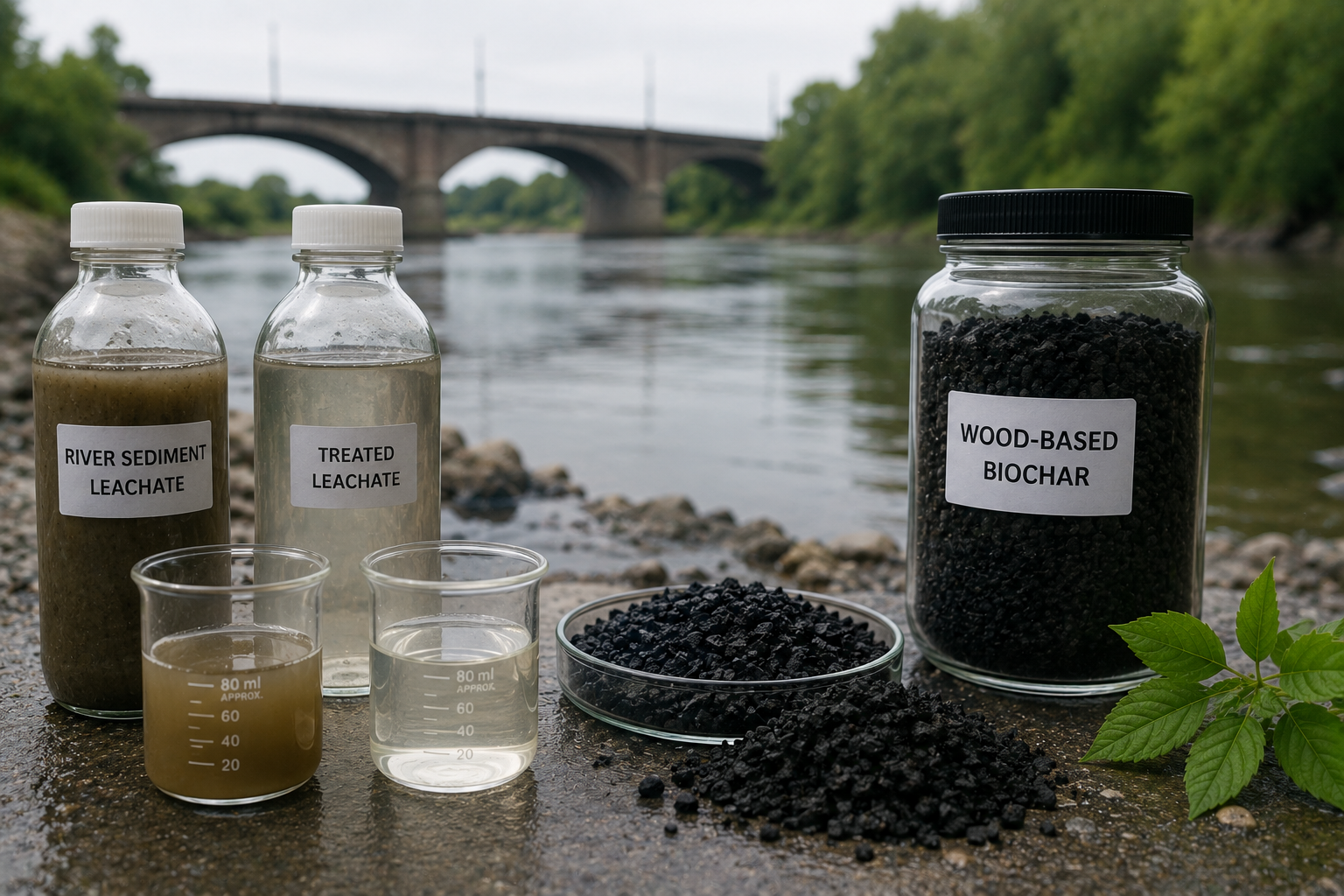
Background/Objective: Urban stormwater runoff delivers dissolved copper (Cu) and zinc (Zn) into receiving waterways at concentrations that frequently exceed EPA freshwater aquatic life criteria of 9 μg/L for Cu and 120 μg/L for Zn. Most published biochar adsorption studies use distilled water as the test matrix, likely overestimating removal efficiency where competing ions and organic matter are present. This pilot study tested whether Wakefield Premium wood-based biochar could remove dissolved Cu and Zn from simulated stormwater using Schuylkill River sediment leachate as the water matrix.
Methods: A 2×2 factorial design tested two doses (0.5 g and 1.5 g per 250 mL) and two contact times (15 and 60 minutes) in duplicate (n = 2 per group). Dissolved metals were analyzed by ICP-OES following EPA Method 200.7 at an external NELAP-accredited laboratory (MJ Reider Associates, PA DEP #06-00003).
Results: Cu removal ranged from 17.0% to 55.3% and Zn removal from 29.1% to 65.7% across the four treatment conditions, with the highest removal observed in the high-dose, long-contact group (H-60). Solution pH increased by 0.3 to 1.5 units in treated samples. Both surface adsorption and precipitation are plausible removal mechanisms; the available data cannot distinguish between them, particularly in the H-60 group where one replicate reached pH 7.03.
Conclusions: Removal was lower than distilled-water studies report, consistent with the competing-ion hypothesis, but leachate characterization and a parallel clean-water comparator would be needed to confirm it. As a pilot study with n = 2, these results are descriptive and do not support statistical inference. Future work should characterize leachate ionic composition, employ replicated designs (n ≥ 3) with no-biochar controls at each contact time, and evaluate performance under continuous-flow conditions.
Keywords: biochar, heavy metal removal, copper, zinc, urban stormwater runoff, adsorption, Schuylkill River, sediment leachate, ICP-OES, water treatment, stormwater management, dissolved metals, pilot study
Introduction
Every time it rains on a developed landscape, water picks up whatever has accumulated on roads, parking lots, and rooftops since the last storm and carries it, untreated, into the nearest stream or river.
Copper (Cu) and zinc (Zn) are among the most persistent contaminants in that runoff. Davis et al.1 estimated that vehicle-related sources account for approximately 48% of Cu in urban stormwater, with brake pad wear as the dominant contributor. Councell et al.2 estimated that tire tread releases 10,000–11,000 metric tons of Zn per year across the United States. The U.S. EPA has established freshwater aquatic life criteria of 9 micrograms per liter for Cu and 120 micrograms per liter for Zn,3 and stormwater from developed areas regularly approaches or exceeds these thresholds. Smullen et al.4 compiled 20 years of nationwide urban stormwater quality data confirming that Cu and Zn are among the most frequently detected metals in urban runoff, and Pitt et al.5 reported median dissolved Zn concentrations of 112 μg/L in industrial stormwater nationally. These aquatic life criteria are far more stringent than drinking water standards (Cu: 1,300 μg/L; Zn: 5,000 μg/L secondary standard),6 reflecting the greater sensitivity of aquatic organisms that absorb metals directly across gill and skin surfaces. For the Schuylkill River, this is not a hypothetical concern. USGS monitoring at Station 01474500 has recorded filtered Zn as high as 970 micrograms per liter7 – just over eight times the aquatic life criterion- and filtered Cu up to 30 micrograms per liter. These peak values, recorded in December 1981, represent the maximum in the only long-term filtered metal record for this station. The Schuylkill drains 1,893 square miles of southeastern Pennsylvania before reaching Philadelphia, where it serves as a drinking water source for more than one million people.
Biochar has received growing attention as a low-cost adsorbent for heavy metal removal from water.8,9,10 It is produced by the pyrolysis of organic feedstocks under limited oxygen conditions and has a high surface area, porous structure, and surface functional groups that can bind metal cations from solution. Inyang et al.8 reviewed the mechanisms by which biochar removes heavy metals, identifying complexation, physical sorption, precipitation, and electrostatic interactions as the primary pathways, with removal efficiency varying by feedstock, pH, and solution chemistry. Li et al.11 further detailed how biochar characteristics and modifications influence the relative contribution of these mechanisms, noting that the dominant mechanism varies by metal species, biochar type, and solution conditions. Mohan et al.9 characterized biochar as a renewable, low-cost, and sustainable adsorbent for contaminant removal from water, and Shakoor et al.12 reviewed its potential as an alternative to activated carbon and inorganic sorbents for heavy metal separation from water.
A consistent limitation runs through the existing literature: most biochar adsorption studies use clean distilled water spiked with individual metal salts as the test matrix. Real stormwater contains competing ions such as Ca²⁺, Mg²⁺, Na⁺, and K⁺, as well as dissolved organic matter and suspended particles that can occupy adsorption sites or reduce removal efficiency. Park et al.13 demonstrated that in competitive multi-metal systems, adsorption capacities decrease substantially: Zn capacity on sesame straw biochar dropped from 34 mg/g in single-metal solution to 7 mg/g in multi-metal solution, a 79% reduction. Kolodynska et al.14 characterized the adsorption kinetics and capacity of biochar derived from animal manure for Cu, Zn, Cd, and Pb, and observed competitive effects among these metals in quaternary systems. Reddy et al.15 compared four filter materials for heavy metal removal from synthetic stormwater, demonstrating that material selection substantially influences removal. However, most published studies continue to use simplified matrices. Qiu et al.10 and Phiri et al.16 noted this gap explicitly, calling for more research in realistic water conditions. A product evaluated only in clean water has not been evaluated for stormwater.
This pilot study tests whether Wakefield Premium Biochar, a commercially available wood-based product, can remove dissolved Cu and Zn from simulated urban stormwater using Schuylkill River sediment leachate as the water matrix. Two biochar doses (0.5 g and 1.5 g per 250 mL) and two contact times (15 and 60 minutes) are compared in a 2×2 factorial design, with dissolved metal concentrations measured by ICP-OES following EPA Method 200.7.17 Because the leachate matrix introduces competing ions absent from clean-water studies, removal efficiencies are expected to be lower than those reported in the existing literature.
Materials and Methods
Experimental Design
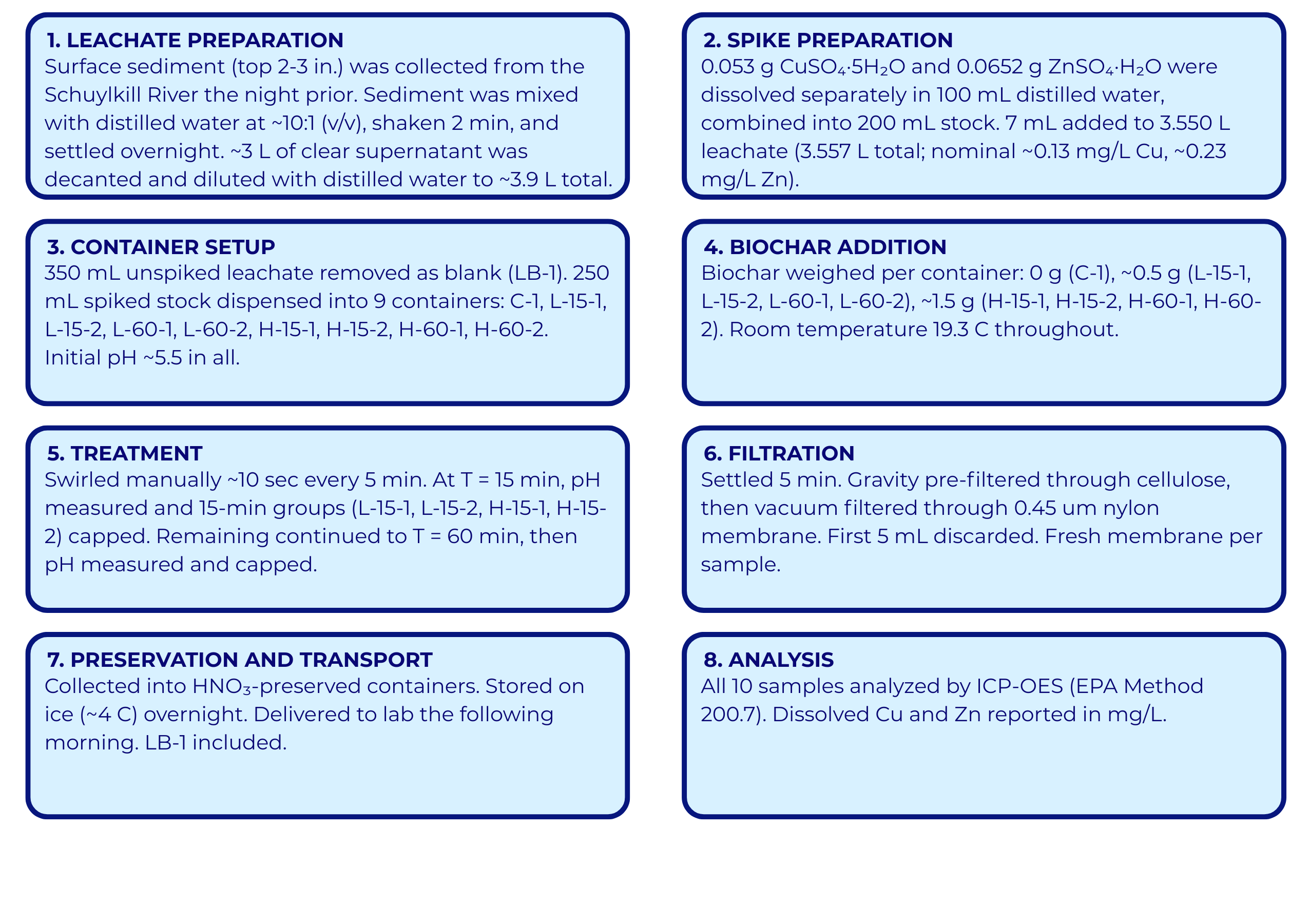
This pilot study used a 2×2 factorial design to evaluate the removal of dissolved Cu and Zn from a simulated urban stormwater matrix at two biochar doses and two contact times. Two dose levels were tested: 0.5 g and 1.5 g of Wakefield Premium Biochar per 250 mL of solution (equivalent to 2 g/L and 6 g/L), selected to span a practically relevant range within the range commonly reported in batch adsorption studies, with a 3× difference chosen to produce a detectable dose-response signal within the constraints of a pilot design. Two contact times were tested: 15 minutes and 60 minutes. All four treatment combinations were run in duplicate. A single spiked no-biochar control (C-1) and a single unspiked leachate blank (LB-1) were also prepared. C-1 served as the baseline against which all percent removal was calculated; LB-1 confirmed that the leachate matrix itself did not contribute detectable background Cu or Zn. Ten samples total were submitted for chemical analysis. Table 1 and Figure 1 summarize the experimental groups and procedure overview, respectively.
Leachate Matrix Preparation
Schuylkill River sediment leachate was used as the water matrix rather than distilled water because published biochar adsorption studies conducted in clean laboratory matrices likely overestimate removal efficiency in real field conditions.10,16 Sediment and ambient river water were collected on April 5, 2026 from a publicly accessible recreational shoreline at the Betzwood area, Valley Forge National Historical Park, Montgomery County, Pennsylvania (40.1093°N, 75.4154°W). Water temperature at the time of collection was approximately 14.5°C, based on contemporaneous measurements recorded at USGS monitoring station 01473500 (Schuylkill River at Norristown, PA), located approximately 4 miles downstream of the collection site. No permits were required. No protected species were sampled. This study did not involve human subjects or animal research. Approximately 300 mL of surface sediment (top 2 to 3 inches) was collected along with ambient river water.
At the laboratory, the collected sediment and river water were combined with distilled water in a sealed gallon jug at approximately a 10:1 water-to-sediment ratio by volume. The jug was shaken vigorously for two minutes to dislodge loosely bound metals and organic matter from sediment particles. The mixture was then allowed to settle overnight on a flat surface without disturbance. The following morning, approximately 3 L of clear supernatant was carefully decanted without disturbing the settled sediment. Distilled water was added to bring the total leachate volume to approximately 3.9 L. Prior to metal addition, 350 mL of unspiked leachate was removed and set aside as the leachate blank (LB-1).
Stock Solution Preparation
A two-step dilution approach was used to prepare the metal spike solution. Two separate 100 mL intermediate stock solutions were prepared by dissolving copper sulfate pentahydrate (CuSO₄·5H₂O; Zep Root Kill, 99%) and zinc sulfate monohydrate (ZnSO₄·H₂O; Alpha Chemicals, 99%) separately in distilled water. The CuSO₄·5H₂O mass weighed was 0.053 g and the ZnSO₄·H₂O mass weighed was 0.0652 g. Both 100 mL solutions were combined into a single 200 mL mixed intermediate stock. Seven milliliters of this combined intermediate stock was added to 3.550 L of leachate matrix to produce the final spiked stock solution with a total volume of approximately 3.557 L. Nominal spike concentrations based on these masses were 0.133 mg/L Cu and 0.234 mg/L Zn. Because the salts were weighed on a non-analytical balance at low mass, the nominal values are approximate. The operative starting concentration for all removal calculations was established by direct ICP-OES measurement of the spiked no-biochar control (C-1): 0.150 mg/L Cu and 0.254 mg/L Zn. All percent-removal values are calculated against this measured baseline and are therefore independent of the spike-preparation accuracy.
Experiment Execution
All containers used in the experiment were clean, lidded polypropylene containers. The spiked stock solution was dispensed in 250 mL aliquots into each treatment container. Wakefield Premium Biochar was used as received without pre-rinsing, to replicate conditions of practical field deployment. Room temperature was 19.3°C throughout. All containers were started simultaneously at 8:45 PM. Each container was swirled manually for 10 seconds at 5-minute intervals. pH was measured using a Vivosun digital pH pen before biochar addition and again at the end of each group’s contact period. Containers were capped immediately following pH measurement.
Sample Processing and Filtration
Following the contact period, each container was allowed to settle for five minutes. Each sample was passed through a cellulose gravity pre-filter to remove bulk biochar particles, then filtered through a 0.45 μm nylon membrane under vacuum. The 0.45 μm threshold is the EPA operational definition of dissolved metals as specified in EPA Method 200.7.17 The first 5 mL of filtrate was discarded before collecting the analytical sample. A new membrane was used for each sample.
Each filtered sample was collected into a 250 mL sample bottle provided in an MJ Reider field filter kit. Concentrated HNO₃, supplied with each kit in a separate vial, was added to each sample immediately after filtration to preserve to pH < 2 as required by EPA Method 200.7. Samples were stored on ice at approximately 4°C and delivered to the laboratory the following day (collected April 6, 2026; received April 7, 2026 at 14:25; temperature at receipt 3.9°C).
Chemical Analysis
Dissolved Cu and Zn concentrations were determined by ICP-OES following EPA Method 200.7 (Rev 4.4),17 with sample preparation by EPA Method 200.2 (Rev 2.8), performed by MJ Reider Associates (Reading, PA; NELAP-accredited, PA DEP #06-00003). All 10 samples were submitted and analyzed on April 8, 2026 (analyst: HRG). Method reporting limits were 0.010 mg/L for Cu and 0.005 mg/L for Zn. Percent removal for each treatment group was calculated as: % Removal = [(C-1 result − Treatment group mean) / C-1 result] × 100, where C-1 is the spiked no-biochar control.
MJ Reider Associates provided quality control data with the amended Certificate of Analysis (June 18, 2026). The laboratory reagent blank returned Cu <0.010 mg/L and Zn <0.005 mg/L. Laboratory fortified blank recoveries were 94.4% for Cu and 95.5% for Zn (acceptance range 85–115%). Matrix spike recoveries ranged from 90.7% to 95.2% for Cu and 91.0% to 94.1% for Zn (acceptance range 70–130%). Matrix spike duplicate relative percent differences were 1.23–5.42% for Cu and 0.59–2.75% for Zn (acceptance limit 20%). All results met EPA Method 200.7 acceptance criteria.
Results
Starting Concentration Verification
Nominal dissolved metal concentrations in the spiked stock solution, based on the weighed salt masses (0.053 g CuSO₄·5H₂O and 0.0652 g ZnSO₄·H₂O), were 0.133 mg/L Cu and 0.234 mg/L Zn. ICP-OES analysis of the spiked no-biochar control (C-1) returned Cu = 0.150 mg/L and Zn = 0.254 mg/L. The measured values were 13% and 8.7% above nominal, respectively, attributable to weighing uncertainty at low mass on a non-analytical balance. All percent removal calculations use the measured C-1 value as the baseline and are independent of the nominal spike calculation. The unspiked leachate blank (LB-1) returned Cu below 0.010 mg/L and Zn below 0.005 mg/L, both below reporting limits, confirming that the leachate matrix did not contribute detectable background Cu or Zn. Raw ICP-OES results for all ten samples are presented in Table 2.
Percent Removal Results
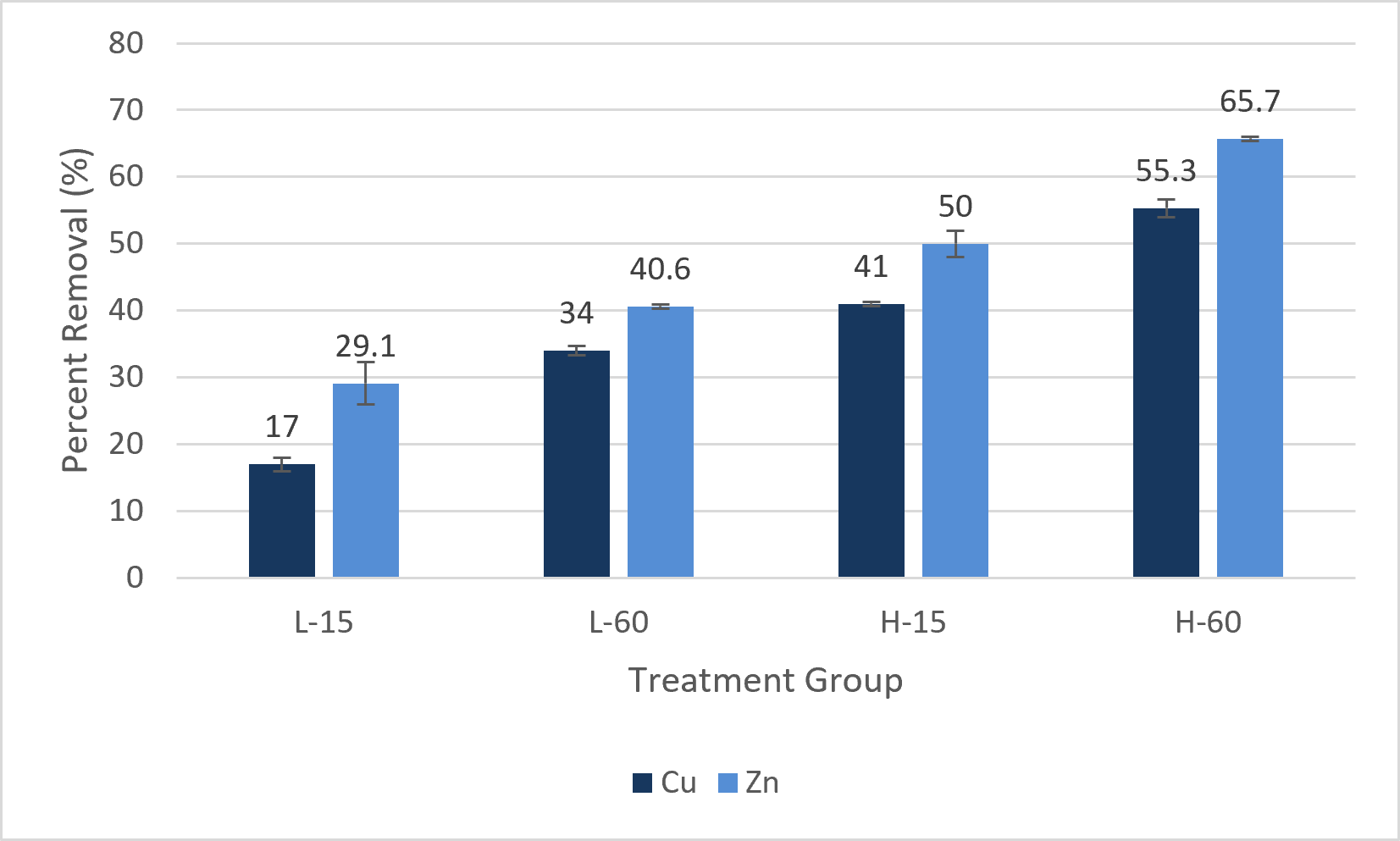
Duplicate results within each treatment group were averaged to produce group means. Percent removal was calculated for each group relative to the spiked no-biochar control (C-1). Results are presented in Table 3. For Cu, percent removal ranged from 17.0% (L-15) to 55.3% (H-60). For Zn, percent removal ranged from 29.1% (L-15) to 65.7% (H-60). In all four treatment groups, Zn removal exceeded Cu removal. Duplicate results were closely matched: the largest difference between replicates within a single group was 0.004 mg/L for Cu and 0.016 mg/L for Zn.
pH Data
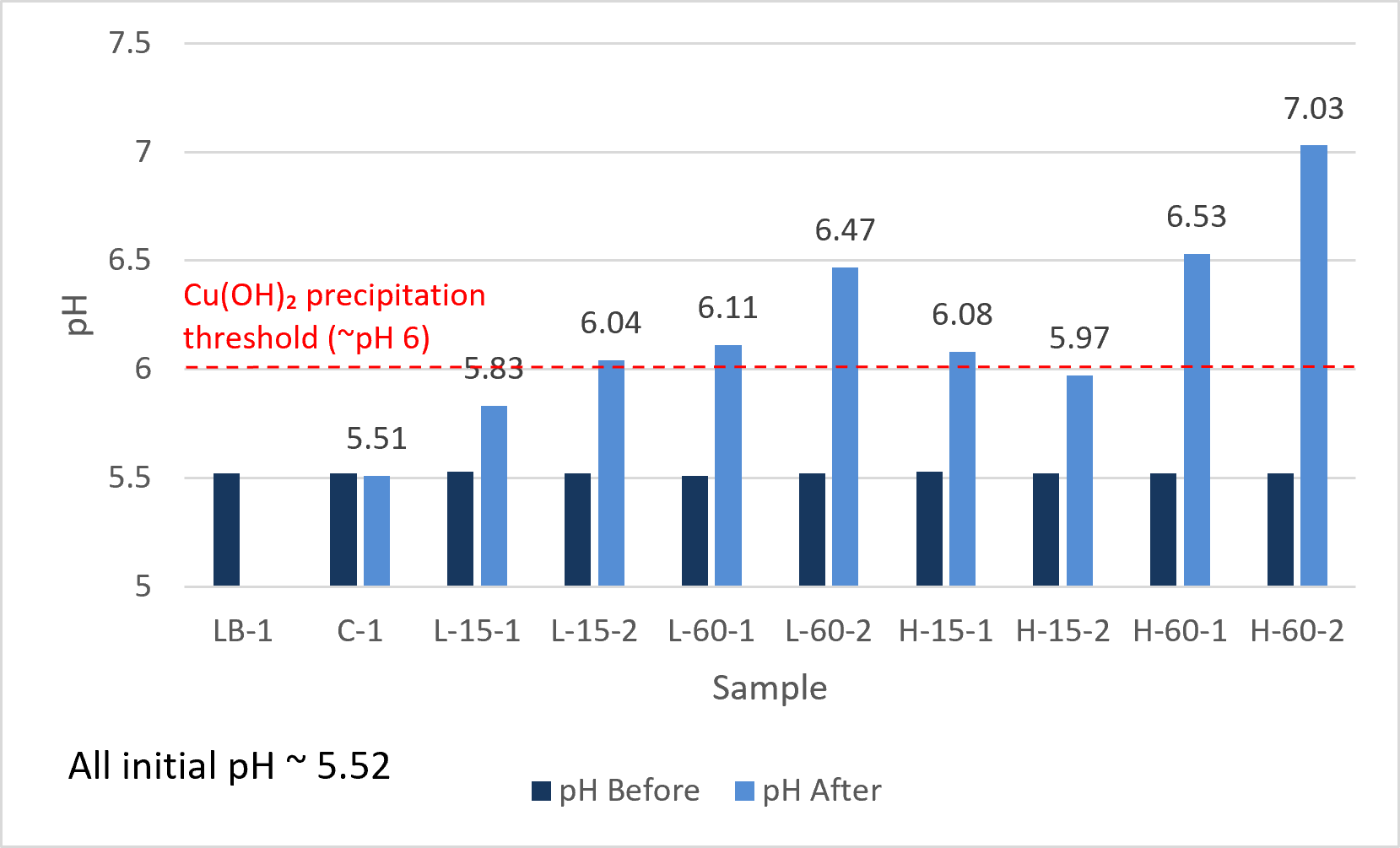
Solution pH was approximately 5.5 in all containers before biochar addition. The spiked no-biochar control (C-1) showed negligible pH change (-0.01 units) over the 60-minute period. All biochar-treated groups showed some degree of pH increase. The L-15 group showed the smallest shifts (+0.30 to +0.52 units). The H-60 group showed the largest shifts: H-60-1 increased by 1.01 units and H-60-2 increased by 1.51 units, reaching a final pH of 7.03 – the only sample to exceed pH 7. Full pH data are presented in Table 4.
Visual Observations
No significant color change was observed between the control and any treatment group. In the 15-minute groups, biochar particles remained predominantly suspended during swirling. In the 60-minute groups, biochar showed increased adhesion to container walls beginning at approximately 35 minutes, more pronounced in high-dose groups. High-dose containers maintained noticeably higher overall turbidity than low-dose containers throughout the experiment.
Discussion
Summary of Observations
Wakefield Premium Biochar measurably reduced dissolved Cu and Zn concentrations in Schuylkill River sediment leachate under all four treatment conditions. The highest removal was observed in the high-dose, long-contact group (H-60: 55.3% Cu, 65.7% Zn) and the lowest in the low-dose, short-contact group (L-15: 17.0% Cu, 29.1% Zn). Zn removal exceeded Cu removal in every treatment group. This is an unexpected finding: Chen et al.18 found that Cu adsorption capacity exceeded Zn on both hardwood and corn straw biochars (Cu qe 12.52 vs Zn 11.0 mg/g for corn straw biochar at 600°C; 6.79 vs 4.54 for hardwood biochar at 450°C), and Cu competed with Zn for binding sites at concentrations ≥1.0 mM. The reversal observed here may reflect matrix-specific effects. He et al.19 demonstrated that dissolved organic matter type substantially affects Cu2⁺ adsorption on biochar: humic acid enhanced adsorption by up to 55% by introducing additional functional groups, while fulvic acid showed no net enhancement due to competition for binding sites. In the present leachate, DOM composition is unknown, but if solution-phase organic ligands preferentially complex Cu — keeping it dissolved and unavailable for surface binding — without similarly affecting Zn, that would explain the reversal. Testing this requires leachate characterization data not collected in this pilot.
pH and Removal Mechanism
The pH data raises a question the study cannot resolve: what fraction of the measured metal removal was surface adsorption onto biochar, and what fraction was driven by metal hydroxide precipitation caused by the pH increase. Ahmad et al.20 identified that the alkaline mineral content of biochar raises solution pH upon contact with water, which can drive metal hydroxide precipitation independently of surface adsorption.
Cu(OH)₂ precipitation becomes thermodynamically favorable above approximately pH 6; Zn(OH)₂ precipitation does not occur until approximately pH 9 (Albrecht et al.21). Most treatment groups showed final pH values below 6.5, where Cu precipitation is less likely but cannot be excluded. Two samples exceeded this threshold: H-60-1 (pH 6.53) and H-60-2 (pH 7.03), the latter reaching a level where Cu hydroxide precipitation is plausible. Zn removal is attributable to non-precipitation mechanisms (adsorption, ion exchange, or surface complexation) across all groups, as no sample approached pH 9. Lu et al.22 demonstrated that the relative distribution of sorption mechanisms on biochar varies with pH, with precipitation becoming dominant at higher pH and complexation dominant at lower pH. Xu et al.23 showed that mineral components (Ca, Mg, K) in biochar contribute to metal removal via ion exchange and precipitation. It is not possible to determine from available data what fraction of H-60 Cu removal was adsorption versus precipitation. XRD or FTIR analysis of spent biochar would be needed to resolve the question.
Comparison to Published Literature
The percent removal values in this study are lower than those commonly reported in distilled-water bench studies. Inyang et al.8 reviewed removal efficiencies frequently exceeding 80% for wood-based biochars; however, those figures frequently reflect chemically modified biochars at higher initial metal concentrations, and unmodified biochars at comparable concentration ranges show substantially lower removal even in clean water. Wang et al.24 confirmed that heavy metal adsorption capacity depends strongly on water chemistry, competing ions, and initial concentrations. The values here – 17.0% to 55.3% for Cu and 29.1% to 65.7% for Zn – are consistent with the competing-ion hypothesis, but confirming that requires leachate characterization and a parallel clean-water comparator. Qiu et al.10 noted that most published studies continue to use simplified matrices, precisely the gap this study begins to address. These results may provide a more realistic estimate of commercial biochar performance under complex stormwater conditions than distilled-water studies alone.
Dose and Contact Time Observations
In the four treatment groups tested, higher biochar dose was associated with higher removal in all comparisons. Tripling the dose from 0.5 g to 1.5 g was associated with a 24 percentage-point difference in Cu removal at 15 minutes and a 21 percentage-point difference at 60 minutes. For Zn, the corresponding differences were 21 and 25 percentage points. Longer contact time was also associated with higher removal: the difference between 15 and 60 minutes was 17 percentage points for Cu at low dose and 14 at high dose, with the same directional pattern for Zn. These observations are consistent with what would be expected from greater surface area at higher dose and continued uptake over time, but with n = 2 and no statistical analysis, they are descriptive observations of this particular experiment, not established dose or contact-time effects.
Tan et al.25 reviewed biochar adsorption kinetics and found that heavy metal uptake typically follows pseudo-second-order kinetics, with the majority of adsorption occurring in the first 15 to 30 minutes. The observation that removal was higher at 60 minutes than at 15 minutes suggests that equilibrium was not reached at 15 minutes under either dose condition. Published equilibrium times for unmodified wood-based biochars range from approximately 120 minutes to 48 hours, so 60 minutes may also represent pre-equilibrium conditions, but this cannot be confirmed from two time points alone.
Adsorption capacities, calculated as qe = (C₀ − Ce) × V / m, ranged from 0.0103 to 0.0255 mg Cu/g and 0.0212 to 0.0515 mg Zn/g (Table 3). Per-gram capacity was higher at the lower dose (0.5 g) than at the higher dose (1.5 g) for both metals: Cu qe was 0.0127 mg/g at L-15 versus 0.0103 mg/g at H-15, and Zn qe was 0.0370 mg/g at L-15 versus 0.0212 mg/g at H-15. This pattern is consistent with the standard observation that per-gram efficiency decreases at higher adsorbent doses when the metal concentration is limiting, as a larger fraction of available adsorption sites remain unoccupied. These values are low compared to modified biochars tested at higher initial metal concentrations, but are consistent with unmodified biochar performance at the low spike concentrations used here.
Environmental Context and Limitations
The residual Cu concentration in the best-performing group (H-60: Cu = 0.067 mg/L) remains above the EPA freshwater aquatic life criterion of 9 µg/L, while the residual Zn concentration (0.087 mg/L) falls below the 120 µg/L Zn criterion. Biochar treatment at these doses and contact times did not achieve aquatic-life-criterion compliance for Cu. Residual Zn (87 μg/L) fell below the 120 μg/L Zn criterion. Batch equilibrium conditions represent a performance ceiling; field or continuous-flow conditions would yield lower removal due to shorter contact times and hydraulic variability.
Several limitations constrain interpretation of these results. Sample size was n = 2 per group with a single unreplicated spiked no-biochar control (C-1), and no no-biochar control was included at the 15-minute contact time. This design cannot separate biochar-driven removal from potential time-dependent losses to container walls, filtration media, or handling, and does not support statistical inference. The tight agreement between duplicates (maximum within-group difference of 0.004 mg/L for Cu and 0.016 mg/L for Zn) provides preliminary evidence of reproducibility at this scale, but is not a substitute for proper replication.
Additional limitations include: only one commercial biochar product was tested, and results should not be generalized to other feedstocks, pyrolysis conditions, or modified biochars; the manual mixing protocol (10-second swirls at 5-minute intervals) introduces more variability than a mechanical shaker would; independent biochar characterization (BET surface area, FTIR, elemental analysis) was not conducted – the manufacturer states a surface area of approximately 375 m2/g and carbon content >60% for Wakefield Premium Biochar, but these values are manufacturer specifications, not independently verified. Ippolito et al.26 demonstrated through meta-analysis that feedstock choice and pyrolysis temperature fundamentally determine biochar properties including surface area, pH, and functional group composition, which is why independent characterization matters. The leachate was prepared from a single collection event (April 5, 2026) and does not capture seasonal variability in sediment metal loading, dissolved organic matter, or ionic composition; the ionic composition of the leachate matrix was not characterized, preventing quantitative assessment of competing-ion effects; no biochar-in-clean-water blank was run to assess potential Cu or Zn leaching from the biochar itself (though any such leaching would increase measured post-treatment concentrations and reduce apparent removal, meaning reported values would be conservative); and the reagents used were consumer-grade (99% stated purity) without certificates of analysis for trace-metal impurities.
Future Work
This pilot study raises four specific questions for future investigation. First, the ionic composition of the leachate matrix was not characterized; future work should quantify competing ion concentrations including Ca2+, Mg2⁺, Na⁺, K⁺, and dissolved organic carbon to put the observed removal differences from clean-water predictions in context. Second, a replicated study with n ≥ 3 and no-biochar controls at each contact time is needed to determine whether the dose and contact-time patterns observed here are reproducible and to enable statistical inference. Third, the mechanism driving the unexpected Zn > Cu removal pattern should be looked at directly; leachate characterization may help isolate the contributing factors. Fourth, a column study under continuous-flow conditions would provide hydraulically realistic data that cannot be obtained from batch equilibrium experiments. Tian et al.27 demonstrated that biochar incorporated into a pilot-scale bioretention system improved nitrate removal from stormwater, supporting its potential as a field amendment for continuous-flow treatment. A replicated study addressing the first three questions is planned as the next phase of this work.
Conclusions
Wakefield Premium wood-based biochar removed dissolved Cu and Zn from a simulated stormwater matrix under all four treatment conditions tested. The highest removal was observed at 1.5 g per 250 mL with 60 minutes of contact time (55.3% Cu and 65.7% Zn removal relative to the spiked no-biochar control, C-1). Higher biochar dose was associated with higher removal in all comparisons, and removal was higher at 60 minutes than at 15 minutes across both dose levels.
Both surface adsorption and precipitation are plausible contributors to the observed removal. In the H-60 group, one replicate reached pH 7.03, where Cu(OH)₂ precipitation is thermodynamically favorable; Zn(OH)₂ precipitation is not plausible below pH 9. XRD or FTIR analysis of spent biochar is needed to resolve the mechanism question.
Removal efficiencies were lower than those commonly reported in distilled-water biochar adsorption studies, consistent with the competing-ion hypothesis. Leachate characterization and a clean-water comparator are needed to confirm it.
As a pilot study with n = 2 and an unreplicated control, these results are descriptive and do not support statistical inference. A replicated study (n ≥ 3) with no-biochar controls at each contact time, leachate characterization, and independent biochar characterization are planned as the next phase of this research program.
| Group | Dose (g/250 mL) | Contact Time (min) | Original ID | Simple ID | n |
| Leachate Blank | 0 | N/A | LB-1 | LB | 1 |
| Control (spiked, no biochar) | 0 | 60 | C-1 | CTL | 1 |
| Low Dose / Short Contact | 0.5 | 15 | L-15-1, L-15-2 | A1, A2 | 2 |
| Low Dose / Long Contact | 0.5 | 60 | L-60-1, L-60-2 | B1, B2 | 2 |
| High Dose / Short Contact | 1.5 | 15 | H-15-1, H-15-2 | C1, C2 | 2 |
| High Dose / Long Contact | 1.5 | 60 | H-60-1, H-60-2 | D1, D2 | 2 |
| Sample ID | Group | Dose (g/250 mL) | Contact Time (min) | Cu (mg/L) | Zn (mg/L) |
| LB-1 | Leachate Blank | 0 | N/A | <0.010 | <0.005 |
| C-1 | Control | 0 | 60 | 0.150 | 0.254 |
| L-15-1 | Low/Short | 0.5 | 15 | 0.126 | 0.188 |
| L-15-2 | Low/Short | 0.5 | 15 | 0.123 | 0.172 |
| L-60-1 | Low/Long | 0.5 | 60 | 0.098 | 0.150 |
| L-60-2 | Low/Long | 0.5 | 60 | 0.100 | 0.152 |
| H-15-1 | High/Short | 1.5 | 15 | 0.088 | 0.132 |
| H-15-2 | High/Short | 1.5 | 15 | 0.089 | 0.122 |
| H-60-1 | High/Long | 1.5 | 60 | 0.065 | 0.086 |
| H-60-2 | High/Long | 1.5 | 60 | 0.069 | 0.088 |
| Group | Dose (g/250mL) | Time (min) | Cu Mean (mg/L) | Cu Range (mg/L) | Cu Rem (%) | Cu qe (mg/g) | Zn Mean (mg/L) | Zn Range (mg/L) | Zn Rem (%) | Zn qe (mg/g) |
| C-1 | 0 | 60 | 0.150 | — | — | — | 0.254 | — | — | — |
| L-15 | 0.5 | 15 | 0.1245 | 0.003 | 17.0 | 0.0127 | 0.1800 | 0.016 | 29.1 | 0.0370 |
| L-60 | 0.5 | 60 | 0.0990 | 0.002 | 34.0 | 0.0255 | 0.1510 | 0.002 | 40.6 | 0.0515 |
| H-15 | 1.5 | 15 | 0.0885 | 0.001 | 41.0 | 0.0103 | 0.1270 | 0.010 | 50.0 | 0.0212 |
| H-60 | 1.5 | 60 | 0.0670 | 0.004 | 55.3 | 0.0138 | 0.0870 | 0.002 | 65.7 | 0.0278 |
| Sample ID | Group | Dose (g) | pH Before | pH After | pH Shift |
| LB-1 | Leachate Blank | 0 | 5.52 | N/A | N/A |
| C-1 | Control | 0 | 5.52 | 5.51 | −0.01 |
| L-15-1 | Low/Short | 0.5 | 5.53 | 5.83 | +0.30 |
| L-15-2 | Low/Short | 0.5 | 5.52 | 6.04 | +0.52 |
| L-60-1 | Low/Long | 0.5 | 5.51 | 6.11 | +0.60 |
| L-60-2 | Low/Long | 0.5 | 5.52 | 6.47 | +0.95 |
| H-15-1 | High/Short | 1.5 | 5.53 | 6.08 | +0.55 |
| H-15-2 | High/Short | 1.5 | 5.52 | 5.97 | +0.45 |
| H-60-1 | High/Long | 1.5 | 5.52 | 6.53 | +1.01 |
| H-60-2* | High/Long | 1.5 | 5.52 | 7.03 | +1.51* |
References
- A. P. Davis, M. Shokouhian, S. Ni. Loading estimates of lead, copper, cadmium, and zinc in urban runoff from specific sources. Chemosphere. Vol. 44, pg. 997-1009, 2001 [↩]
- T. B. Councell, K. U. Duckenfield, E. R. Landa, E. Callender. Tire-wear particles as a source of zinc to the environment. Environ. Sci. Technol. Vol. 38, pg. 4206-4214, 2004 [↩]
- U.S. EPA. National recommended water quality criteria – aquatic life criteria table. 2022 [↩]
- J. T. Smullen, A. L. Shallcross, K. A. Cave. Updating the U.S. nationwide urban runoff quality data base. Water Sci. Technol. Vol. 39(12), pg. 9-16, 1999 [↩]
- R. Pitt, A. Maestre, R. Morquecho. The National Stormwater Quality Database (NSQD), Version 1.1. University of Alabama, 2004 [↩]
- U.S. EPA. 2018 Edition of the Drinking Water Standards and Health Advisories Tables. EPA 822-F-18-001, 2018 [↩]
- USGS. National water information system: Schuylkill River at Philadelphia, PA (Station 01474500). Accessed April 2026 [↩]
- M. Inyang et al. A review of biochar as a low-cost adsorbent for aqueous heavy metal removal. Crit. Rev. Environ. Sci. Technol. Vol. 46, pg. 406-433, 2016 [↩] [↩] [↩]
- D. Mohan et al. Organic and inorganic contaminants removal from water with biochar. Bioresour. Technol. Vol. 160, pg. 191-202, 2014 [↩] [↩]
- B. Qiu et al. Biochar as a low-cost adsorbent for aqueous heavy metal removal: a review. J. Anal. Appl. Pyrolysis. Vol. 155, pg. 105081, 2021 [↩] [↩] [↩] [↩]
- H. Li et al. Mechanisms of metal sorption by biochars: biochar characteristics and modifications. Chemosphere. Vol. 178, pg. 466-478, 2017 [↩]
- M. B. Shakoor et al. A review of biochar-based sorbents for separation of heavy metals from water. Int. J. Phytoremediation. Vol. 22(2), pg. 111-126, 2020 [↩]
- J.-H. Park et al. Competitive adsorption of heavy metals onto sesame straw biochar in aqueous solutions. Chemosphere. Vol. 142, pg. 77-83, 2016 [↩]
- D. Kolodynska et al. Kinetic and adsorptive characterization of biochar in metal ions removal. Chem. Eng. J. Vol. 197, pg. 295-305, 2012 [↩]
- K. R. Reddy, T. Xie, S. Dastgheibi. Removal of heavy metals from urban stormwater runoff using different filter materials. J. Environ. Chem. Eng. Vol. 2, pg. 282-292, 2014 [↩]
- Z. Phiri et al. Utilization of biochar for remediation of heavy metals in aqueous environments. Heliyon. Vol. 10, e25785, 2024 [↩] [↩]
- U.S. EPA. Method 200.7: Determination of metals and trace elements in water and wastes by ICP-AES, Rev 4.4. 1994 [↩] [↩] [↩]
- X. Chen et al. Adsorption of copper and zinc by biochars produced from pyrolysis of hardwood and corn straw in aqueous solution. Bioresour. Technol. Vol. 102, pg. 8877-8884, 2011 [↩]
- P. He et al. Removal of copper(II) by biochar mediated by dissolved organic matter. Sci. Rep. Vol. 7, 7091, 2017 [↩]
- M. Ahmad et al. Biochar as a sorbent for contaminant management in soil and water: a review. Chemosphere. Vol. 99, pg. 19-33, 2014 [↩]
- T. W. J. Albrecht, J. Addai-Mensah, D. Fornasiero. Effect of pH, concentration and temperature on copper and zinc hydroxide formation/precipitation in solution. Chemeca 2011 [↩]
- H. Lu et al. Relative distribution of Pb2+ sorption mechanisms by sludge-derived biochar. Water Res. Vol. 46, pg. 854-862, 2012 [↩]
- X. Xu, X. Cao, L. Zhao. Comparison of rice husk- and dairy manure-derived biochars for simultaneously removing heavy metals. Chemosphere. Vol. 92, pg. 955-961, 2013 [↩]
- S. Wang, B. Gao, B. Li. Attributes of wood biochar as an efficient adsorbent for remediating heavy metals. J. Environ. Chem. Eng. Vol. 10, 108517, 2022 [↩]
- X. Tan et al. Application of biochar for the removal of pollutants from aqueous solutions. Chemosphere. Vol. 125, pg. 70-85, 2015 [↩]
- J. A. Ippolito et al. Feedstock choice, pyrolysis temperature and type influence biochar characteristics. Biochar. Vol. 2, pg. 421-438, 2020 [↩]
- J. Tian et al. A pilot-scale, bi-layer bioretention system with biochar and zero-valent iron for enhanced nitrate removal from stormwater. Water Res. Vol. 148, pg. 378-387, 2019 [↩]