Abstract
Teenagers make frequent use of energy drinks yet little is known of the effect their components have on a brain in development. This paper examines caffeine, taurine and HFCS. Since health bodies advise those under 18 to avoid them, I also considered use and awareness of that advice. I reviewed literature from PubMed, Google Scholar and Web of Science from 2008-2025 and added a 19-question survey of 45 high schoolers. The data were put through Fisher’s exact test, Spearman rank correlation and an exploratory point-biserial correlation. The results are not consistent. A small EEG study reported about 20% less slow-wave activity in subjects who habitually take caffeine versus controls, though much of the work on taurine, dopamine and the developing brain is based on animal or cell studies. The survey showed 56% (25 of 45) to be users of energy drinks. There was a lack of awareness among consumers as to the recommendations for minors (Fisher’s exact p = .013; OR ≈ 6.1, 95% CI 1.4-26.3). And while non-consumers were scored at zero, inflating the relationship, the frequency of energy drink consumption correlated with a greater sleep-disruption score (Spearman r = .54, p < .001). I could find no research on adolescents that put caffeine, taurine and HFCS to the test in combination. The evidence for human sleep is the clearest, but for long-term brain development it is scant and largely from animals or cells. The size of the survey means one can only discern patterns in this group.
Introduction
The sight of Red Bull, Monster and the like at school is what got me thinking about energy drinks. You could not miss them around school. I saw them before class and at practice all the time. I tried one for myself but did not care for it, so I was left to wonder what was in them and what accounted for their vogue among students.
The numbers told part of the story. A 2024 meta-analysis of 192 studies and some 1.1 million people put the figure at 54.7% having tried an energy drink, with 8.8% using them daily; adolescents were among the groups with the highest use1. Consumption is heavy in North America and in the U.S. there are no federal restrictions on age for purchase2.
More striking than the prevalence figures was the age recommendation. You do not hear students talking about it much, but major health organizations recommend that people under 18 avoid energy drinks3. Then there is a 2025 paper from a poison center covering more than 32,000 cases where the odds of medical admission for a 13- to 19-year-old were 12.7 times what they were for a child under 134. Not a brain-development study by any stretch, but it made me more mindful of age in the other papers I read.
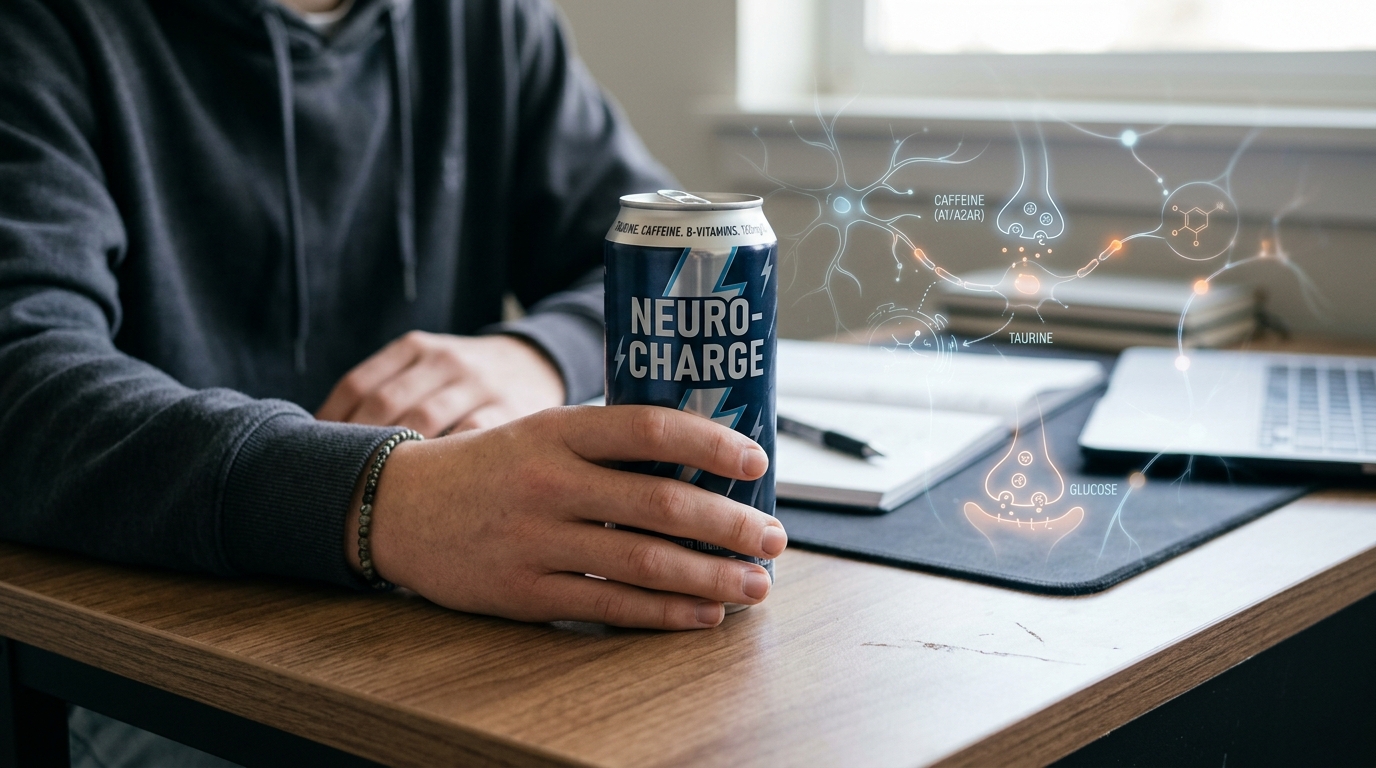
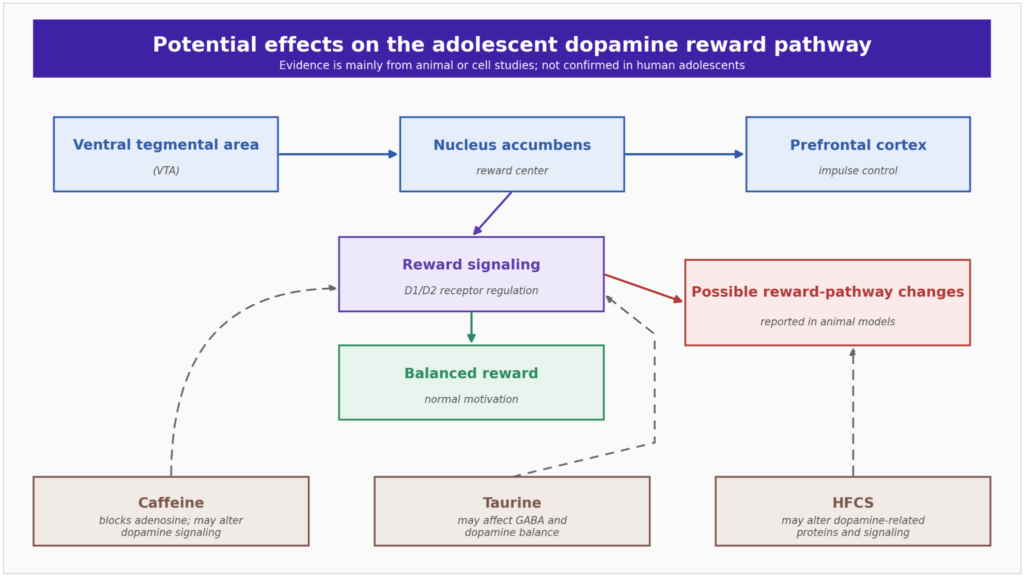
What is an ‘energy drink’ anyway? The term is imprecise and brands can put anywhere from about 50 to 505 mg of caffeine in a can, whereas a 12-ounce soft drink is capped at 71 mg5. Some will have taurine and sugar, others are sugar-free, and the body does not react in exactly the same way. Caffeine blocks adenosine receptors, and taurine can act on GABA-A receptors and dopamine6. Animal studies have also shown HFCS-related changes in dopamine signaling, discussed further below.
It is the adolescent part that interested me most. With synaptic pruning and myelination and the prefrontal cortex still in development, it is easy to see the immediate effect of caffeine. The question was what repeated exposure to an energy drink might mean for the human adolescent brain7.
So the project became two things. I went through the research on complete energy drinks and their components and I put a survey in front of 45 high school students to ask about their use and whether they were aware of the recommendation for minors.
Methods
In the end I put the findings side by side in the Discussion, but for the most part I treated the literature review and the anonymous cross-sectional survey as separate parts of the project.
Literature review
I put together 32 sources for the paper, a mix of original studies, reviews, meta-analyses and policy documents. Most were recent, though I made an exception for an older paper or two if it put an earlier finding or mechanism in context. I used a range of terms in my search of PubMed, Google Scholar and Web of Science through March 2026, such as ‘neurochemistry’, ‘dopamine’, ‘synaptic pruning’, ‘sleep’, ‘HFCS’, ‘taurine’ and ‘adolescent’.
Study selection
Human adolescent studies were what I looked for first. If a narrower question did not yield a good human paper I would use an adult study or a developing-brain animal model. I screened the titles and abstracts of peer-reviewed studies, except for consensus or policy documents I needed for regulation or recommendations.
Review synthesis
This is a narrative rather than a systematic review. A formal risk-of-bias score was not something I gave every paper. My approach was to compare the results after putting the studies in order by ingredient and noting whether they were human, animal or cell studies.
The survey
I put together the 19 questions for the survey on my own. They were not part of any validated medical instrument and the responses are self-reported; there is a difference between someone saying they did not sleep well and having it measured in a laboratory. The questions asked about brands, how often they were used, age of first use, focus, physical symptoms, sleep and whether someone was aware of the recommendation for minors.
I made the survey available online through student peer networks for three days in late March 2026. I removed one response after confirming it was false, and I also removed responses from students age 19 or older. In the end I had 45 students from grades 9–12. Given that about 80 to 100 students would have seen the survey, the response rate is in the neighborhood of 45–56%. It was simple to put it before them through their peers but the sample is hardly neutral; a student with an interest in energy drinks may have been more likely to respond. A faculty advisor looked over the survey and the distribution plan before I sent it out. The sample was mostly 10th-grade boys.
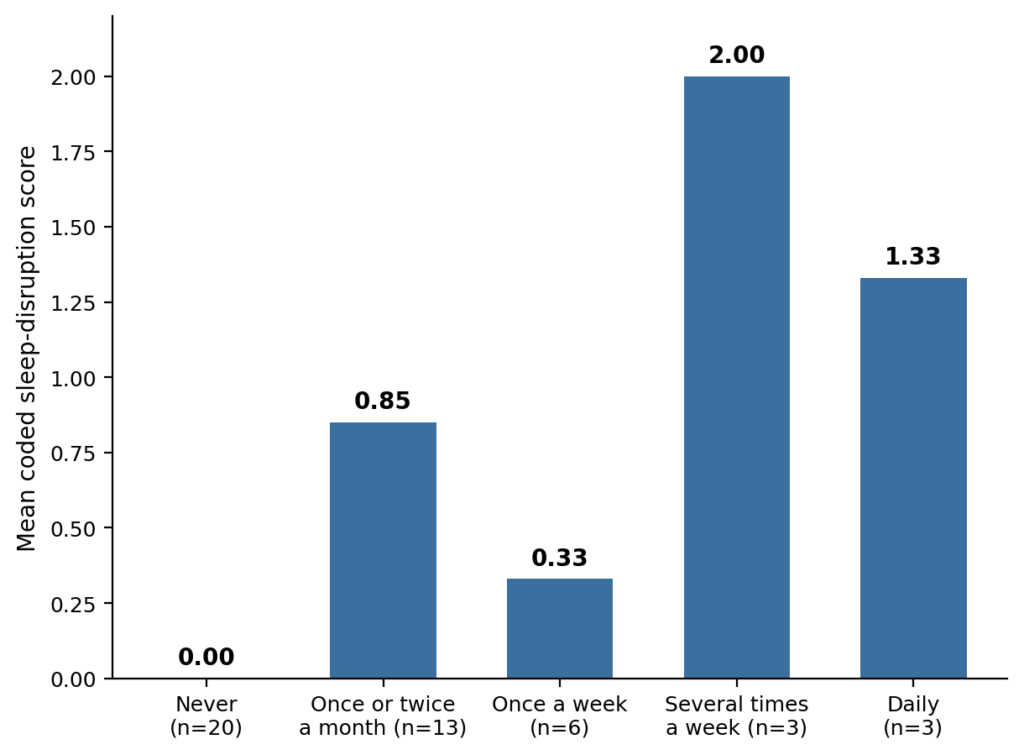
For my analysis I considered anyone other than a “never” to be a consumer. The five frequency options were given a code of 0 to 4, with 4 for daily use; “yes” meant aware while “no” and “not sure” were combined. As for the sleep score, a 0 signified no change. I used 2 for slightly worse sleep and 3 for significantly worse sleep; there were no 1s. Non-consumers were given a 0 as there was nothing to record in the way of post-drink changes.
Data analysis
All the statistics were done in Python. With a small sample like this, Fisher’s exact test was what I relied on for awareness, though I also ran Pearson’s chi-square for comparison. Spearman rank correlation was used for frequency and sleep since both were ranked variables. I ran an exploratory point-biserial correlation to compare consumers with non-consumers. I set α at .05.
Ethical considerations
This was an independent high school project and there was no formal IRB approval or exemption. No names or other identifying information were collected. Students were given a short description of the project and the option to take part. My faculty advisor went over the survey and the plan for its distribution.
Results
Caffeine and sleep
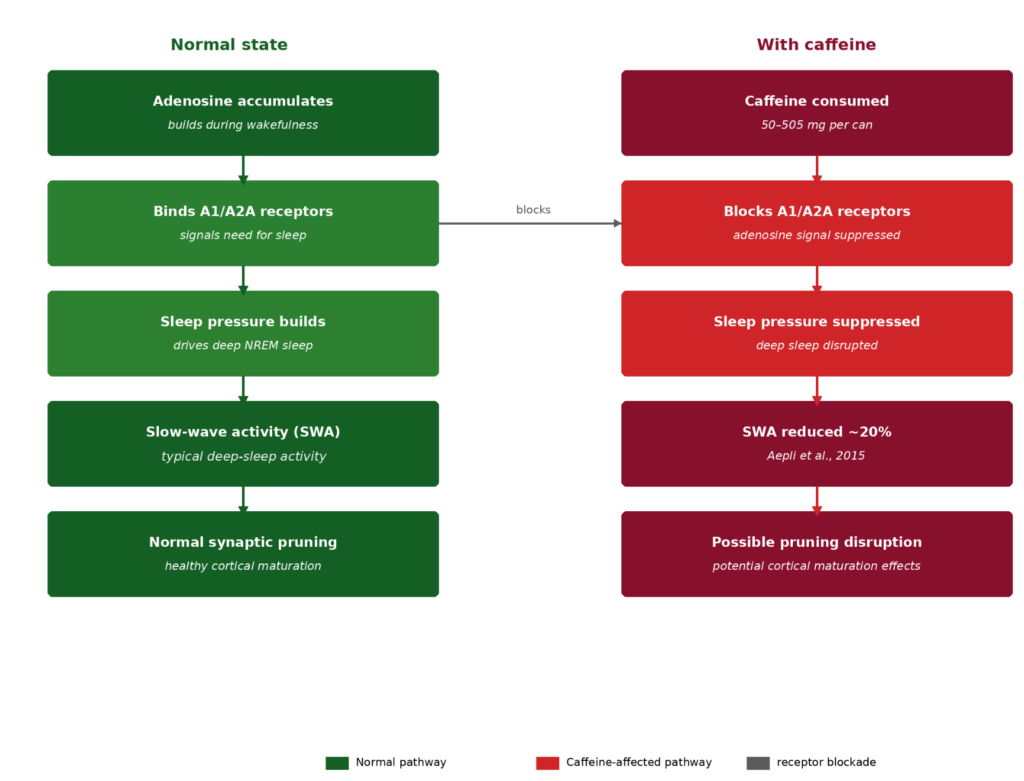
Of all the studies on sleep, caffeine was the easiest to follow. It is a blocker of the A1 and A2A receptors where adenosine exerts its pressure for sleep in the course of the day. Adolescent rats given repeated doses have been found to have their maturation of behaviour and sleep delayed8. The evidence from humans is not as consistent. One study saw slow-wave activity some 20 per cent lower in young habitual takers versus the control group9. In another, teenage boys were administered 80 mg of caffeine. They felt less drowsy afterward. Their ratings of sleep quality did not clearly worsen. Objective measurements, however, showed about 20 minutes less slow-wave sleep on average10.
Other research has gone about it differently. A study of 12,000 children linked higher caffeine intake to poorer performance on cognitive and working memory tests11. And in younger adolescents, one study tied caffeine use to daytime sleepiness and conduct problems12. Rats exposed during adolescence later showed more anxiety-like behavior and altered neuroendocrine signaling13. Yet an ABCD fMRI study of young people showed no clear link between recent caffeine use and the interplay of two brain networks14.
Taurine
One is hard pressed to find as much evidence with taurine. The developing brain has more of it than the adult’s, and it can be protective under certain circumstances15,16. The main developmental study I could locate was on mice. Taurine given in adolescence or early adulthood affected memory and neurotransmitter levels differently depending on sex and timing15. Other research was of a different order. One involved putting taurine and caffeine into cells as they developed17, while another examined chronic Red Bull’s effect on dopamine transmission in rats18. I came across nothing of a like nature in human teenagers.
HFCS and dopamine
In the case of HFCS, male rats given HFCS during adolescence later showed behavioural changes and lower levels of certain dopamine-related proteins in the mesolimbic system19. Mice in a separate experiment had changes in dopamine metabolism and signaling even without obesity20.
The only human study I found was of sugary drinks as a whole rather than HFCS in isolation and its results on the cognitive testing of adolescents were inconclusive21. Given the variety of sweeteners in different drinks, one cannot attribute the outcome to HFCS alone.
Methods in the animal studies vary. One study reported addiction-like behaviour in rats given excessive sucrose at intervals22. Some researchers wait until after adolescence to look at the animals; rats with an adolescent history of HFCS later showed inflammation in the nucleus accumbens and emotional changes as adults23. A diet high in fructose has been shown to make more enduring changes in the frontal cortex of the rat24. Such studies offer some insight into long-term effects but they are of animals.
Combined ingredients
I expected this to put my main question to rest but it did not. In the Giles study, for instance, caffeine accounted for most of the cognitive effects, with taurine or glucose affecting only a few tasks25. Peacock et al. could not show an improvement in reaction time with taurine by itself26. A 2025 meta-analysis pointed to some benefit in reaction time when caffeine and taurine are combined, though what test you use matters; the cognitive side of the analysis was based on just six studies27. None of them tested all three in adolescents: caffeine, taurine and HFCS.
Whole-drink studies are more like what a student actually drinks, but they complicate the individual ingredients. One rat study measured hippocampal function in animals given energy drinks, alcohol or a mix of the two28. Another put mice through a regular energy drink, a sugar-free version, a soft drink or water and looked at the blood-brain barrier and inflammation29. Neither study isolated caffeine, taurine and sugar. I could not find a developmental study that put all three to the test, separately or in every combination.
Then there is a wider review of epigenetic pathways involving caffeine and other exposures30. I used it to get a handle on mechanisms that may be worth following up, if nothing else. It is not direct evidence from human adolescents.
Health guidance and regulation
The policy side is more straightforward than the biology. Several European countries restrict sales of energy drinks to minors31,32, whereas the United States has no federal minimum age. Vetter and Naim describe the U.S. as the least regulated when it comes to these products5, which is a strange situation given the advice to minors.
Energy-drink use in the survey
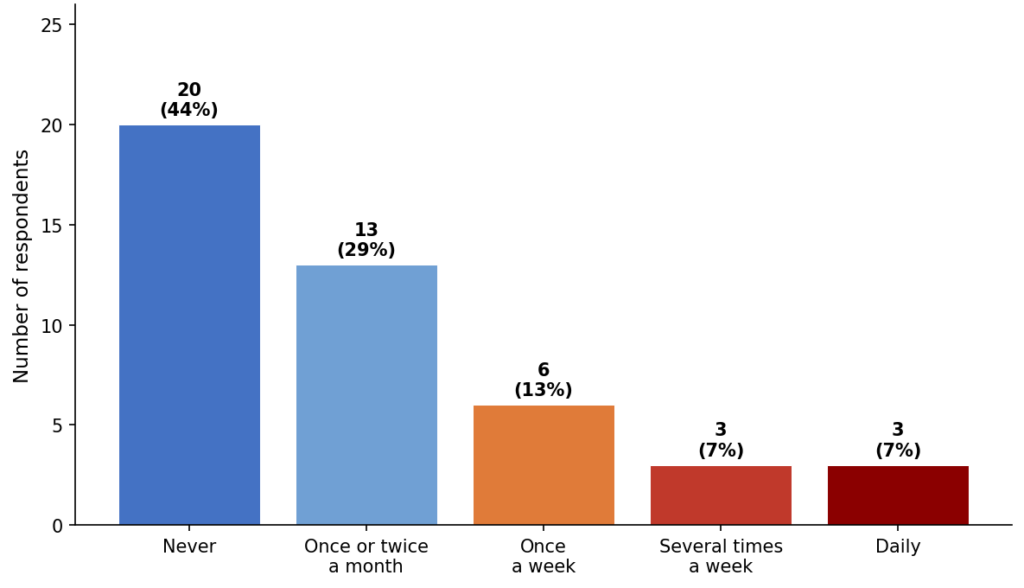
Of the 45 students in my survey, 25 (56%) were current users and 20 (44%) said never. Across the whole sample, 29% had one once or twice a month, 13% around once a week, 7% several times a week and 7% daily. Red Bull, Monster and Celsius were the usual suspects.
The ages at which they started were lower than I had anticipated. Seven students (16%) first tried an energy drink before age 12, 14 (31%) at ages 12–13 and 11 (24%) at ages 14–15. Overall, 21 of the 45 (47%) had tried one before age 14. Among the 32 students with any history of use, the figure was 66%. These are the ages as reported by the students; I make no claim that an early start caused any later health problem.
Students tended to use them for studying, followed by sports, tiredness or getting through the day before school. I set aside the multiple-choice answers and read and coded the written answers myself since they told a different story; I did not put exact percentages on those themes. Some of them were telling:
“I need them to stay awake and make it through the day and practice. I just have too much stuff to do and not enough time.”
An 11th-grade girl who used energy drinks a few times a week. She reported less than five hours of sleep, heart palpitations, anxiety, headaches, irritability, and worsening migraines.
A 12th-grade boy who had used energy drinks daily since before age 12. He reported seven different negative effects.
“To fit in.”
A 10th-grade boy. He said caffeine helped his concentration, but he also reported stomach problems, trouble sleeping, jitteriness, and anxiety.
“I have something called ADD where caffeine is a trigger to help me focus more.”
Awareness and sleep results
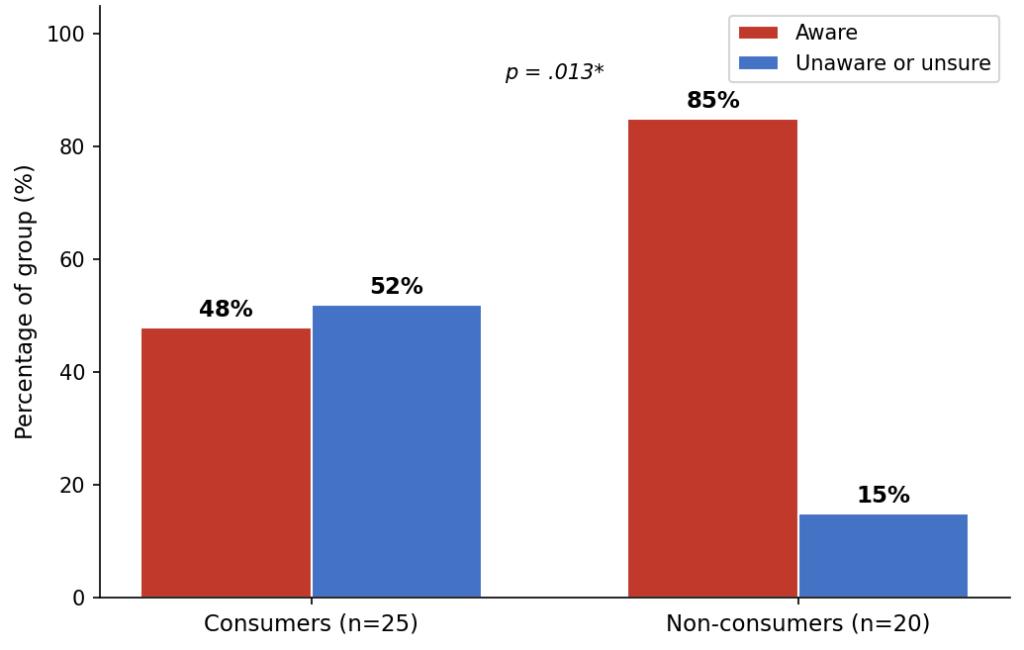
On awareness, Pearson’s chi-square was χ²(1) = 6.64. The two-sided Fisher’s exact test is the result I put forward, p = .013.
The numbers are lopsided. Among the 25 consumers, 12 were aware of the recommendation for minors and 13 were not or did not know; of the 20 non-consumers, 17 knew and three did not. That is 52% to 15%. Consumers had roughly six times the odds of being unaware or unsure, though the 95% confidence interval was broad (1.4–26.3).
The survey’s largest number is the sleep correlation: Spearman r = .54 between the score for sleep disruption and how often someone consumes energy drinks (p < .001; 95% CI [.32, .72]). I checked by collapsing adjacent frequency categories and the correlations were in the .55 to .59 range.
There is a flaw in the sleep figure, however. Since a 0 is what you get if you are a non-consumer, the correlation already has a wide gap between the two groups. The point-biserial tells you the same thing (r = .50, p < .001), with mean sleep scores of 0.92 for consumers and 0.00 for non-consumers. So I would not call .54 a true dose-response for the students who are actually drinking energy drinks. A larger sample would have let me analyze the consumers separately.
Discussion
In the end, sleep is where the clearest human evidence comes through in the review. Even that is not straightforward; the two main studies did not line up perfectly. One found less slow-wave activity in habitual users, while the other gave adolescents caffeine and found less drowsiness with intact sleep quality ratings but a measurable reduction in objectively measured slow-wave sleep9,10. For maturation, HFCS, dopamine-related changes and later anxiety, much of the evidence comes from animals8,13,19,23. A single mouse study provides most of the developmental evidence I found for taurine15.
The survey was something of a different project in itself because the students were not taking isolated ingredients. They were drinking finished products to get through the day, to study or play sports. Over half of this sample were current energy drink users and there was a 52% to 15% gap in awareness. The sleep score went up with frequency of use, though you have to take into account that I gave non-consumers a zero.
I had no desire to discard the animal studies. Some of them tracked the animals after adolescent exposure was over. Rats given caffeine during adolescence were more prone to anxiety-like behavior and changes in stress-hormone signaling later13. With HFCS, behavioral changes were seen along with inflammation or changes in reward-system proteins19,23.
But real life is messier than a lab. In a lab the dose, timing and ingredient are fixed. A student might finish a can quickly, late at night, and also get sugar or caffeine from coffee, soda or food. It is difficult to pin an outcome on a single ingredient.
What I set out to find at the beginning eluded me: a human study of adolescents testing caffeine, taurine and HFCS in combination and also apart. Animal and cell work may point to mechanisms but they do not prove a three-ingredient effect in teenagers, nor does my survey. The survey only speaks to use, awareness and how students reported their sleep.
The awareness numbers are of more immediate value. These are drinks students can get easily and many of the consumers in the survey were not aware of the recommendation for minors. Put the recommendation where it can be seen and the caffeine and sugar content in plain view and the student is better informed. An age restriction might cut down on use, but with 45 students I am not in a position to say so.
Future research
Were I to continue, taurine would be the first place to look. There is a need for replication when one mouse experiment is doing so much of the developmental work15. I would like to see the ingredients tested alone and in different combinations over development. For humans, a longer observational study with validated sleep measures could follow teenagers who already drink energy drinks. There is no reason to have anyone start for the purpose of the study.
Limitations
One has to acknowledge a few limitations. Much of the research on brain mechanisms is from cells or animals, not human teenagers. HFCS is particularly hard to pin down since human studies will often conflate it with other sugars; a finding on a sugary drink is not tantamount to a finding on HFCS.
As for this review, being a narrative rather than a systematic one, it has its limits. No formal risk-of-bias score was applied to the papers and a different search might have yielded a different set. Comparison is difficult when the species, dose and age differ.
There were only 45 students in the survey, mostly from the same area, and all of the answers were self-reported. I put the questionnaire together without recourse to a validated medical survey and did the coding of the written answers, leaving room for one’s own interpretation. School demands or any underlying mental health and sleep problems were not factored in, nor caffeine from other sources.
As for the sleep score, giving every non-consumer a 0 makes the correlation look larger. An r of .54 should not be read as a true dose-response among the students who actually used energy drinks. A larger study would need to look at the consumers separately and measure their sleep more directly.
My main question was what happens when adolescents consume caffeine, taurine, and HFCS together. I did not find a study that answered it. The clearest human evidence was about sleep. Most of the longer-term brain-development evidence came from animals, and there was very little developmental research on taurine. The survey also showed that many students did not know the recommendation for their age. There is still a lot that has not been studied.
Acknowledgements
The author thanks all 45 survey participants for their time and candid responses and the faculty advisor who reviewed the survey and distribution plan.
References
- G. Aonso-Diego, A. Krotter, Á. García-Pérez. Prevalence of energy drink consumption world-wide: a systematic review and meta-analysis. Addiction. Vol. 119, pg. 438–463, 2024, https://doi.org/10.1111/add.16390. [↩]
- M. Rostami, M. Babashahi, S. Ramezani, H. Dastgerdizad. A scoping review of policies related to reducing energy drink consumption in children. BMC Public Health. Vol. 24, pg. 2308, 2024, https://doi.org/10.1186/s12889-024-19724-y. [↩]
- M. Lott, L. Reed, K. Deuman, M. Story, A. Cradock, A. I. Patel. Healthy beverage consumption in school-age children and adolescents: recommendations from key national health and nutrition organizations. Consensus Statement. Healthy Eating Research. https://healthyeatingresearch.org/research/healthy-beverage-consumption-in-school-age-children-and-adolescents-recommendations-from-key-national-health-and-nutrition-organizations/, 2025. [↩]
- T. R. Thompson, H. L. Hays, S. Kistamgari, N. I. Rine, M. Zhu, H. Xiang, G. A. Smith. Pediatric exposures associated with caffeine energy products reported to United States poison centers, 2011–2023. Journal of Medical Toxicology. Vol. 21, pg. 241–252, 2025, https://doi.org/10.1007/s13181-025-01057-w. [↩]
- V. L. Vetter, M. Y. Naim. Cardiovascular toxicity of energy drinks in youth: a call for regulation. The Journal of Pediatrics. Vol. 275, pg. 114224, 2024, https://doi.org/10.1016/j.jpeds.2024.114224. [↩] [↩]
- C. P. Curran, C. A. Marczinski. Taurine, caffeine, and energy drinks: reviewing the risks to the adolescent brain. Birth Defects Research. Vol. 109, pg. 1640–1648, 2017, https://doi.org/10.1002/bdr2.1177. [↩]
- C. Cadoni, A. T. Peana. Energy drinks at adolescence: awareness or unawareness? Frontiers in Behavioral Neuroscience. Vol. 17, pg. 1080963, 2023, https://doi.org/10.3389/fnbeh.2023.1080963. [↩]
- N. Olini, S. Kurth, R. Huber. The effects of caffeine on sleep and maturational markers in the rat. PLOS ONE. Vol. 8, pg. e72539, 2013, https://doi.org/10.1371/journal.pone.0072539. [↩] [↩]
- A. Aepli, S. Kurth, N. Tesler, O. G. Jenni, R. Huber. Caffeine consuming children and adolescents show altered sleep behavior and deep sleep. Brain Sciences. Vol. 5, pg. 441–455, 2015, https://doi.org/10.3390/brainsci5040441. [↩] [↩]
- C. F. Reichert, S. Veitz, M. Bühler, G. Gruber, G. Deuring, S. S. Rehm, K. Rentsch, C. Garbazza, M. Meyer, H. Slawik, Y.-S. Lin, J. Weibel. Wide awake at bedtime? Effects of caffeine on sleep and circadian timing in male adolescents: a randomized crossover trial. Biochemical Pharmacology. Vol. 191, pg. 114283, 2021, https://doi.org/10.1016/j.bcp.2020.114283. [↩] [↩]
- H. Zhang, Z. X. Lee, A. Qiu. Caffeine intake and cognitive functions in children. Psychopharmacology. Vol. 237, pg. 3109–3116, 2020, https://doi.org/10.1007/s00213-020-05596-8. [↩]
- S. M. Kogan, C. L. Lilly, J. E. James, A. L. Kristjansson. Caffeine, daytime sleepiness, and conduct problems among early adolescents: a longitudinal analysis. Journal of Adolescent Health. Vol. 76, pg. 807–812, 2025, https://doi.org/10.1016/j.jadohealth.2024.11.004. [↩]
- C. E. O’Neill, R. J. Newsom, J. Stafford, T. Scott, S. Archuleta, S. C. Levis, R. L. Spencer, S. Campeau, R. K. Bachtell. Adolescent caffeine consumption increases adulthood anxiety-related behavior and modifies neuroendocrine signaling. Psychoneuroendocrinology. Vol. 67, pg. 40–50, 2016, https://doi.org/10.1016/j.psyneuen.2016.01.030. [↩] [↩] [↩]
- O. D. Ware, S. E. Chang, W. K. Thompson, A. S. Potter, H. Garavan, M. E. Johnson, L. Q. Uddin. Examining recent effects of caffeine on default mode network and dorsal attention network anticorrelation in youth. PLOS ONE. Vol. 20, pg. e0327385, 2025, https://doi.org/10.1371/journal.pone.0327385. [↩]
- J. Brown, Y. Villalona, J. Weimer, C. P. Ludwig, B. T. Hays, L. Massie, C. A. Marczinski, C. P. Curran. Supplemental taurine during adolescence and early adulthood has sex-specific effects on cognition, behavior and neurotransmitter levels in C57BL/6J mice dependent on exposure window. Neurotoxicology and Teratology. Vol. 79, pg. 106883, 2020, https://doi.org/10.1016/j.ntt.2020.106883. [↩] [↩] [↩] [↩]
- J. J. Caine, T. D. Geracioti. Taurine, energy drinks, and neuroendocrine effects. Cleveland Clinic Journal of Medicine. Vol. 83, pg. 895–904, 2016, https://doi.org/10.3949/ccjm.83a.15050. [↩]
- M. Serdar, A. Mordelt, K. Müser, K. Kempe, U. Felderhoff-Müser, J. Herz, I. Bendix. Detrimental impact of energy drink compounds on developing oligodendrocytes and neurons. Cells. Vol. 8, pg. 1381, 2019, https://doi.org/10.3390/cells8111381. [↩]
- R. Vargiu, F. Broccia, C. Lobina, D. Lecca, A. Capra, P. P. Bassareo, V. Bassareo. Chronic Red Bull consumption during adolescence: effect on mesocortical and mesolimbic dopamine transmission and cardiovascular system in adult rats. Pharmaceuticals. Vol. 14, pg. 609, 2021, https://doi.org/10.3390/ph14070609. [↩]
- A. M. Maya-Romero, G. E. Dodd, J. D. Landin, H. K. Zaremba, O. F. Allen, M. A. Bilbow, R. D. Hammaker, J. L. Santerre-Anderson. Adolescent high-fructose corn syrup consumption leads to dysfunction in adult affective behaviors and mesolimbic proteins in male Sprague-Dawley rats. Behavioural Brain Research. Vol. 419, pg. 113687, 2022, https://doi.org/10.1016/j.bbr.2021.113687. [↩] [↩] [↩]
- A. M. Meyers, D. Mourra, J. A. Beeler. High fructose corn syrup induces metabolic dysregulation and altered dopamine signaling in the absence of obesity. PLOS ONE. Vol. 12, pg. e0190206, 2017, https://doi.org/10.1371/journal.pone.0190206. [↩]
- X. Yan, Y. Xu, J. Huang, Y. Li, Q. Li, J. Zheng, Q. Chen, W. Yang. Association of consumption of sugar-sweetened beverages with cognitive function among the adolescents aged 12–16 years in US, NHANES III, 1988–1994. Frontiers in Nutrition. Vol. 9, pg. 939820, 2022, https://doi.org/10.3389/fnut.2022.939820. [↩]
- N. M. Avena, P. Rada, B. G. Hoebel. Evidence for sugar addiction: behavioral and neurochemical effects of intermittent, excessive sugar intake. Neuroscience & Biobehavioral Reviews. Vol. 32, pg. 20–39, 2008, https://doi.org/10.1016/j.neubiorev.2007.04.019. [↩]
- J. L. Santerre-Anderson, M. S. Colón, B. L. Pike, C. Y. Kiessling. Adolescent high-fructose corn syrup consumption contributes to protracted dysregulation of adult accumbal neuroinflammation and affective behaviors. Brain Research. Vol. 1867, pg. 149978, 2025, https://doi.org/10.1016/j.brainres.2025.149978. [↩] [↩] [↩]
- M. S. Spagnuolo, A. Mazzoli, M. Nazzaro, A. D. Troise, C. Gatto, C. Tonini, M. Colardo, M. Segatto, A. Scaloni, V. Pallottini, S. Iossa, L. Cigliano. Long-lasting impact of sugar intake on neurotrophins and neurotransmitters from adolescence to young adulthood in rat frontal cortex. Molecular Neurobiology. Vol. 60, pg. 1004–1020, 2023, https://doi.org/10.1007/s12035-022-03115-8. [↩]
- G. E. Giles, C. R. Mahoney, T. T. Brunyé, A. L. Gardony, H. A. Taylor, R. B. Kanarek. Differential cognitive effects of energy drink ingredients: caffeine, taurine, and glucose. Pharmacology Biochemistry and Behavior. Vol. 102, pg. 569–577, 2012, https://doi.org/10.1016/j.pbb.2012.07.004. [↩]
- A. Peacock, F. H. Martin, A. Carr. Energy drink ingredients: contribution of caffeine and taurine to performance outcomes. Appetite. Vol. 64, pg. 1–4, 2013, https://doi.org/10.1016/j.appet.2012.12.021. [↩]
- H. Deng, L. Wang, P. Liu, M. N. B. Naharudin, X. Fan. Caffeine and taurine: a systematic review and network meta-analysis of their individual and combined effects on physical capacity, cognitive function, and physiological markers. Journal of the International Society of Sports Nutrition. Vol. 22, pg. 2566371, 2025, https://doi.org/10.1080/15502783.2025.2566371. [↩]
- F. Biggio, G. Talani, G. P. Asuni, V. Bassareo, M. Boi, L. Dazzi, M. G. Pisu, P. Porcu, E. Sanna, F. Sanna, M. Serra, M. P. Serra, C. Siddi, E. Acquas, P. Follesa, M. Quartu. Mixing energy drinks and alcohol during adolescence impairs brain function: a study of rat hippocampal plasticity. Neuropharmacology. Vol. 254, pg. 109993, 2024, https://doi.org/10.1016/j.neuropharm.2024.109993. [↩]
- L. Graneri, V. Lam, Z. D’Alonzo, M. Nesbit, J. C. L. Mamo, R. Takechi. The consumption of energy drinks induces blood-brain barrier dysfunction in wild-type mice. Frontiers in Nutrition. Vol. 8, pg. 668514, 2021, https://doi.org/10.3389/fnut.2021.668514. [↩]
- R. Mallick, A. K. Duttaroy. Epigenetic modification impacting brain functions: effects of physical activity, micronutrients, caffeine, toxins, and addictive substances. Neurochemistry International. Vol. 171, pg. 105627, 2023, https://doi.org/10.1016/j.neuint.2023.105627. [↩]
- I. Katsarova. Energy drinks consumption in minors: EU and national approaches. European Parliamentary Research Service. PE 779.236, https://www.europarl.europa.eu/thinktank/en/document/EPRS_BRI(2025)779236, 2025. [↩]
- P. Mularczyk-Tomczewska, M. Gujski, T. Koweszko, A. Szulc, A. Silczuk. Regulatory efforts and health implications of energy drink consumption by minors in Poland. Medical Science Monitor. Vol. 31, pg. e947124, 2025, https://doi.org/10.12659/MSM.947124. [↩]