
Abstract
With aging, close families grow apart. Many older adults begin experiencing isolation that carries serious emotional and mental consequences. Though digital tools can help bridge the physical distance between them, such tools are designed for the general population, making it difficult for elderly people to access due to lack of digital experience, complex user interfaces, and the expectation that users will initiate most interactions. This paper reviews current research on multi-generational connections while aging, and utilizes that evidence to propose the design for Heartlinks, which is an AI-powered application designed with the potential to increase interactions between the elderly and their families. This paper presents Heartlinks as a design proposal: instead of functioning as a general messaging app, it is made with the intent to deliver personalized messages that center on family content by using semantic content retrieval, relationships, with a delivery service that is intended to be scalable. Drawing on this literature, the paper proposes a design rationale for the platform’s features that are intended to encourage family connections with elderly, and potentially support cognitive health through the exchange of meaningful communications. Since Heartlinks is still in development, this paper is made with no experimental results or concrete claims about its effects. It serves as a design rationale for the platform, and an evaluation plan – including proposed testing methods, expected results as hypotheses, and a discussion of limitations, ethical considerations, and constraints – made to test the hypotheses on the platform’s deployment.
Keywords: social isolation, inter-generational communication, healthy aging, artificial intelligence, personalization, cognitive health, assistive technology
Introduction
As time passes and families become more geographically dispersed, the adults of the family suffer a growing disconnect from their younger relatives. There are a number of factors that contribute to such isolation, mainly: economic opportunities, refuge, educational mobility, service and global migration of the younger generations take them across cities, states, countries or even continents. While such movements are important for the generations in question, this reduces the chances to interact with their ancestry drastically1.
This growing distance leaves the older generations in social isolation, a condition characterized by infrequent social interaction and reduced participation in meaningful relationships. This matters for mental health: in a national sample of over 11,000 adults aged 50 and older, those who saw others in person only every few months were more likely to develop depressive symptoms two years later than those with weekly contact2. People struggling with this condition often face additional challenges such as retirement, loss of spouse and friends, chronic illness and reduced access to transport and social events. Such exclusions in life can limit social engagement for older individuals. In a nationally representative study of community-dwelling adults aged 65 and older in the United States, Cudjoe et al.3 found that about one in four were socially isolated and 4% were severely isolated.
Concurrently, younger members of the family suffer distance from their grandparents and sometimes even one or both of their parents due to such migrations. This leads them to rely heavily on digital interactions with their relatives. However, older generations are not able to access the same liberty because of barriers like lower digital literacy, interface complexity, physical limitations, or lack of confidence in use of technology4. As a result, the very tools that could be used to bridge the gap between families turn out to be the hindrance in them coming together. This combination of geographic separation and technological exclusion of family members creates an ever widening gap between these generations. In a mixed-methods study of 218 parents with emigrant children in Nepal, Bhandari et al.5 found that 18.8% had psychological distress, that parents who received little support from their migrant children had higher odds of distress, and that interviewed parents described persistent loneliness and sadness. The older generation begins to feel disconnected from their daily lives, the family that they helped forge, their achievements, interests and their experiences meanwhile younger family members may struggle to maintain meaningful communication despite their want, need and intention to. The act of addressing this growing issue requires careful consideration of solutions that facilitate communication and also make these interactions meaningful, accessible and personally relevant.
The Proposed Solution: Heartlinks
Heartlinks is an AI platform built to increase the strength of connections between the elderly and their physically distant families. Instead of just working like a general communication platform like Facebook, WhatsApp, Messages, Snapchat, etc. Heartlinks combines family updates, adaptable content, and recommendations that are personalized to create a sense of presence and belonging regardless of the geographical distance between families.
The platform is made around the idea that older people should not be the people to constantly initiate social interactions or navigate the complex user interfaces of messaging platforms. Instead, Heartlinks actively delivers content that is family centered, including photos, landmarks, cherished memories, and conversation starters that can help the elderly people remain involved in the lives of their children and grandchildren.
With the usage of technology like Weaviate for semantic content retrieval, PostgreSQL for managing relationships with close ones, and FastAPI for reliable delivery service, the program is made to create a personalized experience that is unique to each user’s family, interests, and overall life history. Through the platform being personalized, Heartlinks hopes to shift older adults from the position of passive participants of fast paced communication in the modern day to an active two-way communication with reciprocated social engagement.
Thesis Statement
Research on aging consistently associates social isolation with poorer emotional and physical health, and shows that digital contact with family can partially offset geographic separation. General-purpose communication platforms have placed the burden of starting and sustaining contact on older adults and assume a level of digital fluency that many do not have. This paper argues that a platform designed around three principles could lower these barriers where family members supply content, the system delivers it proactively, the interface asks little of the older user. Heartlinks is proposed as one such design. The paper makes three contributions: a synthesis of the evidence on inter-generational connectivity, isolation, and older adults’ technology use with design rationale linking each Heartlinks feature to a barrier found in that literature, a feasibility and usability pilot protocol for testing whether older adults and their families can and will use the platform. Heartlinks has not yet been deployed and is still in development and because of this its potential effects on loneliness and well-being are presented as hypotheses for future evaluation, not as findings.
Literature Review and Background
Literature Review Methods
The literature for this paper was gathered through a structured narrative review carried out iteratively between January and September 2026. Rather than a single database query, searches were run in stages, each focused on one question raised while developing the framework, and new searches were added as earlier findings raised further questions. Searches were conducted mainly in Google Scholar and PubMed using plain-language and keyword search phrases, and the reference lists of relevant articles were checked for further primary studies. Articles published from January 2010 to September 2026 were eligible.
Searches were organized around four themes. The first examined geographic separation and family contact, using phrases such as “geographic distance family caregivers social isolation”, “psychological distress among parents of emigrant children”, and “frequency of in-person contact and depression in older adults”. The second examined social isolation and health, using phrases such as “loneliness social isolation all-cause mortality older adults cohort”, “social isolation biological markers inflammation older adults”, and “loneliness and risk of dementia”. The third examined technology-based interventions, using phrases such as “technology to reduce loneliness in older adults randomized trial”, “intergenerational technology mentoring older adults loneliness”, “voice assistant loneliness older adults”, and “conversational AI loneliness depression older adults trial”. The fourth examined barriers to technology use, beginning with the question of what causes gaps in older adults’ active participation in technology, and using phrases such as “older adults’ barriers to using tablets”, “oldest-old new users’ attitudes toward social networking sites”, and “older adults icon processing in visual search”. Table 1 lists the search phrases and the sources each identified.
Sources were included if they were peer-reviewed primary research articles (observational studies, trials, surveys, qualitative, or mixed-methods studies), written in English, and studied adults aged 50 or older, their families, or inter-generational pairs, with outcomes related to social connection, loneliness, mental health, cognition, or technology use. Reviews, meta-analyses, and opinion pieces were not cited as evidence, although their reference lists were used to locate primary studies. The measurement instruments used in the proposed pilot are cited to their original validation and benchmark studies regardless of publication date. For each source, the population, study design, sample size, and main findings were recorded, and findings were synthesized narratively within the four themes. No formal quality scoring was performed; instead, each study’s design and population are reported alongside its findings, and the limitations of the evidence are discussed at the end of each section of the literature review.
| Theme | Example search phrase | Sources identified |
| Geographic separation and family contact | geographic distance family caregivers social isolation | Li & Wister (2023)1 |
| frequency of in-person contact and depression in older adults | Teo et al. (2015)2 | |
| prevalence of social isolation among community-dwelling older adults | Cudjoe et al. (2020)3 | |
| psychological distress among parents of emigrant children | Bhandari et al. (2025)5 | |
| digital contact between older parents and adult children during the pandemic | Hwang et al. (2022)6 | |
| digital media grandparent–grandchild communication | Döring et al. (2024)7 | |
| Social isolation and health | loneliness and risk of dementia | Sutin et al. (2020)8 |
| loneliness social isolation all-cause mortality older adults cohort | Barnes et al. (2022)9; Ward et al. (2021)10 | |
| changes in social isolation and loneliness and mortality in older adults | Huang et al. (2026)11 | |
| social isolation biological markers inflammation older adults | Cudjoe et al. (2022)12 | |
| digital reminiscence therapy dementia trial | Moon & Park (2020)13 | |
| social disconnectedness perceived isolation depression anxiety older adults | Santini et al. (2020)14 | |
| Technology-based interventions | technology to reduce loneliness in older adults randomized trial | Czaja et al. (2018)15 |
| intergenerational technology mentoring older adults loneliness | Juris et al. (2022)16 | |
| voice assistant loneliness older adults | Jones et al. (2021)17 | |
| conversational AI loneliness depression older adults trial | Shade et al. (2025)18; Papadopoulos et al. (2022)19 | |
| AI-supported grandparent–grandchild co-creative activities | Kim et al. (2025)20 | |
| mobile app for intergenerational communication | Chung et al. (2025)21 | |
| Barriers to technology use | what causes gaps in older adults’ active participation in technology; older adults’ barriers to using tablets | Vaportzis et al. (2017)4 |
| social technology use and loneliness in older adults | Chopik (2016)22 | |
| Facebook and family communication across generations | Jung (2026)23 | |
| social media and intergenerational bonding with older family members | Farhi et al. (2025)24 | |
| oldest-old new users’ attitudes toward social networking sites | Casanova et al. (2021)25 | |
| older non-users’ perceptions of social networking sites | Lüders & Brandtzæg (2017)26 | |
| Facebook interface for senior users | Gomes et al. (2014)27 | |
| older adults icon processing in visual search | Wu et al. (2022)28 |
The State of Generational Connectivity
Research has mostly shown that physical distance with one another results in losing contact with close family. Li and Wister1 found that, among Canadian family caregivers of older adults, those living at a moderate to long distance from the family member requiring care reported greater social isolation than nearby caregivers when care demands were high, showing how geographic distance strains family care relationships. Geographic isolation reduces the amount of times of interaction with one another and also reduces informal caregiving, and family meetups.
Current shifts in population have increased this challenge regarding reducing isolation. Younger people mostly relocate due to education or employment, which results in their parents and grandparents being left behind. While technology can help families communicate, in-person contact appears to offer benefits that remote contact does not. For example, phone contact was not associated with lower depression risk in the way that in-person contact was2.
The COVID-19 pandemic exaggerates the importance of digital communications in maintaining healthy relationships between families. In a survey of 519 older American parents during the pandemic, Hwang et al.6 found that parents who lived apart from their adult children but stayed in close digital contact reported mental health as good as parents with close in-person relationships, and better than parents whose relationships were detached. This aims at the idea that digital communication can partly compensate for the loss of in-person engagement.
Similarly, in a survey of university students about contact with their grandparents, Döring et al.7 found that although phone calls and in-person visits remain common for them, younger people rely heavily on digital tools to stay in touch with family. Whether this contact builds social engagement depends on how easy and meaningful the interactions are and not on the technology alone.
Taken together, these studies agree that geographic distance reduces family contact and is associated with poorer well-being among older adults1,5. They differ, however, on how far digital contact can make up for it: Hwang et al.6 found that close digital contact with adult children was associated with mental health as good as close in-person contact during the pandemic, whereas Teo et al.2 found that only in-person contact, not phone contact, was associated with lower depression risk. Most of this evidence is observational, so it shows association rather than cause. What the literature establishes is that separation is a risk; what it does not yet establish is which kinds of digital contact, if any, reduce that risk. Heartlinks is built on the hypothesis that digital contact which is easy to start and centered on meaningful family content may compensate more than general messaging does, a hypothesis this paper proposes to test rather than assumes.
Cognition and Aging
A huge amount of research has been associated social engagement with cognitive and mental health outcomes among the elderly population. In a study of 12,030 older adults followed for up to ten years, Sutin et al.8 found that loneliness was associated with a 40% higher risk of developing dementia, even after accounting for social isolation, depressive symptoms, and other risk factors.
In a large sample of 7,982 U.S. adults aged 65 and older followed for about three years, Barnes et al.9 found that those with limited social networks had more than twice the risk of death, and those with severe loneliness about 1.6 times the risk, compared with well-connected peers. In a nationally representative Irish cohort of 6,915 adults aged 50 and older, Ward et al.10 likewise found that people who were both lonely and socially isolated had a 43% higher risk of death than those who were neither, even after accounting for their health conditions.
Following 8,956 Chinese adults aged 65 and older, Huang et al.11 found that persistent social isolation was associated with a 39% higher risk of death and persistent loneliness with a 27% higher risk, suggesting that how long isolation lasts also matters. Such evidence points to the fact that social connections play a vital role in aging healthily.
Researchers have found several different processes that explain such abnormal outcomes. In a nationally representative sample of 4,648 U.S. adults aged 65 and older who provided blood samples, Cudjoe et al.12 found that socially isolated older adults had higher levels of the inflammatory markers interleukin-6 and C-reactive protein, even after accounting for smoking, body weight, and chronic conditions. Over a period of time, such effects can lead to declines in both physical and mental health.
Interventions that are memory based give evidence into the importance of social engagement that is meaningful. In a pilot randomized controlled trial with 41 people with dementia, Moon and Park13 found that digital reminiscence therapy, which uses personal photographs, videos, and memories, improved engagement and reduced depressive symptoms compared with a control group. However, it did not produce a significant improvement in cognitive function. Usage of personal content that is meaningful is seen to cause recall of memories and promote indirect conversations.
These findings suggest that personally meaningful content can support engagement and mood, at least among people with dementia, but they do not show a cognitive benefit. Whether similar content shared by family members benefits older adults more broadly has not yet been tested.
Overall, the evidence in this section is consistent in linking social isolation and loneliness to higher mortality9,10,11, depressive symptoms, and dementia risk8, and a plausible biological pathway, inflammation, has been observed12. These are, however, associations from observational studies; they show that isolation is a risk factor, not that reducing it through technology improves cognitive or mental health. The intervention evidence is narrower: reminiscence using personal media has improved engagement and mood, but not cognitive function, in a small trial of people with dementia13. Heartlinks draws on both lines of evidence, but its potential to support emotional or cognitive health in older adults without dementia remains a hypothesis.
Technology as a Bridge
Technology has started to be explored as a tool that is made to reduce loneliness and increase social connections with loved ones among older people. In a randomized controlled trial with 300 adults aged 65 and older who lived alone, Czaja et al.15 found that a simplified computer system designed for older adults, which offered email, internet access, and other social features, reduced loneliness and increased perceived social support after six months compared with a control group, although the differences between groups had narrowed by twelve months.
Programs that are family focused have shown much promise. In a pilot program evaluated by Juris et al.16, university students mentored rural older adults in using technology such as email and video calls over three months. Older adults’ loneliness scores fell, although the change was not statistically significant in this small sample, and participants described gaining new ways to interact with friends and family.
AI has expanded on the many possibilities for helping older people. In an eight-week study of 16 adults aged 75 to 96, Jones et al.17 found that loneliness decreased after four weeks of using an Amazon Echo voice assistant, which requires little to no technical skill, and that participants who greeted the device in a friendly, social way showed greater reductions. Voice interfaces may be particularly useful for older adults with limited mobility or vision, or who are unfamiliar with technology.
AI-based conversational tools have also been studied as a way to support older adults’ mental health. In a twelve-week randomized trial with 50 adults aged 60 and older who lived alone, Shade et al.18 assigned participants to use either a standard or an enhanced set of conversational AI voice-assistant routines twice daily; participants in both groups reported less depression, and those using the enhanced routines reported significantly less loneliness. Such AI usage can also aid in family engagement by creating conversation topics that are personal or giving information that is important and cherished by both generations. In contrast, a randomized trial in care homes by Papadopoulos et al.19 found that two weeks with a culturally competent conversational robot improved residents’ emotional well-being, but did not significantly reduce loneliness.
Even though such advances exist, there are obstacles. Most communication platforms that are built are mainly built for the general audience rather than being made for the older generations. These platforms generally assume that users will start and maintain conversations themselves and navigate interfaces designed for a broad audience, which can be difficult for older adults with limited confidence in technology4,7. Furthermore, today’s platforms are very rarely integrated with family oriented updates, memories that are personalized, content delivery that is assisted with AI, and a friendly user interface that is made with elderly people as the main users. Across these studies, the evidence for technology-based approaches is promising but uneven. A simplified system designed for older adults reduced loneliness in a randomized trial, but the benefit faded over time15. Intergenerational mentoring appears to work through device training and confidence-building, although the pilot evidence is small and not statistically conclusive16, and voice assistants lower the skill needed to take part17. Findings on AI agents are mixed: Shade et al.18 reported reductions in depression and, with enhanced routines, in loneliness, while Papadopoulos et al.19 found improved emotional well-being but no significant effect on loneliness. Most of these studies are small or short, so their results should be treated as preliminary. No study reviewed here combines family-supplied content, proactive delivery, and AI-generated conversation support in one system designed for older adults. This gap motivates the Heartlinks framework described below; whether combining these features improves on any one of them alone is a question for future evaluation.
Heartlinks uses Weaviate, PostgreSQL and FastAPI in order to support high-throughput, low-latency demands of the modern generation of social messaging architectures. FastAPI serves as an asynchronous backbone of the framework which handles HTTP traffic and maintains WebSocket connections. It delivers native execution to manage concurrent chat streams, typing indicators and presence overhead which are integral to the core of Heartlinks which is about the presence of family around when one converses in chat. The primary data persistence of the framework is anchored in PostgreSQL which grants compliance to ACID(Atomicity, Consistency, Isolation, and Durability) across user authentication, contact graphs, grouping permissions, and the sequential log of chat messages. This database management tool uses relational indexing of data pieces to maintain integrity of the stored information and further promotes security by locking access behind proper user authentication. Furthermore, Weaviate functions as the framework’s AI-native vector database. As the information stored in the database grows, this part of the framework creates a vectorized representation of the data to allow for smooth contextual, semantic search across personal and group messages. Weaviate allows the users to search these messages without exact words and phrases which allows for easier search for older generation users. Together, these tools are used to accommodate a secure, smooth, quick and adaptive application for use by members of all generations.
Heartlinks in Context: Comparison to General-purpose Platforms
General communication platforms like Facebook or WhatsApp are widely used, and their use can benefit older adults: in a national sample of 591 older adults, Chopik22 found that those who used social technology such as email, Facebook, and video calls more often reported less loneliness, which in turn was linked to better physical and mental health. Close digital contact with family has also been associated with better mental health among older parents who live apart from their children6, suggesting that these platforms can support family bonds. A study on users in the US using Facebook found that Facebook was seen to increase family bonds and emotional well-being, specifically in elderly people already on the app23, and a study on residents in Dubai reported that both WhatsApp and Facebook have also been an aid in maintaining family relations24. In a study that trained 39 adults aged 80 and older to use a smartphone, Facebook, and WhatsApp, Casanova et al.25 found that most described the experience positively, used the platforms mainly to stay in touch with relatives and friends, and felt they could help counter loneliness.
Although, similar research traces evidence of such platforms being an inhibitor when it comes to older adults. A mixed-methods study of older non-users in Norway found that many saw sites like Facebook as having little value for people their age, while those who were interested felt they lacked the digital skills to use them, even though they saw the potential for staying in touch with family26. Casanova et al. also found that fear of scams and privacy concerns were the main barriers, particularly on Facebook25. A user study has observed that Facebook’s mobile app did not meet the concerns of seniors when it comes to privacy and family27. In an eye-tracking experiment with adults aged 60 to 66, Wu et al.28 found that flat, abstract icons were the hardest to find, while realistic icons with text labels gave the best search performance, especially for participants with mild cognitive impairment. In focus groups with older adults learning to use tablets, Vaportzis et al.4 found that unclear instructions, low confidence, and physical limitations were the main barriers to use. Existing platforms add to these barriers, as they generally need users to start at the first point of contact, navigate an interface that is made for a broad audience, and independently locate content that fits their interests among a much larger stream of content that is not family related. When taken together, these claims suggest that such general platforms have the ability to support family connections but may leave barriers for older people.
Heartlinks is an app that may have the potential to address some of these obstacles. Table 2 maps each barrier addressed by the literature including the ones addressed by voice-activated assistants to the Heartlinks design goal. Due to Heartlinks not being professionally evaluated, the table does not attempt to compare its performance with other apps. Rather, each design goal is a suggestion/hypothesis that needs to be tested in the proposed evaluation.
| Dimension | What prior research suggests | Heartlinks design goals |
| Primary audience | Major networking apps like Facebook were made for younger generations27 and older non-users often see them as having little value for people their age26 | Made for elderly adults and their family, using simplified user interface which hopes to ease the use of applications by the older adults. |
| Accessibility | Some obstacles include hard-to-recognize icons, unfamiliar interfaces, limited digital experience, privacy worries, and low confidence in use4,25,28 | An application aimed to be a simple, user-friendly interaction that is made to lower such barriers |
| Initiation Design | Low confidence with technology can make digital contact harder7; technology mentoring from younger people can help older adults find new ways to contact family16 | Content is made to be delivered proactively; does not demand older people to seek out their notifications |
| Content Scope | Family content can be hard to manage and find among a larger database of non related family matters7. Facebook’s app does not meet senior concerns about focusing on family27 | Made to center on family photos, triumphs, and important updates. |
| Conversation and memory aid | Personal AI prompts can help in continuing family engagement20 and nostalgic content that has been associated with engagement among people with dementia13 | AI-generated conversation starters and linking parallel memories to encourage communication |
| Privacy | Concerns with privacy is a frequently documented barrier25,27 | Privacy and consent safeguards is a stated consideration, not yet evaluated(see Ethical Considerations) |
| Voice and hands-free access | Voice assistants such as Amazon Echo offer interaction that requires little technical skill and may reduce loneliness17, but they are general-purpose and not built around family content | Heartlinks currently uses a simplified touch interface rather than voice; voice input is a possible future extension for users with limited mobility or vision |
The Heartlinks Framework
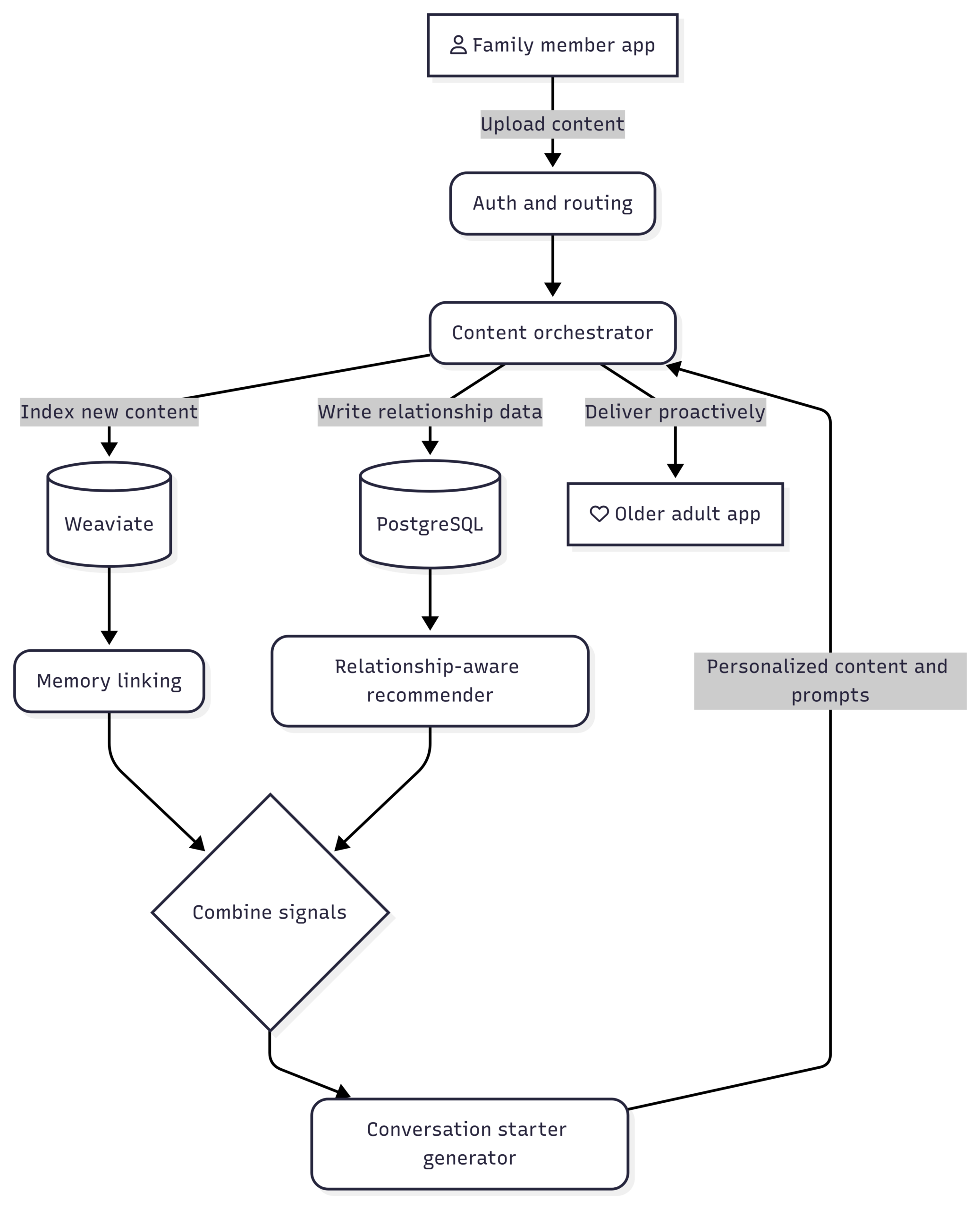
This section presents the design rationale that powered Heartlinks, connecting the core features of the platforms to the problems or gaps that were found in the above literature. Due to the application not being released yet, the following is purely conceptual: explaining how the system is made to work and why, based on present evidence, these choices are made in hopes of being effective. Each claim is made as a hypothesis that needs to be tested in the proposed evaluation that is described in the Methodology section. Figure 1, as following, describes the flow of this framework from the family member’s upload through the content orchestration, indexing process, relationship storage, and proactive delivery to the older adult-app.
Generational Social Connectivity
There was a central problem that was found in the literature, which was that older adults were expected to start contact and sustain the contact, an expectation that low digital literacy and UI being complex make it difficult4,7. Heartlinks is made to invert this difficulty. Rather than requiring elderly people to seek out family updates, the platform itself delivers the family content, any recent photos, milestones, and any updates that are delivered by the children, to a user interface designed for improved simplicity, ease, and manageability. This choice targets what this paper calls the initiation barrier: the effort needed to begin a digital conversation, which is higher for older adults who are less confident with technology or unsure what to talk about. Döring et al.7, surveying 286 university students about communication with a grandparent, found that doubts about grandparents’ technology skills were the main factor lowering satisfaction with digital communication. Juris et al.16 found that older adults who received technology mentoring from university students described gaining new ways to interact with family. Heartlinks responds to both findings: proactive delivery reduces the technical steps needed to take part, and conversation starters reduce the effort of finding something to say.
The platform also tries to encourage a two way interaction between both parties through AI-created conversation starters. Instead of presenting a blank message box, Heartlinks creates prompts that are centered around recent family activity(for example, a soccer tournament or a similar hobby), which lowers the mental and social effort that is needed to begin a meaningful conversation. This parallels the evidence that was found by Chung et al.21, whose inter-generational app used weekly conversation prompts and was associated with improved inter-generational interaction and perceived social support in a two-week study, although participants were matched strangers rather than family members. On the more technical side, PostgreSQL maintains the family network, which allows the system to connect content properly while also having the prompts adapt to specific family events or relations.
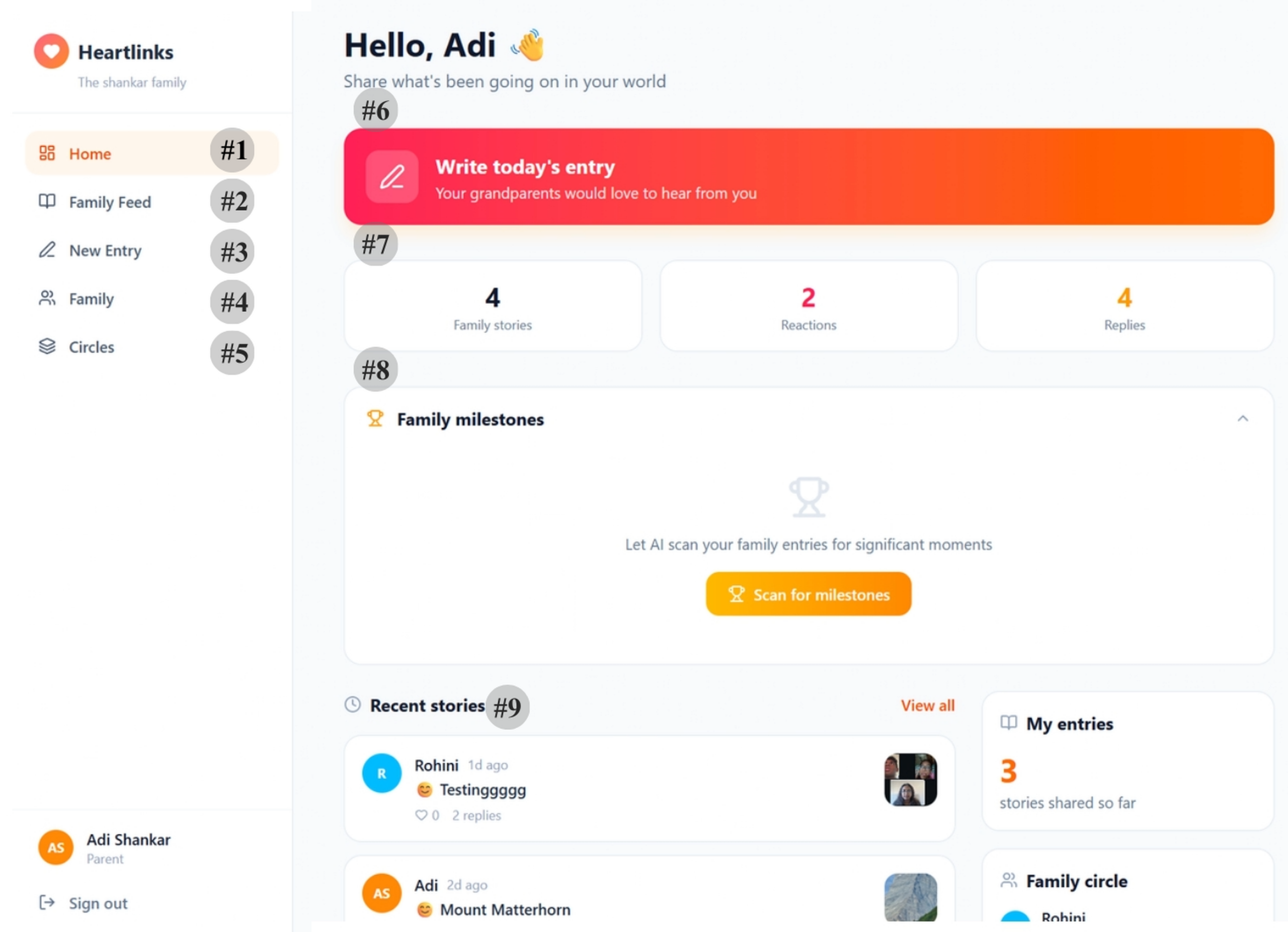
The interface draws on findings that older adults find realistic icons with text labels easier to use and that unfamiliar platforms discourage those with low confidence in their digital skills26,28; it therefore limits the number of choices on each screen, keeps controls in consistent positions, and labels every icon with text. The home screen is organized into three zones. A fixed navigation bar on the left holds five labeled destinations (#1–#5) that remain in the same place on every screen, so the user never has to search for a menu. At the top of the main panel is a visually dominant action (#6), so the most common task, sharing or replying to family news, can be started with one tap. Below it are an activity summary (7), family milestones that the AI can highlight on request (8), and a feed of recent stories (9), which updates as family members contribute. There are no nested menus, search boxes, or settings on the home screen. The design goal is that an older adult can take part fully by reading and replying, while younger family members handle most of the content creation. Some functions, such as managing or exploring family circles (#4, #5), add complexity; in the older-adult configuration these are intended to be managed by a designated family member. Whether this layout actually feels simple to older users has not yet been tested and will be measured with the System Usability Scale during the proposed pilot.
Bringing Families Closer: Deeper Emotional Sharing
For the emotionally resonant, standard messaging applications treat all content as interchangeable text, but not as memory rich exchanges. Heartlinks is designed to move beyond transactional messaging toward more memory-rich exchanges. It uses Weaviate for semantic content retrieval to connect different objects in the album like new family pictures to older pictures in the same geographical locations or containing the same subjects and present them together. This feature is included in order to stimulate recall and promote conversation among older adults as found by Moon and Park13.
Heartlinks is designed to recreate, in digital form, the reminiscence-based engagement that has been associated with improved engagement and mood in people with dementia13. Whether it has similar effects for older adults in general is a hypothesis to be tested. It is hypothesized that these interactions through Heartlinks will feel more personal and increase emotional significance of over-the-internet interactions between relatives as compared to similar interactions on other social media applications. However, this feasibility pilot, as described in the Methodology section, does not include a comparative study with other social media messaging applications as a comparator and is not designed to test such comparison. Testing this comparison would require a controlled design, outlined under Future Comparative and Factorial Studies.
Cognition and Mental Stability
Social isolation has been linked to higher levels of inflammation12, loneliness to higher dementia risk8, and to elevated mortality10,11. Heartlinks is designed to provide the appropriate amount of cognitive stimulation via two complementary pathways. Firstly it uses active conversations which are prompted by personalized content, engaging recall, narrative construction, and language use. Reminiscence research has used these forms of engagement to support mood and engagement13; any cognitive benefit remains untested, since the reminiscence trial cited here found no significant change in cognitive function. Secondly, the application uses an ambient sense of family presence which is created by providing regular proactive updates. These updates are intended to reduce loneliness by addressing the affective pathway through which isolation is believed to harm health14. Whether they do so is a hypothesis for future evaluation.
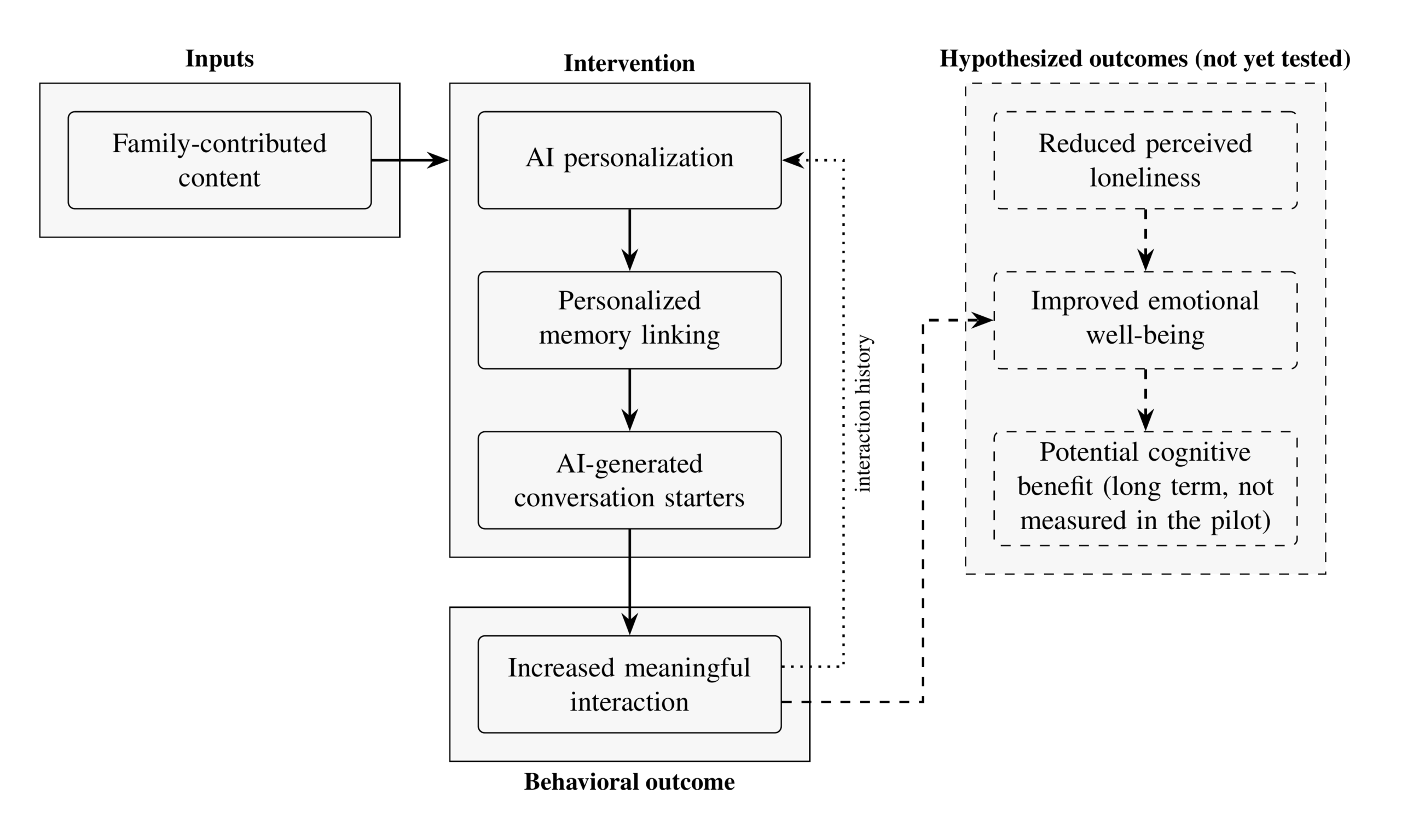
Primarily, Heartlinks is not designed to replace in-person interaction with family, but to complement it. Digital communication cannot replace but only partially compensate for the reduced physical interaction for which there is no substitute1,6. This framework only aims at increasing the frequency and quality of meaningful contact during the long intervals of familial absence rather than replacing those regular visits that improve human connection. Figure 3 presents this conceptual framework pathway that passes through family contribution to content, through AI personalization to hypothesized clinical output.
Proposed Methodology (Planned Evaluation)
Note: Heartlinks is currently in development and has not yet been released to users. The following description of planned evaluation is with regards to the application once it has been deployed. No data has been collected at the time of compilation of this literature.
Study Design
The goal of this pilot study is to establish the feasibility, usability and acceptability of the Heartlinks framework within its target population. The primary outcomes are therefore feasibility and usability measures while changes in loneliness remain secondary and exploratory. Meanwhile, this study is also expected to generate preliminary hypothesis-generating estimates of the change in self-reported loneliness after exposure to the framework. This pilot is neither expected nor designed to test the efficacy of the framework and does not support any causal or comparative claims about Heartlinks versus standard messaging platforms. Furthermore, this study is not designed to test the efficacy of any specific feature of the framework or their contribution to any recorded changes in self-reported loneliness of the participants. Such questions require comparative and factorial designs, outlined under Future Comparative and Factorial Studies. This proposed evaluation uses a mixed design of methods which combines quantitative surveys with qualitative interviews and prototype testing. The combination is intended to record both measurable changes in social connection and subjective, experimental factors of using the platform. A pre-use vs post-use structure of observation is prescribed to be used, with baseline measures collected before the use of the application and follow-up measures collected after a defined usage of the application.
Features Under Evaluation
Under this pilot study four features will be observed– proactive delivery of family-centered content, AI-generated conversation starters, memory linking through semantic retrieval, and the accessibility-focused interface. Each feature corresponds to a design claim made in the Heartlinks Framework section. The pilot will record how often each feature is used and how participants describe their experience of it in interviews; because the pilot is a single-group study, it cannot show whether any one feature causes a change in outcomes.
Proposed Participants
The proposed set of participants includes adults of or above the age of 65 who live geographically separated from one or more of their relatives, preferably a child or a grandchild. Concurrently, each such participant also provides a younger participant which is their geographically separated relative. The recruitment of participants will aim for diversity in digital literacy, living situation, and geographical distance between each pair of participants. The pilot sample for the initial study aims for a modest 15-20 sets of participants. Older participants must own or be loaned a smartphone or tablet and must be able to read the interface language. Individuals with a diagnosis of moderate or severe cognitive impairment, or who cannot give informed consent, will be excluded.
Procedure
Each participant pair will be requested to attend a 30-minute guided onboarding session covering installation, the home screen, and replying to family entries. The intervention will last 8 weeks. Younger participants will be asked to post at least two entries per week, and older participants will be asked to open the application to view these entries at least three times per week. A participant will be considered “adherent” if they meet this threshold for 6 out of the 8 weeks of this intervention period. Baseline measures will be collected before onboarding, post-intervention measures at the end of week 8, and a follow-up at week 12. Exiting participants would be invited for a short exit interview and all enrolled participants will be included in the feasibility analysis, with dropout numbers and reasons reported appropriately.
This initial pilot is a single-group, non-randomized study. Retention and adherence will be reported both per participant and per pair. Any kind of missing questionnaire items will be handled according to each scale’s scoring instructions, and participants without follow-up data will be described rather than imputed. Semi-structured interviews of about 30 minutes will be held with both members of each pair at the end of week 8, recorded with consent, and coded thematically by two independent coders.
Proposed Data Collection
The study will gather data at baseline (before onboarding), at the end of week 8, and at the week-12 follow-up through validated self-reporting interfaces. The primary outcomes are feasibility and usability: recruitment rate, retention at week 8, adherence rate as defined above, and usability measured with the System Usability Scale (SUS)29. The secondary, exploratory outcome is change in loneliness, measured with the UCLA Loneliness Scale, 3-item version (UCLA-3)30. These measures will be supplemented by custom items measuring the frequency and perceived quality of family interaction.
Proposed Data Collection and Analytic Metrics
The central goal of the evaluation is to learn which design choices are worth keeping or refining, and which are worth removing, and hence the platform is designed to collect two complementary layers of data which are validated clinical measures of well-being and behavioral usage data logged directly by the application. The metrics below define how each layer would be converted and expressed as quantities and, in each case, the specific design decision the metric is meant to support. Given the anticipated pilot sample size, all quantities are treated as descriptive and sources of hypothesis rather than confirmatory information.
Clinical Outcome Change
For each subject  , let
 and
 equal the UCLA-3 loneliness score at baseline and at the end of week 8. The individual change score is
Because higher UCLA-3 scores mean more loneliness, a positive  represents an improvement. This participant change score is the fundamental unit of the analysis and feeds every following metric.
Effect Size for a Small Pilot
Rather than relying on significance testing, which has little power at small sample sizes, the magnitude of change is found by using a paired effect size (Cohen’s  ):
where  is the mean of the change scores and
 is their standard deviation. Reporting tells whether the platform is associated with a small, moderate, or large shift in loneliness in a way that is honest about the pilot’s limited power. This estimate is used to only inform the sample size of a future controlled trial and is not interpreted as evidence of effect.
Behavioral Usage Metrics
The application keeps track of different behavioral signals over the observation period of length  . For participant , representative raw metrics include the conversation-starter acceptance rate,
where  is the number of AI-generated conversation starters presented and
 is the number the user acted on. The frequency of logins and of family posts per week will also be tracked. These data indicate whether features reduce the effort of staying in contact or are rarely used.
Composite Engagement Index
Because the raw data live on different scales, they are made consistent and combined into a single engagement index for each participant:
where  is the value of usage metric
 for participant ,
 k and sk are the sample mean and standard deviation of that metric, and
 is a weight reflecting the metric’s assumed importance. In the pilot, all actions are weighted equally. Any usage metric with zero variance across participants cannot be standardized and will be omitted from the index, and the remaining weights will be renormalized so that they again sum to one. A participant with missing data for a metric will have their index computed from the metrics that are available, with those weights renormalized in the same way. Weights may be adjusted in later studies as evidence accumulates about which behaviors matter most. Standard-scaling ensures that the actions with high counts do not completely drown out rare but important actions. This produces a single score summarizing each participant’s overall activity.
Linking Engagement to Outcomes and Prioritizing Features
The key question for iterating on the app is whether engagement actually tracks with improved well-being. This is assessed with a rank correlation (Spearman’s  ) between the engagement index and the clinical change score:
where  and
 are the ranks of
 and for participant ,
 and
 are the mean ranks, and
 is the number of participants. Tied values are assigned their average rank, so is the Pearson correlation of the ranks. Ranks are used rather than raw scores. This keeps the outliers, mainly the very high numbers, from dominating the results, which matters because a small sample is unlikely to follow a normal distribution. Participants shown no conversation starters will be excluded from the acceptance-rate metric. The same rank correlation, computed for each feature separately, is then combined with that feature’s uptake into a priority score to guide design decisions:
where ρf is the rank correlation between usage of feature f and ∆i,and  is that feature’s mean normalized uptake across participants. This analysis is exploratory and intended only for internal design iteration. Features that are used a lot and linked to user improvement get a high priority score and receive more attention and investment. On the other hand, features with little use and little apparent association with improvement are flagged for redesign or removal. This provides a consistent rule for deciding how to update the application based on user behavior.
Proposed Analysis
Feasibility outcomes will be reported descriptively. As a guide, the pilot will be considered to support a larger trial if participant-level retention is at least 70%, participant-level adherence is at least 60%, and the mean SUS score is at least 68, the commonly used benchmark for average usability31. Pair-level retention and adherence will be reported alongside these figures but will not be used to judge success. Changes in UCLA-3 scores will be reported with the effect size above. Interview transcripts will be analyzed thematically to explain participants’ experiences and to identify design problems. Given the small sample, all results will be treated as hypothesis-generating.
Future Comparative and Factorial Studies
If the pilot shows that the platform is feasible, a randomized controlled trial would compare Heartlinks with a standard messaging condition. The comparison group would receive the same onboarding, research contact, and encouragement to participate and post so that differences cannot be attributed to changes in attention to the study. To test the contribution of individual features, a factorial design would randomly assign participants to different versions of the platform with each feature switched on or off which can create multiple different versions of the Heartlinks framework to test different impacts.
Expected Outcomes and Anticipated Contributions
It is expected that the participants will be able to use Heartlinks as intended, with retention, adherence, and usability meeting the thresholds above. Due to the lack of resultant data at this stage of the development of the technology, this section states the outcomes that this framework is expected and designed to produce in the form of testable hypotheses for the evaluation as proposed above. Firstly, it is expected that regular use of the Heartlinks framework will be associated with reduced self-reported loneliness as measured against the UCLA-3 metric. And increased perceived social connection among older participants consistent with the effects observed in trials and pilots of technology-based interventions15,16. Secondly, participants are expected to report that interactions through Heartlinks feel emotionally meaningful, as measured by the custom interaction-quality items and interviews. Whether these interactions are more meaningful than those on general-purpose messaging apps can only be tested with the comparative design outlined under Future Comparative and Factorial Studies. Furthermore, the proactive and intuitive design of the framework is expected to bring down the barriers that users with limited digital literacy feel when interacting with technology4,7. If the suggested hypotheses are supported by the data derived from the interviews conducted with the participants of the survey, the results will position Heartlinks as an accessibility focused contribution to the inter-generational technology literature which addresses the integration gap between generations that has been identified7. Heartlinks would be one of the few to combine family-specific updates, personalized memories and AI driven conversation starters with accessibility embedded in a singular system.
Discussion
Ethical Considerations
The Heartlinks framework handles sensitive family data and serves a generation with severe vulnerabilities such as cognitive and social, several ethical considerations are central to its design and evaluation. Informed consent will be obtained from every participant. Because individuals who cannot give informed consent are excluded from the pilot, caregiver consent will not be used in place of participant consent; any future study that includes people with cognitive impairment would require an approved proxy-consent procedure. Since data privacy is another concern regarding sensitive family information shared via images and other media formats, such information will be stored securely and used only for the purposes that participants have explicitly agreed to. Furthermore, the platform’s personalization feature must avoid manipulation of engagement patterns and only prioritize the core and genuine well being of the participant.
Limitations
This framework and its literature have some limitations which are important to consider. Most significantly, at this stage it presents a framework, but not empirical data and hence, the claims made about Heartlinks remain a hypothesis, not a conclusion. The proposed sample space of participants is small and may not represent the true diversity of its effective user base. Furthermore, the self report structure of the data gathering process can lead to self bias by the users and must account for the same, an account that is not prescribed by this literature. Finally, as the developer of this platform, the author acknowledges the potential for optimism bias which the use of validated instruments and independent qualitative analysis is intended to reduce. Although cognitive health is part of the framework’s long-term rationale, the proposed pilot does not measure cognition; cognitive outcomes would require a longer, adequately powered study using validated cognitive measures.
Challenges and Barriers
This framework may encounter practical hindrances in its execution of its designed purpose, such barriers include but are not limited to digital literacy and confidence gaps which have been documented throughout the literature4. Added to this, there is an imbalance between the roles of the younger and older generation participation in the platform which may make the older generation hesitant to adapt to a new platform. The platform is designed to address this known challenge of sustained engagement across a digital platform.
Long Term Benefits
If the Heartlinks framework proves to be effective and efficient in reducing perceived loneliness for participants, it could offer a substantial long term potential for a family unit. With prolonged use the framework could help maintain family presence across vast distances and help preserve shared memories while supporting the social engagement that has been linked to healthier cognitive aging8. These possibilities are speculative at this stage and represent directions for future research.
Conclusion
Factors like geographical separation and technological exclusion have contributed in isolating many adults from their families at precisely the stage where they need meaningful social connections for emotional and cognitive health. This paper has reviewed the evidence for inter-generational connection, social engagement and cognition in aging and has proposed Heartlinks, a framework powered by AI to proactively deliver personalized, memory-rich family content along with an accessible user interface. The core argument of this literature is that by removing steep learning curves of technology, the burden of initiating conversation, and prioritizing emotional connection, Heartlinks could strengthen family relationships and support a healthy aging process. These claims remain to be tested against empirical evidence. With the global spread of singular family units, a thoughtfully designed framework, with accessibility and AI at its helm, Heartlinks could contribute to how generations stay connected which makes future evaluations of metrics a worthwhile undertaking.
References
- L. Li, A. Wister. Geographic distance and social isolation among family caregivers providing care to older adults in Canada. Ageing & Society. Vol. 43, Issue 2, pg. 298–323, 2023, https://doi.org/10.1017/S0144686X2100060X. [↩] [↩] [↩] [↩] [↩]
- A. R. Teo, H. Choi, S. B. Andrea, M. Valenstein, J. T. Newsom, S. K. Dobscha, K. Zivin. Does mode of contact with different types of social relationships predict depression in older adults? Evidence from a nationally representative survey. Journal of the American Geriatrics Society. Vol. 63, pg. 2014–2022, 2015, https://doi.org/10.1111/jgs.13667. [↩] [↩] [↩] [↩]
- T. K. M. Cudjoe, D. L. Roth, S. L. Szanton, J. L. Wolff, C. M. Boyd, R. J. Thorpe Jr. The epidemiology of social isolation: National Health and Aging Trends Study. The Journals of Gerontology: Series B. Vol. 75, pg. 107–113, 2020, https://doi.org/10.1093/geronb/gby037. [↩] [↩]
- E. Vaportzis, M. Giatsi Clausen, A. J. Gow. Older adults perceptions of technology and barriers to interacting with tablet computers: a focus group study. Frontiers in Psychology. Vol. 8, Article 1687, 2017, https://doi.org/10.3389/fpsyg.2017.01687. [↩] [↩] [↩] [↩] [↩] [↩] [↩] [↩]
- A. Bhandari, S. Paudel, A. Chalise. Psychological distress among parents with emigrant offspring: a mixed-methods study from Changunarayan Municipality, Nepal. PLoS One. Vol. 20, pg. e0329071, 2025, https://doi.org/10.1371/journal.pone.0329071. [↩] [↩] [↩]
- W. Hwang, X. Fu, M. T. Brown, M. Silverstein. Digital and non-digital solidarity between older parents and their middle-aged children: associations with mental health during the COVID-19 pandemic. International Journal of Environmental Research and Public Health. Vol. 19, Article 12560, 2022, https://doi.org/10.3390/ijerph191912560. [↩] [↩] [↩] [↩] [↩]
- N. Döring, V. Mikhailova, K. Brandenburg, W. Broll, H.-M. Gross, S. Werner, A. Raake. Digital media in intergenerational communication: status quo and future scenarios for the grandparent–grandchild relationship. Universal Access in the Information Society. Vol. 23, pg. 379–394, 2024, https://doi.org/10.1007/s10209-022-00957-w. [↩] [↩] [↩] [↩] [↩] [↩] [↩] [↩] [↩]
- A. R. Sutin, Y. Stephan, M. Luchetti, A. Terracciano. Loneliness and risk of dementia. The Journals of Gerontology: Series B. Vol. 75, pg. 1414–1422, 2020, https://doi.org/10.1093/geronb/gby112. [↩] [↩] [↩] [↩] [↩]
- T. L. Barnes, M. Ahuja, S. MacLeod, R. Tkatch, L. Albright, J. A. Schaeffer, C. S. Yeh. Loneliness, social isolation, and all-cause mortality in a large sample of older adults. Journal of Aging and Health. Vol. 34, pg. 883–892, 2022, https://doi.org/10.1177/08982643221074857. [↩] [↩] [↩]
- M. Ward, P. May, C. Normand, R. A. Kenny, A. Nolan. Mortality risk associated with combinations of loneliness and social isolation: findings from The Irish Longitudinal Study on Ageing (TILDA). Age and Ageing. Vol. 50, Issue 4, pg. 1329–1335, 2021, https://doi.org/10.1093/ageing/afab004. [↩] [↩] [↩] [↩]
- Q.-M. Huang, S.-T. Wei, Z.-H. Li, Y.-B. Lv, X.-M. Shi, C. Mao. Associations of changes in social isolation and loneliness with all-cause mortality among older adults: a prospective cohort study. GeroScience. Vol. 48, Issue 4, pg. 5533–5545, 2026, https://doi.org/10.1007/s11357-025-01971-5. [↩] [↩] [↩] [↩]
- T. K. M. Cudjoe, et al. Getting under the skin: social isolation and biological markers in the National Health and Aging Trends Study. Journal of the American Geriatrics Society. Vol. 70, Issue 2, pg. 408–414, 2022, https://doi.org/10.1111/jgs.17518. [↩] [↩] [↩] [↩]
- S. Moon, K. Park. The effect of digital reminiscence therapy on people with dementia: a pilot randomized controlled trial. BMC Geriatrics. Vol. 20, Article 166, 2020, https://doi.org/10.1186/s12877-020-01563-2. [↩] [↩] [↩] [↩] [↩] [↩] [↩]
- Z. I. Santini, P. E. Jose, E. York Cornwell, A. Koyanagi, L. Nielsen, C. Hinrichsen, C. Meilstrup, K. R. Madsen, V. Koushede. Social disconnectedness, perceived isolation, and symptoms of depression and anxiety among older Americans (NSHAP): a longitudinal mediation analysis. Lancet Public Health. Vol. 5, pg. e62–e70, 2020, https://doi.org/10.1016/S2468-2667(19)30230-0. [↩] [↩]
- S. J. Czaja, W. R. Boot, N. Charness, W. A. Rogers, J. Sharit. Improving social support for older adults through technology: findings from the PRISM randomized controlled trial. The Gerontologist. Vol. 58, pg. 467–477, 2018, https://doi.org/10.1093/geront/gnw249. [↩] [↩] [↩] [↩]
- J. J. Juris, E. D. Bouldin, K. Uva, C. D. Cardwell, A. Schulhoff, N. Hiegl. Virtual intergenerational reverse-mentoring program reduces loneliness among older adults: results from a pilot evaluation. International Journal of Environmental Research and Public Health. Vol. 19, Article 7121, 2022, https://doi.org/10.3390/ijerph19127121. [↩] [↩] [↩] [↩] [↩] [↩]
- V. K. Jones, M. Hanus, C. Yan, M. Y. Shade, J. Blaskewicz Boron, R. Maschieri Bicudo. Reducing loneliness among aging adults: the roles of personal voice assistants and anthropomorphic interactions. Frontiers in Public Health. Vol. 9, Article 750736, 2021, https://doi.org/10.3389/fpubh.2021.750736. [↩] [↩] [↩] [↩]
- M. Y. Shade, C. Yan, V. K. Jones, J. Blaskewicz Boron. Interactive AI routines for pain symptoms and loneliness in older adults. Pain Management Nursing. Vol. 26, pg. 530–537, 2025, https://doi.org/10.1016/j.pmn.2025.04.003. [↩] [↩] [↩]
- C. Papadopoulos, N. Castro, A. Nigath, R. Davidson, N. Faulkes, R. Menicatti, A. A. Khaliq, C. Recchiuto, L. Battistuzzi, G. Randhawa, L. Merton, S. Kanoria, N.-Y. Chong, H. Kamide, D. Hewson, A. Sgorbissa. The CARESSES randomised controlled trial: exploring the health-related impact of culturally competent artificial intelligence embedded into socially assistive robots and tested in older adult care homes. International Journal of Social Robotics. Vol. 14, pg. 245–256, 2022, https://doi.org/10.1007/s12369-021-00781-x. [↩] [↩] [↩]
- C. Y. Kim, A. J. Sato, N. T. White, H.-R. Ho, C. P. Lee, Y. Hwang, B. Mutlu. Bridging generations using AI-supported co-creative activities. Proceedings of the 2025 CHI Conference on Human Factors in Computing Systems. 2025, https://doi.org/10.1145/3706598.3713718. [↩] [↩]
- S. Chung, H. Lee, J. M. Jung. Design and evaluation of a mobile app for intergenerational communication. JMIR Aging. Vol. 8, Article e75950, 2025, https://doi.org/10.2196/75950. [↩] [↩]
- W. J. Chopik. The benefits of social technology use among older adults are mediated by reduced loneliness. Cyberpsychology, Behavior, and Social Networking. Vol. 19, pg. 551–556, 2016, https://doi.org/10.1089/cyber.2016.0151. [↩] [↩]
- E. H. Jung. Connecting generations: the roles of age, time perception, and Facebook in family communication. Family Relations. Vol. 75, pg. 2385–2400, 2026, https://doi.org/10.1111/fare.70163. [↩] [↩]
- F. Farhi, R. Jeljeli, S. Setoutah, K. Zamoum, A. Boukhenoufa, S. Saidani, L. Feguiri. Social media and intergenerational bonding through young adults’ communication with older family members. Frontiers in Sociology. Vol. 10, Article 1643296, 2025, https://doi.org/10.3389/fsoc.2025.1643296. [↩] [↩]
- G. Casanova, S. Abbondanza, E. Rolandi, R. Vaccaro, L. Pettinato, M. Colombo, A. Guaita. New older users’ attitudes toward social networking sites and loneliness: the case of the oldest-old residents in a small Italian city. Social Media + Society. Vol. 7, Issue 4, 2021, https://doi.org/10.1177/20563051211052905. [↩] [↩] [↩] [↩] [↩]
- M. Lüders, P. B. Brandtzæg. ‘My children tell me it’s so simple’: a mixed-methods approach to understand older non-users’ perceptions of social networking sites. New Media & Society. Vol. 19, pg. 181–198, 2017, https://doi.org/10.1177/1461444814554064. [↩] [↩] [↩] [↩]
- G. Gomes, C. Duarte, J. Coelho, E. Matos. Designing a Facebook interface for senior users. The Scientific World Journal. Vol. 2014, Article 741567, 2014, https://doi.org/10.1155/2014/741567. [↩] [↩] [↩] [↩] [↩]
- J. Wu, D. Jiao, C. Lu, C. Li, X. Huang, S. Weng. How do older adults process icons in visual search tasks? The combined effects of icon type and cognitive aging. International Journal of Environmental Research and Public Health. Vol. 19, Issue 8, Article 4525, 2022, https://doi.org/10.3390/ijerph19084525. [↩] [↩] [↩] [↩]
- A. Bangor, P. T. Kortum, J. T. Miller. An empirical evaluation of the System Usability Scale. International Journal of Human–Computer Interaction. Vol. 24, Issue 6, pg. 574–594, 2008, https://doi.org/10.1080/10447310802205776. [↩]
- M. E. Hughes, L. J. Waite, L. C. Hawkley, J. T. Cacioppo. A short scale for measuring loneliness in large surveys: results from two population-based studies. Research on Aging. Vol. 26, Issue 6, pg. 655–672, 2004, https://doi.org/10.1177/0164027504268574. [↩]
- J. R. Lewis, J. Sauro. Item benchmarks for the System Usability Scale. Journal of Usability Studies. Vol. 13, Issue 3, pg. 158–167, 2018. [↩]