
Abstract
Excess nitrogen from agricultural fertilizer is one of the most dangerous pollutants in aquatic ecosystems. Nitrogen reaches the water through groundwater and runoff, and its presence causes algal blooms that deplete dissolved oxygen (DO) and create anoxic or dead zones. The objective of this experiment is to find out whether infiltration trenches filled with straw, wood chips, or wood mulch differ from ordinary soil in water retention and nitrate drainage. To set this up, a tub-based trench system was created with drilled drainage holes and filled with the organic material layered beneath 10 cm of packed soil. To start, 2kg of water was poured into each trench across 4 to 5 trials, with some conditions limited to four due to soil complications. To measure the results, a mass scale was used for water retention, while the LaMotte Nitrate-Nitrogen kit was used for nitrate measurements. The results showed that the organic materials retained more water than the control, with the wood chips being the best. For the nitrogen, however, the wood chips and wood mulch initially had higher drainage nitrate (likely from additives), then dropped below or matched the control after the first two trials. In total, the organic trenches showed greater water retention, and nitrogen drainage varied by material over trials. In the future, using separate trenches with untreated materials would lead to more accurate results, while increasing the scale would allow for more confidence in the results.
Introduction
Excess nitrogen from fertilizer is a pressing environmental challenge. Fertilizers provide plants with nutrients and are either natural or synthetic. Natural fertilizers include farm manure, green manure, compost, and limestone. Synthetic fertilizers include nitrogen, phosphorus, and potassium compounds. Some fertilizers supply heavy amounts of nitrogen when soil levels are low1. After rainfall, nutrients from the fertilizer move into groundwater and runoff as ammonia, nitrates, nitrites, and organic nitrogen1. Nitrogen is lost through surface runoff and subsurface leaching, varying in amount with fertilizer, crop, soil, and rainfall amounts2. Rainfall amount, intensity, and preceding dry period affect nitrogen transport in stormwater3. A large portion of applied nitrogen is not taken up by crops and stays in soil or leaches as nitrate2,4. Urea, a form, contributes to nitrate pollution when it is not fully absorbed1. The nitrogen in soil can move below the root zone as nitrate4. Application amount and timing also affect nitrate loss, so fertilizer management plays a key role1,2. A surplus of nitrogen stimulates algal growth, and enough triggers algal blooms, which reduce sunlight from entering the water and deplete oxygen as they decompose5,6. Nutrient availability changes algal communities and bloom likelihood7,8. Certain cyanobacterial blooms affect food webs, with cyanotoxins found in fish tissue9. The toxins can enter the food chain and threaten human health too10. This eutrophication is a global problem in freshwater and marine systems11,12.
Nitrogen losses by runoff and leaching depend on fertilizer management, rainfall, irrigation, and soil2,4. Nitrogen interception solutions that correct this problem are limited. Most are not accessible, especially at the local agricultural scale. Engineered wastewater treatments are very costly and hard to scale. However, field-scale denitrifying bioreactors can treat agricultural drainage and remove nitrate13. Researchers have explored lower-cost options using organic carbon-rich materials14,15. Woodchip systems, for example, are a simple way to reduce nitrate with little infrastructure13. However, these infiltration trenches with organic materials have not been thoroughly studied at small scale yet.
Infiltration trenches work by intercepting runoff and letting it infiltrate into soil where it would do less harm than in the water16. Organic material was chosen as the carbon-rich substrate for microbial nitrogen processes15. Decomposing organic matter releases nutrients, and the retained water is absorbed by roots where it can do its intended job. Organic material management can change water retention and infiltration efficiency, depending on material and site17. The effectiveness depends on hydraulic connectivity, flow, temperature, and system design13,18. Organic media support denitrification, depending on oxygen, carbon, and configuration15,18. Woodchips, specifically, have been studied for nitrogen removal15. Woodchip bioreactors have been shown to reduce nitrate, varying with flow, temperature, and hydraulic retention time13,18. They also keep infiltration capacity over several years, varying with site conditions18. The woodchip-filled trenches can maintain or improve hydraulic conductivity and infiltration19. The basic framework is that the longer the hydraulic retention time is, the more opportunity there is for nitrate removal18. Pilot-scale bioreactors supported this, as higher nitrate removal was shown as residence time increased from 2 to 16 hours20. The framework guided the design and interpretation of this experiment.
For this experiment, a small-scale tub system tested straw, wood chips, and wood mulch against soil. The small scale allows for controlled comparison but does not accurately reflect real trenches that are given more drying time at a much larger scale. Wood chip performance in the field has been shown to vary with flow, temperature, and hydraulics, so lab results may not transfer directly21. Nitrogen removal in boretention varies too with loading rate, dry period, temperature, and design22,23. The objective of this experiment is to measure water retained, nitrate drainage, and observe the effect on drainage water quality. The null hypothesis is that organic materials and soil do not differ in water retention or nitrate drainage. The alternative hypothesis is that organic materials retain more water and produce different nitrate drainage patterns. Because trials were repeated in the same setup, these hypotheses are evaluated descriptively.
Methodology
This experiment compares three different organic material to a soil control, reapting across trials. The four conditions are soil only control, straw, wood chips, and wood mulch each topped with soil. The organic materials were commercially sourced. Each trial, water retention and nitrate drianage were measured. Water retention was calculated by subtracting the drainage weight from the 2kg of water initially poured. The precision of the balance was not measure and should be ntoed when reviewing results. In addition, other errors might arise from evaporation, water on tub walls, and residual water in the collection tub. To test the nitrate, the LaMotte Nitrate-Nitrogen Tablet Test Kit was used. For each test, 5 mL of water was put into a test tube. Then, one Nitrate #1 Tablet and one Nitrate #2 CTA Tablet were added. The tube was closed and shaken for two minutes. Then it was left for five minutes. After that, the color was matched with a chart using the Octa-Slide 2 Viewer. The nitrate level was written down in parts per million. The test kit showed levels like 0, 1, 2, 4, 6, 8, 10, and 15 ppm. These methods were used because they showed the important things about how the trenches worked. The independent variables in this study was the type of organic material while the dependent variable were the water retention (kg) and nitrate drainage (ppm). Water amount, material depth, tub dimensions, room temperature, and wait time were the variables that were controlled. To setup, four 1143/3200 cm holes were drilled in a 28x23x25 cm tub, spaced four cm apart, placed over a second tub with two beakers as spacers. Then, commercially sourced potting soil, packed by hand, was place in one layer to 10 cm. This was the base for each of the conditions. 2kg of water was then poured from a jig at a controlled pace, moderate height, and spread evenly to simulate rainfall. A 10 minute wait time was chose to allow percolation and mimic real trench absorption while staying consistent. The drained water was collected in the lower tub, weighed, and tested for nitrate. The control was repeated four more times. For the organic conditions, 10 cm of each material served as a base layer, while topped with 10 cm of soil. The same procedure as the control was then followed. It should be noted that the control had only 10 cm of soil, while the treatments 10 cm of the material base plus and additional 10 cm of soil which resulted in an unequal depth. Also, other variables of interest such as soil clay, sand, pH, and organic matter were not measure. The results were compared across all conditions. The data were looked at by comparing the water retention and average nitrate levels for each trench. Averages and how much they varied were found for each material. These were compared against the control to see which material was best at keeping water. The nitrate levels were also checked to see how they changed in conditions and over time. Trends in the tests were studied by looking at the results from each time the test was done. This was to see if the materials changed in how they worked, especially if they had some nitrogen that might affect tests. This study didn’t use people, animals, or anything dangerous. So there were no ethical problems. The materials used were organic materials and soil. The test kit was used correctly. All the water was thrown away properly after testing.
Results
| Material | n | Mean (kg) | SD |
| Control | 4 | 0.725 | 0.222 |
| Straw | 4 | 0.987 | 0.312 |
| Wood chips | 4 | 1.325 | 0.380 |
| Wood mulch | 3 | 1.233 | 0.454 |
| Material | n | Mean (ppm) | SD |
| Control | 5 | 2.600 | 0.548 |
| Straw | 5 | 3.000 | 0.000 |
| Wood chips | 4 | 4.500 | 2.915 |
| Wood mulch | 4 | 5.250 | 2.630 |
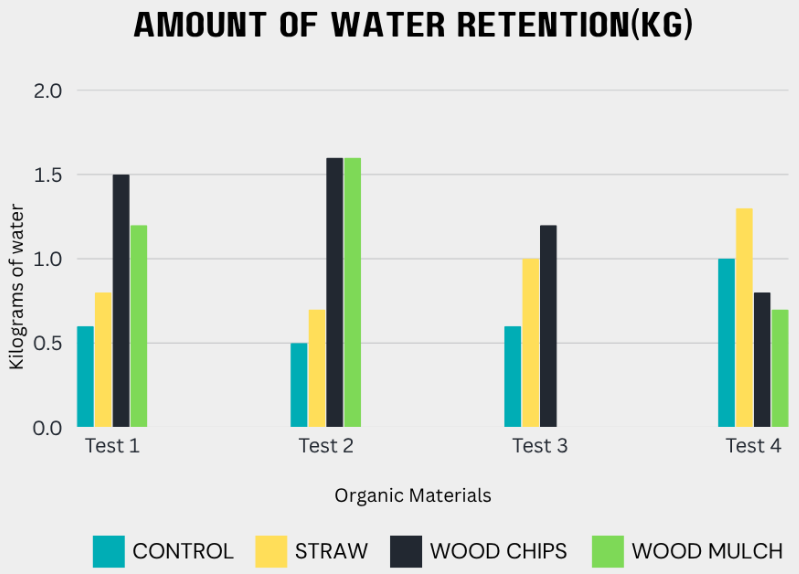
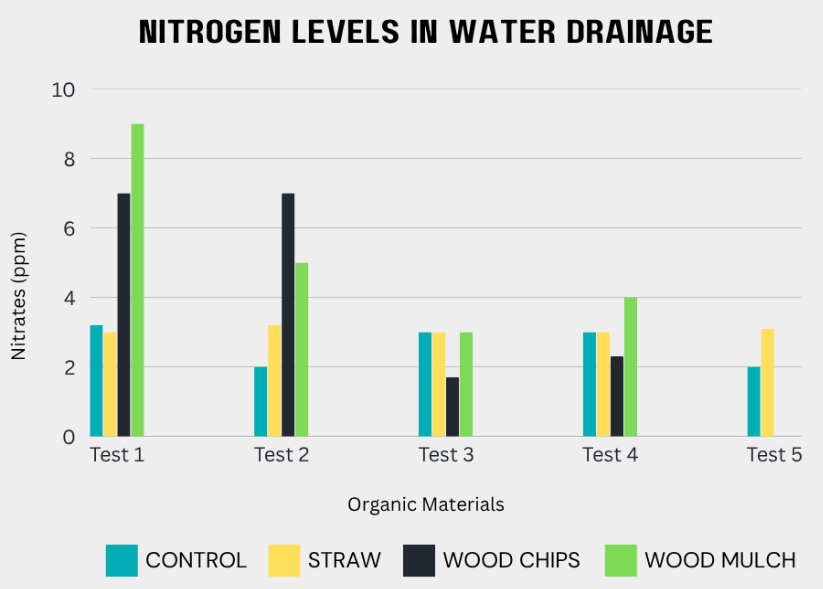
Figure 1 shows water retained across four trials. The wood chips did the best, averaging 1.325 kg. The wood mulch was a close second, averaging 1.233 kg across three trials, with the third one missing because the soil was too saturated to drain. The control was fairly consistent, averaging 0.725kg. The straw averaged 0.987kg, varying moderately. Finally, the control came in last, averaging 0.725 kgs and staying fairly consistent. All of the organic material retained more than the control. Figure 2 shows the nitrate drainage. The control averaged 2..600 ppm, staying consistent across five trials. The straw averaged 3.000 ppm, being fairly similar to the control. Wood chips were high in the first 2 trials and then fell below the control, while wood mulch fell to the control level in trial 3 and rose slightly above it in trial 4, achieving a total average of 4.500 ppm and 5.250 ppm, respectively. No fifth trial was recorded for either because of soil complications. The early nitrate spike suggests that nitrogen additives were present and then flushed out over successive trials, where concentrations dropped substantially. Tables 1 and 2 show the descriptive stats for the experiment. Because the results were measured using the same tub system for repeated trials, statistical tests such as ANOVA that rely on independent observations are limited. The data can still be used to describe what happened during testing, but they do not establish statistically significant differences between the materials. Using separate setups for each trial would help address this limitation in future experiments.
Discussion
This experiment tested whether organic-filled trenches would perform better than soil in water retention and nitrate drainage. The data could not be tested against the null hypothesis because trials were repeated flushes through the same bed, so the results are descriptive only. All organic materials retained more water than the control, but the difference was not tested statistically. The organic materials initially had higher nitrate drainage, but this was likely due to nitrogen additives that were flushed out over trials. After two trials, wood chips dropped below the control, and wood mulch matched it in trial 3 before rising slightly above it in trial 4. With continued use, trenches may produce lower-nitrate drainage, but field performance was not evaluated.
These findings add to research on green infrastructure as a low-cost alternative to intercept agricultural nitrogen. Greater retention matters because hydraulic retention time can affect nitrogen removal too24. Water retention and hydraulic retention time are different measurements, but higher retention means more water stays in the trench after ten minutes. Greater retention may influence nitrogen interception, but contact time, hydraulic retention time, and nitrogen mass removal were not measured, so no conclusions about interception can be drawn from retention data alone. These results are consistent with wood chip claims affecting nitrogen immobilization and nitrate availability25 and bioretention removing nitrate and total nitrogen26. The early spike in nitrogen seems counterproductive but does not undermine long-term potential since untreated material would lack the additives.
The alternative hypotheses could not be formally evaluated because no valid statistical test was possible. Descriptively, the organic materials retained more water, and nitrate drainage showed no consistent difference from the control. However, since nitrate levels declined over time for organic materials, and they had greater retention, this suggests they warrant further investigation.
Future research should run more trials for each condition so the statistics are stronger and the results more reliable. It should also use untreated organic materials instead of commercial products to cut down the effect of nitrogen-based additives on the early trials. The experiment should be scaled up to match the dimensions and operating conditions of real infiltration trenches, since the small tub system used here may not capture how full-scale trenches behave. A separate trench for each trial would reduce carryover between tests. Future studies should also measure nitrate in both the input water and the drainage water, which would allow a mass balance calculation and a more accurate read on how the organic materials affect nitrogen in runoff. Researchers could also test how drying time between trials changes performance, since real infiltration trenches usually get much longer to dry between rainfalls than was possible in this lab experiment.
Several limitations affected how reliable and general the findings are. With so few trials per condition, it was hard to tell whether the patterns were statistically meaningful. Soil characteristics such as clay percentage, sand percentage, pH, and organic matter content were not measured before the experiment. That makes the study harder to reproduce, because those properties can strongly affect infiltration rates and nitrate drainage. The wood mulch condition was also missing one water-retention trial and every nitrogen trial after trial four because of soil problems, so its data are incomplete. The tub system didn’t match the scale or complexity of real infiltration trenches, which cover much bigger areas and have more time to dry between rainfalls. The commercial organic materials may also have contained nitrogen-based additives that raised the early nitrate readings, which adds a confounding variable that might not exist in the field. Most importantly, nitrate in the input water wasn’t measured, so there is no way to tell how much nitrogen each trench kept or released compared with how much went in. The trials were also repeated flushes through the same packed bed, not independent replicates. That means the independence assumption needed for inferential statistical tests wasn’t met, so no statistical conclusions about treatment effects can be drawn from these data. On top of that, the control was 10 centimeters of packed soil, while each treatment was a 10-centimeter organic base topped with 10 centimeters of soil. So total bed depth and material volume differed between the control and the treatments. That difference may have affected water retention, since a deeper porous bed can hold more water just by having more pore space. Future experiments should match total bed depth across all conditions. These limitations should be kept in mind when reading the results.
Nitrogen pollution from runoff still threatens aquatic ecosystems through algal blooms, oxygen depletion, and food chain collapse5,6,11. Organic trenches are a promising, low-cost strategy worth further investigation. The results are still preliminary, but trends in retention and declining drainage nitrate suggest wood chips merit further study. Every step to reduce runoff at the source helps protect rivers and oceans.
References
- Bijay-Singh, E. Craswell. Fertilizers and nitrate pollution of surface and ground water: an increasingly pervasive global problem. SN Applied Sciences. Vol. 3, Article 518, 2021, https://doi.org/10.1007/s42452-021-04521-8. [↩] [↩] [↩] [↩]
- L. Norberg, H. Linefur, S. Andersson, M. Blomberg, K. Kyllmar. Nutrient losses over time via surface runoff and subsurface drainage from an agricultural field in northern Sweden. Journal of Environmental Quality. Vol. 51, pg. 1235–1245, 2022, https://doi.org/10.1002/jeq2.20413. [↩] [↩] [↩] [↩]
- C. A. Davis, A. S. Ward, A. J. Burgin, T. D. Loecke, D. A. Riveros-Iregui, D. J. Schnoebelen, C. L. Just, S. A. Thomas, L. J. Weber, M. A. St. Clair. Antecedent moisture controls on stream nitrate flux in an agricultural watershed. Journal of Environmental Quality. Vol. 43, pg. 1494–1503, 2014, https://doi.org/10.2134/jeq2013.11.0438. [↩]
- J. N. Weitzman, J. R. Brooks, J. Compton, B. R. Faulkner, R. E. Peachey, W. D. Rugh, R. A. Coulombe, B. Hatteberg, S. R. Hutchins. Vadose zone flushing of fertilizer tracked by isotopes of water and nitrate. Vadose Zone Journal. Vol. 23, Article e20324, 2024, https://doi.org/10.1002/vzj2.20324. [↩] [↩] [↩]
- J. Heisler, P. M. Glibert, J. M. Burkholder, D. M. Anderson, W. Cochlan, W. C. Dennison, Q. Dortch, C. J. Gobler, C. A. Heil, E. Humphries, A. Lewitus, R. Magnien, H. G. Marshall, K. Sellner, D. A. Stockwell, D. K. Stoecker, M. Suddleson. Eutrophication and harmful algal blooms: a scientific consensus. Harmful Algae. Vol. 8, pg. 3–13, 2008, https://doi.org/10.1016/j.hal.2008.08.006. [↩] [↩]
- B. M. R. Hasan, M. S. Islam, P. Kundu, U. K. Mallick. Modeling the effects of algal bloom on dissolved oxygen in eutrophic water bodies. Journal of Mathematics. Vol. 2023, Article e2335570, 2023, https://doi.org/10.1155/2023/2335570. [↩] [↩]
- J. T. Stoll, J. H. Larson, S. W. Bailey, C. B. Blackwood, D. M. Costello. Macro- and micronutrient effects on phytoplankton in Green Bay, Lake Michigan, and the western basin of Lake Erie. Journal of Phycology. Vol. 60, pg. 1514–1527, 2024, https://doi.org/10.1111/jpy.13519. [↩]
- H. W. Paerl, T. G. Otten, R. Kudela. Mitigating the expansion of harmful algal blooms across the freshwater-to-marine continuum. Environmental Science & Technology. Vol. 52, pg. 5519–5529, 2018, https://doi.org/10.1021/acs.est.7b05950. [↩]
- M. Skafi, S. Vo Duy, G. Munoz, Q. T. Dinh, D. F. Simon, P. Juneau, S. Sauvé. Occurrence of microcystins, anabaenopeptins and other cyanotoxins in fish from a freshwater wildlife reserve impacted by harmful cyanobacterial blooms. Toxicon. Vol. 194, pg. 44–52, 2021, https://doi.org/10.1016/j.toxicon.2021.02.004. [↩]
- B. W. Ibelings, I. Chorus. Accumulation of cyanobacterial toxins in freshwater “seafood” and its consequences for public health: a review. Environmental Pollution. Vol. 150, pg. 177–192, 2007, https://doi.org/10.1016/j.envpol.2007.04.012. [↩]
- S. Akinnawo. Eutrophication: causes, consequences, physical, chemical and biological techniques for mitigation strategies. Environmental Challenges. Vol. 12, Article 100733, 2023, https://doi.org/10.1016/j.envc.2023.100733. [↩] [↩]
- M. Zhuang, S. Gongadze, Z. Guo. Nutrient water pollution from unsustainable patterns of agricultural systems, effects and measures of integrated farming. Water. Vol. 16, Article 3146, 2024, https://doi.org/10.3390/w16213146. [↩]
- U. Thapa, L. Ahiablame, J. Kjaersgaard, C. Hay. Field evaluation of four denitrifying woodchip bioreactors for nitrogen removal in eastern South Dakota, United States. Science of the Total Environment. Vol. 855, Article 158740, 2023, https://doi.org/10.1016/j.scitotenv.2022.158740. [↩] [↩] [↩] [↩]
- A. Rivas, G. Barkle, R. Stenger, B. Moorhead, J. Clague. Nitrate removal and secondary effects of a woodchip bioreactor for the treatment of subsurface drainage with dynamic flows under pastoral agriculture. Ecological Engineering. Vol. 148, Article 105786, 2020, https://doi.org/10.1016/j.ecoleng.2020.105786. [↩]
- W. J. B. Saliling, P. W. Westerman, T. M. Losordo. Wood chips and wheat straw as alternative biofilter media for denitrification reactors treating aquaculture and other wastewaters with high nitrate concentrations. Aquacultural Engineering. Vol. 37, pg. 222–233, 2007, https://doi.org/10.1016/j.aquaeng.2007.06.003. [↩] [↩] [↩] [↩]
- L. Locatelli, O. Mark, P. S. Mikkelsen, K. Arnbjerg-Nielsen, T. H. F. Wong, P. J. Binning. Determining the extent of groundwater interference on the performance of infiltration trenches. Journal of Hydrology. Vol. 529, pg. 1360–1372, 2015, https://doi.org/10.1016/j.jhydrol.2015.08.047. [↩]
- S. Tenodi, S. Maletić, M. Kragulj Isakovski, J. Kruse, L. Weihermüller. Impact of biochar, compost, and sludge amendments on the soil water balance of a sandy soil. Biochar. Vol. 8, Article 14, 2026, https://doi.org/10.1007/s42773-025-00509-4. [↩]
- Y. Fan, M. Essington, S. Jagadamma, J. Zhuang, J. Schwartz, J. Lee. The global significance of abiotic factors affecting nitrate removal in woodchip bioreactors. Science of the Total Environment. Vol. 848, Article 157739, 2022, https://doi.org/10.1016/j.scitotenv.2022.157739. [↩] [↩] [↩] [↩] [↩]
- P. Louis, L. Delgado-Gonzalez, L. Lassabatère, S. Czarnes, J. Aubert, A. Imig, R. Clément. Woodchip-filled trenches: a solution to enhance urban water infiltration capacity? Geoderma. Vol. 451, Article 117057, 2024, https://doi.org/10.1016/j.geoderma.2024.117057. [↩]
- E. A. Martin, M. P. Davis, T. B. Moorman, T. M. Isenhart, M. L. Soupir. Impact of hydraulic residence time on nitrate removal in pilot-scale woodchip bioreactors. Journal of Environmental Management. Vol. 237, pg. 424–432, 2019, https://doi.org/10.1016/j.jenvman.2019.01.025. [↩]
- M. L. Soupir, N. L. Hoover, T. B. Moorman, B. L. Bearson, J. Y. Law. Impact of temperature and hydraulic retention time on pathogen and nutrient removal in woodchip bioreactors. Ecological Engineering. Vol. 112, pg. 153–157, 2018, https://doi.org/10.1016/j.ecoleng.2017.12.005. [↩]
- E. V. Lopez-Ponnada, T. J. Lynn, S. J. Ergas, J. R. Mihelcic. Long-term field performance of a conventional and modified bioretention system for removing dissolved nitrogen species in stormwater runoff. Water Research. Vol. 170, Article 115336, 2020, https://doi.org/10.1016/j.watres.2019.115336. [↩]
- X. Chen, E. Peltier, B. S. M. Sturm, C. B. Young. Nitrogen removal and nitrifying and denitrifying bacteria quantification in a stormwater bioretention system. Water Research. Vol. 47, pg. 1691–1700, 2013, https://doi.org/10.1016/j.watres.2012.12.033. [↩]
- Y. Fan, M. Essington, S. Jagadamma, J. Zhuang, J. Schwartz, J. Lee. The global significance of abiotic factors affecting nitrate removal in woodchip bioreactors. Science of the Total Environment. Vol. 848, Article 157739, 2022, https://doi.org/10.1016/j.scitotenv.2022.157739. [↩]
- M. W. Kang, M. Yibeltal, Y. H. Kim, S. J. Oh, J. C. Lee, E. E. Kwon, S. S. Lee. Enhancement of soil physical properties and soil water retention with biochar-based soil amendments. Science of the Total Environment. Vol. 836, Article 155746, 2022, https://doi.org/10.1016/j.scitotenv.2022.155746. [↩]
- X. Liu, A. H. W. Beusen, H. J. M. van Grinsven, J. Wang, W. J. van Hoek, X. Ran, J. M. Mogollón, A. F. Bouwman. Impact of groundwater nitrogen legacy on water quality. Nature Sustainability. Vol. 7, pg. 891–900, 2024, https://doi.org/10.1038/s41893-024-01369-9. [↩]