
Abstract
This study investigates the finite-size spectral behaviour of the Tavis–Cummings model, a rotating-wave-approximation variant of the Dicke model describing N two-level atoms coupled to a single-mode cavity field. While cavity-induced phase behaviour has been studied extensively in the thermodynamic limit, it remains unclear whether minimal, exactly diagonalisable systems can reveal finite-size signatures of this behaviour without invoking large-N approximations. This study hypothesises that increasing the coupling strength λ in a finite Tavis–Cummings system will produce progressive restructuring of the many-body eigenvalue spectrum, with resolvable spectral separations emerging at sufficiently high coupling. A two-site, two-photon system is constructed and diagonalised exactly as a 12×12 Hamiltonian matrix, derived from the tensor product of two two-level atomic sites (2² spin configurations) and three photon-number states, under the unit conventions ℏ = ω = ωba = 1. Hermiticity is verified to machine precision at every coupling strength λ, and the lowest-energy eigenvalue is validated against an exact analytical result. As coupling strength increases, the eigenvalue spectrum evolves from a tightly clustered configuration to band-like structures, and the ground-state energy exhibits two analytically derived finite-size crossovers, at λ = 1.00 and λ ≈ 1.37, corresponding to changes in the dominant excitation-number sector. These results are interpreted as finite-size signatures of spectral reorganisation rather than a true thermodynamic phase transition, and the model is presented as a conceptually accessible, fully reproducible framework for studying light-matter interactions in low-dimensional systems.
Keywords: Dicke model; Tavis–Cummings model; cavity quantum electrodynamics; exact diagonalisation; finite-size crossover; light-matter coupling.
Introduction
Vacuum fluctuations refer to the zero-point electromagnetic field present in empty space, indicating that energy exists in spaces even lacking photons (possible thanks to the uncertainty principle)1. When a quantum material is embedded into a cavity, these vacuum fluctuations couple to the material based on the vacuum’s inherent fluctuations, modifying the system’s energy landscape without ever needing to apply external fields2. This phenomenon gives rise to the study of cavity quantum electrodynamics. Researchers have become increasingly more interested in cavity quantum electrodynamics because they have found that it can not only engineer new phases, but also potentially drive chemical reactions and other transformations3. Nonetheless, little is understood about how cavity quantum electrodynamics can be harnessed to transform materials4.
It is well known that confined light in large-scale cavity platforms can alter the collective behaviour of the particles in a system2. Comprehensive reviews of the Dicke model’s role in cavity quantum electrodynamics, spanning both equilibrium and nonequilibrium regimes, are available in the literature5,6. However, the microscopic processes by which vacuum-field coupling can modify many-body spectra are still open to exploration4. Notably, two interactions remain unclear: how energy levels reorganise themselves in response to minimal changes in light-matter interactions, and whether small systems are capable of signalling cavity-induced phase restructuring. Prior exact diagonalisation studies of finite Dicke-model variants have begun to address related questions of finite-N spectral behaviour and scaling7,8, yet a fully analytic, closed-form treatment of the finite-size crossover in a minimal two-site system remains a gap this study addresses. Accordingly, theoretical models that isolate the role of collective coupling from other parameters, like lattice geometries and experimentally specific factors, are ideal for addressing this gap9.
Much of our modern understanding of cavity quantum electrodynamics is based on our understanding of light-matter coupling. In the early 2000s, researchers began developing a minimal model of light-matter phase transitions by assuming a 2D array of coupled cavities, each cavity containing a two-level atom10. When supplied with photons, the model predicts that with the zero-point energy of the photons, the system can undergo a quantum phase transition between a Mott insulator of photons and a superfluid. This occurs from the strong coupling between the photons and two-level atoms, leading to the formation of dressed states/polaritons, which simultaneously interact through evanescent coupling between neighbouring cavities. The coexistence of the photon blockade regime with the photon hopping is what causes the system to transition between a Mott insulator phase and a superfluid10. This research demonstrated that vacuum fluctuations could cause macroscopic phase transitions, laying the foundation for future research to consider light as an active component in many-body systems rather than just a probe.
Although such extended lattice models provide rich phase diagrams, the fundamental role of light-matter coupling in the system’s behaviour is eventually obscured amid all the external parameters and nuances. An approach that would permit the light-matter coupling’s role to stand out would involve studying simplified Hamiltonian models in which many two-level atoms interact and couple with a common cavity field11. The energy-conserving, rotating-wave variant of this interaction was first analysed for a single atom by Jaynes and Cummings12, and later extended to N atoms by Tavis and Cummings, who obtained an exact solution for the resulting many-atom Hamiltonian13,14; a comprehensive review of this model is given by Shore and Knight15. In these models, the strength of hybridisation between matter excitations and photons is controlled by the coupling parameter. Manipulating the coupling parameter would enable the system to transition between weakly interacting and collectively cohesive regimes16, a result independently confirmed using coherent-state methods17 and subsequently generalised to include additional interaction terms18. Analysing how this interaction alters the many-body energy spectrum offers a fundamental approach to comprehending cavity-induced phase behaviour.
Originally predicted in 1954 by Robert H. Dicke, superradiance (or Dicke superradiance) is the process where, in an originally incoherent N-body system, constituent oscillating dipoles couple together through interaction with a common light field, causing the radiative decay of the entire ensemble to accelerate11, a phenomenon comprehensively reviewed by Gross and Haroche19. Dicke studied the radiative decay of an ensemble of N two-level atoms confined in a volume V < λ3. At low densities of inverted atoms, the spontaneous emission intensity ∝ N, with a radiative decay rate of T⁻¹, where T is the radiative decay time for an individual atom20. However, at sufficiently high inverted atom densities, their dipole oscillations become coherent due to photon hopping, developing a giant dipole P ~ Nd, where d is the individual dipole moment20. By emitting an intense, in-sync burst of radiation, the entire system decays at an accelerated rate, TSR ~ NT⁻¹. And since the pulse duration (time for the coherent burst of radiation to be emitted) is TP∝ 1/N, the pulse peak intensity scales as Ipeak ∝ N/Tp ∝ N2: a trademark of coherent emission.
Beyond its initial perception, superradiance’s original interpretation as an emission phenomenon has since been reinterpreted through the lens of many-body Hamiltonians. From this modern perspective, where hybridised spin-photon states are produced through a shared cavity mode, the Dicke model doesn’t stop at just describing coherent radiation, but also shows how a changing coupling strength restructures the eigen spectrum, with precursors of this restructuring detectable even at finite N21. Hence, instead of studying the radiative intensity, the transition from independent emitters to a collectively coherent regime can be studied through the evolution of the eigenvalue distribution and ground-state properties22,23. This characteristic of the Dicke model makes it a useful bridge between cavity quantum electrodynamics and condensed-matter theory.
Additionally, in solid-state environments, superradiance behaves differently compared to that observed in atomic gases because of rapid dephasing and stronger interactions between particles, modifying energy landscapes and collective behaviour24. Excitonic interactions and coupling between electrons and holes dominate the emission process. Densely packed (Fermi degenerate) electrons and holes amplify optical gain and boost bursts at the highest filled energy level (Fermi edge) due to stimulated emission (when external photons’ electromagnetic field’s frequency matches the high-energy electrons’ energy gap, forcing the electrons to transition to a lower energy state and release additional photons). The research in this field is rapidly expanding into exotic solid-state nanostructures, where many-body effects make the findings even richer20.
To better understand how collective light-matter interactions can alter many-body systems, this study examines the physics of the Tavis–Cummings Hamiltonian for a sufficiently small system amenable to explicit treatment. In particular, this study examines how the light-matter coupling constant λ modulates the many-body energy spectrum and phase behaviour of the model in a two-site, two-photon system. The scope of this work is confined to a finite-size theoretical model capable of capturing fundamental effects of light-matter hybridisation, rather than a full material-specific simulation or a thermodynamic description of phase behaviour. The objective of this study is to clarify how collective hybridisation emerges even in small Hilbert spaces. This approach’s conceptual simplicity enables examination of how cavity-mediated interactions influence spectral behaviour through a controlled theoretical framework that remains computationally transparent and accessible. This study hypothesises that increasing the light-matter coupling constant λ in a finite Tavis–Cummings system will produce progressive restructuring of the many-body eigenvalue spectrum, with resolvable spectral gaps emerging at sufficiently high coupling, indicative of a finite-size crossover between distinct coupling regimes.
Methods
Theory: The Dicke Model
To model strong light-matter coupling in low-dimensional materials, we employ the Dicke Hamiltonian model, which describes the interaction between an ensemble of N two-level atoms and a single-mode cavity field11. In this work, the two-level systems represent electronic transitions in a two-dimensional material, while the bosonic field corresponds to a confined mode.
The Dicke Hamiltonian is given by22:
(1) 
where  is the reduced Planck constant,
  is the transition frequency between each atom’s two levels, and
  is the cavity frequency. It should be noted that the interaction term in this Hamiltonian retains only the energy-conserving (rotating-wave) terms
  , and omits the counter-rotating terms
  . This approximation defines the Tavis–Cummings model, a well-established variant of the Dicke model that is valid when the coupling strength is small compared to the transition frequency. Throughout this work, units are chosen such that
  , rendering
  dimensionless. Under this convention, the analytically predicted critical coupling in the thermodynamic Dicke model is
  . The operators
  and
and  create and annihilate photons, respectively, while
  and
and  are Pauli operators representing a spin flip up vs. spin flip down, respectively. is the coupling constant that characterises the material’s coupling strength. Finally,
  represents the number of two-level systems.
In this function, the first term describes the system’s atomic energy. It does this by adding all of the states of every site (either ground or excited) and multiplying that summation by the energy difference between the two levels. The second term describes the system’s photonic energy. It does this by counting the number of photons present in the state, and it assigns each of them energy. The third term describes the system’s light-matter interaction. It describes the exchange of excitations between atoms and the field, where  means an atom absorbs a photon and flips its spin up (getting excited), and
  means an excited atom emits a photon and flips its spin down.
Typically, when the light-matter coupling constant is small, the system’s energy spectrum is largely determined by the atomic and photonic terms of the Hamiltonian16. As the coupling constant increases, the light-matter interaction term becomes increasingly important, and a transition will occur, taking the system from a normal state to a coherent state16.
Computational Methods: Mapping the Phase Transition of a Dicke Model
Exact diagonalisation of the Dicke Hamiltonian for large systems becomes intractable due to the exponential growth of the Hilbert space with the number of sites. To resolve this issue, the matrix was constructed for a reduced, yet completely explicit model: a quantum system with two sites and up to two photons. This proxy captures essential light-matter interactions while remaining computationally feasible.
First, all allowed basis states were constructed by enumerating the tensor product of the two-site spin Hilbert space with the photon Fock space. Each site is a two-level atom occupying either its ground state (↓) or its excited state (↑), giving 2² = 4 spin configurations across the two sites. Combining these with photon occupancies n = 0, 1, 2 yields 4 × 3 = 12 basis states, denoted |σ₁, σ₂, n⟩ (Figure 1).
The 12 states are:
|↑↑, 0⟩, |↑↑, 1⟩, |↑↑, 2⟩, |↑↓, 0⟩, |↑↓, 1⟩, |↑↓, 2⟩, |↓↑, 0⟩, |↓↑, 1⟩, |↓↑, 2⟩, |↓↓, 0⟩, |↓↓, 1⟩, and |↓↓, 2⟩.
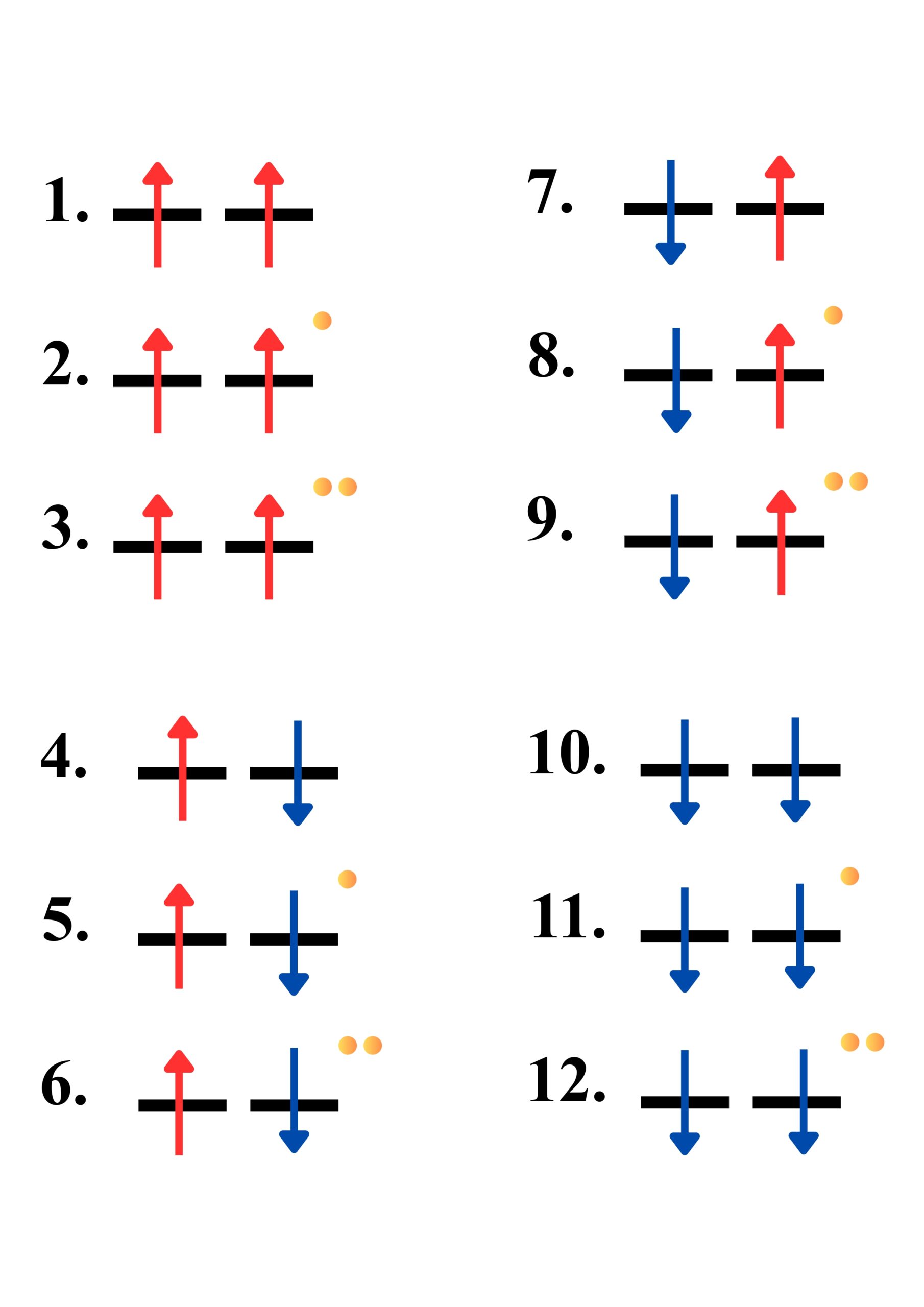
The 12 basis states were indexed sequentially from 1 to 12, grouped in four blocks of three states sharing the same spin configuration (|↑↑⟩, |↑↓⟩, |↓↑⟩, |↓↓⟩), with the three states in each block differing only in photon number (n = 0, 1, 2). This indexing scheme is used consistently throughout the matrix construction described below.
Using these 12 states, the Tavis–Cummings Hamiltonian was explicitly written as a 12×12 matrix whose elements depend on the three terms in the Hamiltonian: the atomic energy, the photonic energy, and the light-matter interaction term. Diagonal elements take the form E = (ωba/2)(m₁ + m₂) + ωn, where mⱼ = +1 for an excited atom and −1 for a ground-state atom. Off-diagonal elements arise from the interaction term: the operator σ⁻ⱼa† connects states differing by one spin flip (site j: ↑ → ↓) and one additional photon, with matrix element (λ/√2)√(n+1). The resulting matrix is manifestly Hermitian by construction. In this matrix, each row and column index corresponds to one of the 12 basis states. The conserved quantity M = n + ∑nⱼup (total excitation number) block-diagonalises the Hamiltonian into five independent sectors (M = 0, 1, 2, 3, 4), which is exploited in the analytical treatment of the ground-state crossovers below.
The Hamiltonian was implemented and diagonalised in Octave Online (GNU Octave, version 8.x), an open-source matrix algebra environment25. Prior to diagonalisation, the Hermiticity of each constructed matrix was verified by computing ‖H − H†‖, which was found to be zero to machine precision (≈ 10⁻16) for all values of λ, confirming correct matrix construction. Exact diagonalisation yields the full energy spectrum and corresponding eigenvectors of the system. The lowest energy eigenvalue represents the ground-state energy of the coupled light-matter system. These eigenvalues were then employed to study how the system’s spectral structure changes with varying coupling strength. The complete Octave code used for matrix construction and diagonalisation is provided in the Supplementary Material.
Computational Methods: Variables and Measurements
In this study, the variable focused upon was the light-matter coupling constant, lambda (λ). Lambda parameterises the interaction strength between cavity photon mode and spin degrees of freedom within the Dicke Hamiltonian. Two lambda grids were used. For the ground-state energy plot, lambda was varied continuously from 0.10 to 8.00 in increments of 0.10 (80 values), providing a smooth curve. For the eigenvalue histogram analysis, eight representative values were selected (λ = 0.25, 0.50, 0.75, 1.00, 2.00, 4.00, 6.00, 8.00) to illustrate spectral evolution across distinct coupling regimes, with values chosen to both straddle and exceed the thermodynamic critical coupling λc = 0.5. All other parameters in the Hamiltonian were held constant throughout. In this context, lambda was treated as a dimensionless control parameter that manipulates the strength of light-matter hybridisation.
As for the dependent variables, two key observables were extracted from the numerical diagonalisation of the Hamiltonian: the eigenvalue spectra and the minimum eigenvalue. The full set of eigenvalues represents the many different many-body energy levels accessible to the system, whereas the minimum eigenvalue corresponds to the ground state energy of the system. The eigenvalue sets were analysed through histogram distributions, which helped characterise how the overall energy spectrum reorganises itself as a function of coupling strength. Meanwhile, graphing the minimum eigenvalues as a function of coupling strength provides insights into how the ground-state energy configurations evolve across different coupling regimes.
As a note, since the entire study was conducted through computational modelling on Octave Online and data modelling, no experimental instruments were used in anyway.
Results
The Hamiltonian matrix for the two-site, two-photon system was constructed and diagonalised across two lambda grids. For the eigenvalue histogram analysis, the matrix was diagonalised at eight representative coupling strengths (λ = 0.25, 0.50, 0.75, 1.00, 2.00, 4.00, 6.00, 8.00), selected to illustrate spectral evolution across distinct coupling regimes. The resulting eigenvalue spectra were analysed using histograms and represent the accessible energies of the many-body system (consisting of both spins and photons). For the ground-state energy plot, the matrix was diagonalised for all coupling strengths from 0.10 to 8.00 in increments of 0.10, and the minimum eigenvalue at each λ was recorded and plotted as a function of coupling strength. The minimum eigenvalue of a Hamiltonian represents the energy of the ground state of the system.
Eigenvalue Distributions for Varying Coupling Strengths
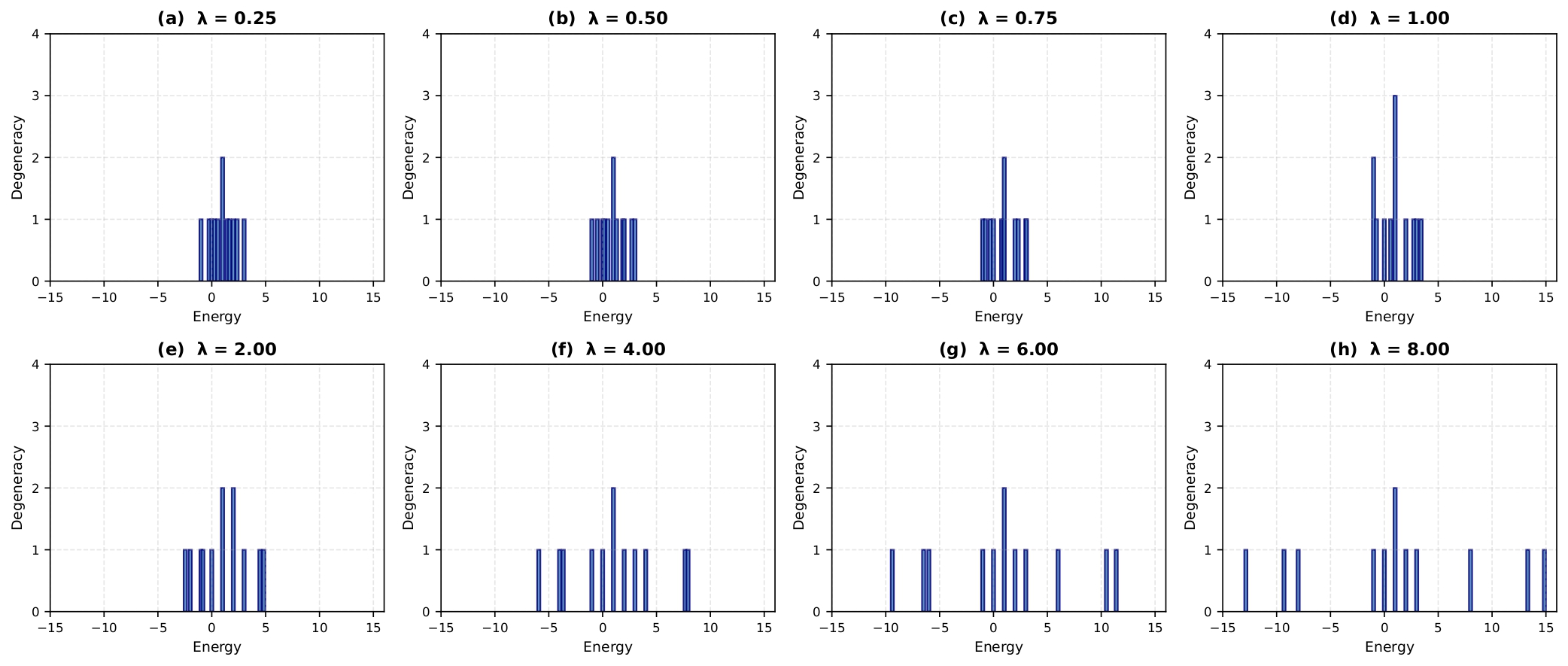
The histograms of the eigenvalue spectra for each lambda value show a clear evolution as the light-matter coupling parameter (λ) increases. At the most basic level, we see that the eigenvalues increase with the coupling parameter, as would be expected, since the larger coupling parameter will raise the energy of the system.
For small coupling strengths, such as λ = 0.25 to 1.00 (see Figures 2(a) – 2(d)), the eigenvalues are broadly distributed across a compact energy range, with relatively small separations between neighbouring values. As λ increases from 1.00 to 2.00, the overall distribution shifts toward the extreme ends of the energy spectrum rather than concentrating toward the centre, reflecting a systemic outward displacement of the spectrum.
At intermediate coupling strengths, such as λ = 2.00 to 4.00 (see Figures 2(e) – 2(f)), distinct separations between clusters of eigenvalues begin to appear. These separations become more pronounced at higher coupling strengths, such as λ = 6.00 to 8.00 (Figures 2(g)–2(h)), where the histograms reveal discrete band-like structures rather than compact spreads of values. This indicates that the energy spectrum reorganises itself with increasing light-matter interaction strength.
The emergence of separations in the spectra is tentatively consistent with a finite-size crossover from a weakly hybridised to a strongly hybridised regime, although the present data cannot establish a connection to a true insulating phase, which requires the thermodynamic limit.
It should be noted that all eigenvalues across the full λ range from 0.10 to 8.00 are confirmed real, as verified by the Hermiticity check ‖H − H†‖ ≈ 10⁻16 at every λ value. This confirms the correctness of the matrix construction and the numerical reliability of all reported spectra.
Ground State Energy vs Coupling Strength
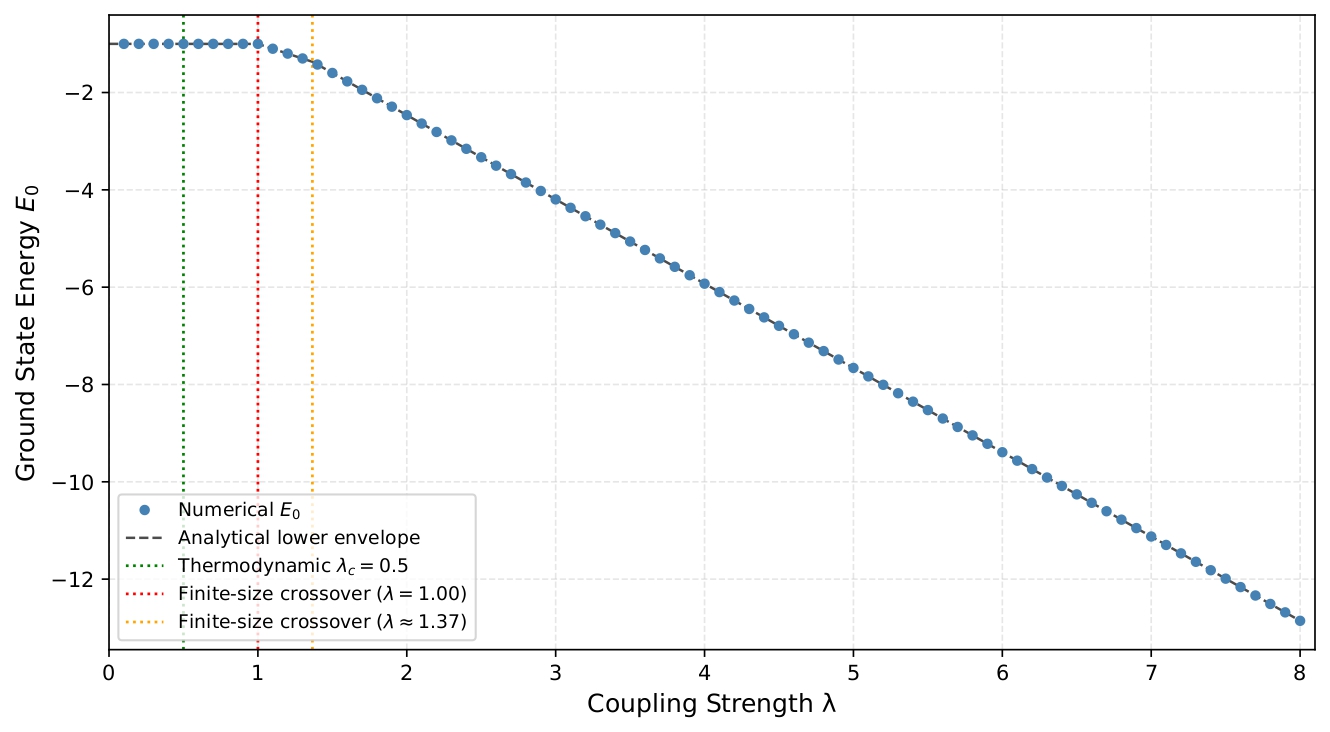
From the eigenvalue spectra for each value, the lowest value of the Hamiltonian was extracted and plotted as a function of coupling strength. The ground state energy from  to
to  remains constant at
  (exact), corresponding to the decoupled
  ground state. Beyond this region, the ground-state energy decreases with , reaching a value of
  at
at  . All reported eigenvalues are numerically exact to within machine precision (
 ), as confirmed by the Hermiticity check at each . The value at (the smallest studied) is consistent with the analytical non-interacting ground state energy of
  , providing a direct validation of the Hamiltonian construction. Two analytically derived finite-size crossovers are identified: at , where the ground state transitions from the
  sector (energy
  , independent of ) to the
  sector (
 ); and at
  , where the
  sector ground state (
 ) becomes lowest. These analytical expressions, derived from the block-diagonal structure of the Hamiltonian, are in exact agreement with the numerical results (Figure 3). For comparison, the analytically predicted critical coupling in the thermodynamic Dicke model is
  ; the explored range spans both below (
 ) and above (
 ) this threshold, enabling comparison across both regimes.
The two-stage decrease in ground-state energy — first following for  , and then for
  — coincides with the emergence of spectral gaps in the eigenvalue histograms above, signalling a finite-size crossover as coupling strength increases.
Overall, increasing the light-matter coupling strength of the system results in a downward shift in the ground state energy, and the spectral structure gets reorganised.
Discussion
Key Findings of the Dicke Model
Diagonalising the two-site, two-photon Tavis–Cummings Hamiltonian reveals a clear relationship between the system’s coupling strength and its energy distribution: as the light-matter coupling parameter increases, the many-body spectrum is significantly reorganised. Histograms of the eigenvalue spectra show that the spectrum is progressively redistributed as λ increases, transitioning from a tightly clustered configuration at low coupling to pronounced band-like structures at higher coupling strengths. The emergence of these structures signals a qualitative finite-size crossover in the accessible energy states of the system, tentatively consistent with a transition from a weakly coupled to a strongly hybridised regime, although the connection to an insulating phase cannot be established from the present finite-size data alone.
This finite-size crossover behaviour is further supported by the dependence of the system’s ground-state energy on the coupling strength. The ground-state energy remains constant at −1.0000 for λ ≤ 1.00, indicating that the cavity interaction has no significant impact on the system’s lowest energy configuration in this regime. Two analytically identified crossovers occur at λ = 1.00 and λ ≈ 1.37, beyond which the ground-state energy decreases monotonically with λ, reaching −12.8560 at λ = 8.0. It is important to note that this shift coincides with the spectral reorganisation observed in the eigenvalue histograms previously discussed.
Together, the results show how coupling strength serves as a strong factor in driving the reorganisation of the eigenvalue distribution and the stability of lower-energy ground states, which is compatible with the coupling-induced modification of the system’s phase behaviour.
Limitations of the Model and Future Improvements
Despite capturing clear indicators of spectral reorganisation, the current model is a highly simplified proxy for light-matter interactions, and this limitation cannot and should not be ignored. Since the study employs a two-site system with a limited photon number, the model constrains the Hilbert space’s size, which prevents true thermodynamic phase transitions from arising. As a consequence, the changes observed in the energy spectrum should be treated as finite-size signatures of crossover behaviour rather than definitive macroscopic phase transitions. In larger systems, additional effects such as sharper symmetry breaking or critical scaling would need to be taken into account. The energy gaps observed could therefore evolve differently as the system grows larger, deviating to some extent from the present results.
Similarly, while fixing the maximum number of photons in the system simplifies the numerical diagonalisation, the truncation of the photon basis may omit higher-order light-matter processes that become more significant with increasing coupling strength. For example, restricting the system’s photon number misses out on higher-order dressing processes, virtual multi-photon processes, and the buildup of collective cavity excitations; all these effects would reshape the energy spectrum in less truncated models. In turn, by extending the photon cutoff number, the model could render strongly hybridised or superradiant regimes with greater accuracy.
Moving past the limitations of this model, further extensions of this study could improve its physical realism. Firstly, to gain access to a closer connection to low-dimensional materials and explore finite-size scaling, the study could increase the number of lattice sites present in the system. Also, by realising open-system effects, like dissipation, cavity losses, or decoherence mechanisms, the study would enable the model to be comparable to experimental quantum electrodynamic platforms to a greater extent, especially where open-system dynamics play an important role. Lastly, by utilising more realistic and evolved versions of the Dicke model that introduce additional interaction terms, like hopping disorder or multi-mode cavities, further research could determine whether the spectral restructuring observed in this study persists under more realistic conditions.
Exploring and understanding these limitations and improvements, together, outline a pathway in which future studies have the freedom to explore more experimentally relevant and larger simulations while preserving this study’s most appealing characteristics that make it an ideal starting point: its conceptual simplicity and freedom to manipulate the parameters.
Implications and Significance of the Results
The results of this study carry value as they contribute to the growing theoretical understanding of how cavity-mediated light-matter interactions influence a low-dimensional quantum system’s phase behaviour. By modelling a two-site, two-photon Dicke Hamiltonian through the evolution of its eigenvalue distribution, this work demonstrates the effect that varying the coupling strength has on the many-body energy landscape of the system, producing spectral gaps and lowering the ground-state energy, consistent with the spectral and entanglement signatures reported for finite Dicke systems with critical and noncritical structure26. These findings support the broader idea that optical cavities are not simply structures meant for probes of material properties; rather, they can actively reshape the phases accessible to quantum materials, as has been demonstrated experimentally with a superfluid gas coupled to an optical cavity27.
Looking through a theoretical lens, the observed emergence of band-like structures and ground-state shifts induced by the coupling parameter shows how light-matter interactions can influence and reorganise a finite system’s energy spectrum: rooting from light-matter hybridisation, the results emphasise the formation of gapped excitation structures. Although when studying cavity-induced phase transitions, large-scale lattice models are typically used, the reduced model used in this study exhibits how key signatures of spectral reorganisation can be brought about even in minimal systems. For this reason, the study offers the scientific community a more accessible framework which can be used to deepen their understanding of cavity quantum electrodynamics and its effects, without the need of handling vexatious and inconvenient aspects, like large Hilbert spaces or complex numerical techniques.
From a more academic lens, this work helps bridge the gap between the ideas stringed together by abstract Dicke-model theory and its application to low-dimensional quantum materials. Most researchers analyse phase transitions using extended systems or in the thermodynamic limit, where the number of particles taken into account is very large; However, fewer studies accentuate how qualitative signatures of phase restructuring can be captured via small-scale models. Through the analysis of eigenvalue distribution across a controlled coupling strength range, this study exemplifies how energy accessibility across a system’s states can be modified through cavity coupling. This may be relevant to further studies in polaritonic systems, quantum simulated systems, and engineered quantum materials.
As a direction for future work, this framework could motivate investigations into real-world 2D materials that may exhibit cavity-induced spectral reorganisation. Two-dimensional materials such as transition-metal dichalcogenides offer strong excitons and ultraconfined polaritons, and the simplified Dicke-type models studied here could serve as a starting point for evaluating whether such materials enter regimes producing spectral gaps and coherent states. It must be emphasised that such extensions remain speculative future directions: the present single-size exact-diagonalisation calculation on 12 states provides no direct basis for claims about 2D materials, polaritonic devices, or moiré systems, and any such connection would require substantially more involved modelling with material-specific inputs.
By using experimentally-derived light-matter coupling values for such materials with simplified Dicke models, future investigations could evaluate whether specific 2D materials enter regimes which result in the emergence of spectral gaps and coherent states. Such approaches would, thereby, bridge theoretical cavity quantum electrodynamics studies with experiments that utilise accessible and viable quantum materials.
In a broader sense, these results reinforce the idea that learning how to manipulate light-matter interaction strength paves the way for manipulating phase transitions in quantum materials without surrendering control to the material’s underlying composition. This proposes that for future theoretical/experimentally-driven experiments, cavity environments could be used as external control parameters for studies of low-dimensional systems, a proposal already pursued via cavity-assisted Raman transitions28,29 and via strong coupling between single photons and superconducting qubits in circuit quantum electrodynamics30, encouraging further research into larger regimes with a higher number of photons, as well as include realistic effects like energy loss and decoherence mechanisms to better match experimental cavity setups.
Ultimately, this study highlights a broader shift in how light is understood within quantum many-body physics. The cavity field no longer serves just as a probe that reveals the properties of matter; rather, it is beginning to emerge as a controllable element capable of influencing the spectral behaviour of finite quantum systems. Future research in quantum optics is poised to advance toward greater integration of light and matter, and the minimal framework demonstrated here provides a transparent conceptual foundation for that progression.
In summary, this work demonstrates that even a minimal two-site, two-photon model is capable of producing analytically characterisable finite-size signatures of spectral reorganisation driven by light-matter coupling. The identification of two closed-form crossovers, validated against exact numerical diagonalisation, offers a transparent and reproducible benchmark for future studies seeking to extend these results to larger systems, higher photon numbers, and more realistic material environments.
Supplementary Material
References
- P. W. Milonni. The quantum vacuum: an introduction to quantum electrodynamics. Academic Press, 1994 [↩]
- H. Ritsch, P. Domokos, F. Brennecke, T. Esslinger. Cold atoms in cavity-generated dynamical optical potentials. Reviews of Modern Physics. Vol. 85, pg. 553–601, 2013, https://doi.org/10.1103/RevModPhys.85.553 [↩] [↩] [↩]
- F. Schlawin, D. M. Kennes, M. A. Sentef. Cavity quantum materials. Applied Physics Reviews. Vol. 9, pg. 011312, 2022, https://doi.org/10.1063/5.0083825 [↩] [↩]
- F. Mivehvar, F. Piazza, T. Donner, H. Ritsch. Cavity QED with quantum gases: new paradigms in many-body physics. Advances in Physics. Vol. 70, pg. 1–153, 2021, https://doi.org/10.1080/00018732.2021.1969727 [↩] [↩]
- P. Kirton, M. M. Roses, J. Keeling, E. G. Dalla Torre. Introduction to the Dicke model: from equilibrium to nonequilibrium, and vice versa. Advanced Quantum Technologies. Vol. 2, pg. 1800043, 2019, https://doi.org/10.1002/qute.201800043 [↩]
- B. M. Garraway. The Dicke model in quantum optics: Dicke model revisited. Philosophical Transactions of the Royal Society A. Vol. 369, pg. 1137–1155, 2011, https://doi.org/10.1098/rsta.2010.0333 [↩]
- Q.-H. Chen, Y.-Y. Zhang, T. Liu, K.-L. Wang. Numerically exact solution to the finite-size Dicke model. Physical Review A. Vol. 78, pg. 051801, 2008, https://doi.org/10.1103/PhysRevA.78.051801 [↩]
- T. Liu, Y.-Y. Zhang, Q.-H. Chen, K.-L. Wang. Large-N scaling behavior of the ground-state energy, fidelity, and the order parameter in the Dicke model. Physical Review A. Vol. 80, pg. 023810, 2009, https://doi.org/10.1103/PhysRevA.80.023810 [↩]
- J. S. Douglas, H. Habibian, C.-L. Hung, A. V. Gorshkov, H. J. Kimble, D. E. Chang. Quantum many-body models with cold atoms coupled to photonic crystals. Nature Photonics. Vol. 9, pg. 326–331, 2015, https://doi.org/10.1038/nphoton.2015.57 [↩]
- A. D. Greentree, C. Tahan, J. H. Cole, L. C. L. Hollenberg. Quantum phase transitions of light. Nature Physics. Vol. 2, pg. 856–861, 2006, https://doi.org/10.1038/nphys466 [↩] [↩]
- R. H. Dicke. Coherence in spontaneous radiation processes. Physical Review. Vol. 93, pg. 99–110, 1954, https://doi.org/10.1103/PhysRev.93.99 [↩] [↩] [↩]
- E. T. Jaynes, F. W. Cummings. Comparison of quantum and semiclassical radiation theories with application to the beam maser. Proceedings of the IEEE. Vol. 51, pg. 89–109, 1963, https://doi.org/10.1109/PROC.1963.1664 [↩]
- M. Tavis, F. W. Cummings. Exact solution for an N-molecule-radiation-field Hamiltonian. Physical Review. Vol. 170, pg. 379–384, 1968, https://doi.org/10.1103/PhysRev.170.379 [↩]
- M. Tavis, F. W. Cummings. Approximate solutions for an N-molecule-radiation-field Hamiltonian. Physical Review. Vol. 188, pg. 692–695, 1969, https://doi.org/10.1103/PhysRev.188.692 [↩]
- B. W. Shore, P. L. Knight. The Jaynes-Cummings model. Journal of Modern Optics. Vol. 40, pg. 1195–1238, 1993, https://doi.org/10.1080/09500349314551321 [↩]
- K. Hepp, E. H. Lieb. On the superradiant phase transition for molecules in a quantized radiation field: the Dicke maser model. Annals of Physics. Vol. 76, pg. 360–404, 1973, https://doi.org/10.1016/0003-4916(73)90039-0 [↩] [↩] [↩]
- Y. K. Wang, F. T. Hioe. Phase transition in the Dicke model of superradiance. Physical Review A. Vol. 7, pg. 831–836, 1973, https://doi.org/10.1103/PhysRevA.7.831 [↩]
- F. T. Hioe. Phase transitions in some generalized Dicke models of superradiance. Physical Review A. Vol. 8, pg. 1440–1445, 1973, https://doi.org/10.1103/PhysRevA.8.1440 [↩]
- M. Gross, S. Haroche. Superradiance: an essay on the theory of collective spontaneous emission. Physics Reports. Vol. 93, pg. 301–396, 1982, https://doi.org/10.1016/0370-1573(82)90102-8 [↩]
- K. Cong, Q. Zhang, Y. Wang, G. T. Noe, A. Belyanin, J. Kono. Dicke superradiance in solids. Journal of the Optical Society of America B. Vol. 33, pg. C80–C101, 2016, https://doi.org/10.1364/JOSAB.33.000C80 [↩] [↩] [↩]
- C. Emary, T. Brandes. Quantum chaos triggered by precursors of a quantum phase transition: the Dicke model. Physical Review Letters. Vol. 90, pg. 044101, 2003, https://doi.org/10.1103/PhysRevLett.90.044101 [↩]
- C. Emary, T. Brandes. Chaos and the quantum phase transition in the Dicke model. Physical Review E. Vol. 67, pg. 066203, 2003, https://doi.org/10.1103/PhysRevE.67.066203 [↩] [↩]
- N. Lambert, C. Emary, T. Brandes. Entanglement and the phase transition in single-mode superradiance. Physical Review Letters. Vol. 92, pg. 073602, 2004, https://doi.org/10.1103/PhysRevLett.92.073602 [↩]
- J. Kasprzak, M. Richard, S. Kundermann, A. Baas, P. Jeambrun, J. M. J. Keeling, F. M. Marchetti, M. H. Szymańska, R. André, J. L. Staehli, V. Savona, P. B. Littlewood, B. Deveaud, L. S. Dang. Bose–Einstein condensation of exciton polaritons. Nature. Vol. 443, pg. 409–414, 2006, https://doi.org/10.1038/nature05131 [↩]
- J. W. Eaton, D. Bateman, S. Hauberg, R. Wehbring. GNU Octave version 4.0.0 manual: a high-level interactive language for numerical computations. CreateSpace Independent Publishing Platform, 2015 [↩]
- L. Bakemeier, A. Alvermann, H. Fehske. Quantum phase transition in the Dicke model with critical and noncritical entanglement. Physical Review A. Vol. 85, pg. 043821, 2012, https://doi.org/10.1103/PhysRevA.85.043821 [↩]
- K. Baumann, C. Guerlin, F. Brennecke, T. Esslinger. Dicke quantum phase transition with a superfluid gas in an optical cavity. Nature. Vol. 464, pg. 1301–1306, 2010, https://doi.org/10.1038/nature09009 [↩]
- F. Dimer, B. Estienne, A. Parkins, H. Carmichael. Proposed realization of the Dicke-model quantum phase transition in an optical cavity QED system. Physical Review A. Vol. 75, pg. 013804, 2007, https://doi.org/10.1103/PhysRevA.75.013804 [↩]
- M. P. Baden, K. J. Arnold, A. L. Grimsmo, S. Parkins, M. D. Barrett. Realization of the Dicke model using cavity-assisted Raman transitions. Physical Review Letters. Vol. 113, pg. 020408, 2014, https://doi.org/10.1103/PhysRevLett.113.020408 [↩]
- A. Wallraff, D. I. Schuster, A. Blais, L. Frunzio, R.-S. Huang, J. Majer, S. Kumar, S. M. Girvin, R. J. Schoelkopf. Strong coupling of a single photon to a superconducting qubit using circuit quantum electrodynamics. Nature. Vol. 431, pg. 162–167, 2004, https://doi.org/10.1038/nature02851 [↩]