
Abstract
This report explores the comparative effectiveness and environmental footprint of five aircraft propulsion mechanisms: turbofan, turboprop, hybrid electric, hydrogen combustion, and sustainable aviation fuel (SAF)-based engines. The goal is to analyze how these systems vary in performance based on efficiency, emissions, and operational characteristics in regard to sustainability. The study offers an analysis and uses secondary data in evaluating several key performance measures of interest for propulsion efficiency, bypass ratio, specific impulse, CO2 emissions, soot emissions, NOx (nitrogen oxides) emissions, thermal efficiency and contrail formation potential. Each of these performance measures is illustrated through graphical and numerical illustrations to indicate performance trends and trade-offs. The results indicate that turbofan engines remain essential for long-haul aviation due to their high thrust-to-weight ratio and operational range, while hydrogen and hybrid-electric propulsion offer the greatest long-term environmental benefits but face technology readiness and infrastructure constraints. Turboprop and sustainable aviation fuel systems represent near-term, deployable pathways for reducing emissions within existing aviation infrastructure. Turboprop engines and SAF-based systems are alternatives that account for existing or transitional aviation infrastructure and have lower emissions capabilities, indicating more work is still needed to achieve fully decarbonized aviation. This indicates that a range of propulsion technologies and fuel pathways will be needed to support aviation decarbonization.
Keywords: Aircraft propulsion, turbofan, turboprop, hybrid electric, hydrogen, sustainable aviation fuel, emissions reduction, bypass ratio, specific impulse.
Introduction
The aviation industry is at a historic crossroads in its evolution, whereby environmental sustainability has become a major measure of progress. Aircraft propulsion systems originated with conventional jet fuel and gas turbine technology, and are now perhaps being re-evaluated in light of greenhouse gas emissions, contrails, and particle pollution. The central challenge is improving propulsion efficiency while reducing the environmental impacts of air travel. This paper explores this dilemma by simultaneously assessing five propulsion systems: turbofan, turboprop, hybrid electric, hydrogen, and sustainable aviation fuel (SAF)-based engines. In comparing each propulsion system’s relevant metrics on a comparative basis, the specific impulse, bypass ratio, CO2 emissions, soot emissions, and contrail formation potential can all be evaluated in efforts to exhibit the environmental and operational tradeoffs of each propulsion system.
For clarity, several technical terms used throughout this paper are briefly defined here. Specific impulse is a measure of how efficiently an engine uses fuel to produce thrust, with higher values indicating better fuel efficiency. The bypass ratio describes how much air flows around an engine’s core compared to how much passes through it; higher bypass ratios generally lead to quieter operation and greater propulsion efficiency. Thermal efficiency refers to how effectively an engine converts the chemical energy in fuel into useful mechanical energy. Propulsion efficiency measures how well that mechanical energy is converted into forward motion of the aircraft. Finally, contrails are condensation trails formed when water vapor in engine exhaust freezes at high altitudes, which can contribute to atmospheric warming depending on conditions.
These metrics are central to aviation sustainability because they directly connect engine design to fuel consumption and climate impact. Specific impulse links stored energy to useful thrust; bypass ratio influences propulsive efficiency and noise; thermal efficiency governs how much fuel energy is converted into work; and propulsive efficiency determines how effectively that work produces forward motion. Together, they explain why engines with similar thrust can have very different emissions per passenger-kilometer.
This study examines a variety of datasets and studies that clearly show performance variability. Performance trends from the literature reveal distinct trade-offs. Turbofan engines, the standard for commercial long-haul aviation, achieve high propulsive efficiency and thrust-to-weight ratios due to their high-bypass designs. However, they typically generate the highest levels of CO2 and particulate emissions (soot) among conventional systems, which also promotes contrail formation. In contrast, turboprop engines offer superior fuel efficiency for regional missions but at lower cruise speeds. Emerging systems like hybrid-electric and hydrogen propulsion promise major reductions in operational emissions but face technological and infrastructure hurdles. Sustainable Aviation Fuel (SAF) provides a near-term pathway for emission reductions within existing engine architectures. Hybrid-electric propulsion systems, while still in development, may achieve higher effective bypass ratios and modest improvements in propulsive efficiency, while substantially reducing or eliminating particulate emissions depending on system design and energy source. Hydrogen engines produce no direct CO2 or soot emissions during combustion, but they produce higher water vapor emissions, which may increase contrail formation under certain atmospheric conditions. Turboprop and SAF-based systems offer different advantages. Turboprops provide strong fuel efficiency on regional flights but are limited by lower cruise speeds, while SAF can reduce soot and life-cycle carbon emissions while remaining compatible with existing engines and fuel infrastructure.
This paper will discuss these trade-offs through graphical and numerical comparisons using available data, such as technical reports, government research and academic literature. Additionally, it will assess a set of pros and cons of each, thereby creating an organized approach to better understand how aviation can move toward cleaner and more efficient propulsion technologies, and ultimately assist in the existing efforts to decarbonize the aviation sector, as well as ultimately guide future research and policy associated with developing sustainable aircraft designs.
Methodology
This comparative literature review enables this research to quantify and compare five distinct aircraft propulsion approaches: turbofan, turboprop, hybrid-electric, hydrogen combustion, and sustainable aviation fuel (SAF)-based engines. Instead of conducting experimental work, this research described, quantified, and synthesized quantitative performance results reported in previously published data to answer the main research question: How do the five aircraft propulsion systems compare in efficiency and environmental performance and which technologies hold the most promise for helping the aviation industry transition toward sustainability?
In this review, the phrase “holds the most promise” is used qualitatively to reflect a propulsion system’s potential to reduce environmental impact while remaining feasible within technological and infrastructure constraints. Criteria considered include emissions reduction potential, compatibility with existing aviation systems, and long-term scalability. A quantitative multi-criteria decision framework was beyond the scope of this study and is identified as an important direction for future research.
Data was selected based on relevancy, merit, and type of description. This review synthesized data from a range of sources (e.g., NASA technical reports, studies by the U.S. DoD, journals with peer-review process, and international aviation regulatory agencies). This study prioritized data published in the last few years to ensure we captured recent technological developments and performance. Specifically, quantitative data published between 2011 and 2025 were considered, with emphasis on studies from the last five to seven years. Earlier sources were included when they provided foundational measurements or well-established reference data that remain relevant to current propulsion analysis. All sources were focused on delivering measurable quantitative performance data on the engine characteristics or emissions performance, and were assessed for robustness and comparability.
Comparative evaluation was based on several important measures: propulsive efficiency, specific impulse, CO2 emissions, soot emissions (qualitatively and quantitatively), NOx emissions (when provided), thermal effectiveness, bypass ratios, thrust-weight ratio, fuel efficiency, and contrails potential (from particulates and vapor outputs). This study obtained measurements directly from data tables and graphs in the sources. The analysis examined each propulsion source separately. For each parameter, the data were prepared for a comparative approach in bar and line graphs, putting in the appropriate units. The separate and complete analysis that was outlined is necessary to showcase real differences in propulsion performance and environmental trade-offs. For example, hybrid electric systems had better bypass ratios, less particulate output, and modestly better propulsive efficiency, even though these systems are only in development.
Because this review draws on data reported across multiple independent studies, numerical comparisons are interpreted in a comparative rather than strictly normalized sense. Where reported, values normalized per passenger-kilometer or per unit thrust were used; otherwise, results were compared qualitatively within the context of similar aircraft classes and mission profiles. Variations in altitude, operating conditions, and engine size across studies contribute to observed differences, and conflicting values were interpreted as indicative of uncertainty rather than resolved through averaging. This approach enables trend-based comparison while maintaining transparency regarding cross-study limitations.
Results
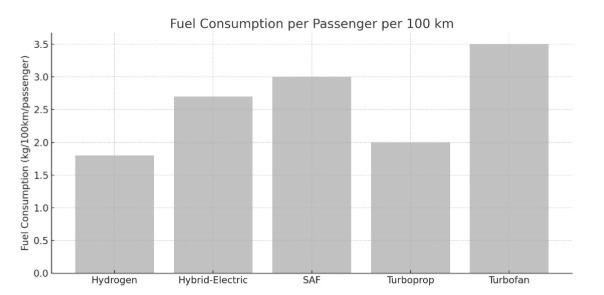
The comparison of the five propulsion systems highlighted distinctive differences in their efficiencies as well as impacts on health and the environment. Fuel use efficiencies per passenger (over 100 km), shown in Figure 1, were highest for the turboprop engines and hydrogen combustion systems. Turboprop engines had advantages from their very high bypass ratios, as well as efficiencies realized at lower cruise speeds that make them well suited for regional operations1. Hydrogen propulsion achieved strong results from the chemistry of its fuel since it doesn’t release CO2 and provides a high energy yield per unit2. Turbofans performed the worst in this metric and this mirrors their design focus on thrust and long-haul operation versus minimizing fuel use per passenger, intuitively supported by long term evaluations of turbofan performance3. Engines using SAF improved their efficiencies moderately, providing a small step up from kerosene baseline4. Hybrid-electric propulsion achieved higher fuel-use efficiency than turbofans and SAF-based engines, as shown in Figure 1, though it did not exceed the efficiency of turboprop or hydrogen systems5.
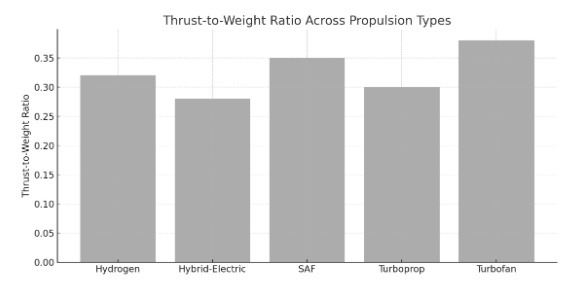
Thrust-to-weight ratio comparisons, evident in Figure 2, revealed the advantages that turbofan engines offer. Among all engine types considered, turbofans achieved the highest thrust-to-weight ratios, which are essential for long-range and high-speed missions6. As shown in past performance comparisons and analyses7, turbofans have amassed decades of design improvements in turbine function. Conversely, hybrid-electric propulsion will have to deal with reduced thrust-to-weight ratios as a consequence of added system mass resulting from the inclusion of additional batteries and power electronics8. Hydrogen and SAF (sustainable aviation fuel)-based engines exhibited lower thrust-to-weight ratios than turbofans but higher ratios than hybrid-electric systems, as shown in Figure 2, but they still do not reach the peak thrust-to-weight performance of conventional turbofan systems. Turboprops exhibited lower thrust-to-weight ratios than turbofans but superior fuel efficiency and bypass ratios, as shown in Figures 1, 2, and 5, making them suitable for regional transport, but not acceptable when considering transcontinental travel or intercontinental distance flights9. Benchmarking subcomponents of performance criteria like thrust-to-weight ratio is helpful because the engines listed above can all be useful for a benefit of some kind depending on intended application of propulsion type.
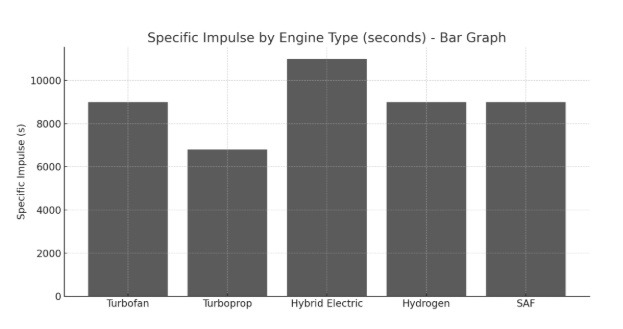
Specific impulse values shown in Figure 3 reveal the efficiency advantages of hybrid-electric systems. Hybrid-electric systems offered the highest specific impulse in comparison to turbofans and turboprops along with hydrogen based engines and SAF propulsion systems. The measurement of specific impulse fairly reflects the conversion efficiency of the stored source energy into thrust10. For turboprops, specific impulse was lowest due to operational considerations at high speeds, as the energy conversion efficiencies were reduced using turboprop based engines11. Turbofan, hydrogen-based, and SAF systems exhibited specific impulse values between those of hybrid-electric systems (highest) and turboprop engines (lowest), as shown in Figure 3. This is largely supported by experimental data from aero engines that have burned kerosene and testing on blended fuel12. This variable proportion demonstrates that from the propulsion aspects of aviation, hybrid-electric propulsion has clear efficiencies even though hybrid-electric is not yet matched for raw thrust with conventional engines.
For hybrid-electric propulsion systems, reported specific impulse values are interpreted as a comparative proxy for energy-to-thrust efficiency rather than a directly equivalent measure to combustion-based engines, reflecting differences in system boundaries and energy storage mechanisms.
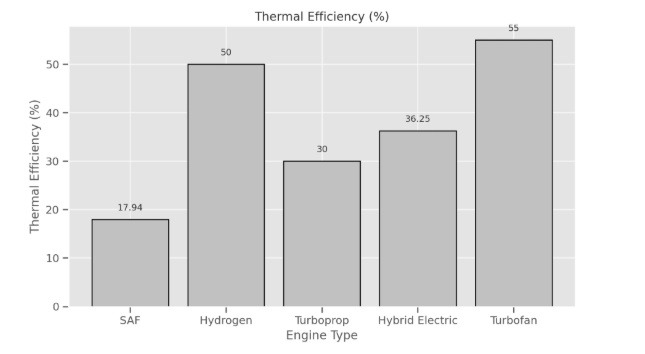
The thermal efficiency results shown in Figure 4 demonstrated the progress of turbofan technology. Turbofans achieved the best thermal efficiency, and thus, they demonstrate the most optimized form of extracting energy from combustion cycles13. When compared, SAF-powered engines achieved the least thermal efficiency. Although SAF can reduce particulate and soot emissions, its use in existing engine architectures may produce limited gains in thermal energy conversion14. Hydrogen propulsion demonstrated thermal efficiency lower than turbofans but higher than SAF-based engines, as illustrated in Figure 4. Driving performance, much like SAF based engines, with hydrogen propulsion performance is still configured around engine architecture15. Hybrid-electric systems gave similar mid-range thermal efficiencies; this aligned with modeling of competing fuel-cells or batteries16.
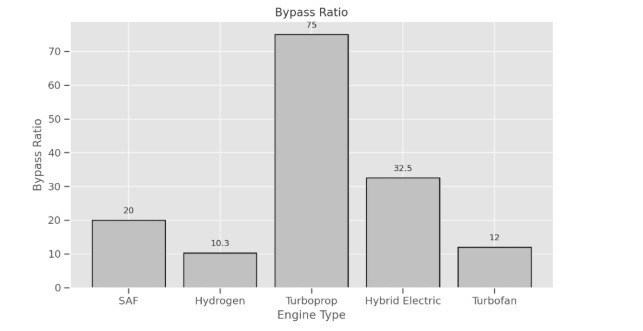
When comparing bypass ratio in Figure 5, turboprops appear highly effective in this comparison because their propeller-driven airflow can be interpreted as producing a very high effective bypass ratio, this confirms we see the respective higher fuel efficiency centred around per-passenger17. Turbofans are typically clustered in the middle either; this reflected high-bypass turbofan designs achieve the optimal balance between thrust and efficiency18. Yet, hybrid-electric engines structured in distributed propulsion concepts also harbored higher bypass ratios19. Hydrogen propulsion systems reflected lower bypass to thrust ratio numbers; this is primarily due to hydrogen propulsion systems combustion, and it is very much constrained hydrogen storage; a limitation noted in feasibility studies on hydrogen systems20.
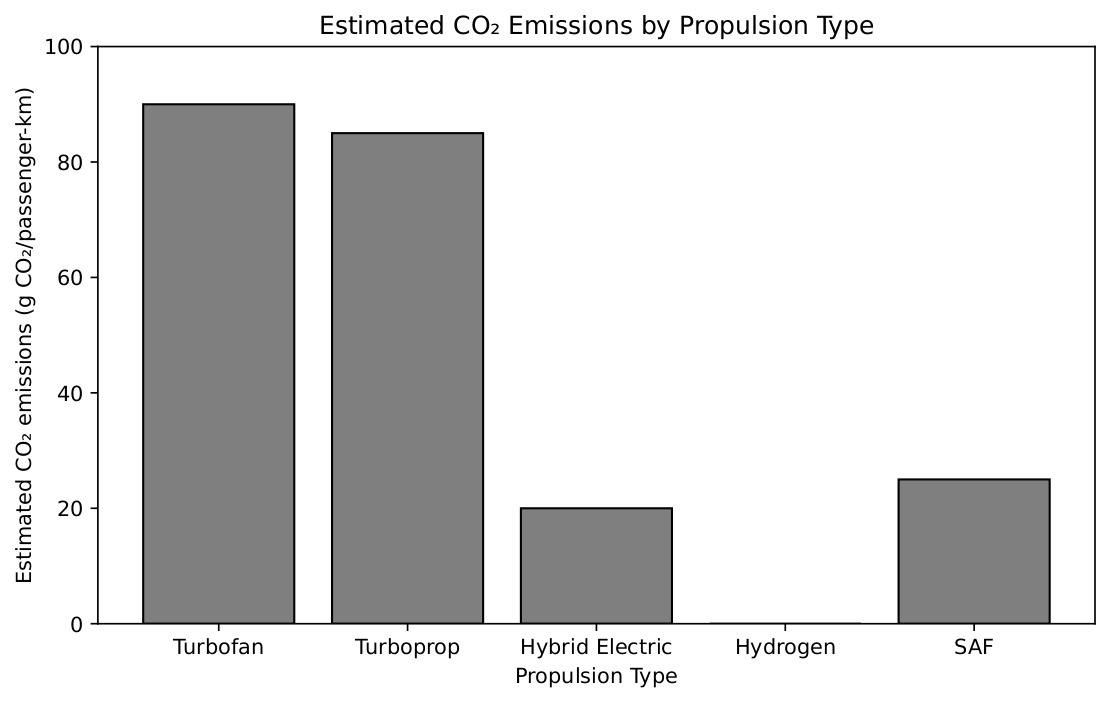
Emissions analysis (Figure 6) provided a key environmental perspective. Figure 6 reports estimated CO2 emissions on a per-passenger-kilometer basis, rather than emissions per unit of fuel energy. Hydrogen propulsion shows zero direct in-flight CO2 emissions21. Turbofan and turboprop systems operating on conventional jet fuel show the highest CO2 emissions in this comparison22. SAF and hybrid-electric propulsion show lower estimated net CO2 impacts, although their total life-cycle emissions depend on feedstock selection, electricity generation, and manufacturing pathways23,24. Beyond operational emissions, life-cycle impacts must be considered. For hydrogen and hybrid-electric systems, upstream emissions from hydrogen production, electricity generation, and battery manufacturing can offset some in-flight benefits if fossil energy sources are used. Similarly, SAF life-cycle emissions depend on feedstock choice, land-use change, and processing pathways. As a result, the relative sustainability of each propulsion option is strongly tied to the broader energy system supporting it.
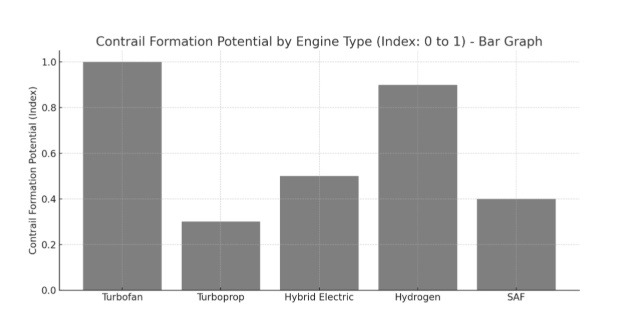
Contrail formation (Figure 7) posed an interesting trade-off. Hydrogen propulsion eliminated soot, but would have high contrail risk from a higher volume of water vapor output25. Turbofans produced significant contrail formation potential, with maximum calculated for kerosene based engines26. Turboprop systems generally produced the least contrail formation because they typically cruise at lower altitudes where persistent contrail formation is less likely27. The SAF demonstrated contrail mitigation potential through the reduction in soot, as had been previously assessed by NASA – DLR18. Hybrid-electric systems showed mixed outcomes in terms of contrail formation, however this was heavily dependent on the preferred flight profile16.
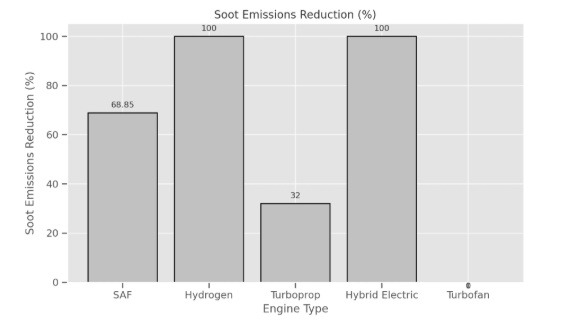
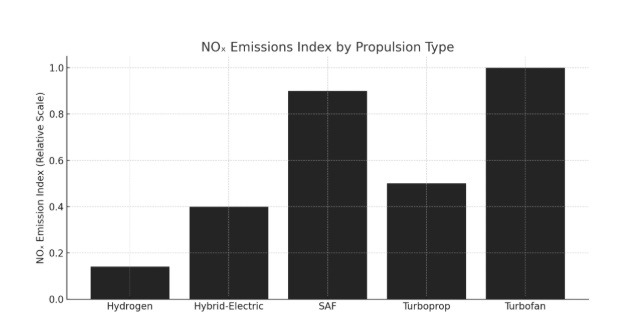
Soot and NOx emissions further distinguished the propulsion modes. Hydrogen and hybrid-electric systems showed soot-free operation, although their NOx impacts depend on combustion design, energy source, and operating conditions20. SAF substantially reduced soot emissions compared to kerosene, consistent with tests of biofuel blends.4. As noted in previous studies6, turbofans had high soot emissions relative to lower-carbon alternatives, consistent with conventional hydrocarbon combustion. Similarly with NOx emissions, hydrogen propulsion also produced the lowest values largely attributed to combustion chemistry. The turbofans produced the highest NOx emissions, consistent with high temperature cycle behaviors26. SAF achieved analogous moderate reductions for NOx emissions confirming benefits of 100% SAF27. Together, Tables 1 and 2 summarize the results and confirm that no single propulsion technology dominates across all performance and environmental categories. Table 1 consolidates efficiency-related metrics including fuel efficiency, thrust-to-weight ratio, specific impulse, thermal efficiency, and bypass ratio, while Table 2 summarizes environmental performance indicators such as CO2 emissions, soot emissions, NOx emissions, and contrail formation potential. These tables enable direct cross-technology comparison and reinforce that no single propulsion system dominates across all performance and environmental dimensions.
Figures and Tables
| Propulsion | Fuel Eff. | CO2 | Soot | NOx | Thermal | Impulse | Contrail | Bypass | T/W |
|---|---|---|---|---|---|---|---|---|---|
| Turbofan | 🔴 Low | 🔴 High | 🔴 High | 🔴 High | 🟢 High | 🟡 Mod | 🔴 High | 🔴 Low | 🟢 High |
| Turboprop | 🟢 High | 🔴 High | 🟡 Mod | 🟡 Med | 🔴 Low | 🔴 Low | 🟢 Low | 🟢 V. High | 🟡 Med |
| Hybrid Elec | 🟡 Mod | 🟢 Low | 🟢 Zero | 🟢 Low | 🟡 Mod | 🟢 V. High | 🟡 Mod | 🟢 High | 🔴 Low |
| Hydrogen | 🟢 V. High | 🟢 Zero | 🟢 Zero | 🟢 Low | 🟢 High | 🟡 Mod | 🔴 High | 🔴 Low | 🟡 Med |
| SAF | 🟡 Mod | 🟡 Mod | 🟡 Low | 🟡 Med | 🔴 V. Low | 🟡 Mod | 🟡 Mod | 🟡 Med | 🟢 High |
| Propulsion | Fuel Eff. | CO2 | Soot | NOx | Thermal | Impulse | Contrail | Bypass | T/W | Illustrative Total |
|---|---|---|---|---|---|---|---|---|---|---|
| Hydrogen | 5 | 5 | 5 | 5 | 5 | 3 | 2 | 2 | 3 | 35 |
| Hybrid Electric | 3 | 4 | 5 | 4 | 3 | 5 | 3 | 4 | 2 | 33 |
| Turboprop | 5 | 2 | 3 | 3 | 2 | 2 | 4 | 5 | 3 | 29 |
| SAF | 3 | 3 | 3 | 3 | 1 | 3 | 3 | 3 | 4 | 26 |
| Turbofan | 2 | 1 | 1 | 1 | 5 | 3 | 1 | 2 | 5 | 21 |
Note: Table 2 is an illustrative qualitative scoring summary, not a formal multi-criteria decision analysis. Scores from 1, poor, to 5, excellent, were assigned based on the comparative trends reported in Figures 1 through 9 and Table 1. Higher scores indicate more favorable performance or sustainability outcomes within the scope of this review. The illustrative total is included only to summarize relative trade-offs and should not be interpreted as a definitive ranking.
Discussion
The compiled results from the literature indicate that different propulsion systems vary substantially in efficiency and environmental impact. No single system provides the best solution across all applications. The figures and tables show that each propulsion pathway involves trade-offs among power, fuel efficiency, technological readiness, and environmental performance. To be truly sustainable, we may need to accept some trade-offs in performance, like reduced power, slower speeds, or less immediate availability. For long distances, turbofan engines are still the best choice. As shown in Figures 2 and 4, these engines achieve the best thrust-to-weight ratio and thermal efficiency. These benefits aren’t without drawbacks for the environment. Turbofans generate the most carbon dioxide, soot and other particles, and nitrogen oxides, and are a major source of contrails, findings that align with previous research. Turbofans are currently very reliable and will continue to be widely used for the foreseeable future, but their long-term viability hinges on using sustainable fuels or making major changes to their design. Turboprops are very fuel-efficient, as shown in Figure 1. It is important to clarify that emissions comparisons in this study are normalized on a per passenger-kilometer basis. Turboprop aircraft typically achieve lower fuel burn per passenger on regional routes, which explains their favorable fuel-efficiency performance. However, when operating on conventional kerosene fuels, turboprops still emit carbon dioxide, and their total emissions per passenger-kilometer can remain comparable to turbofan aircraft depending on mission profile, seating density, and operating altitude. This distinction reconciles the apparent difference between fuel efficiency and emissions trends shown in Figures 1 and 6. Therefore, their high fuel efficiency does not translate to low carbon emissions without a switch to lower-carbon fuels like SAF.
Figure 1 shows strong fuel-efficiency performance on a per-passenger basis, and Figure 5 demonstrates the high effective bypass ratio associated with turboprop systems. This makes sense given that turboprops are typically most efficient on shorter, regional flights.
Turboprops create the fewest contrails because they typically fly at altitudes where contrails don’t last long (Figure 7). Continuing to use kerosene results in significant carbon dioxide pollution (as shown in Figure 6). Turboprops are fuel-efficient aircraft for regional flights, but their environmental impact remains dependent on the use of cleaner fuels and lower-carbon operating pathways. Sustainable Aviation Fuel offers a way to improve air travel in the short term. Sustainable aviation fuel demonstrably lowers carbon dioxide emissions, particulate matter, and contrail formation, mirroring the results seen in tests using fuel blends. Sustainable aviation fuel works with current aircraft engines, lowering emissions without requiring major changes to airport infrastructure. The data in Figures 4 and 9 suggest that while sustainable aviation fuel offers some benefits, it doesn’t fully solve problems with how efficiently the fuel burns or how much NOx is produced – a finding that aligns with other research on the topic. Sustainable aviation fuel is a helpful step for cutting emissions now, but it’s not a complete fix for the future. Hydrogen offers a low-carbon propulsion pathway when produced using low-emission energy sources. Figures 6 and 8 show that CO2 and particulate emissions have been eliminated, and Figure 9 demonstrates a reduction in NOx (nitrogen oxides) emissions. These benefits, confirmed by testing how well it burns, suggest it could be very valuable in the future. Despite the benefits, Figures 5 and 7 show some downsides – lower bypass ratios mean less efficient engines, and more water vapor in the exhaust could worsen contrail formation.
Building and maintaining places to store and refuel also presents difficulties. While new designs can help overcome some problems, getting them widely used will take significant financial investment. Hydrogen offers long-term potential for aviation decarbonization; however, significant infrastructure and system-level challenges must be addressed before widespread adoption becomes feasible. Using a mix of electric and traditional engines significantly improves fuel efficiency. Figures 3 and 5 indicate good fuel efficiency and airflow, and Figure 8 verifies that no harmful particles are emitted. This research supports what we already know about systems that use multiple, smaller engines. However, the lowest thrust-to-weight ratio (Figure 2) results from heavy batteries and extensive cooling requirements. Such constraints currently reduce viability for large aircraft, although modeling suggests improvements may enable greater competitiveness in the future. When combined with renewable power sources, hybrid-electric propulsion has potential to significantly reduce life-cycle environmental impact. Overall, Figures 6–9 and Tables 1 and 2 demonstrate that environmental performance cannot be assessed in isolation. Hydrogen eliminates CO2 but increases contrail formation; SAF reduces particulate matter but retains carbon emissions; turboprops minimize contrails but depend on kerosene; and hybrid-electric propulsion relies on renewable energy availability. A systems-level perspective is therefore required for evaluation of sustainable aviation strategies.
Infrastructure requirements differ substantially across technologies. Hydrogen aviation would require new liquefaction, storage, and airport distribution systems, with projected investments on the order of tens of billions of dollars globally and deployment timelines extending into the 2040s. Hybrid-electric aircraft depend on high-capacity charging or battery-swap infrastructure and associated grid upgrades at airports. In contrast, sustainable aviation fuel can largely utilize existing fuel infrastructure, enabling near-term scaling despite higher fuel production costs.
In conclusion, sustainable aviation requires multiple complementary pathways. Turbofans remain essential for long-haul travel, turboprops provide efficiency on regional routes, SAF enables immediate emission reductions, hydrogen offers long-term potential, and hybrid-electric propulsion promises efficiency gains once technological barriers are overcome.
Limitations
This study is intended as a comparative literature review rather than a source of original experimental or simulation-based analysis. As a result, it does not introduce new performance data, but instead synthesizes and contextualizes results reported across prior studies to highlight relative trends, trade-offs, and gaps in current propulsion research. Differences in reported values across the literature reflect variations in aircraft class, mission profile, and system boundaries, which are discussed qualitatively rather than resolved through a unified analytical model. Consequently, the conclusions should be interpreted as comparative insights rather than definitive rankings, underscoring the need for future work that integrates standardized metrics, lifecycle assessments, and system-level modeling frameworks. Additionally, while this review prioritizes peer reviewed literature for quantitative performance and emissions data, some broader contextual discussions, particularly those related to technology readiness, infrastructure challenges, and deployment feasibility, draw on assessments from governmental and institutional sources. These materials are used to provide qualitative context rather than primary technical evidence and do not alter the comparative trends identified from peer reviewed studies.
Conclusion
This review examined the performance and environmental tradeoffs of five propulsion technologies: turbofan, turboprop, hybrid electric, hydrogen, and sustainable aviation fuel (SAF). This study compared propulsion technologies primarily in terms of efficiency metrics and environmental performance, including fuel efficiency, thrust-to-weight ratio, specific impulse, thermal efficiency, bypass ratio, emissions, and contrail formation potential. This review also evaluates the environmental impacts of these technologies to determine their potential role in sustainable aviation.
The results suggest that no single propulsion system can independently solve aviation’s environmental challenges. Turboprops and SAF-based systems offer near-term reductions for regional and existing aircraft operations, while hydrogen and hybrid-electric propulsion show stronger long-term potential once infrastructure, storage, weight, and technology-readiness barriers are addressed. Conventional turbofans will likely remain necessary for long-haul aviation in the near future, but their environmental impact must be reduced through cleaner fuels, improved engine design, and contrail mitigation strategies. Future research should focus on standardized life-cycle comparisons, contrail reduction strategies, and integrated engine-fuel-airframe designs that can reduce emissions without compromising safety or operational performance.
References
- Y. Gharbia, “Exergy analysis of a turboprop engine at different flight altitude and speeds using novel consideration,” Aerospace, vol. 7, no. 6, Jun. 2020. [Online]. Available: https://www.researchgate.net/publication/342843922 [↩]
- International Council on Clean Transportation (ICCT), Performance Analysis of Evolutionary Hydrogen-Powered Aircraft, Washington, DC, USA, Jan. 2022. [Online]. Available: https://theicct.org/publication/aviation-global-evo-hydrogen-aircraft-jan22 [↩]
- Market Reports World, Commercial Aero Turbofan Engine Market Trends and Forecast to 2033, 2024. [Online]. Available: https://www.marketreportsworld.com/market-reports/commercial-aero-turbofan-engine-market-14715382 [↩]
- Z. Liu, S. Yu, and X. Yang, “Insight of effects of air quality and sustainable aviation fuel blend on energy saving and emission reduction in airports,” Bioresources and Bioprocessing, vol. 11, no. 1, Sep. 2024, doi: 10.1186/s40643-024-00798-w [↩] [↩]
- National Aeronautics and Space Administration (NASA), NASA N3-X with Turboelectric Distributed Propulsion, NASA Technical Report, 2015. [Online]. Available: https://ntrs.nasa.gov/api/citations/20150002081/downloads/20150002081.pdf [↩]
- K. Lee et al., “Influence of turbofan engine design parameters on aircraft environmental impact,” in AIAA SCITECH 2024 Forum, Jan. 2024, doi: 10.2514/6.2024-0735 [↩] [↩]
- A. El-Sayed, M. S. Emeara, and M. A. El Habet, “Performance analysis of high bypass ratio turbofan aeroengine,” International Journal of Engineering Research and Technology, vol. 5, no. 7, Jul. 2016. [Online]. Available: https://www.researchgate.net/publication/306082636 [↩]
- A. Farsi and M. A. Rosen, “Performance analysis of a hybrid aircraft propulsion system using solid oxide fuel cell, lithium-ion battery and gas turbine,” Applied Energy, vol. 324, Nov. 2022, doi: 10.1016/j.apenergy.2022.119712 [↩]
- Boldmethod Flight Training, “How a turboprop engine works,” 2023. [Online]. Available: https://www.boldmethod.com/learn-to-fly/systems/this-is-how-a-turboprop-engine-works-flow-operation [↩]
- A. Dinç, “Optimization of turboprop ESFC and NOx emissions for UAV sizing,” M.S. thesis, Middle East Technical Univ., Ankara, Turkey, May 2017. [Online]. Available: https://www.researchgate.net/publication/315851640 [↩]
- A. Rabl et al., “Experimental investigation of performance and soot emissions of oxygenated fuel blends in a small aero engine,” CEAS Aeronautical Journal, vol. 14, no. 4, pp. 997–1006, Oct. 2023, doi: 10.1007/s13272-023-00695-6 [↩]
- K. Ranasinghe, K. Guan, A. Gardi, and R. Sabatini, “Review of advanced low-emission technologies for sustainable aviation,” Energy, vol. 188, p. 115945, Dec. 2019, doi: 10.1016/j.energy.2019.115945 [↩]
- W. Klimczyk et al., “Sustainable aviation fuels: A comprehensive review of production pathways, environmental impacts, lifecycle assessment, and certification frameworks,” Energies, vol. 18, no. 14, Jul. 2025, doi: 10.3390/en18143705 [↩]
- S. S. Jagtap, P. R. N. Childs, and M. E. J. Stettler, “Conceptual design optimisation of a future hydrogen-powered ultra-high bypass ratio geared turbofan engine,” International Journal of Hydrogen Energy, Nov. 2024, doi: 10.1016/j.ijhydene.2024.09.211 [↩]
- D. Giesecke et al., “Evaluation of ultra-high bypass ratio engines for an over-wing aircraft configuration,” Global Power and Propulsion Society Forum, Oct. 2018, doi: 10.22261/8SHP7K [↩]
- F. Yin, V. Grewe, and K. Gierens, “Impact of hybrid-electric aircraft on contrail coverage,” Aerospace, vol. 7, no. 10, Oct. 2020, doi: 10.3390/aerospace7100147 [↩] [↩]
- NASA Glenn Research Center, “Turbofan engine,” May 2021. [Online]. Available: https://www.grc.nasa.gov/www/k-12/airplane/aturbf.html [↩]
- National Aeronautics and Space Administration (NASA), “NASA–DLR study finds sustainable aviation fuel can reduce contrails,” 2021. [Online]. Available: https://www.nasa.gov/news-release/nasa-dlr-study-finds-sustainable-aviation-fuel-can-reduce-contrails/ [↩] [↩]
- S. Baumeister, T. K. Simić, and E. Ganić, “Emissions reduction potentials in business aviation with electric aircraft,” Transportation Research Part D, vol. 127, Sep. 2024, doi: 10.1016/j.trd.2024.103995 [↩]
- A. Bier et al., “Contrail formation on ambient aerosol particles for aircraft with hydrogen combustion: A box model trajectory study,” Atmospheric Chemistry and Physics, vol. 24, no. 4, pp. 2319–2344, Feb. 2024, doi: 10.5194/acp-24-2319-2024 [↩] [↩]
- K. Gierens, “Theory of contrail formation for fuel cells,” Aerospace, vol. 8, no. 6, Jun. 2021, doi: 10.3390/aerospace8060164 [↩]
- R. Teoh, U. Schumann, C. Voigt, T. Schripp, M. Shapiro, Z. Engberg, J. Molloy, G. Koudis, and M. E. J. Stettler, “Targeted use of sustainable aviation fuel to maximize climate benefits,” Environmental Science & Technology, vol. 56, no. 23, pp. 17246–17255, Nov. 2022, doi: 10.1021/acs.est.2c0578 [↩]
- M. Wang et al., “Effect of hydrogen addition on soot formation and emission in acetylene laminar diffusion flame,” ACS Omega, vol. 8, no. 28, pp. 24893–24900, Jul. 2023, doi: 10.1021/acsomega.3c01216 [↩]
- Z. Yu et al., “Direct measurement of aircraft engine soot emissions using a CAPS-based extinction monitor,” Aerosol Science and Technology, vol. 45, no. 11, pp. 1319–1325, Jun. 2011, doi: 10.1080/02786826.2011.592873 [↩]
- M. A. H. Khan et al., “The emissions of water vapour and NOx from modelled hydrogen-fuelled aircraft and the impact of NOx reduction on climate compared with kerosene-fuelled aircraft,” Atmosphere, vol. 13, no. 10, Oct. 2022, doi: 10.3390/atmos13101660 [↩]
- N. Chandrasekaran and A. Guha, “Study of prediction methods for NOx emission from turbofan engines,” Journal of Propulsion and Power, vol. 28, no. 1, pp. 170–180, Jan. 2012, doi: 10.2514/1.B34245 [↩] [↩]
- T. Harlass et al., “In-flight and ground-based measurements of nitrogen oxide emissions from latest generation jet engines and 100% sustainable aviation fuel,” EGUsphere, Feb. 2024, doi: 10.5194/egusphere-2024-454 [↩] [↩]