
Abstract
Coronary artery bypass grafting (CABG) is a widely utilized surgical procedure that treats advanced coronary artery disease, restoring coronary perfusion by using healthy conduit vessels to create an alternative route for blood flow around blocked arteries. The choice of graft in CABG significantly determines the long-term outcomes of the operation, as graft failure majorly contributes to morbidity and mortality, thereby requiring the identification of optimized approaches. As a result, this study aims to analyze and compare the patency rates, mortality rates, and postoperative outcomes of radial-artery grafts (RAG) and saphenous vein grafts (SVG), offering comprehensive insights on trends and gaps to guide surgical decision-making. An evaluative comparative analysis was conducted, using data extracted from peer-reviewed studies and trials published between 2014 and 2026, involving adult patients undergoing CABG with either SVG or RAG. Postoperative complication incidence, mean graft patency, and mortality at 1, 5, and 10 years, were tabulated and analyzed. RAG demonstrated higher mean long-term patency rates and lower postoperative complication incidences compared to SVG across most included studies. Mortality differences were less consistent, particularly at early follow-up intervals. These findings suggest that RAG may offer advantages over SVG in long-term durability and complication profiles, though variability across studies and patient populations limits definitive conclusions. Conducting further studies with standardized methodology is suggested to confirm these trends.
Keywords: Cardiac surgery, Coronary artery bypass grafting (CABG), Graft selection, Arterial grafts, Saphenous vein graft, Radial-Artery graft
Introduction
Coronary artery disease is a condition caused by plaque buildup in the coronary arteries, resulting in coronary narrowing and blockage that restrict blood flow back to the heart1. To treat this disease, coronary artery bypass grafting (CABG) is the traditional and most effective surgical approach, restoring coronary perfusion by using healthy harvested blood vessels. Specifically, CABG involves the making of an alternative pathway for blood flow to the heart by way of anastomosing (joining) one or more conduit grafts proximally to an arterial source distal to the site of obstruction (typically the aorta or left internal mammary artery)1,2.
Principles of Graft Selection in CABG
A significant portion of the surgical decision-making process for CABG concerns the type of graft chosen for every individual patient, as proper selection determines recipient survival3. Generally, grafts are selected based on length, orientation, and accessibility, but patient-specific patterns of the coronary artery blockage patterns, and comorbidities influence the choice, with some examples of such being diabetes, peripheral vascular disease, or old age, especially seeing as these can increase risk of infection and provide lesser circulation3,4. Ease of harvest, donor-site complications, and surgeon familiarity also play a major role in graft choice, as technical considerations must be balanced with durability and flow3. Ideally, a graft should demonstrate long-term patency, resistance to atherosclerosis, favorable hemodynamics, and compatibility with target coronary arteries.
Radial-Artery Grafts
The radial artery is located in the forearm and at the thumb side of the wrist, originating from the brachial artery in the cubital fossa (front of the elbow). The artery is a common graft choice because it is easily harvested and effectively used in sequential grafting, maximizing application5. Combined with its length, these factors make RAG excellent choices for bypassing multiple coronary arteries efficiently. Furthermore, RAG are associated with better postoperative outcomes such as lower incidences of death, myocardial infarction, repeat revascularization, and adverse cardiac events after CABG, being especially true in studies where they are paired with internal mammary artery grafts6,7. This is especially true in studies where they are paired with internal mammary artery grafts.
In addition, RAG also exhibit superior patency rates, with more than 90% remaining patent at both 1 and 5-years post-surgery, and reports of 85% at the 10th year8,9,10,11. However, a large propensity-matched retrospective cohort study of 8,774 patients from one institution found no significant difference in operative mortality and long-term survival between RAG and SVG12. The study also found that SVG recipients demonstrated a significantly lesser likelihood of experiencing the composite endpoint of major adverse cardiovascular and cerebrovascular events (MACCE) at follow-up (SVG 73.3% vs. RAG 67.4%, p = 0.044), driven by lower rates of coronary revascularization and myocardial infarction13.
Moreover, this conflict is not the first. One trial found no significant difference between the long-term mortalities of RAG and SVG, with median survival at 14.6 years for SVG and 14.2 years for RAG8. However, a patient-level combined analysis of six randomized controlled trials found that RAG were associated with a significantly lower risk of the composite outcome of death, myocardial infarction, and repeat revascularization compared to SVG at the mean 5-year follow-up4. This discrepancy between the studies may reflect selection bias inherent in observational data: patients selected for RAG tend to be younger with fewer comorbidities, while SVG is often used in older and higher-risk patients, possibly confounding the results by causing the artificial favoring of RAG outcomes in non-randomized comparisons.
Despite guidelines recommending RAG for CABG due to their superior long-term benefits, is to be noted that they are oftentimes prone to spasms and competitive flow issues, necessitating the use of calcium blockers to improve grafting outcome14,15. These spasms are also more difficult to reverse in RAG than in other arterial grafts due to RAG thicker muscle wall (tunica media), leaving it susceptible to intense vasoconstriction.
Saphenous Vein Grafts
The saphenous vein is the body’s longest superficial vein, located on the inner side of the leg, running from the dorsal venous arch at the top of the foot and to the femoral vein (A The saphenous vein is the body’s longest superficial vein, located on the inner side of the leg, running from the dorsal venous arch at the top of the foot and to the femoral vein). Like RAG, SVG have been traditional choices for multi-vessel CABG, due to its ease of harvest and availability16. Additionally, the vein’s wall structure and large diameter allow for simple technical use as a bypass graft17. grown to dominate and are now utilized in pairing with other arterial grafts. Despite their greater utilization, however, SVG are prone to intimal hyperplasia and accelerated atherosclerosis, known as saphenous vein graft disease (SVGD), leading to a 40-50% SVG graft failure rate within 10 years post-surgery18,19. In addition, SVG exhibit higher occlusion rates than RAG, with 10-15% occlusion in the 1st year and up to 50% by the 10th20.
Though SVG remain vital components to CABG and have demonstrated similar mid-patency rates as arterial grafts, there is a need to improve their long-term patency. To counter this issue temporarily, the combined usage of arterial grafts and SVG remain a common strategy, named composite grafting. Specifically, SVG have demonstrated improved outcomes when paired with arterial grafts21,22. Furthermore, recent studies have stressed the importance of furthering SVG durability, investigating optimized harvesting, pharmacologic therapy, and graft preservation techniques21,23. Novel external stenting devices such as the Venous External Support (VEST) have also shown promise in improving graft patency, reducing intimal hyperplasia and enhancing lumen uniformity and achieving a 100% patency rate in a 2-year follow-up study24. Additionally, techniques such as “No-Touch” harvesting, specific storage solutions, and pressure-controlled graft flushing have been developed to mitigate SVGD’s symptoms, such as intimal hyperplasia, shortness of breath (dyspnea), heart failure, fatigue, angina pectoris (chest pressure), and acute coronary syndrome25.
Aim
Graft choice in CABG is critical for long-term patient survival and optimal results, remaining one of the leading causes of adverse cardiac events, therefore warranting significant evaluation of graft selection strategies and necessitating significant research into grafts3. As a result, this study aims to analyze and compare the patency rates, mortality rates, and postoperative outcomes of radial-artery grafts (RAG) and saphenous vein grafts (SVG), furthering such graft optimization by identifying the graft type that ensures optimal postoperative outcomes and long-term durability in CABG, both of which are essential to improving patient survivability and reducing reintervention. This study’s results may also serve to guide clinicians in selecting a graft that increases the chance of surgical success per patient needs.
Methods
An evaluative comparative analysis was conducted using data extracted from PubMed/MEDLINE, the Cochrane Library, and Google Scholar (supplementary). Particularly, the search terms utilized were: “coronary artery bypass grafting,” “radial artery graft,” “saphenous vein graft,” “graft patency,” “CABG outcomes,” and “graft failure.” The inclusion criteria were: peer-reviewed studies published in the English language between 2014 and 2026, involving adult patients (≥18 years) undergoing isolated or multi-vessel CABG with either RAG or SVG. The studies also had to report mean graft patency rates over 1, 5, or 10 years following CABG, all-cause mortality (calculated by success rates per interval), and/or postoperative complication rate. Non-human studies, case reports and editorials without outcome data, and studies involving non-standard populations (e.g. those with Kawasaki disease or anomalous coronary origin) were excluded. One pre-2014 foundational reference (Ref 24) was retained for data completeness due to limited qualifying sources reporting SVG 5-year patency within the search; this is noted where applicable.
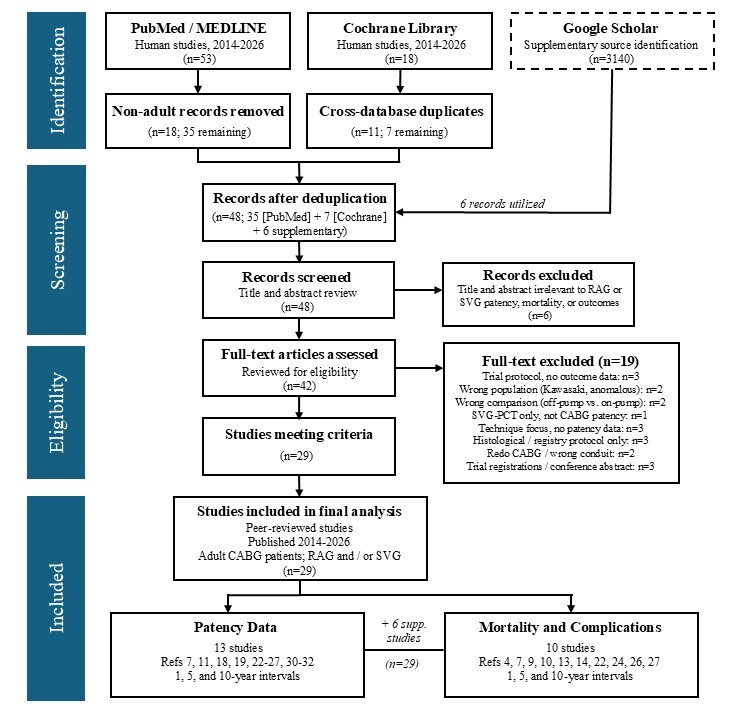
After completing the initial search strategy and excluding cross-database duplicattes, the following database-specific results were identified: PubMed/MEDLINE returned 35 records, Cochrane Library returned 7 records, and 6 additional records were identified through supplementary Google Scholar searching. Following the full-text eligibility assessment, 29 studies were included in the final analysis. Figure 1 below provides a PRISMA flow diagram that summarizes the search process. Identified patency rates and complication incidence were tabulated for both graft types (shown in Table 1). This consolidation of data allowed for the analysis of the key trends and differences between the statistical data of RAG and SVG.
Results
The results of this study assess the mean graft patency and mortality rates at 1, 5, and 10 years for RAG and SVG, as well as analyze their respective incidence of post-operative complications. As shown in Table 1, mean graft patency was calculated from several different sources.
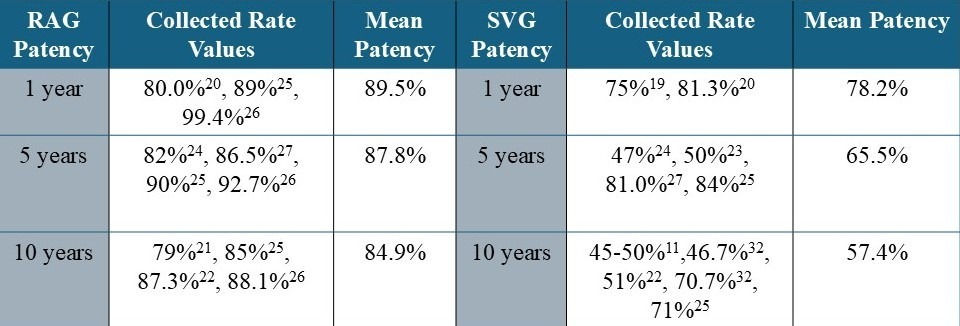
Patency rates were extracted from each study included in Table 1 and averaged with equal weighting at each time interval. No formal analysis was performed to weight the studies according to the sample sizes, representing a limitation of this analysis, with confidence intervals not computed around the means for simplicity. Notes on data sources: one pre-2014 reference (Ref 24) was retained for data completeness due to limited qualifying sources reporting SVG 5-year patency within the 2014-2026 search window. Ferrari et al. (Ref 33) reports a patency rate at a mean 8.4-year follow-up rather than a discrete estimate at 10 years; these values are placed in the 10-year column as the nearest interval. Hall and Brilakis (Ref 23) report approximately 50% SVG failure by 5-10 years, therefore the value is placed in the 5-year column as the upper limit of the range. Additionally, SVG patency data at the 1-year interval were limited among qualifying studies, with only two sources reporting discrete 1-year figures; this is acknowledged as a limitation. Caliskan et al. (Ref 11) report SVG 10-year failure of 45-50%; the midpoint of 47.5% is used in mean calculation.
RAG Demonstrates Superior Long-Term Patency Compared to SVG
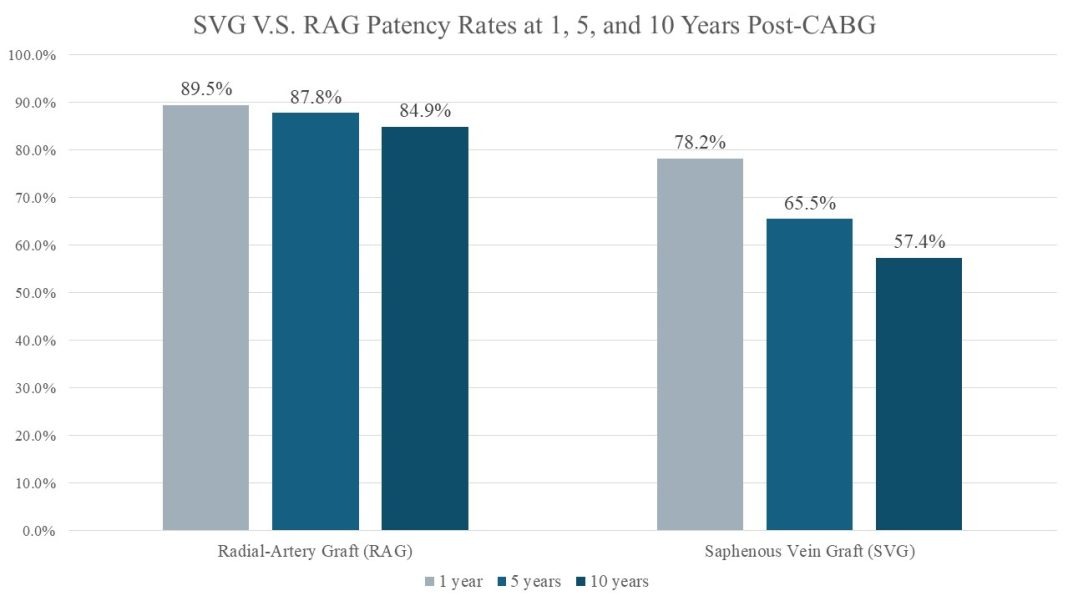
Though both grafts’ patency rates exhibit decreasing patency with time in Figure 2, RAG demonstrated consistent higher patency rates at each interval compared to SVG. Specifically, while RAG patency rates remained consistently above 80%, SVG’s declined from 78.2% to 57.4%. At the 10-year mark, SVG’s patency rate (57.4%) is barely above half of RAG’s patency rate (84.9%). However, it should be noted that because patency rates at each interval were derived from independent studies rather than a longitudinal follow-up of a single cohort, the decline across intervals should be interpreted as a cross-sectional trend across the literature rather than a confirmed trajectory. This approach was necessitated by the absence of studies uniformly reporting patency at all three intervals, resulting in a limitation that should be considered when interpreting the apparent progressive decline.
RAG Demonstrates Lower Long-Term Mortality Compared to SVG
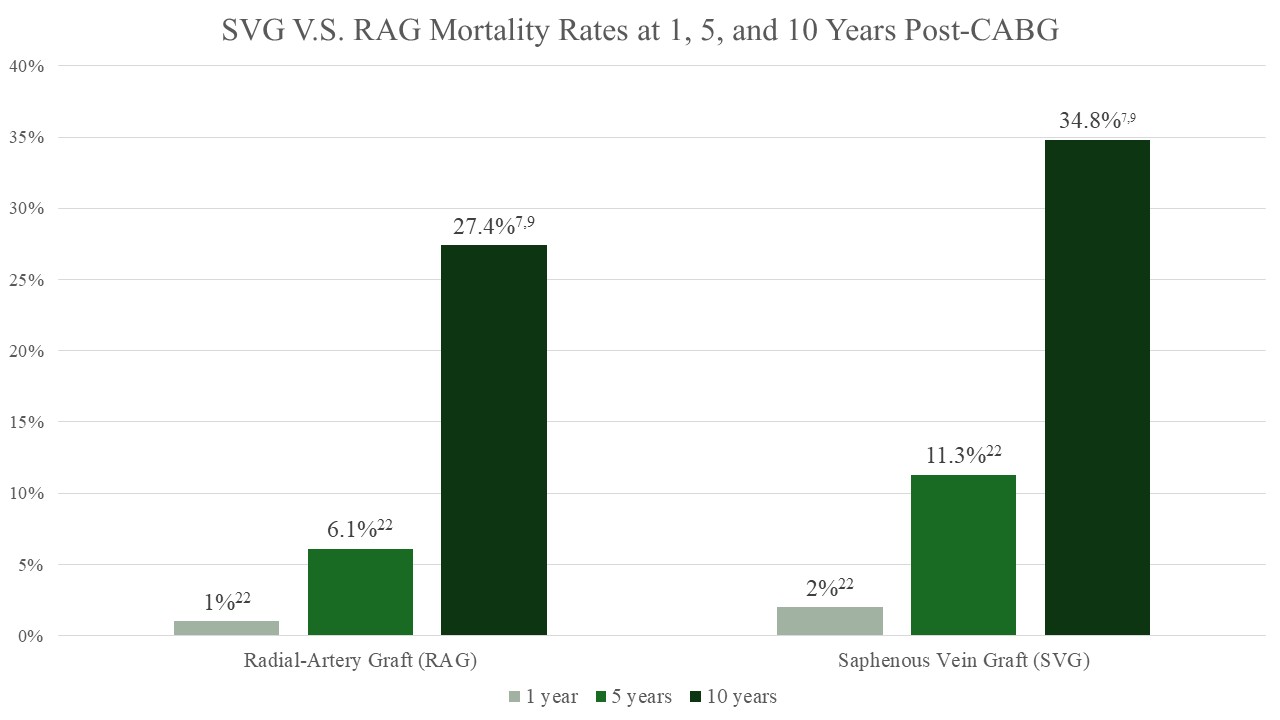
In Figure 3,the mortality rates post-CABG for both graft types progressively increase, with a large jump occurring after the fifth-year mark (from 6.1% to 27.4%, and 11.3% to 34.8%). For all intervals, RAG displayed lower mortality rates than SVG, supporting claims of its comparatively greater longevity and durability. However, at the earlier intervals (1 and 5), the difference between RAG and SVG mortality rates (the values being 1% and 2% respectively) is slight, possibly being the result of optimized perioperative management and short-term follow-ups. Additionally, the later increase at the 10-year mark may signify late-phase disease progression, perhaps atherosclerosis or graft failure. Although, it should be noted that this may reflect heterogeneity among included studies due to differences in patient selection and follow-up methodology, rather than solely representing disease progression.
Regarding the incidence of postoperative complications across the pooled studies, SVG displayed a 50% occlusion rate, whereas RAG showed a lower 42% occlusion rate14. While generally, these post-surgery complications were infrequent, RAG demonstrated a significantly lower rate of MACCE compared to SVG, with a hazard ratio of 0.784.
Discussion
This study provides an evaluative analysis of the mean graft patency rates at 1, 5, and 10 years, mortality rates, and incidence of post-operative complications of RAG and SVG post-CABG. Understanding the various trends of data between RAG and SVG allows for the improvement of surgical planning, allowing for the enhancement of graft longevity and patient survivability. Identifying the graft type that ensures optimal post-surgery outcomes and long-term durability is essential for improving patient outcomes and reducing reintervention, as graft failure remains one of the leading causes of adverse cardiac events following CABG.
Regarding the mean graft patency at each interval, this paper found that RAG demonstrated an overall higher patency rate than SVG. Though both graft types’ patency rates waned a little over time, RAG’s remained almost doubly above SVG’s, maintaining a consistent patency rate above 80% while SVG’s decreased from 78.2% to 57.4%. This signifies RAG’s greater durability and longevity, greatly contributing to a longer lifespan post-CABG while also holding true to previous studies noting RAG superior longevity8,38,39.
For mortality rates, this study found that the rates for both graft types increased over time, with RAG displaying overall lower rates throughout follow-up. The comparatively low rates in the year 1 and year 5 mark may reflect optimized post-surgery management as well as patient selection that tends to include healthier individuals, while the later increase likely correlates with late-phase disease progression. However, the mortality rates at these first two intervals appear insignificant, so it is challenging to state whether or not the grafts’ mortality rates differ greatly. Despite so, it is noteworthy to mention that the difference at the 10-year mark becomes more clinically meaningful, suggesting that RAG may demonstrate a survival advantage that compounds with time.
As stated across the pooled studies, post-surgical complications were low for both valve types; however, RAG demonstrated lower occlusion rates, lower MACCE, and a lower hazard ratio than SVG, consistent with data noting SVG’s higher correlation with post-operative complication in comparison to RAG40,7,41. Although, while the studies gathered via the searching process detail lower MACCE for RAG, other background studies have reported lower MACCE for SVG8,12. These discrepancies likely reflect patient skewedness or different follow-up periods. Taking this into consideration, further studies should prioritize and interpret data on graft performance in the context of patient comorbidities and long-term outcomes.
RAG demonstrates superior long-term patency and lower complication rates than SVG, supporting the preferential usage of RAG in CABG and highlighting its better optimality. This greater performance may be caused by its greater anatomical and technical function. Firstly, the radial artery possesses a thicker muscular wall and endothelium, helping resist atherosclerosis and intimal hyperplasia more effectively than the saphenous vein14. Second, hemodynamically, the radial artery is better suited to withstanding arterial pressures and laminal flow. Lastly, from a surgical perspective, RAG is typically joined to severely stenotic (narrow) coronary arteries, optimizing perfusion and minimizing competitive flow. Furthermore, to combat radial artery vasospasm, use of hydrophilic coated devices, spasmolytic agents, and transradial percutaneous coronary, interventions, have been developed and implemented14,42.
The study’s findings are also consistent with prior literature suggesting RAG may offer long-term durability advantages over SVG. A 2025 systematic review and meta-analysis of 139 studies involving 56,827 patients reported a mean RAG patency of 89% vs. 82% for SVG, and a 2026 retrospective cohort of 47,525 VA patients revealed similar trends43. Nonetheless, given the methodological limitations of the current analysis, definitive clinical recommendations cannot be drawn44. Therefore, individualized graft selection remains essential. By implementing careful surgical decision-making, patients can receive grafts best optimized and most suited for their specific conditions.
This study has several limitations. First, because of its design as a literature-based comparative analysis, it is subject to potential biases in the original research, including selection and publication bias. Second, the patients included in the current analysis may not represent the broader CABG population because of the selection bias affecting the original studies, and the grouping of rates across heterogeneous studies with different patient populations and follow-up durations limit the validity of comparisons. Specifically, the data in Figure 2 was based on the combination of multiple studies at each interval, so the decline may partly reflect differences in study design and patient selection rather than graft deterioration over time. Third, differences in post-surgical treatment, absence of risk-of-bias assessment, and equal weighting of studies regardless of sample size may misrepresent true effects. Lastly, patients selected for RAG tend to be younger and have less comorbidities than those for SVG, which may artificially favor RAG outcomes in observational data.
Collectively, the findings found in this study highlight the importance of individualized graft selection and surgical techniques to optimize CABG outcomes. The limitations of this study warrant further research with larger cohorts and systematic follow-ups to confirm these data trends, as standardized surgical techniques and harvesting methods are fundamental, preventing heterogeneity. Further considering patient comorbidities and intraoperative flow measurements in research may also help improve these personalized strategies, and carefully maintaining rigorous post-operative management may allow for the betterment of graft longevity and patient survivability.
Conclusion
Selecting the appropriate graft type in CABG plays a crucial role in determining patient outcome, surgical success rate, and survivability. This study aimed to compare the long-term patency, mortality, and postoperative complication incidence of RAG and SVG post-CABG, providing valuable insight on optimizing graft selection and determining the graft better suited to maintain high patient survivability and sustainable myocardial perfusion.
RAG demonstrated consistently higher mean patency rates and a lower complication incidence than SVG across the included studies, with the greatest difference in patency rates observed at the 10-year interval (89.5% vs. 57.4% respectively). Mortality differences were less consistent across time points, but RAG displayed a reduced mortality rate at each interval in comparison to SVG. These findings are consistent with the hypothesis that RAG offers greater advantages over SVG in long-term durability and possibly greater overall conditions relative to SVG, possibly caused by RAG’s arterial structures and physiological compatibility with coronary circulation.
The results of this research lend great support to the preferential use of RAG, strengthening the hypothesis that RAG is the superior graft type comparative to SVG. The findings suggest great benefit to emphasizing RAG’s role, perhaps implementing it as a standard approach to consider before greater optimization with a different kind of graft. However, it is important to recognize the immense value of individualized graft selection (catered to each patient), remaining most substantial method of decision as it accounts for person specificities. Therefore, while RAG is advantageous purely in its attributes, clinicians must be prepared to utilize multiple approaches side-by-side to enhance long-term patient survival. Alongside this, optimizing harvesting and anastomotic methods while consistently maintaining postoperative management would assist in preserving longevity. In this way, graft durability emerges as the result of sustained surgical decision-making, reinforcing the importance of combining graft choice with postoperative strategies to achieve proper surgical success in CABG.
References
- A.A. Ahmed. Coronary artery bypass procedures. Advanced Anesthesia Review. Pg. 307-C117.S8, 2023, https://doi.org/10.1093/med/9780197584521.003.0116. [↩] [↩]
- A. Alam, A. S. Rahyab. Coronary artery bypass grafting. Elsevier eBooks. Pg. 92–95, 2022, https://doi.org/10.1016/b978-0-323-79007-9.00020-9. [↩]
- L. Harik, K. R. An, A. Dimagli, R. Perezgrovas-Olaria, G. J. Soletti, J. Leith, M. Dell’Aquila, C. Rossi, G. Cancelli, M. Gaudino. Choice of conduit for coronary artery bypass grafting: technical, anatomic, and pharmacologic considerations. Vessel Plus. Vol. 7(30), 2023, https://doi.org/10.20517/2574-1209.2023.124. [↩] [↩] [↩] [↩]
- M. Gaudino, U. Benedetto, S. Fremes, G. Biondi-Zoccai, A. Sedrakyan, J. D. Puskas, G. D. Angelini, B. Buxton, G. Frati, D. L. Hare, P. Hayward, G. Nasso, N. Moat, M. Peric, K. J. Yoo, G. Speziale, L. N. Girardi, D. P. Taggart, RADIAL Investigators. Radial-artery or saphenous-vein grafts in coronary-artery bypass surgery. The New England Journal of Medicine. Vol. 378(22), pg. 2069–2077, 2018, https://doi.org/10.1056/NEJMoa1716026. [↩] [↩] [↩]
- D. Zheng, L. Zhang, M. D. Yang, J. Wu. Use of radial artery grafts for coronary artery bypass grafting. Heart Surgery Forum. Vol. 25(3), pg. 385-390, 2022, https://doi.org/10.1532/hsf.4697. [↩]
- M. Gaudino, U. Benedetto, S. Fremes, G. Biondi-Zoccai, A. Sedrakyan, J. D. Puskas, G. D. Angelini, B. Buxton, G. Frati, D. L. Hare, P. Hayward, G. Nasso, N. Moat, M. Peric, K. J. Yoo, G. Speziale, L. N. Girardi, D. P. Taggart, RADIAL Investigators. Radial-artery or saphenous-vein grafts in coronary-artery bypass surgery. The New England Journal of Medicine. Vol. 378(22), pg. 2069–2077, 2018, https://doi.org/10.1056/NEJMoa1716026. [↩]
- M. Gaudino, U. Benedetto, S. Fremes, K. Ballman, G. Biondi-Zoccai, A. Sedrakyan, G. Nasso, J. Raman, B. Buxton, P. A. Hayward, N. Moat, P. Collins, C. Webb, M. Peric, I. Petrovic, K. J. Yoo, I. Hameed, A. D. Franco, M. Moscarelli, G. Speziale, J. D. Puskas, L. N. Girardi, D. L. Hare, D. P. Taggart. Association of radial artery graft vs saphenous vein graft with long-term cardiovascular outcomes among patients undergoing coronary artery bypass grafting: a systematic review and meta-analysis. JAMA. Vol. 324(2): pg. 179–187, 2020, https://doi.org/10.1001/jama.2020.8228. [↩] [↩]
- S. Goldman, M. McCarren, G. K. Sethi, W. Holman, F.G. Bakaeen, T. H. Wagner, Y. Wang, M. C. Shih, R. Edson, CSP #474 Investigators. Long-term mortality follow-up of radial artery versus saphenous vein in coronary artery bypass grafting: a multicenter, randomized trial. Circulation. Vol. 146(17), pg. 1323–1325, 2022, https://doi.org/10.1161/CIRCULATIONAHA.122.062343. [↩] [↩] [↩] [↩]
- M. Gaudino, P. Tondi, U. Benedetto, V. Milazzo, R. Flore, F. Glieca, F. R. Ponziani, N. Luciani, L. N. Girardi, F. Crea, M. Massetti. Radial artery as a coronary artery bypass conduit: 20-year results. JACC. Vol. 68(6), pg. 603–610, 2016, https://doi.org/10.1016/j.jacc.2016.05.062. [↩]
- B. F. Buxton, P. A. Hayward, J. Raman, S. C. Moten, A. Rosalion, I. Gordon, S. Seevanayagam, G. Matalanis, U. Benedetto, M. Gaudino, D. L. Hare. Long-term results of the RAPCO trials. Circulation. Vol. 142(14), pg. 1330–1338, 2020, https://doi.org/10.1161/CIRCULATIONAHA.119.045427. [↩]
- H. Kasahara, H. Shin, T. Takahashi, S. Murata, M. Mori. Comparison of patency of single and sequential radial artery grafting in coronary artery bypass. Interactive Cardiovascular and Thoracic Surgery. Vol. 4(4), pg. 512–522, 2021,https://doi.org/10.1093/icvts/ivab279. [↩]
- J. A. Brown, E. Ashwat, S. W. Yousef, D. Ahmad, Y. Wang, F. Thoma, D. Serna-Gallegos, P. D. Yoon, D. West, D. Chu, J. Bonatti, D. Kaczorowski, I. Sultan. Outcomes of radial artery versus saphenous vein as a second conduit after coronary artery bypass grafting. American Journal of Cardiology. Vol. 214, pg. 33–39, 2024, https://doi.org/10.1016/j.amjcard.2023.12.047. [↩] [↩]
- J. A. Brown, E. Ashwat, S. W. Yousef, D. Ahmad, Y. Wang, F. Thoma, D. Serna-Gallegos, P. D. Yoon, D. West, D. Chu, J. Bonatti, D. Kaczorowski, I. Sultan. Outcomes of radial artery versus saphenous vein as a second conduit after coronary artery bypass grafting. American Journal of Cardiology. Vol. 214, pg. 33–39, 2024, https://doi.org/10.1016/j.amjcard.2023.12.047. [↩]
- M. Gaudino, S. Fremes, T. A. Schwann, J. Tatoulis, M. Wingo, R. F. Tranbaugh. Technical aspects of the use of the radial artery in coronary artery bypass surgery. The Annals of Thoracic Surgery. Vol. 108(2), pg. 613–622, 2018, https://doi.org/10.1016/j.athoracsur.2018.10.066. [↩] [↩] [↩] [↩]
- T. Fredericks, N. Nasher, C. D. Pritting, D. Rahimov, A. Saxena, P. Slota, D. Ahmad, N. Saran, J. Stulak, V. Tchantchaleishvili. Comparative estimation of long-term graft patency rates after isolated coronary artery bypass grafting: a systematic review and meta-analysis. Cardiology in Review. 2025, https://doi.org/10.1097/CRD.0000000000001091. [↩]
- A. A. Kolkailah, F. R. Del Val, T. Kaneko, S. F. Aranki. Coronary artery bypass graft. Humana Press, Cham. Pg. 291–310, 2019, https://doi.org/10.1007/978-3-319-97622-8_14. [↩]
- S. Raza, C. Chang, S. V. Deo, J. F. Sabik. Current role of saphenous vein graft in coronary artery bypass grafting. Indian journal of thoracic and cardiovascular surgery. Vol. 34(3), pg. 245–250, 2018, https://doi.org/10.1007/s12055-018-0759-3. [↩]
- E. C. Ghandakly, A. Tipton, F. G. Bakaeen. Pathophysiology and management of saphenous vein graft disease. Expert Review of Cardiovascular Therapy. Vol. 21(8), pg. 565–572, 2023, https://doi.org/10.1080/14779072.2023.2233420. [↩]
- E. Caliskan, D. R. de Souza, A. Böning, O. J. Liakopoulos, Y. H. Choi, J. Pepper, C. M. Gibson, L. P. Perrault, R. K. Wolf, K. B. Kim, M. Y. Emmert. Saphenous vein grafts in contemporary coronary artery bypass graft surgery. Nature Reviews Cardiology. Vol. 17(3), pg. 155–169, 2020, https://doi.org/10.1038/S41569-019-0249-3. [↩]
- G. Adnan, S. Yandrapalli. Radial artery coronary bypass. StatPearls. 2024, https://pubmed.ncbi.nlm.nih.gov/33085397/. [↩]
- E. Caliskan, D. Ramos R. de Souza, A. Böning, O. J. Liakopoulos, Y. H. Choi, J. Pepper, C. M. Gibson, L. P. Perrault, R. K. Wolf, K. B. Kim, M. Y. Emmert. Saphenous vein grafts in contemporary coronary artery bypass graft surgery. Nature Reviews Cardiology. Vol. 17(3), pg. 155–169, 2020,. https://doi.org/10.1038/S41569-019-0249-3. [↩] [↩]
- D. Vervoort, A. Malik, S. E. Fremes. The evolving evidence base for coronary artery bypass grafting and arterial grafting in 2021: how to improve vein graft patency. JTCVS Techniques. Vol. 10, pg. 102–109, 2021, https://doi.org/10.1016/J.XJTC.2021.09.038. [↩]
- D. Vervoort, A. Malik, S. E. Fremes. The evolving evidence base for coronary artery bypass grafting and arterial grafting in 2021: how to improve vein graft patency. JTCVS Techniques. Vol. 10, pg. 102–109, 2021, https://doi.org/10.1016/J.XJTC.2021.09.038. [↩]
- G. Garofalo, C. Olevano, E. L. Santaniello, F. Numis, M. Miele, S. Colucci, A. Nappi, G. Rispo, A. Mollo, B. Fiorani. External stenting for saphenous vein grafts in coronary artery bypass grafting: a single-center experience. Journal of Cardiovascular Medicine. Vol. 25(1), e22, 2024, https://doi.org/10.2459/01.jcm.0001096364.07694.70. [↩]
- Y. Emmert, J. Bonatti, E. Caliskan, M. Gaudino, M. Grabenwöger, M. T. Grapow, P. P. Heinisch, T. Kieser-Prieur, K. B. Kim, A. Kiss, F. Mouriquhe, M. Mach, A. Margariti, J. Pepper, L. P. Perrault, B. K. Podesser, J. Puskas, D. P. Taggart, O. P. Yadav, B. Winkler. Consensus statement—graft treatment in cardiovascular bypass graft surgery. Frontiers in Cardiovascular Medicine. Vol. 11, 2024, https://doi.org/10.3389/fcvm.2024.1285685. [↩]
- E. Caliskan, D. R. de Souza, A. Böning, O. J. Liakopoulos, Y. H. Choi, J. Pepper, C. M. Gibson, L. P. Perrault, R. K. Wolf, K. B. Kim, M. Y. Emmert. Saphenous vein grafts in contemporary coronary artery bypass graft surgery. Nature Reviews Cardiology. Vol. 17(3), pg. 155–169, 2020, https://doi.org/10.1038/S41569-019-0249-3. [↩]
- J. Tatoulis. Total and multiple arterial revascularization. Springer, Cham. pg. 207–217, 2020, https://doi.org/10.1007/978-3-030-24174-2_22. [↩]
- Y. Liu, K. Qin, J. Zhu, H. Yao, Z. Wang, M. Zhou, X. Ye, H. Li, J. Qiu, Y. Zhu, Q. Zhao. Radial artery graft in coronary artery bypass surgery 1 week to 1 year postoperation,Journal of Thoracic Disease. Vol. 15(12), pg. 6408–6418, 2023, https://doi.org/10.21037/jtd-23-574. [↩]
- M. Dreifaldt, J. D. Mannion, H. Geijer, M. Lidén, L. Bodin, D. Souza. The no-touch saphenous vein is an excellent alternative conduit to the radial artery 8 years after coronary artery bypass grafting: a randomized trial. The Journal of Thoracic and Cardiovascular Surgery. Vol. 161(2), pg. 624–630, 2019, https://doi.org/10.1016/j.jtcvs.2019.09.177. [↩]
- D. Nezic. Radial artery versus saphenous vein graft for coronary artery bypass grafting -long-term outcomes. European Journal of Cardio-Thoracic Surgery. Vol. 62(2), 2022, https://doi.org/10.1093/ejcts/ezac371. [↩]
- A. B. Hall, E. S. Brilakis. Saphenous vein graft failure: seeing the bigger picture. Journal of Thoracic Disease. Vol. 11(9), 2019, https://doi.org/10.21037/JTD.2019.03.09. [↩]
- R. F. Tranbaugh, K. R. Dimitrova, P. Friedmann, C. M. Geller, L. J. Harris, P. Stelzer, B. M. Cohen, W. Ko, H. DeCastro, D. Lucido, D. M. Hoffman. Coronary artery bypass grafting using the radial artery clinical outcomes, patency, and need for reintervention. Circulation. Vol. 126(11, supplement 1), 2012, https://doi.org/10.1161/CIRCULATIONAHA.111.083048. [↩] [↩]
- B. F. Buxton, P. A. Hayward, J. Raman, S. C. Moten, A. Rosalion, I. Gordon, S. Seevanayagam, G. Matalanis, U. Benedetto, M. Gaudino, D. L. Hare. Long-term results of the RAPCO trials. Circulation. Vol. 142(14), pg. 1330–1338, 2020, https://doi.org/10.1161/CIRCULATIONAHA.119.045427. [↩] [↩]
- H. Kasahara, H. Shin, T. Takahashi, S. Murata, M. Mori. Comparison of patency of single and sequential radial artery grafting in coronary artery bypass. Interactive Cardiovascular and Thoracic Surgery. Vol. 4(4), pg. 512–522, 2021, https://doi.org/10.1093/icvts/ivab279. [↩]
- M. Hosono, T. Murakami, H. Hirai, Y. Sasaki, S. Suehiro, T. Shibata. The risk factor analysis for the late graft failure of radial artery graft in coronary artery bypass grafting. Annals of Thoracic and Cardiovascular Surgery. Vol. 25(1), pg. 32–38, 2019, https://doi.org/10.5761/atcs.oa.18-00054. [↩]
- G. Ferrari, R. Loayza, A. Azari, H. Geijer, Y. Cao, R. Carlsson, L. Bojö, N. Samano, D. Souza. Superior long-term patency of no-touch vein graft compared to conventional vein grafts in over 1500 consecutive patients. Journal of Cardiothoracic Surgery. Vol. 19, 570, 2024, https://doi.org/10.1186/s13019-024-03057-3. [↩]
- S. Goldman, M. McCarren, G. K. Sethi, W. Holman, F.G. Bakaeen, T. H. Wagner, Y. Wang, M. C. Shih, R. Edson, CSP #474 Investigators. Long-term mortality follow-up of radial artery versus saphenous vein in coronary artery bypass grafting: a multicenter, randomized trial. Circulation. Vol. 146(17), pg. 1323–1325, 2022, https://doi.org/10.1161/CIRCULATIONAHA.122.062343. [↩]
- M. Yamasaki, S. Deb, H. Tsubata, F. Moussa, A. Kiss, E. A. Cohen, S. Radhakrishnan, J. Dubbin, D. Ko, L. Schwartz, S. E. Fremes. Comparison of radial artery and saphenous vein graft stenosis more than 5 years after coronary artery bypass grafting. The Annals of Thoracic Surgery. Vol. 102(3), pg. 712–719, 2016, https://doi.org/10.1016/j.athoracsur.2016.02.107. [↩]
- E. Ruttmann, M. Dietl, G. Feuchtner, B. Metzler, N. Bonoras, D. P. Taggart, M, Gaudino, H. Ulmer. Long-term clinical outcome and graft patency of radial artery and saphenous vein grafts in multiple arterial revascularization. The Journal of Thoracic and Cardiovascular Surgery. Vol. 158(2), pg. 442–450, 2018, https://doi.org/10.1016/j.jtcvs.2018.10.135. [↩]
- M. Gaudino, U. Benedetto, S. Fremes, G. Biondi-Zoccai, A. Sedrakyan, J. D. Puskas, G. D. Angelini, B. Buxton, G. Frati, D. L. Hare, P. Hayward, G. Nasso, N. Moat, M. Peric, K. J. Yoo, G. Speziale, L. N. Girardi, D. P. Taggart, RADIAL Investigators. Radial-artery or saphenous-vein grafts in coronary-artery bypass surgery. The New England Journal of Medicine. Vol. 378(22), pg. 2069–2077, 2018, https://doi.org/10.1056/NEJMoa1716026. [↩]
- M. Gaudino, S. Fremes, T. A. Schwann, J. Tatoulis, M. Wingo, R. F. Tranbaugh. Technical aspects of the use of the radial artery in coronary artery bypass surgery. The Annals of Thoracic Surgery. Vol. 108(2), pg. 613–622, 2018, https://doi.org/10.1016/j.athoracsur.2018.10.066. [↩]
- M. Chyrchel, J. Roczniak, A. Surdacki. Radial artery spasms impair invasive cardiological procedures’ performance: a pharmacological approach to prevention and treatment. Journal of Physiology and Pharmacology. Vol. 74(6), 2023, https://doi.org/10.26402/jpp.2023.6.02. [↩]
- L. Volk, L. Cornwell, O. Pajaro, P. Kolodziejski, J. Wisnowski, A. Walder, A. B. Schutz. Arterial graft choice and outcomes within the Veterans Administration: a 20-year review of 47,525 patients. The Journal of Thoracic and Cardiovascular Surgery. Vol. 171(4), pg. 936–943, 2025, https://doi.org/10.1016/j.jtcvs.2025.09.055 [↩]
- K. M. Patel, R. G. Desai, S. Krishnan. Conduit choice in coronary artery bypass grafting: insights from an expert systematic review endorsed by the european association for cardio-thoracic surgery and the society of thoracic surgeons. Journal of Cardiothoracic and Vascular Anesthesia. Vol. 38(3), pg. 604–607, 2023, https://doi.org/10.1053/j.jvca.2023.12.010. [↩]