Abstract
This paper investigates the degree to which online avatar creation tools reinforce idealized Western beauty standards by generating avatar representations closer to those ideals than the user’s actual appearance. It also explores whether this leads individuals to attempt to present an idealized version of themselves while also wishing to represent themselves authentically. A tension known as the Authentic Idealization paradox. Using Schmid’s facial beauty measurement framework to assess alignment with Western beauty standards (encoded in the Golden Ratio), avatar representations are compared to photographic representations of 30 individuals to assess whether creation tools modify appearances to more closely align with those standards. To assess user perceptions of avatars and their perceived impact on online social interactions, a global survey (n=136) was conducted and analyzed. This research reveals that avatars do align more closely with idealized Western beauty norms than photographs of the corresponding individual (26% closer to those norms across the 6 Schmid measurements), with female avatar representations exhibiting 30% higher levels of conformance than males. The research shows that despite a large majority of survey respondents (85%) reporting a preference for avatars resembling their true selves, the Authentic Idealization paradox emerges with users unconsciously conforming to Western ideals with 55% believing that avatars’ faces are more attractive than the person’s actual face. This research also reveals that users do not believe that their use of Avatar creation tools leads to authentic representations, and they would like additional options to help improve that authenticity. Given the importance of these representations in an increasing number of online social interactions, it is important that the designers of these tools address user needs and integrate more features supporting greater diversity.
Keywords: Avatar customization, Digital self-representation, Beauty standards in virtual environment, Inclusive avatar design, Authentic Idealization paradox
Introduction
In an increasingly digital world, avatars have emerged as tools for self-representation, shaping how individuals communicate and interact in online spaces. Developments in technology over the last ten years have transformed avatars from simple representations to now reflecting complex entities1. In an increasing number of contexts from virtual meetings and gaming platforms to social media and educational environments, avatars now offer users an opportunity to create and customize their digital identity to reflect their personality, preferences and cultural nuances as well as their physical appearance2. More recently the integration of artificial intelligence and deep learning has allowed for the development of lifelike avatars that closely resemble the user3. These changes aim to enhance the user experience and facilitate social interaction.
Facial representation with avatars and their effects have become a focus of research: Avatars that mirror a user’s characteristics can enhance comfort and reduce self-consciousness during digital interactions4. Avatars capable of reflecting user’s emotional states can promote more authentic interactions and strengthen interpersonal connections5. The reverse can also be true and Avatars can contribute to psychological challenges, including body dissatisfaction and negative self-perception6.
Firstly, avatar creation tools may reinforce conformance to facial beauty based on established Western norms and unintentionally perpetuate biases by favoring certain features and cultures7,8 While there is a basis in research for a connection between facial feature symmetry and assessments of attractiveness, beauty standards rooted in Western constructs like the Golden Ratio, which capture both symmetry and a set of relative facial propositions, are generally considered not to be universal9,10.
Secondly, avatar creation tools may also inadvertently exclude options for diverse facial features, limiting self-representation and reinforcing narrow definitions of beauty11,12 and may marginalize users with diverse facial features and body types13.
These are not abstract concerns: Individuals often engage in impression management through their avatars, striving to present an idealized version of themselves that aligns with prevailing beauty standards and the process of customizing avatars allows users to negotiate their identities and express their self-concept14. This is known as the Authentic Idealization paradox: the tension between the need to comply with beauty standards and the need to represent yourself authentically online15.
The psychological implications of this can be impactful according to Higgins’ Self-Discrepancy Theory because discrepancies between one’s actual and ideal self-representations can lead to negative emotional outcomes such as anxiety and depression16. Therefore, avatar creation tools that fail to provide inclusive options often increase such discrepancies which may further contribute to dissatisfaction and diminished self-worth. The Self-Schema Theory also hypothesizes that avatars serve as extensions of an individual’s self-concept, and the inability to align avatars with diverse identities where greater options paradoxically result in lower satisfaction10.
The impact of these discrepancies also extends beyond individual users, influencing broader online social dynamics. It has been found that users measurably modify their behaviors to make them consistent with the appearance of their avatar (referred to as the Proteus effect)17.
This paper investigates the degree to which avatar creation tools reinforce Western beauty standards by increasing conformance with the Golden Ratio in generated avatars. Having investigated this, the research also assesses the degree to which these tools alleviate or exacerbate the Authentic Idealization paradox. Finally, user interest in additional options in avatar creations tools to reduce the paradox is also assessed.
To assess the degree to which avatars increase conformance with the Golden Ratio, the research compares avatar representations and photographs of the corresponding individuals using 6 Golden Ratio derived facial measurements (figure 1)18.
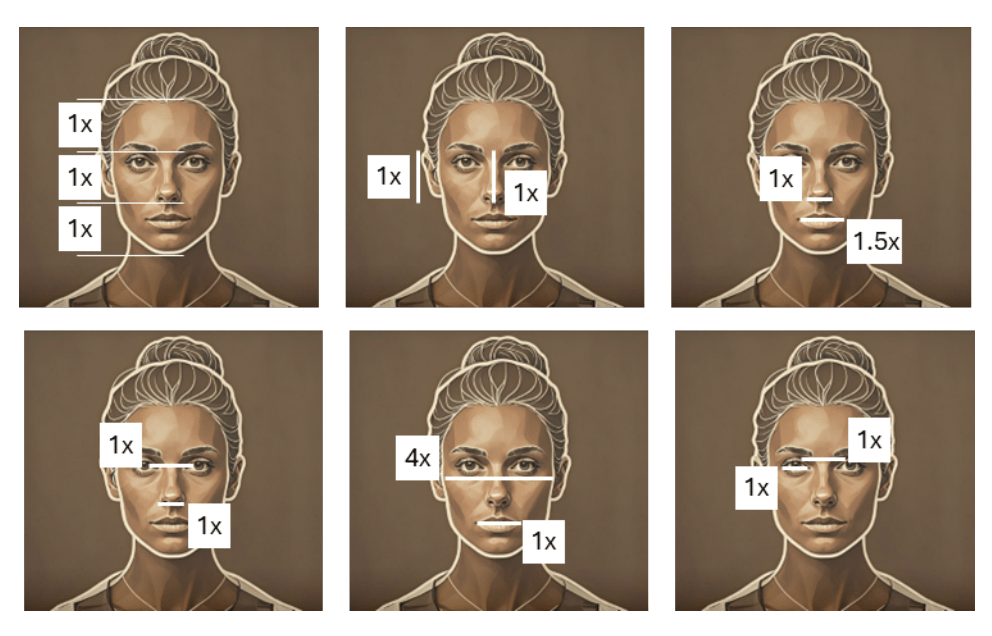
The research then explores how users experience this conformance, how they perceive it impacts their own and others online experiences and social interactions (the Proteus effect) as well as engagement with and influence of current avatar creation tools. Finally, the research explores satisfaction with current customization options in these tools and interest in additional options to enable more inclusive and authentication representation in order to reduce the intensity of the Authentic Idealization paradox) .
Methods
Assessing conformance to Western beauty standards of avatars and corresponding photographic representations of individuals
A sample of 30 pairs of photographs and avatars was used. Each face was assessed using Schmid’s beauty measurement framework, which includes ratios related to symmetry and proportions (Table 1). Photographs were sourced from friends and family of the author with avatars collected from social media sites with the participants’ permission. For each photograph and its corresponding avatar, a score was calculated: First the Golden Ratio measurements were calculated for each photo/avatar pair and then the ratio of these two measurements was calculated to determine if the avatar increased, replicated or reduced the distance of the person from the perfect ratios.
| Measures | Description |
| 1 | Forehead height = nose length = lower face height |
| 2 | Nose length = ear length |
| 3 | Interocular distance = Nose width |
| 4 | Interocular distance = right or left eye fissure width |
| 5 | Mouth width = 1.5 * nose width |
| 6 | Face width = 4 * nose width |
The following steps were followed to calculate the score for each pair:
- Individual measure deviation score: To calculate the degree of deviation for each of Schmidt’s measures, the difference between each ratio and the ideal beauty standard was calculated for both the photograph and the corresponding avatar. This was calculated using the standard deviation of the weighted dimensions divided by the average of those weighted dimensions. For example, for measurement 5, the formula is:
(1) 
- Measure specific deviation ratios: The ratio of deviation scores for each measure was calculated (deviation for avatar/deviation for photograph) and expressed as a percentage. A ratio of less than 100% indicates that the avatar is closer to the Golden Ratio beauty standard than the photograph of the individual for that measure, while a ratio of greater than 100% indicates greater divergence from the beauty standard than the photograph for that measure.
- Average deviation ratio: The average of the set of deviation ratios was calculated as an estimate the degree to which the avatar is closer or further away than the photograph from the Golden Ratio defined beauty standards.
- Relative reduction: The difference in deviation ratio for the photograph and the deviation for the avatar was calculated for each ratio and overall and expressed as a relative percentage reduction of the deviation ratio of the photograph. For example, if the deviation ratio for the photograph was 50% and the deviation ratio for the avatar was 25%, this would be a 50% relative reduction.
Finally, averages were calculated across all pairs as well as by reported gender.
Survey
Survey Design and distribution
The survey was designed to capture reported behaviors and perceptions related to creation and interactions with avatars as well as interest in additional creation options. The complete survey is available upon request from the author. The survey employed a combination of question formats including multiple choice (select all that apply) questions with predefined options, Likert-scale rating questions, and open-ended questions.
The survey consisted of 20 items including:
- A filtering question
- ‘Q: Do you have an avatar? (Eg: Bitmoji, Memoji, Oculus) A: Y; N; Don’t know’
- Demographic details (age, gender, region)
- Eg ‘Q: How do you identify? A: male; female; non-binary; other’
- Frequency of avatar updates and time spent on customization.
- Eg ‘Q: How long did it take for you to build your avatar’s face? A: < 5 minutes; between 5 and 10 minutes; between 10 and 15 minutes; between 15 and 20 minutes; more than 20 minutes; other’
- Perceptions of avatar attractiveness relative to real faces.
- Eg ‘Q: Do you think in general that a person’s avatar’s face tends to be more attractive than the person’s actual face? A: 1-5 scale from much less attractive to much more attractive’
- Desired improvements in avatar creation tools.
- Eg ‘Q: Did you feel there were enough options available to you when creating your avatars face? A: yes; no; other’
- Influence of avatars on online communication dynamics.
- Eg ‘Q: Do you feel people judge you based on your avatar’s face? A: 1 -5 scale from absolutely not to completely’
Before commencing the survey, each respondent was informed (a) that they were participating in a study (b) that their responses would be analyzed but individual responses would remain confidential. No compensation was provided to any of the participants.
The survey was coded using google forms and participants recruited using Snapchat and Instagram to maximize reach among younger users.
Participants
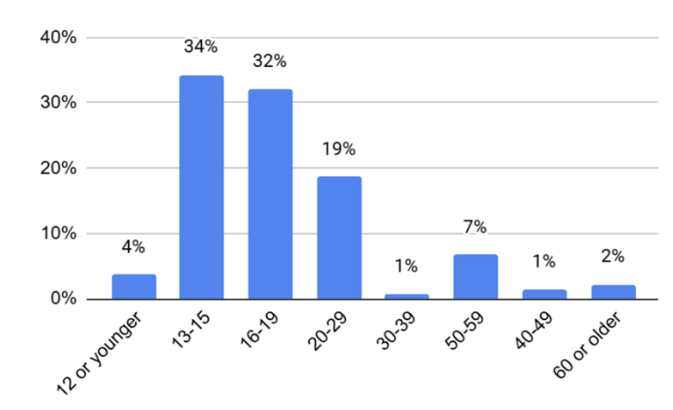
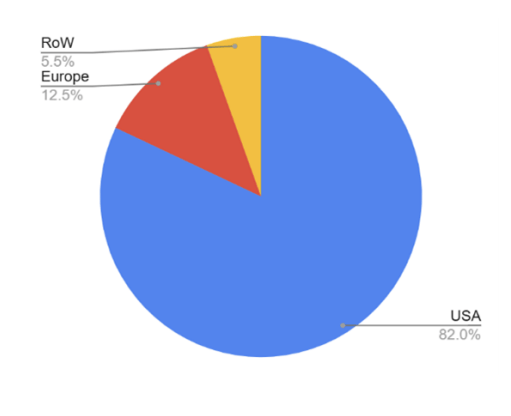
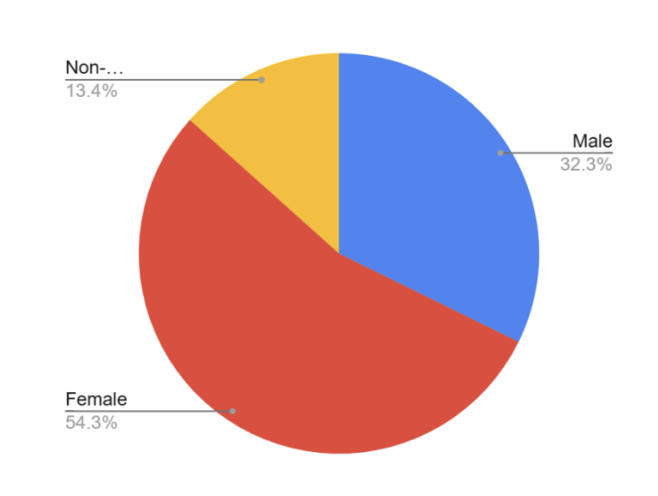
136 participants completed the survey. A majority of respondents were female (54%), 66% were between 13-19 years and 82% were from the United States of America (figure 2, figure 3). However, respondents were diverse, with nearly every race/age group represented across most regions including Europe, the Middle East, and South/Central America, ensuring a mix of cultural backgrounds.
Data Analysis
Frequency analysis was conducted on the set of responses at the overall sample level as well as by gender and age. Confidence Intervals were calculated to determine statistical significance of any differences identified and these are displayed on the bar charts included in this paper. The confidence intervals at a 95% significance level for responses to individual questions were calculated based on the sample size for that question and the proportion of respondents selecting each answer using an online calculator19.
Results
Assessment of degree to which avatar representation reinforces Western beauty standards
The comparison of avatars and photographs using Schmid’s measures is summarized in Table 2. A relative reduction in average deviation greater than 0% was recorded and interpreted to mean that the created avatars are closer to the beauty standard than the photograph. This may be due to a bias in the tool, or conscious or unconscious bias introduced by the person using the tool or a combination of these two factors.
| Schmid Measurement | Photograph: Deviation (%) | Avatar: Deviation (%) | Relative reduction (%) |
| Forehead height = Nose length = Lower face height | 21% | 14% | 34% |
| Nose length = Ear length | 11% | 11% | 1% |
| Interocular distance = Nose width | 9% | 6% | 28% |
| Interocular distance = Right or Left Eye Fissure Width | 13% | 11% | 16% |
| Mouth width = 1.5x Nose width | 9% | 9% | 2% |
| Face width = 4x Nose widt2 | 12% | 6% | 53% |
| Average Deviation | 13% | 9% | 26% |
The average deviation from the Gold Ratio standard among avatar representations was measured to be 9% which is 26% less than the average deviation from the standard of the photographs (measured to be 13%). This supports the conclusion that the avatars do indeed increase conformance to Western beauty standards encoded in the Golden Ratio.
When comparing the degree of deviation between avatars and photographs by gender, the results revealed that for females there was a larger overall increase in Schmid measures between avatar and photograph compared to males: Overall there was 30% relative reduction in deviation for females and 23% for males between avatars and photographs translating into a 7% higher reduction in deviation for females compared to males. Therefore, this research finds evidence that the effect is greater among females.
Results from online survey
Perceptions of avatar facial attractiveness and impact on communication
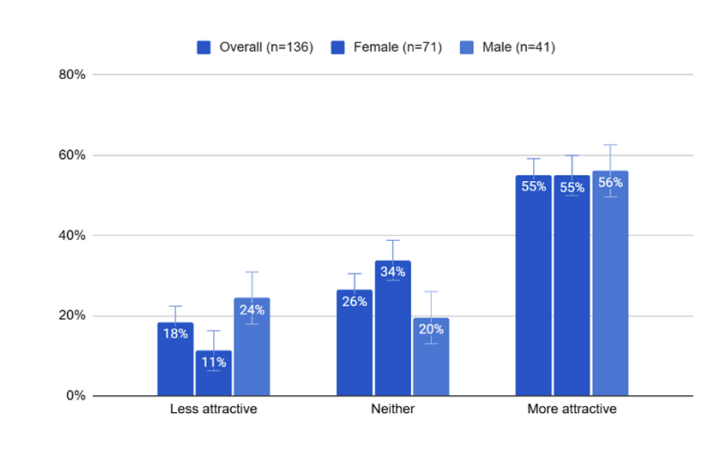
The perceived discrepancy between avatar facial representation and the person was found to align with the findings of the Schmid measurement analysis: Avatars are perceived as more attractive than their human counterparts by 55% of survey respondents (figure 4) including 19% who believed that avatars where much more attractive. Males were significantly less likely than females to state that avatars were less attractive (11% vs 24%, p=0.04 usinga two-proportion z-test) with fewer males neutral than females.
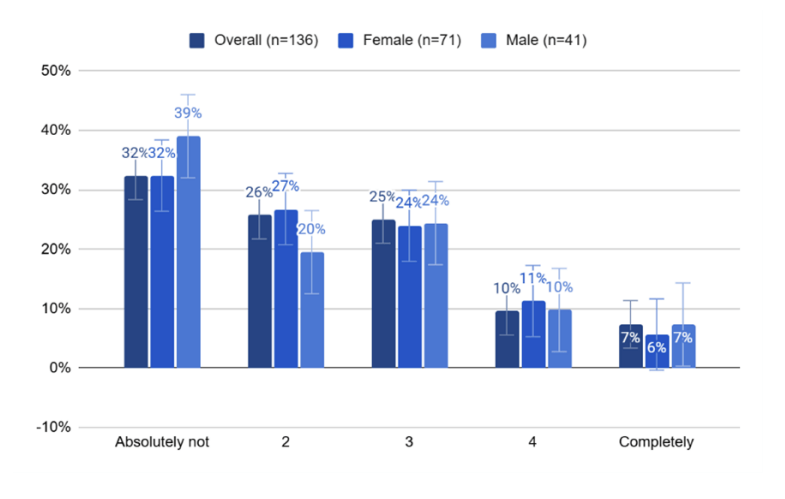
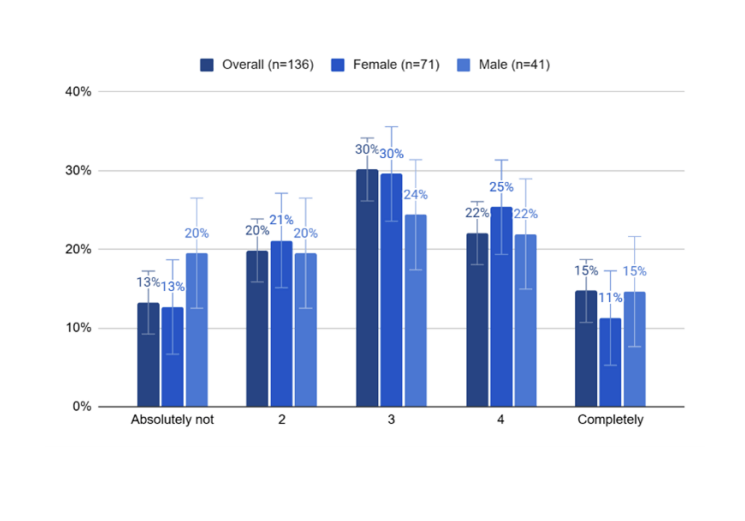
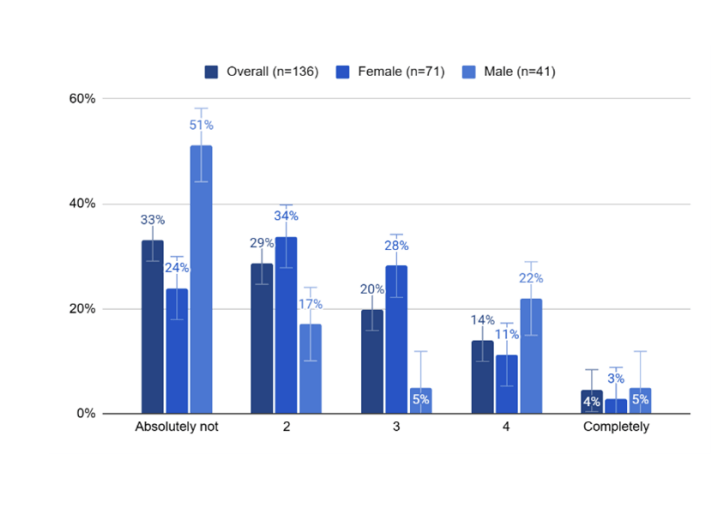
The survey also explored perceived evidence of the Proteus effect: the degree to which avatar’s facial attractiveness impacted online communication. When asked about their own communication, 32% of respondents reported “Absolutely not” while 7% reported “Completely” (figure 5). However, when asked about others’ communication, 13% of respondents believed the facial attractiveness of avatars had “absolutely not” affected how others interacted with them with 15% reported “Completely” (figure 6).
These statistically significant differences (p<0.05) between perceptions of the impact on their own compared to the impact on the behaviors of others is an example of illusory superiority bias which describes when people over-estimate their qualities compared to others17. While the existence of the Proteus effect has been well established in studies of actual behavior, this research suggests that there is mixed awareness of this effect online and low self-awareness of its impact on their own behavior20.
Participants were also asked about their beliefs around whether others judged them based on their avatar. Most respondents felt there was “Absolutely no judgment” or “A little judgment” (figure 7) .
The role of social pressures in avatar creation
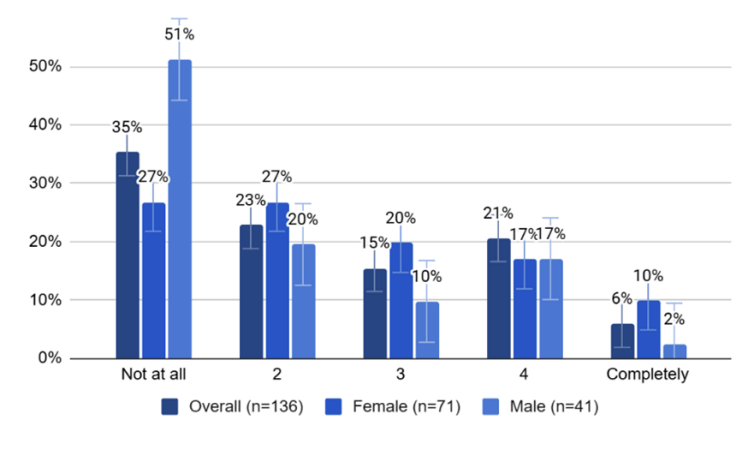
The Authentic Idealization paradox relates to the competing needs to conform to societal beauty standards and to authentically represent themselves through their avatar. The analysis of the survey results found that social pressure was a perceived factor for only a minority of respondents with 58% of respondents stating that the opinion of others has little or no impact on their avatar creation efforts (figure 8) with male respondents much more likely to report no social pressure (51%) compared females (27%). Similarly, 10% of females stated that the opinions of others completely affected how they created their avatar perhaps reflecting the greater social pressures associated with female appearance even in the digital world.
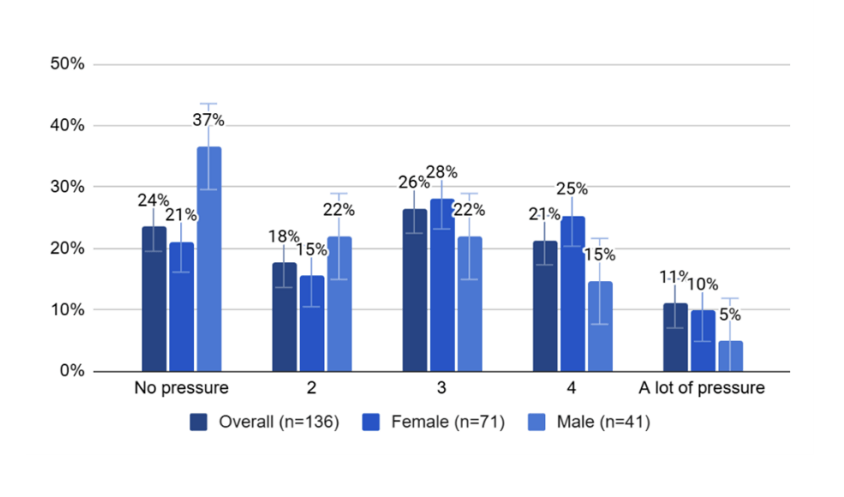
However, when asked if they felt pressures to make avatar appear more flawless compared to actual facial appearance, fewer reporting no pressure (24%) compared to the 35% who reported no effect of the opinion of others (figure 9). While the responses to the two questions were moderately corelated (Pearson product correlation score of 0.48), this suggests a more nuanced implicit pressure to conform to others’ expectations.
Desired similarity between avatar and respondent
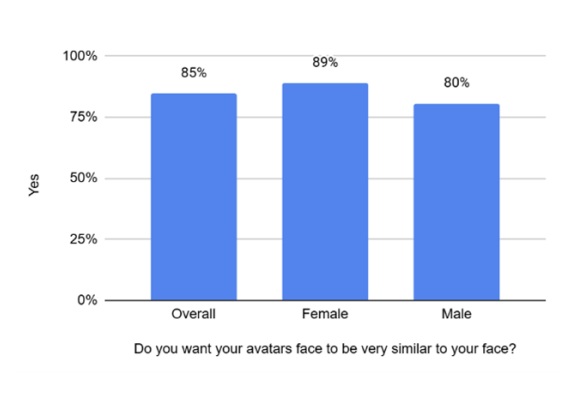
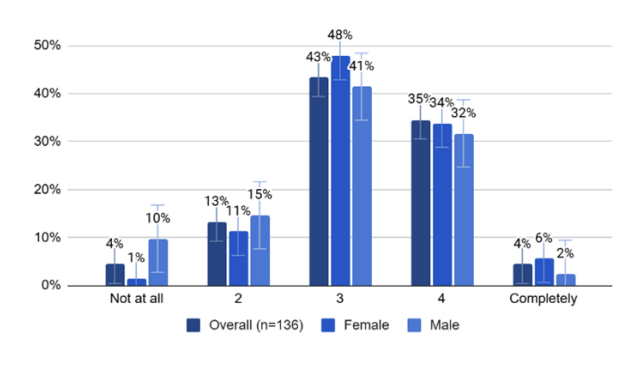
The second component of the Authentic Idealization paradox is the need to authentically represent yourself in your avatar. While respondents believed that avatars tend to be more attractive than the individual they are representing (figure 4), they recognized that this is at the cost of authenticity with only 4% believing that their avatar completely resembles their own facial features with little variation between male and female respondents. This is not aligned with their reported wish to achieve authentic representation through their avatar with 85% stating that they wanted their avatar’s face to resemble their own(figure 10).
User investment in creating and maintaining avatars
While the Authentic Idealization paradox appears to be present, this could reflect lack of engagement in the process of avatar creation rather than issues with the creation tools. The research approached this question by assessing the effort applied to create and update the avatar. Age is a significant factor in the adoption of digital technology with older adults typically adopting technology more slowly21. Therefore, to explore that dimension the analysis of this topic included consideration of the respondents’ age.
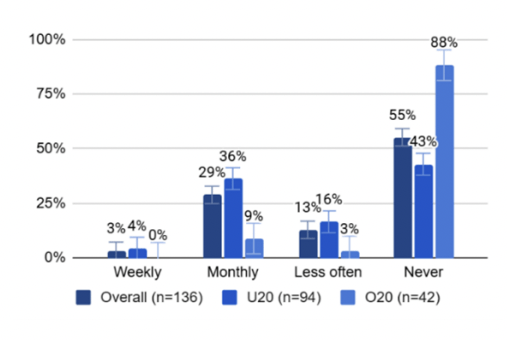
While a majority of respondents (55%) do not update their avatars, this varies significantly by age group with 43% of those under 20 years old reporting never updating their avatars compared to 88% of those over 20 (figure 11). Reflecting this greater engagement among younger respondents, 50% of those under 20 reported updating their avatar at least monthly compared to only 9% of those over 20.
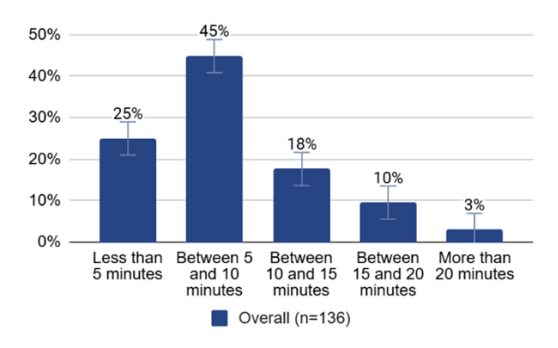
The most common amount of time spent on customizing their avatar’s face was between 5 and 10 minutes (45%) with those over 20 reporting that they spend less time with 33% spending less than 5 minutes compared to only 21% of those under 20 (figure 12). It is also noticeable that a small proportion (7%) of over 20 spent over 20 minutes (the highest category). While the survey did not investigate this issue in more depth, it may reflect usability issues with the current tools as used by adults, greater identity investment or creative engagement.
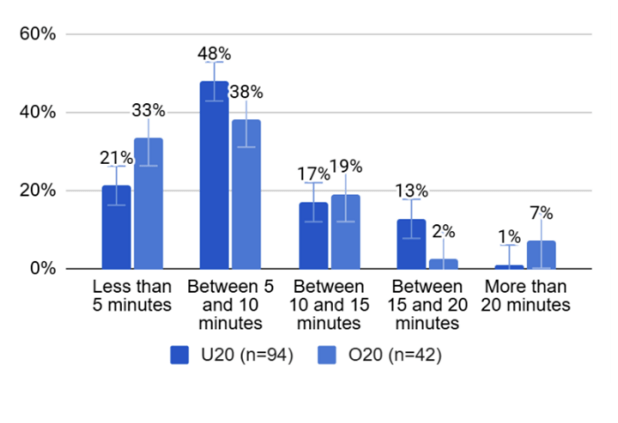
While the authors were not able to identify benchmarks to compare against, the data suggests that for many under 20, curating their avatar is a regular activity into which significant time is invested which may reflect the importance of their avatar representation. The evidence is less clear among respondents over 20 when measured by frequency of updating of the avatar although the time taken to complete the initial creation is similar to that invested by those under 20. Desired improvements in the tool
This research found that people do wish to more authentically represent themselves while also feeling pressure to conform to beauty standards while using avatar creation tools (the Authentic Idealization paradox). To better understand how users would like the tools to change, the survey also explored user interest in tool improvements to help address this paradox.
Most respondents stated a desire for their avatar to be very similar to their own (85%) but a majority of respondents did not feel that there are enough facial options in the creation tools (54%) (Table 3).
| % Yes | %No | |
| Do you want your avatars face to be very similar to your face? | 85% | 15% |
| Did you feel there were enough options available to you when creating your avatars face? | 46% | 54% |
The most common reasons for requesting more options were (figure 13):
- A desire for avatars to resemble their individuality (77%)
- Inclusivity in facial features (62%)
- Better self-expression (56%)
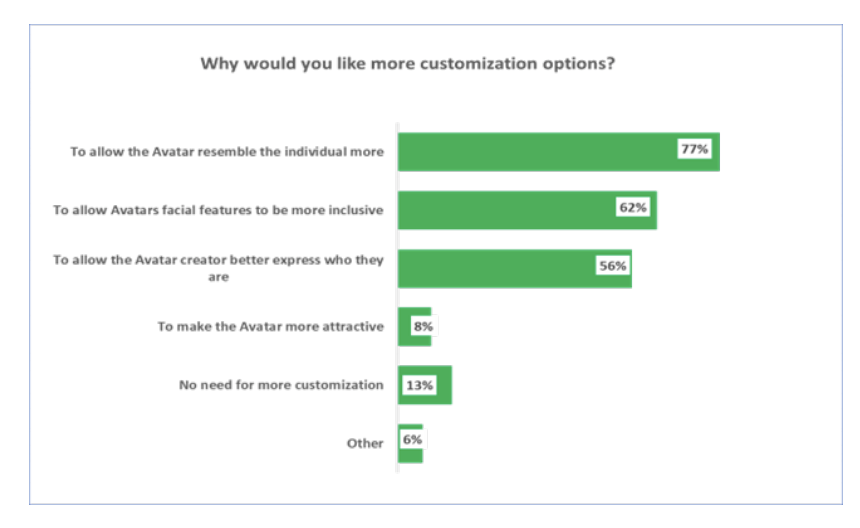
Reinforcing the primary motivator of making the avatar closely resemble the individual, 62% of respondents explicitly mentioned inclusivity as a key motivator for more options and only 8% of respondents indicated they wanted additional customization to make their avatars more attractive.
Finally, participants were asked about specific improvements in facial customization and those related to inclusiveness (more skin tone/complexion options and unique facial features) were most often selected (Table 4).
| Description of option | Support addition of option (%) |
| More skin tone/complexion options (e.g. freckles, moles, wrinkles, acne, etc.) | 76% |
| Unique facial features (e.g. Cleft palate, Downs facial profile, facial palsy, nonsymmetric features, etc.) | 72% |
| Size and shape of the eyes | 55% |
| Ability to show age | 53% |
| Size and shape of the nose | 50% |
| Size and shape of the mouth | 43% |
| Wider face shapes | 41% |
| Narrower face shapes | 32% |
| Size and shape of the ear | 30% |
| Distance between the eyes | 30% |
Discussion
Conclusions
This research has shown that avatar representations do increase conformance with Western beauty standards (as encoded in the Golden Ratio). It also found evidence that people wish for more authentic representation while feeling unconscious pressure to conform to these standards (the Authentic Idealization paradox). Furthermore, the survey respondents seek improvements in Avatar creation tools to help them address this paradox through the addition of more inclusive options.
The idealization of appearance in the avatar representation was validated by the research finding that avatars do not accurately reflect the individual and are in fact closer than photographic representations of individual to the Western beauty standards (9% deviation compared to 13% deviation using the Schmid measurement framework). This confirms previous findings that digital self-representation tends to lean towards societal beauty ideals22.
Gender was a significant factor with this discrepancy greater for females than for males (30% compared to 23%). The analysis of the survey responses also confirms that avatars are perceived as more attractive than their human counterparts with 55% of participants overall believing that the avatars were more attractive than the individual represented.
While 37% of survey participants reported that avatar facial features significantly influenced how others interacted with them (the Proteus Effect), a majority (58%) indicated that social pressure had little or no effect on their avatar creation. This discrepancy highlights another aspect of the paradox of authentic idealization’15 , where users strive for authenticity in their avatars while unconsciously conforming to societal beauty standards. The survey responses suggest that, even as users downplay external influences, their choices in avatar customization may still reflect these deeper societal norms that shape digital interactions and self-representation.
However, there was a significant difference in this response between males (71% reported no societal impact) and females (54% reported no societal impact). This aligns with previous research on gender differences in digital self-presentation, indicating that gender-specific beauty pressures persist in virtual environments23.
This pattern may reflect broader societal pressures and beauty standards that disproportionately impact women24. The findings also reflect observations by other researchers about gender stereotypes playing a significant role in avatar creation, with users often embodying culturally defined ideals of masculinity and femininity25,11.
The desire for the avatar to be an authentic representation was clear with 85% of survey participants expressing a desire for their avatar’s face to be very similar to their face. However, few respondents reported that their avatar’s face completely resembled their own face (4%). A majority of the respondents (54%) wanted more customization options reflecting the perceived gap between what users want and what is available in the creation tools. This is in line with previous research highlighting the importance of character creation interfaces (CCIs) in offering customization options26. This emphasizes the support among users for an inclusive and customizable avatar design which could promote diversity and psychological well-being among users.
Recommendations for future work
Artificial intelligence-powered image generation tools are already providing alternative approaches to generating personalized avatar recommendations. These use a chatbot dialog between the tool and the user. These tools could analyze user-submitted photos for suggesting avatar features while implementing strong privacy safeguards to protect sensitive personal information. They are very different to the previous tool generations which required users to select options from a pre-defined set. As these are more widely adopted, this research should be repeated to explore whether these tools provide a more realistic avatar and better meet user needs.
Social Media apps and avatars are utilized globally and at a scale that ensures that every form of diversity is represented among the users. Incorporating inclusive design principles would ensure that avatar customization options better serve the diverse user base, including individuals of various abilities, ethnicities, and body types27. Subsequent studies should concentrate on comprehending cultural differences in avatar preferences and beauty ideals across various regions and demographics.
To encourage responsible avatar customization, design guidelines should be established that discourage the perpetuation of harmful beauty standards and promote body positivity. These guidelines should be complemented by inclusive design principles that accommodate diverse user needs, preferences, and identities, fostering a more equitable and representative digital environment for all users and potentially be incorporated into legal frameworks such as the European accessibility act (2025).
The research identified a minority of users who spent more than 20 minutes building their avatars face. Further research to better understand any usability issues for this group should be conducted to further inform inclusive design guidelines.
Limitations
The sample size for Schmid’s beauty measures is relatively small, with 30 faces analyzed. The constraint on the sample was the requirement for participants to provide both an avatar from one of their social media accounts and a photograph. Both samples could be increased through automation of the measurement using Artificial Intelligence. The finding that the avatars were both individually and overall closer to the ideal beauty standard than the photographic representation of the individual does suggest that while a larger sample would provide a more robust estimate of the precise differences between avatar and photograph, it is unlikely to change the overall conclusion.
The online survey sample, while diverse, has more female participants and more under 20 than the internet population overall and overall has greater representation of some regions (the United States). This demographic imbalance may impact the findings and underrepresent other user groups’ preferences and experiences. The reliance on self-reported survey data introduces the possibility of response bias, as participants may have been influenced by social factors in answering questions related to social pressure and judgment. Addressing these limitations in future research would enhance the scope and depth of understanding in this important area of study.
References
- M. J. de B. Silva & P. de O. Campos, Past, present, and future of avatar marketing: A systematic literature review and future research agenda, Computers in Human Behavior: Artificial Humans, 2(1), 100045 (2024). [↩]
- C. Schrader, Creating avatars for technology usage: Context matters, Computers in Human Behavior, 93, 219–225 (2019). [↩]
- H. Ishiguro, K. Ogawa, Y. Nakata, M. Nakajima, M. Shiomi, Y. Onishi, H. Sumioka, Y. Yoshikawa, K. Sakai, T. Minato, C.T. Ishi, Y. & Nakamura, Development of Cybernetic Avatars with Humanlike Presence and Lifelikeness, Cybernetic Avatar, 11–69, (2024). [↩]
- I. S. Fitton, J. Dalton, M.J. Proulx, C. & Lutteroth, C. Dancing with the Avatars: Feedforward Learning from Self-Avatars, CHI Conference on Human Factors in Computing Systems Extended Abstracts, 458,1 – 8, (2022). [↩]
- A. Visconti, D. Calandra, & F. Lamberti, Comparing technologies for conveying emotions through realistic avatars in virtual reality‐based metaverse experiences, Computer Animation and Virtual Worlds, 34(3-4). E2188, (2023). [↩]
- L. D. Tolaymat, & B. Moradi, U.S. Muslim women and body image: links among objectification theory constructs and the hijab, Journal of Counseling Psychology, 58(3), 383-392, (2011). [↩]
- Y. Zhai, H. Cao, W. Deng, J. Gan, V. Piuri, & J. Zeng, Beautynet: joint multiscale CNN and Transfer Learning method for unconstrained facial beauty prediction, Computational Intelligence and Neuroscience, 2019, 1-14, (2019). [↩]
- Y. Hong, G.P. Nam, H. Choi, J. Cho, & I. Kim, A novel framework for assessing facial attractiveness based on facial proportions, Symmetry, 9(12), 294, (2017). [↩]
- B. Fink, N. Neave, J. T. Manning, & K. Grammer, Facial symmetry and judgements of attractiveness, health and personality, Personality and Individual Differences, Volume 41(3), 491-499, (2006). [↩]
- V. Swami & A. Furnham, The Psychology of Physical Attraction, Routledge, (2007). [↩] [↩]
- R. Carrasco, S. Baker, J. Waycott, & F. Vetere, Negotiating stereotypes of older adults through avatars, Proceedings of the 29th Australian Conference on Computer-Human Interaction, 218-227, (2017). [↩] [↩]
- D. Pimentel, and S. Kalyanaraman, Customizing your demons: anxiety reduction via anthropomorphizing and destroying an “anxiety avatar”, Frontiers in Psychology, 11, (2020). [↩]
- S. Pandita, L.H. Humphreys, & A.S. Won, The Paradox of Customization: Negotiating racial identity with “multiple choice” in avatar creation, Center for open science, (2023). [↩]
- F. Sibilla, & T. Mancini, I am (not) my avatar: a review of the user-avatar relationships in massively multiplayer online worlds, Cyberpsychology Journal of Psychosocial Research on Cyberspace, 12(3), (2018). [↩]
- O. L. Haimson, T. Liu, B. Z. Zhang, & S. Corvite, The online authenticity paradox: What Being “authentic” on social media means, and barriers to achieving it, ACM Human Computer Interaction 5, CSCW2, Article 423, (2021). [↩] [↩]
- M.D. Barnett, J.M. Moore, & A.R. Harp, Who we are and how we feel: Self-discrepancy theory and specific affective states, Personality and Individual Differences,111, 232–237, (2017). [↩]
- Y. N., Bailenson & N. Ducheneaut, The Proteus effect: implications of transformed digital self-representation on online and offline behavior. Communic. Res., 36, 285–312, (2009). [↩]
- K. Schmid, D. Marx & A. Samal, Computation of a Face Attractiveness Index Based on Neoclassical Canons, Symmetry, and Golden Ratios, CSE Journal Articles, 92, (2008). [↩]
- How to Easily Calculate Confidence Intervals for Your Study,https://surveysparrow.com/blog/calculate-confidence-intervals/, (2025). [↩]
- N. Yee, J.N. Bailenson, N. Ducheneaut, The Proteus effect: implications of transformed digital self-representation on online and offline behavior, Communications, 36, 285–312, (2009). [↩]
- E. Hargittai & K. Dobransky, Old Dogs, New Clicks: Digital Inequality in Skills and Uses among Older Adults, Canadian Journal of Communication,42(2), 2017. [↩]
- Y. Peng, K. Cowan, & J.L. Ribeiro, Into the virtual worlds: conceptualizing the consumer‐avatar journey in virtual environments, Psychology & Marketing, 42(2). 374-394, (2024). [↩]
- R.A. Dunn, & R.E. Guadagno, My avatar and me – Gender and personality predictors of avatar-self discrepancy, Computers in Human Behavior, 28(1), 97–106, (2012). [↩]
- A. N. Saiphoo, & Z. Vahedi, A meta-analytic review of the relationship between social media use and body image disturbance, Computers in Human Behavior, 101, 259–275, (2019). [↩]
- S. Triberti, V. Sebri, A. Gorini, G. Pravettoni, & L. Savioni, Avatars for Clinical Assessment, Research Anthology on Virtual Environments and Building the Metaverse, edited by Information Resources Management Association. IGI Global. 500–521, (2022). [↩]
- S. Pandita, L.H. Humphreys, & A.S. Won, The Paradox of Customization: Negotiating racial identity with “multiple choice” in avatar creation, Center for open science, (2023). [↩]
- M. Ma, M. Gotsis, B. Harris-Lowe, & M. Coopilton, Inclusive character creator : A showcase of inclusive design principles for 3D character creators. SIGGRAPH ’22: ACM SIGGRAPH Posters.17. 1 – 2, (2022). [↩]