Abstract
When expressing rational numbers, fractional expressions are generally more efficient and convenient than decimal expressions in real-life applications. Thus, mathematicians have long sought to convert rational numbers expressed in decimal form into the corresponding fractional forms. However, numerous types of decimal expressions lack a known method of conversion into fractional form. This study aims to establish a method for converting a specific group of rational numbers from decimal to fractional form. Consider the decimal expression of  , which is
  . Interestingly, from the repetend, the digit 8 is missing from the ascending sequence from 0 to 9. Such type of rational number — where the repetend forms a sequence from 0 to
  with exactly one missing digit — is the group of rational numbers to be generalized. This methodology was done through theoretical exploration of decimal expressions, utilizing geometric series and number theory. The process first began through generalizing rational numbers whose repeating decimal sequences have the missing digit
  . Utilizing the result, generalization for all rational numbers with a repetend missing any single digit from 0 to were done. Consequently, if one considers a decimal number whose repetend consists digits of
  to
to  with one missing natural number
  , the number can be represented as
  . Therefore, this generalization enables more efficient and precise usage of such rational numbers, helping data compression and computational efficiency. Also, the structured complexity of a missing digit holds practical value in fields such as cybersecurity and computational efficiency.
Keywords: rational number, decimal expression, fractional form, missing number
Introduction
Background
Every rational number can be expressed in both fractional and decimal forms. However, in many real-life applications, fractional forms are often more preferred. Unlike decimals, which can be lengthy and infinitely repeating, fractions offer a precise and exact representation. For instance, the lengthy decimal  can be simply expressed as
  . Thus, fractional forms are preferred in pure mathematics for their clarity and ability to prevent complicated expressions, making it easier to manipulate algebraically. In computer science, while fractional forms provide accurate values, decimal expressions need to be rounded and cannot be stored exactly due to floating-point limitations. These small rounding errors lead to losses in precision and can be detrimental in fields like finance, engineering, and scientific simulations. The usage of fractional forms are also data-efficient. Instead of representing a rational number as a potentially lengthy decimal expansion, a fraction simply captures the same value using just two integers: a numerator and a denominator. This reduces the number of bits needed for storage and lowers the demand for memory allocation and processing time. This is especially important in systems that process large datasets, where performance and memory efficiency are critical. As a result, it has always been a goal for mathematicians to successfully convert every rational numbers in decimal forms to fractional forms.
The following are the conclusions mathematicians have reached1:
When a rational number is written in decimal form, it takes one of two possible expressions. The first type is when the length of the decimal expression is finite. For example, there is  or
or  . This case occurs when the denominator of the given rational number in irreducible form can only be divided by 2 or 5. Therefore, the fractional form for such decimal is expressed as
![\[r = \frac{n}{2^a \cdot 5^b}\]](https://nhsjs.com/wp-content/ql-cache/quicklatex.com-3c49418f1c5ac12cc92c83c3acfab790_l3.png "Rendered by QuickLaTeX.com")
This makes sense because every decimal expressions are based on base 10. Therefore, if the denominator of a fraction is a power of 10, its decimal representation will be finite in length. That is, when the given decimal expression is  , it can be converted to fractional form by


For further analysis, consider the rational number
for some natural number
 and non-negative integers
  and
and  . Under this setting, there are three possible cases
1. If  , the result is
ex. 
2. If  ,
,  is multiplied to both numerator and denominator to get
ex. 
3. If  ,
,  is multiplied to both numerator and denominator to get
ex. 
The second type is when the length of the decimal expression of the rational number is infinite. This happens when the denominator of the given rational number in irreducible form can be divided by a prime number other than 2 or 5. Thus, the given rational number is expressed as
![\[r = \frac{n}{p \cdot 2^a \cdot 5^b}\]](https://nhsjs.com/wp-content/ql-cache/quicklatex.com-e66eab693e1474f8d99296e933eab97b_l3.png "Rendered by QuickLaTeX.com")
for some natural number
, non-negative integers and , and natural number  coprime to 10.
ex.


One key feature of the decimal expression of such rational numbers is that it contains a periodic part. For example,  has 1′ as the repeating part, and
  has13′ as the repeating part.
To demonstrate this periodicity, the understanding of the following equation is necessary:
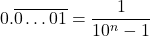
where the periodic part contains
 zeros
zeros
This equation is proven by the formula of the sum of geometric series2. Since the initial term is  and the common ratio is also , the following formula can be used:
![\[a + ar + ar^2 + \cdots = \frac{a}{1-r}\]](https://nhsjs.com/wp-content/ql-cache/quicklatex.com-c7e0b26252a9b97760046e1dcbf640ae_l3.png "Rendered by QuickLaTeX.com")
where is the initial term and  is the common ratio to get
![\[0.\overline{0\ldots01} = 10^{-n} + 10^{-2n} + \cdots = \frac{10^{-n}}{1-10^{-n}} = \frac{1}{10^n-1}\]](https://nhsjs.com/wp-content/ql-cache/quicklatex.com-903d7915e9965e819cfc289ab4c82642_l3.png "Rendered by QuickLaTeX.com")
Having proven (1), consider any natural number which cannot be divided by neither 2 nor 5. Then, there exists an integer  such that
  for some natural number . This is proven by the Euler theorem. From the Euler theorem3,4,
  , since and 10 has no common divisor. Now, take
  and
and  .
.
Next, let any rational number of the second type to be referred as  . To make the denominator some kind of form of
  , multiply some number to both numerator and denominator and have
  for some natural numbers
  . Then, multiple to both numerator and denominator to get
 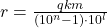 . As the objective is to prove the periodicity of the decimal expression,
  will be ignored since it translates the decimals. Therefore, it needs to be proven that
  has a periodic part. If
  , no additional step is needed, but if
  , subtract some integer
  to make
  for some
  . Because the number of digits in
  is less than or equal to , can be expressed as
  (some
(some  can be zero). Finally, using
  ,
,  can be concluded, successfully proving the infinite periodicity of the expression.
Consequently, these two different types of rational numbers can be summarized as the following:
Let  be a rational number where and
  are relatively prime natural numbers. If the prime factor of is only 2 or 5, then the decimal expression of is finite. If not, the decimal expression of is infinite and has periodicity.
Purpose
In the case of the second type of rational number, expressed as  , there are significant limitations to its generalization. Since can be any prime number other than 2 or 5, the scope of rational numbers that fall under this form is extremely broad. Therefore, it is necessary to further divide this category into subgroups and develop alternative fractional representations for each group of rational numbers. Through finding a generalized fractional representation for each subgroup, it would be easier to convert complex decimal expressions back into fractions which will aid in diverse fields like computer science. Consequently, this research paper aims to generalize a fractional representation for a specific subgroup of rational numbers — those whose decimal expressions exhibit a missing number between consecutive numbers 0 through in their repetend. This will be discussed in detail in 1.3 Objectives.
Objective/Methodology
Now, consider following decimal expressions.


In each of the repetends of the decimal expressions, respectively, number 8, 98, and 998 are missing, but other non-negative integers less than 10, 100, 1000 are present. In fact, all numbers except for are arranged in increasing order.
Such rational number is expressed as
![\[r = 0.\overline{(0\ldots0)(0\ldots1)(0\ldots2)\ldots(9\ldots6)(9\ldots7)(9\ldots9)}\]](https://nhsjs.com/wp-content/ql-cache/quicklatex.com-315d8ee4ff0a4791653204e7ec4d6c94_l3.png "Rendered by QuickLaTeX.com")
which will be generalized in Section 2 first.
It is important to note that Section 2 provides a generalization only for decimal expressions whose missing digit is  (i.e. ). However, the ultimate goal of this study is to generalize decimal expressions whose repetend forms a sequence of consecutive numbers from 0 to in increasing order, with any single digit missing. Therefore, in Section 3, utilizing the result from Section 2, the generalization for cases where the missing digit is 0 and where it is (i.e.
  ) will be done. Then, these cases serve as the foundation for the final generalization of decimal expression
![\[0.\overline{(0\ldots0)(0\ldots1)(0\ldots2)\ldots(0\ldots(k-1))(0\ldots(k+1))\ldots(9\ldots8)(9\ldots9)}\]](https://nhsjs.com/wp-content/ql-cache/quicklatex.com-f65642459c0e42cd436fa0e12f43685c_l3.png "Rendered by QuickLaTeX.com")
with positive integer that encompasses all decimal expressions with any single missing digit from 0 to .
Decimal expression with missing digit
This section presents a generalization of the rational number  , a class of repeating decimals in which the repetend consists of a consecutive sequence of numbers from 0 to , except for (i.e. ).
To make some generalization, first observe the three simplest cases which are:
Such observation gives the following assumption:
Theorem
There is a decimal number whose repetend of the decimal expression is the sequence of consecutive numbers from 0 to except for , where each number is written in -digit numbers. For instance, 0 is written as  ( zeros), 1 is written as
  ( zeros), and 11 is written as
  (
( zeros). It is expressed as
![\[0.\overline{(0\ldots0)(0\ldots1)(0\ldots2)\ldots(9\ldots7)(9\ldots9)}\]](https://nhsjs.com/wp-content/ql-cache/quicklatex.com-822638a5cdecebeb5878d2fdd7322198_l3.png "Rendered by QuickLaTeX.com")
The generalization of this rational number into fractional form is 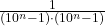 .
.
(Proof of Theorem)
The goal is to prove
![\[\frac{1}{(10^n-1) \cdot (10^n-1)} = 0.\overline{(0\ldots0)(0\ldots1)(0\ldots2)\ldots(9\ldots7)(9\ldots9)}\]](https://nhsjs.com/wp-content/ql-cache/quicklatex.com-12d00de758374445e2450a99ee8319be_l3.png "Rendered by QuickLaTeX.com")
First, analysis of the three simplest cases provides an insight.
From  , the following equation can be derived:
![\[\frac{10}{9 \cdot 9} - \frac{1}{9 \cdot 9} = 0.\overline{123456790} - 0.\overline{012345679} = 0.\overline{111111111} = 0.\overline{1}\]](https://nhsjs.com/wp-content/ql-cache/quicklatex.com-8c7ad7b173785d3a61d7c56621ad644c_l3.png "Rendered by QuickLaTeX.com")
Similarly, from  and
and  , it derives


Such equation made by the three cases above now needs to be generalized to all ‘s.
Let  . From the insight given by the three previous examples, multiply
  to
to  to get
![\[10^n A_n = 0.\overline{(0\ldots1)(0\ldots2)\ldots(9\ldots7)(9\ldots9)(0\ldots0)}\]](https://nhsjs.com/wp-content/ql-cache/quicklatex.com-0a59140a35c0949e8b407d17715f485b_l3.png "Rendered by QuickLaTeX.com")
Then, the difference between  and can be written as
![\[(10^n-1) A_n = 0.\overline{(0\ldots1)(0\ldots2)\ldots(9\ldots7)(9\ldots9)(0\ldots0)}\]](https://nhsjs.com/wp-content/ql-cache/quicklatex.com-77b6741a7e9a6732b709987544a84b29_l3.png "Rendered by QuickLaTeX.com")
![\[- 0.\overline{(0\ldots0)(0\ldots1)(0\ldots2)\ldots(9\ldots7)(9\ldots9)}\]](https://nhsjs.com/wp-content/ql-cache/quicklatex.com-8d95ddac05e6bf1889ea63c48a217dea_l3.png "Rendered by QuickLaTeX.com")
which can be simplified as
![\[[(10^n-1) A_n = 0.\overline{(0\ldots1)(0\ldots1)\ldots(0\ldots1)(0\ldots2)(0\ldots0)}]\]](https://nhsjs.com/wp-content/ql-cache/quicklatex.com-ebac1bb807bb7b5801edf451a40c7db5_l3.png "Rendered by QuickLaTeX.com")
![\[[- 0.\overline{(0\ldots0)(0\ldots0)(0\ldots0)\ldots(0\ldots0)(9\ldots9)}]\]](https://nhsjs.com/wp-content/ql-cache/quicklatex.com-5b57add0830ed8ca3c966945371adf8d_l3.png "Rendered by QuickLaTeX.com")
Again, it can be further simplified to


This is the generalization for a decimal expression with missing number .
Ex) When  ,
,
![\[(10^5-1) A_n = 0.\overline{000010000200003\ldots999979999900000}\]](https://nhsjs.com/wp-content/ql-cache/quicklatex.com-bbb41006213f5d4b75304a6267687f39_l3.png "Rendered by QuickLaTeX.com")
![\[- 0.\overline{000000000100002\ldots999969999799999}\]](https://nhsjs.com/wp-content/ql-cache/quicklatex.com-dccb8df82505c5458fbefe091a729d3a_l3.png "Rendered by QuickLaTeX.com")
![\[= 0.\overline{0000100001\ldots000010000200000} -\]](https://nhsjs.com/wp-content/ql-cache/quicklatex.com-4a2a7634c919ac537a51c09118aba964_l3.png "Rendered by QuickLaTeX.com")
![\[0.\overline{0000000000\ldots0000000009}\]](https://nhsjs.com/wp-content/ql-cache/quicklatex.com-4775ceb1eb48d721ff3ed50877fafe61_l3.png "Rendered by QuickLaTeX.com")
![\[= 0.\overline{00001} = \frac{1}{10^5-1}\]](https://nhsjs.com/wp-content/ql-cache/quicklatex.com-503c328402bc3a249f3d6f5395d5f80f_l3.png "Rendered by QuickLaTeX.com")
therefore
![\[A_1 = \frac{1}{(10^5-1)^2}\]](https://nhsjs.com/wp-content/ql-cache/quicklatex.com-6c6a67ff87b7ff4812dc7fa98cc75fe3_l3.png "Rendered by QuickLaTeX.com")
Ex) When  ,
,
![\[(10^6-1) A_6 = 0.\overline{000001000002\ldots999997999999000000}\]](https://nhsjs.com/wp-content/ql-cache/quicklatex.com-6fc55f010eb4460abd68c6ffbb1a10d4_l3.png "Rendered by QuickLaTeX.com")
![\[- 0.\overline{000000000001000002\ldots999996999997999999}\]](https://nhsjs.com/wp-content/ql-cache/quicklatex.com-309d4dd45d11aa6342068585b9c20541_l3.png "Rendered by QuickLaTeX.com")
![\[= 0.\overline{000001000001\ldots000001000002000000}\]](https://nhsjs.com/wp-content/ql-cache/quicklatex.com-6205f1abf87c131145163bb80d59dc27_l3.png "Rendered by QuickLaTeX.com")
![\[- 0.\overline{000000000000\ldots000000000000999999}\]](https://nhsjs.com/wp-content/ql-cache/quicklatex.com-cedeb5e114213273dc1eb6f26e45a60f_l3.png "Rendered by QuickLaTeX.com")
![\[= 0.\overline{000001} = \frac{1}{10^6-1}\]](https://nhsjs.com/wp-content/ql-cache/quicklatex.com-190533c158ada07a4a1cfeee6b51f97d_l3.png "Rendered by QuickLaTeX.com")
therefore
![\[A_6 = \frac{1}{(10^6-1)^2}\]](https://nhsjs.com/wp-content/ql-cache/quicklatex.com-d8f59b941d30c27b881beb976f0a7ea9_l3.png "Rendered by QuickLaTeX.com")
Further analysis gives an interesting insight.
has the length of the periodic part denoted as  because there are `‘ numbers written down with each number represented using the -digit format. Thus, it can be expressed as
![\[[A_n = \frac{(0\ldots1)(0\ldots2)\ldots(9\ldots7)(9\ldots9)}{10^{n(10^n-1)}-1} = \frac{1}{(10^n-1)^2}]\]](https://nhsjs.com/wp-content/ql-cache/quicklatex.com-64bdea8c3ea3b0f3bfe5cc1c4be306b2_l3.png "Rendered by QuickLaTeX.com")
through multiplying  to both sides,
![\[[\frac{10^{n(10^n-1)}-1}{(10^n-1)^2} = (0\ldots1)(0\ldots2)\ldots(9\ldots7)(9\ldots9)]\]](https://nhsjs.com/wp-content/ql-cache/quicklatex.com-1756194985a6ec95686ae1fe63061fac_l3.png "Rendered by QuickLaTeX.com")
One interesting property of the above quality is that the left hand side is an integer. This means that can be divided by  . Then, the explicit formulation of the division can be written as the right hand side which has a complex structure.
Ex) When 
![\[[\frac{10^{1 \cdot 9}-1}{(10^1-1)^2} = \frac{10^9-1}{81} = 12345679]\]](https://nhsjs.com/wp-content/ql-cache/quicklatex.com-a9afc2840695ca6e2b256128959832bb_l3.png "Rendered by QuickLaTeX.com")
Ex) When 
![\[[\frac{10^{3 \cdot 999}-1}{(10^3-1)^2} = \frac{10^{2997}-1}{998001} = 1002003004005\ldots996997999]\]](https://nhsjs.com/wp-content/ql-cache/quicklatex.com-9b64b0ce7687875c3ce9dcc6e4225bfa_l3.png "Rendered by QuickLaTeX.com")
Generalization of decimal expression with any missing digit
In this part, first, generalization of decimal numbers with missing digits and 0 will take place. This is done to show how the result from Section 2 can aid in constructing generalization of decimal expressions with other missing digits. Then, final generalization of decimal numbers with any missing digit from 0 to will be done.
Missing 
This case is when the missing number is . Such decimal expression can be written as follows:
![\[[0.\overline{(0\ldots0)(0\ldots1)(0\ldots2)\ldots(9\ldots7)(9\ldots8)}]\]](https://nhsjs.com/wp-content/ql-cache/quicklatex.com-746d9248794aec7e3cf95153241e434b_l3.png "Rendered by QuickLaTeX.com")
To find the corresponding fractional form for such rational number, the following equation takes place:
![\[0.\overline{(0\ldots0)(0\ldots1)(0\ldots2)\ldots(9\ldots7)(9\ldots8)}\]](https://nhsjs.com/wp-content/ql-cache/quicklatex.com-54c6a91f94801b18243ab35d3431bc28_l3.png "Rendered by QuickLaTeX.com")
![\[= 0.\overline{(0\ldots0)(0\ldots1)(0\ldots2)\ldots(9\ldots7)(9\ldots9)}\]](https://nhsjs.com/wp-content/ql-cache/quicklatex.com-439f775ffbd37c371cac3e7826c94806_l3.png "Rendered by QuickLaTeX.com")
![\[- 0.\overline{(0\ldots0)(0\ldots0)(0\ldots0)\ldots(0\ldots0)(0\ldots1)}\]](https://nhsjs.com/wp-content/ql-cache/quicklatex.com-a74cb890e6719485671c1b2b75580201_l3.png "Rendered by QuickLaTeX.com")
![\[= \frac{1}{(10^n-1)^2} - \frac{1}{10^{n(10^n-1)}-1}\]](https://nhsjs.com/wp-content/ql-cache/quicklatex.com-d831b6e4b6d013d2a26e50fd1abfcce2_l3.png "Rendered by QuickLaTeX.com")
![\[\therefore 0.\overline{(0\ldots0)(0\ldots1)(0\ldots2)\ldots(9\ldots7)(9\ldots8)} =\]](https://nhsjs.com/wp-content/ql-cache/quicklatex.com-d0602e72646403e209c9a34aa27b230b_l3.png "Rendered by QuickLaTeX.com")
![\[\frac{1}{(10^n-1)^2} - \frac{1}{10^{n(10^n-1)}-1}\]](https://nhsjs.com/wp-content/ql-cache/quicklatex.com-b10a61dcfb0eda6fcdd42c8638df68a0_l3.png "Rendered by QuickLaTeX.com")
Ex) When the missing number is 9,
![\[0.\overline{012345678} = 0.\overline{012345679} - 0.\overline{000000001}\]](https://nhsjs.com/wp-content/ql-cache/quicklatex.com-d6047698207c7f3aa221eb5462f6bc39_l3.png "Rendered by QuickLaTeX.com")
![\[= \frac{1}{(10^1-1)^2} - \frac{1}{10^{1 \cdot (10^1-1)}-1} = \frac{1}{81} - \frac{1}{10^9-1}\]](https://nhsjs.com/wp-content/ql-cache/quicklatex.com-8f72b5eab4fe3741d3f608baf8bfdd76_l3.png "Rendered by QuickLaTeX.com")
Ex) When the missing number is 999,
![\[0.\overline{000001002003\ldots996997998} =\]](https://nhsjs.com/wp-content/ql-cache/quicklatex.com-600d6cc7f9dd552634f9d2870990eef8_l3.png "Rendered by QuickLaTeX.com")
![\[0.\overline{000001002003\ldots997999} -\]](https://nhsjs.com/wp-content/ql-cache/quicklatex.com-92c424961a2871902462608a8741ee78_l3.png "Rendered by QuickLaTeX.com")
![\[0.\overline{000000000\ldots000001}\]](https://nhsjs.com/wp-content/ql-cache/quicklatex.com-a620e8de80b28d7fe6fe7f69369aea45_l3.png "Rendered by QuickLaTeX.com")
![\[= \frac{1}{(10^3-1)^2} - \frac{1}{10^{3 \cdot (10^3-1)}-1} = \frac{1}{998001} - \frac{1}{10^{2997}-1}\]](https://nhsjs.com/wp-content/ql-cache/quicklatex.com-2e9c130d51c9c59a61073f1825aa908f_l3.png "Rendered by QuickLaTeX.com")
Missing zero 
This case is when the missing number is 0. Such decimal expression can be written as follows:
![\[[0.\overline{(0\ldots1)(0\ldots2)(0\ldots3)\ldots(9\ldots8)(9\ldots9)}]\]](https://nhsjs.com/wp-content/ql-cache/quicklatex.com-5afcbe6d6d57765e9f08ec3c5ecb5d9b_l3.png "Rendered by QuickLaTeX.com")
To find the corresponding fractional form for such rational number, the following steps takes place.
First, multiply to  and get
![\[\frac{10^n}{(10^n-1) \cdot (10^n-1)} = 0.\overline{(0\ldots1)(0\ldots2)\ldots(9\ldots7)(9\ldots9)(0\ldots0)}\]](https://nhsjs.com/wp-content/ql-cache/quicklatex.com-96f54246bb11371612c9397b90a2cb1f_l3.png "Rendered by QuickLaTeX.com")
Next, the following equation takes place:
![\[0.\overline{(0\ldots1)(0\ldots2)\ldots(9\ldots7)(9\ldots8)(9\ldots9)}\]](https://nhsjs.com/wp-content/ql-cache/quicklatex.com-bfe8c696f9d404ae5a18a451b7bbd9cc_l3.png "Rendered by QuickLaTeX.com")
![\[= 0.\overline{(0\ldots1)(0\ldots2)\ldots(9\ldots7)(9\ldots9)(0\ldots0)}\]](https://nhsjs.com/wp-content/ql-cache/quicklatex.com-52296da0f2b7cde46bef685e13b31f9d_l3.png "Rendered by QuickLaTeX.com")
Consequently,
![\[\therefore 0.\overline{(0\ldots1)(0\ldots2)\ldots(9\ldots7)(9\ldots8)(9\ldots9)}\]](https://nhsjs.com/wp-content/ql-cache/quicklatex.com-e8bc9f5e6a9d0022bc332659cca930a8_l3.png "Rendered by QuickLaTeX.com")
![\[= \frac{10^n}{(10^n-1)^2} - \frac{1}{10^{n(10^n-1)}-1}\]](https://nhsjs.com/wp-content/ql-cache/quicklatex.com-44422d62ba1e149ad4b6cde8c06fafe7_l3.png "Rendered by QuickLaTeX.com")
Ex) When the missing number is `0′,

Ex) When the missing number is `000′,
![\[0.\overline{001002003\ldots997998999} = 0.\overline{001002003\ldots997999000}\]](https://nhsjs.com/wp-content/ql-cache/quicklatex.com-5c06142efb88e327ecabddd778cb7efa_l3.png "Rendered by QuickLaTeX.com")
![\[- 0.\overline{000000000\ldots000000001}= 10^3 \times 0.\overline{000001002\ldots996997999}\]](https://nhsjs.com/wp-content/ql-cache/quicklatex.com-c9cd60220e29a93854804ce384ee98f9_l3.png "Rendered by QuickLaTeX.com")
![\[- 0.\overline{000000000\ldots000000001}\]](https://nhsjs.com/wp-content/ql-cache/quicklatex.com-fdc421cdf84e61d104be851c343c73b1_l3.png "Rendered by QuickLaTeX.com")
![\[= \frac{10^3}{(10^3-1)^2} - \frac{1}{10^{3 \times (10^3-1)}-1}\]](https://nhsjs.com/wp-content/ql-cache/quicklatex.com-6782c29bda3746732220abe4db147b8c_l3.png "Rendered by QuickLaTeX.com")
![\[= \frac{1000}{998001} - \frac{1}{10^{2997}-1}\]](https://nhsjs.com/wp-content/ql-cache/quicklatex.com-010ca7c889dbd36f3df1c90c4051eb42_l3.png "Rendered by QuickLaTeX.com")
General case
In this case, generalization will occur for every single missing number. Specifically, consider a missing non-negative integer , where  . Such decimal expression can be written as follows:
![\[[0.\overline{(0\ldots0)(0\ldots1)(0\ldots2)\ldots(0\ldots(k-1))(0\ldots(k+1))\ldots(9\ldots8)(9\ldots9)}]\]](https://nhsjs.com/wp-content/ql-cache/quicklatex.com-33f47d9a50e42f0f46f20f98a211f043_l3.png "Rendered by QuickLaTeX.com")
To find the corresponding fractional form for such rational form, the following steps takes place:
First, take the decimal expression of  . As is the missing number, add 1 to all numbers in the decimal expression of , where
  . This can be represented as follows:



In this representation, the first addend is . The second addend is  . To elaborate further about the second addend, for ,
  represents the number of digits in the repetend. For
  ,
,  , , it represents the leftmost 1 in the second addend, the second-to-rightmost 1 in the second addend, and the rightmost 1 in the second addend, respectively.
Therefore, it can be written in the following:

Through using the sum of geometric series, it can be further simplified as

Ex) When the missing number is `4′,
![\[0.\overline{012356789}= 0.\overline{012345679} + 0.\overline{000011110}\]](https://nhsjs.com/wp-content/ql-cache/quicklatex.com-e5a7c7794c6dc031ab5c53d8884713d5_l3.png "Rendered by QuickLaTeX.com")
![\[= \frac{1}{(10^1-1)^2} + \frac{10^{1 \times (10^1-4-2)}-1}{10^{1 \times (10^1-1)}-1} \times \frac{10^1}{10^1-1}\]](https://nhsjs.com/wp-content/ql-cache/quicklatex.com-c5ba5ec6dcd3bf3d6f584e76d001838a_l3.png "Rendered by QuickLaTeX.com")
![\[= \frac{1}{81} + \frac{10^4-1}{10^9-1} \times \frac{10}{9}\= \frac{1}{81} + \frac{99990}{9 \times (10^9-1)}\]](https://nhsjs.com/wp-content/ql-cache/quicklatex.com-64d55ced480ea416a176e37fdd20be56_l3.png "Rendered by QuickLaTeX.com")
Ex) When the missing number is `541′,
![\[0.\overline{000001002\ldots540542\ldots998999}\]](https://nhsjs.com/wp-content/ql-cache/quicklatex.com-5d0947416914c7be9369ca6360742de0_l3.png "Rendered by QuickLaTeX.com")
![\[= 0.\overline{000001002\ldots540541\ldots997999}\]](https://nhsjs.com/wp-content/ql-cache/quicklatex.com-a73b0a4210c48516bbec438da79e4b79_l3.png "Rendered by QuickLaTeX.com")
![\[+ 0.\overline{000000000\ldots000001\ldots001000}\]](https://nhsjs.com/wp-content/ql-cache/quicklatex.com-b2ef8ec02f600d1d14c314f1a128284f_l3.png "Rendered by QuickLaTeX.com")
![\[= \frac{1}{(10^3-1)^2} + \frac{10^{3 \times (10^3-541-2)}-1}{10^{3 \times (10^3-1)}-1} \times \frac{10^3}{10^3-1}\]](https://nhsjs.com/wp-content/ql-cache/quicklatex.com-9c538244972220e546e39f1433edb98a_l3.png "Rendered by QuickLaTeX.com")
![\[= \frac{1}{998001} + \frac{10^{3 \times 457}-1}{10^{3 \times 999}-1} \times \frac{1000}{999}\]](https://nhsjs.com/wp-content/ql-cache/quicklatex.com-91829f80515193b64ea3a475d226faf2_l3.png "Rendered by QuickLaTeX.com")
![\[= \frac{1}{998001} + \frac{10^{1374}-1000}{999 \times (10^{2997}-1)}\]](https://nhsjs.com/wp-content/ql-cache/quicklatex.com-1dd5ce44b0a6a71bae473d72e66c90b1_l3.png "Rendered by QuickLaTeX.com")
As a matter of fact, this generalization also works when  ,
,  , and
, and  which was introduced in previous sections.
When , using the generalized formula from (2), the same equation from Section 2 derives.
![\[\frac{1}{(10^n-1)^2} + \frac{10^{n(10^n-(10^n-2)-2)}-1}{10^{n(10^n-1)}-1} \times \frac{10^n}{10^n-1}\]](https://nhsjs.com/wp-content/ql-cache/quicklatex.com-9d40b0fc6c3a73a3320167c352e9e1d3_l3.png "Rendered by QuickLaTeX.com")
![\[= \frac{1}{(10^n-1)^2} + \frac{10^{n \times 0}-1}{10^{n(10^n-1)}-1} \times \frac{10^n}{10^n-1}\]](https://nhsjs.com/wp-content/ql-cache/quicklatex.com-b5bf10515d3e4301405d886d2b4be8af_l3.png "Rendered by QuickLaTeX.com")
![\[= \frac{1}{(10^n-1)^2} + \frac{0}{10^{n(10^n-1)}-1} \times \frac{10^n}{10^n-1}\]](https://nhsjs.com/wp-content/ql-cache/quicklatex.com-59029a62f7cea0db0345177082e1a7a7_l3.png "Rendered by QuickLaTeX.com")
![\[= \frac{1}{(10^n-1)^2}\]](https://nhsjs.com/wp-content/ql-cache/quicklatex.com-e1b6e3c3e5c8fc2a60b0efda83cb06aa_l3.png "Rendered by QuickLaTeX.com")
When , using the generalized formula from (2), the same equation from Section 3.1 derives.
![\[\frac{1}{(10^n-1)^2} + \frac{10^{n(10^n-(10^n-1)-2)}-1}{10^{n(10^n-1)}-1} \times \frac{10^n}{10^n-1}\]](https://nhsjs.com/wp-content/ql-cache/quicklatex.com-5d0bc0574fe7d6cb07f6f299f2394194_l3.png "Rendered by QuickLaTeX.com")
![\[= \frac{1}{(10^n-1)^2} + \frac{10^{-n}-1}{10^{n(10^n-1)}-1} \times \frac{10^n}{10^n-1}\]](https://nhsjs.com/wp-content/ql-cache/quicklatex.com-86479c20cce9353086f0a12859ecbc8a_l3.png "Rendered by QuickLaTeX.com")
![\[= \frac{1}{(10^n-1)^2} + \frac{1-10^n}{10^{n(10^n-1)}-1} \times \frac{1}{10^n-1}\]](https://nhsjs.com/wp-content/ql-cache/quicklatex.com-55f82ed6c028e381e56ec971cacbf693_l3.png "Rendered by QuickLaTeX.com")
![\[= \frac{1}{(10^n-1)^2} + \frac{(-1)}{10^{n(10^n-1)}-1}\]](https://nhsjs.com/wp-content/ql-cache/quicklatex.com-b115258755115aac82ede0079de336f8_l3.png "Rendered by QuickLaTeX.com")
When , using the generalized formula from (2), the same equation from Section 3.2 derives.
![\[\frac{1}{(10^n-1)^2} + \frac{10^{n(10^n-0-2)}-1}{10^{n(10^n-1)}-1} \times \frac{10^n}{10^n-1}\]](https://nhsjs.com/wp-content/ql-cache/quicklatex.com-57d09454b0927f867c2e5518044809a0_l3.png "Rendered by QuickLaTeX.com")
![\[= \frac{1}{(10^n-1)^2} + \frac{10^{n(10^n-2)}-1}{10^{n(10^n-1)}-1} \times \frac{10^n}{10^n-1}\]](https://nhsjs.com/wp-content/ql-cache/quicklatex.com-ad8404a3ce67d241a0d38ce9da0ac2c5_l3.png "Rendered by QuickLaTeX.com")
![\[= \frac{1}{(10^n-1)^2} + \frac{10^{n(10^n-1)}-10^n}{10^{n(10^n-1)}-1} \times \frac{1}{10^n-1}\]](https://nhsjs.com/wp-content/ql-cache/quicklatex.com-00b0c5a84d961f1eec5a2d35c6c8f96f_l3.png "Rendered by QuickLaTeX.com")
![\[= \frac{1}{(10^n-1)^2} + \left(1 - \frac{10^n-1}{10^{n(10^n-1)}-1}\right) \times \frac{1}{10^n-1}\]](https://nhsjs.com/wp-content/ql-cache/quicklatex.com-d672305ac628dc96de669aaeeb7a17c7_l3.png "Rendered by QuickLaTeX.com")
![\[= \frac{1}{(10^n-1)^2} + \frac{1}{10^n-1} - \frac{1}{10^{n(10^n-1)}-1}\]](https://nhsjs.com/wp-content/ql-cache/quicklatex.com-8d176364b1829156069d6569b3822535_l3.png "Rendered by QuickLaTeX.com")
![\[= \frac{1}{(10^n-1)^2} + \frac{10^n-1}{(10^n-1)^2} - \frac{1}{10^{n(10^n-1)}-1}\]](https://nhsjs.com/wp-content/ql-cache/quicklatex.com-377168b42d835465f74fe64ade1f1ceb_l3.png "Rendered by QuickLaTeX.com")
Consequently, the generalized equation is correct.
For further analysis, to obtain the decimal part for such rational number, one needs to multiply  to the generalized format so that it eliminates the decimal. This can be represented as follows:
![\[(10^{n(10^n-1)}-1) \cdot \left(\frac{1}{(10^n-1)^2} + \frac{10^{n(10^n-k-2)}-1}{10^{n(10^n-1)}-1} \cdot \frac{10^n}{10^n-1}\right)\]](https://nhsjs.com/wp-content/ql-cache/quicklatex.com-b648dd00eb8115e3567c1de7978a901e_l3.png "Rendered by QuickLaTeX.com")
![\[= \frac{10^{n(10^n-1)}-1}{(10^n-1)^2} + \frac{10^{n(10^n-k-1)}-10^n}{10^n-1}\]](https://nhsjs.com/wp-content/ql-cache/quicklatex.com-c28e08b45dfaf2cf40e5ff1df715bd66_l3.png "Rendered by QuickLaTeX.com")
![\[= \frac{10^{n(10^n-1)} + 10^{n(10^n-k)} - 10^{n(10^n-k-1)} - 10^{2n} + 10^n - 1}{(10^n-1)^2}\]](https://nhsjs.com/wp-content/ql-cache/quicklatex.com-f47c2994b16292c00529490a73e39c18_l3.png "Rendered by QuickLaTeX.com")
Ex) When `5′ is the missing number,
![\[\frac{10^{1 \times (10^1-1)} + 10^{1 \times (10^1-5)} - 10^{1 \times (10^1-5-1)} - 10^2 + 10^1 - 1}{(10^1-1)^2}\]](https://nhsjs.com/wp-content/ql-cache/quicklatex.com-3041a06eec872ded720a70e0ccdff362_l3.png "Rendered by QuickLaTeX.com")
![\[= \frac{10^9 + 10^5 - 10^4 - 10^2 + 10 - 1}{81} = 12346789\]](https://nhsjs.com/wp-content/ql-cache/quicklatex.com-2481c3af28fe1f982874eb9635831c3f_l3.png "Rendered by QuickLaTeX.com")
Ex) When `333′ is the missing number,
![\[\frac{10^{3 \times (10^3-1)} + 10^{3 \times (10^3-333)} - 10^{3 \times (10^3-333-1)} - 10^6 + 10^3 - 1}{(10^3-1)^2}\]](https://nhsjs.com/wp-content/ql-cache/quicklatex.com-a100ab9d068643e3802a60a8998ffef9_l3.png "Rendered by QuickLaTeX.com")
![\[= \frac{10^{2997} + 10^{2001} - 10^{1998} - 10^6 + 10^3 - 1}{998001}\]](https://nhsjs.com/wp-content/ql-cache/quicklatex.com-b5c1b3b03ac8ebdbc78284f8d27cd387_l3.png "Rendered by QuickLaTeX.com")
![\[= 1002003\ldots332334\ldots998999\]](https://nhsjs.com/wp-content/ql-cache/quicklatex.com-e46a19c539e512e88083dd811fb39ab7_l3.png "Rendered by QuickLaTeX.com")
This is one of the interesting corollary of the result.
Real-life applications
This study presents two key characteristics that provides area for real-life applications. The first characteristic is clarity and efficiency. By generalizing a specific group of complex decimal expressions, this research paper offers a method to represent such numbers in a more concise and precise form. This simplification allows shorter and simpler equations, making it easier to manipulate algebraically. It also improves data efficiency through minimizing the number of bits required and reducing processing time. Moreover, this clarity helps mitigate errors caused by floating-point limitations in computers, thereby ensuring great accuracy when applied in other fields like finance. Another usage due to clarity lies on encoding. The repeating decimal pattern can be used to encode information in a non-obvious way. For instance, the missing number in the repetend could represent a specific message. Anyone familiar with the system and its generalization could easily decode the value, aiding in digital communication. The second characteristic is complexity. The concept of omitting a single digit from the repetend within a consecutive sequence of numbers from 0 to generates a wide range of complicated decimal expressions. Therefore, this provides real-life applications in cybersecurity. However, such usage has limitations in terms of security as these rational number isn’t fully secure by itself. Even if the decimal expression looks complex, this rational number can be determined by a simple generalization. However, when integrated into a larger system, it proves highly useful. One example is obfuscation which is about hiding information so that even if someone sees it, they won’t know what it means. For instance, from such rational number, if a certain digit is missing, that could potentially represent a secret piece of information. Through combining it with random positions and numbers, it increases the confidentiality of the information. It can be used in contexts like steganographic communications where political dissidents, journalists, and military units need to send secret messages. Another example is the generation of secure passwords. Due to its complex structure, it is still hard to reverse-engineer the password. Also, the complexity of the decimal expression adds another barrier to brute-force attacks. This would ultimately help people protect their private information from attackers.
Conclusion
Study of rational numbers with decimal representations missing a single digit from a consecutive sequence of numbers from 0 to have been done. At first, conversion of the rational number with the missing digit (i.e., ) to fractional form was done and was expressed in simple form (Section 2). Next, using the result from Section 2, the conversion of rational number with any missing digit was finalized. Specifically, the number could’ve been converted to the fractional form ![[\frac{1}{(10^n-1)^2} + \frac{10^{n(10^n-k-2)}-1}{10^{n(10^n-1)}-1} \times \frac{10^n}{10^n-1}]](https://nhsjs.com/wp-content/ql-cache/quicklatex.com-c112cae363764203e5869e04415b48ba_l3.png "Rendered by QuickLaTeX.com") when is the missing digit. Also, as a corollary, the way to express the repetend which consists of to without was shown. This was expressed as
when is the missing digit. Also, as a corollary, the way to express the repetend which consists of to without was shown. This was expressed as ![[\frac{10^{n(10^n-1)} + 10^{n(10^n-k)} - 10^{n(10^n-k-1)} - 10^{2n} + 10^n - 1}{(10^n-1)^2}]](https://nhsjs.com/wp-content/ql-cache/quicklatex.com-db7a601ca735e8ba7edc20920b9f4784_l3.png "Rendered by QuickLaTeX.com") The results from this study provides benefits in areas like cybersecurity, computational efficiency, digital communication, and pure mathematics. Further improvement could lie on the generalization of more complex decimal expressions such as the case when there are at least two missing digits. Generalizing more complex decimal representations could further enhance benefits in computational efficiency and cybersecurity. Nevertheless, this study provides significant value in mathematics that can lead to real-world innovation.
The results from this study provides benefits in areas like cybersecurity, computational efficiency, digital communication, and pure mathematics. Further improvement could lie on the generalization of more complex decimal expressions such as the case when there are at least two missing digits. Generalizing more complex decimal representations could further enhance benefits in computational efficiency and cybersecurity. Nevertheless, this study provides significant value in mathematics that can lead to real-world innovation.
References
- Y. I. Manin, A. A. Panchishkin. Introduction to Modern Number Theory: Fundamental Problems, Ideas and Theories. Springer Berlin Heidelberg (2005). [↩]
- Mathematics LibreTexts, 24: The geometric series. https://math.libretexts.org/Bookshelves/Precalculus/Precalculus_(Tradler_and_Carley)/24%3A_The_Geometric_Series (2020). [↩]
- K. C. Chowdhury, A First Course in Theory of Numbers. (2007). [↩]
- L. K. Hua, Introduction to Number Theory. Springer Science & Business Media(2012). [↩]