Abstract
Climate change is one of the most pressing environmental issues of our time. Scientists and policymakers are seeking sustainable, affordable ways to reduce CO2 and other greenhouse gases to mitigate climate change. One notable solution for carbon sequestration is algae. In this experiment, we hypothesized that CO2-absorbing algae would most effectively mitigate atmospheric CO2 under conditions of high initial algal mass and high light levels. To test this hypothesis, a total of 18 containers of varying amounts of algae were exposed to varying amounts of light: High light-high mass (HL-HM), High light-low mass (HL-LM), Low light-high mass (LL-HM), Low light-low mass (LL-LM), High light-control (HL-C), and Low light-control (LL-C). We measured CO2 (ppm, parts per million) and nitrate (ppm) levels in each container over a 14-day period. As a result, we found that CO2 consumption was not affected by light level, algal mass, or their interaction. However, treatments with higher algal mass exhibited greater nitrate consumption than controls. Although this study has limitations, the results suggest that algae may require genetic modification to enhance CO2 absorption to become a viable solution for climate change mitigation.
Introduction
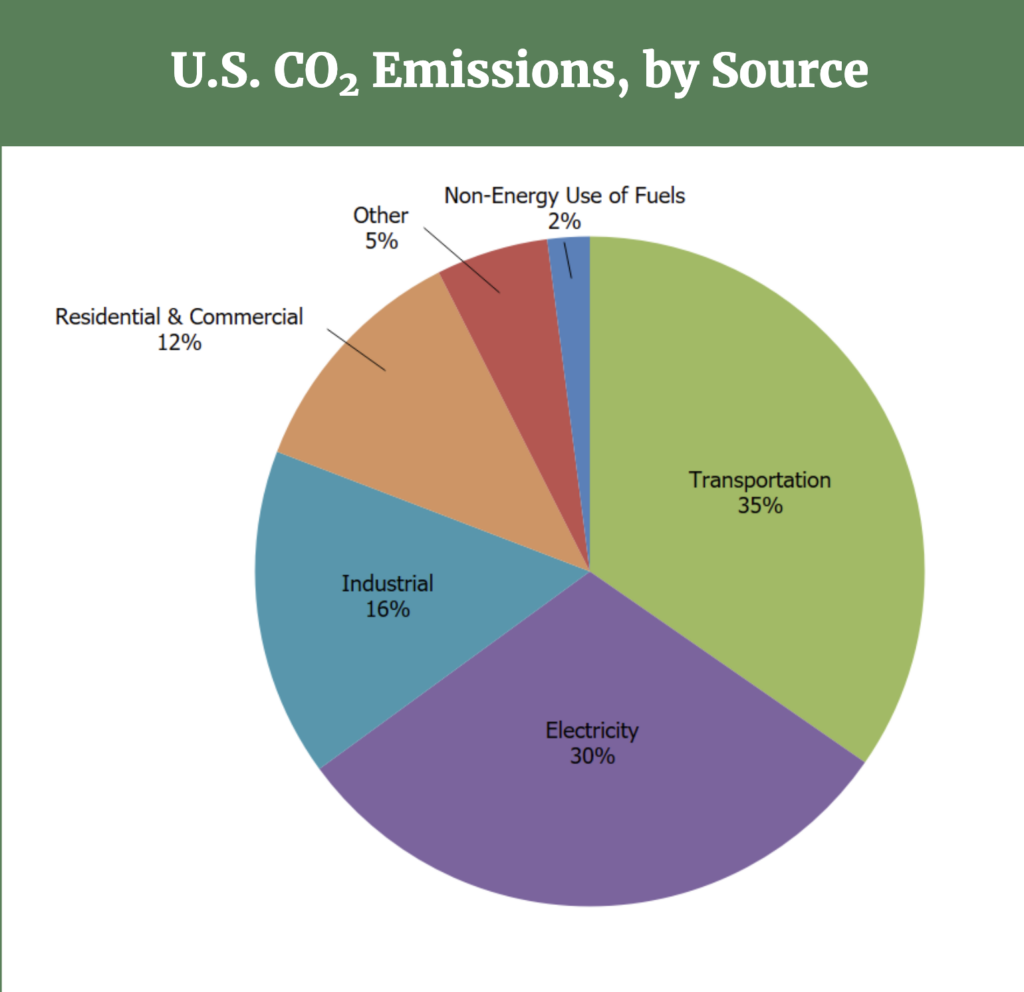
Climate change is one of the most pressing global issues of the 21st century. Rising global temperatures, melting ice caps, and frequent extreme weather events have completely changed ecosystems and altered the way of life for both wildlife and humans worldwide. According to the IUCN, “The 2022 Global Risk Report by the World Economic Forum argues that biodiversity loss, along with climate change, is one of the greatest global challenges of our time.”1. According to the United Nations, human activity has impacted three-quarters of land-based environments and two-thirds of marine environments2. Since the Industrial Revolution in the 1800s, human activity has driven global warming at a rate not seen for over many millennia, with CO2 production increasing 250 times faster than after the last Ice Age3. Some of the leading human activities that drive this trend are transportation, electricity, and industry, as seen in Figure 14. As a result of these trends, there has been an increase in greenhouse gases in our atmosphere, particularly CO2. With the effects of climate change intensifying, researchers are looking towards clean and sustainable solutions to reduce CO2 levels. Many current solutions for carbon reduction focus on artificial or engineered approaches, such as carbon capture and storage (CCS), renewable energy systems, and direct air capture technologies5. Even though these approaches can mitigate climate change, they are often costly, energy-intensive, and difficult to deploy on a global scale. However, this paves the way for nature-based solutions (NbS). Some NbS’s include restoring forests, protecting peatlands, and using photosynthetic organisms. These offer low-cost, renewable alternatives that harness natural processes to capture carbon1 .
According to the IUCN, “The latest IPCC report demonstrated that nature-based solutions such as reducing the destruction of forests and other ecosystems, restoring them, and improving the management of working lands, such as farms — are among the top five most effective strategies for mitigating carbon emissions by 2030”6. Among these natural solutions, algae have emerged as quite the promising option7. Algae are simple, plant-like organisms found in both freshwater and marine environments. They also have an extensive and broad phylogenetic range, allowing them to grow in varied environments, allowing them to grow 10-50 times quicker than terrestrial plants8. As a result, they can fix CO2 10-50 times faster9. Algae naturally absorb CO2 from the atmosphere and release O2 via photosynthesis. Under optimal conditions, they could be completely carbon-negative. However, it is unknown whether this is true at small scales or under varying conditions. Unlike many terrestrial plants, algae grow rapidly, do not require fertile soil, and can thrive in diverse environments using only sunlight and water10. In addition, they can be used to clean wastewater by removing nitrogen compounds, ammonia, nitrate, and nitrite11. Because of these traits, algae present itself as an accessible and sustainable approach to carbon removal12. Cultivating algae also requires minimal infrastructure. This could enable implementation in wastewater systems or bioreactors, which makes it a cheaper and more scalable option than many technological alternatives13. However, large-scale implementation has not yet been achieved, primarily because research is still in its early, laboratory-based stages.
Altogether, this begs the question: what are the effects of CO2-absorbing algae on climate change mitigation? To better understand algae as a natural solution to climate change, we investigated how different algal biomass and light levels affect CO2 absorption in a closed-container system, aiming to find the most optimal conditions for maximizing algal CO2 uptake. We hypothesized that CO2-absorbing algae at high algal densities and high light levels could mitigate atmospheric CO2 production. By understanding the environmental impacts on algae, we can determine whether algae could serve as a low-cost, conventional strategy for reducing global CO2 levels.
To investigate the potential of algae, we conducted this experiment to identify the optimal conditions for maximizing CO2 uptake. We measured CO2, algal mass growth, and nitrate levels as indications of photosynthetic activity and gas absorption, using initial algal mass and light level in a 12-hour cycle as the primary independent variables. The next sections describe the experimental design and analytical methods we used for our study.
Methods
Experimental Design
We decided to use a factorial design to investigate how different environmental factors, such as light intensity and initial algal biomass, affect CO2 uptake by freshwater algae (Scenedesmus spp.). We used 18 clear, food-grade plastic containers, with three replicates per treatment combination. Scenedesmus spp. Algae cultures and Alga-Gro® Freshwater Medium were obtained from Carolina Biological Supply (Items #152510 and #153752, respectively). Each container was equipped with the following: 0.8L of growth medium, a label with a unique identifier, and a vented lid to allow gas exchange. We then placed each container in a Ziploc bag to trap the gases produced and kept them in the same room to maintain a uniform ambient temperature.
The two independent variables were: (1) light intensity—high (HL; defined as the highest light level, light level 5 of the GooingTop LED Grow Light) or low (LL; defined as the lowest light level, light level 1 of the GooingTop LED Grow Light)—and (2) starting algae mass—high
(HAM; two vials of Scenedesmus spp. Algae cultures, each 0.03 L), low (LAM; one vial of Scenedesmus spp. Algae cultures, each 0.03 L), or zero (control). Of the six combinations of independent variables, there were three containers for each to ensure the accuracy and validity of the results. Three containers of each combination of independent variables were chosen because it was similar to the amount used in “Effects of environmental factors and nutrient availability on the biochemical composition of algae for biofuel production”14. Light treatments were established using GooingTop LED Grow Light lamps set on a 12-hour light: 12-hour dark cycle using an outlet timer. HL containers were placed under a GooingTop LED Grow Light, set at level 5 brightness (60,000 lux), while LL containers were placed under a GooingTop LED Grow Light set at level 1 brightness (13,000 lux). These grow lamps were considered sufficient based on a previous study of Scenedesmus obliquus, a close relative to Scenedesmus ssp., which reported an optimal light intensity of about 13,000 lux15. One GooingTop LED Grow Light at each brightness level was placed over each group to ensure uniform light exposure within each treatment. Control containers received only medium, while experimental containers were inoculated with either high or low algal mass. The exact volumes of the algal cultures were recorded at inoculation. The six treatment combinations were: High light-high mass (HL-HM), High light-low mass (HL-LM), Low light-high mass (LL-HM), Low light-low mass (LL-LM), High light-control (HL-C), and Low light-control (LL-C).
The dependent variables measured were carbon dioxide (CO2), algal mass growth, and nitrate (NO3–) concentrations over time, which indicated photosynthetic activity and CO2 absorption. CO2 was measured daily using a Vernier CO2 Gas Sensor (Item #CO2-BTA). The sensor was placed in the Ziploc bag of each container until the reading stabilized. We then recorded the CO2 concentration in ppm on our data sheet. CO2 measurements were taken daily at 20:00 HRS, whilst Nitrate concentration was measured every other day using the API® 5-in-1 Test Strips at the same time. We chose these nitrate measurement instruments for their cost-effectiveness within a limited budget. For every measurement, the strip was dipped into the container, avoiding algae clumps, and was held at a consistent angle and lighting. Then a colorimetric test was performed as per manufacturers instructions and the nitrate concentration was recorded. In addition, we measured room and water temperatures (°C) with a standard thermometer during each CO2 measurement, and we conducted daily visual observations, including water color (e.g., clear, light green, dense green), turbidity, algal clumping, and other noteworthy changes.
Data Collection
The data was collected over the course of a 14-day period. On inoculation day, all containers were labeled, the growth medium batch was prepared, the equipment was rinsed, and the light timer was set. The initial baseline measurements of CO2, temperature, and nitrate concentration were recorded prior to algal inoculation. Post-inoculation, a second set of measurements was taken to establish post-inoculation baseline values. We recorded the date, time, and volume of algae added for both measurements.
During Days 1–14, measurements were taken at the same time each day (20:00 HRS). During each measurement, the following was collected: CO2 concentration (ppm), temperature (°C), nitrate concentration (ppm; every other day), and the previously described qualitative observations. All of the measurements were recorded with the date, time, container ID, treatment group, and replicate number. To minimize contamination, the containers were handled with clean hands; the bags and lids were kept sealed between measurements; and instruments were kept clean between uses. The control containers served as contamination checks. Any significant changes in their parameters would indicate the presence of external factors affecting the results.
Data Analysis
After the experiment, two time-series graphs were created for both CO2 and nitrate concentrations over time for each treatment group. We then calculated the mean and standard deviation for each treatment group on each day in order to assess trends and variability. To determine whether light intensity and/or starting algae mass had any effect on the algae, a two-way ANOVA test was performed16. Additionally, we calculated rates of change for CO₂ (ppm/day) and nitrate (ppm/day) to quantify how quickly each treatment group absorbed CO₂ and consumed nutrients.
Any decreases in nitrate concentration over time provided indication of algal growth, photosynthetic activity, and nitrate consumption from the medium17.
Results
CO2 Consumption Patterns
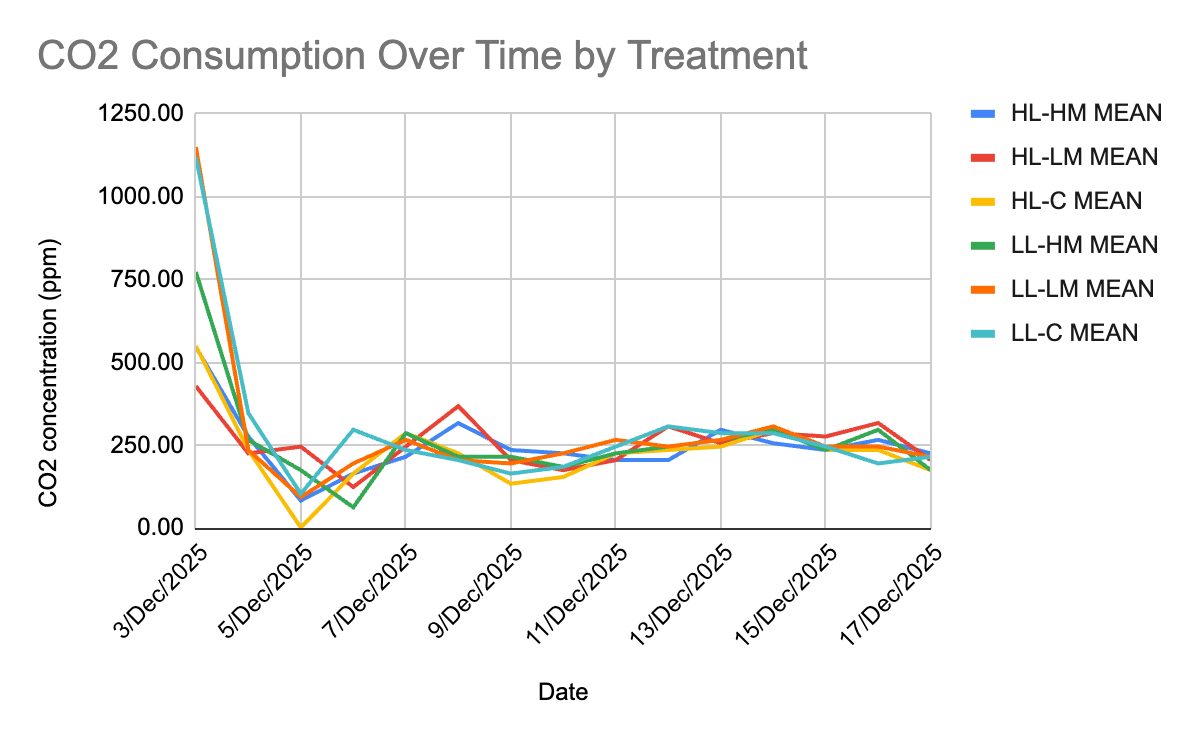
Over the 14-day experimental period (4-17th December 2025), CO2 concentrations had decreased across all treatment groups (Figure 2). After stabilizing from the inoculation day values (276.57 to 1251.22 ppm) (761.13 ± 318.68, mean ± sd), the initial CO2 readings on Day 1 ranged from 93.46 to 488.28 ppm (253.76 ± 107.76), whilst on Day 8, CO2 levels had lessened to a smaller range of 185.01-307.08 ppm across all treatment groups. Lastly, the final CO2 readings on Day 14 ranged from 154.5 to 246.05 ppm.
The CO2 consumption rates varied among treatment groups (Figure 2). The low-light control group (LL-C) displayed the highest rate of CO2 consumption (-9.40 ppm/day), whereas the high-light low-mass (HL-LM) (-1.45 ppm/day each; sd = 4.54 ppm/day) and low-light low-mass (LL-LM) (-1.45 ppm/day each; sd = 7.37 ppm/day) treatments showed the lowest rates.
Nitrate Consumption Patterns
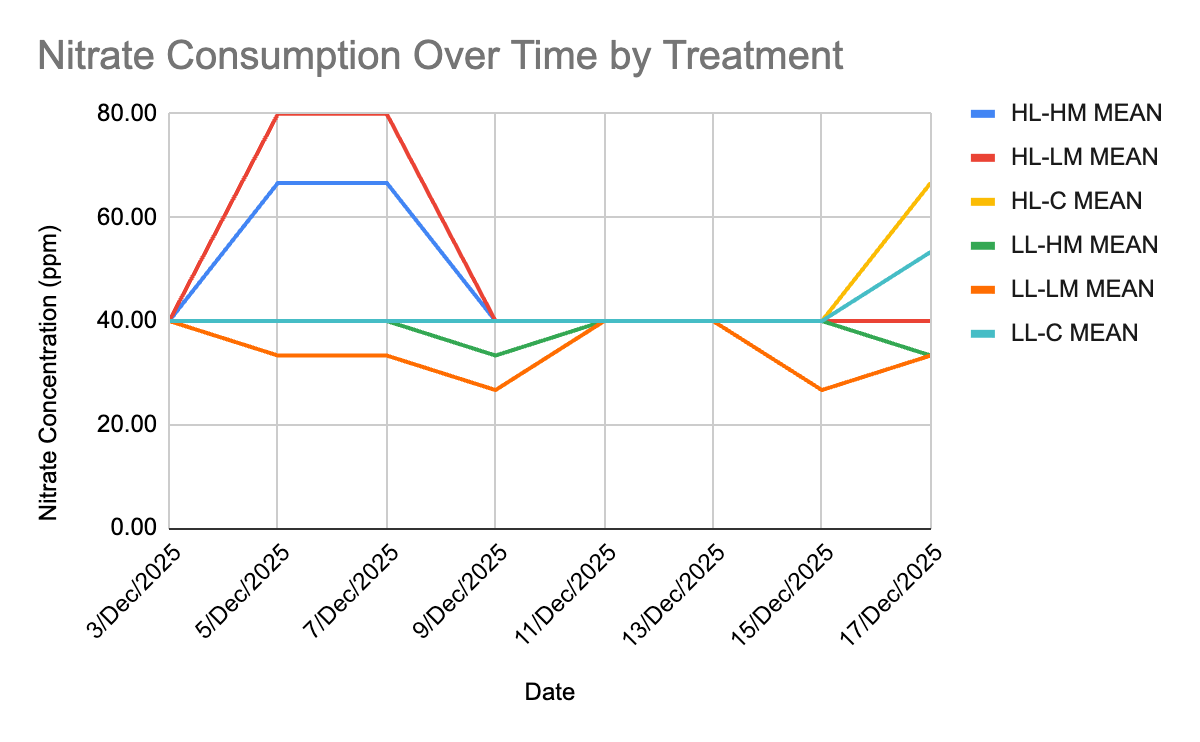
Across the experimental period, nitrate concentrations generally decreased (Figure 3). Initial nitrate readings on Day 1 ranged from 20-80 ppm (50 ± 19.70), with the high-light (HL) container mainly at ~80 ppm. By Day 8, nitrate levels stabilized at ~40 ppm across all containers. At the end of the experimental period, the nitrate concentrations ranged from 20-80ppm (44.44 ± 17.56).
Nitrate consumption rates varied across all treatment groups. The high-light treatments with algae (HL-HM and HL-LM) were the most photosynthetically active, with rates of –2.0 ppm/day (0.00 ppm/day) and –3.0 ppm/day (1.65 ppm/day), respectively, while the control containers (HL-C and LL-C) showed net increases of +2.0 ppm/day (1.65 ppm/day) and +1.0 ppm/day (1.65 ppm/day), respectively. This indicates that high lighting had a significant effect on nitrate uptake and played a greater role than initial algal mass.
Algal Growth Observations
Our qualitative data revealed an increase in algal growth throughout the experiment. Observations on Day 1 showed minimal algal clumping, which was barely noticeable in high-mass containers. However, no clumping was observed in low-mass or control containers. By Day 8, a distinct ~1 cm-thick layer had formed at the bottom of all containers containing algae. Dense, dark-green algal clumps were present by Day 12 across all treatment groups with algae. The most prominent growth was seen in the HL-HM, LL-HM, and LL-LM containers on the last day, which had the darkest algal clumps.
Statistical Analyses
We used a two-way ANOVA test to assess the effects of light level and algae mass on CO2 and nitrate consumption rates. Based on our test results, it was concluded that CO2 consumption, light level (F1,12 = 0.561, p = 0.468), algal mass (F2,12 = 0.815, p = 0.466), and their interaction (F2,12 = 0.171, p = 0.845) had no significant effects on CO2 uptake or nitrate consumption.
As for nitrate consumption, we found that algae mass did show a significant effect (F2,12 = 10.231, p = 0.00255), whilst light level (F1,12=3.769, p = 0.07605) and the light level:algal mass interaction (F2,12 = 3.769, p = 0.05367) showed little to no effect. Therefore, the treatment groups with higher algal mass showed greater nitrate consumption than the controls, indicating photosynthetically active algae.
Discussion
This study investigated the effects of light intensity and algal biomass on CO2 and nitrate consumption over a 14‑day period. We hypothesized that a high-light, high-algal-mass environment would increase CO2 consumption. However, the statistical analyses showed no significant differences between treatments. Suggesting that our system was more sensitive to nutrient uptake than to CO2 uptake. Through our experiment and results, we concluded that the algae were photosynthetically active. Therefore, we can attribute these unexpected results for CO2 consumption to supplier-specific algal conditions, methodological challenges, and inconsistencies in baseline conditions.
When we received the algae, the amounts of algal mass in each vial were noticeably unequal. This led to minute inconsistencies across the treatment groups. The manufacturer only states that each vial contains 0.03 L of the substance, including algae and growth medium. However, some vials could have been older and have grown over time compared to newer-packaged vials. This explanation seems plausible, as some vials had noticeably larger clumps of algae and a darker hue, indicating that there was more algae growth than in the other vials.
Unlike CO2, nitrate consumption is a more reliable indicator of algal activity because it is less susceptible to physical loss and does not mix with the environment as easily18. We also chose nitrate for its environmental relevance, since combining nitrate and phosphorus in excess amounts can “accelerate eutrophication, causing dramatic increases in aquatic plant growth and changes in the types of plants and animals that live in the stream”19. In this experiment, algal mass had a noticeable effect on nitrate consumption as the treatment groups containing algae consistently removed nitrate from the medium, whilst the control groups gained nitrate. It should also be noted that there may have been inconsistencies in the nitrate data collection, as the quantitative data are based on qualitative color observations, subjecting it to observer bias. This pattern seems reasonable, since algae require nitrogen to synthesize proteins, chlorophyll, and other compounds14. Consequently, containers with stronger nitrate uptake developed thicker algal layers. This makes sense, as eutrophication, the presence of excess nitrate in bodies of water, creates enormous algae blooms which cause an imbalance in oxygen levels in the water, suffocating other wildlife20. However, due to the nitrate-limited environment, this poses the question whether the maximum CO2 fixation had been reached due to the lack of nutrients within the container21. A lack of nitrogen can inhibit key cellular pathways, making it unable to use nitrate-based pathways to produce energy, consequently lowering CO2 fixation22. According to Jin et al. (2006),maintaining a ~15-20 ppm of nitrate allowed for an increase in exponential growth by 3 days, resulting in a high CO2 fixation23. Therefore, it is plausible that the addition of nitrate to each treatment group could have increased overall CO2 uptake rates.
The results raise the question of whether light mattered at all. A possible explanation is that both light levels were just sufficient for growth. Other factors that may have limited growth include nutrient levels in the initial algal culture and container conditions. In addition, temperature may have contributed to the limitations of our results. After further investigation, temperature can be a major factor, as we kept the treatment groups at a consistent room temperature. This could have caused a slower CO2 fixation along with preventing the synthesis of the D1 protein, which slows down PSII repair14. An increase in temperature could have resulted in a higher CO2 uptake and nitrate assimilation. Overall, nitrate consumption indicates that the algae were metabolically active, although we were unable to obtain the corresponding predicted CO2 values. Based on our results, algae may appear to be a very limited solution for climate mitigation, since this experiment detected only small differences in CO2 consumption. This may help explain why many researchers now focus on improving algal photosynthetic efficiency rather than only altering algal environmental conditions8. Our inability to detect strong environmental effects on CO2 consumption suggests that more precise measurements and careful experimental design are crucial for evaluating the true potential of algae towards climate change mitigation. However, our study outcomes are not completely null, as the strong nitrate consumption indicates the algae are metabolically active. Meaning that the main challenge in detecting CO2 consumption in this experiment may lie in instrument accuracy and in maintaining optimal conditions for CO2 measurement, such as in an enclosed system.
We found several limitations in our study, including sensor defects, a non-airtight system, a shortened experimental period, and a small scale. The CO2 sensor used was an older model that produced anomalous readings and occasionally caused repeated measurements. We originally calibrated the sensor using Vernier’s online instructions. It seemed to have functioned properly during calibration. However, this may have led to a loss of functionality over time. This seems plausible, as inoculation conditions varied across the experimental groups. Our design also implemented a semi-open system using Ziploc bags (zip-lock bags), which could have allowed gases to escape and mix with ambient air. As a result, this likely reduced our measurement accuracy and masked algal CO2 uptake. We used standard plastic zip-lock bags due to budget constraints and the lack of a specialized controlled‑air enclosure. This could have been another significant factor in our analogous readings. However, the loss of CO2 was less of a concern because CO2 is heavier than oxygen, so most of the CO2 remaining in the bag would settle at the bottom and would not have been as easy to lose. However, we still took cautionary actions such as not disturbing the gas inside the bag before opening it to take measurements, quickly opening and sealing the bag during measurements, and ensuring the bags were not compressed, which could release gas. Another factor that limited our study could have been that the 14-day duration was too short for the algae to acclimate and reach peak CO2 consumption and growth rate. There was also the risk of contamination from the containers, which we had not tested for any harmful substances to the algae. Finally, the small scale introduced many challenges. Such as limited gas exchange, measurement sensitivity, and time frames, which may differ from conditions in larger laboratories or natural systems. This limits our ability to predict how algae would behave in large-scale production.
For future work, we recommend using sealed, enclosed systems and more sensitive instruments to ensure accurate gas measurements and extend the experimental duration to allow for maximum algal growth. Future experiments should also explore the sensitivity required for instruments for this scale of experiment. Additional measurements, such as O2, pH, and algal biomass (in weight), would provide further insight into algal growth and gas exchange. Since light level and algal mass had no significant effect on CO2 consumption in this study, future experiments should test a wider range of light intensities, light colors, and algal masses.
Published research suggests that genetic modification may be necessary to boost CO2 absorption efficiency within algae. In addition, there can be further improvement in microalgal culture systems to better suit algal growth requirements24. However, these techniques are still emerging, and their application remains limited, as they depend on specialized and regulatory support in specific countries8. The modified algae could be scaled for real-world application to combat climate change; however, this requires further insight into nutrient constraints and ecological trade-offs for it to be a large-scale strategy25.
Consequently, this conclusion exceeds what this study can suggest. Although this experiment encountered challenges that masked clear CO2 results, the nitrate consumption by algae indicates biological activity and nutrient uptake. We concluded that, via improved experimental design and measurement techniques, algae’s role in CO2 uptake can be accurately assessed. Once improved, we will be able to determine if environmental optimization alone is sufficient or whether genetic enhancement is required for climate-mitigation applications.
Conclusion
In conclusion, contrary to our hypothesis, neither light level nor algal mass significantly affected CO2 consumption rates (p > 0.05), whilst algal mass significantly influenced nitrate consumption (p < 0.05), with higher biomass associated with greater nitrate uptake. CO2 consumption rates varied among treatments during the 14-day period. The low-light control group (LL-C) exhibited the highest rate of decline in CO2 consumption (-9.40 ppm/day), whereas the high-light low-mass (HL-LM) (-1.45 ppm/day each; sd = 4.54 ppm/day) and low-light low-mass (LL-LM) (-1.45 ppm/day each; sd = 7.37 ppm/day) treatments showed the lowest rates. Meanwhile, nitrate consumption rates varied across all treatment groups. The high-light treatments with algae (HL-HM and HL-LM) were the most photosynthetically active, with rates of –2.0 ppm/day (0.00 ppm/day) and –3.0 ppm/day (1.65 ppm/day), respectively, while the control containers (HL-C and LL-C) showed net increases of +2.0 ppm/day (1.65 ppm/day) and +1.0 ppm/day (1.65 ppm/day), respectively.
After analysis, we concluded that there were several limitations that could have affected our study’s accuracy and precision. These limitations include the use of an older Vernier CO2 gas sensor model, an experimental design that uses a semi-open system with Ziploc bags, an insufficient growing period, possible chemical contamination, and a small experimental scale. Even though they limit and complicate our interpretations, these limitations do not invalidate the entire study. As a matter of fact, they highlight the technical challenges of measuring CO2 on a small-scale and semi-open system and provide insight into the best approach for future experiments.
By implementing sealed systems and more sensitive devices, it will ensure more accurate gas measurements for future research. In addition, extending the experimental duration could allow for maximum algal growth rate, allowing full analysis of the maximum potential of algae. To provide further insight, additional measurements, such as O2, pH, and algal biomass, could be taken. This study suggests that environmental factors may play a limited role in CO2 uptake and that the algae may require genetic modification to enhance photosynthetic activity. However, these techniques are still emerging, and their application remains limited because they require specialized expertise and regulatory support in specific countries.
Although the limitations of this study prevented us from drawing conclusions about algal CO2 uptake, the apparent nitrate consumption indicates that the algae were photosynthetically active. To accurately evaluate algae’s ability to lessen atmospheric CO2, we recommend that future studies use more airtight experimental setups and more precise measurement tools. Through such refinements, the potential of algae can be studied to its full extent, determining whether it requires genetic modification or can naturally achieve meaningful real-world climate mitigation.
References
- G. Martinez, B. Drion, J. Gladstone, A. Vidal. Nature-based Solutions for corporate climate targets: views regarding the corporate use of Nature-based Solutions to meet net-zero goals. IUCN, International Union for Conservation of Nature, 2023. [↩] [↩]
- U. Nations. What is climate change? United Nations https://www.un.org/en/climatechange/what-is-climate-change. [↩]
- Evidence – nasa science. https://science.nasa.gov/climate-change/evidence/ 2022. [↩]
- O. US EPA. Carbon dioxide emissions. https://www.epa.gov/ghgemissions/carbon-dioxide-emissions 2025. [↩]
- T. Thiedemann, M. Wark. A compact review of current technologies for carbon capture as well as storing and utilizing the captured co2. MDPI https://www.mdpi.com/2227-9717/13/1/283 2025. [↩]
- Nature-based solutions for climate | iucn. https://iucn.org/our-work/topic/nature-based-solutions-climate 2025. [↩]
- A. Pessarrodona, R. M. Franco-Santos, L. S. Wright, M. A. Vanderklift, J. Howard, E. Pidgeon, T. Wernberg, K. Filbee-Dexter. Carbon sequestration and climate change mitigation using macroalgae: a state of knowledge review. Biological Reviews. Vol. 98, pg. 1945–1971, 2023, https://doi.org/10.1111/brv.12990. [↩]
- B. Barati, K. Zeng, J. Baeyens, S. Wang, M. Addy, S.-Y. Gan, A. El-Fatah Abomohra. Recent progress in genetically modified microalgae for enhanced carbon dioxide sequestration. Biomass and Bioenergy. Vol. 145, pg. 105927, 2021, https://doi.org/10.1016/j.biombioe.2020.105927. [↩] [↩] [↩]
- M. Ashour, A. T. Mansour, Y. A. Alkhamis, M. Elshobary. Usage of chlorella and diverse microalgae for co2 capture – towards a bioenergy revolution. Frontiers in Bioengineering and Biotechnology. Vol. 12, 2024, https://doi.org/10.3389/fbioe.2024.1387519. [↩]
- J. B. Shurin, M. D. Burkart, S. P. Mayfield, V. H. Smith. Recent progress and future challenges in algal biofuel production. F1000Research. Vol. 5, pg. f1000 faculty rev, 2016, https://doi.org/10.12688/f1000research.9217.1. [↩]
- M. Taziki, H. Ahmadzadeh, M. A. Murry, S. R. Lyon. Nitrate and nitrite removal from wastewater using algae. Current Biotechnology. Vol. 4, pg. 426–440, 2015,. [↩]
- G. Li, J. Yao. A review of algae-based carbon capture, utilization, and storage (algae-based ccus). MDPI https://www.mdpi.com/2673-5628/4/4/24 2024. [↩]
- P. Gururani, P. Bhatnagar, V. Kumar, M. Vlaskin, A. Grigorenko. Algal consortiums: a novel and integrated approach for wastewater treatment. MDPI https://www.mdpi.com/2073-4441/14/22/3784 2022. [↩]
- F. M. Ekpan, M. O. Ori, H. S. Samuel. Effects of environmental factors and nutrient availability on the biochemical composition of algae for biofuel production. Discover Applied Sciences. Vol. 7, pg. 1209, 2025, https://doi.org/10.1007/s42452-025-07363-w. [↩] [↩] [↩]
- X. Zhao, X. Chai, G. Liu, Y. Hao, Y. Zhao. Characteristics of light regime on biofixation of carbon dioxide and growth of scenedesmus obliquus with light-emitting diodes. Journal of Renewable and Sustainable Energy. Vol. 6, pg. 033104, 2014, https://doi.org/10.1063/1.4873398. [↩]
- R. A. Fisher. Statistical methods for research workers. in Breakthroughs in Statistics: Methodology and Distribution (eds S. Kotz & N. L. Johnson) pg. 66–70, Springer, New York, NY, 1992. https://doi.org/10.1007/978-1-4612-4380-9_6. [↩]
- E. Sanz-Luque, A. Chamizo-Ampudia, A. Llamas, A. Galvan, E. Fernandez. Frontiers | understanding nitrate assimilation and its regulation in microalgae. frontiers https://www.frontiersin.org/journals/plant-science/articles/10.3389/fpls.2015.00899/full 2015. [↩]
- K. S. Johnson, M. R. Mazloff, M. B. Bif, Y. Takeshita, H. W. Jannasch, T. L. Maurer, J. N. Plant, A. Verdy, P. M. Walz, S. C. Riser, L. D. Talley. Carbon to nitrogen uptake ratios observed across the southern ocean by the soccom profiling float array. Journal of Geophysical Research: Oceans. Vol. 127, pg. e2022JC018859, 2022, https://doi.org/10.1029/2022JC018859. [↩]
- 5.7 nitrates | monitoring & assessment | us epa. https://archive.epa.gov/water/archive/web/html/vms57.html. [↩]
- (PDF) eutrophication: causes, consequences, and controls in aquatic ecosystems. ResearchGate https://www.researchgate.net/publication/285683019_Eutrophication_Causes_consequences_and_controls_in_aquatic_ecosystems. [↩]
- E. Cointet, G. Wielgosz-Collin, G. Bougaran, V. Rabesaotra, O. Gonçalves, V. Méléder. Effects of light and nitrogen availability on photosynthetic efficiency and fatty acid content of three original benthic diatom strains. https://doi.org/10.1371/journal.pone.0224701. [↩]
- P. M. Glibert, F. P. Wilkerson, R. C. Dugdale, J. A. Raven, C. L. Dupont, P. R. Leavitt, A. E. Parker, J. M. Burkholder, T. M. Kana. Pluses and minuses of ammonium and nitrate uptake and assimilation by phytoplankton and implications for productivity and community composition, with emphasis on nitrogen-enriched conditions. Limnology and Oceanography. Vol. 61, pg. 165–197, 2016, https://doi.org/10.1002/lno.10203. [↩]
- H.-F. Jin, B.-R. Lim, K. Lee. Influence of nitrate feeding on carbon dioxide fixation by microalgae. Journal of Environmental Science and Health, Part A. Vol. 41, pg. 2813–2824, 2006, https://doi.org/10.1080/10934520600967928. [↩]
- Microalgae-based carbon capture and utilization: a critical review on current system developments and biomass utilization. Taylor & Francis. [↩]
- P. Anugerahanti, J. Palmieri, C. A. Baker, E. Popova, A. Yool. The impact of large-scale macroalgae cultivation and harvesting strategies on the marine carbon dioxide removal efficacy and marine biogeochemistry. Preprint at https://egusphere.copernicus.org/preprints/2025/egusphere-2025-5360/ 2025 https://doi.org/10.5194/egusphere-2025-5360. [↩]