
Abstract
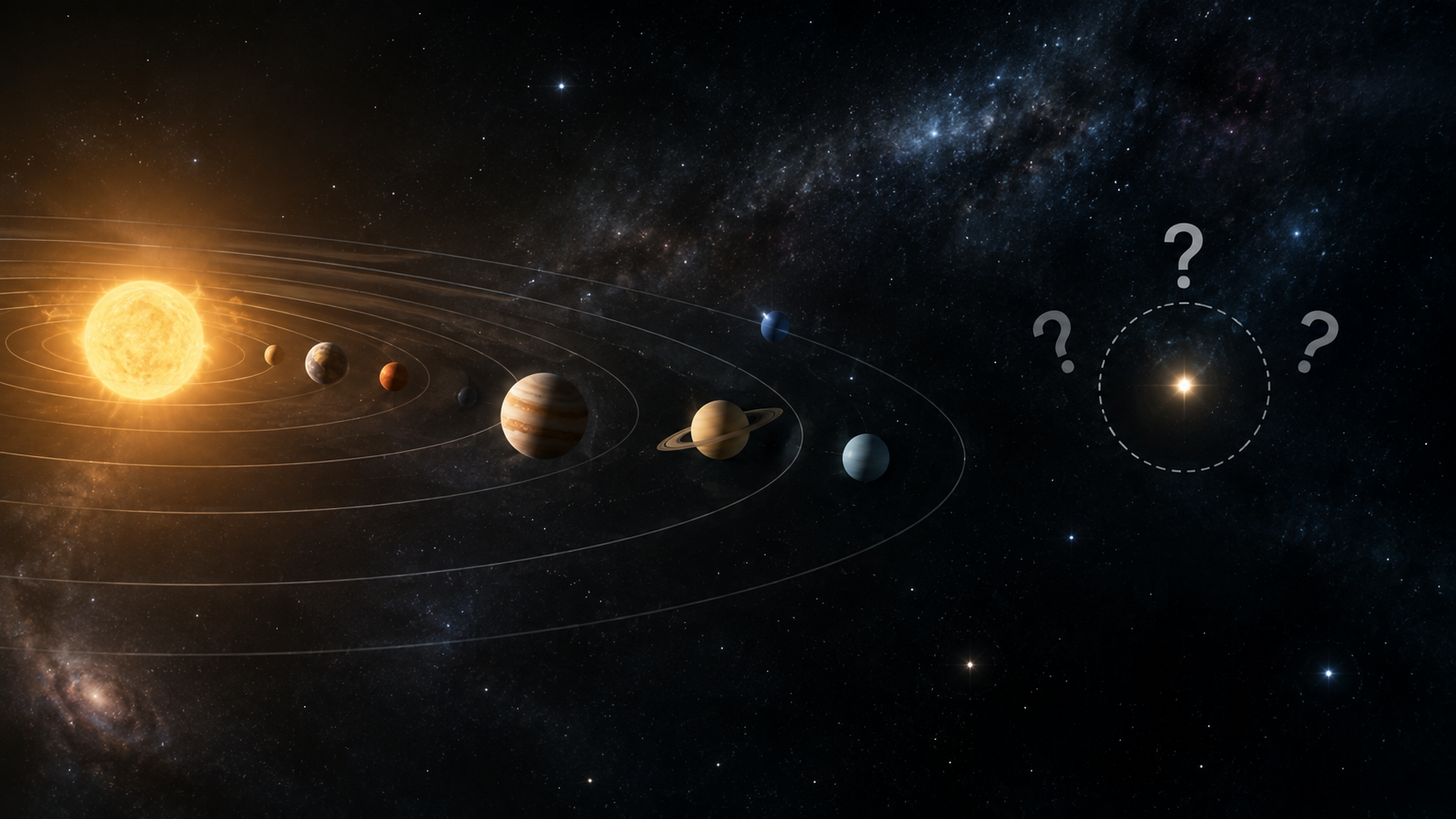
Stars in the universe do not always have planets revolving around them, raising a question about the factors that influence planet formation in both positive and negative ways. This literature review elaborates and explores reasons why some stars can’t host planetary systems. To investigate, NASA websites and astronomical articles were used. There is a focus on the factors influencing stellar metallicity, binary star systems, various cosmic phenomena and cosmic dynamic disruptions like gravitational slingshots. Findings elucidate that low metallicity reduces heavy elements, which restricts planet formation, and binary star systems with intense radiation disrupt planetary disks. Finally, many results imply that a combination of physical factors and environmental effects determine whether planets evolve around a star, providing an insight into the intricacy of planet formation in intergalactic space.
Keywords: Protoplanetary Disk, Stellar Metallicity, Star Clusters, Binary Stars, Orphaned Stars
Introduction
The night sky is filled with billions and trillions of stars1, leading us to wonder if each of them has planets revolving around them just like our solar system. Over the last three decades, scientists have conducted various studies and investigations and already have discovered thousands of planets in the universe. On the other hand, scientists have also discovered many stars drifting alone in the nothingness2, which raises a fascinating but important question: “Why isn’t every star part of a planetary system?”
The formation of a star includes the formation of a surrounding disc consisting of gas and dust, called the protoplanetary disk3. Under the right stellar environment, planets can form around the stars in the discs, forming planetary systems. However, this formation of a planetary system is blocked by various conditions, like the star not being able to keep the disc long enough to support planet formation, the formation of binary companions or triplets, and furthermore, gravitational interactions in star clusters due to a third-party celestial body4. Moreover, some stars drift alone in the darkness and get orphaned from their galaxies and star clusters due to supernovae or black hole slingshots5.
Additionally, our observations are limited by the tools utilized and several biases. For instance, Malmquist bias restricts scientists to detect the brighter and bigger stars, overlooking the existence of the fainter ones, which may or may not have planets around them6. This literature review research paper will explore why some stars don’t share their journey with planets.
Methodology
This study employs a structured literature-review methodology to address the question: Why Isn’t Every Star Part of a Planetary System? This study relies exclusively on secondary sources, utilizing existing research of star formation, protoplanetary disks, and stellar environments, rather than the collection of new primary numerical data.
A systematic study was conducted using Google Scholar as the primary research engine. Key terms include stellar metallicity, planet formation and stability, binary star systems, and orphaned/rogue stars. Titles, abstracts, and keywords were synthesized to shortlist peer-review research journals. Additionally, NASA-hosted webpages were used to obtain summaries of results and mission-based findings.
Thematically, an outline of the research paper was developed, which progressed from general processes to key dynamic factors that hinder certain stars from hosting planetary systems. As the methodology is based on secondary sources, the conclusion is layered due to selection biases and detection limits of the original surveys, yet this approach provides a detailed evidence-based explanation for the respective research question.
How Do Planets Form Around Stars?
Planets form around the stars in regions called protoplanetary disks. Protoplanetary disks quickly form due to the initial collapse of a molecular cloud, and the density of the center increases rapidly7, followed by the formation of a protostar in the center, which continues the accretion of material from the surrounding disk. Planets form by the clumping of the leftover ice and dust around a newly created protostar by a process called accretion. Then, the clumps grow further to form larger bodies called planetesimals or protoplanets8. The planets closer to the star experience very high temperatures, allowing the metallic elements to condense, and making them small, hard, and rocky. While the planets are very far away from the star, beyond the frost line in a protoplanetary disk envelope which contains a huge number of gases, forming gas giants like Jupiter and Saturn9.
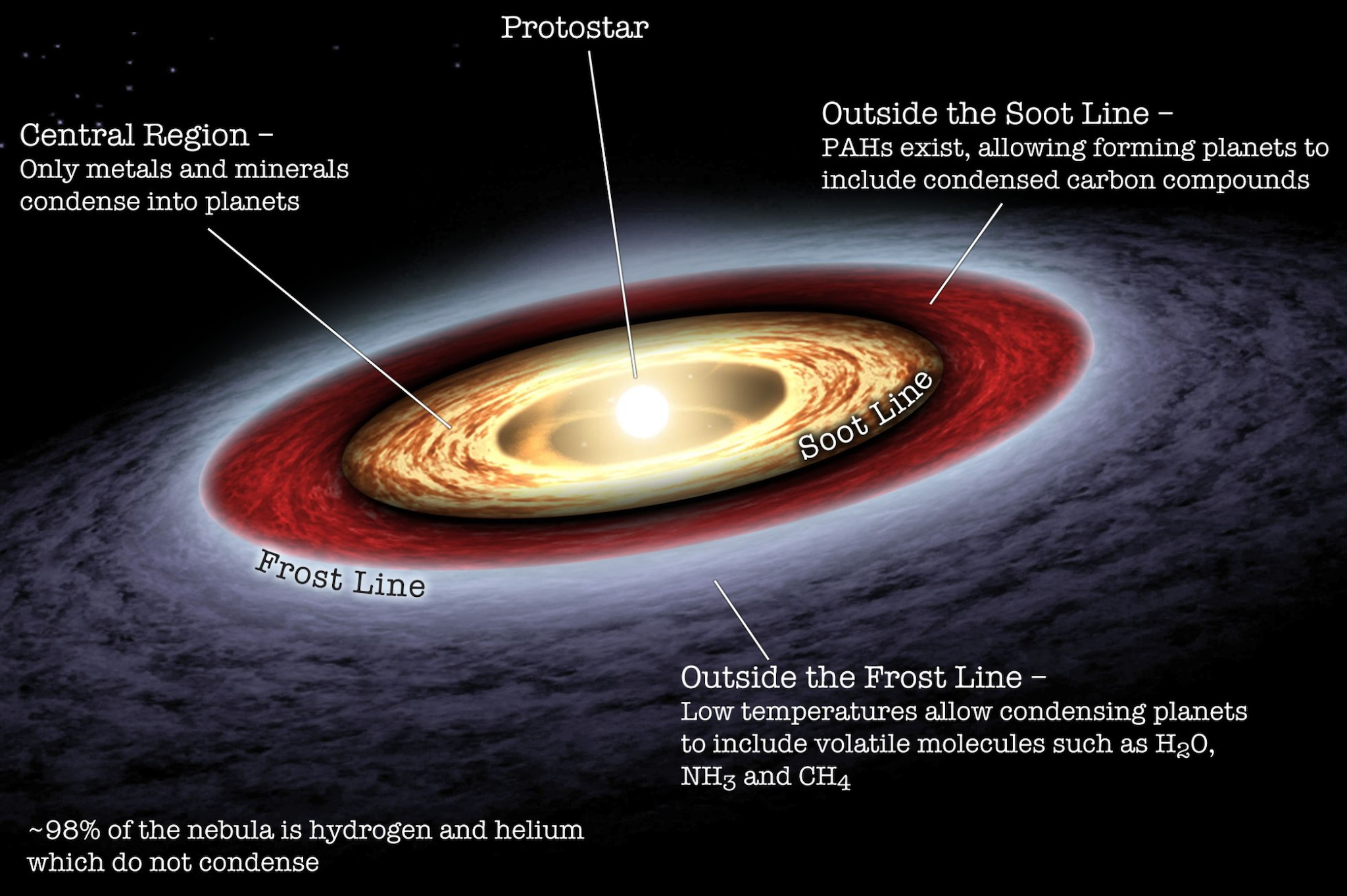
Planet formation can only occur under certain favourable conditions. As the protostar in the center continues to accrete the matter in the protoplanetary disk, the mass of the gas and dust increases. For gas-giant planets, models generally necessitate solid cores with masses that are several times that of Earth. In contrast, terrestrial planets can develop across a wider spectrum of masses, ranging from sub-Earth to several Earth masses, influenced by factors such as disk temperature and composition10. Additionally, the proper time before the disk disperses also plays a pivotal role in planet formation. Due to accretion by the protostar, the protoplanetary disk disperses, and the disk can no longer support a suitable environment for planet formation11. Before then, the protoplanetary disks can provide a birth environment for planets for an estimated 1 to 10 million years12.
Factors Influencing Planet Formation
The two most important factors that shape whether planets can form around a star are its metallicity & surrounding environment. While the metallicity decides how many heavy elements are available to build planets, the environment impacts the available duration of surrounding disks of materials.
Stellar Metallicity
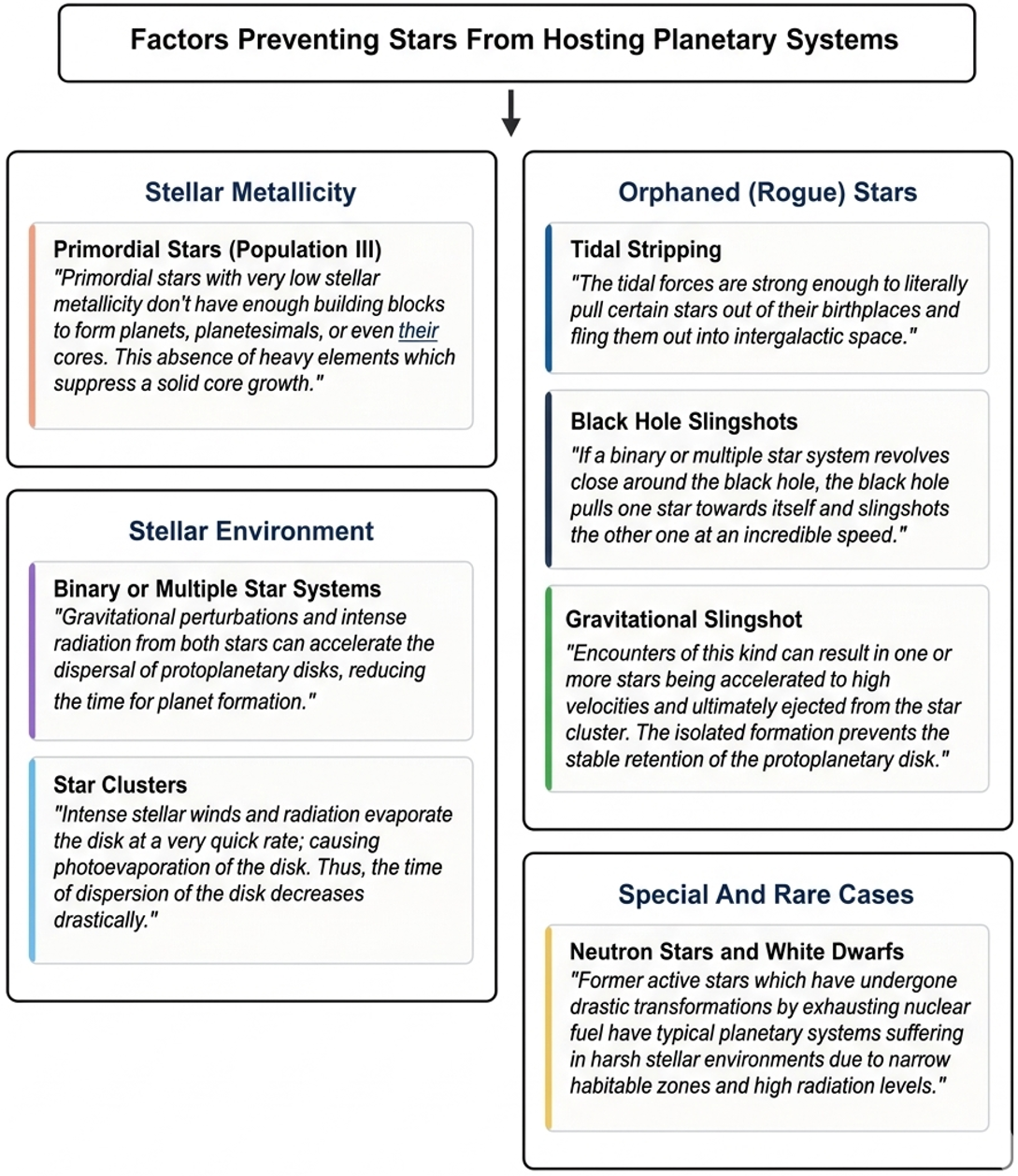
The formation of planets depends heavily on the chemical makeup of a star and its surrounding protoplanetary disk. Firstly, primordial stars with very low stellar metallicity don’t have enough building blocks to form planets, planetesimals, or even their cores. They simply can’t become part of planetary systems13.
The dependence of planet formation on stellar metallicity remains to be an area of active investigations. Population III stars, characterised with approximately zero metallicity, might be considered unlikely to be hosting planetary systems around them, due to the absence of heavy elements which suppress a solid core growth. However, this inference remains to be highly uncertain due to lack of observational evidence.
Meanwhile, Population II stars with low stellar metallicities are capable of hosting planetary systems, particularly terrestrial planets. Many observational studies indicate that the occurrence rate of small, terrestrial planets exhibits a weak dependence on stellar metallicity, whereas gas-giant formation correlates with high metal abundance.
Population I stars, possessing solar or super-solar metallicities, have the highest probability of hosting planetary systems. Increased metal availability facilitates both terrestrial and rapid core accretion for the formation of a gas-giant. Overall, ongoing theoretical efforts continue to refine the role of stellar metallicity in shaping planet formation, composition and planetary system architecture14.
Measurement of stellar metallicity
Scientists discover different elements in a star by using a powerful technique called spectroscopy in astronomy. Spectroscopy helps scientists to understand the chemical makeup of the outer layer of a star.
All layers of the star emit light which passes through its atmosphere and atoms in the layers emit light with different wavelengths. Unique wavelengths appear in a device called a spectrograph as dark or bright lines, depending on the type of the spectrum. An absorption spectrum shows dark lines, while an emission spectrum shows brighter lines. Absorption lines occur when a continuous spectrum passes through a cooler gas, while emission lines occur when a hot gas is viewed against a dark background. This distinction is highly significant for the understanding of how stellar spectra are interpreted. By matching the observed lines with those measured in laboratories on the Earth, scientists identify the elements in a star. Additionally, the width and the intensity of a spectral line is used to determine the abundance of that element in the star15.
Each element has different spectral lines, because all of them have different electronic configurations. Thus, when the electrons absorb just the right energy from the photons, they jump to a higher energy level, creating dark lines in a continuous spectrum. Just like how a fingerprint acts as a unique identifier for a person, the spectral patterns are unique for every element16.
Stellar Environment
The kind of stellar environment a star is in, whether a binary system or a crowded cluster, has a big impact on whether planets can form because it affects how long the surrounding disks of material can actually last.
Binary or multiple star systems
Binary or multiple star systems form when a single collapsing molecular cloud produces two or more dense regions, each heavy and compact enough to create stars. Each region collapses independently, resulting in stars that revolve around one another. The majority of systems arise from fragmentation during the star formation process17.
Despite the complex gravitational dynamics, many planets like Kepler-16b have been discovered to revolve around binary star systems. Instead of the presence of a companion, it’s actually the orbital configuration and separation between the stars that matters.
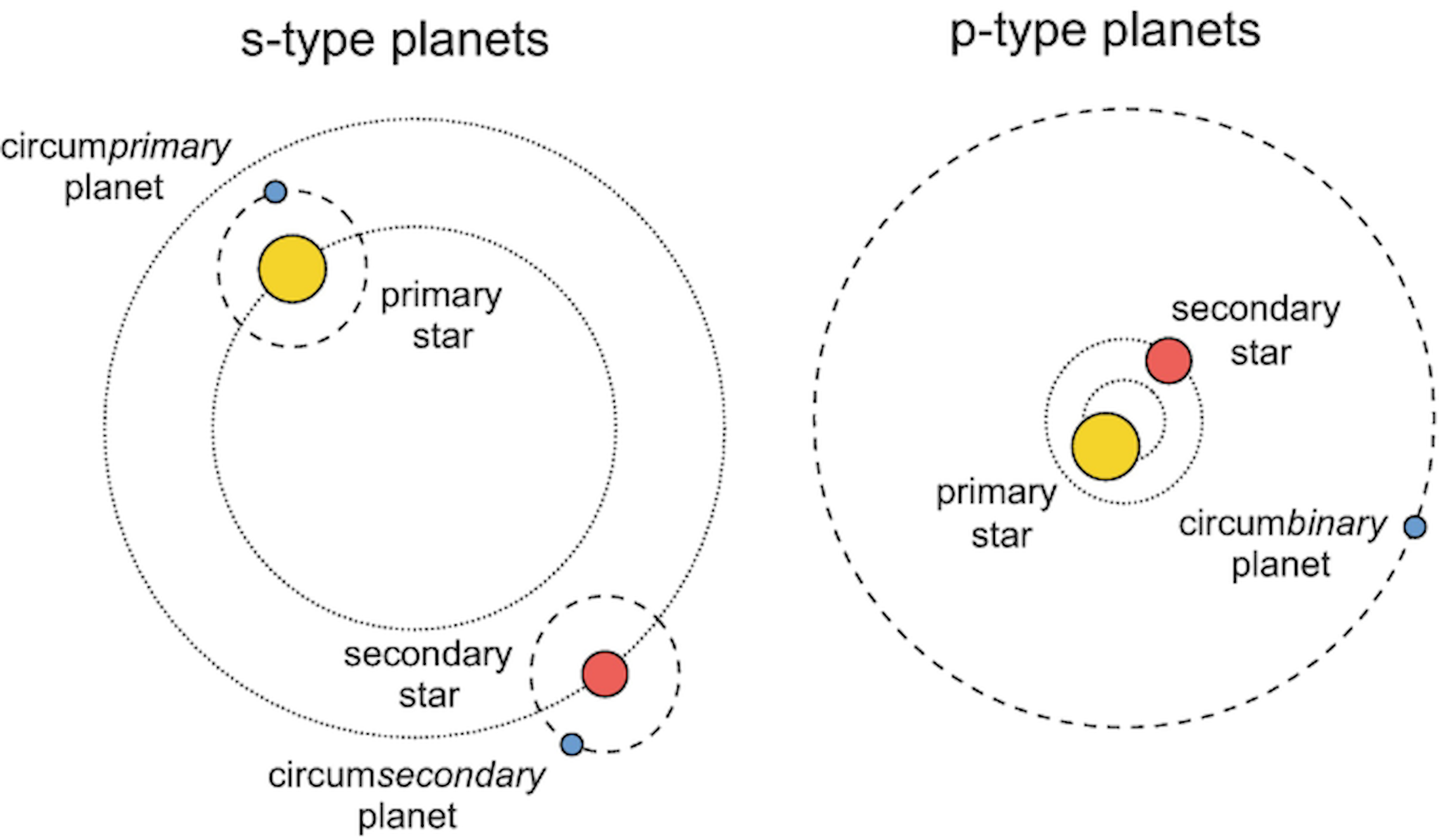
Two main types of planetary orbits are distinguished:
- S-type (Satellite-type) orbits: In this configuration, the planet orbits around one of the stars, while the companion acts as a distant perturber. In wide binaries, where the separation is large, planets can revolve in a manner similar to those in singular star planetary systems.
- P-type (Circumbinary) orbits: The planet orbits around both of the stars about their common center of masses. In close binaries, stability is attainable beyond a specific radius where the combined gravitation forces become smooth enough to support long-term orbits.
Gravitational perturbations and intense radiation from both stars can accelerate the dispersal of protoplanetary disks, reducing the time for planet formation. However, numeric and observational investigations show that planets can exist in both S-type and P-type orbits configurations, provided that the binary is dynamically stable and the orbital & radii parameters fall within favourable ranges. Ongoing investigations focus on how orbit eccentricity, binary separation, and disk properties mould the frequency of planetary systems existing in such environments18.
Star Clusters
Similarly to binary systems, due to the high proximity among stars in a cluster, the protoplanetary disks get destroyed very quickly. Moreover, intense stellar winds and radiation evaporate the disk at a very quick rate; causing photoevaporation of the disk. Thus, the time of dispersion of the disk decreases drastically, which leads to failure of star clusters supporting planet formation19.
However, observations depict that planet systems can and do form in star clusters. Scientists have discovered many stars hosting planetary systems in open star clusters like Pleiades and Hyades. Current research demonstrates that clustered environments may suppress disk lifetimes, reducing planet occurrence rates, but they do not inhibit planet formation universally. The degree to which stars can support planetary systems depends on the local density and the frequency of gravitational interactions20.
Orphaned (Rogue) Stars Without Planetary Systems
Orphaned stars are solitary bodies which drift alone in the vast emptiness, unbound to any galactic system. Intergalactic or rogue stars wander in intergalactic space21.
Orphaned stars are extremely faint, making their detection very hard. Their collective light only appears as a ghostly glow within other galaxy clusters. Meanwhile, orphaned stars play a vital role in helping humans understand galactic interactions and mapping matter in star clusters. Recent astronomical surveys convey information about many more orphan stars existing currently, than the previous estimations22.
How Do They Become Orphaned?
Gravitation interactions during galaxy mergers and dynamic ejection from star clusters remove the stars from their origin, and turn them into orphan stars.
When galaxies interact or collide with each other, they create immense gravitational forces which cause a process, called tidal stripping. The tidal forces are strong enough to literally pull certain stars out of their birthplaces and fling them out into intergalactic space23.
There are supermassive black holes lying in the center of many spiral galaxies. If a binary or multiple star system revolves close around the black hole, the black hole pulls one star towards itself and slingshots the other one at an incredible speed24. The resulting cosmic interaction, often called a black hole slingshot, is responsible for creating hypervelocity stars. Hypervelocity stars are said to be among the fastest moving stars ever observed by humans25.
Another space phenomenon, known as gravitational slingshot or dynamic ejection, can lead to a star becoming orphaned26. In crowded star clusters, gravitational interactions often take place among three or more celestial bodies. Encounters of this kind can result in one or more stars being accelerated to high velocities and ultimately ejected from the star cluster27.
Why Do They Lack Planets?
Orphan (rogue) stars lack planets mainly because of their circumstances like violent gravitational interactions and isolated formation. The isolated formation prevents the stable retention of the protoplanetary disk inhibiting planetary system formation28.
When stars are ejected from their birth environments by stellar kicks, supernova explosions, gravitational slingshots, or black hole slingshots, theoretical models say that such events can strongly perturb or even strip away protoplanetary disks. These scenarios have sudden acceleration or gravitational disruptions which may disperse the gas reservoirs leaving limited material behind for planet formation. All orphaning mechanisms typically act in dense environments, for example star clusters, where many stars crowd together leading to rapid disk dispersal, thereby putting various constraints and limitations for formation & survival of planetary systems29. Planets require steady gravitational conditions to form, whereas orphaned stars drift in isolation, lacking influence from any nearby bodies which impedes them from coming together as a unified whole.
How Do Scientists Detect Planets and Their Detection Limitations?
Astro-scientists detect planets around stars using two methods: the Doppler effect and the planet’s transit around the star.
Doppler Effect
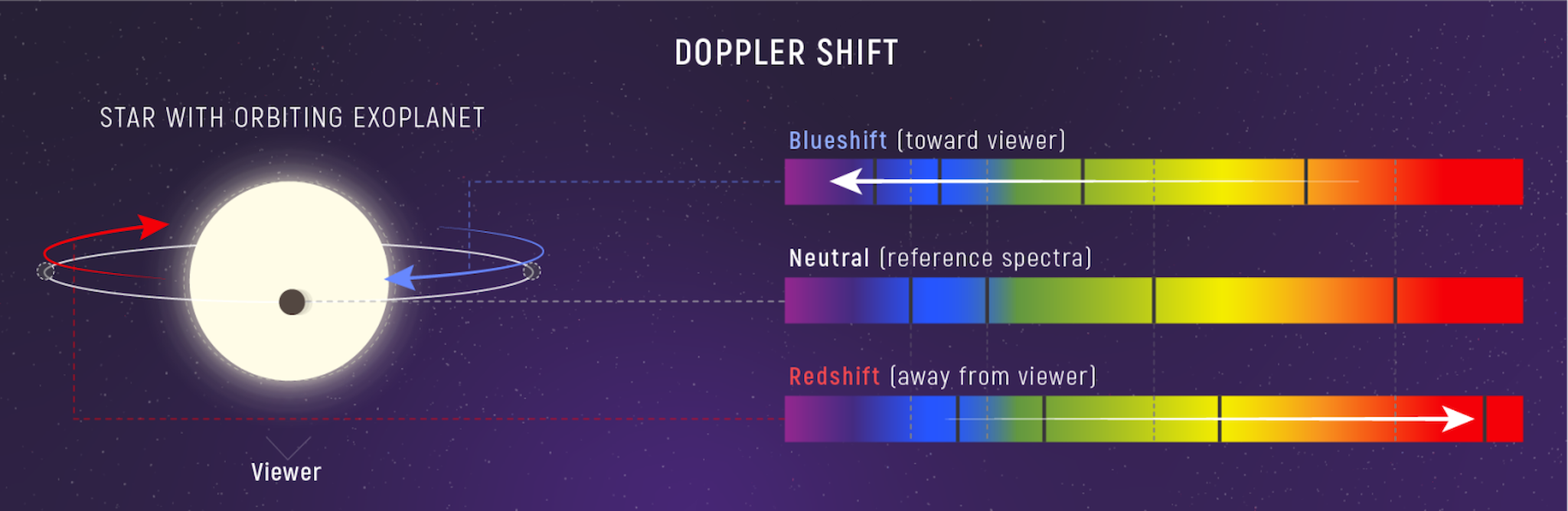
The Doppler effect is a major technique used by astronomers to detect planets around stars which cannot be directly seen. When a planet revolves around a star, the gravity from the planet makes the star wobble slightly, causing the star to move in a very tiny orbit around their common center of mass. Due to the wobble, the star moves either towards or away from us and experiences a Doppler effect. Its light waves compress towards the blue wavelength in the spectrum when the star moves closer; similarly, the light waves stretch towards the red wavelength in the spectrum when the star moves away30. Basically, when the star moves towards us, the waves get compressed, and the frequency of the waves increases (bluer wavelength). Meanwhile, when the star moves away from us, the waves get stretched, and the frequency of the waves decreases (redder wavelength). Detecting minute changes in the wavelengths requires a technique called Doppler spectroscopy31.
Additionally, there are certain key limitations when astronomers use the Doppler effect. The Doppler effect is sensitive to certain orbits and can only detect planets orbiting their stars along the line of sight from the Earth. Moreover, the method favours large close-in planets which produce larger wobbles, making their detection easier32. Very precise and expensive instruments are required when detecting smaller planets. Furthermore, stellar storms, turbulent surfaces, or stellar flares can make planetary system detection very hard; therefore, planetary systems around active stars become a limitation when using the Doppler effect.
Equation Of Measuring Doppler Shift of Light
(1) 
Here:
 is the change in the wavelength (
 ),
),  is the original wavelength emitted by the source,
  is the star’s velocity towards or away from the Earth, and
  is the speed of light (approximately
  ). Specifically,
  is the wavelength measured by the observer on Earth which may be longer if the star is moving away, or may be shorter if the star is moving closer, revealing the motion of astronomical objects29.
This equation is valid for non-relativistic velocities with the limitation of  . In this domain, the full relativistic doppler formula simplifies to this one linear equation. This equation correctly describes the small wavelength shifts seen in stellar spectra as the stars get pulled by their planets, since a typical star wobbles on the order of tens of metres per second, which is far below the speed of light33.
In practice, astronomers measure the doppler shift by comparing the data from absorption lines received for a respective star to their fixed laboratory wavelengths. High-resolution spectrographs are used to spread the starlight into a detailed spectrum. If the small shifts are towards blue, then the star moves towards the Earth, but if the shifts are towards red, then the star moves away from the Earth.
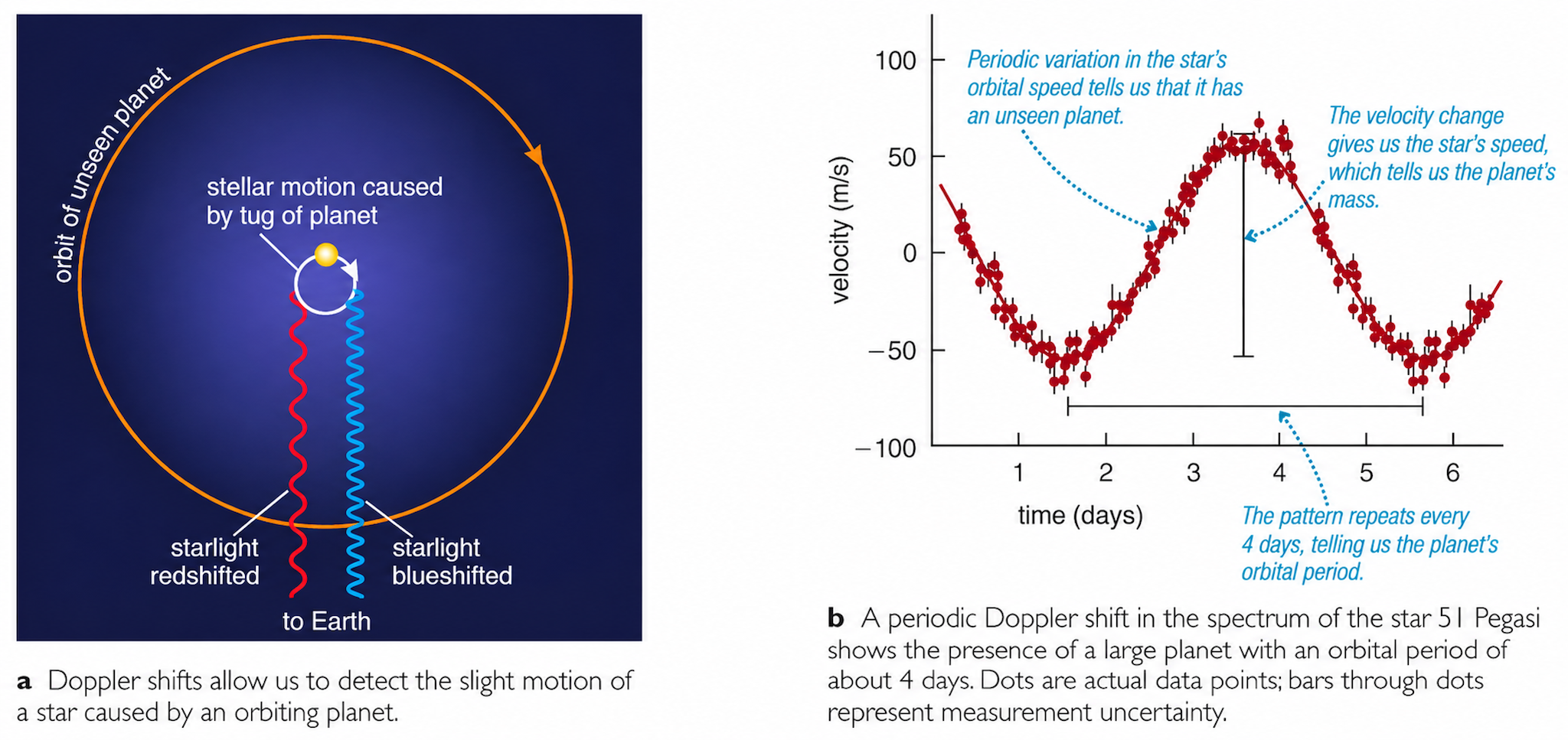
These small shifts are then tracked over time and are converted to radial velocities. This allows the astronomers to draft a radial-velocity curve that shows how the star’s light varies with time. This graph is then fitted with a periodic curve that allows the scientists to infer the presence of an unseen companion.
The amplitude of each oscillation is proportional to the planet’s mass and inversely proportional with the star’s mass and orbital distance. The doppler shift equation becomes the fundamental tool that translates subtle wavelength shifts into quantitative evidence for an orbiting planet34.
Transiting Planets
Transiting planets helps scientists detect exoplanets by observing the change in brightness of a star, when the planet passes in front of (transit) the star, as seen from the Earth.
When a planet crosses the star, a dip occurs in the starlight measured by instruments on Earth. The dip repeats periodically as the planet moves in front of the star each time an orbital period completes.
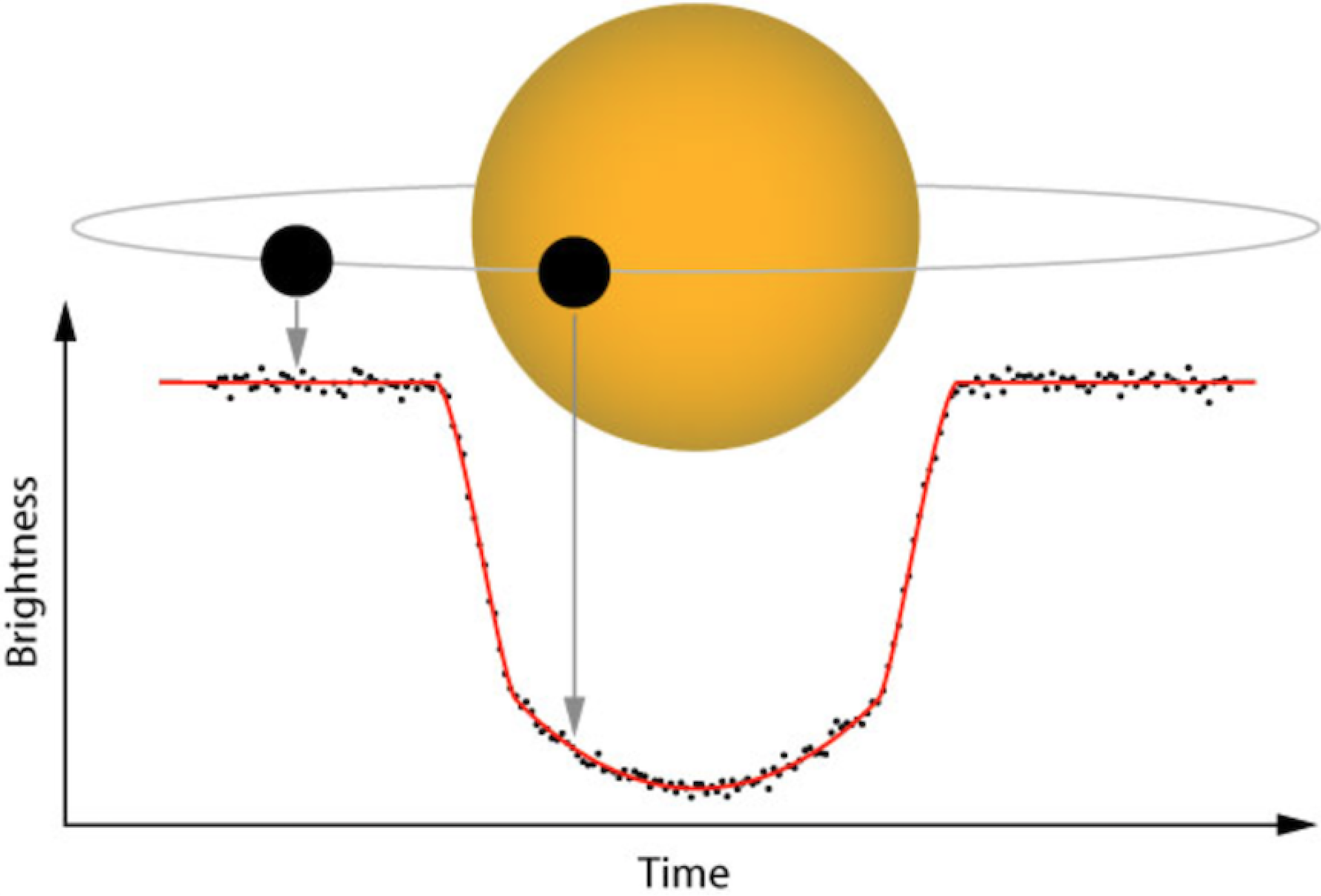
Under ideal conditions, like a perfectly circular orbit, a planet being much smaller than the star, and a perfect view from Earth, the dip in the star’s brightness follows the formula:
(2) 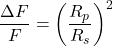
Here,  is the planet’s radius and
  is the star’s radius. This equation directly links the transit depth to the fractional area blocked by the planet. However, this requires a precise knowledge about the star’s radius and high-cadence photometry to measure
  accurately, typically demanding space-based telescopes like Kepler and TESS which help in reducing the noise35. Multiple planetary systems can be identified if several dips occur at regular intervals, showing several planets orbit the same star. Additionally, the transit method helps measure the type and metallicity of planets. When a planet has an atmosphere, starlight passes through the layer, allowing scientists to analyze the chemical elements present and distinguish whether the planet is rocky like Earth or a gas giant similar to Jupiter36.
Similarly to the Doppler effect, the method of transiting planets requires the planets to be aligned so they are visible from Earth. Additionally, some false positives exist like solar spots or eclipsing by a binary system, and these exceptions can be tested by other methods.
Special And Rare Cases
Neutron stars and white dwarfs are former active stars which have undergone drastic transformations by exhausting nuclear fuel37. Even though the celestial bodies cannot theoretically host planetary systems, some exotic planet systems have been found to exist, but only in rare circumstances.
The first confirmed exoplanets were found to be revolving around the pulsar PSR B1257+12, a millisecond neutron star. These systems are thought to be second-generation planets, formed by the debris disk formed either before or after the supernova event. Many follow-up surveys have identified various pulsars, and have found only a handful of such systems which shows that planet formation is rare around neutron stars, but not impossible38.
Observations also show that planetary systems can persist around white dwarfs. Recent studies using the James Webb Space Telescope (JWST) have found giant planets revolving around white dwarfs, including two systems around the metal-polluted white dwarfs, WD 1202‑232 and WD 2105‑82. In these systems, JWST’s Mid-Infrared Instrument (MIRI) had discovered planets at the separations of 11-12 AU and 34-35 AU, respectively, with masses inferred at the order of 1-7 Jupiter masses. These detections convey that these outer planets have likely survived the red-giant phase and subsequent mass loss, by attaining different configurations as the star transitioned into a white dwarf39.
All such stars can only host exotic planetary systems, while typical planets suffer in harsh stellar environments due to narrow habitable zones and high radiation levels. Hence, ordinary, stable, and life-friendly planetary systems form only around regular stars.
| Factor | Mechanism of prevention of planet formation | Relative severity and impact on planet formation |
| Stellar Metallicity | Lack of heavy elements hinders solid core accretion and formation of protoplanetary disks. | Relatively high for gas giants (Restricted to Population III and Population II stars), meanwhile, very low for terrestrial planets. |
| Binary Star Systems | Harsh gravitational perturbations and intense cosmic radiation can accelerate protoplanetary disk dispersal. | Affects planet formation moderately, because it can be hindered, but remains possible in dynamically stable S-type or P-type systems. |
| Star Clusters | Photoevaporation from intense stellar encounters and winds can lead to rapid disk dispersal. | Moderate to high effect as local gravitational interactions can drastically shorten the disk lifetime. |
| Orphaned Stars | Ejection via harsh cosmic events like tidal stripping, gravitational slingshots, or stellar kicks can violently disrupt the protoplanetary disks. | Extreme effects, because sudden isolation and extreme accelerations can completely prevent stable disk material retention. |
| Neutron Stars & White Dwarfs | Narrow habitable zones and intense radiation along with the mass loss, and red-giant phases destroy typical planets and their disks. | Extremely effected from the lens of habitable planet formation, but relatively low for rare exotic systems. |
| Observational (Malmquist) Bias | The Malmquist bias, transit method limitations, and stellar activity can obscure existing planetary systems. | Not applicable because it limits the detection of planets rather than physically and realistically preventing planetary system formation. |
Discussion And Conclusion
This reviewed literature suggests that many stars can’t host planetary systems around them due to the combined effects of stellar metallicity, dynamic environments, and observational limitations on our side, rather than a single isolated cause. Protoplanetary disks, the fundamental sites for planet formation, are fragile structures that can be perturbed and disturbed by violent cosmological events like close encounters, tidal interactions, and intense radiation. Such processes reduce the time available for planetesimals to grow successfully into planets, despite being capable of doing so.
Next up, stellar metallicity further modulates this picture. Population I stars with solar metallicities are usually associated with hosting planetary systems, while gas giant formation depends completely on metal abundance; on the contrary, small terrestrial planets depend weakly on the same. This implies that low stellar metallicity environments may be able to host terrestrial planets but are less efficient at forming gas giants, shaping the diversity of planetary systems across the universe.
Meanwhile, several future questions arise for future work and investigations. The detailed dependence on stellar metallicity in extremely metal-poor environments is still poorly constrained observationally. In addition to this, the role of dynamic ejections, such as stellar kicks, gravitational interactions, and supernovae explosions, in truly inhibiting planetary system formations versus just making systems fainter and harder to see still requires further research and study.
Future-generation campaigns with well-developed instruments, wide-field surveys, and deep imaging around white dwarfs & neutron stars will further clarify the importance of these factors across various stellar populations. Numeric simulations of star clusters, binary systems, and disk disruption will help us refine our understanding about why some stars remain “planet-less.” Ultimately, the study of why every star does not host a planetary system is propelled by the interplay among initial conditions, stellar environments, and technological limitations that sculpt the varying architecture of planetary systems across the universe.
Acknowledgements
Thank you for the guidance of mentor Dr. Ryan Jeffrey Farber, Purdue University, Fort Wayne in the development of this research paper.
References
- NASA. Galaxy basics. https://science.nasa.gov/universe/galaxies/ (2025). [↩]
- E. A. Petigura, A. W. Howard, and G. W. Marcy. Prevalence of Earth‑sized planets orbiting Sun‑like stars. Proceedings of the National Academy of Sciences. Vol. 110, pg. 19273–19278, 2013. https://doi.org/10.1073/pnas.1319909110. [↩]
- B. Ercolano and I. Pascucci. The dispersal of planet‑forming discs: theory confronts observations. Royal Society Open Science. Vol. 4, pg. 170114, 2017. https://doi.org/10.1098/rsos.170114. [↩]
- R. A. Mardling. Tidal interactions in star cluster simulations. Monthly Notices of the Royal Astronomical Society. Vol. 321, pg. 398–420, 2001. https://doi.org/10.1046/j.1365-8711.2001.03974.x. [↩]
- L. Ahlberg. Rogue supernovas likely flung into space by black hole slingshots. https://news.illinois.edu/rogue-supernovas-likely-flung-into-space-by-black-hole-slingshots/ (2015). [↩]
- A. G. Butkevich. Statistical biases in stellar astronomy: the Malmquist bias revisited. Monthly Notices of the Royal Astronomical Society. Vol. 362, pg. 321–330, 2005. https://ui.adsabs.harvard.edu/abs/2005MNRAS.362..321B/abstract. [↩]
- OpenStax Astronomy 2e. 21.1-star formation. https://openstax.org/books/astronomy-2e/pages/21-1-star-formation (2025). [↩]
- J. E. Chambers. Accretion of planetesimals and the formation of rocky planets. Cambridge University Press, pg. 299–355, 2010. https://ui.adsabs.harvard.edu/abs/2010pdac.book..299C/abstract. [↩]
- Coleman, Gavin A. L., and Richard P. Nelson. “Giant planet formation in radially structured protoplanetary discs.” Monthly Notices of the Royal Astronomical Society, vol. 460, Aug. 2016, pp. 2779-2795. Oxford Academic, https://doi.org/10.1093/mnras/stw1177. [↩]
- G. M. Kennedy and S. J. Kenyon. Planet formation around stars of various masses: the snow line and the frequency of giant planets. The Astrophysical Journal. Vol. 673, pg. 502–512, 2008. https://ui.adsabs.harvard.edu/abs/2008ApJ…673..502K/abstract. [↩]
- R. D. Alexander, I. Pascucci, S. Andrews, P. Armitage, and L. Cieza. The dispersal of protoplanetary disks. In Protostars and Planets VI. University of Arizona Press, pg. 475–496, 2014. arXiv:1311.1819. [↩]
- Y. Imaeda and T. Ebisuzaki. The origin of high eccentricity planets: the dispersed planet formation regime for weakly magnetized disks. Geoscience Frontiers. Vol. 8, pg. 233–245, 2017. 10.1016/j.gsf.2016.07.001. [↩]
- NASA. Small planets don’t need stars with heavy metal content to form. https://www.nasa.gov/news-release/small-planets-dont-need-stars-with-heavy-metal-content-to-form/ (2012). [↩]
- L. A. Buchhave, M. Skottfelt, and D. A. Caldwell. An abundance of small exoplanets around stars with a wide range of metallicities. Nature. Vol. 486, pg. 375–377, 2012. https://doi.org/10.1038/nature11121. [↩]
- OpenStax Astronomy 2e. Spectroscopy in astronomy. https://openstax.org/books/astronomy-2e/pages/5-3-spectroscopy-in-astronomy (2025). [↩]
- Brauner, M., Pignatari, M., Masseron, T., García-Hernández, D. A., & Lugaro, M. (2024). Unveiling the chemical fingerprint of phosphorus-rich stars: II. Heavy-element abundances from UVES/VLT spectra. Astronomy & Astrophysics, 690, A220. https://doi.org/10.1051/0004-6361/202451327. [↩]
- NASA. Multiple star systems, stars, universe. https://science.nasa.gov/universe/stars/multiple-star-systems/ (2024). [↩]
- M. Cuntz. S‑type and P‑type habitability in stellar binary systems. The Astrophysical Journal. Vol. 798, pg. 101, 2015. https://doi.org/10.1088/0004-637X/798/2/101. [↩]
- A. Gautam, J. P. Farias, and J. C. Tan. Star cluster formation from turbulent clumps. Monthly Notices of the Royal Astronomical Society. Vol. 536, pg. 298–313, 2025. https://doi.org/10.1093/mnras/stae2650. [↩]
- M. S. Fujii and S. F. Portegies Zwart. Survival rates of planets in open clusters: the Pleiades, Hyades, and Praesepe. Astronomy & Astrophysics. Vol. 624, pg. A110, 2019. https://doi.org/10.1051/0004-6361/201834677. [↩]
- B. Reipurth, S. Mikkola, M. S. Connelley, and M. Valtonen. Orphaned protostars. The Astrophysical Journal Letters. Vol. 725, pg. L56–L61, 2010. https://doi.org/10.1088/2041-8205/725/1/L56. [↩]
- C. Gohd. Star clusters: inside the universe’s stellar collections. https://science.nasa.gov/universe/star-clusters-inside-the-universes-stellar-collections/ (2023). [↩]
- R. B. Larson. The role of tidal interactions in star formation. Monthly Notices of the Royal Astronomical Society. Vol. 332, pg. 155–164, 2002. https://doi.org/10.1046/j.1365-8711.2002.05281.x. [↩]
- J. G. Hills. Hypervelocity and tidal stars from binaries disrupted by a massive galactic black hole. Nature. Vol. 331, pg. 687–689, 1988. https://doi.org/10.1038/331687a0. [↩]
- P. Plait. Hypervelocity stars hint at a supermassive black hole right next door. https://www.scientificamerican.com/article/hypervelocity-stars-hint-at-a-nearby-supermassive-black-hole/ (2025). [↩]
- S. Chatterjee and J. C. Tan. Gravitational slingshot of young massive stars in Orion. The Astrophysical Journal. Vol. 754, pg. 152, 2012. https://doi.org/10.1088/0004-637X/754/2/152. [↩]
- NASA. The enigmatic universe of orphan stars. https://science.nasa.gov/universe/exoplanets/free-floating-planets-may-be-more-common-than-stars/ (2011). [↩]
- J. M. Diederik Kruijssen. On the fraction of star formation occurring in bound stellar clusters. Monthly Notices of the Royal Astronomical Society. Vol. 426, pg. 3008–3040, 2012. https://doi.org/10.1111/j.1365-2966.2012.21923.x. [↩]
- OpenStax Astronomy 2e. 21.4 planets beyond the solar system: search and discovery. https://openstax.org/books/astronomy-2e/pages/21-4-planets-beyond-the-solar-system-search-and-discovery (2025). [↩] [↩]
- Ruh, H. L., Zechmeister, M., Reiners, A., Nagel, E., Shan, Y., Cifuentes, C., Jeffers, S. V., Tal-Or, L., Béjar, V. J. S., Amado, P. J., Caballero, J. A., Quirrenbach, A., Ribas, I., Aceituno, J., Hatzes, A. P., Henning, Th., Kaminski, A., Montes, D., Morales, J. C., … Varas, R. (2024). The CARMENES search for exoplanets around M dwarfs. The impact of rotation and magnetic fields on the radial velocity jitter in cool stars. Astronomy & Astrophysics, 692, A138. https://doi.org/10.1051/0004-6361/202450836. [↩]
- C. Lovis and D. Fischer (2010). Radial velocity techniques for exoplanets. In EAS Publications Series, 41, 27–75. https://doi.org/10.1051/eas/1041002. [↩]
- OpenStax Astronomy 2e. 5.6 the Doppler effect. https://openstax.org/books/astronomy-2e/pages/5-6-the-doppler-effect (2025). [↩]
- A. Reiners, J. L. Bean, K. F. Huber, S. Dreizler, A. Seifahrt, and S. Czesla (2010). Detecting planets around very low mass stars with the radial velocity method. The Astrophysical Journal, 710, 432-443. https://doi.org/10.1088/0004-637X/710/1/432. [↩]
- J. T. Wright. Radial velocities as an exoplanet discovery method. In Handbook of Exoplanets. Springer, pg. 619-631, 2018. https://doi.org/10.1007/978-3-319-55333-7_4. [↩]
- S. Seager and G. Mallén‑Ornelas. A unique solution of planet and star parameters from an extrasolar planet transit light curve. The Astrophysical Journal. Vol. 585, pg. 1038–1055, 2003. https://doi.org/10.1086/346105 [↩]
- NASA. Transit method, Roman space telescope missions. https://science.nasa.gov/mission/roman-space-telescope/transit-method/ (2023). [↩]
- B. Schutz, in: Gravity from the Ground Up, Cambridge University Press, Cambridge, pp. 135-152 (2012). https://www.cambridge.org/core/books/abs/gravity-from-the-ground-up/birth-to-death/259C62116A0752164E69EF14068A369A. [↩]
- A. Wolszczan and D. A. Frail. A planetary system around the millisecond pulsar PSR1257+12. Nature. Vol. 355, pg. 145–147, 1992. https://doi.org/10.1038/355145a0. [↩]
- S. E. Mullally, J. Debes, N. K. Lewis, and E. Agol. JWST directly images giant planet candidates around two metal‑polluted white dwarf stars. The Astrophysical Journal Letters. Vol. 962, pg. L32, 2024. https://iopscience.iop.org/article/10.3847/2041-8213/ad2348. [↩]