
Abstract
Per- and polyfluoroalkyl substances (PFAS) are an expansive group of man-made chemicals that possess carcinogenic properties. However, research regarding the relationship for female-specific cancers like uterine cancer and PFAS is limited. One prominent point source of PFAS release is Aqueous Film-Forming Foam (AFFF) which was commonly utilized by military and fire training centers on a regular basis in the late 1900s. Contamination extends to surface water, groundwater, and soil. Employing an exploratory county-level ecological analysis through a weighted regression analysis, this study aimed to uncover any connection between 2018-2002 USCS uterine cancer rates and AFFF site density in New Jersey. AFFF sites were located using the EPA’s PFAS Analytic Tools. Sociodemographic and population density were included as covariates. The slope of the regression line was -0.0309 (p>0.05), providing no substantive evidence that AFFF site density and uterine cancer rates are correlated. Situating this finding within pre-existing literature, more work still needs to be done within this field. Future researchers should focus on expanding these methods across multiple states along with including more relevant covariates to ensure the robustness of findings. This should also be accompanied by more comprehensive data collection and organization regarding the history of AFFF usage at specific facilities.
Keywords: PFAS, AFFF, uterine cancer, environmental contaminants, carcinogens, public health
Introduction
Per- and polyfluoroalkyl substances (PFAS) are a diverse group of man-made chemicals known for their persistence in the environment and ability to bioaccumulate in living organisms. In particular, it is the strong carbon-fluorine bonds that prevent PFAS from breaking down easily, making them ubiquitous throughout the environment1. Since their first use in the 1940s, PFAS can be found in a multitude of places: drinking water, wastewater, soil, fertilizers, air, cookware, seafood, hygiene products, electronics, paper, textiles, and aqueous film-forming foam (AFFF)2. Studying them, however, poses a challenge as thousands of chemicals fall under this category1.On top of that, there are multiple pathways in which exposure can occur such as dermal, nasal, and oral3. Long-term exposure to PFAS can lead to reduced immune system function, high blood pressure in pregnant women, thyroid disease, and even some cancers4. Uterine cancer is specifically of interest in this study.
Uterine cancer is a broad term encapsulating all cancer types involved with a uterus with 90% of all uterine cancer being endometrial5. Incidence and mortality rates for uterine cancer have only projected to increase in coming years6. Additionally, Berglas et al. (2025) found that endometrial cancer (EC) research is consistently and severely underfunded by the National Institute of Health, further highlighting the need for more research within this field7. The exact mechanisms behind the development of uterine cancer are still a mystery, but a few risk factors are known such as higher estrogen levels, obesity, advanced age, a preexisting condition of Polyendocrine Metabolic Ovarian Syndrome (PMOS), and genetic predispositions5.
Literature Review
One potential factor contributing to uterine cancer development that has recently been examined is PFAS exposure. The association between PFAS and cancer in general is disputed in the field, however some cancers like kidney, prostate, and testicular have accumulated more convincing evidence of association than others8. Madrigal et al. (2025) conducted a study to discover a link between the concentration of eight different PFAS in serum from post-menopausal women and their risk of developing endometrial cancer, finding no correlation between the two9. In contrast, Cathey et al. (2023) found that women who were previously diagnosed with uterine cancer had higher serum concentrations of PFNA, a chemical within the PFAS group10. Through computational models, another study by Hong et al. (2025) found that PFAS have the ability to disrupt cell processes associated with cancer development. More specifically, the researchers found that PFAS have the ability to prevent detection and repair of DNA damage and alter estrogen signaling11. Additionally, Yang et al. (2025) discovered that PFAS induce hormone disruption, especially in women over 6012. Both studies highlight traits known to be directly associated with endometrial cancer, presenting PFAS as endocrine disruptors13.
The effects of PFAS have also been investigated alongside demographic factors, with Ayodele and Obeng-Gyasi’s study being the most notable. The researchers first found how elements including race, age, income, occupation type, and education level influenced median serum concentrations of four different types of PFAS. Then, they looked at the same demographics alongside endometrial cancer mortality rates. After comparing patterns from both of these analyses, the researchers found significant amounts of overlap, insinuating a potential correlation between PFAS exposure and endometrial cancer14.
DeLuca et al. (2025) organized a study with a similar idea, but with a focus on seven U.S. counties. The researchers utilized PFAS serum concentrations from a questionnaire for pregnant women and explored the demographic variables that could have influenced differences in concentrations. After finding that location in context of point sources can be one of the most important variables towards predicting PFAS serum concentrations of a local population, the researchers called for future studies to investigate further: “Spatial mapping analyses suggested that participants’ proximity to local point sources can overshadow expected trends with demographic information”15.
Since AFFF production in the 1960s, the most prevalent point sources of PFAS contamination are facilities that routinely utilize AFFF: military training bases and fire academies. The runoff produced from this intensive, high-volume use of AFFF seeps into soil, groundwater, and surface water while bioaccumulating in aquatic life16. In addition, there are PFAS precursors found in AFFF which can transform into PFAS over time17. These precursors contribute significantly to the long-term contamination of AFFF use, as the precursors are less mobile than their fully developed PFAS counterpart18. Even one significant fire extinguishing event can be detrimental to the surrounding environment19. Ruyle et al. (2023) defined the extent of PFAS persistence at such facilities: “…PFAS contamination above regulatory guidelines will persist for centuries without remediation”20. When identifying PFAS point sources, Garrett et al. (2025) found that AFFF sites had the highest average detection of PFAS across the United States compared to other point sources21. Proximity to AFFF sites like military bases has been associated with elevated levels of PFAS in both public water systems and groundwater wells22. A study conducted by Hu et al. (2016) aimed to find the relationship between presence of point sources and PFAS detected in water systems under the same watershed. They found that a military fire training site within a watershed increases the likelihood of PFAS detection from 10.4% to 28.2%23. In addition, repeated PFAS exposure mainly through AFFF can be related to several kinds of cancer, specifically in firefighter populations24.
Overall, the conjoined research areas of PFAS and uterine cancer remain nuanced and understudied. In a study conducted by Berglas et al. (2025), the researchers found uterine cancer was 150% underfunded at most when compared to its disease burden, displaying the need for more research within this discipline7. Yang et al. (2025) urge for future research to focus on hormone-related diseases specifically for women, as their bodies are usually researched less than men’s: “Future studies shall also focus on the accumulative PFAS effects on hormone-related diseases, especially in females and the elderly”12.
There appears to be an empirical gap in the prior research due to a lack of rigorous research in literature.Although existing studies examine links between AFFF usage and PFAS contamination in waterways or PFAS exposure and cancer, no study tries to utilize density of local AFFF point sources to predict cancer rates, let alone uterine cancer rates. Ayodele and Obeng-Gyasi’s study does lay the groundwork for such studies, but they call for more population analyses while accounting for diverse demographics14. As stated previously, geographic location in the context of PFAS sources has already proved to be useful and even more effective than other demographics when predicting serum concentrations of local populations. Point sources of interest for this study were military training bases and fire academies, as these sites are established as main contributors of AFFF contamination25. Investigation towards this topic will advance current knowledge and understanding on identifying high-risk populations and will contribute to the overall conversation surrounding uterine cancer and PFAS. This is especially important for a field that is growing in importance everyday, but still frequently overlooked.
All discussed perspectives lead to the focus of this study: How does the density of AFFF military training bases and fire academies relate to uterine cancer incidence rates on a county basis across New Jersey?
Methods
This study is defined as an exploratory ecological analysis characterized by a weighted regression. The objective of this study is to find county level associations, not to make any conclusions on the individual level or establish cause and effect relationships. The variables involved include the number of military and fire training facilities per county, uterine cancer incidence rates, population density, and a variety of variables compiled in a Sociodemographic Index (SDI). As established previously, AFFF sites were used due to their extensive contamination abilities alongside their heavy use in the late 1900s. The analysis focused on New Jersey because the state has some of the highest PFAS detection rates within its watersheds and number of known contaminant sites relative to its size21,23. Additionally, limiting the study to one state aids in keeping a consistent policy timeline, making remediation efforts tracking more consistent.
Data Collection
A comprehensive list of military and fire training facilities flagged for potential or known AFFF use were obtained through the U.S. Environmental Protection Agency’s PFAS Analytical Tools website. Specifically, they were pulled from the “Industry Sectors” tab with the “National Defense” and “Fire Training” filters. Uterine cancer rates were expressed in per 100,000 women and gathered from the 2018-2022 United States Cancer Statistics (USCS) incidence rates. The entire 1999-2022 delimited ASCII file was downloaded and then filtered. Rates were filtered by selecting “New Jersey” under “STATE”, “Corpus & Uterus, NOS” under “SITE”, “Incidence” under “EVENT_TYPE”, “Female” under “SEX”, and “All Races” under “RACE”. After all the filters were applied, the values under “AGE_ADJUSTED_RATE” were noted along with their confidence intervals. For population density, county land areas were taken from the U.S. Census Bureau and female population numbers were sourced from the DP05 “ACS Demographic and Housing Estimates” table from the U.S. Census Bureau. Specifically the “2022: ACS 5-Year Estimates Data Profiles” was utilized as it fits the same 2018-2022 timeframe as the uterine cancer rates. The Black and Hispanic population percentages were sourced from the same table on the “Black or African American” and “Hispanic or Latino (of any race)” This factor was important to acknowledge because previous literature has found that public water systems serving higher proportions of Black and Hispanic residents show significantly higher rates of PFAS detection26. Given that AFFF use at military and fire training sites is a prominent PFAS source, and that AFFF facility siting can be correlated to disproportionately affected Black and Hispanic populations, racial/ethnic composition was treated as a potential confounder27.
The economic sociodemographic factors with their margins of error were pulled from the “Median Household Income” tab within “INCOME AND BENEFITS (IN 2022 INFLATION-ADJUSTED DOLLARS)”, the “Unemployment Rates” tab within “EMPLOYMENT STATUS” , and the “All people” tab within “PERCENTAGE OF FAMILIES AND PEOPLE WHOSE INCOME IN THE PAST 12 MONTHS IS BELOW THE POVERTY LEVEL”. All of these values came from the DP03 “ACS Selected Economic Characteristics” under the same 2018-2022 window. A study based in Florida noted that a greater number of PFAS sites were found within lower income census tracts when compared to higher income tracts, creating disparities in exposure likelihood28. In addition to this siting-related pathway, economic values were also incorporated into the SDI because Rose et al. (2026) suggests that endometrial intraepithelial neoplasia (precancerous condition) and non-endometrioid tumor rates are increasing in lower socioeconomic groups as well as the overall proportion of these tumors within endometrial cancer incidence rates29. The exact query URLs for each database used can be found in the supplemental document if requested from the author.
Data Organization
Each of the collected numbers were organized by county. Microsoft Excel was employed for all data organization and analysis. To establish a biological lag of 15 years between the release of AFFF and the midpoint of the cancer diagnosis data timeframe (2020), the operative history of facilities in 2005 or before was of interest30. Due to the long persistence of the PFAS within AFFF, their contamination effects would still be relevant, even decades after initial use20. Originally, the number of years a facility was open until 2005 was going to be used to weigh facilities on long-term AFFF usage, however pinpointing opening years using public documents posed a challenge. In response to this limitation, the method was simplified so that any facilities active exclusively after 2005 were excluded and all pre-2005 active facilities were weighed the same. In addition to the biological lag, this year is before any sort of PFAS regulation in New Jersey as the first formal action was drinking water Maximum Contaminant Levels in the 2010s31. This minimizes any interference of remediation efforts with data. Operative years were found through a variety of methods. First, the last inspection, penalty, informal action, and formal action dates that were included in the downloaded dataset from the PFAS Analytical Tools were evaluated. Any facility with a recorded date before January 1st, 2005 was marked to be active before 2005. Next, the remaining facilities’ FRS IDs were put through a search on the EPA’s FRS Facility Query to find their “Detailed Facility Report” where the last updated date is listed for each federal document provided. Once again, any facility with a date before January 1st, 2005 was included in the analysis. Afterwards, a search of federal and statewide documents was conducted to find mention of any remaining facilities in a pre-2005 context. Finally, local websites and newspaper archives were consulted for any information regarding a facility’s operating years; this approach was mostly utilized for smaller fire academies. All of the facility identification sources can be found in the row of its corresponding facility on the “AFFF sites” sheet in the supplemental document. Although sites were found to be operational before 2005, whether they used AFFF or not within that timeframe couldn’t be confirmed due to a lack of public documentation of AFFF usage, creating a limitation of the data.
Throughout this process, duplicates were determined by cross checking the included latitude and longitude coordinates alongside slight name variations and historical context given by the Formerly Used Defense Sites (FUDS) FY24 Interactive Map supplied by the U.S. Army Corps of Engineers. These were removed, moved to the “Duplicates” sheet and highlighted blue. Additionally, any fully removed facilities were highlighted orange and moved to the “Removed” sheet with an explanation as to why. All of this information is in the supplemental document. Ultimately, the finalized list of included facilities was organized by county, generating a count number of AFFF sites per county.
Due to the low number of counties in NJ (n=21), only two covariates were used in the analysis to maintain statistical power. Since uterine cancer rates were already age-adjusted, age demographics weren’t included as extra covariates. To adjust for external variables accordingly, population metrics were divided by land area to be combined into a collective population density index while sociodemographic factors were merged into a composite SDI.
For each of the sociodemographic factors (median household income, below poverty line percentage, unemployment rate, Black population percentage, and Hispanic/Latino population percentage), their margin of errors were converted into coefficients of variation (CV) to establish data reliability.
As provided by the researchers behind the American Community Survey at Esri, Equation 1 illustrates the formula used. They also note that a CV below 12% indicates high reliability; all data passed this check32.
Afterwards, z-scores were calculated for each sociodemographic factor for every county using Equation 2 for standardization purposes. Median household income, in addition to the equation, was multiplied by negative one so its direction matches the rest of the SDI index. Pearson’s correlation coefficients were computed to determine the relative directions of the data and can be viewed on the “Master” sheet in the supplemental document. To create the final SDI index, each county’s z-scores were averaged. This index represents deprivation; the SDI value increases as a county represents more at-risk demographics.
Finally, weights for each county were established by using the uterine cancer rate confidence intervals as shown by Equation 3. The z-value was set to 1.96 due to the cancer rate confidence intervals being 95%. Before multiplying all variables by the weights, the square root of each weight was taken to accommodate Excel’s regression software. The uterine cancer rates, AFFF site counts, SDI indexes, and population densities were all multiplied by this transformed weight.
Data Analysis
To run the weighted regression, the LINEST function embedded into Excel was applied. The “known_ys” range was set as the uterine cancer rates and the “known_xs” range included the transformed AFFF site counts, SDI indexes, and population densities along with a column of the weights they were multiplied by. Due to the weighted nature of this method, the intercept was forced to zero and the weights column was provided to act as the intercept instead. The received slopes and standard errors by the function were tested for significance by computing t-statistics and p-values.
Results
After accounting for duplicates and removing any unidentified facilities, 58 military and fire training sites remained with 57 found to be active before 2005.
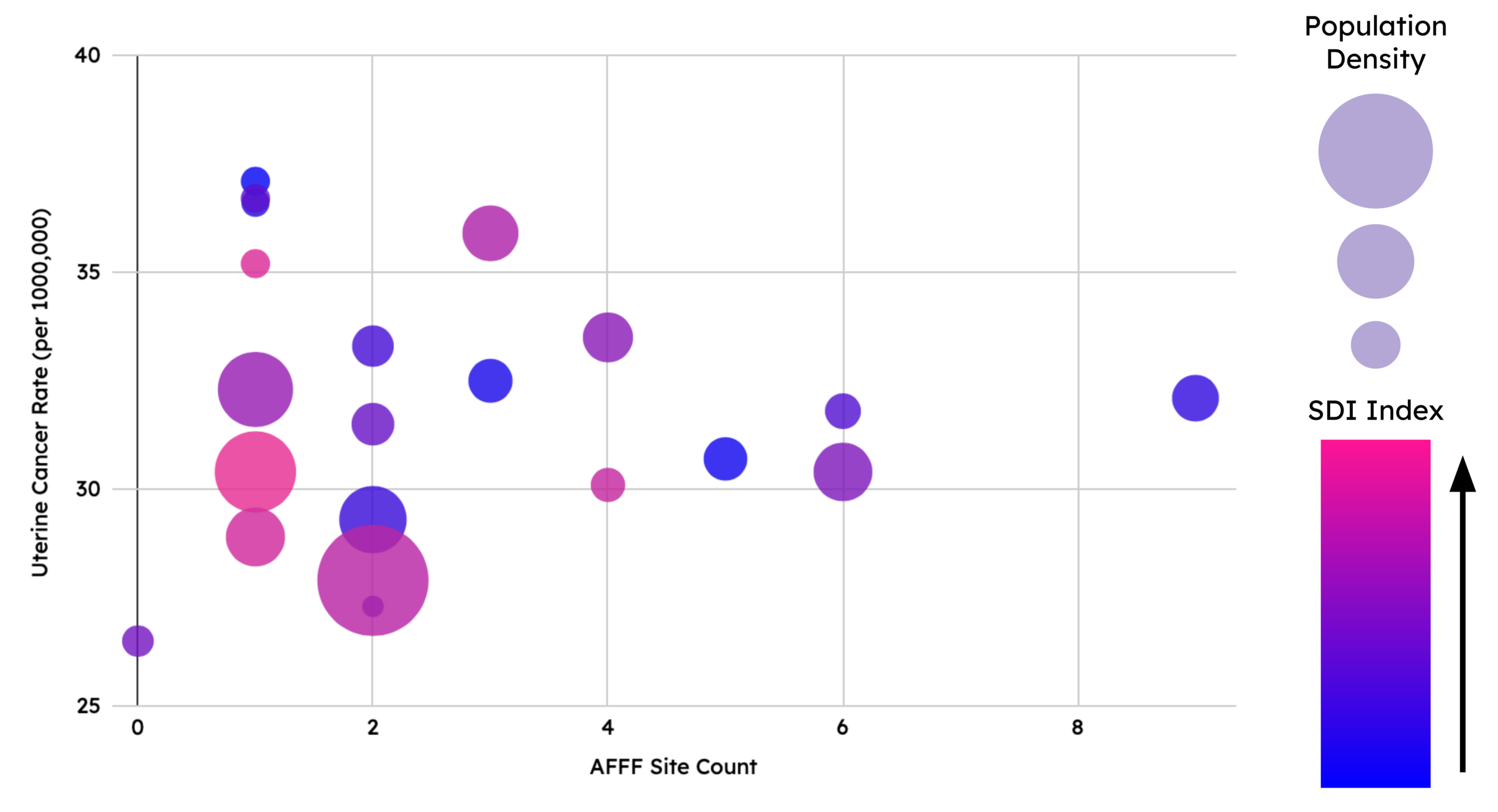
As represented in Figure 1, the LINEST function was run with AFFF site counts on the x-axis, uterine cancer rates on the y-axis, and two confounders of population density and a SDI index. The greater a SDI index z-score was, the more deprived the county was, which is represented by pink.
| AFFF Site Count | Population Density | SDI Index | |
| Slope | -0.0317 | -1.08 | 0.151 |
| Standard Error | 0.230 | 0.496 | 0.732 |
| t-statistic | 0.137 | 2.18 | 0.207 |
| p-value | 0.446 | 0.0217 | 0.419 |
Alongside the reported data in Table 1, the regression model (df =17) returned with an R2 of 0.996, indicating strong fit. The only variable found to have a statistically significant slope against uterine cancer rates (p ≤ 0.05) with all other values held constant is population density. Since it has a negative slope, more observed AFFF sites were found in less densely populated counties. In addition to its high p-value, the AFFF site variable also yielded a near-zero slope, representing no significant relationship between AFFF site count and uterine cancer rates by county. The SDI index also has a high p-value. These results were likely limited greatly by the small sample size of 21 counties.
Discussion
Addressing the main objective of this study, the weighted regression analysis revealed no significant relationship between the number of military and fire training sites and uterine cancer rates across NJ counties. Overall, existing research has investigated PFAS serum concentrations in relation to previous uterine cancer diagnosis, endometrial cancer risk, and sociodemographic overlap with endometrial cancer9,10,14. These studies received conflicting findings. This finding remains consistent with the nuanced nature of the association between PFAS in general and uterine cancer, however it brings a new perspective by specifically examining AFFF sites as point sources. Showcased by the disproving of the initial hypothesis and discourse in literature, it is evident that the current understanding surrounding the relationship between PFAS exposure and uterine cancer is scattered. More thorough investigation and data collection is still required before a solid inference can be made due to varying methods revealing different results.
Limitations
Analogous to all studies, the new understanding is limited. First, the AFFF site count proxy was not validated against any known measures of PFAS serum concentrations as no available database with this information broken down by county exists. Additionally, the EPA’s Unregulated Contaminant Monitoring Rule (UMCR) data for water system PFAS testing had gaps. Concentrations of PFAS found in water systems were only reported if a facility exceeded the Maximum Contaminant Level (MCL), restricting the ability to make an accurate water concentration variable. The assumption that AFFF site proximity positively relates to PFAS exposure stemmed from literature instead23,33. Regardless, results should be interpreted as the correlation between uterine cancer rates and AFFF site presence rather than PFAS exposure.
Second, this county level analysis generalizes variables across entire counties. For example, a facility near a county border could be impacting residents from both counties, however its impact would be limited to the county it is located in. In addition, population density and sociodemographic compositions around different facilities in the same county can differ. For this reason, this analysis cannot model individual exposure levels.
Third, this study weights all facilities the same in terms of the amount of AFFF release. As mentioned before, the method originally tried to account for this limitation by including the number of years each facility was operative for, however there seems to be a gap in such data. Additionally, local geographic terrain may influence how and the extent in which AFFF contaminates its surroundings.
Next, all types of uterine cancer are combined in one aggregate rate, rather than split up by histology because that data isn’t available publicly at the county level due to privacy issues. This is an important distinction as uterine cancer can be divided into endometrial carcinomas characterized by aggressiveness and estrogen-level dependence as well as uterine sarcomas5. If possible, this study should be replicated using cancer rates incorporating histology to gain a better understanding of how AFFF contamination could affect variations of uterine cancer differently.
Finally, the small sample size constrains the results generated by this study. Only two covariates were applied to maintain statistical power, which could skew findings. In addition, certain counties may have disproportionately influenced results. More covariates should be applied in future studies for more robust conclusions.
Future Research
As an extension of this study, future researchers should apply this methodology across more states, and therefore a greater sample size. However, more extensive and thorough data collection must be done first. When confirming the operative status of facilities, finding information was an arduous task. Researchers and organizations like the EPA may want to conduct site-by-site data collection to generate a more comprehensive dataset of AFFF usage across the United States. This will allow future research to yield more accurate results and conclusions of AFFF usage on public health. Additionally, further investigations should employ Geographic Information System (GIS) tools to better represent the impact of AFFF release on surrounding communities, rather than relying on county borders. Other variables that may want to be included in future studies are seafood consumption and groundwater versus public water system reliance as these factors can differ in rural and urban areas. As established in this study, population density was inversely associated with AFFF site count, making these variables worth consideration.
Moreover, despite the scientific field’s ongoing debate surrounding PFAS and uterine cancer, policy makers and federal organizations still need to take action towards reducing PFAS prevalence in the environment, and therefore our bodies. It is crucial that governments enforce policy that regulates PFAS contamination while accounting for racial and economic disparities. Furthermore, they should increase transparency with the public about what they could be exposed to based on where they reside through more resources like the PFAS Analytical Tools. Overall, continued efforts should be taken towards combating PFAS contamination to uphold public health.
References
- Z. Abunada, M. Y. D. Alazaiza, M. J. K. Bashir. An overview of per- and polyfluoroalkyl substances (PFAS) in the environment: source, fate, risk and regulations. Water. Vol. 12, pg. 3590, 2020, https://doi.org/10.3390/w12123590. [↩] [↩]
- J. Glüge, M. Scheringer, I. T. Cousins, J. C. DeWitt, G. Goldenman, D. Herzke, R. Lohmann, C. A. Ng, X. Trier, Z. Wang. An overview of the uses of per- and polyfluoroalkyl substances (PFAS). Environmental Science: Processes & Impacts. Vol. 22, pg. 2345–2373, 2020, https://doi.org/10.1039/D0EM00291G. [↩]
- Y. Zhu, X. Pan, Y. Jia, X. Yang, X. Song, J. Ding, W. Zhong, J. Feng, L. Zhu. Exploring route-specific pharmacokinetics of PFAS in mice by coupling in vivo tests and physiologically based toxicokinetic models. Environmental Health Perspectives. Vol. 131, pg. 127012, 2023, https://doi.org/10.1289/EHP11969. [↩]
- E. M. Sunderland, X. C. Hu, C. Dassuncao, A. K. Tokranov, C. C. Wagner, J. G. Allen. A review of the pathways of human exposure to poly- and perfluoroalkyl substances (PFASs) and present understanding of health effects. Journal of Exposure Science & Environmental Epidemiology. Vol. 29, pg. 131–147, 2019, https://doi.org/10.1038/s41370-018-0094-1. [↩]
- A. S. Felix, L. A. Brinton. Cancer progress and priorities: uterine cancer. Cancer Epidemiology, Biomarkers & Prevention. Vol. 27, pg. 985–994, 2018, https://doi.org/10.1158/1055-9965.EPI-18-0264. [↩] [↩] [↩]
- J. D. Wright, M. T. Prest, J. S. Ferris, L. Chen, X. Xu, K. J. Rouse, A. Melamed, C. Hur, B. M. Heckman-Stoddard, G. Samimi, N. A. Bickell, T. M. Layne, E. R. Myers, L. J. Havrilesky, S. V. Blank, N. K. Stout, W. D. Hazelton, C. Y. Kong, E. B. Elkin. Projected trends in the incidence and mortality of uterine cancer in the United States. Cancer Epidemiology, Biomarkers & Prevention. Vol. 34, pg. 1156–1166, 2025, https://doi.org/10.1158/1055-9965.EPI-24-1422. [↩]
- E. Berglas, D. Musheyev, A. B. Lavi, R. S. Berglas, R. Berglas, A. E. Kabarriti. Inequity of NIH cancer funding in the United States: an ecological study predicting funding based on disease burden from 2008 through 2023. The Lancet Regional Health – Americas. Vol. 45, pg. 101081, 2025, https://doi.org/10.1016/j.lana.2025.101081. [↩] [↩]
- K. Steenland, A. Winquist. PFAS and cancer, a scoping review of the epidemiologic evidence. Environmental Research. Vol. 194, pg. 110690, 2021, https://doi.org/10.1016/j.envres.2020.110690. [↩]
- J. M. Madrigal, B. Trabert, D. N. Medgyesi, J. A. Fisher, A. M. Calafat, J. Cook Botelho, K. Kato, P. S. Albert, D. T. Silverman, J. N. Hofmann, R. R. Jones. Prediagnostic serum concentrations of per- and polyfluoroalkyl substances and risk of endometrial cancer in a US cohort. Environmental Health Perspectives. Vol. 133, pg. 067701, 2025, https://doi.org/10.1289/EHP16569. [↩] [↩]
- A. L. Cathey, V. K. Nguyen, J. A. Colacino, T. J. Woodruff, P. Reynolds, M. T. Aung. Exploratory profiles of phenols, parabens, and per- and poly-fluoroalkyl substances among NHANES study participants in association with previous cancer diagnoses. Journal of Exposure Science & Environmental Epidemiology. Vol. 33, pg. 687–698, 2023, https://doi.org/10.1038/s41370-023-00601-6. [↩] [↩]
- Y. Hong, J. Li, Y. Qiu, Y. Wang, Z. Du, Z. Liu, Y. Mi, H. Geng, S. Xin. Integrative in silico analysis of per- and polyfluorinated alkyl substances (PFAS)-associated molecular alterations in human cancers: a multi-cancer framework for predicting toxicogenomic disruption. International Journal of Surgery. Vol. 111, pg. 5122–5136, 2025, https://doi.org/10.1097/JS9.0000000000002632. [↩]
- L.-X. Yang, J. Zhai, Z.-J. Chen, Y. Du. Female-specific associations of serum perfluoroalkyl and polyfluoroalkyl substances with sex hormonal/insulin dysregulation: an integrated population-based study. Ecotoxicology and Environmental Safety. Vol. 298, pg. 118273, 2025, https://doi.org/10.1016/j.ecoenv.2025.118273. [↩] [↩]
- S. J. Kitson, D. G. Evans, E. J. Crosbie. Identifying high-risk women for endometrial cancer prevention strategies: proposal of an endometrial cancer risk prediction model. Cancer Prevention Research. Vol. 10, pg. 1–13, 2017, https://doi.org/10.1158/1940-6207.CAPR-16-0224. [↩]
- A. Ayodele, E. Obeng-Gyasi. Exploring the potential link between PFAS exposure and endometrial cancer: a review of environmental and sociodemographic factors. Cancers. Vol. 16, pg. 983, 2024, https://doi.org/10.3390/cancers16050983. [↩] [↩] [↩]
- N. M. DeLuca, K. Thomas, A. Mullikin, R. Slover, L. W. Stanek, A. N. Pilant, E. A. Cohen Hubal. Geographic and demographic variability in serum PFAS concentrations for pregnant women in the United States. Journal of Exposure Science & Environmental Epidemiology. Vol. 33, pg. 710–724, 2023, https://doi.org/10.1038/s41370-023-00520-6. [↩]
- N. M. Brennan, A. T. Evans, M. K. Fritz, S. A. Peak, H. E. Von Holst. Trends in the regulation of per- and polyfluoroalkyl substances (PFAS): a scoping review. International Journal of Environmental Research and Public Health. Vol. 18, pg. 10900, 2021, https://doi.org/10.3390/ijerph182010900. [↩]
- E. F. Houtz, C. P. Higgins, J. A. Field, D. L. Sedlak. Persistence of perfluoroalkyl acid precursors in AFFF-impacted groundwater and soil. Environmental Science & Technology. Vol. 47, pg. 8187–8195, 2013, https://doi.org/10.1021/es4018877. [↩]
- A. C. Maizel, S. Shea, A. Nickerson, C. Schaefer, C. P. Higgins. Release of per- and polyfluoroalkyl substances from aqueous film-forming foam impacted soils. Environmental Science & Technology. Vol. 55, pg. 14617–14627, 2021, https://doi.org/10.1021/acs.est.1c02871. [↩]
- J. Reinikainen, N. Perkola, L. Äystö, J. Sorvari. The occurrence, distribution, and risks of PFAS at AFFF-impacted sites in Finland. Science of The Total Environment. Vol. 829, pg. 154237, 2022, https://doi.org/10.1016/j.scitotenv.2022.154237. [↩]
- B. J. Ruyle, C. P. Thackray, C. M. Butt, D. R. LeBlanc, A. K. Tokranov, C. D. Vecitis, E. M. Sunderland. Centurial persistence of forever chemicals at military fire training sites. Environmental Science & Technology. Vol. 57, pg. 8096–8106, 2023, https://doi.org/10.1021/acs.est.3c00675. [↩] [↩]
- K. K. Garrett, V. Say, S. Ciaranca, P. Brown, E. Haberlack, C. Hopkins, M. Lengefeld, A. Cordner. The landscape of PFAS contamination in the United States: sources and spatial patterns. Environmental Science & Technology. Vol. 59, pg. 18795–18807, 2025, https://doi.org/10.1021/acs.est.4c1447. [↩] [↩]
- A. S. Nair, Z. Ma, S. M. Watkins, S. S. Wood. Demographic and exposure characteristics as predictors of serum per- and polyfluoroalkyl substances (PFASs) levels – a community-level biomonitoring project in Pennsylvania. International Journal of Hygiene and Environmental Health. Vol. 231, pg. 113631, 2021, https://doi.org/10.1016/j.ijheh.2020.113631. [↩]
- X. C. Hu, D. Q. Andrews, A. B. Lindstrom, T. A. Bruton, L. A. Schaider, P. Grandjean, R. Lohmann, C. C. Carignan, A. Blum, S. A. Balan, C. P. Higgins, E. M. Sunderland. Detection of poly- and perfluoroalkyl substances (PFASs) in U.S. drinking water linked to industrial sites, military fire training areas, and wastewater treatment plants. Environmental Science & Technology Letters. Vol. 3, pg. 344–350, 2016, https://doi.org/10.1021/acs.estlett.6b00260. [↩] [↩] [↩]
- P. E. Rosenfeld, K. R. Spaeth, L. L. Remy, V. Byers, S. A. Muerth, R. C. Hallman, J. Summers-Evans, S. Barker. Perfluoroalkyl substances exposure in firefighters: sources and implications. Environmental Research. Vol. 220, pg. 115164, 2023, https://doi.org/10.1016/j.envres.2022.115164. [↩]
- D. Salvatore, K. Mok, K. K. Garrett, G. Poudrier, P. Brown, L. S. Birnbaum, G. Goldenman, M. F. Miller, S. Patton, M. Poehlein, J. Varshavsky, A. Cordner. Presumptive contamination: a new approach to PFAS contamination based on likely sources. Environmental Science & Technology Letters. Vol. 9, pg. 983–990, 2022, https://doi.org/10.1021/acs.estlett.2c00502. [↩]
- J. M. Liddie, L. A. Schaider, E. M. Sunderland. Sociodemographic factors are associated with the abundance of PFAS sources and detection in U.S. community water systems. Environmental Science & Technology. Vol. 57, pg. 7902–7912, 2023, https://doi.org/10.1021/acs.est.2c07255. [↩]
- A. J. Maruzzo, A. B. Hernandez, C. H. Swartz, J. M. Liddie, L. A. Schaider. Socioeconomic disparities in exposures to PFAS and other unregulated industrial drinking water contaminants in us public water systems. Environmental Health Perspectives. Vol. 133, pg. 017002, 2025, https://doi.org/10.1289/EHP14721. [↩]
- L. E. Wild, N. DiStefano, G. Forman, B. I. Arocha, M. S. Lee, P. A. Borowsky, E. Franzmann, N. Solle, A. J. Caban-Martinez, E. Kobetz. Socioeconomic disparities and risk of papillary thyroid cancer associated with environmental exposure to per- and polyfluoroalkyl substances (PFAS) in Florida. International Journal of Environmental Research and Public Health. Vol. 22, pg. 1290, 2025, https://doi.org/10.3390/ijerph22081290. [↩]
- J. Rose, L. Baandrup, R. Hertzum-Larsen, J. Aarestrup, J. L. Baker, S. K. Kjær. Trends in the incidence of endometrial intraepithelial neoplasia and endometrial cancer by type, age, and socioeconomic status in Denmark 2005–2022. Maturitas. Vol. 209, pg. 108959, 2026, https://doi.org/10.1016/j.maturitas.2026.108959. [↩]
- B. Pothuri. Development of endometrial cancer after radiation treatment for cervical carcinoma. Obstetrics & Gynecology. Vol. 101, pg. 941–945, 2003, https://doi.org/10.1016/S0029-7844(03)00234-5. [↩]
- H. S. Iyer, S. A. Joseph, J. Varga, C. Opara, J. M. Graber, R. J. Laumbach, P. G. Georgopoulos, J. E. Hart, G. B. Post, E. S. Barrett. Impact of regulatory actions to establish maximum contaminant levels on per- and polyfluoroalkyl substances in New Jersey public water systems. Environment International. Vol. 209, pg. 110179, 2026, https://doi.org/10.1016/j.envint.2026.110179. [↩]
- Methodology: 2020-2024 Esri american community survey. 2026 https://www.esri.com/content/dam/esri_content_doc/dbl/us/2026/j10020-american-community-survey-2026.pdf. [↩]
- C. A. McDonough, S. Choyke, K. E. Barton, S. Mass, A. P. Starling, J. L. Adgate, C. P. Higgins. Unsaturated PFOS and other PFASs in human serum and drinking water from an AFFF-impacted community. Environmental Science & Technology. Vol. 55, pg. 8139–8148, 2021, https://doi.org/10.1021/acs.est.1c00522. [↩]