
Abstract
Racial and ethnic minority adolescents are increasingly being exposed to racism via digital platforms, but little is known about the psychological processes through which online racial discrimination may be associated with depressive outcomes. In line with minority stress theory, this study examined internalized racism as a mediating mechanism between perceived online racism and depressive symptoms, and whether social media checking frequency moderated this indirect pathway. Participants were N = 69 racially and ethnically diverse adolescents recruited as part of a parent study focusing on Asian American and Latinx/Hispanic families. The analytic sample was predominantly Asian American (71.0%) and Hispanic/Latinx of any race (23.2%). Self-report measures of perceived online racism, internalized racism, depressive symptoms, and social media checking frequency were completed by participants. A moderated mediation model was tested in a path analysis with observed variables and bias-corrected bootstrapped confidence intervals. Perceived racism online was associated with higher levels of internalized racism, which was associated with higher levels of depressive symptoms. The direct association between perceived racism online and depressive symptoms was not significant. The indirect effect was significant for the mean and at low levels of social media checking frequency, but the index of moderated mediation was not, and checking frequency emerged as a significant negative correlate of internalized racism as a main effect. Due to the small sample size, cross-sectional design, and non-random sampling, findings should be taken as preliminary and exploratory. However, the findings provide initial evidence that internalized racism may be a relevant psychological process linking perceived online racism to depressive symptoms among Asian American and Latinx/Hispanic youth.
Keywords: online racism, internalized racism, depressive symptoms, social media, adolescents, minority stress theory
Introduction
The proliferation of social media has fundamentally transformed the developmental contexts in which racial and ethnic minority adolescents come of age. While digital platforms—social networking sites (e.g., Instagram, TikTok, X/Twitter), video-sharing platforms (e.g., YouTube), online gaming environments, and public comment sections on news and media sites—have increased opportunities for social connection, peer support, and identity exploration, they have also become fertile grounds for racially motivated harassment, microaggressions, and hate speech. For youth of color, these online contexts are not racially neutral. That is, they are embedded within broader structures of systemic racism that shape what content algorithms amplify and what types of hostility youth encounter daily1. As adolescence is a critical period of identity formation, understanding how exposure to online racism translates into psychological harm and what factors contribute to this process is a pressing public health concern. Drawing on minority stress theory, which posits that stigmatized group members encounter unique chronic stressors in addition to general life stressors that accumulate thru distal and proximal stress processes to produce adverse health outcomes2, the present study examines whether online racial hostility, as a distal stressor, is associated with depressive symptoms thru the proximal process of internalized racism, and whether this indirect pathway varies by social media checking frequency.
Perceived online racism and depressive symptoms
Perceived racism (i.e., individuals’ subjective experience of being treated discriminatorily on the basis of their race) has been consistently linked to poor mental health outcomes across a variety of racial and ethnic minority groups3. Perceived online racism is a distal stressor within the minority stress framework2, an objective event based in the environment that triggers a sequence of psychological reactions. The proliferation of digitally mediated communication has transformed the ways racism is manifested. Online discriminatory comments and exclusionary behaviors, often masked as humor or innocent remarks, are now included in this spectrum. The perception of online racism has increased dramatically in an era of constant device usage4. Social media algorithms have amplified this phenomenon.
Emerging evidence on the mental health consequences of online racial discrimination among adolescents of color. In a national longitudinal study, Black adolescents reported large increases in online racial discrimination during 2020, and those exposed predicted poorer mental health on the same and the next day, even after controlling for general time online and cybervictimization5. Latinx and African American adolescents’ trajectories characterized by increasing online racial discrimination were associated with increased depressive and anxiety symptoms over time, as identified via growth mixture modeling across a multilayer period. Online racial discrimination was significantly associated with increased odds of suicidal ideation among Latine youth even after controlling for depression6. The burden is not limited to one group: after the rise in anti-Asian racism during the COVID-19 pandemic, two-thirds of Asian American adolescents and young adults in one study reported worsening depressive symptoms (5), and 93% of Asian American, Native Hawaiian, and Pacific Islander youth ages 14-25 reported past-year race-based discrimination, with nearly half above the clinical threshold for moderate depression7,8.
At the same time, the link between online racial discrimination and depressive symptoms is not always strong. However, several cross-sectional studies have found null or weak associations, with highly variable effect sizes9. Racial identity centrality and social support may buffer the mental health impact of online discrimination such that some youth demonstrate resilience or even identity-reinforcing responses to online racist content10. The evidence base is also heterogeneous with regard to operationalization, design, and populations sampled, with relatively few studies of Asian American adolescents and most studies based on self-reports of exposures and outcomes. Therefore, a direct effect of online racism on depressive symptoms cannot be assumed. Mechanisms and boundary conditions need to be identified for whom online racism translates into mental health harm.
Internalized racism as a mediating mechanism
The minority stress theory2 distinguishes between distal stressors, which are objective and environmentally based events such as experiences of racial discrimination, and proximal stressors, which are the internal psychological reactions to those events. Perceived online racism is a distal minority stressor when adapted to digital spaces, and internalized racism is the proximal psychological process through which the stressor may be linked to depressive symptoms11. In line with social identity theory12, repeated exposure to online racist content may lead adolescents to internalize negative evaluations from the dominant society and to develop feelings of hopelessness and worthlessness characteristic of depression13,14, thus undermining their positive feelings about their own racial group.
As defined by Campón and Carter (2015)15, internalized racism (also called appropriated racial oppression) is the method by which racially minoritized individuals adopt and integrate the negative perceptions of their racial group from the dominant culture into their self-concept and worldview. The construct is distinct from the experience of discrimination (a distal stressor), general low self-esteem, and ethnic identity. Consistent with the multidimensional structure of the Appropriated Racial Oppression Scale used in the current study15, internalized racism was operationalized across four dimensions including emotional responses to one’s racial group membership, endorsement of standards of beauty from the dominant culture, devaluation of one’s racial group, and patterns of thinking that reflect appropriated oppression.
This pathway is developmentally salient during adolescence when identity formation is a major psychosocial task of the period16. The potential for these messages to activate proximal internalization processess may be heightened in online contexts that continually expose young people to dehumanizing representations of their racial group via memes, slurs, viral videos, and algorithmically amplified hate17 present young people with dehumanizing representations of their racial group Previous research has documented associations between discriminatory experiences, internalized racism, and psychological distress in adult samples18,14, and in ethnoracially minoritized college students, online racial discrimination has been associated with greater suicidal ideation thru internalized racism19,20; however, these populations typically have more consolidated racial identities than younger adolescents, who may be especially susceptible to internalizing negative racial messages online10, No previous research has examined internalized racism as a mediating mechanism between perceived online racism and depressive outcomes specifically in racially diverse youth, a gap this study seeks to fill.
Social media use as a moderator
The extent to which online racism is internalized as internalized racism may not be universal across all youth. Minority stress theory posits that the health impact of distal stressors is a function of not only their presence, but also their chronicity and accumulation2. Theoretically, social media use is relevant to this framework as it determines the dose of the digital environment to which an adolescent is exposed: the more the engagement, the more the occasions on which internalized processes can be activated. In addition, African American and Latinx youth have been found to spend more time online than their White peers21, so differences in engagement may exacerbate existing inequities in exposure. At the same time, the platforms that expose youth to racist content also provide access to counter narratives, racially affirming communities, and peer solidarity that may serve as buffers rather than intensifiers of internalization22. The distal-to-proximal pathway may be strengthened, weakened, or unaffected by social media use, considering that higher engagement likely results in more exposure to both harmful and protective content. It is this theoretical ambivalence that motivates the decision to treat social media use as a boundary condition to be tested rather than assumed.
The present study
The current study investigates a moderated mediation model where internalized racism mediates the relation between perceived online racism and depressive symptoms, and social media use moderates the indirect pathway among racial and ethnic minority adolescents. It is hypothesized that: (H1) perceived online racism will be positively associated with depressive symptoms, (H2) the association between perceived online racism and depressive symptoms will be mediated by internalized racism, that is, higher levels of perceived online racism will be associated with higher levels of internalized racism which, in turn, predicts higher levels of depressive symptoms, and (H3) the indirect effect will be moderated by social media checking frequency, that is, the indirect effect will be stronger for adolescents who check social media more frequently. The study draws on minority stress theory to offer a deeper understanding of the conditions under which online racism threatens the psychological well-being of adolescents at a critical point in identity development.
Methods
Participants
As shown in Table 1, the analytic sample consisted of N = 69 adolescents (49.3% female) between the ages of 14 and 19 (M = 18.14, SD = 0.90). The majority of the sample (89.9%) was aged 18 or 19, and 49.3% identified as female. Consistent with the parent study’s recruitment of Asian American and Latinx/Hispanic families, the sample was predominantly non-Hispanic Asian (71.0%, n = 49) and Hispanic/Latinx of any race (23.2%, n = 16), with small numbers of non-Hispanic Black (n = 2), non-Hispanic White (n = 1), and non-Hispanic American Indian or Alaska Native (n = 1) participants. Nineteen percent of participants were first-generation (born outside of the United States), 68% were second-generation (born in the United States to immigrant parents), and 13% were third-generation (born in the United States to U.S.-born parents).
| Characteristic | n | % |
| Age (years) | ||
| M (SD) | 18.14 (0.90) | |
| Range | 14–19 | |
| 14 | 1 | 1.4 |
| 15 | 1 | 1.4 |
| 16 | 1 | 1.4 |
| 17 | 4 | 5.8 |
| 18 | 39 | 56.5 |
| 19 | 23 | 33.3 |
| Gender | ||
| Female | 34 | 49.3 |
| Male | 35 | 50.7 |
| Generational status | ||
| First generation (foreign-born) | 13 | 18.8 |
| Second generation (U.S.-born, immigrant parents) | 47 | 68.1 |
| Third generation or later | 9 | 13.0 |
| Race (single-select) | ||
| Asian | 49 | 71.0 |
| White | 11 | 15.9 |
| Black or African American | 5 | 7.2 |
| American Indian or Alaska Native | 2 | 2.9 |
| Another race not listed | 2 | 2.9 |
| Hispanic/Latinx ethnicity | ||
| Hispanic/Latinx | 16 | 23.2 |
| Non-Hispanic | 53 | 76.8 |
| Mutually exclusive race/ethnicity | ||
| Non-Hispanic Asian | 49 | 71.0 |
| Hispanic/Latinx (any race) | 16 | 23.2 |
| Non-Hispanic Black or African American | 2 | 2.9 |
| Non-Hispanic White | 1 | 1.4 |
| Non-Hispanic American Indian or Alaska Native | 1 | 1.4 |
| National/ethnic origin | ||
| Chinese | 15 | 21.7 |
| Korean | 14 | 20.3 |
| Mexican | 12 | 17.4 |
| Japanese | 9 | 13.0 |
| Singaporean | 5 | 7.2 |
| Indian | 3 | 4.3 |
| Taiwanese | 2 | 2.9 |
| Cuban | 2 | 2.9 |
| Thai | 2 | 2.9 |
| Puerto Rican | 2 | 2.9 |
| Filipino | 1 | 1.4 |
| Vietnamese | 1 | 1.4 |
| Mixed ethnicity | 1 | 1.4 |
Note. N = 69. Race and Hispanic/Latinx ethnicity were assessed using separate single-select items consistent with U.S. Office of Management and Budget standards. Within the Hispanic/Latinx subgroup (n = 16), 10 identified racially as White, three as Black or African American, two as another race, and one as American Indian or Alaska Native. Percentages may not sum to 100 due to rounding.
Procedure
Data were drawn from the Navigating Race study (Montclair State University; IRB protocol FY23-24-3223), an ongoing dyadic study of family, peer, and school influences on racial-ethnic socialization, discrimination, and health outcomes among Asian American and Latinx/Hispanic adolescents and their parents. The present manuscript reports a secondary analysis of de-identified youth survey data collected as part of that larger study.
Parent-adolescent dyads were eligible if one or both parents identified as Asian and/or Latinx/Hispanic American, the participating parent was at least 18 years old and resided in the United States with legal custody of an adolescent aged 13–19, and both dyad members were able to complete an online survey in English, Spanish, Chinese (Simplified or Traditional), Japanese, or Korean. Recruitment was conducted through university and professional listservs, social media platforms (Facebook, Twitter, Instagram), and partnerships with community-based organizations serving Asian and Latinx/Hispanic families in the New York tri-state area. All recruitment materials were translated into the six study languages by native-speaker members of the research team with documented translation experience.
Parents first completed a brief eligibility screening survey in Qualtrics. Youth aged 18 or 19 and their parents each provided independent informed consent within their surveys. For youth aged 13–17, parents provided consent through the screening survey, and the youth’s assent was obtained during a brief Zoom meeting, with the research team member reviewing the assent form verbatim and observing the youth’s digital signature on a signable PDF. Surveys were administered online via Qualtrics (approximately 45 minutes). Both parents and youth received a $25 Amazon e-gift card upon completion of the survey, with the option to select “prefer not to answer” available on sensitive items.
Because the study assesses sensitive content, a tiered safety-response protocol was implemented in consultation with a licensed psychologist. Participants endorsing a score of 2 or higher on the suicidal-ideation item were contacted within 24 hours by a trained student who administered the Columbia-Suicide Severity Rating Scale (C-SSRS; Posner et al., 2011), and depending on severity, a structured safety plan was provided or a warm transfer to the 988 Suicide and Crisis Lifeline (C-SSRS score of 4–6). All participants received a list of mental health resources, and parents of minor youth who triggered the safety protocol received follow-up within 48 hours.
The youth survey portion of the dataset, as of September 2025, comprised 84 youth respondents, 69 (82.1%) of whom provided complete data on all variables, which were included in the moderated-mediation model (perceived online racism, internalized racism, depressive symptoms, social media checking frequency, age, gender, and generational status). Listwise deletion was applied; given the small sample size, multiple imputation procedures were not pursued. Because recruitment targeted Asian American and Latinx/Hispanic families specifically, analyses described patterns within these groups rather than across racially and ethnically minoritized youth more broadly.
Measures
Perceived Online Racism. Perceived online racism was assessed using the 15-item Perceived Online Racism Scale23. Participants rated the frequency of their exposure to online racial discrimination on a Likert-type scale. A mean composite score was computed across all 15 items, with higher scores indicating greater perceived online racism. The scale demonstrated excellent internal consistency (α = .96).
Internalized Racism. Internalized racism was measured using 24 items from the Appropriated Oppression scale15. Participants rated their agreement with statements reflecting internalized negative racial attitudes. Responses of 8 (Prefer not to answer) were recorded as missing. The total scale demonstrated excellent reliability (α = .94). The measure includes four subscales: Emotional Responses (7 items; α = .89), American Standard of Beauty (6 items; α = .94), Devaluation of Own Group (8 items; α = .92), and Patterns of Thinking (3 items; α = .74). In the subscale level correlations were explored to examine differential patterns of association with the key study variables, although the total score was used in the moderated mediation model.
Depressive Symptoms. Depressive symptoms were assessed using the 7-item Depression subscale of the Depression Anxiety Stress Scales-2124 (DASS-21). Consistent with standard DASS-21 scoring procedures, raw item responses were recoded to the 0–3 metric (i.e., 1 was subtracted from each response), summed across the seven items, and the resulting sum was multiplied by 2 to generate the standard DASS-21 depressive symptoms score, which ranged from 0 to 42. Higher scores indicate greater depressive symptom severity. The subscale demonstrated good internal consistency (α = .89). In the present sample, the mean depressive symptom score was 3.68 (SD = 5.15), with 65 participants (94.2%) scoring in the normal range (< 10), and one participant each falling in the mild (10–13), moderate (14–20), severe (21–27), and extremely severe (28+) categories per standard DASS-21 severity thresholds.
Social Media Checking Frequency. Social media checking frequency was assessed with a single item asking participants how often they check their most commonly used social network site. Responses ranged from 1 (less than once a week) to 8 (20 or more times per day), with 9 (Prefer not to answer) recorded as missing. Higher scores indicate more frequent social media checking. The mean checking frequency was 6.14 (SD = 1.48), corresponding to approximately 7–12 times per day, suggesting frequent daily engagement with social media among this sample.
Covariates. Age, gender (0 = male, 1 = female), and generational status were included as covariates. Generational status was dummy-coded with second-generation as the reference group (Gen1 = first-generation; Gen3 = third-generation or later).
Analytic Plan
Analyses were conducted in R (version 4.5.2) using the lavaan package25 for observed-variable path analysis (a special case of structural equation modeling (SEM) restricted to manifest variables, with no latent measurement model estimated). To test the hypothesized moderated mediation model (PROCESS Model 7)26, a path model was specified in which perceived online racism (X) predicted depressive symptoms (Y) through internalized racism (M), with social media checking frequency (W) moderating the a-path (i.e., the relationship between perceived online racism and internalized racism; see Figure 1). Both the independent variable and the moderator were mean-centered before computing the interaction term. Age, gender, and generational status were included as covariates in both the mediator and outcome equations.
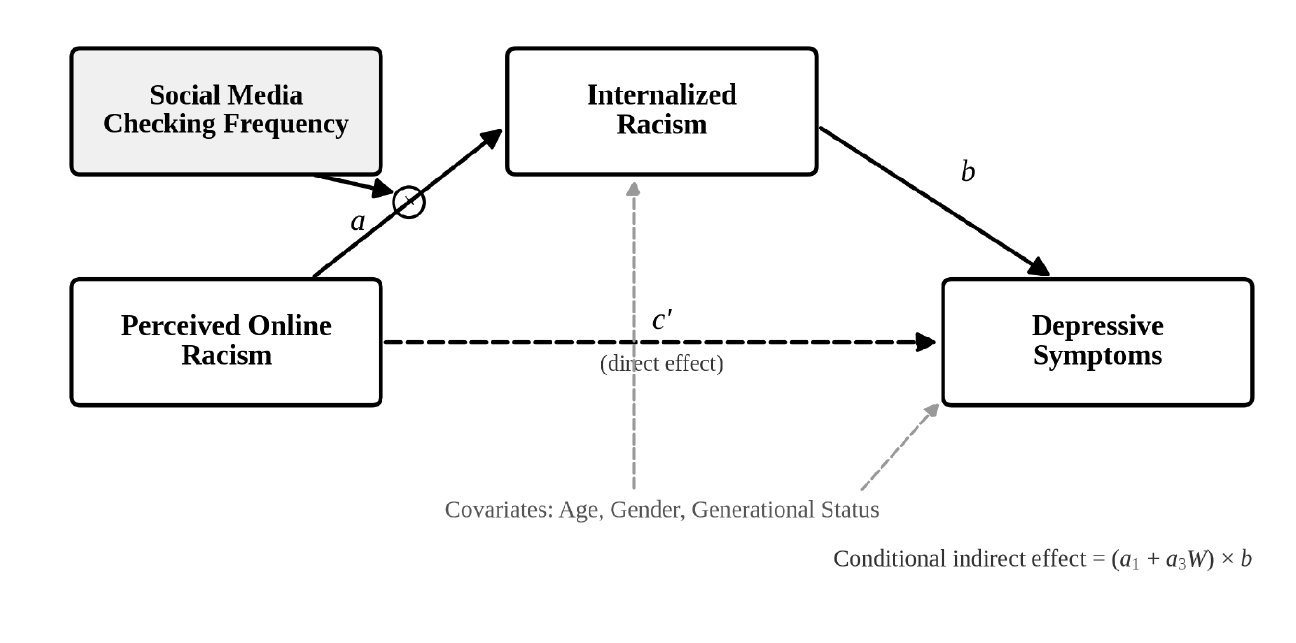
Note. Solid lines represent hypothesized direct paths. The dashed line represents the direct effect (c′) of perceived online racism on depressive symptoms. The × symbol indicates the moderating effect of social media checking frequency on the a path. Covariates (age, gender, and generational status) were included in both the mediator and outcome equations. The conditional indirect effect is calculated as (a1 + a3W) × b, where W = social media checking frequency.
Given the small sample size relative to the complexity of the moderated mediation model, a sensitivity power analysis was conducted to characterize the effects the present sample could reasonably detect. For a single coefficient in the mediator model (which included seven predictors), the study had 80% power (α = .05) to detect only effects of f² ≥ .12, corresponding to a medium-to-large effect. A Monte Carlo power analysis (2,000 simulations, each with 1,000 bootstrap resamples, using the observed parameter estimates as population values) indicated that power to detect the index of moderated mediation was approximately .07 and power to detect the interaction coefficient on the a-path was approximately .13, whereas power to detect the conditional indirect effect at the mean level of social media checking frequency was approximately .75. Accordingly, the mediation components of the model were adequately powered, but the moderation components were substantially underpowered. The moderation analyses are therefore interpreted as exploratory rather than confirmatory throughout.
Model parameters were estimated using maximum likelihood (ML) estimation. Because the hypothesized path model is just-identified (saturated; df = 0), it reproduces the observed covariances exactly, and global fit indices (e.g., CFI, RMSEA) are not informative; model adequacy is therefore evaluated through the magnitude, direction, and precision of the estimated paths rather than through global fit. Confidence intervals for indirect effects were obtained using 10,000 bootstrap resamples. Conditional indirect effects were probed at low (−1 SD), mean, and high (+1 SD) levels of social media checking frequency. The index of moderated mediation (IMM) was computed to evaluate whether the indirect effect varied significantly across levels of the moderator. A simple mediation model (without moderation) was also estimated for comparison. Simple slopes analysis and Johnson-Neyman intervals were computed using the interactions package27 to further probe the interaction.
Results
Preliminary Analyses
Descriptive statistics, bivariate correlations, and scale reliabilities are presented in Tables 1, 2, and 3. Among the key study variables, perceived online racism was positively correlated with internalized racism (r = .20, p = .094) and negatively correlated with depressive symptoms (r = −.20, p = .094). Internalized racism was significantly and positively associated with depressive symptoms (r = .49, p < .001). Social media checking frequency was positively correlated with perceived online racism (r = .49, p < .001) but negatively associated with internalized racism (r = −.18, p = .134). Age was significantly associated with all key variables, such that older adolescents reported higher perceived online racism, lower internalized racism, and fewer depressive symptoms.
| Variable | 1 | 2 | 3 | 4 | 5 | 6 | M | SD | α |
| 1. Perceived Online Racism | — | 2.55 | 0.97 | .96 | |||||
| 2. Internalized Racism | .20† | — | 2.37 | 0.92 | .94 | ||||
| 3. Depressive Symptoms | −.20† | .49*** | — | 3.68 | 5.15 | .89 | |||
| 4. SM Checking Frequency | .49*** | −.18 | −.22† | — | 6.14 | 1.48 | — | ||
| 5. Age | .34** | −.40*** | −.60*** | .24* | — | 18.14 | 0.90 | — | |
| 6. Female | −.18 | −.24† | −.19 | −.04 | .00 | — | 0.49 | 0.50 | — |
Note. N = 69. SM = social media. Reliability coefficients (Cronbach’s α) are reported for multi-item scales. SM Checking Frequency, Age, and Female were single-item or single-indicator variables and therefore do not have reliability estimates. †p < .10. *p < .05. **p < .01. ***p < .001.
| Association | Zero-order r | Partial r (adj.)a | Model-based βb |
| Perceived online racism → Depressive symptoms (c′) | −.20 (p = .094) | +.06 (p = .653) | −.06 |
| Perceived online racism → Internalized racism (a1) | +.20 (p = .094) | +.32 (p = .008) | +.53 |
| Internalized racism → Depressive symptoms (b) | +.49 (p < .001) | +.35 (p = .003) | +.32 |
Note. N = 69. aPartial correlations adjust for age, gender, and generational status. bModel-based standardized coefficients are drawn from the moderated mediation model; the a1 path additionally adjusts for social media checking frequency and the online racism × checking frequency interaction, which accounts for its larger magnitude relative to the partial correlation. The reversal in sign of the perceived online racism to depressive symptoms association between the zero-order (−.20) and adjusted (+.06) estimates reflects suppression by age (see text).
Moderated Mediation Analysis
As presented in Table 4, the overall model explained 40.9% of the variance in internalized racism (R² = .409) and 49.5% of the variance in depressive symptoms (R² = .495). Contrary to H1 (shown in Table 4), perceived online racism did not predict depressive symptoms in the adjusted model. The negative zero-order association between perceived online racism and depressive symptoms (r = −.20) was reduced to zero after controlling for age, gender, and generational status were included (partial r = +.06, p = .653), whereas both mediational paths remained positive after adjustment (perceived online racism–internalized racism partial r = +.32, p = .008; internalized racism–depressive symptoms partial r = +.35, p = .003). This pattern is attributable primarily to age, which functioned as a suppressor: older adolescents may have reported higher perceived online racism (r = +.34, p = .004) but markedly lower depressive symptoms (r = −.60, p < .001) and lower internalized racism (r = −.40, p = .001). This pattern suggests inconsistent mediation rather than a direct inverse association between perceived online racism and depressive symptoms. Given the non-normality in the residuals for both the a-path (Shapiro-Wilk W = .82, p < .001) and the b/c′-path (W = .94, p = .001) models, bootstrapping resampling (10,000 resamples) was used to estimate confidence intervals. Internalized racism responses (skewness = 1.93, kurtosis = 5.26) and depressive symptoms (skewness = 2.94, kurtosis = 10.39) were positively skewed, indicating that the majority of participants reported low levels on these constructs, with a subset reporting substantially higher values. Variance inflation factors (VIFs) ranged from 1.06 to 2.12, indicating no multicollinearity concerns.
| Predictor | B | SE | β | p | 95% CI LL | 95% CI UL |
| Mediator: Internalized Racism | ||||||
| Perceived Online Racism (a1) | 0.507 | 0.128 | .535 | < .001 | 0.256 | 0.757 |
| SM Checking Frequency (a2) | −0.245 | 0.079 | −.396 | .002 | −0.400 | −0.091 |
| Online Racism × SM Checking (a3) | −0.058 | 0.064 | −.106 | .367 | −0.185 | 0.068 |
| Age | −0.487 | 0.105 | −.477 | < .001 | −0.694 | −0.281 |
| Female | −0.286 | 0.173 | −.158 | .098 | −0.625 | 0.053 |
| First generation (vs. second) | 0.086 | 0.269 | .037 | .748 | −0.440 | 0.613 |
| Third generation (vs. second) | −0.145 | 0.265 | −.054 | .583 | −0.664 | 0.374 |
| R2 = .409 | ||||||
| Outcome: Depressive Symptoms | ||||||
| Internalized Racism (b) | 1.822 | 0.586 | .323 | .002 | 0.674 | 2.969 |
| Perceived Online Racism (c′) | −0.308 | 0.592 | −.058 | .604 | −1.469 | 0.853 |
| Age | −2.380 | 0.618 | −.414 | < .001 | −3.591 | −1.169 |
| Female | −1.446 | 0.918 | −.141 | .115 | −3.245 | 0.353 |
| First generation (vs. second) | 2.061 | 1.325 | .158 | .120 | −0.537 | 4.660 |
| Third generation (vs. second) | −1.653 | 1.343 | −.109 | .219 | −4.287 | 0.981 |
| R2 = .495 | ||||||
| Conditional Indirect Effects | ||||||
| At −1 SD SM Checking | 1.080 | 0.441 | .224 | .014 | 0.216 | 1.942 |
| At Mean SM Checking | 0.922 | 0.377 | .173 | .014 | 0.184 | 1.662 |
| At +1 SD SM Checking | 0.766 | 0.393 | .122 | .052 | −0.006 | 1.538 |
| Index of Moderated Mediation | −0.107 | 0.122 | −.034 | .387 | −0.346 | 0.134 |
Note. N = 69. SM = social media. Unstandardized coefficients (B), bootstrap SEs, standardized coefficients (β), and 95% bias-corrected bootstrap confidence intervals (CI; LL = lower limit, UL = upper limit) based on 10,000 resamples. Generational status dummy-coded with the second generation as reference.
Consistent with Hypothesis 2, perceived online racism was a significant positive predictor of internalized racism (B = 0.507, SE = 0.128, β = .535, p < .001). In turn, internalized racism significantly predicted depressive symptoms (B = 1.822, SE = 0.586, β = .323, p = .002), controlling for perceived online racism and covariates. The direct effect of perceived online racism on depressive symptoms was not significant (B = −0.308, SE = 0.592, β = −.058, p = .604). Age was a significant negative predictor of depressive symptoms (B = −2.380, p < .001).
Social media checking frequency was significantly and negatively associated with internalized racism (B = −0.245, SE = 0.079, β = −.396, p = .002). However, the interaction between perceived online racism and social media checking frequency was not significant (B = −0.058, SE = 0.064, β = −.106, p = .367), indicating that social media checking frequency did not moderate the relationship between perceived online racism and internalized racism. The indirect effect of perceived online racism on depressive symptoms through internalized racism was significant at the mean level of social media checking frequency (indirect effect = 0.922, 95% CI [0.184, 1.662], p = .014) and at low levels of checking frequency (−1 SD; indirect effect = 1.080, 95% CI [0.216, 1.942], p = .014). The indirect effect at high levels of checking frequency (+1 SD) was marginally significant (indirect effect = 0.766, 95% CI [−0.006, 1.538], p = .052). However, the index of moderated mediation was not significant (IMM = −0.107, 95% CI [−0.346, 0.134], p = .387), indicating that the strength of the indirect effect did not differ significantly across levels of social media checking frequency.
Consistent with the sensitivity analysis, the non-significant index of moderated mediation should not be interpreted cautiously, given the small effect size (f² = .01) and limited power to detect moderation. In the simple mediation model, perceived online racism predicted internalized racism (B = 0.320, SE = 0.126, β = .337, p = .011), but internalized racism did not predict depressive symptoms (B = 1.822, SE = 1.270, β = .323, p = .152). The bootstrapped indirect effect was not significant (B= 0.582 (95% CI [−0.064, 2.072], p = .274), and the total effect was also not significant (B= 0.276 (95% CI [−1.054, 1.518], p = .679). Thus, although the moderated mediation model yielded significant conditional indirect effects at the mean and low levels of checking frequency, the overall pattern should be interpreted as preliminary.
Discussion
The present study examined whether internalized racism would indirectly link perceived online racism and depressive symptoms in racial and ethnic minority adolescents, and whether frequency of social media use would moderate this indirect pathway. Overall, results provided partial support for the hypothesized mediation model. Perceived online racism was associated with greater internalized racism, and internalized racism was associated with greater depressive symptoms. However, the direct effect of perceived online racism on depressive symptoms was not significant after controlling for covariates, and there was no evidence for the moderation of social media checking frequency on the indirect effect.
These findings are broadly consistent with minority stress theory2, which suggests that distal stressors such as experiences of racism may influence health via proximal psychological processes. The current study suggests that internalized racism may be a viable pathway linking perceived online racism to depressive symptoms. The pattern suggests that exposure to online racism is potentially related to depressive symptoms, but perhaps not through a direct, immediate effect, but rather through its association with internalized negative racial beliefs.
However, the results should be interpreted with caution at the same time. The substantial conditional indirect effects in the moderated mediation model should not be interpreted as strong evidence for a moderated process, because the index of moderated mediation was not significant and the simple mediation model was also not significant. Taken together, these results indicate that an indirect association may be present under some model specifications, but we find no evidence for a robust moderating role of frequency of social media checking.
The index of moderated mediation was not significant, meaning that the indirect effect did not differ significantly across different levels of social media engagement. This null finding may be partly due to restriction of range, as participants reported high and relatively homogeneous levels of checking frequency (M = 6.14, corresponding to approximately 7–12 times per day), which limit statistical power to detect moderation. In addition, a single-item measure of checking frequency cannot capture the dimensions of social media use that would be most theoretically relevant to the hypothesized moderation, including time spent on the platform, active versus passive use, platform-specific exposure patterns, exposure to identity-threatening or identity-affirming content, or critical social media literacy practices28. Notably, social media checking frequency was nonetheless a significant negative predictor of internalized racism as a main effect, which is a finding somewhat unexpected given the assumption that greater platform exposure increases vulnerability to harmful content. This result may be consistent with the increasing salience of platforms such as TikTok and Instagram as sites of racial pride, collective identity, and counter-narratives among minority youth. Research on Black and Asian adolescents has demonstrated that social media may function as a site of racial socialization, in which youth actively seek and engage with content that promotes positive racial identity and mitigates the internalization of racist ideologies10. Similarly, Latinx youth have been shown to use social media platforms to access ethnicity-affirming communities that support bicultural identity development and resist dominant cultural hierarchies. The association found in the present study is small in magnitude, observed within a cross-sectional design, and based on a single-item measure of checking frequency, all of which further limit the interpretive conclusions that can be drawn. An interpretation in which more frequent social media checking exposes youth to identity-affirming counter-narrative content that buffers internalization processes22,10 extends beyond the measured variables in the present study and is not supported by the data presented here. Future research using validated multidimensional social media measures that distinguish content exposure, active versus passive use, exposure to racist content, and exposure to identity-affirming content will be needed to clarify the substantive meaning of associations between social media activity and internalized racism.
Implications
The results of the present study should be interpreted with caution due to the preliminary and exploratory nature of the analyzes. The observed associational pattern is theoretically consistent with the broader proposition of minority stress theory that distal stressors and proximal psychological processes co-occur in members of stigmatized groups2 and is preliminary motivation for future longitudinal research examining whether internalized racism operates as a within-person psychological process linking online racial discrimination exposure to depressive symptomatology over time. However, the non-significant moderation result and the relatively small sample size prevent us from making strong theoretical claims about the conditions under which such a process may unfold.
Because of the cross-sectional design and the non-significant total effect found in the simple mediation model, the current study does not allow for concrete recommendations for interventions or applied programming guidance. These results alone should not be used to recommend specific school-based, clinical, or community programming. Many of the practice approaches that an over-interpretation of the present results would have suggested10,29 are better supported by the broader literature on racial identity development, critical consciousness, and culturally responsive practice. Practitioners interested in supporting adolescents of color navigating online racial hostility are encouraged to consult that broader evidence base rather than to conclude from a small exploratory study.
From a practical perspective, the present exploratory findings suggest that interventions targeting internalized racism, if replicated in adequately powered longitudinal studies, may be a relevant component of mental health programming for adolescents of color. This can include school counselors or community mental health providers integrating psychoeducation about racial identity development into social-emotional learning curricula, including activities based in Critical Consciousness frameworks30 that help adolescents to recognize, name, and critically analyze the negative racial messages they encounter online rather than passively accepting them. Models such as the Say It Loud curriculum and Positive Youth Development that affirm racial and ethnic identities may be models, but their efficacy for interrupting pathways of online racism–internalization has not been tested and should be evaluated empirically before recommending adoption. Emphasis placed on ‘tentatively’ is based on theory and prior adult research, rather than on causal evidence in the present sample, and should not be implemented as evidence-based practice without further empirical support.
In terms of digital environments specifically, the present findings tentatively suggest that it is of value to support adolescents in the development of critical appraisal skills for online content. This could include technological literacy programming to help students identify algorithmic amplification of harmful content, to actively curate their social media feeds toward affirming and counter-narratives, and to differentiate between online spaces that reinforce negative racial messages and those that support positive racial identity. This type of programming could be offered as standalone workshops within school health curricula or as part of existing media literacy courses. Again, the present data cannot determine whether approaches such as these would reduce internalized racism or depressive symptoms, and empirical evaluation using randomized or quasi-experimental designs is necessary before such recommendations can be considered evidence-based.
Limitations
Several limitations of the present study warrant consideration when interpreting these findings. First, the design is cross-sectional and based on single-time-point self-report measures, which precludes inferences about directionality or causal sequence and allows for plausible alternative explanations, including reverse causation, mutual influence, and unmeasured third-variable confounding. Relatedly, all constructs were assessed via youth self-report, raising the possibility that observed associations partly reflect shared method variance; future research should incorporate multi-method or objective indicators, particularly behavioral measures of social media use. Second, the sample was relatively small (N = 69), which precludes group-specific or comparative analyses by race or ethnicity. A sensitivity analysis further indicated that, although the sample was adequately powered to detect the mediator-related associations, it was substantially underpowered to detect the magnitude of moderation observed; the non-significant index of moderated mediation therefore reflects limited statistical power rather than demonstrated absence of a boundary condition. The sample is composed predominantly of Asian American and Latinx/Hispanic youth, which precludes group-specific or comparative analyses by race or ethnicity. Third, the sample is heavily skewed toward older adolescents and emerging adults (89.9% aged 18–19), such that findings more closely approximate emerging adulthood than adolescence broadly defined; this should temper any developmental interpretation of the results. Fourth, depressive symptoms in the analytic sample were substantially floor-restricted, with 94.2% of participants scoring in the normal range on the DASS-21 depression severity index; this restricted variability limits the ability to detect associations with clinical-range depressive outcomes. Fifth, the measure of social media use was limited to a single item assessing checking frequency, which fails to capture the quality, content, or context of engagement. Future research should assess social media use across multiple dimensions, including passive versus active use, content type, and platform-specific engagement. Sixth, while racial and ethnic diversity is a strength of the sample, race was not formally examined as a moderator; future research with adequately powered samples should test whether these pathways operate with differential strength across racial and ethnic groups. Relatedly, the assessment of online racism was not specific to participants’ own racial-ethnic group, and the measured constructs are themselves heterogeneous across the Asian American and Latinx/Hispanic populations represented in the sample; national-origin and pan-ethnic variation could not be examined at this sample size. Seventh, both internalized racism and depressive symptom distributions exhibited significant positive skew. Although bootstrapped confidence intervals were used to address non-normality, findings should be interpreted with caution, and replication in more clinically symptomatic or high-risk samples is warranted. Finally, the sampling and recruitment context limits the cultural and contextual generalizability of findings; the present results should not be assumed to characterize adolescents of color in regions, family structures, or community contexts beyond those reflected in the recruitment frame.
Conclusion
The present study offers preliminary, exploratory evidence for an associational pattern in which perceived online racism, internalized racism, and depressive symptoms co-occur among Asian American and Latinx/Hispanic adolescents and emerging adults. Finally, in the moderated mediation model, the cross-sectional indirect effect of perceived online racism on depressive symptoms via internalized racism was statistically significant at the mean and low levels of social media checking frequency. The index of moderated mediation was non-significant, and the total effect in a simple mediation model without the moderator was non-significant. The current findings are intended to motivate future longitudinal studies with adequately powered and more demographically diverse samples to investigate whether internalized racism operates as a within-person psychological process connecting online racial discrimination to depressive outcomes in adolescent and emerging adult development.
Replications must be longitudinal, multi-method, and sufficiently powered to establish whether the associations observed are representative of robust psychological processes and to clarify the role of social media in moderating this pathway. The present findings represent one preliminary data point in an expanding literature and should be viewed more as hypothesis-generating for future research than as settled conclusions.
References
- S. U. Noble, K. McMillan, J. Pierre. Structural racism in tech: social media platforms, algorithmic bias, and racist tech. In D. A. Christakis, L. Hale (Eds.), Handbook of children and screens: digital media, development, and well-being from birth through adolescence. Springer, 2025, pg. 288–293. [↩]
- I. H. Meyer. Prejudice, social stress, and mental health in lesbian, gay, and bisexual populations: conceptual issues and research evidence. Psychological Bulletin. Vol. 129, pg. 674–697, 2003, https://doi.org/10.1037/0033-2909.129.5.674. [↩] [↩] [↩] [↩] [↩] [↩]
- Y. Paradies, J. Ben, N. Denson, A. Elias, N. Priest, A. Pieterse, A. Gupta, M. Kelaher, G. Gee. Racism as a determinant of health: a systematic review and meta-analysis. PLOS ONE. Vol. 10, pg. e0138511, 2015, https://doi.org/10.1371/journal.pone.0138511. [↩]
- B. M. Tynes, F. T. Lozada, N. A. Smith, A. M. Stewart. From racial microaggressions to hate crimes: a model of online racism based on the lived experiences of adolescents of color. In C. Capodilupo et al. (Eds.), Microaggression theory: influence and implications. Wiley, 2019, pg. 194–212. [↩]
- J. Del Toro, M. T. Wang. Online racism and mental health among Black American adolescents in 2020. Journal of the American Academy of Child and Adolescent Psychiatry. Vol. 62, pg. 25–36, 2023, https://doi.org/10.1016/j.jaac.2022.07.004. [↩]
- L. Polanco-Roman, A. Anglin, M. Miranda, A. Amador, T. Joyner. Online racial discrimination and suicidal ideation among Latine adolescents. JAACAP Open. Vol. 2, pg. 237–245, 2024, https://doi.org/10.1016/j.jaacop.2024.07.001. [↩]
- R. Jeung, A. Yellow Horse, P. Popovic, R. Lim. Stop AAPI hate national report. Ethnic Studies Review. Vol. 44, pg. 19–26, 2021, https://doi.org/10.1525/esr.2021.44.2.19. [↩]
- The Asian American Foundation. Beyond the surface: understanding mental health among Asian American, Native Hawaiian, and Pacific Islander youth. TAAF, 2024, https://www.taaf.org. [↩]
- X. Tao, C. B. Fisher. Exposure to social media racial discrimination and mental health among adolescents of color. Journal of Youth and Adolescence. Vol. 51, pg. 1–17, 2022, https://doi.org/10.1007/s10964-021-01514-z. [↩]
- D. Rivas-Drake, B. J. Pinetta, L. P. Juang, A. Agi. Ethnic-racial identity as a source of resilience and resistance in the context of racism and xenophobia. Current Directions in Psychological Science. Vol. 31, pg. 42–48, 2022, https://doi.org/10.1177/10892680211056318. [↩] [↩] [↩] [↩] [↩]
- D. M. Szymanski, A. Gupta. Examining the relationship between multiple internalized oppressions and African American lesbian, gay, bisexual, and questioning persons’ self-esteem and psychological distress. Journal of Counseling Psychology. Vol. 56, pg. 110–118, 2009. [↩]
- H. Tajfel, J. C. Turner. The social identity theory of intergroup behavior. In S. Worchel, W. G. Austin (Eds.), Psychology of intergroup relations. Nelson-Hall, 1986, pg. 7–24. [↩]
- D. James. Internalized racism and past-year major depressive disorder among African-Americans: the role of ethnic identity and self-esteem. Journal of Racial and Ethnic Health Disparities. Vol. 4, pg. 659–670, 2017, https://doi.org/10.1007/s40615-016-0269-1. [↩]
- D. M. Mouzon, J. S. McLean. Internalized racism and mental health among African-Americans, US-born Caribbean Blacks, and foreign-born Caribbean Blacks. Ethnicity & Health. Vol. 22, pg. 36–48, 2017, https://doi.org/10.1080/13557858.2016.1196652. [↩] [↩]
- R. R. Campón, R. T. Carter. The Appropriated Racial Oppression Scale: development and preliminary validation. Cultural Diversity & Ethnic Minority Psychology. Vol. 21, pg. 497–506, 2015, https://doi.org/10.1037/cdp0000037. [↩] [↩] [↩]
- E. H. Erikson. Identity: Youth and crisis. W. W. Norton, 1968. [↩]
- B. M. Tynes, T. McGee, D. English. Adolescents’ daily race-related online experiences and mental health outcomes. JAMA Network Open. Vol. 8, pg. e2536870, 2025, https://doi.org/10.1001/jamanetworkopen.2025.36870. [↩]
- D. James. Health and health-related correlates of internalized racism among racial/ethnic minorities: a review of the literature. Journal of Racial and Ethnic Health Disparities. Vol. 7, pg. 785–806, 2020, https://doi.org/10.1007/s40615-020–00726-6. [↩]
- B. T. Keum. Impact of online racism on suicide ideation through interpersonal factors among racial minority emerging adults: the role of perceived burdensomeness and thwarted belongingness. Journal of Interpersonal Violence. Vol. 38, pg. 4537–4561, 2023, https://doi.org/10.1177/08862605221117247. [↩]
- L. Polanco-Roman, B. T. Keum, A. Anglin, R. Chami. Online racial/ethnic discrimination, suicidal ideation, and alcohol misuse among ethnoracially minoritized college students: the roles of internalized racism and ethnic identity. Journal of Racial and Ethnic Health Disparities. 2025, https://doi.org/10.1007/s40615-025-02381-1. [↩]
- V. Rideout, A. Lauricella, E. Wartella. Children, media, and race: media use among White, Black, Hispanic, and Asian American children. Northwestern University, Center on Media and Human Development, 2011, https://cmhd.northwestern.edu. [↩]
- B. T. Keum, A. Y. Choi. Critical social media literacy buffers the impact of online racism on internalized racism among racially minoritized emerging adults. Journal of Counseling Psychology. Vol. 71, pg. 659–667, 2024, https://doi.org/10.1037/cou0000758 [↩] [↩]
- B. T. Keum, M. J. Miller. Racism on the internet: conceptualization and recommendations for research. Psychology of Violence. Vol. 7, pg. 107–111, 2017, https://doi.org/10.1037/vio0000063. [↩]
- P. F. Lovibond, S. H. Lovibond. Manual for the Depression Anxiety Stress Scales. 2nd ed., Psychology Foundation of Australia, 1995. [↩]
- Y. Rosseel. lavaan: An R Package for Structural Equation Modeling. Journal of Statistical Software. Vol. 48, pg. 1–36, 2012, https://doi.org/10.18637/jss.v048.i02. [↩]
- A. F. Hayes. Introduction to Mediation, Moderation, and Conditional Process Analysis: A Regression-Based Approach. 2nd ed., The Guilford Press, 2018. [↩]
- J. A. Long. interactions: Comprehensive, User-Friendly Toolkit for Probing Interactions. R package version 1.1.0, 2019, https://cran.r-project.org/package=interactions. [↩]
- J. Fardouly, R. Magson, C. Johnco, N. Oar, R. Rapee. Parental control of the time preadolescents spend on social media: links with preadolescents’ social media appearance comparisons and mental health. Journal of Youth and Adolescence. Vol. 47, pg. 1456–1468, 2018, https://doi.org/10.1007/s10964-018-0870-1. [↩]
- Diemer, M. A., Rapa, L. J., Park, C. J., & Perry, J. C. Development and validation of the Critical Consciousness Scale. Youth & Society. Vol. 49, No. 4, pg. 461–483, 2017, https://doi.org/10.1177/0044118X14538289. [↩]
- Watts, R. J., Diemer, M. A., & Voight, A. M. Critical consciousness: Current status and future directions. New Directions for Child and Adolescent Development. Vol. 2011, No. 134, pg. 43–57, 2011, https://doi.org/10.1002/cd.310. [↩]