
Abstract
Many students listen to music when studying. They can do that almost anywhere with headphones and streaming platforms. This leads to conversations over whether music is good for concentration. Many students think music can help them destress, but research shows that music can harm focus. This literature review focuses on both neurological and self reported findings of music. The limited capacity theory and arousal-mood hypothesis can help us better understand how background music can impact performance. This review examined 26 research articles of students in high school or college. The findings showed that background music had a general effect on concentration and performance. Other factors, like genre, familiarity, and individual opinion also had an effect. Many students also chose to study with music for emotional reasons. Music can provide benefits for mood, but it’s still unclear the extent of the impact. Future research should try to isolate familiarity, look at different types of tasks, and adapt to modern listening habits. These findings can help teachers and students to create the best study habits.
Keywords: Background music, Concentration, Mood, Arousal, Academic Performance
Introduction
The ability to concentrate for long periods of time in this increasingly fast-paced world is one of the most important skills for studying. Students often have a lot of work and extracurriculars, but also face daily distractions. All the while, the use of music streaming platforms, like Spotify, Apple Music, and Youtube, and the use of headphones or other listening devices have become more popular. Students can now play music anywhere, including in libraries, classrooms, and other study spaces. Background music has become an important part of studying for many students. Many researchers have started asking the question: Does music help or harm concentration and other cognitive processes when doing academic tasks? This literature review will look at how background music can affect concentration and mood.
It is important for teachers and students to understand the relationship between music and academics. This could help them make new classroom rules or improve study strategies. There are also many beliefs around the role of music that can affect the perspective of students. Therefore, it is important to see what actual research says about background music to help people make better decisions.
This literature review can be organized into three themes: (1) looking at objective measurements of concentration, which include test scores and brain scans; (2) self reported data, which include surveys that show the students’ beliefs; (3) mood and arousal, which shows the emotional side of music. These three themes can help us better understand how background music affects study.
Methods
Online searches were done to look for research relating to the effects of music on concentration. The searches were all done between August 2025 and March 2026, and JSTOR and Google Scholar were the main databases used. This is to make sure there is a variety of sources. These are the keywords used in the searches: music, concentration, genre, familiarity, survey, Mozart, arousal, creative, mood. The keywords were searched in different combinations.
Studies were included if they met the following criteria: (1) published in peer-reviewed academic journals; (2) involved high school or college students; (3) examined the effects of music listening during academic tasks on both experimental and observational levels; (4) reported measurable findings relating to concentration and mood; (5) provided enough methodological detail and sample sizes; (6) used appropriate statistical analysis, including ANOVA, regression analysis, or mediation analysis. To ensure the research is updated and reflects modern habits, studies published before 2010 were not used. Studies were also excluded if they looked at factors other than mood and concentration.
The search initially showed 511 articles. Then, a round of screening was conducted to remove duplicate studies and studies that were outdated. After that, a round of screening on titles and abstracts was conducted to remove irrelevant studies. After that, 117 articles remained. Studies that did not show clear methods were also removed, as well as ones that did not focus on high school and college students, or did not directly examine listening to music during academic tasks. Finally, 26 peer-reviewed articles were included. The screening process is shown in Figure 1 using a PRISMA-style flow diagram.
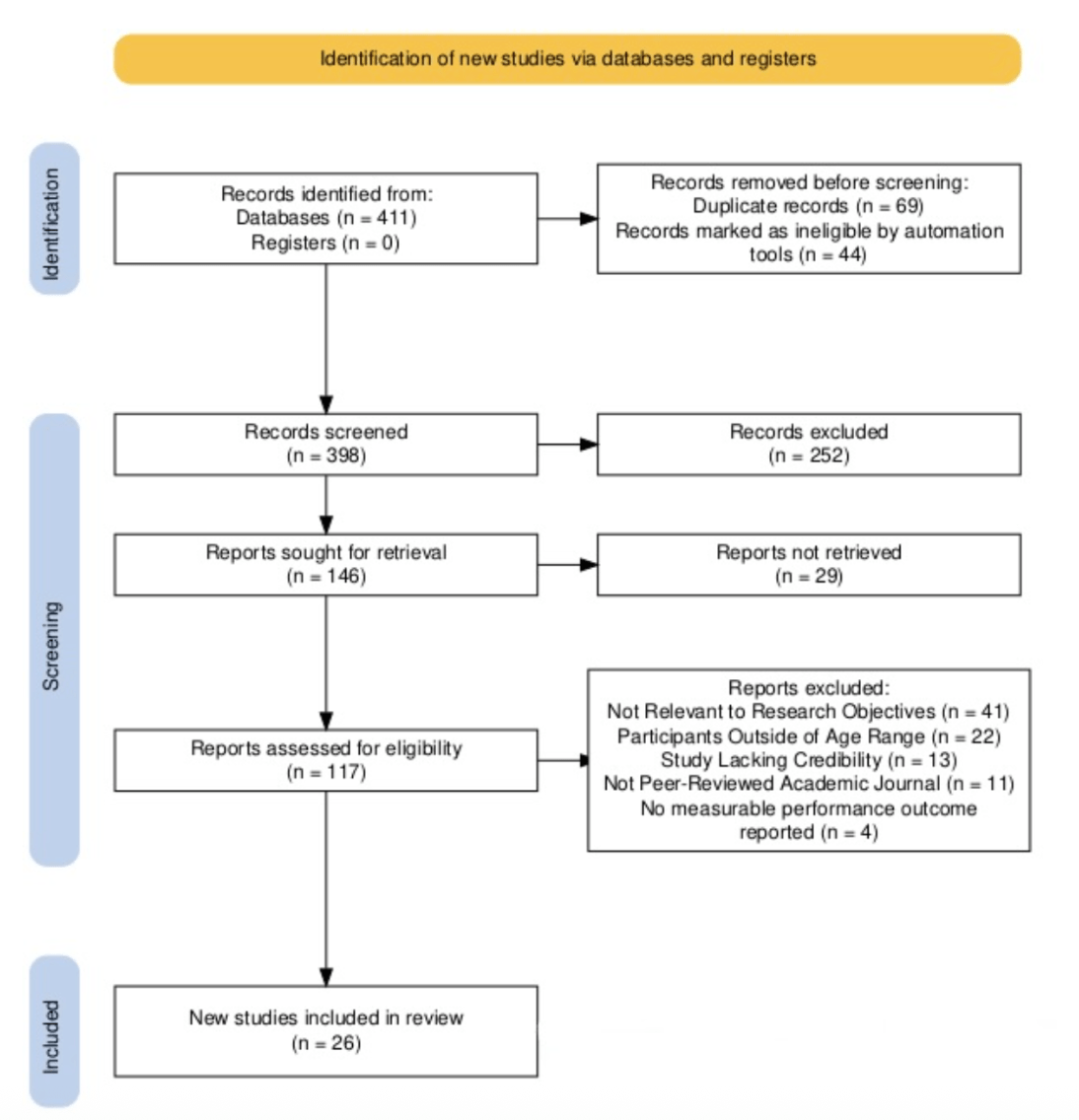
Some exemptions were manually made in the screening process. Two studies were included even though they fell out of the date range, because of their foundational contributions to the field: Thompson et al. (2010), who proposed the arousal-mood hypothesis, and Yerkes & Dodson (1908), which first suggested the Yerkes-Dodson Law. Also, Preacher & Hayes (2008) was cited by one of the included studies for their methodology, which is why it was included.
The selected studies were then put into one of three sections. The first two sections focused specifically on how music could affect concentration, either through objective (brain scans, task accuracy) or subjective (self-report, surveys) measures. Only studies that focused directly on concentration and focus were included in these sections. The third section broadens up to include the effect of music on mood and emotions by interpreting the arousal-mood hypothesis. This included studies on creativity-related tasks. This section tries to respond to the increasing popularity of creative and open-ended assignments.
Theme 1: Objective Measure of Concentration
Neurological and Behavioral Evidence
The human brain processes auditory and visual stimuli simultaneously. Therefore, even when a student is focused on a task visually, background noise can interfere subconsciously. This effect can be explained by the limited capacity theory, which states that humans have a limited cognitive capacity to process information. This limited resource will be distributed between different stimuli1. Hence, any unwanted background stimuli will compete for attention and divert existing resources from the task at hand.
Researchers have examined how this competition for resources can affect concentration by looking at the N400 effect. The N400 effect is a neurological measure of attention. Specifically, it is a negative-going voltage deflection in brainwave activity that usually peaks at around 400 milliseconds after the introduction of a stimulus. The N400 response to stimuli shows how the brain is attempting to integrate incoming information into what it already knows. A larger N400 response, therefore, signals more difficulty in processing and integrating the incoming stimuli1.
A study by Du et al. (2020) investigated the neurological effects of background music on reading comprehension using event-related potentials (ERPs)1. His experiment involved 39 postgraduate students from China, who were classified into one of three groups: high-arousal music, low-arousal music, and silent. They were asked to complete comprehension related tasks while their neural activity was recorded using electroencephalography (EEG). They found that there was a significantly larger N400 effect shown for both music groups compared to silence1. This suggests that it took more cognitive effort to complete their tasks with background music.
However, they also found that behavioral measures, including task accuracy and completion time did not vary among the three groups1. This suggests that even though background music can increase cognitive load, it did not translate into their performance. The impact of background music seems to only extend to the cognitive level. These findings make conceptual sense through the limited capacity theory, as there are only a finite amount of resources for cognitive processing, and background music naturally occupies some of those resources. It is important to note that this study only involves a smaller sample size of 39 students, who all come from the same background. This limits the diversity of this survey and removes factors, like cultural differences, that can influence music use in academic settings.
Other than neurological measures, another measure for attention is behavioral measures, like test accuracy. Test accuracy is useful as it doesn’t require specialized equipment and technology, and is more practical to understand how music influences concentration2. Test scores can directly show specific skills of academic performance, like whether information was successfully processed and remembered. Furthermore, taking tests is one of the most common academic tasks that students face in the real world, and the results are more standardized and easy to compare. These factors allow it to better capture the functional results on learning and make it more useful in educational research.
Several studies on test accuracy reported similar results to the EEG data reported by Du et. al (2020). Students working in silence often scored higher on tests than those working with background music. In a study by Chou (2010), 133 Taiwanese college students were put in one of three musical groups: classical music, hip-hop, and silence. Then, they had to complete a TOEFL-style reading comprehension test while listening to their respective genre of music. The group studying in silence scored 67.67 out of 100, while the classical group scored 64.41, and the hip-hop group scored 58.322.
Musical Genre
Beyond simply comparing music and silence, different genres of background music can create a varying impact on concentration. Chou’s findings show that classical music seems to be less distracting than hip-hop as it scored 6.09 points higher on average2. Similarly, Sundari & Maruthavijayan (2025) conducted a study with 80 participants, and found that soft instrumental music was better for concentration when compared to loud lyrical music3. However, the study relied on questionnaires and self-reported numbers, which could introduce bias.
Other studies using objective tests have produced mixed results. Han et al. (2020) examined the effects of genre on attention with the Frankfurter Attention Inventory (FAIR), a standardized test used to measure selective and sustained attention. The study was conducted with 90 university students in South Korea, who were randomly put in one of six groups: R&B/ballad, dance/rock, classical/jazz, fast beats, slow beats, and a silent control group. The results showed that participants that listened to classical or jazz background music scored much higher on sustained attention than the R&B/ballad, fast-beats, or silent conditions. However, there were no differences in other areas of selective attention and response accuracy4. These findings show that while some genres can support sustained attention, the overall influence of genre on concentration is vague.
Other studies show different findings of music genre and concentration. For example, Lang et al. (2012) compared classical music and dubstep as participants completed reading comprehension tasks. Lang also took physiological measurements, including brain wave activity and heart rate. The results show that the classical music group scored higher on reading comprehension than dubstep (4.21 vs 2.95 out of 7), but there were no differences in brain wave and heart rate5. Huang and Shih (2011) also found similar results, where participants completed tasks while listening to different background music, including popular songs, classical light music, traditional Chinese music, and a silent control group. The silent group scored the highest in attention, and there were no strong differences between the other groups6. However, it is important to note that the study measured attention through creating its own tasks, which might be different from real academic tasks. Also, all participants in the study were university students from Taiwan. They could be more culturally familiar with traditional Chinese music, which might influence their overall view. These findings show that while some genres can influence performance in some cases, there is no consistent relationship between genre and concentration.
It is also interesting that classical music is seen as the best genre for study even without strong evidence. This comes from the “Mozart Effect,” which is a popular belief that listening to Mozart can improve performance. Even though this theory is very popular, later research has shown mixed findings of its effects. Therefore, it is important to note that research and findings on musical genres can be influenced by existing bias towards classical music.
Familiarity and Preference
As findings for musical genre remain inconclusive, many researchers have turned to other factors that could affect concentration. One such factor is familiarity and personal preference. When a listener hears familiar and likable sounds, the brain might create different neural responses that could alter processing.
This pattern can be seen in some of the studies above. For example, Huang and Shih (2011) found that participants scored significantly lower on tests when listening to music that they showed preference to (liked or disliked)6. This shows that when listeners have a strong emotional response to the music, it may require additional cognitive resources to process the songs.
A study conducted by Monteiro et al. (2013) examined how both the language and genre affected academic performance among university students in Botswana. 60 students were split into one of 6 background music conditions, combinations of the languages English, Setswana, and French, and the genres of pop and gospel music. The students had to complete a task while listening to their respective musical conditions. The results showed that test scores were significantly higher for Setswana and English compared to French7. These results can be explained as Setswana and English are the official languages of Botswana. As participants are more likely to be familiar with their native languages, it seems that familiarity improves cognitive processing and test scores. On the other hand, foreign languages might be considered as noise, which aligns with the limited capacity theory, as noise will require more resources to process. These findings are further supported when researchers compared pop music and gospel music. They showed that students listening to pop background music scored higher than gospel music. This makes sense through a familiarity lens, as pop music is designed to appeal to the mass, and features catchy, simple, and memorable melodies. In comparison, gospel music only appeals to a certain population of church goers, study participants are more likely to be familiar with pop music8. However, these results might not be applicable to all student populations as music use and culture in Botswana could be unique.
A similar study by Tanaka et al. (2018) used an EEG to examine how familiar and unfamiliar music can affect brain activity. The study involved 15 participants from Japan who were exposed to background music while completing one of three tasks: an auditory-active task, a visual-active task, and a control task. In the auditory-active task, participants were asked to focus on the background music over visual stimuli; in the visual-active task, participants focused on a silent movie while music played in the background; in the control task, they listened to music without any visual task. After each trial, the participants rated how familiar they found the music, which allowed researchers to classify them into either familiar or unfamiliar categories. The researchers then measured their cortical entrainment, meaning the degree their neural activity synchronized to the musical cadence9. The results showed that participants listening to unfamiliar music showed higher cortical entrainment, and this effect remained even for participants who were in the visual-auditory category and were not focused on the music. Therefore, unfamiliar music seems to automatically increase neural activity and is harder for the brain to ignore9. Unfamiliar music will require more processing and resources, which negatively affects concentration.
Mori et al. (2014) conducted a similar study, where they compared familiar music, unfamiliar music, and a silent condition. Twelve university students were assigned a sustained attention task that required them to find an unusual symbol within a grid of 100 symbols as quickly as possible in 15 minutes. The number of completed trials was the measure of concentration. Results showed that participants who listened to familiar music recorded the most completed trials at 92.17, compared to 89.75 for unfamiliar music and 88 trials for silence10. Participants also made the fewest mistakes when listening to familiar music. The researchers also analyzed how attention changed over time, and found that the group listening to familiar music showed most stability in attention levels10. These findings suggest that listening to familiar music can help increase concentration by maintaining consistency. However, the study only consisted of 12 individuals, and the limited sample size makes it hard to draw strong conclusions.
However, a different study by Komloa (2018) found that familiar music might be more distracting than unfamiliar music. In the study, 40 participants were split into one of three conditions: familiar music, unfamiliar music, and no music. While listening to their respective conditions, they had to complete a Concept Shifting Test (CST), which measures reaction time and performance as a gauge of attention. The results showed a larger increase in reaction time in the familiar music group when compared to the unfamiliar music group, which suggests that familiar background music was more distracting11. The familiar group also performed worse than the silent group, while they did not find much correlation with performance in the unfamiliar group. Komloa suggests that these results can be due to how familiar music can attract the listener with its recognizable lyrics and melodies, hence diverting attention11. It is important to remember that the effects of familiarity can vary with the type of task and individual differences. Together, these studies suggest that familiarity and personal preference in background music can be a factor on concentration, yet current evidence is inconclusive, and the limited findings point in either direction.
Overall, research shows that background music can reduce concentration by competing for cognitive resources. This can be seen in the N400 effect, which shows that additional processing is needed by the brain when there is background music. Task performance also supports these findings, as accuracy is usually lower with music. However, there are specific factors of music, including genre and familiarity that could affect concentration. Results across these factors are inconsistent. This could be due to researchers using different experimental designs, and further research is needed.
Theme 2: Self-report measures of concentration
While neurophysiological measures can show the objective effects of music on concentration, this is only a part of the picture. It is also important to understand the individual opinions from students. People usually repeat behaviors that feel effective to them, which leads to the creation of new habits and attitudes. The choices made by students while studying are usually made from how productive they feel, instead of actual data.
Therefore, most of the research in this area is collected from surveys and self-reported data. Most participants in these surveys are college students from around the world. Since the surveys are mostly self-reported, there might be subjective bias. Many studies also fail to report their methods, which makes it hard to check for reliability. Even with these limitations, the findings still show interesting patterns of how students use music while studying.
Even though the previous section shows that there is no specific genre of music that strongly benefits study, classical music usually comes to the minds of students. This is called the “Mozart Effect”, which is the belief that classical music is better for cognitive performance. However, there is little evidence to support this, which is discussed earlier. Therefore, we can infer that classical music is so popular because of cultural perceptions.
Ead et al. (2014) conducted a mixed methods survey with 200 students at Cairo University. The study found that 50.2% of students liked to study with classical music, compared to 8.9% who studied with pop music12. Sundari and Maruthavijayan (2025) also noted that students preferred instrumental and classical music for concentrating over music with lyrics and strong rhythms3. On the other hand, Umuzdaş (2015) reported different results. In a study with 481 Turkish students, 133 students reported listening to Turkish pop while studying, 90 reported listening to pop, 66 reported listening to Turkish folk, and 57 reported listening to classical. This shows that classical music isn’t the most popular choice of genre. Furthermore, the study found that students with higher levels of education preferred classical and Turkish classical music, while students with lower levels of education listened to rock and rap music13. This shows a trend of how calmer and more traditional music is popular with harder academics, but more experiments and data are needed to draw conclusions.
Adriano (2010) found that classical music was not the most popular genre of study. In a mixed-methods study with 668 high school students, students preferred to listen to pop, rap, rock, electronic music, and other more modern genres14. The survey also found that the genre of music students listened to often depended on the type of academic task. Students preferred to listen to music while doing math compared to reading and writing. This shows that students might change how they interact with music depending on the type of task at hand14. Kumar et al. (2016) also surveyed 200 Malaysian medical undergraduate students through a questionnaire. The results showed that pop music was the most common genre to study with at 82%, followed by instrumental music at 70%. Only 43% of students reported listening to classical music while studying15. These findings show that students preferred to listen to more contemporary genres. Moreover, statistical analysis from Umuzdaş (2015) showed no clear relationship between the type of music students listened to and the academic tasks they were performing. This suggests that students pick the genre of music based on personal preference, rather than strategically13.
Other than genre, the surveys also reveal how students view the effectiveness of music for studying. In all the studies, students who thought music was neutral or ineffective for studying ranged from 62.5% to 73.5%, which is clearly a majority12,13,15. This makes sense when looking at the limited capacity theory, where it is shown earlier that background music can compete for attention resources. However, we know that students probably did not think of it through that theory. Their views probably developed from popular social and cultural beliefs. Silence is often seen as best for concentration throughout all the surveys.
Many students still choose to listen to music even when they think that music is more distracting. For example, Ead et al. (2024) found that 73.4% of students listened to music while studying, even though many of them knew that music could negatively affect their concentration12. Muslimah et al. (2020) found that 75% of students listened to music while studying, while only 5.5% believed music could improve concentration16. Similarly, Kumar et al. (2016) also reported that 60% of students listened to music while studying15. These contradictions show that there might be some other benefits from music that outweigh its harms to concentration.
To better understand why students keep listening to music, some surveys look at the reasoning behind listening to music. Muslimah et al. (2020) used questionnaires and interviews to examine the listening habits of 24 fifth-semester English majors at Universitas Ibn Khaldun in Indonesia. 83.3% of students reported using music to relax and reduce stress17. This suggests that music might be a way to regulate mood and make the study environment more comfortable. However, since the sample size is small, more research is needed.
In a survey of 438 participants from Bhutan, Prohmvatik et al. (2023) also found similar results. The study used an online questionnaire that looked at the motivations of students for listening to music. 50.1% of students reported listening to music to improve their mood, while only 30.2% felt more productivity. Furthermore, 64.6% saw music as entertainment, 58.2% used it to express their feelings, and 43.4% believed that music can improve physical or mental health18. It is important to note that the study relied on online questionnaires and the author did not report where the questions were from or whether they were validated, hence it is hard to know how reliable this survey is. Also, since more participants came from a similar area, there might be specific cultural beliefs towards studying and music that might influence their overall responses. However, the findings in this study do support the idea that music is used for emotional benefits during study.
A study by Vigl et al. (2023) also supports these findings by examining the emotional effects of music on study. They conducted a mixed-methods study with 48 secondary school students in Finland, comparing a normal week of classes with a week where students were asked to listen to music before each lesson. The study found that listening to music significantly improved the students’ self-reported mood and motivation19. Most of the participants in Sundari and Maruthavijayan (2025) also reported emotional benefits from music. 45% of students reported that music helped reduce stress when studying, while 43.8% said it helped them avoid distractions, 21.3% found music helped them memorize better, and 18.8% said music helped them focus for longer times3. Kumar et al. (2016) reported that 47% of students believed music could help them concentrate, while 29% found that music helped them keep calm, and 17% listened to music to stay awake15. Together, these findings show that music has a strong influence on mood and emotion while studying, which could lead to better concentration and performance.
Overall, the surveys show that music is able to impact the mood of students while studying. While many students know that studying with music will harm concentration, they still do it for emotional benefits. Music is able to provide motivation and reduce stress when completing academic tasks. The studies also show that classical music isn’t the most popular genre. Even though students think that instrumental music is more beneficial for concentration, many still listen to modern genres, like pop, rap, and electronic music when studying. These findings show that students use music differently from research, and that instead of directly affecting concentration, music has a bigger emotional impact.
Theme 3: Music and mood: arousal-mood hypothesis
From the previous findings, we know that the influence of music extends beyond concentration. Beyond concentration, many academic tasks now require creativity and analytical thinking. Understanding its effects on mood and arousal can provide a bigger picture of how music can be used in academic settings. Arousal can be defined as the degree of physical and psychological activation experienced. Specifically for music, high-arousal music usually includes faster, louder, and more rhythmic songs, while low-arousal music is usually slower and more relaxing. Mood can be defined as the valence of an emotional state and determines whether the experience was positive or negative.
The arousal-mood hypothesis is a theory proposed by Thompson et al. (2001) that combines these factors. It hypothesizes that listening to music can influence a person’s arousal level and emotional state, which affects their cognitive performance20. The paper investigates the Mozart Effect and the belief that listening to Mozart can improve cognitive performance. Thompson et al. (2001) showed that the Mozart Effect is misleading, as the observed effect can be explained instead by changes in arousal and mood created by Mozart’s music. In the experiment, participants either listened to a Mozart sonata, which was categorized as high arousal and positive mood, or an Albinoni adagio, which was categorized as low arousal and negative mood. They then completed a spatial reasoning task. While participants performed better while listening to Mozart, that advantage disappeared when the researchers controlled for differences in arousal, mood, and enjoyment20. In other words, the improvements were not because of Mozart’s music itself, but by the emotional state produced from the music. Therefore, they concluded that instead of a specific composer or piece, changes in mood and arousal can create improvements in cognitive performance. This aligns with the findings from the self-reported section above, where students reported greater emotional benefits from music.
Nguyen and Grahn (2017) conducted a study that explored how mood and arousal from music affected performance. The study involved three experiments, each with 30-33 undergraduate students at the University of Western Ontario. Participants completed memory and recall tasks when listening to instrumental music. The instrumental music was categorized into one of four conditions: high-arousal positive (HAP), high-arousal negative (HAN), low-arousal positive (LAP), and low-arousal negative (LAN). Self-reported scales were used to record the emotional responses of participants to the music. They found that different musical pieces created different emotional states. Within minutes of exposure, high arousal music created higher arousal ratings, while positive music produced more positive mood ratings21. These findings support the arousal-mood hypothesis, and shows that music can influence the emotions of listeners. This suggests that any effects of music on cognitive performance are due to changes in mood and arousal.
This effect can be further explained by the Yerkes-Dodson Law (Yerkes & Dodson, 1908). This theory proposes an inverted-U relationship between arousal and task performance. This means that performance improves when arousal increases to an optimal point, and declines when arousal becomes too high or low22. When arousal levels are low, individuals can feel boredom, fatigue, or less motivation, which can make it harder to focus on the task. On the other hand, high arousal levels can lead to stress, overstimulation, and overload, which makes it hard for the brain to process information effectively. Therefore, moderate arousal is best for performance, especially with tasks that require concentration and problem solving22. This can be applied to music as well, where different types of music can influence performance depending on the emotional states they create. For example, music with moderate arousal and mood help listeners stay in a good emotional state for longer, hence improving cognitive performance. Likewise, music that leans to one of the extremes can worsen performances and increase distractions. Positive emotions can also improve academic performances by helping our creativity, flexibility, and long-term attention.
Even though moderate arousal levels are seen as best for performance, this still varies from task to task. Lehmann and Seufert (2017) found that for more difficult, language based, or demanding tasks, low-arousal music can be more beneficial as it can help memory and attention. Calmer music can create a more steady emotional state and avoid too much stimulation. In contrast, for tasks that require more energy and sustained effort, high-arousal music can be more beneficial as it can increase alertness and motivation23. Arousal does not affect all types of tasks and performances in the same way, and aligns with the earlier findings that different tasks have different optimal music. Therefore, the relationship between music and academic performance cannot be interpreted absolutely, and there is flexibility to adjust to the specific tasks at hand.
Even though this review is focused on concentration and accuracy, it is also important to consider creative tasks. This is because nowadays, both tasks that combine analytical and creative aspects have become more common in academics. One example is solving open-ended problems by coming up with your own ideas. Therefore, it is important to understand how music can affect creativity, as it can help us better understand music’s overall effects on academics. Since music is an expressive form of art itself, its effects on emotion and creativity are especially interesting and relevant.
A study conducted by He et al. (2017) looked at how music affects creative thinking. The study involved 584 students between ages 9 to 14 from Hong Kong. The students were randomly assigned to one of three groups: a positive music group, a negative music group, or a silent control group. The music used in the study were already tested for their ability to induce positive or negative valence. Creativity was measured through the Test for Creative Thinking–Drawing Production (TCT-DP). Emotional response was measured through the Affect Grid, which is a self-reported scale that records changes in valence and arousal24. Their study also used Preacher and Hayes’ mediation analysis with 5,000 bootstrap samples to test how arousal and valence affected creativity25. They found that listening to both positive and negative music improved creativity. In fact, having arousal is a necessary precondition to improving creativity, as both positive and negative groups outscored the control group24. Creativity was achieved through separate paths between positive and negative groups. For positive valence, creativity was boosted in similar ways to test accuracy. For negative valence, creativity was only boosted at high arousal levels, for example, emotions of anger and fear. Creativity was not enhanced for negative valence at low arousal levels, like emotions of sadness. Finally, neither very high or very low levels of arousal helped creative thinking, which aligns with the Yerkes-Dodson Law proposed earlier22. Therefore, music’s effects on creativity align with concentration on many levels.
Ritter and Ferguson (2017) also provides findings for how mood and arousal can affect creativity through music. In their study, 155 university students completed creativity tasks while listening to music of different arousal and valence, including happy (high arousal, positive valence), calm (low arousal, positive valence), sad (low arousal, negative valence), anxious (high arousal, negative valence), or silence. The results showed that participants who listened to happy music scored an average 93.87 points, which is higher than the silent group, who scored an average score of 76.10. This difference shows that a positive mood and higher arousal improved creativity26. However, the study found no clear relationship between the music and accuracy-related tasks.
Eskine et al. (2018) also conducted two experiments using the Remote Associates Test, a popular measure of creativity. In the first experiment, 35 undergraduate students between 18 and 23 completed creativity tasks after listening to hip-hop music, classical music, or simulated background noise. Participants who listened to hip-hop showed higher creativity than both the classical music and background noise groups27. A second experiment with 16 participants also showed similar results, as participants performed better on the creativity task after listening to music compared to non-musical sounds27. Interestingly, while participants reported more positive moods after listening to music, there was no significant relationship between mood and creativity. This shows that even though music can improve creativity, it might not be because of mood and arousal alone.
Moreover, Doyle and Furnham (2012) suggests that the relationship between music and creativity might be from individual differences. They studied 54 participants, with 27 classified as creative and 27 classified as not creative. Participants completed a reading comprehension task in both silence and with music. Although there wasn’t a strong relationship between creativity and silence, creative people performed better than non-creative in the music condition28. Also, creativity had a negative correlation with reported distraction from music, with a correlation of -0.28. It also had a positive correlation with how often participants listened to music while working, with a correlation of 0.2528. These findings show that creative people might be more used to studying with music, hence finding it less distracting. The authors note that the evidence isn’t as strong because of limitations in the methods.
Overall, research shows that the relationship between music and academic performance can be explained by its ability to create emotion. The arousal-mood hypothesis and Yerkes-Dodson law both show how music can affect cognitive performance through arousal and mood. Moderate arousal and positive mood can improve concentration, motivation, and creativity, even though the optimal level depends on specific details on the task. Studies also found that creativity can improve some areas of thinking, especially generating new ideas. Also, individual differences in personality, creativity, and study habits seem to influence how distracting or beneficial music might be. Together, these findings show that music does not universally improve or harm academic performance. Instead, it depends on how it affects the listener emotionally, and individual characteristics of the listener and task itself.
Discussion
This review examined whether background music helps or hinders concentration when completing academic tasks. Literature was reviewed and categorized into one of three sections: objective measures of concentration, self-reported student beliefs, and emotional aspects. Across these three sections, findings suggest that the relationship between music and study is highly complex, and cannot be explained by one single factor. Instead, the effect of music depends on different variables, including individual habits and the task at hand.
Objective evidence shows that background music can increase cognitive processing. Studies using the N400 effect show that additional resources for processing background music, which could affect concentration. Students listening to background music often show worse performances on attention tasks, compared to silence. These findings make sense when looking at the limited capacity theory, which suggests that the attention resources in the brain are finite. When background music is introduced, it forces the brain to divert some of the resources that were originally for the task at hand to process the new stimuli. However, these effects are small, and participants are usually able to maintain a similar level of performance.
Research shows that different factors of music, including genre, familiarity, and personal preference can play a major role in influencing academic performance. Some studies show that instrumental or classical music can be less distracting than music with lyrics and high intensity, but other experiments fail to report any correlations. Studies also produce mixed findings on familiarity, as some suggest that it improves concentration, while others suggest that it increases distraction by drawing attention to recognizable melodies. These contradicting findings show that there is no strict pattern for music and concentration, but the impact depends on how listeners approach and process the music.
Findings from surveys provide a different perspective as it shows the perception of students on music. Across all the surveys, most students acknowledge that music does not improve concentration, but most of them still choose to study with music. This contradiction shows that there are other factors of music that outweigh the harms of concentration. Music can affect emotion by reducing stress, providing motivation, and creating a comfortable study environment. These surveys help explain why music is so popular in academic settings, even when there are no clear improvements to concentration or performance.
This review focuses on the limited capacity theory and arousal-mood hypothesis as its main scientific frameworks. However, other frameworks can also give important perspectives. For example, differences in personality and neural processing might affect their responses to music. Task complexity theories examine how the demands of a task can affect how music is perceived. Building off the limited capacity theory, cognitive control frameworks highlight how people allocate attention with different stimuli. This review did not explore these theories to avoid broadening too much. However, future research should look at using these frameworks as they might reveal a different perspective to music and academics.
There are some limitations to this review. First, the sample population of many studies were small and limited to a specific university, which raises questions about how applicable the findings are to the rest of the world. Also, surveys might not be the most reliable and there might be personal bias involved. Furthermore, most experiments categorize music into very broad genres without thinking about the diversity within each genre. For example, even within classical music, there are individual pieces that can be really different in tempo, tone, and complexity, which makes it hard to make conclusions based on the broad genres itself.
Another limitation is that the studies rarely looked at familiarity and personal preference as an individual variable. Even though some studies suggest that familiarity is an important variable that influences music, the study focuses on other factors, and these findings usually come indirectly. Future research should focus on familiarity by only changing the variable of familiar and unfamiliar music, and controlling the genre, arousal, tempo and other factors. We can then understand whether concentration and other benefits come directly from familiarity, or through a mix of other factors.
Additionally, many current studies focus on reading comprehension related tasks because they’re more standardized and the results are easily measurable. However, reading comprehension tasks might not fully represent all academic tasks, which often involves longer periods of focus, problem solving, and some aspects of creativity. Future studies should try to understand the impact of music on different types of academic work, in order to better reflect our current academic environment.
Finally, with the development of new technologies, student listening habits have changed. Now, many students listen to music through streaming platforms, which mostly create playlists from algorithms that adapt to patterns and individual preferences. These new technologies might produce different effects on the brain than the music used in labs. Understanding the effect of these modern listening behaviors can create a better understanding for how students use music in academic settings.
Overall, this review found that music does not create a universal benefit or harm to concentration. Instead, its effects depend on many factors, including emotion, task, or individual differences. While background music can affect concentration in some areas, they also make study easier by providing emotional benefits. We can better conclude the impact of music on academic performance by conducting further research that targets specific factors of music.
Conclusion
The effect of music on concentration is complicated, and this literature review does not support a simple conclusion on the impact of music. Objective studies show that background music can increase cognitive processing, and in some cases, reduce concentration. However, these findings are not consistent throughout the studies, and depend on factors like task type, genre, familiarity, and individual differences of listeners. Self-reported research shows that even though students think music increases distraction, they still choose to study with music. This is because of how music can improve mood and reduce stress, making study feel more manageable. The arousal-mood hypothesis is a theory that’s useful in understanding why music is so popular even with its drawbacks.
Overall, this literature review suggests that music shouldn’t be considered a need for study, but more context of the music, task, and listener is needed for its use. Future research should try to model real academic environments, tasks, and listening habits. It should also try to isolate variables of familiarity and emotion. It should take a more balanced approach to academic performance and emotional benefits of music. This can help students make better decisions about their study habits, as well as help teachers design learning environments that can better support their students.
References
- M. Du, J. Jiang, Z. Li, D. Man, C. Jiang. The effects of background music on neural responses during reading comprehension. Scientific Reports. Vol. 10, pg. 18651, 2020, https://doi.org/10.1038/s41598-020-75623-3. [↩] [↩] [↩] [↩] [↩]
- P.T. Chou. Attention Drainage Effect: Attention drainage effect: how background music effects concentration in Taiwanese college students. Journal of the Scholarship of Teaching and Learning, Vol. 10, pg. 36-46, 2010, https://www.researchgate.net/publication/234696409. [↩] [↩] [↩]
- S.S. Sundari, S. Maruthavijayan (2025). Impact of music concentration levels of students. Indian Journal of Legal Review, Vol. 5(12), pg. 951-968, 2023, https://ijlr.iledu.in/wp-content/uploads/2025/10/V5I12103.pdf. [↩] [↩] [↩]
- W. Han, S. Park, C. Kwak. Effect of background music for attentive concentration in working. Audiology and Speech Research, Vol. 16 (3), pg. 188-195, 2020, https://doi.org/10.21848/asr.200044. [↩]
- M. Lang, J. Alexander, P. Firouzbakht, L. Glennon. Effects of music type on reading comprehension performance and other physiological factors. Journal of Advanced Scientific Research, Vol. 1(1), pg. 1-11, 2012, http://jass.neuro.wisc.edu/2012/01/. [↩]
- R. Huang, Y. Shih. Effects of background music on concentration of workers. Work (Reading, Mass.), Vol. 38(4), pg. 383–387, 2011, https://doi.org/10.3233/WOR-2011-1141. [↩] [↩]
- N.M. Monteiro, S.K. Balogun, T. Teseletso. Effects of music genre and music language on task performance among University of Botswana students. American Journal of Applied Psychology, Vol. 1 (3), pg. 38-43, 2013,https://doi.org/10.12691/ajap-1-3-2. [↩]
- N.M. Monteiro, S.K. Balogun, T. Teseletso. Effects of music genre and music language on task performance among University of Botswana students. American Journal of Applied Psychology, Vol. 1 (3), pg. 38-43, 2013, https://doi.org/10.12691/ajap-1-3-2. [↩]
- T. Tanaka, Y. Kumagai, R. Matsui. Music familiarity affects EEG entrainment when little attention is paid. Frontiers in Psychology, Vol. 12, pg. 444, 2018, https://doi.org/10.3389/fnhum.2018.00444. [↩] [↩]
- F. Mori, F.A. Naghsh, T. Tezuka. The effect of music on the level of mental concentration and its temporal change. CSEDU, Vol. 1, pg. 34-42, 2014, https://www.researchgate.net/publication/288637193. [↩] [↩]
- N. Komlao. Variations Of Auditory Distractions: The effect of familiarity with background music on cognitive performance on the concept shifting task. National College of Ireland, Vol. 1,pg. 1-48, 2018, https://norma.ncirl.ie/3289/1/. [↩] [↩]
- H.A. Ead, N.A. Abdelrahman, Y.A. Hassan. The harmonious balance: exploring the impact of music on concentration and academic performance among Cairo University students. Science Journal of Education, Vol. 12(6), pg. 130-140, 2024, https://doi.org/10.11648/j.sjedu.20241206.13. [↩] [↩] [↩]
- S. Umuzdaş. An analysis of the academic achievement of the students who listen to music while studying. Educational Research and Reviews, Vol. 10(6), pg. 728-732, 2015, https://doi.org/10.5897/ERR2014.1742. [↩] [↩] [↩]
- J. Adriano. Teenagers’ reasons for listening to music and the students’ perception of the effects of listening when completing school assignments. Johnson & Wales University ProQuest Dissertations & Theses, Vol 1,pg. 1-24, 2010, https://scholarsarchive.jwu.edu/dissertations/AAI3397941/. [↩] [↩]
- N. Kumar, Y.T. Chian, S. Vishroothi, M.A. Wajidi. The effect of listening to music on concentration and academic performance of the student: cross-sectional study on medical undergraduate students. Research Journal of Pharmaceutical Biological and Chemical Sciences, Vol 7(6), pg. 1190-1195, 2016, https://www.researchgate.net/publication/311435289. [↩] [↩] [↩] [↩]
- M. Muslimah, W. Apriani. The effect of listening to music on concentration and academic performance of the students: cross-selectional on English education college students, Journal of English Teaching, Applied Linguistics and Literatures, Vol. 3 (1), pg. 1, 2020, https://doi.org/10.20527/JETALL.V3I1.7779. [↩]
- M. Muslimah, W. Apriani. The effect of listening to music on concentration and academic performance of the students: cross-selectional on English education college students, Journal of English Teaching, Applied Linguistics and Literatures, Vol. 3 (1), pg. 1, 2020,https://doi.org/10.20527/JETALL.V3I1.7779. [↩]
- S. Prohmvitak, K. Bidha, K.Y. Thinley, S. Tshering, T. Wangchuk. Impacts of music on the academic performance of college students after Covid-19. ASEAN International Sandbox Conference, Vol. 1, pg. 1, 2023, https://rsujournals.rsu.ac.th/. [↩]
- J. Vigl, M. Ojell-Järventausta, H. Sipola, S. Saarikallio. Melody for the mind: enhancing mood, motivation, concentration, and learning through music listening in the classroom. Music & Science, Vol. 6(2), pg. 1-13, https://doi.org/10.1177/20592043231214085. [↩]
- W.F. Thompson, E.G. Schellenberg, G. Husain. Arousal, mood, and the mozart effect. Psychological Science, Vol. 12 (3), pg. 248-251, 2001, https://doi.org/10.1111/1467-9280.00345. [↩] [↩]
- T. Nguyen, J. Grahn. Mind your music: the effects of music-induced mood and arousal across different memory tasks. Psychomusicology: Music, Mind, and Brain, Vol. 27(2), pg. 81-94, 2017, https://doi.org/10.1037/pmu0000178. [↩]
- R.M. Yerkes, J.D. Dodson. The relation of strength of stimulus to rapidity of habit-formation. Journal of Comparative Neurology and Psychology, Vol 18, pg. 459-482, 1908, https://doi.org/10.1002/cne.920180503. [↩] [↩] [↩]
- J. Lehmann, T. Seufert. The influence of background music on learning in the light of different theoretical perspectives and the role of working memory capacity. Frontiers in Psychology, Vol. 8, pg. 1902, 2017. https://doi.org/10.3389/fpsyg.2017.01902. [↩]
- W. He, A. Hui, W. Wan. Emotional reactions mediate the effect of music listening on creative thinking: perspective of the arousal-and-mood hypothesis. Frontiers in Psychology, Vol. 8,pg. 1680, 2017, https://doi.org/10.3389/FPSYG.2017.01680. [↩] [↩]
- K.J. Preacher, A.F. Hayes. Asymptotic and resampling strategies for assessing and comparing indirect effects in multiple mediator models. Behavior Research Methods, Vol. 40, pg. 879–891, 2008, https://doi.org/10.3758/BRM.40.3.879. [↩]
- S.M. Ritter, S. Fergurson. Happy creativity: Listening to happy music facilitates divergent thinking. PLOS One, Vol 12(9), pg. e0182210, 2017, https://doi.org/10.1371/journal.pone.0182210. [↩]
- K.E. Eskine, A.E. Anderson, M. Sullivan, E.J. Golob. Effects of music listening on creative cognition and semantic memory retrieval. Psychology of Music, Vol 1, pg. 1-16, 2018, https://doi.org/10.1177/0305735618810792. [↩] [↩]
- M. Doyle, A. Furnham. The distracting effects of music on the cognitive test performance of creative and non-creative individuals. Thinking Skills and Creativity, Vol 7(1), pg. 1-7, 2012, https://doi.org/10.1016/j.tsc.2011.09.002. [↩] [↩]