

Abstract
The rate of hospice enrollment for neurodegenerative diseases such as Alzheimer’s has typically been low. As Alzheimer’s and other dementia conditions progress, communication between patients and others becomes increasingly difficult, which complicates symptom management and care planning. This paper attempts to determine if there is any relationship between increased communication difficulty and the rate of hospice enrollment for dementia patients. The purpose of this paper is to determine if there is a relation between rates of communication difficulty and rates of hospice enrollment. If a patient has higher rates of communication difficulty, then the rate of hospice enrollment will increase. The NPALS study was used as our data set. The study was used to study dementia patients in US residential care centers. From this, the hospice enrollment rate and communication difficulties of patients were studied. A quasi-Poisson regression model was used when analyzing the data set. The study showed that dementia patients in a residential care center had a much higher relative risk of being admitted into hospice care if they had severe communication difficulties instead of some communication difficulties. This shows an association between an increase in communication difficulty and increased hospice enrollment rates but not a causal link. This paper provides insight into how communication difficulty affects the care of neurodegenerative patients and advocates for the expanded use of AAC.
Keywords: Dementia, hospice, AAC, communication.
Introduction
With the decline in mental ability brought about by conditions like dementia, it becomes increasingly difficult to talk and communicate with people that have these neurodegenerative illnesses. People that experience diseases like Alzheimer’s and Parkinson’s have to deal with a decrease in motor skills, confusion, memory loss, and cognitive decline1,2. Because of this, medical professionals have made use of what some call alternative and augmentative communication, or AAC. Through the use of devices and aids like picture boards, memory aids, speech-helping apps, and unique gestures, medical professionals can continue to communicate with someone despite their decline3. The AAC field has shown the importance of communication in that of hospice and palliative care. Professionals in hospice have to make sure to consistently communicate with their patients to ensure that they are following their wishes and wants for their end-of-life care4. This is especially important for people with neurodegenerative diseases, as properly talking and interacting with patients that have these diseases, like dementia, gets much harder as the condition progresses into later stages. Many times it is nearly impossible to have much communication when the person is near death, further emphasizing the need for early use of these communication methods to establish effective ways to communicate in the long term. As a result of their decline and increased inability to communicate, doctors have a harder time determining the needs of the patient. This includes the potential care that the neurodegenerative patient might need or want, such as hospice and palliative care. It has been shown that people with diseases like Alzheimer’s, Parkinson’s, or other types of dementia often have a much lower chance of going into hospice, and if they do, they often do it much later than they should have. Approximately only 12% of American dementia patients ever utilize hospice care, and around one third of those are near death, compared to cancer, where 70% of those who have the disease and are over 60 go into hospice5. Often, this is because of prognostic uncertainty from the doctors, as dementia’s long course hampers accurately estimating survival time making it difficult to ascertain if the patient is in need of hospice care6.
It is a clear problem that low numbers of people with neurodegenerative diseases like dementia are likely to get hospice care, as it shows a major gap in the hospice and palliative care fields. The enrollment of someone into hospice considers multiple factors that include disease severity and prognosis. The religious or cultural values of a person, their family’s wishes, or the goal of the patient’s care. However, research suggests that the effects of neurodegenerative diseases make it much harder for patients to enter hospice care. It is important for neurodegenerative patients to have the option to use hospice services. While not everyone may need or want to use hospice care, the patient and their family should be able to freely choose between possible care options for their situation. Additionally, Many of those that do receive hospice care receive it near death, missing out on pain management that they might have wanted earlier on5.
In this paper we will examine the relationship between the rates of communication difficulty and the rate of hospice enrollment for people with neurodegenerative disease, as communication is one of the most important features in maintaining good quality care for both neurodegenerative disease patients and hospice patients. This work aims to explore the potential correlation between the two, as communication can affect prognosis or the determination of symptoms, which affects the rates of hospice enrollment. The study also seeks to explore the use of AAC to improve communication difficulties, based on the documented benefits of the use of communication skills like AAC with patients7. Also, it aims to discern if neurological conditions will be affected more or less depending on the patient’s ability to communicate effectively. Specifically, this study will use data from people with types of dementia, like Alzheimer’s. While there has been a lot of research dealing with the effects of communication on neurological diseases, there has been comparatively little connecting that to hospice enrollment. Further research in this area could help nurses and caregivers of patients with Alzheimer’s or other dementia conditions to better care for their patient’s condition and make more accurate decisions about the patient’s end-of-life care. To accomplish this objective the National Post-Acute and Long-Term Care Study (NPALS) was used to observe dementia patients in residential care centers, their hospice enrollment rate, and their communication difficulty rating.
Literature review
Communication impairment and cognitive decline are defining features of Alzheimer’s and other diseases under the umbrella of dementia. People with dementia have symptoms such as memory difficulties, learning difficulties, speech and language difficulties, disorientation in time and space, difficulties in understanding, and behavioral changes8. A study in South India showed that out of 50 dementia patients, 36 experienced word-finding difficulties, 34 struggled to make complete sentences, and 21 struggled with non-verbal communication9. Healthcare providers also express how it was a challenge to communicate with dementia patients, as 34 out of 40 reported they had trouble explaining treatment plans, which leads to delays in diagnosis and treatment9. Another study conducted by Hockley et al. conducted interviews with patients that had dementia related diseases and their caretakers and found that issues with communication were a major factor in quality of life10. Patients spoke about struggling to participate and listen during conversations as well as their difficulties fluctuating10. As the disease progressed, patients spoke of frustrations and potential relationship breakdowns that happen as a result of inadequate communication10. These sources show how widespread and fundamental the problems with communication are for dementia patients. The difficulty in assessing the wants of the patient, together with the great fluctuation in difficulty that dementia patients often have, results in patients often having unmet needs and not receiving proper care.
The communicative and cognitive difficulties that dementia patients experience have been a problem when caring for them in hospice, where communication is very important for effective care. A 2018 longitudinal study by Aline De Velemick and other researchers found that hospice patients that were diagnosed with dementia were less likely to be discharged for an acute hospitalization which may include a serious illness, injury, or surgery11. This may be because of dementia patients being unable to express their pain due to an inability to properly communicate11. However, the paper also notes that it could be because hospices want to reduce costs from hospitalizing patients11. The study found that dementia patients were more likely to be disenrolled after a long period of hospice stay11. Another study by J Hunt et al. looked at 867,695 dementia patients enrolled in the Medicare Hospice Benefit between July 2012 and December 201712. They found that of all those patients, 70,945 (8.2%) were disenrolled because of extended prognosis, meaning that a patient’s life expectancy has been extended beyond the typical 6-month estimate12. The study found that another 43,133 (5.0%) were disenrolled because the patient revoked their access to hospice within a year of enrollment12. Some characteristics were associated with an increase in both disenrollment types, like being younger, a female, or of a minority ethnicity12. The longer stay that dementia patients have when compared to other patients is likely because of a difficulty in prognosis, which inhibits doctors from making decisions regarding the patient’s care11. Another study by A Luth et al. further found that dementia patients that stayed at home were more likely to live discharge than other forms of hospice like nursing home care13. The study also found that home hospice care patients were less likely to die within 6 months than nursing home patients13. This source shows how hospice disenrollment can be affected by the type of hospice care used and demonstrates the need for more research to get a better understanding of how different types of hospice can affect the health outcomes of dementia patients. Overall, the literature shows how dementia patients face unique difficulties likely because of the conditions’ effects on communication and cognitive ability. These problems make accurately caring for them more difficult in a hospice setting.
Research has also been done on how beneficial hospice has been in providing for dementia patients. The previously cited study by De Velemick et al. showed that dementia patients that were disenrolled from hospice typically died around 5 months after leaving hospice and suggested that Medicare Benefit hospice might not be the correct option for dementia patients11. However, a study by L Harrison et al. found that the proxies of dementia patients were more likely to report care to be excellent, more likely to report anxiety and stress to be managed and less often to report transition during the last days of life14. The study also found that hospice enrolled patients had higher quality care during the last month of life and thought that expansion was warranted14. The opposition between the sources shows that there are still questions over how effective or supportive hospice care is for dementia patients and whether dementia patients should consider it.
Besides research done on dementia patients already in hospice care, research has also been done on the transition of patients to palliative or hospice care and their initial uses. A study by C Hanson et al. did a study where they compared giving specialty palliative care consultation to late-stage dementia patients vs usual hospital care15. The consult protocol addresses issues like prognosis, treatment of pain, management of neuropsychiatric issues, and social support15. Transition care was also provided for the intervention group that provided supportive calls from palliative care nurses and recommended referrals for post-discharge services15. The study found that triggered Palliative care consultation was useful in improving decision making and neuropsychiatric symptom management15. Families were found to be more likely to discuss prognosis and goals of care while the patients were more likely to forgo future hospitalizations15. The study also found that the intervention group was more likely to receive hospice care in the future than the control group with 25% in the intervention group doing so while only 3% in the control group did so15. Further research also shows that the use of palliative care in hospitals is linked to an increase in hospice enrollment. A study by Lackraj et al. found that dementia patients who received palliative care in hospitals were 35% more likely to be discharged into hospice16. However, the source notes that the effects might differ in different hospital environments meaning more research needs to be done to determine the accurate effects of palliative care in hospitals16. Overall, the sources show how palliative care is linked to an increase in hospice enrollment and is likely to be a factor in hospice enrollment. Other factors in a person’s life have also been shown to be associated with a change in hospice enrollment. A study by Lin et al. showed that people of Black and Hispanic descent were significantly less likely to use hospice than people of white descent and instead used emergency services or inpatient care17. Another study by S Sullivan et al. used machine learning to show there was an association between increased hospice use and the patient having diabetes, a regular physician, not relying on food stamps, and not having chewing or swallowing problems18. The literature shows that hospice enrollment depends on a combination of influences, including clinical interventions, healthcare practices, and socioeconomic factors.
Techniques such as augmentative and care have shown some abilities to counteract the degenerative effects of dementia. Many studies done on AAC have shown that it can significantly improve the quality of life for patients with conditions such as Alzheimer’s as well as others. A study by Dietz et al. used personalised AAC devices for post-stroke aphasia patients19. Aphasia is a disorder which damages a person’s understanding of language20. A personalized AAC interface was created, and the participants helped to program two stories they were willing to tell into the device, which they would then share during the study19. The study also examined expressive modality units defined as information that can be expressed through spoken or non-spoken methods such as writing, drawing, or gestures19. The study found that, while the control group increased the amount of spoken expressive modality units, the AAC group showed greater improvement in informativeness and complexity19. The study also noticed that the AAC group had more participants who made clinically relevant improvements on at least three spoken language dependent measures19. 5 out of 6 in the AAC group made at least three improvements, while only 2 out of 6 in the control group did19. Another study which interviewed speech language pathologists also found that AAC was effective at addressing communication difficulties in post-stroke aphasia patients with several viewing it as intrinsic to their rehabilitation approach21. High tech assisted communication devices have also been used in the ICU, where it was shown they increased patient autonomy and were useful in normalising communication with non-speaking patients22. Another study done in the paediatric ICU interviewed nurses who shared that effective communication through AAC led to better individualised care for the children23. However, the nurses also emphasized how AAC can vary based on the child, with some being too young to use AAC devices23. Though these are indirect sources, they show how AAC is useful when dealing with conditions that negatively affect communication. AAC techniques have been tested on patients with different stages of Alzheimer’s to determine their effects on communication. In one study patients that were determined to have mild Alzheimer’s had multiple conversations both with and without the use of AAC24. The researchers used a flexiboard with pictures and vocabulary as their alternative communication device. The study had five dependent variables, which were the number of utterances, percent of utterances that included a false start, percent of all utterances that included explanatory collateral, percent of one-word utterances, and number of references to AAC devices24. Overall, the use of AAC devices did not show to have affected any of the variables by much. Additionally, the AAC device was only used an average of 3 times per conversation, and patients tended to use more one-word responses when AAC devices had voice output24. However, it must be understood that AAC is very wide and includes many techniques for improving communication.
A study by Acton et al. used multiple different communication strategies to observe their effects on dementia patients. Such strategies included avoiding open leads, using minimal cues, and avoiding yes or no questions. The researchers found that patients used more words when talking and introduced new conversation subjects more often, with patients who had more severe dementia having the greatest improvement25. Another study by Collins et al. researched methods to improve communication with moderate-to-severe dementia26. The study indicated the importance of person-centered conversations as well as the utility of using personalised devices like pictures, photographs, and objects based on preferences of the person26. While these sources utilised different techniques, both show that communication barriers as a result of dementia can be partially mitigated through person-centered strategies and individualised methods.
Elements of AAC have also been used in palliative care, as seen by a 2024 study that consisted of an interview with speech language therapists who were asked to determine the most important strategy in 7 different categories: environmental strategies, non-verbal strategies, verbal strategies, visual strategies, communication forms, formal strategies, and assistive technologies27. The therapists in the study were shown to give greater emphasis to verbal and non-verbal strategies, with those that had palliative care experience placing more importance in verbal communication27. The study also acknowledged that the use of AAC increased quality of life for patients by allowing them to express their needs27. However, the source notes that some AAC strategies might not be useful for end-of-life care27. For instance, using support products and technologies might not be viable for people in hospice care, as it is time consuming to allocate a particular product27. While this study is indirect evidence, as it doesn’t directly deal with dementia, it shows how AAC is being used in a palliative setting. Though the use of AAC strategies varies depending on the patient, the literature shows that AAC has the potential to overcome communication barriers between patients, and caregivers especially for conditions like dementia.
A multitude of research has been done to understand the effect of the communication difficulties that patients with Alzheimer’s or other dementia conditions deal with as well as how these difficulties affect a patient’s stay in hospice. Research has also been done on the factors that can potentially affect a person enrolling in hospice. However, there is an identified gap in the literature describing how different levels of communication difficulty are associated with hospice enrollment. This study seeks to explore the correlation between both variables and thus advocates for the use of AAC strategies within patients with dementia and hospice populations.
Methods
Study population
This cross-sectional secondary analysis used historical records of people with Alzheimer’s or other dementia conditions to determine the relation between end-of-life communication difficulties and rate of enrollment into hospice for people with neurodegenerative diseases. The study can identify associations but cannot determine whether communication difficulty came before hospice enrollment. For this specific study, the National Post-Acute and Long-Term Care Study (NPALS) was used to gather data. The NPALS is a two-stage probability-based sample design survey that collects data in the US from people who require post-acute care, or people that need care after medical treatment. It also collects data on those who receive long-term care and cannot provide for themselves. NPALS uses a multi-mode survey protocol with mail, web, and computer-assisted telephone follow-up for non-response. NPALS surveys items on provider characteristics such as ownership, size, number of years in operation, services offered, selected practices, and staffing in addition to aggregate user characteristics, such as age, sex, race, and the number of residents/participants needing assistance with activities of daily living28. Overall, its goal is to provide estimates for the use of both post-acute and long-term care. It is considered representative of samples for US residential care centers, as it provides national and state-level estimates and compares estimates among centers. The NPALS survey that was used for the study was the 2022 survey. As the survey was compiled two years after the start of the covid pandemic, it had to adapt how it collected data by introducing remote data collection as well as including covid-related questions to the survey29.
Statistical analysis
The NPALS complex survey design data analysis was performed accounting for two-stage cluster sampling (facility then sampling unit within facility), stratification, and population weights, with finite population corrections applied at both stages. The general description of the sampled population was reported with 95% confidence intervals, which are the ranges of values that could be true. This was done to ensure accuracy with the reported results, as only the patients in the survey were sampled individually, and not doing it could result in our results being skewed and biased in order to better represent the national population of those in residential care communities. Furthermore, the patients were classified according to their communication capabilities as reported by the dataset (no problem, some problem, severe problem) and to their dementia status.
Odds ratios are when the odds of something happening in the experimental group are compared to those in the control group to see how associated they are. Odds ratios for hospice enrollment determined by communication capabilities were obtained through a quasi-Poisson regression model, given that it is used to count data over periods of time and is used when the data is overdispersed as opposed to Poisson regression, where the spread of data points equals the mean. Using these techniques, the relative risk was then calculated, which is the ratio of risk between an experimental group and a control group. The relative risk was calculated for those that had some and severe difficulties with breathing. Relative risk was used, as it allows us to see the probability that a person in a certain demographic will be affected, which for the study means being accepted into hospice.
Sample Selection
549 residential care community residents were included in the NPALS study. For the analysis, subjects were selected that had a reported communication difficulty status. All 549 were chosen, as they had information on communication status. Subgroups were made by classifying patients by an Alzheimer’s or other dementia condition diagnosis, which was determined by monitoring for who the NPALS survey recorded as having “Alzheimer’s disease or other dementia.” One subgroup included dementia patients, while the other included all other surveyed individuals. In the survey 215 people had Alzheimer’s or another dementia condition. Other comorbidities were not assessed when sampling or grouping subjects.
The analysis was done on R version 4.3.1.
Results
Table 1 shows the weighted general description of the population based on the NPALS survey of those in residency care. The results were weighted to further represent the total population of residential care community residents in the US. Table 2 shows that on average the age of those in hospice was older, with an estimate of 87.4 over 83.6. Approximately 64% of those in hospice were diagnosed with dementia. Patients in hospice were also shown to be majorly women and White non-Hispanics, although the proportion of White non-Hispanics was higher in those not admitted into hospice care. Most importantly, Table 1 shows that around 44% of the general population had Alzheimer’s or other dementia conditions, though the confidence interval was larger than the other demographics, meaning a higher uncertainty in the estimate. The table also shows that with an increase in communication difficulty, the group size drops dramatically, going from 66% for those with no difficulty to 10% for those with severe difficulty. Table 3 shows that among residents with Alzheimer’s or other dementia conditions 11% (CI) were enrolled in hospice, around double that of those residents without dementia. Table 3 also shows hospice prevalence increased markedly with communication difficulties. The CIs should be interpreted cautiously. This table is a prevalence table. Residents with Alzheimer’s disease or other dementia were 2.32 times as likely to be enrolled in hospice compared to non-dementia residents (95% CI: [1.12]–[4.81]). Within dementia residents, hospice likelihood increased with communication difficulty: compared to those with no difficulty, residents with some difficulty had a RR of 5.14 and those with severe difficulty had a RR of 8.93.
| Demographic/Clinical Factor | Weighted Estimate [95% CI] |
| Age (Mean) | 83.9 [82.8 – 85.1] |
| Sex: Female | 67.2% [62.3% – 72.1%] |
| Ethnicity – White Non-Hispanic | 91.8% [88.6% – 95.1%] |
| Alzheimer’s or Other Dementia Conditions diagnosed | 44% [35.4% – 52.5%] |
| Communication: No Difficulty | 66% [60.7% – 71.4%] |
| Communication: Some Difficulty | 24% [18.8% – 29.1%] |
| Communication: Severe Difficulty | 10% [4.8% – 15.2%] |
| Hospice enrollment | 8% [5.4% – 10.6%] |
| Characteristic | No Hospice [95% CI] | Hospice [95% CI] |
| Age (Mean) | 83.6 | 87.4 |
| Sex – Female | 66.4% [61.3-71.6] | 76% [62.1-89.8] |
| Ethnicity – White Non-Hispanic | 92.3% [89.1-95.5] | 86.6% [73.5-99.8] |
| Alzheimer’s or Other Dementia Conditions diagnosed | 42.2% [32.9-51.5] | 64.6% [48.4-80.8] |
| Communication: No Difficulty | 69.9% [64.3-75.5] | 21.4% [6.4-36.4] |
| Communication: Some Difficulty | 21.8% [16.7-27] | 48.7% [32-65.5] |
| Communication: Severe Difficulty | 8.3% [2.6-14] | 29.9% [14.7-45] |
| Subgroup | Hospice Prevalence | Denominator |
| No Alzheimer’s/dementia (ALZ = 0) | 5.0% [2.2%-7.8%] | All non-dementia residents |
| Alzheimer’s disease or other dementia (ALZ = 1) | 11.7% [6.4%-17.0%] | All Alzheimer’s/dementia residents |
| No communication difficulty | 2.6% [0.5%-4.6%] | Residents with no communication difficulty |
| Some communication difficulty | 16.2% [9.3%-23.2%] | Residents with some communication difficulty |
| Severe communication difficulty | 23.8% [6.1%-41.5%] | Residents with severe communication difficulty |
ALZ variable (NPALS 2022) captures Alzheimer’s disease or other dementia combined. Estimates are weighted proportions with design-based 95% CIs. The denominator for each row is the weighted count of residents in that subgroup.
Table 4 presents how a patient’s ability to communicate effectively affects their hospice enrollment odds by comparing dementia patients and non-dementia patients. On average dementia patients either had equal or higher relative risk of going to hospice than other residential care center patients, though the confidence interval is wide for these statistics. However, the data shows that a high communication barrier resulted in a bigger relative risk for the person entering hospice. This was true for both dementia patients and non-dementia patients, though the relative risk increased more for those with Alzheimer’s or other dementia conditions. This was a x1.97 increase for non-dementia patients and a x2.7 increase for those with dementia. The data also shows that with an increase in communication barriers, the rate of hospice enrollment became more equal for both focus groups. When patients only had some difficulty with communication, there wasn’t a difference in relative risk between dementia and non-dementia patients, though the CI was different. When this was increased to severe difficulty, there was a difference of 4.81%, as dementia patients were more likely to enroll.
| Population | Communication Barrier | Relative Risk (95% CI) | p-value |
| All Residential Care Center Patients | Some Difficulty | 6.48 (2.61-16.1) | <.001 |
| All Residential Care Center Patients | Severe Difficulty | 12.74 (4.84-33.5) | <.001 |
| Dementia Patients | Some Difficulty | 6.48 (1.37-30.74) | 0.019 |
| Dementia Patients | Severe Difficulty | 17.55 (4.3-71.69) | <.001 |
| Note: Models account for survey weights, clustering, and stratification. Relative Risk > 1.0 indicates increased likelihood of hospice entry. Models were adjusted for age, sex, and self-reported ethnicity. | |||
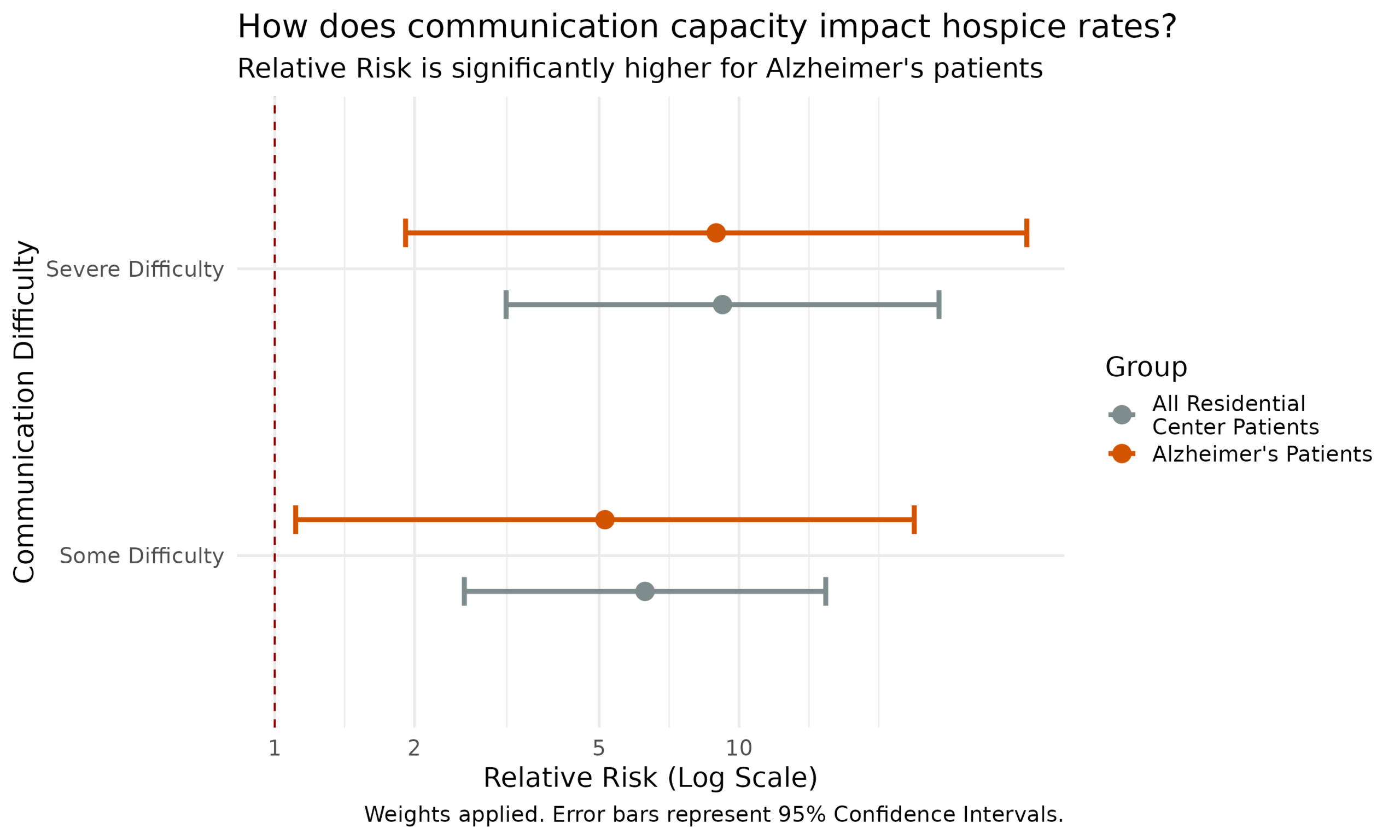
As shown in Figure 1, people with Alzheimer’s or other dementia conditions are much more likely to go into hospice care if they have severe difficulty communicating compared to if they had just some difficulty. The plot also visualizes how the confidence interval for people with dementia is very wide, As shown by comparing the plot of Alzheimer’s and dementia patients and the plots of non-dementia patients
Models were adjusted by age, sex, and self-reported ethnicity of the surveyed patients. Adjustment by sex was not significant in any of the models. Other comorbidities were not adjusted for. When adjusting the whole population model by Alzheimer’s or other dementia condition diagnoses, the adjustment was also not significant as P = 0.49. This means the association is just due to chance.
Discussion
General overview
Overall, the analysis has shown that the average age for hospice enrollment is 87.4, that women are more likely to go into hospice, and that people with Alzheimer’s or other dementia conditions on average are more likely to go to hospice than non-dementia patients. The data also show that dementia patients have a much higher chance of being admitted into hospice when they can’t communicate than those who can communicate some.
Connection to AAC
As a result of needing to use more consistent ways to correspond with patients, care personnel might be more likely to use augmentative and alternative communication techniques on dementia patients than on other patients. This is especially true as hospice is not the default for dementia patients, given that previous research showed that dementia patients were highly unlikely to go into hospice and normally only very late5. The fact that the rate of hospice enrollment is so much lower for those that had fewer communication difficulties could show that the greater use of augmentative and alternative communication devices could help medical professionals determine when a person is ready for hospice care. Of note are the wider confidence intervals for data on dementia patients. This is likely because the subgroup is smaller and there is more differentiation between dementia patients than there is between non-dementia patients. This means that the estimates and numbers for the dementia patients are less precise and could vary from group to group.
Strengths
This study shows an association between communication and hospice enrollment, although it does not claim a causal link between the two. This study also helps to fill a gap in the literature, given that while there has been research dealing with the effects of communication difficulties in dementia patients, there is not enough evidence that directly looks at how communication difficulty and hospice enrollment associate with each other.
Limitations
While the study was able to use the NPALS study, which provided good information about communication difficulties and their relation to hospice care, the inability to access more explicit data sets greatly restrained this essay, as it prevented more direct research into how hospice enrollment is related to communication difficulty in dementia patients. The use of only the NPALS study also meant that the sample size was smaller than desired. In the future it would be best to use not only future NPALS studies but also other data sources for a more accurate look. The study also did not adjust for other comorbidities, which also could have influenced the final result.
Another limitation is that dementia patients that have severe communication difficulties typically have a very advanced stage of the disease. As such, the more accurate reason for an increase in hospice enrollment could be because of how advanced the disease is and not the communication difficulties. Additionally, there could be a case of reverse casualty where people enrolling in hospice proceed to develop more damaging communication difficulties.
Future possibilities
In the future, more research needs to be done to determine the association between communication difficulty and hospice enrollment rates. Further research should also be done to determine how communication difficulties specifically affect the rate of hospice enrollment for other neurodegenerative diseases like Amyotrophic Lateral Sclerosis (ALS). As these and other neurodegenerative diseases also have lower rates of hospice enrollment, studies must be done to see if the use of AAC has effects comparable to those seen in dementia patients. The use of AAC has shown potential when dealing with patients that have neurodegenerative diseases, as it has been shown to greatly improve communication rates. The increased use of AAC would also improve the efficiency of dealing with and taking care of patients through improved communication. As such, more research should be done to determine the effectiveness of AAC on neurodegenerative patients. Research should also be done to determine any association between the use of AAC and increased hospice enrollment rates.
Conclusion
This study explores a major issue in the care of Alzheimer’s and other patients with neurodegenerative disease, as these patients have been shown to be less likely to go into hospice, which could be potentially helpful depending on their ability to communicate. The data shows that communication is a highly important factor in a person enrolling into hospice. While this study shows an association between increased communication difficulties and increased hospice enrollment, it does not definitively show this to be causation. More research needs to be done in this field to determine a more solid link. Further support needs to be given to resources related to communication with patients with neurodegenerative diseases to ensure adequate care for their condition and lives. Through further research in this field, dementia care can see a benefit to its caretaking abilities.
Acknowledgements
The authors would like to thank Lumiere Education for mentoring resources and writing workshops for the paper.
References
- National Institute on Aging. Alzheimer’s disease fact sheet. 2023. Available from: https://www.nia.nih.gov/health/alzheimers-and-dementia/alzheimers-disease-fact-sheet [↩]
- J. Yu. 10 early signs. Available from: https://www.parkinson.org/understanding-parkinsons/10-early-signs [↩]
- Augmentative and alternative communication (AAC). American Speech-Language-Hearing Association;. Available from: https://www.asha.org/public/speech/disorders/AAc/. [↩]
- M. Engel, M.C. Kars, S.C.C.M. Teunissen, A. van der Heide. Effective communication in palliative care from the perspectives of patients and relatives: a systematic review. Palliative and Supportive Care. Vol. 21(5), pg. 890–913, 2023 Aug 30, doi:10.1017/s1478951523001165. [↩]
- M. Silveira. Commentary: Hospice care for those with dementia falls far short of meeting people’s needs at the end of life. 2024. Available from: https://ihpi.umich.edu/news-events/news/commentary-hospice-care-those-dementia-falls-far-short-meeting-peoples-needs-end. [↩] [↩] [↩]
- I.H. Broyles, Q. Li, L.M. Palmer, M. DiBello, J Dey, I Oliveira, H. Lamont. Dementia’s unique burden: function and health care in the last 4 years of life. The Journals of Gerontology: Series A. Vol. 78(6), pg. 1053–1059, 2023 Feb 6, doi:10.1093/gerona/glad003. [↩]
- M. Fried-Oken, A. Mooney, B. Peters. Supporting communication for patients with neurodegenerative disease. NeuroRehabilitation. Vol.37(1), pg. 69–87, 2015 Aug 22, doi:10.3233/nre-151241. [↩]
- S. Banovic, L. J. Zunic, O. Sinanovic. Communication difficulties as a result of dementia. Materia Socio-Medica. Vol. 30, pg. 221–224, 2018, DOI: 10.5455/msm.2018.30.221-224. [↩]
- B. Ragasivamalini, V. Balambighai, S. Nivedhitha, K. Prasanth. A cross-sectional study of dementia-related communication barriers in clinical practice in South India. Cureus. Vol. 17, e81560, 2025, DOI: 10.7759/cureus.81560. [↩] [↩]
- A. Hockley, D. Moll, J. Littlejohns, Z. Collett, C. Henshall. Access to communication support for community-dwelling people with dementia: A mixed methods study exploring local perspectives within the United Kingdom context. Age and Ageing. Vol. 54, afaf150, 2025, DOI: 10.1093/ageing/afaf150. [↩] [↩] [↩]
- A. De Vleminck, R. S. Morrison, D. E. Meier, M. D. Aldridge. Hospice care for patients with dementia in the United States: A longitudinal cohort study. Journal of the American Medical Directors Association. Vol. 19, pg. 633–638, 2018, DOI: 10.1016/j.jamda.2017.10.003. [↩] [↩] [↩] [↩] [↩] [↩]
- L. J. Hunt, S. Gan, W. J. Boscardin, K. Yaffe, C. S. Ritchie, M. D. Aldridge, A. K. Smith. A national study of disenrollment from hospice among people with dementia. Journal of the American Geriatrics Society. Vol. 70, pg. 2858–2870, 2022, DOI: 10.1111/jgs.17912. [↩] [↩] [↩] [↩]
- E. A. Luth, D. J. Russell, J. C. Xu, B. Lauder, M. B. Ryicker, R. R. Dignam, R. Baughn, K. H. Bowles, H. G. Prigerson. Survival in hospice patients with dementia: the effect of home hospice and nurse visits. Journal of the American Geriatrics Society. Vol. 69, pg. 1529–1538, 2021, DOI: 10.1111/jgs.17066. [↩] [↩]
- K. L. Harrison, I. Cenzer, C. K. Ankuda, L. J. Hunt, M. D. Aldridge. Hospice improves care quality for older adults with dementia in their last month of life. Health Affairs. Vol. 41, pg. 821–830, 2022, DOI: 10.1377/hlthaff.2021.01985. [↩] [↩]
- L. C. Hanson, C. E. Kistler, K. Lavin, S. L. Gabriel, N. C. Ernecoff, F.-C. Lin, G. A. Sachs, S. L. Mitchell. Triggered palliative care for late-stage dementia: a pilot randomized trial. Journal of Pain and Symptom Management. Vol. 57, pg. 10–19, 2019, DOI: 10.1016/j.jpainsymman.2018.10.494. [↩] [↩] [↩] [↩] [↩] [↩]
- D. Lackraj, D. Kavalieratos, K. P. Murali, Y. Lu, M. Hua. Implementation of specialist palliative care and outcomes for hospitalized patients with dementia. Journal of the American Geriatrics Society. Vol. 69, pg. 1199–1207, 2021, DOI: 10.1111/jgs.17032. [↩] [↩]
- P. J. Lin, Y. Zhu, N. Olchanski, J. T. Cohen, P. J. Neumann, J. D. Faul, H. M. Fillit, K. M. Freund. Racial and ethnic differences in hospice use and hospitalizations at end-of-life among Medicare beneficiaries with dementia. JAMA Network Open. Vol. 5, e2216260, 2022, DOI: 10.1001/jamanetworkopen.2022.16260. [↩]
- S. S. Sullivan, W. Bo, C. S. Li, W. Xu, Y. P. Chang. Predicting hospice transitions in dementia caregiving dyads: an exploratory machine learning approach. Innovation in Aging. Vol. 6, igac051, 2022, DOI: 10.1093/geroni/igac051. [↩]
- A. Dietz, J. Vannest, T. Maloney, M. Altaye, S. Holland, J. P. Szaflarski. The feasibility of improving discourse in people with aphasia through AAC: Clinical and functional MRI correlates. Aphasiology. Vol. 32, pg. 693–719, 2018, DOI: 10.1080/02687038.2018.1447641. [↩] [↩] [↩] [↩] [↩] [↩]
- National Institute on Deafness and Other Communication Disorders. Aphasia. https://www.nidcd.nih.gov/health/aphasia, 2025. [↩]
- I. Odendaal, K. M. Tönsing. Augmentative and alternative communication for individuals with post-stroke aphasia: perspectives of South African speech-language pathologists. Augmentative and Alternative Communication. Vol. 41, pg. 56–64, 2025, DOI: 10.1080/07434618.2024.2374303. [↩]
- J.V. Radtke, B.M. Baumann, K.L. Garrett, M.B. Happ. Listening to the voiceless patient: case reports in assisted communication in the intensive care unit. Journal of Palliative Medicine. Vol. 14(6), pg. 791–795, 2011 Jun, doi:10.1089/jpm.2010.0313. [↩]
- L. E. Zaylskie, E. E. Biggs, K. J. Minchin, Z. K. Abel. Nurse perspectives on supporting children and youth who use augmentative and alternative communication (AAC) in the pediatric intensive care unit. Augmentative and Alternative Communication. Vol. 40, pg. 255–266, 2024, DOI: 10.1080/07434618.2023.2284269. [↩] [↩]
- M. Fried-Oken, C. Rowland, D. Daniels, M. Dixon, B. Fuller, C. Mills, G. Noethe, J. Small, K. Still, B. Oken. AAC to support conversation in persons with moderate alzheimer’s disease. Augmentative and Alternative Communication. vol. 28(4), pg. 219–231, 2012 Dec, doi:10.3109/07434618.2012.732610. [↩] [↩] [↩]
- A.M. Sunjaya, T. Schreiber, K. Kantilal, N. Davies, S. Griffiths. Communication strategies for delivering personalised dementia care and support: a mixed-methods systematic review and narrative synthesis. Age and Ageing. Vol. 54(5), 2025 May, doi:10.1093/ageing/afaf120. [↩]
- R. Collins, A. Hunt, C. Quinn, A. Martyr, C. Pentecost, L. Clare. Methods and approaches for enhancing communication with people with moderate-to-severe dementia that can facilitate their inclusion in research and service evaluation: Findings from the IDEAL programme. Dementia. Vol. 21, pg. 1135–1153, 2022, DOI: 10.1177/14713012211069449. [↩] [↩]
- C. Dias, I. T. Rodrigues, H. Gonçalves, I. Duarte. Communication strategies for adults in palliative care: the speech-language therapists’ perspective. BMC Palliative Care. Vol. 23, Article 49, 2024, DOI: 10.1186/s12904-024-01382-x. [↩] [↩] [↩] [↩] [↩]
- National Center for Health Statistics. 2020 National Post-acute and Long-term Care Study methodology documentation. National Center for Health Statistics, Centers for Disease Control and Prevention, 2023. https://www.cdc.gov/nchs/data/npals/2020-NPALS-methodology-documentation-508.pdf. [↩]
- B.W. Ward, M. Sengupta, C.J. DeFrances, D.T. Lau. Covid-19 pandemic impact on the national health care surveys. American Journal of Public Health. Vol. 111(12), pg. 2141–2148, 2021 Dec, doi:10.2105/ajph.2021.306514. [↩]