

Abstract
Background. Genetics is one of the fundamental sciences of biology that explains the mechanisms of heredity and variations in living organisms.
Objective. This study aims to present the basic principles of genetics, starting from historical discoveries to core laws of inheritance.
Approach. A narrative review of classical and foundational concepts in genetics was conducted, focusing on the work of Gregor Mendel, Thomas Morgan, and the fundamental laws of inheritance.
Key Findings. The analysis shows that both genetic and environmental influences play significant roles in the formation of character and behavior.
Conclusion. Understanding these core genetic principles remains essential for students and researchers in biology and related fields, providing a solid foundation for more advanced studies in molecular genetics and genomics.
Introduction
This work is a narrative educational review that examines the role of genetic inheritance and environmental factors in the formation of human character and temperament.
Relevance of the Study. Since ancient times, scientists and doctors have been trying to understand the inheritance of certain features of character and behavior by a person. Character is the most complex model of behavior, clearly transmitted not only genetically but also changing during life. By understanding the inheritance of certain traits, it will be possible to prevent the appearance of criminals, as now geneticists prevent the birth of children with dangerous and incurable diseases (for example, cystic fibrosis, Shereshevsky-Turner syndrome, etc.). It will also be possible to avoid inheriting mental illnesses such as bipolar personality disorder and schizophrenia1.
The problem of partial misunderstanding of where this or that character trait or mental illness comes from remains relevant due to the high risk of giving birth to children whose parents have been diagnosed. Although scientists such as Francis Galton and Gregor Mendel have been studying the basics of genetics and the ways in which a wide variety of physical traits are inherited since the 19th century, the inheritance of eye color and hair growth rate has not yet been fully elucidated. Studying the inheritance of behavior will help find quick solutions to modern problems. For example, it will help develop preventive programs and ensure the protection of children’s mental health. Based on the above, we formulated the goal of the work to try to find out how much of a person’s temperament and character traits depend on heredity, and how much depend on the influence of the environment and individual life experience.
To achieve the goal, the following tasks were set:
- To study the mechanism of inheritance of physical qualities
- To study the known mechanism of inheritance of character traits, temperament, and intelligence
- Explore two studies
- Analyze and compare them
Working Hypothesis: Character and temperament are closely related to genes and are inherited.
Alternative Hypothesis: Character and temperament have nothing to do with genetics and inheritance and serve as an example of non-hereditary or modificational variation.
Approbation of the Work: The results of the work were reported at the school conference.
Structure of the work: The work consists of 3 chapters, conclusions,a list of references, and annex. The list of references contains 23 sources, the annex contains 5.
Research Methods:
The literature search and selection process were conducted as follows:
- A systematic search of scientific literature was performed in the electronic databases of PubMed and nature.
The main keywords and phrases used included: “inheritance of physiological traits”, “inheritance of psychological traits,” “genetics of temperament,” “heritability of personality traits,” “genetic and environmental influences on behavior,” “longitudinal studies on character inheritance of teenagers during transition to adulthood” and “longitudinal studies on character inheritance of infants.”
Inclusion criteria were:
- Peer-reviewed articles and books in English and Russian
- Publications date between 1991 and 2024
- Studies focusing on the genetic and environmental contributions to personality, temperament, and character traits.
Out of the collected material and reviewed publications, two key empirical studies: Hopwood et. al. (2012)2 and Penichet et. al. (2024)3 were selected for detailed analysis and comparison. These two studies were chosen because of their longitudinal nature and their shared implementation of ACE (Additive genetics, Common environment, and unique Environment) model. Also, both examine the relative contribution of genetic and environmental factors to personality traits.
The selected material was then analyzed, compared, and generalized. Finally, conclusions were drawn regarding the relative influence of heredity and environment on human character and temperament.
The Science of Genetics and the Basic Rules of Gene Inheritance
Genetics is the study of the laws of heredity and variability in organisms, dating back to the days when humans were just beginning to cultivate fields and domesticate animals. For example, a Babylonian tablet over 6,000 years old shows the pedigrees of horses and indicates possible hereditary characteristics.
In the 19th century, Gregor Mendel crossed peas with yellow seeds with green seeds and observed how their phenotype would change. It was he who derived the terms dominant and recessive genes. He also derived 3 of Mendel’s laws, which became the foundation for further study of genetics.
Mendel’s first law, or the law of dominance, states: “In the monohybrid crossing of homozygous individuals with different values of alternative traits, the hybrids are uniform in genotype and phenotype.” To clarify, if individuals are monozygotic (AA * AA or aa * aa) on the basis of the color of the spines (spines are only green), then spines of a different color cannot appear.
For example, if the inheritance of phenotypic traits by plants is studied, and if the dominant gene is green and the recessive gene is yellow, crossing two heterozygous (Aa * Aa) organisms, there is a 75% probability that the offspring will get green in the phenotype. These are the basics of inheritance – Mendel’s second law, or the law of splitting.
When two individuals differing from each other in two (or more) pairs of alternative traits (AAbb * AaBB) are crossed, genes and their corresponding traits are inherited independently of each other and combined in all possible combinations. For example, the color of the spines and the color of the plant itself do not depend on each other and can enter into completely different combinations. Naturally, later theories were discovered that supplemented Mendel’s laws. Thomas Morgan, the outstanding geneticist of the 20th century, discovered the linked inheritance of traits – or, in simple words, that the certain group of genes for eye color and for hair color are directly related because they are close on the same chromosome4.
Character and Behavior. The Main Difference
Character is a structure of stable, relatively constant mental properties that determine the features of relationships and behavior of a person5. When we talk about character, we usually mean just such a set of properties and qualities of a person that leaves a certain seal on many of its manifestations and deeds.
Behavior is a certain established way of interacting with the environment and is determined by the ability to change one’s actions under the influence of internal and external factors. Behavior is a characteristic feature of the animal type of organisation, and it has a great adaptive value, allowing animals to avoid negative environmental factors.
To summarize: character is mental properties, can be inherited, and is the basis of behavior.
Behavior is a way of interacting with the environment, which can change depending on conditions. That is, it cannot be inherited.
To conclude: behavioral tendencies, such as aggression, can be partly heritable, but specific actions depend strongly on the environment and situation.
Inheritance of Character Traits
A person does not have character traits that would not have genetic components. And there are no character traits that would be 100% determined by genes.
For example, there is a certain group of genes that are responsible for introversion/extroversion (the influence of the DRD4 gene). Studies of twins show that the level of sociability, propensity for leadership and active social interaction have a significant genetic component6.
Neuroticism is also inherited7. 116 genetic variants are associated with neuroticism. Some of these variants are found near or within genes associated with cellular metabolism, as well as genes previously associated with major depressive disorder and anxiety. Thus, neuroticism has a strong genetic basis and may be closely related to the mechanisms responsible for metabolism8.
Aggression and impulsivity, in turn, were studied very carefully. The so-called experiments on mice were carried out using “reverse genetics.” The effect on serotonin receptors was investigated by deleting the serotonin receptor gene, as a link between serotonin and aggressive behavior in mice had been established. It turned out that in real life, under normal conditions, the “mutants” behaved normally, but when attacking they were twice as aggressive. More importantly, linkage analysis helps clarify the link between serotonin genes and impulsivity and proactive aggression. DAT1 and DRD2 genes are also closely related to the genetics of aggression9.
In the human body, as in many living beings, proteins control everything. Some studies have already found links between certain genes and memory and thinking. For example, the SHANK3 gene encodes a protein important for the formation and function of synapses in the brain, which affects how it works. Variants in the SHANK3 gene are associated with autism and schizophrenia10.
Also, it is worth mentioning that many diseases have a significant social component. The environment has a very strong influence on the development of certain character traits and diseases.
According to twin studies, human personality is 30-60% inherited, leaving a significant percentage for the personal environment6.
Inheritance of Intelligence
Early studies of adult twins have determined that the inheritance of intelligence varies between 57% and 73%, although later analyses have shown that the percentage is as high as 80%11.
Heritability scores take values from 0 to 1; a heritability score of 1 indicates that all variations in the trait in question are of genetic origin, and a heritability score of 0 indicates that none of the variations are genetic. For example, if we consider the heritability of growth, the score is about 0.80 – which is high enough and indicates the heritability of the trait. If we consider the heritability of depression, the numbers differ in women and men – 0.42 and 0.29, respectively8, which, in turn, shows a completely different proportion and that the trait depends more on the surrounding social environment (almost all experiments and analyses were carried out using the twin study).
Heritability measures the proportion of a trait variation that can be attributed to genes, not the proportion of a trait caused by genes. Thus, if the environment related to a given trait changes in a way that affects all members of the population equally, the mean value of the trait will change without any change in its heritability (because the variation or differences between individuals in the population will remain the same). If we take the heritability of height, then in everyone it corresponds to the genes that came from the parents, but if the environment changes, and a person needs a taller stature, the average reading of the trait will also change. Using the example of the human population through the centuries, you can trace this trend. According to Arzamas, the average height of men during the reign of Peter I was about 165 cm, while nowadays the average height of men is 182.5 cm, which again shows a change in the environment.
Let us turn to the inheritance of intelligence. It is important to note that the high heritability of a trait does not mean that the environment is not able to affect the trait in any way. An example would be vocabulary size. This trait is closely related to intelligence and is largely inherited. If a person develops in an environment where books are available to them or in the environment, where book words are often used, they are more likely to grow up well-read.
Contrary to popular belief, two parents with a higher IQ will not necessarily produce offspring with equal or higher intelligence, and the more extreme the trait in the parents, the less likely the child is to show the same extreme as the parents – this phenomenon is called regression to the mean.
Numerous studies have estimated IQ heritability as 0.7–0.8 in adults and 0.45 in children in the United States12. Heritability estimates have been found to increase with age. Heritability estimates in infancy are only 0.2, about 0.4 in middle childhood, and reach 0.8 in adulthood.
The general family environment also affects the development of intelligence. Although experts have found that by adulthood, adoptive siblings are also not similar in terms of intelligence development, as are strangers. At the same time, the similarity of intelligence reaches 0.24 in siblings.
The American Psychological Association’s 1996 report, Intelligence: Known and Unknown, speaks of a mandatory minimum responsibility for normal child development. Explaining that no matter what the heritability of the child’s intelligence is, it will not be possible to develop it in unfavorable conditions5.
What language parents use when talking to their children, what resources are available to the family, significantly affects the development of the child’s intelligence, although genetic factors should also be taken into account. Recent twin studies have shown that the influence of family as a social institution strongly influences children in early childhood, and much less so in adolescence. The results indicate that the atmosphere of the family is potentially important for the development of the inner world of the child, but it does not play the most important role in the development of intelligence13.
Malnutrition and diseases have a noticeable effect on intelligence, among other things. Phenylketonuria (a congenital metabolic disorder) reduces IQ by an average of 10 points. Lack of iodine in the body also contributes to the decrease – by 12.5 points5.
Inheritance of Temperament
Temperament is defined as the biological basis for affective arousal, expression, and regulatory components of personality. Each child has his or her own unique temperament, which affects how he or she responds to the world. Some children will approach new situations with joy, while others will be more reluctant. This has an enormous impact on their development, and this is why temperament is one of the most widely studied features in child development. Estimates of temperament heritability range from 0.2 to 0.6, counting the maximum mark. It can be said that temperament can be mostly inherited genetically14.
Genetics contributed to individual differences in temperament and peer problems, with peer problems being largely inherited (44%). The remaining variance is attributed to environmental factors. Genetic factors largely mediate correlations between peer problems and temperament. The results indicate the importance of characteristics based on children’s temperament in their social development.
Large studies have identified several genes that play a role in temperament. Some gene variations may contribute to certain traits associated with temperament. For example, variants in the DRD2 and DRD4 genes are associated with a desire to seek out new experiences, while gene variants are KATNAL2 associated with self-discipline and caution. Variants affecting the PCDH15 and WSCD2 genes are associated with sociability, while some variants in the MAOA gene may be associated with introversion, especially in certain conditions. Variants in several genes, such as SLC6A4, OLFM4, MEF2C, and TMEM161B, contribute to anxiety or depression. Increasingly, research is also finding that the effects of parenting depend on the child’s temperament and genotype, with negative emotionality and sensationalism influencing outcomes in both positive and negative directions. Thus, this means that the development of temperament also has a social structure9.
Researchers believe that there is a genetic link to impulsive aggression through the effect of the gene on the production of the MAOA enzyme. The MAOA gene reduces the production of MAOA enzyme, which leads to an increase in impulsive aggression. A 26-year study in New Zealand found a strong correlation between childhood abuse experiences and criminal or aggressive behavior in men with the MAOA gene. In this study, it was found that impulsive aggression was nine times more likely to occur in men with the gene who had been abused than in abused men without the gene or men with the gene who had not been abused15. The links between the child’s temperament and parental behavior were investigated. The purpose of the study: whether the child’s temperament and their upbringing predict changes in each other. With the help of cross-sectional analyses, it turned out that maternal negativity at 36 months contributes to the development of childhood frustration at 54 months, regardless of temperament. But maternal negativity and childhood compulsive self-regulation predicted each other’s balance by 54 months. The results show that temperament and upbringing have an independent and complementary effect on the adaptation of preschool children, and there is some evidence of a bidirectional relationship.
In turn, parental behavior can shape a child’s temperament, and this transaction between parenting and temperament contributes to the child’s adaptation. In addition to directly influencing children’s adaptation, temperament can indirectly shape adaptation through parental behavior12. For example, fearfulness has been found to predict an increase in maternal warmth in preschool-aged children and maternal acceptance in pre-adolescence, whereas negative reactivity in toddlers leads to an increase in negative parental behavior and a decrease in maternal sensitivity to the child in infants.
Again, it has already been established that upbringing partially shapes the child’s temperament. The higher the maternal detachment, the more strongly mother’s negative affect and negative parental behavior were associated with an increase in the child’s negative emotional excitability. Maternal warmth, responsiveness, support, and consistent introduction of restrictions gave an increase in children’s forced self-regulation; while punitive discipline and coercion have been associated with a decrease in children’s coercive self-regulation.
There is also evidence of bidirectional effects of irritability/impulsivity and parenting. For example, irritability in infants predicted a decrease in maternal sensitivity, and at the same time, maternal sensitivity predicted a decrease in the infant’s irritability within six months. In the pre-adolescent period, the child’s irritability predicted an increase in inconsistent discipline on the part of the mother, while inconsistent discipline and rejection by the mother predicted an increase in irritability and fear. Taken together, these results suggest that there are complex bidirectional relationships with certain dimensions of temperament and aspects of parenting that predict mutual changes in each other over time12
In toddlers, the observed harsh upbringing is associated with increased negative emotional excitability of the child, but the negative emotional excitability of the child could not predict changes in harsh upbringing. This suggests that in toddlers, upbringing can have a greater impact on temperament than temperament on upbringing.
Influence of the Environment on Behavior
The environment has a significant impact on human behavior, affecting both physical and mental health, as well as social interactions.
A study16 conducted in 2013 found that different responses to stimuli were observed depending on temperament.
Bonding with deviant peers increases the risk of subsequent aggressive and destructive behavior in childhood, as well as delinquency and substance use during adolescence.
Similarly, numerous aspects of temperament distinguished teenage drug abusers from their peers, including high levels of activity and negative emotions, low attention control, and flexibility, and arrhythmicity
Longitudinal studies have expanded on these cross-sections over time, linking poor attention regulation, high activity levels, negative emotions, and social retardation in childhood to aggressive and antisocial behavior and substance use during adolescence.
Theoretical ideas agree that temperament leads to behavioral problems not directly, but indirectly through interaction with the social environment17.
Inheritance of Mental Illnesses
Children of parents diagnosed with mental disorders are more at risk of developing these mental disorders than others. It was revealed during the PRISMA 2020 studies that genetics significantly affect mental stability. For some psychiatric disorders, the association with risk to offspring is so strong that a parent’s diagnosis has been seen as an indication for primary targeted prevention10.
The exact influence of the family (social factor) on the development of disorders has not yet been fully determined.
The absolute risk of any psychiatric disorder among the offspring of affected parents was: 55% in the offspring of parents suffering from bipolar disorder or anxiety disorders; 51% in the offspring of parents suffering from depressive disorders; 38% in the offspring of parents suffering from substance use disorders and 17% in the offspring of parents suffering from psychosis.
Studies have found that about one in two offspring of parents with anxiety, bipolar and depressive disorders will develop a mental disorder10.
Study “Genetic and Environmental Effects on Stability and Development of Personality Traits During the Transition to Adulthood: A Longitudinal Three-Step Study”
(2012, Christopher J. Hopwood, M. Brent Donnellan, Daniel M. Blonigan, Robert F. Krueger, Matt McGugh, William G. Iacono, S. Alexandra Burt)
The transition from adolescence to adulthood greatly changes a person’s personality, making them more emotionally stable and mature. People master new social niches, learning to interact with new individuals, and build a life and family.
In these studies, scientists tried to identify how exactly character traits changed from 17 to 29 years old and where the origins of the changes themselves come from.
The transition to adulthood (18-30 years old) involves a network of major changes and development in the areas of intimacy, identity, parenthood, etc. However, it is still not clear whether these changes are accompanied by endogenous (internal) or exogenous (external) factors. Accordingly, the goal is to find out the influence of genetics and society on the development and change of personality during this period. Those who grew up in the same family are asked to answer questions, after which their results are compared2.
Sociologists are still not sure when exactly the transition to adulthood occurs. But many agree with Arnett that people in their “20s” adapt to certain conditions and by the age of 30 occupy a specific niche and take on at least one of the social roles.
In general, one view argues that biologically determined internal processes underlie personality change in young adulthood, while another view argues that personality maturation is at least partly related to participation in the social roles of adulthood.
Participants: same-sex mono- and dizygotic male and female twins from Germany.
Age of participants: 17 years (at the time of start), 24 years, 29 years (the study was carried out in three stages).
Method: the same participants took tests and answered questions for 12 years, the Big Five scale was used to assess personality, which includes: extraversion, agreeableness, conscientiousness, emotional stability, openness to new experiences18.
Research
Two terms are needed to be introduced here. Absolute stability (average level) and differential (rank) stability. Absolute stability maintains the average level of a certain personality trait in the group over time. Example: in adolescence, the level of extraversion is approximately 3.4, then in adulthood the result is preserved; it will also be 3.4. (3,4 – arithmetic mean from the Big Five scale (1 – very introverted; 7 – very extroverted).
Differential stability, in turn, maintains a certain level over time in each person. For example, suppose a girl had the highest level of extroversion among her teenage friends. After 20 years, the level of extroversion in the group increased by 1.0, that is, it increased in the majority of participants in the group, but the girl still had the highest result among all5.
Let us get back to the study. All 626 pairs of twins were asked to answer 198 questions from the Multidimensional Personality Questionnaire (MPQ). The following qualities were assessed:
- negative emotionality (NEM) – reflects a person’s tendency to experience negative emotions, for example, a person with high NEM often experiences anxiety and irritation;
- agent-based positive emotionality (PEM-A) – focus on achievements, ambitions, leadership, for example, with a low level of PEM-A, a person is proactive, enjoys achieving success, seeks to influence others;
- communitarian positive emotionality (PEM-C) – the ability to enjoy communication, intimacy, for example, a person with a high PEM-C is more sensitive and caring;
- restraint (CON) – reflects a tendency to self-control, restraint in behavior and impulses, for example, a high level of CON confirms that a person is cautious, traditional, and risk-averse2.
MPQ trait data was standardized using a T-scale metric using wave 1 data.
Test-retest coefficients (a psychological method of assessing the reliability of a test in which the same test is repeated on the same participants after a certain period of time) were used to indicate the degree of differential stability of personality traits over time. Growth curves were used to estimate the changes.
It is also assumed that any differences between mono- and dizygotic twins are due to their genetic similarity, since the social environment of each pair of twins was the same.
In order to understand the reasons for differences in personality (differential stability) over time, a special model was used, the Cholesky model of decomposition. In this model, the variations and relationships between personality traits are broken down into genetic and environmental influences.
It is possible to measure how these genetic and social influences coincide with each other at different points in time. If the genetic correlation (association) is equal to 1.0, it means that the genetic influences are completely the same in different measurements. If the correlation is equal to 0.0, it means that the genetic influences do not coincide at all. (Cholesky diagram, Annex).
For each personality dimension (e.g., at 17, 24, and 29 years of age), the differences between people (variance) are broken down into three parts:
A – genetic influences (designated as A1, A2);
C – general environmental conditions (for example, family) – denoted as C;
E – individual environmental conditions, unique to each (denoted as E1, E2)
The diagram the researchers used (Figure 1 (Annex)) shows only one of the twins — because the other would have the same pathways. Each line in the diagram shows the contribution of a certain factor. To find out what part of the differences explains the factor, the value on the line is squared. These values are indicated by small letters and two numbers, such as a11. The study also shows how genetic or social influences at one age are similar to those at another age. This is denoted by the letter r, for example: rA₁₇→₂₄ is a genetic link between a person at 17 and 24 years old.
To understand where differential stability and personality changes with age come from, the researchers used a biometric model of the hidden growth curve, which allows us to divide changes into the influence of genes and environment.
At each stage (17, 24, 29 years), the differences between people were divided into three parts, which were described earlier2.
First, they tested what influenced personality at the beginning of the studies (at age 17), then what influenced the changes over time, and finally what influenced the differences between people at each stage. A hidden growth curve was used (an invisible line (because it is built from several dimensions at the same time) shows the development of a particular characteristic).
Strengths: the study has a strong longitudinal design spanning 12 years, uses large twin sample with different sexes, applies robust statistical model, such as ACE model.
Limitations: Personality traits were assessed exclusively through the self-reported questionnaires, which may be less objective due to limited self-awareness. Additionally, sample consisted of only German twins, which limits the generalizability based on culture.
Analysis of the First Study
Table 1 (Annex) shows how personality changed over three periods of life: 17-24; 24-29 and 17-29. The results show that personality remained fairly stable over time, even after 12 years (the correlation coefficients between the results ranged from 0.49 to 0.57). Most of the changes occurred between 17 and 24 years, and from 24 to 29 years of age, fewer changes were recorded so over the years the personality becomes more stable.
There are also changes in all 4 traits studied: NEM (tendency to experience negative emotions); PEM-A (tendency to focus on ambitions); PEM-C (ability to enjoy communications); CON (tendency to control oneself). NEM declined substantially in the first phase (17–24 years), while CON tended to increase, with the changes being sharp in both the first and the second interval. The PEM factor has not changed much.
Differential stability also changed. There was evidence of a significant genetic contribution for all 4 traits (NEM, PEM-A, PEM-C, CON) – about 33-56% of the variance (differences), together with the independent influence of social and environmental – about 42-61% of the variance (differences). changes over time (17-29 years). The results also show that personality is inherited in both pre-adult and adulthood2.
Table 2 (Annex) shows that genetic influences were more stable over time than environmental influences and individual life experiences. Importantly, independent environmental influences became increasingly stable with age. That is, there is a particularly strong genetic contribution to differential stability, and the constancy of environmental influences is increasingly visible. Table 2 also suggests that NEM is strongly influenced by social and environmental factors. It can be concluded that the change factor NEM has a unique environment for each person. At the same time, CON changes are more genetically generated (68%), so implies the difference between individuals when inherited, although social factors are also present (32%); meaning that average reading of the trait can still change if the environment changes.
This study clearly shows that genetic contribution is very important for the basis of these traits, but the changes are more dependent on the unique environment. Although it has been indicated and noted before that such a factor as CON is mostly influenced by genetics, personality has the ability to change due to individual life experiences. It was found that both traits (NEM and CON) are directly affected by genes, as well as their changes over time. However, the independent social environment greatly influenced the development of NEM in particular. It was also determined that for NEM this effect was stronger. In the scientific literature (Robins, 2002), there is a hint that the level of NEM may be associated with the experience of romantic relationships12.
Genes also play an important role in differential stability (the preservation of differences in individual traits with age in a group of people), but environmental factors turned out to be stronger. Moreover, between stages 2 and 3 (24–29 years), there is a stronger relationship between personal environmental factors, that is, simplistically, people in this period (24—29 years old) consciously choose an environment that suits their personal characteristics (Roberts and Wood, 2006 have shown that this also applies to work19
Alternative explanations for the observed changes include gene-environment correlation: individuals may select environments (e.g., relationships) which reinforce their genetic predispositions (active gene-environment correlation). Also, there is a weakness – the equal environments assumption in twin studies, which basically means that study assumes that identical and fraternal twins have very common environment. In reality, fraternal twins have less common factor of shared or common environment (C) than identical twins. In addition, in other large studies (e.g., Bleidorn et. al. 201920) the genetic influence (A) is much more significant than in Hopwood et. al. 2012 which only implies 33-56%11.
Study “Genetically Based Long-Term Study of Temperament at an Early Age and Children’s Aggression”
(Eric N. Penichet, Christopher R. Beam, Susan E. Luzak, Deborah W. Davis)
Usually, physical aggression in children reaches its peak by the age of 4 and then decreases as the ability to self-regulate increases. For some children, increased aggression can lead to rejection by peers, difficulties in family relationships, and an inability to adapt to the outside world. This study examines whether different aspects of temperament are associated with childhood aggression before the age of 7. The focus of the study was on three aspects, which directly correlate with children’s aggression: self-control, activity, and sociability3. As it turned out, self-control (a child’s ability to regulate behavior and impulses) is negatively related to childhood aggression (that is, the more self-control a child has, the less aggressive they are). A study21 conducted in 2008 found that there is an “aversion response” when 6-month-old babies tried to keep their irritation at bay, which in turn negatively affects later aggression. At the same time, the activity manifested in the expenditure of energy and the strength of motor movements in the child has a positive effect on the later manifestation of aggression. What is more, high levels of activity in infancy have also been positively associated with childhood impulsivity and inattention, both of which are correlated with aggressive behavior. The influence of sociability on children’s aggression is not yet completely clear. Some studies prove that sociability has a positive effect on aggression, but only slightly. On the other hand, other studies with opposite results suggest a negative association. It is also important to note that favorable environmental conditions in childhood (sensitive upbringing) demonstrate a positive relationship with self-control and a negative relationship with aggression. Thus, it can be concluded that both genetic and environmental aspects affect the development of childhood aggression14.
Despite the observed genetic correlations between self-control and behavior, genetic variance (genetically determined differences) has been found to underlie both self-control and behavior. Thus, making it clear that genetics plays an important role in the formation of personality. The only twin study that examined the common etiology of the association between activity and childhood aggression found no common genetic or general environmental differences to explain their differences (so most likely it is determined by individual environment).
The importance of using the long-term method is key, as some aspects of temperament do not begin to emerge until the end of the first year of life.
Olino et al., 201322 is an excellent example of showing that boys exhibit higher levels of activity than girls, lower levels of self-control, and lower levels of sociability. Also, some studies have argued (Baker et al., 200823.) that boys have greater genetic variance (i.e., they are more influenced by genetics), while girls are more likely to have general and non-general environmental variability. That is, girls are more susceptible to social changes3.
Participants: 131 monozygotic and 173 dizygotic twin pairs
Age of participants: from 6 to 36 months, later 7 years.
Why were babies used? In the period up to 2 years of age, the expression of temperament is most pure, and later it is very difficult to separate the expression of temperament from other forms of behavior.
Method: The tests were administered using the Social Behavior Checklist (SBC), a 104-item questionnaire used and completed by teachers to express their opinions about children in the classroom. These 104 items covered aspects such as social and emotional traits, a subscale of aggression that includes passive and active aggression. Temperament was also measured using the Bailey Infant Behavior Scale (IBR – Infant Behavior Record), which is a summary assessment of a number of behavioral characteristics in infants – mental and motor development. Parents’ opinions were not included in the evaluation of the original study. Instead, there was direct observation by the researchers and the trained examiners. Based on the analysis of the IBR scale, 5 main factors were obtained: activity, emotional extraversion (inclination to positive emotions), purposefulness, audiovisual perception, and coordination of movements.
Research
The current study included only 3 of them: activity, emotional extroversion, and purposefulness. The activity measured the children’s overall energy and motor activity levels. Emotional extroversion, in turn, assessed the social involvement and emotionality of children. Finally, purposefulness measured the children’s level of focus and perseverance. 6 groups of infants were used: 6, 12, 18, 24, 30 and 36 months. The task was to find out how each of the factors affects the aggression of the child in each group, how it depends on gender, genetics, and environmental conditions.
Strengths: the use of teacher and observer ratings makes the study more objective, assessments were conducted in natural environment, the longitudinal design and twin sample allow good separation of genetic and environmental influences.
Limitations: the sample is limited to a specific age range, findings may be influenced by unfavorable conditions in some families or kindergartens.
Analysis of the Second Study
First, phenotypic data were calculated, such as sex, year of birth, and socio-economic status of the family. Analysis of sex variances did not reveal any differences between boys and girls who participated at the age of 7 years. There was also a negligible difference between the socio-economic status of different children. Temperament was measured in all 6 groups (6, 12, 18, 24, 30 and 36 months). The researchers compared the indicators in mono- and dizygotic twins in order to find out how much temperament traits and aggression are related to genes (A); how much of an influence individual life experience (E) has; and whether there is an influence of the general environment (C) (the ACE model). This biometric analysis includes 3 components: A is genetic influence; for example, monozygotic twins have 100% of the same genes, and dizygotic twins have 50%. Thus, it is possible to put the degree of genetic commonality (how similar the genes are in different individuals) in mono 1.0, in di 0.5; C is the common environment, the influence of the general conditions in which twins grow up, this part is the same for each pair of twins, because they come from the same environment. Therefore, the generality coefficient is 1.0; E — individual environmental conditions, for example, different friends, social circle, random events, different for every person, so highly intimate, therefore, there is no generality coefficient for E.
Table 3 (Annex) shows the mean values and standard deviations for each value.
Figure 2 (Annex), in turn, presents the average temperament scores for boys and girls. It can be noticed that at the age of 6 to 30 months, the Activity in boys is increased (the correlation coefficients difference with a girl is 0.30 (in girls 0.08, in boys 0.38)). At 6 months, girls and boys had equal scores on the Affect-extraversion scale. Between the ages of 12 and 36 months, girls showed higher results of emotional extroversion than boys. Thus, we can conclude that boys have a genetic predisposition to be a little more aggressive, and girls are more emotionally extroverted (more empathetic and social). The same goes for Task Orientation, with girls showing higher average scores (the difference between boys and girls is 0.06 to 0.26. In the end, 7-year-old boys showed slightly higher levels of aggression compared to girls (a difference of 0.0003).
Table 3 (Annex) presents the correlation between temperament and aggression. The correlation between activity and aggression gradually increased from 6 to 36 months, reaching a significant value of 0.18 at 18 months, increasing until it reached a maximum of 0.26 at 30 months of age. The relationship between emotional extroversion and aggression was close to 0 until 24 months, after which it gained a maximum value at 30 months – 0.20, then again decreased to 0.12. Purposefulness, in turn, had more and more negative correlations with aggression as children grew older. The peak was at 36 months – 0.23. Overall, stronger levels of some temperament traits were associated with either higher or lower aggression, depending on the trait.
To sum up, identical twins had more similarity on all counts, at all ages, except for purposefulness. At 6 months, both groups (mono- and dizygotic twins) had a goal of 0.38 and 0.37, respectively. From this we can conclude that the development of purposefulness in children is weakly determined genetically, most of all influenced by the environmental factors: upbringing, environment; and many healthy children of this age will have this level of trait. For activity, purposefulness (in general) and emotional extraversion, the discrepancy increased between dizygotic twins, indicating a strong influence of the environment and social traits, and for monozygotic twins, on the contrary, there was more and more similarity over time, which indicates the great importance of the genetic factor. In identical twins, both the initial level of temperament and the changes with age were more similar than in fraternal twins, which suggests that genetics not only provides starting traits, but also lays down the mechanics of their changes3. Finally, monozygotic people have more similar levels of aggression at 7 years of age. However, identical twins are still different, which can be explained by the influence of incompatible environmental dispersion.
Genetic influences fully explained the link between activity and aggression between 6 and 24 months. By 30 months, genetic influences accounted for 74% of the correlation, and joint environmental influences accounted for the remaining 26%. When scientists looked at changes in activity over time and its relationship with aggression, they found that only 8% of this relationship was the individual conditions of the child’s life, that is, 92% of the relationship between aggression and activity (and its change) is genetic.
The correlation between emotional extroversion and aggression is also largely explained by genetics — at 30 months by 84%; at 36 months — 92%.
The link between purposefulness and aggression, in turn, increased with age. That is, the higher a child’s sense of purpose, the lower the level of aggression – also mainly due to genetics.
Sex differences were noticeable. In boys, activity began to correlate with aggression earlier, and at 12 months it became equal to 0.17, and increased with age in negative correlation. In girls, this relationship appeared later, at 24 months, and became equal to 0.21. There is a very important difference: at 30 months, girls had 43% of the influence of an independent environment, while boys at the same age had the percentage equal to only 9.
Non-common environmental influences explained 35% of the activity-aggression association in girls, while no effect was found in boys. This means that girls’ behavior at this age is one-third dependent on their environment and individual conditions in childhood, while boys are more predictable based on their genetic traits.
Thus, the association between temperament traits and aggression in early childhood appears to be largely influenced by genetic factors, environmental influences are also present and may vary depending on the specific trait, the child’s age, and sex.
Alternative explanations provide that children with higher activity levels may evoke more negative responses from parents or peers, amplifying aggression. Socioeconomic status and parenting quality, as were taken into account to some extent, could still confound results. Also, this study assumes the equal environments assumption of the ACE model, which has been criticized (e.g., Felson, 201424). Additionally, the sample is homogenous, as sample is taken only from one region, so there is not enough data to generalize all cultures3.
Comparison of the Two Studies
The study of the influence of genetic and environmental factors on the development of personality and behavior remains a key task to this day. Two longitudinal studies—Peniche (2024) and Hopwood (2012)—offer an in-depth look at the role of heredity and environment at different periods of life: early childhood and transition to adulthood, respectively. Despite the general interest in identifying the influence of genetic and social factors, research differs dramatically in methods, results, and goals.
Briefly about the two studies. The 2024 Genetically Based Longitudinal Study of Early Childhood Temperament and Childhood Aggression, led by Peniche3 aims to find out how different aspects of temperament (activity, determination, emotional extraversion) can affect the future manifestation of aggression in children. The task is also to prove how genetic and social factors affect their development.
In turn, the study “Genetic and Environmental Effects on the Stability and Development of Personality Traits during the Transition to Adulthood: A Longitudinal Study in Three Phases” led by Hopwood focuses more on studying personality traits, such as negative emotionality, agent-based positive emotionality, communitarian positive emotionality, and restraint, in adulthood2.
Both papers use biometric analysis of the ACE model (A — genetics; C – general environment; E is a unique medium) in order to identify the dispersion (difference) of the studied features. Also, both works are continuous, that is, they use the same participants, but after a while. In the 2024 study, for short, the “Childhood Aggression Study”, 7 stages were used, while the 2012 study – “Personality Trait Study” for short – used only 3 stages.
The results were completely different. The study of “childhood aggression” revealed that certain temperament traits can both positively and negatively affect the development of aggression by the age of 7 and easily proved how genetics can influence the development of traits, and in subsequent aggression. Accordingly, almost no general and non-general environmental influences were identified. Although, clear sex differences have been reported. For example, the association between activity and aggression in girls at 30 months of age was 43% dependent on individual life experience, while in boys at the same age this association was correlated by only 9%. We can conclude that at least in some isolated cases, the society around influenced, but most of the changes still depend on genetics.
At the same time, the “personality traits” study shows that personality traits are fairly stable throughout the 12 years of research (meaning that a person was less likely to become violently aggressive after 7 years). The stability of traits such as negative emotionality and restraint is mainly genetically explained. It is worth noting that almost all changes are directly related to individual experience. The general environment played little role in this experiment either.
Commonalities: strong genetic influence on both studies; the use of the same method for determining variances (ACE); the overall environment has minimal impact.
Differences: In the first 2012 study, there was a significant impact on individual experience, most likely due to the age of the participants. In the study of “childhood aggression” babies are from from 6 to 36 months, which hardly implies much experience. Also, the data collection for the study was different. For example, the “personality traits” study was based on self-reported personality traits, while the second study used a parental assessment of temperament and an external (teacher’s) assessment of aggression, making the first study slightly less objective. Genetics was key in both cases, but in Hopwood’s study, it did not explain all the changes.
The scientific contribution was significant. A 2012 study proved that although the foundations of personality are genetically laid, they can change depending on individual experiences and conditions; which greatly helps psychologists and therapists to have a broader understanding of personality. Penichet, in turn, showed that early manifestations of temperament can be used to predict the development and change of certain traits over time. This is very important for preventive programs in children’s institutions and the protection of children’s mental health3
Conclusions
The mechanisms of inheritance of physical properties and traits of character and temperament were studied. The inheritance of physical traits was partially explained as early as the 19th century, which was soon confirmed by the eminent scientist Thomas Morgan in the 20th century5. At the same time, knowledge about the inheritance of character traits and temperament is still very shallow. In order to find out more about the inheritance of personality traits and their future reflection on behavior, I chose two studies: “Genetic and Environmental Effects on the Stability and Development of Personality Traits during the Transition to Adulthood: A Longitudinal Study in Three Stages” and “Genetically Based Longitudinal Study of Early Childhood Temperament and Childhood Aggression.” Both studies aimed to find out the influence of genetics and environmental factors, such as family income, care, upbringing, etc.
A 2012 study found that a very large percentage of personality formation is due to genetics. In turn, changes in personality traits are more directly due to unique experiences, such as stress, work, and relationships. That is, genetics sets the basis of personality, and individual life experience has a greater impact on changes over time2.
The 20243 experiments are a long-term, multi-stage study of children’s aggression and the impact of genetics and environmental factors on it. Scientists used young children as participants, which does not immediately imply that they have a lot of unique life experience. It was found that genetics affects almost all changes and connections between the ages of 6 and 36 months. The effects of the general and non-shared environment are minimal. This study also showed sex differences, which was not the case in the first study2. They showed that one of the factors for 30-month-old girls was strongly influenced by non-common environmental factors – or individual experiences, while boys were almost not affected. That is, based on this study, we can conclude that genetic factors predetermine the development of traits in children, while the social environment has a minimal effect on individual traits.
Thus, our working hypothesis that character and behavior are closely related to genes and are inherited was partially confirmed. Yes, it has been clearly shown that genes have a significant influence on character traits, this was confirmed by two completely different studies; but, in turn, non-common environmental factors, or individual life experiences (E), have a fairly significant influence on the change in personality traits in adulthood, whereas the general environment’s (C) contribution is almost negligible
During project activities, I tried to find out the impact of various aspects on the general behavior of a person.
Annex
- Figure 1. Cholesky decomposition scheme https://pmc.ncbi.nlm.nih.gov/articles/PMC3058678/figure/F1/
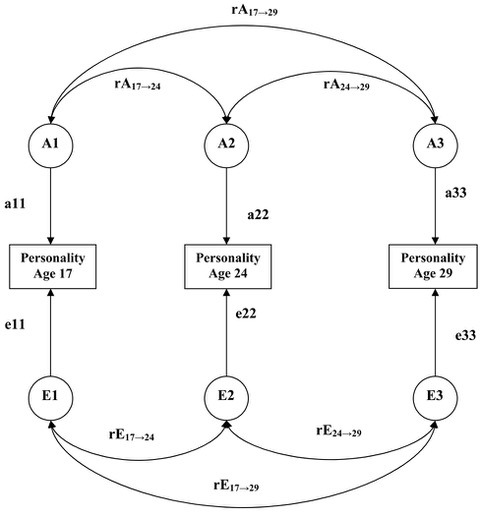
e33 indicates the extent to which non-shared environmental factors (E) influence personality at age 29.
2. Table 1 https://pmc.ncbi.nlm.nih.gov/articles/PMC3058678/table/T1/
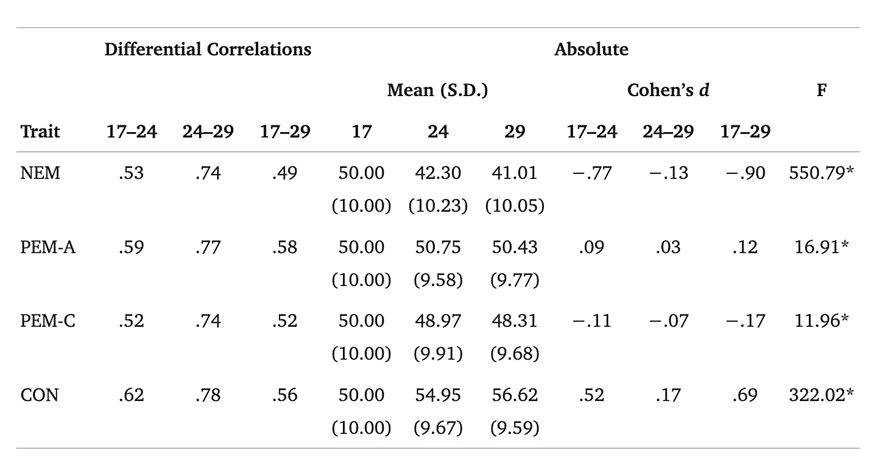
.53, .74, etc. – these are stability (correlation) coefficients. They show how consistently a person maintains their relative position on a particular trait over time.
3. Table 2 https://pmc.ncbi.nlm.nih.gov/articles/PMC3058678/table/T5/
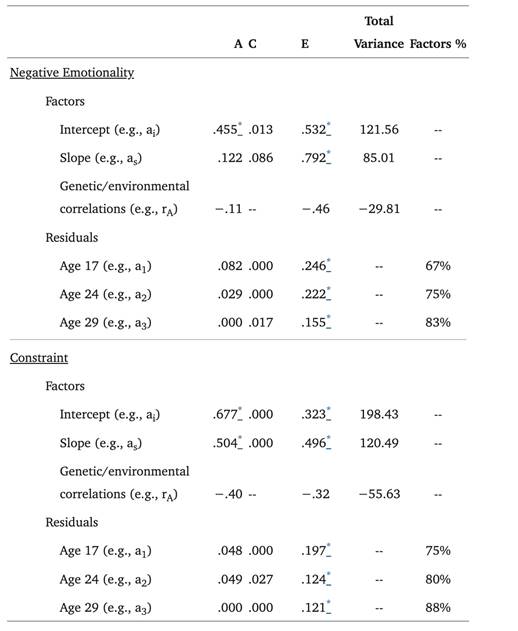
The table shows the genetic and environmental contributions to the development of two personality traits: Negative Emotionality (NEM) and Constraint (CON) from age 17 to 29. It is based on Cholesky decomposition model and growth curve model.

6, 12, 36 months: the child’s age when temperament was assessed;
Intercept: the average overall correlation between the temperament dimension and aggression;
Slope: the rate of change in the association between temperament and aggression over time.
The graph shows the developmental trajectories of mean temperament scores from 6 tom 36 months of age, comparing boys and girls.
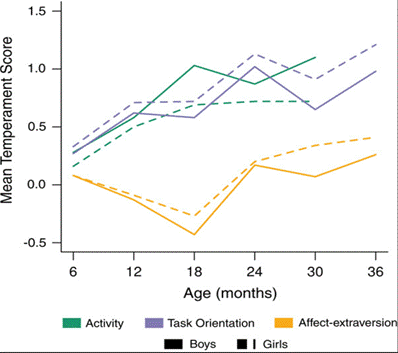
Refrences
- Michael J. Owen (2023) Genomic findings in schizophrenia and their implications. Available at https://www.nature.com/articles/s41380-023-02293-8. [↩]
- Christopher J Hopwood (2012) Genetic and environmental influences on personality trait stability and growth during the transition to adulthood: A three-wave longitudinal study. Available at https://pmc.ncbi.nlm.nih.gov/articles/PMC3058678/#S4. [↩] [↩] [↩] [↩] [↩] [↩] [↩] [↩]
- Eric N. Penichet (2024) A genetically informed longitudinal study of early-life temperament and childhood aggression. Available at https://www.cambridge.org/core/journals/development-and-psychopathology/article/genetically-informed-longitudinal-study-of-earlylife-temperament-and-childhood-aggression/FFC63095D49E8692F40D07C4F2D01285. [↩] [↩] [↩] [↩] [↩] [↩] [↩] [↩]
- Krushinsky L. V. (1991) Evolutionary and genetic aspects of behavior. Available at https://royallib.com/read/krushinskiy_leonid/evolyutsionno_geneticheskie_aspekti_povedeniya_izbrannie_trudi.html#0. [↩]
- V. S. Ramachandran (2012) Encyclopedia of Human Behavior. Available at https://archive.org/details/TheEncyclopediaOfHumanBehaviour. [↩] [↩] [↩] [↩] [↩]
- Mariam A Mosing (2012) Genetic influences on life span and its relationship to personality: a 16-year follow-up study of a sample of aging twins. Available at https://pubmed.ncbi.nlm.nih.gov/22155943/. [↩] [↩]
- Luciano (2017) The genetics of neuroticism. Available at https://nebula.org/blog/genetics-of-neuroticism-luciano-2017/?srsltid=AfmBOoq7iuukxz1_v4-1CWcf_9bpt_btoKrtLzDSxnWI6O4P9I4qI8-B._ [↩]
- Maria Shadrina (2018) Genetics Factors in Major Depressions Disease. Available at http://pmc.ncbi.nlm.nih.gov/articles/PMC6065213/ [↩] [↩]
- Emiko Koyama (2024) Genetics of child aggression, a systematic review. Available at https://www.nature.com/articles/s41398-024-02870-7 [↩] [↩]
- Rudolf Uher (2023) Transdiagnostic risk of mental disorders in offspring of affected parents: a meta-analysis of family high-risk and registry studies. Available at https://pubmed.ncbi.nlm.nih.gov/37713573/. [↩] [↩] [↩]
- B. Devlin (1997) The heritability of IQ. Available at https://www.nature.com/articles/41319. [↩] [↩]
- Marius Lahti‐Pulkkinen (2024) Maternal psychological distress and temperament traits in children from infancy to late childhood. Available at https://pmc.ncbi.nlm.nih.gov/articles/PMC11472812/. [↩] [↩] [↩] [↩]
- Chloe Austerberry (2022) Heritability of Psychological Traits and Developmental Milestones in infancy. Available at https://pmc.ncbi.nlm.nih.gov/articles/PMC9396365/ [↩]
- Kimberly Saudino (2005) Behavioral Genetics and Child Temperament. Available at https://pmc.ncbi.nlm.nih.gov/articles/PMC1188235/ [↩] [↩]
- Pratibha Reebye (2005) Aggression During Early Years – Infancy and Preschool. Available at https://pmc.ncbi.nlm.nih.gov/articles/PMC2538723/ [↩]
- Sylvie Mrug (2013) Temperament alters susceptibility to negative peer influence in early adolescence. Available at https://pmc.ncbi.nlm.nih.gov/articles/PMC3278311/ [↩]
- Fatimah Ahmad Fauzi (2023) Aggressive behavior in adolescent: The importance of biophysical predictors among secondary school students. Available at https://pmc.ncbi.nlm.nih.gov/articles/PMC10152137/ [↩]
- R A Power (2015) Heritability estimates of the Big Five personality traits based on common genetic variants. At available at https://pmc.ncbi.nlm.nih.gov/articles/PMC5068715/?_ga=2.201706325.538204657.1772050785-1912959929.1772050785. [↩]
- Wood, D., & Roberts, B. W. (2006). The effect of age and role information on expectations for Big Five personality traits. Personality and Social Psychology Bulletin, 32(11), 1482–1496. https://doi.org/10.1177/0146167206291008). [↩]
- Wiebke Bleidorn. The policy relevance of personality traits. Available at: https://onlinelibrary.wiley.com/doi/10.1111/jopy.12453, 2019. [↩]
- Susan C Crockenberg (2008) Predicting aggressive behavior in the third year from infant reactivity and regulation as moderated by maternal behavior. Available at https://pubmed.ncbi.nlm.nih.gov/18211727/. [↩]
- Thomas Olino (2013) Gender differences in young children’s temperament traits: comparisons across observational and parent-report methods. Available at https://pmc.ncbi.nlm.nih.gov/articles/PMC9560959/ [↩]
- Baker, L. A., Raine, A., Liu, J., & Jacobson, K. C. (2008). Differential genetic and environmental influences on reactive and proactive aggression in children. Journal of Abnormal Child Psychology, 36(8), 1265–1278. https://doi.org/10.1007/s10802-008-9249-1 [↩]
- Jacob Felson. What can we learn from twin studies? A comprehensive evaluation of the equal environmental assumptions. Available at: https://pmc.ncbi.nlm.nih.gov/articles/PMC4136807/, 2014. [↩]