Abstract
Recovery of antibiotic-resistant colonies after CRISPR-Cas9 transformation may vary with recovery temperature and guide-plasmid condition. This preliminary study examined streptomycin-resistant Escherichia coli DH5α colony recovery after transformation targeting rpsL. Two complete reagent conditions used Cas9, donor DNA, and one of two guides whose spacers exactly matched distinct sites in the NC_000913.3 rpsL region; five control groups assessed background resistance and the contribution of individual reagents. Each group was tested at 27°C, 32°C, 37°C, or 42°C during a one-hour post-transformation recovery interval, with five independent transformation replicates per temperature-by-group condition. Samples were subsequently plated on streptomycin-kanamycin-arabinose selective medium and nonselective medium, and all plates were incubated at 30°C. Selective counts were normalized to viable counts. Growth on selective medium was treated as evidence of streptomycin resistance, not molecular confirmation of the intended rpsL allele. Among the three temperatures with calculable recovery, square-root-transformed two-way ANOVA identified effects of recovery temperature, experimental group, and their interaction (all p < 0.001). The highest mean recovery occurred with Cas9, donor DNA, and Guide 1 at 32°C (0.0948% ± 0.0057%). At 42°C, neither selective nor nonselective colonies were detected at the plated dilution, making normalized recovery undefined. These results describe preliminary phenotype-based colony-recovery patterns that require molecular confirmation.
Keywords: CRISPR-Cas9; Escherichia coli DH5α; guide-plasmid condition; recovery temperature; colony recovery; rpsL; streptomycin resistance
Introduction
CRISPR-Cas9 is a gene-editing tool for modifying specific DNA sequences. Adapted from a bacterial immune mechanism, the system uses the Cas9 enzyme and a guide RNA to locate a target sequence in the genome. Cas9 cleaves both DNA strands adjacent to a protospacer-adjacent motif (PAM)1. Using Escherichia coli, CRISPR-Cas9 systems combined with a donor DNA and tools like Lambda Red can support chromosomal editing. Cas9 cleavage counterselects cells that retain the unmodified target2,3,4,5,6. Guide sequence and target features, including mismatch position, GC content, and secondary structure, influence Cas9 targeting. Temperature sensitivity also varies by Cas enzyme and experimental system7,8,9,10,11. Recent studies have improved pCas-based editing, reduced survivor or escaper formation, and standardized iterative editing in E. coli.12,13,14
Temperature and gRNA design both influence CRISPR activity; however, their relationship to resistant-colony recovery after bacterial transformation remains poorly characterized7,8,9,10,11. E. coli provides a controlled system for testing how these factors relate to bacterial colony recovery after transformation2,3,4,5,6. This study considers whether recovery temperature and gRNA design are associated with the recovery of antibiotic-resistant bacterial colonies. All selective and nonselective plates are incubated under one common permissive condition so that the assigned temperature does not differ during colony growth.
Temperature can affect membrane fluidity, enzyme activity, cellular recovery, viability, and colony formation. Temperature may also affect the expression or activity of CRISPR-Cas9 components.7,11,15 Therefore, raw colony counts reflect the combined effects of transformation, resistance generation, survival, and growth as opposed to Cas9 activity alone. Most E. coli strains grow well near 37°C, but other temperatures may favor recovery or expression of the editing system.15 Similarly, gRNA target site, strand, self-complementarity, and GC content can influence Cas9 binding and cleavage, which may alter the number of resistant colonies recovered.9,16,17,18,10 The assigned temperature differed only during the one-hour post-transformation recovery period; all plates were later incubated at 30°C for 24 hours. Since arabinose was present on the primary selective plates, expression of the manufacturer-reported recombination system after plating cannot be excluded. Selective counts were normalized to viable counts from nonselective plates to partially account for differences in survival and recovery.
This study used CRISPR-Cas9 to target the ribosomal protein S12 gene, rpsL, in Escherichia coli DH5α. The rpsL gene offers a phenotypic selection assay because it encodes a component of the bacterial ribosome targeted by streptomycin. In susceptible bacteria, streptomycin binds to the ribosome and inhibits protein synthesis. Cells carrying resistance-associated changes in rpsL grow on streptomycin-containing medium19. In this experiment, such growth was considered evidence of a streptomycin-resistance phenotype but not proof of the intended rpsL change, since spontaneous rpsL mutations or other mechanisms may also confer resistance19. The experiment tested whether recovery temperature and guide-plasmid condition were associated with the number of streptomycin-resistant colonies recovered. A four-temperature, seven-group controlled experiment provided the framework. The 4 × 7 design included four recovery temperatures and seven experimental groups. Five independent transformation replicates were conducted for each temperature-by-group combination, and each culture was plated on both selective and nonselective medium. Alignment against the Escherichia coli K-12 MG1655 reference genome (NC_000913.3) revealed that both guide spacers exactly matched distinct reference protospacers in the rpsL region; these were not fully or partially complementary versions of a single guide. Guide 1 matched NC_000913.3:3474412-3474431 on the plus strand (PAM: 3474432-3474434) and had 45% GC content. The custom GenScript Guide 2 matched NC_000913.3:3474552-3474571 on the minus strand (PAM: 3474549-3474551) and had 30% GC content. These are reference-genome alignments; the rpsL locus in the experimental DH5α preparation was not sequenced before transformation. Only one bacterial strain and one target gene were used, and resistant-colony recovery was measured without molecular confirmation. Since this study measures recovery in bacterial systems, the results cannot be directly generalized to mammalian cells. This study aimed to determine whether recovery temperature and guide-plasmid condition affected normalized resistant-colony recovery. The initial hypothesis expected 37°C to yield the greatest recovery, as this temperature is near the standard growth optimum for E. coli. A temperature-by-group interaction was also anticipated.
Methods
This study looked at seven experimental groups at four different recovery temperatures, carrying out five separate transformation reactions for each combination of temperature and group, giving a total of 140 transformations. The entire experimental design was 4 × 7. Each recovered culture was distributed among the various media types; the pairs of plates came from a single transformation replicate and were not additional replicates. The two complete reagent sets included the Cas9 plasmid, donor DNA, and either Guide 1 or Guide 2. The five control cases were untransformed cells; cells containing Cas9 and donor DNA but no guide; cells with Cas9, donor DNA, and a non-targeting guide; cells that had Cas9 and Guide 1 but no donor DNA; and cells with Cas9 and Guide 2 but no donor DNA. All the conditions began from the same preparation of competent cells and had the same final transformation volume. The independent variables were the recovery temperature (27°C, 32°C, 37°C, or 42°C) and the experimental group. Temperature was varied during the one-hour recovery period following heat shock, and all the plates were then incubated at 30°C for 24 hours. The dependent variable was the normalized streptomycin-resistant colony recovery, which was calculated by dividing the number of selective colony-forming units (CFU) by the number of viable CFU from the paired nonselective plate. Colony growth did not indicate that the intended rpsL allele had been introduced.
Materials included LB agar, E. coli DH5α, a Cas9 plasmid, guide plasmids, donor DNA, LB recovery medium, and a bacterial transformation buffer containing 25 mM CaCl₂ and 20% PEG 8000. The primary selective plates had 50 µg/mL streptomycin, 25 µg/mL kanamycin, and 1 mM arabinose. Kanamycin was used to select for the retention of the Cas9 plasmid, while streptomycin was used to select for the resistance phenotype; no antibiotic was included to specifically select for the retention of the guide plasmid. To estimate Cas9 plasmid retention, separate LB-kanamycin plates containing 25 µg/mL kanamycin were prepared. Each freeze-dried DNA tube was reconstituted with 55 µL of sterile water. Alignment of the 59-nucleotide single-stranded donor with the E. coli K-12 MG1655 reference genome (NC_000913.3) positioned it at nucleotides 3,474,396 to 3,474,454 on the plus strand, with 29 nucleotides flanking the central substitution on each side. The donor sequence was 5′-ATACTTTACGCAGCGCGGAGTTCGGTTTTGTAGGAGTGGTAGTATATACACGAGTACAT-3′. The supplier describes this donor as causing the K43T change in rpsL associated with streptomycin resistance. However, when the posted donor sequence was examined against the coding strand, an AAA-to-CAA (K43Q) change was predicted, rather than the AAA-to-ACA (K43T) change. Since neither the donor nor the resulting colonies were independently sequenced, the exact allele identity remains unresolved. The central substitution in the donor was seven nucleotides from the Guide 1 PAM but 124 nucleotides from the Guide 2 PAM, which makes the PAM-to-substitution distance another difference between the two guide conditions. The manufacturer states that the Cas9 plasmid contains recombinases that are activated by arabinose; the linked sequence file is identified as pCas_orig.20 The published pCas design includes S. pyogenes Cas9, the λ Red Exo, Beta, and Gam recombinases under arabinose control, a kanamycin-resistance marker, and the temperature-sensitive repA101(Ts) replicon.4 The plasmid lot supplied was not independently sequenced, so those features remain as those reported by the manufacturer for this experiment. The guide plasmids were obtained from different vendors, and their backbone equivalence was not independently confirmed. Both spacers were aligned in both orientations against NC_000913.3; the reported mismatch counts, strands, protospacer coordinates, and PAM coordinates are reference derived. The measured A260/A280 ratio was 1.8. The plasmid topology and the stock molar concentrations were not determined, so it is not possible to establish that equimolar amounts of Cas9 and guide plasmids were used. For each transformation, 1.0 µL of the Cas9 plasmid and 1.0 µL of the assigned guide-plasmid preparation were added. The donor was not HPLC-purified; in each transformation containing donor DNA, 1.0 µL of the reconstituted donor preparation was added.
| Guide | Guide-reference alignment (5′ to 3′) | Reference-site details |
| Guide 1 | Guide: GGAGTTCGGTTTTTTAGGAG Ref: GGAGTTCGGTTTTTTAGGAG PAM: TGG Mismatch count: 0 | Protospacer: 3474412-3474431 (+); PAM: 3474432-3474434; 45% GC; substitution 7 nt from PAM |
| Guide 2 | Guide: TAAAACCAGGAGCTATTTAA Ref: TAAAACCAGGAGCTATTTAA PAM: TGG Mismatch count: 0 | Protospacer: 3474552-3474571 (-); PAM: 3474549-3474551; 30% GC; substitution 124 nt from PAM |
LB agar medium was prepared with 300 mL water and 12.0 g LB-agar premix (40 g/L; 1.5% [w/v] agar). The medium was heated in 30-second intervals for approximately 4 minutes until clear, and 10 mL was poured into each plate. One batch of base LB agar was divided to prepare selective, nonselective, and plasmid-retention media. Freeze-dried DH5α cells were resuspended in 100 µL sterile water, spread on LB agar, and incubated at 30°C for 18 hours. Cells from this plate were used to prepare one competent-cell suspension in transformation buffer for all conditions. Starting density was estimated as 4.1 × 10⁸ CFU/mL from 41 colonies obtained after plating 10 µL of a 10⁻⁵ dilution on nonselective LB agar immediately before transformation. A total of 140 transformation mixtures were prepared. For each mixture, 10 µL competent-cell suspension was combined with 1.0 µL of the Cas9-plasmid preparation, 1.0 µL of the assigned guide-plasmid preparation, and 1.0 µL of the reconstituted donor preparation when assigned. Omitted components were replaced with equal volumes of sterile water, giving the same 13 µL pre-recovery volume in every transformed condition. Untransformed controls received cells and matched sterile-water volumes without plasmid or donor DNA. Mixtures were refrigerated for 30 minutes, heat shocked for 30 seconds at 42°C, supplemented with 250 µL LB recovery medium containing 1 mM arabinose, and incubated for one hour at the assigned recovery temperature. After recovery, 10 µL of each culture was plated undiluted on primary selective LB agar containing streptomycin, kanamycin, and arabinose. A 10 µL aliquot of a 10⁻⁴ dilution of the same culture was plated on nonselective LB agar. For the Cas9 + donor, no-guide group, a matched 10 µL aliquot of a 10⁻⁴ dilution was plated on LB-kanamycin agar. All plates were incubated at 30°C for 24 hours. Plates were photographed and coded to conceal condition. Colonies were marked in Apple Photos to prevent recounting, and every plate was counted twice. Ambiguous overlapping growth was recorded rather than estimated, and counts differing by more than 5% were repeated. Some selective plates contained more than 300 colonies, including all five 32°C Guide 1 plates (475-548 colonies); crowding and merged colonies may therefore have increased counting uncertainty. OD₆₀₀ growth curves and molecular confirmation were not performed.
Means, sample standard deviations, and figures were calculated using the raw counts in the supplementary data table. Normalized recovery was calculated as streptomycin-kanamycin-arabinose selective CFU/mL divided by paired nonselective CFU/mL. Because recovery was undefined for every 42°C replicate, percentage-based inference was limited to the 3 × 7 subset containing 27°C, 32°C, and 37°C. Recovery percentages were square-root transformed and analyzed using a two-way ANOVA testing recovery temperature, experimental group, and their interaction. Residual normality was assessed with the Shapiro-Wilk test, and homogeneity of variance was assessed with the median-centered Brown-Forsythe test. Significant effects were followed by Tukey-adjusted comparisons among temperature-by-group conditions on the transformed scale. Descriptive means and standard deviations are reported on the original percentage scale. The significance threshold was α = 0.05. Calculations were independently verified using Python 3 with SciPy. Plasmid-retention proportions were reported descriptively.
The experiment was conducted under Biosafety Level 1 conditions in a supervised laboratory setting. Gloves, safety goggles, a laboratory coat, and aseptic technique were used throughout. Bacterial cultures and plates were decontaminated with 5% bleach before disposal in accordance with BSL-1 safety procedures. The experiment was conducted from August 1 to August 16, 2026.
Results
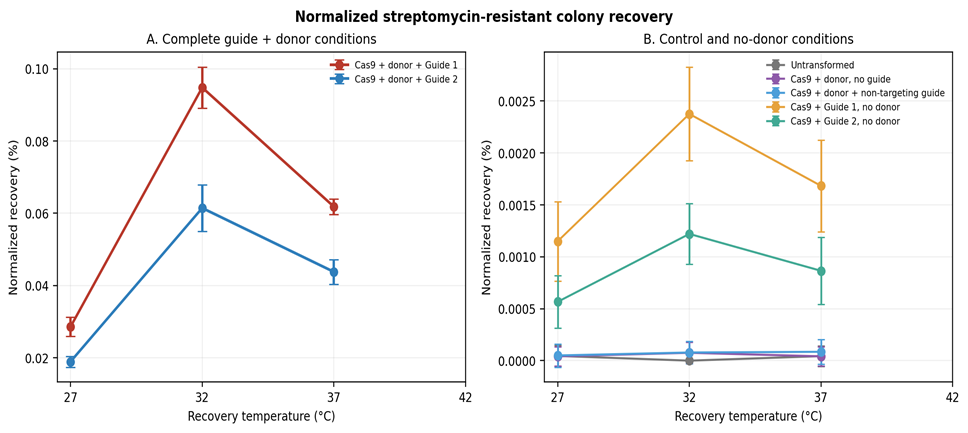
Normalized streptomycin-resistant colony recovery under streptomycin-kanamycin-arabinose selection was compared across four recovery temperatures and seven experimental groups (Table 2; Figure 1). Among the 21 temperature-by-group combinations with calculable percentages, mean recovery ranged from 0.0000% to 0.0948%. The highest mean occurred in the Cas9 + donor + Guide 1 group at 32°C (0.0948% ± 0.0057%). Several high-recovery plates exceeded 300 colonies, so the largest counts may have additional uncertainty from crowding. At 42°C, both selective and nonselective counts were zero at the plated dilution, so normalized recovery was undefined and the condition was treated as non-informative.
| Temp. | Experimental group | R1 | R2 | R3 | R4 | R5 | Mean ± SD (%) |
| 27°C | Untransformed | 0.0000 | 0.0000 | 0.0000 | 0.0000 | 0.0002 | 0.0000 ± 0.0001 |
| 27°C | Cas9 + donor, no guide | 0.0000 | 0.0002 | 0.0000 | 0.0000 | 0.0000 | 0.0000 ± 0.0001 |
| 27°C | Cas9 + donor + non-targeting guide | 0.0000 | 0.0000 | 0.0003 | 0.0000 | 0.0000 | 0.0001 ± 0.0001 |
| 27°C | Cas9 + Guide 1, no donor | 0.0011 | 0.0017 | 0.0007 | 0.0013 | 0.0009 | 0.0011 ± 0.0004 |
| 27°C | Cas9 + Guide 2, no donor | 0.0005 | 0.0007 | 0.0003 | 0.0009 | 0.0005 | 0.0006 ± 0.0003 |
| 27°C | Cas9 + donor + Guide 1 | 0.0274 | 0.0322 | 0.0250 | 0.0296 | 0.0287 | 0.0286 ± 0.0027 |
| 27°C | Cas9 + donor + Guide 2 | 0.0180 | 0.0207 | 0.0171 | 0.0186 | 0.0202 | 0.0189 ± 0.0015 |
| 32°C | Untransformed | 0.0000 | 0.0000 | 0.0000 | 0.0000 | 0.0000 | 0.0000 ± 0.0000 |
| 32°C | Cas9 + donor, no guide | 0.0002 | 0.0000 | 0.0000 | 0.0002 | 0.0000 | 0.0001 ± 0.0001 |
| 32°C | Cas9 + donor + non-targeting guide | 0.0000 | 0.0002 | 0.0000 | 0.0000 | 0.0002 | 0.0001 ± 0.0001 |
| 32°C | Cas9 + Guide 1, no donor | 0.0024 | 0.0030 | 0.0018 | 0.0026 | 0.0021 | 0.0024 ± 0.0005 |
| 32°C | Cas9 + Guide 2, no donor | 0.0013 | 0.0016 | 0.0011 | 0.0014 | 0.0008 | 0.0012 ± 0.0003 |
| 32°C | Cas9 + donor + Guide 1 | 0.0928 | 0.0957 | 0.0977 | 0.0864 | 0.1015 | 0.0948 ± 0.0057 |
| 32°C | Cas9 + donor + Guide 2 | 0.0583 | 0.0636 | 0.0643 | 0.0520 | 0.0690 | 0.0614 ± 0.0065 |
| 37°C | Untransformed | 0.0000 | 0.0000 | 0.0002 | 0.0000 | 0.0000 | 0.0000 ± 0.0001 |
| 37°C | Cas9 + donor, no guide | 0.0000 | 0.0000 | 0.0002 | 0.0000 | 0.0000 | 0.0000 ± 0.0001 |
| 37°C | Cas9 + donor + non-targeting guide | 0.0002 | 0.0000 | 0.0000 | 0.0002 | 0.0000 | 0.0001 ± 0.0001 |
| 37°C | Cas9 + Guide 1, no donor | 0.0019 | 0.0014 | 0.0023 | 0.0016 | 0.0012 | 0.0017 ± 0.0004 |
| 37°C | Cas9 + Guide 2, no donor | 0.0009 | 0.0010 | 0.0007 | 0.0013 | 0.0004 | 0.0009 ± 0.0003 |
| 37°C | Cas9 + donor + Guide 1 | 0.0610 | 0.0645 | 0.0588 | 0.0629 | 0.0620 | 0.0618 ± 0.0021 |
| 37°C | Cas9 + donor + Guide 2 | 0.0420 | 0.0447 | 0.0400 | 0.0430 | 0.0491 | 0.0438 ± 0.0034 |
| 42°C | Untransformed | N/A | N/A | N/A | N/A | N/A | N/A |
| 42°C | Cas9 + donor, no guide | N/A | N/A | N/A | N/A | N/A | N/A |
| 42°C | Cas9 + donor + non-targeting guide | N/A | N/A | N/A | N/A | N/A | N/A |
| 42°C | Cas9 + Guide 1, no donor | N/A | N/A | N/A | N/A | N/A | N/A |
| 42°C | Cas9 + Guide 2, no donor | N/A | N/A | N/A | N/A | N/A | N/A |
| 42°C | Cas9 + donor + Guide 1 | N/A | N/A | N/A | N/A | N/A | N/A |
| 42°C | Cas9 + donor + Guide 2 | N/A | N/A | N/A | N/A | N/A | N/A |
The normalized recovery for each replicate was obtained by dividing the selective CFU/mL by the paired nonselective CFU/mL. When the recovery could not be calculated because both the selective and paired nonselective counts were zero (0/0), this was indicated by N/A. Raw counts, dilution factors, and the details of the calculation are given in Supplementary Table S1.
A two-way ANOVA was carried out to examine the relationships between recovery temperature, experimental group, and their interaction, and normalized recovery, with the 42°C trials being omitted as the recovery could not be defined (Table 3). For the square-root-transformed values, the model found associations with recovery temperature, F(2, 84) = 291.99, p < 0.001; with the experimental group, F(6, 84) = 3224.65, p < 0.001; and with the interaction between temperature and group, F(12, 84) = 92.36, p < 0.001. The Brown-Forsythe test showed no differences in variances, F(20, 84) = 0.56, p = 0.929, but the residuals were still not normally distributed (Shapiro-Wilk W = 0.957, p = 0.0018). Therefore, the results of the ANOVA and post-hoc tests only describe exploratory associations and not definitive effects.
| Source | df | F | p |
| Recovery temperature | 2 | 291.99 | <0.001 |
| Experimental group | 6 | 3224.65 | <0.001 |
| Temperature × group | 12 | 92.36 | <0.001 |
| Residual | 84 | N/A | N/A |
The Tukey-adjusted comparisons between the 21 temperature-by-group conditions that could be analyzed revealed that, in both the complete guide plus donor situations, the mean recovery was greater at 32°C than at 27°C or 37°C and also higher at 37°C than at 27°C (in all cases the adjusted p value was less than 0.001). At each analyzable temperature, Guide 1 plus donor was greater than Guide 2 plus donor (all adjusted p values being less than 0.001). Furthermore, each of the complete guide plus donor conditions outperformed both its corresponding no-donor condition and the three negative-control conditions at all analyzable temperatures (in all cases the adjusted p value was less than 0.001).
The background level of streptomycin resistance and the effect of each reagent were assessed in the control groups. The mean recovery for the untransformed samples was 0.0000% ± 0.0001%, 0.0000% ± 0.0000%, and 0.0000% ± 0.0001% at 27°C, 32°C and 37°C respectively. The corresponding no-guide values were 0.0000% ± 0.0001%, 0.0001% ± 0.0001% and 0.0000% ± 0.0001%, while the non-targeting-guide values were 0.0001% ± 0.0001%, 0.0001% ± 0.0001% and 0.0001% ± 0.0001%. The fact that there are occasionally colonies in these controls shows that the background recovery is low. The mean values for Guide 1 no-donor groups were 0.0011% ± 0.0004%, 0.0024% ± 0.0005% and 0.0017% ± 0.0004%, whereas those for Guide 2 no-donor groups were 0.0006% ± 0.0003%, 0.0012% ± 0.0003% and 0.0009% ± 0.0003%.
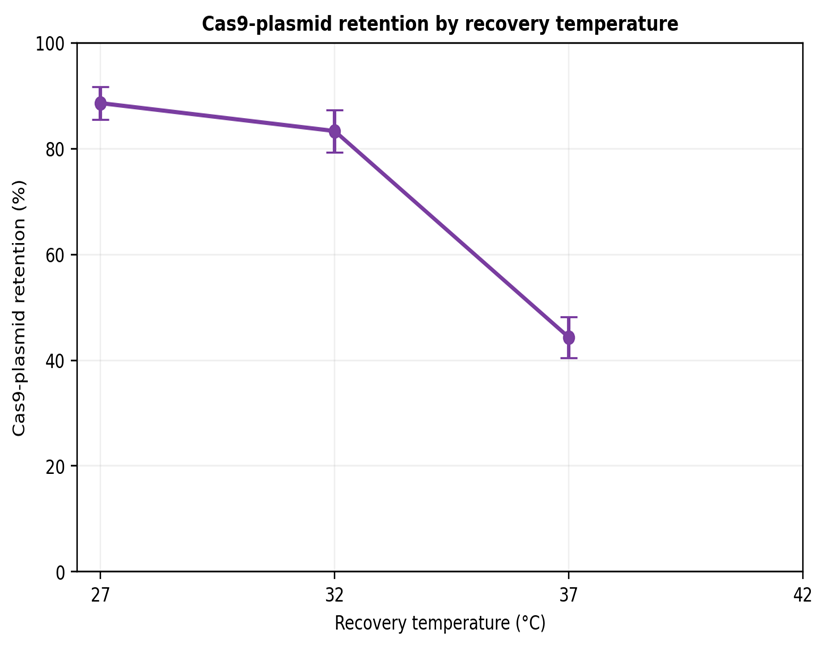
The selective counts were normalized using the nonselective counts, and in the case of the Cas9 + donor, no-guide group, the matched LB-kanamycin plates gave a representative estimate of Cas9-plasmid retention (Table 4 and in Figure 2). The mean retention in this group was 88.6% at 27°C, 83.3% at 32°C, and 44.3% at 37°C; these figures do not apply to groups that contained a guide. At 42°C, both the LB-kanamycin and the paired nonselective counts were zero at the 10⁻⁴ dilution, so the plasmid retention could not be determined. Since there were no viable counts at lower dilutions nor any OD₆₀₀ growth curves, it was not possible to tell whether the result reflected reduced viability, a detection-limit effect, or a failure due to dilution or plating.
| Temp. | R1 | R2 | R3 | R4 | R5 | Mean ± SD (%) |
| 27°C | 91.1 | 91.7 | 86.0 | 89.4 | 84.8 | 88.6 ± 3.1 |
| 32°C | 82.7 | 85.5 | 78.4 | 88.9 | 81.1 | 83.3 ± 4.0 |
| 37°C | 44.9 | 50.0 | 39.6 | 45.1 | 42.0 | 44.3 ± 3.9 |
| 42°C | N/A | N/A | N/A | N/A | N/A | N/A |
Discussion
Of the three temperatures that were analyzed – recovery temperature, experimental group, and their interaction – the normalized streptomycin-resistant colony recovery was found to be associated with each of them (all p < 0.001). In the complete guide plus donor conditions, the highest mean recovery occurred at 32°C rather than the expected 37°C. The Cas9 plus donor plus Guide 1 combination achieved the highest mean recovery overall. Because the interaction was significant, the extent of the temperature differences varied by experimental group. The data presented here refer to phenotype-based colony recovery and do not demonstrate editing efficiency or confirm the intended rpsL allele.
Alignment to NC_000913.3 showed no mismatches for either guide spacer at its respective reference site in the rpsL region. This indicates only that the sequence matches the reference, not that the experimental DH5α preparation has been confirmed by sequencing. At 27°C, 32°C, and 37°C (in all cases with an adjusted p-value < 0.001), Guide 1 with the donor outperformed Guide 2 with the donor. The two guides differed in their reference target site, strand, GC content, and distance from the PAM to the substitution (7 nucleotides for Guide 1 and 124 nucleotides for Guide 2), and the plasmids were independent preparations from different vendors with unverified equivalence. The difference must therefore be regarded as resulting from a combination of guide, plasmid, and condition, and not as being due solely to complementarity, GC content, target site, or spacer sequence.9,16,17,18,10
The untransformed, no-guide, and non-targeting-guide controls exhibited either zero or very low recovery, which indicates a low level of background streptomycin resistance. The colonies that were isolated might be due to spontaneous resistance, contamination, or nonspecific survival. The no-donor groups gave a low but detectable level of recovery, whereas supplementing the donor DNA was linked to a much higher recovery for both guides at each temperature that could be analyzed. However, growth on medium containing streptomycin cannot tell the intended rpsL substitution apart from natural resistance or some other mechanism.19
During the one-hour recovery period, the temperature varied, and all the plates were then incubated at 30°C. Yet arabinose was also found on the primary selective plates, which means that the recombination system as reported by the manufacturer might have been active during colony formation. In the case of the representative Cas9 + donor, no-guide group, the estimated level of Cas9-plasmid retention decreased between 32°C and 37°C, a trend that is in agreement with the reported repA101(Ts) replicon.4 This result does not apply to the groups containing a guide. At 42°C, both the LB-kanamycin and the nonselective counts were zero when the 10⁻⁴ dilution was plated. Therefore, it is not possible to say whether retention was lost, viability decreased, a detection-limit effect occurred, or an operational problem affected plating.
Several limitations remain. No colony PCR or sequencing was performed to confirm the resulting rpsL allele, the supplier-reported donor identity, or the starting rpsL sequence. Consequently, guide-target matching was based only on the NC_000913.3 reference, not the experimental DH5α preparation. Sequence inspection also produced a codon interpretation inconsistent with the supplier’s K43T label, leaving the intended allele identity unresolved. The study used one bacterial strain, one gene, two non-equivalent guide-plasmid conditions, and five independent transformation reactions drawn from one competent-cell preparation; these are transformation replicates rather than independent biological replicates from separately grown cultures. Because guide target site and PAM-to-substitution distance differed, the guide comparison cannot isolate a single design feature. Guide-plasmid backbone equivalence, plasmid topology, molar stock concentrations, and the supplied Cas9-plasmid sequence were not independently established; equimolar plasmid input therefore cannot be assumed. Primary plates co-selected the streptomycin-resistance phenotype and Cas9-plasmid retention but did not specifically select guide-plasmid retention. Several selective plates exceeded 300 colonies, so crowding may have increased counting uncertainty. Plasmid retention was measured only in the Cas9 + donor, no-guide group. The 42°C condition could not be included in percentage-based inference, and using only a 10⁻⁴ nonselective dilution prevented reliable assessment of low viable-cell recovery or exclusion of a dilution/plating failure. Residuals remained non-normal after transformation, so inferential statistics are exploratory. These limitations restrict conclusions to phenotypic colony-recovery patterns under the tested conditions.
Further research should sequence the donor reagent, the initial rpsL locus, and representative resistant colonies taken from each experimental and control group; it should report the fraction of clones carrying each allele; and it should confirm both guide-plasmid backbones. Further investigations should start with competent-cell preparations grown independently, use guide constructs that differ only in the spacer sequence, keep the PAM-to-substitution distance constant, quantify and equalize plasmid inputs, evaluate guide-plasmid retention, plate a range of selective and nonselective dilutions at each temperature, and collect OD₆₀₀ growth curves. Implementing these modifications would allow the viability, plasmid retention, guide design, and the results of molecular editing to be separated. Recent studies have expanded bacterial genome engineering through prime editing, multiplex base editing, recombination-component optimization, homologous-arm analysis, and automated strain-engineering workflows.21,22,23,24,25
Conclusion
In the 3 × 7 exploratory analysis, normalized resistant-colony recovery was related to recovery temperature, experimental group, and their interaction. The condition involving Cas9, the donor, and Guide 1 at 32°C had the highest mean value (0.0948% ± 0.0057%), although crowded plates increase uncertainty around this estimate. The 42°C condition was not informative because both the selective and nonselective counts were zero at the plated dilution, and an operational failure cannot be ruled out. The study offers a controlled, phenotype-based comparison that includes negative controls and paired viable-count normalization, along with a representative plasmid-retention measurement in one group. It does not confirm genome editing, identify the exact donor allele, provide independent biological replication, isolate a single guide-design variable, verify equimolar plasmid input, or determine viability at 42°C. The most important next steps are to perform molecular sequencing, use independently prepared competent cells, use matched guide backbones, quantify plasmid inputs, and plate multiple dilutions.
Supplementary Information
References
- M. Jinek, K. Chylinski, I. Fonfara, M. Hauer, J. A. Doudna, E. Charpentier. A programmable dual-RNA-guided DNA endonuclease in adaptive bacterial immunity. Science. Vol. 337, pg. 816-821, 2012, https://doi.org/10.1126/science.1225829. [↩]
- W. Jiang, D. Bikard, D. Cox, F. Zhang, L. A. Marraffini. RNA-guided editing of bacterial genomes using CRISPR-Cas systems. Nature Biotechnology. Vol. 31, pg. 233-239, 2013, https://doi.org/10.1038/nbt.2508. [↩] [↩]
- M. E. Pyne, M. Moo-Young, D. A. Chung, C. P. Chou. Coupling the CRISPR/Cas9 system with Lambda Red recombineering enables simplified chromosomal gene replacement in Escherichia coli. Applied and Environmental Microbiology. Vol. 81, pg. 5103-5114, 2015, https://doi.org/10.1128/AEM.01248-15. [↩] [↩]
- Y. Jiang, B. Chen, C. Duan, B. Sun, J. Yang, S. Yang. Multigene editing in the Escherichia coli genome via the CRISPR-Cas9 system. Applied and Environmental Microbiology. Vol. 81, pg. 2506-2514, 2015, https://doi.org/10.1128/AEM.04023-14. [↩] [↩] [↩] [↩]
- C. R. Reisch, K. L. J. Prather. The no-SCAR (Scarless Cas9 Assisted Recombineering) system for genome editing in Escherichia coli. Scientific Reports. Vol. 5, pg. 15096, 2015, https://doi.org/10.1038/srep15096. [↩] [↩]
- D. Zhao, S. Yuan, B. Xiong, H. Sun, L. Ye, J. Li, X. Zhang, C. Bi. Development of a fast and easy method for Escherichia coli genome editing with CRISPR/Cas9. Microbial Cell Factories. Vol. 15, pg. 205, 2016, https://doi.org/10.1186/s12934-016-0605-5. [↩] [↩]
- R. B. Banakar, M. S. Schubert, G. K. Kurgan, K. M. Rai, S. F. Beaudoin, M. A. Collingwood, C. A. Vakulskas, K. Wang, F. Zhang. Efficiency, specificity and temperature sensitivity of Cas9 and Cas12a RNPs for DNA-free genome editing in plants. Frontiers in Genome Editing. Vol. 3, pg. 760820, 2022, https://doi.org/10.3389/fgeed.2021.760820. [↩] [↩] [↩]
- P. D. Hsu, D. A. Scott, J. A. Weinstein, F. A. Ran, S. Konermann, V. Agarwala, Y. Li, E. J. Fine, X. Wu, O. Shalem, T. J. Cradick, L. A. Marraffini, G. Bao, F. Zhang. DNA targeting specificity of RNA-guided Cas9 nucleases. Nature Biotechnology. Vol. 31, pg. 827-832, 2013, https://doi.org/10.1038/nbt.2647. [↩] [↩]
- J. G. Doench, N. Fusi, M. Sullender, M. Hegde, E. W. Vaimberg, K. F. Donovan, I. Smith, Z. Tothova, C. Wilen, R. Orchard, H. W. Virgin, J. Listgarten, D. E. Root. Optimized sgRNA design to maximize activity and minimize off-target effects of CRISPR-Cas9. Nature Biotechnology. Vol. 34, pg. 184-191, 2016, https://doi.org/10.1038/nbt.3437. [↩] [↩] [↩] [↩]
- K. Okada, K. Aoki, T. Tabei, K. Sugio, K. Imai, Y. Bonkohara, Y. Kamachi. Key sequence features of CRISPR RNA for dual-guide CRISPR-Cas9 ribonucleoprotein complexes assembled with wild-type or HiFi Cas9. Nucleic Acids Research. Vol. 50, pg. 2854-2871, 2022, https://doi.org/10.1093/nar/gkac100. [↩] [↩] [↩] [↩]
- C. LeBlanc, F. Zhang, J. Mendez, Y. Lozano, K. Chatpar, V. F. Irish, Y. Jacob. Increased efficiency of targeted mutagenesis by CRISPR/Cas9 in plants using heat stress. The Plant Journal. Vol. 93, pg. 377-386, 2018, https://doi.org/10.1111/tpj.13782. [↩] [↩] [↩]
- Q. Li, B. Sun, J. Chen, Y. Zhang, Y. Jiang, S. Yang. A modified pCas/pTargetF system for CRISPR-Cas9-assisted genome editing in Escherichia coli. Acta Biochimica et Biophysica Sinica. Vol. 53, pg. 620-627, 2021, https://doi.org/10.1093/abbs/gmab036. [↩]
- Q. Li, M. Sun, L. Lv, Y. Zuo, S. Zhang, Y. Zhang, S. Yang. Improving the editing efficiency of CRISPR-Cas9 by reducing the generation of escapers based on the surviving mechanism. ACS Synthetic Biology. Vol. 12, pg. 672-680, 2023, https://doi.org/10.1021/acssynbio.2c00619. [↩]
- H. Fang, J. Zhao, X. Zhao, N. Dong, Y. Zhao, D. Zhang. Standardized iterative genome editing method for Escherichia coli based on CRISPR-Cas9. ACS Synthetic Biology. Vol. 13, pg. 613-623, 2024, https://doi.org/10.1021/acssynbio.3c00585. [↩]
- A. Farewell, F. C. Neidhardt. Effect of temperature on in vivo protein synthetic capacity in Escherichia coli. Journal of Bacteriology. Vol. 180, pg. 4704-4710, 1998, https://doi.org/10.1128/JB.180.17.4704-4710.1998. [↩] [↩]
- E. A. Boyle, J. O. L. Andreasson, L. M. Chircus, S. H. Sternberg, M. J. Wu, C. K. Guegler, J. A. Doudna, W. J. Greenleaf. High-throughput biochemical profiling reveals sequence determinants of dCas9 off-target binding and unbinding. Proceedings of the National Academy of Sciences of the United States of America. Vol. 114, pg. 5461-5466, 2017, https://doi.org/10.1073/pnas.1700557114. [↩] [↩]
- E. A. Boyle, W. R. Becker, H. B. Bai, J. S. Chen, J. A. Doudna, W. J. Greenleaf. Quantification of Cas9 binding and cleavage across diverse guide sequences maps landscapes of target engagement. Science Advances. Vol. 7, pg. eabe5496, 2021, https://doi.org/10.1126/sciadv.abe5496. [↩] [↩]
- M. Labuhn, F. F. Adams, M. Ng, S. Knoess, A. Schambach, E. M. Charpentier, A. Schwarzer, J. L. Mateo, J.-H. Klusmann, D. Heckl. Refined sgRNA efficacy prediction improves large- and small-scale CRISPR-Cas9 applications. Nucleic Acids Research. Vol. 46, pg. 1375-1385, 2018, https://doi.org/10.1093/nar/gkx1268. [↩] [↩]
- G. Pelchovich, R. Schreiber, A. Zhuravlev, U. Gophna. The contribution of common rpsL mutations in Escherichia coli to sensitivity to ribosome-targeting antibiotics. International Journal of Medical Microbiology. Vol. 303, pg. 558-562, 2013, https://doi.org/10.1016/j.ijmm.2013.07.006. [↩] [↩] [↩]
- THE ODIN. CRISPR Bacterial Guide. https://www.the-odin.com/crispr-bacterial-guide/ (accessed August 17, 2026). [↩]
- Y. Tong, T. S. Jørgensen, C. M. Whitford, T. Weber, S. Y. Lee. A versatile genetic engineering toolkit for E. coli based on CRISPR-prime editing. Nature Communications. Vol. 12, pg. 5206, 2021, https://doi.org/10.1038/s41467-021-25541-3. [↩]
- D. C. Volke, R. A. Martino, E. Kozaeva, A. M. Smania, P. I. Nikel. Modular (de)construction of complex bacterial phenotypes by CRISPR/nCas9-assisted, multiplex cytidine base-editing. Nature Communications. Vol. 13, pg. 3026, 2022, https://doi.org/10.1038/s41467-022-30780-z. [↩]
- R. Chai, Q. Zhang, J. Wu, Z. Shi, Y. Li, Y. Gao, Y. Qi, L. Qiu. Single-Stranded DNA-Binding Proteins Mediate DSB Repair and Effectively Improve CRISPR/Cas9 Genome Editing in Escherichia coli and Pseudomonas. Microorganisms. Vol. 11, pg. 850, 2023, https://doi.org/10.3390/microorganisms11040850. [↩]
- R. Chai, J. Guo, Y. Geng, S. Huang, H. Wang, X. Yao, T. Li, L. Qiu. The Influence of Homologous Arm Length on Homologous Recombination Gene Editing Efficiency Mediated by SSB/CRISPR-Cas9 in Escherichia coli. Microorganisms. Vol. 12, pg. 1102, 2024, https://doi.org/10.3390/microorganisms12061102. [↩]
- K. Iwai, M. Wehrs, M. Garber, J. Sustarich, L. Washburn, Z. Costello, P. W. Kim, D. Ando, W. R. Gaillard, N. J. Hillson, P. D. Adams, A. Mukhopadhyay, H. Garcia Martin, A. K. Singh. Scalable and automated CRISPR-based strain engineering using droplet microfluidics. Microsystems & Nanoengineering. Vol. 8, pg. 31, 2022, https://doi.org/10.1038/s41378-022-00357-3. [↩]