

Abstract
This study explores the potential use of publicly available football performance statistics to identify potentially undervalued players across major professional football leagues. The study uses player performance data from the 2024-2025 season and player salary data from the 2025-2026 season. Among this data, using specifically the UEFA Champions League players data, a linear regression model was trained to estimate performance-based salary benchmarks. The model was then applied to the Premier League, La Liga, Bundesliga, Serie A, Ligue 1, and Major League Soccer (MLS). The model performance was modest with metrics being R² =0.135, RMSE=0.304 for log10 salary. This suggests that performance metrics are not the only parameters that influence player salaries, but other factors such as reputation and market consideration can enter into play. Thus, the model presented in this paper should be considered more as a benchmarking framework rather than a precise prediction tool. The model was then used to analyse player salaries in other leagues, which revealed significant differences in salary alignment: MLS league salaries showed the highest valuation discrepancies while Champions League salaries showed the closest alignment with the benchmarking framework. Additionally, the framework identified younger attacking players whose performance was disproportionately high in comparison with their actual salary. This work illustrates how a statistical approach can identify discrepancies between salary and performance of professional football players, hence leading to data driven recruitment strategies.
Introduction
For a given professional football club, player recruitment is a central decision, and player salaries are an important part of this decision. When financial constraints become significant for clubs, it becomes indispensable to evaluate whether player salaries actually correspond to their performance. For the last few years, professional football data on player performance and salary has been publicly available, hence increasing the importance of analytics in recruitment strategies and player performance evaluation.
Even though player performance is the most important parameter in evaluating a player, many other factors enter into play when the salary is determined, such as reputation, popularity or contract duration. Thus, it is possible to come across players whose performance is strong while their compensation is relatively lower than other players with similar or even lower performance.
Football clubs have started using sports analytics as a tool in their recruitment strategies. This movement is inspired by the “Moneyball” philosophy that is applied in baseball to leverage statistics in order to identify undervalued players and build better performing teams with lower wage budgets1. Yet, the various differences between how football is played and how baseball is played makes it complicated to apply the Moneyball approach to football in the same way: in football, players score less and interactions between players are more complex.
In previous research, it has been shown that player performance is associated in part with football players salaries and transfer values, especially performance metrics related to attacking roles such as goals and assists,2,3. Nevertheless, other factors (superstar effect, market visibility, wage regulation) were also flagged as key in determining player compensation4,5. Research that examines player valuation is often based on the exploration of proprietary datasets or on the use of complex machine learning methods, which limits the reproducibility of the results6,7. It is worth noting that relatively few studies tackled the comparison of the relationship of performance and salary across different leagues that belong to different economic systems.
To address these gaps, this study uses publicly available football data to develop a salary benchmarking framework based on player performance. The UEFA Champions League player performance and salary data were used as a reference, due to its prime reputation in the football ecosystem. This reference data was used to train a linear regression model that estimates salary based on performance metrics. This model was then applied to other leagues (Premier League, La Liga, Bundesliga, Serie A, Ligue 1, and Major League Soccer (MLS)) to compare the dynamics among them.
This study does not aim to predict the exact salary of a given player. It rather intends to provide a benchmarking framework that reveals discrepancies between player performance statistics and their compensation. This study highlights as well the discrepancies across various football leagues, belonging to different football labour markets, and how to potentially identify players with performance disproportionately high in comparison with their actual salary.
In this research, three hypotheses are evaluated. First, attacking performance metrics are associated with player salaries. Second, the relationship between player performance and player salary varies across football leagues that belong to different economic systems. Third, a benchmarking framework based on performance can help identify players whose performance is disproportionately high relative to their actual compensation. More broadly, this study examines how even simple models can help the decision-making process in professional football recruitment.
Background and Related Work
Quantitative analysis has been increasingly used in professional sports over the last two decades, as illustrated by the example of the “Moneyball” approach in baseball, that leverages data to identify undervalued players and build higher performing teams with lower budgets 1. Since, data driven approaches have been used for recruitment and player performance evaluation in different sports including football. However, football remains different from baseball as scoring is lower, and positional responsibilities and player interactions add complexity. Therefore, a quantitative approach for football requires adaptation8.
Nonetheless, clubs and researchers have used sports analytics to develop analytical frameworks that can evaluate player performance and market value. Gudmundsson and Horton9 conducted a review of spatiotemporal analytics in team sports; they highlighted the growing use of analytics based on tracking and event data in team sports, and discussed the opportunities and the limitations of measuring one player’s individual contribution from this data. Pappalardo et al.10 made a large-scale public dataset of match events available across multiple professional competitions, to help increase the reproducibility in football analytics research using openly accessible sources.
Research on football player wages has a theoretical foundation in labour market economics. Simmons11 examined the relationship between compensation and performance, superstar wage premiums, and institutional wage constraints, as the three central themes in football economics. Lucifora and Simmons5 were among the first to examine these relationships empirically using actual salary data. They flagged superstar effects in Italian Serie A : the high public visibility of a player was connected to a higher salary with respect to what the performance alone would predict. Franck and Nüesch2 explored the same concept in other leagues, highlighting the role of media exposure. Frick4 showed that European football labour markets deviate from a simple pay-for-performance model, as other factors enter into play, such as club financial capacity and collective bargaining dynamics in addition to individual performance. Garcia-del-Barrio and Pujol12 demonstrated that hidden monopsony rents affect player compensation in winner-take-all markets, particularly within high-revenue leagues.
Researchers have also explored the relationship between team performance and their wage expenditure. Carmichael et al.13 found that across Premier League, wage expenditure was linked to player performance, and that higher wage expenditure was associated with higher success at the team level, even though on the individual level the relationship between wages and performance was not always direct. Müller et al.3 examined further the individual level and showed that performance metrics, player age, and broader economic factors had a meaningful contribution to player valuation. More recently, Berri et al.14 focused specifically on the goalkeeper labour market and found that clubs do use measurable performance data to set contracted salaries, though contextual and positional factors significantly complicate the relationship between statistical output and compensation.
Several studies have attempted to estimate player market value and salary using performance statistics with different approaches and results. McHale et al.15 developed a statistical player performance rating system for the English Premier League. They demonstrated that measurable contributions can be combined into one coherent index, although isolating contextual and tactical factors remain difficult. Herm et al.16 examined determinants of crowd-based football market valuations; they found that both sporting performance and player reputation contribute significantly to valuation outcomes. Peeters17 further demonstrated that community-based market valuations contain information that is relevant from an economic standpoint about player quality, though they remain subject to reputational and popularity biases. Thrane18 investigated the relationship between performance and actual pay in Norwegian football; they found that goals, assists, and matches played are positively associated with player compensation, but that the effects differ meaningfully between actual earnings and crowd-sourced market valuations. Decroos et al.19 took a different approach by developing a framework for valuing individual performances in football, thus offering a more granular measure of player contribution than traditional summary statistics such as goals and assists.
Whether publicly available data are reliable is a question in itself. Prockl and Frick20 compared Transfermarkt valuations with actual MLS player salaries across ten seasons. They found correlation coefficients between 0.70 and 0.75 and concluded that crowd-sourced market values represent a reasonable proxy for salaries in leagues where wage data are not publicly available. Coates and Parshakov21 extended this analysis and found that while crowd-sourced transfer values are correlated with actual fees, they tend to underestimate player value, particularly at the upper end of the transfer market; this reinforces the importance of interpreting publicly available salary data as approximate benchmarks rather than exact contractual figures.
The valuation studies in football all differ in terms of methodology and the tradeoffs involved. More sophisticated models, including Random Forests, gradient boosting, and ensemble approaches, could improve model performance by capturing nonlinear relationships within the data. Al-Asadi and Tasdemir22 applied several such models to predict player market values; they found that Random Forest outperformed linear regression on predictive accuracy metrics. Similarly, Behravan and Razavi23 proposed a clustering and support vector regression approach for estimating transfer market values, achieving lower prediction errors than standard regression baselines. McHale and Holmes7 further demonstrated that incorporating advanced performance metrics alongside machine learning algorithms produced substantially better predictions of transfer fees than regression models based on basic statistics alone. However, Butler et al.6, in a study examining whether advanced analytics affect footballer pay in the Premier League and Serie A, found that few advanced performance metrics beyond basic statistics help to explain contracted player salaries, and that there remains meaningful misalignment between individual performance and compensation; this directly supports the benchmarking approach adopted in this study. Franceschi et al.24 conducted a review of 29 empirical studies on player valuation. They found that the choice of data source and variable selection were as essential as model complexity in explaining valuation outcomes. More broadly, using complex machine-learning models could reduce interpretability and reproducibility of the results, especially when proprietary datasets or black-box model architectures are involved. Therefore, simple regression approaches remain valuable if the objective is to produce a transparent and reproducible framework using publicly available data25.
At the same time, football labour markets differ noticeably across leagues. Wages are influenced by several factors such as revenue distribution, salary regulations, broadcasting income and club spending capacity4,12. For instance, unlike European competitions, MLS operates under a salary cap and centralized roster rules, which limits player compensations relative to European markets that follow the market in terms of player compensation. Such institutional differences lead to variations in terms of alignment between player salaries and actual performance, and thus constitute an important consideration when interpreting cross-league comparisons.
Data
This study uses publicly available datasets on football player performance metrics from the 2024-2025 season and player salaries from the 2025-2026 season. The performance datasets were taken from FBref, which provides detailed metrics for players in major professional football leagues. The salary datasets were gathered from various databases on player wages, combined into a single Kaggle database for the purpose of this study.
All these different datasets were merged into one final dataset including the players from the UEFA Champions League, Premier League, La Liga, Bundesliga, Serie A, Ligue 1, and Major League Soccer (MLS), with their performance metrics and salaries. The data were collected and cleaned in 2026, and the various datasets were merged using player name, league and club information. Before merging, player names were standardized to remove accents and special characters. Duplicate players were manually reviewed and corrected. Players with missing metrics or salary data were removed. Furthermore, players who played less than 300 minutes in the season were also removed to reduce noise from small performance samples. After all cleaning, the final dataset contained 2,337 players across seven competitions: the UEFA Champions League, Premier League, La Liga, Bundesliga, Serie A, Ligue 1, and MLS.
These seven leagues were chosen because six of them are among the most competitive European elite football leagues, belonging to different football labour markets. MLS has a specific financial system where salaries are capped; the wage structure is thus different from European leagues.
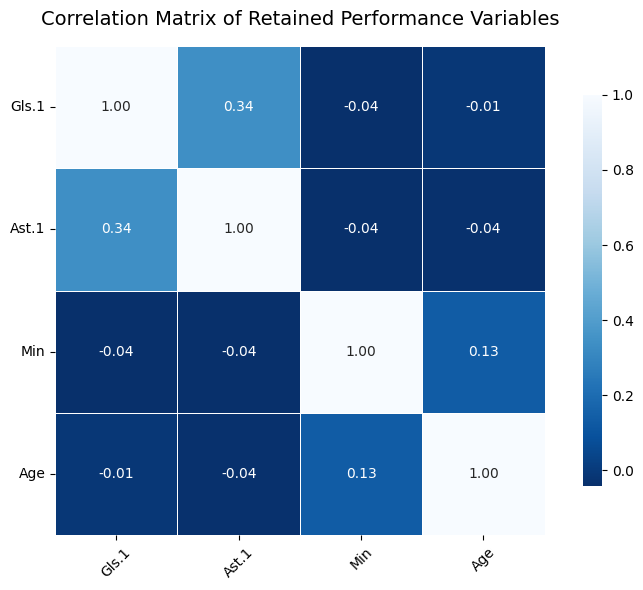
The simultaneous presence in the dataset of overlapping features (e.g. goals, goals plus assists, non-penalty goals) was detected through a correlation analysis. Through variance inflation factor (VIF) testing, highly correlated features and multicollinearity among them were identified, as the presence of overlapping features in the dataset leads to inflated VIFs. Thus, to reduce redundancy and multicollinearity, the study focused on statistics related to attacking performance and playing-time, as previous works have linked player valuation to offensive performance. Specifically, four features were kept: goals per 90 minutes, assists per 90 minutes, minutes played, and player age. Goals and assists are the most notable attacking metrics; minutes played indicates the participation of the player on the actual field and player age adds an indication of the career stage. These features showed low VIF values close to 1, indicating low collinearity among predictors.
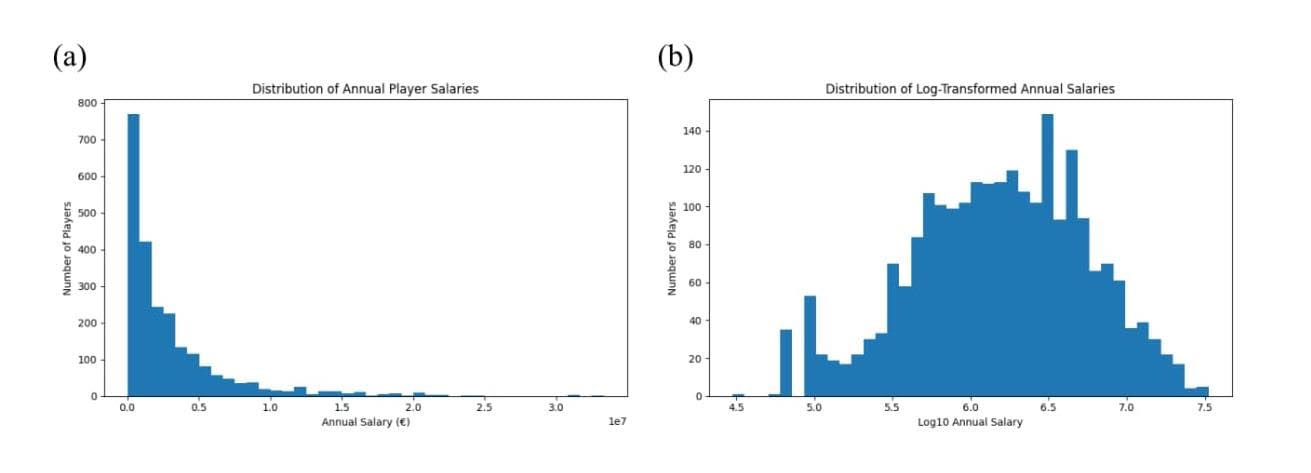
All salary values were provided in three currencies: USD, GBP and EUR. To ensure homogeneity, and given that euros was the original currency for most players, we used it to represent all salaries. As shown in Figure 2, the salary data was skewed due to extreme salaries of certain top players. Therefore, the salary data was transformed using log10 before training the model.
It is worth noting that the salaries provided in this dataset should be considered as an approximation of the compensation, rather than an exact value. The wage figures that are publicly available may not include bonuses, image rights or other types of undisclosed benefits.
Methodology
The goal of this study is to understand whether publicly available data on football player performance and salaries can be used to build a benchmarking framework capable of identifying discrepancies in professional player compensation with respect to their performance. The study does not aim to develop a model that perfectly predicts player salaries; instead, it intends to examine how attacking performance metrics and player compensation relate to each other, thus identifying players whose salaries are misaligned with their performance across different professional leagues.
The UEFA Champions League was chosen as the reference competition because it brings together the most competitive players in terms of both performance and salaries. A linear regression model was trained on the UEFA Champions League data (containing 213 players after preprocessing). This model served as a benchmarking framework that was then applied to the other leagues, to explore relationships between predicted and actual player compensation and to identify players with performance to salary discrepancies.
In the regression model, the target variable was defined as the log10 of the annual salary in euros:

As the log10 transformation reduces the high skewness of the salary data distribution, it decreases the influence of extreme outliers on the regression and strengthens the assumption of linear regression.
The linear regression model was chosen because it is suitable for exploratory economic analysis. More complex machine learning models would improve prediction accuracy, but linear regression was sufficient for the goal of our research, which is interpreting the relationship between performance metrics and salaries. The model predicts the log10 salary, y, as a linear combination of the considered performance features:
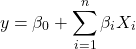
where Xi represents the selected player performance variables, βi the associated coefficients, and β0 the intercept term.
To train and test the model, the UEFA Champions League dataset was split into 80% for training and 20% for testing, using a fixed random state = 42 to ensure reproducibility. Model performance was evaluated using three metrics: the coefficient of determination R2, the root mean squared error (RMSE) and the mean absolute error (MAE).
In addition to linear regression, other machine learning models were also tested (Ridge Regression, Lasso Regression, Random Forest Regression) to evaluate robustness.
The trained model was used to predict salaries for all players of the dataset across all the different leagues. A valuation ratio was computed for each player to compare the predicted salary to the actual salary:

For a given player, a valuation ratio greater than 1 indicates that the salary predicted by the model is larger than the actual salary, meaning that the player is actually paid less than what the benchmark suggests, based on his performance. However, the predicted salaries should not be viewed as exact predictions, but rather a benchmark indication of the salary level for a similarly performing player in the Champions League. In order to limit the influence of extreme outliers, the valuation ratios were capped at 20 at the league level visualizations and macro analysis; the ratios remained uncapped for individual players for the purpose of ranking them and identifying potentially undervalued profiles.
Finally, age, attacking performance metrics and valuation ratios were used to filter players and identify young players who appear to have relatively low salaries compared to their performance. This led to the identification of a pool of potentially undervalued players across all studied leagues presented in the Results section.
Results
When tested on the testing set of the UEFA Champions League, the linear regression model achieved an R2 = 0.135, an RMSE = 0.304 and an MAE = 0.256 on the log10 salary scale. The four features used being related to attacking performance, playing-time and playing age, the relatively low R2 indicates that other factors enter into play in determining player salaries (such as reputation, superstar effect or contract duration). After reconverting salaries back from log10 and recomputing the errors in euros, the RMSE and the MAE translate respectively to €4.49 million and €3.67 million approximately. Even though the model does not entirely explain player salaries and does not provide exact salary prediction, it does capture the relationship between attacking performance and compensation.
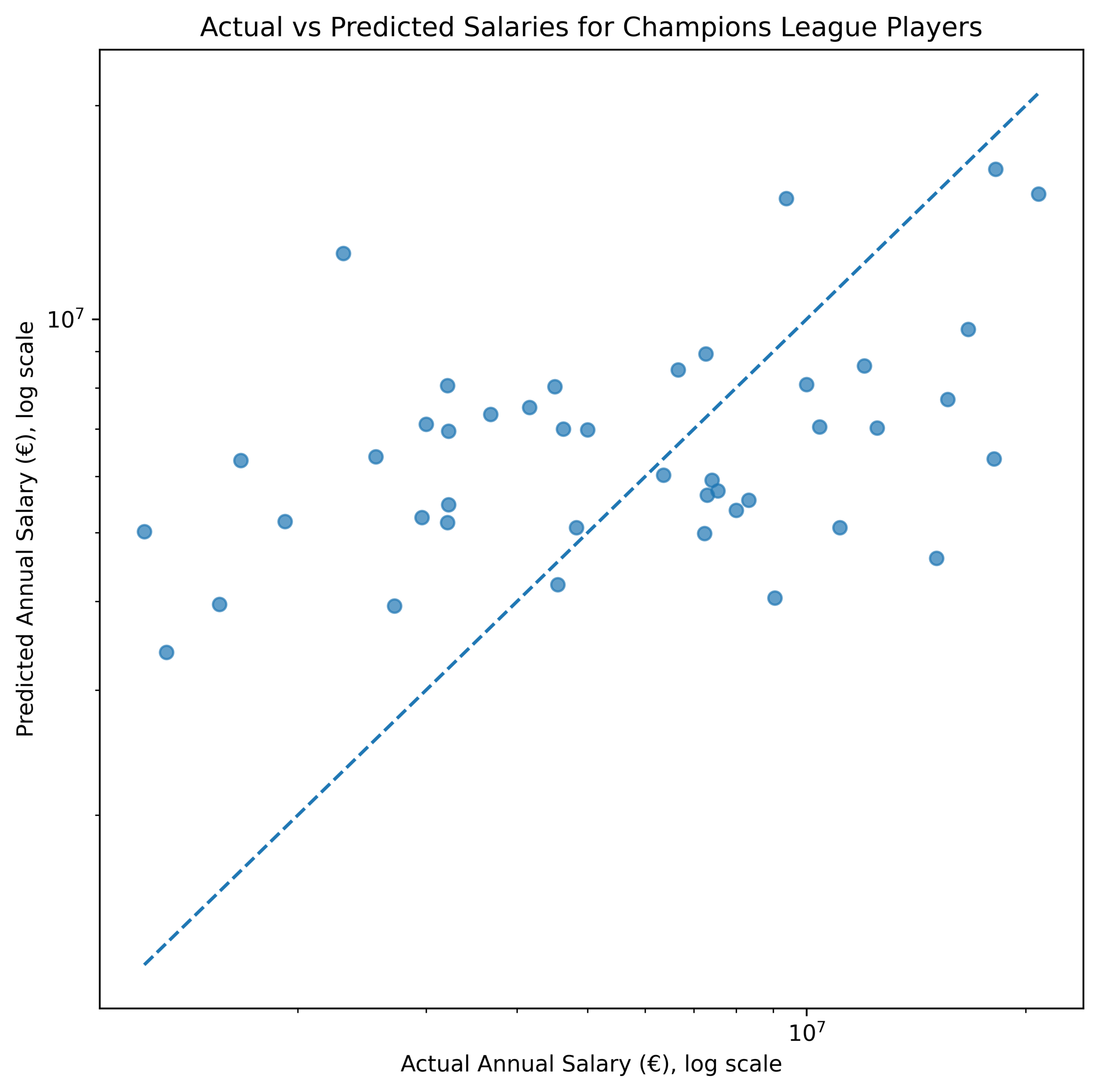
Figure 3 presents the relationship between predicted and actual salaries for Champions League players. The results are dispersed around the line of perfect prediction: players above the line of perfect predictions have predicted salaries higher than actual salaries, or valuation ratios greater than 1, indicating potential discrepancies in the salaries compared to a relatively better performance; players below the line of perfect prediction have predicted salaries lower than their actual ones, signaling potential overcompensation with respect to the benchmarking framework.
In comparison with linear regression, among Ridge Regression, Lasso Regression, and Random Forest Regression, Random Forest achieved the highest performance with R2 = 0.166, only with a relatively small improvement compared to the R2 = 0.135 for linear regression. This shows that, regardless of the model complexity, the studied player performance metrics only partially explain the player salaries. Hence, linear regression was used as the main framework in this study because the main objective was interpretability.
| Model | R² | RMSE (log10 salary) | MAE (log10 salary) |
| Random Forest | 0.166 | 0.298 | 0.252 |
| Linear Regression | 0.135 | 0.304 | 0.256 |
| Ridge Regression | 0.135 | 0.304 | 0.256 |
| Lasso Regression | 0.134 | 0.304 | 0.256 |
Among the four features used for the regression, goals per 90 minutes are the strongest positive predictor of player compensation, as shown by the regression coefficients. Minutes played and age are both positively related to compensation, while assists per 90 minutes have a more limited effect after controlling for the other features.
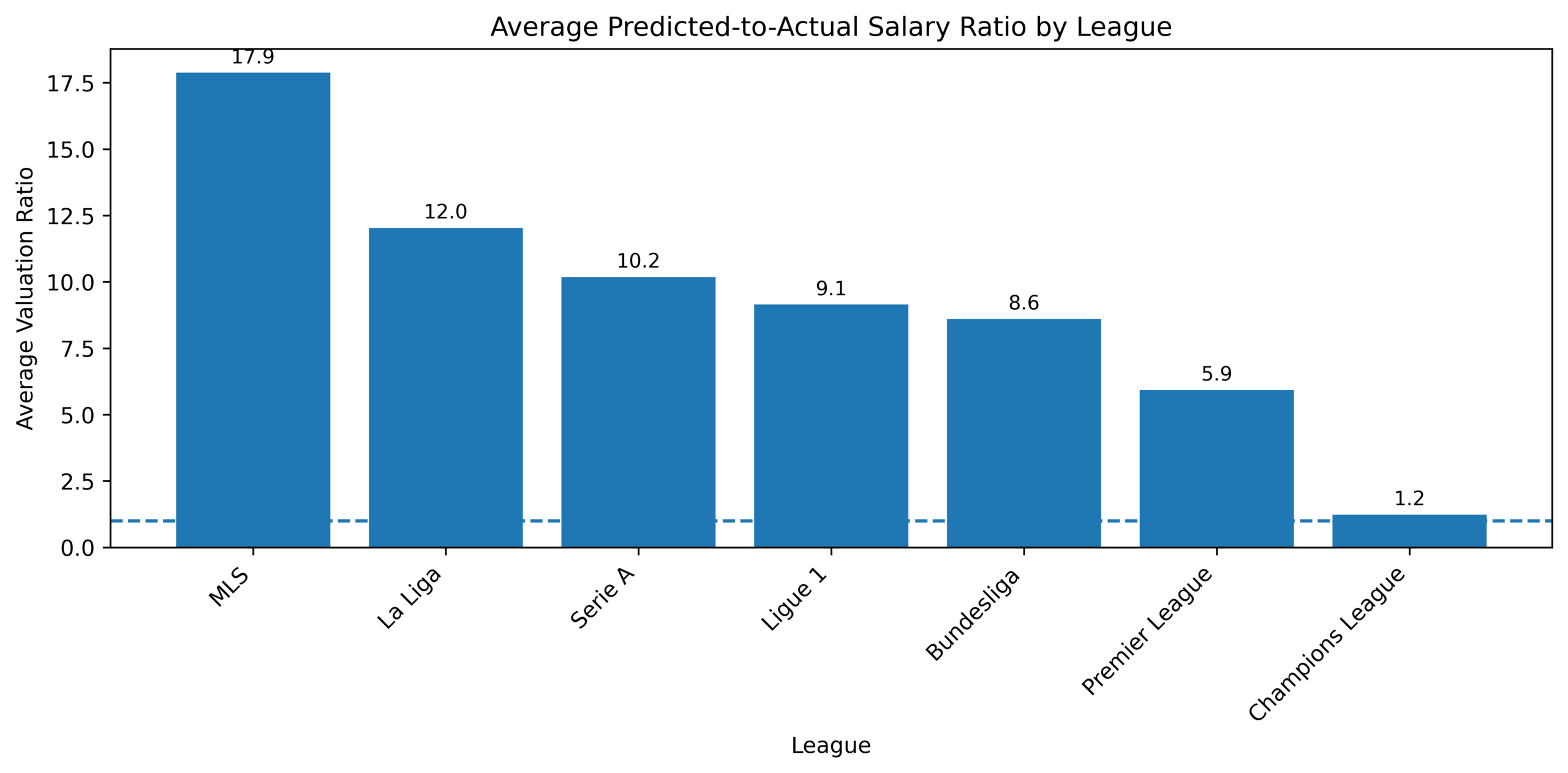
In Figure 4, average valuation ratios are represented for all seven studied competitions, showing significant variation. The highest average valuation ratio corresponds to the MLS league (17.88), followed by La Liga (12.04), Serie A (10.19), Ligue 1 (9.15), Bundesliga (8.60), and the Premier League (5.93). The Champions league had the smallest average valuation ratio (1.23). This closer alignment between actual and predicted salary was expected for Champions League as it served as the reference for training the benchmarking framework.
The differences between leagues are not only due to player performance but also to external economic factors. In MLS, salaries are capped, which translates into lower player compensation and therefore larger gaps between predicted salaries, based on performance, and actual salaries, in comparison with other leagues. Conversely, Premier League exhibits lower gaps between predictions and actual salaries, as salaries in this competition are closer to Champions League salary levels. The other European leagues, which could be seen as transitional talent markets for top professional football, fall in between.
In Table 2, a few examples of the identified pool of potentially undervalued attacking players are shown. Most players within this pool – identified through the benchmarking framework trained on Champions League data – play outside the highest paying teams; they are relatively young with strong attacking performance. Even though these results are not to be considered evidence of mispricing, they suggest that the use of publicly available data can help identify players with compensation disproportionately low with respect to their performance.
| Player | League | Age | Actual Salary (€) | Predicted Salary (€) | Ratio |
| Diego Luna | MLS | 21 | 388,924 | 30,798,930 | 79.2 |
| Kevin Schade | Premier League | 23 | 588,835 | 35,702,330 | 60.6 |
| Aimar Oroz | La Liga | 22 | 950,000 | 50,381,880 | 53.0 |
| Romano Schmid | Bundesliga | 25 | 1,320,000 | 47,770,480 | 36.2 |
| Matthis Abline | Ligue 1 | 22 | 1,180,000 | 48,185,040 | 40.8 |
| Sebastiano Esposito | Serie A | 23 | 1,110,000 | 33,321,740 | 30.0 |
Discussion
The results suggest that player performance and wage statistics can be used to build a benchmarking framework that can identify discrepancies between compensation and performance. More specifically, the results support the first hypothesis, by indicating the association between attacking performance metrics and player salaries, even though the linear regression model does not fully capture the variation in salaries. The model reveals differences across leagues, which supports the second hypothesis. The results also support the third hypothesis, as the benchmarking model helped identify players that are less paid than what their performance suggests.
The relatively low R2 of the linear regression model indicates that attacking performance metrics are not the only factors that determine player salaries, which aligns with previous works showing that compensation in football is affected by other economic factors4,5.
It is worth noting that the exact values of the valuation ratio should be treated with caution, especially extreme ones for younger players with low salaries as dividing by very low salaries will result in very high valuation ratios.
In practical terms, such a benchmarking framework could be used by clubs with limited budgets, in order to identify players who would be affordable to them in terms of salaries while having a relatively strong performance. Thus, instead of competing financially with other clubs, they could maximize their playing performance with the same available budget.
The research has several limitations that should be acknowledged. First, the benchmarking framework is based primarily on attacking performance and does not account for statistics related to defense, tactics and off-ball movement. In other words, performance is much more complex that attacking only. Second, as previously stated in the Data section, salary figures are estimates and not fully exact numbers. Third, the developed framework relies on a small training sample of Champions League players, on a simple linear regression model.
Future work could explore the effect of other factors on the benchmarking framework (e.g expected goals (xG), progressive carries, defensive actions, pressing metrics, and positional adjustments); extending the analysis over multiple seasons could give deeper insights into valuation discrepancies, compensation increases and impact of transfers on the actual salaries.
In conclusion, while the framework could be further improved, the approach in this study suggests that the use of publicly available football data could translate into tools that inform the decision-making process of football clubs, especially ones with budget constraints.
References
- M. Lewis. Moneyball: The art of winning an unfair game. W. W. Norton & Company, 2003. [↩] [↩]
- E. Franck, S. Nüesch. Talent and/or popularity: What does it take to be a superstar? Economic Inquiry. Vol. 50, pg. 202–216, 2012, https://doi.org/10.1111/j.1465-7295.2010.00360.x. [↩] [↩]
- O. Müller, A. Simons, M. Weinmann. Beyond crowd judgments: Data-driven estimation of market value in association football. European Journal of Operational Research. Vol. 263, pg. 611–624, 2017, https://doi.org/10.1016/j.ejor.2017.05.005. [↩] [↩]
- B. Frick. The football players’ labor market: Empirical evidence from the major European leagues. Scottish Journal of Political Economy. Vol. 54, pg. 422–446, 2007, https://doi.org/10.1111/j.1467-9485.2007.00423.x. [↩] [↩] [↩] [↩]
- C. Lucifora, R. Simmons. Superstar effects in sport: Evidence from Italian soccer. Journal of Sports Economics. Vol. 4, pg. 35–55, 2003, https://doi.org/10.1177/1527002502239657. [↩] [↩] [↩]
- D. Butler, A. Farnell, R. Simmons. Do sports analytics affect footballer pay? Frontiers in Behavioral Economics. Vol. 3, pg. 1490871, 2024, https://doi.org/10.3389/frbhe.2024.1490871. [↩] [↩]
- I. G. McHale, B. Holmes. Estimating transfer fees of professional footballers using advanced performance metrics and machine learning. European Journal of Operational Research. Vol. 306, pg. 389–399, 2023, https://doi.org/10.1016/j.ejor.2022.06.033. [↩] [↩]
- R. Rein, D. Memmert. Big data and tactical analysis in elite soccer: Future challenges and opportunities for sports science. SpringerPlus. Vol. 5, pg. 1410, 2016, https://doi.org/10.1186/s40064-016-3108-2. [↩]
- J. Gudmundsson, M. Horton. Spatio-temporal analysis of team sports. ACM Computing Surveys. Vol. 50, Article 22, 2017, https://doi.org/10.1145/3054132. [↩]
- L. Pappalardo, P. Cintia, A. Rossi, E. Massucco, P. Ferragina, D. Pedreschi, F. Giannotti. A public data set of spatio-temporal match events in soccer competitions. Scientific Data. Vol. 6, pg. 236, 2019, https://doi.org/10.1038/s41597-019-0247-7. [↩]
- R. Simmons. Professional labor markets in the Journal of Sports Economics. Journal of Sports Economics. Vol. 23, pg. 728–748, 2022, https://doi.org/10.1177/15270025211051062. [↩]
- P. Garcia-del-Barrio, F. Pujol. Hidden monopsony rents in winner-take-all markets: Sport and economic contribution of Spanish soccer players. Managerial and Decision Economics. Vol. 28, pg. 57–70, 2007, https://doi.org/10.1002/mde.1313. [↩] [↩]
- F. Carmichael, I. McHale, D. Thomas. Maintaining market position: Team performance, revenue and wage expenditure in the English Premier League. Bulletin of Economic Research. Vol. 63, pg. 464–497, 2011, https://doi.org/10.1111/j.1467-8586.2009.00340.x. [↩]
- D. Berri, D. Butler, G. Rossi, R. Simmons, C. Tordoff. Salary determination in professional football: Empirical evidence from goalkeepers. European Sport Management Quarterly. Vol. 24, pg. 624–640, 2023, https://doi.org/10.1080/16184742.2023.2169319. [↩]
- I. G. McHale, P. A. Scarf, D. E. Folker. On the development of a soccer player performance rating system for the English Premier League. Interfaces. Vol. 42, pg. 339–351, 2012, https://doi.org/10.1287/inte.1110.0589. [↩]
- S. Herm, H.-M. Callsen-Bracker, H. Kreis. When the crowd evaluates soccer players’ market values: Accuracy and evaluation attributes of an online community. Sport Management Review. Vol. 17, pg. 484–492, 2014, https://doi.org/10.1016/j.smr.2013.12.006. [↩]
- T. Peeters. Testing the wisdom of crowds in the field: Transfermarkt valuations and international soccer results. International Journal of Forecasting. Vol. 34, pg. 17–29, 2018, https://doi.org/10.1016/j.ijforecast.2017.07.008. [↩]
- C. Thrane. Performance and actual pay in Norwegian soccer. Journal of Sports Economics. Vol. 20, pg. 1051–1065, 2019, https://doi.org/10.1177/1527002519851146. [↩]
- T. Decroos, L. Bransen, J. Van Haaren, J. Davis. Actions speak louder than goals: Valuing player actions in soccer. Proceedings of the 25th ACM SIGKDD International Conference on Knowledge Discovery & Data Mining, pg. 1851–1861, 2019, https://doi.org/10.1145/3292500.3330758. [↩]
- F. Prockl, B. Frick. Information precision in online communities: Player valuations on www.transfermarkt.de. International Journal of Sport Finance. Vol. 13, pg. 319–335, 2018. [↩]
- D. Coates, P. Parshakov. The wisdom of crowds and transfer market values. European Journal of Operational Research. Vol. 301, pg. 523–534, 2022, https://doi.org/10.1016/j.ejor.2021.10.046. [↩]
- M. A. Al-Asadi, S. Tasdemir. Predict the value of football players using FIFA video game data and machine learning techniques. IEEE Access. Vol. 10, pg. 22631–22645, 2022, https://doi.org/10.1109/ACCESS.2022.3154767. [↩]
- I. Behravan, S. M. Razavi. A novel machine learning method for estimating football players’ value in the transfer market. Soft Computing. Vol. 25, pg. 2499–2511, 2021, https://doi.org/10.1007/s00500-020-05319-3. [↩]
- M. Franceschi, J.-F. Brocard, F. Follert, J.-J. Gouguet. Determinants of football players’ valuation: A systematic review. Journal of Economic Surveys. Vol. 38, pg. 577–600, 2024, https://doi.org/10.1111/joes.12552. [↩]
- A. Bryson, B. Frick, R. Simmons. The returns to scarce talent: Footedness and player remuneration in European soccer. Journal of Sports Economics. Vol. 14, pg. 606–628, 2013, https://doi.org/10.1177/1527002511435118. [↩]