
Abstract
With the recent rapid expansion of generative artificial intelligence, creative industries like video game development have significant potential to use AI to create game features that were once only human-made. However, how different audiences perceive AI art is not very well understood, thus motivating the question of whether people who report having or not having creative experience respond to AI-generated art in different ways and how they differ in desire to avoid games that use it. Comparing two groups, experienced participants and non-experienced participants, this study examines whether they can distinguish AI-generated and human-created art, and also whether they would purchase a game if they knew it used significant AI-generated art. This study was conducted using a mixed-methods approach: a narrative literature review and a survey for the two groups of 93 non-experienced and 156 experienced participants. Participants analyzed four hand-picked images being two AI-generated and two human-created. Per each image, participants rated its quality, then they guessed its source. After the source was revealed, they were asked whether their perception changed. Finally, they were asked if they would avoid a game using AI-generated art. Results indicated near-chance accuracy in the main analysis when distinguishing image source (experienced: 55.6%, non-experienced: 52.7%) with a response bias towards “human” being present. Additionally, experienced participants reported higher purchase avoidance intent (62.8% versus 29.0%, d = 0.75). This gap cannot be explained by detection ability as the two different groups did not differ significantly in accuracy (p = .362).
Keywords: Generative AI, Video game graphics, AI-generated art, human-created art, aesthetic perception
Introduction
In recent years, artificial intelligence has become increasingly integrated into creative industries, such as video game development1. Tasks such as creating game art or generating the in-game experience that previously required human labor can now be completed more quickly and efficiently using AI tools2. Although prior research has examined human perception of AI-generated content such as photographs of faces3, much less is known about how players perceive AI-generated visuals across different video games. Specifically, it is unclear whether they can effectively distinguish AI-generated game art from human-created art, and how this knowledge shapes their evaluation of the art. This gap is increasingly pertinent, given that visual design plays a central role in engaging and creating the appeal of games in the modern gaming industry4. Authenticity in the context of the research relates mainly to the feeling that a real person put meaning into something. On the other hand, aesthetic judgment from participant point of view is their opinion on the visual quality of the image (Q6, Q9, Q12, Q15). Purchase-avoidance intent as used in this study refers to a stated intent to not buy a game made with AI art (Q20). Creative experience is a key division between the groups and refers to a participant’s self-reported experience with hands-on creative work production (Q5). More specifically, visual art or game development, rather than simply playing or viewing the artwork. This metric was measured by one question on the survey (Q5) in which participants were asked to provide their level of creative experience.
With these terms defined, the central problem remains that while generative AI is becoming increasingly relevant in the global market, there is a limited understanding of its consequences for game art generation5. This study aims to answer the question: Can participants distinguish AI-generated game art from human-created art, and does learning who created the artwork change how they report their judgment of aesthetics and image quality? This study also aims to find how the two groups differ in terms of self-reported purchase-avoidance intent. As gaming companies continue to innovate in creating video games for consumers, it is essential to understand how the target audience perceives different AI-generated images and whether this approach is viable for making a video game.
To explore this question, the study uses a mixed-methods approach: (i) a literature review on AI art and perception, supported by peer-reviewed research; and (ii) a survey of two groups, participants with and without visual-art or game-development experience, provides firsthand data on their perceptions. The survey asks participants whether an image is AI-generated or human-created and includes a post-disclosure follow-up. Participants rate the artwork on a Likert scale to determine whether their perception changes after learning the image’s creator.
This study explores an under-researched area: how gamers perceive AI-generated art in video games. There is much more speculation than fact in this area, so the primary data collected here provides a more concrete look at whether people can actually distinguish AI-generated images from human-created ones. It also provides valuable data on different potential consumers and their opinions and perceptions on AI. Based on this, video game companies can obtain more concrete data on how different consumer groups might rate artwork, and what they would report about it once learning that it was AI-generated. Theoretically, this study is able to extend algorithm aversion and social-identity accounts taken from general audiences to those who create visual products, suggesting the possibility that creative practice may shape reactions to AI-generated art.
Theoretical Framework
To better understand the context and purpose of this paper, multiple theories must be defined which are solid predictors at the root of the research gap being analyzed in this study. One such theory is algorithm aversion, which states that people have a low amount of trust for the predictions of algorithms after witnessing them make an error, especially in forecasting students’ performances and ranking airline traffic, opting to trust human judgments6. This decision often persists even when human judgments make more mistakes and are clearly inferior to the algorithm6. People also value algorithm-made products like news less7. Bridging to creative work, and more specifically artwork, studies found that people have a tendency to value an artwork less when told an algorithm created it, even if the artwork is identical8,9,10. Bellaiche et al. (2023) found this effect also applied to ratings of beauty, monetary worth, and profundity8. Moreover, the social identity theory is pertinent and has been applied to preferences between AI versus human art11. Professional identity can partly be considered a social identity, and threats to it are considered threats to the individual12. While no specific job was measured, social identity theory remains relevant as it is being applied to creative practice instead. The threat seen to the “group” is to the work that each participant does in the creative field, rather than being related to the actual employment itself. Algorithm aversion theory motivates H4 while social identity theory is the main motivator of H2, H5, and H6. Theories that discussed actual adoption of technology such as technology acceptance theory were not relied on for the shaping of this study as the research is focused on measured opinions and buying intent rather than actual adoption of the technology.
Methodology
Literature Review Methodology
This literature review was conducted as a narrative review. The search engine used was Google Scholar, combined with backward citation tracking from initial papers found. The search terms are in the below paragraph. Additionally, studies based on how people are able to perceive or evaluate AI-generated work visually or discussing AI’s adoption into creative industries were included. Studies were also included if the effects of disclosing or labeling AI authorship were discussed. Included studies were dated from 2020 and onward to capture the period in which such modern image generation models began to emerge and become available to the public. These time period constraints do not pertain to any of the included theory sources that predate these ranges. Papers discussing generative AI in the context of text or audio that did not meet any of the inclusion criteria were excluded. Moreover, peer-reviewed work was the preferred standard as well as original data being preferred over commentary. Preprints and industry reports were also used when no peer-reviewed source had the necessary information. No formal quality scoring was performed.
Some relevant search terms to this paper include a combination of generative AI, human perception, and video game concepts. Some key words such as ‘AI-generated art’, ‘game visuals’, ‘AI detection’, ‘human vs AI’, ‘aesthetic perception’, ‘quality ratings’, ‘algorithm aversion’, ‘authorship disclosure’, ‘perceived authenticity’, ‘player perception’ are present. Studies were prioritized if they analyzed patterns of human perception in determining how generative AI is used for image creation or other creative areas. Additionally, studies examining AI in artistic expression as a whole were reviewed to provide a broader foundation for the knowledge base this study requires.
Across the literature, several recurring themes emerged to structure the present review. Firstly, a common theme in the literature is that human-made art is often preferred because it is perceived as more meaningful, intentional, and aesthetically authentic. People also tend to use dual-process reasoning when evaluating AI-generated art, an initial gut reaction followed by a more reflective judgment about the artwork’s authorship and intention. While AI tools let non-professionals generate art quickly and explore more ideas, the output quality can become repetitive over time.
Finally, it was established that humans often have considerable difficulty distinguishing AI-generated artwork, with extremely high misclassification rates, human analyst performance decreasing when viewing faces, and older analysts performing worse than younger analysts.
Survey Methodology
For the studio channel, all staff at both studios were emailed by the company leadership, with a total of 313 being invited (Studio A: 262, Studio B: 51). The second channel was a convenience sample recruited through personal networks and email chains to students at a Southern California high school as well as to family and friends. Roles and years of experience were not recorded. Answers of “Agree” or “Strongly Agree” on Q5 meant experienced, while “Neutral”, “Disagree”, or “Strongly Disagree” were non-experienced, meaning that the 32 people who answered “Neutral” were placed in the non-experienced group. They did not affirm having experience, and did not deny it either. Any unfinished responses were not recorded, meaning no completion rate is available, and start times were not saved either, meaning average time of completion was not recorded. Both recruitment channels were contacted in the U.S. with individual location not recorded. All the tables, figures, and other analyses are based on the analytic sample of 249 rather than the recruiting total. Of the 313 gaming staff invited by a studio email on 5 February 2026, 127 people aged 19+ responded to the survey (40.6% minimum, 95% CI [35.3, 46.1]) on 5 and 6 February before the wider request was sent out. Two more replies on 5 February were aged 13–18. This is the minimum of participants recruited from the two gaming studios combined as there is no other verifiable way to track studio participants’ responses after 6 February. The high school soccer team was provided with the survey by email on 5 February as well, while the rest of the high school and friends and family were asked on 7 February through personal networks and email chains. Every member of the soccer team is aged 13–18 and thus anyone 19 or older who replied before 7 February came from the studio email. In terms of the second recruitment channel, a response rate was not available as no fixed list of people invited was created. For both recruitment channels, reasons for not responding were not collected.
To ensure the validity and reliability of this study, multiple strategies are utilized in data collection. Every image presented to the participant is in a standard survey format with the same layout, instructions, and multiple-choice options. Table 2 provides both the image’s source and date of access. Additionally, Image 3’s generation date is not known. Rather, the date it was accessed is listed. Images were chosen under the requirement that they looked visually animated and were of a single concept game character of any game. Each character was in a standing pose. However, the set of images was not initially tested for equivalency in terms of style, complexity, or genre. This set of images also carries confounds, including visible layout differences, especially between Images 2 and 4. Moreover, each image had slight differences in terms of cropping, resolution, and the art style. All images were cropped and resized to be of similar format for the survey without editing the artwork itself, but exact sizing was not measured. Seeds were not recorded for the AI-generated images, and the Midjourney image’s version was not recorded. These differences have the potential to have influenced per image guesses of participants about the source of the images, meaning that these per-image findings shift towards image specificity rather than a generalization. The survey itself has a cross-sectional, within-subjects design, allowing all participants to be tested across all conditions. The survey used in this study included a question asking the participant to affirm informed consent. Additionally, all information entered remains confidential, as only results and data patterns will be presented. No participant’s personal information was necessary.
Each participant completed the study at their own pace between the dates of 5 February 2026 and 7 March 2026. Answers were submitted via a Google Form with 20 questions analyzing four images, which participants analyzed to determine whether they were AI-generated or human-created. Questions were first asked to gauge participants’ age and experience with video games, as well as their perceptions of video game graphics and different forms of video game art. Additionally, they were asked about their familiarity with AI image-generation tools, as this could affect their ability to distinguish AI-generated from human-created images. After this, the AI-generated vs. human-developed experiment proceeded, with pictures provided to the participant. For each image, three questions were asked. First, the participant was asked if they found the image visually appealing and high quality. Afterwards, they were asked if they thought the image was AI-generated or human-created. Finally, they were asked whether or not their perception had changed after finding out the source of the image. After they have finished analyzing each image, the participant is asked a summative question to determine if the participant found it easy to distinguish between AI-generated and human-created art. The survey itself followed a similar format throughout, with almost all questions using a standard Likert scale. This included a scale of answer choices from “strongly disagree, disagree, neutral, agree, and strongly agree.” No pilot test was used before the survey was sent out to participants. Instead, it was drafted and reviewed by the researcher and mentor before being distributed.
Ethical Considerations and Conflict of Interest
Throughout this study, a mentor provided advisory support for preparing and designing the research model, and the protocol itself was reviewed by a qualified review panel, convened in accordance with the Regeneron Science Talent Search pre-college IRB requirements. The panel consisted of a licensed medical professional, school administrator, and qualified educator, and reviewed the study on 28–29 September 2026. As data was collected between 5 February and 7 March 2026, this review was retrospective, yet the panel reviewed and approved the study with conditions at minimal risk, considering that participation was voluntary and respondents remained entirely anonymous with no identifying information other than an age range for research purposes. The survey collected no personally identifying information. From the survey itself, the consent question reads “I voluntarily agree to participate in this anonymous research study and understand I may stop at any time”, allowing participants to choose whether to continue with the survey. Those who responded “No” to this question were completely removed from the survey data and results.
For participants under 18 years of age, personal assent was required. Many were reached through the local high school and personal networks. Participation was voluntary and anonymous and the survey contained no questions asking for any identifying information other than the age range. The survey itself was a minimal risk query with opinions about game art. The review panel determined parental consent to not be required for minor subjects.
Authorization of the survey being sent to employees of both gaming studios was obtained through a relative who is an officer of both companies. Moreover, once again, participation was voluntary and no identifying information was obtained from the employees, meaning there is no way for the researcher or officer of the company to determine what any single individual answered, or who that individual is.
Data Analysis
Identification accuracy was scored per each trial as either correct or incorrect. It was scored as correct when the participant’s guess of the source of the image matched the true source. Responses of “Not sure” were scored as incorrect in the primary analysis, and were additionally removed through use of a robustness check. The accuracy of the experiment was measured against the 50% chance level. It used two-sided binomial tests that had 95% Wilson confidence intervals, both on the trial and participant level. Determining true discrimination versus response bias required the use of signal-detection analysis where AI images were treated as the signal while sensitivity (d’) and the criterion (c) were calculated with a log-linear correction. A logistic regression was able to predict the correct identification from the group and image source with cluster-robust standard errors by the participants. In addition to the other model, the same identification model was run while having the participant and the image vary as random effects in order to account for the small size of the image set. Python was used as the primary software for statistical analyses. When comparing groups on the Likert scale, Mann-Whitney U tests were used. Also, any categorical comparisons required chi-square. Additionally, the image-level tests were Bonferroni-corrected. Finally, the size of effect in the data was reported with Cohen’s d for Mann-Whitney tests and Cramér’s V for the chi-squares. For the two existing multi-item scales, Cronbach’s alpha was used to establish internal consistency. The perception-change scale proved to be acceptable (.829) though the appeal and quality ratings were below the .70 bar (.594) (Table 7). Therefore, the four image ratings were analyzed separately instead of simultaneously.
Hypotheses
H1. Taking an exploratory approach, this study examines whether experienced participants will report a greater ability to distinguish AI-generated art from human-created art.
H2. Experienced participants will have different quality ratings for an individual AI-generated and human-created image than a non-experienced participant would.
H3. Taking an exploratory approach, experienced participants will be more accurate at distinguishing between AI-generated and human-created images than non-experienced participants.
H4. Experienced participant self-reported changes in perception of the overall quality and appeal of the art will be different from non-experienced participants’ self-reported changes after finding out whether the image is AI-generated or human-created.
H5. Each group as a whole will differ in how they characterize the differences between AI-generated versus human-created images.
H6. Experienced participants will have stronger views on avoiding purchasing games that integrate significant AI tools into their production pipeline than non-experienced participants will.
Results
Summary of Literature Review
As AI-generated art is becoming increasingly prevalent across industries, researchers are starting to compare the way it is perceived with how human-created art is perceived. Son and Lee (2024), a preprint, found that human-created art was preferred to AI-generated art due to its perceived meaningfulness and aesthetic value13. When precision and objectivity were valued over creativity in art restoration, then generative AI-created artworks were more likely to meet consumer expectations13.
Additionally, it was found that using text prompts with image generative AI can enhance an artist’s productivity by around 25%, with artists who used AI to think of more novel ideas tending to get higher ratings from peers. However, this paper also found that, while the peak content novelty of the focal subject matter increases over time, the average content novelty and artwork visual novelty decreases14.
Moreover, other findings suggest that AI-generated images have advanced to the point that humans often struggle to classify real or generated photographs of faces3. For instance, Lu et al. (2023) found that humans struggled to classify AI-generated vs. real photographs, misclassifying 38.7% of the time. They also found that, though the best performing AI detection model still definitively outperforms humans, it still has an error rate of around 13% when classifying AI-generated vs. human-created photographs15. Cooke et al. (2025) find that, when examining the specific features of AI-generated media, humans struggle to distinguish synthetic from authentic media when human faces are present. Furthermore, older adults did somewhat worse when discerning differences in the media presented, the drop being largest for audio and video16. In fact, a further study found that older adults had more false alarms, having a higher likelihood of saying that human images were AI-generated17. It was also found that AI using a higher level of computation power had higher ratings and even more positive emotion from the viewer though the gains were relatively modest and had diminishing returns overall18.
It is also indicated that some models often struggle with realistic humans and complex scenes19. The modern AIGC systems often rely on a two-step process, looking into intent understanding and then content generation. Sometimes, understanding of the intent is poor. As new models are coming out, however, they are able to combine text, images, and other data types, thus expanding their capabilities beyond just single-domain tasks and are more readily applicable to the real world20.
Though AI-generated art is reaching a point where it is almost equal in quality to human-made artwork, when both a human-made and AI-generated piece are labeled, the human-made artwork leads to higher ratings despite both being highly similar9. Art labeled as human-made is seen as having had more effort and narrative infused into it, increasing positive judgments. Though people who are more positive about AI have less bias, there is still an overall negative bias against AI art in meaning and value8. People often feel less emotional connection to the AI creators which lowers their overall preference for such AI-made art11. To add, people judging art without knowing the source tended to prefer AI-generated pieces. Additionally, a separate group was told that one image in each pair was AI, and identified it significantly, if only modestly, above chance (d = 0.31)21.
Studies were also conducted in marketing where AI was revealed to be the source. When an ad label made viewers aware of AI use, they saw the ad as less appropriate and trusted it less, though the study also found a smaller effect in the opposite direction22. Moreover, another study found that disclosing an ad to be AI-generated lowered evaluation of that ad, mainly due to a perceived loss of credibility23. Contradicting studies were also apparent in review as some measured different things from others such as measured trust, credibility, and even overall opinion. Additionally, others showed one labeled image next to another image, while other studies showed images one at a time to evoke different responses from participants. For instance, it was found that labeling AI-generated content did not actually change perceived credibility24. A caveat to this found in a separate study was that while AI labels may have increased the perceived novelty of the content, they did lower the level of perceived authenticity, demonstrating the trade-offs of disclosure25. In certain contexts, details about the way the AI created a piece shift a participant’s moral judgment and aesthetic judgment of the visual they are looking at26.
Delving into the specifics of artists in game development itself, a preliminary study surveyed game-industry artists as well as fine arts students regarding attitudes towards generative AI and if it was perceived as a threat to their jobs27. Despite common sentiments of AI’s potential, a study of U.S.-based artists found little evidence that affirmed any short-run earnings declines. After ChatGPT’s release, there was little to no evidence of any reduction in artist wages with effects remaining mainly neutral or positive. Moreover, AI has recently been changing tasks, but no judgments on employment can be made as evidence is mixed. Instead it is being used for ideation and support which may lead to task shifts rather than full immediate job loss. However, the future remains uncertain due to AI’s potential in this field28.
Another key finding was that viewers who believed the creator to have more ‘mind’ (agency and experience) had a higher appreciation for the art29. Emotional depth is clearly a main aspect of this thought process as machines are often assumed to lack personal feelings. Thus, AI-artwork is rated as having less emotional depth, craftsmanship and aesthetic value30. A study of tourism photos found that AI-generated tourism photos were seen as relatively authentic, especially when not labeled as AI, though human photos were seen as more authentic31.
Compounded with the idea that AI artwork is unfavorable in the common view, collaboration of an artist with AI has been seen to negatively impact the artwork rating. This effect can be reduced at its core if the level of involvement was clearly articulated or if the art was commercially driven32.
Despite the findings above, further research has demonstrated that human bias often appears only when human and AI art are directly compared one after another by the same person. Additionally, when compared with one another, the bias can be classified as a positive bias towards human artwork rather than a negative bias towards AI33.
While the existing literature covers AI art perception in general, very little of it focuses specifically on the video game industry. It is still unclear whether knowing that there is AI use in game art changes how a non-experienced participant reports about the art itself. Given how large and profitable the gaming industry is, this gap is worth addressing, which is exactly what this study sets out to do.
Survey Results
Section 1: Demographics & Background (Q1–Q5)
| Q2: Age group | 13–18 | 19–25 | 26–35 | 36–45 | 46+ |
| Experienced participants (n = 156) | 19.9% | 5.1% | 14.1% | 26.3% | 34.6% |
| Non-experienced participants (n = 93) | 38.7% | 19.4% | 15.1% | 9.7% | 17.2% |
| Q3: Gaming frequency | Daily | Weekly | Monthly | Rarely | Never |
| Experienced participants (n = 156) | 55.1% | 28.2% | 10.3% | 3.8% | 2.6% |
| Non-experienced participants (n = 93) | 22.6% | 34.4% | 11.8% | 19.4% | 11.8% |
| Q4: Familiar with AI image generation tools | Strongly Disagree | Disagree | Neutral | Agree | Strongly Agree |
| Experienced participants (n = 156) | 1.3% | 2.6% | 8.3% | 57.7% | 30.1% |
| Non-experienced participants (n = 93) | 4.3% | 4.3% | 17.2% | 55.9% | 18.3% |
| Q5: Experience with visual art / game development (grouping variable) | Strongly Disagree | Disagree | Neutral | Agree | Strongly Agree |
| Experienced participants (n = 156) | 0.0% | 0.0% | 0.0% | 35.3% | 64.7% |
| Non-experienced participants (n = 93) | 33.3% | 32.3% | 34.4% | 0.0% | 0.0% |
Q1 (consent): all 249 analyzed participants affirmed consent. Four records that did not affirm consent were excluded before analysis, reducing the recruited total of 253 to an analytic sample of 249. Scale for Q4–Q5: 1 = Strongly Disagree, 5 = Strongly Agree.
Section 2: Image Evaluation Summary (Q6–Q17)
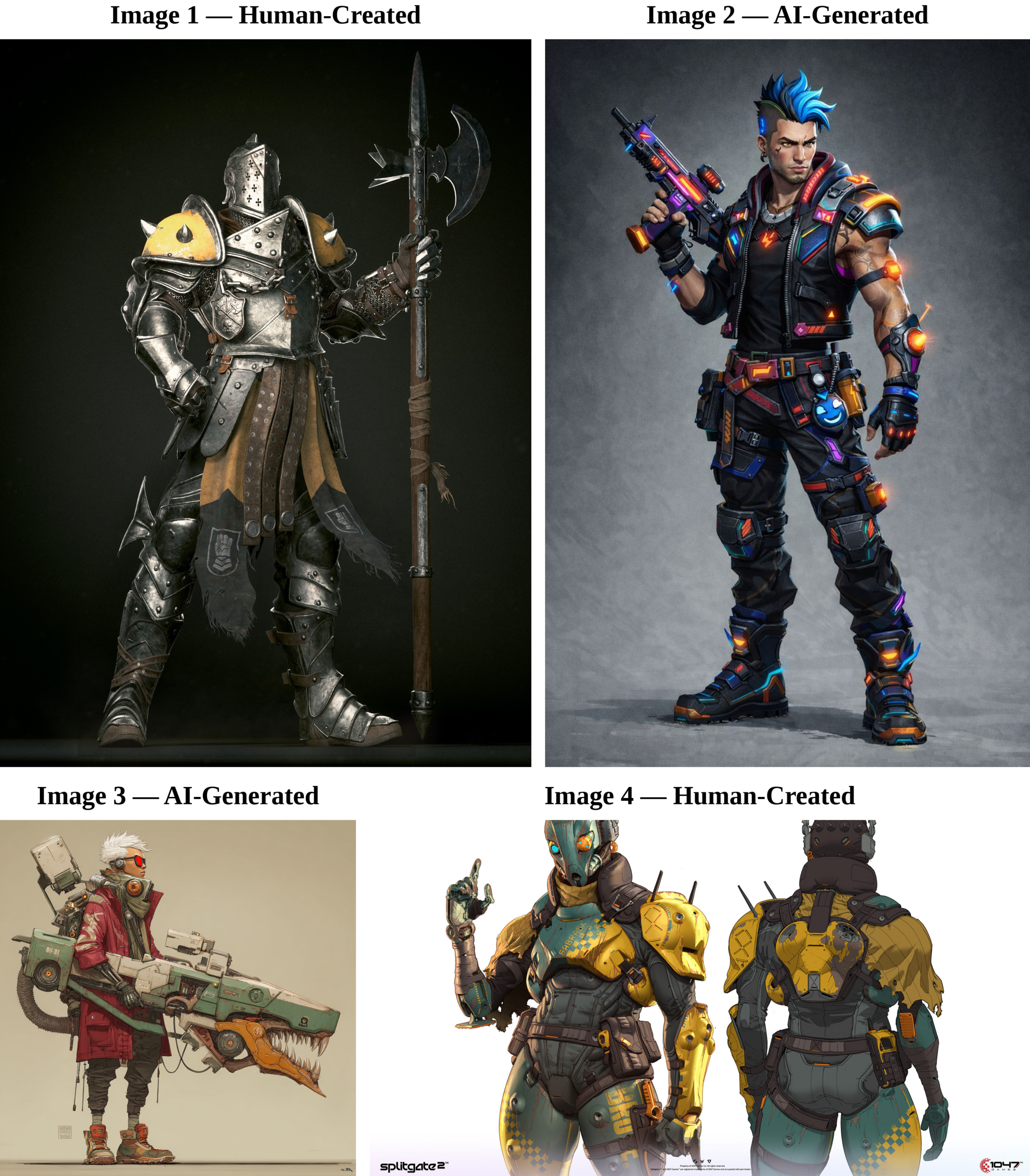
The four game art images evaluated in Section 2 are shown below (Figure 1) with source information.
| Image | Source Type | Platform / Tool | Artist / Creator | Prompt | License / Permission | Date |
| Image 1 | Human-created | ArtStation | Walter Torezan Junior | Not applicable (human-created) | Copyrighted work by named artist was used as a research stimulus under fair-use/research rationale, and permission was not obtained from the artist. | Accessed 19 January 2026 |
| Image 2 | AI-generated | ChatGPT (GPT-5.2) | Generated by the researcher | “Create a random concept character for the video game Fortnite” | Self-generated by the researcher; no third-party permission required | Created 18 January 2026 |
| Image 3 | AI-generated | Midjourney AI | Midjourney community user “e.gg” | “Sci fi cyberpunk rogue with a snaketooth futuristic weapon” | AI-generated image lacking human authorship. Not subject to copyright (U.S. Copyright Office). | Accessed 1 February 2026 |
| Image 4 | Human-created | ArtStation | Joao David Fernandes | Not applicable (human-created) | Copyrighted work by named artist was used as a research stimulus under fair-use/research rationale, and permission was not obtained from the artist. | Accessed 19 January 2026 |
| Image | Actual Source | Visual Appeal Mean [95% CI] (E / N) | Guessed AI (E / N) | Guessed Human (E / N) | Unsure (E / N) | Perception Change Mean [95% CI] (E / N) |
| Image 1 (Q6–Q8) | Human-created | 3.81 [3.69, 3.94] / 3.86 [3.69, 4.03] | 26.9% / 31.2% | 56.4% / 53.8% | 16.7% / 15.1% | 2.90 [2.72, 3.07] / 3.03 [2.81, 3.26] |
| Image 2 (Q9–Q11) | AI-generated | 3.40 [3.24, 3.56] / 3.69 [3.50, 3.88] | 64.1% / 74.2% | 28.8% / 20.4% | 7.1% / 5.4% | 2.92 [2.75, 3.10] / 2.92 [2.72, 3.13] |
| Image 3 (Q12–Q14) | AI-generated | 3.99 [3.84, 4.15] / 4.16 [4.00, 4.33] | 30.8% / 23.7% | 62.2% / 69.9% | 7.1% / 6.5% | 3.36 [3.18, 3.54] / 3.37 [3.16, 3.57] |
| Image 4 (Q15–Q17) | Human-created | 3.70 [3.56, 3.83] / 3.81 [3.65, 3.96] | 17.9% / 30.1% | 71.2% / 59.1% | 10.9% / 10.8% | 2.90 [2.73, 3.06] / 3.13 [2.92, 3.33] |
Each image was rated for visual appeal (5-point Likert mean), then respondents guessed whether it was AI or human, then learned the true source and rated whether their perception changed (5-point Likert mean). E = Experienced, N = Non-experienced.
Visual Appeal & Perception Change: 5-point Likert scale (1 = Strongly Disagree, 5 = Strongly Agree). Attribution: percentage selecting each option.
Section 3: Overall Attitudes (Q18–Q20)
| Q18: Overall view of AI vs. human art quality | AI lower quality | AI equal quality | AI higher quality | Could not tell a difference | Varied too much to generalize |
| Experienced participants (n = 156) | 25.0% | 19.2% | 1.3% | 32.7% | 21.8% |
| Non-experienced participants (n = 93) | 21.5% | 35.5% | 5.4% | 30.1% | 7.5% |
| Q19: Easy to distinguish AI from human art | Strongly Disagree | Disagree | Neutral | Agree | Strongly Agree |
| Experienced participants (n = 156) | 5.1% | 43.6% | 25.6% | 20.5% | 5.1% |
| Non-experienced participants (n = 93) | 12.9% | 46.2% | 19.4% | 20.4% | 1.1% |
| Q20: Would not buy a game using significant AI art | Strongly Disagree | Disagree | Neutral | Agree | Strongly Agree |
| Experienced participants (n = 156) | 3.8% | 18.6% | 14.7% | 19.9% | 42.9% |
| Non-experienced participants (n = 93) | 10.8% | 33.3% | 26.9% | 17.2% | 11.8% |
Scale for Q19 and Q20: 1 = Strongly Disagree, 5 = Strongly Agree. Q19 means [95% CI]: 2.77 [2.61, 2.93] (experienced participants), 2.51 [2.30, 2.71] (non-experienced participants). Q20 means [95% CI]: 3.79 [3.59, 4.00] (experienced participants), 2.86 [2.62, 3.10] (non-experienced participants).
Participant Demographics
Table 1 shows that the experienced group skewed older (60.9% aged 36+), while the non-experienced group was younger (58.1% aged 25 and under, 38.7% aged 13–18; U = 9822.5, p < .001, d = 0.69).
As expected, there was a disparity in gaming frequency with 55.1% of experienced participants playing daily versus 22.6% of non-experienced participants, while 31.2% of non-experienced participants played rarely or never compared to only 6.4% of experienced participants (U = 10253.0, p < .001, d = 0.82). Table 1 also shows that both groups claimed familiarity with AI tools (87.8% of experienced participants and 74.2% of non-experienced participants agreeing or strongly agreeing). However, experienced participants showed stronger agreement (30.1% vs. 18.3% strongly agree; U = 8707.5, p = .003, d = 0.40).
Pre-Disclosure Quality Ratings
All four images and both groups had extremely similar mean quality ratings. Of all images, Image 3 received the highest ratings from both groups (Experienced: 3.99 and Non-experienced: 4.16). On the other hand, Image 2 had the lowest quality ratings (Experienced: 3.40 and Non-experienced: 3.69). The average difference between experienced and non-experienced ratings across all four images was 0.15 units on the 5-point scale. This shows that aesthetic image-quality judgments are not too closely related to reported creative experience when the source of the image is not revealed.
AI vs. Human Art Detection
As Table 3 shows, results indicated that a large majority of participants in both groups guessed “human artist” in Images 1, 3, and 4. Image 4 had the most “human” guesses among experienced participants (71.2%) while Image 3 drew the most “human” guesses among non-experienced participants (69.9%). On the other hand, Image 2 showed a large grouping of “AI-generated” guesses, with 64.1% of experienced and 74.2% of non-experienced participants choosing this option. These results show that both experienced and non-experienced participants were more likely to select the “human artist” option than the “AI-generated” option.
When classifying “Not sure” as incorrect, the experienced participants classified the image correctly 55.6% of the time (95% CI [51.7, 59.5]). This only slightly exceeded chance with a binomial p value of .006. On the other hand, non-experienced participants had 52.7% accuracy (95% CI [47.6, 57.7]), which ended up being comparable to chance with the p value being .325. As a sensitivity check, if the 32 neutral respondents were not taken into account, the non-experienced group’s accuracy was 57.8% (p = .018) which can be counted above chance. This means the group’s at-chance result from the main analysis depends on the inclusion of the “Neutral” (Q5) answers as being non-experienced. If the “Not sure” responses were removed, accuracy only increased to 62.1% and 58.2% respectively to each group. Looking on the level of the participants, the most common score was two of the four given images identified correctly, which would be expected for guesses. The experienced-group mean reached 2.22 of 4, while the non-experienced mean was 2.11 of 4. Utilizing a signal-detection analysis revealed poor sensitivity (d’ = 0.69 with experienced and 0.48 with non-experienced participants) as well as positive response criterion (c = 0.41 and 0.26), meaning there was a largely consistent bias towards the “human” answer. Logistic regression of this found that there was no real difference between the groups in accuracy (p = .362). There was, however, a significant image source effect in the cluster-robust logistic regression, implying the possibility that AI images were harder to identify (OR = 0.59, p < .001), though this did not stay consistent in the mixed-effects model (Table 6). It was only driven by one AI image (Image 3) that was incorrectly classified as human by a large majority of participants. A notable pattern is that participants who felt it was easier to identify the image sources were more accurate (Spearman ρ = +0.479, p < .001) with accuracy rising from 42.9%, excluding “Not sure”, among those with the least confidence, to 77.8% among the most confident. The pattern observed here was across participants, with more accurate participants finding it easier, as the two groups did not differ greatly in overall confidence or even accuracy. This link held up when testing all scoring rules involving a selection of “Not sure.” One caveat is that ease of distinguishing was collected after every image was analyzed rather than before participants viewed each one, meaning that judgments were made in hindsight rather than in the moment.
Self-Reported Ease of Detection
Both groups reported having a hard time distinguishing AI from human art: 48.7% of experienced and 59.1% of non-experienced participants disagreed or strongly disagreed that detection was easy, while only 25.6% and 21.5% respectively agreed (Table 4).
Post-Disclosure Perception Changes
Across all four images, the mean perception change remained near the neutral 3-point mark, meaning a moderate but not large change in participant views when the source was disclosed. Image 3 had the largest shift (experienced: 3.36, non-experienced: 3.37). Overall, there was little discrepancy between groups despite having different backgrounds.
Perception Change Distributions
The full response distributions show more variation than the means alone suggest. Image 1 showed stronger non-experienced participant “Agree” responses (32.3% vs. 22.4%). Image 3 had the greatest positive skew, as roughly half of each group reported a significant perception change. Images 2 and 4 showed high neutral responses (35.3–37.6%), which indicate little to no perception change.
Overall Assessment of AI versus Human Art Quality
In the “varied too much to generalize” category, experienced participants chose it close to three times more (21.8% vs. 7.5%). A small but notable difference: 5.4% of non-experienced participants rated AI art as “higher quality” versus only 1.3% of experienced participants.
Purchase Avoidance Intent
This purchase-intent question showed the difference between groups across the entire survey. When asked if they would avoid purchasing a game if it used significant AI-generated art, 62.8% of all experienced participants agreed or strongly agreed, while only 29.0% of non-experienced participants agreed. The experienced participant distribution was also heavily skewed towards “Strongly Agree” (42.9%), indicating a strong desire to avoid such games.
The non-experienced participant distribution was more even across the scale, with “Disagree” (33.3%) and “Neutral” (26.9%) being the most common.
Hypothesis Testing and Results
Table 5 contains all of the results of the hypothesis tests conducted. The strongest effect seen in this data was the difference in intent to purchase between experienced and non-experienced participants, at U = 10156.5, p < .001, and d = 0.75. Boycott sentiments were much higher for experienced participants (M = 3.79, SD = 1.28) than non-experienced participants (M = 2.86, SD = 1.18), a notable difference between the two groups.
| Hypothesis | Test | Statistic | p | Effect size | Interpretation |
| H1 | Mann-Whitney U | U = 8266.0 | p = .051 | d = 0.26 [0.01, 0.52] | Not supported. The p-value (p = .051) is just above the .05 threshold. |
| H2 | Mann-Whitney U (4 tests) | U = 6199.0–6983.0 | adj. ps = .170–1.000 | d = −0.30 to −0.06 | Not supported; no image survives correction for multiple comparisons |
| H3 | Chi-square (4 tests) | χ² = 0.17–3.78 | all adj. ps ≥ .207 | V = 0.03–0.12 | Not supported; similar identification accuracy in both groups |
| H4 | Mann-Whitney U (4 tests) | U = 6270.0–7201.0 | all ps ≥ .062 | d = −0.22 to 0.00 | Not supported; similar self-reported perception change in both groups |
| H5 | Chi-square | χ²(4) = 17.18 | p = .002 | V = 0.26 | Supported; groups differed in global evaluation of AI versus human art |
| H6 | Mann-Whitney U | U = 10156.5 | p < .001 | d = 0.75 [0.49, 1.02] | Supported with the largest effect in the study |
Additionally, Hypothesis 1 was found to be not supported as experienced participants reported only a slightly better ability to distinguish between art sources. It can be concluded that the group difference was not statistically significant (U = 8266.0, p = .051, d = 0.26) (Table 5). The p-value (p = .051) was just above .05, and the result was reported as not supported.
On the other hand, Hypothesis 3 was also not supported. All four images showed no significant group differences for source-identification accuracy in their chi-square results. Neither experienced participants nor non-experienced participants were more accurate than the other in distinguishing between AI-generated and human-created images.
To add, Hypothesis 2 was also not supported. The four images were all tested at once, meaning that the threshold was corrected for multiple comparisons, and no image showed a real difference between the groups after the correction. Also, Image 2 had the largest difference between group quality ratings (experienced: 3.40, non-experienced: 3.69; U = 6199.0, adjusted p = .170, d = −0.30). Most of the participants were able to correctly identify Image 2 as AI-generated.
Hypothesis 4 was also not supported. After image sources were revealed, both of the groups had a very similar amount of self-reported perception change. All Mann-Whitney U tests conducted were found to be not significant.
Hypothesis 5 was supported with overall AI-versus-human evaluations being different between groups (χ²(4) = 17.18, p = .002, V = 0.26). Experienced participants were more likely to report that the quality varied too much between the images to make a generalization (21.8% vs. 7.5%), and less likely to say AI art was equal (19.2% vs. 35.5%).
Hypothesis 6 found that a much larger number of experienced participants reported an intent to avoid purchasing games using significant AI-generated art while a minority of non-experienced participants expressed the same (U = 10156.5, p < .001, d = 0.75).
Table 6 summarizes the primary models. Model 1 examined purchase intent using ordinal logistic regression. After accounting for age, gaming frequency, and AI familiarity, the only significant predictor was the group. On average, an experienced participant reported more of a desire to boycott an AI-generated game (β = 1.34, SE = 0.28, z = 4.78, p < .001; OR = 3.81, 95% CI [2.20, 6.60]). No other predictors were significant enough to have any real value. This result supports the purchase-intent finding that group differences cannot be based solely on age, gaming frequency, or AI familiarity.
| Model/Outcome | Significant Predictor(s) | Key Coefficient(s) | Model Fit | Interpretation |
| Purchase intent (ordinal logistic) | Group only | Experienced: β = 1.34; OR = 3.81; p < .001 | Pseudo-R² = .047; LR χ²(4) = 35.17; p < .001 | The odds of reporting avoidance intent were about 3.8 times as high for experienced participants, once age, gaming frequency, and AI familiarity were accounted for. |
| Distinguishing ease (ordinal logistic) | None | Age: β = −0.14; OR = 0.87; p = .070 | Pseudo-R² = .019; LR χ²(4) = 12.64; p = .013 | No significant predictor. |
| Average perception change (OLS) | Age only | Age: β = −0.13; p < .001 | R² = .057; F(4, 244) = 3.67; p = .006 | Older respondents changed their opinions less after disclosure. |
| Image-specific perception change (ordinal logistic) | Age in all four images | Age ORs = 0.77–0.86; ps from < .001 to .044 | Pseudo-R² = .006–.023 | The age effect replicated across AI and human images alike. |
| Correct identification (mixed-effects logistic) | None | Group OR = 1.14 [0.86, 1.53], n.s. (p = .363); AI-source OR = 0.57, n.s. | Random intercepts: participant SD = 0.347, image SD = 0.624 (weakly identified from four stimuli) | Once participant and image variance are modeled, neither group nor image sources reach significance. Because there are only four stimuli, the image random effect is absorbing most of the source difference, meaning the AI-source effect from the cluster-robust model cannot be separated from image-to-image variation. |
| Moderation — purchase intent (group × age, group × AI familiarity) | None | χ²(2) = 1.24, p = .538 | Joint LR test of interaction terms; underpowered | The group gap in purchase-avoidance intent does not vary with age or AI familiarity; the joint test is non-significant and underpowered. |
| Moderation — distinguishing ease (group × age, group × AI familiarity) | None | χ²(2) = 4.39, p = .111 | Joint LR test of interaction terms; underpowered | The group difference in self-reported ease does not vary with age or AI familiarity; the joint test is non-significant and underpowered. |
| Scale | No. of items | Cronbach’s α |
| Perception change | 4 | .829 |
| Appeal / quality | 4 | .594 |
Model 2 examined the ease of distinguishing AI-generated from human-created art. In this model, the group was not significant (p = .124), indicating that experienced participants did not report determining the origin significantly easier. Instead, it was clear that age was not a significant predictor of self-reported ease in Model 2 (β = −0.14, p = .070), with another separate correlation demonstrating that age was not related to a participant’s actual identification accuracy (ρ = −0.055, p = .388). However, age was able to predict one’s reported perception change (β = −0.13, p < .001), a clear outcome.
Changes in participants’ perceptions after the image’s source was revealed were modeled in two ways. One approach was an OLS model predicting the average participants’ perceptions across all images, which showed that age was the only significant factor (β = −0.13, SE = 0.04, t = −3.53, p < .001). At the same time, group, gaming frequency, and AI familiarity had no effect. Finally, ordinal logistic models for each image replicated that age was significant for all images and that the odds ratios stayed within the range of 0.77–0.86. Testing found that older people often changed their opinion less after finding out the image source (ρ = −0.255, p < .001). Delving into specifics, the 13–18 group reported an average perception change of 3.16 on the 5-point scale, the 19–25 group 3.39, the 26–35 group 3.34, the 36–45 group 3.11, and the 46+ group 2.64. This finding contradicts several of the literature that were reviewed in the research, thus providing potential significance.
Finally, convergence checks demonstrated a strong correlation between ordinal and OLS modeling, with six of eight predictor-outcome pairs yielding the same conclusion. Overall, the convergence analysis supports the strength of the given principal findings. A moderation test was used to determine whether or not the gap between experienced and non-experienced avoidance intent changed with age or AI familiarity. The test found that the gap did not change based on age or AI familiarity. However, the test results are weak and cannot be fully built upon as the sample size was not large enough to confirm.
The models of this experiment explained below 6% of the variance in participant answers meaning that the model did not have enough information to provide predictions, or provide the foundation for decisions. Therefore, it can be concluded that these models identify weak associations, but not a basis a gaming studio could rely on.
Discussion
This study examined whether non-experienced and experienced participants can distinguish AI art from human art, and whether knowing the source changes their opinions. By using a single blind quality rating as well as self-reported change in perception, the survey captures if a participant’s self-reported view shifts once they learn who made the image. Real data from both non-experienced and experienced participants gives an important perspective that provides a different approach from most existing research about AI art.
In the past, research has identified that humans have low accuracy in distinguishing AI-generated photography and voices3,15,16. However, there is little research on these perceptions specifically in the video game industry, or even how the negative connotation of AI affects the non-experienced participants. H1 and H3 were not supported. Both groups reported similar confidence when distinguishing the artwork, while actual accuracy in the main analysis was near-chance and thus not very high for both groups. Therefore, this study cannot demonstrate that either group was superior in telling the difference between AI and human-created artwork. Experienced participants were 55.6% accurate at only slightly above chance (p = .006) and non-experienced participants were 52.7% accurate in the main analysis, not different from chance (p = .325).
These findings highlight a difference in responses to AI-generated art between the two groups. Experienced participants reported a greater intent to avoid games using AI art while non-experienced participants reported less negative perception of AI art, revealing a notable divergence between responses to AI authorship. After testing H4, participants finding out the image source only reported moderate changes in perception and similarly for both groups, signaling that H4 was not supported. Testing H2 also demonstrated that both groups rated all four images at a similar level before the image’s source was disclosed. The average gap was only 0.15 units on the 5-point scale. Therefore, it is likely that the main discrepancy lies in sentiments towards AI authorship.
H6 was supported. In total, 62.8% of experienced participants and 29.0% of non-experienced participants expressed intent to avoid such games. This coincides with the social identity theory where people associate a part of their identity with the group they belong to. When the group they identify with through their work is threatened, its members can also feel this threat on an individual level12. In this case, participants who make visual work might have a stake in human creative authorship that non-makers do not, meaning AI-generated content conflicts with that group’s interests. This may be because their best interest is to protect their group. On the other hand, non-experienced participants showed less concern, possibly because there is no group stake for them. This finding aligns with the earlier work of Gu and Li (2022), who found that art experts rated AI-labeled paintings lower, and non-experts’ ratings did not differ by label34. While it is not definitive, these results suggest a possible reason for avoidance intent as experienced participants see more risks to themselves in allowing it to be brought into the fold. H5 was also supported with χ²(4) = 17.18, p = .002. To elaborate, overall experienced-participant quality assessments were less likely to rate AI art as equal across the board in quality. These findings may not just apply to the realm of video games. They suggest that people who make creative work may react differently from those who consume it, meaning that this can possibly show up anywhere with the same setup such as illustration, magazine and newspaper design, and even stock photos.
Limitations
Many of the non-experienced participants were chosen from the same high school, indicating convenience sampling due to data being collected from the easiest access point. To add, the non-experienced group was not screened for being an active gamer, and thus, purchase-intent findings for that specific group will consist of some who rarely or never buy video games. Similarly, an email was sent to both participating game studios, which also indicated convenience sampling. However, within their respective pools, respondents were diverse, including non-experienced participants who played varying amounts of video games or who had varying levels of knowledge about games, and also experienced participants of all levels of generative AI expertise. The groups themselves come from a single self-reported question, and were not verified in any other way. Additionally, both groups differed in factors such as age (d = 0.69), how often they played games (d = 0.82), and their overall familiarity with AI (d = 0.40) (distributions in Table 1). All three differences are significant on Mann-Whitney U tests (p ≤ .003). Model 1 is able to account for all three of the mentioned factors with the buying difference remaining (OR = 3.81, p < .001). Because actual employment was not measured, this study cannot separate a professional from a hobbyist in terms of their stake in the industry. Finally, one last point to note is that every participant analyzed the same labeled images and no group was left uninformed for experimental purposes. Therefore, H4 measures what participants reported rather than what disclosure may potentially have caused.
The four images used in this experiment are a small stimulus set that is not able to represent game art as a whole (Table 2). In regard to the survey data, the source effect is likely image-specific with the two AI-sourced images behaving in opposite ways. A large number of participants spotted Image 2 as AI, while Image 3 was incorrectly identified as human, meaning that the two images could be giving different results. There is no plausible way to separate whether people reacted to the AI label itself or the specific image.
Because participation in this survey was voluntary, those who filled it out could have been motivated by a higher level of connection to the industry being investigated by this study. Experienced participants who responded likely did so out of interest due to its relevance to their own creative work and social identity. Respondents recruited through the second recruitment channel who responded likely did so out of interest in video games and possibly their connections to the researcher.
While all participants did not put any personally identifying information into the survey, the fact that the survey was sent by company leadership possibly altered the responses of respondents who received the studio email. There is a chance that many respondents answered in line with perceived expectations, rather than based solely on their own opinion. Responses may also reflect social desirability, where participants provide answers that might be viewed favorably by peers or company leadership. Though anonymity reduces the likelihood of either, it should still be considered. Because many respondents cannot be matched to a single recruitment channel, the actual size of this possible bias cannot be fully measured.
As the AI landscape has been changing rapidly, it is difficult to say whether a measurement of attitudes at one point in time will still be seen later. Additionally, all participants were recruited in the U.S., meaning that the findings in this study cannot necessarily speak for the opinions and sentiments of people in other areas of the world. Moreover, much of the information on the survey was self-reported, including the headline finding of purchase avoidance. Despite being a possibility, many experienced participants could report an intent not to purchase a game created with generative AI, yet still buy one all the same35. Finally, the two groups for this study have possible differences in areas beyond reported experience including age, gaming frequency, education, and also recruiting route. This means there is a chance that reported experience was not the only deciding factor of the purchase avoidance gap.
Conclusion
This study examined whether participants could detect AI-generated art, and how their perception changed after source reveal. Non-experienced participants performed at chance when distinguishing between images, and experienced participants were marginally above it. Both showed weak sensitivity and a consistent bias towards selecting “human.” Therefore, the main analysis cannot conclude that either group could reliably tell one from the other. In terms of stated purchase intent, 62.8% of experienced participants reported intentions to avoid buying games with AI-generated content, while only 29.0% of non-experienced participants said the same.
Across the four images, AI art was rated similarly to human artwork and there was little difference in both groups’ quality ratings. However, the experienced participants were more likely to pick “varied too much to generalize,” and far more likely to report wanting to avoid games with AI art (62.8% versus 29.0%).
Future research could branch out and analyze multiple categories of game assets. For instance, studies can show the same images to different participants, label them AI-made, human-made, and not labeled, and then measure the before and after of each image. A further scope in terms of group sizes and more images could provide more comprehensive results. To add, environments, textures, and user interfaces could be created by AI versus humans instead of just focusing specifically on character models and concept art. Also, future studies could analyze consumer behavior over a longer period of time and determine the patterns in their actions due to AI use. This study measured a participant’s purchase intent, but a future study could analyze consumer behavior in real purchasing environments and examine the patterns in which their attitudes toward AI art could shift over time. As exposure increases and AI technology becomes more integrated into society, the public’s perception towards AI may also change.
Among the two groups studied, the non-experienced participants’ accuracy detecting AI art was not different from chance in the main analysis. Conversely, experienced participants stated more intentions to avoid it. As the non-experienced participants in the main analysis often identified AI art close to chance with fewer objections toward it, non-experienced participants in this sample may have less resistance to AI-created art, though further testing with more than just four images would be necessary to provide concrete conclusions. The data also shows that the participant self-reported change in perception after finding out the source was moderate, and around the same for both groups. One possible interpretation is that non-experienced participants often seemed to care more about the way the artwork looked rather than how it was made.
Acknowledgements
For this study, the researcher was aided by a mentor who filled an advisory role, helping with determining the methods and also creating the survey. That mentor is Soniya Gupta-Rawal, PhD candidate in Management Studies (Marketing) at Cambridge Judge Business School, University of Cambridge. The researcher also thanks the leadership and staff of the two participating game studios (Studio A and Studio B) for their time and responses. The survey was distributed to studio staff by a relative of the researcher who is an officer of both studios (see Ethical Considerations and Conflict of Interest). AI in the form of Claude (Anthropic) assisted with running data analyses as well as helping to search for relevant literature and citations. Claude was not used to write any of the writing elements of this paper which were done solely by the researcher.
Supplementary Material
References
- Game Developers Conference. 2025 State of the game industry. Informa, https://reg.gdconf.com/state-of-game-industry-2025, 2025. [↩]
- S. A. Alharthi. Generative AI in game design: enhancing creativity or constraining innovation? Journal of Intelligence. Vol. 13, pg. 60, 2025, https://doi.org/10.3390/jintelligence13060060. [↩]
- S. J. Nightingale, H. Farid. AI-synthesized faces are indistinguishable from real faces and more trustworthy. Proceedings of the National Academy of Sciences. Vol. 119, pg. e2120481119, 2022, https://doi.org/10.1073/pnas.2120481119. [↩] [↩] [↩]
- L.-C. E. Mai, S. Long, Y. Yuan, K. Fu. Analysing of players’ perceptions on game aesthetics. Frontiers in Communication. Vol. 10, pg. 1622613, 2025, https://doi.org/10.3389/fcomm.2025.1622613. [↩]
- A. Ternar, A. Denisova, J. M. Cunha, A. Kultima, C. Guckelsberger. Generative AI in game development: a qualitative research synthesis. arXiv preprint. arXiv:2509.11898, 2025, https://doi.org/10.48550/arXiv.2509.11898. [↩]
- B. J. Dietvorst, J. P. Simmons, C. Massey. Algorithm aversion: people erroneously avoid algorithms after seeing them err. Journal of Experimental Psychology: General. Vol. 144, pg. 114–126, 2015, https://doi.org/10.1037/xge0000033. [↩] [↩]
- J. Rix, B. Berger, T. Hess, C. Rzepka. The algorithm discount: explaining consumers’ valuation of human- versus algorithm-created digital products. Journal of Management Information Systems. Vol. 42, pg. 633–668, 2025, https://doi.org/10.1080/07421222.2025.2487308. [↩]
- L. Bellaiche, R. Shahi, M. H. Turpin, A. Ragnhildstveit, S. Sprockett, N. Barr, A. Christensen, P. Seli. Humans versus AI: whether and why we prefer human-created compared to AI-created artwork. Cognitive Research: Principles and Implications. Vol. 8, pg. 42, 2023, https://doi.org/10.1186/s41235-023-00499-6. [↩] [↩] [↩]
- C. B. Horton Jr., M. W. White, S. S. Iyengar. Bias against AI art can enhance perceptions of human creativity. Scientific Reports. Vol. 13, pg. 19001, 2023, https://doi.org/10.1038/s41598-023-45202-3. [↩] [↩]
- K. Millet, F. Buehler, G. Du, M. D. Kokkoris. Defending humankind: anthropocentric bias in the appreciation of AI art. Computers in Human Behavior. Vol. 143, pg. 107707, 2023, https://doi.org/10.1016/j.chb.2023.107707. [↩]
- W. Feng, X. Song. Consumers’ preference for human-generated versus AI-generated artwork: a social identification account. Journal of Consumer Behaviour. Vol. 25, pg. 118–137, 2026, https://doi.org/10.1002/cb.70063. [↩] [↩]
- E. Jussupow, K. Spohrer, A. Heinzl. Identity threats as a reason for resistance to artificial intelligence: survey study with medical students and professionals. JMIR Formative Research. Vol. 6, pg. e28750, 2022, https://doi.org/10.2196/28750. [↩] [↩]
- J. Son, J. Lee. ‘Art’ificial intelligence?: consumer assessment of artworks created by human vs. generative AI. SSRN preprint. 2024, https://doi.org/10.2139/ssrn.5047908. [↩] [↩]
- E. Zhou, D. Lee. Generative artificial intelligence, human creativity, and art. PNAS Nexus. Vol. 3, pg. pgae052, 2024, https://doi.org/10.1093/pnasnexus/pgae052. [↩]
- Z. Lu, D. Huang, L. Bai, J. Qu, C. Wu, X. Liu, W. Ouyang. Seeing is not always believing: benchmarking human and model perception of AI-generated images. Advances in Neural Information Processing Systems. Vol. 36, pg. 25435–25447, 2023, https://doi.org/10.52202/075280-1105. [↩] [↩]
- D. Cooke, A. Edwards, S. Barkoff, K. Kelly. As good as a coin toss: human detection of AI-generated content. Communications of the ACM. Vol. 68, pg. 100–109, 2025, https://doi.org/10.1145/3729417. [↩] [↩]
- E. Velazquez, G. Flores-Cruz, N. Roque. Detection of AI-generated images: a mixed-methods study on age-related differences [conference abstract]. Innovation in Aging. Vol. 8 (Suppl. 1), pg. 1301, 2024, https://doi.org/10.1093/geroni/igae098.4158. [↩]
- S. Grassini. Computational power and subjective quality of AI-generated outputs: the case of aesthetic judgement and positive emotions in AI-generated art. International Journal of Human–Computer Interaction. Vol. 41, pg. 9056–9065, 2025, https://doi.org/10.1080/10447318.2024.2422755. [↩]
- H. Bougueffa, M. Keita, W. Hamidouche, A. Taleb-Ahmed, H. Liz-López, A. Martín, D. Camacho, A. Hadid. Advances in AI-generated images and videos. International Journal of Interactive Multimedia and Artificial Intelligence. Vol. 9, pg. 173–208, 2024, https://doi.org/10.9781/ijimai.2024.11.003. [↩]
- Y. Cao, S. Li, Y. Liu, Z. Yan, Y. Dai, P. S. Yu, L. Sun. A comprehensive survey of AI-generated content (AIGC): a history of generative AI from GAN to ChatGPT. arXiv preprint. 2023, https://doi.org/10.48550/arXiv.2303.04226. [↩]
- J. van Hees, T. Grootswagers, G. L. Quek, M. Varlet. Human perception of art in the age of artificial intelligence. Frontiers in Psychology. Vol. 15, pg. 1497469, 2024, https://doi.org/10.3389/fpsyg.2024.1497469. [↩]
- B. Koning, H. A. M. Voorveld. Disclaimer! This content is AI-generated: how AI-disclosures influence trust in advertisements and organizations. Journal of Interactive Advertising. Vol. 25, pg. 240–253, 2025, https://doi.org/10.1080/15252019.2025.2554149. [↩]
- T. H. Baek, J. Kim, J. H. Kim. Effect of disclosing AI-generated content on prosocial advertising evaluation. International Journal of Advertising. Vol. 45, pg. 171–192, 2026, https://doi.org/10.1080/02650487.2024.2401319. [↩]
- F. Li, Y. Yang, G. Yu. Nudging perceived credibility: the impact of AIGC labeling on user distinction of AI-generated content. Emerging Media. Vol. 3, pg. 275–304, 2025, https://doi.org/10.1177/27523543251317572. [↩]
- Y. Shi, Z. Jiang. Consumer responses to AI disclosure labels: the role of novelty and authenticity. SAGE Open. Vol. 16, pg. 21582440261417793, 2026, https://doi.org/10.1177/21582440261417793. [↩]
- I. Bara, R. Ramsey, E. S. Cross. AI contextual information shapes moral and aesthetic judgments of AI-generated visual art. Cognition. Vol. 257, pg. 106063, 2025, https://doi.org/10.1016/j.cognition.2025.106063. [↩]
- Ł. Sikorski, J. Matulewski, M. Czerwonka. On the attitudes of GameDev industry artists towards GenAI. Preliminary results. Proceedings of the 2025 Computers and People Research Conference. pg. 1–6, 2025, https://doi.org/10.1145/3716489.3728432. [↩]
- C. A. Makridis. The labor market effect of generative artificial intelligence on artists. Journal of Cultural Economics. Advance online publication, 2026, https://doi.org/10.1007/s10824-026-09575-3. [↩]
- T. V. Messingschlager, M. Appel. Mind ascribed to AI and the appreciation of AI-generated art. New Media & Society. Vol. 27, pg. 1673–1692, 2025, https://doi.org/10.1177/14614448231200248. [↩]
- I. Bara, K. M. Darda, R. Ramsey, E. S. Cross. Algorithmic aesthetics: cognitive perspectives on AI-generated visual art. iScience. Vol. 28, pg. 113826, 2025, https://doi.org/10.1016/j.isci.2025.113826. [↩]
- H. T. Bui, V. Filimonau, H. Sezerel. AI-thenticity: exploring the effect of perceived authenticity of AI-generated visual content on tourist patronage intentions. Journal of Destination Marketing & Management. Vol. 34, pg. 100956, 2024, https://doi.org/10.1016/j.jdmm.2024.100956. [↩]
- U. Messer. Co-creating art with generative artificial intelligence: implications for artworks and artists. Computers in Human Behavior: Artificial Humans. Vol. 2, pg. 100056, 2024, https://doi.org/10.1016/j.chbah.2024.100056. [↩]
- N. E. Neef, S. Zabel, M. Papoli, S. Otto. Drawing the full picture on diverging findings: adjusting the view on the perception of art created by artificial intelligence. AI & Society. Vol. 40, pg. 2859–2879, 2025, https://doi.org/10.1007/s00146-024-02020-z. [↩]
- L. Gu, Y. Li. Who made the paintings: artists or artificial intelligence? The effects of identity on liking and purchase intention. Frontiers in Psychology. Vol. 13, pg. 941163, 2022, https://doi.org/10.3389/fpsyg.2022.941163. [↩]
- B. Casais, J. Faria. The intention-behavior gap in ethical consumption: mediators, moderators and consumer profiles based on ethical priorities. Journal of Macromarketing. Vol. 42, pg. 100–113, 2022, https://doi.org/10.1177/02761467211054836. [↩]