
Abstract
Heavy metal contamination of soil and water threatens food and drinking water safety while spent coffee grounds (SCG) are discarded worldwide in huge quantities. This literature review aims to cover current research on how SCG can be highly effective at removing heavy metals such as Pb²⁺,Cd²⁺, Cu²⁺,and Zn²⁺ through ion exchange chelation and surface complexation mechanisms, often outperforming other low cost biosorbents. Simple washing and pyrolysis to process raw SCG makes them optimal for water and soil remediation applications while also adding valuable plant nutrients. Optimal removal (90–98%) is achieved with particles smaller than 0.5 mm at a pH of 4.5–5.5, at temperature between 25–40 °C and with 1–2 hours contact time. Magnetic modification greatly improves recovery of the processed SCG, and acid regeneration allows 5–10 reuse cycles with little loss of performance. When mixed into soil at 2–5%, SCG sharply reduces plant uptake of heavy metals, and in water treatment SCG works efficiently in simple columns. While SCG represents an abundant, sustainable, and practical solution for heavy metal remediation in both soil and water, they are limited by variability in composition, potential phytotoxicity at high concentrations, inconsistent performance across different contaminants and soil conditions, and a lack of long-term field studies confirming environmental safety and effectiveness outside controlled laboratory settings.
Keywords: spent coffee grounds; heavy metal removal; biosorption; water remediation; soil amendment; low-cost adsorbent; waste valorization; sustainable remediation; biochar; systematic review
Introduction
Soil and water contamination by heavy metals, particularly lead, cadmium, copper, and zinc, poses a direct threat to food production and public health across both industrialized and developing regions. Conventional remediation methods (chemical precipitation, ion exchange resins, activated carbon) are effective but expensive, energy-intensive, and often generate secondary waste streams that require their own disposal1,2. The search for cheaper, waste-derived alternatives has therefore attracted sustained research interest over the past two decades.
Spent coffee grounds (SCG) are one such alternative. Global coffee consumption produces an estimated 10 to 15 million tonnes of SCG annually, most of which ends up in landfill3. The material is rich in negatively charged functional groups, primarily carboxyl and hydroxyl groups, that can bind heavy metal cations through ion exchange and chelation. SCG also contain residual nutrients including potassium, nitrogen, phosphorus, calcium, and magnesium, which, when the material is applied to soil, may offer agronomic co-benefits, though the bioavailability of these nutrients depends heavily on processing conditions and soil chemistry4,5.
This review examines the suitability of SCG for heavy metal remediation in both water and soil. It differs from earlier narrative reviews in three ways: it follows a PRISMA-guided systematic search strategy with explicit inclusion and exclusion criteria, it distinguishes between five material categories (raw SCG, washed/defatted SCG, chemically treated SCG, pyrolyzed SCG/biochar, and magnetically modified composites) rather than treating all forms as interchangeable, and it maps specific quantitative claims to the studies and experimental conditions that produced them. The goal is not to declare SCG a universal solution but to identify where the evidence is strong, where it is weak, and what gaps remain.
Search Strategy and Literature Selection
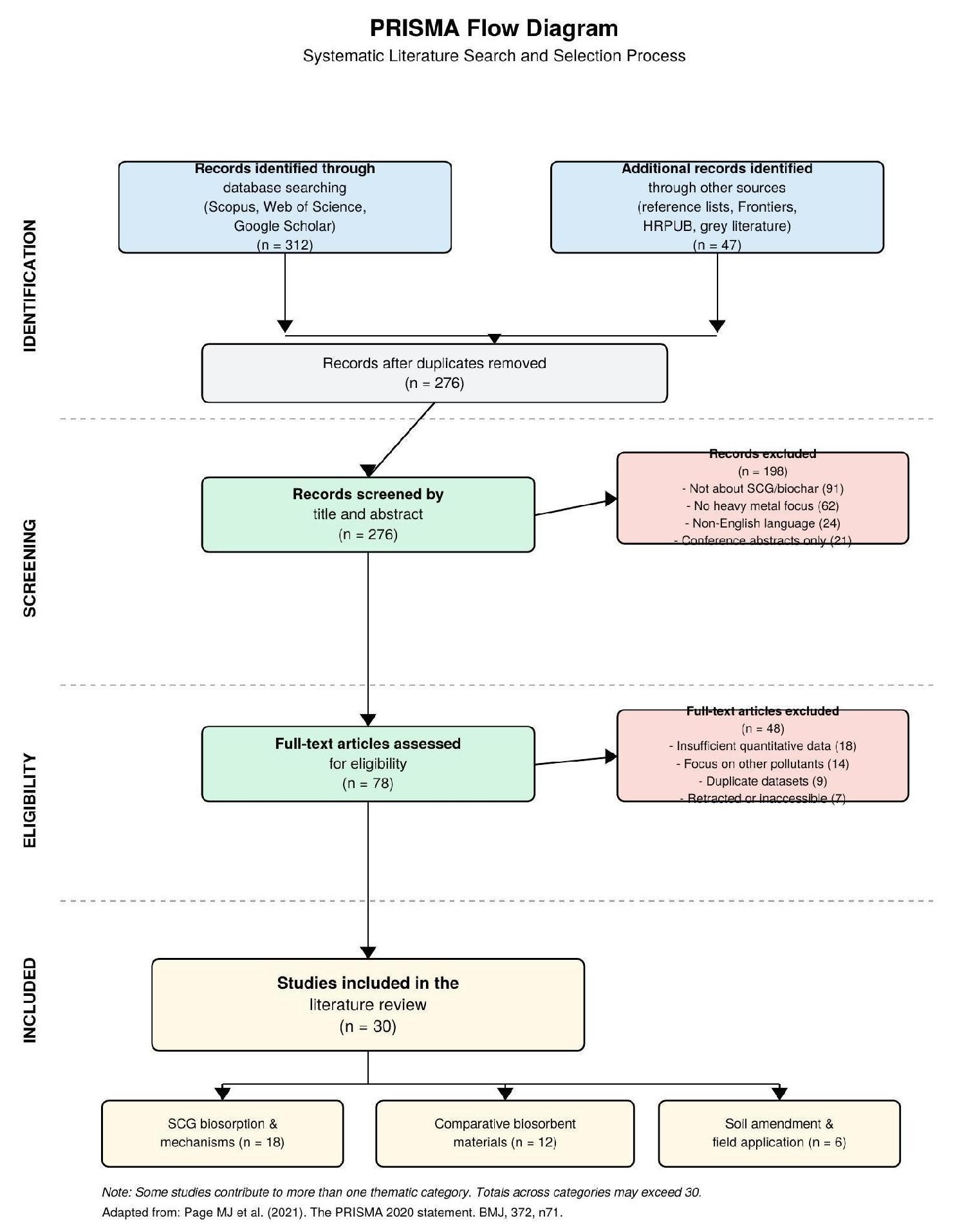
I searched Scopus, Web of Science and Google Scholar between September 2024 and January 2025. I combined terms for the material, such as “spent coffee grounds,” “SCG” and “coffee biochar,” with terms for heavy metals, adsorption, water treatment and soil remediation. I did not set a date limit, although most results were published between 2003 and 2025.
The database searches returned 312 records. I found another 47 by checking the reference lists of key reviews and looking at other sources, including the Frontiers in Environmental Science review series (2022), the HRPUB compendium on waste-derived adsorbents (2022), and a 2025 preprint on recycled coffee grounds. After removing 83 duplicates, 276 records remained.
I first screened their titles and abstracts. I excluded studies that did not use spent coffee grounds or coffee-derived biochar as the main adsorbent, did not examine heavy metals, were not in English, or were conference abstracts without a full article. This removed 198 records, leaving 78 articles for full-text review.
For the full-text review, I included studies that reported numerical results for metal removal, adsorption capacity or reduced metal bioavailability. I excluded articles focused mainly on dyes or pharmaceuticals, studies with data repeated in another publication, and articles that were inaccessible or retracted. This removed another 48 articles, leaving 30 studies.
I grouped the 30 studies by topic, with some studies fitting into more than one group: 18 examined how spent coffee grounds adsorb metals and how well they perform, 12 compared them with other biosorbents, and 6 looked at their use in soil or field settings. Figure 1 shows the selection process in a PRISMA flow diagram.
Material Categories and Preparation
A recurring problem in research on spent coffee grounds (SCG) is that studies often use the same name for materials prepared in very different ways. Grounds taken straight from a coffee machine are different from grounds that have been washed, treated with chemicals, heated to make biochar, or coated with iron oxide. These steps change the surface of the material and its pores, which affects how it removes metals from water (Anastopoulos et al., 2023; López et al., 2021). If the materials are grouped together, an “optimal” condition found for one type of SCG might be wrongly applied to another.
In this review, I separate SCG into five categories. Raw SCG are dried after brewing but receive no other treatment. Washed or defatted SCG are rinsed with hot water or treated with solvents to remove some of the oils, caffeine and other soluble compounds. Chemically treated SCG are washed with acids such as HCl or HNO₃, or treated with NaOH, to change their surface properties. Pyrolyzed SCG, also called SCG biochar, are heated to around 300–700 °C with limited oxygen. This removes many organic compounds and can increase porosity. Magnetically modified SCG are coated with iron oxide particles, usually magnetite (Fe₃O₄), so they can be removed with a magnet after treatment (Anastopoulos et al., 2023).
Raw SCG can release caffeine, polyphenols and tannins into water, and these compounds can also affect plant growth. This is why many studies wash the grounds before using them. Pyrolysis removes many of these compounds, but it uses energy and, if poorly controlled, may produce polycyclic aromatic hydrocarbons (PAHs). Biochar often removes more metal than raw SCG, although making it takes more processing. Whenever I discuss “optimal conditions,” I specify which type of SCG the finding applies to.
Mechanisms of Heavy Metal Removal
SCG removes heavy metals from solution through several overlapping mechanisms. The dominant ones, according to the studies reviewed, are ion exchange, chelation (inner-sphere complexation), and outer-sphere surface complexation. The relative contribution of each depends on the material category, the metal in question, and the solution chemistry.
Ion Exchange
Ion exchange happens when metal ions such as Pb²⁺, Cd²⁺ and Cu²⁺ replace other ions, including H⁺, Ca²⁺, Mg²⁺, K⁺ and Na⁺, attached to groups on the surface of spent coffee grounds (SCG). The metal ions bind to negatively charged groups, mainly carboxyl (–COO⁻) groups, while the displaced ions enter the water. Studies report ion exchange for different forms of SCG, although chemically treated SCG and biochar can have more accessible sites for metals to bind to (Kim et al., 2014; Davila-Guzman et al., 2018).
Other biological materials can also bind metals through groups on their surfaces. These include maize cob and husk, sunflower stalk, cassava waste, wool, rice husk, waste tea, and microbial and algal biomass (Igwe & Abia, 2006; Gang & Weixing, 1998; Abia et al., 2003; Dakiky et al., 2002; Ahluwalia & Goyal, 2005; Mustapha & Halimoon, 2015; Ansari et al., 2011; Davis et al., 2003). Many can be used after cleaning or chemical treatment. SCG may also need washing because compounds left over from brewing, such as caffeine and polyphenols, could enter the treated water or affect its use in soil. Grinding the material can expose more surface for adsorption.
It is difficult to tell how much metal removal comes from ion exchange alone. In outer-sphere adsorption, a metal ion is held near the surface by electrostatic attraction while retaining its surrounding water molecules. In surface complexation, it bonds directly to a surface group. Some studies describe removal as “ion exchange” without enough evidence to separate these processes. FTIR and XPS results can help investigate the bonds, but they do not always establish one mechanism on their own.
Chelation and Surface Complexation
SCG can also bind metal ions directly through groups on its surface. Chelation occurs when two or more donor atoms bind the same metal ion in a ring-shaped arrangement. Surface complexation also involves direct bonding, but does not necessarily form a ring. These bonds can hold metals more strongly than electrostatic attraction alone, although this does not mean the metals cannot be released again.
Adsorption often increases as pH rises towards 4–6 because more carboxyl groups lose H⁺ and become available to bind metal ions. Hydroxyl groups do not necessarily become deprotonated across that range. A change in adsorption with pH therefore cannot, by itself, show whether chelation or another mechanism occurred. FTIR peak shifts and XPS data can provide supporting evidence, but only some of the reviewed studies include this characterisation (Anastopoulos et al., 2023; Kim et al., 2021).
Comparative Performance Across Biosorbent Materials
Table 1 compares the cost, removal efficiency, and application context of SCG against other commonly studied low-cost biosorbents. The data are drawn from the studies cited in the table caption. These comparisons should be interpreted with caution: different studies used different metal concentrations, pH levels, particle sizes, and contact times, so direct equivalence cannot be assumed. What the table does show is that SCG fall in the upper range of performance among waste-derived biosorbents and are among the cheapest to obtain.
| Material | Approx. Cost (USD/kg, 2025) | Efficiency (% Removal; Key Metals) | Notes on Application |
|---|---|---|---|
| Spent Coffee Grounds | 0.20-0.50 | 75-100% (Cr, Cu, Pb) | Effective in soil amendment; reduces metal bioavailability by 50-80%. |
| Maize Cob/Husk | 0.10-0.25 | 80-99% (Ni, Cr, Pb) | High capacity in wastewater; 95% Pb removal in batch systems. |
| Sunflower Stalk | 0.05-0.15 | 60-70% (Pb, Cd, Zn) | Phytoremediation focus; limited in multi-metal mixes but economical for soil. |
| Alfalfa (Medicago sativa) | 0.15-0.20 | 70-95% (Ni, Cr, V) | Strong in soil phytoremediation; up to 99% Cr in treated fibers. |
| Cassava Waste | 0.05-0.10 | 80-99% (Cu, Zn, Cr) | Excellent in packed columns; 83% average multi-metal removal. |
| Wool | 8.00-10.00 | 90-99% (Zn, Cu, Pb) | Superior in filters; 95% Zn in 3 hours, but higher cost limits scalability. |
| Rice Husk | 0.09-0.15 | 86-98% (Pb, Cr, Ni) | Versatile for wastewater; 93% at 50 ppm with modifications. |
| Waste Tea Leaves | 0.20-0.50 | 78-97% (Pb, Ni, Cd) | Rapid adsorption; 96% Pb in batch tests. |
| Fungal Biomass | 2.00-5.00 | 80-94% (Cr, Pb, multi-metals) | Broad-spectrum in soil/water; 94% Cr in 6 months. |
| Bacterial Biomass | 1.00-3.00 | 70-91% (Fe, Cd, Pb) | Fast kinetics; 77% in 10 min with magnetotactic strains. |
| Algal Biomass | 1.00-1.50 | 85-95% (Cu, Zn, Cr) | Eco-friendly for wastewater; up to 94% in symbiotic systems. |
Conditions Affecting Removal Performance
While ‘chemical’ considerations such as pH and mechanism of complexation for bioremediation are undoubtedly important, the ‘chemical engineering’ considerations such as temperature, contact time, particle size, initial metal concentration, and adsorbent dosage are at least equally important, if not more so, when determining whether a given SCG material actually works in practice, and how effectively it does so. This section reviews each factor with reference to the specific material categories and studies involved.
pH
Almost all reviewed studies report an optimal range of pH 4 to 6 for Pb2+, Cu2+, Cd2+, and Zn2+15,1,2. Below pH 3, excess H+ ions compete for the same binding sites and removal drops sharply. Above pH 7, metals begin forming hydroxide precipitates on their own, making it impossible to distinguish genuine adsorption from chemical precipitation. In the pH 4 to 6 range, carboxyl and hydroxyl groups are deprotonated and negatively charged, giving the strongest electrostatic and coordinative attraction to heavy metal cations.
An obvious question may be that if raising pH above 7 precipitates the metals anyway, why bother with SCG? Chemical precipitation requires adding bases such as NaOH or lime which generates large volumes of hazardous sludge needing expensive disposal and can make water or soil too alkaline for plants or aquatic life. Chemical precipitation is also ineffective at the low metal concentrations common in real contaminated sites, and it risks redissolving precipitates if pH shifts back down. SCG biosorption operates at a pH compatible with life and without additional chemicals which drastically alter the overall environment. SCG is also selective for multiple metals simultaneously, and allows regeneration and reuse15,1.
Temperature
Temperature has a positive but modest effect in the range of 25 to 40 ˚C16,17. Warmer temperatures enhance ion diffusion into SCG pores and generally slightly open the material’s structure, exposing more binding sites. Above 50 ˚C, returns diminish. Most practical applications operate at room temperature to 40 ˚C, which is convenient since it eliminates the need for heating infrastructure and reduces the power consumption associated with SCG remediation.
Contact Time and Particle Size
Contact time and particle size are closely linked. With finely ground SCG (< 0.5 mm) at the right pH, equilibrium is typically reached within 30 to 120 minutes and more than 90% of Pb2+ or Cu2+ can be removed18,5. Coarser particles (> 2 mm) can take 6 to 24 hours for the same result. Contact time refers to how long the SCG remains in contact with the contaminated water or soil slurry. If the contact time is too short, many binding sites remain unoccupied, while if the contact time is too long, the overall process is inefficient, since equilibrium was reached earlier on.
Particle size effects are well documented. Kim et al. (2014) showed that particles below 0.5 mm reach adsorption equilibrium in 10 to 30 minutes versus 2 to 6 hours for particles above 2 mm. Liang et al. (2022) found that 0.25 mm SCG removed 98% of Pb2+ in 30 minutes, compared to 62% for 2 mm particles; the pseudo-second-order rate constant increased 7.4-fold when particle size dropped from 1.18 to 0.25 mm. Dave et al. (2023) reported capacity increasing from 34.2 mg Pb2+/g at 1 to 2 mm to 61.8 mg/g below 0.3 mm. Azouaou et al. (2023) found the 0.1 to 0.5 mm fraction gave 38.7 mg Pb2+/g versus 21 mg/g for raw coarse SCG.
However, fine particles cause problems in column systems: higher pressure drop (the resistance to flow increases as voids between particles shrink), difficulty in solid-liquid separation after batch treatment, increased leaching of caffeine and tannins from incompletely treated SCG, and dust handling become issues at column-scale systems. Joo et al. (2016) showed that 0.3 to 0.5 mm SCG delayed Pb2+ breakthrough in fixed-bed columns by 3.2 times compared to 1 to 2 mm particles, but at the cost of significantly higher pressure requirements.
Initial Metal Concentration and Dosage
Higher starting concentrations provide a bigger thermodynamic driving force, so initial uptake rates are faster. However, the percentage removed drops because binding sites are finite2. The adsorption capacity (mg metal per g SCG) rises with concentration until saturation, then levels off. Most reviewed studies worked in the 50 to 200 mg/L range for water treatment applications. At adsorbent dosages of 1 to 2 g/L, removal efficiencies above 90% were commonly reported.
| Paper/Factor | Raw or processed SCG | pH range studied | Optimum pH found | Optimum temperature | Contact time | Particle size | Metal concentration | Batch vs. flow setup | Synthetic vs. real water/soil |
|---|---|---|---|---|---|---|---|---|---|
| Oyekola et al. (2022) | Pyrolyzed (biochar) | pH 2-8 | pH 4-6 | 25 C (room temp.) | 30-120 min | <0.5 mm | 50-200 mg/L | Batch | Synthetic (single-metal) + real contaminated soil (pot trial) |
| Azouaou et al. (2019) | Washed / defatted | pH 2-8 | pH 5.0 | 25 C | 90 min | Not specified | Cd: 10-100 mg/L | Batch | Synthetic (single-metal) |
| Davila-Guzman et al. (2018) | Raw and washed | pH 3-7 | pH 4.5-5.5 | 25 C | 60-120 min | Not specified | Cu: 50-200 mg/L | Batch | Synthetic (single-metal) |
| Kim et al. (2014) | Raw and pyrolyzed | pH 4-6 (soil native) | pH 5.0 (soil) | 25 C | 30 days (soil equilibration); 10-30 min (batch) | <0.5 mm vs. >2 mm tested | Pb, Cu, Zn in contaminated soil | Batch + soil pot trial | Synthetic (batch) + real contaminated soil (multi-metal) |
| Kim et al. (2021) | Pyrolyzed and raw | pH 4-6 | pH 5.0 | 25, 35, 45, 55 C tested | 60-120 min | <0.5 mm | Cu: 50-200 mg/L | Batch | Synthetic (single-metal) |
| Lobo et al. (2022) | Chemically treated (acid-washed) | pH 4-6 | pH 5.0 | 20-60 C tested; best 25-40 C | 60-120 min | Not specified | Pb, Cd: 50-100 mg/L | Batch | Synthetic (single-metal) |
| Liang et al. (2022) | Washed | pH 5.0 (fixed) | pH 5.0 | 25 C | 30 min | 0.25, 0.5, 1.18, 2 mm fractions tested | Pb: 100 mg/L | Batch | Synthetic (single-metal) |
| Dave et al. (2023) | Chemically treated | pH 5.0 (fixed) | pH 5.0 | 25 C | 60-120 min | <0.3, 0.3-1, 1-2 mm tested | Pb: 100 mg/L | Batch | Synthetic (single-metal) |
| Azouaou et al. (2023) | Raw (ground fractions) | pH 5.0 (fixed) | pH 5.0 | 25 C | 60-90 min | 0.1-0.5 mm vs. coarse raw | Pb: 100 mg/L | Batch | Synthetic (single-metal) |
| Jutakridsada et al. (2022) | Pyrolyzed (biochar) | pH 5.0 (fixed) | pH 5.0 | 25 C | 5 min to 24 h; equilibrium 90-120 min | <0.5 mm | Cu, Pb: 50-200 mg/L | Batch | Synthetic (single-metal) |
| Park et al. (2020) | Pyrolyzed (biochar) | pH 4-6 (soil native) | pH 5.0 (soil) | 25 C (greenhouse) | 30-120 min (batch); weeks (soil) | <0.5 mm | Pb, Cd, Cu in contaminated soil | Batch + soil pot trial | Synthetic (batch) + real contaminated soil (multi-metal) |
| Wu et al. (2016) | Raw and acid-washed | pH 5.0 (fixed) | pH 5.0 | 25 C | 90 min | <0.5 mm | Pb: 100 mg/L | Batch (regeneration study, 5 cycles) | Synthetic (single-metal) |
| Anastopoulos et al. (2023) | Magnetically modified (Fe3O4-coated) | pH 4-6 | pH 5.0 | 25 C | 60-120 min | <0.5 mm | Pb, Cd: 50-200 mg/L | Batch (regeneration study, 4-8 cycles) | Synthetic (single-metal) |
| Lopez et al. (2021) | Chemically treated (acid/alkali) | pH 3-7 | pH 4.5-5.5 | 25 C | 60-120 min | Not specified | Cr(VI): 50-100 mg/L | Batch | Synthetic (single-metal) |
| Joo et al. (2016) | Raw (ground) | pH 5.0 (fixed) | pH 5.0 | 25 C | Continuous flow | 0.3-0.5 mm vs. 1-2 mm | Pb: 50 mg/L | Fixed-bed column (flow) | Synthetic (single-metal) |
| Isa and Jamil (2022) | Raw (washed) | pH 5.0 (fixed) | pH 5.0 | 25 C | 90 min (shaken at 120 rpm) | Not specified | Multiple metals, 100 mg/L | Batch | Synthetic |
| Liu et al. (2022) | MOF-coated / NADES-modified | pH 4-6 | pH 5.0 | 25 C | 60-120 min | <0.5 mm | Pb, Cd: 50-200 mg/L | Batch (regeneration, up to 10 cycles) | Synthetic (single-metal) |
Mildly acidic pH (around 5.0) consistently emerges as optimum, deprotonating carboxyl and hydroxyl groups on SCG to favour metal cation binding while avoiding hydroxide precipitation at higher pH. Room temperature (25 °C) is sufficient in most studies, with Lobo et al. (2022) showing best performance across a 25–40 °C window and diminishing returns above this range. Contact times of 60–120 min achieve equilibrium for fine particles (< 0.5 mm), with Liang et al. (2022) and Jutakridsada et al. (2022) demonstrating that smaller particle fractions reach equilibrium faster due to greater accessible surface area. Metal concentrations tested span 10–200 mg/L, covering realistic contamination ranges for Pb, Cu, Cd, Zn, and Cr(VI). Processing and modification strategies — pyrolysis to biochar15,4,16,5,18, acid/alkali washing19,17,20,21, magnetic Fe₃O₄ coating for post-treatment recovery3, and MOF/NADES functionalisation22 — consistently outperform untreated SCG and improve practical recoverability and regeneration performance over multiple cycles. Most studies use synthetic single-metal solutions; Kim et al. (2014) and Park et al. (2020) extend to multi-metal contaminated soil pot trials, and Joo et al. (2016) provides the only fixed-bed column validation.
Modifications
Coating spent coffee grounds (SCG) with magnetite particles allows them to be collected with a magnet after use. The coating may also improve Pb²⁺ and Cd²⁺ removal by adding binding sites on the iron oxide surface. The reported increase of 20–50% depends on the material and test conditions, so it should not be treated as a general result (Anastopoulos et al., 2023). Acid treatment, alkali treatment and pyrolysis also change the properties of SCG. Results for one modified material cannot be assumed to apply to raw or washed grounds (López et al., 2021).
| Factor | Optimal Conditions | Key Results (Efficiency/Capacity) |
|---|---|---|
| pH | 4-6 | 70-98% removal; e.g., 78% for Cu at pH 6 (39.1 mg/g) |
| Temperature | 25-40 °C | 60-91% removal; e.g., 88-91% for Cu at 25 °C |
| Contact Time | 30-120 min (fine particles) | 80-98% removal; e.g., 91% for Cu at 90 min (45.5 mg/g) |
| Particle Size | <0.5 mm | 62-98% removal; e.g., 97% for Cu with <200 µm |
| Initial Concentration | 50-200 mg/L | 41-91% removal; e.g., 37 mg/g for Cu at 90 mg/L |
| Adsorbent Dosage | 1-2 g/L | 60-98.8% removal; e.g., 98.8% for Cd at 1 g/L |
| Modifications | Pyrolysis, acid, magnetic | 44-97% removal; e.g., 98.8% for Cd with alginate beads |
Removal often improves as pH rises towards 4–6 because more carboxyl groups become available to bind metal ions. Smaller particles expose more surface and may need less contact time. Increasing the SCG dosage can increase the percentage of metal removed, though it does not necessarily increase the amount removed per gram. Temperature, treatment and magnetic coating can also affect the result, but their effects depend on the material being tested.
The ranges in Table 3 are useful starting points, rather than one set of optimal conditions for every form of SCG. Most come from batch experiments using a single metal in a prepared solution. In real wastewater or contaminated soil, other ions and organic matter can compete for binding sites, while buffering can change the pH. Removal may therefore be lower than the values reported in the table.
Post-Adsorption Management
Once SCG have adsorbed heavy metals, the material itself becomes contaminated. Treatment of these contaminated materials depends on whether the application is for water treatment or soil amendment.
In water treatment, the metal-loaded SCG is separated from solution by filtration or centrifugation. Isa and Jamil (2022) describe a typical procedure: 0.1 g SCG in 100 mL solution, shaken at 120 rpm for 90 minutes, then filtered through Whatman No. 42 filter paper. In soil treatment, the SCG typically remains in place as a permanent amendment. Kim et al. (2014) applied SCG at 2, 5, and 10% w/w, mixed into contaminated soil and equilibrated for 30 days at 25 degrees C with 60% water holding capacity, without any separation step.
For water treatment applications, there are two paths: disposal or regeneration. Disposal options include landfill (if the loaded SCG passes leaching tests such as TCLP (toxicity characteristic leaching procedure), incineration under controlled emission conditions (noting that some heavy metals can volatilize, as discussed by Yu et al., 2004), or immobilization in cement19. Landfilling adds to waste volume and incineration requires expensive emission controls; therefore neither of them would be ideal for SCG post-treatment.
Regeneration is the more sustainable and more studied option. Washing the metal-loaded SCG with strong acid (0.1 to 1 M HCl, HNO3, or H2SO4) or chelating agents such as EDTA reprotonates functional groups and pushes heavy metals back into solution. Wu et al. (2016) showed five cycles with only about 15% loss in Pb2+ removal using 0.5 M HCl. Kim et al. (2021) achieved six cycles retaining 82% of initial Cu2+ capacity. Azouaou et al. (2010) and Jutakridsada et al. (2022) both reported 3 to 5 cycles with 70 to 85% of original capacity for raw or pyrolyzed SCG. Magnetically modified SCG can go 4 to 8 cycles with more than 80% capacity intact, because the iron oxide layer protects the structure during acid washing3,19.
Newer approaches include natural deep eutectic solvents (NADES) and metal-organic framework (MOF) coatings, which can boost original adsorption capacity by 30 to 100% and allow up to 10 or more cycles while converting desorbed metals into less toxic forms3,22. The concentrated metal solution from regeneration still requires its own treatment, usually precipitation or electrowinning, but the SCG itself is recycled, making the process more circular.
One environmental dimension that the literature largely ignores is the energy cost of regeneration, the chemical inputs required, the transport logistics of collecting SCG from dispersed sources, and the carbon footprint of pyrolysis. A full life-cycle assessment of SCG-based remediation has not been published as of this writing. This is a gap worth closing, because the sustainability argument for SCG depends partly on whether the processing overhead cancels out the waste-valorization benefit.
Discussion
The studies reviewed suggest that spent coffee grounds (SCG) can remove heavy metals from water, and that treated SCG can sometimes perform as well as other low-cost biosorbents. Ion exchange and surface binding help explain how this happens. Some studies report removal of 90–98%, but these figures come from particular materials and carefully controlled conditions. They should not be taken as the performance of SCG in general.
Most high removal rates come from batch experiments with one metal dissolved in prepared water at an adjusted pH. Real wastewater contains other ions, organic matter and particles that can compete for binding sites or cover the SCG surface. Soil is harder to assess because the aim is usually to reduce how much metal plants take up, rather than remove the metal from the soil altogether. The soil studies reviewed report reductions in plant metal uptake, but mainly from controlled pot trials. There is still little field evidence (Kim et al., 2014; Park et al., 2020; Oyekola et al., 2022).
SCG may also have a lower adsorption capacity than activated carbon or synthetic resins, particularly in systems that need to treat water continuously. Used coffee grounds are cheap to obtain, but collecting, preparing and separating them after use still costs money. A fair cost comparison would need to include these steps, along with what happens to the grounds once they contain heavy metals.
Safety is another issue. Washing or pyrolysis may remove compounds that affect plant growth, but neither step makes SCG automatically safe. Pyrolysis conditions can affect whether polycyclic aromatic hydrocarbons (PAHs) form. Organic compounds released from SCG could also increase metal movement through some soils. SCG contain nutrients such as potassium, nitrogen and phosphorus, although how available these are to plants depends on the treatment used. Germination tests, plant growth measurements and tests of metals in soil porewater would help assess the effects in each setting. Few of the reviewed studies provide all of this evidence (Park et al., 2011).
There are practical limits too. Fine SCG particles can clog filtration columns and are difficult to separate from water after batch treatment. Acid regeneration may reduce their performance over repeated uses. The grounds themselves vary with the coffee and brewing method, making it difficult to prepare a consistent material. More work is needed on preparation methods, repeated use, real wastewater, field trials and total costs before larger-scale use can be assessed.
Small-scale use may be easier to test first, especially where coffee grounds are available locally. Studies of SCG biochar mixed into soil offer a possible starting point, but a rate such as 2–5% should not be recommended for a garden without testing the soil, the biochar and the plants grown there (Park et al., 2020; Oyekola et al., 2022). SCG-packed water filters also need testing with real water, including whether the treated water meets the standards for its intended use.
Conclusion
Spent coffee grounds, across the material categories reviewed here, show consistent ability to remove Pb2+, Cd2+, Cu2+, and Zn2+ from water and soil under laboratory conditions. They outperform many other waste-derived biosorbents in both capacity and speed23,19,24. Acid regeneration allows reuse over multiple cycles, and magnetic modification extends both capacity and practical recoverability3,21,16.
Though, most of this evidence comes from small batch, single metal solution experiments. The movement from laboratories to real fields would be significant, and there is no data or literature on how the current SCG technology would translate in the real world. Standardized preparation protocols pegged to feedstock characterization, pilot-scale trials in real contaminated sites, regulatory-grade leaching and ecotoxicity testing, and lifecycle cost analyses that include collection, transport, processing, and disposal of spent adsorbent are all needed. Until that work is done, the strong claims about SCG as a “practical solution” remain conditional.
We can see that the sheer volume of material is not a concern, as over ten million tonnes of SCG are generated annually25, and almost all of it is wasted. Even if the remediation application captures only a fraction of that supply, the cost and environmental logic of turning coffee waste into a functional adsorbent is a promising strategy. It is definite that SCGs can remediate heavy metals, but it is necessary to facilitate the technical engineering and regulatory work needed to move the technology from the laboratory to a deployed tool in the real world.
References
- Azouaou, N.; Sadaoui, Z.; Djaafri, A.; Mokaddem, H. Adsorption of Cadmium from Aqueous Solution onto Untreated Coffee Grounds: Equilibrium, Kinetics and Thermodynamics. Sep. Purif. Technol. 2010. [↩] [↩] [↩]
- Davila-Guzman, N. E.; Cerino-Córdova, F. J.; Soto-Regalado, E.; et al. Equilibrium and Kinetic Studies of Lead Adsorption on Spent Coffee Grounds. Chem. Eng. Commun. 2018. [↩] [↩] [↩]
- Anastopoulos, I.; Pashalidis, I.; Hosseini-Bandegharaei, A.; et al. Magnetically Modified Spent Coffee Grounds for the Removal of Heavy Metals from Aqueous Solutions: A Review. J. Mol. Liq. 2023. [↩] [↩] [↩] [↩] [↩]
- Kim, Min-Suk, et al. The Effectiveness of Spent Coffee Grounds and Its Biochar on the Amelioration of Heavy Metals-Contaminated Water and Soil Using Chemical and Biological Assessments. J. Environ. Manage. 2014, 146, 124–130. [↩] [↩]
- Park, J.; Kim, J.-Y.; Kim, M.-S.; et al. Spent Coffee Grounds as a Soil Amendment for Immobilization of Heavy Metals in Contaminated Soil. Environ. Geochem. Health 2020. [↩] [↩] [↩]
- Igwe, J. C.; Abia, A. A. A Bioseparation Process for Removing Heavy Metals from Waste Water Using Biosorbents. Afr. J. Biotechnol. 2006, 5 (12), 1167–1179. (Maize cob/husk adsorption.). [↩]
- Gang, S.; Weixing, S. Sunflower Stalks as Adsorbents for the Removal of Metal Ions from Wastewater. Ind. Eng. Chem. Res. 1998, 37 (4), 1324–1328. [↩]
- Dhankhar, R.; Hooda, A. Fungal Biosorption—An Alternative to Meet the Challenges of Heavy Metal Pollution in Aqueous Solutions. Environ. Technol. 2011, 32 (5–6), 467–491. [↩] [↩]
- Abia, A. A.; Horsfall, M., Jr.; Didi, O. The Use of Chemically Modified and Unmodified Cassava Waste for the Removal of Cd, Cu and Zn Ions from Aqueous Solution. Bioresour. Technol. 2003, 90 (3), 345–348. [↩]
- Dakiky, M.; Khamis, M.; Manassra, A.; Mer’eb, M. Selective Adsorption of Chromium(VI) in Industrial Wastewater Using Low-Cost Abundantly Available Adsorbents. Adv. Environ. Res. 2002, 6 (4), 533–540. [↩]
- Ahluwalia, S. S.; Goyal, D. Removal of Heavy Metals by Waste Tea Leaves from Aqueous Solution. Eng. Life Sci. 2005, 5 (2), 158–162. [↩]
- Mustapha, M. U.; Halimoon, N. Microorganisms and Biosorption of Heavy Metals in the Environment: A Review Paper. J. Microb. Biochem. Technol. 2015, 7 (5), 253–256. [↩]
- Davis, T. A.; Volesky, B.; Mucci, A. A Review of the Biochemistry of Heavy Metal Biosorption by Brown Algae. Water Res. 2003, 37 (18), 4311–4330. [↩]
- Ansari, M. I.; Malik, A.; Masood, F. Bacterial Biosorption: A Technique for Remediation of Heavy Metals. In Microbes and Microbial Technology: Agricultural and Environmental Applications; Ahmad, I., Ahmad, F., Pichtel, J., Eds.; Springer: New York, NY, 2011; pp 283–319. [↩]
- Oyekola, O.; Ntwampe, S. K. O.; Mekuto, L.; et al. Modified Spent Coffee Grounds and Biochar for Remediation of Heavy-Metal Contaminated Soils. Environ. Sci. Pollut. Res. 2022. [↩] [↩] [↩]
- Kim, M.-S.; Min, H.-G.; Lee, S.-H.; Kim, J.-G. Regeneration and Reuse of Spent Coffee Grounds for Copper Adsorption from Aqueous Solution. Chemosphere 2021. [↩] [↩] [↩]
- Lobo, C.; Castellari, J.; Colman Lerner, J.; et al. Temperature Effects on Heavy Metal Adsorption by Spent Coffee Grounds. Environ. Technol. Innov. 2022. [↩] [↩]
- Jutakridsada, P.; Prajaksud, C.; Kuboonya-Aruk, L.; et al. Adsorption Kinetics of Heavy Metals on Spent Coffee Grounds and Coffee-Derived Biochar. J. Mater. Cycles Waste Manag. 2022. [↩] [↩]
- Dave, A.; Patel, R.; Shah, M. Comparative Adsorption Study of Heavy Metals on Modified Spent Coffee Grounds. RSC Adv. 2023, 13, 22145. [↩] [↩] [↩] [↩]
- López, F.; Díaz, M.; García, J. Assessment of Untreated Coffee Wastes for the Removal of Chromium from Aqueous Solution. J. Environ. Chem. Eng. 2021. [↩]
- Wu, Y.; Zhang, L.; Wang, J.; et al. Regeneration of Spent Coffee Grounds for Heavy Metal Adsorption over Multiple Cycles. J. Environ. Manage. 2016. [↩] [↩]
- Liu, X.; Wang, H.; Chen, Z.; et al. NADES- and MOF-Modified Spent Coffee Grounds for Advanced Heavy Metal Adsorption. Chem. Eng. J. 2022, 446, 137215. [↩] [↩]
- Liang, J.; Li, Y.; Zhang, Q.; et al. Effect of Particle Size and Acid Modification on Lead Removal by Spent Coffee Grounds. ACS Omega 2022, 7, 17788–17798. [↩]
- Azouaou, N.; Belmedani, M.; Sadaoui, Z. Effect of Particle Size on Lead Adsorption onto Spent Coffee Grounds. Egyptian Journal of Chemistry 2023, 66 (1), 145–157. [↩]
- Campos-Vega, R.; Loarca-Piña, G.; Vergara-Castañeda, H. A.; Oomah, B. D. Spent Coffee Grounds: A Review on Current Research and Future Prospects. Trends Food Sci. Technol. 2015, 45 (1), 24–36. [↩]